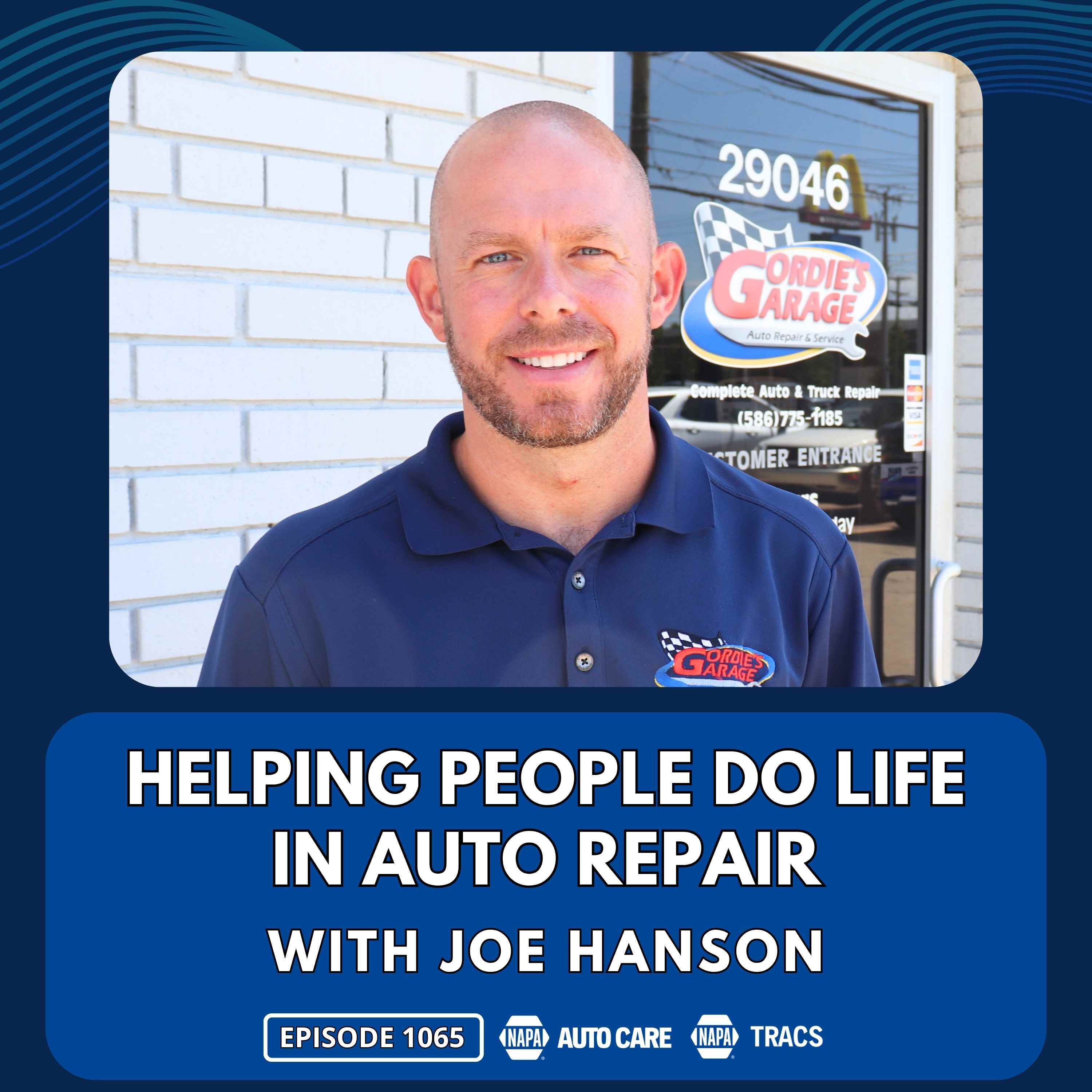
Joe Hansen discusses the philosophy behind Gordy's Auto Entire, emphasizing the importance of helping people do life through automotive repair. He shares insights on the technician shortage and the innovative Napa AutoCare apprentice program designed to cultivate new talent. The conversation touches on the growth of the business, including the expansion of services like fleet work and tire sales, while maintaining a focus on customer experience and building a supportive work culture. Joe reflects on the personal fulfillment derived from serving both customers and employees, highlighting the dual mission of helping people both externally and internally.
In this fireside conversation, Joe Hanson of Gordie’s Auto and Tire shares how a clear purpose—“Helping people do life”—guides every part of the business. This mission shapes both the customer experience and the culture within the shop, ensuring the team feels supported, valued, and equipped to build meaningful careers.
Joe walks through the realities of growing the business, from navigating permits and environmental requirements to expanding fleet services and managing tire sales intentionally. Issues such as leadership team dynamics, marketing, and phone call audits are management problems—they are never permanently "fixed," but instead require continuous coaching and management. He also emphasizes the importance of communication, setting clear expectations, and educating customers about the complexity of modern testing and ADAS calibration—not just “plugging in a scanner.”
Joe remains committed to the work for as long as it’s meaningful—and rooted in helping people, not just chasing revenue.
"...after that second store I acquired, they did a little fleet. Or the third store did a little fleet..."
Fleet sales happen when companies buy many cars at once instead of just one. This is usually cheaper for them because they are buying in bulk.
Fleet sales refer to the sale of multiple vehicles to businesses or organizations, rather than individual consumers. This can include cars, trucks, or vans used for company purposes, often at a discounted rate due to the volume of the purchase.
"...Let's talk about tires. I know you're big in that. And again, I think that was another major evolution..."
Tires are the round rubber parts of a car that touch the road. They help the car move and stay stable while driving.
Tires are essential components of a vehicle that provide traction, support the weight of the vehicle, and absorb shocks from the road. They come in various types and sizes, depending on the vehicle and its intended use.
"I'm in here for, you know, a five or six hundred dollar brake job."
A brake job is when a mechanic fixes or replaces parts of your car's brakes. This is important to make sure your car can stop safely.
A brake job typically involves replacing or repairing the components of a vehicle's braking system, such as brake pads, rotors, and calipers. It's essential for maintaining safe stopping power in a vehicle.
"Are they taking the financing option that you offer? For sure."
A financing option is a way to pay for something in smaller amounts over time instead of paying everything at once. It can help if you can't afford to pay for something big right away.
A financing option allows customers to pay for services or products over time rather than all at once. This can help manage larger expenses, such as car repairs or new tires, by breaking them into smaller, more manageable payments.
"You know, you get to have a little bit of a die ag. People will say, I don't want to pay for the diagnostics of the testing."
Diagnostics is like a check-up for your car, where mechanics find out what's wrong by testing different parts.
Diagnostics refers to the process of identifying the cause of a vehicle's problem, often through specialized testing and analysis. This can involve checking various systems and components to pinpoint issues.
"And then they come back. We had one today with the thermostat."
The thermostat helps keep your car's engine at the right temperature by controlling how coolant flows through it. If it doesn't work, your engine can get too hot.
The thermostat is a critical component in a vehicle's cooling system that regulates the engine temperature by controlling the flow of coolant. If it fails, it can lead to overheating or poor engine performance.
"It was a head gasket. You know, a customer left one to a competitor and called us back and said, you know, can I bring it in?"
The head gasket is a part of the engine that keeps everything sealed tight. It helps keep oil and coolant separate so the engine runs smoothly without overheating or leaking.
The head gasket is a critical component in an internal combustion engine that seals the cylinder head to the engine block. It prevents coolant and oil from mixing and ensures that the combustion process occurs efficiently within the cylinders.
"...instructor led Napa AutoCare classes, web-based courses, and hands-on training with a mentor."
Napa AutoCare is a group of car repair shops that help train mechanics. They focus on teaching them how to fix cars properly.
Napa AutoCare is a network of automotive repair shops that provide quality service and repairs. They offer training programs for technicians to improve their skills and knowledge in the automotive field.
"...graduates earn four ASC certifications, the G1, a 4, a 5, and air conditioning, and are officially registered with the Department of Labor..."
ASC certifications show that a mechanic knows how to fix cars well. They help mechanics get better jobs because employers trust these certifications.
ASC certifications are credentials that demonstrate a technician's expertise in various automotive repair areas. These certifications are recognized in the industry and can enhance a technician's job prospects and credibility.
"...you just sold me Ford tires. Absolutely needed an alignment..."
Ford is a well-known car company from the United States that makes many types of vehicles, including trucks and sports cars.
Ford is an American automotive manufacturer known for producing a wide range of vehicles, including cars, trucks, and SUVs. The company has a long history and is recognized for models like the Ford F-150 and Ford Mustang.
"...Absolutely needed an alignment. You can visually see that it was off..."
Alignment is when the wheels of a car are adjusted to make sure they are straight and working correctly. This helps the car drive better and the tires last longer.
An alignment refers to the adjustment of a vehicle's suspension system to ensure that the wheels are set to the correct angle. Proper alignment helps with tire wear and vehicle handling.
"...you ran it over your Hunter Lane check machine..."
Hunter Engineering makes machines that help car repair shops check and fix how the wheels are aligned. This is important for keeping cars safe and running well.
Hunter Engineering is a company that specializes in manufacturing automotive service equipment, including alignment machines and tire changers. Their equipment is widely used in auto repair shops for precise vehicle alignment and diagnostics.
"...we got to do a calibration. Whatever your price is, it just doesn't matter."
Calibration means adjusting the car's systems so they work correctly, especially after something has been fixed. It's like making sure all the tools in a toolbox are set up right before you start working.
Calibration in automotive terms often refers to the process of adjusting the settings of a vehicle's systems, such as sensors or cameras, to ensure they function correctly after repairs or replacements. This is particularly important for advanced driver-assistance systems (ADAS).
"Have you jumped into battery electric vehicles? I mean, you must be doing hybrid, right?"
Battery electric vehicles run only on electricity, using batteries instead of gasoline. They don't have a traditional engine and are better for the environment because they don't produce exhaust fumes.
Battery electric vehicles (BEVs) are powered entirely by electricity stored in batteries, without any internal combustion engine. They are known for being environmentally friendly and producing zero tailpipe emissions.
A hybrid car uses both a regular engine and an electric motor to drive. This helps save fuel and reduces pollution compared to cars that only use gasoline.
A hybrid vehicle combines an internal combustion engine with an electric motor, allowing for improved fuel efficiency and reduced emissions compared to traditional gasoline-only vehicles.
"Help. That's our number one corvette. Serve, right?"
The Chevrolet Corvette is a fast and stylish sports car made by Chevrolet. It's known for being powerful and fun to drive, and many people love it because it represents American car culture and performance.
The Chevrolet Corvette is a high-performance sports car that has been a symbol of American automotive engineering since its introduction in 1953. Known for its sleek design and powerful V8 engine, the Corvette is often celebrated for its impressive speed and handling, making it a favorite among car enthusiasts and collectors alike.
Select text to request an explanation
This is the Automotive Repair Podcast Network.
You know the technician shortage is real, but Napa AutoCare has a solution at no cost to members.
You know the Napa Tracks has on-site training plus six days a week support. It all starts when a local representative meets with you to learn about your business and how you run it.
After all, it's your shop, so it's your choice. Let us prove to you that Tracks is the single-best shop management system in the business.
Find Napa Tracks on the web at NAPATRACS.com
Hey, look, I've got Joe Hansen with me. Joe, I counted up, we did 19 episodes together in 10 years. Seriously, Joe, 19.
And you were on individually with me or panels. And it's been a while since I've had you on, so don't ask me where this came up.
In son of a gun, did I not go to your website because maybe I was thinking about you.
And I saw this great, incredible headline on your website. It says, helping people do life.
And it really moved me, Joe. I wrote to you and I said, get on. What's going on? We need an update on Gordy's Auto Entire.
We need to understand helping people do life. And Joe, I think that is such a powerful statement.
I mean, that's our whole purpose, right? And it wasn't easy coming up with that. I got to say, though, because it was like one of my coaches, we got together and we, you know, this is probably, it's got to be five, maybe six years ago, something like that.
And he's like, all right, we got to figure out what we're doing this. And I'm like, doing what? And he says, fixing cars and doing what you're doing.
And I'm like, we're doing it to fix cars. And he's like, are you though? And I'm like, yeah, right? Am I? And he's like, I don't know, are you?
I'm like, all right, I can see this is going to lead somewhere. So what are we doing here, Larry? And I got to tell you, it probably took about six months to figure out, you know, why were you're doing what were you doing?
It was quite an exercise. It was many meetings. You think it'd be simple. Just come up with why you're doing what you're doing. And, you know, why you go to work every day, but it kind of gets empty after a while, right?
So we sat down and asked me a lot of questions. He's like, you know, what gives you energy? What gives you excitement?
You know, and I'm like, well, I just like him fun. And he goes, what's that? And I go, man, I got to be honest, I watched my dad for, you know, my whole life helping everybody.
And he's like, okay. And I'm like, and I get some excited. And I got it. It does me too. I said it just literally gives me energy.
And it wasn't even about helping just necessarily with people with their cars. It's just helping in general. Like, you know, I mean, we're all wired that way, aren't we?
We go out and, you know, do something for somebody or get them out of a bind or just, just whatever it is, right?
And you just feel really good about it. And it's not even the money that gives you that energy. It's just like, wow, that was.
Joe, you're so right. Our cars help us do life.
Yes. It's amazing.
It is. And so it gets kind of down to like, why does anybody do anything, right? How does business even, it gets pretty deep.
It's like, why does business even exist? And it's to serve each other, right?
I mean, our nutritionist keeps us healthy. Our painter makes our house look good. Our doctor helps us get back to health.
Hopefully, you know, and it just so happens in mechanics, keep the wheels moving so that we can do all of those things.
The car doesn't function. It's got to check engine light on or it just doesn't feel or sound good. It complicates our life.
And when you get on to, you know, auto motor repair near me near Roseville, Michigan, or New Baltimore, or Sterling, or Chester Field.
And that website comes up. You've almost subliminally said, rest my child, come here.
Your problem is now mine. Let me just handle this for you. Yeah. Oh God. Absolutely. For locations. Yes. Currently.
When's the fifth one coming? It's looking like early spring. That's probably the most exact I can be.
Are you building or buying building? Oh, well, we're going to be adding on to our current Sterling Heights location.
We have a big truck business there. And we've always had that truck business there even way before I acquired it even.
And once I got in there, I'm like, wow, this is just some low hanging fruit. We need to take advantage of that.
And we got a phenomenal team there. And they're just, I mean, they're just great. They love the trucks.
And so we have a demand and we're turning them away left and right. So I'm like, let's build this, let's build it them.
It's been a lot of hurdles. I learned a lot. I'll tell you that through this process of building, going through environmental and city and all that.
And so yeah. Is this the first time you've actually done an addition? It is. Yes. Oh, yeah. That's the learning curve wall.
I was like, wow, there's just a lot of things, right? There's a lot of things.
Why do I need to permit to do anything? Everything. It's been almost two years in the making going through the environmental.
That was probably one of the biggest things. And then, you know, just learning all the different things.
I had no idea. But it's fun. Having fun to blast.
All right. I want this episode to be a fireside chat with Joe.
I just want to find out what's going on in your world because I believe every shop owner,
every specialist who's listening, every service advisor listening can learn something from some of the questions that I'm really curious about.
You're doing online appointments. Is it working? Yeah.
We've been doing them for a long time. They work great. I don't know how you don't do them to be honest.
I mean, it's just part of our routine. I mean, our CRM kicks out the emails that people book appointments and it's seamless.
So fleet services. You just mentioned them. Is it all you only do them at one place?
Or do you recruit fleet from everywhere and take them all to the one store?
Oh, no. We do them at all the stores. For sure. We do significant amount of fleet at all the stores.
The biggest amount of fleet we do is at our Sterling Heights store, only because it's the biggest store.
But in addition to that, that's where the large trucks are. And a lot of that is obviously fleet work.
Has this been in Gordys for years? Or did you just say one day, hey, let's do fleet?
No, I didn't really do a lot of fleet until I acquired the Sterling Heights location in 2021.
Once I got in there, I was like, what is a national account? What is this network?
It was a complete eye opener to me. Some good stuff, some bad stuff.
I mean, there's less margin on a lot of that fleet work, right? But it's consistent.
So the cash flow is there, which is super important as we all know.
My first year was a lot of learning. And then after that second store I acquired, they did a little fleet.
Or the third store did a little fleet. The first store didn't do any, but it was easy to implement that into that.
And then my first store started doing much more fleet because of that.
Let's talk about tires. I know you're big in that. And again, I think that was another major evolution in you looking at.
Hey, we're not in the tire business. Let's get in it. What percentage of your business is tires, Joe?
It's still not a lot. I thought it would be a lot easier to get a lot more.
It's probably, I would say, six to eight percent of our tire business, but of our total business is tires, but it's a significant profit center,
even though it's that small of a mob because we didn't do hardly any.
Our mechanical business has grown.
It's a lot. We've grown quite a bit, even though it's only six, eight percent, but it is growing.
You know, we click it. It was interesting because it was like, and I don't have everybody agree with this.
It's just what we're seeing through our little business.
It's just like, you get going, you get all fired up about tires, right?
And you're like, I'm going to do 30 percent tires, 30 percent labor, 30 percent mechanical.
And it's like, but that's not what we do, right? And that's not what we did.
That's not where we made our money. And that's not what we're experts at.
But why not just still a great add-on, right? So we can get to 15 percent tires, right? Let's do it.
But we're not going to do that in spite of our auto repair business serving our people the way we've served them over the years, right?
Because it does take a certain amount of real estate in the building.
It takes a certain amount of talent away from the other stuff.
And there's only so much you have of those things.
So I'm not going to jeopardize repair for tires. But at the same time, I'm still growing our tire business.
There's so much tire business that we are not taking advantage of for sure that when it's in the shop,
we're not capitalizing on all of it, but we're getting a lot better at it.
Why is it time? You want to get it done, but you've got the vehicle in for some real major service.
And now it's going to take maybe till the next day to get the tires and supply the customer.
I just saw a survey. Only 31 percent of shops are currently able to complete services within a single day.
That came from AZ and Ratchet and Rentry. I just saw that.
31 percent aren't getting services done in one day. Is that possible?
Yeah, I don't know a stat, but I just think it'll work. It's probably right.
I mean, it's right. Obviously, they have the stat. They know what they're doing.
Maybe supply chain and availability of parts, but I believe in that's a little bit of an issue still.
So it slows you down, right? Back to the tires.
I think you asked why not more.
And I'm the last one to make an excuse. It's training.
It's a matter of, I think confidence, taking a mechanical shop and turning some of them into tires, stores, right?
It's training. They're very comfortable selling everything else.
And then it gets into tires and they're like, well, and then it gets down to, like, people buy from confidence salespeople, people that they, right?
And if they're maybe they're not confident as much as they are, and not that they're not confident, but not as much as in selling the other services that they sell, people may not buy just because of that.
You know, they might go, well, you know, I'm just going to hold off on them tires.
I'm going to wait till spring. I'm going to wait till fall.
I believe it was your website is I was kind of hanging out really loving what you were doing there.
And it asks, I think I was able to walk through get a tire quote, right?
Yeah, for sure.
$1,200.
For tires?
For four tires for my car.
It happens.
I know it does. I get it. Low profile, nice and wide.
And I start to think, okay, I'm in here for, you know, a five or six hundred dollar break job.
And I need tires.
Are people financing through, they're swiping their car probably number one.
Are they taking the financing option that you offer?
For sure.
Yeah, it was good year and not Napa, the easy pay.
And we use them both.
Yeah, people very seamless, very easy.
I think it's essential for sure giving people an option.
Never like to see people have to charge things and go into debt.
But it is what it is.
They got to have a car that runs and have a safe car.
You figure you got a car, right?
Very said this to me.
Very, very.
He said this long time.
I would never forgot.
He goes, think about it.
Joe, you got a seven thousand pound missile going down the road.
Or maybe a five thousand pound missile going down the road.
And there's four square inches of rubber touching on each wheel.
And you're going down the road.
Why would people not want a tire that's going to grab him?
Like, I never thought of that way.
That's a great way to put it.
We use that on the shop all the time, you know?
Because I mean, he's right.
You think about that.
God, I haven't talked to Barry in so long.
Oh, no.
Yeah.
You know, we should do.
We should get all like four or five of us.
That used to get connected.
Yeah.
They used to hang out together all the time.
We should get us back together and do an on-air cocktail hour or something.
Oh, man.
That'd be fun.
That'd be great.
You see more price quotes of late?
People price shopping?
Yeah.
Yeah.
I don't know if it's anymore.
You've been doing this a while, right?
So everything goes like this.
But I don't care if they have a price quote.
You know, we're not.
I'm not trying to be the cheapest.
I'm not trying to.
I'm not trying to be the most expensive either.
But we're just trying to help people.
You know, we're legitimately.
Hey, how can we figure out outside of the repair?
How can we figure out how we can help this person?
Either they have to finance this or just, you know, maybe use a different part
or whatever we have to do to get them back on the road.
Safety first.
But to get them back on the road.
So yeah, we get price quotes.
We just work through its communication.
You just talk to the customer, build a relationship.
I mean, we've had plenty of times where people have, you know, gone somewhere else and came back.
So I should have just.
I should have had you guys do it.
They didn't fix the issue.
Even it's rare, but that happens, right?
Because we're going to use a good part or we were taking our time to die, you know,
to do the testing properly to give them the right answers.
You know, you get to have a little bit of a die ag.
People will say, I don't want to pay for the diagnostics of the testing.
I understand.
I don't want to pay that either.
That's not a fun thing to do.
But they go to a guest somewhere and they tell that shop what to fix or that shop maybe isn't
doing the testing.
And it seems cheaper up front.
And then they come back.
We had one today with the thermostat.
It was a head gasket.
You know, a customer left one to a competitor and called us back and said, you know,
can I bring it in?
It's still, you know, they paid the money for thermostat and wasn't that.
There's something else with the head gasket.
So people are making automotive.
I don't appreciate the word diagnostic.
You said testing.
And I love that better.
But just the solution to so many of the problems that happen.
They're not respecting the fact that it's like it was.
Well, it's going to be the points.
It's going to be the condenser.
It's going to be the plugs or maybe the wire.
It's not like that today and anymore.
And I think, I don't know.
Who do you think is dumbing down this that, you know, anybody can do this
and it should be done for cheap?
What, why is that still the moniker of what we do?
I think it's our fault.
Could you got to take responsibility for what's going on to some degree?
And I think it's sure there's other factors.
There's parts stores that diagnose them in the parking lot, test them in the park.
There's all those right.
And that's fine.
That's a different clientele.
But you know, again, it comes back to the training and talking to that customer
and the transparency and educating them on what it takes to actually find out what's wrong with that vehicle.
Letting them know, you know, it's not as simple as it looks.
And here's the thing.
Like, I've always hoped and I think anybody owns a shop.
Maybe he even had to do testing.
Wouldn't it be great if we could plug that thing in?
That everyone thinks a lot of customers think we have.
You can plug that computer in and it just tells you what's wrong.
My God, that would be the greatest thing.
If there was something like that, can you make it?
There'd be no comeback.
There'd be nothing.
You just plug it in.
Yeah, you need this, this, this.
And you just do the work and it's done, right?
And when you tell that to a client, you think you're lying to him.
Yeah, they do.
A lot of times.
Joe's just trying to charge him more.
He really does know.
I had one customer and, man, long time customer too.
And every time he comes in, I'm not paying for time.
Don't charge him with that testing.
And I finally just had to be like, well, I don't know if we're going to wear a fit
because I do have to pay these guys to do this, right?
You know, we know this scenario.
It takes time to do the testing.
And then I got to pay a guy to do that testing.
And there has to be revenue.
There has to be a margin.
There has to be profit.
Otherwise, we're not going to be here.
You know, so we just can't guess that on.
Hey, you know, it's no secret.
The automotive industry is facing a technician shortage.
But Napa AutoCare is stepped up with a powerful solution.
The Napa AutoCare apprentice program.
And the best part?
It's completely free for members.
This program was pioneered by shop owners Pete McNeil and master technician Jake Sorenson
at McNeil's AutoCare in Sandy, Utah.
They recognize that waiting for skilled technicians to appear wasn't an option.
So they built a program to grow their own.
By recruiting motivated individuals with the right passion and attitude
and providing them with structured training, they approved that apprentices
could become the next generation of skilled certified technicians.
The program features a comprehensive nine-stage curriculum
with in-depth classroom videos, instructor led Napa AutoCare classes,
web-based courses, and hands-on training with a mentor.
Apprentices move at their own pace, typically completing the program within two years,
graduates earn four ASC certifications, the G1, a 4, a 5, and air conditioning,
and are officially registered with the Department of Labor
as journey workers' automotive technicians.
And here's the business benefit.
As Apprentices gain skills, they generate billable hours,
often boosting shop profits as early as stage 5.
Plus, Napa now offers a new Apprentice Toolkit,
developed with Carlyle Tools at an exclusive price,
helping break down one of the biggest barriers for new technicians,
the cost of tools.
Together, Napa AutoCare and your shop can tackle the technician shortage head-on.
Start now, grow your own talent and build your bench for the future.
Visit member.napaautocare.com or contact your Napa representative today
and get started with your Apprentice program.
Let's face it, your shop management system is the single most important tool in your shop, period.
Napa Tracks was built from the ground up to make your business more profitable and efficient.
We provide an extensive set of tools to increase and track profitability in real time.
Napa Tracks offers the industry's best post-sale support, hands down,
and we train your people on site.
Yep, on site, and we offer remote refresher training 10 times a week
and customer support is open six days a week.
Give us a call, visit the website,
or join our Facebook community today to learn more.
We'll prove to you that Tracks is the single best shop management system in the business.
Napa Tracks is always customized and tailored for you,
whether you're a one-man shop or a large multi-bay or multi-location company,
after all, it's your shop.
So it's your choice.
Visit us on the web at Napa Tracks,
that's n-a-p-a-t-r-a-c-s, dot com.
Joe, what percentage of clients do you believe are key droppers?
I don't know if I know what percent are necessarily key droppers.
You're gut.
10 percent, 20 percent.
They just come into this here.
Joe, we've been coming here forever here, fix whatever's wrong.
Yeah, I would say 20 would be aggressive.
Okay.
I think when we were a single shop owner,
and it was just, I was on the counter,
and then my dad's running around,
and it's just like our little tiny world, right?
I think it was probably higher than,
because it was so much more personal, right?
And now it's like, I'm not everywhere.
Not that our staff isn't actually their better than me on the counter.
It's really better than me on the counter.
But it's that family relationship thing.
So a little bit, it's a little tougher to keep that.
So I think in a multi-shop world,
it might drop a little bit, right?
Not to anyone's fault.
It's just a little bit of a different feel.
Yeah, the intimacy of it.
I think when people see more than one,
they're thinking it's not family, right?
Even though we are, it's not as family, right?
But we are.
I got a question about,
you just sold me Ford tires.
Absolutely needed an alignment.
You can visually see that it was off.
You ran it over your Hunter Lane check machine,
saw that it was required.
It's a later model vehicle with a dash forward radar on it.
And you say, look, the alignment's going to be $3.99
because the alignment's $9.99.
We got to do a calibration.
Whatever your price is, it just doesn't matter.
But it's more than a typical person
would be knowing that an alignment used to cost.
Will you refuse to do the whole job
if they don't get the calibration
because they think you're beessing them
or the shop down the street who doesn't have 8S equipment
says, just bring it in.
I'll do the alignment.
Would I refuse?
I don't know that I would refuse.
I would document for sure.
I wouldn't refuse.
We have the equipment.
So, I mean, we can do it.
And we do.
Do people understand what that means
if that radar is going to be off down the road?
You have to educate them.
You have to teach them.
You know, hey, you're break.
Are you going to have your safety equipment
that's not going to work properly?
I mean, there's a liability component to this.
But at the same time,
I'm not going to just dismiss the job.
No, I would just educate them.
You know, I don't know.
Have you jumped into battery electric vehicles?
I mean, you must be doing hybrid, right?
Yeah, we have it in two stores.
The other one's not as much.
But yeah, we actually just did about a year ago
to have a hybrid battery.
My brother's Toyota.
So, yeah.
Are there a lot of EVs out in Detroit?
No.
I think this stat was 5%.
It's nothing.
But you're ready and you're prepared.
We can do tires with all that.
Yeah.
And we got dust in our cylinder hides.
So, we have one tech that is served.
Actually, two stores certified for hybrid and that.
So, what's the latest equipment you've bought?
What did I buy last about another scanner?
I'll tell scanner.
I did buy a liner with Ados,
which we like it.
It's pretty cool.
Is it at one of the shops?
Yeah, right now.
And then we're buying some hoist right now
because we're putting the addition on.
So, we're in the process of that.
A tire machines today.
Man, we bought a lot of stuff, I guess.
Yeah.
I bought some tire machines.
They're wearing out.
The answers.
Yeah.
I mean, we're some Hunter stuff.
Yeah.
How many road forces do you have?
No.
Okay.
Don't see the need.
Just don't see it.
Got it.
A apprentice program.
Did you do anything with apprentices?
You have four technicians.
Tech apprentices on that now.
So, we had a couple of injuries this year in the shops
and a little bit of short-handed, right?
And man, it was like, how are we going to do this?
Right?
And how are we going to make it without Andrew?
And, you know, because you're doing many hours
and it's like, ah.
And then on our new Baltimore store, same thing.
It's like, man, we're in a bind.
And I, Jacob and, uh, I mean, they all have,
not the Jacob and Drew.
They've been in the apprentice program for a short time.
But what we really found that accelerated,
like, really accelerated their progress
is the pressure to perform
and step up when we needed them.
Because sometimes in the apprentice,
I don't, maybe I'm getting off topic with this,
but it just came to mind.
Sometimes in the apprentice program,
you know, they're going through,
and they're learning, and they're doing their online training,
and they're doing their book work,
and they take their tests,
and they get a test,
and then they work with the technician for a couple of days,
and they go back to the do-tires and all the changes
and basic stuff,
and then they work with the test.
And that routine is like, okay, cool.
But at the end of the day, when they get out of that routine,
they need to produce, right?
You need to be able to produce.
And we had these, you know, unfortunate events
at the shops with injuries and whatnot.
We were like, okay, so they were in this program,
and we're like, how come the hours are still good?
We're like, how are we doing this?
And we're looking and we're watching Drew Dwin's, you know,
50 hours, Jacob.
He had 60 hours one week.
We're like, what, where have you been?
Like, what is happening here, right?
And it was just, they were just absorbing all that information
and learning it.
But they were in the apprentice program, Joe,
before this happens, so it was kind of...
Yeah.
They're incubating and we're like, okay, they're doing it.
And they were doing finale, getting their service moving out,
getting all their...
And then all of a sudden, we need...
Like, it's like, okay, you're coming off the match here.
You need to do this and they did.
It was like, wow, that's just crazy.
So one valuable lesson we learned from the apprentice,
doing this apprentice program is test them,
meaning throw them in the fire, let them get to work,
and see what they can do.
Because I think we would be very surprised at the talent
that's out there, at least from what we've experienced,
that they're able to do a lot more than what maybe we thought
they were ready for.
And they just develop so much faster.
So it's been a great...
Yeah.
And it feels really good.
And just circle this back with helping people, you know,
I like our purpose, right?
Helping people do life.
And it's like, a lot of people think,
oh, that's about the consumer side of this, right?
That's about going out and fixing their car
to keep moving and all that good stuff.
But it's a 50-50 deal to me.
There's an internal component.
If we can bring people into our industry,
raise them up, they can make a good living.
And then, you know, they get married.
Like we had Danny, he just got married.
He's in the apprentice program.
I was like, all right, this is cool.
And he's like, right?
And then you got Kevin over here.
He's on a second baby.
And he got TJ over here in the counter.
And he's raising their family.
And you're like, man, I didn't do it, right?
But it's just this environment that we have
that we're helping people do that.
They could have done that anywhere.
I get that.
But they didn't.
They did it with us.
And that feels good.
Because we're part of our team.
And we can raise them up and hopefully provide an environment
where they can, you know, sharpen their craft
and provide a living and support their family
and their way, all that kind of stuff.
So it's more than just the outward.
There's a lot going on inside that.
Honestly, it's probably, if not,
it's probably more fulfilling, to be honest.
They're both good.
But that's like, yeah, this is cool.
Like we got all these families that were a part of,
like helping with.
And so there's more to it than just the cars.
What a very, very powerful two minutes
that you just spoke to helping people do life.
Not only for our clients, but as you just said,
maybe more so for the culture of our people inside
and all the mouthful fees and all the lives that are flourishing
because of this.
And it goes back to something that I've been on
a little bit of a soapbox about lately,
two amount of soapbox about a lot of things.
But it was thinking about skilled trades the other day.
And, you know, I want to call them essential skilled trades.
And I realize that the word trades shouldn't be there.
It should either be a skilled opportunity
to be a skilled occupation or a skilled career.
We say trades, and it's not like it's disrespectful,
but really trade school or apprentice programs
build and create occupations, slash, or careers.
And when you speak to helping people do life,
you got to have a career or an occupation in order to do life.
We're fortunate not to become a part of another
very small part of it, but to help one of the local Catholic schools
that one of their, I guess, they were learning to use CAD
and do 3D printing and they're making a plow and a solter
and all this things, you know,
and we were able to contribute to that
so they could get their resources.
And it's like, yeah, that's what it's about right there.
You got these, it's one thing to advertise, right?
It's cool.
You get your flyers, you go to the house,
people come in on, you know, I'm here for the kupa.
But it's more fun when you go somewhere and you're like,
oh, okay, we're part of that.
We're part of the school.
Oh, there are banners there.
It's a high school and we're helping support that.
And just little droplets right here and there.
And it just seems to work better.
I can't measure it, obviously,
because they're not coming in with the banner or the,
or the thing, right?
But the noise, right?
You hear the noise, so.
I love the word noise.
I use it a lot.
A couple of great words of incubating and droplets,
marketing droplets.
I love that.
I don't think that's an official word, but it should be.
No, it's made it up.
Yeah.
In that survey that I had mentioned just a little earlier ago,
it's at 80% of a survey respondents report
that shop expertise was very or extremely important.
How do you get that confidence in stilling your clients
for them to feel and believe that you guys are the experts?
Process.
You got to have processes.
You literally have to, from the time the phone rings to the,
I mean, actually it's from the time we just talked about this.
You got to set the groundwork, right?
Like you literally have to get up in the morning and be ready.
Like you get up, brush your teeth.
Make sure you're close and good.
Make your hair if you got any.
But do your thing with that.
If you're just be ready, get your game face on.
Get in and be ready to serve.
Because that's what you're there for.
You're there to serve these people.
Help.
That's our number one corvette.
Serve, right?
We don't serve cars.
Serve people.
So you got to be ready to do that.
And from that point, you got to be ready to answer that phone
with the intent to help, right?
It might be busy.
We might be slammed.
But you got to be ready to help.
So, you know, without getting too detailed,
you got to have the processes downing.
And I think that people, they get comfort in you sounding confident
and you knowing what you're going to do.
You knowing what is going to happen.
Another thing that really gives people confidence is setting expectations with them.
Right?
When they come, this is what you're good.
This, here's what you're going to expect.
You know, someone calls on the phone and they're talking about,
you know, I got to bring my car in for an engine light.
All right.
What day?
Well, you're going to bring it in Thursday.
Great. You know what?
On Thursday, I'm going to have Anthony or Billy is going to be the technician looking at that car for you.
I mean, he's you're going to like that.
He's really good at what he does.
So right there, that customer is now going,
okay, so I'm taking it in.
I know I'm going this day.
And oh, Billy's working on it.
And this guy says he's really good.
I just identified that technician.
Seems like a small thing.
But no, it's big because you walk in and they're,
they can already see the expectations been set.
They're comfortable with Billy and they never ring Matt Billy,
but they're just comfortable because that advisor identified them, right?
So this is a couple of little things right there.
But the process is everything.
It really makes you look professional.
I've always said process is win wars.
And I don't mean that in a negative way,
but it's the war and the challenge against making things really good,
either internally and or externally, you know, versus your competition.
I heard two incredible words there because I asked you about
where are people feeling that you have that expertise?
You said experience.
You said expectations.
And it's really, I mean, if my experience was at the top of its craft,
everything worked out so well my expectations were Matt,
that must connot to me expertise.
It's great.
It's a great way to define it.
You said the word customer experience,
the phrase customer experience, at that end of the day,
it's what it is, right?
That's what it's all about.
Like that experience, how do you make it good?
It's all those things that we just talked about following
or that customer experience.
And if it's a good experience, it's because it communicated,
you were transparent.
You were eager to help.
You were empathetic.
You were all those things to that customer.
You made them feel like they were important.
All those things.
Well, that's right.
It's real tough to lose unless you have an irrational customer.
Were you born to do this or was there a moment in time
you said I need some training, some coaching,
some guidance, some accountability,
and that was kind of a defining move or movement for you?
I think I was in junior high school.
Then I started way back.
I think my first training that I did was
I managed my success when that was around way, way back.
So I did that.
I mean, I can't even remember all the training.
I mean, and then through the our 20 group
and you know, those are like brothers, right?
Those guys do more than anything.
And so yeah, there's been training important to do this.
No, not even, didn't want to do it.
I had grown up in it.
You know, family business that can be, you know,
like I hate this.
I'm never doing it, right?
All that kind of stuff growing up, you know,
working with family has dynamics that are interesting.
You know, now it's the best thing ever.
You know, still, you know, I think about how,
like, you think about like, well, I work,
my mind worked there, my day worked there, right?
Works there.
But it's like, I saw my dad more in those years
when it was me and him at the shop
than most people ever see their parents or their day.
Because I was there every day.
Good and bad sometimes, right?
Sometimes you're like, oh, my God, I can't take it anymore.
But now we're on the other side.
You know, he's 85 and still kicking
and actually just crushing it still, working every day.
You look back at that and you're like, man,
what a blessing that was, you know,
because you learn so much and it's just not really measurable.
So yeah, so I wanted to do it.
No, no, I mean, I didn't decide to do this till I was probably
decided to decide until I decided, hey, dad, I'm buying.
I need to buy the shop.
I need to eat out with my life and from there, it's fun.
Been there and done that, Joe, I hear you, man.
Any big problem that you're working on right now?
Well, the big one I was working on was, you know, our expansion.
But I think that we got that on a, not a problem.
We don't do that.
We do opportunities.
More challenge, problem, more challenge.
Yeah, yeah.
You know, we were working through that.
But you know, we're just a lot of,
a lot of growth stuff we're working on.
You know, getting our leadership team solidified
and learning how to work together.
That's not a problem you fixed, though.
Like Andy Stanley did a podcast once and he was talking about
problems to fix and problems to manage, right?
And you know, right away, if you, you know, a problem that,
you got to understand the difference, right?
So if you got something that you have to manage,
you won't get pissed off and mad when you can't fix it.
Because you're just managing it.
Things like an example on a manage, something you're going to manage
is, you know, having the, the way that the phone calls are going on,
on the phone call audits, right?
It's like, why aren't they, they're never going to be fixed.
You're always going to have to manage them, right?
You're always coaching and you're always encouraging and
giving constructive feedback.
It's a problem that you're going to manage, right?
So we have a lot of things that we're managing.
You know, like I said, we're working together,
leadership teams working together, marketing branding.
I mean, there's just nothing one, not one thing standing out,
for sure, just that every day, every day is a day, right?
You just go in and get at it.
What's the next for you, Joe?
As far as, look at what's going on in the industry
and the consolidation that's going on
and private equity.
And obviously, you know, you're a multi-shop operator
and everybody's, oh my God, well, you know,
Joe's preparing himself for a really big, wonderful exit someday.
And maybe not.
There's a lot of people that says, no, I'm just comfortable
with where I am.
What's your think on that?
And I tell everyone to say at work, I'm,
I'm going to do this till it's not fun.
And I look at my dad and he's still having fun.
I'm 49, he's 84 or most 85, close to 85.
You know, you look at, and it's true,
there's tons of consolidated.
I mean, it is absolutely everywhere.
And we get approached all the time to, hey, do you want it?
You want it?
All right, it's just what it is.
It's just what it is.
And we've had friends that have consolidated
and it has been tremendously awesome for them.
And they're happy.
It's my dad's name on the business, right?
It's Gordy's all the entire week.
That wasn't an accident to name it that.
That's my dad, right?
So that would be super weird, right?
How could you sell that to, you know,
that's weird.
I can't, I don't understand that yet.
But I mean, you know, I'm having fun.
And I just don't, what I do, right?
I'm going, even if you've got a ton of money, right?
You get OK.
Then I've seen a lot of people get the money.
And then, you know, they don't have a purpose then.
And it's just, it's not fun.
I'm having fun.
Start a coffee shop or a brewery.
Yeah, good.
There's only 30 of them within four miles.
Honestly, I'm so focused on growing the business
and trying to make it better and improve it and build our truck shop.
And then some other opportunities that are, you know, horizon there.
And I just, I don't know, I'm just having fun.
Joe, I love the fact that you're having fun.
I love the fact that you've invested in some really high tech equipment
to give the best experience you can to your clients.
And building an apprentice program
and working with your sales team and selling tires.
I mean, wow.
I guess you're right.
I mean, think about what Joe just said when it stops being fun.
Then either you need to get a shot of fun from a doctor, a fun doctor,
or go to school, find a 20 group, get a coach, or get the hell out.
Yeah.
And honestly, I think knowing why you're doing what you're doing.
I don't think you can have fun until you do that because you're just chasing dollars.
Then you're just chasing the next busy season.
They're trying to fix the next slow season.
When you know what you're doing and why you're doing it, the purpose is just that.
And I mean it.
I'm like, to help people even at a nonprofitable moment.
There's times you do help people and then you lose money.
And it's okay.
Because you still feel good.
You still did the right thing.
So, and I see my dad do that all the time.
I used to get so mad at him when I was young.
I said, why the guy's taking advantage of you?
But that'll be fine.
It was fine.
And it is fine.
It was almost like it was a religion for your dad to help people.
That he would look the other way or do it at cost or not charge.
Because it was more fulfilling to his heart than it was to the business.
And it was religion to help people do life.
And he never realized it back then.
No, he didn't.
He just was at home.
So, he did what he's still doing.
You know, he's still that way.
Powerful legacy story, Joe.
I wish you all the luck in the world out of the Detroit metropolitan area.
Joe Hansen-Gordy's auto-entire.
Thanks for being here, man.
Appreciate you, Carm.
Thank you.
Thanks for being on board to listen and learn from the premier automotive repair business podcast.
Remarkable results radio.
Get your episodic education on the ARPN listing app at AutomotiveRepairPodcastNetwork.com.
Also, enjoy the podcast on our Carm Capriotto YouTube channel.
Carm is all for advancing the professional automotive service industry.
Until next time.
Request an explanation for:
1 cars
1 cars featured
Request an Explanation
Heard something you'd like explained? We'll add it to this episode.
Sign in to request explanations for terms you heard.
Want to learn more?
Browse our glossary for plain-English explanations of automotive terms, jargon, and concepts.
See something that's not quite right? Our annotations are AI-generated and can sometimes miss the mark.
Click the flag icon on any annotation to suggest a correction.