Rivian is an electric-vehicle company. Here, the host talks about who’s investing in it and how Rivian is involved in the software side of a partnership.
A joint venture is when two companies team up to work on something together. Here, Rivian and Volkswagen are partnering so Rivian can build software, while Volkswagen puts money into Rivian.
VW Group is the big parent company that owns Volkswagen and other car brands. Here, they’re talking about how much of Rivian they might own and how their EV profits will compare to gas cars.
Concept
EVs won't make the same margin as gas cars until at least 2030
“Margin” is basically how much money a company keeps as profit after costs. They’re saying Volkswagen thinks EVs won’t be as profitable as gas cars for a while—at least until 2030.
An “EV platform” is the shared design and engineering base a car company uses for multiple models. SSP is Volkswagen’s plan to use one common EV foundation across its brands to help cut costs.
Term
MEV Plus platform
MEV Plus is an earlier electric-car “platform” Volkswagen is using. The idea is that Volkswagen is moving from its current EV base to a newer one (SSP) that can be used across more brands.
A digital instrument cluster is the screen behind the steering wheel that shows your driving info. On an EV, it can show things like battery level and estimated range.
Charging from 20% to 80% is often used because that’s where EVs typically charge quickest. Charging closer to empty or full can slow down to protect the battery.
Auto Slate is the company working on an affordable electric pickup. In this segment, they talk about how the factory is being set up to build the truck.
Quality inspection equipment is testing gear used to make sure the vehicle is built right. In this case, it vibrates the car to mimic driving over bumpy roads.
Indakata is the data provider the hosts are using for the UK used-EV sales numbers. They cite it to show EVs are taking a bigger share of used-car sales.
Market day supply is basically how many days a car stays listed at a dealership before it gets sold. In this episode, they use it to show EVs are selling faster than before.
DC fast charging infrastructure is the network of quick EV chargers. The hosts are saying EV adoption can grow faster than the number of fast chargers available.
The Tesla Semi is an electric big-rig truck made by Tesla. It’s built to haul heavy loads and recharge using very high-power chargers, and the episode compares the standard and long-range versions.
A tri-motor setup means the truck uses three electric motors to move it. More motors can help the truck put power down better, especially when it’s carrying a heavy load.
A megacharger is an extremely powerful EV charger. It’s designed for big electric vehicles with huge batteries so they can recharge fast enough to keep working.
The MCS 3.2 connector is the special plug used for very high-power EV charging. Higher-power charging needs a different, more robust connector than the ones you’d see at normal fast chargers.
This is the battery’s chemical recipe—what materials are inside the cells. Different recipes can change how much energy the battery can store and how well it handles demanding use.
“4680” is a battery cell size/type used by Tesla. It describes the cell’s shape and dimensions, and that matters for how much energy the battery can hold and how it’s built into the vehicle.
Range numbers depend on how heavy the vehicle is when it’s driving. If the truck is carrying more weight, it usually uses more energy, so the real range can be different than the headline estimate.
CDL means Commercial Driver’s License. It’s the special license you need to drive big commercial trucks legally, and you have to learn the rules for that vehicle type.
Dryage is short-distance hauling of shipping containers. Think of it as moving a container from one place at the port/nearby area to another so it can be loaded onto the next transport step.
A dry cathode is a different way to make the battery’s positive electrode. The “dry” part means fewer wet, chemical-heavy steps, but it can be tough to get working reliably at scale.
A solid state electrolyte means the battery uses a solid material for the part that helps ions move inside the battery. In this episode, they’re saying don’t mix that up with the “dry cathode” manufacturing idea.
“Wet cathodes” are the traditional way of making the battery’s positive electrode, using liquid chemicals during production. The dry cathode approach is meant to avoid some of that chemical handling.
“2170” is another Tesla battery cell size/type that’s been used for years. Here, they’re comparing how much energy it can store versus the newer 4680 cells.
Energy density tells you how much energy a battery can pack into its weight. If a battery has higher energy density, it can usually go farther without adding as much weight.
A charging curve is how charging speed changes during a charging session. Even if two batteries have similar size, one might charge slower or faster depending on how full it is.
“Battery Day” is a Tesla event where the company talked about future battery technology. The hosts are using it as a reference point to see whether the 4680 plan is meeting expectations.
Cathode materials are part of the battery’s chemistry that helps store and release energy. If the supply chain for these materials changes, it can impact how batteries get made.
Battery chemistry is what the battery is made of inside. Changing it can affect things like how much energy it stores and how well it lasts, so the speaker thinks Tesla may need to try different chemistry options.
Form factor is the “shape and size” of a part and how it’s built to fit. In this case, it’s about how the battery cell is designed and packaged inside the car.
“Hardware three” is a label for a particular generation of the computer/electronics in a Tesla. The speaker is noting what tech generation their car has while talking about battery changes.
This is a Tesla Model Y (an electric SUV). The hosts are saying the 2026 version did well on a government test for driver-assist features, like helping you stay in your lane and avoid crashes.
This is a safety test for a car’s “helping you drive” features. The idea is to see if the car can meet the required minimum performance in crash-avoidance situations.
This feature watches for pedestrians and can brake by itself if it thinks a crash is about to happen. The test checks whether it can do that successfully.
“Full self-driving” is Tesla’s name for a more advanced set of driving-assist features. Even with it, the car usually still expects you to supervise and take over when needed.
Autopilot is a Tesla feature that helps the car drive in some situations, like staying in the lane. It doesn’t mean the car is fully driving by itself—you still have to watch and be ready to take control.
Concept
driver-assistance vs full autonomy
The segment contrasts “passed the test” with ongoing investigations into Tesla’s autopilot and full self-driving, highlighting the difference between driver-assistance and true full autonomy. Even when systems perform well in certain evaluations, regulators may still scrutinize real-world behavior and safety outcomes.
LIVE
Hey campers, it's Jan from Toyota!
This summer we're headed to Camp Toyota and the fun starts now!
We're kicking things off by kicking up mud.
Jump in campers, we're going off-roading in a four-runner.
Next, we're heading to the hot springs in a RAV4.
And finally, park your tundras and Tacomas around the campfire
because we're roasting marshmallows.
Your summer start here!
Dealer in between Mayberry, so you're participating in Toyota Dealer for Details event and stream first.
Toyota, let's go places!
See if you could save when you switch to Progressive.
You'll feel good about making a savvy choice.
Visit Progressive.com and see if you can enjoy a little extra cash back.
Progressive Casualty Insurance Company and Affiliates.
National average 12-month savings of $946 by new customers surveyed
who save with Progressive between June 2024 and May 2025.
Potential savings will vary.
Hello everyone and welcome to Kill The Water Podcast about electric vehicles, renewable energy, autonomous driving, and much, much more.
My name is Bode and I am your host and on today's episode, we have news.
We have news.
But in the last three episodes, we had interviews and I hope everybody enjoyed today's episode.
Kim, Max, and Jill were a delight to chat with and sometimes, you know, when you get such good guests,
I think to myself, maybe I should just be doing interviews for this show.
But interviews are, they're a different kind of work.
It's not easier, it's not harder than just doing news, it's just different.
And I still like doing the news.
Like today, or yesterday, I started doing, creating the show.
And there were so many things that I wanted to talk about.
Like this show is easily going to be twice as long as a normal show.
I really went deep into like just the news.
There's a lot of fun things that I thought would be interesting to chat about.
Before I do that though, I was able, because of those interviews,
I was able to go to Alaska and visit my family and my mom and my aunt who are not doing great,
if I'm being honest with you.
But I was able to see them and that was nice.
And I was able to see my sister and new grandnieces and my niece and nephew and my sisters and my brother
and got to hang out with friends.
So it was all great.
It was a very fast trip, but man, so much fun.
And I grew up on the Kenai Peninsula.
I grew up on this little community called Nikiski, which isn't so little.
It's bigger than the state of Rhode Island.
Well, the fire service, the fire department used to, I don't know if they still do,
covers an area bigger than the state of Rhode Island and there's like three or four stations out there.
So some of their response times can be quite long and could involve a helicopter.
And there's not a lot of people out there.
But I love being able to go back and visit and see just how it's changed and how it hasn't changed.
So it was great.
There was a Tesla supercharger in Soldatna and that's where my family lives now.
So I was staying in Soldatna.
So there was a Tesla supercharger there.
I did not rent a Tesla, so I didn't get a chance to try it out,
but I assumed that it would work like every other supercharger.
One thing I did get to do, though, is I woke up at 2.30 in the morning to get on the plane to go to Alaska.
And I ordered a Waymo and I've taken a Waymo to the airport before.
The Waymo, though, did not take me on the freeway.
The Waymo, and this was in the time period where they had just gotten approved to be on the freeway.
But it didn't take me on the freeway initially, the first time I did it.
But this last time I did it, it did take me on the freeway, which was interesting.
I wasn't sure how I would feel about it.
But yeah, ultimately, it was a good ride.
I mean, it was also 2.30 in the morning, so not a lot of traffic on the road, but it was a good ride.
I quickly forgot that I was on the freeway and just kind of enjoyed the moment and listened to my podcast
and sat in the passenger seat, so that was fun.
So positive experience for the Waymo on the freeway ride.
Alright, let's go ahead and jump into our new shall we?
Let's see here.
Up until recently, Amazon was the largest investor in Rivian.
They owned 11.8%, but we now have a new leader.
I'm going to give you a second guess who the new leader is.
If you guessed VW Group, you would be correct.
VW Group now owns 15.9% of Rivian, which makes them the largest investor in the company.
This all comes down to the joint venture between Rivian and Volkswagen,
which is, you know, Rivian's developing software and stuff like that for the cars,
and Volkswagen is investing in Rivian while they're doing this.
To this point, VW has invested $3.3 billion into Rivian,
and there's still another $1.5 billion left if Rivian's able to hit those benchmarks.
Oh yeah, and another couple of things on this.
It's possible that VW Group could own as much as 20% of Rivian by 2027,
which is nutty when you consider that VW Group also owns Scout,
and Scout is very similar to Rivian and what Rivian's trying to accomplish,
but so I thought that was interesting.
And then kind of in a similar but different story,
Volkswagen Group says that its EVs won't make the same margin that their gas cars make
until at least 2030, and that's at least, not by, but at least 2030.
So right now, Volkswagen is working on the SSP platform, which is Scalable Systems Platform.
This is a new platform that Volkswagen is developing for all of the VW Group brands.
So right now, Volkswagen, the car company has the MEV Plus platform,
and then, you know, I can't remember what the other platform is,
but the hiring cars use a different platform.
By making this platform universal across all of Volkswagen's brands,
that will help the company save about 20% when it comes to production costs,
and that will make it closer those margins anyway.
It doesn't mean you're going to pay less for a car,
but it'll make those margins closer to what gas car margins are.
Moving on, the Chevy Spark EUV, which stands for Electric Utility Vehicle,
was the best-selling electric car in Brazil in April.
Now, I know that is very specific.
It's the best-selling electric car in Brazil in April, but yes.
I only brought this story up because I didn't know that the Chevy Spark came in an EV version,
and it's not going to come here to the US, so don't get your hopes up.
But it's a good-looking car.
It's a little boxy, but also it's kind of sleek.
Overall, I really like the look of this car.
Chevy sold about 1,000 Spark EUVs in Brazil in April, so not a ton.
But let's talk a little bit more about the Spark vehicle itself.
It's got a very modern-looking interior, 8.8-inch digital instrument cluster behind the steering wheel,
10.1-inch infotainment screen, which is more than big enough.
I like a little bit bigger screen, but when you're talking about a car that's more affordable,
you're not going to get those big screens.
Interestingly, the Chevy Spark does support Apple CarPlay and Android Auto.
This is interesting because GM got rid of these services in favor of their own flavor of the Google built-in software.
So if you buy a Chevy or GM product in the US, you're not going to have the ability for Android Auto or CarPlay,
at least in the electric versions.
I don't know if the gas versions have transferred over to this new software or not.
But I thought it was interesting that you could buy that and get those options available in Brazil.
And there are still a few physical buttons.
It looks like the buttons based on the pictures that I saw were used for climate control.
And in terms of specs, we're looking at a 42 kilowatt-hour battery.
And the chemistry is lithium-iron phosphate.
Range 360 kilometers or 220 miles.
We should all always remember that range isn't calculated the same way in every region.
Very slow charging, but probably enough for the size of battery pack that this is.
A 50 kilowatts charging speed that gives you 20 to 80 percent in about 30 minutes.
The starting price is 145,000 Brazilian real.
That's where it starts at. It tops out at 160,000 Brazilian real.
If you want to know how that relates to US money, it's $29,000 US or $32,000 topped out.
So still very affordable and a good-looking car.
So congratulations to Chevy for being the best-selling electric car in Brazil in April.
Congratulations. You must be very proud.
Campers, it's Jan from Toyota.
This summer, we're headed to Camp Toyota and the fun starts now.
We're kicking things off by kicking up mud.
Jump in campers. We're going off-roading in a four-runner.
Next, we're heading to the hot springs in a RAV4.
And finally, park your Tundras and Tacomas around the campfire because we're roasting marshmallows.
Your summer start here.
So I know you've got a curious mind.
Here's a helpful fact you might not know yet.
Drivers who switch and save with Progressive save over $900 on average.
They make it super simple.
Pop over to progressive.com, answer some questions, and you'll get a quick quote with coverage options tailored to your choices.
Plus, you'll see which discounts you may qualify for, like the online quote discount or savings for paying in full.
In fact, 99 percent of progressive auto customers earn at least one discount.
See if you could save when you switch to progressive.
You'll feel good about making a savvy choice.
Visit progressive.com and see if you can enjoy a little extra cash back.
Progressive Casualty Insurance Company and Affiliates.
National average 12-month savings of $946 by new customers surveyed who save with progressive between June 2024 and May 2025.
Potential savings will vary.
Moving on to Slate.
Auto Slate is making progress towards releasing their affordable EV pickup truck.
So if you didn't know, the factory is in Warsaw, Indiana, and it's starting to look more and more like an auto factory.
Previously, the building was used for industrial printing, but now I think it was phone books or something like that is what they printed there.
But now it's starting to look more and more like an actual automotive plant.
So currently Slate has installed all of the robots required to stamp, weld, and assemble the truck's body and frame.
They've also successfully installed the individual workstations and they're all ready to go.
They're working on installing currently the line, the trim line, which installs items like wiring, harnesses, seats, windows.
That's currently being installed.
Also, they're currently working on quality inspection equipment, getting that installed.
Like they have this big machine that they put the car on and it vibrates it and it's supposed to simulate like going over a bunch of bumps and stuff like that.
Again, for quality control.
Right now we don't have the final price for the Slate, but we should find that out in June.
I hope when we get the pricing, I hope we'll see like a configurator so that we can get the pricing on some of the accessories.
Because as you know, the Slate is extremely customizable.
So I'm looking forward to going through the online builder and kind of designing it the way I would want it.
And just to kind of see what I can come up with.
All right, these next two stories were recommended by Mark.
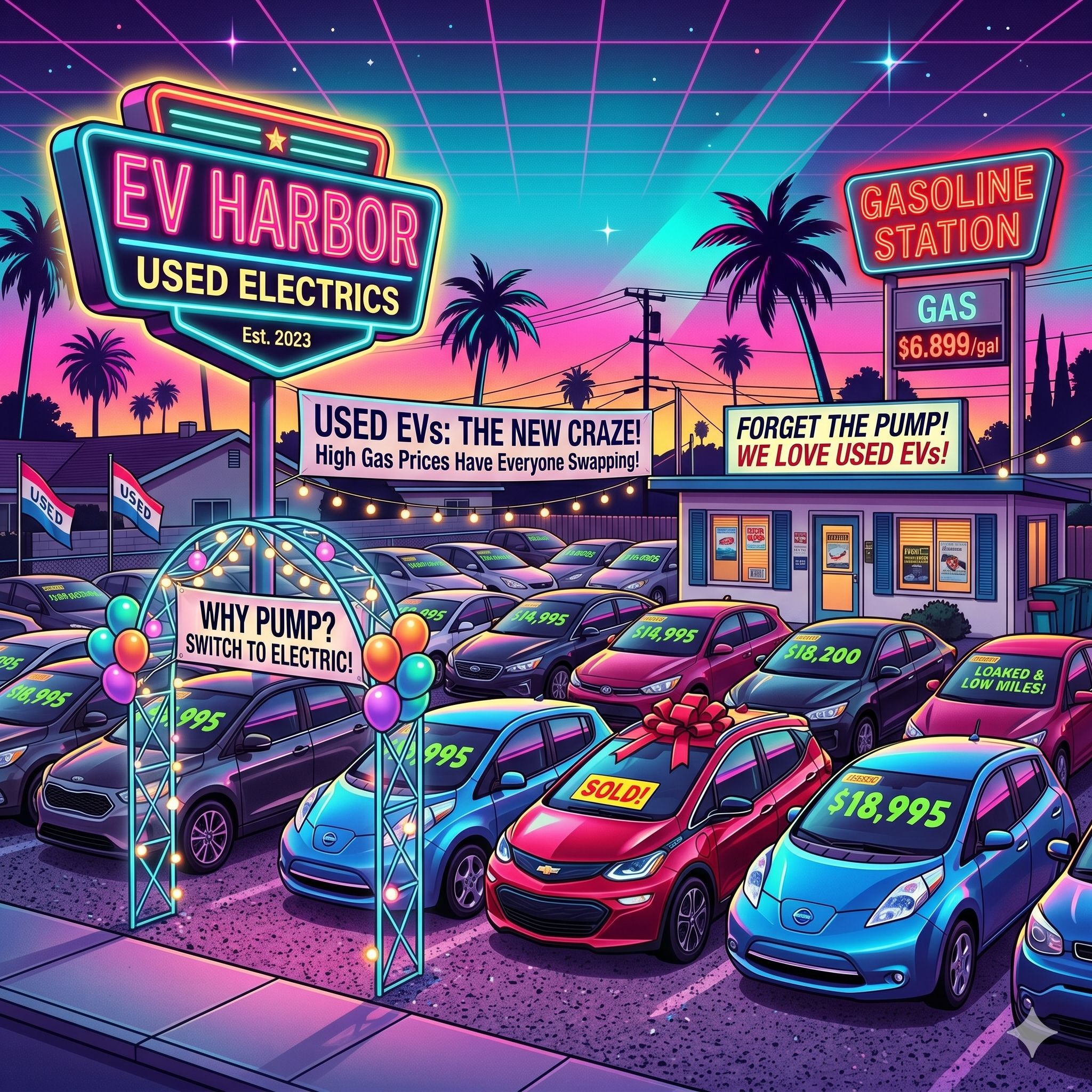
I'm not sure if anybody has noticed, but the price of gas or maybe called petrol where you're from and diesel has gone up quite a bit over the last few weeks.
And you know what else has gone up?
Used EV sales in the UK and other places, but this article was specific about the UK.
Right now, as we stand, used EV sales in the UK reached a record 9.8% of all used car sales in April of 2026.
This is a modest bump from the 7.4% of used cars being sold in the UK being EVs.
So yeah, we got like a 2.4% bump.
So the company that put this information out is called Indakata.
They track used car listings in real time to show dealerships how fast inventory is moving and what that inventory is actually worth.
Like if you have a Chevy Spark, for instance, sitting on your lot and it's used, they'll tell you what other car companies are able to get out of that, how much they're able to sell it for.
So Indakata, they cover 16 different European countries.
And what they did was they looked at market day supply, which is how long the car has been sitting on the lot.
And that market day supply actually fell to 41 days for EVs.
For context, in January, market day supply for used EVs was right around 85 days.
So it, you know, more than cut in half in terms of how long EVs are staying on the lot.
And if you just kind of need some context, petrol cars, gas cars, they're typically on the lot for 39 days, used cars are on the lot for 39 days.
Whereas the used EVs are on the lot for only 41 days.
So, you know, getting a little bit of parity there.
All right, we have one more Mark recommended story.
Thank you, Mark, for recommending the last two articles.
According to EV infrastructure news, Australia's adoption of EVs has jumped from 1.9% to 27.5% market share in just four years.
So here's what's happening.
Actually, you know, what's interesting is Australians are buying one EV every three minutes, which is just nutty.
So why is this happening?
Well, you know, Tesla is still responsible for a significant number of sales in Australia.
But affordable EVs coming from China are really what's driving the sales.
One issue or kind of issue that, you know, Australian EV owners are facing, though, is, you know, the vehicle sales are kind of outrunning the DC fast charging infrastructure.
That's not to say that there's not enough DC fast chargers out there or people are being stranded in the middle of the Australian outback.
Because, you know, they can't find a charger.
It's just there could be more.
Australia is making all the, you know, they have a lot of land to cover and they're making big strides in building out their charging infrastructure.
So, yeah, congratulations to Australia.
That's awesome news.
All right, everybody, that is our EV news for today.
Before we move on, I just want to thank because we have a new Patreon subscriber.
Now, I don't actually, or I don't think I have this person's name.
I think I just have what they like to be called online, which is canik with a zero.
So I'm sure that there's a better way to pronounce this and I apologize if I'm butchering it.
But thank you so much for supporting the show without going into too many details or behind the scenes type stuff.
Patrons come and go.
I actually am very impressed at how long people stay subscribed to this podcast because I don't think it's very good.
But you all seem to be very supportive and I appreciate that.
And I don't know if it's because you pity me or you enjoy the content or both.
But, you know, every now and again, we'll have some people that have to dip out and that's okay.
It could be because of financial reasons.
Things are expensive now.
It could just be that they don't listen to the show anymore like that happens to me as well.
And that's no big deal.
But whenever somebody comes in and knew that supports the show, I always appreciate it.
I also appreciate it when people come back because that's super cool as well.
So, canik, if I'm saying your name right, thank you so much for supporting the show.
And thank you to all of the patrons who support the show.
I really appreciate it.
All right, let's jump into our Tesla news.
Oh, you know what?
If you want to support the show, you can go to support kilowatt dot com.
You can support the show on Patreon or you can support the show on Supercast.
All right, let's move on to our Tesla news.
We have battery information on the Tesla Semi.
And this information comes to us via a regulatory filing to the California Air Resource Board.
So, just basically we're going to start off with some information just on the Tesla Semi itself.
The standard range semi is going to weigh around 20,000 pounds.
This is important, I promise.
The long range version is going to weigh 23,000 pounds.
The standard range truck is going to be powered by a 520 kilowatt tri-motor drive train.
Whereas the long range will be 800 kilowatt tri-motor drive train.
It will be capable of charging on a 1.2 megawatt megacharger.
And this requires a new MCS 3.2 connector.
It's a big old connector.
As far as battery chemistry, this is going to be a nickel cobalt manganese aluminum battery chemistry.
The self form factor is going to be 4680, which we're going to talk about there in a few minutes.
One of the other stories that's coming up.
In terms of the battery's size and range, the Tesla standard range semi is going to have a 548 kilowatt hour battery.
That's just nuts.
Can you imagine having that in your car?
That will give the standard range semi 323 miles of range.
For my understanding, these range estimates are based on 82,000 pounds of weight.
So 325 miles of range when it's hauling 82,000 pounds of weight.
The Tesla long range semi is an 822 kilowatt hour battery.
500 miles of range based on that same 82,000 pounds of weight.
Although inside EVs did some calculations and they think that that range is closer to 483 than it is to 500 miles of range.
Now in terms of how the gross vehicle weight is calculated in the US, that's the semi, the trailer, the fuel, the cargo.
I don't know if the humans calculated in that mess or not, but at 82,000 pounds, even if you weigh 260 pounds, it's not a huge percentage.
But in the US, you can only, your maximum weight is 80,000 pounds.
So I'm not sure why Tesla is using 82,000 pounds.
Maybe it's just because that they can, you know, wow the semi truck drivers with a little extra range.
Not sure, but that's kind of what we got here is 82,000 pounds is how they calculated the range.
I will see as these trucks actually get out into the public and more people are driving them around and we can kind of get a better feel for it.
It is worth noting too that not every semi can hold the same amount.
There's, man, I don't even want to get into this, but I had to do a little bit of this stuff when I got promoted to be a driver.
Well, when I got qualified to be a driver in Nevada, there was a lot of CDL stuff that I had to learn, but just because, you know, you have a semi truck does not mean you can just haul whatever weight you want.
There's, you know, all sorts of factors that go into how many axles you have and a whole bunch of other stuff.
So I'm simplifying this way down is what I'm saying here.
Now, as far as orders, Tesla has received an order of 370 Tesla semis from Watt EV and this deal is worth right around $100 million, which is very impressive.
So Watt EV should get about 50 of these deliveries in 2026 and the rest sometime in 2027.
And what these EVs are going to do or what these Tesla semis are going to do is they're going to support the port of Oakland and they're going to do a little bit of dryage and what dryage is, and I didn't know this until David told me.
So thank you, David.
But dryage is these little short little transport of shipping containers to different like truck or rail or some other port or within the port.
It's just moving shipping containers from one place to another so it can be, you know, put on the road or rail or water at some other point in time.
So they're going to be using it for dryage and they're also going to be using it for regional like pleat routes, like something that's fairly close.
So I'm guessing most of, and I don't know this for sure, but most of the trucks that Watt EV ordered are going to be the smaller battery pack, the standard range battery pack.
But that should be fine for what they're looking to do, but still pretty good for Tesla.
Toyota and the fun starts now.
We're kicking things off by kicking up mud.
Jump in campers.
We're going off-roading in a forerunner.
Next, we're heading to the hot springs in a RAV4.
And finally, park your Tundras and Tacomas around the campfire because we're roasting marshmallows.
Your summer start here.
Drivers who switch and save with Progressive save over $900 on average.
They make it super simple.
Pop over to progressive.com, answer some questions, and you'll get a quick quote with coverage options tailored to your choices.
Plus, you'll see which discounts you may qualify for, like the online quote discount or savings for paying in full.
In fact, 99% of progressive auto customers earn at least one discount.
See if you could save when you switch to Progressive.
You'll feel good about making a savvy choice.
Visit progressive.com and see if you can enjoy a little extra cash back.
Progressive Casualty Insurance Company and Affiliates.
National average 12 month savings of $946 by new customers surveyed who save with Progressive between June 2024 and May 2025.
Potential savings will vary.
Alright, let's talk about the 4680 battery cell.
So Tesla had its big battery day event way back in September of 2020.
If I'm remembering right, they had an earnings call and then they had the battery event afterwards and everybody had to sit in their cars.
Tesla unveiled the 4680 battery cell and they also made a bunch of promises that really haven't come to fruition.
So one of the promises they made was a dry cathode, which is not to be confused with a solid state electrolyte.
This is different.
And we've talked about dry cathode before and we're already running long for the show, so I'm not going to go into it again.
But it was supposed to simplify manufacturing.
It was supposed to clean up some of the chemicals, the nasty chemicals that go into the wet cathodes.
And Tesla found that this was way harder than they thought it was.
And actually Elon said on some earnings call that it was a mistake to go the direction of the dry cathode.
But eventually they were able to kind of figure it out and work out the problems.
I'm not sure how successful they were, but they're selling 4680 cells with the dry cathode as far as I know.
So that was one of the issues that they had with the cells.
And that was for a long time the biggest issue because they just couldn't get it at scale.
And then the 4680 cells were supposed to be more energy dense, quite a bit more energy dense than the 2170 cells.
And in reality, they're not.
The energy density of a 4680 cell currently, according to Electric, is 244 watt hours per kilogram.
Whereas when you look at the 2170 cell, it has 269 watt hours per kilogram.
So what is that? 15 more, no, 25 more watt hours per kilogram than the 4680 cell.
So as we sit right now, the 2170 cells are still more energy dense.
And then that leads us to battery capacity.
So if we're comparing the batteries on the European Model Y, the 4680 battery pack gets you right around 79 kilowatt hours.
The same European Model Y that comes equipped with 2170 cells gets 82 kilowatt hour battery pack.
So three kilowatt hours more for the 2170 cell, which is around an 8% reduction in range when you compare the 4680 and the 2170.
Depending on which way you look at it, if you're saying it's 2170, it's an 8% increase.
If it's 4680, it's an 8% decrease.
But yeah, it is important to note that the 2170 does have a slightly larger capacity.
So I don't know if that's an apples to apples comparison.
And then the charging curve out of spec Kyle Connors outfit found that the 4680 cell in Europe charged slower than the 2170 cell.
It actually added two kilowatt hours more to the 2170 cell when charged at the same time period from the same state of charge.
So the point is, and you can kind of see this, the 2170 cells are still outperforming the 4680 cells.
If we can just kind of bring this down to something that's more easy to understand, right?
There also is some signs that the supply chain is, you know, Tesla's kind of not not giving up,
but changing the way that they're looking at the 4680 cells compared to 2020, September of 2020 when they had battery day.
Electric points to a supplier that had a $2.9 billion contract for cathode materials.
And according to Electric, these cathode materials were supposed to go directly to 4680 cell production.
It looks like according to the article, there was a write down to $7,386, not 7 million or 700 million $7,386, which is a 99.9% reduction in that contract,
which is not lucrative for the company that's providing the cathode materials.
Now, having said all of that, right, I do want to point out that
Electric's not misleading you or giving you bad information in this article or me or any of us, right?
But I'm not sure that we can get an apples to apples comparison based on the limited amount of information we have.
Electric, whoever wrote this article and I can't remember who it is, they definitely cited their sources and they made a good case.
But there are more aspects to this stuff than we know externally.
So I think that in one way, we can definitively say that the 4680 cell is not stacking up to being what Tesla said it was going to be in 2020.
And they definitely haven't solved a lot of problems.
But I don't necessarily know that it's a failure.
I don't think it's going to end up being the same thing that Tesla initially thought it was going to be.
I think they're going to have to continue iterating on this form factor and with different battery chemistries and all that stuff.
Because it's just not that technological leap that they thought it would be, right?
But on the other side, it could still turn out to be something.
And I'm not trying to be an apologetic apologist for Tesla.
I'm just, you know, I thought the article was well written, but I don't know that that tells the whole story.
You would have to have a much more significant article, almost a book written so that we could get even probably half of the story.
You know, there's just so much more that I don't think we see.
So while I agree, the 4680 cell is not what Tesla said it was going to be.
I don't know that it's like the worst thing ever.
I would certainly, like I appreciate the fact now that I have the 2170 cells in my car.
Because shortly after I got my car delivered, or shortly before, that's when they were putting the 4680 cells in and I was like, ah man, I'm missing out.
But it turns out I'm not, so I'm happy about that.
Still got hardware three though.
Anyway, I say all that to say this.
I love that Tesla swung for the fences on this and hopefully they keep developing the 4680 cells so that it becomes something closer to what they announced in 2020.
Alright, that brings us to our final story.
The 2026 Tesla Model Y has become the first vehicle to pass the US National Highway Traffic Safety Administration's Advanced Driver Assistance System test.
So it's the first to pass, which I think is great.
And the Model Y passed all eight of NHTSA's new and existing ADS benchmarks under their new car assessment program.
Fantastic.
As far as I know, nobody else has submitted a car to the test yet.
So yes, it's the first, but I don't think anybody failed before Tesla.
So just a little bit of information about the test.
These tests are conducted.
Their pass fail evaluations.
So if they don't meet the minimum requirements, it doesn't pass.
So it's not like, well, it did three out of the four things we expected it to do in this situation.
So that's a pass.
No, that's not how that works.
If it didn't do all four out of the four things that expected to do in this situation or whatever the number was or whatever the criteria was, then it just failed.
So the tests were pedestrian automatic emergency braking.
So successfully, you know, detecting and stopping for pedestrians on the roadway.
Lane keep assist, you know, keeping you between the lanes.
Blind spot warning, alerting the driver that the vehicles, their vehicles and adjacent lanes.
Blind spot intervention, actively taking control, not letting you crash into somebody that's in your blind spot.
Forward collision warnings, crash imminent braking, dynamic brake support, lane departure warnings, and yeah, I think that's, I think that's all of them.
Listen, none of these are all that hard.
I think there's probably quite a few car companies that could pass this, you know, it's not as if there's some sort of complicated road test that's happening here.
All of these things are fairly simple and available in a lot of cars, maybe not all of them are available in all cars, but a lot of these features come available in a lot of cars standard.
So, you know, not to say that I'm poo-pooing the job that Tesla did here because I'm not. Good job, you passed the test.
However, it wasn't, I don't think necessarily a hard test.
So we'll just kind of keep that in the back of our heads.
This does not negate the fact that the National Highway Traffic Safety Administration has still got a lot of investigations in terms of Tesla's autopilot and full self-driving.
This just means that they passed the test and I honestly, you know, being the first to do it is awesome.
I don't know what to say.
My car does all of these things, although I think my car does all these things.
My car does a lot of these things.
I'm not going to say all because maybe it doesn't do one or two of these things, but the rating specifically that applies to Model Y vehicles that were manufactured on or after November 12, 2025.
So my car doesn't technically qualify for that.
But, you know, when I look through this list, it does a lot of this stuff.
So I would feel confident that it would come close.
I could get a solid B minus out of my car if I feel like if this was graded that way.
All right.
So that's it.
That's our show this week.
I hope everybody enjoyed it.
If you have any questions, do you send me an email?
BodeBODIE at 918digital.com.
You can also find me on X at 918digital.
Although I don't use X very much.
I don't know why I gave that.
You can also find me, where can you find me?
And LinkedIn.
So if you go and search for BodeBODIE, GrimGRIMM, I'm there as well.
And then I have one other thing that I was told to say.
I can't remember what it was, but I'm looking up the email.
This came from the folks at the Believe Network, because I'm not doing this enough.
I want to thank everybody for listening.
Please don't forget to hit subscribe to the show if you're not already subscribed.
If you get a chance, leave a five-star review.
We're on Apple Podcasts, Spotify, Amazon Music, YouTube.
All of that does really help.
And I need to be better about asking people to help us out with that.
So thanks for listening.
I hope you all had a wonderful week.
And I hope you're having a great weekend.
And I will talk to you soon.
Hey campers, it's Jan from Toyota.
This summer we're headed to Camp Toyota, and the fun starts now.
We're kicking things off by kicking up mud.
Jump in campers.
We're going off-roading in a four-runner.
Next, we're heading to the hot springs in a RAV4.
And finally, park your tundras and Tacomas around the campfire,
because we're roasting marshmallows.
Your summer start here!
Dealer in between may vary, so you're participating in Toyota Delivery Details event and stream first.
Toyota, let's go places!
Like the online quote discount, or savings for paying in full.
In fact, 99% of progressive auto customers earn at least one discount.
See if you could save when you switch to progressive.
You'll feel good about making a savvy choice.
Visit progressive.com and see if you can enjoy a little extra cash back.
Progressive Casualty Insurance Company and Affiliates.
National average 12 month savings of $946 by new customers surveyed who save with progressive between June 2024 and May 2025.
Potential savings will vary.
If you liked the show, please take a moment to rate, review and subscribe.
It really does help the show to grow.
Thank you for listening.
About this episode
Used EVs are getting a “glow-up” as higher gas and diesel prices push buyers toward electrics, and the market is moving fast—used EV supply dropped to 41 days in the UK and EV sales are outpacing charging build-out. The hosts connect that demand to real-world charging and battery details, from Tesla Superchargers and Waymo rides to Tesla Semi megacharger specs and the 4680 vs 2170 battery debate. They also highlight Brazil’s Chevy Spark EUV success and used pricing ranges.
In this episode of Kilowatt, we chat about Volkswagen significantly increasing its stake in Rivian. We also take a global look at adoption, from the historic rise of electric vehicles in Australia to the growing demand for used EVs in the UK. The discussion highlights innovation and market strategy, covering Slate Auto’s vision for a $20,000 electric pickup and the Chevy Bolt EUV’s surprising performance in Brazil. Additionally, we break down critical tech updates, including leaks regarding the Tesla Semi’s battery capacity and the safety milestones achieved by the Tesla Model Y. Join us for an in-depth analysis of the trends and technology driving the future of transportation.