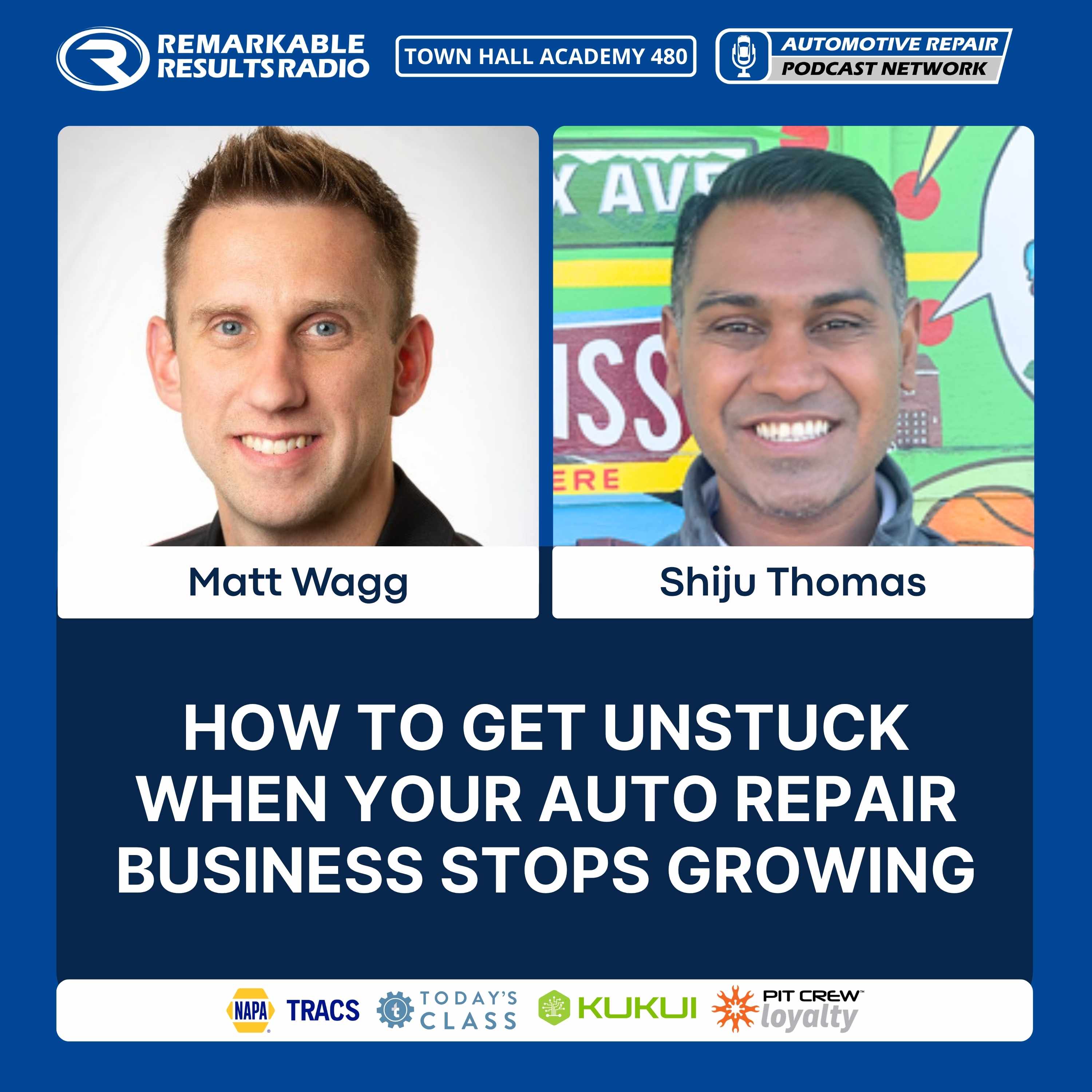
How to Get Unstuck When Your Auto Repair Business Stops Growing [THA 480]
About this episode
Shop owners hit plateaus for lots of reasons, and this roundtable breaks down how to get unstuck when growth stalls. Guests Matt Weg and Siju Thomas compare notes on tenure vs. performance, leadership accountability, and the need for clear standards, KPIs, and regular communication. They argue culture is tangible and built through hiring for shared values, ongoing development, and healthy conflict. The conversation also stresses outside perspective—coaches/peer groups—and goal-setting tied to purpose, not ego or comfort.
In this episode of the Town Hall Academy, host Carm Capriotto is joined by Matt Wagg and Shiju Thomas to tackle a common challenge in the automotive repair industry: getting “unstuck.” The conversation focuses on breaking through growth plateaus by sharpening leadership, building a meaningful culture, and committing to continuous employee development.
Leadership & Accountability
- Growth stalls when tenure is valued over performance
- Not every team member will grow with the business
- Leaders must make tough calls and avoid carrying “dead weight.”
- Practice radical candor: honest conversations build trust
- Self-awareness is critical; seek outside accountability (coaches/peers)
Culture & Development
- Culture must be intentional and tangible, not just social events
- Built through aligned hiring and shared values
- Reinforced with tools like assessments, training, and team learning
- Continuous education prepares teams for evolving vehicle technology
- A learning culture attracts higher-level talent
Embracing Being “Stuck”
- Feeling stuck often signals ambition and growth
- Indicates you’re pushing into new challenges
- Clear personal and business goals provide direction
- Without clarity, the business risks drifting without purpose
Ultimately, getting unstuck isn’t about quick fixes; it’s about honest reflection, intentional leadership, and a commitment to growth. The shops that move forward are led by people willing to have the hard conversations, invest in their teams, and take ownership of what needs to change. If you’re feeling stuck, take it as a signal, not a setback, and use it as the catalyst to refocus, realign, and lead your business to the next level. Matt Wagg, Accelerated Diagnostics and Automotive, Bennington, NE. Matt’s previous episodes HERE Shiju Thomas, Hotchkiss Auto Repair, Denver, CO. Shiju's previous episodes HERE Thanks to our Partner, NAPA TRACS NAPA TRACS will move your shop into the SMS fast lane with onsite training and six days a week of support and local representation. Find NAPA TRACS on the Web at http://napatracs.com/ Thanks to our Partner, Today's Class Optimize training with Today's Class: In just 5 minutes daily, boost knowledge retention and improve team performance. Find Today's Class on the web at https://www.todaysclass.com/ Thanks to our Partner, KUKUI Stop juggling multiple marketing tools. KUKUI’s integrated platform delivers 4x better website conversions, automated follow-up, and real-time ROI tracking. Get industry-leading customer support with KUKUI at https://www.kukui.com/ Thanks to our Partner, Pit Crew Loyalty You’re probably tired of chasing new customers who never return. We understand. Pit Crew Loyalty ends the one-and-done cycle, turning first visits into lasting, reliable revenue at https://www.pitcrewloyalty.com/ Connect with the Podcast: - Follow on Facebook: https://www.facebook.com/RemarkableResultsRadioPodcast/ - Join Our Virtual Toastmasters Club: https://remarkableresults.biz/toastmasters - Join Our Private Facebook Community: https://www.facebook.com/groups/1734687266778976 - Subscribe on YouTube:
NapaTrax
"And we thank our great partners, NapaTrax, today's class, Kukui and Pit Crew Loyalty. Hey, did you know that NapaTrax has on-site training plus six days a week support?"
NapaTrax is a service that helps auto repair shops manage their business better. They also provide training and support so shop owners can improve day-to-day operations.
NapaTrax is a shop-management and training-support platform aimed at helping automotive repair businesses run more efficiently. In this segment, it’s positioned as offering on-site training and ongoing weekly support to improve how a shop operates.
shop management system
"Let us prove to you that Trax is the single best shop management system in the business."
A shop management system is software that helps an auto repair shop keep track of jobs and customers. It can make scheduling and workflow easier so the shop doesn’t get overwhelmed.
A shop management system is software used by automotive repair businesses to organize work and business operations. It commonly supports things like job tracking, scheduling, customer communication, and internal workflows so the shop can run more predictably and grow.
historic shops
"It was a 1918 building, and maybe not all of our buildings in our organization are that old, but it definitely speaks to the legacy of acquiring historic shops, keeping that historic name and serving those local communities."
They’re describing keeping an old, well-known auto repair shop’s identity instead of starting from scratch. That can help you keep customers because people already trust the name in the community.
The speaker is talking about “historic shops” as a business strategy—acquiring older, established automotive repair locations and keeping their legacy. In the auto-repair world, that can mean strong local brand recognition and customer trust built over decades.
valuing tenure over performance
"Hey, let's jump in as this valuing tenure over performance. Siju, this was one of your talking points."
This is about whether a workplace rewards people for staying a long time instead of rewarding them for doing great work. In a repair shop, that can make it harder to improve results if the best performers aren’t recognized.
“Valuing tenure over performance” is a people-management concept: rewarding employees mainly for how long they’ve been there rather than how well they’re doing. In an auto repair business, this can affect productivity, quality, and how quickly problems get fixed when growth stalls.
scaling
"[414.2s] That's probably one of the biggest things [416.9s] that people have in scaling. [419.4s] And if not scaling to find additional places, [422.1s] but just scaling to go from million and a half to two [424.7s] to two and a half to three, to your point,"
Scaling just means growing your business to the next level. The key question is whether your team and systems can handle more work without everything falling apart.
In business, “scaling” means growing capacity and results without proportionally increasing costs or headcount. In the context of an auto repair shop, it’s about whether your leadership team and processes can handle the next revenue/volume step.
core values
"What I had to think about on this topic is operating aligned with our core values. Two of our core values are development and results."
They’re saying the team should act in a way that matches what the business claims to stand for. If the company’s values are “development and results,” then hiring and managing should reward those behaviors.
The speaker frames employee performance and growth using the organization’s “core values.” In an auto repair business, aligning day-to-day behavior (how people communicate, take accountability, and improve) with stated values can prevent stagnation.
results
"Two of our core values are development and results. ... the same principles apply for results. If you don't operate a meritocracy, the organization falls apart"
They’re talking about measurable outcomes, not just hard work. For a car shop, that usually means getting repairs done well and keeping customers happy.
“Results” is used as a performance outcome alongside development. In auto repair operations, results often show up as throughput, quality of work, customer satisfaction, and consistent job completion—not just effort.
development
"Two of our core values are development and results. And I think to myself, just because someone has tenure in the organization, are they prioritizing development?"
“Development” here means ongoing improvement in skills and behavior, not just staying employed. For a shop, that can translate to training on diagnostics, customer communication, and process consistency.
meritocracy
"If you don't operate a meritocracy, the organization falls apart"
A “meritocracy” is a system where people advance and are rewarded based on performance rather than tenure or politics. In an auto repair business, that helps ensure the shop keeps improving—especially when growth stalls due to complacency.
KPI
"And therefore there's gonna be some sort of KPI for everyone in the organization and everyone should be accountable for those KPIs."
KPI means a “key performance metric.” It’s a number or goal your team tracks so everyone knows what “good performance” looks like.
KPI stands for Key Performance Indicator. In an auto repair business, KPIs translate goals like throughput, quality, and customer satisfaction into measurable targets for each role.
continuing education
"I love the whole thing on the development piece, this continuing education, I'm this big believer that you've gotta be a perpetual student in any capacity in our industry, both leadership and on the technical down in the Bay side."
Continuing education is ongoing training to keep skills current as vehicles, diagnostics, and repair procedures evolve. In the auto repair world, it often includes manufacturer updates, new scan tool workflows, and updated repair standards.
getting ourselves unstuck
"[844.2s] Our whole episode here today [845.6s] is about getting ourselves unstuck. [847.6s] And what is it that I have to do to stop to realize, [854.1s] I gotta pick up the biggest, most powerful thing"
The episode is about how to fix a business when it feels like it’s not moving forward. The host’s point is that the solution starts with figuring out what’s causing the stall.
“Getting ourselves unstuck” is the episode’s central business concept: identifying why progress has stalled and then addressing the root cause. Here, the root cause is linked to communication breakdowns rather than technical issues alone.
communication
"I gotta pick up the biggest, most powerful thing [857.4s] that was said in the last six minutes, [860.0s] the word communication. [886.8s] is the ability to communicate."
They’re saying the main problem isn’t just the car work—it’s how people talk and understand each other. If you can’t clearly explain what’s going on (and confirm it), the business gets stuck.
In this episode, “communication” is framed as the key skill for getting an auto repair business “unstuck.” The host argues that growth stalls when people can’t clearly confirm and clarify what’s actually happening, internally and with customers.
confirming and clarifying
"And so we're not confirming and clarifying [896.8s] in our self-awarenesses and what it is. [898.5s] So thank you for bringing up communications."
They’re talking about making sure you and the other person truly understand each other. Instead of assuming, you check and restate so mistakes don’t happen.
“Confirming and clarifying” refers to verifying understanding to prevent misunderstandings from turning into operational problems. In an auto repair context, this mindset helps ensure you’re aligned on diagnoses, customer expectations, and next steps.
NapaTracks
"NapaTracks was built from the ground up to make your business more profitable and efficient. We provide an extensive set of tools to increase and track profitability in real time."
NapaTracks is a software/service that helps auto repair shops run better. It’s used to track how the business is doing and to train the team so things stay organized and profitable.
NapaTracks is a shop management and training platform aimed at improving an auto repair business’s profitability and efficiency. In this segment, it’s positioned as a system that helps track performance in real time and supports ongoing training for staff.
increase and track profitability in real time
"We provide an extensive set of tools to increase and track profitability in real time."
This means the shop can see how money is doing while the work is still in progress. Instead of waiting weeks for reports, you can spot problems earlier and fix them faster.
“Real-time” profitability tracking means using up-to-date data to monitor revenue, costs, and performance as work is happening rather than waiting for end-of-month reporting. For a repair shop, this can help identify bottlenecks, pricing issues, or staffing problems sooner.
post-sale support
"NapaTracks offers the industry's best post-sale support hands down and we train your people on site."
Post-sale support is the help you get after you buy something. Here, they’re saying they’ll keep supporting the shop after the system is installed.
Post-sale support refers to help provided after a customer purchases a product or service—such as onboarding, troubleshooting, training, and ongoing assistance. In this context, it’s used to emphasize that the platform won’t just be sold and left alone.
on site training
"...and we train your people on site. Yep, on site."
On-site training means someone comes to your shop to teach your team. It helps everyone learn the new tools the right way using your actual workflow.
On-site training means instructors come to the shop to train staff directly in their real work environment. This can improve adoption of new systems and reduce mistakes during the transition.
pit crew loyalty
"Well, pit crew loyalty changes the story. Our clients cut that rate by up to 38%, raising lifetime value by more than 50%."
This is basically a loyalty program for customers. The idea is to get people to come back more often, so the shop earns steadier money instead of always needing new customers.
“Pit crew loyalty” refers to a customer loyalty program model where customers repeatedly return to the same shop. In this context, it’s used to reduce churn, increase visit frequency, and stabilize revenue without relying on constant new customer acquisition.
lifetime value
"Our clients cut that rate by up to 38%, raising lifetime value by more than 50%."
Lifetime value means how much money a customer is expected to bring in over time. If customers keep coming back for service, the shop’s lifetime value goes up.
Lifetime value (often abbreviated as LTV) is the total profit a business expects from a customer over the entire time they stay with the company. In auto repair, higher LTV usually comes from repeat visits, retention, and upsells rather than one-off work.
predictable revenue
"creating predictable revenue without extra ad spend. Pit crew loyalty, where customers stay and shops thrive."
Predictable revenue means the shop can expect money more consistently. When customers return regularly, it’s easier to plan and less stressful than waiting for random new jobs.
Predictable revenue means the shop can forecast income with more consistency because customer demand is steadier. Loyalty programs and repeat service behavior help smooth out the ups and downs that come from relying on new customers.
ad spend
"creating predictable revenue without extra ad spend. Pit crew loyalty, where customers stay and shops thrive."
Ad spend is what you pay for ads to get new customers. The point here is that loyalty can reduce how much you need to spend on ads.
Ad spend is the money a business spends on advertising to acquire new customers. The segment contrasts loyalty-driven repeat business with growth that depends on continuously paying for ads.
Start with why
"Sounds like you've read, everyone's read this book. ... Start with why. I actually haven't read that. Oh yeah, oh yeah, you guys start with why, Simon."
This is a business idea that says you should figure out the “why” behind what you do, not just the “what.” When your team shares the same purpose, it’s easier to make decisions and grow the business.
“Start with why” is a leadership framework popularized by Simon Sinek. It focuses on clarifying the purpose behind a business decision so you can align people, culture, and strategy around that shared mission.
Simon Sinek
"Oh yeah, oh yeah, you guys start with why, Simon. Simon Sinek. Simon Sinek."
Simon Sinek is a well-known business author who teaches people to focus on the reason behind their work. For a shop owner, that can help you hire and manage people who care about the same goals.
Simon Sinek is a leadership author and speaker known for the “Start with Why” concept. In business contexts like auto repair, it’s often used to help owners align hiring, customer experience, and day-to-day priorities with a clear mission.
top dead center
"But if you can't seem to get yourself over top dead center, I love that term, right? [1719.8s] Automotive term, right?"
Top dead center is an engine moment when a piston is at the very top of its travel. The speaker is using it as a metaphor for being stuck in one place and not moving to the next step.
Top dead center (TDC) is the position in an engine where a piston reaches its highest point in the cylinder. In this episode it’s used as a metaphor for being “stuck” at a point where progress feels impossible, even though the system is technically set up to move forward.
accountability partner
"We never have an accountability partner [1753.2s] to get us to that next step and that next level."
An accountability partner is someone who helps you stay on track with your goals. Instead of just learning or planning, they help make sure you actually take the next steps.
An accountability partner is a person or group that helps you follow through on goals by checking progress and creating follow-up. In the context of an auto repair business, it’s a practical way to turn learning and intentions into consistent execution.
financial piece
"[1972.1s] of how to get unstuck in a lot of it [1974.8s] we didn't even bring up the whole financial piece [1976.8s] I'm stuck just giving enough money"
They’re talking about the money side of running the shop—like whether you have enough cash to keep things going. Even good work won’t help if the finances aren’t managed.
The “financial piece” refers to the business-side numbers that determine cash flow and sustainability, not just day-to-day operations. For auto repair shops, this includes budgeting, pricing, and ensuring you have enough working capital to cover slow periods.
alignment
"what do you mean the alignment [2028.3s] the alignment over at Carm's place is 400 bucks"
Wheel alignment adjusts the angles of the tires so they roll straight and wear evenly. If alignment isn’t done correctly—or if it’s skipped when it should be—handling can suffer and tires can wear out faster.
factory manuals
"because we're not paying attention [2041.6s] we're not reading the factory manuals [2042.7s] we're not doing the continuous education and improvement"
Factory manuals are the “official instructions” from the car company. Following them helps make sure the repair is done the right way, not just the quick way.
Factory manuals are the official repair instructions from the automaker, including exact procedures, specifications, and required steps. Skipping them can lead to incomplete repairs, missed safety steps, or incorrect settings.
writing tickets
"if all they're doing is dispatching and writing tickets and putting out the fires of normal daily operations"
In a repair shop, a “ticket” is the paperwork (or computer record) for a customer’s car. Writing tickets means logging what the customer needs and what the shop plans to do.
“Writing tickets” is shop shorthand for creating a repair order/work order in the shop’s system. It’s how technicians and managers document customer requests, diagnose issues, authorize work, and track costs.
being stuck
"if you never do get stuck / that might mean you're not being ambitious enough ... / the beauty of being stuck / is your ability and opportunity to get unstuck"
“Being stuck” means your business isn’t moving forward like you want. Instead of panicking, you look for what’s causing the slowdown and then work on a practical fix.
In an auto repair business context, “being stuck” usually means growth has stalled and you’re facing operational or customer-flow problems. The point is to treat it as a signal to diagnose what’s limiting progress and then take deliberate steps to improve.
Relay Hill Auto Denver
"Wow / Siju Thomas a CEO Relay Hill Auto Denver / six stores"
This is the name of the auto shop the guest leads in Denver. It’s mentioned to give context about who’s speaking.
Relay Hill Auto Denver is referenced as the CEO’s business location. For listeners, this is a real-world example of how shop leadership and strategy are discussed in the episode.
Request an Explanation
Heard something you'd like explained? We'll add it to this episode.
Sign in to request explanations for terms you heard.
Want to learn more?
Browse our glossary for plain-English explanations of automotive terms, jargon, and concepts.
Help improve this episode
See something that's not quite right? Our annotations are AI-generated and can sometimes miss the mark. Click the flag icon on any annotation to suggest a correction.