NapaTrax is a service that helps auto repair shops manage their business better. They also provide training and support so shop owners can improve day-to-day operations.
A shop management system is software that helps an auto repair shop keep track of jobs and customers. It can make scheduling and workflow easier so the shop doesn’t get overwhelmed.
They’re describing keeping an old, well-known auto repair shop’s identity instead of starting from scratch. That can help you keep customers because people already trust the name in the community.
This is about whether a workplace rewards people for staying a long time instead of rewarding them for doing great work. In a repair shop, that can make it harder to improve results if the best performers aren’t recognized.
Scaling just means growing your business to the next level. The key question is whether your team and systems can handle more work without everything falling apart.
They’re saying the team should act in a way that matches what the business claims to stand for. If the company’s values are “development and results,” then hiring and managing should reward those behaviors.
They’re talking about measurable outcomes, not just hard work. For a car shop, that usually means getting repairs done well and keeping customers happy.
“Development” here means ongoing improvement in skills and behavior, not just staying employed. For a shop, that can translate to training on diagnostics, customer communication, and process consistency.
A “meritocracy” is a system where people advance and are rewarded based on performance rather than tenure or politics. In an auto repair business, that helps ensure the shop keeps improving—especially when growth stalls due to complacency.
Continuing education is ongoing training to keep skills current as vehicles, diagnostics, and repair procedures evolve. In the auto repair world, it often includes manufacturer updates, new scan tool workflows, and updated repair standards.
The episode is about how to fix a business when it feels like it’s not moving forward. The host’s point is that the solution starts with figuring out what’s causing the stall.
They’re saying the main problem isn’t just the car work—it’s how people talk and understand each other. If you can’t clearly explain what’s going on (and confirm it), the business gets stuck.
They’re talking about making sure you and the other person truly understand each other. Instead of assuming, you check and restate so mistakes don’t happen.
NapaTracks is a software/service that helps auto repair shops run better. It’s used to track how the business is doing and to train the team so things stay organized and profitable.
This means the shop can see how money is doing while the work is still in progress. Instead of waiting weeks for reports, you can spot problems earlier and fix them faster.
This is basically a loyalty program for customers. The idea is to get people to come back more often, so the shop earns steadier money instead of always needing new customers.
Lifetime value means how much money a customer is expected to bring in over time. If customers keep coming back for service, the shop’s lifetime value goes up.
Predictable revenue means the shop can expect money more consistently. When customers return regularly, it’s easier to plan and less stressful than waiting for random new jobs.
This is a business idea that says you should figure out the “why” behind what you do, not just the “what.” When your team shares the same purpose, it’s easier to make decisions and grow the business.
Simon Sinek is a well-known business author who teaches people to focus on the reason behind their work. For a shop owner, that can help you hire and manage people who care about the same goals.
Top dead center is an engine moment when a piston is at the very top of its travel. The speaker is using it as a metaphor for being stuck in one place and not moving to the next step.
An accountability partner is someone who helps you stay on track with your goals. Instead of just learning or planning, they help make sure you actually take the next steps.
They’re talking about the money side of running the shop—like whether you have enough cash to keep things going. Even good work won’t help if the finances aren’t managed.
Wheel alignment adjusts the angles of the tires so they roll straight and wear evenly. If alignment isn’t done correctly—or if it’s skipped when it should be—handling can suffer and tires can wear out faster.
Factory manuals are the “official instructions” from the car company. Following them helps make sure the repair is done the right way, not just the quick way.
In a repair shop, a “ticket” is the paperwork (or computer record) for a customer’s car. Writing tickets means logging what the customer needs and what the shop plans to do.
“Being stuck” means your business isn’t moving forward like you want. Instead of panicking, you look for what’s causing the slowdown and then work on a practical fix.
they deliver four times better website conversions,
automated follow-up, and real-time ROI tracking.
Get industry-leading customer support with Kukui.
That's kukui.com.
You're probably tired of chasing new customers
who never return.
We understand.
Pit Crew Loyalty ends the one and done cycle,
turning first visits into lasting, reliable revenue.
On the web at pitcrewloyalty.com.
Hey, welcome back.
Let me introduce and get started on this great podcast
we're gonna call Getting Unstucked.
Now you gotta stick around.
Stick, stuck, oh, that's kinda cool.
Because sometimes we get stuck
on getting over a hump in business growth,
leveling ourselves up as a leader,
valuing tenure over performance.
I can't wait to hear about that.
I think that's so powerful.
And developing ourselves and the team
is sometimes we just said,
let's set it on autopilot and see what happens.
Nothing happens unless you make it happen.
And also, sometimes we get stuck
on finding what we really come to work every day for.
Is it for family?
Is it for the people we work with?
Is it for our clients?
Is it for self-satisfaction?
What's it for?
And a lot of times we get stuck.
Matt Weg is your founder, CEO of Accelerated Diagnostics
and Automotive in Bennington, Nebraska.
Hello, Matt.
Hey, Karm, thanks for having me.
I'm really excited about this topic.
I think it's really timely with things
that I've had going on in my life the last couple years,
and it's gonna be fun to talk about those things.
Well, I know you both have some great stuff to contribute.
I know that you taught a couple of classes
or one class at least at Vision this year, Matt.
I did.
Yeah, actually, and it goes similarly
along with what we're gonna talk about.
I taught one class at Vision this year
on employee development and engagement
and kind of setting ourselves up to succeed
in the next five to 10 years as a business.
And we'll elaborate on that through our discussion today,
but it's really taken a deep dive inside
at what we're currently doing and what's good,
what's strong, where are we weak,
where do we have opportunities,
and then how do we start looking at who do we currently have
that can solve those shortfalls,
and then how do we get forward based on that set and goals?
You think I picked this guy on purpose?
Siju Thomas is here from Hatchke's Auto Repair,
Denver, Colorado, six stores.
Hello, Siju.
How you doing, Karm?
Thanks for having me.
It's always a pleasure to be here
and the service you do for the industry is immeasurable.
Thank you very much.
Thank you so much.
Ben, to his place, really,
I love that old legacy building you're in, and you make it...
I mean, it's just like going to get an automotive repair
in the 30s, right?
It was a 1918 building,
and maybe not all of our buildings in our organization
are that old, but it definitely speaks to the legacy
of acquiring historic shops,
keeping that historic name and serving those local communities.
Well, thank you so much.
Hey, let's jump in as this valuing tenure over performance.
Siju, this was one of your talking points.
I find it so fascinating.
Love this guy.
He's been with me a dozen years now.
I'm not sure he's really making it,
and I think we're having some problems,
but I love this guy.
And to me, you're always in this dichotomy of stuckness
and making choices.
It's one of the greatest challenges I've faced
as an owner and operator.
It's that you build a personal relationship,
you build a professional relationship with a team member,
and as time goes on,
either their performance may not elevate
like the rest of the organization,
or it might actually backtrack.
But I think many of us place such a high value in tenure,
and intrinsically, that's not a problem.
Tenure is a good thing.
It shows commitment, it shows loyalty,
and that should be valued.
However, it shouldn't be valued at the expense of performance.
And that's one of the things
that I realized last year, a year ago at this time,
four out of the five people I had on my leadership team today
are different than a year ago.
And it was a hard pill to swallow.
I, leaders in the organization,
may have been exactly the leaders
to take us from point A to point B,
and I appreciate them dearly.
But it's a serious question of,
is that team gonna take you from point B to point C?
That's probably one of the biggest things
that people have in scaling.
And if not scaling to find additional places,
but just scaling to go from million and a half to two
to two and a half to three, to your point,
not everyone who's on that team has the capacity
to balloon up, if you will,
with all the tools, leadership skills,
all that are necessary to get to that level.
Matt, I know you're thinking this thing right now.
Yeah, this was the real challenge that I had.
So I'd say over the last two years, maybe two years ago,
I really got to a point,
our organizations rather knew as well.
I started this from scratch in September of 2020,
then we grew really fast,
but we kind of plateaued at about the three year mark.
And I had to figure out what was causing that.
And I went from just me as a sole employee
and my wife doing part-time work
to we had a full team of seven, eight people on staff
within three years.
And it became very stagnant
and we weren't being able to, we weren't growing.
I was having a lot of turnover
and I had to do, much like Suju said,
I had to take a deep dive into who was there
and are these the right people that are meeting the goals
and the mission and the vision of the organization?
And have I done a good job as a leader
conveying that message to them?
And I started working on getting that message across
and then figuring out, you know what,
I have people here that are not cut out
to go to the next level with me.
They were fine with where we were
and that's what they were keeping it at.
And they didn't want to do the work
and no matter whether I was able to lead them or not.
And like you guys had said,
I look at it as we're constantly climbing a staircase.
And sometimes people can't take that next step
and we've got a rope and we're trying to pull that person
up the next step, but they're just dead weight.
And sometimes we've got to cut that rope loose
and that's what I also had to do.
And so a majority of our leadership team,
the couple higher level team members,
they're within a couple of years old
of joining our organization as well.
Guys, is it partly because we're not close enough?
We look at the 10 years that you as a certain level
of loyalty, we're giving, they're giving,
but are we spending enough time with them?
Because I know one of your talking points,
Meg is this dream manager and really,
can we get unstuck with this employee that I have
and not really knowing where they're going
and how I can help them and can they really help me?
What I had to think about on this topic
is operating aligned with our core values.
Two of our core values are development and results.
And I think to myself,
just because someone has tenure in the organization,
are they prioritizing development?
And when I say that in our organization,
I'm very serious about it being personal and professional.
I wanna know that they're developing personally.
I wanna know that they are understanding who they are,
how they operate as a team member,
knowing we all have shortfalls in our temperament.
Are they engaged in being accountable in that regard?
In addition to fixing cars, serving customers,
communications.
So I think there's a core element of,
just because someone's in the organization long-term
does not mean they're continually pushing the pedal
on development and the same principles apply for results.
If you don't operate a meritocracy,
the organization falls apart
and results are critical in what we do.
And therefore there's gonna be some sort of KPI
for everyone in the organization
and everyone should be accountable for those KPIs.
Matt, how often do you have to sit down
with people to make sure you are there aligned?
I love the whole thing on the development piece,
this continuing education,
I'm this big believer that you've gotta be
a perpetual student in any capacity in our industry,
both leadership and on the technical down in the Bay side.
Yeah, I agree with you totally on this.
And that's one of the things we look at.
So a couple of our values are commitment and excellence.
And are people committed and what does that look like
to be committed, committed to oneself,
committed to our company, committed to our community,
to the people we serve.
And part of commitment is developing yourselves
and understanding what that standard of performance is.
And that's a term that I use quite often now
is helping people understand what that looks like.
As a leader, I wasn't the best at communicating
what my expectations were of people.
And I think some of it was that I just was afraid
to upset somebody or I was afraid to let them know,
hey, this is what the plan is here.
It was more of a personal growth
that I had to go through as a human being
before I could really start to lead people properly
and effectively and to help them explain where they're at.
And so one thing that we do is we are speaking regularly.
Everybody knows what their role is in the company.
They know what their standard of performance is.
And if they deviate from that standard,
they understand what that looks like
and what the consequences are going to be.
And we realize people are human beings,
they're gonna have off days
and they might go through things in life.
And I think that's we're being a good leader too
in understanding and having empathy and compassion for people
when they go through those moments of difficulties.
We gotta be there for them too as teammates
and as partners in this organization together.
We're on this journey together.
I couldn't agree with Matt more.
Just some really good points there.
Oftentimes leaders have to lead by making tough choices
and holding people accountable.
And part of the reason that's tough
is many of us leaders genuinely care so much
about the people on our team
that the more we might criticize that,
the more that might be a personal criticism of ourselves,
our ability to train them.
And we have failed as a leader
if we are criticizing them
or giving them a disciplinary notice.
There was a book that was quite transformative to me
and it was Radical Candor, a New York Times bestseller,
that really emphasizes the point
that a great manager isn't always trying to hug
and say friendly things to an underperforming team member.
They're willing to speak truth and be honest.
And that is the best thing you can do to develop,
to create transparency, to create trust
because there's a predictability and an ownership
that comes from management in the future of an employee.
I always say, if managers being tough on you,
that means they care.
When they stop being tough on you,
then what does that mean about their investment
of their time and energy in you?
And you know, and sometimes they get stuck
because they can't do something
about the problem that they're having with you.
Our whole episode here today
is about getting ourselves unstuck.
And what is it that I have to do to stop to realize,
I got a problem and I gotta figure out how to fix it.
I gotta pick up the biggest, most powerful thing
that was said in the last six minutes,
the word communication.
If you look at the conferences
in the last year, year and a half,
communication classes are right up there.
I mean, you're gonna find a ton of them.
And I noticed by going around Vision last year
that communication classes are full
because people realize that part of the magic
of getting unstuck is the ability to communicate.
And so I'm stuck because me and the wife, I say blue,
she hears Navy.
All right.
And so we're not confirming and clarifying
in our self-awarenesses and what it is.
So thank you for bringing up communications.
We've been doing a lot of episodes on that lately.
And I have to tell you,
it's probably one of the magical points
we're gonna look back in five years.
It says, I became a better communicator.
Not because I'm in front of a room
and I'm pontificating, I'm listening better.
I can't get this individual who I think is unbelievable
to the next level.
They're stuck.
How do I unstuck them?
One of the keys that unlock performance
and allows for better communication is culture.
And when I think about what that means is
if you look at Lencioni's book,
Five Disfunctions of a Team, he talks about trust.
He talks about conflict.
And conflict people think of as a negative thing,
but it could be something that's really healthy
and necessary in a high-performing, healthy team.
And so I think when you tackle why is there bad communication,
it could be insecurity, it could be a lack of trust.
There's a lot of whys that need to be addressed.
And then good communication tends to be the end result
of dealing with underlying team dynamics
that are not healthy.
Let's face it, your shop management system
is the single most important tool in your shop, period.
NapaTracks was built from the ground up
to make your business more profitable and efficient.
We provide an extensive set of tools
to increase and track profitability in real time.
NapaTracks offers the industry's best post-sale support
hands down and we train your people on site.
Yep, on site.
And we offer remote refresher training 10 times a week
and customer support is open six days a week.
Give us a call, visit the website
or join our Facebook community today to learn more.
We'll prove to you that Tracks
is the single best shop management system in the business.
NapaTracks is always customized and tailored for you
whether you're a one-man shop
or a large multi-bay or multi-location company.
After all, it's your shop, so it's your choice.
Visit us on the web at NapaTracks, that's N-A-P-A-T-R-A-C-S.com.
Hey, Karm here, suggesting you discover a smarter way
to train your entire automotive team.
Experience powerful bite-sized training sessions
accessible from any device in just five minutes daily.
It's perfect for technicians, advisors, and managers alike.
Today's class prepares your shop for sustained success
by reinforcing crucial knowledge.
Plus add a competitive edge with our leader board
to make learning fun and rewarding for everyone.
For effective training that delivers,
turn to todaysclass.com.
Shop owners, we know you are overwhelmed
with a flood of missed calls, empty bays,
and disconnected marketing tools.
Kukui has spent over a decade building
one integrated platform for auto repair shops,
one login, one dashboard, and mobile-first websites
that convert four times industry average.
Smart, innovative CRM with automated follow-up,
24-7 online booking, and real-time ROI tracking.
With 900-plus years of combined team experience,
we fuel the growth of 2,200-plus shops
and have influenced $3 billion in revenue.
Stop working harder, start working smarter,
get industry-leading customer support,
and book a demo with Kukui, that's kukui.com.
You know, most shop owners feel trapped
spending on ads while half their first-time customers
never come back.
It's frustrating, it's exhausting, and it's not your fault.
The industry average is 54%, one and done.
We understand how discouraging that can be.
Well, pit crew loyalty changes the story.
Our clients cut that rate by up to 38%,
raising lifetime value by more than 50%.
Loyalty members visit nearly three times more often,
creating predictable revenue without extra ad spend.
Pit crew loyalty, where customers stay and shops thrive.
On the web at pitcrewloyalty.com.
Culture, baby, you know, it's one of the hardest things
for many up-and-coming top shop operators, Matt.
And I bring that to a point where, Matt,
when you first opened, were you a top shop operator?
No, sir.
See, it takes a guy with stones like yours to admit it, right?
And you worked on it, you did something about it.
And when it came to that culture piece,
there's just too many people covering their ears,
their eyes, their brain,
because it is one of the hardest things to do.
It's an untouchable,
as I said, well, we're gonna move the toolbox over there,
look at how much better we are.
We're gonna have a great culture.
What's that mean?
How's it work?
Siju, you guys got, both of you have great cultures.
I hung out with your manager, Matt,
at Vision, smart guy.
And he bleeds that culture in the business.
And that's the biggest, in fact,
out of all these great topics that we're covering,
it's so foundational, right, Siju?
It's the foundational growth of your business,
yet we're stuck in making it work.
One thing I'll comment on that as well,
I think too often people hear culture
and they think something very subjective.
Oh, we had a team lunch and now we have good culture.
Oh, we went to a baseball game
and now we have good team culture.
I would suggest that culture is something really tangible.
What are your initiatives to pursue better culture?
And it could be, hey, we're gonna do some personality
assessments and talk through our different personalities.
So we get to know each other and put our guard down.
It could be we're having a book club together
and people are voluntarily reading
some of the same things and talking through it.
It could be team building exercises.
It's not just, hey, we're gonna go to the bar
and have a couple drinks, which is also good.
But nevertheless, culture needs to be tangible.
You don't have a great culture
unless you have a plan for it.
Matt, what is it taking to continue to evolve your culture?
The big thing for me was making sure
that we have the right fit of people that we're hiring.
And I think one of the biggest things for me,
at least being early on in business
and being a new business and in the time
that we're in in society,
it's very difficult for me being a new operator
to hire top talent.
It was very difficult, especially within the first six months
or two years because people have all this uncertainty.
COVID was still a real thing.
And they're like, I'm not gonna go to a startup shop
when I've been here 10 or 15 years.
And some of the things I had to realize
and learn the hard way was that
I should have been more patient
as a leader and a manager.
And early on, we were just hiring people
based on a resume or what they would tell you.
And then they would get in and you would start to see
that this person doesn't have values
that align with mine or the organization.
This person thinks this way,
which is not in alignment with how we do things here.
This person does work this way,
which isn't in alignment with how we do things here.
And I had to remember that the why is behind,
why did I decide to go into business and risk everything
and put my whole family's wellbeing on the line to do this?
And then I needed to find people
that also had those sorts of importance in their life.
And so when I got to this point of being really stuck
and we started to rehire,
I had to figure out what was the why
or the people that were gonna help fulfill the why
and shared similar whys to me that I could help as well.
So finding-
Sounds like you've read, everyone's read this book.
Start with why.
I actually haven't read that.
Oh yeah, oh yeah, you guys start with why, Simon.
Simon Sinek.
Simon Sinek.
When I think of values,
I remember one really cool trick on how to start.
But again, it goes back to mission, vision, values.
Well, what's our mission?
Oh, we can come up with a really cool sentence.
And what is our vision and-
But ultimately, if you don't have any of this
in your culture set,
really cool way, I remember someone telling me this,
or I read it in a book, maybe,
he said to you is get a whiteboard,
not too big on the exit door of your business, right?
And every time somebody leaves for the next week,
we would love you to write a reason that you work here,
a reason we work for our clients,
a reason we work with each other.
And all of a sudden, these dozen to 20 words are there
and you bring them into one of the huddles
and you say, listen, we need to refine this stuff.
Who wrote this down?
What does it mean to you?
And by the time you're done,
you've probably got yourself over a couple of weeks
in massaging this exercise,
you know, maybe a five, six, seven key value set,
these singular words that mean things
to what we do as a team, what we do for our clients,
what we do for each other.
And the owner starts to see how this team
that he's developing appreciates
the business that he's running.
And now I can't imagine the goosebumps
that the owner is gonna start getting
as his culture is starting to percolate.
Some would think culture comes from the owner down.
My assessment is that culture really needs to start
from the team and it needs to be contagious.
We started working on, wait, who are we?
What's our value set?
What's our mission?
So much of it came back to analyzing
who in our organization represent our culture
and understanding from all of those people
that are great advocates, great ambassadors for who we are,
then we were able to boil down a sense
of what differentiates us from someone else.
And it sounds like Matt has a phenomenal organization,
but you know what, his culture is gonna be
a little different than the culture in my organization
and that's okay and that's good.
And that is where we cherish the differences
among the people, among the communities that we're in.
I think it's just critical that management
and ownership allow their team members
to be part of the process, to be vocal in that process
because it's most important that the team
owns that culture.
It is not a top down exercise
because you don't wanna tell your team what they are.
What you hire towards your team,
you hire towards your core value
and certainly the owner and management
of the organization is gonna impact that culture,
no question.
At the end of the day though,
you really want buy in from the entire team
because you're ultimately everything you do
and how you operate, how you treat customers
need to be aligned with those core values.
Matt, are you watering your culture,
watching it grow, evolve and develop
as not only what you believe
is the strength of your organization,
but to Saju's point and I so believe in this,
it's gotta come from bottom up.
Yeah, I go back to where the big thing for us
that's changed this drastically
was getting the right people brought in
that had the values and the drive and the energy
and the motivation and the desire to do well.
So all people that aligned with the values
that I built this organization on.
And I think when you've got that core framework,
skill set can be taught to people, right?
I can teach somebody to fix a car better
or do a task better or do an administrative duty better.
Like Saju said, the big thing is,
it's like everybody is part of the culture.
It's not what I make it.
It's getting the right people there
and now we're taking pieces of everybody's,
what they bring in that's unique about them
and their good experiences.
And we let this all mold and mesh
and build into this really cool thing.
And that's what we're like really in the catalyst of
right now is experiencing all these great
different personalities of this team
that we've built right now and it's all working together.
And one thing that I always stress to everybody,
especially when we talk about our organization and the wise,
and you know, I always place myself in a position
that we're all equals here.
Everybody here plays a key role
in the success of this organization.
No one person here is more important than one another.
If I'm gone or I'm not doing my job,
it's gonna affect everybody here and the customers.
If one of the technicians is gone or not doing their job,
it affects everybody in the organization.
And we've really learned that we all play such a vital role
in the success of this ecosystem we've built
and people, when they see that they're valued
and they play a really important role,
that just, I mean, it lights a fire in the right people
when you've got the right people on the team.
I gotta stop, just go in a tiny little different direction.
I'm listening and I'm not sure I can do it.
I'm listening to this episode on being stuck.
I believe that the culture is a critical piece.
Okay, first of all, selfish promotion.
You just go to my website, remarkableresults.biz,
type in the word culture and listen
to the unbelievable number of episodes.
Maybe look at people you know
and some coaches that we've had on
and some authors that we've had on and listen to them
and maybe get excited and motivated about it.
But if you can't seem to get yourself
over top dead center, I love that term, right?
Automotive term, right?
Do I need to hire someone to give me a kick in the butt
like a coach, a mentor group or something?
Because so many of the top operators didn't get there
unless they found someone willing to say,
yes, Matt, yes it you, you can do this
and you will do it by next Thursday
when we have our next call
or we never have our next meeting.
And a lot of times we stuck ourselves,
we stick ourselves someplace
with greatest intentions in the world, greatest.
We never have an accountability partner
to get us to that next step and that next level.
So you can take all this learning down,
write all these great notes, read the show notes
and still be in the same place
and stuck in another five months saying, damn, where am I?
I'd like to speak to that
because that's a really great thing
and that was something that I did early on in business
was I realized where I was strong and where I was weak
and I realized what I needed to improve on
and I hired a coach within six months of starting our business
and I've worked with a coach every day since
and it's a little humbling because oftentimes us
as business owners and people that are self-employed
or in small business, we don't have these wealth of resources
that a large organization has
and that's part of why we went self-employed
was because I wanna do it my way
and I wanna do it this way or I can do it better
but we have to eat a piece of what I call humble pie sometimes
and realize we don't know everything
and we're not the best at everything
and we never will know everything
and we'll never be the best at everything
but we can improve every day.
Matt makes that reference of we don't know everything
to what I think about is that adage
that the emperor has no clothes
and I think oftentimes as owners of the company
we're not being held accountable for our shortfalls
and there's this higher status of us needing to be self-aware
of those pitfalls because sometimes we're stuck
and we don't even know it
and we could spend multiple years operating
in a suboptimal way without realizing
we were stuck in the first place
and so that's where in recent years
as I mentioned one of our core values is development
what I constantly tell myself and my leadership team
is that we have to show the rest of the organization
and lead by example by prioritizing development
and that's part of the reason why Karm
I've been part of some of these coaching groups
whether it's pro services with the lead
or transformers or the institute
there's so many great coaching groups in this country
and I think we're blessed for that
at the same time there's a number of great peer groups
that go beyond just the coaches and the coaching groups
I was part of one locally
and then part of another national one
so it is absolutely critical for owners to be self-aware
to not walk with ego and arrogance
and that's why humility has to be part
of that development culture
and as the rest of the team sees that
then they're more likely to go pursue classes
then you don't have that senior 20 year tech
beating his chest because he's the best technician
in the world because we know this is a humbling industry
and the second you think you know everything
you're gonna get beaten down pretty quickly
so I think that's absolutely right
so that's where development has to come from the top
and you have to know when you're stuck
in order to get unstuck.
Wow, thank you for that because I know that ego
being stuck in an attitude
that no one can teach me, tell me, I know everything
but yet I'm too busy to even do anything about it
but we're okay and maybe this is the episode
that five people are gonna listen to this
that I call in struggle mode
that are really looking to go somewhere new
and special and different.
How about the word profitability?
How about the word I can't believe
all the great work we're doing
we have money now that we can buy.
Again, I'm sorry but I think all of this stuff
of how to get unstuck in a lot of it
we didn't even bring up the whole financial piece
I'm stuck just giving enough money
to mama to buy groceries every week
I even cashed a couple of paychecks
and I really found this great individual
I can't afford that individual
I can't believe people want that kind of money
was this guy crazy paying that kind of money to people
and those are all things that are getting in your way
you're stuck in an attitude
which is why I love this episode
I'm so glad this thing is working out
to the passion that I wanted it to come from you
but thank you for bringing up I'm stuck
and you're stuck in your ego
because that's what's preventing the marginality
that exists in our industry
the marginal operators are pulling the rest
that are working their butts off
this professionalism of our industry
is such that there are too many pulling it down
what do you mean the alignment
the alignment over at Carm's place is 400 bucks
well he says these gotta do a calibration
I mean don't worry about that mine's 99
because we're not paying attention
we're not reading the factory manuals
we're not doing the continuous education and improvement
the word development which is just beautiful
that you talk about all the time
where is the development
so when you sit down with your people and say
we're gonna do training like we've never done training
before and I believe the word is education
we're gonna be educating ourselves beyond imagination
this year I'm committing to 40 hours
I'm gonna fly a few of you to conferences
this is what we're doing I'm bringing in a trainer
I'm working with some guys
we're going to the next level
I don't have time for that boss I'm not going
who owns the business or is it that
you haven't been able to sell the continuing education thing
that's getting in our way of being so good at what we do
right and I think as a leader you must be a visionary
or you need to have a visionary mindset on your team
in a leadership role because we have to be looking at
where is the future going
and we have to be communicating that to our team members
especially the younger generation
they want to know purpose
they want to know what's in it for them
they wanna know they're gonna have security in five years
is this business even going to be around
and when they see like Suju said
the leadership not developing themselves
or investing into others
people are smart enough they see things
and they realize hey I see all these new systems
on these cars we're turning away cars
that are going to the dealer
or we can't fix these things
and we're not investing into the right tooling
for me to do my work I'm not getting trained on this
the owners more focused on retiring rather than develop
and I hear this all the time
the owners more focused on this or that
and we're just suffering here and you know what
I mean these shops are gonna go out of business
unfortunately if they're not taking the time
to look at what is five or 10 years down the road
and what am I doing today to prepare for that
and we have got to be building that into our team members
and that's how you build purpose behind development
is hey here's where we're going in five years
with this industry well guess who has to know that
the owner and the management have to be educated
on what the trends are and what's coming down the pipeline
and then we have to build that value
and we have to sell that to our team members
hey guess what I need somebody trained in this skill set
because in five years 75% of cars that we see
are going to have that technology
and it's gonna be failing
and there's a class coming up and here's what I'm gonna do
I'm gonna send you to it and we're gonna start
getting you involved with it
we're gonna start giving you these jobs
when they come into the shop
and I want you to be my subject matter expert
on that particular system or vehicle.
I'll tell you what if we were to survey
and I think both of you guys would agree
all the shop owners and managers in this country to say
what is the number one thing shops are stuck on right now
and it's been an issue for years
it's probably labor shortages
it's competencies and high level technician
automotive engineers that are capable to come in
and do the work and do it at a high level
and you know what what I've realized
is recruiting over the last few years
has become exceptionally easier in my organization
because we talk about continuous education
we talk about training and development
I constantly say we are a development organization
that is a core of who we are
and so not only is it something we talk about it
but it has to be something we do
because of what Matt pointed out
and the evolution of the market
because if you're a high level technician
you wanna be an organization
that recognizes the complexity of what we do
you know we're not doing an arms race on
who has the cheapest alignment
we're going to price the work we do appropriately
at the level it needs to occur
to make sure that the team is being compensated appropriately
for the complexities of this industry
there's a lot that goes into
but it requires managers and owners to be unstuck
and have their head out of daily operations every day
if all they're doing is dispatching and writing tickets
and putting out the fires of normal daily operations
they're not gonna have time to be thoughtful
about the growth and development
with the growth of their shop
and the development of their people
all they are is a boat floating on the lake
without an engine
mm-hmm
that's right
that's where I was at a year and a half ago
oh my god
guys this was great
I'm not necessarily saying we have changed the world
but hopefully there's enough people
that listen to this
forward this to a friend of yours
part of the answers to so many problems
we have in the industry
exist in all the content that we produce
and the articles that we write
so guys I wanted both of you
because you're so damn successful in your own right
in your own markets
and you've gone out and gotten the help
and you've realized you've raised your hand
and says how can I be a better leader
how can we have great culture
how can we find our purpose
and these were all things I'm sure
over the evolution of your business
you were stuck on
even what I do every once in a while
I fall into a problem
and I say ooh boom
I know how to back up
I know how to rethink
I know how to research
I know how to ask
I know how to get
and then I take all that stuff
I apply it to the roadblock
and see if I could push that block
left right forward to something
and you keep working it
but you can't give up
and you can't give up in trying to get unstuck in
it is not easy as you both have outlined here
any final words to our audience
said you I'll do you then Matt next
Thanks Karm again
I really appreciate being here
one thing I'll call out is
one shouldn't be scared of getting stuck
in fact you should be
a little bit concerned
if you never do get stuck
that might mean you're not being ambitious enough
you're not pushing hard enough
you're not finding yourself
into complex situations that you need to solve
the beauty of being stuck
is your ability and opportunity to get unstuck
so embrace it
have a positive attitude about it
and have a solution oriented mindset
in those circumstances
that you actually welcome periodically
Wow
Siju Thomas a CEO Relay Hill Auto Denver
six stores
so glad to have you here
thank you for wanting to do this for us
always
Matt Wagg founder CEO
accelerated diagnostics and automotive
in Bennington, Nebraska
final word Matt
Yeah well spoken Siju
love it
I mean that's exactly the truth there
and I'm gonna kind of follow up
with what you just said
and I think sometimes we don't realize
we're stuck and we're stuck
because we don't always have that
outside perspective
I ask yourself this question
how do you know if you're stuck
and what are you doing to quantify that
do you have goals set
and if you don't have goals
you're probably stuck
because as we just said here
your goals should be challenging you to get stuck
and figure out new and
in more complex ways to grow yourself
as a human being and a leader
to get that goal accomplished
no goals should come easy
so what do goals look like
I mean you got to find purpose
and meaning in your business
and why you're doing what you're doing
as an operator and an owner
set you know whether that be set in your end game
or I have a growth goal
you need to have something
it needs to be something that matters to you
don't let somebody else set that goal for you
don't live somebody else's life
like oh the guy down the street
or I listen to this guy talk
and I need to be like him to be successful
you need to find what matters to you
and what's in your heart
what drives you
and that needs to set your goals
that's what I'm working on actively
I'm so glad you brought up the goal thing Matt
maybe we should have gone back
and maybe added it to our earlier dialogue
I don't think there's a whole lot of things
that we can do without having set goals
and then getting ourselves unstuck
while we go to reach them
hey thanks again so much
Automotive Repair Podcast Network
seven episodes for a great great talent
that's all part of the content
that we produce each and every week
thanks for being here
thank you
thank you
thanks for being on board to listen and learn
from the Premier Automotive Repair Business Podcast
Remarkable Results Radio
get your episodic education on the ARPN listening app
at AutomotiveRepairPodcastNetwork.com
also enjoy the podcast on our
Carm Capriotto YouTube channel
Carm is all for advancing the professional
automotive service industry
until next time
About this episode
Shop owners hit plateaus for lots of reasons, and this roundtable breaks down how to get unstuck when growth stalls. Guests Matt Weg and Siju Thomas compare notes on tenure vs. performance, leadership accountability, and the need for clear standards, KPIs, and regular communication. They argue culture is tangible and built through hiring for shared values, ongoing development, and healthy conflict. The conversation also stresses outside perspective—coaches/peer groups—and goal-setting tied to purpose, not ego or comfort.
Thanks to our Partners, NAPA TRACS, Today's Class, KUKUI, and Pit Crew LoyaltyWatch Full Video Episode
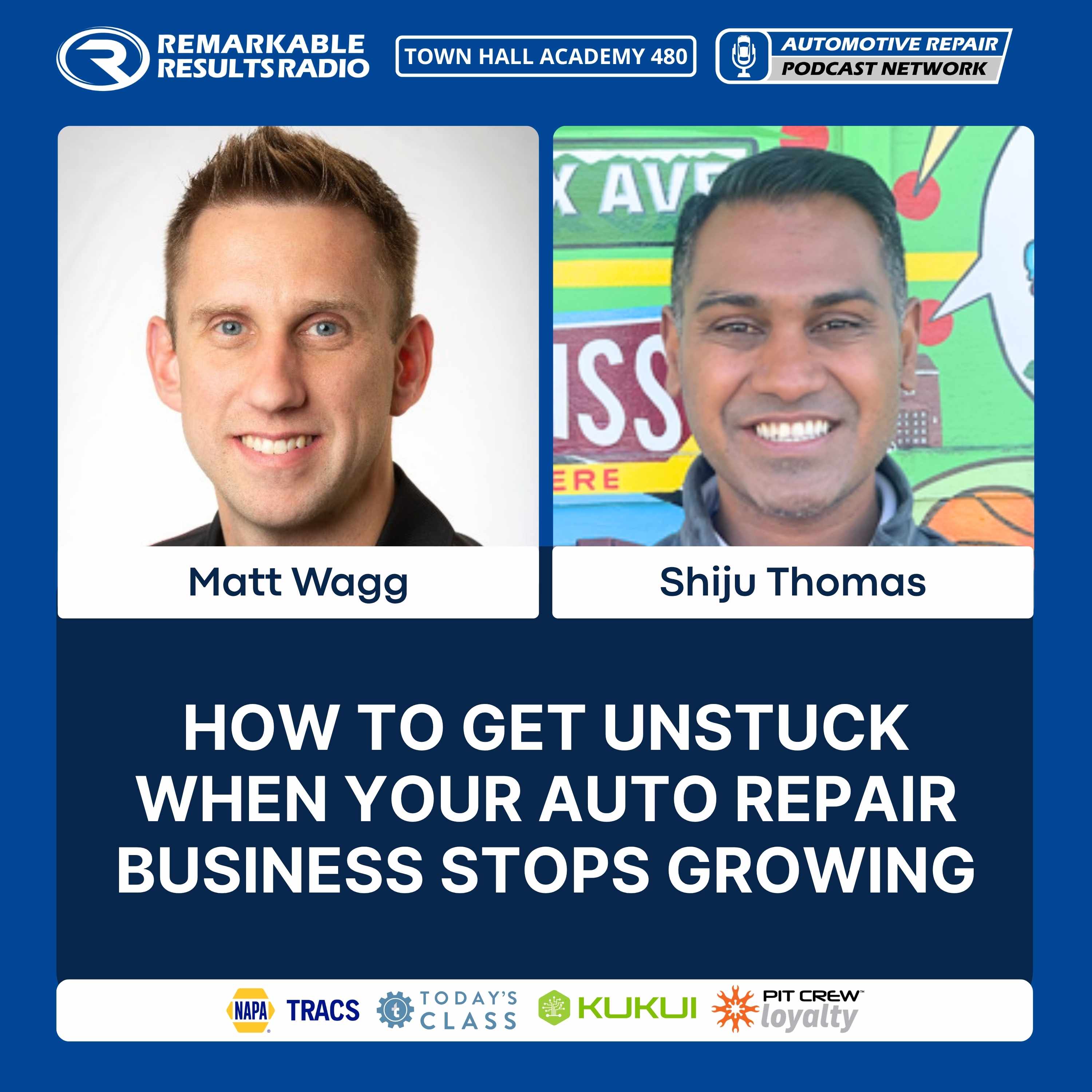
In this episode of the Town Hall Academy, host Carm Capriotto is joined by Matt Wagg and Shiju Thomas to tackle a common challenge in the automotive repair industry: getting “unstuck.” The conversation focuses on breaking through growth plateaus by sharpening leadership, building a meaningful culture, and committing to continuous employee development.
Leadership & Accountability
Growth stalls when tenure is valued over performance
Not every team member will grow with the business
Leaders must make tough calls and avoid carrying “dead weight.”
Practice radical candor: honest conversations build trust
Self-awareness is critical; seek outside accountability (coaches/peers)
Culture & Development
Culture must be intentional and tangible, not just social events
Built through aligned hiring and shared values
Reinforced with tools like assessments, training, and team learning
Continuous education prepares teams for evolving vehicle technology
A learning culture attracts higher-level talent
Embracing Being “Stuck”
Feeling stuck often signals ambition and growth
Indicates you’re pushing into new challenges
Clear personal and business goals provide direction
Without clarity, the business risks drifting without purpose
Ultimately, getting unstuck isn’t about quick fixes; it’s about honest reflection, intentional leadership, and a commitment to growth. The shops that move forward are led by people willing to have the hard conversations, invest in their teams, and take ownership of what needs to change. If you’re feeling stuck, take it as a signal, not a setback, and use it as the catalyst to refocus, realign, and lead your business to the next level.
Matt Wagg, Accelerated Diagnostics and Automotive, Bennington, NE. Matt’s previous episodes HERE
Shiju Thomas, Hotchkiss Auto Repair, Denver, CO. Shiju's previous episodes HEREThanks to our Partner, NAPA TRACS
NAPA TRACS will move your shop into the SMS fast lane with onsite training and six days a week of support and local representation. Find NAPA TRACS on the Web at http://napatracs.com/Thanks to our Partner, Today's Class
Optimize training with Today's Class: In just 5 minutes daily, boost knowledge retention and improve team performance. Find Today's Class on the web at https://www.todaysclass.com/Thanks to our Partner, KUKUI
Stop juggling multiple marketing tools. KUKUI’s integrated platform delivers 4x better website conversions, automated follow-up, and real-time ROI tracking. Get industry-leading customer support with KUKUI at https://www.kukui.com/Thanks to our Partner, Pit Crew Loyalty
You’re probably tired of chasing new customers who never return. We understand. Pit Crew Loyalty ends the one-and-done cycle, turning first visits into lasting, reliable revenue at https://www.pitcrewloyalty.com/Connect with the Podcast:
- Follow on Facebook: https://www.facebook.com/RemarkableResultsRadioPodcast/
- Join Our Virtual Toastmasters Club: https://remarkableresults.biz/toastmasters
- Join Our Private Facebook Community: https://www.facebook.com/groups/1734687266778976
- Subscribe on YouTube: