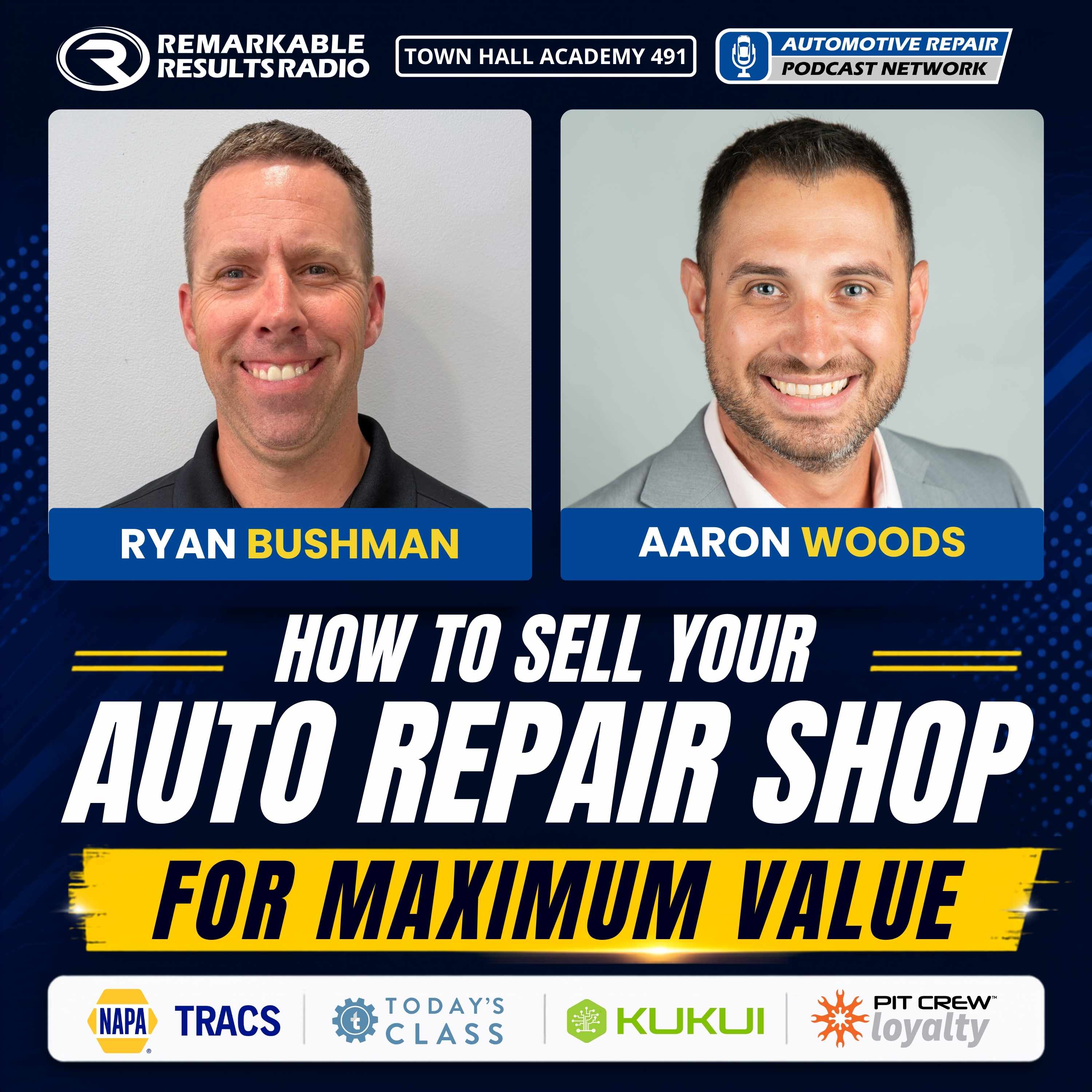
How to Sell Your Auto Repair Shop for Maximum Value [THA 491]
About this episode
The conversation focuses on how auto shop owners can sell for maximum value by planning early, tightening operations, and making the numbers buyer-ready. Hosts discuss valuation using EBITDA and an EBITDA multiple, why owner dependency and messy financials lower risk and multiples, and how clean P&Ls, add-backs, and separating owner expenses help. They also cover exit timing (planned vs forced), leadership that can run “without me,” and using peer groups for accountability and motivation.
The auto repair industry is facing a "Silver Tsunami" as thousands of shop owners approach retirement age. The challenge isn't simply selling a business; it's maximizing its value and creating a successful transition that benefits employees, customers, and future owners.
In this episode, host Carm Capriotto welcomes shop owner and business coach Aaron Woods and Ryan Bushman, a recent shop owner seller, for a candid discussion on exit planning, business valuation, financial preparation, and the leadership mindset required to build a shop that can thrive without its founder.
What You'll Learn
- Why every shop owner needs an exit strategy, even if retirement feels years away.
- How to transition from being the daily "hero" of the business to becoming a strategic guide.
- The key factors that influence shop valuation and why buyer risk impacts sale price.
- How creating a turnkey operation can significantly increase a business's market value.
- The importance of clean financial statements and separating personal expenses from business expenses.
- What "add-backs" are and how they can reveal the true profitability of your shop.
- Why investments in team development and training may strengthen valuation discussions.
- How defining your retirement goals helps determine the financial target your business must achieve.
- The value of coaches, peer groups, and industry-specific advisors during exit planning.
- Why finding an automotive-savvy accountant should be a priority for owners considering a future sale.
The best business exits don't happen by accident. Owners who begin preparing years in advance can reduce buyer risk, increase profitability, strengthen leadership teams, and ultimately maximize their company's value. Whether retirement is five years away or fifteen, the time to start building a business that operates independently of you is now. A successful exit begins with intentional planning, disciplined financial management, and a clear vision for life after ownership.
Ryan Bushman, Business Coach, Institute for Automotive Business Excellence
Aaron Woods, CEO X-tra Mile Auto Care, Stillwater, OK, Business Coach, Institute for Automotive Business Excellence. Listen to Aaron’s previous episodes HERE
Thanks to our Partner, NAPA TRACS
NAPA TRACS will move your shop into the SMS fast lane with onsite training and six days a week of support and local representation. Find NAPA TRACS on the Web at http://napatracs.com/ Thanks to our Partner, Today's Class Optimize training with Today's Class: In just 5 minutes daily, boost knowledge retention and improve team performance. Find Today's Class on the web at https://www.todaysclass.com/ Thanks to our Partner, KUKUI Stop juggling multiple marketing tools. KUKUI’s integrated platform delivers 4x better website conversions, automated follow-up, and real-time ROI tracking. Get industry-leading customer support with KUKUI at https://www.kukui.com/ Thanks to our Partner, Pit Crew Loyalty You’re probably tired of chasing new customers who never return. We understand. Pit Crew Loyalty ends the one-and-done cycle, turning first visits into lasting, reliable revenue at https://www.pitcrewloyalty.com/ Connect with the Podcast:- Visit the Website:https://remarkableresults.biz/
- Subscribe on YouTube:https://www.youtube.com/carmcapriotto
- Follow on Facebook:https://www.facebook.com/RemarkableResultsRadioPodcast/
- Follow on LinkedIn:https://www.linkedin.com/in/carmcapriotto/
- Follow on Instagram:https://www.instagram.com/remarkableresultsradiopodcast/
- Join Our Virtual Toastmasters Club:https://remarkableresults.biz/toastmasters
- Join Our Private Facebook Community:https://www.facebook.com/groups/1734687266778976
- Join our Insider List:

Ford Capri
"One episode at a time. Carm Capri out here with deep thanks to you as a listener an..."
The Ford Capri is a Ford car that’s shaped like a sporty two-door coupe. It was made for people who wanted a stylish car that could still feel fun to drive. It may be discussed because it’s a well-known model from the past that many enthusiasts still talk about today.
The Ford Capri is a classic European-style personal coupe built by Ford, known for its sporty look and role as an affordable “grand tourer” for enthusiasts. It often comes up in podcasts and car discussions because it represents a distinct era of Ford’s design and performance-focused models. The mention in the episode likely ties to the car’s identity and the community of owners who keep these cars on the road.
EBITDA
"And when we talk about the multiplier of EBITDA, that's really the risk associated with the deal, right? ... Therefore it increases the multiple of the EBITDA, right?"
EBITDA is a way to measure how much money a business is making from its day-to-day operations, before certain accounting items. When people talk about a “multiple of EBITDA,” they mean the sale price is calculated as a number times that earnings figure. It helps buyers compare one business to another in a consistent way.
EBITDA is a financial metric that approximates a business’s earnings before interest, taxes, depreciation, and amortization. In a shop-sale context, buyers and sellers use it to estimate how much cash the business can generate and to compare deals consistently. The “multiplier of EBITDA” means the purchase price is often expressed as a multiple of that EBITDA figure.
risk associated with the deal
"And when we talk about the multiplier of EBITDA, that's really the risk associated with the deal, right? ... Doing all of those things decreases the risk to a potential buyer."
In business sales, “risk associated with the deal” refers to how likely the buyer thinks the earnings will hold up after the transaction. If the shop’s success depends heavily on the current owner (for example, being the main technician or front-counter face), the buyer perceives more risk. That perceived risk can reduce the valuation multiple.
turnkey package
"So really focusing on lowering the risk to a potential buyer of the business by processes, by owner involvement, by being able to hand them a turnkey package that runs just like it did the week before, the week after the sale is going to increase that multiple."
A “turnkey package” means the business is set up so it can run with little extra work from the new owner. Here, it’s about having clear processes and systems so the shop keeps operating the same way after the sale. Buyers like that because it lowers the chance of surprises.
A “turnkey package” means the seller hands over a business that can operate smoothly with minimal additional setup. In this context, it implies documented processes and systems so the shop runs consistently even after the owner is no longer involved. That reduces buyer uncertainty and supports a higher valuation multiple.
Request an Explanation
Heard something you'd like explained? We'll add it to this episode.
Sign in to request explanations for terms you heard.
Want to learn more?
Browse our glossary for plain-English explanations of automotive terms, jargon, and concepts.
Help improve this episode
See something that's not quite right? Our annotations are AI-generated and can sometimes miss the mark. Click the flag icon on any annotation to suggest a correction.