The Ford Capri is a Ford car that’s shaped like a sporty two-door coupe. It was made for people who wanted a stylish car that could still feel fun to drive. It may be discussed because it’s a well-known model from the past that many enthusiasts still talk about today.
EBITDA is a way to measure how much money a business is making from its day-to-day operations, before certain accounting items. When people talk about a “multiple of EBITDA,” they mean the sale price is calculated as a number times that earnings figure. It helps buyers compare one business to another in a consistent way.
In business sales, “risk associated with the deal” refers to how likely the buyer thinks the earnings will hold up after the transaction. If the shop’s success depends heavily on the current owner (for example, being the main technician or front-counter face), the buyer perceives more risk. That perceived risk can reduce the valuation multiple.
A “turnkey package” means the business is set up so it can run with little extra work from the new owner. Here, it’s about having clear processes and systems so the shop keeps operating the same way after the sale. Buyers like that because it lowers the chance of surprises.
LIVE
This is the Automotive Repair podcast network.
Hey, what's up everyone?
Welcome back to episodic education with a goal to advance our professional
automotive service industry.
One episode at a time.
Carm Capri out here with deep thanks to you as a listener and to all of our
great sponsors who make the show possible.
Hey, let's face it.
Your shop management system is the most critical tool in your shop.
And Napa Tracks will move your shop into the SMS Fastlane with onsite training
six days a week support and local representation.
Find Napa Tracks on the web at N-A-P-A-T-R-A-C-S dot com.
Ready to optimize with today's class?
Boy, listen to an episode we did with David Boy's great program.
Roll out a training plan for your automotive shop in just five minutes
daily you boost knowledge retention and improve team performance.
Start seeing results today.
Join your peers at today's class dot com.
You're probably tired of chasing new customers who never return.
We understand pit crew loyalty ends the one and done cycle turning first
visits into lasting reliable revenue on the web at pitcrewloyalty.com.
They deliver four times better website conversions, automated follow-up
and real time ROI tracking.
Get industry leading customer support with Kukui.
That's K-U-K-U-I dot com.
Hey, look it.
We've got this app out there that you've got to get your hands on the
Automotive Repair Podcast Network app.
You know, we produce seven podcasts a week.
We've got all these great talent.
Look at Matt and Hunt and Chris and Kim and Brian and Craig.
You got to get the app ARPN dot app.
There's so many fun things you can do with this thing, by the way.
You know, you can save your own playlists.
You can share things with people.
You can read all the show notes all in one place ARPN dot APP.
Hey, today I'm loving this episode.
We've got a couple of really great people on here to talk.
We're going to talk about the value of your business, preparing your
business for sale.
And all I can say guys is this.
It's an overused two word statement that means so much in our industry.
It's called the Silver Sonami.
And in fact, it's like, you know, a horror movie from Hollywood.
The Silver Sonami.
And it's so true because what's the percent?
It escapes my mind of shop owners that are over 60 and are really
looking to retire.
And if they haven't said that they are, they really are.
And they haven't publicly admitted it with me to talk about this as
Aaron Woods, extra mile auto care and still water Oklahoma.
Hello, Aaron.
Hey, Carm, it's good to be back.
Good to see you.
Good to see you.
Congratulations.
Just got married, right?
Thank you.
Yes, just two weeks ago.
Coach and president of the Institute.
Yes, sir.
Damn, you don't have anything else to do, do you?
And she still married you.
I'm blown away.
When you find somebody that's more than a two points ahead of you,
you got to wrap that up, my friend.
So yes, married my best friend two weeks ago.
I met her.
Wonderful woman.
Yeah, absolutely.
She was on the cruise.
All right.
Ryan Bushman is also here.
Ryan, new coach at the Institute.
He just sold his business a few months ago, family business.
He did go through the process of raising his value to prepare for a sale.
We can't wait to hear all about it, Ryan.
Thanks for being here.
Yeah, thanks for having me.
Glad to be here.
The industry needs this.
We talk about succession.
We've done a lot of episodes.
Aaron, you may have even been on a few in the past,
but it's the kind of topic that we just can't let alone and forget
we did it a couple of years ago or six months ago.
We got to bring it back because there's always new listeners
who come on that are feeling brand new things going on in their life
and things that they want to do, which is why we want to talk about this
and probably give it a different kind of a slant than we have done in the past.
We want to talk about valuation of your business, what you want really,
what you want and if that number is here and you've done any kind of math
or gone to anyone else and where you think you could get is here.
How do you close that gap to get what you want?
And are you going to sell to an internal candidate,
maybe a local individual who owns shops who's looking to scale
or private equity and how you really can plan to get where you want to get.
So let's start when gentlemen should a shop owner decide to start to sell?
Oh, by the way, I think I know the answer.
I want a million dollars for my business and I'm just going to go out and shop it.
But I don't know if the numbers that are on my profit and loss statement
will support someone giving me a million bucks.
So how do we close that gap if it exists, Aaron?
You hit the nail on the head.
It's like, when do we start to think about selling our shop?
I think that that needs to start at a much earlier stage, right?
I mean, when we're ready to exit is not the time that we want to start
thinking about our exit.
Somebody once told me and I think it was great advice when they say
that there is, you know, a couple of different ways to look at that, right?
It's like everybody is going to exit in a business.
It's whether it's a planned exit or a forced exit is really the difference
between the two.
What we encourage a lot of people as shop owners, you know, clients is
that you want to be able to be in your position for a planned exit.
And so when does that begin?
That oftentimes begins much earlier, you know, oftentimes even years
before the physical act of the exit.
I think that's always great advice that I certainly intend to
live by with my shop as well.
Great advice, Aaron.
Did that strategy work for you, Ryan?
Definitely.
I think what really propelled our ability to sell was just the fact
that we were building a business that was bigger than just me.
We had processes in place and we had people in place that wanted
to run their positions and their jobs without just me doing everything.
And so I think that was the key is we're building something that
that I could send off without me being there.
I think he hit it.
One of the most important things and it should be in the takeaway
of this episode is without me in it.
Am I right, Aaron?
You go and want to buy a business and that owner is front and center
pivotable point center of the circle and he leaves the business could
implode if he hasn't let it run without himself.
That's a great point.
And a lot of times when we talk about evaluation of a business, right?
There's essentially two things that go into the evaluation of the business.
When I start asking myself as a shop owner, what is my business worth?
There's what we call the net profit of the business, which went on
the financial world.
We call that EBITDA, which is an acronym, right?
For earnings before the interest, taxes, depreciation and amateurization.
And then there's the multiple of EBITDA that we oftentimes bring.
So an example might be as if my shop has an EBITDA or a net profit
number of $250,000 annually, then that's what the number is that I have.
And then the multiple of EBITDA is oftentimes what I would look to get.
And when we talk about the multiplier of EBITDA, that's really the risk
associated with the deal, right?
And as Ryan had alluded to earlier with talking about and his preparation
for the sale, how he focused on processes and he focused on getting
the business to where he as the owner was not needed in the operation.
Doing all of those things decreases the risk to a potential buyer.
So therefore it increases the multiple of the EBITDA, right?
And so that can, you know, having those things and vice versa, right?
Going back to what you said, Arm is, Hey, I'm an owner, I'm looking to sell,
but you know, I'm really the hero in the business, meaning the business
success each day is really evolved around me, whether I'm at the front
counter, you know, facing the customers each day or I'm in the shop
as the main technician of business.
If I'm a potential buyer of this business, then that's going to be more
risk for me as I look to remove the owner from that operation.
Therefore, that multiple of that net profit or EBITDA is going to be
much less.
And so that can really swing, you know, the deal whether we're talking
going back in the example of the $250,000 EBITDA or net profit, a
multiple of, you know, say three is going to be a much different
in number than say a multiple of one or 1.5 at that point.
So really focusing on lowering the risk to a potential buyer of the
business by processes, by owner involvement, by being able to hand
them a turnkey package that runs just like it did the week before,
the week after the sale is going to increase that multiple.
Ryan, I know you want to jump in and I have a ton of questions for you,
but I've got to stop for a moment, Aaron.
You brought up the word hero.
If you go back to Donald Miller and story brand, right, there's the
hero, the guy, the villain and the victim.
Sometimes owners say that they're the victim because the world's against
me, but to be the guide for your people and let them become the
hero allows you to get up and out of the business.
So I wanted to clarify that for one reason.
Oh, yeah, so I am the hero of the business.
What should I be?
You should be the guy and that's just my point.
Ryan, did you have an eternal candidate?
I didn't.
Honestly, I wasn't looking to sell it all.
So I think that's the beauty of it is we were building a business
that was valuable and I didn't even realize it, I guess.
I had goals at age 55.
I wanted to be able to retire and I'm 46 now.
And so we were doing things to try and get ready for that.
We were approached with a substantial offer and my wife and I looked
at each other and said, well, you know, maybe it's time for me to do
something else if we can sell it for that much money and move on.
Then yeah, I could do something else.
And so yeah, it's interesting.
I wasn't even looking to sell.
What a great point, Aaron.
We weren't even ready, but we had done the work to prepare for this
potential day.
Absolutely.
I'm sorry.
When that piece of gold lands in your lap, you pet it.
I think that's a great point.
It goes back to what, you know, we were talking about at the beginning
of the episode, right?
It's like everybody is going to exit at some point in time, right?
It's whether it's a planned exit or it's a forced exit.
And I guess what I mean by forced exit isn't necessarily like, you know,
somebody bought your building and kicked you out.
I mean, more of like your, you know, whether it be an age or retirement,
your body can't physically do it anymore.
Like all of those things in my opinion are more of like a forced exit.
But even if Ryan wasn't necessarily had the intention right there to sell,
it was still a planned exit, right?
Because it was a planned exit because he was thinking about, he had some
sort of an end goal in mind.
He was preparing the business.
It was no longer dependent upon him.
He had the processes in place.
And so even though that he didn't know exactly when the day
was that it was going to happen, it was still planned.
You know what I love about it?
He was doing wealth building for whatever possible or potential date.
It could have ever happened, but he wasn't prepared for it.
But he was prepared for it because he got out of his own way problem.
I don't know how long ago it started to be the CEO and really run the
business and it goes back to, I think something you said earlier, Ryan.
We had the protocols, the processes, the driven systems.
You know, the hero driven performance was gone and you end up being
the guide in your people were the heroes in the business, which
anyone could walk in and just go guys, let's go.
It's new day.
Let's keep working and they just kept going along.
How's the business doing by the way?
Business is doing well.
It's fun to go in and see those processes still working.
Certainly they've made some changes and I think that's another
thing that when you sell, you have to be expecting that things may
change and that's okay.
It's not yours anymore, but it is fun to see, you know, the people
that you grew with doing well and some people have left and most are
there, but yeah, to see those processes working and and then
excelling it doing that is always awesome to see.
Cool to see some legacy there.
Okay.
So let's pick some key things to start with obviously processes and systems
protocols I call them, but clean financials.
That's a big hurdle for so many, isn't it?
Absolutely.
I mean, if you think about it, going back to what I mentioned before
about the multiple of the EBITDA, right?
And you know, so many I'll draw from my experience of coaching is
that when we look at a financial statement, it's unclean.
It's unclear whether I even, you know, whether we're working with
somebody that doesn't even necessarily have a P&L.
We were talking a little bit before the show, Carm.
I'm actually, you know, on my shop side of things, you know, in the
midst of acquiring a location, you know, about 60 miles away.
And so I'm going through this process, you know, from the side of
the buyer and when we were talking about it and the shop owners
sending me the financials and we're having to really go through and
decipher what's owner's personal spending through the business,
what is going to translate terms of expenses from that ownership
into us, when those financials aren't necessarily clean, it makes
that net profit or that EBITDA numbers more difficult to arrive to.
And when that number is unclear as to what that is because the
financials aren't clean and prepared, then the multiple that we talk
about, again, going back to the risk factor is going to be much lower.
And nothing against the shop owner.
Great guy.
He's ran a very successful business for 40 plus years, but it's just
a testament as to say that this individual and so many people,
there's not a planned exit and so when it's time for them or they're
ready to retire, it's going, you know, here's everything that I have.
I know it's not where it needs to be.
What can I get from my business?
Let's face it, your shop management system is the single most important
tool in your shop, period.
Napa Tracks was built from the ground up to make your business more
profitable and efficient.
We provide an extensive set of tools to increase and track profitability
in real time.
Napa Tracks offers the industry's best post sale support hands down
and we train your people on site.
Yep.
On site and we offer remote refresher training 10 times a week
and customer support is open six days a week.
Give us a call, visit the website or join our Facebook community today
to learn more.
We'll prove to you that tracks is the single best shop management
system in the business.
Napa Tracks is always customized and tailored for you.
Whether you're a one man shop or a large multi bay or multi location
company, after all, it's your shop.
So it's your choice.
Visit us on the web at Napa Tracks.
That's N-A-P-A-T-R-A-C-S dot com.
Strengthen your shop's entire team with today's class.
Everyone from technicians to service advisors can access impactful
training on their phones in just five minutes a day.
Opt for solo sessions or ignite friendly competition, challenging
team members to climb the leaderboard for the highest score.
Our effective daily training ensures measurable progress, helping
you develop your team.
Train smarter, not harder with today's class and transform your shop
and your people.
Start seeing results today at today's class.com.
You know, most shop owners feel trapped spending on ads while
half their first time customers never come back.
It's frustrating.
It's exhausting and it's not your fault.
The industry average is 54% one and done.
We understand how discouraging that can be.
Well, pit crew loyalty changes the story.
Our clients cut that rate by up to 38% raising lifetime value by
more than 50%.
Loyalty members visit nearly three times more often creating
predictable revenue without extra ad spend.
Pit crew loyalty where customers stay and shops thrive on the
web at pitcrewloyalty.com.
Shop owners, we know you are overwhelmed with a flood of missed
calls, empty bays and disconnected marketing tools.
Cacui has spent over a decade building one integrated platform
for auto repair shops, one login, one dashboard and mobile first
websites that convert four times industry average smart,
innovative CRM with automated follow up 24 seven online booking
and real time ROI tracking with 900 plus years of combined
team experience.
We feel the growth of 2200 plus shops and have influenced
$3 billion in revenue.
Stop working harder.
Start working smarter.
Get industry leading customer support and book a demo with
Cacui.
That's kukui.com.
This episode has so much power and we're only how far in about
16 minutes and if the industry could share this with people
that they know, you know, let's go back to the, you know, the
20 groups that Aaron, I know you lead with the Institute.
They wouldn't be in that if they weren't wanting to be just the
best CEOs in the industry and prepare one day for for something
be it acquisition or scaling.
However, and I find that if our people in the industry don't
listen to this, then I only have one thing to say.
Shame on that they're not going to take something.
Listen, learn just one thing and implement it.
Take something from here and start to run a better business
so that someday you can get out and feel a whole lot happier
than you would than having to accept a hardly anything for
all the years that you put in.
Let's go back to, you know, building staging the business.
Ryan, you got to separate owners expenses from the business.
Is that going to be a critical thing to look at?
Oh, definitely.
So as we went through the process, the first thing that they
asked for before they'll put an offer together is I want to
see, you know, P&L's and balance sheets and three to four
years of that.
And so we sent that off and the one thing that came back as
positive feedback was, wow, those are some clean financials.
That's made it very easy for us to put an offer together and
when they go to the bank to get the money, the banks way more
willing to work with them and say, yeah, we can give Flynn
money on this business because we can see that it's been
making money.
Isn't that a cool word, Aaron?
Clean financial clean.
They're clean.
That's right.
It's clean and I love what he said there because it's so true
and it really, it goes back to just the foundational component
of any art of negotiation, right?
It's who has the leverage?
You know, going back and talking about Ryan in that situation
and it's like he presented these financials and they're clean.
They're organized.
That sends the message to the potential buyer in that sense
that Ryan, you know, has been running a great profitable
organized business.
Well, in that point, the leverage almost shifts into Ryan's
support at that point because now he knows, listen, I have
options to go out and if this doesn't, this deal doesn't work
with this buyer.
I know that I could go approach a different buyer and therefore
when those options are in Ryan's side of the corner, then
the leverage moves over there and then the value of that
business goes up, right?
Versus the other side of it.
If it's like, well, if it's not clean, it's not organized and
it's like, well, this, you know, as a buyer, if I'm looking to
retire, it's like, well, this might be the only buyer that I
can find for my business, then they have the leverage at that
point.
So it really just kind of comes back to just the basic
component of any sort of a deal, right?
It's like, who has the leverage and where does that come from?
Great point.
Okay.
So clean financials, separating the owner's expenses, good
protocols, process driven performance now.
You mean you want me to make more money too?
God help you.
If you were doing wealth building, you've got to start
maximizing profitability.
You've got to look at everything going on, marketing and
matrixing and pricing, all of that.
So there's such a huge component in there.
This segment of this is a heavy lift, right?
All right.
Absolutely.
I agree.
You know, I think it comes down to where do we live in the
business and are we coming to work every day?
And are we focusing on being the role?
I talk a lot about the difference between a title and a
role in the business.
And there's so many times where the owner is the title that
they have, but the role that they fill in the business isn't
the owner's role.
It's a manager role.
It's a technician role.
It's a service advisor role.
And it's like, what's the biggest advice that I give?
Like you say, Carmen, what do I focus on?
Well, I think we have to focus on how do I step more into
the role of the owner and the owner is to overseas the
marketing and the financials and, you know, the processes
and all of the things that we need to do because if I'm
focusing on being a technician all day or I'm focused on
being a service advisor all day, I'm too in much in the thick
of the business to be able to focus on those higher level
strategy components.
And then at that point, that's where the business is really
driving you at that point.
You're not necessarily driving the business.
We have brought up some incredible strategies, things
that people need to focus on to do this from your both
personal experiences.
What are the biggest mistakes you see owners making out of
all this?
Well, I think the biggest thing with most owners is number
one, they haven't surrounded themselves with other individuals.
We've talked about the 20 groups and I think that that is
what taught me the most once I hired a coach got into a 20
group and had the support of my peers.
It's amazing how much faster we grew and how those processes
were easier to build because you're working as a team of
20 group members to build processes, not just yourself.
And so many owners, you talked about it as we were leading up
to this, they want to keep their secret sauce.
I don't want to share that with anybody, but that's not the
way this industry should work.
We should be sharing everything with all of our peers.
We're not in competition, we're a team.
Yeah, okay, I'll talk about the secret sauce here for a minute.
A lot of people don't want to share their secret sauce
because what they really are admitting to you is that
they're really suffering under a whole lot of stresses and
challenges that they don't want to admit to anyone that they
have like meeting payroll, paying their bills, finding
really good people, toxic work environment that they believe
that they've potentially helped create this, but they don't
know how to solve it.
So the secret sauce is that I'm unwilling to get advice from
other people.
My Aaron, the peer groups are so critical and so important and
especially when you assign an accountability partner to
somebody and you've got two people running two businesses
and they're each up each others, but if you will on their
success and looking at their profit and loss statements and
they spend time weekly or monthly, I don't know the exact
details and how they're assigned.
But my God, can you imagine?
It's a quality peer pressure.
I look at it's nothing but quality and once you accept
that quality peer, the pressure is not to put you down.
The pressure is to lift you up.
Of course, I mean, Ryan and I were actually just on a coaching
call with a client just, you know, shortly before this podcast
and one of the things that we were talking about on that call
was the power of the room, right?
And, you know, you don't know what's possible and sometimes
it may seem like it is impossible until you get in a room
full of peers and you see what others are doing and what
they're able to achieve and that just almost gets you
internally motivated knowing that you can do those things
as well.
And I will always say this till the my ending day is that
the power of the group is not necessarily the coach is
sitting at the room where it's not the facilitator.
I mean, I'm not saying that those things don't have value,
but the power of the group truly comes from within the group.
It's holding each other up.
It's lifting each other up.
It's seeing how others are doing.
It's drawing from those experiences of others and
learning from others and sharing with others is truly remarkable.
And I agree 100% with what Ryan said as some of the biggest
mistakes is not reaching out and getting that support from
other people long before the time is that you're looking to exit.
Anything to say on that, Ryan?
It's just amazing when you sit in a room with your peers and
you hear them say, well, I can get, you know, 60% parts margin
on a part and you're going, well, man, I didn't think that was
even possible and you're then another one says it and another
one and you're like, all right, I can't be the only one in the
group that's not able to do that.
And so you just have to join in and it's what you call FOMO.
I don't want to be a laggard at all because the next time
I want to sit with my friends having coffee somewhere and
I want to say me too.
I want to be able to say that.
I think one of the most powerful things that an owner can
say, you know, going back to your original question, Karm is
like, what is something that, you know, you wish owners would
do and I think it's really one simple question in my opinion,
which not to take away from what Ryan said, because I agree
with that, but it's reframing a question.
It's instead of asking yourself, what can I get out of my
business?
It's reframing that into what do I need from my business?
And we recognize and I recognize that selling a business is
more than just a cash or a monetary transaction.
It's really a culmination of the years that you've served
your community.
It's the years that you've employed people around you and
they've supported their families and, you know, oftentimes
your life's work as to what you've poured into something for
20, 30, even 40, 50 years into that.
And yes, at the end of the day, the monetary value that you
receive from that sometimes is how we, how we tend to value
that on a tangible side of things, but you have to ask
yourself, what do I need from my business in order to then
fill that, you know, feel inside that what I've poured into,
you know, the things that I just talked about is what I need
out of my business to then go on and, you know, do whatever
it is that's next in life.
And I think it's just that one simple question.
I think too many people wait till the finish line and then
ask themselves, what can I get instead of starting much earlier
and saying, what do I need?
And then working on the things of the business to get to that
number at that point.
All right, let's just play a simple little game, guys.
I'm loving this episode.
I'm a listener and I'm a semi-struggling shop owner, but
I think I'm doing pretty good.
Life is great.
We got all the toys that we need, you know, we're paying
for all the grandkids cell phones out of the business, all
that junk, right?
I want to get just a million dollars for my business.
And if we do the backwards crazy math, Aaron, and that is
the multiple of three based on the EBITDA of the business.
Let's just say the EBITDA is 300003
hundred and 75000 dollars times three.
It's around a million bucks.
Okay.
Let me look at the EBITDA of my business.
Where is my Providence Law State?
Oh, it's at 80000
Oh, I got to get to 375
Oh, what do we got to do about it?
Oh, so you said something, the power of the room, the power
of the group.
If you want to get yourself to a place where the 370
five is real or the 400 all of a sudden is close
and then you're on a roll with your people and your team
because you've changed the business.
You've done a 360 and now you're going for 500
I got an eight bay place, whatever you're building on your.
Whoa, I'm sorry.
It's like the simplest piece of math.
I think that anyone can do today and then get their butt in gear
and make it happen.
How do you make it happen?
You know me.
I love coaches.
I love 20 groups.
Everybody that I know that has come up to me.
I heard you've been preaching this for eleven going on twelve
years, Carmen.
I finally did and you were right.
And I was the ass that never did anything about it.
Maybe this show is not only about valing your business for
sale, but maybe it's the upside the head.
I hear all the time one of the most common things that I hear
and I won't name names, but you know one of those people from
your local market who is one of the biggest people that I hear
say this is I wish I would have done it sooner.
Yeah, he tells me that often.
Yes, that is the number one thing that I oftentimes hear is
I wish I would have done it sooner and to go back and to talk
a little bit about, I wanted to give some advice.
I was talking with some shop owners that sold out.
This is probably been a couple of years ago and I was asking
them, I'm like, what are some things that you wish, you know,
when you got to the finish line that you wish you would have
done a little bit differently and I thought it was really good
advice and one of the things was you had mentioned, hey, I'm
looking at my profit and loss statement and I see $80,000 at
the bottom of that number, right?
And I'm looking to get up to that 350, but hey, I'm a semi
successful shop owner and I'm going to go back and use your
reference of pay for my grandkids cell phone payments and I'm
sending my kids and my kids are on the payroll, you know, as
a tax strategy and one of the things that I oftentimes tell
shop owners, listen, there's oftentimes, you know, that going
through the business as maybe part of a tax strategy and I'm
not an IRS person.
I'm not here to judge people on doing that.
But what I will say is there is a very, very important thing
in the valuation of a business that we oftentimes call add-backs
and when somebody is looking at your profit and loss statement
and they see that number at the bottom, you need to be able to
easily identify and pull out some of those, whether that be a
grandkids cell phone payment or, you know, you've got your
children on payrolls, a tax strategy, you have to be able to
identify those things very easily and if you can, you can
pull those out of the expenses to raise that net profit back
up and when it going back to the beginning of my story, when
I was talking with these shop owners that sold out back in 2022,
they said, you know, we didn't ever do that and so we were
going back for three years of credit card statements and bank
statements and trying to highlight like what was this
payment and what was that payment and oftentimes they
they probably did their best but at the end of the day, they
probably still left a lot on the table with not being able to
separate that out and so when you're looking at your profit
and loss statement, if you've got those things that you are
running through the business, you know, look at what we call
class accounting or something that is able to separate those
things easily out of the P&L so that you can ask for that
as what we call an add back to raise that net profit up.
That's incredible advice, Erin, and back in the day when I
was when I work for corporate America and I was on an
acquisitions team, we would sit down with the potential
acquisition and we'd say, have you done any work to normalize
the P&L and that's the add back piece to try to normalize it
for me to look at not for you to look at and so those are
great points, but if again, if your plan is five years, six
years from now, here's my target profitability so I can get
a 33 and a half multiple then need to start
normalizing it now.
Even if you don't take it out of your P&L, you need to have
a separate little listing going on each and every month for
what the add backs need to be.
And again, let's go back to tax strategy.
We have a podcast on the aftermark the automotive repair
podcast network with Hunt Demeris, the accountant, and you
should hear how Hunt talks about that stuff.
Stop being the tax man, just keep it clean.
Hunt's always in this keep it clean mode, but yet do anything
you want to do.
If you called him up for advice, he would probably recommend
against it.
Absolutely.
You know, and I'm going to say this as a joke, but I was
talking with somebody one time and they said, yeah, you
always want to have three sets of financials.
You want to have, you know, one for the banker,
tax man, one for the seller or for the buyer, right?
It's like, yes, obviously we're not saying do anything that's
against the law or anything nefarious.
It's just, you know, as another example of an add back, right?
It could be, hey, I have invested, you know, all of these
thousands of dollars into training.
We talk about the 20 groups and the peer groups and all of
that.
And I've seen several shop owners that have been able to
say, hey, that training is what I took and I invested into
my people to get the business to where it is, to where now
it's able to be ran without the owner being present.
So I'm going to take that thousands of dollars in training
and I'm going to ask for that as an add back into that net
profit.
So again, it doesn't necessarily have to be like a, you know,
keep grandkids cell phone.
I was just using your example, but you know, it could be be
training, right?
It could be things like that, that if we, if we're running
those clean financials and we're keeping a separate set of
numbers that we can pull out and ask for at the end of the day,
that could increase that net profit by 10 fold and it could
also raise that multiple as well.
Ryan, I have to ask you this question on what Aaron just
said, training, let's call it education.
The education for us, me, our people, our sales advisor team,
the whole thing.
I want to add that back because it brought me where I am today
in the valuation of my business and I'd say, what?
You want me to pay you for what you did to get where you are?
And so I don't know what that argument is and if it's healthy
and strong with Aaron, you bring up such an incredible
think.
What you're feeling about that, right?
Well, I definitely agree with Aaron that without that training,
you aren't where you are.
Your service advisors aren't as well equipped to handle
customers and to do the job that they need to do your technicians,
especially in our world today with the complex systems that
they're diagnosing.
If they don't have the training, then they are not going to
be able to be the top of their game.
And so I think asking for that is not unreasonable because
you have done what a lot of shops are not doing and that's
you've invested in your people.
I do think that's what sets apart the great shops from the
average shops is that they invest in their people, not just
in their, their own selves, their own pockets.
It's been great to have you guys on the show, but I have one
final question for both of you.
The same question for both of you.
You love your opinion of this.
What's one thing that every shop owner listening today should
do in the next 30 days?
If they think they may sell their business someday.
Ryan, I'm going to start with you.
Well, one of the biggest things that we did a few years back
is we hired a good accountant.
Hunt, Demeris was my accountant and I think every shop owner
needs a very good qualified accountant that knows the automotive
industry and oftentimes they're too scared to do that because
it does cost a little bit more in the short term, but in the
long term, you always get that back.
And so that was really one of the huge fines that we had is
hiring a good accountant that could help us through it on a
month to month basis.
And when I had questions, Hunt was the first person I called
when I had an offer and I said, what do you think?
And he was there to help guide me through the whole process.
And so I just think that's a key component in the day to day.
Clean financials, a new accountant kind of goes hand in hand.
It does.
Great point, Ryan.
Aaron, take us home.
As Ryan was bringing up that great point, I was thinking and
honestly, I don't know that I can choose just one.
So I'm going to give you two, but they're going to be quick.
One is seek help, get support, you know, get into a 20 group
whether, you know, there's lots of options out there, right?
The other one is, you know, I'm a big proponent of a vision
board and I think that if you see it, you achieve it.
It becomes real, it becomes tangible.
And so I'm going to draw back and I'm going to say, what do I
need from my business and what am I going to do when that day
comes after my business sells?
And I think answering that question helps then guide you
along to that process.
And therefore now you know, am I going to retire at 65?
Is it 45?
Is it 55?
What is my life going to look like and what am I going to do
after that?
And then what is the number I need to support that?
All great points, guys.
Appreciate it.
Look, it was a great episode.
I think we covered a lot of heavy content here.
Something, I mean, if anyone was taking notes or can go to the
show notes of this episode either on my website or on the app
and look at some of the bullet points that we're going to create
because of this discussion, I think you got a little mini
roadmap and maybe, as I said earlier, maybe I kick in the
butt to at least start getting where you want to be.
So if anything, pick your number, work toward it, figure out
how to work toward it and go get the power of the group
working for you.
Love that.
And I know you guys got all kinds of great groups at the
Institute.
So who knows, just maybe call the Institute.
We'd love to hear from you.
I bet you would.
Hey guys, always a pleasure.
Erin Woods, extra mile auto care out in Stillwater, Oak,
Lowholm and coach and president of the Institute and Ryan
Bushman, brand new coach at the Institute, sold his business
a few months back and he figured out a while back how to get
the number.
He was unexpectedly going to get this.
Good for you, my friend.
Thanks guys.
Thank you.
Thank you, calm.
Thanks for having us.
Thanks for being on board to listen and learn from the
premier automotive repair business podcast, remarkable
results radio.
Get your episodic education on the ARPN listening app at
automotive repair podcast network.com.
Also enjoy the podcast on our Carm Capri auto YouTube
channel.
Carm is all for advancing the professional automotive
service industry until next time.
About this episode
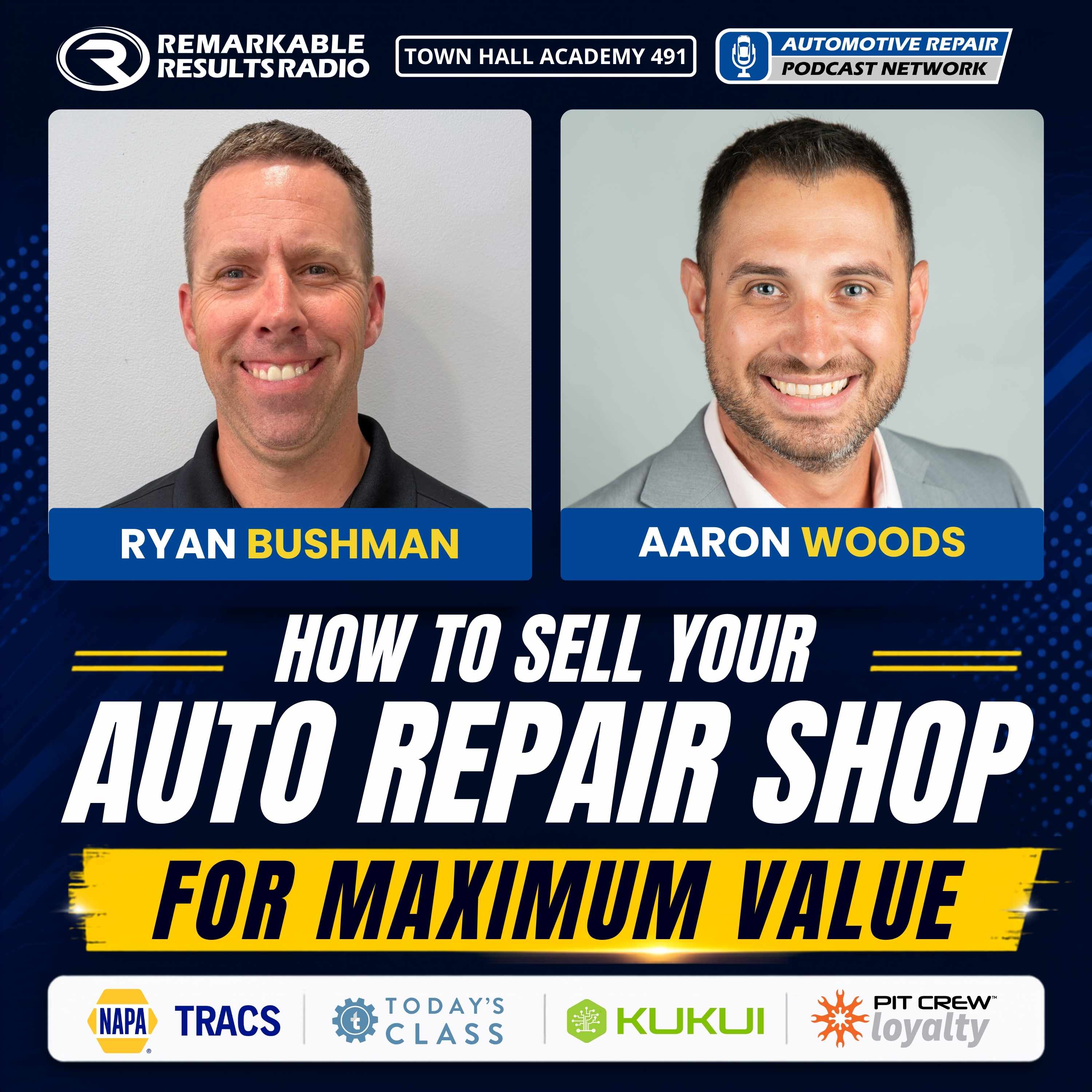
The conversation focuses on how auto shop owners can sell for maximum value by planning early, tightening operations, and making the numbers buyer-ready. Hosts discuss valuation using EBITDA and an EBITDA multiple, why owner dependency and messy financials lower risk and multiples, and how clean P&Ls, add-backs, and separating owner expenses help. They also cover exit timing (planned vs forced), leadership that can run “without me,” and using peer groups for accountability and motivation.
Thanks to our Partners, NAPA TRACS, Today's Class, KUKUI, and Pit Crew LoyaltyWatch Full Video Episode
The auto repair industry is facing a "Silver Tsunami" as thousands of shop owners approach retirement age. The challenge isn't simply selling a business; it's maximizing its value and creating a successful transition that benefits employees, customers, and future owners.
In this episode, host Carm Capriotto welcomes shop owner and business coach Aaron Woods and Ryan Bushman, a recent shop owner seller, for a candid discussion on exit planning, business valuation, financial preparation, and the leadership mindset required to build a shop that can thrive without its founder.
What You'll Learn
Why every shop owner needs an exit strategy, even if retirement feels years away.
How to transition from being the daily "hero" of the business to becoming a strategic guide.
The key factors that influence shop valuation and why buyer risk impacts sale price.
How creating a turnkey operation can significantly increase a business's market value.
The importance of clean financial statements and separating personal expenses from business expenses.
What "add-backs" are and how they can reveal the true profitability of your shop.
Why investments in team development and training may strengthen valuation discussions.
How defining your retirement goals helps determine the financial target your business must achieve.
The value of coaches, peer groups, and industry-specific advisors during exit planning.
Why finding an automotive-savvy accountant should be a priority for owners considering a future sale.
The best business exits don't happen by accident. Owners who begin preparing years in advance can reduce buyer risk, increase profitability, strengthen leadership teams, and ultimately maximize their company's value. Whether retirement is five years away or fifteen, the time to start building a business that operates independently of you is now. A successful exit begins with intentional planning, disciplined financial management, and a clear vision for life after ownership.
NAPA TRACS will move your shop into the SMS fast lane with onsite training and six days a week of support and local representation. Find NAPA TRACS on the Web at http://napatracs.com/Thanks to our Partner, Today's Class
Optimize training with Today's Class: In just 5 minutes daily, boost knowledge retention and improve team performance. Find Today's Class on the web at https://www.todaysclass.com/Thanks to our Partner, KUKUI
Stop juggling multiple marketing tools. KUKUI’s integrated platform delivers 4x better website conversions, automated follow-up, and real-time ROI tracking. Get industry-leading customer support with KUKUI at https://www.kukui.com/Thanks to our Partner, Pit Crew Loyalty
You’re probably tired of chasing new customers who never return. We understand. Pit Crew Loyalty ends the one-and-done cycle, turning first visits into lasting, reliable revenue at https://www.pitcrewloyalty.com/Connect with the Podcast: