This is a more rugged version of the Subaru Outback. It’s meant to handle rougher roads better than the regular models, and in this episode the host also talks about the updated interior screens and the engine/transmission setup.
Wilderness is Subaru’s more rugged version of the Outback. It’s meant to be better suited for rougher roads and light off-roading than the regular trims.
The Wrangler is an off-road SUV. The podcast is saying it’s tougher than a typical SUV, but it’s not only for the hardest trails. Driving on rough ground can make wheel bearings wear faster.
This means the car uses a 2.4-liter engine with four cylinders, and it has a turbo to make it feel stronger. The host then connects that to how the car drives, especially when the engine shuts off and restarts.
A CVT is a type of automatic transmission that can change ratios smoothly instead of using fixed gears. In this case, the host says the car’s stop-and-start behavior felt rough when it turned back on.
Auto start-stop is a system that shuts the engine off when the car is stopped (like at a light) to save fuel, then restarts it when you’re ready to move. The host describes a rough restart event—especially noticeable when you press the gas right as the system is transitioning—resulting in a jolt.
“Cubic feet” is how car reviewers measure how much space there is to store things. Bigger numbers mean you can fit more gear behind the seats or in the back.
All-weather floor mats are tough mats that catch mud and water so it doesn’t ruin the carpet. They’re made for wet or snowy days and are usually easy to hose off.
Term
aquafobic
“Aquafobic” here just means “doesn’t like water.” The host is saying the car’s interior doesn’t get stained or marked when it’s wet.
“Trailseeker” is Subaru’s name for a more adventure-oriented version of the Outback. Here, it’s being used to describe the newer, more SUV-like direction.
The Subaru Trailseeker is an SUV version meant for outdoor or rough-road use. The podcast is talking about it as a new name or updated version. If you drive it on rough roads, wheel-related parts can wear faster.
Torque is the “pulling power” that helps the vehicle get moving. Higher torque usually means it feels stronger when you accelerate, especially from a stop or slow speeds.
Range is the estimated distance a vehicle can travel before it needs to be recharged or refueled. For electric vehicles, range depends on battery capacity and real-world factors like speed, temperature, and driving style.
Rear wheel steering means the back wheels can also turn a little. That helps the car turn into tight spots—like parking—without you having to do as many awkward maneuvers.
The Mercedes-Benz S-Class is a top-of-the-line luxury car. Here, they’re talking about the big dashboard screen and how the car shows driving/navigation info.
MBUX is Mercedes-Benz’s dashboard computer system. It’s designed to show navigation and key controls on the screen in a way that’s easier to use while driving.
The EQS is Mercedes-Benz’s electric luxury sedan. In this part, they’re using it to talk about how Mercedes is building upcoming electric cars on different electrical “voltage” systems.
This means the EV is built with a higher-voltage electrical system. In general, higher voltage can help the car charge faster and move power more efficiently—if the charger and car are designed for it.
This is the EV’s lower-voltage electrical design. The host is comparing it to higher-voltage EVs, which often aim for faster charging and better efficiency.
The Chevrolet Volt is a plug-in hybrid, meaning it can drive on electricity and also use gas when needed. The podcast is talking about differences in the car’s electrical system related to charging and power. How you drive and charge can affect wear on parts around the wheels.
That “kilowatts” number tells you how fast the charger can put energy into the battery. Bigger number usually means faster charging, as long as the car supports it.
“Volts” is the electrical voltage of the EV’s battery system. Higher voltage can help the car charge efficiently and sometimes faster, because it can move power with less current.
AC charging is the kind of charging where the power comes in as alternating current, and the car converts it for the battery. It’s typical for home charging and slower chargers.
All wheel steering means the car can steer more than just the front wheels. That can help it turn more easily at low speeds and feel steadier when driving fast.
Term
118
That “118” number is likely how much energy the battery can store. A bigger battery usually means more driving distance, but driving style and efficiency still affect it.
Kilowatt-hours (kWh) tell you how much energy is in the car’s battery. A bigger number usually means the car can go farther, but it also depends on how efficiently the car uses that energy.
“Miles per kilowatt-hour” is a way to measure how efficiently an EV uses its battery. If the number is higher, the car goes farther on the same amount of battery energy.
The Mercedes-Benz GLC is a luxury SUV. In this conversation it’s mentioned as part of a comparison about how EV range and efficiency can differ from one model to another.
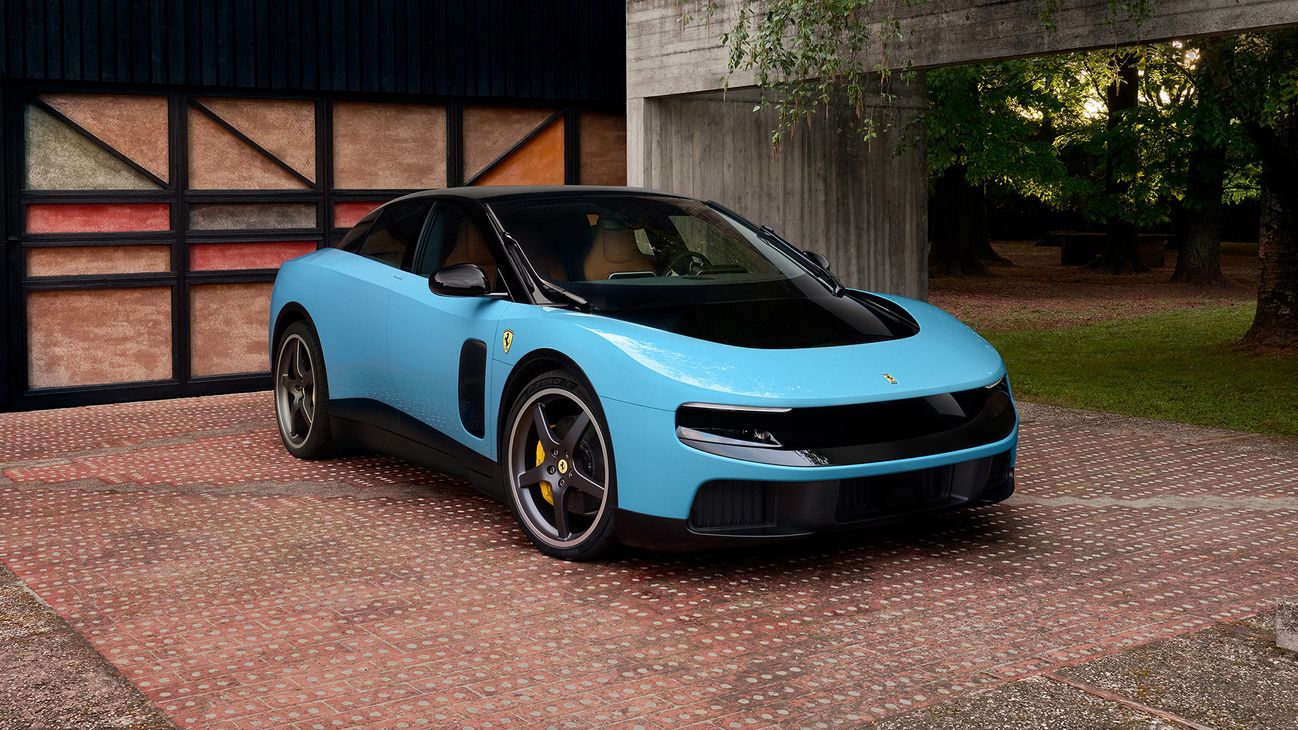
The Ferrari Luce is mentioned as a name that might be used for a future Ferrari. The podcast is speculating about it rather than describing a specific car you can buy today. There aren’t enough details here to talk about its maintenance or parts.
Rear axle steering means the back wheels can steer a little too. That helps the car turn more easily in parking lots and can feel steadier when you’re driving faster.
“Enhanced steering” means the car’s steering system can be set to do more than the basic version. In this case, it’s about letting the rear wheels turn more for tighter maneuvering.
The Mercedes EQS SUV is an electric luxury SUV. Because it has a big battery, it can feel heavy, but it’s still designed to drive smoothly and handle nicely.
The third row is extra seating behind the second row. On many SUVs it’s there for emergencies or occasional trips, but it can be tight and not very comfortable for regular use.
The Toyota Highlander is a family SUV that can seat more people. The podcast is saying the third row exists, but it may not be very comfortable or practical. Carrying more people and using the vehicle often can increase wear on parts near the wheels.
Adaptive cruise control is cruise control that “watches” the car in front of you. It can slow down when traffic gets slower and speed back up when the road opens again.
The Mitsubishi Outlander is a midsize SUV. The podcast is mentioning it because it was expected to be used or reviewed but didn’t work out as planned. How a vehicle is driven and maintained affects wear on wheel-related parts.
The Kia EV9 GT line is an all-electric family SUV with three rows of seats. The big point in this segment is that its charging plug is different, so you may need the right adapter to charge it at home.
An AXJ3400 charge port is the specific type of plug your EV uses to charge. If your home charger uses a different plug type, you’ll need an adapter to connect them.
The Genesis GV70 is a compact SUV from a luxury brand. The podcast is talking about whether there’s an EV version and how the lineup is organized. Like any SUV, how you drive affects wear on parts near the wheels.
J1772 is the common plug used by many home EV chargers. In this segment, the host couldn’t use their J1772 charger without the right adapter for the EV9’s charging port.
A NAX adapter is a piece you use to connect your EV to a different kind of charging plug. The host says the car had one adapter type but not the one needed for their home charger, so they ordered it.
The Hyundai Ioniq 9 is a Hyundai electric vehicle. The host is saying it uses a lot of the same core engineering as a Kia, even though the outside design looks different.
Captain’s chairs are separate seats in the middle row instead of one big bench. They can feel more comfortable and make it easier to get to the third row.
Here, “Ottomans” means built-in footrests for the back seats. The host says they’re designed so they won’t move while you’re driving, which helps prevent distractions or unsafe movement.
That means the dashboard uses two big screens, each about 12.3 inches. One screen shows the driver info, and the other usually handles things like music, navigation, and settings.
Climate control is what keeps the car’s cabin comfortable. It controls heat or A/C, how strong the fan is, and where the air blows (like toward your feet or your face).
Dual zone temperature control means the driver and passenger can set different temperatures. So one person can be warmer or cooler without affecting the other.
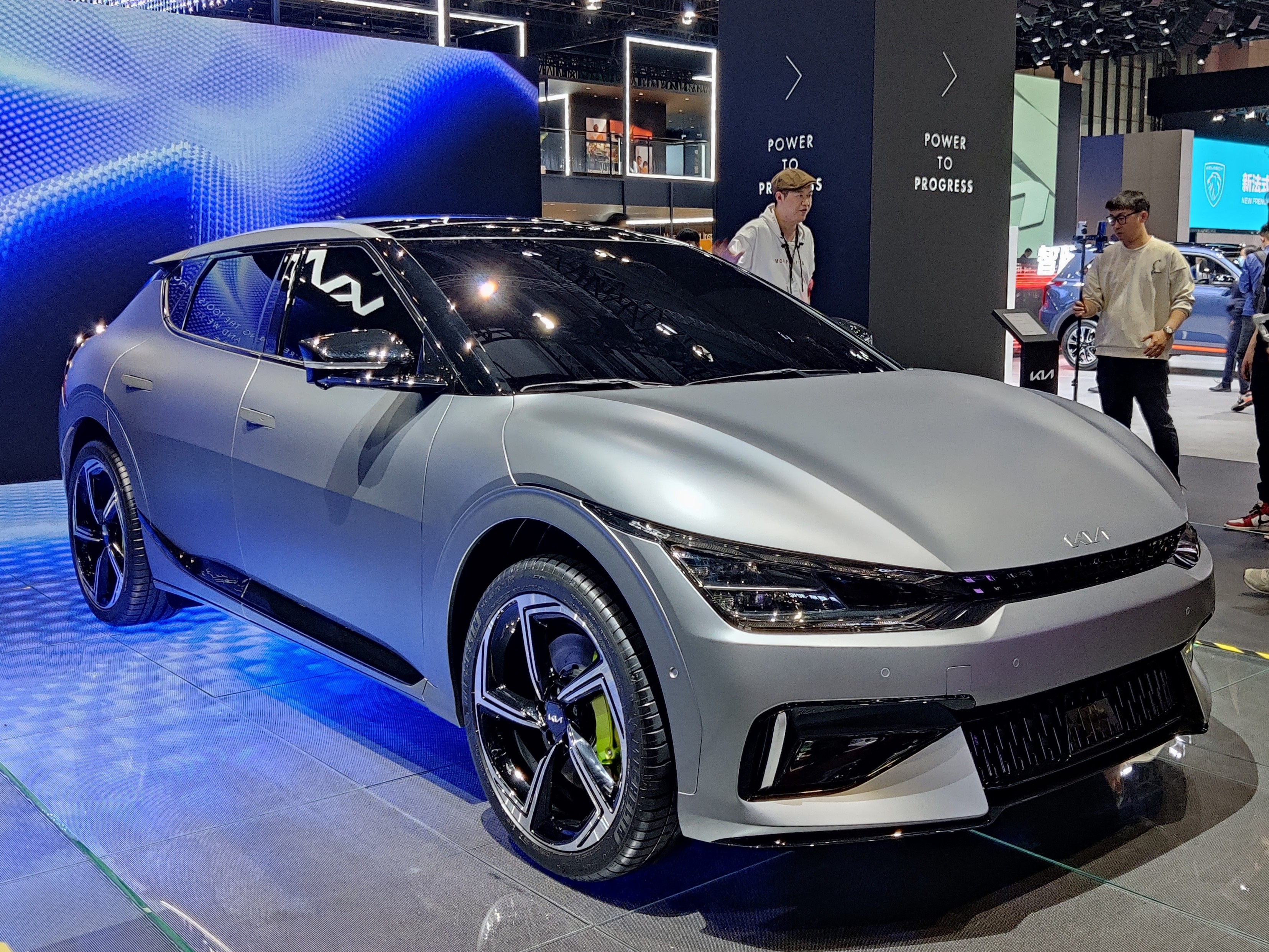
The Kia EV6 is an electric SUV. The podcast is saying it’s quick compared with some other smaller electric vehicles. Driving style and road conditions still affect how fast wheel-related parts wear.
Thermal management is the system that keeps the battery at the right temperature. If the battery stays in a good temperature range, the car can charge faster and more consistently.
State of charge (SoC) is the battery’s current charge level, usually expressed as a percentage. Charging speed typically slows as SoC rises, so the host’s point is that the EV9 can still charge quickly up to around 70% SoC.
Rebates and incentives are discounts that can lower what you actually pay for a car. The host is saying you might be able to get the EV9 for a few thousand less if you negotiate or shop different dealers.
Those amber lights are there so other drivers can clearly see the vehicle’s outline. The wider the vehicle is, the more visibility rules it has to meet—so it gets lights mounted up high.
The Ford F-150 is a large pickup truck. The podcast is comparing how wide it is compared to another truck. Width can affect how easy it is to drive and park, especially on rough or tight roads.
They’re comparing the Hummer’s width to the Ford Bronco Raptor. The point is that the Raptor is already wide, so it helps you understand just how big the Hummer feels in tight spaces.
The Ford F-150 is a large pickup truck. The podcast is saying that some versions can handle off-road driving, but it may not be the ideal choice for very extreme off-road use. Rough roads can also cause more wear on parts over time.
Car
Hummer HX
A “concept” car is a design study that shows what a brand might build someday. The Hummer HX was GM’s idea for a smaller, Jeep Wrangler–sized Hummer that would be easier to drive than the big original Hummers.
The Jeep Wrangler is a rugged SUV designed for off-road driving. The podcast is using it as a reference point for vehicle size and purpose. If you drive it on rough trails, some parts like wheel bearings can wear faster.
The Hummer H3 was the smaller Hummer compared to the bigger ones. It was meant to feel more manageable, but the host suggests the advertising and vibe were a bit odd.
FlexFab is a manufacturing method a company is promoting for making metal parts in small quantities quickly. It sounds a lot like 3D printing, but the hosts aren’t sure if it’s actually the same kind of process.
Flexible manufacturing just means a factory setup that can make different versions of a part without taking forever to retool. Here, they’re saying it helps them make small batches quickly.
Stamping tools are the dies and tooling used to form sheet metal into specific shapes by pressing it. The hosts mention that FlexFab would “specialize stamping tools” and run multiple designs using the same machines, implying a hybrid approach between tooling-based forming and flexible production.
Additive manufacturing means making a part by building it up in thin layers, like stacking slices. It’s different from cutting a part out of metal because it can create complex shapes more easily.
The Tesla Model Y is an electric crossover SUV. The podcast is just noting that someone used to have one and then changed to a different vehicle. Like any car, how you drive affects wear on things near the wheels.
A delivery window is the range of dates when the company expects to bring your car to you. You’re basically reserving a spot in their schedule.
Concept
$50 deposit
A deposit is a refundable or non-refundable payment you make to secure priority for an order. In this context, the speaker says people who put down the deposit get first access to the ordering/production slots.
A roll cage is a strong metal frame inside the car that helps protect you if the car flips or crashes hard. It’s often used in cars that get driven aggressively or on tracks.
A modular vehicle is built so you can swap or remove sections more easily than on a normal car. That makes it more friendly for customizing—like turning it into an open-air setup or adding safety gear.
The Volkswagen ID. Buzz is an electric van. The podcast is talking about how people are excited and when deliveries are happening. Vans often carry more weight and drive in busy traffic, which can wear wheel-related parts faster.
Term
old technology
The host means the car would have used earlier EV tech if it launched sooner. They’re saying that what felt “new” at the time might have seemed less impressive later.
The Rivian R3 is a smaller Rivian electric vehicle that the podcast describes using body-shape comparisons. It sounds like it comes in different styles, like a two-door or wagon-like form. Any car driven regularly will still need wheel-related maintenance as parts wear.
The Ford Flex is a Ford vehicle with a very boxy, unusual look. The hosts are saying the front of the car they’re talking about reminds them of the Flex, and they liked the Flex a lot.
An “open air kit” is a set of parts that lets you open up the vehicle so more air and light come in. It’s like turning part of the car into an open-air setup by removing certain panels.
A rear bulkhead is a wall/partition panel behind the back seats. If you remove it, the layout changes—like where the rear seats would go and whether that area can be used for storage instead.
The AMG GT is a sporty Mercedes made by AMG, the brand’s performance team. It’s the kind of car you’d expect to feel fast and exciting even just sitting in it.
A “fleet preview” is when a car company shows new trucks or vans to businesses that buy lots of vehicles. It’s meant for companies that need them for work, not just individual drivers.
Upfitters are businesses that customize a truck for a particular job. For example, they might add tool racks or storage in the bed so it’s ready for work.
An electric truck is a truck that runs on electricity from a battery instead of gas. In this segment, they’re talking about making one available for business fleets.
The Ford Maverick is a small pickup truck that many people use for work. Here, the host says lots of buyers choose the hybrid version, and it’s common among tradespeople and businesses.
A hybrid uses two power sources—an engine and an electric motor—to help save fuel. The host says more than half of Mavericks sold are the hybrid version.
A robo taxi is a self-driving-style taxi you can summon with an app. Instead of a human driver, the car uses technology to handle the driving, though it may only work in certain areas.
“The Strip” means the main hotel-and-casino area along Las Vegas Boulevard. The host is saying the robo taxi only serves certain spots along that area.
“Zook’s cast” is a way to connect your phone to the car so you can play your music through the car speakers. It’s basically like using Bluetooth to pair your phone to the vehicle.
LIVE
Ryan Reynolds here for Mint Mobile.
I don't know if you knew this, but anyone can get the same premium wireless for $15 a month plan that I've been enjoying.
It's not just for celebrities, so do like I did, and have one of your assistance assistants switch you to Mint Mobile today.
I'm told it's super easy to do at mintmobile.com slash switch.
Up-front payment of $45 for three-month plan, equivalent to $15 per month required.
Intro rate first three months only, then full-price plan options available, taxes and fees extra, default terms at mintmobile.com.
Tried compression socks. Hated them. We get it. Most are either so stiff they feel clinical, or so light they don't do anything.
AeroLite Plus from Wellow is neither. It delivers real graduated compression, but features ventilation and cooling technology that make it the most comfortable compression sock for warm weather and everyday wear.
You finally get support that feels good from the moment you put them on. Soft, breathable, easy to put on. Not too much, not too little.
Just right. Shop now at HelloWellow.com. That's HelloWELOW.com.
This is episode 455 of Wheel Bearings. I am Sam of Buell Summit from Telemetry.
And I am Nicole Wakeland from TestMiles.
And I am Roberto Baldwin from SAE International.
And let's see. Did anybody travel this week?
I don't think so.
I did. And I didn't put it on the show notes, which was stupid. I should have put it on there.
I went to, actually it was one of the coolest things they were good to do.
I went to the IAHS, the Insurance Institute for Highway Safety, and I saw them crash test a Mazda CX-5.
Oh, let's come back to that later.
So that's what I did. So that's where I was this week.
Ka-Blamo. Ka-Blamo.
Ka-Blamo. It's loud when that happens.
Mm-hmm.
All right. Well, Nicole, did you drive to that event?
No, it was in Virginia.
Oh, OK.
I flew to it.
What did you drive while you were at home?
While I was at home, I drove the 2026 Subaru Outback Wilderness,
which has been a fun little car to have this week.
So this is the seventh gen. So it's all new. It's all redesigned.
They have new interior stuff, new upgrades, like the 12.1-inch touchscreen and a 12.3-inch instrument cluster.
There's more cargo room.
The wilderness trim is like it's on the higher end.
It's 44.995 as far as lineup goes.
But that gives you, makes it a little bit more wilderness,
it's supposed to be a little bit more wildernessy off-roading than the rest of the Subaru lineup is a little bit.
But, you know, it's still not like you're going to go do the Rubicon.
It's just a little bit more rugged for you.
There's a 2.4-liter turbo four-cylinder and there you get 260 horsepower and 277 pound-veed-a-torque.
A CVT with the worst auto stop that I have encountered in ages.
Like when it would start and stop, most of them now have gotten better, right?
So you sometimes you notice them, if you happen to put your foot on the gas right at the moment
where it's starting to turn off, you still will get that little almost kind of jolt.
This one was not good. Russ thought I was doing something.
He's like, why did you hit the gas that way?
And like, I didn't do anything.
The car just turned back on and the whole car went like, it was it was bizarre how rough the auto start stop was.
It was disconcerting. So that was not great.
Otherwise, it was fine to drive.
You know, it's got plenty of power.
It's relatively well mannered.
I mean, this is a Subaru.
It isn't all about like performance driving and great handling.
It's about getting you through the muck, holding stuff in the back of the car, being durable, handling day to day life with messiness.
And this will do that.
You've got room for five.
You've got 34.6 cubic feet and room behind the rear seats and 80.5 when you fold them down.
So that is an incredible amount of room when you think about it.
This isn't a huge vehicle.
So if you need to carry stuff like you're doing the weekend projects, this is this is a great vehicle for that.
Although right now we got down to almost freezing last night.
Can I just complain for a second?
It was 34 degrees this morning.
I woke up. I'm like, why?
Why am I so cold and because the house is set to air conditioning and it's not there?
The heat won't kick on.
I'm like, well, do something about that.
You're the husband.
Make the heat kick on any day.
It was so cold here right now.
I don't know what's happening tomorrow's June 1st and it feels like March.
But it's great for projects, anything you want to put in there.
But even that 34 cubic feet behind the rear seats, it super really does a great job of giving you a versatile vehicle.
So it's plenty of room for adults to sit in the back, but plenty of room for stuff, even with those adults.
So if you want to put, you've got kids and you got all their stuff that you want to put in there
or your family going away for a weekend, there's plenty of room to put everything you need in there.
You're camping, that kind of stuff.
And I do really love that Subaru Interiors do not make you cringe when they're muddy or messy or things are gross.
Because it was pouring rain yesterday and freezing cold and I walked through some muddy streets and mucky streets in Boston.
And I got back in and there's these nice all-weather floor mats and the water's coming in the car.
And when I opened the door, because it's dumping rain, I closed the door and it's just you don't even know that it rains.
You don't even know I was in there with money.
But like everything just looks fine.
And if you, I'm sure you guys have all experienced this.
It's like when you've been out in the wilderness.
You've been out in the wilderness.
When you have, you know, when it rains or it snows and the water gets on the door panel and then you look at it hours later
and you see little dots like it's sort of almost like you have to rub it a little bit to hide where the water has sort of left a little bit of a mark
on the door panel where this doesn't do that.
And it was pouring.
It was absolutely dumping when I opened the door.
I'm like, oh my God, get me in.
It broke my umbrella.
It's completely aquafobic.
It was aquafobic.
It broke the rain broke my cute little Irish umbrella.
But it did not in any way harm the Subaru outback wilderness.
So there you go.
My poor umbrella though turned inside out and it's done.
So I like it.
The infotainment system is good.
You know, it's got that 12.1 inch screen, which is new.
So it's bigger.
It looks more modern.
I really like how it looks.
The old setup felt just clunky.
It worked, but it felt clunky.
I feel like this is not clunky.
It's nice.
I think it's nice.
They did it.
And there's a 12.3 inch digital instrument cluster, which again gives it that a little bit more tech forward kind of vibe.
The only thing I hear is a little quirky thing.
So the charging pad for the wireless for Chi is right in like sort of under the screen in front of where your
cupholders are all the way forward.
And it's a little pod and it's just big enough for my iPhone.
What do I have?
Seventeen my iPhone and like I could toss the car key next to it.
There's not a good spot to put your stuff though.
If you want to put your wallet in there, like there's no spot to put your wallet or your keys.
If you have other random stuff in your pocket.
So I felt like the stuff where to throw things was awkward somehow.
We also had something we had to return to Home Depot.
We bought the wrong garage door opener fob and we had to bring that back and we're like, where do we put this as we're driving around?
So there's not a good spot to put little things.
I felt like, I mean, you can open this in our console and shove some stuff in there.
But I wanted this better spot to just toss my stuff when I walked in the car.
So overall, I liked it.
Again, you know, 260 horsepower.
It's a decent science vehicle.
It's not super responsive, but it's also not slow.
It was fine navigating through Boston traffic, weaving into that of people as you do in Boston to get where you need to get to.
Had plenty of power to do that, but it's not about sportiness.
It's not about that.
It's about the versatility and the utility of having a super.
And of course, you've got that all wheel drive.
So when the weather is coming like it was yesterday or the snow comes back, which it feels like it could today, you're going to be all set.
So overall, I liked it.
And you guys want to take a guess at destination and what I have.
We'll see what it is by the time this publishes.
In like three hours.
1100 Sam.
I'm going to say 14.
Oh, Sam, you were really close.
1450.
Oh, OK.
So quite, you know, how do you feel about the design of this new Outback?
So this is one of those things that I think loyal Subaru fans just raise their fist and said,
why don't you do this to my outback?
Yeah, but I'm going to tell you Subaru people don't care about the way a car looks.
Well, I think some of them.
If you look back at, I mean, beyond the last generation or two of Subaru's.
Yes.
I mean, Subaru's were traditionally, shall we say, unconventional looking.
Unconventional looking.
Well, so the thing about this is it looks more SUV-ish and less wagon-ish than it did once upon a time.
There are people who are all about their wagon.
They loved that their Subaru was kind of a wagon.
And some of those Subaru people, because I live in Suburbanland in New England,
it is the official unofficial car of New England.
And some people are a little upset that it doesn't look like it used to.
Nobody hates how it looks.
They're all fine.
They're just like, man, where'd my wagon go?
That's kind of the vibe.
Right. Now it's an SUV.
That's called the Trailseeker now.
Yeah, right.
So this so they're a little sad that their Outback Wilderness
wagon, not really a wagon, is now definitely an Outback Wilderness SUV.
But nobody hates on it.
They're just like, oh, I miss having the wagon because I was different.
I was unique. I had a wagon.
Nobody has a wagon. I had a wagon.
So, yeah, but I mean, I'm fine with it.
I think it looks good.
I like the design.
So I'm fine with them de-wagging it.
There's there's at least two of them in my neighborhood now, the new ones.
And I see them fairly regularly when I'm out walking the dogs.
And I don't know, this this look, it just looks a little cluttered and busy.
You don't like it? You're anti-new.
It looks very classic Subaru.
And, you know, in that unconventional way, you know, I wouldn't call it
a pretty design or an attractive design.
But, you know, it's certainly functional.
I mean, I don't think like you said, though, no one's really looking for a
super like, oh, I want a really beautiful car and could have bought myself a Subaru.
What one of one of my neighbors that has has this gorgeous husky,
he's got an older outback, you know, probably about 15 years old or so.
So a couple of generations back and he was asking me about this new one
and he really likes it.
So I think I think you're right, Robbie.
I think, you know, Subaru.
Well, no, actually, you said Subaru people were saying,
you know, what'd you do to my Subaru or my outback?
But he's an outback owner and he likes it.
So, you know, who knows?
Subaru people love their Subaru.
They just, you know, I have a Subaru.
It's my second Subaru.
I mean, I have the BRZ.
So it's the least Subaru Subaru.
At least at least, you know, it functions like a Subaru.
It does what you expect a Subaru outback to do.
That's true.
It's the most important thing to a Subaru person.
It's got to be Subaru in its performance.
And if it does that, then they're happy.
Well, will it withstand the dogs, you know, without falling apart?
Exactly.
It will withstand the dogs and I think it will.
So, yes.
OK.
All right.
So that's 2026 Outback Wilderness.
Outback Wilderness with its little brawn.
When we drove it, that thing, it handles way better than I should.
It does.
It does.
It does have an adaptor.
Yeah.
It is.
I was very impressed at how well it handled.
We drove it around the mountains, not really mountains,
the Foothills, the Californian when we did the drive program.
Yeah.
Yeah.
I mean, when you look at it, you know, it looks like it should feel really clunky to drive.
Like it should be wobbling all over the place.
You know, it doesn't look like anything that would have any kind of
decent driving dynamics, but.
No, it handles nicely.
It was great.
And we have through all of our crummy roads and everything we had, it handles.
It handles nicely.
All right.
Robbie, you had something this week.
I did change.
Come on.
Robbie had a car.
What?
I know, I know.
I had the 2026 Mercedes Benz EQS 400 four medic SUV.
So the EQS SUV, because the EQS, then there's the EQS SUV.
OK, that's that's how that's it.
It's not it's not even remotely confusing.
Not at all.
It's it's an odd.
Sure, why not?
So it has three and 55 horsepower, 500 and ninety pound
feet of torque.
I just realized that I haven't done the math on how well the drive.
How well on its its range yet.
I did the 100 mile run yesterday.
But it is like driving.
It's like you're in a cocoon when you're driving this vehicle.
Like you're just in there, you're safe.
Everything's very smooth.
It is it is erasing the ills of the world from your driving experience.
Wow.
That's what it feels like driving this vehicle.
That's that's got to be pretty isolating because we got some ills.
Yeah. So yeah, it's it's comfortable to drive.
It has the rear wheel steering at 10 degrees.
And so, you know, I went to the stores a couple of times, had to buy a bunch
of animal food and people food and other reasons to go to stores.
I can't remember what they were.
And, you know, that that that 10 degree rear axle steering is really cool.
It's great.
Just right into the parking spot that you, you know,
you wouldn't be able to in a similarly sized car without that.
You'd be like, oh, hold on.
Now you got to do that little thing in the parking lot, which is slightly embarrassing
where you couldn't get like perfectly within the lines or a little bit too close
to when you're like, oh, you got to back up, go for it, back up, go for it.
And I always feel sort of like, you know, I do this for a living and I've
screwed this up. I don't know how.
So yeah, yeah.
So no, I I think it's for people who want something like this.
It's big and squishy and comfortable.
It's got the it's got the hyper screen, not the super screen.
It's in the new, you know, S class.
I think the hyper screen is better than the super screen.
You get more real estate.
It's MBUX, which, you know, I think, you know, I'm a fan of MBUX
because it's just a big map and then little widgets of things you need.
That's it. That's all people want.
They just want. Where am I going?
OK, I got to push on things.
I don't want to have to swipe, you know, you know, let me swipe left and right.
No, the little widgets figure out like how you drive, what you use
and they appear as you're driving.
The end. Ta-da.
It's the I don't know why it seems so difficult for everyone to figure that out.
But there you go.
Now, the new EQS, the sedan and those will be in all the new Mercedes Benz
CLA, GLC, those are on 800 volt architectures.
This is still this is still the 400 volt architecture.
So it charges at 200 kilowatts, which for 400 volts, that that's good.
Good, fine, whatever.
It's AC charging, you're charging at home or charging at a slow charger
and AC charge at 9.6 kilowatts as a read the adjustable region on the paddles.
And they're extreme region is just extreme is all hell.
Normal regions find though.
Handles really well for how big it is,
just being that all wheels, all wheel steering probably helps.
But it still feels just like you're kind of doing something that someone else that
it almost feels like video game ask.
Because again, you're you're sort of you're detached and you could feel like a little, you know,
Oh, it's a little dynamic and you know, it handles really well.
You know, we have all the mountain roads up here, but it's, you know, but it's it handles well.
But you still feel very I mean, it's very much built for the person who's like,
I just want to be comfortable in all driving situations.
Every single one of them.
So and you know, bumps and stuff, it handles those really well.
Yeah, it's comfortable.
All the seats are really comfy.
Has massage seats, vented seats.
It's yeah, it's a big giant heavy Mercedes.
The battery is I believe 116 kilowatts.
Let me double check that.
No, it's 118.
It has 312 miles of range.
If you know, I can do the math really quick.
Hold on.
I got a look at my notebook.
I'm not doing math.
Feel free.
I'm not mad.
I'm not going to do math Sunday morning.
I'm not mathing 312 miles of range.
116 kilowatt hours.
That's about 2.9 ish miles per kilowatt hour.
So Robbie does math.
Yeah, I got to think about 2.7 miles per kilowatt hour.
A little optimistic there.
Yeah, so yeah, I still got better range than there.
I got 318 miles of range on my versus the 312, which each PA says.
So it's pretty spot on for range.
It's, you know, the new vehicles are more efficient.
You're going to, you know, the GLC, I think it's still that bulbous EQS design though.
So that's, you know, you got to figure that out.
I've talked to multiple people at Mercedes and the idea was, you know, there's an article
on wired coming out an interview with Ola eventually, hopefully this week.
But one of the key takeaways was that, you know, their idea was, well, we want to make
something for people who, you know, the first adopters, that was the idea for this.
You know, we thought that we, that people wanted something that looked different,
that looked like an EV and, you know, post that, they're like, oh, people just want a car.
It looks like a car that's also an EV.
The end.
That's it.
And so now you get the, you know, you got the CLA, which is a great little EV, the GLC,
which I've only driven on sand.
But it worked really well.
You know, on a sand dude.
So, yeah, I think we, as an automaker that continues to push forward with EVs, they're
taking what they've learned and they're applying it versus just throwing their hands up and
giving up.
So maybe that's Ferrari's excuse for the luce.
Maybe.
I don't hate the luce.
I just think it's, I think I'd, like I said last week, it's a really rad Honda EV.
Yeah.
So it's a rad Honda.
Yeah.
So the suggested retail price for this vehicle is $90,000, $9,950.
The one I got, $105,330.
And that includes this thing, this exclusive trim, $3,000.
Okay.
I don't know what that, what?
You confused.
But the rear axle steering was, hold on, it's hard to, things aren't lining up.
I think it's $1,300, which to be honest, I mean, if you're already spending that much,
your miles will just get the rear axle steering.
13?
Yeah, $1,300.
Yeah.
You guys would probably just be standard on that car.
Well, they do have, they have rear axle steering, it's like 4.5 degrees.
Oh, okay.
That's the standard.
But if you really want to go for it to 10 degrees, you should.
Okay.
So it's enhanced steering.
Yeah.
So yeah, so you get 4.5 degrees of rear axle steering.
So you get that for free, well, free, because you know, you're paying a lot of money for
a car.
But if you really want to, like, you know what, I want to park in every parking space.
I want to be able to do circles like a smart car, but in a giant SUV, you're going to have
to shell out $1,300.
Do you want to, let's say, destination delivery, what are you guys thinking?
I'm going to go $26.95.
I'm going to go $11.95.
Well, it is Mercedes.
They are, they're already, you know, it costs a lot of money.
So they don't have to add like all this crazy stuff.
So it was $12.50.
Wow, what a bargain.
Yeah, it's a bargain.
So $12.50.
So that's, you know, again, you're already paying a lot of money.
So we don't need it.
We don't need a pad destination and delivery.
Mercedes customers expect to be, you know, paying too much money for their cars already.
So, you don't need to hide the price increases.
Yeah, like some automakers hide it.
Some, you know, they put it in there, but they're very upfront about it.
And, you know, and Mercedes is like, it doesn't, it shouldn't cost that much to ship a car.
We're going to charge you for absolutely everything else.
Like the white paint, it's manufacturer, which is their, you know, their special stuff.
Yeah, $17.50.
It's white paint.
Look at it.
It's white paint.
It's just white paint.
Like I don't like an Arctic white or a Wimbledon white.
It's moonlight, white metallic.
It's white.
I don't know.
It's like, whenever you get a white car, it's always a little more difficult because, you know, try to take photos.
You have to, you know, you can't do anything in the middle of the day because it just blasts.
You know, it's just a giant spotlight.
Completely blasted out, yep.
And how metallic can a white paint even be?
I mean, I could probably be pretty metallic.
Just make it, it's a disco ball if you really want to go for it.
Yeah, so, but, you know, overall, you're still getting that real fancy, comfortable Mercedes feeling.
It does feel heavy.
118 kilowatt hour battery pack will do that.
But it handles really well, even though you sort of feel sort of disconnected from everything that's happening.
Because that's kind of its job.
So, what it's supposed to do?
Did you try climbing into the third row?
Oh, gosh, no.
I don't, there's no point in that unless it's a van, who cares?
Like, why even have it?
Yeah, well, I know the, you know, the-
I don't think this one has a third row.
I think this one just has the two rows.
Well, it might be optional.
Yeah, I don't think that's the case.
So, when I had an EQS a couple of years ago, when my wife and I were on vacation in California,
we had an EQS SUV, and it had the third row in there.
And, you know, it's kind of like the third row of the Highlander.
It's there, but not really all that useful.
It's there.
Like, what's the- yeah, yeah, I don't know.
I would want to use that.
It's just, you know, I think it's a selling point.
It's like for, I think there's a lot of people who get adaptive cruise control and then never use adaptive cruise control.
Like, they just never use it.
They never turn it on, they never figure out how it works.
They just, and at least that's kind of, at least that's helpful.
Like, the third row is that, but like, I don't know, I guess.
It's a, you know what it is?
It's a spacer in your trunk.
Like, you need something, like, you don't want things rolling around.
So, you put up the third row so like, the thing will like have something that you can shove up against.
That's the third row.
Because you can't, like, I guess you could put a baby seat back there, but then you got to reach all the way back there,
the fight with throwing a baby in there.
Yeah, I mean, you don't want to put baby seats in the third row because, you know,
inevitably while you're driving somewhere, you have to, you know,
you or your partner, you know, may have to reach back to deal with something with the kid.
Just leave the baby in the car.
Just leave the car on.
Yeah.
Baby doesn't want to go anywhere.
Baby likes the car.
There's vibration.
It's got its toys.
It doesn't need you.
It's got the car.
Just leave the baby in the car.
Well, and, you know, I have, you know, it's been a long time.
This is for somebody who gets freaked out if he has to leave his dogs in the car for more than five minutes.
Just leave the baby.
But if it's a baby, or a child, whatever.
It's been a long time since we had babies.
So, you know, we didn't have EVs back in those days, but, you know, I think, you know,
kind of the noise and vibration of an internal combustion vehicle, you know,
generally helped put babies to sleep anyway.
It does.
We used to do that when the kids were young.
We'd take them on, when Rose would be a whiny, cranky child, we would put her in the car.
Strap her in the car.
We had a little roof.
Yeah, you have a little drive route.
You do the route.
By the time you get done, she just fall asleep.
You can carry her inside.
Oh, now they just fall asleep because it's so comfortable.
Now they just fall asleep because it's comfy.
Like, oh, I like this car.
Oh, wow.
This is better than the house.
This is okay.
Why do we even live in that giant crash?
Why have a house?
Why?
House of perchumps.
All right.
Anyway, that's the 2026 EQS-400 4-O-Matic SUV.
There you go.
There you go.
There you go.
Yeah!
Carl's Jr. introduces the Angus Maximus.
That's its Latin name, roughly translating to burger with a ridiculous amount of 100% Angus
beef for only $5.99.
This glorious stack of awesome sits at the top of the food chain.
Not to be confused with McDonald's not so big a Mac-us with less beef and no Angus.
The new Angus Maximus.
$5.99.
The new Angus Maximus.
$5.99 at Carl's Jr.
Available for a limited time at participating restaurants, tax not included.
Not valid for use within a combo or in combination with any other offer or discount.
Let's be honest.
Buying cannabis shouldn't be complicated, sketchy, or low quality.
That's why I want to tell you about mood.com.
That's M-O-O-D.com.
Mood ships federally legal cannabis straight to your door.
No medical card, no hassle.
And here's the kicker.
The quality is better than anything you'll find at your local dispensary.
Yeah, I said it.
Whether you're into edibles, concentrates, flour, or just looking to explore, you'll find it all at mood.
And it's not just the variety that makes them stand out.
Every product is sourced from small, American-owned family farms that care deeply about what they grow.
It's cannabis you can trust, delivered discreetly, and ready to elevate your mood.
And because you're a listener, you get 20% off your first order.
Just head to mood.com.
That's M-O-O-D.com to get started.
Be honest.
How often do you actually wear your compression socks in the summer?
If the answer is not really, Wellow built AeroLite Plus for you.
They tested it in 12-hour nursing shifts and full Texas heat days, 912 days, 134 prototypes,
until they got a compression sock that actually breathes.
Airflow knit construction, cooling tech that activates with moisture, and the same real support you'd expect, just without the heat.
Your routine doesn't have to stop when the temperature goes up.
Discover AeroLite Plus at HelloWellow.com.
That's HelloW-E-L-L-O-W.com.
We've updated the Wheel Bearings merch store, and now there's a whole bunch of new choices, new colors, new styles, T-shirts, sweatshirts, hoodies, hats, mugs, travel mugs, stickers, aprons, tote bags, you name it.
Get your Wheel Bearings merch at shop.wheelbearings.media.
Go check it out.
That's shop.wheelbearings.media.
Well, I was supposed to have had a Mitsubishi Outlander last week, but when it got returned back to...
Did it break down?
Yeah, it had to go in the shop for something, so I'll have that in a few weeks.
So instead, they got me a Kia EV9 GT line.
Okay.
Basically, the EV9 for 2026, the only thing essentially that has changed, except maybe a couple of color combinations, the only thing that has functionally changed from the 2025 model or the 2024 model is the charge port, which is now an AXJ3400 charge port rather than a CCS port.
So I think pretty much all of the Hyundai Motor Group vehicles, I'm not sure about the GV70 EV, but everything else pretty much that they're selling now has an AX port on it.
And so that's good.
Well, it's good until you go and try and plug in your home J1772 charger and realize, oh, they put a CCS adapter in here, but they didn't put a NAX adapter in here.
So I had to go on Amazon and order one so I could charge the car at home.
Are you sure it was in somewhere else like Nicole, where it was like hidden under a chair or something?
I looked under the seats.
You looked under the seats?
I did look under the seats.
I looked everywhere, looked in all the nooks and crannies, could not find it.
Found the CCS one, but could not find a J1772 adapter.
But it's okay because I'm probably worthwhile to have one around anyway.
I know, that's what I figure when I bought it, and I'm like, I should probably have one of these.
Yeah, sooner or later, I'm going to need it anyway.
So, although maybe not for long because I'm getting another charger sent to me to evaluate, which will have a NAX port on it.
So then I'll need a NAX to CC or NAX to 1772.
Either way, Ramster.
Anyway, the EV9, three-row electric crossover.
I've been a fan of this thing since it came out.
I like the design.
It was the first of a new design language for Kia.
A little more angular, some crisp, sharply folded lines on the body.
It's a unique design.
It looks pretty distinctly different from a Hyundai Ioniq 9, which shares most of its underpinnings.
And, you know, overall, you know, I'm a fan of this car.
If you happen to get one with rear-wheel drive, you get actually a surprisingly decent, like, 3.5 cubic foot frunk.
If you get the all-wheel drive version, because it's now got a motor in the front axle,
that shrinks by about half to about 1.8 cubic feet, which is, you know, it's enough to store your, you know, charging cables and, you know, some other knickknacks in there.
You're probably not going to fit. You could fit it probably, you know, a laptop bag, but not...
You could put a personal pan pizza in your...
But not a large.
Yeah, you could probably actually take a couple of personal pan pizzas.
Like, are you good at little Caesars? You get 22 largest throw-in there?
Yeah, that might fit.
You wouldn't be able to get the big, giant ones that they have at this local place here, Benito's pizzas, that are like, I don't know, 36 inches or something insane.
But, yeah, so you can fit some smaller stuff in the frunk.
The, you know, the third row, I did climb into the third row.
It is usable by, you know, a 5'10 adult.
And this one, the one that I had, the GT line, had the second row captain's chairs with the Ottomans that can come up.
So it's got the Ottomans on the front seats.
Obviously, you can't deploy the one on the driver's seat while you're driving.
You certainly shouldn't, anyway.
I don't think you actually...
Yeah, if you try to activate it or, you know, move it while the car is in drive, it will not move, which is good.
I mean, the Ottoman won't move, not the car.
The only, you know, kind of annoyance that we've rediscovered with this thing is, you know,
it's got the standard dual 12.3 inch displays under a single sheet of glass.
And then there's also the smaller, I think it's about a 5 inch display in the middle for some of the climate control stuff.
So you've got the instrument cluster in front of you, infotainment on the right,
and then the small control panel, touch panel to control some of the, you know, which,
if you want air blowing up or at your feet or wherever, you know, so some of the climate control stuff in there.
It's, as usual, it's still blocked by the steering wheel.
So if you... I don't know what the hell they were thinking when they did that one.
It's so weird.
I remember when we were in Korea and we were drawing the drive program, like, why?
Why did you do this?
And they put that into a couple of other vehicles since then.
They're already committed to hiding it.
Yeah.
Unfortunately, the temperature control is in the center dash.
So you actually use a lot is there, but like, all everything else is weird spot.
You have to, like, move your head to look around your steering.
Yeah.
So you have physical toggles on the center stack for temperature, you know, the dual zone temperature control, the fan speed.
And then there's the little roller for the volume control.
But just above that, there are some touch controls that are backlit, you know, from behind the whatever type of trim you have on,
depending on which trim level you've got in the vehicle, you know, that get you know, are shortcuts to maps and settings and a couple of other things.
And then you've got the touchscreen above that.
And the thing is, you know, most of the time, most people when they're using a touchscreen, you know, they may use, you know, like they're pinky or something to brace their hand.
So it's not moving around while you're driving.
And those touch controls are right where your fingers would usually fall if you're bracing your hand on on there.
And so when my wife and I were going out somewhere last week, you know, she went, she was going to just hit pause on something we were listening to the comment on it.
And she kept hitting the settings button and sending it from the Android Auto screen to settings, which, you know, kind of annoying.
Yeah, bad place to put those.
Yeah.
But other than that, you know, the GT line, it's, you know, there's two battery sizes you can get in the EV9.
There's the smaller one in the base light all wheel drive trim, which is I think about 67 or 76 kilowatt hours, 76.1 kilowatt hours.
And then there's the big battery, which is the one you should get if you're getting one of these things.
99.8 kilowatt hours on the and you get all when wheel drive, which is standard on the GT line.
You get 379 horsepower, 516 pound feet of torque, which is more than enough.
You will, you will not be wanting for performance in this thing with the GT line, because a little bit heavier, bigger wheels.
It's rated at 280 miles per charge driving range.
I actually, you know, I did, you know, in the driving I did with it, I was actually averaging about three miles per kilowatt hour, which actually works out to closer to about 300 miles.
And on a couple of drives, you know, some, some local drives, you know, when I had to go to Lowe's to get some more lumber to finally finish my deck.
I averaged 3.1, 3.2 miles per kilowatt hour.
This thing is very spacious. So with the second and third row seats folded down and the front passenger seats slid forward, you can fit a stack of two by 10 by eight foot deck boards in there.
They will fit inside with the tailgate closed.
You have the proof.
I have, I guess I did it. I had six of those boards in there and it did all fit with everything closed.
So it is a very useful, very utilitarian vehicle.
And, you know, you'll get, you know, generally somewhere between 280 and 300 miles, depending on how you drive.
I mean, if you're really using all that performance, you probably might get less than that.
But overall, you know, it's more than enough for pretty much everybody's daily needs.
And these things charge fast.
You know, the EV9, the Ioniq 9, they'll charge about 215, 220 kilowatts.
So slightly slower than what you get with the smaller ones like the Ioniq 5 and the EV6, but still very, you know, very quick.
And as with all the Hyundai Group vehicles, they've got good thermal management on the battery.
So they will, they'll maintain a high rate of charge all the way, you know, high power charging, you know, pretty much all the way to about 70% state of charge.
So, you know, I have, I have charged an EV9 in the past, you know, even at 70%, I was still getting like 130, 140 kilowatts.
So that's, you know, that makes it a really good road trip vehicle, which will be useful next week when we're doing Operation Frodo.
That's right.
Yeah. So, because we will have an EV9 as part of our fleet.
Robbie, your lights just went out.
Oh, Robbie, did we lose Robbie altogether?
Maybe it's just your camera?
I don't know what that looks like.
You look like you were in the dark.
I don't know what happened there.
It looked like, you know, like a motion sensor turned off or something.
I don't know.
They upgraded, they updated Riverside.
I feel like it's broken now.
You're having Riverside issues.
Every time anyone upgrades anything anymore, it's always broken for like about six months.
So like, hey, we updated, we added AI and now it's broken.
Don't please, no.
That's, that's, that's exactly what I wanted.
I wanted the one, the one thing this tool is supposed to do.
It can't do anymore because you added a feature that I didn't ask for.
Cool.
So the EV9s, EV9s start at $55,000 for the light rear wheel drive.
That's with the standard range battery.
Long range battery, which is that's, that should be your starting point is 58,000 for
the light trim in rear wheel drive.
The, the GT line that I had starts at $71,900.
All in the one I had in the driveway came to $76,670.
Not inexpensive, but I mean, you can get some pretty good deals on these things.
If you shop around, there's, you know, dealers are offering some pretty good rebates and
incentives on these things.
So you can get it for probably, you know, at least five to $6,000 less than that.
And, you know, it's really nicely equipped for that price point.
When I guess at the destination charge.
1600.
1400.
And Nicole gets it by like $5.
1495.
I'll take the win.
Thank you.
Thank you very much.
And the EV9s are built in West Point, Georgia.
So Georgia.
So that is the 2026 EV9 GT line.
Okay.
All right.
Let's carry on.
Carry on.
So GM opened a new advanced design studio.
In Pasadena, California this past week, they had a studio previously which, can I remember
exactly, was it an Irvine?
Long Beach, maybe?
Where?
Long Beach.
Yeah.
Somewhere in the Southern California area.
They've had an advanced design studio there for a long time.
Somewhere around there.
But they opened a new studio this past week.
And I guess, you know, they had some people out there and they showed off two concepts.
For a GMC, they called the GMC Hummer X, a pickup truck version and an SUV version.
So kind of like what they have right now with the Hummer EV.
But these are a little bit smaller, but they're still very large for you.
Are they?
I was trying to find measurements on here.
I'm scrolling, scrolling, scrolling, but then I have to compare it.
Is it actually that much smaller?
It looks smaller.
Yeah.
It's about seven inches shorter.
Okay.
So the, probably the more important thing is not so much the length, but the width.
It is like seven inches narrower than the current.
Maybe I did see this vehicle like a hundred years ago.
I mean, that would be, because I liked the Hummer, but that was, that was the only vehicle
that I got through in a drive through on the drive program.
And I was dry.
And I was, and then there was a wall as I came around through the drive through and I had
a moment of panic, like, oh God, I thought I'd have some overhang room over the curb.
And I don't, please Lord Almighty, don't let me take out the wall.
And I think I had like, like even a piece of paper between the bumper of the old one
and the wall as I came around that corner to get my coffee.
So I'm glad it's a little smaller.
It was a little big.
It was large.
Yeah.
Well, the current production Hummer is 86.7 inches wide, which is why it has to have the
amber lights on the, on the top of the windshield because anything over 85 inches, you have
to have those amber lights on the top of the windshield.
I love it.
And this thing is almost just shy of 87.
So the, the Hummer acts is only is a mere 80 inches wide.
Only 80 inches.
Only 80 inches.
Okay.
Which is, which is still about five inches wider than a Ford Bronco Raptor, which is already
a very wide vehicle.
Yeah.
I don't, I, okay, fine.
I mean, yes, it's smaller, but like, could it be smaller?
Smaller, more smaller.
Because at some point you run into issue, I mean, especially when you're like, oh, you
know, the photos are of this thing, you know, outdoors, you know, in the desert.
Sometimes trails are pretty narrow.
Yeah.
And you have a super wide car.
It doesn't work out so well.
Yeah.
This is why going off-roading with something like say a, you know, a Raptor, an F-150 Raptor
or a TRX is generally not, it's fine on the, in the desert, but it's not a vehicle you
want to take on a trail.
Yeah.
It's always like, it's hard to maneuver.
Desert dirt roads, like roads to the houses of people who don't recognize the U.S. government.
Like those types of roads.
Who don't recognize the U.S. government.
Yeah, when you stop them, they're like, I'm a sovereign citizen, you know.
They're just trying to think of a sovereign citizen.
That's the word I was trying to come up with.
Yeah.
It's the roads to those, to the homes of, you know.
So people who refuse to recognize U.S. government exist.
Yeah.
I don't recognize the laws of this government.
I am a, you know.
The laws of the land.
I am an island of a human.
In my world, the national anthem is written by Maroon 5 or something.
I don't know.
The, the Hummer X also has a lot of screen in it.
Yeah, I don't, I don't like this at all.
What is happening?
It's like the layer of a supervillain, you know, like, 77 different windows on this
full width screen all the way across the dashboard.
It's like you're watching like, if you're a security guard or a supervillain, either
way, you're watching, you know, feeds from everyone's like toilet in their apartment.
I definitely think it's supervillain because you would need that many screens and you would
drive something like a Hummer because you could run over your enemies.
Yeah.
So I feel like, like, yeah, definitely supervillain.
Until they drive down like a narrow alley and they're like, ah, foiled again.
And then you're stuck.
Why does it look like that?
It's totally, it's just, it's seven stacked.
It's very, instead of one long screen, it's just a bunch of little screens.
You know, I've been watching the show Homeland and it does give off CIA vibes.
Not going to lie.
Yeah, like these are like, yeah, especially these over the, like, okay, this is where
we're going to bomb a wedding.
The far right is telling us where our team is.
Then you have a map that's close up.
Then you have a map of the full area.
You got your live views from the drones or from the satellite.
Right, you got your live drone view in there.
You've got one that's just calm chatter and heat sensors so you can see where your
team is.
Yeah.
Nope, this is too much.
This is too much.
Yeah, they designed this before they realized people hate the fact that vehicles don't have
buttons.
So I went to the design studio in Detroit.
Sure, I think it was Detroit.
And they showed me like a little tiny little sliver of something.
And I guess it was this.
I thought it was smaller or maybe they have a smaller version in the design.
I mean, hopefully they have something smaller in the works as well.
Yeah.
Let me just, just give us a tour to come a sized something.
Yeah.
You can call it a Hummer.
I've said before.
Before anybody's feeling.
Back in 2009, they had a concept called the Hummer HX.
So this was when the original iteration of Hummer, before Hummer went away, before GM
went through bankruptcy, actually it was probably like 2008 actually.
They had the Hummer HX concept, which was a Wrangler sized vehicle.
And I think that's the vehicle that when GM launched their EVs, that's what they should
have built was an electric version of that.
Yeah.
That would have been a lot cooler.
Yeah.
It was 2008 was a bad time to launch anything, the financial crisis.
Like we're going to build a Hummer.
Ah, no.
Yeah.
Oh, because remember the H3?
We're just going to kill Hummers.
Remember they had the H3 where they were talking about how it was smaller.
Like they had a short dude who was like, I don't remember.
It was sort of a weird ad.
But it was smaller than the H2 and definitely smaller than the original Hummer, which was
the size of a one bedroom apartment.
One bedroom, two.
Maybe two, yeah.
Bedroom and a half.
Well, it was one bedroom, but I had a walk-in closet.
There you go.
And the closet was bigger than the bedroom.
Yeah.
They keep all your hats.
So, let's see.
I'm looking at the specs for the Hummer H3, the 2009 Hummer H3.
It was 187.5 inches long.
And this one, 188.
It's a scooch bigger.
So, yeah, it's actually pretty close to the same size as the H3.
So, I guess it is actually quite a bit smaller.
Maybe the Hummer is the, you know, whenever they make the Hummer smaller, it's like doom
is coming.
It's like a profit.
The prophecy has been...
Everything's going to collapse.
Yeah, everything's going to collapse whenever Hummer decides.
Maybe we shouldn't...
Hummer make a bigger car.
Maybe we should ask that.
Okay, we don't want things collapsing.
So, another interesting thing that they didn't get into a lot of detail on here.
Yeah, this new design studio, they've got capability to do all kinds of, you know, basically
do all the fabrication and the design work and everything.
So, you know, they've got...
They can do clay models and build, you know, fiberglass models and everything else.
But something they mentioned in the press release here is about what they call FlexFab.
So, flexible manufacturing technology that they say enables fast, small batch on-demand
production similar to 3D printing but for metal.
They'll specialize stamping tools, multiple designs with the same machines.
They don't really get into any detail about what exactly that is or how they're doing that.
Is it additive printing?
Is it additive manufacturing?
It's like 3D but with metal.
I'm like, well, you know we can 3D print metal now, right?
Yeah.
I'm very confused by...
It's like 3D printing but metal.
I'm like, just say it's additive manufacturing or you just 3D print metal.
It's similar to 3D printing.
So, is it additive or not?
I have no idea.
That's such a weird...
It's like 3D printing but metal.
Like, what's that even mean?
What does that mean?
I mean, it's...
It's like a hamburger but metal.
What?
According to the specs, 57% of the HummerX concepts is made with the FlexFab process.
Okay.
So...
Rob, you're still like, I don't get it.
It's made possible by flexible manufacturing similar to 3D printing but for metal.
Stop.
You're going to hurt your head.
Multiple designs from the same machines.
It's got to be additive manufacturing because it's multiple designs.
Yeah.
They just don't want to say 3D printing.
I think that maybe they feel like 3D printing is hobbyist type.
You're like, well, we don't want to think it's people like Rob.
You're making like...
We can't print something as tough as a Hummer.
Yeah.
We just...
On the same machine that Rob prints, a bunch of Daft Punk helmets for reasons that are...
It's far more complicated than that.
It's far more complicated than Rob and his, you know...
Do you make your Daft Punk helmets out of metal though?
I mean, no, but then I paint them and they look metal.
Okay.
That's good enough.
That's really good.
Yeah.
It's like 3D printing but Daft Punk helmets.
But metal.
Maybe it's like 3D printing but it only works if you're listening to heavy metal.
Oh, okay.
Like if you're not listening to Metallica, it just doesn't work.
So, you know, no production plans right now, but I wouldn't be surprised if something like this, you know...
If they...
Assuming they continue with Hummer into the future beyond the current generation, I wouldn't be surprised if a next-gen Hummer is at least sized more like this and, you know, probably has some of this design to it.
Yeah.
Yeah.
It'd be a nice change.
I think it would be better.
I don't know if they'll build it, but I think it would be better.
I see Hummer...
I mean, again, I live in Northern California, which we're just silly with EVs, but I see Hummers around.
Yeah, well, just one in my neighborhood, around the corner, somebody's got one.
They used to have a Tesla Model Y and they got rid of that and got a Hummer.
Wow, that's a...
From a Model Y to...
Wow, that is a jump.
Yeah.
Geez, Louise.
A lot of room.
Bring all your friends.
Actually, you could probably fit more of your friends in the Model Y than in the Hummer.
The Hummer is large, but not very space-efficient.
There's so much room for just air.
And you can take the top off.
It's the only convertible EV you can buy right now.
Only when you can buy North America.
Well, North America is the only place it counts.
Because there is the MB Sybuster.
Yeah, if I can't buy the Honda and cool thing.
So, in my brain, I have to pretend it doesn't exist.
Okay.
Most people don't realize how much their personal information is being bought and sold every day.
Data brokers are making billions, pulling details about you from public records and the internet,
and then packaging and selling it, usually without your consent.
That's how your information lands in the hands of scammers, spammers, even stalkers.
It's why you get endless robo-calls and why ads seem to follow you everywhere.
That's where Aura comes in.
Aura actively removes your data from broker sites and keeps it off.
They also instantly alert you if your information shows up in a breach or on the dark web.
But Aura goes beyond data protection.
With one app, you get a VPN, antivirus, password manager, spam call protection, dark web monitoring,
and even up to $5 million in identity theft insurance, all backed by 24-7 U.S.-based fraud support.
Other companies might sell just credit monitoring or just a VPN.
Aura gives you all of it, together, at the same price competitors charge for just one service.
Start your free trial today at aura.com.
Protect yourself now at aura.com.
So, speaking of electric trucks, Slate announced something this week.
They announced that they're going to announce the pricing for the Slate truck on June 24th.
And officially start taking orders at that time.
What do you think the pricing is going to be?
They're going to do what they said they're going to do?
Anywhere from 23 to 2750.
What price would the price have to be for you to take your...
Because you put a reservation out for one, right?
So, I put the $50 one down.
So, that is a refundable...
I can get my $50 any time.
On the 24th, you can...
Hold on, I have an email from them.
I think it's a $300 deposit.
It's a $300 non-refundable deposit.
Which I understand.
They're like, okay, you're saying you want us to build this car.
No take backs.
It's the $300 is a no take backs.
Because I've already given them $50, I can get it...
It's $250 for me additional.
So, you can put in...
Here we go, I found it.
Get more info.
So, yeah, it's $300 for a deposit.
It's...
What that does is that puts you in the queue to order your vehicle.
Then you have 30 days to lock in your delivery window.
And then later you can personalize it and buy it and whatnot.
And they're saying they're going to start production in late this year.
So, you might get one in December.
Probably January, February.
Probably next year.
You haven't put the people who put the $50 deposit down,
they get first dibs essentially.
And I put my $50 deposit down at the event, within minutes.
I was like, this is ridiculous and I'm buying this.
Because it feels like the Robbie Carr.
It feels like the Robbie Carr.
It's like, oh, you want to do some weird stuff.
You can print all the stuff you need to add to this.
Yeah, everything is just like, hey, do you like tinkering with things?
Do you want a car that just like...
You want to take the doors off?
You want to take the rear wall out and just have it open air?
Go for it.
You want to put a roll cage in there?
Knock yourself out.
Knock yourself out, buddy.
It is the goofy nerd modular vehicle.
So, yeah, it's $300.
It's non-refundable.
And it'll account towards the purchase of your slate.
I think the battery...
Sorry, the ranges are like $180 and $240.
I have to double check that.
I'm just going to...
I think they said $150 originally, but that may have changed.
$150, yeah, whatever I said was probably a lie.
So $150 and $240, I think are the range...
The battery ranges will like, we'll know more on June 24th.
I will be at Slate on June 24th for this thingy.
So I'll have some more information.
That'll be on ours, Technica.
So keep an eye there and follow me on Blue Sky.
And I'll be like, you know, posting about it.
I'll be posting through it.
Yeah, this is sort of...
And again, part of me is very excited about this vehicle.
And the other reportery part is like, well, this all crashed and burned.
Because building a car and company is pretty much impossible.
They seem to have found like sort of this weird...
And I know people are like, well, no one wants a two-door vehicle, which...
Okay, that's fine.
You can say that, but...
It's more for Robbie.
It's more...
But again, like for Normie, like a lot of people, like people my wife works with,
people in bands, you know, Normie's really are excited about this truck.
Does that translate into buying the truck?
I don't know.
But if, you know, they have the excitement that, you know, maybe the ID...
The ID Buzz had, except they're actually delivering it in a timely fashion.
So, you know, ID Buzz, if they had delivered that vehicle 23 years earlier,
then you would have been like, oh, you know, I think they went a lot better.
By the time they deliver it with old technology, you know, we can...
Relitigate the ID Buzz and everything that went wrong with that.
But yeah, it's...
When I saw...
If they hit 27, I think that's going to be a big deal for them.
When they showed it last year, I think it was in Newport, Rhode Island, I was at, or something,
and they had them there for people to see.
They did this sort of like tour thing, you know, to promote it.
And they had it at various places where like the public could see and go, and all.
And the number of fans that turned out for that was pretty cool.
Like people that were just, I ordered one, I want to see it.
They were some genuine excitement.
So when you're talking about things translating into orders,
there definitely is excitement about this, even though it's a two-door and...
I don't know if people want to...
So I think a lot is going to hinge on that price though.
But there are some...
They were like fanboys, man.
They were so excited to see this vehicle.
So...
So one of the things is I can't buy this and have the BRZ.
I live in the Bay Area.
I buy in a house, you know, I bought a house.
My bills are very high.
So I can't have both.
So this is something I have to like figure out in the next like 25 days.
So I'd have to get rid of your BRZ.
So I'd have to get rid of the BRZ if I wanted to slate.
I know.
I don't know.
Oh, do you want the BRZ?
The slate more than the BRZ?
That's what I'll have to figure out in the next 25-ish days or so.
So, yeah.
Yeah, that's the...
It's a Sophie's choice.
And you can certainly fit a bunch of band stuff in the back of this.
Sophie's choice.
I can put my guitar...
My guitar amp fits in the trunk of the BRZ.
Well, my...
I don't know if my new guitar amp fits in it.
But in the...
And I can stick the guitars in like the passengers.
Fit all my band stuff for me.
Yeah.
In the BRZ.
Like drums and stuff.
I can put like percussion.
I can put that in the backseat and stuff.
So I can get stuff in.
And the back seats do go down in the burrs.
But at the same time, I'm like...
I like the...
You know, I like a man transmission.
I like this car.
This other car is just wacky and weird.
And I can do all this weird wacky stuff with it.
And so it's a...
Again, Sophie's choice.
Do I want to continue to have, you know, a man transmission that's just fun, no matter what.
Or do I want a car that I'm just going to tinker with constantly?
So what is the price threshold?
You know, what's the maximum that, you know...
Yeah, where would you say, Robbie, like, no doubt about it.
I'm keeping the BRZ.
Forget it. I'm out.
If they're like $29.95, I'm like, no.
Really? That's your...
I think it's probably going to be like $27.
You do?
And for $27, you're in.
You're like, I will get it at $27.
I will look at, see what sort of weird incentives I can get from California.
I'm sure there's like $1,000 I can get with California.
It's got to be something.
Might be based on income, incentives, EVs, which unfortunately...
I mean, well, fortunately, we're doing fine.
Not because of me, because of my wife.
He clarifies, this is all my wife's doing, just serve me.
You're a journalist.
I mean, obviously it's got to be your wife.
PG&E pre-owned, no.
I'm looking...
I have to look at some stuff.
I'm scrolling through the various combinations, you know, they show on the Slate website.
They've got two different caps that you could put on the back to make it into an SUV.
One is a Slate back, you know, that looks kind of like a two-door Rivian R3.
And then there's a, you know, more like a wagon version, you know.
It's just the roof just goes straight back to the rear end and then straight down.
And this looks like a little, you know, especially with the shape of the front end.
This looks like a mini Ford Flex.
And I find that very appealing.
Oh yeah.
I missed, the Ford Flex was a great car.
Yeah.
That's the first time I started, I did anything with a review car.
And it's also the first and only review car I've ever gotten a ticket in.
It was a long time ago.
See, I like the open air kit.
Yeah, where it's just open.
If you scroll down, if you scroll over.
Just take out the rear bulkhead.
Yeah, you don't need any of that stuff.
You got to put rear seats in?
Maybe, we'll see.
So there's a hole where the seats go because you have to put the seats into something.
So I'm curious, like, can I just open it up and use that as storage?
Like, what kind of weird, again, what kind, I like the idea is that...
What kind of things that they didn't think of, could you possibly do?
That's what you're trying to figure out.
Yeah, and that's, you know, and that's sort of the fun thing about it.
Like, I can get wraps and stuff later.
I'm like, I'll probably just use it, keep it gray for a while.
Because I have to, like, I'll probably just have the regular truck.
And then you can upgrade and buy stuff later on.
That's the other cool thing is, like, I don't have to go in and get all the things that I think I want.
And then later on, I'll be like, I should have just got the truck.
I can just get the truck and then do wacky things with the truck.
And then later on, we're like, you know what, maybe you should put some seats in the back
and make people jump into the back of it like it's a 90s hip-hop video.
Where everyone had a Wrangler and they would just leap into the backseat.
Yeah, see, I feel like they're like, ha ha, we got you.
Like, they came to my house, they watched me for like a few weeks,
they're like, yeah, we should build a car for this idiot.
This guy, he needs a car, let's make him one.
You need to build the first slight Dooley.
I got Dooley with the, was it the JC Whitney catalog?
Whoops, I don't know why I just did cancel.
I accidentally hit the, I don't know how that happened.
June 24th, I don't know if I'm allowed to say this, but they're going to give me a ride along in the car.
Yeah, so I'll be able to tell you like, hey, this is what like feels like to sit in the car,
which it's not as good as driving, obviously, but you can feel, you can get a good idea of like how, you know,
a pretty good idea of how this thing, I mean, I got a ride along in the AMG GT,
and I'm still waiting for my video, it seems to have been lost, unfortunately.
Oh, really?
I know, right?
That's kind of a bummer.
Yeah, I got video from like the backseat, which is completely worthless.
Yeah, that's not helpful.
But so I'll have a ride along, again, that'll be on ours and you can look at it and I'll probably just like tweet about,
not tweet, but skeet about it from Blue Sky.
Okay.
And you can look, I guess I'll also be on Instagram.
It's strngwis, look at me up on both of those.
And that's, that's my sort of default go to name.
All right.
So I went out to Las Vegas for a couple of days this week.
It was Ford Pro invited me out there, they were doing their annual Ford Pro fleet preview.
So this was mostly for, you know, fleet owners, fleet managers, upfitters, you know, all the people that are customers of Ford Pro,
which is their commercial vehicle business unit.
And, you know, there's not a whole lot, you know, to really mention here about that specifically, although they did say that the new $30,000 electric truck,
the universal EV is going to be available through Ford Pro starting next year.
So, and they're going to be supporting that, you know, and working with upfitters to get equipment.
And, you know, when I walked around the upfitter pavilion at this event, there were several Mavericks out there, you know,
equipped with all kinds of stuff to mount in the bed for the, you know, for professionals to use, you know, different racks and caps and different stuff to put on there.
So, you know, the Maverick is actually quite popular among the professional community.
There's like three of my block that have like stickers on them for their business.
Yeah. Well, I mean, there's a roofing company not far from here, you know, when I drive by there, you know, they have like eight or nine of them in their lot there, you know,
the various staff use those, you know, to go out and do estimates and, you know, managers use them and things like that.
And I've seen them for like auto parts stores.
So they're quite commonly used as commercial vehicles.
And I think that's also going to be an important market for the slate as well as those commercial vehicles where they don't necessarily need that second row of seats, you know, they can just use the bed.
But one of the, one of the things they also mentioned about the Maverick is that they are increasing capacity for Maverick hybrids.
They're raising it to currently, you know, about 55, 56% of all Mavericks sold are hybrids.
They're raising that to 80% by the fall and by 90 to 90% availability by the end of the year.
So they will have enough capacity to support 90% hybrid sales in the Maverick by the end of 2026.
That's cool.
Yeah.
Also, while I was in Las Vegas, I decided they, you know, a bunch of them, people from Ford were going out to see no doubt at the sphere.
They invited me to go.
I said, no, thanks.
I want to go on.
Instead, I went and pulled up the Zooks app on my phone and took another ride in a Zooks Robo taxi.
Oh, okay.
So I did this in January during CES.
You could have hit listen to Don't Speak instead.
I know what you're saying.
Please stop playing it.
Don't tell me because it hurts.
See, we were helping you, Sam.
You couldn't make it to, you didn't want to go, but we're going to make you.
So we're here for you.
Okay.
So I took a ride in the Zooks.
And so when I did it in January, you know, there was, there's a couple of issues that I had.
One was there were very limited number of places you could actually go with the Zooks in January.
There was like literally seven places that you get picked up and dropped off with the Zooks Robo taxi.
You know, with the Luxor hotel at the south end of the strip and the resorts world at the north end of the strip
and then a handful of places in between.
Now there's almost 20 different locations.
So you can go to many of the major hotels now.
So you can go to the Fountain Blue where we're staying from with the Zooks.
The resorts world, you can get to the wind and the encore.
You can get all the way down to Mandalay Bay and a bunch of other locations along the strip.
They still have relatively few vehicles of their Robo taxis.
So the waits tend to be pretty long.
You know, when I went in January, I waited almost an hour for a ride.
This time it only took about 30 minutes, but what they do now in the app, if there's too much of a backlog,
it'll just, you know, instead of giving you some bogus estimate of how long the wait is going to be
and then continually updating that to a longer and longer period of time,
they just say, sorry, we've got too many ride requests right now, try again later.
So you know, it's like, okay, fine, if I need to get somewhere, I'm just going to grab an Uber or a Lyft or a taxi.
I appreciate that they're like, yeah, we're not going to be able to do this.
I'm like, okay, cool.
Just standing around for 30 minutes like a chump.
I mean, oh, rather than be sitting there, just tell me, if I need to sort out my things here and do this differently,
just tell me I'm not going to be mad.
I am going to be mad if it turns out my five minutes is 50.
So please don't do that.
Yeah.
And then one other issue that I had in January was, you know, on these vehicles,
you know, these things, they all look the same.
They're all the same color.
And on the corners, they have a little, number on there.
And in the app, you know, when, when your ride is confirmed, it'll tell you, okay, this is the number of your vehicle.
Well, the thing is, when you're standing around there at the pickup area, you know, the ride share pickup area of a hotel,
you see all these vehicles coming in.
And so, you know, you got to go walk up and look at each one to see which one is yours.
You got to put the big numbers like a race cars.
Yeah.
Well, this is, you know, and I mentioned all the stuff.
I talked to Zooks after I took my ride in January.
I mentioned all these things.
And so what they actually did was now they've put LED light strips in the front and back windows and on the inside of the car.
And in the app, you know, it lets you pick, you know, you can pick a theme for what color you want.
So basically it's lit up with a color.
So you can, you know, in my case, it was orange.
So when the car pulled up, you know, that had the orange lights on it, I knew that was my ride.
And, you know, so I got up and walked over to it.
And that was your color blind.
It's great.
Well, always finding a way to make it a challenge.
It just seems like just slap a number like a big.
Because that's too easy.
On the sides of the car.
Put a little panel with the person's name on it, whatever it is.
Well, my name is always like kind of weird because you have privacy issues.
But if you just slapped a big like 12 inch by 12 inch sticker with a circle, that's at number seven.
And they had the front, the sides, the back.
That's it.
Yeah, you don't have to make it complicated guys.
Yeah.
But it's at least it's better than it was.
Yes.
And then other things that they added, they've now, they added what they call Zook's cast capability.
It's basically just Bluetooth.
So, you know, they always, they have, at each of the four seats, you know, they have a touch screen.
You know, and it lets you, you know, pick what style of music you wanted to listen to.
And pick no doubt.
No, I did not.
Okay.
But you can tap the Zook's cast button on your phone and basically pairs your phone to the vehicle or Bluetooth.
And then whatever you're listening to on your phone, you can just play it through the speakers in the car.
So, you know, and it's very quick and easy, works well.
The ride was smoother than before.
It was pretty good last time, but it had some, it was a little, the braking control at low speeds when it was like,
especially when it was maneuvering around the parking area or the garage was a little bit rough.
Herky jerky.
A little herky jerky at low speeds.
That's an awesome ride.
On the road, it was fine.
And so they clearly did some work on that.
And it's definitely much smoother now.
So, if you're in Vegas and you feel like trying one of these out, you can just download the Zook's cast.
You can just download the Zook's app, just go in your app store and whatever device you're using,
download the Zook's app, sign up.
The rides right now are free in Las Vegas.
They're not charging for them.
So, you can get around to a bunch of different places free of charge because, you know,
using ride hail or a taxi in Vegas can be pretty expensive.
It's obviously not going to stay free forever.
You take the monorail.
Monorail.
That's true.
You can do that.
You can go to even more limited places you can go.
It's still more than the Tesla tunnel.
That's true.
And it's a lot smoother than the Tesla tunnel.
But just take your cross this.
Yeah, it's also a lot smoother than the Tesla tunnel.
I don't know how they managed to make the roadway in the Tesla tunnel so bumpy.
Is it bumpy?
Oh, it's very bumpy.
I don't know that I thought it was bumpy.
I mean, I believe you.
I mean, I was just...
I mean, it's just driving cars in a whole.
Yeah, the whole cars.
Yeah, just drive first.
And then they...
The way they have it when they come up, they have to stop and wait for each other.
And I'm like, hmm, it seems like someone could have figured out how to not have you have to stop.
I'm like, you know what?
If it works better, light rail.
That's what's true.
Yeah.
Yes, it certainly would.
Like right down the middle of the strip, like it's just a light rail.
And then like, it's like a party rail, bus, but it's light rail.
And everyone gets in.
There's little cup holders for your giant yard of margarita.
Come on.
Yeah, that would be perfect.
Because every time you walk, you're in Las Vegas, you're like, oh, I could walk to that casino.
It's not that far.
Yeah.
No.
Miles away.
It's other than you think.
You're going to die.
Well, and it's, you know, whatever distance it is, and you can multiply that by like three
or four from the actual, like, you know, as the bird flies distance, because Las Vegas is
one of the least walkable cities in the world.
So you end up meandering around, trying to get from one place to another.
So it's really terrible to try and get anywhere on foot in Las Vegas.
They're not allowed to just pick you up along the street in taxis.
No, it's always a go to a hotel.
Which I did that once.
I pulled the taxis like, I'm not allowed to do this.
I'm like, but I'm already in the car.
I'm here already.
Can we just go with it?
It's like, okay.
Yeah, we did that once this year, last year, you know, taxi pulled up.
Yeah, same thing.
We're not really supposed to do that, but you did it anyway.
Which isn't good.
Thank you.
Thank you, Taxi Person, who did the things first.
Yeah.
And they're doing early rider testing in San Francisco right now.
They've also got vehicles running in Austin and Seattle and a couple of other cities.
So they plan to launch in several more cities this year.
The other company that is currently running driverless Robo Taxis in multiple cities,
I think they're actually, they've been in like 10 cities now, operating in 10 cities across the US.
And they're testing in at least another dozen in the US plus London, England and Tokyo, Japan is Waymo.
And Waymo's been having challenges of late.
Apparently, you know, following some major storms in the South in the last couple of months.
They've had issues with Waymo Robo Taxis just driving right into flooded waters.
Woo!
How does that even happen?
I feel like that should be like really at the top of the list for things to make, don't drive into danger.
Listen, item number one.
If you're only programming your car for the peninsula in Northern California
and you're not really thinking about anywhere else in the world, it's pretty easy to just let your car drive into the water.
That's, well, it's always the age, they're like, well, the edge cases.
I'm like, you should only be concerned about the edge cases to be honest.
Right?
Because that's the moment where it's going to go horribly.
Yeah, the non edge cases are the easy things.
Focus on the edge cases.
Right?
But, you know, apparently, you know, I guess it's, you know, it's very difficult to actually detect how deep the water is when you're driving along.
Okay, okay, but basically...
The sensors can detect that yes, there's water, but you don't know if it's a puddle or, you know, or a foot and a half of water.
It can't even tell if it's a puddle?
Well, no, it just doesn't.
It doesn't know, it has no idea how deep the water is.
Well, that seems, fix that.
I feel like that should be easier.
Why is it so hard, Sam, engineering man?
Why is that so hard?
The sensors can't see through the water.
I mean, they can't tell where the road is under the water.
So, could you see like the ripple of the water or something and be like, that is a large body of water?
So, as a human, you have, if you've driven over this road, you have the context of like, oh, I know how, I have a good idea of how deep this water is.
I understand like, oh, context-wise, like, this is probably pretty deep or it's not really that deep because you've driven this road before or you can look around at the...
And you drive in and you go like, hey, debris floating by me, this is bigger than a puddle.
Okay.
Exactly.
For robots, robots don't have context.
They have rules, but the context of a lived life is not available within a robot.
Stupid robots.
So, how would you overcome that?
Like, what would be the solution to avoid that?
I think one of the things...
Don't drive through water.
Yeah.
That makes these things a lot less useful.
Yeah.
But I think one of the things is, they have HD maps in these things.
And they should have topographical information as part of that map.
So, you should be able to tell where low spots are in the water.
So, with the radar and the lidar, that's going to reflect off the top surface of the water.
And if you know, if your map tells you that, okay, this road, the lowest part of this section
of road is, let's say, 600 feet above sea level.
But I'm seeing this...
Mmm, okay.
The water is at 605 feet above sea level.
Then it's like, oh, there's probably five feet of water there.
There's something.
I don't want to go into that.
Yeah.
Yeah, yeah, yeah.
Okay.
I'm not working on this, but these are the kinds of things that, like detecting school
buses, they've had...
Waymo's had problems with this too.
Tesla's had problems with it, but Waymo has been also struggling with this in recent months
with driving past school buses or going through fast through construction zones.
Yeah.
Some of these reports that we're seeing in the last couple of months really seem like
they should be solved problems.
They should be no-brainers, and yet they're still struggling with it after all these years.
You know, they've been doing this since 2009.
It's really hard for a robot to figure all this out.
These cars still just get stuck on one road.
You know, there's always a video of like 15 Waymo's or cruise or zoos or...
Yeah, well, that's the other one in Atlanta.
They just all went to one road, and they're all congregating, plotting
to take over the universe, and then people shoot video.
Poor little cars.
Or you see them just circling around a cul-de-sac or around about somewhere in Atlanta for hours
for no reason.
Yeah.
That's not good.
Yeah.
On the plus side for Waymo though, they did announce that they're finally ready to launch
the OHI, which is their Zeekr built robotaxi.
This is their little minivan.
You know, it's smaller than like a Ford Transit Connect.
It's a pretty cool looking little vehicle.
But they've finished their testing and validation with that vehicle, and they're starting to
do first rider trips with that in San Francisco, and they will be rolling that out to other
markets over the next few months.
So I know there's a bunch of these testing here in Detroit.
They're driving around downtown Detroit, and they've got them in Denver and in Austin
and a bunch of other cities, so they'll be rolling those out.
But yeah, Waymo's been having some challenges.
Poor Waymo.
Ugh, really?
All this is very hard.
You're still beta testing on public roads, which makes me not, yeah.
Makes you a little bit nervous.
Yeah.
Also, why didn't they just put the front seat, you know, the way they have these, so it's
looking backwards so you could talk to your friends?
That's what they do in the zoops.
I know.
Why don't they have this one front seat like turned around so you can talk to your friends?
You can have a little chat.
You don't need to be looking forward.
You're not driving in a car.
For now, at least, the Waymo Ojai still has driver controls in it so that if they need
to, somebody can jump in and manually drive it.
So that's probably why.
At some point, they eventually will make it carriage seating like the zoops, but not yet.
All right.
Mitsubishi has said that they're working with Nissan to bring a pickup truck back to the
US market.
It's going to be based on the next generation of the frontier.
All right.
Yay?
Are we excited about this?
I don't remember it much.
So it's going to be a Mitsubishi pickup truck, a new Mitsubishi, okay?
They're also bringing back the Pajero as an SUV, probably sharing the same platform so
it'll be a Mitsubishi-badged version of the new Exterra, Nissan Exterra.
Okay.
I mean, I think that's cool.
I just don't know how many people, like nothing against Mitsubishi.
Can our people clamoring for a Mitsubishi pickup?
That's it.
Who's clamoring for Mitsubishi stuff right now?
We talked about Subaru people, truck people are like, I drive Toyota's.
I drive Chevy's.
I drive Ford's.
And this is even more so in small towns.
I don't think people realize just how divisive the Chevy versus Ford thing is.
There's a real war spot there.
Big deal.
But Mitsubishi still sells pickup trucks in other parts of the world.
They make pickup trucks and sell them in other parts of the world, but they haven't sold
them here for probably 20 plus years.
Has it been that long?
Yeah, it's been a while.
It's been a while.
Wow.
I guess, yeah.
I mean, they were never really that popular here.
So I'm wondering, you know, would anybody even care?
That's just it.
I'm like, who's going to be excited about that?
I mean, I would make more sense for Mazda to bring a truck back than it was for Mitsubishi
because those little, you know, those B Mazda trucks, they sold really well in the 90s.
And people remember them.
Maybe when Toyota finally launches their compact truck, you know, maybe they'll have a Mazda
branded version of it.
Maybe that's the moment.
Yeah.
Mitsubishi Mighty Max, that was the 90s truck that Mitsubishi sold.
The Mighty Max?
Is that really what it was called?
The Mighty Max, yeah.
Mighty Max.
I'm not going to lie.
I like that.
Mighty Max.
The Honda Ridgeline is going to be taking a break, apparently.
Apparently, Honda is pausing production for about 18 months because the Ridgeline is really
only sold in North America.
It's only ever been built here.
It's based on the same platform as the Odyssey and the Pilot and the Passport.
And I guess they're going to pause production for a year and a half until 2028 when they
can launch and update it with their new hybrid system for larger vehicles.
I think the Rivian is literally just a Ridgeline.
The Rivian, their R1T is just what the Ridgeline should have been.
I remember when we got our Ridgeline and my wife got into it.
She's like, oh, is this electric?
I'm like, yeah.
I'm all no.
She's like, it's a lame.
Done.
Done.
Could have felt like it should be electric truck.
It just feels like, oh yeah, this could be electric.
Yeah, this makes sense.
But you know, I think if Honda hadn't killed their EV program, maybe they could have.
I know.
Well, you know, 18 months to make this thing a hybrid seems like a long time.
But all right.
It does, but.
The Ridgeline has a...
For 2020.
Are we going to lose the little trunk in the bed if it's a hybrid?
That's an important...
I think we do.
That was so cool.
No, actually, I don't think they will.
I don't think they would put the battery back there for safety reasons.
I think they'll put the battery probably under the seat or something.
But that would mean potentially losing the magic seat in the Ridgeline.
Well, something's got to tie.
They'll probably put it up further up front.
All right.
So the Ford Bronco for 2026 is getting decontented.
The Bronco Sport, I should say.
The little Bronco, the baby Bronco.
The baby Bronco?
Yeah.
It's getting decontented for 2026.
And they're lowering the price on all but the base trim level, which is actually strangely
enough going up.
But most of the other trims are going down.
But they're getting rid of stuff like, you know, right now they have a 12.3 inch infotainment
screen standard on most of the trims.
That's going back to the older 8 inch screen.
They're getting rid of the availability of a wireless charging pad for your phone.
The few other things that are going away.
You know, if you want the larger, sorry, not the infotainment, but the instrument cluster
display, which is currently 12.3 inch, that's going to a smaller 8 inch display.
Yeah, they're getting rid of the wireless charging pad.
There's a few other things that they're ditching or making standalone options.
So the base trim, the big bend is going up in price by $850 for 2026.
The heritage goes down by 600.
Outer banks goes down by 1350.
And the badlands goes down by 2850.
But you get less stuff.
Yep.
I don't know if that's such a deal, Sam.
They're trying to deal with the affordability problem.
Yeah, which is a challenge.
So they have, yeah, that's the only, if they still want to have a margin on it, they have
to do something in there.
So let's bring it down, but we got to take stuff out of there to make it work.
I get it.
It's just sad panda, you know.
It's a solid strategy.
Blah, blah, blah.
So blah, blah, blah.
There are a bunch of politicians and domestic automakers that really don't want Chinese
companies.
You could just stop right there.
They're just a bunch of politicians.
They really don't want Chinese cars in the US market.
And so there's a bill in the House of Representatives right now.
Bernie Moreno, who is a senator from Ohio, he's actually trying to just outright, out
and out ban any Chinese built vehicles from the US.
And before Moreno got elected to the Senate a couple of years ago, guess what he did?
Guess what his line of work was?
It's a car dealer.
Hard lobbyist.
Oh, a car dealer.
Yeah, even better than a lobbyist.
He was a dealer.
So he's trying to ban...
He's still a car dealer.
Yeah.
So he's still, he's trying to ban Chinese cars altogether.
But in the House, there's something called the Motor Vehicle Modernization Act of 2026,
which would prohibit automakers that have any direct or indirect equity interest by a
foreign adversary government, such as China, from importing, selling or manufacturing vehicles
for sale in the US.
And Volvo is Chinese owned.
They are technically publicly traded, but Gile owns like 80 plus percent of their shares.
But Gile is not technically, at least that we know of, owned at all by the Chinese government.
However, BAIC, Beijing Automotive Industries Corporation, is owned by the Chinese government.
And BAIC owns about 10% of Mercedes-Benz.
Dun, dun, dun.
If this bill goes through unchanged, Mercedes could be barred from doing business in the
United States.
That sounds crazy.
Do you think that could actually happen?
I know.
Right now, I wouldn't be surprised.
Gosh, that would be crazy.
I feel like they'll figure something out and that won't actually happen.
I hope so, but never know.
So if you're in the market for Mercedes, you might want to get one sooner rather than later.
Speak now or forever hold your peace.
Is that where we're getting to now?
It feels like they're just, I mean, Alabama's going to lose its mind if they do this.
Because all the Mercedes SUVs are built in Tuscaloosa.
They just had a big event there with politicians that showed up for whatever reason.
I still don't understand why politicians-
Politicians always show up everywhere.
I know.
They don't-
You go to a factory, politicians are going to be there.
For reasons that don't make any sense because they had nothing to do with whatever is going
on at this point because all this stuff happened like decades ago before they decided they
wanted to run for whatever they run for.
So yeah, so I don't know, man.
That's a tough sell when you have, again, Alabama, you're like, oh, hold on, hold on,
hold on, hold on.
Almost one second.
We're talking about thousands of people just absolutely losing their jobs.
Yeah.
Well, they have two assembly plants in Alabama that employ more than 10,000 people.
It's lacking both.
And they would have to shut them down unless BAIC sells their stake in Mercedes or this
bill has changed.
To be fair, right now, this is only in the House of Representatives.
There is no Senate equivalent of this particular bill.
So it might not go anywhere.
But BAIC owns like 9.89% of Mercedes shares and 9.7% of Mercedes shares are owned by an
investment firm owned by Li Shufu, who is the CEO of Jili, or his founder and chairman
of Jili.
But so between them, the Chinese own about 20% of Mercedes group.
You got money, Mercedes?
Yeah.
Buy the thing that makes money.
Yeah.
And then of course, there's Volvo that I mentioned.
Volvo is primarily owned by Jili, which is not government owned.
But because they do a lot of collaborative engineering work with other Jili group brands,
there was concern because back in 2024, prior to the last election under the Biden administration,
they issued some new regulations called securing the information and communications technology
and services supply chain for connected vehicles.
Probably what that said is that for security reasons, vehicles sold in the US could not
use any software or connected vehicle hardware sourced from China.
So I remember talking to somebody from Audi back when this first came up and he said,
by 2029, all this stuff has to be out of all vehicles sold in the US.
And he was saying, they're having a hell of a time going down through their entire supply
chain and trying to source where every bit of code and every component comes from to
make sure that there's nothing coming from China related to connectivity or safety systems.
So Volvo is the first automaker to submit a request for compliance authorization or authorization
under this rule, showing, saying that, yeah, we don't have anything China sourced that
fits under this rule.
And they got their authorization this past week so they can continue to build and sell
cars in the US.
They currently don't build that many of them, but it also applies to the vehicles that they
import from Europe.
So they're the first ones to get authorization to do that.
Cool.
Very cool.
So for now, Volvo is safe.
I have stories from friends who have gone to China and they clearly know that they're
being watched while they're there because they're coming out for the United States.
Whatever device you have, it's only as safe, secure as the least secure part
or piece of code.
That's just InfoSec 101.
That said, if we had some really quality privacy laws in this country, this would be less of
an issue.
But we can't do that because ad networks.
We don't want to upset the ad networks.
Can't make Facebook angry.
I regularly get calls from reporters to comment on some of this security stuff with China,
because people like Moreno and others are saying, we can't allow the Chinese in here
because it would be a security threat.
They have Chinese cars driving around here with cameras that could be sending data back
to China.
It's like, excuse me, but pretty much 100% of new cars sold in the United States right
now have cameras on them and have data connectivity.
If the Chinese wanted to do this, if they wanted to spy on us using cars, which would
be an extremely inefficient way of spying on the United States, by the way.
If they wanted to do that, they could just go and buy some Fords or GMs or Toyotas or
Hondas and tap into those cameras and get that data and send it back.
They don't need to sell cars here to do that.
Also they can just buy the data?
Yes.
It's literally just like GM got in trouble for selling data that wasn't clearly FTC and
California both said, you didn't really tell people that you were selling data like this
in a way.
You can just buy it.
We got to watch out for China.
I'm like, China can just buy the data just like everyone else does.
Any of a dozen data brokers and they'll gladly sell you all the data you want.
Yes.
We're just like, we can't let China get this data.
I'm like, well, then we should have some privacy loss.
No, let's not do that.
Let's not fix the problem.
Let's do some performative legislation that'll fix this even though it doesn't.
Again, China, you can't sell anything with these things.
Cool.
China just buys the data.
Let's say a Volvo is going around and they could just buy the data from a data broker.
Yeah.
Blop, blop.
Legally.
Legally.
They can legally just buy the data.
Ford ended production of the Escape and the Lincoln Corsair back in December at their
Louisville assembly plant so they could retool the factory to build their new universal electric
vehicles.
Ford, the only vehicle Ford has in the compact crossover class now is the Bronco Sport.
Which is just a better escape.
It's the same platform.
Yeah.
The Escape name may be coming back.
Ford has said they're planning to build other vehicles off that same platform in addition
to the $30,000 electric truck.
When we toured their EV development center, we saw some clay models under silks, one of
which looked very much like an escape-sized and shaped vehicle.
Ford authorities reporting that by 2029 the escape name could be back on an EV crossover
based on this platform.
Which I think that would be pretty good for Ford if they can sell that for low $30,000
price point.
I think that could be a pretty competitive vehicle for them.
Definitely.
Well, the bonkers amount of cars.
So Nicole, tell us about your visit to Virginia.
So I went to the Insurance Institute for Highway Safety this week, the IHS, with the folks
at Mazda.
And they let us go and see a moderate overlap front crash test for the Mazda CX-5.
And we get up on this.
We literally go and we walk the facility.
We got to walk the long, so they call it a runway, but it's this long giant hallway
where they rush the car down to its ultimate demise.
We go down there and we see them all loaded up with sensors.
We come back.
We stand on this gantry that the car literally comes down the runway right underneath you.
Kablama goes into the barrier.
And they took us to see this.
This is like a real testing.
It's only one part of the testing.
We don't know what the results are.
And Mazda was very careful to say, don't speculate.
We don't know.
You look at it, we don't know anything.
I don't know the first thing about what a good crash test versus a bad crash test really
looks like.
But what was neat to see it.
And you know what?
It was the amount of figuring stuff out and the data and the engineering that goes into
this is insane.
We all know that vehicles are designed to be as safe as they can be.
But when you see them do this and you see what they do and you see why they do it, it's
really pretty impressive.
So we won't know how the CX-5 actually did.
I think they said five or six weeks.
It'll be sometime this summer because there's also more than one crash test.
They crash a bunch of Mazda CX-5s to get all their results.
This was just one result to give us an example of it.
And there were some kind of neat things that I just didn't know.
So you know when you see all those videos, they're always perfectly lit videos.
They have these special lights that hang over the area where you do the crash test.
They put out 75,000 watts when you turn them on.
So literally the crash test countdown begins.
The lights are not on yet.
And they turn it on sort of right before the end so that when the car comes in, it's lit
up at the right moment.
Then it just stays lit for, you know, it's one minute that it's lit up for.
That's it.
And they turn them off.
And they are so intense that standing on the gantry, you suddenly feel like someone
has lit a fire right in front of your face.
You can feel the heat from this, which was crazy.
And it was incredible to see it because the sound of it and the feel of it and seeing
it crashed.
And it was weirdly, like you won't, a little overwhelming because you go down there, you
see it, you hear it, you see what happened.
They let us go down there once the guys checked to make sure everything's okay for us to walk
down there.
They throw like kitty litter, what it looks like for any of the fluids because they don't
have gas in it anymore, but they put other fluids in it to mimic gas so they can see
how that would leak out of the vehicle.
And they make sure everything's safe.
They get rid of the big bits and pieces of stuff and then you can go down there and take
pictures.
And you're literally looking at this and the thing is you can see right inside.
You see the crash just dummies and they paint them all.
They paint them in very specific ways so they can see what part of their face or arm or
feet or whatever connected with which part of the vehicle.
And you see them in there and you see the little face print of paint on the airbags.
And they're skewed.
They're still in their seats, but they're all kind of a skew and there's a moment where
you think, oh my gosh, they're just going to make sure that when that's a person.
That's what happens to a person if they're in that vehicle and they hit something like
that.
And it was only a test at 40 miles an hour.
It wasn't like some 85 mile an hour crash because they're trying to test where they're
going to get the most data and the most ability to get automakers to see results that they
can take action on.
So this is the Insurance Institute for Highway Safety.
All these insurance companies, insurance is great for them because if they make your
vehicle safer, there's fewer payouts that an insurance company has to do.
So it makes sense, but it also really does make things safer.
And if they make the, if they said, okay, we're going to crash this car at 100 miles
an hour, well, that makes it really, there's a point where it's, you're making it so safe,
but you also just turn that vehicle into a tank.
So there's this engineering safety conversation that has to happen with everything.
And it was just really kind of impressive to see it.
Like when you really, and you see all the technology they have in the trunk and all
the sensors and everything they're pulling, they also did a tour of the facility and they
had, I think everyone's probably seen this video is in 1959.
I forget what it was.
A 1959 vehicle.
I think it's a Chevy versus a 2000, I believe 2009 Chevy and they crash test them and they
have them in the lobby of the building.
So you walk into the building and these two vehicles are literally on display there.
And when you think about what, what crash tests have done, you look at how that looks,
that old 1959 vehicle.
And it wasn't a survivable thing for the person in the front seat.
The seat has moved, the steering wheel, everything is, there's metal poking in.
There's no space left for your feet.
So you have horrible foot injuries.
You look at the modern one and the doors off so you can see inside.
You feel like you could just sit right down there and be okay.
And it's such a dramatic difference.
And that's partly because of what the IHS does.
And they had another one where they showed, it was kind of by fluke that it happened to
be Mazda, but they have, because they have these permanent displays set up once you get
further into the facility.
They had a CX-5 that they put through one of the first side impacts.
When they first did that test, where they ran a barrier at the side of the vehicles,
if you were T-boned basically, they had a Ford and they had this Mazda.
And the thing is they work with the automakers throughout the process.
They're not trying to stump them.
They're not trying to fool them.
They want to make cars safer.
So sometimes what's coming, like they know a little bit what's coming down the line.
They might not have every single detail about what the crash test is going to be,
but they'll have an idea.
They're looking at this, they're looking at that.
This is what we're going to be testing on upcoming generations of your car.
And so they had talked to automakers and Mazda knew the side impact test was coming.
So they started to take action to try to make their vehicle safer.
Like even not knowing all the details of how this test is going to be, let's do it.
And this is years ago.
So they have the Mazda they tested because it was coming out and it was going to be new.
And you can see that the B pillar squishes a little bit, like there's a little, but
it basically keeps the passenger compartment in one piece.
You don't look at it and think, well, that's going to be a bad accident.
But then they had a Ford and like they said, it wasn't that the Ford was built terribly.
This is something all the automakers are doing at the time.
And they hadn't, you know, it was probably just about to be redone.
And when you look at it, the B pillar hasn't just squished inward.
The entire frame has come off the chassis.
So you see like the bottom and it's like all the colored metal has squished inside to the car.
And it's now one with the passenger compartment.
And you see these very dramatic differences between this is what we've
encouraged automakers to do by showing them areas where people are getting hurt significantly
and frequently versus what they were doing before.
And it's not a matter, like they said, if they have bad cars and we're trying to make them have good cars,
it's you can always make things safer.
So if we can figure out ways to look at the things that cause the most number of injuries
and find a way to make those injuries less frequent and target the highest injury kinds of accidents,
you can keep people from having debilitating injuries for their whole life and keep people from getting killed in cars.
So it was a pretty amazing thing to see.
It was one of the it was something that's always been on my bucket list.
Like I really want to see them crash test a car.
I've never been so excited for a drive program.
I was so like you want me to drive a Ferrari?
No, no, no, no, I want to see them crash test a car.
I was so excited to see this.
And it was really impressive in seeing all of their displays and seeing how much cars have changed,
even modern cars.
We didn't take that 1959 Chevy to prove this makes a difference.
You are looking at modern cars and seeing we weren't doing something here.
Now we are.
And they keep talking about how they, you know, they're constantly changing it to make it a little bit better,
a little bit better, better.
And it's all about keeping people safe.
So it was impressive.
It was one of the coolest things that I've gotten to see in this job ever.
Cool.
Yeah.
Did IHH, are they the ones that did the Toyota Corolla test a few years ago,
where they showed like an early 2000s and then a modern Toyota Corolla?
I feel like they've done a couple where they've done, yeah, they've done a, they've done.
Where you just like suddenly are like, oh yeah, I'm in, you know, 2000s Corolla.
And then you see the difference.
You're like, oh wow.
Well, yeah.
That's a huge jump.
Exactly.
Well, like the side impact test, it's not like this was a test they conducted, you know, these are modern vehicles.
And we, you know, things that you would think, oh, like it's an older car, I still have it.
I'm driving around in it, but that's, that's what your older car does.
I think that the good thing, bad thing that coming away from it, you think, oh man, if
I'm driving a car that's older, you're giving up a lot of safety.
Like I'm not knocking on older cars, but there's something to be said for.
So when I got rid of my charger, when I first went to upgrade it, part of it was I kept looking at things
and I'm thinking, I don't have any of the safety stuff.
And that did pretty well in crash tests.
But you think about, they keep engineering things, each iteration, each all new version of whatever your vehicle is.
They take things like what the IHS has come up with in crash tests.
And like Jennifer Morrison, their safety person for Mazda, I forgot her exact title.
But she was saying, you know, we, I said, how's it feel when you don't get greens?
Because there's like a colored boxes, green is good, then there's yellow and there's red.
Red is bad.
And she said, we get reds when things are new and you get reds.
And she said, we don't want to see a red.
She's like, you kind of feel that like, we got a red.
She said, and it initially you're, you're hurting, you're upset and you're like, oh gosh darn it, why we get a red?
But she said, then you look at it and you go, that's an opportunity.
That's an opportunity to make it a green.
There are things out there right now that have reds in different categories.
And you know, behind the scenes, every automaker has engineers going, good, how do we get that to a green?
And it's a challenge, but it's a good challenge because nobody wants to put people in unsafe cars.
Nobody wants to have a horrible injuries in their cars.
So the stuff that they do really helps our vehicles be safer.
And it is a tool for automakers, even when they don't do well and even when it challenges them, like some of this overlap stuff is really hard for them
because it takes the, instead of the force going in the full front of the vehicle, it goes into half the vehicle or even a smaller portion of the vehicle.
You got to take a lot of force and put it really narrow area and protect, I guess the big thing in those impacts is the lower extremity injuries
because it gets squished and there's things where like the tires used to kind of go right into the passenger compartment.
They showed a Ford Explorer and a grand wagon here or wagon here.
And you can literally see in the crashed example how one did really well and one didn't.
Wagon here to great.
And you can see where the shock is, you know, the exorberation that would be with a tire.
There's no longer tire and it's like slightly off skewed.
It's not perfect.
And you look at the Ford Explorer and the thing is pointing at the passenger compartment.
So you know if the wheel was on the end of that, that wheel is good.
Things like that.
Like how do you make that one little thing?
Not do what it does when you hit it.
Okay, let's make a little engineering change so it pushes a different direction and doesn't smash into people.
So it was really fascinating to watch all this and to hear how even a bad test is a good test because it gives them a way to learn.
Yeah, I, I, I've witnessed a few crash tests over the years.
Most recently went to Honda's R&D Center in Ohio probably about five or six years ago.
And we saw them do the small offset rigid barrier test with a Civic.
And you know, that is one of the most severe tests because it's a 25% overlap.
So it's the kind of crash.
It's one of the, actually one of the more common crashes that you can have on the road, multi vehicle crash, because, you know,
it's the kind of thing that, you know, if a car starts drifting over the centerline of the road, you know, you're, you're not going to get typically a full straight head on crash.
Right.
It's, it's going to be, you know, partial overlap.
And that's a real, that, you know, when they launched, when they first started doing that about 10, 12 years ago, pretty much everybody failed.
Right.
That test.
And, you know, as everybody started reengineering their vehicles to perform better in that test, you know, now when they did, when Honda did that,
that test with the Civic, you know, this is a, you know, 40 mile an hour crash, 25% overlap into a rigid barrier.
And we walked out and the door, the driver's side door could still open and close.
That's, they talked about that.
They said like, when you see, you see these car crash, like the goal is that your car might look like it's done, but that you open your door and you get out.
Yeah.
And they were even talking about, even say you're in an accident where for some reason you can't get out, right?
Like you just physically are unable to, you've been hurt.
Even getting, somebody asked them, well, how hard is it to get people out?
They said, these, all of this even makes it easier for first responders because instead of them having to work to pry open metal that will no longer open, break A pillars, break B pillars, do what they have to do.
Very often first responders can just walk up and open the door.
So it makes it easier.
You don't have to use the jaws of life.
Right.
You just walk up, open the door and take the person out.
So you don't have to suddenly like, I can't help you.
Give me a minute.
It's just like no walk up, open the door.
So even if you're still injured and need help, help gets to you faster, which is something I hadn't really even thought of.
So it's, and that can make a huge difference.
You know, if there's any huge difference, if you're trapped in your car and they can't get to you, like, which also when you think about as a first responder, if you're just thinking like, I'm stuck and I can't help this guy because I can't get to him.
What a horrible thing.
If they can get you out and get to you, they can immediately treat you.
They can help you.
They can stabilize you.
They can get you whatever kind of medical care you need immediately rather than waiting minutes, which matter if you're in a car accident.
That really matters.
So it was a really, it was an interesting thing to see.
And I just think the, I wish everybody could have a chance to see what one of these crash tests is like, honestly.
And I know that's not realistic.
And that's not how it works.
But to see it like when that, when it crashed, Sam, you've seen it, you feel it in your chest.
Like the boom.
I mean, it reminded me on a smaller scale.
Many, many years ago, I saw the space shuttle take off and it was the first time I ever heard a sonic boom and you feel it just like right up through your body.
And when this, this car hit the barrier, you get that same sense of like, bam, like you feel it in your soul.
And it, it does have that you think, God, this is so important because those are just dummies with pain on their faces.
But what if that was people like hitting like that?
That is, you know, hopefully none of us get to know what a crash is like in the real life.
But it happens.
And to think that what they're doing in this building, this beautiful pastoral landscape in Virginia, inside these really violent crash tests are happening to keep all of us safe.
It's, it's cool.
I think safety is, it made me, it impressed me the efforts that they're going to and how important it is to truly look at that crash test data and that it's a great tool, a fantastic tool for you buying a carbidol.
And also for automakers to say, guys, we can do better.
We can do better.
We can just keep improving.
We can do better.
Yeah, I added putting a link to the crash test that IHS did with a 1959 Chevy Bel Air versus a 2009 Malibu.
It is, it is just unbelievable.
And when you watch it, they had it playing too.
Like you see in the modern car, you crash and airbag and everything's relatively happy.
And you see the other one, like they showed one.
This is the other one they were talking about.
They had one of the things with the side impact thing that they, they realized and they have the vehicle there side impact where it did poorly.
And then a great big SUV SUVs have really changed the story because they thought initially that the, that the dummies head went out the window and, and they're like, no, that it intruded so far that it intrudes to the point that when it hits, it bends your neck and your neck taps your head tapped the hood.
And there's a dent in the hood of this SUV from the head of the dummy going and hitting it.
And when you think about that, like, can you imagine that?
And now they're like, well, we got to stop this.
We got to find a way to stop this.
And they find a way to like address something.
And they said, you know, even what they do today as cars change, like SUVs becoming all the rage, that posed whole new challenges because when an SUV hits an SUV, it's one thing.
When an SUV hits a car, entirely different deal.
So it's, it's an ever evolving thing.
There's never a point where they could say, we got it.
They never have got it.
They're always able to improve things and, and react better and make it safer.
It's just really cool stuff.
Like go safety engineers.
It was amazing.
It was really amazing.
Awesome.
All right.
We've got some listener questions.
Let's start off with Ken.
I listen to your podcast every week and look forward to hearing learning the latest.
Last week, Nicole touched on the challenge of charging at a Tesla charging station with its very short cable.
Robbie has talked about traveling distances down the coast of California is Ioniq five.
How does he plug in at these stations?
Are you aware of any approved extension cable that can be used for these situations?
It only needs to be about three feet.
So, Robbie, go.
So, so when I was doing my, my, my traveling, I was with the, my next, not my next, I'm sorry, my CCA.
Yes.
2024 Ioniq five.
So I didn't stop at any Tesla charging stations when I did.
I stopped at Electrify America stations.
Like free charging.
Yeah.
I was getting free charging.
So like all these trips down south up and down, up and down the coast, up and down the state.
They were free because I had free charging that goes away.
Like, I don't know.
Like we turned the car back in on, on, on Friday.
So it's gone now.
So the, the, the, the salad days of free charging, I think are over to be honest.
Most automakers are, are getting away from that now.
Yeah.
Yeah.
Yeah.
So, so yeah.
So I, I, you know, I'm sorry.
I was, I was using CCS charger.
So I, I, well, we, we, you know, we do have the next, you know, the 2026 NACS enabled or NACS outfitted Ioniq five.
So, you know, I guess I'll give you all a heads up when we, when we do some traveling with it.
Um, so I actually did see a video, uh, so I think it was last week, um, from Tom Malogny, who does the state of charge YouTube channel.
Uh, and he tests a lot of chargers and, uh, charging equipment adapters and things like that.
And he actually just did, uh, a test.
He's actually done three separate tests now with a supercharger extension cable from a company called handshow.
Um, and, um, basically, you know, and, uh, you know, looking around there, there's a few other channels, you know, that have also tested the same extension cable.
Um, I think right now can, I would probably recommend not getting an extension cable.
Um, the, uh, Tom had some quite a few issues with this, uh, with this unit from handshow.
Previously he had tested prototype cables that they sent him and those had some issues with, uh, not, not cutting off the power flow when you press the button to disconnect it.
So, um, you could conceivably, um, unplug it while the power is still flowing and, you know, then get a pretty substantial arc, uh, electrical arc, which would be bad.
They, they fixed that handshow, fixed that so that you might get shocked and died by the power flow.
Yeah, so, so as soon as you go to press the button, it immediately cuts off the power flow.
So that's good.
But, um, he tested it.
Um, he tested the cable with both his Rivian R1T and his F-150 Lightning, uh, at, uh, at a supercharger station and tried, you know, a couple of different chargers.
In each case, the, uh, the charger, uh, it would stop charging after about seven or eight minutes.
Um, and it would not continue.
And, you know, he, he sent back, you know, he contacted the manufacturer, uh, sending, sending that cable back.
They're going to send him another one, you know, take a look at it, send him another one.
Tom was speculating that perhaps it was getting too hot.
Um, and, you know, it was generating too much heat and then the charger was, uh, was disconnecting.
Uh, it was just shutting off the power flow.
Yeah.
Yeah.
Um, so right now there, there is not an extension cable that I would recommend.
Uh, you might want to wait a little bit longer, uh, before you try purchasing one.
Um, you know, I'm sure at some point somebody will come out with, with a good one, but right now they don't seem to exist.
Yeah.
Womp, womp.
Ooh.
Uh, here's another one targeted at Robbie from Martin.
Um, this message is for Robbie since you own one.
My name is Martin and I live in Salinas, California.
I'm interested in possibly purchasing a used, uh, used Ioniq five.
Um, and, uh, according to consumer reports, it tested very well, but was not recommended because of reliability issues.
Have you had any problems with yours?
Uh, thank you for any information you can give me.
Enjoy listening to the show.
Uh, we didn't have any, the last like few weeks we had the car, um, the region started making a weird noise.
It was louder than it should be.
Um, we, but I took it to the, the dealer didn't have a spot for it to get looked at in the service center.
I talked to the, the person at the dealership and like, Hey, before, it didn't have time to fix it before the car had to be turned in for the lease.
So I, so I talked to the guy and he's like, yeah, that's just the warranty issue.
He's like, whatever.
Yeah.
And so we gave the car back.
Other than that, we didn't have any issues.
I know that, you know, consumer reports, they based their reliability issues on the lifetime of an automaker.
So it's not just Ioniq five.
I mean, you know, Hyundai's had some, some, some engine issues over the years.
Um, and so as Hyundai has gotten better, they still have long term, you know, if you look at the long term, you see reliability issues.
So on one hand, you're like, well, is it really about this car or is about the long term of this automaker?
So you kind of have to like look at that.
I mean, I like the car enough to buy a new one.
That's, you know, and we were going to buy a used one.
It's just the new one, the pricing and, and the, everything seemed to work out for us pricing wise.
So, you know, whenever, you know, if you're concerned about reliability, I mean, I can understand that again, you know, Hyundai has had that long term issue with, with their, with their gas engines.
This is, you know, um, and so, but yeah, I mean, we, other than that, sound, you know,
other than that sound, which didn't change the way the car drove at all.
Um, yeah, it was no issues.
Um, you know, but, you know, within the EVs, it's, it's usually less issues with the sort of the actual powertrain and more of all the other bits because they add all these extra, you know, whiz bang features.
Those are sort of the things that end up like going a little, you know, haywire.
I do know someone who also has an Ioniq 5.
Some rats got into the insulation and ate, chewed through some wires.
So, but that's not an EV unique problem.
That's not, yeah, that's not an EV problem.
That's a problem.
That happened on my 1990 Miata.
Yeah.
So you can get like a peppermint spray that you can spray your car with and around your, your, your house.
And so now your car smells like a peppermint patty.
Um, and so you got that going for us.
Yeah.
So, yeah, I think, um, I understand why a consumer reports has that reliability issue.
Um, is a long-term sort of Hyundai issue.
My personal issue, I didn't have any problems.
I do know people who had the 12 volt, uh, battery problem, especially at the beginning where Hyundai wasn't quite sure what was going on.
So people felt like they were getting scammed.
Yeah.
Uh, that's been sort of, I don't know if resolved is the thing.
I think they've, they've, they've changed things and they're more, you know, they're more likely to, to, you know, to, to help you figure out the issue because it's come a far bigger issue than they originally anticipated.
So, but other EVs have had that issue as well.
So, yeah, somehow charging a 12 volt battery is really tough.
I think certain jeeps have had that problem, uh, if I recall correctly.
Yeah.
Yeah.
So, yeah.
So I liked the car again.
I liked it enough that we bought a new one.
We were going to buy a used one.
Um, and I, you know, I think that's a good thing.
And I, you know, it's, it's, I like, yeah, yeah, I think the, the, the main issue, um, with all the EGMP cars, so the Ioniq five and six and the nine, the key EV six and EV nine, um, four in terms of reliability, the, the biggest issue is the integrated charge control unit, um, which is what, you know, it handles charging the, the high voltage battery, but also the 12 volt battery.
Um, and, um, uh, that, you know, they were having, that's the one that Robbie was talking about that they had, had some issues.
Um, you know, it would fail.
There was a fuse in there that would blow and then it would not be able to charge the 12 volt battery.
Um, they have made changes to the design of that.
Uh, again, it's covered under warranty.
Uh, and, you know, Hyundai's got a recall on it.
So, you know, if you, if you have an issue, um, you know, they will, they will fix it free of charge.
And they've also extended the warranty on that component, um, to 10 years, 180,000 miles.
Um, you know, initially when they first did the recall, they did not have enough of the parts.
And so a lot of customers were waiting quite a long time to get theirs fixed.
Um, we actually had the ICCU fail on our EV six in December or November.
Um, it was fixed in a day and a half.
They just had to, they just had to get the order apart from the warehouse.
Um, and like day and a half after we took it in, we had it back.
Uh, and you know, again, fixed, there was no cost, no charge to fix it.
So, you know, I think that that's probably the only major issue that you're likely to encounter with this whole family of vehicles.
Um, and you know, other than that, you know, we love the car.
We love the EV six.
Yeah. I had a friend who I told him about the Onyx five, they bought it and they had this issue and they were one of the first people to have it.
So it ended up being sort of a, like a gauntlet of like trying to figure out what was going on.
And it sort of turned them off from Hyundai.
Um, which I understand, you know, like, I get it.
You, you know, if you're the first person to have this issue, that's sort of like that.
I bought, I'm the first person to buy a car.
This is, that's when I went to sort of jump back to the slate.
Like I put my $50 deposit in at the event within minutes.
So does that mean I, do I really want the first slate spilled?
Or do I want to wait like 5,000 slates in 10,000 slates in?
Like, do I want like one of the first one?
How many slates would you need to wait in to feel comfortable?
Like pick a number.
You would have to have X slates.
I don't know.
I don't know.
It was, it's, so they got a, what a 100000 that night or something goofy.
Um, if, if, if my slate comes in.
I have more than happy to wait until April as opposed to getting one in December.
So you don't want to get to keep driving the birth for a while.
You don't want to get to keep driving the birth for a while.
Yeah.
I kind of like, do I want the December slate?
Do I want to be the guinea pig?
But also then I get to be, you know, content.
That's the other thing.
You know.
It's kind of, it's kind of also kind of like being the first person to buy an
electric cheap wagon or a S.
Shush you.
Yeah.
Yeah.
Yeah.
You and you the first.
Risks were taken.
Hey, no.
I mean, and that's, you know, that's always the challenge when you, when you buy
something that is brand new.
I mean, the Ford BZ, B, I would be Z four X, you know, the tire issue, the BRZ, sorry,
the, the, the BRZ GR 86, the, the issue with the, the oil pan, the gasket, they're using
like a, instead of using like a gasket, it was like a, like a, some sort of like goo.
And it was coming apart and getting sucked up into the engines and destroying engines.
Like the Tacoma is, you know, the Tacoma, whatever, or not was Tacoma or the Tundra,
the Tacoma, the Tacoma, you know, it's not just EVs.
It's all like the very first of any car.
Yeah.
Well, the, the Tundra, you know, they're, they recall something like 250,000 of the current
generation Tundra now to replace the turbocharged V six engines because of foreign material in
there.
So, so, so right now, I mean, let's go back to, to, to, to Martin.
Maybe don't buy year one of the car.
Get a 2025, get a 2024.
I had someone say in the OEM say to me years ago, never buy the first, never buy a new
car, the first model year.
I know it, but I, I really want the slate.
I know, I know, I, you're talking to the woman who bought a wagon, your ass in the first
months, it was out.
I hear you.
So.
Yeah.
Yeah.
We take these risks so you don't have to.
Exactly.
Yeah.
Exactly.
It's all for you.
We jump right in.
Dear listeners.
They're like, here we go.
Let's see what happens.
Finally, finally we got Mark.
Thanks for sharing my tongue cheek email about refueling my car about a month ago.
Like I said, you do you, if it makes you happy and you're not hurting anyone.
I was wondering last night how many people in general and how you three in particular
cruise for fun.
I remember back in the day, I'm 64 now, collecting gas money from friends and going for a cruise
with no predetermined destination.
I still do that now cruising to basically get lost for a couple of hours, then turning
on my GPS to get home, choosing the no expressway option.
So I'm taking more back roads on my return home.
I've mentioned before my cruiser now is a 2013 Mercedes SL 63 AMG, as I've always loved
convertibles with the sun in my face and the wind in my remaining hair.
Oh, I know that part.
I know Sam and Joyce's Miata, which is super fun car to drive.
I drove one myself and the driving experience was exhilarating.
As you said on the podcast, it's more fun to drive a slow car fast than a fast car slow.
Not that the Miata is a slow car.
Actually, it is kind of slow.
It's kind of slow.
But it's fine.
It's not Del Sol slow.
Which I had a Del Sol for years and I still was like, I'm fine with this.
I'm curious how Sam and Joyce's Miata and what cars Nicole and Robbie drive for pleasure.
This is the informative and entertaining podcast.
Oh, go.
My BRZ.
You go first.
I drive my BRZ.
And that's the, you know, that's, I, when I, so I'm from a small town, which I probably
mentioned too many times, and the town had a lot of windy roads and a lot of off road,
you know, a lot of dirt roads.
And so it was a great town to sort of learn how to drive.
And that was what I did for, to get out of the house was I just went driving.
And so now, you know, if I get, I'm just sitting around and I love the, you know, I do this
too, where you go somewhere and you need to turn off the, you know, you
set your, you know, I use, for me, it's Google Maps or Apple Maps.
And I tell it, okay, I want to go home, but not on the freeway.
And so then I find all these weird roads and sometimes I'm like, well, which way is this?
Well, you know, I've never been on this road.
And so I will, yeah, I will drive around with my, with my BRZ.
I'll do it to you.
I don't like 52 as well.
I, I, and again, I'm going to go back to the slate.
I could take the doors off, which you could do it to be honest.
You could do that on any car.
No, nothing stopping you from not taking doors off.
You just take the doors off.
You just take the doors off.
Every time like the Brangler and Bronco people are like, oh, you can take the doors off.
I'm like, I could take a doors off.
Anybody could.
Nothing stopping the rest of us.
A cavalier if I wanted.
Slice of a Baron.
Take those doors right off.
Just take the doors off.
There's nothing stopping me.
But yeah, and, and, and I do miss having a convertible.
I really want an EV convertible, but I don't think that's going to happen anytime soon.
And I don't want to hummer.
When you, when you, when you take the ballcat out of your, out of your slate, you know,
you'll be partially open air.
Yeah.
And I take, I can take the doors off.
That's one of the things.
I take the doors off.
Slightly open air.
They're just like, yeah, do whatever.
We don't care.
Knock yourself out.
I'm like in the ball.
I take the ballcat.
I take the doors off.
I put, I get like a little system for my dogs.
So they, you know, they're not sliding around little, little leashes for them so they can
hang out.
And the little one will want to sit in the passenger seat and the big one likes to hang
out in the back.
And I just drive around.
I think for me, for I, I, it's not one car.
I mean, cause we'll take Russ's car out and we'll, you know, when it's nice and doors
off, windows you know, top down all that kind of stuff.
Do you ever put the windshield down?
Never because it'll, it will bugs in my teeth.
That's a thing.
But I, when I just want to go out and drive, it actually, it doesn't matter what car I
have, especially if it's nice.
I roll the windows down and I always open the sunroofs and my hair gets all messed up
and I just let the wind blow everywhere.
But I drive and I have this thing because I, where I live, I, like, I know the area really
well.
I've lived here forever, but I go out and I'll like take a left and I'll drive for a bit.
And then at some point I just randomly turn it in intersection in a way that I don't normally
go.
And then I turn again and then I turn, I keep turning in a direction that I've never been.
And I find myself in the middle of nowhere in, you know, Southern New Hampshire, which
has some pretty rural roads and it's always beautiful.
There's always farms and maple sugar shacks and random, like places that I've never been
in towns that I've, that I've lived, you know, and explored my whole life.
So I'm, I'm a big drive to a certain spot, then even get off the highway and then just
start randomly turning.
Do I know where this road goes?
Yes.
Do I know where the other direction goes?
Never been that way.
Let's find out.
And I just meander.
I'm a big meander.
In fact, when the girls are home, we'll go out and we'll chat and I just have them pick
a direction at every intersection, left or right, right.
And they decide which way we go and we'll find all sorts of interesting stuff.
So that's my just kind of chilling out and enjoying and doing my drive thing.
That's exactly what I do.
And sometimes when I'm doing this to sort of, I'll find a spot.
I'm like, oh, I can come here and take photos or I can come here and shoot video.
So it's kind of work related, but really I'm just like cruising around, looking around.
Yeah.
Same, same thing for me.
You know, I just hop into Miata or, you know, if I've got something interesting that I'm
driving that week, you know, I might take that out and just go out and head out somewhere
out of town and just drive around for a couple of hours, you know, just get some random roads.
And, you know, try to avoid dirt roads with the Miata, but other than that, you know,
just driving around, you know, just have some music playing and just enjoy the, enjoy the
weather.
And, you know, sometimes I'll take one of the dogs with me.
You know, our current two aren't as fond of going for drives as our previous dogs were.
Rosie, our first corgi, she loved going for drives in the Miata.
Because she was just tall enough that she, you know, she could sit up on the passenger
seat and look out through the windshield.
And, you know, the others we've had since then are a little bit smaller than her.
So, but they, you know, they still like going for drives.
And, yeah, just, you know, just drive nowhere in particular for a couple of hours.
Yeah.
It's really, I mean, when you have to drive cars for a living, like I had the Aston Martin
advantage, I was like, well, I just, well, I looked at the map around the area and there's
parts.
There's, I was trying to go to this one road.
I couldn't remember exactly where it was.
And so I was like, well, this looks close enough.
I just dropped a pen and then went to a completely different road.
It wasn't the same place.
But I was like, well, I've never been here before.
And there's like crazy, you know, bridges that I got to drive over and people are fishing.
And yeah, there's a little, yeah.
I think when people think Northern California, San Francisco, they think it's like just,
just, just city, city.
There's actually a ton of green space up here.
We're all about hiking and stuff.
So yeah, it's her, yeah.
You can't, you go five minutes from anywhere and you can be in the middle of the woods
if you want.
There you go.
Yeah.
Same thing here.
You know, you drive, you know, 15 minutes, you know, like basically if you go, you know,
I live just to the east of Ann Arbor.
And, you know, if you head north and northwest from, you know, from Ann Arbor, it's full of
forested areas and trees and lakes and rural roads.
You know, to the south is more farmland, but to the, to the north, you know, lakes everywhere.
And, you know, the roads aren't necessarily great, but, you know, it's just, it's just a beautiful area.
So I enjoy doing that.
There you go.
All right.
Well, thanks everybody.
And we will talk to you next time.
Bye.
Bye everyone.
Bye.
I'll be honest, shopping for clothes is not my favorite thing.
I just want to look good without overthinking it.
Stitch Fix makes it easy.
You take a quick style quiz, your size, your vibe, your budget, and a real human stylist
sends a box with clothes that actually fit your life.
Try it on at home.
Keep what works.
Send back the rest.
Shipping's free.
No subscription required.
Get $20 off at stitchfix.com slash podcast.
Tried compression socks.
Hated them.
We get it.
Most are either so stiff they feel clinical or so light they don't do anything.
AeroLite Plus from Wellow is neither.
It delivers real graduated compression, but features ventilation and cooling technology
that make it the most comfortable compression sock for warm weather and everyday wear.
You finally get support that feels good from the moment you put them on.
Soft, breathable, easy to put on.
Not too much, not too little.
Just right.
Shop now at hellowellow.com.
That's hello, w-e-l-l-o-w, dot com.
About this episode
Cruising isn’t just about speed—it’s about comfort, utility, and the tech details that make everyday driving feel right. The hosts start with Subaru’s redesigned Outback Wilderness, praising its rugged practicality and all-wheel drive while calling out a rough CVT auto stop restart and awkward wireless charging placement. They then widen the lens to EV ownership logistics (charging standards, adapters, and reliability), and finish with a crash-testing deep dive from IIHS—how instrumentation, barriers, and structural design changes translate into safer outcomes.
This Nicole drove the new Subaru Outback Wilderness, Robbie had the Mercedes-Benz EQS 400 SUV and Sam had the Kia EV9.
In the news, GM opened a new Pasadena design studio and showed off a couple of GMC Hummer concepts. Waymo is having some challenges with its Robotaxis while Zoox is making improvements. Slate will announce final pricing in a few weeks and Mitsubishi is partnering with Nissan for a new truck for North America. Honda is pausing production of the Ridgeline and Ford is decontenting the Bronco Sport and planning to revive the Escape as an EV. Mercedes could get barred from the US market if a new bill becomes law and Volvo gets approvals to keep selling its vehicles. Nicole went to see a crash test at IIHS.