
"I Never Took Their Money!" Why Some Manufacturers Tried to Blacklist this "Car Mom" | Kelley Stumpe, Founder & CEO at The Car Mom
About this episode
Kelley Stumpe, founder of The Car Mom, explains why dealers misunderstand “car mom” buyers: families treat shopping like a safety decision, not a casual purchase. She argues the real friction comes when salespeople don’t match that seriousness, and she pushes for better in-person product knowledge—especially around child seats and fit. Kelley also shares how she stays independent after being blacklisted by manufacturers, including refusing their money and relying on dealer access, CPST checks, and her family-focused media platform.
cup holder
"But I have tried to get, and I have gotten women just as excited about, like, a cup holder as, like, a man is excited about an off-roading suspension."
A cup holder is the built-in spot in a car where you put drinks. For families, it matters because it helps prevent spills and keeps things easy to grab while you’re driving.
A cup holder is the built-in storage feature designed to hold drinks like cups and bottles while driving. In family-focused car shopping, it’s often treated as a practical “quality of life” detail because it reduces spills and keeps items within reach.
off-roading suspension
"as, like, a man is excited about an off-roading suspension. Like, it's different, but like..."
Off-road suspension is the part of the car that helps it handle bumps and rough ground. It’s designed to keep the wheels working well when the road isn’t smooth.
Off-roading suspension refers to suspension setups tuned for rough terrain—typically with more wheel travel and better control over bumps. It’s different from everyday suspension because it has to keep the tires in contact with uneven ground and manage body motion during impacts.
third row
"Specifically, putting a third row, a car seat in the third row, I think, is a pain in my butt."
The third row is the back row of seats in a car with multiple rows. For families, it matters because getting to those seats and fitting a car seat can be difficult.
The third row is the rear-most seating area in a multi-row vehicle, usually found in minivans and some large SUVs. It’s important for families because access and space affect how easily you can install and use child seats and how comfortable passengers are.
seven-door vehicle
"Got to break my back every time, which begs the question. Like, have you spoken with any manufacturers about building a seven-door vehicle?"
A seven-door vehicle is a car with more doors than usual. More doors can make it easier to get to the back seats, which is helpful when you’re dealing with kids and car seats.
A seven-door vehicle is a vehicle layout that includes more doors than the typical four (two front, two rear). The extra doors usually help with easier access to additional seating rows, which can matter for families and for getting in/out with child seats.
dealer background
"I come from a dealer background. [224.7s] So, if Toyota wants to stop selling me a car, that's fine."
A dealer background means the speaker has worked in or around car dealerships, which affects how they evaluate vehicles and how they interact with manufacturers. Dealership experience often influences what they consider important, like inventory access, pricing realities, and customer delivery.
Toyota
"So, if Toyota wants to stop selling me a car, that's fine. [227.6s] Your family owns dealerships, right?"
Toyota is a car company. In this quote, it’s used as an example of a manufacturer that could stop providing cars to the reviewer.
Toyota is the automaker referenced here as an example of a manufacturer that could choose not to supply the speaker with vehicles. The point is about how manufacturer access can shape which cars a reviewer can get to test.

Ford Expedition
"Why did my wife text me the other day that she wants to buy a Ford Expedition? [243.4s] What have you done? [244.7s] Like, I know that it was because of you, but she has no idea what a Ford Expedition even is."
The Ford Expedition is a big Ford SUV that can seat a lot of people. It’s the kind of vehicle families look at when they need room for kids and gear.
The Ford Expedition is a full-size three-row SUV from Ford, aimed at families who need space for kids and cargo. It’s commonly discussed in the context of family safety and practicality because it’s designed to carry multiple passengers comfortably.
car seat friendly
"The Ford Expedition is the most car seat-friendly car out there. It is more car seat-friendly than the minivans."
“Car seat-friendly” just means the car is easy to use with child car seats. That can include how much space there is and how easy it is to buckle them in—especially when you have more than one seat.
“Car seat-friendly” is a shorthand for how easy a vehicle is to use with child safety seats—things like seat spacing, access to buckles, and whether multiple seats can fit without major compromises. It’s not a regulated rating, but it’s a common way shoppers describe real-world usability.
marketing positioning
"Do you think, like, is Ford sleeping on this type of marketing positioning? ...the largest following of literal car buying moms online..."
Marketing positioning is how a company decides what to emphasize about a product. In this case, they’re talking about whether Ford should promote the Expedition’s family/car-seat benefits more clearly to parents.
Marketing positioning is how a brand frames a product’s key advantage to a specific audience. Here, the discussion is about whether Ford should highlight the Expedition’s child-seat practicality more aggressively to “car buying moms” online.
Tier 3
"I would put that in dealers as well, like Tier 3, Tier 1, whatever you want to call it, but I would be putting that everywhere."
“Tier 3” sounds like an internal ranking for dealerships. It usually means “one of the lower or different groups” based on performance or strategy, but the exact meaning depends on the automaker.
“Tier 3” is a dealership or marketing classification term used to group dealers by some internal criteria (often sales volume, performance, or region strategy). The exact definition varies by manufacturer, so it’s best understood as a category label rather than a universal standard.
Kentucky Truck Plant
"In two weeks, I'm going to the Kentucky Truck Plant and I get to see my expedition roll off the line."
The Kentucky Truck Plant is a Ford factory in Kentucky. The host is saying she’ll visit to watch her Expedition get built and come off the production line.
The Kentucky Truck Plant is a Ford manufacturing facility in Kentucky where certain trucks and SUVs are assembled. Visiting it “to see my Expedition roll off the line” implies the vehicle is being built there during the production process.
blacklist this car mom
"I'm very protective with how I work with the manufacturers... I've never taken money from a car manufacturer to a motor vehicle... I just think that in a way, I feel like that narrative is kind of done."
This part is about whether car companies try to block or limit a “car mom” influencer. She explains she doesn’t take money from manufacturers and focuses on helping families.
This segment centers on the business relationship between a “car mom” figure and automakers/dealers, including whether manufacturers try to restrict or punish her influence. The discussion frames it as a narrative about how she chooses not to take manufacturer money and focuses on family-oriented education instead.
motor vehicle
"I've never taken money from a car manufacturer to a motor vehicle."
“Motor vehicle” just means a car or other road vehicle. Here, the speaker is saying she doesn’t take money from car companies tied to vehicles.
“Motor vehicle” is a broad legal/industry term for road-going vehicles powered by an engine (or motor). In this context, it’s being used to distinguish manufacturer money from any kind of vehicle-related compensation or sponsorship.
online marketplace
"I have to imagine that dealers or someone has offered you to build like a female focused more online marketplace."
An “online marketplace” is a website or app where people buy and sell things. In car sales, it usually means a platform that helps shoppers find cars and connect with sellers.
An “online marketplace” is a platform where buyers and sellers connect digitally—often with listings, messaging, and sometimes lead generation or transactions. In car retail, this can mean dealer-driven online sales tools or third-party platforms that match shoppers with inventory.
seven doors
"But like if you have seven, if you literally have a car with seven doors, right? Every, you know, middle row, front door row and back row has its own door."
“Seven doors” means the vehicle has a lot of entry points. For families, that can make it easier to get kids into the back seats without struggling every time.
“Seven doors” refers to a vehicle layout with multiple exterior doors to improve access to different seating positions. In family-focused minivan-style packaging, more doors can reduce the hassle of reaching the middle and rear seats, especially when kids are in car seats.
middle row
"Every, you know, middle row, front door row and back row has its own door. That will, you get my business."
The middle row is the set of seats behind the front seats and ahead of the back row. It’s important because it affects how easy it is to get kids in and out of the car.
The middle row is the seat row between the front seats and the third row in a multi-row vehicle. It’s central to family usability because door placement and seat access determine how easily passengers—especially children—can be buckled in and removed.

Mercedes Sprinter
"I don't want to, to drive a Dodge Sprinter or a Mercedes Sprinter. I just want seven doors."
The Mercedes Sprinter is a big van that can be configured with seats for families. In this conversation, it’s mentioned to show that even a popular van isn’t ideal if it doesn’t meet the speaker’s needs for easy kid access.
The Mercedes Sprinter is a full-size van known for practical packaging and multiple seating configurations. Here it’s used as a contrast to the speaker’s requirement for easier family access—specifically wanting more doors for getting kids in and out.
window sticker
"…it immediately scans the window sticker and it provides all that product knowledge that the salesperson will never have…"
A window sticker is the official label on a new car’s windshield. It lists important details like what the car is and how it’s priced. The segment says the system reads it so the salesperson can quickly answer questions.
A window sticker (often called the Monroney label) is the official retail information label on a new car. It typically includes key specs and pricing details, which the speaker says the AI system scans to provide product knowledge during a customer’s visit.
AIS
"…that the salesperson will never have to the extent that AI can have on the spot."
AI means computer software that can “think” in a way—like understanding information and helping answer questions. Here, it’s described as a tool that reads the car’s sticker and helps the salesperson with details on the spot.
AI (artificial intelligence) refers to software that can interpret information and generate responses based on patterns in data. In this segment, the host describes an AI “companion” that scans a car’s window sticker and provides product knowledge in real time to assist salespeople.

Honda Odyssey
"…if you sell a Honda Odyssey and you don't have my Honda Odyssey tour memorized and my Sienna tour memorized…"
The Honda Odyssey is a family minivan. People buy it when they need lots of room for kids, car seats, and everyday errands. It’s the kind of car salespeople often have to explain clearly to parents.
The Honda Odyssey is a minivan built for family use, with a focus on easy access, lots of interior space, and practical features for passengers. In a dealership context, it’s a common “family hauler” shoppers compare against other minivans.

Sienna
"…and you don't have my Honda Odyssey tour memorized and my Sienna tour memorized and my Pacific tour memorized…"
The Toyota Sienna is another popular family minivan. It’s often compared with the Honda Odyssey when parents are shopping for a vehicle with lots of space. The point is that salespeople need to know the key details to help customers decide.
The Toyota Sienna is a family minivan known for being practical and widely cross-shopped with other minivans. The mention here is about memorizing product details so a salesperson can recommend the right option to families.
cross sell
"…to be able to like cross sell and cross object to families, like the contents out there."
Cross-sell means suggesting something related to what the customer is already interested in. At a car dealership, that could be recommending another vehicle option or related choices that fit the same family needs.
Cross-sell is a sales strategy where a seller recommends related products or options to a customer. In a dealership setting, it can mean steering a family toward comparable vehicles or add-ons after learning what they like about one model.
EV
"say, Hey, what do you think about, you know, [856.1s] buying an EV like in general?"
EV means electric vehicle. It’s a car that runs on electricity from a battery, not gasoline.
EV stands for electric vehicle, meaning the car is powered primarily by an electric motor and a battery instead of a gasoline engine. The discussion here is about how families evaluate EV safety and practicality for children.
massive battery
"but she was concerned about like her kids being driven on like a massive battery. [868.8s] Have you ever heard that concern?"
EVs have a big battery that powers the car. Some parents worry about safety because the battery is a major part of the vehicle.
Many EVs use a large battery pack, typically mounted low in the vehicle to help with stability and crash protection. The host is describing a common family concern: whether that battery is safe when children are in the car.
bottom of the EV
"obviously like the whole bottom of the EV is a big battery. [873.8s] No, I have."
The bottom of the EV is where the battery pack is often located, typically under the floor. This packaging can lower the car’s center of gravity, but it also leads to concerns from some buyers who associate the underfloor area with “the battery being close to passengers.”
charging the EV
"I've also heard the concern of like charging the EV with your kids in the car. [880.2s] So like you stop at a place to charge it and like that's a little people perceive"
Charging the EV means plugging the car in to recharge its battery. Some people worry that the charging stop could be dangerous, especially when kids are in the car.
Charging the EV refers to replenishing the battery using an external power source (home charging or public chargers). The segment highlights a perceived risk: families may worry about safety while stopping to charge with kids in the car.
crash test
"The crash test interesting. They're very heavy."
A crash test is when a car is deliberately smashed in a controlled way to see how safe it is for people inside. The goal is to measure how well the car protects occupants in a crash.
A crash test is a controlled evaluation where a vehicle is driven into a barrier or subjected to a simulated impact to measure how well it protects occupants. Results are used to compare safety performance across vehicles and to identify weaknesses in structures and restraints.
mass wins
"And a lot of the time, you know, you can make the argument that mass wins, but sometimes with EVs,"
“Mass wins” is the idea that heavier vehicles can sometimes do better in crashes because they’re harder to slow down. But it doesn’t guarantee safety—what matters is how the car is built to absorb impact.
“Mass wins” is a safety argument that a heavier vehicle can sometimes perform better in impacts because it has more inertia. In practice, it depends on the crash type, vehicle structures, and how the vehicles’ energy-absorbing zones interact.

Hummer EV
"But the fact that like GM came out with like a Hummer EV that could crab walk before we came out like with a hybrid Tahoe like did feel like kind of interesting."
The GMC Hummer EV is an electric SUV built for serious off-roading. Here it’s mentioned because it can do unusual driving maneuvers thanks to advanced steering and control systems.
The GMC Hummer EV is an electric off-road SUV known for extreme capability and distinctive features like four-wheel steering. In this segment, it’s used as an example of a GM EV that includes advanced maneuvering tech.
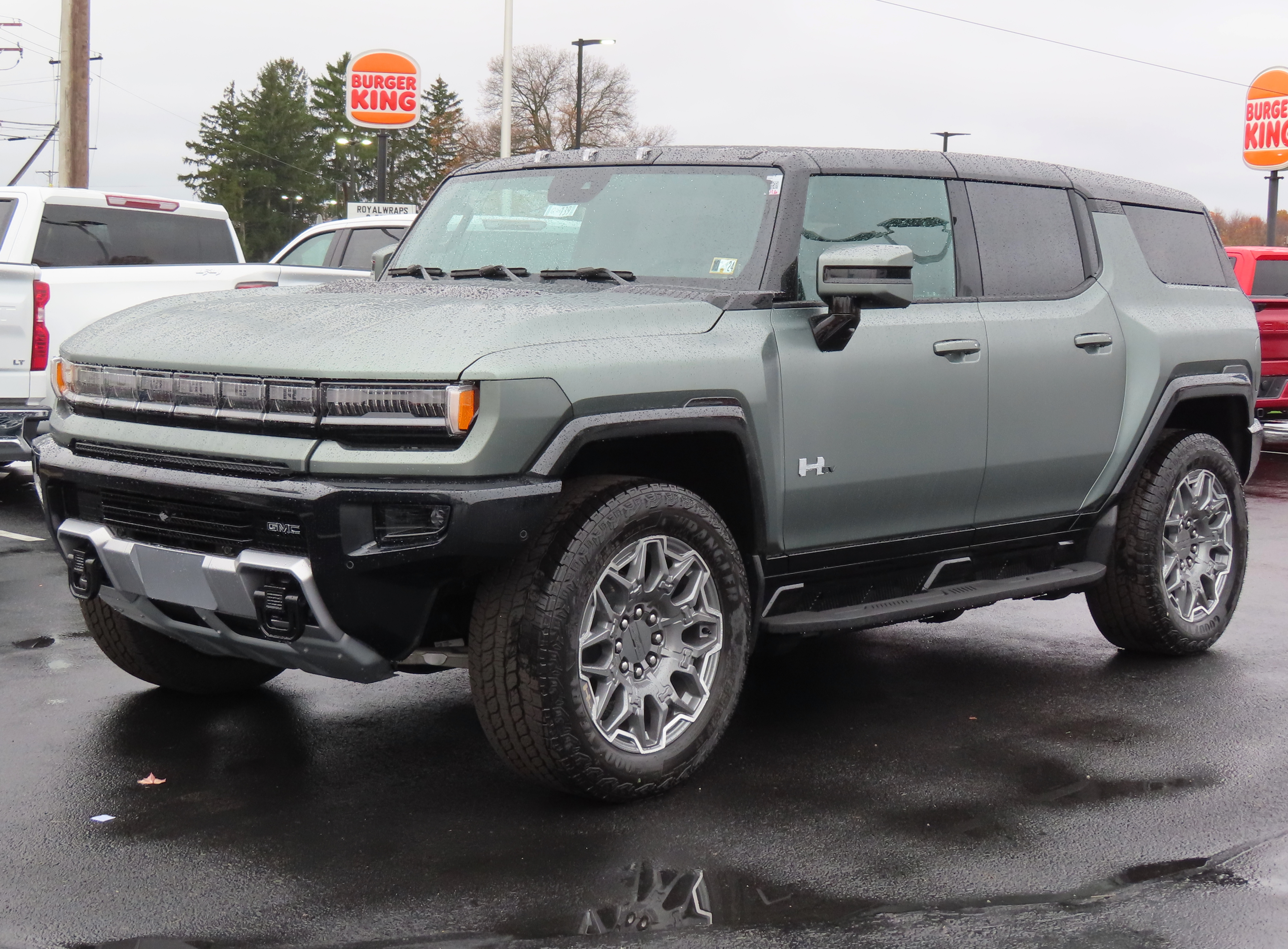
Hummer Ev
"...e. But the fact that like GM came out with like a Hummer EV that could crab walk before we came out like with..."
The Hummer EV SUV is an electric SUV built for tough driving, including off-road situations. It’s known for special movement features that help it shift sideways or maneuver in difficult spots. People bring it up because it shows how electric vehicles can still be designed for serious capability.
The Hummer EV SUV is a fully electric, high-performance SUV known for its extreme off-road hardware and distinctive driving features. It’s frequently mentioned because it introduced advanced low-speed maneuvering tech—like crab-walking—intended to help the vehicle move precisely in tight or uneven conditions. In a podcast, it’s a standout example when discussing how automakers push technology and capability in electric vehicles.
crab walk
"GM came out with like a Hummer EV that could crab walk before we came out like with a hybrid Tahoe"
Crab walk is when a vehicle can move sideways, like a crab, to fit into tight spots or maneuver off-road. It usually requires special steering that can control more than just the front wheels.
Crab walk is a coordinated driving mode where a vehicle steers so all wheels move in a sideways direction (or near-sideways) for low-speed maneuvering. It’s commonly enabled by four-wheel steering or advanced chassis control, and it helps with tight off-road or parking situations.
powertrain
"my wife could care less about the powertrain. She doesn't even know like the difference in that sense."
A powertrain is the set of components that generate and deliver propulsion—typically the engine (or electric motor), transmission, driveshaft(s), differential(s), and related control systems. The speaker is saying her wife doesn’t care about the technical differences between powertrain types (like EV vs hybrid).
market research perspective
"But regardless, it was interesting to me from like a market research perspective that like that was something, a very simplistic view of it. Like, yeah, why would I want my kids on a big battery?"
“Market research perspective” means looking at what people believe and how that belief changes what they buy. In this segment, the host is using that lens to question a simple fear about car seats compared with what’s in the whole car.
A “market research perspective” means analyzing consumer beliefs and behavior as data—what people think, why they think it, and how that affects buying decisions. Here, it’s used to evaluate the “simplistic view” parents have about exposure from a car seat versus the entire vehicle interior.
Wi-Fi electronics
"Yeah. And by the way, like going to any car nowadays, you're literally surrounded by Wi-Fi electronics. You are sitting in like a big cell phone."
Modern cars have lots of electronics and wireless features. The host is saying that you’re already surrounded by connected tech in the car, so the concern they’re discussing may not be as unusual as it sounds.
Modern cars increasingly include wireless connectivity and electronic modules that can communicate over Wi‑Fi or similar networks. The host uses this to frame why people are already surrounded by electronics while in the car, even when the specific worry is about car-seat exposure.
FR free car seat
"The concern that a lot of parents have when it comes to car seat is they want like an FR free car seat. So like the one that wasn't sprayed with the harsh chemicals."
“FR” means flame-retardant. Some car seats use chemicals to help slow fire spread, and some parents try to avoid those by looking for an “FR-free” seat. The host’s point is that the whole car interior can have similar treatments, not just the seat.
“FR” here refers to flame-retardant chemicals used in some child-safety-seat materials. Parents may look for an “FR-free” car seat to avoid those additives, but the host argues the concern can be misleading because the broader vehicle interior may also contain similar chemical treatments.

Ford Bronco
"... called like the Boulder, like competing with the Bronco. Like there's just it."
The Ford Bronco is an SUV designed for off-road driving, like dirt roads and rough terrain. It’s the kind of vehicle people talk about when they want a truck-like SUV that can handle more than just regular city streets. Dealership discussions often focus on how well it can go off-road and what features it includes.
The Ford Bronco is a rugged, off-road-focused SUV built for drivers who want serious capability beyond normal street driving. It’s often discussed because it’s a modern revival of the Bronco nameplate and because it competes directly in the “go anywhere” SUV segment. In dealership conversations, it commonly comes up when comparing off-road features and overall value versus other capable SUVs.

Toyota Land Cruiser
"Well, you could be like, Mark, I noticed you're a Toyota guy. You know, what do you think about the new Land Cruiser coming back?"
The Toyota Land Cruiser is a tough, long-lasting SUV that’s known for off-road driving. The host is using it as an example of a car topic people bond over.
The Toyota Land Cruiser is a long-running, body-on-frame-style SUV famous for durability and off-road ability. Here, the host uses “the new Land Cruiser coming back” as an example of the kind of car conversation a person might have with a “Toyota guy.”
podium
"This episode is brought to you by podium. If you're like most dealers, you've probably tried some version of AI by now."
Podium is a company that makes software for car dealerships. The idea here is that it uses AI to answer phone calls and help with scheduling and follow-ups.
Podium is a software vendor that provides AI tools for car dealerships. In this segment, it’s described as using voice AI to handle calls and help manage sales and service workflows.
sales and service workflows
"thousands of their customizable AI agents are actively running sales and service workflows every day."
Workflows are the dealership’s routine steps, like how a customer gets a quote, schedules service, and gets updates. The claim is that AI can help run those steps without as much manual work.
Sales and service workflows are the step-by-step processes a dealership uses to handle leads, appointments, repairs, and customer follow-up. The segment claims these AI agents can run those workflows automatically each day.
AI add-on
"What makes them different is they're not just another AI add-on. They consolidate sales service messaging and especially voice into one customizable platform"
An AI add-on is like an extra app you add to your dealership software. The point being made is that stacking lots of separate AI tools can be messy compared to one system that does it all together.
An AI add-on is an extra software module you bolt onto existing systems to add AI features. The host contrasts it with a more integrated platform that consolidates messaging and voice instead of creating multiple disconnected tools.
voice AI
"They consolidate sales service messaging and especially voice into one customizable platform... Podium's voice AI book's appointments, routes calls correctly, and escalates when it should"
Voice AI is AI that can talk to people on the phone. In this context, it can answer calls, send them to the right place, and help schedule appointments.
Voice AI refers to AI systems that understand spoken language and respond in real time. Here it’s used to book appointments, route calls, and escalate issues based on dealership procedures.
playbook
"based on your dealership's playbooks."
A playbook is a set of instructions for what to do in common situations. Here, it means the AI follows the dealership’s own rules for when to handle a call and when to pass it to a person.
Dealership playbooks are predefined rules and scripts that describe what the staff should do in different situations. The segment says the AI escalates calls based on these playbooks, meaning it follows the dealership’s specific procedures.
non-toxic car
"I don't, I don't think we're that far off from, hey, the first like non-toxic car. I'm telling you right now, bookmark this podcast."
A “non-toxic car” is a car designed to be much safer for people and the environment. The idea is that it uses fewer harmful chemicals and produces less harmful stuff over its life.
A “non-toxic car” is a marketing/industry idea that aims to reduce harmful substances across the vehicle’s lifecycle—materials used in manufacturing, emissions during use, and possibly end-of-life waste. The host frames it as an upcoming milestone where a vehicle will be “branded” as the first of its kind.
recycled materials
"like with the EVs, like vehicles that are made with like more recycled materials that are less toxic."
“Recycled materials” means the car uses parts made from materials that were used before or pulled from waste. The host is saying that can make the car cleaner and less harmful.
“Recycled materials” in vehicle manufacturing means using previously used or waste-derived inputs (like recycled metals or plastics) to build parts. The host connects it to lower toxicity and reduced environmental impact.
less toxic
"like vehicles that are made with like more recycled materials that are less toxic. I really think it's something that a lot of people just don't know about."
“Less toxic” means the car is designed to avoid or reduce harmful chemicals. That can be about what it’s made from and what it puts into the environment.
“Less toxic” refers to reducing exposure to harmful chemicals or pollutants. In automotive terms, it can relate to material choices (e.g., coatings, plastics, adhesives) and to how the vehicle is produced and used.
Child Passengers Safety Tech
"So like I have a team of CPSTs, which stands for Child Passengers Safety Tech, who check I have to who check every single one of the pieces of content I put out..."
CPST stands for Child Passenger Safety Technician. They’re trained to help parents install child car seats correctly so the seat is positioned and secured the right way for safety.
A Child Passengers Safety Tech (CPST) is a trained specialist focused on installing and using child safety seats correctly. Their job is to help ensure car seats are fitted properly to reduce injury risk in crashes and to prevent common installation mistakes.
CPST
"like every every car has, again, me and my team of CPST is lossy over this, but every car will have recommended car seats"
CPST means Child Passenger Safety Technician. They’re trained to help you pick the right car seat and make sure it’s installed correctly in your specific vehicle.
CPST stands for Child Passenger Safety Technician. These are trained professionals who help families choose and correctly install child car seats based on vehicle fit and the seat’s requirements.
seat belts
"every car will have recommended car seats based on their seatbelts, their latch, their head restraints, the fit"
Here, seatbelts matter because some child seats are installed using the car’s seatbelt. Where the belt and buckle are located can change how well the seat fits.
In this context, seatbelts are part of how child seats are installed or evaluated, since some seats use the vehicle seatbelt path while others use LATCH. Vehicle belt geometry and buckle placement can affect fit and installation difficulty.
head restraints
"based on their seatbelts, their latch, their head restraints, the fit,"
Head restraints are the parts of the seat that support your head. For child seats, they can sometimes get in the way, so the car’s head restraint position matters for proper fit.
Head restraints are the adjustable supports on a vehicle seatback that can interfere with or affect child-seat installation. Some child seats require specific clearance or may need to be positioned to avoid contact with the head restraint.
bench
"the fit, the bench, like we're able to give really good recommended car seats."
A bench seat is the kind of seat that can fit more than one person across. Its shape can change how a child seat sits and how easy it is to install.
A bench seat is a multi-person seat with a continuous seating surface, and its shape can affect child-seat placement and installation angles. The podcast is treating bench geometry as a factor in recommending compatible car seats.
latch map
"Every car is going to have a latch map. So families will know like where the lower anchors and the tether anchors are."
A latch map shows where the car’s child-seat attachment points are. It helps you hook the car seat in the right spots so it’s safer and easier to install.
A latch map is a vehicle-specific guide showing where the LATCH lower anchors and tether anchors are located. It helps families install child seats correctly without guessing anchor positions.
lower anchors
"So families will know like where the lower anchors and the tether anchors are."
Lower anchors are built-in points in the car where you attach a child seat. Using them correctly helps the seat stay secure.
Lower anchors are part of the LATCH system: fixed points in the vehicle seat where a child seat can attach using rigid connectors. Correct use reduces installation errors compared with seatbelt-only installs.
tether anchors
"So families will know like where the lower anchors and the tether anchors are."
Tether anchors are the points in the car used to attach the top strap on many forward-facing child seats. That top strap helps keep the seat more stable in a crash.
Tether anchors are the attachment points used by many forward-facing child seats to secure the top tether strap. They help limit head-forward movement in a crash and improve overall restraint performance.
child passenger safety tech
"it's 40 hours. It's a 40 hour you do it for one week in your certified child passenger safety tech have one on staff and then advertise that one thing that yours need to stop doing"
A child passenger safety technician is someone trained to help with child car seats. They focus on making sure the seat is installed and used correctly. The host is saying dealerships should have that kind of help available.
A child passenger safety technician is a trained professional focused on child restraint systems—like car seats and boosters—and on correct installation and fit. In the segment, the host uses this term to argue that having that expertise available at dealerships can improve how families get information. The key idea is safety education tied to the actual car-seat setup.
lease return
"Like, sometimes I feel like dealers are so coy with like what happens at a lease return like how to get more money for your trade."
A lease return is when you’re done with a leased car and you have to give it back. There’s usually an inspection and you might be charged for damage or excessive wear. The host says dealers don’t explain this clearly enough.
A lease return is the process of ending a leased vehicle and turning it back to the leasing company. It often involves inspections, wear-and-tear assessments, and decisions that can affect the final charges. The host criticizes dealers for being vague about what to expect during this process.
trade
"Like, sometimes I feel like dealers are so coy with like what happens at a lease return like how to get more money for your trade."
A trade-in is your current car that you hand over when buying another vehicle. Dealers may not explain clearly how they’ll value it. The host is saying people should understand the process so they can get a better deal.
In car buying, a trade-in is the vehicle you give to the dealer as part of the deal for a new or used car. The host implies dealers can be “coy” about how trade-in value is handled, especially around lease returns. The specialized meaning here is the dealership transaction step, not the everyday word “trade.”
pre-owned market
"I also really like I also think people are missing in terms of the pre-owned market like educating our consumers and one makes a good pre-owned car and you know"
The pre-owned market just means used cars. The host is saying people should get educated about buying used cars, because it’s not exactly the same as buying new. Knowing what to expect can help you avoid bad surprises.
The pre-owned market is the used-car segment where vehicles are sold after their original ownership period. The host argues that consumers need education specific to buying used cars, not just new-car or leasing situations. This is about how information and expectations differ when shopping for used inventory.
100,000 miles
"One thing [2640.9s] that I've really been talking a lot about on my platform is that 100,000 miles isn't too many miles. [2646.3s] I think you can buy a car with 100,000 miles."
“100,000 miles” is a big number people use to judge a used car. But miles don’t tell the whole story—maintenance and driving habits matter a lot too.
In used-car shopping, “100,000 miles” is a common threshold that people associate with wear. The key point here is that mileage alone doesn’t automatically mean the car is worn out—what matters is how the car was maintained and how it was driven.
200,000
"This car has [2663.5s] 112. It's going to cars are designed to make it to 200,000. That's okay kind of like easing some of that anxiety..."
“200,000” is basically the idea of how long a car can last in miles. The host is saying that many cars are built to go that far if they’re maintained properly.
“200,000” here is shorthand for a vehicle’s expected service life in miles. Many mainstream cars are engineered to reach very high mileages if they receive regular maintenance, so the host is arguing that higher-mileage purchases can still make sense.
Request an Explanation
Heard something you'd like explained? We'll add it to this episode.
Sign in to request explanations for terms you heard.
Want to learn more?
Browse our glossary for plain-English explanations of automotive terms, jargon, and concepts.
Help improve this episode
See something that's not quite right? Our annotations are AI-generated and can sometimes miss the mark. Click the flag icon on any annotation to suggest a correction.