The diffuser is a part under the car that helps it stick to the track by shaping the air under the floor. If there’s a “diffuser issue,” it means that part isn’t working as well as expected, which can hurt grip and speed.
In racing, “tires” are the rubber compounds that provide grip. If everyone is struggling with tires, it usually means the tires aren’t lasting or gripping as well as expected, so the car feels slower or harder to drive.
Term
high deck race
This sounds like a transcription glitch, but the idea is that the race conditions will be tough—especially because it’s hot and the tires will be under stress. That can make the car harder to keep fast for long.
Long runs are when the team drives for many laps in a row to see how the car holds up. It helps predict race pace because tires and balance change as the stint goes on.
The tire challenge means the tires aren’t working the way the team wants. If they don’t get the right grip, the car can feel slippery and hard to control.
Lack of balance is when the car doesn’t feel “even” in how it turns and grips. The driver can’t get the steering to feel predictable, so the car may push wide or rotate too much.
The Oldsmobile Intrigue is a regular family car (a mid-size sedan) made to be comfortable for daily driving. When people mention the “power unit,” they mean the engine and related parts that make the car move. It may come up in conversation because owners sometimes had different experiences with how that setup performed over time.
A high altitude track is a race at elevation where the air is thinner. That can reduce engine power and change how turbo cars perform, so teams have to adapt.
Turbos are parts that help the engine make more power by forcing extra air in. At high altitude, the air is thinner, so turbo cars can struggle compared to lower tracks.
GPS traces are recorded position and speed data from the car, used to compare line, acceleration, and timing through corners. In racing analysis, they help infer where the car is gaining or losing time—like whether acceleration out of a corner is strong.
Surface temperature is how hot the tire’s outer layer gets during a lap. Teams aim for a specific operating window because too-cold tires lose grip, while overheating the surface can reduce traction and consistency over a single lap.
A simulator in Formula 1 is a driver-in-the-loop setup used to model car behavior and help engineers understand performance issues. When the host mentions simulator work “into the early hours,” it implies they’re using it to diagnose handling problems like traction and corner behavior.
Grip is how well the tires can hold the road. If grip changes unpredictably, the driver can’t tell exactly how much the car will stick when they turn or accelerate.
Wheel spin is when the tires start slipping while you’re trying to accelerate. Instead of the car moving forward efficiently, the wheels spin faster than the grip allows.
A flip-top rear wing is a rear wing that can change position using a mechanism. The team checked whether it moved and returned correctly, and didn’t feel it was worth running it for long.
Silverstone is a well-known race track in the UK where Formula 1 races. The host mentions it’s a sprint weekend, meaning there’s less time for experimenting with new parts.
A sprint weekend is when F1 adds an extra, shorter race earlier in the weekend. That usually means less time to test new parts and more focus on getting the car ready to race.
Hungary is mentioned as the next race location where the team might try the wing again. It’s basically about when they’ll get another chance to test it.
An electrical problem means something in the car’s electronics or wiring failed. If it stops the car on track, it’s usually serious enough that the team can’t just keep driving.
Overheating means the car is getting too hot. In this case, the host suggests it’s because the car is scraping/dragging the bottom, which can make it run hotter.
The “floor stays” are parts that help hold up the car’s underbody (the floor). Because the floor affects airflow, the exact shape and placement of these parts can be used to gain downforce.
A fillet radius is a rounded corner where two surfaces meet. In racing, rounding edges can change how air moves, which can help the car generate more grip.
“Aero gains” are improvements from aerodynamics—basically how well the car grips the road and how efficiently it moves through the air. In racing, small changes can matter a lot.
Technical directives are official FIA instructions that tell teams what they’re allowed to do with the car. If a loophole is found, these directives can shut it down quickly.
The “exhaust wing ban” is the FIA shutting down a type of aerodynamic add-on near the exhaust. Teams were using it to get extra downforce, so the rules were changed to stop that approach.
A diffuser is a part under the car that helps air flow in a way that increases grip. If the rules change about nearby bodywork, teams often have to reshape the diffuser too.
An engine upgrade means the team brings a newer or improved version of the engine parts to make the car faster. In F1, teams don’t always get the same upgrades at the exact same time, so results can vary race to race.
“In a crate” just means the new parts are ready somewhere, but the team hasn’t put them on the car yet. They may plan to install them later in the season.
In F1, drivers earn points based on where they finish in the race. “Proper points” here means scoring enough to matter in the standings, not just barely missing out.
Qualifying is when drivers set the fastest timed laps to decide where they start the race. A qualifying lap is that timed lap, and it’s important because starting near the front usually gives you a better chance to race well.
LIVE
Welcome to In Car Insights where we offer you insight from a car. We failed you on one
score. We're not in a car. We're on little sort of wobbly chairs. No, wobbly chairs. They
rotate. Country chairs, so for us, but they're just chairs. But we do have insight, don't
we, John? I hope so. It's been a bit of a better day. My sunk cost fallacy problem
of yesterday hasn't really happened. I got to the paddock eager to chase people before
curfew this morning. And it's a quite funny little scene because curfew ended at nine
o'clock. So I stood in the paddock. There's certain places down the paddock you know people
are going to walk past you. One's a paddock gate. So I observed the very end of curfew
at nine o'clock. And they're like eight, 59 and 30 seconds. A lot of Audi mechanics
marched forward to the gates and they were holding their passes out. And you could they
were all counting down their watch and bang on when it went eight, 59, 59 seconds, passes
on hit nine o'clock straight through absolute pure efficiency from Audi there to come in
the second curfew ended. One of my great joys is when we arrive and it's a little bit
before curfew. And there can be a few dozen in some cases in extreme case go somewhere
like Singapore sometimes they'll be more than 100 personnel all just waiting to get in but
you can just barge all past them. No, no, we're coming through. We're not operational personnel.
We are fine. So let's look at the on track action today. Mercedes fastest. So it felt
a little bit like business as usual. Comey Antonelli quickest fastest on the long runs
as well. The Mercedes so it feels a little bit back to where we were before that remarkable
Sunday in Barcelona. Yeah, I mean, no one's got any doubt that Mercedes is the still the
team to beat. It's been very quick. Obviously the diffuser issue is flared up this weekend,
which I'm sure we'll talk about in a minute, but it was never going to be anything that's
a massive game changer. So yeah, Mercedes looks consistent. Everyone's struggling with
tires. It's going to be another high deck race and have a hot race. All those issues
are coming through. But McLaren looks quite close. Red Bull seems to have made a little
bit of a step. I think Mercedes is just mindful that Friday in Barcelona looked as comfortable
as now and things turned around very rapidly on Sunday says they're still a bit cautious.
No confidence. But George, I mean, you look at the lap times today didn't look too great
for George in terms of single lap pace, but long runs. It's up there right up there with
Kimmy, I think slightly quicker. Going to one calculation I saw. So it looks like it's
a game on between the two Mercedes drivers. For obviously the interesting one, they've
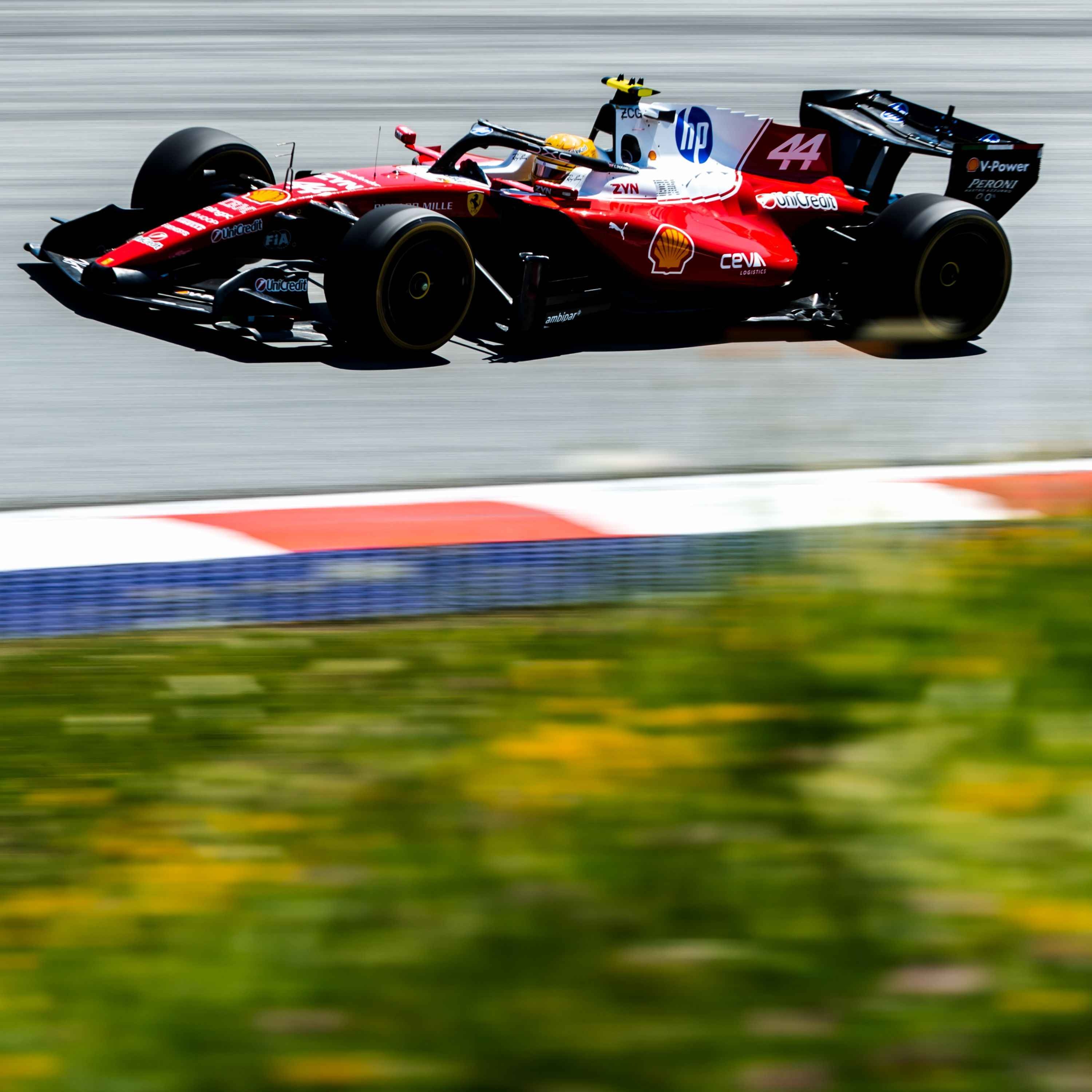
got this engine upgrade on the car. They were struggling for grip, sliding around a lot.
I'm very interested to see what happens over the next few days because while Charles Leclerc
was asked, I was going to be like Barcelona that you struggle on Friday and you go well
and he said, well, we're pretty confident in Barcelona. There's potential. We're not
so sure now. Now, I've not spent much time looking at this. I've a quick glance at the
data. There's quite a lot of Ferrari time going on the straight. There are a few corners
where they're losing out, but I'm looking at that and thinking, are you being a little
bit restrained with the engine as well? Because everyone's struggling a bit for grip, because
as you say, it's that tire challenge. So not particularly positive noises from Ferrari,
but I think we're going to need to have a look at tomorrow before we get a slightly better
picture.
You know, they don't seem as comfortable as they were in Barcelona. Even though Friday
in Barcelona was difficult and it came back. I think they sense that things aren't as
comfortable. As you said, Leclerc complained about lack of grip. There's a lack of balance.
The single lap pace didn't seem very quick. Lewis was fifth. So behind one Red Bull, one
Mercedes, two McLarens. Long run pace puts them behind Mercedes and McLaren on a par
with Red Bull. So not fantastic, but there is the intrigue over the power unit. My only
caveat on that is, we've come into this weekend well aware of a high altitude track for the
first time. We know the turbos don't particularly like this altitude. Yeah, it's thinner. It
makes things difficult. So the question is whether the Ferrari is smaller turbo, which
minimizes turbo lag. And if you look at the, I think we were looking at some GPS traces
together, you can see them accelerating quite well coming out the corners. So the question
is, is that deployment? Is that turbo lag responsiveness? Then running out of kind of
advantage further down the straights? Is that an engine turned down? Or is that a smaller
turbo unable to get the boost pressure up enough to get all the air into the engine itself as
the Audi would, for example? But that's something we'll only know tomorrow once they wind things
up. And it may be an answer we only get in qualifying.
Yeah, you can make a case for either argument on Ferrari. And we don't really have a steer
particularly on that. So I guess we have to take it a face value. So we're struggling a bit with
grip, etc. But this is all about the tires, isn't it? It's that great challenge for a single lap
of it's very easy to get heat into the tires. But what you normally want to do ideally is put the
heat into the core of the tire. And then you want to kind of adjust and get your surface
temperature right by the end of the lap. But there isn't really time to do that here. That's
the challenge here. So you can warm things up, but then you can't get it kind of back down to
that that window you want where the surface temperature is about right and not spiked and
the core is there. So it's switched on, etc. So it's always a challenge here and a lot of
performance variation can be in that Red Bull seem to be struggling a little bit, didn't they?
Yeah, it doesn't seem to be as good a picture. I think it's one of those challenges that when
you bring a big upgrade, either you for some reason have a good fortune, it works instantly,
you're not chasing things or some elements aren't working as well. You've then got to try to kind of
unpick it and understand it. Maybe the balance isn't in the right place. You've got to adjust it.
So you're learning things all the time. So it's a day of big learnings from Red Bull.
We heard on the radio a lot of complaints about the power unit, the way the car was handling,
especially in turn three. So I think a long way to go for them just yet. But I mean, this is the
story of Red Bull since forever has been very, very difficult Fridays. I'm sure they'll be,
you know, burning the candle in Milton Keynes tonight. Whoever's on the simulator there will
be running into the early hours and maybe they'll arrive tomorrow in a much more comfortable place.
Yeah, people will have heard them complaining about turn three in particular. I'll just read
you what Ezek Haja said after the session of the program. He said, it's like the rears are
grabbing, locking up and you lose all the support. It's not a linear grip. It's not nice. So you're
constantly guessing the grip. And then once you go back on the throttle, the engine has to catch
up and it creates wheel spin on exit. So it's really, really poor just in this corner. I don't
know how much we're losing, but it really feels bad. So that explains that one. McLaren brought
their flip top rear wing, as I like to call them, but they didn't run it today. What's going on there?
Yeah, the McLaren, I think a few people have called it. I'm not sure if I was going to grab
because it's a bit tricky to pronounce. Yeah, so the wing arrived this morning. Russell Bachelor,
who we use as a photographer, got some snaps for us. Obviously, it doesn't look dramatically different
stationary in the pits. Everyone's waiting to take some photographs of it out on track. But Russell,
who was there, said as the mechanics were running through stuff, there were some
concerned faces and finger pointing. And the team explained tonight that
basically some processes they needed to check in the garage, which you couldn't do in the factory.
So on the car, obviously checking how it works. Is the mechanism working correctly? Is it coming
back into position? All these sort of aspects that are critical to these wings. McLaren said it
didn't get itself into as comfortable a place as it wanted to be with all the way the wing was
working to feel it was worth running it out on track. It was only going to be a very short test.
Anyway, they felt they'd be better off sacrificing that element anyway, focusing on the actual car
performance for this weekend. So the wings being parked, taken off the car, it won't run again this
weekend. Probably won't run at Silverstone since it's a sprint weekend. You've got no time to
mess around with development parts there. So we may not see it again until Hungary,
but it probably doesn't change McLaren's timeframe very much because it was something that was much
more likely to come out after summer break. Looking further behind that group in the midfield,
we've got that three car group that's now midfield almost now with racing bulls,
Audi and Alpine. And obviously, Alpine tends to be a bit stronger in the races and in qualifying.
Racing bulls tend to be a bit stronger in qualifying than the race. Audi is generally
pretty quick in both, but unfortunately they lose 87 positions off the start. So they struggle to be
in there and have reliability problems. So that's that normal picture. And then you've got kind of
Hassan Williams together and then Aston Martin down the back. Cadillac were a bit frustrated,
I think, today because they've got this pretty big new upgrade on the car, talking about that being
worth a few tenths. But a lot of problems they had, didn't they? Checo stopped on track,
an electrical problem. Bottas, you'd have seen kind of the floor almost dragging that. I think
they described that as some kind of build problem with the... Did the team describe it as a car
overheating? Sorry? Did the team describe it as a car overheating? Briefly, they said it was
overheating. But it's a little bit like, well, it's overheating because you are dragging the
bottom of the car, the front of the tea tray, I think specifically on the ground. So that will
have that effect. Things do get a little bit hot. So yeah, but they did talk a little bit more in
detail about that later on, the technical director Nick Chester. And yeah, this is such a hard track
to judge all the upgrades because there's so many little things, the tires, and it's very easy to
out of the car. But tomorrow is going to be the real
pointer, I think, on track, certainly for the single lap pace, obviously, in FP3 and qualifying.
But some off track stuff going on. Obviously, this question mark with the Ferrari, the Mercedes,
rather diffuser, and the bodywork they've got there that they've had to take off and Ferrari's
part in stopping them from doing that or stopping them from being able to run what they wanted to
run. So that's been something you've sort of been running down. We knew yesterday that had
happened, but it's a classic thing of you want to chase down the why's and the wherefores,
what exactly is going on, what exactly is the argument, why exactly has this come to pass?
Yeah, the story has been bubbling away a little bit now. But while we kind of knew the basics,
we didn't understand the details of it. And I think it's sometimes important that until you
understand the actual details, then it's better to just dig some more and find stuff out. So,
which we did today, and it's quite an interesting story. So these little serrated wings that have
appeared on the back of the Mercedes in Canada and caught Ferrari's attention basically involves a
clever exploitation regulations of a floor stay that then allows you to fit a fillet radius and
an edge radius, which gives you a kind of a cone appearance, then you can run these extra bits of
bodywork for aero gains. So it's a clever way of doing it. Ferrari preseason had tried to use the
same route in terms of the floor stays and edge radiuses and fillet radiuses, but a very different
concept. But trying to exploit this in a different way felt that Mercedes had been allowed to do,
it wasn't allowed to do. Fi doesn't see things that way, felt that Ferrari was a completely
different idea, had no link to Mercedes at all. But it emerged that Ferrari then said, right,
if you allow what Mercedes is doing, we want to do some more outlandish things. One of which
solution which I learned was that they would have these serrated wings right on the edge of the floor
near where the rear wheel was, which would then be in a close proximity to anybody else, battling
their cars for position would potentially lead to the risk of punctures. So it's in a crazy place
to allow it. But that was the moment I think Fi realised that we need to stop this now because
teams are going to take this too far. This often happens in F1. The Fi just decides that these
things can get out of control, will stop it, like the exhaust wing ban that was confirmed in the
regulations this morning. So it moved post-Barcelona, it updated what we know as technical directives.
There are FiA docs that now have all these FiA judgment calls in them, so to speak. They said
you can't use these fillet radiuses, edge radiuses, error gains. So that's why Mercedes had to alter
their diffusers weekend. You understand racing balls had to do it as well. But Haas, which has
been exploiting a little bit in the area, has continued doing what it's doing. But another
kind of fascinating little tech battle that I always find quite intriguing.
It's worth noting Haas and Cadillac aren't running the Ferrari engine upgrade here. There's obviously,
they have to offer the same kit, but there are a little bit of allowances in terms of manufacturing
and everything. If you needed to have a full set of all the new engines for all of them, that would
be a lot. So I think I can actually say they do have one in a crate in the garage, but not on the
car as yet. But over the next few races, we'll see Haas and Cadillac getting there. It was a case
a few years ago when Haas and Salba, as it was, got the upgrade before Ferrari because they wanted
to run it with the customers first. So there's always a little bit of variation there. So final
quick answer, John, your tip for poll tomorrow? George Russell, I want to go for it, just because
I think he's been quietly fast today. He knows he needs to start getting some proper points and
beating Kimmy Antonelli. Should be a track that suits him a little bit better. So yeah, I'll go for him.
I think just to be different, I'm going to go Antonelli. Ultimately, it's going to come down to
nailing that tire for the qualifying lap. And we all think it's going to be Mercedes, but I'm
really interested to see if Ferrari can take a bigger step, perhaps, than they were suggesting
overnight. If they don't, all the reasons you mentioned could be the reason. And if they do,
some of the reasons I suggested. So let's see how it goes on. We'll be back tomorrow with more
in car insights, and we may even be in the car.
Original notes
As a special bonus, we're making the Friday edition of our In-Car Insights podcast - usually only available to The Race Members' Club - free for everyone to listen to.
Mercedes ended practice day at F1's Austrian Grand Prix on top, but could McLaren be a threat and is Ferrari holding something back with its upgraded engine? Edd and Jon discuss the pecking order at the end of Friday at the Red Bull Ring, plus explain why F1 has banned both Mercedes and Ferrari innovations.
If you like what you hear - and we're confident you will - head to Patreon.com/therace to sign up to The Race Members' Club and enjoy these bonus episodes (and much more besides) on every grand prix weekend.