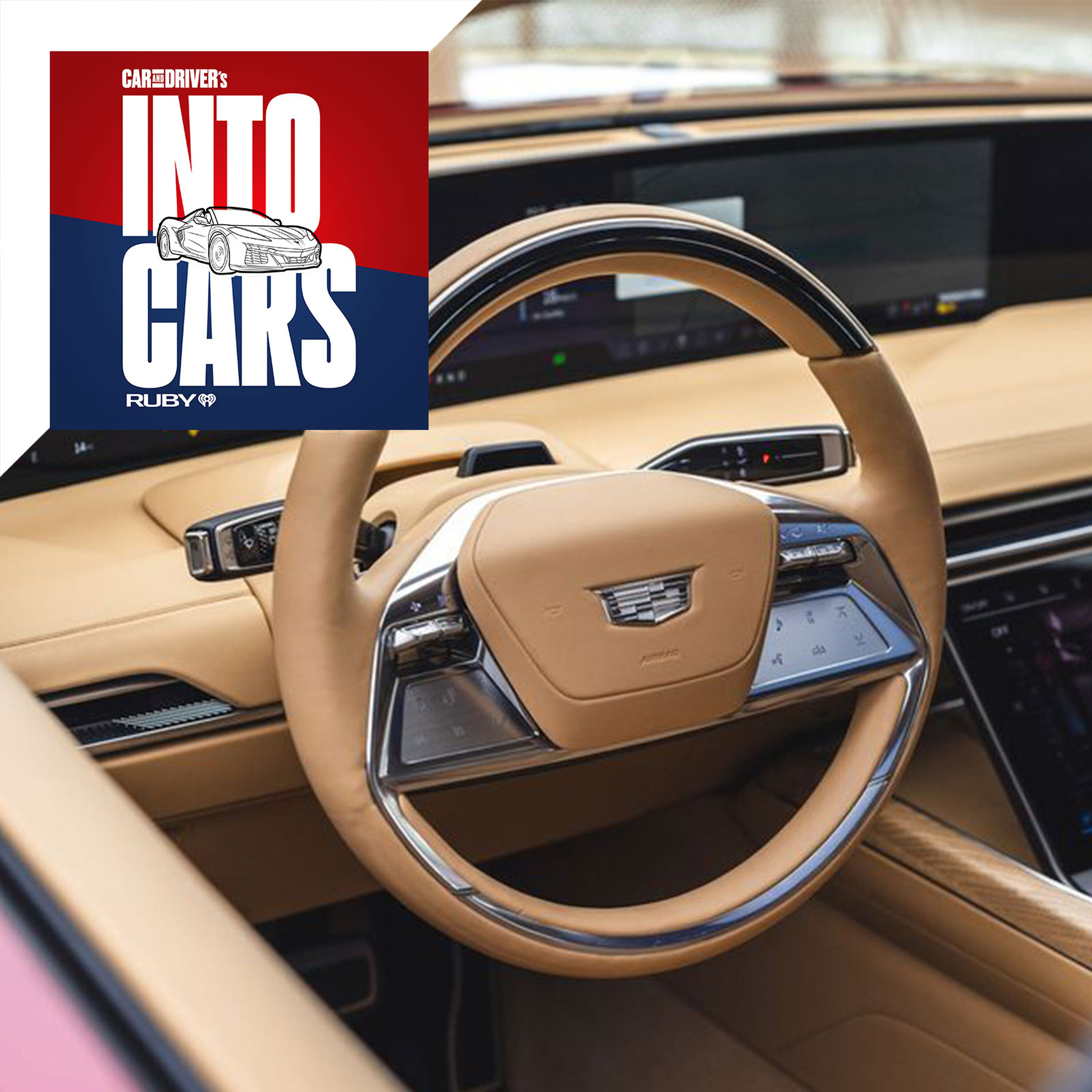
Exploring the Cadillac Celestiq, the podcast takes listeners on a unique field trip to Cadillac House at GM's Technical Center. Hosts Tony Kiroga and Eddie Alterman dive into the design and engineering of Cadillac's flagship electric sedan, which starts at over $350,000. They interview key designers and engineers, discussing the car's striking proportions, advanced technology, and the bespoke customer experience at Cadillac House. The episode highlights the meticulous process of customizing the Celestiq, showcasing its luxurious materials and innovative features, making it a standout in the luxury EV market.
Cadillac’s new $350,000 Celestiq offers buyers a unique experience. Hosts Tony Quiroga and Eddie Alterman travel to Cadillac House to see what Celestiq customers have in store for them. After a thorough walk around of the Celestiq from the engineers and designers who created it, Tony and Eddie option out a Celestiq with Cadillac’s design concierge.
For more on the Cadillac Celestiq visit Car and Driver online.
"...the customer experience of a very special car, the over $350,000 Cadillac Celestiq. In addition to specifying how we'd order Cadillac's most expensive car ever..."
The Cadillac Celestiq is a very expensive electric car made by Cadillac. It's meant to compete with luxury brands like Rolls-Royce and Bentley, which are known for their high-quality and expensive vehicles.
The Cadillac Celestiq is Cadillac's flagship electric vehicle, designed to compete in the luxury market. With a price tag over $350,000, it aims to rival high-end brands like Rolls-Royce and Bentley.
"The Cadillac Celestiq is a $350,000 to start, 600 horsepower EV sedan..."
Horsepower is a way to measure how powerful a car's engine is. More horsepower usually means the car can go faster and perform better.
Horsepower is a unit of measurement for power, commonly used to describe the power output of engines. In the automotive context, higher horsepower typically indicates better performance and acceleration.
Car
Cadillac Celestic
"You either have to work there, be a journalist, or buy a Celestic. It's truly one of the most amazing places in America in terms of mid-century architecture."
The Cadillac Celestic is a new luxury electric car from Cadillac. It's designed to be very high-end and showcases the latest technology and design features.
The Cadillac Celestic is a luxury electric vehicle that represents Cadillac's commitment to modern design and technology. It is part of a new wave of electric vehicles aiming to redefine the brand's image.
"...the flat battery pack out of something like a Lyric was not going to work for a car like this."
The Cadillac Lyric is a new electric SUV from Cadillac. It's designed to be luxurious and has a lot of modern technology inside.
The Cadillac Lyric is an all-electric luxury SUV that represents Cadillac's entry into the electric vehicle market. It features advanced technology and a spacious interior.
"...we quickly realized the flat battery pack out of something like a Lyric was not going to work for a car like this. You really just can't get these proportions with anything like that."
A battery pack is a group of batteries that work together to store energy for electric cars. It's like a bigger version of the batteries you might use in a remote control, but designed for cars.
A battery pack is a collection of batteries that are connected together to provide a specific voltage and capacity for powering electric vehicles. In this context, it refers to the energy storage system used in electric cars.
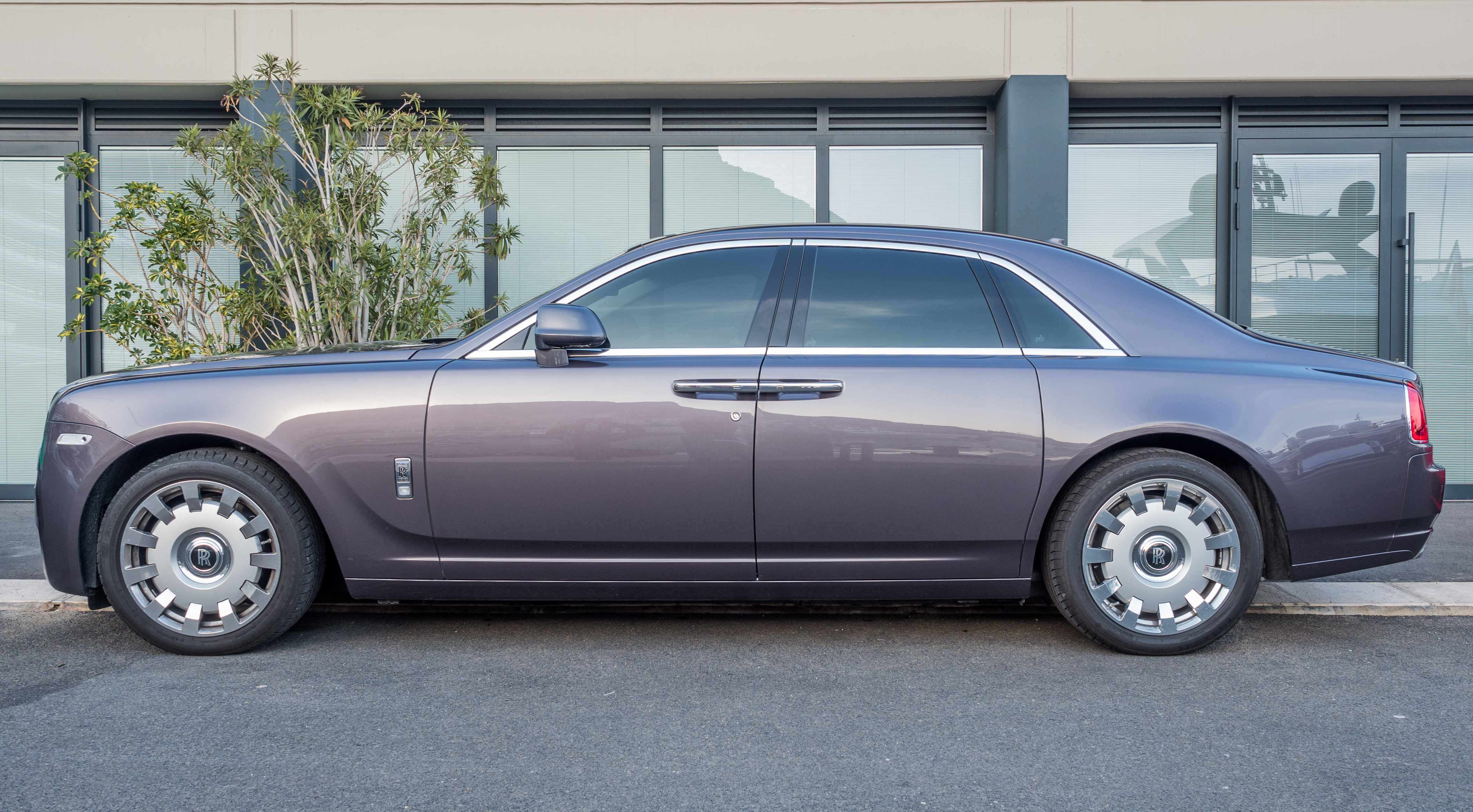
"...I can't think of any car in modern times with the 130 inch wheelbase. We're, I forget exactly the number, like five millimeters longer than a Rolls Royce Ghost..."
The Rolls Royce Ghost is a very fancy car that is known for being really comfortable and luxurious. It's made for people who want the best of the best.
The Rolls Royce Ghost is a luxury sedan known for its opulence and advanced technology. It features a powerful V12 engine and a focus on comfort and refinement.
"...I can't think of any car in modern times with the 130 inch wheelbase. We're, I forget exactly the number, like five millimeters longer than a Rolls Royce Ghost..."
The wheelbase is how far apart the front and back wheels are on a car. A longer wheelbase can make a car feel more stable when driving.
Wheelbase is the distance between the front and rear axles of a vehicle. It affects the car's stability, handling, and interior space.
"...the roof line, the wheel tire package, these 23 inch wheels are..."
23 inch wheels are really big wheels that can make a car look cool and help it handle better, but they might make the ride a bit bumpier.
23 inch wheels refer to the diameter of the wheels on a vehicle. Larger wheels can enhance the car's appearance and handling but may also affect ride comfort.
"...the same as an Escalade. So it's got the wheel tire package from an Escalade with a roof shorter than a CT6..."
The Cadillac Escalade is a large, fancy SUV that offers a lot of space and luxury features. It's often used by families or people who want a comfortable ride with plenty of room.
The Cadillac Escalade is a full-size luxury SUV known for its spacious interior, powerful performance, and high-end features. It's a popular choice among those looking for a combination of luxury and utility.
"...a roof shorter than a CT6 and the length that's halfway between a short and long wheelbase Escalade."
The Cadillac CT6 is a large luxury car that offers a comfortable ride and many high-tech features. It's designed for people who want a stylish and advanced vehicle.
The Cadillac CT6 is a full-size luxury sedan that features advanced technology, a spacious interior, and a focus on performance. It represents Cadillac's commitment to luxury and innovation.
"There's carbon fiber body panels, right? The hood, these front fenders, the rear quarter panels, those are all carbon..."
Carbon fiber body panels are parts of a car made from a special lightweight material that makes the car stronger and helps it go faster.
Carbon fiber body panels are lightweight and strong components used in automotive construction to improve performance and efficiency by reducing weight.
"...he person responsible ultimately for things like CTSVs, CT5V, black wing, tell us about the performance ..."
The Cadillac CTS-V is a fancy car that goes really fast and looks great. It's made by Cadillac, which is a luxury brand, and it's known for being powerful and fun to drive.
The Cadillac CTS-V is a high-performance version of the Cadillac CTS sedan, known for its powerful engine and sporty handling. It represents Cadillac's commitment to competing in the luxury performance segment, often discussed for its blend of luxury and speed.
"So Tony, as the person responsible ultimately for things like CTSVs, CT5V, black wing, tell us about the performance a little bit."
The Cadillac CT5-V Blackwing is a sporty version of the Cadillac CT5, built for speed and performance with special features that make it fun to drive.
The Cadillac CT5-V Blackwing is a high-performance variant of the CT5 sedan, featuring a powerful engine and advanced technology designed for enhanced driving dynamics.
"The technology we incorporated into the suspension. We've got MR dampers, air springs, active roll control."
MR dampers are special shock absorbers that can change how stiff or soft they are while you drive, helping the car handle better and feel smoother.
MR dampers, or Magnetic Ride dampers, use magnetorheological fluid to adjust the damping characteristics in real-time, providing improved ride comfort and handling performance.
"We've got MR dampers, air springs, active roll control. We obsessed over the kinematics to give it smooth ride and even motions."
Active roll control is a system that helps keep the car from leaning too much when you turn, making it feel more stable and easier to handle.
Active roll control is a technology that helps reduce body roll during cornering by adjusting the suspension stiffness dynamically, enhancing stability and handling.
"...without a high character internal combustion engine like you have in the V cars, you have to find other places to give it that character. And so we're seeing that a lot in EVs because the power delivery is so similar from EV to EV..."
An internal combustion engine is what most cars use to run. It burns fuel like gasoline to create power that moves the car.
An internal combustion engine (ICE) is a type of engine that generates power by burning fuel and air inside the engine's cylinders. This process creates a series of controlled explosions that push pistons, ultimately powering the vehicle.
"...and so we're seeing that a lot in EVs because the power delivery is so similar from EV to EV. If you take the engine out of the equation, what are the points of differentiation..."
EVs are cars that run on electricity instead of gasoline. They use batteries to power an electric motor, which moves the car.
EVs, or electric vehicles, are cars that are powered entirely or partially by electricity instead of traditional fuels like gasoline or diesel. They use electric motors and batteries to propel the vehicle.
"...it's really in chassis development. Yeah. And the good news is it's in things that we're really, really good at..."
Chassis development is about building the part of the car that holds everything together, like the frame and suspension. It affects how the car handles and feels when you drive it.
Chassis development refers to the engineering and design processes involved in creating the structure of a vehicle, which includes the frame, suspension, and handling characteristics. This is crucial for vehicle performance and safety.
"And that's what we were able to do with this car because every EV goes really quickly zero to 60."
An EV, or Electric Vehicle, is a car that runs on electricity instead of gasoline. This means it uses electric motors to move instead of a traditional engine that burns fuel.
EV stands for Electric Vehicle, which is a type of vehicle that is powered entirely or partially by electricity. These vehicles use electric motors instead of internal combustion engines (ICE), leading to different performance characteristics and environmental impacts.
"Even the slow ones, quote unquote, are really fast by ICE vehicle standards. So that's not a discriminator anymore. And in fact, I'm sure you guys have been in these really, really fast EVs, they're almost uncomfortable."
'Zero to 60' is a way to measure how fast a car can go from a complete stop to 60 miles per hour. It's often used to compare how quickly different cars can accelerate.
The term 'zero to 60' refers to the time it takes for a vehicle to accelerate from a complete stop to 60 miles per hour. It's a common performance metric used to gauge a car's acceleration capabilities, especially in sports and performance vehicles.
"Even the slow ones, quote unquote, are really fast by ICE vehicle standards. So that's not a discriminator anymore."
An ICE vehicle is a car that uses a traditional engine that burns fuel, like gasoline or diesel, to run. This is different from electric cars that use batteries and electric motors.
ICE stands for Internal Combustion Engine, which refers to traditional vehicles that use gasoline or diesel fuel to power their engines. This contrasts with electric vehicles (EVs) that rely on electric power.
"...and really low center of gravity that comes with an EV. It's crazy. Yeah, the car is just amazing."
The center of gravity is where the weight of the car is balanced. If it's low, like in electric cars, it helps the car stay stable and handle better when turning.
The center of gravity is the point in a vehicle where its weight is evenly distributed in all directions. A low center of gravity helps improve stability and handling, especially in electric vehicles (EVs) due to their battery placement.
"Can you talk a little bit about the mega castings that are in the car? Yeah, sure. It's one of the things we did early on."
Mega castings are big chunks of metal that are shaped into parts for cars. Instead of using many smaller pieces, manufacturers use these large pieces to make the car stronger and easier to put together.
Mega castings refer to large, single pieces of cast metal used in automotive manufacturing to create structural components. This approach can reduce the number of parts needed, streamline assembly, and improve overall vehicle rigidity.
"...we distributed the lithium pouches around to get the right amount of energy. And then you got to figure out a body structure that connects all the dots."
Lithium pouches are special battery packs used in electric cars. They hold energy so the car can run, and they can be shaped to fit in different spaces in the car.
Lithium pouches are flexible battery cells used in electric vehicles (EVs) to store energy. They are lightweight and can be arranged in various configurations to optimize space and weight distribution within the vehicle.
"...you just push the button and it opens. When you have the key fob in your pocket and you walk up to the driver's door, it would open for you..."
A key fob is a remote control for your car that helps you unlock the doors and start the engine without using a traditional key. You just need to have it with you.
A key fob is a small electronic device that allows you to control various functions of your car, such as locking and unlocking the doors, starting the engine, and sometimes even opening the trunk. It communicates with the car using radio signals.
"...that has a built-in APU for making 12 volt loads and then one large one in the rear. It adds up to..."
An APU is a small engine that helps power things in the car, like lights and electronics, without needing to run the main engine.
An APU, or Auxiliary Power Unit, is a device that provides energy for functions other than propulsion. In vehicles, it can be used to power electrical systems when the main engine is off.
"super comfortable to drive, super quiet. So N, N, V, what is it? Oh, noise and vibration. Okay. So that's the new, there's no harshness anymore because you don't have that."
NVH is a term used to describe how much noise and vibration you feel when driving a car. A car with low NVH is quieter and smoother, making it more comfortable to drive.
NVH stands for Noise, Vibration, and Harshness, which are key factors in assessing a vehicle's comfort and refinement. Lower NVH levels generally indicate a more pleasant driving experience, as they reduce unwanted sounds and vibrations inside the cabin.
"the interior with the 38 speakers and the AKG guys, if they're listening to this, they'll chuckle because I've been telling them for years..."
AKG is a brand that makes really good sound systems. They are known for providing high-quality audio, which makes listening to music in the car much better.
AKG is a well-known audio equipment manufacturer that specializes in high-quality sound systems. Their products are often used in premium vehicles to enhance the audio experience for passengers.
"...this is the first car I know of that anybody's really done four of exactly the same 40 way power seats with all the massage, the armrests and the center console armrests are all heated..."
40 way power seats are special car seats that can move in many different ways to make you comfortable. You can adjust them up, down, forward, backward, and even change the support for your back.
40 way power seats refer to seats that can be adjusted in multiple directions and positions, allowing for a highly customizable seating experience. This includes adjustments for height, tilt, lumbar support, and more, often controlled electronically.
"...into this space, they see Celestic and all of its grandeur. Really, for any vehicle, photos will never do i..."
The Hyundai Grandeur is a big, comfortable car that has a lot of nice features and looks really good. It's made by Hyundai, which is known for making reliable cars, and this one is more focused on luxury.
The Hyundai Grandeur is a full-size sedan that offers a blend of comfort, technology, and style, primarily aimed at the luxury market. It is significant for showcasing Hyundai's design and engineering capabilities, often discussed in the context of its upscale features.
"They fell over an El Dorado with a red interior and a white exterior. And we partnered with the archives who had that exact same unit."
The Cadillac El Dorado is a fancy car made by Cadillac, famous for being stylish and luxurious. The 1971 version is a classic that many people admire.
The Cadillac El Dorado is a luxury car produced by Cadillac, known for its distinctive styling and high-end features. The 1971 model is particularly notable for its classic design and was part of the El Dorado's long production run.
"...e exterior. And then if we go in and we pull the Phantom blue, which is probably our deepest blue, it cou..."
The Rolls-Royce Phantom is one of the most luxurious cars you can buy, known for being super comfortable and very stylish. It's made by Rolls-Royce, a brand famous for making cars that are like rolling pieces of art.
The Rolls-Royce Phantom is a flagship luxury sedan that epitomizes opulence and craftsmanship. Known for its smooth ride and bespoke features, it is often discussed as a symbol of wealth and status in the automotive world.
"Well, you know, the MSRP is directly correlated to the selections that we're making. Obviously, there are some significant price drivers in the vehicle."
MSRP is the price that car makers suggest dealers charge for their cars. It's like a starting point for how much a car should cost, but the actual price can be different.
MSRP stands for Manufacturer's Suggested Retail Price, which is the price that the manufacturer recommends a dealer sell a vehicle for. It serves as a guideline for pricing but can vary based on dealer markups and additional options.
"... and fake eight speed gearbox engineered into the Hyundai Ionic 5N EV can successfully replicate the experience"
The Hyundai Ioniq 5 is a new electric car that looks very modern and cool. It's designed to be eco-friendly and has a lot of smart technology, making it a popular choice for people who want to drive electric.
The Hyundai Ioniq 5 is an all-electric crossover that stands out for its futuristic design and advanced technology. It represents Hyundai's push into the electric vehicle market, often discussed for its impressive range and innovative features.
Select text to request an explanation
Hello and welcome to Car and Drivers Into Cars, a podcast from iHeartMedia's Ruby Studio
brought to you by eBay Motors.
I'm Tony Kiroga, the editor-in-chief of Car and Driver, and I'm joined by my co-host,
former editor-in-chief and current chief brand and content officer Eddie Alterman.
And together, we're Into Cars.
Each episode of this podcast covers a new car that we think is worthy of your attention.
The cars we select may feature a novel design, cutting-edge engineering,
or something entirely new.
We'll cover the stories behind the cars, answering the whys and exploring the what's.
And then we'll sit down with the people who actually made the cars to answer our questions
about them.
Come along for the ride and you'll hear it all.
The good, the bad, and the ugly in the way that only Car and Driver delivers.
This episode of Into Cars is a little different.
We're going on a field trip to Cadillac House at GM's Technical Center in Warren, Michigan
to have the customer experience of a very special car, the over $350,000 Cadillac Celestic.
In addition to specifying how we'd order Cadillac's most expensive car ever,
we're going to talk to the designers, engineers, and people responsible for a car that will
compete with the Rolls Royces, Bentley's, and Mybox of the World.
For what seems like decades, Cadillac has been teasing a true flagship for its lineup,
and now they've built it.
The Cadillac Celestic is a $350,000 to start, 600 horsepower EV sedan that's as long as an escalate.
But you don't just power slide into your local Cadillac dealership to get one.
Owners have to make the cut, and once they do, they're welcomed into the world of Cadillac House.
Cadillac House at Vanderbilt, that's the official name, is the brand's Atelier,
where customers go to spec out their Celestics.
The trim and color choices are limitless, and it all happens in the midst of a mid-century
modern architectural masterpiece, Aero Saranen's General Motors Technical Center,
dedicated in 1956. Cadillac House is a jewel box of glass, travertine, and marble
located right in the heart of the Tech Center campus. And the thing is, nobody gets to see it.
You have to be invited in. You either have to work there, be a journalist, or buy a Celestic.
It's truly one of the most amazing places in America in terms of mid-century architecture.
It's just not open to the public, and we're going to go there today.
We're here at this incredible building Cadillac House at Vanderbilt with Alexandra Demoska,
who is going to be our tour guide to sort of orient us to the space. And this is where
Celestic owners will be speccing out their cars. So give us the tour.
It's quite a special place, and that's why it was selected for the Celestic
Peacebook design process. It seemed fitting to create a space that would house the design
process that was happening on a one-to-one level between the client and the designer,
and also with the support of our concierge. And we're at the GM Technical Center, which
in its day was dubbed the Versailles of the industry. And there is so much meaning to
the place where we're standing. It's really the heart of the American automotive industry,
but it also is the origin point of the American mid-century modern design. It was one of the
first commissions to a now very prominent designer, Aero Saranen. And Aero Saranen did
the St. Louis Arch, he did the TWA terminal at JFK, and a bunch of really significant...
And many, many iconic chairs. And I think that's why it's not only the automotive industry,
it's part of the architecture and furniture. And also modern art, because when you look
around, you look outside of the catalogue house, and you see a fountain by Alexander Kolder called
the Water Ballet. There are many sculptures, and one of them is the one that we're standing in front
of, which is a beautiful, glimmering screen by Harry Bertoya. And it really feels like you're in
the heart of the whole complex, too. As I mentioned, on one side, you have the view of the Alexander
Kolder fountain, but also you see the new design building, which is called Design West, and the
iconic design dome. Behind us on the other side is the vehicle engineering building. So we're
technically standing at the intersection of artistry and engineering.
We're here with Aaron Crossley, who's the design director for Celestic, and Tony Roma,
who's the chief engineer of Celestic. And they're going to take us through the Celestic. We're
standing in front of this, what's this color called? This is Cyber Yellow Metallic. Tell us
and it catches people's attention. You can tell even on paper that it's really something that you
need to build. That started the process and the development of creating three-dimensional scale
models and then full-size models, transitioned to a concept vehicle, and then concept turned into a
production car. And it was really very natural. Everybody was very invested. And we've talked
a lot about a flagship for Cadillac. Tony's worked on a lot of them. I've worked on a lot of them.
And there's always been one reason or another that it didn't quite take flight. And this,
just all of the pieces came together in terms of what the vehicle looked like from a design
evolution perspective, what the vehicle would do for the brand overall. It is a completely new
proportion, super long wheelbase, very, very low. So can you tell us about the packaging of this?
We had this maybe three-quarter scale kind of vision model. So we scanned it and tried to put
people in it. And, you know, let's just say the studio was a little aggressive with their
so you got to take something and start tugging and pulling on it and
massaging it. And over the course of a fair amount of time, we quickly realized the flat
battery pack out of something like a Lyric was not going to work for a car like this. You really
just can't get these proportions with anything like that. So we take our pouch cells that we
normally put like toast and we put them like pancakes. We flip them down and we stack them
up in varying layer heights of sixes or nines. They have to go in multiples of three because
we do three pouches in parallel and 100 in series. So instead of being stacked, like I said, like
toast in threes, it's turned on their side. Fallen dominoes kind of thing. Exactly. So we have stacks
of six nines and 12s depending on where you look. Oh, amazing. I had no idea. I thought this was like,
oh, you just take the skateboard under the Hummer and throw it on this thing. Well, you couldn't
get it this short. The proportions wouldn't be anywhere like this. The roof would have to be
significantly taller. So how long and low it is. I can't think of any car in modern times with the
130 inch wheelbase. We're, I forget exactly the number, like five millimeters longer than a Rolls
Royce Ghost. And it ends in an eight because of the significance to the culture in China. So,
you know, we thought through even little teeny details. So 3308 is the wheelbase and the height,
I think it's lower than a Malibu. The proportions are crazy. Like you said, and the working on it in
the studio, even in a setting like this, when it's by itself, you definitely get a sense of scale.
But then, yeah, the first time you take it out into the real world, you're like, boy.
It has a huge impact when you see it on the road in a sea of crossover SUVs.
Well, and back to your point about the roof line, the wheel tire package, these 23 inch wheels are
basically the same as an Escalade. So it's got the wheel tire package from an Escalade with a
roof shorter than a CT6 and the length that's halfway between a short and long wheelbase Escalade.
I think it speaks to the overall size of the thing where they look,
yeah, completely sort of natural. They do look really natural.
That's the wheelbase, I think. You need those wheels to make this work. If they were any smaller,
it would be. Kind of silly. Well, walk us around it a little bit and tell us what you're proudest of.
There's a lot of things. I'm proud. I think the vehicle overall, when we talk about
how unique it is from an appearance, the low profile bull proportion, I think that that speaks
a lot to if you look at all of the significant Cadillacs of the past. I mean, they were always
making these bold, unexpected design statements. And I think Celestic continues that narrative for
Cadillac. There's a lot of beauty in the simplicity of the form as well. And then it's highlighted
and punctuated by incredible technology and beautiful materials. I'm really proud of
the work that the team did collectively to be able to deliver this vehicle with this level of
material execution, I think is a huge accomplishment. There's carbon fiber body panels, right?
The hood, these front fenders, the rear quarter panels, those are all carbon. The deck lid is also
carbon, but you really can't see any of it. It's covered. This A to C and D pillar trim,
this piece right here is carbon. Oh, that's a huge piece. Yeah. The only reason the doors
aren't carbon fiber is because we needed them to be radar transparent. There's a radar unit
right kind of in the center here that's looking for objects that the power doors might bump into.
So we chose SMC, essentially fiberglass, only because the radar can't see through carbon.
So a lot of work done with the engineering teams around paint as well and paint pigments and
being able to have that radar transmissibility with the different pigments without causing
any issues with that. So there was a lot of really upfront work done to really understand
what the right pigment load is, what the right amount of aluminum is, so that we could have
such broad opportunities for color on the vehicle. I think the other material, no,
we love to talk about, and we can start with the exterior, is that everything that looks
like metal is real metal. Tremendous amount of subtlety and the line work. And yeah,
as you said, the shape itself is simple, but as you look closer, you see all this cool stuff
sort of emerge. The way that that bone line goes all the way down the side of the car and that
kind of crease in the door, it breaks up the surfaces. There's a lot going on down the side
of the car, even though, yeah, like you said, at first glance, it looks super simple. It's been
a lot of time perfecting that body fight. So Tony, as the person responsible ultimately for
things like CTSVs, CT5V, black wing, tell us about the performance a little bit.
Yeah, I can't wait until we get a chance for you guys to drive this thing. It is like nothing
you've ever driven before. The technology we incorporated into the suspension. We've got MR
dampers, air springs, active roll control. We obsessed over the kinematics to give it smooth
ride and even motions and these Michelin tires completely overachieved on what we thought they
were going to be. Those are the pilot EVs. Yeah, it's funny when you look at it and all the things
we've been talking about, how elegant it is and large and all of that and you get in and you expect
that's what it's going to drive like, but then when you get in and drive it the first time,
like Mark Roystrove, he got out of the car and he started talking about how athletic and responsive
the car is, which is exactly what we were hoping he would say, but you don't expect that. So you
get out of the car going, how did you do that? And that's exactly the response we're looking for.
It's smooth and elegant and quiet when you want it to be and then when you want it to be a little
more aggressive, it responds very well. So without a high character internal combustion engine like
you have in the V cars, you have to find other places to give it that character. And so we're
seeing that a lot in EVs because the power delivery is so similar from EV to EV. If you take the engine
out of the equation, what are the points of differentiation and you're starting to see like,
okay, it's really in chassis development. Yeah. And the good news is it's in things that we're
really, really good at. So it's about giving the customer an experience that they don't even know
how you would do that. And that's what we were able to do with this car because every EV goes
really quickly zero to 60. Even the slow ones, quote unquote, are really fast by ICE vehicle
standards. So that's not a discriminator anymore. And in fact, I'm sure you guys have been in these
really, really fast EVs, they're almost uncomfortable. When you do that launch, especially if you're,
you can literally make people sick in a car like this, that was certainly not what we were going
for. And right from the beginning of use this statement, though, we were trying to make a great
car that happened to be an EV versus making a great EV. And that's a key difference. And so
we did obsess over the kinematics and the suspension and the isolation and all those things.
How did you achieve that was such a low hood line?
We hollowed out the structure. Normally, there would be some structure that would tie in the
front of dash to the radiator support area. And the upper suspension would get bounded by that.
So the upper control arm comes within about three millimeters of the actual surface of the hood.
And we had to hollow everything out in order to let it all come up. And just, it's all about
there's no bumps on the hood and engineering the right clearances.
It was the first time we had ever done that at GM, that we had ever really made the structure
literally go around the traveling front suspension. You know, when I drove that Escalade V, I was so
astounded by the inertial management and how you have such a large and also massive body feel so
small and drive so small. So this thing does the same job as this. Oh, yes. And no offense to my
Escalade brothers and sisters, but does it way better? You're going to be blown away. What we
were able to do with chassis modal for shake and vibration and the response, like I said,
these tires, oh my gosh, and really low center of gravity that comes with an EV. It's crazy.
Yeah, the car is just amazing. Can you talk a little bit about the mega castings that are in
the car? Yeah, sure. It's one of the things we did early on. We talked about, you know, what did
you do when you saw the proportions? Well, we packaged the people in space where we wanted
them to be. We distributed the lithium pouches around to get the right amount of energy.
And then you got to figure out a body structure that connects all the dots. And when the engineers
came in the first time and said, okay, what if we made the entire lower structure out of castings?
You sort of look at them and you go, no, that would never work. Can you think of castings, big
heavy, you know, cast iron skillet kind of thing. But then you really start looking at, well, okay,
by the time we weld together hundreds of pieces of metal and all the rest of the stuff, and we just
sort of went down this road. And so we've got six major castings that come together
to make the entire lower structure. And these are all sand castings. So we have the flexibility.
We can 3D print sand cores. So it's a mixture of hard tooled and printed cores to make the
castings. And it gives us a lot of flexibility if we have to change something. Well, I would think
it's one of the major learnings as far as engineering in this car. And what is the volume
ultimately? Well, we don't talk of specifics, but we don't have the ability to even make very many
of these, even if we wanted to. So, you know, somewhere in the order of two a day is around
what we expect we're going to make. But yeah, we're not talking specifics on volume beyond that.
Can we go inside and check out the interior? Absolutely.
First off, how do you open the doors? I don't see any door handles.
Well, that was one of the things early on, right? So these little round buttons, and like I
mentioned, there's radar, so you'll get used to when you drive the car. You want to stay out of the
zone for the radar, and then you just push the button and it opens. When you have the key fob in
your pocket and you walk up to the driver's door, it would open for you. It's a setting you can choose
it or not. When you get in the driver's side and you push the brake pedal, it closes the door for
you. So the owner, in theory, never even has to touch the driver's door. How do you close this
door from the inside? So this is the door handle, and so you just flick it up. It's a micro switch,
and it'll do itself, or you can push the door handle. When you pull up to pick somebody up and
you put the car in park, the screen pops up and you can just flick and open their door for them.
It's pretty cool. The leather smell coming off of this. As soon as you open the door. There's a lot
of leather. And these door, are the interior door handles a retro? Yeah, that's a good catch.
70s Cadillac. That's exactly right. If you go look at a 60s Cadillac, this is what they're
very much like. Yep. No record player, no bar. No record player. They can spec it out for different
markets, I'm sure. Yeah, exactly. Should we hop in? Yeah. Oh, wow. 130-inch wheelbase. I can feel it
back here. And there goes the door all by itself. The door handles are all cast. I think they're
cast zinc. The window switches, the window lifters are 3D printed aluminum. Well, coat hooks are 3D
printed. The metal on the assist handle is all 3D printed. Yeah, these are a real retro touch too.
The grab handles. So that's an impressive screen up there. How big is that screen? 54 inches.
And this side over here has electronic shutters in it. So as soon as you're driving down the road,
it turns opaque to the driver. So I can sit here and watch Hulu on my side of the screen or
YouTube or whatever I want. And the driver can't see it. Is this the largest moonroof or panoramic
sunroof? It's the largest I know of. Yeah, let's put it that way. And then you can just,
you know, you can make it look dark. It's like a triple seven window. And every piece in here is
unique to the celestic. The suite of components visually is the same from a brand consistency
perspective, but how we've executed it on celestic is unique to celestics. Exactly.
Can you talk about what some of the goals were with the interior design?
Having overall design or form language that was fairly simple and easy to understand
so that it could then be embellished by materials, craftsmanship, technology,
a really simple breakup that's easy to understand and realize in many different
colors and combinations. You know, an interior that is meant to be a blank canvas,
that's meant to be customized and enhanced by the owner of the vehicle, you know,
when they design it. I think another really unique thing about this interior because of the way it
is hand built is this ability to kind of taking advantage, if you will, of this ability to line
things up. So, you know, you can trace this line from the base of the A-pillar basically all the way
360 degrees around the car. So really emphasizing the long lines that you get from the exterior,
echoing those on the interior. The IP we went for this low in a way look. You can see even how
the steering column interfaces with the IP, that was a real design feature that we struggle with
a lot is to get this down and away from you that spacious feeling. You know, you're in a big car
but yet the headers pretty low so you want to make sure that it doesn't feel claustrophobic.
Very airy in here. Where are the batteries packaged? Now that we're sitting in the car,
it's four seats. It's very comfortable. I have a ton of foot room. I have a ton of leg room.
Where have you packaged the batteries? Are they down this center tunnel?
Hold that thought about foot room, right? So under Erin and I here are the nine stacks tall
because a front occupant's legs are further out in front of them so they can handle the age point
which you call the hips down to your heel. They can handle that being a little more so we can lay
our feet out. The rear occupants because you've had the front seat in front of you, you need your
heel down lower to be comfortable. So you only have six tall underneath your heels there but then
it goes to 12 underneath your bottom. So your floor is higher than mine? Yes. Okay. And then the
center tunnel, we turned the pouches that are about half the width of the car. We turned them 90
degrees and there's two stacks of 12 down the middle under the center console here. Like a
ferro gas tank. I can't think of a more elegant reference but yes, like a ferro gas tank. Yes.
And then tell us about the motors a little bit. It's a two motor system, right? So one in the front
that has a built-in APU for making 12 volt loads and then one large one in the rear. It adds up to
over 600 horsepower of propulsion power and they're very similar to like the performance version of
Lyric. They're bespoke to us only because of what we do to them from an N and V standpoint. We kind
of encapsulate them, wrap them up. We did some different things with the gearing but they're
very common. I could spend $100,000 on drive units and it wouldn't make this car that much
more special versus spending all the attention we did on the interior and other things. So
the drive units are more than adequate. When you drive this car, it's very quick,
super comfortable to drive, super quiet. So N, N, V, what is it? Oh, noise and vibration. Okay. So
that's the new, there's no harshness anymore because you don't have that. Yeah, could just be,
I don't use the acronym right. That could be it too. So the stereo system, 36 speakers inside,
is that right? 38 speakers and then we have two outside. So you could say we've got 40,
we've got exterior speakers, we've got a tailgate mode. So if you're at a car show,
you can turn on and there's speakers outside or if you're washing your car, you can turn it on.
But the interior with the 38 speakers and the AKG guys, if they're listening to this, they'll
chuckle because I've been telling them for years and they won't let me say the best audio system
in the world because that's a pretty subjective thing. But they know very clearly that's been our
goal. And we're in the middle of the audio tuning loops right now, spent a lot of time with them,
you know, obsessing over all those little details. Listen to a lot of Steely Dan records.
You listen to a lot of diverse music right now, you can imagine. I wonder how long it would take
if you just were sitting in the car listening to the stereo, how long it would take to discharge
the battery? We can calculate it, but it would be a very, very long time. It's a theoretical time.
This is the world's largest boombox. Four weeks later, you'd be
duff and out of battery. What about the sort of sound signature of the vehicle itself? What were
you going for in terms of the sort of over-the-road sounds? Yeah, that's a really good question.
And we've been working on that as a brand, I'd say, as the Cadillac brand. We don't want this
car to be too unique and on its own, it doesn't need to be. It's more like everything else about
the car. It wants to be the most pure expression of Cadillac. So you'll find that it'll be real
similar to what you would find in a Lyric only, maybe just a touch more refined and a touch more
expressive. This car is all about quiet. And the quieter you make it, as you guys know, you've driven
so many cars over the years, I'm sure, we call it drain in the swamp, right? And you start to
notice those stumps that start sticking up and the things that you never heard before when you
finally get everything else quieter. So we're obsessing over a lot of really small little details.
So I noticed there's a V button on the steering wheel. What does that enable? So that enables
what we call velocity mode. It lets the inverters use all the range of their capacity. Normally,
you don't. And like in velocity mode, it hurts range a little bit because it keeps the battery
conditioned in a pretty narrow window. So you really only want to use it if you really want
all the power. So I'm looking back at the cargo area, which is massive,
which offers some practicality to this car. But it's sort of unexpected to build a essentially
a hatchback of this giant vehicle. Yeah. So what was the thinking? Why isn't it a sedan?
Well, that was just driven by the shape. When you look at that sketch there and talked about in
the very beginning, the lines that make the shape really demanded that it not be a traditional,
you know, three box sedan that would have totally altered its characteristics. And there's no
logical place to put a bulkhead. I mean, trust me, the engineers wanted to. But that signature,
if we were to get out and look in from the hatch, right, that signature is one of the things the
designers were very obsessed with from the beginning, that four freestanding seats with this long
center console. Yeah, the seats are amazing. I don't have my durometer with me, but they're nice
and soft, but also kind of firm and supportive. And it feels like I'm not sure where the adjustment
is. It's virtual. Yeah, so I'm kind of reclined too back here. It's essentially the same seat
in the front and the rear. This is the first car I know of that anybody's really done four of exactly
the same 40 way power seats with all the massage, the armrests and the center console armrests are
all heated, active cooling, not just ventilation, power headrests, all the bells and whistles.
You've got a neck scar, if you'll notice the little vent at the bottom. That's part of what we do to
create what we call micro climate around each occupant. And that isn't a much to the EV part
of it, right? For efficiency and range, you create, you create this, yeah, exactly local climate around
the person to make them comfortable. So you're not constantly conditioning this huge cabin.
Yeah, I've been in some EVs where I had some range of anxiety and shut everything down except for
the heated seat for that very reason. That's exactly right. You've pulled off a real trick here
because the cabin itself isn't huge and we're sitting in one that has a black interior,
but there's so much light and we're sitting in a car inside a building. And a lot of it is this
little sail window back here that you look to your right and it just brightens. I mean,
it's a really amazing trick you pulled off here. Yeah, when you recline back even further and
you look out that window, yeah, it's actually pretty comfortable. It's pretty cool.
Is this the longest duration project you both have ever worked on that five years?
Yeah, it's the longest single car. Of course, single car, yeah. And it's rare for a chief
engineer to really stick with a car all the way from like that first vision model all the way
through to production. That's pretty rare. And same from a design aspect as well,
because usually once they had an execution mode, we move on to the next project and also being
able to have the car in its entirety. Usually we have exterior team and interior team and to
be able to be overseeing the vehicle on its entirety, I think, just speaks to the importance
of the vehicle. So was this car from concept to production? Was it designed and engineered
with a price in mind or was it designed and engineered first and then you said this is
what it's going to cost? I'd be lying if I said we engineered it to cost in any way.
This was designed with a vision in mind, a vision and experience. This is truly an exercise of what
we're capable of from a design and engineering standpoint, the material choices we made.
There were definitely goals. If my bosses are listening to this podcast, they'll be like,
wait a minute, we gave you goals, of course. But yeah, this is more about that than the price.
And the price sort of landed where it did. And it's in the range of what you would pay for a
Rolls-Royce or something. So I don't think that's going to shock anybody. I think what people need
to do now is they need to see it. They need to experience it. There was this holistic desire
to do this vehicle and to create this experience around it. And that was that everybody, I think,
was equally passionate and committed to making that happen. And it was kind of like,
we will do what we have to do to create that and we'll figure the rest out as we go. But
we need to achieve the vision. And I think creating the concept vehicle initially as well gave us
that additional kind of physical North Star that this is what we're trying to capture for production.
But just to be clear, this does not have the North Star system.
Different North Star.
Different North Star. But a word that has significance to the brand.
Sorry, Dan. Well, I can't wait to drive it.
Me either. Thank you both for this incredible walk around. What a treat.
Yes, thank you. It's so cool to be here.
Thank you. Thank you, Tony. Thanks for coming.
So what happens after you decide to buy an over $340,000 Cadillac?
When we return, Eddie and I option out a Celestic as our private tour of Cadillac House continues.
Welcome back to Car and Drivers Into Cars.
So Eddie and I are about to go through the client experience of
speccing out a Celestic and building our own Celestics. And we're joined here by the Concierge.
Hi, yes, my name is Rob Sanmartin. I am one of three Concierge currently with the Celestic program.
Hi, my name is Maya Dagger and I am Assistant Marketing Manager for Celestic.
Great. Excellent. Let's go through the process.
Yeah, let's go see. So obviously, when you walk in,
you're greeted by this beautiful custom piece by Harry Bertoya.
This is the first commissioned piece ever by Bertoya and his largest. So essentially,
when we greet clients into this space, they see Celestic and all of its grandeur.
Really, for any vehicle, photos will never do it justice. So it's always a great opportunity
when we walk up these steps here to see it in its full presence. At 218 inches in length,
it's six inches longer than a standard Escalade. So again, it's a very big vehicle and it's very
impressive considering what it took to bring something of such genuine quality into fruition.
So this space in general, we have such a great opportunity to customize how we surprise and
delight our clients. One client of mine in particular, they had a love story from 1971.
They fell over an El Dorado with a red interior and a white exterior. And we partnered with the
archives who had that exact same unit. We pulled it into the space.
Very cool.
Yeah, it was a very touching moment. They definitely had a connection to the vehicle.
Did they try to buy the El Dorado?
No, they didn't. They're still in possession of that.
Oh, they still own their own.
Yeah, so yeah, we've been fortunate. We have a lot of clients that do have a
storied past with GM and Cadillac in the spirit of surprise and delight.
And getting to know our clients, we've met with them virtually probably
at least three or four times before they come to this space. We'll have understood their preferences.
So once customers see the car, where do you take them?
We do like the opportunity to give the client a full vehicle walk around with a subject matter
expert. So we'll typically have a member from our engineering team join us. But before we get
to that and we'll kind of pause here, move them over to our lounge space, get them settled,
get any refreshments that they want. We'll also have a procured selection of food and beverage
out here. We'll let them settle. Once we feel like the client is comfortable, we'll then transition
back to the vehicle and then do that full walk around experience.
I'm comfortable.
Are you comfy?
We're ready.
Great. We have the opportunity to engage clients in any appointment that they really want.
And the clients always find something exciting, something that they end up gravitating towards
that you don't really expect. I had a client recently that was so fixated on the active rear
spoiler that that's all we did. We just played with activating it and disengaging it for at least
20 minutes. Yeah. So every client is unique. Every client journey is special.
Part design expert, part therapist maybe. Oh, trust me. I'm on call.
So this is the first time the customers will actually have seen the car too, right?
Yes.
Yes.
So they've learned about it. How have they learned about the car?
So yeah, it really depends. We do things known as like our whisper events. So we invite like a
curated selection of people to those events and they will have seen the vehicle there.
Sometimes we do, you know, bring the concierge or some of our subject matter experts
to introduce them. So everybody's coming in at different points in their journey.
A lot of people come to the website too and they look at the vehicle and there's a high-level
interest there through our emails, all the traditional channels that we would normally go through.
So we'll go through, you know, a full program overview regarding the vehicle,
ask all those engineering questions, see the vehicle for the first time for most clients,
as you had mentioned, and then we'll come to this space. As I had mentioned,
we would typically have their design on the table. We would have all of those materials
that were working with the design.
All that they've selected already.
Yes.
From their virtual appointments.
Yes. Everything would have been predetermined.
And so you have 90 basic colors on these bucks here, all sort of arrayed in the ROYGBIV order.
Right now we have 75 actually on the wall because it gets super overwhelming.
And then on top of that, we have a matte pairing for every single color that we can do in matte.
And in this offering, we have everything from effect pigments,
tricotes, tint coats, solids, ceramics. So we have a great mix of everything.
We could also do a custom development if a client had a very specific color that they
wanted to achieve.
So how many leathers do we have?
We have around 10 leathers right now that are currently available.
So we've come in, Eddie and I, we've had a discussion with you already.
And now we've brought to you some good ideas and some bad ideas.
Okay.
So what's the next process?
Do I walk over to that wall and select my favorite leather?
What's first?
I like to anchor us with the exterior color, to be honest.
Okay.
Because I feel like that's the crowning jewel of the vehicle itself.
With that being said, could you, yeah, let's go take a look.
Could you tell me a little bit about your current collection or some of the colors and
materials that you find yourself gravitating towards in life?
I'm liking some of these lighter blues.
Okay.
I have a 1998 Geoprism.
Very similar to that.
And I want to keep, you know, the family resemblance.
Okay. I like that.
You know, in that blue space, I would love to investigate maybe something that has a
little bit more of a metallic as well as let's pull a solid.
And then just for fun, let's look at this.
These are great blues, very cool.
Hard to choose.
I like that French blue in the middle.
Yes, I do too.
We call that a Carolina blue.
These blues are really unique.
Right now we have things that lean more into that purple space like the hydrangea.
You had mentioned our Carolina blue.
That's more of like a cornflower blue.
And then we lean into this wonderland, which is more of like a robin's egg.
So with that being said, we're leaning more in this direction, I believe.
Sure.
Okay, good for that.
Sounds good.
Now, if we talk about the interior, could you tell me a little bit about some of the spaces
that you're inspired by?
Where would this vehicle typically reside?
Here in Michigan.
Here in Michigan.
Okay.
So I want something a little bright for those gray days.
Light and bright, I agree.
But I also love the Detroit Tigers, so I want something in the baseball mitt.
I have a huge mitt collection.
Well, you just planned this in reverse.
You just planned the whole vehicle.
All right, so I'm going to pull some of these fabrics.
So we have our cinnamon, our camea, and our sheer gray.
We can't go wrong with any of these.
I like the idea of maybe one primary color and then subtle accents of the other.
I like the cinnamon as the primary and the camea as the accent.
Oh, really?
Interesting.
So, Rob, when you said, oh, interesting, does that mean that guy's out of his mind?
No, I just typically, you know, I'm not one to do that subtle contrast.
A lot of my clients like something that's a little bit bolder, but I love that.
So we're looking at this gigantic 16-foot diagonal screen.
And the car's being built for us in real time with the options that we just selected.
So if you can see on the wall there, we have already rendered that Carolina blue on the exterior.
So we picked the exterior, we picked the cinnamon leather,
and now we're watching the accents get applied.
I don't want to get ahead, but can I choose my carpet color?
No, of course.
This is where Tony really goes for broke.
So you'll see on all these fine accents, we've started to pull that contrast color.
It's nice, it's subtle.
Oh, cool.
Oh, it's a smart vehicle.
I like this.
I bet you say that to all the clients.
Oh, trust me, no.
I mean, I'm here to make sure that they're not making a $400,000 mistake.
So there's definitely been some choices that we've helped clients steer them into a new direction.
I can't wait to hear how you talk me out of my carpet.
What are you going to choose, Bahia Orange?
So let's look at floor mat color.
I like that red.
Oh, come on.
You like that red.
You know what, it's not red.
Can I get the, not just the floor mats, but can I get the carpet carpet?
Yeah, you can get the whole flooring in a different color as well.
There we go.
Okay.
It's surprisingly okay.
It is surprisingly okay.
And you know what, that's actually really funny.
I had a client recently that they were going with four tones on the interior and we were just like,
wait, but honestly, when it rendered it was beautiful, we just did accent piping,
accent stitching, and an embroidered headrest in a contrast color as well.
Okay.
I've made a choice that I probably shouldn't have made.
Talk me out of it.
How do we do this?
I understand that you really love the red.
But what I'm really gathering is that maybe you're looking to do something
that's a little bit more bold.
I am.
I'm very bold.
Okay.
So with the exterior, we have that beautiful Carolina blue.
I'm thinking we can bring blue into this space.
Okay, let's do that.
I think it would be lovely if we, you know, we have this lighter blue exterior.
And then if we go in and we pull the Phantom blue, which is probably our deepest blue,
it could work really nicely.
All right, I got to do this.
Phantom is super chromatic.
And Phantom also is that perfect accent for a brown.
Honestly, you can't go wrong with saddle and blue.
I don't know if it's bold enough.
Oh, I like it.
You want to go bolder?
It looks terrific.
Okay.
It looks great.
You love it, but it's not what you want.
Can you do the lighter blue?
Yeah, let's definitely look at the Santorini blue.
But that does look really nice.
So this is Santorini.
What do we think?
That does remind me of my yacht.
It's very yacht adjacent.
I hear you.
To be fair, we're going modern.
I mean, honestly, with some of our leather selections that we've made so far,
we have our cinnamon with that Santorini.
Maybe we switch out the hard decor for our Humea, which is our carbon fiber.
And then I think this could go into a whole another direction.
Was she selecting piping for the carpets?
Yes.
Very nice.
Just so you're aware, there's probably around 300,000 areas within the vehicle
that we're able to customize.
Oh, that's nice.
That's really good.
So the piping has gone to the seat color.
This will be perfect for Greece.
That's it.
So how does the pricing work?
Right.
Not that I care about cost, you understand.
Well, you know, the MSRP is directly correlated to the selections that we're making.
Obviously, there are some significant price drivers in the vehicle.
There are some significant upgrades.
But that being said, it will just be determined by the selections that we make.
We do start at the $340,000 mark.
We're just north of that.
What is the most expensive, ballistic one can build?
Honestly, the Skyzel limit.
Skyzel limit?
And is this configurator...
This configurator is not online.
This is just...
It is not.
You can see the rendering itself is pretty advanced.
So it really takes rendering support.
There you go.
That's what I'm talking about.
That's good.
You guys joke, but I actually don't...
It's pretty good.
It's nice.
I gotta say, I have a lot of experience in building really ugly porches on their configurator.
Is there a cloth seat option?
There is a cloth seat back option and then the lower IP and mid-range of the vehicle.
We have three cloth options.
So you're changing the piping of the seats right now.
Yes.
We're just doing a center stripe.
Very soft.
And can we do the center stripe and sanarini?
So the center stripe has changed colors there down the spine.
Oh, wow.
Can I do my rear seats in a different color than my front seats?
Yes, we can.
I love having the driver's seat one color and everything else.
Oh, that's what you like.
I like that.
Oh, wow.
Every panel of the seat can be customized.
And this order, basically, this ticket,
it goes to the craftspeople sitting on this campus or...
Yeah, no.
So we have our Artisan Center where the vehicles are being built by hand.
No more than two a day will be built by hand.
And they do receive this actually in form of a book.
We're documenting our designs as we go.
And especially once they're finalized, it's a very detailed book
that's called a commissioning book.
And that is the Bible for every single celastic build.
There are so many possibilities.
There really are.
You could just spend hours and hours and hours doing this.
And that's why the design team, the color and trim team,
they developed a beautiful palette of available offerings
that we get to play with.
And there are no two celastics that are alike.
I think you're really leaving some website traffic on the table here
by not offering this configurator.
This is the best configurator I've ever seen.
But I also think it could definitely crash a server.
That's right.
It's very heavy.
We have our beautiful Santorini Blue
and the lower portion of the vehicle as well.
I really love the combination of the strikingly bold
with the classic cinnamon caramel leather.
Tell me I have good taste.
You do have good taste.
You do, man.
What I've noticed is we've walked a long way
from what we had originally to here.
And you've guided us expertly.
Oh, thank you.
You've made your ideas our idea.
Yeah.
You made some great choices today.
Thank you.
These are really fun.
I can't wait to see it.
Me too.
From this point, I would just generate an MSRP
based off this.
I would work with our financial team
to understand what that was,
provide it to the client for their review, their approval.
And I bring the appropriate number of suitcases of cash.
Yes, all, yeah.
All fives, please.
Don't ask why.
Thank you.
Yeah, of course.
Thank you.
It was a lovely meeting.
Yeah, it was super fun.
These interviews were brought to you by eBay Motors.
Visit ebaymotors.com for more.
Car friends, we hope you enjoyed the behind the scenes tour
of the Cadillac house and the Cadillac Celestic.
While it might be the most expensive Cadillac ever built,
it also might be the most advanced and certainly the most special.
Well, I think that was the best configurator ever,
never seen anything quite that extensive
and elaborate and huge.
So that was really fun.
But, you know, this really does promise a return to form for Cadillac.
It's a long promised flagship.
And I think they may have finally delivered it.
For more on the all new Cadillac Celestic,
visit caranddriver.com
and be sure to pick up the latest issue of Car and Driver Magazine.
And tune in next week to see if the internal combustion engine sounds
and fake eight speed gearbox engineered into the Hyundai Ionic 5N EV
can successfully replicate the experience
of driving a combustion engine car.
If you don't like the idea of all this fake sound,
this is really cool.
That's how it sounds, right?
It's really cool.
The fake gearbox is done so convincingly.
Thank you for joining us for Car and Drivers Into Cars.
If you enjoyed the show,
join us every week for new episodes.
And don't forget to rate and review wherever you listen to podcasts.
Car and Drivers Into Cars is a production of Car and Driver
and I Heart Media's Ruby Studio.
Our show is hosted by Eddie Alterman and myself, Tony Quiroga.
Our executive producer is Matt Romano.
Our EP of post production is Matt Stillo.
Our supervising producer is Sierra Kaiser.
This show was edited by Sierra Spring.
Special thanks to our location sound recordist, Matthew Sisko.
Thanks for listening.
We'll see you next time.
Request an explanation for:
8 cars
Scroll for more
8 cars featured
Request an Explanation
Heard something you'd like explained? We'll add it to this episode.
Sign in to request explanations for terms you heard.
Want to learn more?
Browse our glossary for plain-English explanations of automotive terms, jargon, and concepts.
See something that's not quite right? Our annotations are AI-generated and can sometimes miss the mark.
Click the flag icon on any annotation to suggest a correction.