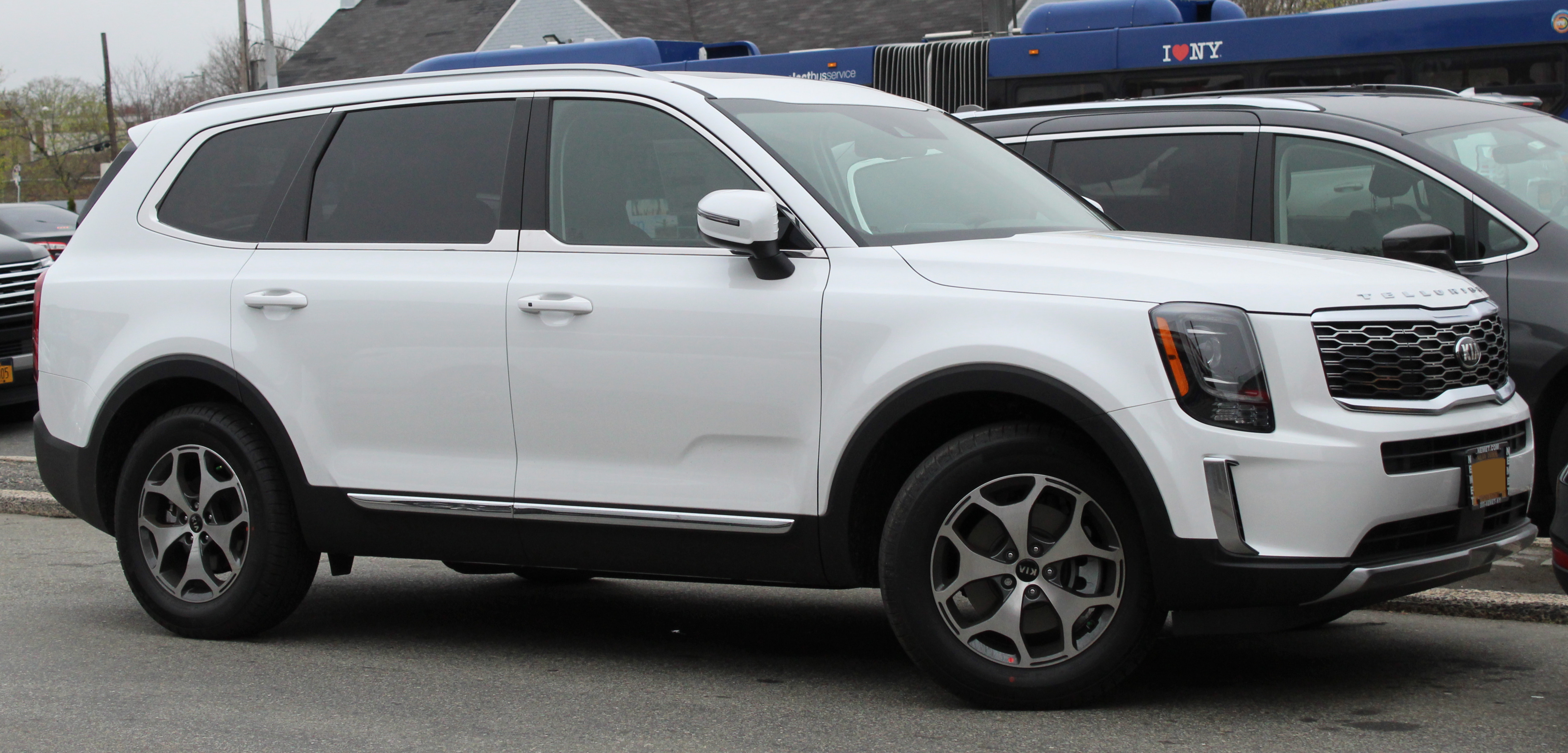
The Kia Telluride is a family SUV with three rows of seats. It’s a common kind of car people want to keep looking nice, but it can be harder to clean perfectly if you don’t have a garage.
A soft touch car wash is an automated wash that tries to be gentler than harsher brush-and-spray washes. The concern is whether it’s still rough enough—or uses chemicals strong enough—to wear down a ceramic coating over time.
A ceramic coating is a protective layer you put on your car’s paint to help it resist grime and make it easier to clean. The big question here is whether it’s still worth it if you’re using a car wash instead of washing at home.
Gloss Boss is the name of a ceramic coating product the host mentions. Different ceramic products can last different lengths of time and may react differently to car washes.
This is the idea that you should expect results that match how you actually care for your car. If you wash it differently (like using an automated tunnel wash), the protection won’t behave exactly like it would with careful hand washing.
The host is saying that protective products help, but they don’t make your car impossible to scratch. If something physically rubs the paint, you can still damage it.
A sealant is like a protective coating for your car’s paint that helps water bead and makes washing easier. It’s not permanent and it won’t prevent scratches from physical contact.
A ceramic spray is a spray-on product that adds a protective layer to your car’s paint. It helps water bead up and makes washing easier, but it won’t prevent scratches from happening if you rub the paint.
Car wax is a traditional paint protection product that forms a temporary protective film over the paint. It can improve gloss and add some resistance to water and dirt, but it still requires periodic reapplication and won’t make paint scratch resistant.
Clear coat is the shiny, transparent top layer on your car’s paint. It’s the layer that helps protect the color underneath, and coating sprays are meant to add extra protection on top of it.
Water beading means water forms little droplets on the paint instead of running as a sheet. Coatings can make that happen, which can make washing easier and help reduce grime sticking.
UV exposure is sunlight that can slowly damage your car’s paint. Protective coatings can help slow that wear, but they don’t make the paint immune forever.
A soft touch car wash is one where machines or brushes actually touch your car’s paint. The rubbing can slowly dull or scratch the paint and any protective coating you have.
A tunnel wash is an automated car wash where your car drives through a long tunnel and gets sprayed with cleaner. The chemicals used can be strong, so it matters what protective coating you have on the paint.
A touchless car wash doesn’t use brushes or cloths on your paint. It cleans using chemicals and water pressure, which can be safer for the paint’s surface but may not clean as effectively as a wash that physically scrubs.
A touchless (or brushless) car wash cleans without rubbing your paint with brushes. It uses water pressure and cleaning chemicals instead, which usually helps protect waxes and coatings from being worn down as fast.
Ceramic protection is a product layer you put on your car’s paint to help it repel water and dirt. It can wear off with repeated washing, especially if the wash is rough or uses strong chemicals.
Term
graphing sprays
This phrase doesn’t clearly match a standard detailing term, but it sounds like the host is listing different types of spray-on protective products. The main point is that these sprays are meant to be maintained and can wear off with washing.
Professional coatings are stronger, longer-lasting protective layers that are usually applied more carefully than store-bought sprays. They can still wear down, but they generally last longer if you wash the car reasonably.
“Toughest shell” sounds like a specific protective coating product the host uses. The point is that if it wears off from washing, it’s designed to be easy to put back on again.
A tunnel car wash is the kind where your car drives through an automated machine that cleans it step-by-step. Depending on the brushes used, it can be rougher on waxes and coatings than a touchless wash.
Term
ceramic code their car
A ceramic coating is a protective layer you put on your car’s paint. It helps the car stay cleaner and makes water bead up, but you still may need to dry/wipe after a tunnel wash.
Microfiber towels are soft cleaning cloths that grab water and grime. Using them after washing helps you dry the paint without leaving streaks or causing scratches.
Door jams are the areas around the door opening where the door latches. They can get wet and dirty during a wash, so wiping them helps the whole car look cleaner.
The host says you should refresh the spray coating regularly. They recommend doing it about every month to a month and a half, based on how often you use tunnel car washes.
In detailing, durability refers to how long a coating or protection product keeps working effectively after application. The host contrasts expecting “three to six plus months” of durability when using a more aggressive maintenance routine like a car wash. It’s essentially about product longevity under real-world washing.
The Morgan Plus Six is a small, two-seat sports car made by Morgan. People talk about it a lot in terms of keeping it looking good, because the outside surfaces still need protection to stay nice over months of driving. Detailing products are often chosen based on how long they last.
Tuva Shell is a product meant to protect your car’s paint, similar to ceramic coatings. The host likes it because it’s quick and easy to use, even if you’re using an automated car wash. The idea is to add protection without making detailing a big project.
A car wash tunnel is an automated conveyor-style wash system where the vehicle is driven or pulled through a controlled wash process. Because it can be more aggressive than careful hand washing, the host suggests adjusting expectations for how long a coating will last. They recommend a quick wipe-down after the tunnel.
The host’s main point is that car protection only helps if you keep doing it. It’s better to do it regularly than to use something fancy once and then forget it.
Term
coinop car wash
A coin-operated car wash is a self-serve setup where you do the cleaning yourself. The advantage here is you can skip the brush system and use sprays/pressure washing instead.
Pre-soak means you spray cleaner on the car and let it sit for a bit. That way, the dirt softens up before you do the main wash, so you don’t have to scrub as hard.
A pump sprayer is a tool you fill with cleaner and pressurize by pumping. Detailing uses it to apply cleaner ahead of time so grime loosens before you rinse or wash.
SuperSoper is the name of a detailing chemical the host references as part of a pre-soak/cleaning process. The context suggests it’s used with a pressure washer workflow to loosen and remove grime more efficiently.
A pressure washer is a high-pressure water tool used to rinse and blast off loosened dirt. In detailing, it’s commonly used after pre-soaking so the grime releases and is carried away with less need for physical scrubbing.
LIVE
I had a great question come in from a potential customer, his name is Jack, and he has a question
that I think a lot of people deal with and a lot of people actually wrestle with in their
head.
He got a brand new Kia Telluride in a dark jade green color.
He has no garage, no car port, so obviously the car is going to be sitting outside.
But that also means that he doesn't have the resources to actually wash the car himself
either or at least wash the car in a convenient manner himself.
So he uses a soft touch commercial car wash a few times a month.
He says two to three times a month.
And his question is, if I used to have a shell, is it pointless if I'm using the car wash?
And I thought, man, this is such a relevant question to, I think, something that a lot
of people may be asking themselves of, like, am I just wasting my money spraying this ceramic
spray in a car?
Should I use a ceramic coating like the gloss boss or wipe on ceramic coating if I maintain
my car a certain way?
And this is actually something that I used to ask a question that I used to ask my customers
when I was going to be installing this wipe on ceramic coating to their car of how are
you actually going to be be maintaining this car?
How does the car live?
What is the situation at home?
Because that would dictate, you know, back when I used to believe that there was a difference
in ceramic coatings.
And when I say a difference, I mean, like a three year, a one year, an eight year, a lifetime,
whatever.
That is way too confusing for a customer.
That is why I only offer one ceramic coating.
I call it three to five years.
And I teach people how you could make that coating the gloss boss lasts forever, basically
making it unnecessary to have multiple coatings in my line, though it would be more profitable
for me to offer multiple coatings in my line.
There is no need to offer.
And a big thing for me is if it's there's no need for it, I'm not going to do it.
That's just part of my thing.
So obviously not everyone has the ability to hand wash their car, have a deionized water
tank, a foam cannon, all the niceties that I call.
So a lot of people just use the local car wash.
And so today, as I responded to Jack in his email, but I wanted to elaborate on it, I thought
it would be kind of an important conversation or discussion to have.
So because I think the answer is yes, there are a ceramic spray, a ceramic coating still
is very much worth it if you are using, we'll just call it a tunnel wash, right, a tunnel
car wash, but you need to understand some things.
And I think you need to just set proper expectations for how your main proper expectations for what
your expectancy out of the product is based on how you're maintaining that product, right?
And so because a lot of times, and this is where I get tongue tied a lot, as you can
obviously see, but it's also so hard because it's very nuanced.
Like there's a lot of factors that go into play here.
So setting proper expectations is very, very important, but those expectations are based
on your situation and how you're maintaining the car.
So the blanket answer is no, it's not a waste.
Yes, it's worth it, but we need to understand a few things.
And the first thing to understand is that protection is not a force field, right?
Whether that's a ceramic spray, a wax, a sealant, or even a professional wipe on
coating, they do not make the paint scratch proof, they do not make it maintenance free.
They do not mean that you could beat the car up to death and it'll look perfect forever.
But what they do do like tough a shell is they create a layer, a barrier layer between
the exterior elements or whatever is happening happening and your car's clear coat.
So think of it as sunscreen.
You don't apply sunscreen once and then never apply it again for your whole entire life.
You actually have to reapply multiple times a day and then based on what you're doing,
are you getting in the ocean?
Are you getting in the pool?
Are you laying in the shade?
Obviously, if you lay in the shade with SPF 100 on, you're probably not going to get burned,
right?
But if you're out in the open ocean and you apply sunscreen once, you're probably going
to get burned if you're out there for eight hours, right?
So the same rules apply with the ceramic spray.
It helps with water beating.
It makes cleaning the car easier.
It helps with UV exposure, dirt, you know, resistance kind of to an extent and helps
your car look better for longer.
But it does not stop physical contact from being physical contact.
One thing I talk about all the time and one thing that I thought about a lot when I was
developing a car wash soap is I found myself telling people, Hey, the more you touch
your car, the more chance that you have to scratch your car, right?
So if you're running your car through a soft touch car wash, those brushes, those
claws that that's creating abrasion.
So that contact is going to slowly wear down the protection and also create
scratches over time, right?
And so because you're abrading the surface, you are, you have that protective
layer of toughest shell on the car.
But every time you rub it, you run the risk of removing that a little bit, right?
And you pair that with kind of harsh chemicals that are usually known in
tunnel washes and you kind of have a concoction of a kind of a bad environment.
Obviously, leaving dirt on the car, I think is actually worse.
But then there are a couple of different options.
There are like Jack talked about, he's going to a soft touch car wash and then
there's touchless car washes, right?
So a touchless car wash is using usually really aggressive chemicals to clean
the car, but nothing physically touching the paint, which could be an option for
people, especially if you have a ceramic coating because the ceramic coating helps
the car stay cleaner longer.
And so nothing is being attracted to the surface.
And so when you go through like a touchless car wash, your car actually
gets a lot cleaner because it does ceramic coating is helping it, right?
A soft touch car wash uses brushes, cloths, foam, whatever.
And it's actually touching the paint.
So touchless is safer for the paint, but may not clean as well.
If you don't have ceramic protection, a soft touch car wash usually cleans better,
but it is going to be harder on the paint and the protection.
So if you're like, you have a dark color car like Jack has, I would probably
try to go to like a touchless or a brushless car wash instead of the soft
touch because soft touch, though it's in the name, it's still pretty aggressive.
Again, but just knowing the trade off and then setting the expectations
depending upon what you're willing to do or what you're going to do and then
adjusting your
your expectations based on that, right?
So though the car wash isn't going to remove tough shell instantly,
it will remove it over time, right?
Repeated washing, especially with those soft brushes or stronger
car wash chemicals will shorten the lifespan of any ceramic protection or
really any protection in general.
Spray wax, ceramic spray, sealants, graphing sprays, professional coatings.
So the question really isn't, will the car wash remove it?
Because the answer is yes, but the better question is how often should you
maintain it based on how often you wash the car, right?
And so for someone who is following the whole system is using the super
soap or like I show, toughest shell may last a lot longer.
For someone who parks outside, has no garage, uses soft touch car wash.
You may see a reduction in durability.
But the nice thing is, and this is kind of why with all these nuances around
a product, this is why I came back to the core of my whole product line really.
But the core with toughest shell is that easy enough
to reapply it quickly and it's not a big deal.
And so what I do and what I suggest is that when you're using a tunnel car
wash, and this is the information that I tell my clients, whether I
ceramic code their car or not, if you're going through a tunnel car wash,
after you go through the tunnel car wash, it's inevitable that you still have
drips and the car isn't dry all the way.
Have one or two microfiber towels, have a bottle of toughest shell, take
three and a half minutes, maybe even less, and pull over after the tunnel
car wash and wipe the whole entire car down with toughest shell and your
microfiber towel, one or two sprays per panel, wipe the whole car down,
open up all the doors and wipe all the door jams down.
If you do that, not only will your car look significantly better all the time,
you won't really even be able to tell that you're using a subpar tunnel car
wash, right, and your car will stay protected for a very, very long time.
You will literally have no issues, right?
And it could be that simple.
Tunnel car wash, get through the tunnel car wash, pull over into a parking spot.
A lot of times you're going to go over there and vacuum your car anyway for free.
So pull into one of those vacuum spots, whip out two microfiber towels or one
microfiber towel in your bottle of toughest shell, one or two sprays per
panel, work your way around the whole car, you don't have to worry about
streaks, you don't have to worry about doing it in direct sun.
You don't have to worry about any of the issues.
That's why I designed it like that.
And you get all the benefits, right?
And just know that you should probably reapply it maybe every four to six weeks,
depending upon how often you're taking your car through this car wash.
You're saving on the convenience of the car wash.
You're, you're acknowledging that it's a little bit more aggressive.
So because of that, you're going to maintain the car a little bit differently
and you're not going to expect that three to six plus months worth of
durability on the car, right?
Because of how it's being maintained.
I hope that makes sense.
So I think this is where a product like Tuva Shell totally makes sense.
It's not a complicated coating.
It doesn't take hours to apply.
You don't need to overthink it.
You don't need to be scared of it.
You don't need perfect conditions.
Just run the car through the tunnel, wipe it down.
Good to go.
That's it.
So I think if you're someone who's using a car wash because you want that
convenience or you have to, then you probably also want protection.
That's convenient and easy because I think that's the whole point, right?
And so you can, you can apply Tuva Shell without it seeming like a huge project.
And I think that's really one of the biggest advantages of that product.
I think for a long time, the focus was like extreme durability.
But what I found, I found out through talking with you guys is that extreme
durability is like way down the list and easy use, slickness, gloss instantly
is, is the best.
And just like what I used to tell my clients all the time is that
maintenance, maintenance, maintenance.
So the best protection you can use for your car is the one that you're wanting
to use consistently and often.
And the one that you want to use consistently and often is the one that
you don't have to fight.
It does not annoying to use.
It's actually enjoyable to use.
And so that's where I think Tuva Shell can really, really shine.
So I think for Jack's situation, brand new car, no garage, no car park.
I would apply Tuva Shell.
I wouldn't say after every car wash, but definitely, definitely maybe every other.
Right.
Or if you can go, you know, a month or a month and a half, right?
I would probably try to switch from a soft touch to a touchless.
If the car's not too dirty.
And, you know, I think in a perfect world, I would maybe even find a coinop
car wash and don't use their brushes, maybe get a couple of pump sprays.
But again, that kind of gets into the complexity side of detailing, like using
a pump sprayer to pre-soak and your whole car with the SuperSoper using
their pressure washer that does add a lot of time.
And maybe time is not something that Jack has in the season of his life.
And so he's, I think what he's asking if I read between the lines is like,
how do I keep my car looking great with his little amount of not effort,
because he's clearly putting in a lot of thought and a lot of effort behind it.
So I don't think it's like a shortage of effort.
I think it's just, this is my situation.
How do I make my car look as best as possible in this situation
that is cohesive for my lifestyle?
And so that is why for me, when I was developing products, you know,
I'm busy, I have three kids, I run businesses, I'm busy, right?
But I love my car being clean.
And so I have all the product to clean my own car, but I still don't want
it to be a, because I don't have the time for it to be a multi hour process.
So how do I get the results that I want without the multi hour process?
Right.
And so I think, uh, I think that's the goal here.
And with that too, because I don't want it to be a multi hour process,
I'm realizing that it may not be perfect.
Right.
And so I think a lot of detailing content online makes people feel like
if they can't do everything perfectly, if we can't clean the barrels of the rims
every time we do it, if we can't use the perfect drainage, if we can't use
the perfect towel, if we don't have the perfect method, it makes people think
that they shouldn't be doing anything at all, or they're paranoid to do anything.
And I personally think that's wrong.
So if you don't have a garage, still protect the car anyway.
If you use a car wash, protect the car anyway.
If you don't have time to hand wash it every week, two weeks
or whenever you can, right?
Because something is better than nothing.
And so maintenance, maintenance.
And I think a product like Tuffa Shell fits that real world use case perfectly
because it's easy to use, easy to apply, easy to maintain and strong enough
to actually make a difference.
So that's where that durability really comes in.
So I think the goal is not to turn your life into a detailing routine
where everything you do revolves around your car.
The goal is to enjoy your car, keep it looking good and make maintenance easier.
So yeah, again, Jack, if you're listening, Tuffa Shell is definitely worth it.
Obviously, I will leave everything linked below for those of you that are
interested in trying out Tuffa Shell.
It obviously supports the channel.
Obviously, it keeps the content going.
I want you to support my product brand over everyone else's.
That keeps my whole ethos going, which is awesome.
But the fun part about that is, is I actually deliver my chemicals,
actually deliver on all the methods, the methodology that I talk about.
And they deliver on what the label says.
So if you're looking and interested for a product line that actually delivers
on what the label says, you're tired of the junk, welcome to the Jimbo's detailing line.
So I'll link everything below.
It's also on Amazon for your convenience.
I appreciate the support and I'll catch you guys in the next one.
See you.
About this episode
A Kia Telluride owner who relies on soft-touch commercial washes asks if ceramic spray is just money down the drain. The host says the answer isn’t “waste,” but it is about expectations: protection wears off, and repeated brush/chemical washing shortens lifespan. Ceramic sprays help with water beading, UV resistance, and easier cleaning, yet they aren’t scratch-proof or maintenance-free. For tunnel/automated washes, wipe down afterward and reapply every four to six weeks, using an easy product like Tuva/Tuffa Shell.
A customer recently asked me a great question: "Is Tough As Shell still worth using if I take my car through a soft-touch automatic car wash?"
He had just bought a brand new dark jade green Kia Telluride, parks outside, does not have a garage or carport, and uses a commercial soft-touch car wash two or three times a month.
So in this video, I'm answering that question honestly.
Does a car wash remove ceramic spray? Is ceramic spray still worth it if you use automatic car washes? How often should you reapply protection if your car sits outside? And what is the best way to protect a new car when real life gets in the way?
The truth is, products like Tough As Shell are not force fields. They will not make your paint scratch-proof or maintenance-free. But they do add a real layer of protection that helps with water beading, easier cleaning, UV exposure, gloss, and keeping your paint looking better over time.
If you use a soft-touch car wash regularly, you may need to refresh your protection more often. But that does not make ceramic spray pointless. In fact, for many people, an easy-to-use ceramic spray is one of the most realistic ways to keep a daily driver protected.
ceramic spray, ceramic spray coating, automatic car wash, soft touch car wash, touchless car wash, car wash scratches, car paint protection, new car paint protection, Tough As Shell, Jimbo's Detailing, ceramic spray vs car wash, best ceramic spray, how to protect car paint, car detailing tips, ceramic coating maintenance, spray ceramic coating