Is The Longbow Speedster The Future Of British Roadsters? — Carmudgeon w/ Cammisa & DTS — Ep 236
The Carmudgeon Show
Is The Longbow Speedster The Future Of British Roadsters? — Carmudgeon w/ Cammisa & DTS — Ep 236The Carmudgeon Show · May 4, 2026
Annotations will appear as you listen
0:00
94:27
Topic
British roadsters
“British roadsters” are sporty open-top cars that people associate with the UK. They’re usually talked about as a classic style of fun, simple driving.
Longbow is the company making the electric sports car the hosts are talking about. They’re basically here to question the company about what they’re building.
A six-speed manual means you use a clutch and shift through six gears yourself. It usually gives the driver more control and a more involved driving experience.
Manual steering means you’re doing more of the work yourself to turn the wheel. It can feel more connected to the road, but it’s usually heavier than power steering.
An elongated hood just means the front hood looks longer than usual. Designers do this to make the car’s shape look more dramatic or balanced.
Concept
symbiosis of man and machine
This phrase describes the idea that driving feel and performance come from the interaction between the driver and the vehicle. In enthusiast terms, it’s about how the car’s design supports skilled input rather than replacing it.
Energy density means “how much energy you can pack into something.” If it’s higher, you can get more useful energy from the same space or weight, which helps cars make power more efficiently.
“First principles” means starting from the most basic idea and working upward. Here, the basic idea is that less weight usually makes a car easier to drive quickly and safely.
Taking weight out of a car makes it easier to accelerate, brake, and turn. That usually helps the car feel more responsive and stable when driving hard.
Cubic centimeters (cc) tell you how big the engine is inside—how much space the cylinders have. Bigger usually means more potential power, but it doesn’t guarantee it by itself.
Horsepower is a way to describe how much power the car’s motor can make. More horsepower often helps acceleration, but the car’s weight and tires matter too.
Concept
0 to 60 in 3.5 seconds
“0 to 60” means how fast the car goes from stopped to 60 miles per hour. It’s a simple way to compare acceleration between cars.
Electrification just means the car uses electricity instead of a gas engine. Here, they’re saying an electric drivetrain can still make a lightweight sports car handle well.
Automation here means the car using sensors and computers to help drive—like holding a lane or controlling speed. The hosts are saying you can have an electric sports car without relying on those features.
The battery is what stores the electricity for an electric car. The discussion is about the idea that batteries make cars heavy, and how that doesn’t have to be the case.
An electric drivetrain is the car’s power system for moving the wheels using an electric motor. They’re saying the electric parts don’t automatically force the car to be packed with other tech.
These are the “helping” driving features—systems that can assist with things like staying in the lane or adjusting speed. The hosts’ point is that an electric car doesn’t have to include these aids to be a good sports car.
ADAS is a set of safety and convenience features that help you drive. It can include things like keeping you in your lane or braking automatically if it thinks you’re about to hit something.
Concept
self-driving stuff
This is the umbrella idea of cars that can drive themselves to some extent. Some systems help a lot, but you still may need to pay attention depending on the level.
A combustion car is a normal gas or diesel car. It makes power by burning fuel inside the engine. They’re asking if an electric car can feel just as good to drive.
Sacrilege Motors is the company that built the EV-converted Porsche 911 they’re talking about. They chose the name because some people get upset when you replace a classic car’s original gas setup with electricity.
They’re talking about electric cars. The idea is that EVs can still be light and fun, but they don’t naturally make the same engine sounds and vibrations, so designers have to compensate.
An internal combustion engine is the classic engine that burns gasoline or diesel to make power. The point here is that electric cars don’t work the same way, so they won’t naturally produce the same sounds and feel.
They’re talking about the “feel” of driving. With electric cars, you don’t get the usual engine sounds and vibrations, so designers try to add other sensory cues to make it still feel exciting.
Concept
unbundling
They’re using “unbundling” to mean breaking the car experience into separate pieces. Instead of getting everything automatically from a traditional engine, you may have to redesign or add the missing pieces one by one.
The Tesla Roadster was an early electric sports car from Tesla. It was meant to show that an electric car could still feel exciting and fast like a sports car, not just like a normal commuter EV.
A gear shift is what changes the car’s gearing—how the power is delivered to the wheels. EVs often don’t shift like gas cars, so designers have to decide what the driver should feel.
A clutch is a pedal (in many manual cars) that helps you smoothly start moving and change gears. EVs usually don’t need a clutch the same way, so the hosts are talking about whether EVs should copy that feel.
“Introduced noise” means the car adds sounds on purpose, like an artificial engine noise. The hosts are saying that kind of fake sound can feel gimmicky instead of genuine.
Genesis is Hyundai’s luxury-car brand. The podcast mentions it as part of a broader conversation about what was happening in the car world at the time. It’s not one specific car in this context, but the luxury lineup under the Genesis name.
This is an expression meaning a smaller underdog trying to beat a much bigger rival. Here it’s used to describe Tesla’s early Roadster effort as a tough fight against established automakers.
Weight distribution means how a car’s weight is split between the front and back wheels. If more weight is toward the front, it can change how the car turns and grips in corners.
A gear train is the set of gears that transfers power through the car. They’re saying you can hear those gears working, which makes the drive feel more alive.
A head gasket is a critical seal inside the engine. If it fails, the engine can start mixing fluids or losing compression, and it often requires major repairs.
A windscreen (windshield) is the front glass panel that helps deflect airflow away from occupants. The hosts mention it in the context of selling sports cars in England, where weather and customer expectations can affect how important roof and wind protection features are.
“Move volume” here is sales/market language: the idea is that adding a roof (or roof options) increases customer appeal and sales numbers. The hosts argue that in England (and generally outside California), buyers value weather protection more, so roof-equipped variants sell better.
Concept
emergency type roof
This sounds like a small safety roof or roll-over protection piece. It’s meant to help in an emergency, not to fully replace a normal hardtop.
Concept
wind in your hair
This phrase just means the car is open to the air, so you feel the wind while driving. It’s part of the appeal of a roadster.
Torsional stiffness is how well the car’s frame resists twisting. If it twists too much, the wheels don’t stay in the best alignment, and the car can feel less precise in corners.
A subframe is like a strong inner frame that holds parts such as the suspension. If the front and rear aren’t properly tied together, the car can flex and lose some handling precision.
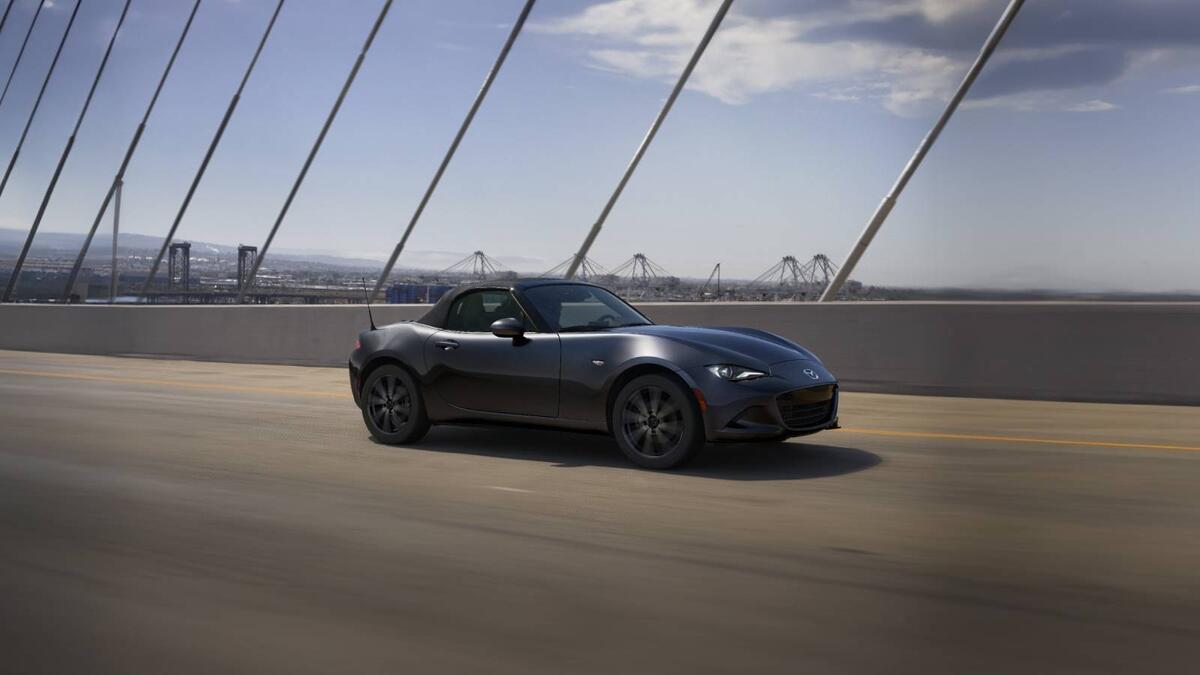
The Mazda MX-5 (Miata) is a small two-seat roadster. It’s made to be light and fun to drive. The podcast mentions a “Monza Miata,” which is a special version or build based on the Miata.
The Alpine A110 is a small, lightweight sports car from France. People bring it up because it has a similar “fun, tossable” vibe to classic European roadsters, but it’s a modern design.
Renault is a major French car company. The hosts are basically saying that Renault (and by extension its sports-car efforts like Alpine) hasn’t been sold in the U.S. for a long time.
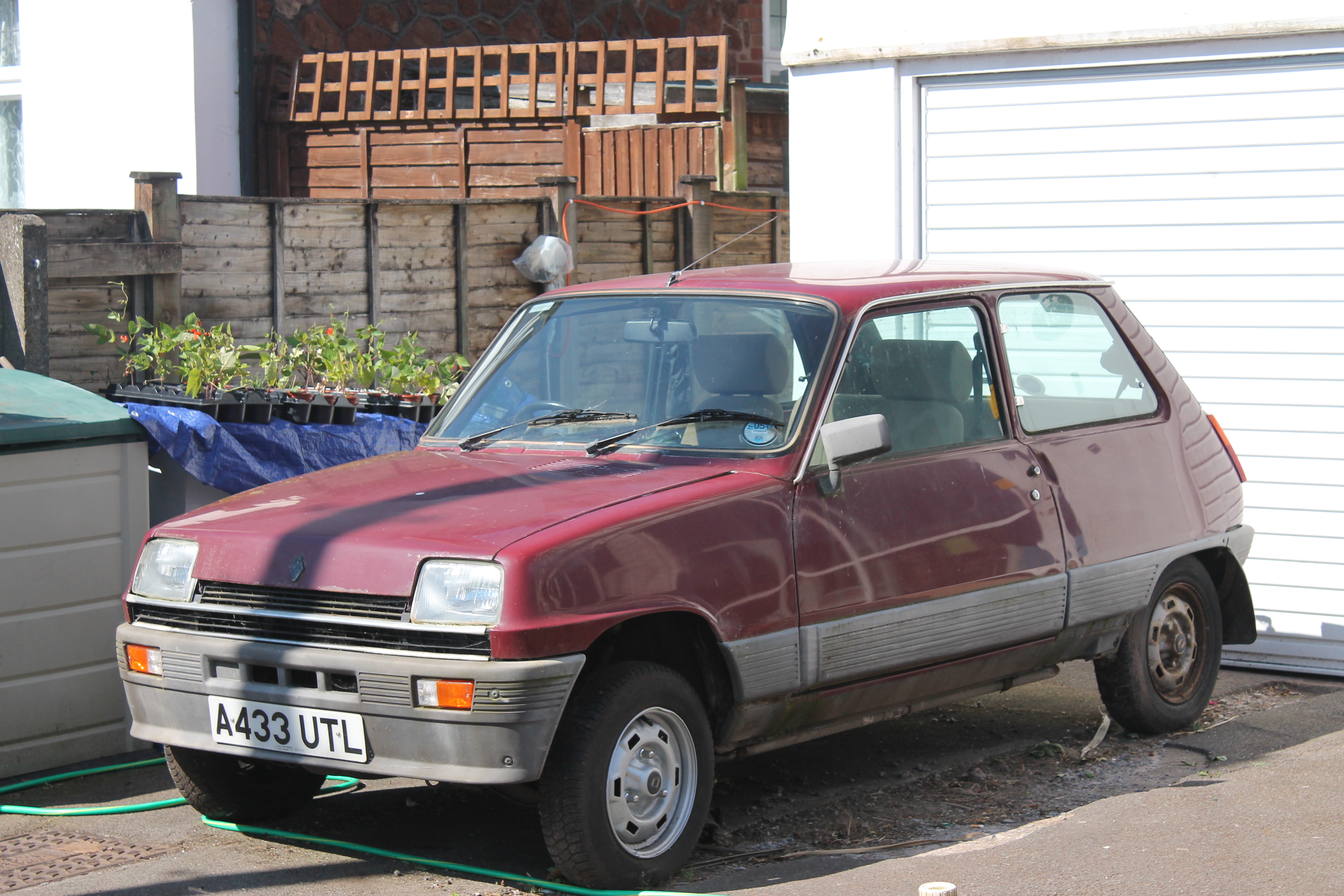
The Renault 5 is a small, popular hatchback made by Renault. Here, the hosts are talking about how it was marketed under a confusing nickname in some places.
The Ferrari LaFerrari is a very special, high-performance Ferrari supercar. The podcast talks about how some people mispronounce or nickname it, and it also explains where the name idea came from. That’s why it’s part of the conversation.
I can’t tell which car “5” refers to from the podcast snippet you provided. The text looks like it’s continuing a discussion about the LaFerrari name, but the car name itself isn’t clear. If you share the full line, I can explain the correct car.
The Renault Fuego is a Renault coupe. They mention it as another example of Renault model names that sound like something else—here, they joke that it’s “fire.”
kWh is how much energy the car’s battery can store. “50 kWh” means the battery holds a moderate amount of electricity, which affects how far the car can go.
Light weighting means making the car lighter. A lighter car usually needs less energy to move, which can help an electric car go farther without a bigger battery.
Drag coefficient is a number that describes how much the car “fights” the air as it moves. Less air resistance usually means the car uses less energy at highway speeds.
A windshield (or windscreen) affects airflow around the vehicle, which can change aerodynamic drag and reduce wind buffeting. For open-top or low-aero cars, adding a windscreen can noticeably improve highway efficiency and comfort.
They’re talking about cost—how much these cars cost and whether people will want them at that price. It’s part of the bigger question of whether roadsters can be both good-looking and not outrageously expensive.
They’re talking about the size of the battery, measured in kilowatt-hours (kWh). A bigger number usually means the car can store more energy for driving.
Term
rear drive for one motor
They’re describing where the electric power goes. “Rear drive” means the rear wheels get the power, and “one motor” suggests it’s not a dual-motor setup.
Electric cars often don’t use a multi-gear gearbox. A “single speed transmission” means there’s basically one gear ratio between the motor and the wheels.
“Off-the-shelf” means they’re using parts that already exist in the market. The point here is that they don’t have to invent every component themselves.
An inverter is the device that turns battery power into the right kind of electricity for the electric motor. Using silicon carbide helps it work more efficiently, so the car can use its battery power better.
This is about how the car’s battery and electronics are wired electrically. A higher-voltage system (like 800 volts) can move the same power with less current, which can improve efficiency and charging speed.
Torque is the “push” that gets you moving, and power is how strongly the car can keep pulling. Together they describe how fast and how hard the car accelerates.
BMW is another major car brand. In this context, they’re being used as an example of a source for proven parts so a smaller company doesn’t have to invent everything from scratch.
Mercedes is a car brand that can also provide parts. The idea here is that using proven parts from big brands helps a smaller sports-car maker build faster and with fewer unknowns.
Toyota is a big mainstream automaker. Here it’s being used as an example of where British sports cars can borrow proven parts to keep development simpler.
Rover Group is a company that made cars and also supplied parts. The idea is that smaller British sports-car makers could use Rover-sourced engines/components instead of starting from zero.
A V8 is an engine with eight cylinders arranged in a V shape. They’re talking about which engine type these small British sports cars used from other suppliers.
They’re talking about a naming mix-up: in the U.S., people hear “case series” and assume it’s Honda’s K-series engines. The point is that the term is being used incorrectly in casual conversation.
“Rover K” means the Rover version of that four-cylinder engine family. They’re basically debating whether it makes sense to swap that engine into a car that would otherwise use a Honda K.
“K series” here means a specific family of four-cylinder engines. They’re arguing about how good the Rover version is compared with the Honda version, and how people swap them.
Term
Honda K28
Honda K28 is the name people use for a Honda four-cylinder engine with about a 2.8-liter size. They’re using it as the engine that gets swapped into (or out of) these cars.
Term
K-trum
“K-trum” sounds like a nickname or shorthand for a particular K-series-based setup. They’re trying to say what engine it uses, but the exact meaning isn’t fully spelled out here.
A powertrain is everything that makes the car move and sends power to the wheels. The discussion is basically saying that the “personality” of a car isn’t only about how strong the engine is.
Term
acoustically
Here “acoustically” means “by sound.” They’re saying EVs don’t always give you the same engine noises that make gas cars feel distinct, so sound alone may not tell you much.
This means the car’s computer software decides how it responds to your inputs. The idea is that programming can shape the driving feel so much that it can blur differences between brands.
Rivian makes electric vehicles. The hosts are saying that, for many drivers, it’s hard to tell which EV brand you’re in just from sound or basic response because the car’s behavior is largely software-controlled.
This means a sports car that runs on electricity instead of gas. The hosts are asking why we haven’t seen one that feels truly exciting to sports-car fans yet.
Electric vehicles are cars that run on electricity stored in batteries. The host’s point is that EVs didn’t spread quickly until Tesla made them more convincing to buyers and other companies.
The Tesla Model S is Tesla’s bigger, more premium electric sedan. The point here is that even major car companies once said EVs like this wouldn’t work.
Panel gaps are the small spaces between the car’s body panels. If they’re even and consistent, it usually means the car was built carefully; if they’re uneven, it can suggest poorer fit and assembly.
Lotus Engineering is an engineering firm tied to Lotus. Other car companies hire them to help with tricky parts of a car, like the drivetrain, instead of doing everything in-house.
Company
AOB
AOB is being mentioned as another company that does specialized engineering work. The host is saying big car makers may hire firms like this—especially for the powertrain—rather than handling it all internally.
An engineering services provider is a specialized company that helps other companies design and develop a product. In car projects, they often help translate a wish list/specs into something that can actually be engineered and built.
The Dodge Journey is a midsize SUV/crossover meant for everyday driving and families. In the podcast, it’s mentioned as part of a timeline for a project or discussion. It’s not being described in detail there—more like it’s part of the story.
A supply chain is how all the parts and materials get made and delivered to build something. They’re saying that doing this 15 years ago was harder because getting the right parts wasn’t as straightforward.
Think of an EV platform as the “car layout” that’s designed for electric parts. If you build a sports car on that layout, the battery and electric motor fit more easily without redesigning everything from scratch.
A skateboard format is how some electric cars are built: the battery and key parts are placed low in a flat “platform” under the floor. That helps designers shape the car and keep the weight low for better handling.
The rear axle is the part that the rear wheels are connected to. It’s part of the structure that lets the wheels spin, and here it’s mentioned because of where the motor is placed.
LIVE
You want to talk about the people here?
Sure.
We've got extra people.
You are so far away that I feel like we're in that, you know, can you pass the salt?
It's got to be great for Paul.
Anyway, welcome to the Carmageddon show.
I am Jason Camisa.
I'm Derek Tam-Scott.
You are?
Daniel Davy.
And you are?
No.
God, this is going to get confusing about that.
We have special guests here today from Longbow, which is a new electric sports car manufacturer,
and we're going to torment the shit out of them for ruining the sports car world.
And Derek is smiling already.
I'm readying myself.
I'm readying for a good fight.
That should have a V12 in it with a six-speed goddamn manual, manual steering and all that or not.
All right.
All that and more ahead.
Not?
Oh God, they're cheeky.
They're British.
So they have sense of humor.
That one called me a C word earlier, but he said it as a compliment.
No.
I don't know if I'm a good judge or character.
We'll find out.
We're going to find out.
Well, a great conversation about a really interesting car company with two actual car
people and us and us.
Derek is going to clap.
And I think what we should do and to honor our guests is you will clap and then you will
clap.
A Mexican clap wave.
Is that a Mexican?
That is right.
Mexican wave.
It's a Mexican wave.
We just call it the wave.
We just call it the wave.
We must be close to that.
Mexico.
You can't say the word Mexican.
We're too close to that.
We call it a Mexican wave.
I think there's something in World Cup at some point.
You say like a case idea.
We'll do that or something.
Anyway, we'll all make fun of Derek because we're the C word here by clapping after him
to show him how it's done.
Okay.
Get ready.
Hey, Jason's was the best.
Now the jingle.
Very formal intro, right?
Yes.
Now I'm a racist.
What are these people?
We could have them tell us.
Can you just do that?
Can we just ask them?
Yeah.
Do you speak English?
It actually came from our country.
What country is that?
England.
I've never heard of it.
There's nothing to spell about Speak American, actually, whilst we've been here recently.
Can you say the word Carmudgeon?
We can say it.
We just have to change our intonation and like ask a question at the end of every sentence
and then...
Like Carmudgeon.
Carmudgeon.
Period.
So you're thinking of like the sort of California accent.
California like, oh my God.
We're in California, right?
Yeah.
Not that part of California.
Okay.
Sorry.
The other thing California has it does it a little bit too.
You're a native.
Yes.
Can you make a statement without doing the like, oh my God, like, let's go to the movie.
I mean, I don't speak in a normal fashion for someone from this area or of my demographic
of this generation.
That's true.
That's why we understand you though.
Everyone else is really difficult.
Is it?
No.
Okay.
Oh, they're having a song.
So as you guys can see, this is going to be a very professional podcast.
But in all seriousness, you guys do have real jobs and you have a product.
We did have real jobs until we started on this job.
Oh, CEOs.
You can't fire yourselves.
Tell the board to fuck off.
That's just the right.
That's what you do, right?
You tell the board to fuck off and let you do.
We're the board as well.
Oh.
Because we're co-founders.
So do whatever you want.
Kind of stack in our paper.
All right.
So that's whatever they want.
That's whatever they want.
Okay.
So who are you?
How did you?
I know this because I've done my homework, but they don't know this.
So introduce yourself.
Who are you and how did you get here?
And I don't mean by that like that terrible Uber driver that tried to kill you.
Shut up.
I made him laugh.
No, it's because he did have a terrible Uber.
Did he really?
No, Uber drives me terrible.
We talked about politics.
No.
Yeah, yeah, yeah.
But I'm British, so it wasn't like I wasn't coming from any angle.
What angle was the driver coming?
The Uber driver coming.
He was neutral.
We were like neutral aligned.
So what did you talk about?
He wasn't American.
Yeah, Americans are never neutral.
He's American, but he's Filipino original.
So we talked about poverty and why it's actually a problem.
But enough of that.
No apologies.
Okay.
I'm Daniel Davy.
I'm not a political commentator.
Oh, you sound like awesome.
I'm the CEO, co-CEO of Longboat Motor Car Company.
How did we get here?
Well, we didn't drive in that because it's raining today.
You forgot to put a roof on it.
We came to California avoiding the rain that we brought it with us.
But no, we're here showing the car, meeting people and unveiling it
to the California public for the first time.
So it's really exciting.
Okay.
Mark Tapscott.
Not sure how far away maybe our family's kind of,
maybe it was separated by a hyphen at least for us.
Yeah, Tapscott versus Tam Scott.
Letter off.
One letter and another hyphen.
Can you hyphenate your name just to fuck with him from now on?
Do you know where yours came from?
Well, it's, yeah, it's Tam and Scott,
which are separate from my mother and father.
So probably a different origin than yours.
Yeah.
This is, this comes back from like Devon and Cornwall,
old England and it means like a small cottage of the taps.
I guess we should,
I should probably adopt a similar origin story.
Because that's much more compelling.
Can appropriate some heritage.
Perfect.
Because it's a historical podcast.
I'm not hearing.
Well, a woman later we start talking about Longboat
and the whole feature.
So your company's called Longbow,
which I thought was a reference to the elongated hood
and or your genitalia.
It's been a nickname in the past.
It'd be extra longbow.
Extra Longbow.
Derek is mortified.
The audience has now tuned out and reported us
as inappropriate to YouTube.
So tell us about the name Longbow.
So Longbow, one, finding a name is super hard, right?
A name that you can use, that you can trademark,
It's Googleable.
It's Googleable.
You don't have to tell people how to spell it.
It has a URL that's available.
Has URL that's available.
And then it also ties into what you're doing,
ties into your history.
So we're British, as you can tell by our accents
and terrible humour.
Our company's British,
designed, engineered, manufactured in the UK.
Our car, lightweight sports car,
is the proud history of British motoring.
But then really it's the,
it's actually, so Longbows are beautifully crafted.
If you don't know what Longbow is,
so we, in the 1500s, 1400s,
we being England, United Kingdom,
pioneered using very longbows
that had like the highest pound per square inch.
So you could fire arrows like 300 metres
and shoot through armour.
And that was super well crafted.
But to become a longbowman,
you have to start at the age of six, training that force.
So a longbow is nothing without the archer.
The archer is nothing without the longbow.
And it's the same thing for us.
So a beautiful crafted piece of technology
that is handcrafted.
But it's nothing without a driver
and the skill of the driver.
So it's that kind of symbiosis of man and machine almost.
That's where Longbow comes from.
You are listening to the History Channel.
Well, I was just going to call it the
Marketing Bullshit Channel, actually.
Because that does sound like Marketing Bullshit,
but it's actually quite good.
It's true, yeah.
No, it's good.
And we came up with it.
We sat over many wines trying to think through names
and googling everything, checking GoDaddy
and what feels right.
And then we just clicked, right?
There's a whole point of that it's the car and the driver.
And I think when you start looking at a lot of other cars
at the moment, it's not necessarily that feeling
of how do those two things connect.
It's actually how do you disconnect a lot of those things
a lot of the time with all the screens and everything else.
So we're already trying to bring it back
to the driver and the tool itself.
And then Voodaca, who sits on the front of the car,
the lady holding the bow.
The longbow fought the French.
Voodaca, she fought back the Romans.
So there's a lot of kind of passion power
and fighting against what's happening at the time.
Yeah, exactly.
David and Goliath.
So she pulled everyone together that after her,
her husband, the king was killed to fight back the Romans.
Okay, so your product does that.
Give us maybe the highlights that will capture the attention
of a person who might be disinclined
to believe anything new could be cool.
That's projection.
By the way, that's Derek speaking for himself.
Well, speaking of a friend.
Right.
If you're trying to take on the incumbent philosophy
of building cars and with a different place,
you're coming from an altogether different place,
tell us what about your car shows that.
Actually, we just lean into the past.
So where have cars come from?
So before everyone put loads of power in marketing,
bullshit into cars,
you didn't have that power to white ratio.
So you needed to have a lightweight car
because if it was heavy, it couldn't go anywhere.
Right.
So I think that increase in democratization
and energy density has meant that people
have become lazy with weight.
Yes.
So we just went back to that.
So actually, first principles,
if you want something to be better on the road,
remove the weight.
We don't have two turns trying to get out the corner
when we're trying to go into the corner.
So we didn't have to do anything other than look at
what has been the best selling and the most successful
and the most iconic British cars,
typically a lightweight sports cars.
So it's just leaning into that really.
So what is it weight?
This is under 900 kilograms, which is 1,900 and...
73 pounds.
73 pounds.
There you go.
73.
So it is lighter than any car on sale in America today.
That's the same number of cubic centimeters
as a series one Lotus Esprit also,
if you're curious, which no one probably was.
When I warned you about him being an encyclopedia,
he just booted up.
That's amazing.
So if that's useful to you,
if not, please file it away in what we call the round file,
which is the rubbish bin.
Trash bin.
So it weighs under 2,000 pounds.
It is an EV making how many horsepower?
So we've...
We haven't announced horsepower.
Okay.
But let's say the horsepower we have in there is way in excess.
It's adequate.
It's adequate.
It's adequate.
More than adequate to give the figures we've said,
which is 0 to 60 in 3.5 seconds
and a top speed of 125 miles per hour.
Okay.
All right.
So it is philosophically an old fashioned British sports car
brought into the modern age, the electrification.
Because of electrification almost.
So what we're trying to make is the best handling,
lightweight British sports car today,
not despite it being electric, but actually because it is.
And I think when we talk about electrification a lot,
it's that whole piece of, you think electrification,
you think heavy, first of all,
you think the batteries all being where they are,
and then you think big screens, automation.
And that's absolutely not what this car is all about.
Because the drivetrain, electric drivetrain,
doesn't actually mean any of those other things.
So we're just trying to separate that and show people
that you can have a lightweight sports car
that happens to be electric.
So you said, for the audience,
I went to a presentation that you guys gave last night
on those cars to perspective buyers.
I snuck in and they didn't kick me out until afterwards.
But you said something that was really,
that I had not heard before,
which was that the car industry has bundled together
electrification with screens and autonomous driving aids,
and they don't need to be.
And that's a really, really good point.
There's no reason why any of those things
need to be bundled together.
They are just because I think they're happening
at the same time, right?
We have by happenstance, we have touch screens
at the same time as we have EVs,
at the same time as we have ADAS
and all sort of self-driving stuff.
But I think it's a brilliant observation to say,
let's decouple those and go back to the experience
of the car.
My question is, can an EV,
and I think the audience will ask this,
can an EV give you the same driving pleasure
as a combustion car through lightweight
and handling in the way that a combustion engine could?
We've experienced one,
a couple of actually interesting cars.
One, though, that stands out is the Sacrilege Motors 911.
So it was an old Porsche 911 converted to EV.
And they aptly named the company Sacrilege Motors,
knowing that people were going to shit all over it.
But it was quite good.
It was a great, I shouldn't say that,
it was a great experience,
despite it being electric, right?
You're missing out on some things,
but you're gaining others.
And so, but I think to the audience,
that's a really important distinction to make,
just because it's electric doesn't mean it can't be light
and it can't be analog.
It's not going to be the same, right?
I think if anyone comes on and says,
hey, we're going to build an electric car
that's exactly the same as an internal combustion engine,
it's just not the case.
But it also doesn't need to be, right?
What you need to do, though, is add something extra.
When you're taking away the sound, the vibration,
these other things, you need to still add something in.
So we're always talking about theater, we call it.
We have to add theaters.
We have to work even harder to add something more in
so that you are really experiencing driving.
I mean, it helps.
The first car doesn't have a windscreen, right?
You're eating bugs and enjoying what's going on.
But yeah, we introduce that theater.
When you talk about theater,
what sort of arsenal of tools do you actually have?
Is it acoustic?
I think there's, you know, the thing about unbundling is,
we're actually not necessarily unbundling
because when you think of EVs,
pretty much all EVs are sedan's crossover SUVs
or hypercars, that's it.
So no one's built an electric sports car.
Tesla did with the Roadster.
No one's done it since.
So we have a shot almost at the, like,
what does an electric sports car drive like?
No one has a clue.
No one's done it.
So we have a chance, almost from the beginning,
to define what that is.
You know, like, when they've defined,
okay, this is how a gear shift works,
and here's brake, you know, clutch,
and we have the same idea to almost set the standard
of what an electric sports car should drive like.
And that's not, it shouldn't have some fake gear shifting in it
and it shouldn't have, you know, introduced noise,
like the sound of a UFO flying around.
Like, all those things are not authentic.
And you guys both worked on the Tesla Roadster project.
That's what we didn't get back into it.
So you guys were at Tesla early?
Yeah, I was at Tesla 2010.
So that was kind of midway through the Roadster.
Spent time here in Mountain View,
not sleeping in the Bull Ring,
then worked in UK and Germany for it.
Then left, worked in a few other companies,
came back to Tesla for Model 3,
and then worked at Lucid,
so launching the European,
Middle East markets for Lucid as well.
So we've come from, actually, and that's the thing,
that was almost kind of the genesis,
the coolest time at Tesla,
and my favorite product was the Roadster.
Startup, you know, David versus Goliath,
you mentioned earlier.
No one knew what the fuck you were doing.
And you had to figure it out and that was cool.
You know, there was no blueprint,
and that product was cool.
You know, it turned heads as transformational,
and that was despite the fact
it had a 65, 45 weight distribution.
It wasn't exactly the same handler as the Elise.
But it traded stuff.
First of all, what I loved about the Roadster,
and I did a video on it,
and probably two years ago now,
and it was great to revisit it.
So I drove them back in the day.
Oh, nine was my first Roadster loan.
And I set this loan up thinking that I was going to hate the car
and that I was going to throw this stupid start-up
called Tesla under the bus.
I think I've said this before on the podcast.
And I made it about 100 feet and changed my mind.
I mean, and you know, I thought they've ruined an Elise
and they've taken everything good about it.
And I just shut up because it was different.
It wasn't better or worse.
It was just different,
but it was actually a visceral experience.
And that engine, on that car,
you could really hear the motor.
You could hear the gear train.
And that is something sadly very absent from most EVs to this day.
But it did give you quite.
I mean, go take one on a back road.
So what's your connection with the Elise?
Do you have a collection?
I've replaced untold head gaskets on the K series,
on S1s back in the day.
So I used to kind of build and design and race,
race loadices.
That was the first kind of cars I started pulling apart.
And then after that, I was kind of,
this is cool, but you know, what more, what next?
And then a friend of mine had a roadster
and he turned up in it and said, sitting this.
You're right, thanks.
But it doesn't have a K series head gasket problem.
Exactly.
I'm not interested.
No problem.
Yeah.
And then I did sit in it.
And sure, it felt a little bit like a, you know,
Usain Bolt with a backpack full of bricks
the way it kind of did.
But it just changed my mind.
This is where we are today.
I've got to be involved in this from that moment on.
And yeah, since then we've been waiting for the next roadster.
Yeah.
Hasn't happened.
So they're taking money for it for years now.
It's any, any minute now it's going to pop right out.
That's it.
That's it.
Well, can I having a little competition with,
with Elon if he's listening, right?
Oh, he's, he's actually in that room right there.
That's why there's a fifth chair.
Yeah.
Oops, caught me out roadster before.
So your, your roadster will beat Tesla's roadster to market.
Why not?
When is this on sale?
We're starting deliveries of this end of this year,
early next year.
And then is that Elon time meaning that'll be 2037 or
we're British and we're very conservative.
So we're not Swiss.
I mean, if you're Swiss, I'd actually believe you.
I'm half German.
Oh, okay.
So I have fun time.
So I'm half on time.
So one of the car will be done by the year.
Half of it.
The left hand side.
And then roses a year later.
So we're, we're back to backing products into the market.
So yeah.
Okay.
So this car is called the speedster speedster.
So it's a GT three, a C to reference last week.
Oh yes.
It's a GT three convertible.
Yes.
Okay.
Like a Porsche speedster.
Okay.
So this one's the speedster.
The roadster has something more than this car,
presumably or different.
A roof.
A roof.
Yeah.
Windscreen turns out when you're selling sports cars in England
and everywhere other than California, not today,
a roof is important to move volume.
Yeah.
Makes sense.
So this is this,
I can't look at this thing without thinking of the SP one and two,
which is a compliment of the highest order for me in my opinion.
But it's a, yeah.
So it's got no windscreen.
So you will have one with a windscreen and a sort of emergency type roof
or something like that.
Something cool.
Yeah.
Okay.
So we wouldn't follow the pack.
Right.
Having the wind in your hair is important,
but also if you don't connect your front and rear subframe,
you miss a whole opportunity on torsional stiffness.
So how do you do both of those things?
It's kind of the problem you need to solve.
Yeah.
We were at cars and coffee the other day and someone said to us,
Monza Miata, the Monza Miata.
Oh yeah.
That seems to be Monza Miata.
Yeah.
It's dimensionally closer to the Miata,
but sort of philosophically and like in terms of the language,
I think definitely I see the Monza there.
How big is it actually?
No jokes.
1.83 by 4.2.
And I have no idea what that means.
He's probably speaking metric.
4.5 multiplied by 7.
Number that makes no sense.
4.23 times 2.54 divided by 2.54 is the length of it.
What car is it comfortable to?
Because I think oftentimes if you give it dimension and inches,
it's not super useful either.
It's a width of a 9.11 and a little bit shorter.
When we were looking at cars,
that modern day cars that we should be kind of considering
that are going to be competitive set,
Alpine A110 kind of came up really, really high on that list.
Which we never got in the US, annoyingly.
Really?
No.
We had one in the studio.
I did one, but it was...
It was temporary important.
Renault has not been present in the United States
since probably 1991 or something like that.
I think you could call it's presence in the late 80s.
It's tenuous at best.
We had Le Carr.
It was available.
We had the Renault 5.
And then the Alliance.
Le Carr.
They called it Le Carr here, yes.
It was called the Renault 5.
It was called the Le Carr here.
Imagine how expensive that marketing campaign really cost
to get with that terrible name.
And people would call it the Le Carr,
which is like the Ferrari, Ferrari, La Ferrari.
Ferrari, La Ferrari.
Ferrari ripped off its name from the Renault Le Carr.
Then there was the Renault Alliance, which was anything but.
And the Fuego was available here.
Oh, I forgot about that.
It was fire.
Yes, it was fired.
So, okay, conventionally, it looks smaller than a 9.11.
And I'm surprised to hear that it's as big
because it really does look very compact.
I mean, it's all hood.
And so it's a very, very long bow.
And it weighs a half of a 9.11 also, which would be noted.
Well, if it's like a Carrera 4 Cabriolet,
it probably weighs half of a Carrera 4 Cabriolet.
Right, with two people in it.
Trunkful of stuff.
So what size of a battery is in there?
50 kWh.
Yeah, so we haven't gone for a large battery.
So for us, again, light weighting is important,
but if it's lighter, you need less battery.
So from a watt-hours per kilometre,
you're approaching kind of best in class,
as in, not electric sports car,
because there's only one,
but be comfortable to a giant sedan
that's designed around slippiness,
because weight just helps, you know?
What are you, do you have to be obsessive
about drag coefficient?
Or do you even care about range on a car like this?
I mean, a car like this without a windscreen,
I'm guessing long highway slogs down I-5,
which you guys just have done,
and you know how absolutely miserable it is,
and I'm suspecting you won't want to do it
in a Colorado windshield.
But it's range, do your customers,
I should say, care about range in a car like this?
Something that certainly inspired
what we've done with the design here
is this belief when we were growing up,
why is it that it's only really expensive cars,
it seems, that have these sort of beautiful,
curvaceous lines, and that you have to spend more money
to have something that's beautiful,
why can't something at a lower price
also have something that looks like it
should be more expensive?
Should we talk about price when you mentioned price?
I think that people probably must be very curious
about what it costs.
As you can see on that spectrum,
we talked about if Monza and Miata
were definitely closer to Miata than we are on Monza.
What was the Monza price at? 1.5 million?
I don't know, they are so expensive now
that the idea of what it might have cost
when it was new is so immaterial.
Okay, so bigger than a bread box,
smaller than a football stadium.
So both beauty and price,
those things shouldn't actually really cross over,
they shouldn't be exactly right.
So we priced this car,
it's about 110,000 US for the Speedster,
and then the Roadster is around 85,000 US.
We want to change how the earth kind of feels.
And for reference, a 911 starts at a buck 20 now,
is that right?
Something like that.
In US, and what is a Boxster?
70 something maybe?
The Boxster, of course, cylinder doesn't exist in my mind,
so I thought I'd look that up.
Stripper model?
Strippers exist, but not Stripper Porsches.
Yeah, so 85,000 meaning this would be,
the daily usable version of this car
would be considerably less expensive than a 911.
And in a world where the average,
don't forget transaction price for a car is 50K in the US,
not a whole lot more.
Okay, so you start with roughly 50 kilowatt hour battery,
it's rear drive for one motor,
single speed transmission, I'm guessing.
And you guys went into some detail
on how compact the motor was.
It's an in-house developed motor.
So as it all comes together,
so the complete motor as a package is ours,
but the ingredients are not.
So we take an off-the-shelf,
mass produced 10,000, 20,000 a year motor company,
we then have a McLaren applied,
or motion applied,
inverter, silicon carbide inverter,
and then a transmission from a supplier,
we probably won't need,
but they're Formula One derivative.
And then the whole thing together
is then the longbow hyperdrive.
But we can do that now,
we don't need to develop it because it's all off the shelf.
What's really important, that whole part,
is that we can have the latest 800 volt system
in this car doing what it needs to do,
providing all that power and torque.
And we don't have to invest in a huge factory
to go and build that motor ourselves.
And we can go and get the components
that have done a million miles worth of testing
with Mercedes, with BMW, these other partners,
and we bring those components together
to build a really reliable car
built on the shoulders of others.
And that's, I think, how we can be successful
and move so quickly,
because we don't have to develop all of those components
that are already out there and doing a great job.
It's like a rover case series.
It all comes back to that little old Lotus.
Well, though, in terms of taking an off-the-shelf component
that has been proven, or disproven, I guess,
mass-produced, has been mass-produced,
as I always say.
But do you mean throwing that in the Elise?
Yeah, I mean, just like if you're going to make a small...
What is the formula that is always used
by low-volume British sports car manufacturers?
It would be, you would look at Lotus using components
from Toyota and Rover Group,
and if you were looking at TVR,
then it's going to be also from the Rover Group
in the form of the V8s that they would use
until they started doing their own motors,
which was really a cul-de-sac
that I don't think anybody should go down again.
For the record, we never got the case series.
And for the record, when we talk about case series,
we're not talking about Honda case series.
In the U.S., we hear case series, and we think Honda case series,
which are probably the best four-cylinders ever made.
The Rover case series was probably not
the best four-cylinder ever made.
But interestingly, back in the U.K., certainly,
we swap out the Honda K28 with the K series,
and I don't know if they noticed this.
Hold on, we go in which direction?
You add the Honda motor, you remove the Honda...
Back into the Elise S1 and S2s that had the K series.
Okay.
So you put the Honda engine in where...
One K for another K.
I know Brits are masochists, stereotypically,
but you'd have to be a special kind of breed
of fucked up to take a Rover K
and put it where a Honda K was.
Yeah.
Okay.
The K-trum as well, right?
So I think K-trum have a Ford Ecotec, right?
Yeah, and they were using Lotus Ford motors
from the outset also and, yeah.
So it's a BMW with Morgan now, right?
So it makes so much sense because a car
is more than a powertrain.
There's a lot...
But also a powertrain off the shelf
isn't necessarily how it's going to then manifest
in the car that you built.
There's so much more than just the power delivery.
Yes, a lot of judgment calls that you make
to determine the character.
Exactly, yeah.
And certainly also one of the defining...
One of the clearest defining characteristics
of a combustion car is the engine.
That's not really the case with EVs.
So you can pull from suppliers,
and I doubt very much most of us could tell
the difference between a Lucid powertrain
and a Tesla powertrain and a Rivian powertrain,
just acoustically or response
and solve probably programmed in anyway.
So if you're not relying on the engine
to give the car its personality,
then why not get supplier stuff?
We're chefs, right?
So we're taking in all those different ingredients
and you can make something really delicious
or not at all.
And then it's that spice that you put into it
and the flavoring that we go.
And that's really what the long road part of it does.
We are there adding what we think
our customers and drivers want
using those off the shelf components.
Do you plural have any answer to this question,
which I think is probably on the mind
of a lot of car enthusiasts,
which is why has no one built
an electric sports car yet?
Is it because the market isn't there
or because they can't imagine creating something
that would be compelling to sports car buyers?
Or why hasn't this happened yet?
Because the Roadster effectively was the first
and so far last car
that really could be categorized as a sports car.
That's an EV.
And obviously it's pervaded
a bunch of other form factors
or types of cars.
What are your thoughts on why that hasn't happened yet?
I think so.
The only reason why there are so many electric vehicles
on the road at the moment
is because Tesla came along
and punched everyone in the nose
with the Model 3, with the Model S.
If people, a car company,
a traditional car company is not going to change
if what's working, they're not there
to innovate and drive things forward.
You would recount Porsche's 2012 conversations
where they said this is absolutely insane
that someone would make an electric car.
These people are fools and why would they do this?
Actually, by the time this episode airs,
I did a revelations episode on Model S in a year.
And it will be a nightmare for me
because of all of the Tesla hate.
But it was a story that needed to be told
because I was there at the time
when the car companies literally said this will never work.
I laughed at it for years and years
at the build quality, the panel gaps,
and then ultimately have adopted all of Tesla's...
Well, they've paid attention to what Tesla's done
and tried to emulate parts of it
with very aggressive success.
That's kind of helped us, though,
because we were dealing with that in those early days as well,
of everyone telling you, why on earth are you doing this?
This is never going to work.
This Tesla, Tesla, Tesla, whatever it was,
plugging it in on the wall and everything else.
So we've gone through that.
So it kind of actually fuels us when people say,
this kind of thing won't work.
So I think there's...
You can do it.
But then there's another side that we discovered on this journey.
So early on, we went to...
Even major car companies use engineering service providers.
So they'll go to...
Lotus Engineering, for example.
What's the one in the powertrain one in Austria?
AOB?
Anyway, I thought...
But yeah, and they'll do powertrains,
they'll do the whole thing.
Generally, car companies are program managers
who run it for, right?
And we went to one of these large engineering services providers,
one of the largest in the world, and we said,
we'd like to work with you to build this car.
And we gave them the specs of a 2008,
and this was like 2020 when we started on this journey.
We gave them the specs of a 2008 Tesla Roadster.
We didn't tell them it was the specs of a 2008 Tesla Roadster,
and they were like, you can't build this car.
You can't be done.
You can't be done.
Were they German?
Was it a German company?
Because it's just the...
This is not possible.
It was a bit like Daniel, they're part ownership, part part.
Because the German national anthem is,
this is not possible.
Yeah, and we were like,
these are the specs of a 2008 Tesla Roadster.
We know it has legitimately been done
15 years ago before the supply chain.
And what they're saying is,
they don't know how to do it because they've never done it,
because no one's asked them.
And they were like,
but we can figure it out for $20 million.
We were like, we'll probably go somewhere else.
And then we started working from the other way up.
So 90% of this car is not an electric car.
So really, if you then...
Those companies are not the best sports car manufacturers.
In the UK, there's great engineering service providers
for low volume.
Right, right.
On programs, we have to make money.
That's where we work with them.
So let's start with the premises of sports car,
UK supply chain.
We don't have a $50 million budget
for the first car to blow on you,
exploring how to build a sports car.
How would you then make this sympathetic
to an electric vehicle platform?
It turns out it's just a sports car
with a slightly different powertrain.
And it's probably easier because the powertrain
is smaller and lighter and you can sort of
play some magic in terms of where it goes
and you'll get some benefit from that lower center of gravity
and all that.
That's why I said we're building the best sports car,
not despite it being electric, but because it is,
because you can place all the batteries.
So for us, again, it's not...
We talked about it last night, having the batteries
that all sit in the skateboard format,
which is what most of the cars on the road are.
That's great.
It works for those vehicles.
But for a sports car,
we need a different weight distribution.
So we can put them exactly the way we want them.
And that motor, it's so small,
along with the rest of the drivetrain,
it kind of just sits between the rear axle.
It's about 70 to 90 kilos,
depending on which configuration we have.
We stick it super low,
a couple of equal length drive shafts out to the wheels,
and then that whole rest of that space behind the car,
we call it the penthouse.
It's all luggage space.
So you can fit a huge amount of, you know,
practical storage space behind it,
again, making it even better
because it's electric as a sports car.
That's a real sales pitch, wasn't it?
Yeah.
The weight distribution you were aiming for was 55 rear?
55, 45.
And we didn't have to,
we just went to one of our advisors,
Michael van der Sander,
who launched Renault Alpine.
He was at Aston Martin,
but he also launched,
or he took Jaguar SVO from 100 million to like 2 billion.
And we were like,
what should the weight distribution be?
He was like, 55, 45.
That's what we did at Alpine.
We're like, great done.
There's our market research done
because that was based off of all of his experience.
I think Ferrari typically quotes 52 or 58.
If you're in a presentation of a front engine car,
they'll say it's 58 front,
otherwise they'll say it's 52 rear.
But interesting.
Okay.
And so where are the batteries in this car?
They're center tunnel and stacked above that
in between the passengers, behind the passengers.
So again, because we're designing it from the ground up,
we can choose what is the best thing to do
and let's look at what's already been done.
I can think when you look at rematch,
for example, with an Avera,
it's probably the best performing hyper-electric car out.
And that's in like a T-shape.
So you can stick it along the center
for the sort of polar moment of inertia
and then a little bit behind the driver's seat as well,
replacing some of that weight
that we'd have normally had with a larger engine.
Is that behind?
Yeah.
And that'll give you,
that's where like a fuel tank would go
in a car traditionally,
if you want to minimize changes of polar moment of inertia
as the fuel level changes.
Exactly.
Right off the CG.
And this car, double wishbone suspension,
what's the steering?
Is it manual or is it electric?
It's electric rack.
I mean, we're coming to the US,
so being homologated for what we need to be here
and back in Europe.
Do we now require an E-pass
in the electric rack in the US?
I think people to drive, you know, you're...
The buyers.
When you said the US, you meant customers, not regulations?
And I think you, you know,
we're committed to lightweighting,
but you don't want to be so committed to lightweighting
that you're, you know,
like,
smelling your shit.
You're committed to something that actually doesn't...
Ultimately, you want to build a great driver's car
and a driver's car needs to be livable.
Right.
So we could save weight on the seats
and give you carbon buckets,
but if you drive for three miles,
you want to end your own life.
So it needs to be comfortable.
And when you drive it
and your wife or partner drives the car,
it needs to drive well.
So I think your commitment to lightweighting needs to come
so far that you're not actually making a metric
that actually holds you back.
So you're making the point that we did though,
which is we wanted, let's go manual rack and then hydraulic.
How do we do this?
But I think that came from our perception
of what maybe we've heard and talked about,
which is electronic steering,
we actually don't want and then there's disconnection.
But actually, I mean, what we've had on this now,
really quite good these days.
I mean, look, they've gotten there.
They started out pretty terrible.
We'll drive a Honda S2000.
People are going to get so upset.
Honda S2000, for example.
Electric steering was terrible and it's gotten wonderful.
I mean, modern GT cars,
or should GT cars effectively as good
as the hydraulics systems were?
Plus on a lightweight car, you don't need a huge motor.
And the bigger the motor, the more it dampens.
What you're feeling.
Okay.
So electric steering, double wishbone suspension,
front rear drive, couple hundred horsepower is all you need.
Right?
That's all you need.
You said three and a half seconds to 60 on 2000 pounds
plus the driver is...
You've been doing some math.
350 horsepower gets you there, 400 somewhere.
Less.
And then maybe...
Oh, yeah.
I think like 230, 240 gets you there.
Have you...
I asked before, but then I interrupted you.
Have you spent a lot of time wind tunneling?
Is the CD really, really low on this car
or does it not really matter?
It's part of the reason we built this
the way we built it.
Right.
So we built this in six months,
which is the fastest anyone's built a car that drives
from a clean sheet.
So this is a functional...
Is it a prototype or a proof of concept
or a pre-production pilot?
Or how would you characterize the status of this?
So normally a car company, when they do the first car to Alpha,
they go to a third party and say,
here's a million and a half dollars,
go make us something that looks like this.
And that company would lay down like a steel ladder frame
and then they build a model on top.
That has no carryover into engineering program.
So that's just to show a thing
and get loads of ticks in the box
and they'll spend 30 grand on paint.
So it looks lovely on a concourse.
That's not what we've done.
So actually this is none of the things you said,
but I would say it's not an Alpha,
it's closer to a Beta,
but it's a validated engineering vehicle that drives.
And actually the reason...
It's a really long answer to your question about aerodynamics,
but we 3D printed the exterior.
First time it's been done on a car.
So the full exterior, this is 3D printed.
Because Quicker is cheaper, we didn't need to tool it.
And there's some fettling you can do to get it right.
But that allowed us very quickly
to run physical aerotesting.
Normally in a vehicle program, that would come two years later.
We can do that really early on and get some results.
There's CAE or computer testing you can do as well
that we've done to fettle it.
And this addresses one of your earlier questions.
We're not optimizing the car for maximum efficiency, right?
Because then you've got a pebble.
Yeah, right.
Actually beauty is important for us.
So stability is important,
but we're only going up to 125 miles an hour top speed.
Stability is important, then beauty.
So we'd rather a bite your knuckle beautiful car,
but you maybe have a 275 range versus a 290 range.
Then the car that's...
We've optimized every aerodynamics and you've aerodynamiced out
the character and the beauty of the car.
The appeal of the car in the first place, right?
When we're speaking to our aerodynamics team,
the question always is whatever change you make,
if that car, once you parked up and you're walking home,
you don't want to take one more look back at it
and you've made that change for an aero reason,
you've done it wrong.
Beauty has to come first with something like this.
Yeah, so that's the North Star, that's the philosophy.
That's the focus that's missing from every jellybean
or pebble as you call it on the road.
It's always been designed by committee
and it has to do everything for everyone.
But a low volume car, you can get away with it and say,
this is the compromise.
If you don't like it, go buy yourself a jellybean.
But that's also because, you know,
Rory Sutherland talks about this,
which is so much money has been focused on,
like when you look at range anxiety,
so much money and effort is focused on the range component of it
and none of it on the anxiety component.
So it's very simple.
This car doesn't have a roof.
If you want to drive 500 miles,
you need to stop once for 45 minutes.
That's it.
And if you want to drive 750 miles,
you need to stop twice for 45 minutes on journey.
Buy a different car.
But yeah, buy a different car.
Or you'll stop for two hours and enjoy the break.
It is very livable with that
because it's a 100 kilowatt charger.
You can charge it in 45 minutes from empty
and that's more than anyone needs, really.
That's the big discussion
that sort of non-EV fans have all the time,
is range, range, range.
Where am I going to charge it?
How am I going to do that?
The truth of the matter is,
if you look at even Americans who drive a huge amount
compared to Europeans,
a 200 mile EV is actually all they really need,
except for that one time a year that they go on some road trip.
But a car like this,
you're not concerned with that anywhere, right?
I mean, you drove a roadster in 2009.
What was the charging infrastructure like?
There was none.
I mean, the best part of this was,
I was the first ever loan of any Tesla to any media.
And so I showed up at the factory
and had a whole presentation.
Had hung out with Zach Edson, if you know Zach, a tall guy.
And we were discussing like the engineering behind it.
And I thought, this is fucking science experiment.
We're really going to charge the thing.
And he and I went to Home Depot
and bought an outlet and some wire.
And we made a charging cord from a picture I had
on my blackberry of a 240 outlet
that was in my friend's shop.
He had a 240, a 50 amp, 240 outlet.
And so we're like, oh, that's a Neema 1450,
which of course I didn't know what that was at the time.
And so we made a charging cable for the car.
And I think it was a five day loan.
And I had made arrangements with my friend
to charge it there at night every night.
And we had a backup plan.
I came in at midnight every night to check to see if it made
sure it didn't flip the circuit breaker.
And everywhere I went, I had a Toyota Tundra
with a trailer following me
because I genuinely thought it was going to die,
including going drag racing with the thing.
So what I did was every day I did something else,
car guy related with the car.
So one day I took a drag racing, one day I took it shopping.
One day I literally bought my house in that car.
You know, I took it on a backroads drive,
all this other shit.
And the drag race day,
I had a whole crew of people there with a ATV
so that we'd be able to drag it off of the quarter mile strip
to get it onto the trailer to get it home.
Not realizing I was regenning almost everything I'd spent
on the way and I got home with like 80% battery.
But without, until you experience this,
you have this truly,
I'm an anxious person to begin with,
true anxiety about what will I do?
On the side of the road, I won't have lights.
The thing won't fucking go, it's too heavy to push.
It was a non-issue.
It was a complete non-a.
I never went close to the end of that tiny little battery.
That was what, 45, 50 kilowatt hours?
I think it was 54.
That sounds right.
Something like that was nothing.
But the reality is many years later,
I bought a Lotus Elise and I can count on one hand
the number of times I did a drive long enough
that would have depleted the battery in a Tesla Roadster.
It just wasn't a long distance car.
And I think, sure, a lucid air, right?
You know, spend a hundred and something thousand dollars
on an everyday sedan and it would be nice
to make it from here to Los Angeles without having to stop.
Great, that's a very different use case.
The problem is that Americans,
the car industry in particular,
and in general Americans in particular
want everything in one vehicle.
And that just has-
I think we also suffer from this philosophy
of like it needs to be a professional grade product
that can do all this stuff
even though I'm never going to do that.
And that's why people buy Range Rovers or Toyota 4-Runners.
It's why they buy F-150s.
I mean, that's a million units a year.
Any of those communities-
They're never going to use the bed.
They're never going to use the 13,000-
Why people buy GT3s also but never take them to the track.
It's all the same coin, different sizes of the same coin,
which is this idea that people want to know
that they could do something
even if they never are going to do it.
But what that results in
is nothing that looks special or feels special
or drives special or is indeed special.
The cynic in me is not that people think that,
but people are told that.
So if I'm trying to drive,
and this isn't becoming political,
and it may get half-rante,
but if I'm a publicly listed car company
and I'm trying to increase my net marginal profit each year
by a percentage point and sell more cars,
you can't sell more cars, right?
If you need to sell more cars,
you can charge more for cars.
If you want to charge more for cars,
you need to put more into cars.
And if you want people to buy those,
you need to tell them you need it, right?
Sure.
You need to drive across that river.
Oh, I need that.
Wimes, if you crash into that river,
you need a car that can float
and drive across the river, right?
Oh, well, I didn't know that was a problem.
Now I've got more anxiety, so I'm going to buy a thing.
The waterproof floating car.
You get that for the low, low price of $3,000 extra.
I'll take it.
But that's why Slate,
what Slate's doing is incredible, right?
Oh, yeah.
Do you want to pay $1,000 and get into more debt,
or do you want to wind your own windows down?
I'll wind my own windows down.
Thanks, I need the exercise.
It's great.
I don't know.
I think that the industry has done a great job
of telling us we need more things
that we pay more money for that gets you into more debt.
Especially in the United States, where they're like,
oh, we won't even offer the four-cylinder version
in the United States,
and they've all got to have leather and heated seats
and sunroofs and all that stuff.
And then Americans look at European specs,
oh, they all live like peasants there
because they haven't got heated steering wheels.
How'd you get up that hill?
I'm sure.
I'm going to stop you right there.
Heated steering wheel is required for human survival.
Oh, heated toilet seats.
Like heated toilet seats, come on.
Am I wrong on this?
Once you've experienced a heated steering wheel
or heated toilet seat, you are not going back.
Yes.
And that's actually a Japanese thing,
more than an American thing, the toilet seat anyway.
It's one thing.
Can we talk about that?
You've already started now.
It's actually one thing.
When we talk about speed of lightness and all that,
it's actually one thing we'll probably include in the car.
Because there's not much weight.
It doesn't have much complexity.
Is what, a heated toilet seat?
I was going to say this is new to me now.
This is a whole new year.
Because the product is a cheaper and lighter than right now.
But heated steering wheel, right?
It's actually...
I wouldn't consider...
Genuinely, I'm sorry to say this,
I wouldn't consider a car like this without it.
You don't have a roof.
You'd like to be able to use it year round.
If you told me it didn't have heated seats
and a heated steering wheel, I would be upset.
Well, it's a more efficient way of conditioning the space
or the occupants in an EV anyway.
If you told me it had heated seat belts,
like the new S-Class, Mercedes S-Class does,
I would say that's a great idea.
You haven't heard this?
They've now, they're putting the next S-Class as heated.
So S-Class already has steering wheel, door panel,
and center armrest that are all heated.
So everything you touch,
the only thing that touches you, pedals,
you presumably have shoes on, and that isn't heated.
Is pedals and the seat belt,
well, they've solved the seat belt thing.
And have now shown that it reduces the load
on the cabin heater by X amount of percent,
thus giving you X amount more range.
And why not?
And then they charge you extra $1,000 for the car.
I don't care what they do.
Because I can't have a warm hug the entire time
because they're referring to as a hug.
I would do that.
But no, that adds probably no weight.
What does a heating element add?
Nothing.
No, I think that's the right choice.
Well, it is ultimately, in your case,
probably the most efficient way to get comfortable occupants,
certainly more so than providing heated air
because you don't have a heater core from your coolant,
from an EV, sorry, from the internal combustion engine.
We're also British,
so we've got leather dueling gloves that you can wear.
So your hands are double in wool.
They should be heated too.
I want heated socks.
I'm cold all the time.
So Derrick is also.
That's true.
This is when you actually speak to the people
that are going to use the product.
We call ourselves car people.
I don't know.
You're going to probably beat us on every fact going.
No, I'd be interested.
Actually, you should offer your resume
in the form of cars you particularly love
or were inspired by or have owned.
But anyway, finish your thought before we.
And then we'll put you to the query.
Turn up the lights.
So being, you know, car guys rather than maybe
in a marketing department or, you know,
at the sea level having to make these decisions
that are led by the marketing department
that end up with cars that can float
across the Yangtze River for some reason.
You did show a video of that in your presentation yesterday,
which was fucking savage of you.
I'm sorry.
It was great.
It was close, close audience.
It was great.
Oh, no, not anymore.
And now it's probably, but you were.
Your point was not every car needs to do everything.
Exactly.
And when we're especially something like this, right,
we're building it for real enthusiasts
that really want what we're doing.
And if we start adding in extra things,
it actually, it dilutes that experience altogether.
We've already mentioned Michael van der Sander,
who's on our board, but Mike Fluitt,
who's the former CEO of McLaren launching that,
his advice to us was speak to every one of your customers
and ask them what they want.
And we got a chance to do that in the first couple of weeks
when we had a few hundred reservations come through.
We set up those calls.
And what we heard actually from customers was they wanted
a lot less than we were planning on putting in the car.
He was like, this is music to our ears.
Thank you.
We thought we'd have to add these heated seatbelt things
and everything else.
And we were told, no, no, nobody really wants that.
There's only one man in America that's really asking for that.
He hasn't got a reservation just yet.
As soon as he places a reservation,
then maybe we'll start adding.
So yeah, we managed to actually pair back
what we were putting into the car.
And that's been kind of really enlightening for us
that people want to experience a lightweight sports car.
And that's what we're going to do.
If there's one thing missing from the automotive industry,
and we've talked about this before,
it's clarity of purpose, right?
Doing everything for everyone results in something
that appeals to no one, right?
No one loves people, everyone will buy a Camry.
Sorry if you guys can hear the car alarm going off
in the background.
Is that one of our cars?
That's not mine.
Oh, maybe.
Hopefully.
My car is too dignified to make all that noise.
No, I have a Lexus LS 400
with two billion miles on it in the parking lot.
Hopefully that doesn't have an alarm.
Just got hit.
Whatever.
Not my problem.
No, that clarity of purpose is what makes things
really, truly appeal to people.
All right, what's your car resume, both of you?
I'd like Derek's question.
Oh, I did.
So, I would like to start with the Lotus at least.
There was no story before that.
It's redemption, obviously.
He drives a Camry every day in Europe.
I don't even know if half the listeners
are going to even know what one of these is,
but a Fiat Panda.
Oh, yes.
I can't.
The original.
The box one.
The Jujuro design one.
And now imagine a Spanish manufacturer.
Seat.
Yeah.
Their version of that, which was cheaper,
and their styling,
which included painting the outside of it
in a dark kind of denim blue,
calling it the denim edition,
and inside all of the seat upholstery.
It was denim.
It was indeed denim,
and it was stitched with all the leather patches
and the rear seats,
which as a 16, 17, 17 year old as I was,
back in the UK at the time,
was a hammock.
Two bars.
And the cloth just goes between the two of it.
Oh, like a Citroën du Chavaux did this.
It's like a lawn chair, sort of.
What was the material in the hammock?
You can guess.
It was denim.
And the floor was a plastic in denim pattern.
Wow.
And because it was only like a 800cc,
I had to kind of try and make something of it.
So I went to,
I don't know what your version of Halfords is here,
but the auto zone.
Auto zone, exactly.
I bought a fire extinguisher,
and this is in the era of Fast and the Furious,
as well you've got to remember.
So I painted it blue,
got some bicycle cable out the hose,
put it down near the dash and plugged it in,
and put a NOS sticker on it.
That was my first car.
Then it was Lotus.
Then we moved on to some proper things.
Oh, wow.
Okay.
Real car gun.
That's what I'm trying to say.
The NOS bottle.
It's hilarious.
Okay, I get it.
So it's a Seat Panda,
whatever they call the Panda in Spain.
What do you drive now?
I actually don't.
Real answer.
Yeah.
I'm always just traveling around a lot.
So, yeah.
No cars.
I don't understand that.
No cars.
What does that mean?
I wouldn't know.
Don't look at me.
And what's your embarrassing?
The motivation is finish this,
and then this will be the next car.
So I don't get a car until we've got these.
So this will be your daily?
I mean, until we get the roof first.
Well, he doesn't need it.
He doesn't need a daily.
He's currently dailying nothing.
So the amount of use that it's going to,
or mission that it needs to solve is.
That's it.
It's limited.
Okay.
It's limited, exactly.
Okay.
A coolest car.
I had a ST195 Celica.
The one that had the lights again.
It's just a coolest car.
It's like a homologated rally car.
Yeah.
Yeah, yeah.
Super cool.
Then I had a,
then I weirdly had an MX6.
Oh.
Yeah.
I love coupes.
I absolutely love them.
Is this first or second generation?
It's the one that looks a bit like a knockoff DB7,
maybe if you squeeze?
Yeah, yeah.
Exactly that.
Great lines.
MX5, I look wrong in it because I'm 6'2".
And then I thought,
and then I sold myself on the rear seats
because you can't really, and that was, that was cool.
I think I saw one here with a private reg number
that was XL Miata.
Cool.
On an MX6 or something like that,
or maybe it was XL MX5 or something like that.
MX5 plus one.
Yeah.
It's such a great car.
They were available with six cylinders here,
maybe even three valves per cylinder on the first gen actually.
The first gen MX6 was available with a six cylinder
with three valves per cylinder.
Single overhead cam, I think.
Not that anyone's counting.
They were based for four cylinders.
In Europe, yeah, we wouldn't have had that.
And I wouldn't have, that was,
and that was when I was a Tesla.
Then I had family and kids, lived in London.
And then I managed to,
before we then kicked off Longbow,
and then all of our money and time and effort
went into not having nice cars.
Had a Cayenne GTS, a V8.
That was such a great car.
That's very American.
I got to pretend it was a family car.
Yes, right.
Yeah.
And then now we just have an estate actually,
because we drive back and forward to Europe a lot as a family.
And then that's part of the reason we have to make Longbow a success,
is I then have to have one of these as my car.
To get away from it.
So I can then start having nice cars again, right?
When you say an estate, which estate?
Because you're about to be judged very harshly by us and everyone.
We'll bleep it.
It's a 2018 E-Class 220 diesel.
Okay.
Cool.
Okay.
So we're fans of diesel cars.
It's bomb proof, right?
It's rural drive, bomb proof.
I've got dogs and kids.
They ruin it anyway.
We had it like a week and then they bang all the doors
and I'm just like, I have to just not do it.
Like when I get in cars, they have to be clean
and I make them smell nice and polish them.
And then hand it over to my lovely wife and my kids
and it's crime scene every time.
Every single time.
That's a valiant for continuing to try.
Yeah.
And so that's, this will be then in the driveway
and having a valid excuse as a middle aged man
that it's not a midlife crisis to have a sports car
that doesn't have a roof.
Yeah, it's business.
It's a company car.
Advanced corporate testing.
Okay.
So you showed a bunch of slides in your presentation yesterday
that included a bunch of variants of future products.
And it was, there's this, then there's the Roadster,
then there was a coupé and a sort of off-roady sort of looking thing.
And then at very last, there was a hot hatch.
With denim interior available.
Okay.
I didn't know actually.
And a hammock.
We're going to do a demo.
There was one made.
I have a question.
Why last?
Actually from the, it's the first time we showed it
and there was the reaction made us probably rethink that a little bit.
Mine, my reaction certainly would have made you,
well, close the company and never talk to me again.
You kind of, you kind of have your head and your heart.
So what you want to do, what makes business sense.
Hatches from a price point, from a size, where we need to hit it,
you know, price points of materials and volumes you need to get to,
to make one that's not a ridiculous price, that makes sense.
As you know, we put this in.
Well, as long as it costs less than an FF or a GTC4 Lusso,
then you're, then you're not,
it won't even be the most expensive hatchback ever made.
But I think for us, every, any car,
we don't want it to be this thing that's only enjoyed by the very few.
Sure.
You know, and so if you do a hot hatch,
it's kind of sacrilegious for a hot hatch to be like 150 grand, right,
or 100 grand.
It needs to be at the price where someone can aspire to,
or be like, you know what, I've done really well,
or I've got this, or it's a retirement, or it's X,
and they can buy one.
And so that's frankly harder in that product,
because we don't want to do a car that's just kind of gratuitous,
car for the elite,
whereas something like a two plus two,
actually, as you said from the price point here,
we're slightly lower than or similar to one of those cars.
So, you know, a two plus two, a coupe,
that sits where a 911 would sit.
It's where a DBS two plus two would sit from price point.
And that feels right, I think for a hatch for us.
My first car was a hot hatch.
So it needs to be a car that's not this super elite thing
that you mentioned a few of them earlier, right?
That's not what Lombo is, that's not what we're about.
It's not our North Star.
It feels like the answer to a question
that lots of people are asking, I hope.
I'm sure you hope also, but the philosophy of sort of accessibility
and proving that an EV need not be about maximum insulation
for the occupants from the experience.
I should also say the design you showed is not exactly a golf, right?
No, no, it's very sexy.
It's a high curvature.
Yeah, it makes me laugh.
It's not 32, right?
If it was a car, if it was a golf, it would be at that end of it, right?
But it was, it's also sort of from the one,
from the illo looked low and elegant and really interesting.
And my immediate thought was, okay, this is a toy, right?
It's obviously without a roof.
Roads, you know, the forthcoming cars
are sort of less and less of toy
and more they can do transportation.
The one thing I'm longing for personally more than anything else
is a high style, great handling, lightweight, small, daily drivable car.
That's happened, that's electric.
And that just ticked every box.
I was looking, I would order this right now.
If I knew it was rear drive, great dynamics and lightweight.
And I wonder, and I saw the reaction in the room last night.
There were a bunch of people are like,
I would totally have that as my daily, but I see your point, right?
If it winds up being more expensive than something like this,
it's not worth doing that to the brand.
But actually, I think from that reaction, if we can bring it there quicker
and a way of making it hit that point,
I think we wouldn't give on that price point.
We wouldn't give on where we want to hit from volumes.
But anything we can do to get there quicker,
that's why we have a platform, that's why it carries over.
If we see that we can build that quicker, we will.
And almost it's you kind of,
and this is advice we had from some advisors as well as, you know,
don't get distracted.
So speedster, we then do a roadster, we then do a,
if you have too many concurrent vehicle programs
and you're doing too many things and then all of a sudden.
Then you end up like Lotus in 2015.
For that one brief moment.
Yeah, where they had the newest spree.
They introduced like five cars simultaneously at Paris
and none of them got built.
I mean, this is all off the same platform as well.
So we're learning, we're developing,
and once you get to that hot hatch,
it needs to be a really well-developed car.
That makes people will ask more of it.
Exactly.
The hardest thing, it was so much harder at Tesla
when you had Model 3 customers and Model S customers,
which was much harder than roadster customers.
So, because at that point, this is a car, this isn't,
I mean, I hope that there are some people who've just bought,
this is a daily driver and they live with it every day
because that's just the coolest thing you can do.
But this is someone's second or third car,
fourth or fifth car, some third or fourth.
Some people just said they never drive it
and it just appreciates.
The roadster, that probably could become
someone's second car or daily driver.
When you get to the hot hatch,
that could be someone's only car.
And so, all of a sudden, if it's off the road
for a day or a week, it's a problem.
And if you're driving your kids to school with it,
which you can't do in this unless you've got one kid
and they've got a helmet on and you're in California,
you take an Uber.
But if that, you start materially impacting someone's life
when you move into that space
and it's a big responsibility as a car company, right?
You need to take it seriously.
We're not just building cars, right?
At that point, we're building a transportation system
that needs that support, that service.
So there's a lot of stuff there to build out
and make sure it's supported in the right way.
But we do want these cars, especially Speedster and Roadster,
another thing that we really enjoy growing up,
especially with my story now about painting
the fire extinguisher NOS bottle,
working on cars yourselves.
That's something we really want to try and bring back as well,
that maybe a father-son type thing that I had with my dad,
being able to do something on the car is really interesting.
So high voltage, you know, leave that to the garage.
But the rest of the car is meant to be as basic and simple
and understandable by people as possible.
And then we give you the manual, we give you the parts.
You can work on the cars.
Consistent with your early conversations
with your customers about what they wanted.
And I imagine that was a recurring theme
because just the accessibility and the opposite experience
that you have now, if you have a modern car,
when you go in for service and they're replacing various modules
and this one's $1,000 and that one,
and you end up leaving with $10,000 for nothing,
it's a reflection of the complexity that's part of modern cars
that I'm sure most people would rather not have.
That's a right to repair.
It's a real thing. It should be.
Can you give examples of things that you intended the car to have
that customers said they would rather deal without?
Not to put you on the spot, but I'm putting you on the spot.
There was a lot of talk around comfortable seats
and wanting to stick at least three sets of golf clubs.
I don't know why someone said they wanted three sets of golf clubs.
And a car that seats two fucking people?
Exactly.
Oh, get a life.
So I was like, I don't think you're being honest with me here.
So we pared down on those things.
But seating I think is a really important part.
You mentioned how going from a carbon bucket seat,
which is I think what, you know, take an aerial atom
or something similar to that.
That's not what this car is.
It needs to be livable.
But again, things like screens.
That was probably the main question I had from every single person,
which is please don't put a screen in it
or please keep things simple.
I want easy to reach dials.
I want things I can feel and touch.
And I want to be engaged with it.
No, no capacitive stuff. Keep it simple.
It's so amazing having watched the industry embrace this
capacitive shit that never worked better than any of the physical buttons
and seeing how long, if you want an indication,
anyone wants an indication of how fucking dumb
and slow the auto industry is.
It's been 10 plus years of everyone bitching,
not just the magazines, but customers in JD Power
surveys and everything, hating all of this stuff.
And it's a decade for them to say,
now we've stopped doing this and returned to physical controls
and they do it with one little thing at a time.
They're that slow.
Have you been long and seen the new Ferrari?
Have you touched the new Luce interior?
What do you think?
Not yet. I mean, I think it's about time.
I think I'm going to get myself in trouble here.
Whoever made the decision to remove a big red.
So when the first start button came out,
rather than a key, it was a little bit jarring.
But the first time you get in a car and you press that start button,
you realize it's fine.
You get the drama and the theater of a start.
Whoever decided to replace that with a capacitive button
that doesn't exist until your fingers on it,
needs to be actually shot.
And I'm not promoting violence here
because that would be the wrong thing to do.
But immediately.
In both cases, except for this one.
Yeah.
I mean, I just that shows a fundamental misunderstanding
of what people buy a Ferrari for,
which is the drama and the whole experience.
And so everything that company can do to walk back those decisions.
First of all, their capacitive stuff sucked.
It didn't work well at all.
No one's really is all that great.
But theirs was extra terrible.
But these cars have long, long lives, life spans.
And what is invoked now will not be acceptable,
much less cool 20 years from now.
So Bravo that they took them an entire generation of cars
to figure out what should have been obvious to us.
But what I'm seeing in our world is you can have a screen,
but that screen needs to be,
this is sort of in the enthusiast world,
that screen needs to be just infotainment,
just car play or that Android Auto,
if your credit rating is below 300.
It's waiting.
I can't even keep a straight face like that.
It needs to be just your car
and then maybe a menu with some advanced,
you know, tweaking functionality
or something that you can do while you're stopped.
But everything else needs to be physical control
in sort of the enthusiast crowd that I'm around with.
And so there was a generation of cars where that was the case,
sort of Mark 7 Golf is always my benchmark,
where everything was a physical control,
except for what you were listening to.
Like changing daylight savings settings or something like that.
Right. I mean, you know,
it's easier than clicking through a menu and steering wheel.
So my question is that interior you've said
is not representative of what will come.
Where's your balance of physical controls
and displays and gauges versus screens?
I mean, we gave the design team a pretty hard time
on this one, didn't we?
Because we keep on saying
we want sort of hypersupercar level of consideration
in the car, but in this price point.
So one of the cars that we really like the interior of,
Bugatti Veyron, mainly because they've considered,
your point, right?
These cars are going to be around for many, many years.
So don't put something in there
that's going to date an age very quickly.
So we've got a lot of that tactile physical touch
that goes in there.
And then it's trying to represent lightness
in the vehicle as well.
It's actually quite difficult.
So how do you sort of more skeletal side of it is going on?
Have you looked at the interior of the S1 LM?
Because I think they do that.
That's one of the things, like you say,
it's a skeletal sort of to emphasize how little material
or how much material is missing, I guess,
but trying to convey that in the form language
of the materials inside.
The S1 LM interior does a good job of that.
Well, we also, we wanted to, again,
being inspired, I guess, by Lotus,
having the chassis.
So the actual kind of, you know,
the bones of the car being visible.
So when you're getting into it, you're not...
And it has holes in them.
You don't want to be isolated from it.
You want to be feeling part of the machine.
That's what we're trying to do with all of this.
You crossed the threshold and you're in.
It's getting down to a symbiosis of archer and driver.
You shouldn't feel that you're apart from it, right?
You're not in the saddle.
You are in the saddle.
I don't know.
I don't know if that's a good analogy or not.
But you're in it.
You're part of the car, right?
Like the formula cars where you're there,
you're crammed in and you can see all of the scaffolding around.
You think, if I crash, this is what's going to be ending me.
But just being like aware of what the car is,
that's the thing that we've tried to put in there as well.
So there's a lot to go in rather than just going,
let's make a sports car interior.
And that's why we haven't revealed it yet.
Yeah, there's an authenticity to that,
where it's telling you how it works
and how you're involved in that.
Do you know what else it is?
Lighter.
Yeah, right.
Like we don't have to just keep covering everything with bits of plastic.
Elise did that so well.
Possibly the best ever.
Yeah.
Series two Elise.
Yeah.
I think beautiful.
They were super smart with all the railings that they had coming along the dash.
So you can have these.
And it was part of the structure.
Simple extrusion.
Like the ashtray and the panda that slides across the dashboard.
But we couldn't go that far because we're not a track car.
So you have to, because we are an on-road performance car
and we are saying we're in a daily driver space.
So you can't go that raw.
So we're looking like the Elba.
And if you look at that,
and we talk about this high water line.
So the X, if you look at it,
the X theory on the Elba ingresses all the way in.
So you feel like you're riding in one of those like sea kayaks.
That is a compliment for me.
And we figured if we did that,
that's not the right communication because it's not this raw.
It's raw, but it's not a track car.
So we call it the high water mark.
So how far does the X theory ingress on the interior?
And so, yeah, there's this whole, a lot you can do.
And we realized, you know, we kept getting flack as Mark says,
because we were saying,
can we have it look a bit more like the P72 please?
And we like this from the Evaya.
And we like, and they're like, it's not a hypercar.
And you're like, we're not saying that it needs to be machine bronze,
you know, that was manufactured on this one island in Corfu by a blind man.
Like it doesn't have to be that specific from materials and finish,
but the thought that's given to it.
Exactly.
Because you can do that without spending $2,000 on it.
You can do that for 20 bucks.
And again, back to this, no one's built an electric sports car before.
We have an opportunity to define what that interior layout is as a standard.
It's an interesting question to ask how much the exterior should come into the car,
because you refer back to like cars from the 1950s,
then you get the dashboards always the same color as the exterior of the car.
And there is some way to sort of present the, to unify the interior and exterior in a way that oftentimes,
you know, some car designs, you look at the interior and exterior,
it's widely discordant in other cars.
It's very much a representation of what you get on the outside of the car.
And giving that some consideration is a neat touch.
But it does have a shifter in there.
There is something that sticks out right in the middle that, that is used rather than a dial or something else to change.
Because again, like no one wants to press a button to go forwards or backwards or the shift on the side of the wheel.
Like you want to feel like you're doing something and something mechanical is happening.
So when we show the interior, I think you guys are going to look and go,
that's the car they've been inspired by that.
It's going to be pretty on the nose with a few of the features in there,
but we don't care because we know those things have been really iconic in those vehicles.
And we've reimagined them and put them into something that's electric now.
We literally were the shifter in this car.
The engineering team were like dead set against it because they're like,
no, it's not the most efficient way of shifting between gears and we're like, that's,
shut the fuck up.
We literally bought it.
We went online, we found this guy in Sweden who built this.
We looked at, there's a functional safety side of it, but like a, what's it called, like a racing, like a sim rig.
I mean, what's the coolest one of these?
And I just ordered it, had it sent over and messing this guy in Sweden, sent it to the engineering team.
And then the first message you guys got, it's got a really stiff action.
We were like, good.
It's supposed to be like a bolt action.
Yeah.
Yeah.
So when you change like click, click, click and then it just feels, yeah.
You are, when you are engaging a gear in a car,
even if you're not physically engaging anything, right?
You're just commanding the computer to pull the parking pole and telling what direction to turn the motor.
You are affecting a mechanical change that could kill someone.
And this is one of my problems with modern cars is that you have, look, you could,
you could make it voice command.
You can do whatever you want.
But at the end of the day, if I don't fully know exactly what gear I'm in, that's a huge safety problem.
And there are a lot of modern cars where it's a spinny wheel with, there are detents there,
but you don't feel the, you can't feel the difference between park and drive.
It should absolutely be a very clear motion and a very clear engagement of a gear, right?
To say, and now I know for sure that I'm going, when I press that accelerator pedal,
it's going to move forward or backwards.
So I'm with you there.
I mean, just because you can do something doesn't mean...
And this is why when it's just, you know, a small team and it's not a big group of executives
and marketing team that all got these ideas that just blend into nothing,
we can go, no, that's what it should be.
We believe that.
Let's do it.
A bit like Elon with the two rear seats in the back of the S, right?
I've got five kids.
So build it.
You're making it.
Yeah.
We had this conversation around theater as well the other day.
And we were like, I talked about what's the start of sequence to get.
And you think what's the start of sequence in a, in a, the coolest sports car or supercar.
And then what's authentic for electric.
And we got into this whole conversation around, well, when you're, when you're doing,
there's a phase of electric vehicles you call like contactors close.
What you're doing there is you're effectively making a 50 kilowatt hour battery pack live
that can go through a 400 or 300 kilowatt motor.
That's like what powers, even in America, let's say in America and Europe,
prepare your house for a week.
But here, prepare your house for a day, right?
The electricity that goes through your house in a day on with,
with loads of air conditioning, everything running through,
going through something that's like, like a hundred times the power of a microwave.
And it's, you know, so, so when it sounds like I got a V12, you're like, that's nothing.
This, this, this power here will, you'll frag a street.
How do you communicate that, that, that you now as a driver have the ability,
you've got that power at your fingertips.
Because I think electric vehicles disconnect you from what's happening.
It's an incredible, like an unbelievable amount of power you have.
You have your like potential energy into kinetic energy.
You, you know, this is live now, you're ready to go.
And the roadster used to communicate that.
You put it down, you felt it.
And I think cars have disconnected you from this.
So you're like, oh, it's an electric vehicle.
Like that is a, that is a certifiable weapon of mass destruction at your fingertips.
But because it's electric and your people on the screen,
no, I'm just driving an iPad.
You're like, iPads can't frag a street.
And that's the problem with electricity is always that it's the silent killer, right?
It's why it's so scary to be, you know, I can't,
I'm sure you've seen some of the Instagram reels of people getting zapped by power wires, right?
I mean, electricity is, was thought to be magic, right?
It was, you know, the stuff of the devil because it's silent.
It's invisible and it's unbelievably powerful.
So you're right in calling that out.
That's something that no electric car really does.
If anything, it's a startup, you know, sound effect that it plays, but you're right.
The amount of power at your fingertips or an energy is enormous.
Energy-tamed it, right?
Yeah.
When you tame an ICE, it's you're taming little explosions.
We've tamed electricity and we're now harnessing it.
It's cool.
How do you show that off?
Yeah, exactly.
McLaren, a GMAT 50 certainly shows that off.
If you've heard that startup sequence on a T50, it's fucking nuts.
Have you heard one start in person yet?
I think so.
If they do...
It's a lot of starter.
It's a lot of starter.
So is the integrated motor, sort of the hybrid sort of motor that it has there spins it.
I think it's 600 RPM.
It's 450 or 600 RPM spins the V12 for six seconds or something because it will not fire the
engine until it has confirmed oil pressure.
And so most people hear that starting and think it's the engine.
It's just...
And it's sitting there...
And everyone's kind of looking around like, oh, it's a little bit...
And then it just explodes off the line and everyone jumps.
It's a hell of a startup sequence.
And they made it.
So this is typical Gordon Murray.
He said, you know, like this is...
We really needed to spin this engine.
The tolerances are so tight, we cannot run it without...
For longevity.
Can't run it without confirmed oil pressure.
So fuck it.
Make it a...
Make the starter motor a little louder than it would have otherwise and let it go.
And I think that's a...
To really find a way to replicate that.
And it would be a cool touch.
In an authentic way.
Yes.
Authentically, exactly.
UFO sounds.
No, can you do...
So you're going to have fake shifts like at a Hyundai Ioniq 5N...
What do you think of that?
You've driven it?
I've driven it.
It's...
Look, as a toy drifting around the track, it's a hell of a car.
As a EV, it's a hell of a car.
I don't...
The way they did the...
The way they programmed in the shifts is perfect, right?
It's 100% replicates the force that you would feel on the car and on your body.
Including, you know, slowing it down in gear.
So you're in third gear at 2000 RPM and you floor it.
There's nobody home, right?
And then you get a downshift and it comes in.
It's got the bucks.
It's 100% natural.
It's a wonderful gimmick that I would never use in the real world ever.
Even on a back road.
It's silly, right?
I love that they did it so well.
I just don't think...
I think it's a one or two or three times trick that you'll just never use again.
I tend to gravitate towards things that are authentic.
So I want my EV to be authentically an EV.
I want my...
CVT to take it to red line immediately.
And hold it there.
But I mean, this is why all of my manual...
My combustion cars are manual.
They're all manual.
I don't even have a single drive by wire.
Not true.
I have one drive by wire car, but everything else is...
Half of them have clutch cables.
They don't even have clutch hydraulics in them.
And I prefer it that way.
I'd like to interact directly with the machinery
and get the most pleasure of it that way.
Not for daily driving.
That's a different story.
It becomes tiresome.
Carverators are a fucking pain in the ass.
For example, you know,
clutches that are 75 pounds are a pain in the ass in traffic.
But at the end of the day, it's more experience
because what you're feeling is authentically what the car is doing.
And if you turn the noise off of that when you're driving it for the passenger,
it's the most like nauseating, vomit-inducing thing you can experience
because you don't have that connection between what's the engine doing.
It was great.
When's the shift happening?
I was driving it.
He was in the passenger seat and he was just like...
Yeah, I'm speaking to experience.
I mean, we all know from being in EV...
First of all, we've all been in Ubers.
And we know it's sort of binary 010101 throttle application.
But you put a sort of bad driver like that in an EV
and you throw yourself in the backseat and you are instantly sick.
You don't get car sick too.
Not usually.
But...
If I were reading, I probably would.
Will you get car sick in EVs driven by...
Yeah.
I'm onto car sickness and I will be nauseated within seconds.
And so there is actually a benefit to having the noise in an EV
because it does tell your brain what to expect.
So if you told me you put in some noise to enhance gear, wine or some,
you know, inverter noise or whatever,
just to signal to the passenger something's happening.
I wouldn't yell at you because I think it's a benefit to the passenger.
Better still would be to actually hear it.
Like in the case of the Tesla Roadster.
Authentic theater.
Authentic theater, yeah.
But maybe that could also become tiresome.
Although maybe you could hear it and then use the stereo speakers
to cancel it out if you needed to.
Or just rip the roof off on that load of wind.
You're not going to hear anything in that thing, right?
But I think that's a good point.
I remember back in like 2010 and one of the sales calls.
Daniel from Tesla,
Daniel, I drive a Ferrari 430 to work every day and my ears hurt.
So I think there's a chance of what is,
I think there's, we romanticize certain things around cars.
Your susceptibility, perhaps.
That isn't actually a nice, it's a bug not a feature, right?
So with an electric sports car,
does it open up a different dimension that you haven't had before in the car?
Do you focus more on, it's like if you lose a sense, the others are more amplified.
So if you lose that sense, is your sense of touch and feel with one pedal driving
that talk does that become enhanced?
You're really more dialed in.
And I get, we're there to curate that, I guess, right?
That's our responsibility.
Curious to see.
Yeah, having the Roadster experience, I think will be incredibly helpful.
I find that car now experiencing it like recently as still,
it's an impressively direct, authentic, like communicative experience.
There's just a lot to it.
So it's impressive that it, and it's, you know, that was just sort of the result
of the way they engineered the car, but you experienced the car today.
And you say, this is remarkably like,
I feel remarkably close to what the car is doing in a way that is not typical for an EV.
It's just fun, isn't it?
It's just a fun car to, you know, would you choose a Tesla?
Would any of us choose a Tesla Roadster over an Elise with a Honda K engine?
What am I going to do at the weekends without changing the head caskets?
One over the Honda K series.
Oh, okay.
So you don't have to do anything.
I think I would for romanticism because where my journey started with electric vehicles
was with the Roadster, but probably not because it's heavier, right?
It's like 300 kilograms with the same brakes, which I experienced.
We did a little thing where we took what we've got in even early prototype vehicles
and said, okay, what if we put the batteries that we have today
with the energy density that exists and the motor back into an original Tesla Roadster?
And it was quite interesting, right?
The under a ton.
Just our powertrain in an original Tesla Roadster would bring under a ton.
Those are the batteries were heavy.
That's a thousand kilograms.
So 2,200 pounds.
Yeah.
So I think it shaves off like 200 kilograms, 250.
Yeah.
So you'd be like 2,200 pounds instead of 2,000 pounds.
Yeah.
And lightweight means small brakes.
I noticed them.
They are vented, but they're fairly small.
They are much bigger than they need to be.
So this is the other thing when you're making a lightweight sports car,
the brakes you actually need look like they're more for like a mountain bike or something like that, right?
So you have to like pump these things up to even look like they're the right thing.
It's a virtuous circle.
Yeah, especially when you have, if you can, if the battery can accept 100 kilowatts,
that's more than enough to lock up the rear wheels probably.
Anyway, you barely need the brakes in normal driving or you won't need the brakes in normal driving
and barely need them on spirited driving.
It's quite interesting.
There's this, we've, we've, we've toyed around.
There's all these techs, all this tech coming in.
We look to have motors and other little bits.
Theoretically, even with a rear wheel setup, you probably could not have brakes, right?
So there's a functional safety level you need to cover off.
And I think that that's going to be hard.
And there's a homologation level and certification and stuff you don't want to mess with.
But, you know, Yasa Motors just showed a thousand,
a thousand horsepower motor that weighs 12 kilograms.
Oh my God.
So it's actually lighter than the normal brake package wheel hub and everything else that you'd have.
And it's a thousand horsepower.
It's an axle motor.
So not an axle, but a wheel.
It's an in-wheel motor and it's weight neutral.
It's like a what, like inside it, it's the kind of the planetary gear system and everything else.
It means your braking force is a thousand horsepower per wheel.
Meaning it could lock them up with an apartment building on it.
That's wild.
And that's now.
So we, you know, we think, so one of the problems is if you're vertically integrated, you commit to a tech.
But the tech's evolving at such a pace that whatever you commit is outdated the second you put it on the road.
Whereas if you can be adaptable, you know, it would not surprise me if in the next 10 years,
you can have a weight neutral or weight negative in-wheel motor in the wheels for each car
that gives you so much more space, what drops all the weight or your cost or your heating and cooling becomes a lot easier
and can remove your brakes, right?
There is no reason for rear wheel brakes anymore on an EV with a big motor in the back.
There's no reason for it other than redundant safety, but you absolutely don't need it.
So there's a lot of stuff in cars that can go away once you start really thinking systemically.
I know a lot of people disagree with this, but I really truly believe the future is going to be won by lightweight miniaturization
because the way everything is going now, we talked about the lucid motors the other day,
like how small those things are now and energy and power density can be.
And also the ultimate future of electrification is going to be probably in wheel motors.
That is probably where it will head.
If we can already get to a point where you've got that much power for the same weight as an entire usual system or conventional system.
Brakes.
Exactly.
Of just the brakes.
And that's today.
So another 10 years on from that, why would you have inbound all this extra weight?
It's going to sit there and it will change everything, I'm pretty sure.
Someone packs.
I mean, showed you yesterday.
So in 2010, it was $1,500 per kilowatt hour and that's at the cell level.
Now it's $100 in 15 years.
And the same thing has happened to motor prices and it's not stopping.
It's not going to get down to like three bucks per kilowatt.
It probably won't get to three bucks per kilowatt hour, but it's going to get lighter.
It's going to get and it's probably a battery equivalent of Moore's law.
So batteries will be cheaper and motors will be lighter and cheaper, even adjusted for inflation in the future.
So you need to bet where is it going?
Not where are we?
And I think there's an opportunity for everyone to do this.
There's nothing unique about us.
Everything we're doing, everyone else could do.
They could probably do it better because they're a billion dollar conglomerates with, you know, they spend.
But they can't.
They don't have the vision.
Well, and if they did, they don't have the freedom and flexibility to do it without some asshole board member saying,
but it has to have a fragrance dispenser in the fucking glove box.
It's a seatbelt.
That doesn't cost anything.
I'm sorry.
You guys gave me that read.
That is one of those inventions that is almost Tesla in its simplicity, right?
Because it's just a bunch of heating elements in a seatbelt.
But I don't know.
We're literally going to go look at his seatbelts as soon as this ends.
I'm sure they have a patent on it because it's Mercedes-Benz, but by all means go.
But I mean, there are so many things that are built into these cars because some dickbag manager wants this car to be able to do everything for every use case
and ultimately appeals to no one.
And that's what I think is really special about your car and your company.
You guys have a clear vision about what you want.
And even when I push back on you on the fact that I want an EV hot hatch, you say no.
And that's a good thing.
It's genuinely, it's a good thing because it means you have a vision for what you want.
And you have customers who want that or have identified people who are perspective customers who want that
and are willing to stick to your guns on that.
I think it's really important.
Otherwise it will be a gray blob shaped SUV with the heated steering wheel and seatbelt.
We're going to do the Camisa pack now for sure.
A lightweight.
Listen, I was in traffic the other day behind a Mercedes, a rear-wheel drive Mercedes.
And we were on a probably 20 something percent grade, really steep San Francisco hill and it was raining.
And they stopped on the paint stripe and the car wouldn't move.
And I've genuinely never seen this.
The fucking thing just sat and spun tire and spun tire and spun tire and they would just back up.
It would just slide backwards down the hill while the wheels were spinning just enough to get on the pavement.
And then get on the paint stripe again and stop.
The moron behind the wheel couldn't figure out just back up six more feet and go.
And I watched this whole thing unfold and I thought this is why every car in America has to have four-wheel drive.
The stupid fuck behind the wheel who is driving on bald summer tires in 12 degrees centigrade rain
is now going to drive straight to the Mercedes dealership and say,
I need to have something with all-wheel drive rather than I should have put real tires on my car
or learn to back it up.
And I'm on this grade stopped in a front-wheel drive car, which is, it was my e-golf,
which terrible weight distribution and all the other stuff.
You don't want a tall, heavy car with front-wheel drive going to start out up a hill and it just went.
And I thought this is the problem.
It's an untrained driver situation wants everything who never wants to have to understand what's going on in their car.
Who will now go and spend $75,000, $80,000, $100,000 on a new product?
They don't need because they experienced something because of their own.
You're getting so many minutes.
They're smarter enough to figure out what happened.
Well, they're not going to.
They're just going to go and buy a new car.
This car doesn't go in the rain.
That's broken car.
Yeah, this is the problem with EVs, right?
With a lot of EVs is the horsepower you need in a car
and the power you need in a car is not what you're getting.
EVs massively blow that out.
They weaponized it, right?
So you could have a ton of e-motor in there that gives you 150 horsepower, 200 horsepower,
that hits any functional case you need in a car.
But because that car company did 0 to 60 and 5,
and I've been in those meetings where you talk VA, VI adjustment on your feature sets
and how you need to hit it to hit your margins across the vehicle products.
And they'll be like, well, we can offer more horsepower,
which means we can charge slightly more for the car.
Right.
And then it becomes this race that it's like, you don't stop giving people who can't drive.
And it never used to be the case, right?
Like my Golf GTI Mark III with a 2-liter engine was a weapon back in the day.
115 horsepower.
Yeah.
Yeah, I got the...
Could barely move out of its own way.
And that was a weapon.
God, Golf, yeah.
Yeah.
GTI, it's 8 valve.
I wish I got 16 valve.
We'll always regret that.
But it's a weapon.
And someone who's next to you of a 1.2, which is what everyone else had with a manual,
you're not struggling on the stripes, right?
Because you have to learn how to drive it.
Whereas now someone in that same car,
that'll do 0 to 60 in like 5 seconds.
And someone who's just got their license.
That's slow now.
That's a problem.
It's a problem.
Well, it doesn't need bigger numbers anyway.
I think it needs like these better experiences.
And when you look at the tyres on this, actually,
a lot of comments the other day were,
you should make those tyres wider on the rear.
It needs to look better.
We've specifically chosen tyres of that width
because we want the car to kind of move around, actually.
How wide are they?
Super narrow.
We've got two, two, four, five, fifty-fives on there.
That's not a narrow tyre.
225.
It can be compared for today.
Yeah.
Yeah.
That's the problem.
Everything is 395.
It's 475.
I'm making some.
And when you look at it from the back,
yeah, maybe you go,
oh, it could look, you know,
you want it more 911,
you want some more width on it.
But no, it's going to change to make drives.
Yeah.
Right.
Then you can't slide it.
There's a reason why a slow car fast is a thing.
It's fun to slide around.
It's fun to have a car that walks around
and wiggles around.
Yeah.
The most fun I've ever had.
Let me add a philosophy.
It's on a really underpowered sports bike
where you have to take it all the way to the end of the rev range
every way you want.
And you're working those gears.
And that was when,
okay, I'm experiencing this.
I'm riding now.
Yeah.
And then I won't need to go anywhere.
From 1000cc and never did that again.
So U.S. legal.
That's the intent for U.S. homologation.
And what volume targets?
You have sales volume targets.
Speeds is 150 units.
Limited run.
Globally.
That's what we do.
150 of those.
And then they're gone and we've sold most of them.
Then Roaster,
we're looking around 5000 a year on that.
And then we add additional vehicle lines.
And we probably keep Roaster Road as a 5000.
You know, we don't want to,
our rule is kind of N over two.
So if people want 10,000 Roasters,
we'll sell 5000.
We won't max it out.
And I think then having controlled customer base,
the Ferrari model,
probably a bit more than others.
And then we add additional vehicle lines.
5000 is not a small number.
I mean,
that's Ferrari up till a couple of years ago, right?
Yeah.
A quarter of the price.
Right.
That's chief point, right?
So your volume,
we pick that price because you're,
so between $60,000 and,
in my pocket,
because I knew that fucking light was going to do that.
Between $60,000 and $200,000,
around 250,000 sports cars a year are sold.
Oh my God.
And majority of them are not at the 200,000 range.
So if you come in there,
so yeah, 5000 is a high number,
but there are no other electric sports cars.
So if we can come in and take a fraction of that,
right?
It's a small percentage of that with our,
with our products as a brand,
and the price point with the,
the zirability.
Yeah.
It's a huge success.
We reached there.
You know,
that's our ambition.
It's 13,000 cars a year by 2031.
It's our ambition,
which is no,
no small number.
In automotive,
it's tiny in low volume.
It's high.
You know, it's,
it's the right,
the right spot.
I wish you great success.
Yeah.
Me too.
Happy.
As soon as you get a drivable car,
we're happy to slide it around to terrible things
on camera with it.
Just putting that out there because I have to,
it's my job and I'm a whore.
But yeah, no,
wish you absolute best of luck.
I think it's a really cool product.
And I think you guys are set,
you're in a position where you can set the standard
for what the next generation sports car is.
Thanks.
That's a lot of weight on the shoulders.
Appreciate it.
Don't fuck it up.
Right.
But not a lot of weight on the car.
Oh God.
Yeah.
So on that note,
we'll conclude this here.
Yeah, please.
Cause Derek's not going to make a better,
a worse pun, better.
Where is that?
I don't know.
Depends on your perspective.
Okay.
Off we go.
Thank you guys for joining.
Thanks for bringing it out.
And I'll take mine in a hot hatch in brown with brown.
Because.
Brown on brown.
Brown on brown.
Oh no, no, no.
Denim with your denim.
Denim totally brown with denim.
No, brown with denim.
No, no, brown.
Shit on the outside.
What a beauty.
Jeans on the inside.
Corderoil on the outside.
Yeah.
Oh, behave.
Amen.
All right, thanks guys.
Thank you.
Appreciate it.
It's just an inside out person.
Denim on the inside and brown on the outside.
Oh, I thought we were done after.
We should probably also say,
send people to your website and tell them.
Oh yeah, of course.
Sorry.
Now we'll really end it after.
Okay.
Tell them where to find you and,
and how to give us our commission on that.
Longbow Motors.com.
Not.co.uk.
Where we're.
So international.
Exactly.
Global company.
That's the plan.
So yeah, go there.
You can see all about the technology that we've talked about.
You can play around the configurator where you can choose your two different colors.
No denim.
No corderoid just yet.
Not yet.
Oh, you make a model so that I can change colors.
It's getting very cool.
Okay.
Yeah.
Go to the website.
Check them out.
About this episode
Longbow’s founders make the case for a British electric roadster that leans hard into lightness, simplicity, and driver involvement. They discuss a sub-900 kg target, a 3.5-second 0-60 claim, and a deliberately stripped-back interior with physical controls and a real shifter. The conversation also covers pricing, battery and drivetrain choices, 3D-printed development, customer feedback that pushed the car toward less complexity, and the company’s ambition to define a new kind of electric sports car.
Live in-studio this week we have the Longbow Speedster and co-founders of Longbow Motors Daniel Davey and Mark Tapscott. They join us all the way from the UK to show off and discuss their entry into the rather quiet EV sports car space.
You might be wondering - what’s a Longbow Speedster? What does it have to do with a medieval weapon used in the dark ages? And what happened to the windshield? As it turns out, all three of those questions can be answered with a single word: simplicity. While the Speedster is fully electric with a claimed range of 275 miles and a 0-62 time of 3.5 seconds, it’s also one of the only EVs in existence under one ton that isn’t a golf cart. More importantly, it wants to bring a more traditional approach to EV motoring - a handful of tactile buttons and no screens - just driver and machine.
Daniel and Mark chat with Jason and Derek about their origin stories as enthusiasts, discussing some festive cars owned like the Seat Marbella Jeans Edition, Toyota Celica ST185, and Mazda MX-6. Having a plethora of experience working at Tesla when the Roadster was in development, the bowmen of the long table also discuss how they plan to make a splash in the industry and why lightness will soon become synonymous with EVs in ways we never quite anticipated.
All this and more on this episode of The Carmudgeon Show with Jason Cammisa and Derek Tam-Scott.
Learn more about your ad choices. Visit megaphone.fm/adchoices