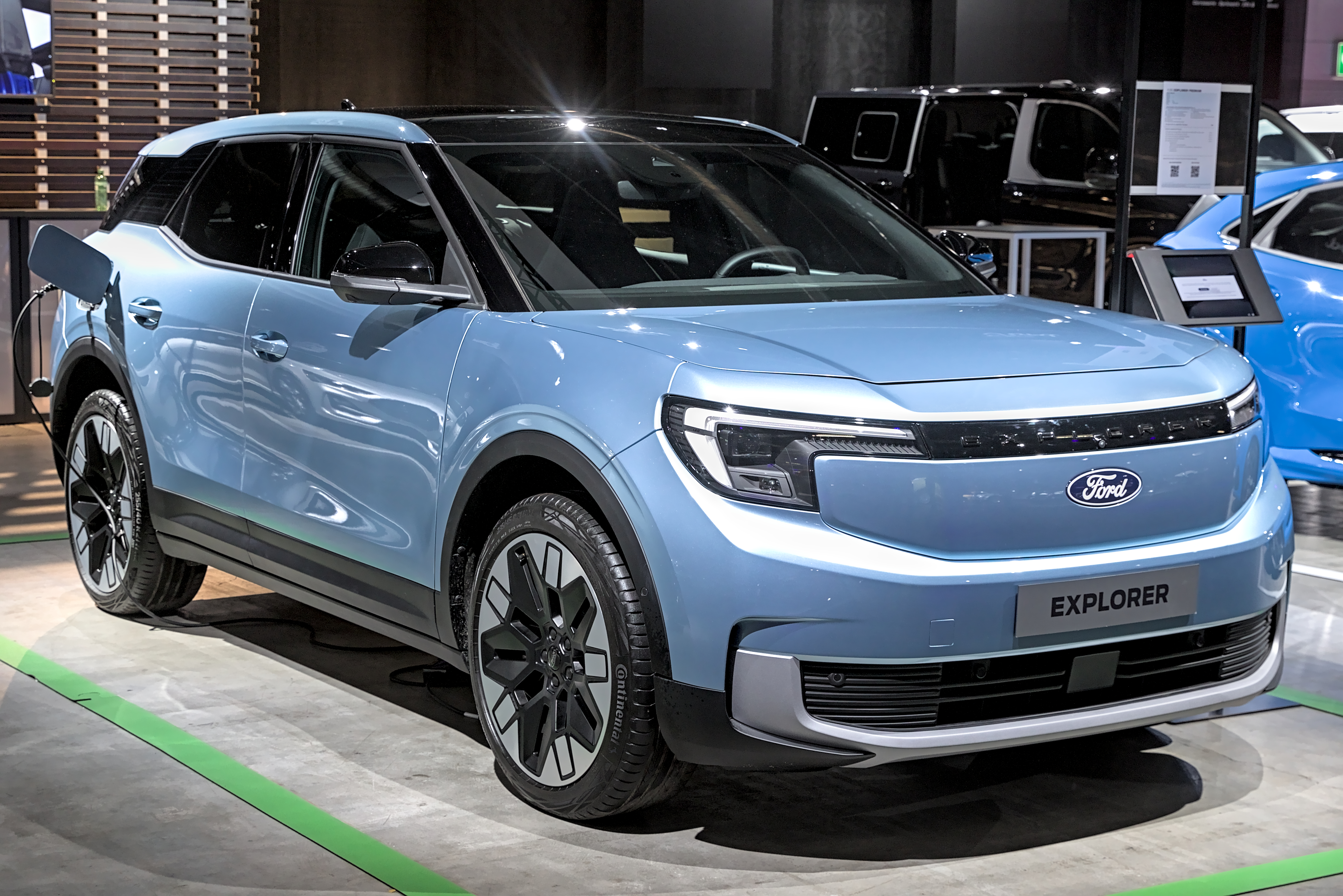
The Ford Explorer is a large family-friendly vehicle that can carry many passengers and their belongings. It's popular for its roomy design and has been around for a long time, making it a common choice for people looking for an SUV.
A hybrid car uses both a regular gasoline engine and an electric motor to run. This helps the car use less fuel and produce fewer harmful emissions than cars that only use gasoline.
The sticker price is the price you see on a car when you go to buy it. It's the amount the car maker suggests the dealer should sell it for, but it can be higher when you add other costs.
Interest rates are what you pay extra when you borrow money to buy something, like a car. If the rates are high, you end up paying more money back over time.
The loan term is how long you have to pay back the money you borrowed to buy a car. If you make the term longer, your monthly payments can be smaller, but you might pay more in interest overall.
Electric vehicles are cars that run on electricity instead of gasoline. They can be more expensive to fix because they have different parts and technology compared to regular cars.
Insurance premiums are the money you pay to an insurance company to protect your car. If repairs and accidents cost more, your insurance might cost more too.
LIVE
If you're an automotive supplier and you know your team is building the next big thing, prove it
on the industry's biggest innovation stage. Automotive News is now accepting applications
for the 2026 PACE program. PACE awards recognize traditional and non-traditional suppliers worldwide
for new product, process, and business model innovation, and entries must be innovations
already commercialized through a sale to an automaker. Still pre-commercial but past the
pilot stage, PACE Pilot recognizes post-pilot pre-commercial innovations across automotive
and future mobility, products, software, IT systems, and processes with the potential to
revolutionize an automaker's business. All submissions are reviewed by an independent
panel of judges and MIMA is the exclusive lead sponsor. Ready to be recognized?
Apply by February 9th at AutoNews.com
Welcome to Daily Drive for Friday, January 16th, 2026. I'm Kellan Walker in Las Vegas.
Today on the show, Canada strikes a landmark deal allowing Chinese EVs into its market.
Ford explores battery deals with China's BYD triggering political backlash
and US EV registrations plunge 49% after tax credits end. Plus, Holly's Chris Press explains
how integrating auto insurance into the car buying process is helping dealerships close deals.
We look at insurance as the second lever to pull in order to save the customer money so they
can fit the car they want. Let's run through all the news you need to know to keep up in the auto
industry. Canadian Prime Minister Mark Carney has announced a landmark agreement with Beijing,
allowing Chinese electric vehicles into Canada's market. In exchange, China will drop duties on
canola and other agricultural products. The deal permits up to 49,000 Chinese EVs annually
at a 6.1% tariff, about 3% of Canada's market. In return, China will reduce canola seed duties
to 15% by March and lift tariffs on Canadian lobster, crab, and peas. The agreement marks a
significant shift after Ottawa imposed the 100% tariffs on Chinese EVs in 2024
to protect domestic automakers. More on this story in a minute with automotive news Canada's
Greg Lason. Meanwhile, Ford is exploring battery deals with China's BYD for its international
hybrid production. The talks involve supplying Ford's overseas factories with batteries for
the automakers expanding hybrid lineup. Those overseas hybrids would be exported worldwide,
including to the US, though most American sold hybrids will still come from North American
factories. The discussions triggered immediate political backlash from White House trade advisor
Peter Navarro and House China panel chair John Molinar, who said Ford, quote,
should work with our allies, not our adversaries. Ford already sources batteries from BYD for its
Chinese joint venture factories and has a separate deal with China's CATL. There's no guarantee an
agreement will actually happen. And US electric vehicle registrations dropped 49% in November.
That's after federal tax credits ended in September. EV market share fell just under 5%
down nearly 4 percentage points from a year earlier. Legacy automakers took the hardest hit.
Chevrolet saw registrations plunge 75%, Honda fell 85% and Nissan dropped 94%. Tesla fared
better with a 35% decline, actually growing its market share to over 53%. Some analysts predict
the EV market will rebound this year with more affordable models launching.
Others say we won't see EV share climb above 6% for the next two years.
And those are today's headlines. You can find more details on all those stories at AutoNews.com.
Joining me now to help us understand Canada's deal with Beijing to allow Chinese made EVs is
Greg Lason, the digital and mobile editor of Automotive News Canada and host of the Automotive
News Canada podcast. Greg, welcome back to Daily Drive. Good to be here. Greg, this deal comes
after Canada imposed those steep tariffs just two years ago to protect its auto sector.
What's driving this dramatic policy shift now? What's happened is full on trade war with China.
Yes, everyone knows we're engaged in one with the United States, but when we enacted those 106.1%
tariffs on Chinese EVs, China then enacted tariffs on our canola industry, some seafood,
other agribroducts, and the farmers in the West started bending the ear of Prime Minister Mark
Carney saying how much they were hurting. And then it became a delicate dance for Prime Minister
Mark Carney to figure out how do I keep everybody happy? And so a lot of pressure from the West
to lower the canola tariffs in China, a lot of pressure from the auto industry to keep the tariffs
on Chinese EVs in place. This is the compromise. 49,000 units per year allowed into Canada at a
tariff rate of 6.1%. It's capped, and China has said, or at least Mark Carney says China is expected
to drop their tariffs on canola down to 15%. So this is the compromise, but I say it like this.
Is it really a win because it's just less losing? There's still a tariff on canola,
and now we have Chinese EVs entering the North American market. So I don't know if this is a
win for both industries or a loss for both industries because a year and a half ago,
EVs weren't allowed in Canada at all other than 100% tariff, and there were no tariffs on canola.
That's completely changed even with this deal. With Canada now opening its doors to Chinese EVs,
what does this signal about the possibility of Chinese automakers eventually entering the U.S.
market? So there's some very big language put out there by our federal government that says
it expects this could trigger some North American EV production by Chinese brands.
It's not set in stone. It's not a definitive deal, but it could mean eventual production,
could mean eventual battery production in Canada based on the sources I've spoken to all day,
that maybe because we have critical minerals and we have refining facilities and we already
have battery factories here that we're a good fit for a Chinese battery maker here. And then
coupled that with Donald Trump's comments earlier this week that he's open to Chinese EV assembly
in the United States, suddenly you have an EV supply chain that really looks a lot like the
North American EV supply chain. So there's a possibility of jobs, but this is so far down the
road. I mean, even the Chinese EVs themselves won't be arriving until next year at the earliest.
What you might see early on is Tesla and maybe Polestar capitalized on the 6.1 tariff that they
will pay because they had previously been importing from China to Canada. They'll probably be the first
two automakers to take advantage of that, make vehicles in China cheaply and send them to Canada,
and then the Chinese brands arrive in a year, year and a half.
Perfect. Greg, thank you so much for joining me.
Anytime.
You can read more about that in all of today's top news stories at AutoNews.com.
Coming up next, Polly's Chris Press explains how integrating auto insurance into the car buying
process is gaining popularity at dealerships and why it's becoming a crucial tool to help customers
afford the vehicles they want. That's next on Daily Drive.
Artificial Intelligence dominated CES 2026, but is the industry's pivot away from EVs putting the
U.S. at risk? This slowdown in the U.S. and this pivot to hybrid and other powertrains,
my concern is how far will we fall behind and how difficult will be for us to catch up or can we
catch up? On this week's episode of the automotive news shift podcast, EY's George Lenio joins the
show. He talks about why U.S. automakers skipped big displays this year, the shift from EV hype to AI
and robotics, and his concern that the U.S. is falling behind China in electrification.
I'm Molly Boygon. Join me on shift, available this Sunday wherever you get your podcasts.
Welcome back to Daily Drive. I'm Kellan Walker. Auto insurance has become the second highest
cost when purchasing a new vehicle and dealerships are increasingly integrating it into the sales
process. Chris Press is vice president of automotive distribution at Poly. He spoke with
automotive news senior retail editor Dan Shine about how insurance integration is evolving
and why it's particularly important for younger buyers and affordability conscious consumers.
Chris, I appreciate you joining me on the FNI Friday edition of Daily Drive.
Thank you for having me.
So back in the old days when I was younger and I'm by my first car and my second car,
bringing your own auto insurance was kind of part of the deal. It's like, you handle the
auto insurance and it's not part of the car buying process. But it's become more so now
that it is, it's kind of evolved over time. Kind of give us a little bit of that history and how
it's kind of changed from the old days of you're responsible for your car insurance to now where it
can be part of the process when you go into a dealership to buy a car. Yeah, and that's a great
point. It has changed in the past. Many states allow a person to add their new car to the policy
post purchasing the car. And that's still the case. However, many dealerships nowadays,
they want the new car with all of the correct coverages to be on the policy at the point of
purchase. The reason is there's just been bad experiences as far as customers having accidents
and not having full coverage. Or in some cases, fraud situation where having the correct insurance
verifies who the buyer is and protects the dealership as well. So many dealerships are now
asking customers to have the full end to end insurance covered prior to leaving the dealership,
which is one opened up opportunity for that type of service to be offered. But also you have a lot
of customers that are youthful drivers that don't have insurance or don't know where to get insurance.
And we're also seeing a lot of new to the US buyers that have foreign driver's license and
other challenges that really need someone that has insurance experience to be able to assist them.
We've kind of mentioned younger buyers. And this is kind of part of the way they kind of operate
now too. They don't do things the old way. So that kind of factors in, I would guess, as well
into how dealerships are now kind of handling this as insurance as part of the whole sales process.
Yeah, I agree. The insurance industry is adjusted. A lot of times there was the friend or the family
friend that they would have insurance through a broker. But nowadays, a lot of the carriers work
directly with their customers. And you can imagine that youthful drivers and people under 25,
they don't always know the best place to go to get the correct insurance. So just providing
general guidance on we have a trusted partner or we have someone that can help you with this
is a huge value add for the dealership in creating an excellent customer experience.
Yeah, I think if that hurdle is out of the way, especially for young drivers who maybe don't have
insurance or this and forth, to be able to kind of supply that would I would think smooth over
that transit, you know, that whole transaction process. I mean, it's already a lot of paperwork
and a lot of hassle to take one little hurdle out. I think it also would be a good selling point.
Yeah, that's exactly right. The experience is much better. It puts the customer's mind at ease.
You know, obviously finances in today's day and age with increasing inflation and those factors
has caused a lot of pressure on the consumer. So either giving customers a good option or being
able to use insurance as a lever to help them save money so they can afford it the car they want
is a huge advantage for our dealerships. Yeah, you kind of touch on affordability. That's
seemed like in 2025, this was a big issue. I think it's going to continue to be a big issue.
Everything's a little bit more expensive. So the bills are adding up, taking money away from
potential car payments. And it just seems that people are kind of on the sidelines a lot in 2025
because of the high sticker prices because of interest rates may be a little bit high. But
also insurance is going up too. It's going to be very expensive. And so again, this is probably
another hurdle that consumers are facing. Well, absolutely. Insurance is the second highest cost
when it comes to purchasing a new car. I think the latest data out is that the average new car
purchase is about $50,000. Interest rates have come down slightly over the last couple of months,
but still are higher than what I think many consumers have been used to over the last five
years. And so the dealership has to find a way to make sure the car fits into their budget.
And there's only so many things you can do. You can try to extend the length of a loan in order
to help them afford it. You can try to help them lower the interest rates, but that's very limited.
And so what we look at insurance is the second lever of a poll in order to save the customer
money so they can fit the car they want. You really, as a car dealership, don't want to reduce the
trim or downsell them to a different car to save money. You want to get them to what they want,
what they came to the store for. So insurance just gives our dealerships an extra option in
order to make the car fit and fit. Right. It's people, they see a car, they fall in love with
it, with whatever features they have, and they don't want to start taking away the heated seats
and the heated steering wheel. If they can find another way and kind of searching through different
insurance options, that might help them keep the level that they want.
That's exactly right. Yep. And if you want to talk about the cost of insurance, so yeah,
the cost of insurance has risen significantly over the last few years. That's simply because
inflation, the inflation rate has been high, the cost of accidents and repairs has gone up,
whether because of the inflation or because of EVs, electric vehicles, being more expensive to fix.
And so what we've seen is that insurance has gotten to a very high level. Now,
luckily the last few quarters, you'll see that the rates have taken a little bit of a step back,
which is great, giving customers a little bit of breathing room. However, overall,
it is much higher than it was even just a few years ago. And that's something that customers
have to take into consideration when purchasing their car. Yeah, you kind of lead me to my next
question. Polly did a kind of their Q3 report on the insurance and all and the fundamentals.
And it kind of mentioned that the kind of the friction, that insurance friction kind of lessened
in Q3. What were some of the factors why that happened? Yeah, majority of it is price. So with
price taking a step back and stabilizing, that's been incredibly helpful for customers.
But the other aspect is the carriers have caught up with their pricing. So when inflation was going
significantly higher, carriers have the ability to raise prices. They're very limited in being
able to do that. So for example, they have to go to the department of insurance, they have to get
that approved, it can take time. So during that period of time, you know, they're losing money
and they typically have to reduce their underwriting criteria, meaning not offering
insurance as much to customers or putting in restrictions such as we'll only offer insurance
to customers if you put your home and your auto with us. And so now that the carriers are mostly
caught up, what we're seeing is not only has the price stabilized, but the carriers are more
willing to offer insurance to all customers, which has really lessened the pressure on the
insurance industry and new car buyers in particular. And in that same Q3 report from Polly, it
talked about 50% growth or increase in the number of customers who took kind of that
high collision deductible. Kind of interesting to talk a little bit about how, you know,
that that kind of growth from what I can't remember the number from where it was, but
and just kind of the reasoning again behind that. Yeah, absolutely. So one, changing your deductible
from 500 to 1000 can save you about 10% on your insurance. So that's a great easy way to help
customers find a more affordable premium. The other thing is customers are becoming more
insurance aware to where they say, Hey, at what level would I actually submit a claim? So for
example, if you would, you know, had an $800 claim or an $800 incident, would you submit a claim
for $800? Many customers nowadays say no, I wouldn't because I know that it's going to go on my
driving record. It's going to be, you know, it's going to affect my premium going forward.
I'll just pay the $800 out of pocket. So therefore they assess where they feel comfortable paying
out of pocket versus needing insurance. And many of your customers are landing on a $1,000
deductible as that number. In addition, the carriers are also recommending to their customers to move
from 500 to 1000 for the same reason. It's more affordable. They don't want small claims either.
So really it benefits both the customers and the carriers. And I think that's why you're seeing
a strong move in higher deductibles. Great stuff, Chris. Really interesting. Great
talking with you. Really appreciate your time. Yeah, great. Thank you, Dan. Appreciate it.
Chris Press is vice president of Automotive Distribution at Poly. He spoke with our own
Dan Shine. That's Daily Drive for today. I'm Kellan Walker. Thanks to Automotive News Executive
producer Jake Nier, as well as our own Lauren Siliff for his reporting for today's podcast.
You can get the latest news on Canada's deal with China, Ford's battery negotiations,
and everything happening in the auto industry at AutoNews.com. Come back tomorrow for our weekend
drive episode where Larry Veliquette and Michael Martinez will break down President Trump's
combative Detroit visit, Stellantis dumping all of its plug in hybrids, and more of the week's
biggest news stories. Larry, I got to say, I just wish there was some way that Ford could have
possibly known that getting involved with Donald Trump might lead to some drama.
We'd love to hear from you. Let us know what you think of the show and the topics we cover today.
Send us an email at dailydrive at autonews.com or leave us a voicemail at 313-444-2774.
And if you enjoy the podcast, remember to like, leave a review, and subscribe so you never miss an episode.
About this episode
Canada has reached a significant agreement with China, allowing the import of Chinese electric vehicles (EVs) into its market, which previously faced a 100% tariff. This deal, which permits 49,000 EVs annually at a 6.1% tariff, reflects a shift in trade dynamics influenced by agricultural interests. Meanwhile, Ford is negotiating battery supply deals with BYD, sparking political controversy. The episode also explores how integrating auto insurance into the car buying process is becoming essential for dealerships, especially for younger buyers navigating affordability challenges.
Canada strikes a deal with China allowing up to 49,000 Chinese EVs annually in exchange for agricultural concessions, marking a dramatic policy shift. Ford explores battery deals with BYD for international hybrids. Plus, Polly’s Chris Pres explains how integrating auto insurance into the car-buying process is helping dealerships close deals amid affordability pressures.