The Porsche Taycan is Porsche’s electric car. The host is saying the car they saw wasn’t something like a Taycan—it was a traditional sports car instead.
The Ford F-150 is a pickup truck, usually used for hauling and everyday driving. A 1976 F-150 would be an older version, so it can look noticeably different from newer trucks. The podcast is basically pointing out how an old truck in good shape can still stand out.
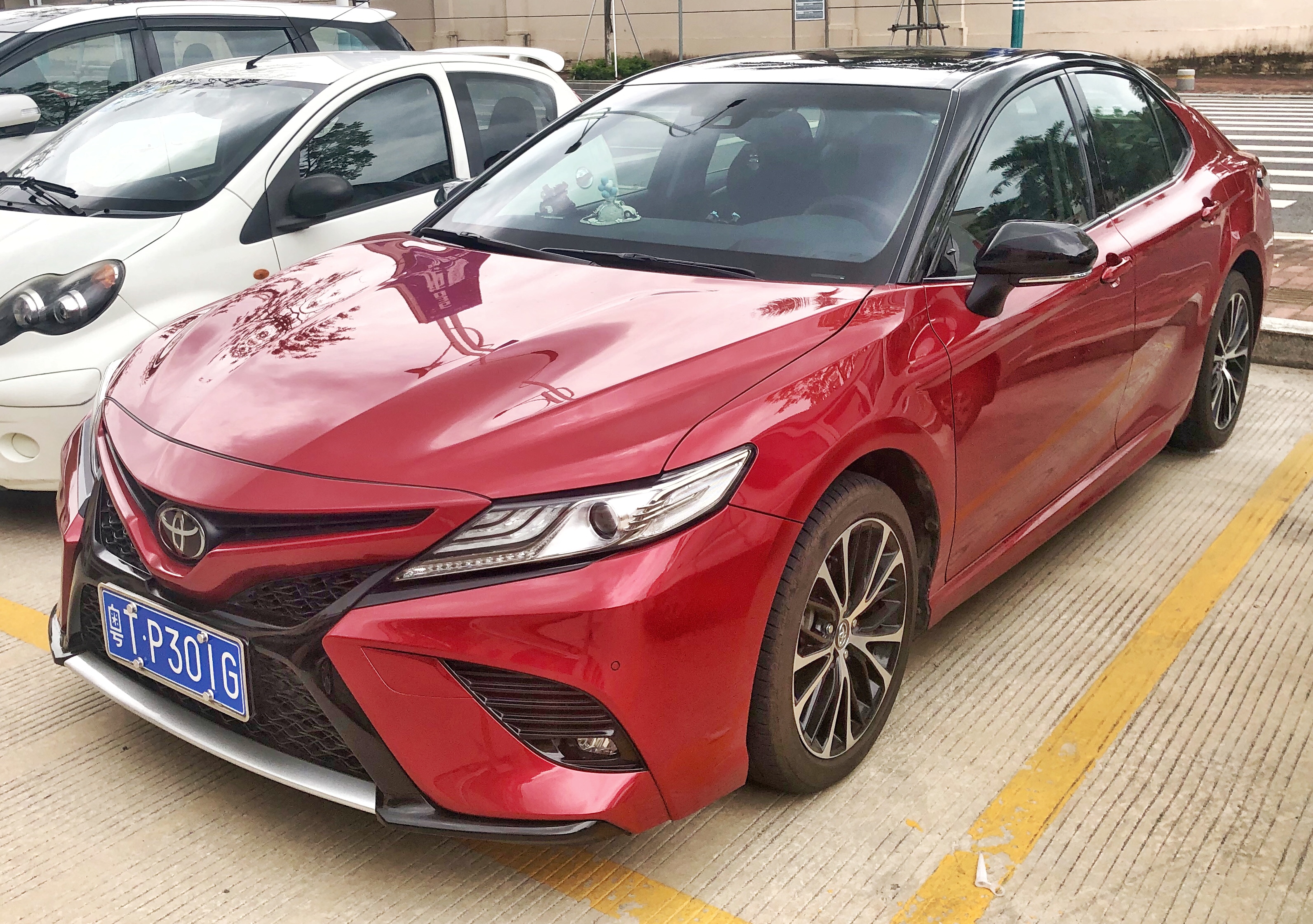
The Toyota Camry is a regular, everyday car (a sedan) that many people drive. Because it’s common, it can be used as a comparison point for cars that look or feel different. In the podcast, it’s mentioned to explain what doesn’t stand out.
Concept
split in half
“Split in half” here means the race car was designed so parts of it could come apart. That makes it easier for the team to reach and fix important stuff during a long race. It’s a design choice made for racing practicality.
Group B was a high-performance rallying classification (especially famous in the 1980s) with relatively liberal rules that encouraged powerful, lightweight cars. The transcript mentions Porsche and Group B in the context of whether Porsche was serious about racing, but it’s worth noting that Group B is primarily associated with rallying rather than endurance racing.
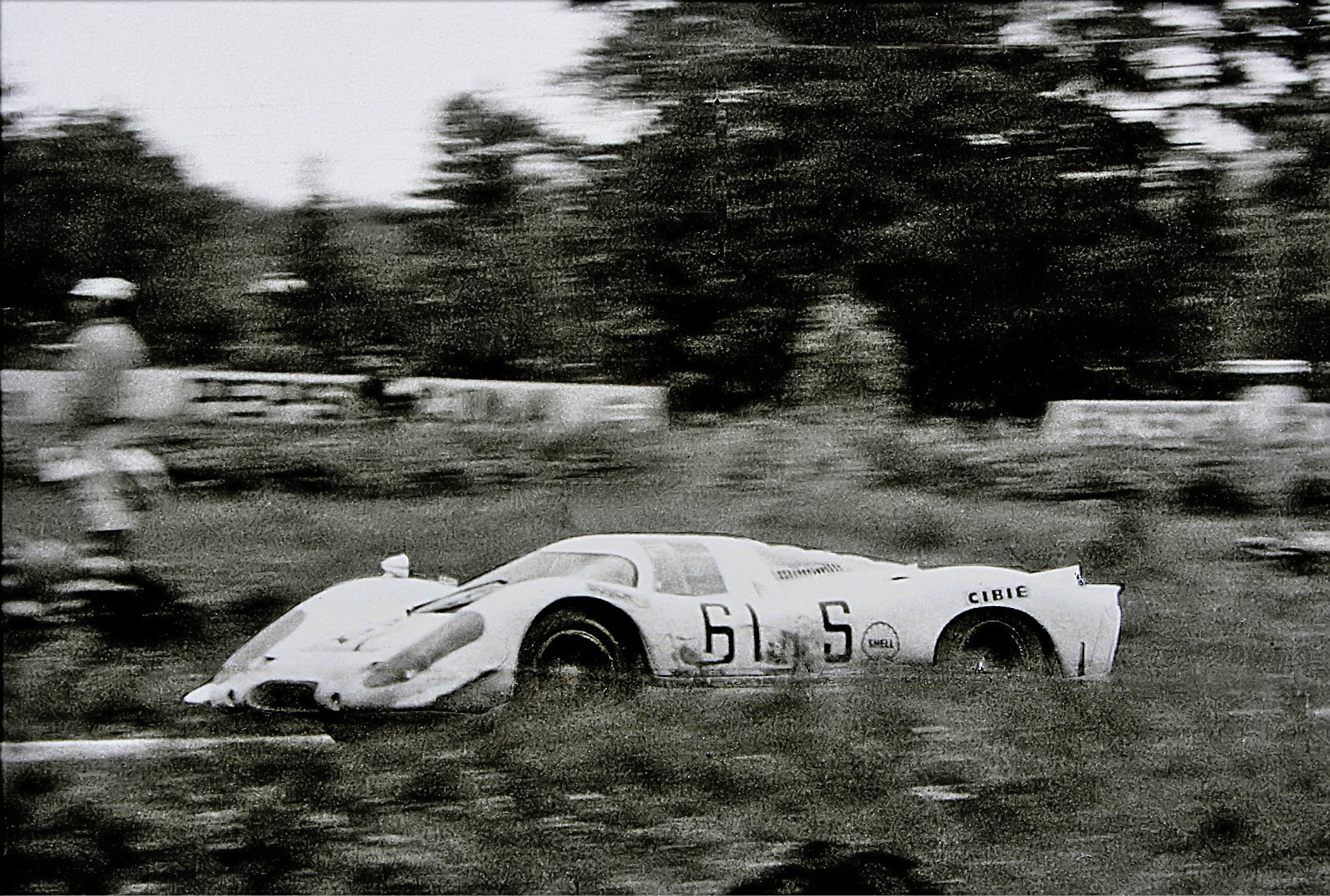
The Porsche 917 was one of Porsche’s most famous race cars. In this story, the key point is that in certain crashes the car could separate into two halves, which is why it became part of racing folklore.
The Ford GT40 was a famous race car from the late 1960s. Here it’s mentioned because its construction is described as more rigid, which affected how people thought about safety in crashes.
A monocoque is a car body that acts like the main structure. Instead of a separate frame doing most of the work, the shell itself is what holds the car together.
Topic
Porsche vs. Gulf/Golf team relationship (factory team vs outsourcing)
They’re talking about how Porsche’s racing effort was split between the factory and the Gulf/Golf team. The big idea is that sometimes the teams didn’t agree on new ideas, but the partnership still produced results.
Le Mans refers to the 24 Hours of Le Mans, the world-famous endurance race held in France. It’s treated here as the “most important race,” which is why failing to win it is framed as the key irony of the Porsche–Gulf/Golf program.
Car
Porsche 908/3
The Porsche 908/3 was another Porsche race prototype used in endurance racing. Here, it’s mentioned because the discussion about an engine/oil problem is corrected to the 908/3 rather than the 917.
“Ran out of oil” means the engine didn’t have enough oil to lubricate itself. Without oil, the engine can overheat and get damaged fast—especially in a long race.
The Porsche 911 is Porsche’s famous model with a distinctive flat-six engine. In this part, they’re talking about the early engineering effort to decide exactly how that flat-six would be set up.
A “flat six” is an engine with six cylinders laid out in two sides. Here they’re talking about the specific engine layout Porsche was working out for the 911.
A “12 cylinder engine” means the engine has twelve cylinders. They’re crediting the design of that big engine as a major reason the Porsche 917 could work as a top race car.
The Audi Quattro is a car that uses four-wheel drive. That means power goes to more than just the rear wheels, which can help the car grip the road better. The podcast mentions it because it’s an important example of four-wheel drive in performance cars.
The Porsche 928 is a Porsche grand tourer with a V8 engine. In this conversation it’s brought up as part of a “what if Porsche did X instead” speculation.
The Porsche 959 was a special Porsche built to race in the Group B rally category. It used a lot of advanced tech for its era, so it took a long time to finish. By the time it was ready, Group B rallying was being shut down for safety reasons.
Homologation means you have to build a certain number of “real” cars for the public so the race version is officially approved. In Group B, that minimum was 200 cars. That’s why manufacturers had to commit to production, not just one-off race prototypes.
They mention the Ford RS200 to show that lots of big companies built rally cars for Group B. It’s one of the famous Group B machines. The takeaway is that Group B was a magnet for manufacturer projects.
Car
Porsche 961
The Porsche 961 is basically the racing-focused version of the 959’s ideas. The host connects it to Le Mans and explains it as part of Porsche’s development work, not just a one-off race car.
This part is about how racing rules changing can force teams to either redesign cars or stop racing. The host uses Porsche examples to show that timing and regulations often drive the decision.
Car
Porsche 956
The Porsche 956 is a famous Porsche race car that did very well at Le Mans. Here it’s used to explain Porsche’s decision-making when rules change: they sometimes step away after long periods of success.
The Porsche 935 is a well-known Porsche race car, especially in endurance racing. The host talks about different versions of the 935 and points to a Porsche video series explaining the story behind them.
The FIA is the organization that writes the rules for international auto racing. Here, it’s important because when the FIA changes rules, Porsche has to adapt—or sometimes push back.
This refers to car parts that can move to change how the car’s shape affects airflow while driving. The host says Porsche had a moving rear aero feature on the 917, and the FIA banned that approach before Le Mans in 1969.
An exemption in motorsport rules is a temporary permission to run with a configuration that would otherwise be disallowed. In this case, the FIA allowed the team to compete in that specific race with the existing setup, while requiring compliance starting after the event. Exemptions are often used when teams need time to redesign parts to meet new regulations.
Term
trim tabs
Trim tabs are small aerodynamic devices used to fine-tune airflow over a car. Depending on the rules and placement, they can help adjust downforce or stability by changing how air moves around the bodywork. In racing, when regulators ban or restrict them, teams may need to redesign aero packages to stay compliant.
Balance of performance is a way race organizers try to make different cars perform more evenly. They may tweak rules so no one car is clearly faster than the others. Even then, teams often feel the tweaks don’t perfectly match their car.
A boost limit is a restriction on how much pressure a turbocharged engine is allowed to run. In practice, it’s enforced by rules that cap turbo boost (often via engine control limits or hardware restrictions) to control power output. When a series changes or applies a boost limit, teams may need to re-engineer their cars to comply.
USAC (United States Auto Club) was the sanctioning body for IndyCar-era racing and the Indianapolis 500 in the period referenced. In the segment, USAC issues an unfavorable ruling on turbo boost, which affects Porsche’s decision about whether to enter. Sanctioning-body rulings like this can change the technical direction teams must take.
LIVE
Welcome to Porsche Patter with Bracken Helms, the show where we hear Bracken and his distinguished
guests from the Porsche community patter on about Porsches and all things automated.
Porsche Patter is sponsored by Circuit64. Circuit64 creates authentic automotive apparel made for
life-minded automotive enthusiasts. The links for Circuit64 are in the shown notes. Okay, let's get to it.
Jay Gelotti, part three. Okay, let's start out with the fact of like a lot of these old customary
things you did. Do they even exist anymore? I mean, you think about flashing your lights like
that's the least of my worries anymore. I mean, I'm going through a small parking lot. Not a huge
Walmart parking lot where there's a lot going on. A small parking lot last week. And I pass a Porsche.
Not an SUV. Not a Taycan. Not an EV. Not even a four-door Porsche of any kind. It's a sports car.
We're going in opposite directions through a small parking lot. So we're going, what,
10, 15 miles an hour? And we pass each other. I'm just looking at him and I'm staring at him
as we pass each other. He doesn't even acknowledge that I'm there. Like, he doesn't even like, oh,
cool car. Anything. Okay, maybe he didn't see you. Really five feet away from each other going
opposite directions? And you notice anything that's out of the ordinary when you're driving,
like an old car. It could be a 1976 Ford F-150. That's in good condition. I mean, if it's beat
up, maybe you just look at it as, oh, it's an old beat up car. But like, you notice things that
aren't like your average like Toyota Camry, Tesla. I mean, if you don't live in California,
maybe not, but like, God, there's so many Teslas. Oh, you goddamn Tesla people. Anyway,
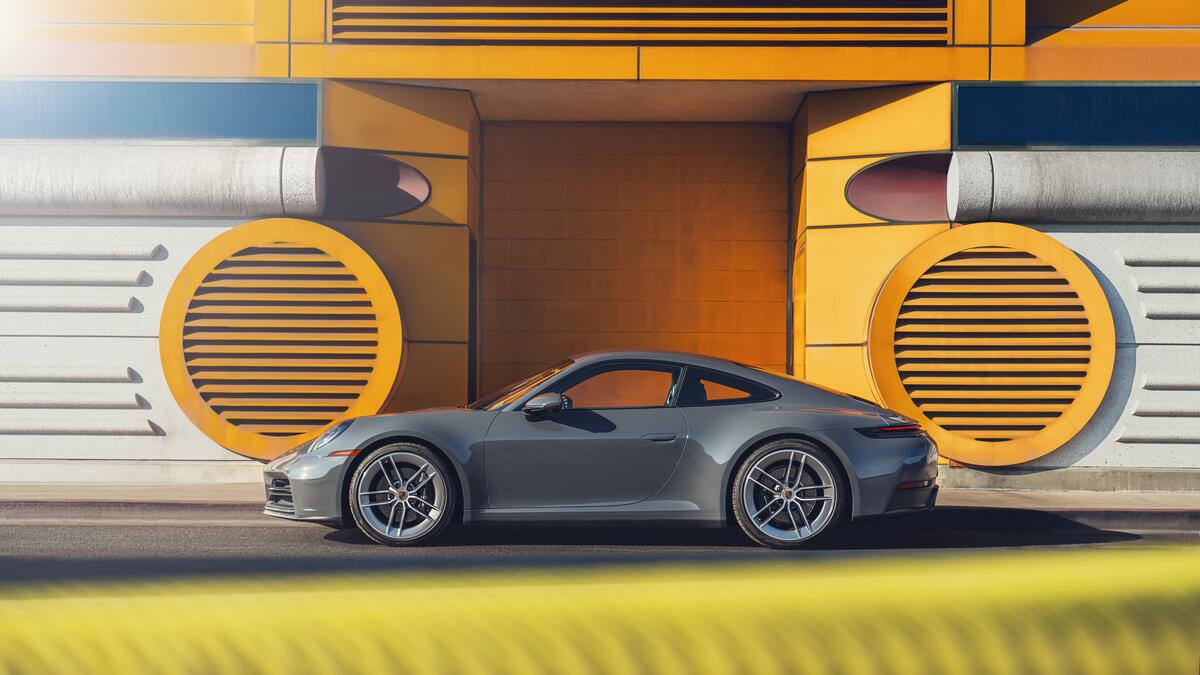
um, but you notice stuff like that. This is a 74 911. It's something that even if you're not into
cars, you notice it's a target. Now, whether you like targets or not, that's not the point.
You for sure notice a car without a top on it more than anything. And it's one of the older
targets. So you got a silver bar, like that just sticks out. The target top is off. Now,
here's the kicker. It's yellow. The car is yellow. I got a friend that hates cars,
and he notices a yellow car. I mean, it just nothing. I don't know what else to say. Moving on.
All right. In this episode, we talk about the 917, how they used to split in half. We talk about
the Salzburg cars, or I guess the wire and Salzburg cars. We talk a little bit more about
Fernand Piac. We talk about Porsche and Group B in the 1959. And if they were really serious about
that, we talk about when Porsche decides to go racing and when they decide they don't want to race.
We talk about politics in racing as far as Porsche back in the day. And I guess I'm wrong
with the baby 935. I remember back in the day, like when I first learned about the baby 935,
and it only raced a couple of times and, you know, it did good. And then one time it didn't
finish or something like that. Like it raced two or three times. I don't know. But it seems
like lately, every time I read about it, it's, it was so dominant that they saw no reason to
continue. They came in, they made their point, and then they were, okay, we're done. But yeah,
him, he's kind of like, I don't know about that. Anyway, here's Jay Gelotti, part three.
So your buddy Brian Redman also was quoted as saying, or he says that the 917 was known for
splitting in half. Yeah, Brian does like to bring that up. But it's important to understand why,
because you have to remember in 68, when he drives for John Wyre in GT40 in 68, and that car's a
monocoque. So it's a, basically it's a steel and aluminum chassis, sturdy. You can still get
killed in one, and drivers did. But in Brian's mind, that was safer because it was just sturdier.
It wasn't as flimsy as all these little aluminum tubes welded together. And it's absolutely true.
And I, when I do my 917 history presentation, I show the photos of all five 917s in period that
broken half in crashes, because that's what happens. The engine is so heavy,
relative to the rest of the car, the engine creates so much momentum that if it crashes,
and it hits just the wrong way, the engine wants to tear the back half of the car away
from the front half of the car. So it breaks right across the cockpit. And if you're the driver,
you know, that's a little bit disconcerting. And there was the one fatal crash, you know,
John Wolf in 1969. It's the one driver who was killed in period in a 917. And obviously,
that, you know, the car did break in half. So. So what did the wire team think when Pia
showed up with the Salzburg car? Well, they were a bit miffed, a bit, I think Brian would say they
were a bit concerned, because, you know, they thought they were the factory team. And all of
a sudden, this car shows up at Daytona in 1970 with Ferdinand Pieck himself, and some of the
factory engineers and some of the factory mechanics and two factory drivers, or at least
drivers who had been factory drivers the year before. And of course, the cars owned by Porsche
Salzburg, Ferdinand Pieck's mother, her company. And so they were a little bit concerned. And this
kind of carried on through both years of the program between Porsche and the golf team. The
golf team was always ostensibly the factory team. But sometimes if they turned down an innovation
or a development, all of a sudden that innovation or development would show up on the Porsche
Salzburg or the Martini car. So there was friction there. It's speculation on my part. I don't think
Ferdinand Pieck was probably real happy about the outsourcing idea. I think he probably would have
preferred to keep control of the factory racing team. But his uncle, I think his uncle, Ferry
Porsche, had the final say, probably. And so Ferdinand Pieck had to kind of live with this
compromise and this relationship between Stuttgart and the golf team in England. And it worked pretty
well. I mean, let's face it, they won like 17 races or whatever it was. I mean, it worked
pretty well for Porsche and for golf. And oftentimes the golf team would eventually
accept a development that they might have initially turned down. But let's face it,
it didn't win. The golf cars finished first and second at Daytona in 1970. And the winning car was
45 laps in the lead after 24 hours. So it was a pretty crushing display by the Porsche and golf
combination right out of the gate. The only problem is they didn't win Le Mans. That's the irony
of that program is that only in the movie does the golf 917 win at Le Mans. In the real world,
both years, the golf cars failed to win the most important race. So.
Yeah. I mean, I have written here that the 917 ran out of oil at the Nuberbring,
but the Salzburg team knew and so they had a bigger. Well, no, that's yeah, that's the 9083.
Oh, okay. You know, about years and years later when Klaus Bischoff was one of the Porsche mechanics
at that time, eventually became head of the Porsche Museum. And so years and years later,
you know, when Brian and Klaus got talking about that, that's when Brian found out. Oh, yes,
in Porsche Salzburg, we know about this problem. And so we have more oil in the car.
I mean, the golf 9083s though were prepared by Porsche. So it's a little bit odd that having
the right amount of oil on board was not done correctly on the golf cars, but was done correctly
on the Salzburg cars, even though really all those cars were factory entered. The 9083s never
were prepared directly by the golf team. You know, the golf team would just show up and the cars
would show up painted in golf collars. And then the golf team would be in charge of actually
running the car in the race, but they weren't in charge of actually developing or building, you
know, the 97 teams that the golf team ran, those cars essentially were built in England
or rebuilt after every race, those cars were rebuilt in the golf team shop in England.
We, you know, we hear a lot about Hans Medsker or Valentin Schaefer when it comes to the 911
engine, but Piak was way involved and his name doesn't come up immediately.
Yeah. Well, certainly that was one of his first jobs when he starts working at Porsche. He's working
alongside with Hans Medsker as they're trying to finalize what this flat six for the 911 is going
to be and how it's going to be configured and all the details around that. That's one of his first
assignments when he starts working for Porsche. And then Hans Medsker obviously is alongside him
all the way through and particularly when we get to the 917. I mean, can't imagine the 917
without Hans Medsker's, you know, brilliant 12 cylinder engine design that, you know, without
that, we don't have the 917. And of course, Medsker was involved in virtually every Porsche
racing engine, you know, from that period all the way through the 80s and even into the 90s,
you know, he's really the guru for Porsche racing engines. Valentin Schaefer, of course, is
important because he's the guy who is more hands on in actually getting these engines to work sometimes,
like the first turbo, the first turbo 917 engine, the Can-Am car, you know, Valentin Schaefer is
very involved by that point with the engineering side of actually how do we make this engine run?
Because at first they had trouble even just making it run. And that's a long story. But for those
who are interested in that story, you want to read Mark Donahue's book, The Unfair Advantage,
if you want the whole story on the 917 turbo engine development, at least from Mark's perspective,
I should say, but it's worth reading if you want to read about what really happened
during that period. I mean, this next question is semi-loaded, but I just can't help but ask.
That's okay. We've seen all the terrific and crazy things that Fernand Peek ended up doing.
What would have happened if he wasn't kicked out of Porsche?
Again, really, really hard to say. And remember, he and all the family members,
they basically kicked themselves out. They basically said, because theoretically,
there was some squabbling and some disagreement. And so, Ferry Porsche, I think, made the decision
with the family to say, look, we'll all step back from the day to day. But remember
that Ferry Porsche and Louise Porsche, their children now become shareholders, right?
So, Fernand Peek, even though he's no longer part of the day to day, he's always there in
the background, kind of like his mother. They're always there in the background,
just like it is today as shareholders. The family members are still there, in a sense,
in the background. They still have to be kind of like the keepers of the flame.
So, I think Fernand Peek still had a lot of influence in terms of what was going on at Porsche,
especially on certain specific projects or specific questions that might come up.
But to your question, if he had been still in charge of R&D, or let's say he had eventually
become, maybe replaced his uncle as the head of the company, as the CEO, that takes a real leap
to imagine, God, what would Porsche have done or not done? In that case, it's a really interesting
question. Well, it will take a lot of thought and a lot of imagination to picture. I mean,
who knows, would Porsche have done the Quattro instead of Audi? I don't know, maybe.
Would we have had a 911 Quattro? Well, I guess we did eventually with the 959,
in a way, the four-wheel drive. But who knows, would we have had a four-wheel drive
928? I don't know. I mean, we could really go crazy with speculating on all that stuff.
So my next question is similar to that, or on that. The 959, they say they developed it for
Group B, but Audi was already so far ahead, would they have really, like, if things would have
worked out, would they have really went to Group B? Because part of me thinks Audi was already so
far ahead. But then I think, God, with like little support ProDrive, or was it a ProDrive?
Yeah, ProDrive was able to do miraculous things with the 950, with the SCRS with very little.
So maybe if they would have helped combine with the 959, but I don't know, it just,
they said that they were going to go to Group B, but it just seems like they would have entered
so far behind Audi. Well, Group B, clearly Group B was the impetus, if I can use that word,
it was the impetus for the 959 program. Because Group B, again, was pretty free in terms of the
rules. You had to build 200 cars for homologation. That was the homologation requirement for Group
B. Whatever you build, you got to build 200. There was a lot of manufacturing involvement
in Group B. I mean, the manufacturer was really kind of embraced Group B. It wasn't just Audi,
but it was also, you know, Peugeot, Renault, MG, Ferrari, Lancia. I mean, you can go on and on
down, Ford built the RS200. I mean, Group B attracted a lot of manufacturer interest. So
it does make sense that Porsche started down the Group B road. Porsche's approach was very
different because it was super high technology approach, right? It was everything they could
think of in terms of new technology to put in the 959. And I think that's in part why it took so
long for the 959 to be developed and finished. And by the time it was ready, of course, Group B
had basically come to an end or was just on the verge of coming to an end because it was, again,
so crazy, so unsafe. I'm talking about Group B rallying, of course. The cars were so fast.
And everybody, I'm sure, has seen video of, you know, no crowd control. People literally standing
in the road until a Group B rally car comes over a hill, all four wheels in the air at, you know,
120 miles an hour, and people are standing in the road until the last second when they get out of
the way. I mean, it was insanity at that time in the mid-80s. So by the time, you know, Group B
rally competition is canceled as being too unsafe, the 959 doesn't get its chance. Of course, it did
do Perry Dakar and did well in Perry Dakar, but it's a different kind of event. So, yeah, the
answer to your question again is, you know, it's speculative. All we can say for sure is that the
959 is inspired by Group B, gives it a reason for being, but then it kind of goes down its own
different path. And they did try it. Of course, it's in circuit racing. I mean,
they tried it at Le Mans and managed to finish. I think they won, they won the class. They might
have been the only car in the class, but I think they won the class with the 961, which is the
circuit racing version of the 959. But it was really a technology test bed. You look at the 959,
you see all the things that trickled down eventually to our everyday 911s. And so I think it was
valuable. It was controversial at the time because Porsche spent so much money on it.
I think it was worthwhile as a development exercise and as a PR exercise, but opinions
can differ on that. Okay. Porsche is a small company. So do you feel with Porsche racing?
Do you feel like it is resources that slow them down or are they more of been there done that?
What I mean by that is like the 917, they changed the rules and they could have jumped through hoops
and adapted and continued to race, but they're like, no, been there done that. We won. We've
done what we wanted to. Same with Can-Am. They changed the rules. They could have just been
like, okay, we'll let's continue racing, but they may have also, so the resources would have taken
up a lot or they can just be like, been there done that. And then it's happened with the 956,
the rules changed in what 88 and they could have adapted to the new rules and they're like,
well, we've dominated for so long. Why? And 935 baby, they came in, they kicked ass and then
they're like, we're out. Well, I might differ with you on the 935 baby. That's a different story.
And by the way, Porsche has just come out with a great series of videos on their YouTube channel
about the 935 with our friend Norbert Singer telling us firsthand what went on with all
the different variations of the 935, including the baby, which only ever raced twice and only
won the second race at Hawkenheim. But I think to your larger point, I think it's a combination.
There's always the timing thing of when the rules change and then you have to look at what's going
on internally inside Porsche on the money side of things. And does it make sense to,
are they in a position to spend money? So for instance, as the 962 program comes to an end or
comes toward an end in the late 1980s, Porsche is in very difficult financial position. And that
difficulty continues or in some ways gets worse into the early 1990s. So there's really no money
there to spend on a new racing program in the late 80s, early 90s, although they did carry on with
their IndyCar program that had already started. But you when you get to 1990, they cancel that
because it's not very successful. And again, it becomes a money thing. So yes, you see the
coincidence there between rules change and the financial situation. I think in some of these
cases, Porsche gets a little bit stubborn and a little bit like, okay, we'll just take our ball
and go home to your point. We've proved our point. And you're going to change the rules. We'll just
we'll take our ball and go home and see how successful your racing series is without us.
How many fans come to your races? If we're not there, right? We see what happened to the K&M
without Porsche. Basically, the series died. And it's not only because of Porsche, but the series
did die, basically. If you look at the FIA, the World Sports Car Championship, after the 917s are
outlawed, that championship starts into a bit of a decline as well in terms of how many people
are coming to the races and all that sort of thing. So I think it's a combination.
So going by what you just said, with the 935 and they went to the slant nose and they were going
to outlaw it, was that Porsche taking their ball and going home and kind of pushing their trip to
say, we'll pull out if you don't let us do this slant nose because the CSI told them you can't do
this. It's hard to know when it's like they're a small company standing up for themselves or when
they're taking their ball and going home. And you always get different stories, but often I think
it was Porsche standing up for itself. So if we go back to 69 at Le Mans, the FIA had outlawed
movable aerodynamic devices. The original 917 had these trim tabs on the tail that moved,
depending on which way the car was turning. Well, they get to Le Mans in 1969 and a few weeks before
the FIA had outlawed what they called movable aerodynamic devices. And Porsche basically said,
okay, you need to give us a reasonable amount of time to comply with the rule change,
but if you're going to change the rules on us for this race, we'll just take our cars and go home.
So to your point, that was a case of a small company standing up and saying, look, this is
unreasonable. You haven't given us enough time to re-engineer our car. And so the FIA did grant
an exemption for that one race. They said, after this race, you can't have the trim tabs anymore,
but we'll let you race this race with them. So that's an example of, hey, it's always a negotiation
between the manufacturers and the rules makers. I mean, that goes on and on. And to this day,
you know, I think it still goes on because in this day and age where we have balance of performance,
nobody is happy. And so all the manufacturers are generally unhappy with balance of performance.
And so there's all this negotiation that goes on. But certainly Porsche was not afraid to stand up
for itself as a small company. I don't think they were afraid to take the ball and go home
or not send the ball at all. In the case of the Indy 500 in 1980, when USAC gave them an
unfavorable ruling on boost, you know, the boost limit, Porsche just said, well, fine, well,
we just won't come. Thanks for joining us for today's episode. If you enjoyed the show,
please subscribe, comment, like, and share with your friends. Feel free to send questions or
suggestions to the email in the description of the show. Special thanks to our sponsor, Circuit
6-4. Goodbye for now. We hope we can get together again for our next episode. Now get out there
and enjoy the cars and the people.
About this episode
A parking-lot sighting of a “74 911” sets up a deeper dive into Porsche’s endurance and rally-era rule chaos. The hosts connect the 917’s notorious crash behavior—“splitting in half”—to its heavy engine and then contrast movie mythology with real results, including a Le Mans miss and an oil-issue correction to the 908/3. From Hans Medsker’s 12-cylinder work to Group B homologation and later FIA/BoP constraints, timing and regulations shape what Porsche builds—or walks away from.
Jay Gillotti has written very well know books such as Gulf 917 and Porsche Decades. This year a new book he is writing is coming out about the Porsche 936. He has also written articles for 000, Panorama, Forza, Vintage Motorsports, International Motor Racing Research Center, Collier AutoMedia and Wayne Carini's The Chase. He was also contributed to other automotive books like A French Kiss with Death, 1982 and Daring Drivers, Deadly Tracks. He has helped out at events like Pebble Beach Concours D'Elegance and moderated many Porsche Events people like Brian Redman, John Horsman, Vic Elford, Derek Bell, Hurley Haywood among others.
In this episode we talk about: -The 917 splitting in half. -Ferdinand Piech. -Porsche and Gruppe B. -Porsche deciding to race or not, was it financial or what? -Politics in racing with Porsche.