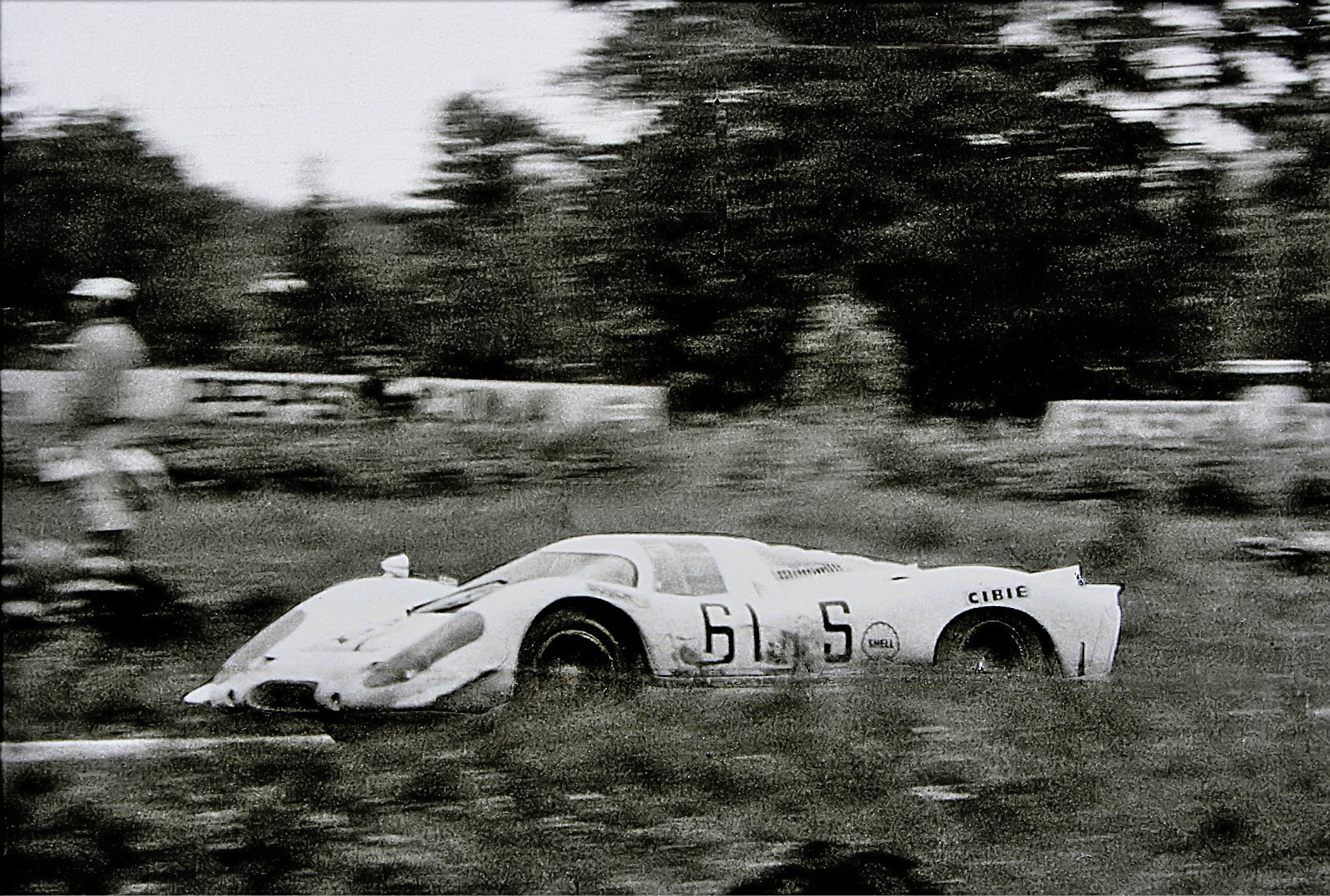
Le Mans is a long-distance race where cars have to keep going for hours. Porsche winning there is a big deal because it shows the cars could last and still be quick.
The Porsche 936 is a classic Porsche race car from the 1970s. It’s the kind of car people study because it represents Porsche’s endurance-racing engineering at the time.
WEC is a major endurance racing series. The host is talking about Porsche leaving it and being frustrated because the rules and plans weren’t settled yet.
Concept
LMD8
LMD8 is a type/class of race car used in endurance racing rules. The speaker is saying teams were trying to decide what kind of car to build while the rulebook was changing.
In racing, “hypercar” means the top class of very advanced race cars. The host is talking about what category teams were planning for as the rules were being figured out.
ICE just means an engine that burns fuel to make power, like gasoline or diesel. It’s the opposite of an electric motor-only setup.
Car
Porsche 956
The Porsche 956 is a famous Porsche race car built for endurance racing. People remember it because it was very successful in major long-distance events.
IMSA is a U.S. racing organization that runs sports-car competitions. Different series have different rules, so cars sometimes need different parts to race there.
Group C was a set of racing rules for endurance prototypes. If a car’s engine/turbo setup doesn’t match the rules for another series, it can’t be used.
Car
Porsche 962
The Porsche 962 is a famous Porsche race car used for long-distance racing. The speaker is saying that early on, Porsche made it in slightly different ways for different racing series, and that later other builders also made their own versions—so it can get confusing to know what’s “really” a 962.
A “type number” is Porsche’s internal model designation used to identify specific variants of a race car. In this segment, the host wonders why Porsche felt the 962 needed its own type number—implying that different chassis/engine setups for different series may have warranted distinct official identities.
The World Endurance Championship refers to FIA endurance racing at the top level, centered around long-distance events like the 24 Hours of Le Mans. The host uses it to explain why Porsche might have differentiated the 962’s identification when the car was intended for different racing programs.
The Porsche 935 is a turbocharged Porsche race car from the 1970s/80s that became a benchmark for customer-built race programs. Here it’s referenced as a comparison point: the host says the 962 story gets confusing for similar reasons—customers building their own chassis and creating multiple “versions” under the same model name.
In some prototype racing eras, customer teams could build or commission their own chassis based on the manufacturer’s design. The host says this happened with the 962 (and compares it to the 935s), which is why you can see cars called “962” that weren’t actually built by Porsche—making identification tricky.
Concept
Rothmans colors
“Rothmans colors” refers to the distinctive livery associated with Rothmans, a tobacco brand that heavily sponsored motorsport teams in past decades. The host says those colors are nostalgic, linking the visual identity of the cars to the era of Porsche racing they remember.
This segment pivots to a discussion about “politics” on the racing side—how decisions, rules, and organizational factors can affect what teams and cars get built or succeed. It’s positioned as a follow-up question rather than a fully explained technical topic.
The Porsche 917 is one of Porsche’s most famous race cars from the 1970s. The hosts are talking about how racing rules changed in a way that affected whether it could keep racing in certain endurance categories.
The FIA is the organization that writes and enforces many of the rules for international auto racing. In this discussion, they’re being blamed (or questioned) for decisions that changed what certain race cars were allowed to do.
In that era, racing was split into different rule categories. The hosts are talking about the top prototype categories (Group 4/5) and how rule changes made certain cars—like the Porsche 917—no longer eligible.
This was a big international endurance racing series. The hosts are imagining what would have happened if Porsche’s 917 could have kept racing there instead of being banned by rule changes.
Car
LMP 2000
LMP 2000 refers to a Le Mans Prototype class with a 2000cc displacement limit that emerged as rules evolved for endurance racing. The hosts connect it to Porsche’s V10 development path—suggesting the engine work was redirected from a GT1 idea into the LMP 2000 program.
A V10 is an engine with ten cylinders arranged in two sides that form a V shape. The hosts are talking about Porsche considering a V10 for one racing category, then switching plans when the rules changed.
GT1 was a high-level racing class for race-prepped “grand touring” cars. The hosts are debating whether Porsche’s V10 idea was meant for GT1 before the rules pushed them in another direction.
“Mechanical problems” means the car isn’t working as it should. In a long race, that can be serious enough that the team has to change plans, like using a different car or driver.
“15 laps behind” means the car is far back compared with the front of the race. In a long race, it can still recover if it keeps running without more breakdowns.
A Formula One Grand Prix is a major race in Formula One. Here it’s used as a comparison to show the driver was pushing extremely hard for a very long stretch of time.
White smoke usually means something is going wrong in the engine. In this case, it shows up right when the car starts having trouble, and the team later finds out a piston was damaged.
Term
engine start to tighten up
When the driver says the engine “tighten[s] up,” they mean it suddenly feels like it’s not running freely. In a race, that can be a warning that something inside the engine is failing.
A “burned piston” means the piston inside the engine got damaged from extreme heat. That’s serious enough that the team has to change how the engine runs to try to finish the race.
If one cylinder is damaged, the team may shut it down and run the engine on fewer cylinders. It’s a way to keep the car going long enough to finish or get classified.
Qualifying time is the time the car sets in the qualifying session. The rules here use that number as a benchmark, so teams can’t just drive super slowly at the end and still be considered to have finished properly.
Martini is a brand that sponsored race cars and is famous for a recognizable logo and color scheme. The host is pointing out that those colors aren’t unique to one specific Porsche.
An air box is part of the engine’s air intake system. The host is saying the Porsche 936 has a big one, which helps make it look unique.
Car
Porsche 917K
The Porsche 917K is one of Porsche’s most famous old race cars, strongly tied to endurance racing. In this conversation, it’s basically the “looks the best” reference point.
Car
Porsche 963
The Porsche 963 is Porsche’s current-generation top endurance race car. The host is saying it’s already done well, but the big question is whether it can win Le Mans—because that single result affects how people judge its place in Porsche history.
Car
Porsche 919
The Porsche 919 is another Porsche race car that’s known for doing well at Le Mans. The host lists it to emphasize how often Porsche’s top prototypes have actually won the race.
Car
Porsche 804
The Porsche 804 is an early Porsche race car that competed in Formula One. The host says it didn’t get great results back then, but it’s famous for sounding incredibly intense when it runs.
LIVE
Welcome to Porsche Pattern with Bracken Helms, the show where we hear Bracken and his distinguished
guests from the Porsche community patter on about Porsches and all things automotive.
Porsche Pattern is sponsored by Circuit 6-4. Circuit 6-4 creates authentic automotive apparel
made for life-minded automotive enthusiasts. The links for Circuit 6-4 are in the shown notes.
Okay, let's get to it.
Jay Gelotti, part four. Some of the things that stuck out in this one, you know, you don't really
think about it like when Porsche won the Le Mans in 70 and 71 and they got kicked out. But then
I'm starting to think, well, was the mantra really like an awesome car or since it was won
72, 73 and 74 was like a dominant car or there just was no one in the series. I mean, if you
would have said, oh, well, Porsche dropped out after 71 and then Ferrari took over, then it's like,
okay, well, you know, who would have known, you know, they probably would have done well, but
you know, that's a tough team to beat. But I mean, I don't know. I wasn't around. So I don't
know. But like mantra, I'm sure they were good, but were they like so dominant that if they wouldn't
have changed the rules, Porsche would have just continued to run over them. And what would that have
looked like? Porsche won Le Mans 70, 71, 72, 73, 74, because this mantra was not really that hard
of competition. But then again, there may be older people that are listening to this and like, that
mantra was a damn fine car. I don't know, Porsche, you know, I don't know. Another thing I want to
comment on is Jay didn't just do like a article in the May panorama. I think he's got a few articles
in that panorama. So you may want to check that out. While you're checking it out, though, his
book should be coming out on the 936 soon. And that could be a good read. Okay, so I read something
that really irritated me. When Porsche pulled out of the WEC last year, there's just so much going on.
Well, do you have a hypercar or the LMD8 or whatever? And you know, they were trying to figure
out the rules. And so I was kind of irritated with the WEC. And when they pulled out, I was like,
God, I wish they'd just hold in there until they can figure all this stuff out. You know, I did
hear about, well, they didn't pull out of the formula E. But then I heard, well, they're not
really putting that much money into formula E. So I kind of was like, okay, I know right now, if you
say, I don't know if EVs, well, of course they're not, no one's buying them. But maybe in the future,
maybe like, it'll be hybrid, maybe maybe they have to know, like, you can't just continue
building ice. Like you've got to know, in case the world goes somewhere else, you can't be caught
with your pants down. So maybe they're why that's why they're staying in formula E. But when I just
barely read this last week, that the formula E is quite costly. Like with that money, they could
have stayed in the WEC. I'm just like, especially with what's going on with all the teams that are racing
right now, like this is like a gold pinnacle, like all the teams are racing now. This isn't just like
Porsches out there by themselves or Toyotas out there by themselves. And then like he says in this
episode, the 963s never won Le Mans. And they're just out of it to go for formula E. I mean, I've
watched formula E races and I'm willing to like get behind Porsche and whatever they do, like I'll go
watch a formula E race anytime. But God, to pull out a WEC suit and focus on formula E. God, this
part of me is like once to understand why we're racing in this series and we're way ahead of all the
other car companies. Are we counting China? Because are you really ahead of all? No matter what kind of
racing you do, are you really ahead of like BYD, NEO, ZIPPAC or whatever, all these Chinese EV
companies are so far ahead of everybody else. I don't care what kind of racing you're doing. So I
don't know. And I'm sure Roger Penske really wants that Le Mans win. And I really want it too, to just
pull out of it. Oh my God. Anyway, J. Jalotti, part four. So going back to like simplifying things, if you
came into Porsche, it would be kind of confusing the 956 and the 962. I kind of wonder why they gave it a new
name. I mean, part of it makes sense to me, but part of it, like you said, with your Porsche Decades
book, it kind of complicates things. It really was basically the same car.
You know, yes, I mean, they're very similar. The difference being the 962, they had to lengthen the
wheelbase a little bit so that the driver's feet were behind the front axle line. That's the main
change to the chassis. Now the 962 for IMSA in the US, don't forget, had to run a completely different engine
and turbo setup, because the Group C 956 engine and turbo setup was completely illegal as far as IMSA was
concerned. So for the 962, when the 962 first appeared, it was a little bit different chassis,
different engine. And I guess I've never read anybody say for sure why Porsche felt that it should have its
own type number. Maybe because it was going to race in IMSA, they thought giving it a different type number
would, you know, would differentiate it from the car they were racing in the World Endurance Championship.
But then, of course, a year later, they decide to race to create a Group C version of the 962.
So now we have the 962 on both sides of the pond racing in different configurations, but it's essentially
the same chassis. And then to make it even more confusing, of course, like with the 935s,
Porsche's customers start building their own chassis, right? So we have all these 962s that are not even built
by Porsche. They're built by other people copying and trying to improve Porsche's chassis. And so then
that gets really confusing because you look at a 962 and you say, oh, it's a 962. Well, who built the chassis?
You know, so it does get confusing. But I can say because that was my era. I mean, that's the era when I was
in college. And I read every word of every magazine that, you know, I could find on what was going on in racing
at that time. And I don't remember anybody complaining about the car having a different name.
You know, the 962 versus the 956. If anything, I think people, maybe it was a clarifying thing for people at the time.
Yeah. I mean, it's definitely nostalgic for me because I was at the age where I was just like starting to be aware
of the world around me. Like I was super young, but I remember like, you know, my dad was in the Porsche world
and just the Rothmans colors are just like nostalgic and tell to me they just make my brain race.
Well, my one trip to Le Mans was 1985. I was turned 21 years old right on the Monday. And so, yeah, I mean, it was
overwhelming in a way to finally, you know, kind of kind of like live in the dream, you know, to finally get there to see
the 24 hours of Le Mans in person. And I can't I don't have off the top of my head, but there was what 12 probably 12
956's and 962's at the start. I mean, think about that. And then the three Lancias. So there was like 15 cars that
potentially could win the race. It was it was really a goal a second kind of golden age of sports car racing with those particular
cars. I'm just glad I got to experience that a little bit, you know, firsthand. Yeah.
Time that you believe Porsche got the most screwed with politics.
Oh, boy. I haven't really thought about that. Now you're talking about on the racing side. Yeah. Yeah.
Boy, that's a really hard one. You know, my mind immediately does go to the, you know, I hate to pick on usac. But in 1980, you
know, that decision that usac made. And again, it's complicated, we can spend an hour on it. But I think that usac made a really
illogical decision in terms of how much boost they were going to allow Porsche to run at Indy in 1980. I mean, that one just
really sticks out to me. Because how cool would it have been to see that car race at the 500 and to see what Porsche
could do at that time at Indy? That's the one that that really kind of sticks out to me. I mean, again, we could go on and on
for an hour comparing all the different times that Porsche has, you know, has had a decision go against them. I mean, the 917
being outlawed in endurance racing is one that it's always been thought that the FIA being a French based organization, at least in
those days tended to favor the French teams. And so when the FIA made the decision to outlaw what became group four, the five
leader cars, that really what the French were doing is they were trying to favor Matra, which was the French team. And it turned out that
guess what, 72, 73, 74, guess who won at Le Mans, right? Matra won all three years. But I think their investment in the 917
paid off pretty well with two championships, two Le Mans wins. The interesting thought experiment would be, okay, what if they
hadn't been outlawed, and they continued racing in the World Sports Car Championship? I mean, how fast would later versions of the 917
developed for Le Mans, how fast would those cars have been down the malls on? Interesting to think about.
Right, it is. True or false, Porsche thought about putting the V10 in the GT1, but the rules changed, so they just ended up using that to
develop the LMP 2000. Back up on that one. So the V10 in... They were going to use the V10 in the GT1. I don't know if this is true,
but the rules changed, so they just started using it for the LMP 2000. For sure, it was developed for the LMP 2000. We know that.
I'm not sure if I know that the V10 was considered for the GT1. Now, I will say I'm not the greatest expert on the GT1s, and in that
era, I wasn't following sports car racing as closely, because I had just gotten married and had a house and a job and all kinds of things
going on, so I wasn't following sports car racing as closely, so I would have to look that up to see, is that really true, that the V10 was
potentially being developed for the GT1? I don't know that to be a fact. It wouldn't surprise me, but I don't know that for a fact.
So I'm always interested in the LMP 2000.
It's a great what if story.
Yeah, there's so much I don't know. I mean, I know they, triple zero, they tried to put a little bit more information on it, but a lot of people don't
know much about it, so...
I'll admit, I don't know all that much about it, because at the time, it was very hard to find any information. There was very little information
about it, other than it was canceled, and it's only in recent years that more information has come out about the car. Porsche really kept it hidden
for the longest time, and it's only in recent years that they've got it out, and they got it running, and you see it on YouTube. Alan McNish drove it at
Weissach, a few years back, and I don't remember how much Norbert Singer talks about it in his book, but...
What is your favorite race?
Well, obviously 24 hours of Le Mans is my favorite event, has to be. I mean, it's the granddaddy of Le Mans, in terms of cars that turn right and left.
It's the greatest race. There's no question about that. Now, are you talking about an individual race, or just...
That's my next question. What would you consider the best race to have ever been raced, or race, or slash a race you wish you could have seen in person?
Well, again, there's so many to choose from, but I think because the 936 is so fresh in our mind at the moment, fresh in my mind anyway,
stay tuned for the May issue of Panorama Magazine, you'll know why. So 1977, 24 hours of Le Mans is one that if I could go back in a time machine,
for sure, I think that would be one that I would pick, because what happened is, you know, Jackie X, the car he's driving has a failure.
They switch him over to the other car, which is being driven by Jurgen Barth and Hurley Haywood. And Hurley's there at Le Mans for the first time.
It's his first drive at Le Mans.
And he's sick.
And so, say again.
And he's sick.
And supposedly he's not feeling 100%, although I think when I asked Hurley about that, he didn't quite recall that part.
Oh, that's what Jurgen said.
Yeah. Well, a few other people who were there have told me that. But anyway, the point is that the car that Jurgen and Hurley are driving has had a bunch of mechanical problems.
And at one point, there are 15 laps behind in 41st place.
Now, you don't expect to pass 40 cars at Le Mans.
But, you know, at around 830 at night, they make a quick decision.
They say, okay, X's car has failed, we'll put X in the other car, and we'll tell Jackie just drive as fast as you can for as long as you can.
And so this turns into X's greatest drive, in my opinion, because between roughly 830 at night and 9 o'clock or so the next morning, he does the equivalent of five Formula One Grand Prix races.
Pretty much flat out as fast as he can go.
And in that period of time, his co-drivers, I think Barth and Haywood only drive one shift each in that span of time.
X does all the rest of the driving.
It's unbelievable.
I mean, the stamina he must have had to drive that car flat out at night, sometimes in the wet as fast as you can go.
And so by the next morning, the Renault's, who were the main competition, started having engine failures.
And so the 936 keeps coming up and the leaderboard until finally the last Renault fails, I think, at about 9 in the morning, if I remember correctly.
So now the 936 is in the lead.
After having been behind 15 laps behind, now they're like six or seven laps in the lead.
And then it gets even more dramatic toward the end at Hurley's last stint.
He was supposed to finish the race, but with about 45 minutes left to go, he's coming through the Porsche curves and he feels the engine start to tighten up and cloud of white smoke he can see behind them.
Luckily, he's able at that part of the track, he's able to get it into the pits.
You know, if that had happened somewhere else on the track, he might not have been able to get it back to the pits, but he gets it back to the pits and they realize, you know, that they burned a piston.
And so they scramble and try to figure out, can we can we run it on five cylinders?
And so eventually they set it up to run on five cylinders.
They have to make two laps to be qualified as a finisher, but they're so far ahead that they can just sit in the pits and get the car ready for about a half hour or so, a little more than a half hour.
I think they're stationary in the pits, but then they send Jurgen Barth out as the most mechanically inclined of the drivers.
They send him out with a little clock taped to the steering wheel so he knows what time it is to finish Hurley's last lap and then do one more lap as the rules required and they end up winning the race.
So that's pretty high drama for a 24 hour race.
That's probably one I would pick.
And one more thing, those last two laps had to be within a certain amount of their qualifying time.
They couldn't just putt around.
That's right. You couldn't putt around and you think he had to be within 150% or 150% of your qualifying time.
It's in my new book. I just don't have it off the top of my head.
But the thing people always get wrong about that is that because Hurley had come in the pits, basically he had passed the start finish line.
So in a sense, in essence, he had started a new lap when he stopped in the pits.
So that's why Jurgen couldn't just go around once because then the timing of that lap would have been like 45 minutes to complete that lap, right?
So that's why he had to go around twice so that the very last lap to take the checkered flag would be within the timing rules of how slow your last lap could be.
Right.
What do you consider the most underrated race car?
Oh, the 936. Again, I mean, I hate to keep harping on it, but to me, the 936 is drastically underrated.
You know, so many of our Porsche friends and fans, they don't even know what it is.
And so I'm kind of on a mission for the 50th here to get everybody educated and everybody to know more about it because I think it's drastically underrated.
When you consider that how relatively little Porsche has spent in terms of resources on the program and yet they won the World Sports Car Championship, you know, basically they won seven out of the eight races in 76.
The car went on to win Le Mans three times, finished second at Le Mans twice.
I just think it's a drastically underrated car.
And I think that's the middle child syndrome, right?
Because the car that came before it is the 917, which is a legend beyond a legend.
The car that came after it, 956, 962, again, you know, massive success.
The 936 sits in the middle between those two massive legendary cars.
And I think that's why it's so underappreciated and maybe underrated as well.
And even the look of it seems to be even more underrated because some people, you'll hear them talk about a 936, but they don't even really know what it looks like because you'll see them in the 936 and they'll be like, oh, I'm not really sure what that is.
Like they know that they know the Norma Clayture of 936, but the actual like, like you'll see old like Rothmans and you've seen 917s and golf and like.
Well, I mean, Martini, the Martini logo, the Martini colors and the Martini logo live on.
Of course, that low or that color scheme appeared on a lot of different cars, not just the 936.
It's a popular logo and a popular color scheme.
The 936, if you talk about the aesthetics, it doesn't have people.
When people think of the 917, they mostly think of the coupe, even though we had a 917 spider for Can-Am style racing.
But most people think of the coupe and then the 956 is a coupe and they're just dramatic looking cars.
You know, the cars, when the car has a roof, in my opinion, it has a more dramatic look to it.
Somehow, to me, the spiders don't have quite the same level of drama the way they look.
So aesthetically, yeah, the 936, although the 936 with the big air box is kind of unique looking.
You know, that was a period thing for a few years in Formula One and in sports car racing, having these big air boxes behind the driver's head.
So I think the 936 is pretty cool aesthetically, especially with the air box.
But yeah, it's hard to compete with a 917K when we're talking about the aesthetics.
Yeah.
Okay, which race car do you feel like did not live up to its true potential?
For Porsche?
Yeah.
Oh, again, that's a tough one.
I mean, in contemporary times, the one that comes to mind, and this might be controversial, you know, the 963 may,
may end up not winning Le Mans.
And so it's going to be, you know, when you think of its predecessors, 917, 936, 956, GT1, 919, you know, they all won the 24 hours of Le Mans.
No.
The 963 is sitting there in the unenviable position of having been a very successful car in many ways, but it might end up without a Le Mans victory,
which will, in the annals of Porsche, may create a downgrade.
If we go further back in Porsche's history and we look for unsuccessful cars,
hmm, it's a harder, that's a harder one because Porsche's had so much success with kind of everything.
I mean, we could go, we go back to the early 60s.
We could talk about the 804, you know, Porsche's only real Formula One car, only 11 race.
Porsche put a fair amount into that program, didn't get a whole lot out of it in period.
So the 804 is an interesting car.
Have you ever heard it run?
I don't think so.
Yeah.
The 804 makes the most ungodly screaming noise.
I was standing next to Klaus Bischoff.
We talked about that.
One of the rent sports, Klaus Bischoff was there and he was warming up the engine in the 804 Formula One car.
And it was the most ungodly screaming noise I think I've ever heard from an engine.
But again, it didn't do that well and then Ferry Porsche pulled the plug on Formula One after it had that one race win.
So I'd have to really think hard about other cars that were unsuccessful by Porsche standards.
We had an unfortunate engine, you know, the Aero's Formula One engine in the early 1990s.
That was really unsuccessful.
That's Hans Metzger's only sort of disaster of his entire career was that one engine that really pretty much was a total failure.
But that wasn't a car.
That was just an engine.
Special thanks to our sponsor, Circuit64.
Goodbye for now.
We hope we can get together again for our next episode.
Now get out there and enjoy the cars and the people.
About this episode
Porsche Patter’s Jay Gillotti Part 4 bounces from endurance rule chaos to the 936’s underappreciated greatness. The hosts connect Porsche’s WEC exit to shifting hypercar/LMD8 uncertainty, then zoom into the 962’s IMSA-specific changes—down to a lengthened wheelbase and a different engine/turbo package. They also revisit FIA decisions that outlawed the 917 and how a V10 plan fed into the LMP 2000. The episode culminates with the 936’s late-race five-cylinder survival and its legacy versus the 963’s Le Mans stakes.
Jay Gillotti has written very well know books such as Gulf 917 and Porsche Decades. This year a new book he is writing is coming out about the Porsche 936. He has also written articles for 000, Panorama, Forza, Vintage Motorsports, International Motor Racing Research Center, Collier AutoMedia and Wayne Carini's The Chase. He was also contributed to other automotive books like A French Kiss with Death, 1982 and Daring Drivers, Deadly Tracks. He has helped out at events like Pebble Beach Concours D'Elegance and moderated many Porsche Events people like Brian Redman, John Horsman, Vic Elford, Derek Bell, Hurley Haywood among others.
In this episode we talk about: -Time Porsche was burned by politics. -V-10 for GT1. -Race he wished he could have attended. -Underrated Porsche race car. -Race car that didn't live up to its potential.