
About this episode
Porsche Patter’s Jay Gillotti Part 4 bounces from endurance rule chaos to the 936’s underappreciated greatness. The hosts connect Porsche’s WEC exit to shifting hypercar/LMD8 uncertainty, then zoom into the 962’s IMSA-specific changes—down to a lengthened wheelbase and a different engine/turbo package. They also revisit FIA decisions that outlawed the 917 and how a V10 plan fed into the LMP 2000. The episode culminates with the 936’s late-race five-cylinder survival and its legacy versus the 963’s Le Mans stakes.
Jay Gillotti has written very well know books such as Gulf 917 and Porsche Decades. This year a new book he is writing is coming out about the Porsche 936. He has also written articles for 000, Panorama, Forza, Vintage Motorsports, International Motor Racing Research Center, Collier AutoMedia and Wayne Carini's The Chase. He was also contributed to other automotive books like A French Kiss with Death, 1982 and Daring Drivers, Deadly Tracks. He has helped out at events like Pebble Beach Concours D'Elegance and moderated many Porsche Events people like Brian Redman, John Horsman, Vic Elford, Derek Bell, Hurley Haywood among others.
In this episode we talk about:
-Time Porsche was burned by politics.
-V-10 for GT1.
-Race he wished he could have attended.
-Underrated Porsche race car.
-Race car that didn't live up to its potential.
Send questions and suggestions to [email protected]
https://www.circuitsixfour.com/
https://www.instagram.com/circuit6four/https://mail.google.com/mail/u/0/#inbox
Le Mans
"you don't really think about it like when Porsche won the Le Mans in 70 and 71 and they got kicked out. But then I'm starting to think, well, was the mantra really like an awesome car..."
Le Mans is a long-distance race where cars have to keep going for hours. Porsche winning there is a big deal because it shows the cars could last and still be quick.
Le Mans is a famous endurance race held in France, where teams race for hours and cars must be fast and reliable over long stints. Porsche’s wins in the early 1970s are often used as evidence of how dominant its endurance program was at the time.

Porsche 936
"While you're checking it out, though, his book should be coming out on the 936 soon. And that could be a good read."
The Porsche 936 is a classic Porsche race car from the 1970s. It’s the kind of car people study because it represents Porsche’s endurance-racing engineering at the time.
The Porsche 936 is a purpose-built Porsche race car from the 1970s, best known for competing in endurance racing. It’s a key part of Porsche’s historic Le Mans/WEC-era development story, which is why a book about it would interest enthusiasts.
WEC
"When Porsche pulled out of the WEC last year, there's just so much going on. Well, do you have a hypercar or the LMD8 or whatever? And you know, they were trying to figure out the rules."
WEC is a major endurance racing series. The host is talking about Porsche leaving it and being frustrated because the rules and plans weren’t settled yet.
WEC stands for World Endurance Championship, a top-level endurance racing series. The speaker is discussing Porsche pulling out of the WEC and how rule changes and uncertainty can affect manufacturers’ decisions.
LMD8
"Well, do you have a hypercar or the LMD8 or whatever? And you know, they were trying to figure out the rules."
LMD8 is a type/class of race car used in endurance racing rules. The speaker is saying teams were trying to decide what kind of car to build while the rulebook was changing.
LMD8 refers to a class of endurance race cars (the “L” indicates Le Mans-style rules, and “D8” points to the eight-cylinder/engine-category concept used in that era’s regulations). It’s mentioned as one of the options teams were considering while the series rules were being worked out.
hypercar
"Well, do you have a hypercar or the LMD8 or whatever? And you know, they were trying to figure out the rules."
In racing, “hypercar” means the top class of very advanced race cars. The host is talking about what category teams were planning for as the rules were being figured out.
In endurance racing, “hypercar” is a top-tier category for highly advanced prototype-style cars built to meet specific technical rules. The term is used here because Porsche and others were weighing which category to commit to while regulations were in flux.
Formula E
"I did hear about, well, they didn't pull out of the formula E. But then I heard, well, they're not"
Formula E is a racing series where the cars are electric. The host is comparing Porsche’s involvement in that series versus leaving WEC.
Formula E is an all-electric single-seater racing series. The speaker contrasts Porsche’s WEC situation with Formula E, implying Porsche stayed involved there even while endurance rules were unsettled.
ICE
"But maybe in the future, maybe like, it'll be hybrid, maybe maybe they have to know, like, you can't just continue building ice."
ICE just means an engine that burns fuel to make power, like gasoline or diesel. It’s the opposite of an electric motor-only setup.
ICE stands for internal combustion engine, meaning a car that makes power by burning fuel (like gasoline or diesel) in cylinders. The speaker contrasts ICE-focused development with EV and hybrid strategies.

Porsche 956
"if you came into Porsche, it would be kind of confusing the 956 and the 962."
The Porsche 956 is a famous Porsche race car built for endurance racing. People remember it because it was very successful in major long-distance events.
The Porsche 956 is a Group C-era endurance race car known for its aerodynamic efficiency and dominance in the late 1980s. It’s a key part of Porsche’s Le Mans/World Endurance racing legacy.
wheelbase
"The difference being the 962, they had to lengthen the wheelbase a little bit so that the driver's feet were behind the front axle line."
Wheelbase is the distance between the front and rear wheels. On a race car, it can change how the car feels and how it’s packaged for the driver.
Wheelbase is the distance between the front and rear axles. In race-car design, changing wheelbase affects stability, weight distribution, and how the car fits the driver’s seating position and rule constraints.
IMSA
"Now the 962 for IMSA in the US, don't forget, had to run a completely different engine and turbo setup..."
IMSA is a U.S. racing organization that runs sports-car competitions. Different series have different rules, so cars sometimes need different parts to race there.
IMSA is the International Motor Sports Association, which organizes major sports-car racing in the United States. Racing under IMSA rules can require different technical specifications than other series, which is why the speaker mentions a different engine and turbo setup for the 962.
Group C
"because the Group C 956 engine and turbo setup was completely illegal as far as IMSA was"
Group C was a set of racing rules for endurance prototypes. If a car’s engine/turbo setup doesn’t match the rules for another series, it can’t be used.
Group C was a top-level sports-prototype racing category with specific rules about car design and energy usage. The speaker says the Porsche 956’s Group C engine and turbo setup was illegal under IMSA rules, illustrating how category regulations can force major hardware changes.

Porsche 962
"So for the 962, when the 962 first appeared, it was a little bit different chassis, different engine. And I guess I've never read anybody say for sure why Porsche felt that it should have its own type number."
The Porsche 962 is a famous Porsche race car used for long-distance racing. The speaker is saying that early on, Porsche made it in slightly different ways for different racing series, and that later other builders also made their own versions—so it can get confusing to know what’s “really” a 962.
The Porsche 962 is a Group C-era race car built around Porsche’s 956/962 development for endurance racing. In this segment, the host explains how the 962’s identity got tied to different racing programs and even different chassis/engine setups early on, which caused confusion about what exactly counts as a “962.”
type number
"…why Porsche felt that it should have its own type number. Maybe because it was going to race in IMSA…"
A “type number” is Porsche’s internal model designation used to identify specific variants of a race car. In this segment, the host wonders why Porsche felt the 962 needed its own type number—implying that different chassis/engine setups for different series may have warranted distinct official identities.
World Endurance Championship
"…different type number would, you know, would differentiate it from the car they were racing in the World Endurance Championship."
The World Endurance Championship refers to FIA endurance racing at the top level, centered around long-distance events like the 24 Hours of Le Mans. The host uses it to explain why Porsche might have differentiated the 962’s identification when the car was intended for different racing programs.

Porsche 935
"And then to make it even more confusing, of course, like with the 935s, Porsche's customers start building their own chassis, right?"
The Porsche 935 is a turbocharged Porsche race car from the 1970s/80s that became a benchmark for customer-built race programs. Here it’s referenced as a comparison point: the host says the 962 story gets confusing for similar reasons—customers building their own chassis and creating multiple “versions” under the same model name.
customers start building their own chassis
"…like with the 935s, Porsche's customers start building their own chassis, right? So we have all these 962s that are not even built by Porsche."
In some prototype racing eras, customer teams could build or commission their own chassis based on the manufacturer’s design. The host says this happened with the 962 (and compares it to the 935s), which is why you can see cars called “962” that weren’t actually built by Porsche—making identification tricky.
Rothmans colors
"…my dad was in the Porsche world and just the Rothmans colors are just like nostalgic and tell to me they just make my brain race."
“Rothmans colors” refers to the distinctive livery associated with Rothmans, a tobacco brand that heavily sponsored motorsport teams in past decades. The host says those colors are nostalgic, linking the visual identity of the cars to the era of Porsche racing they remember.
Porsche racing politics
"Time that you believe Porsche got the most screwed with politics. Oh, boy. I haven't really thought about that."
This segment pivots to a discussion about “politics” on the racing side—how decisions, rules, and organizational factors can affect what teams and cars get built or succeed. It’s positioned as a follow-up question rather than a fully explained technical topic.
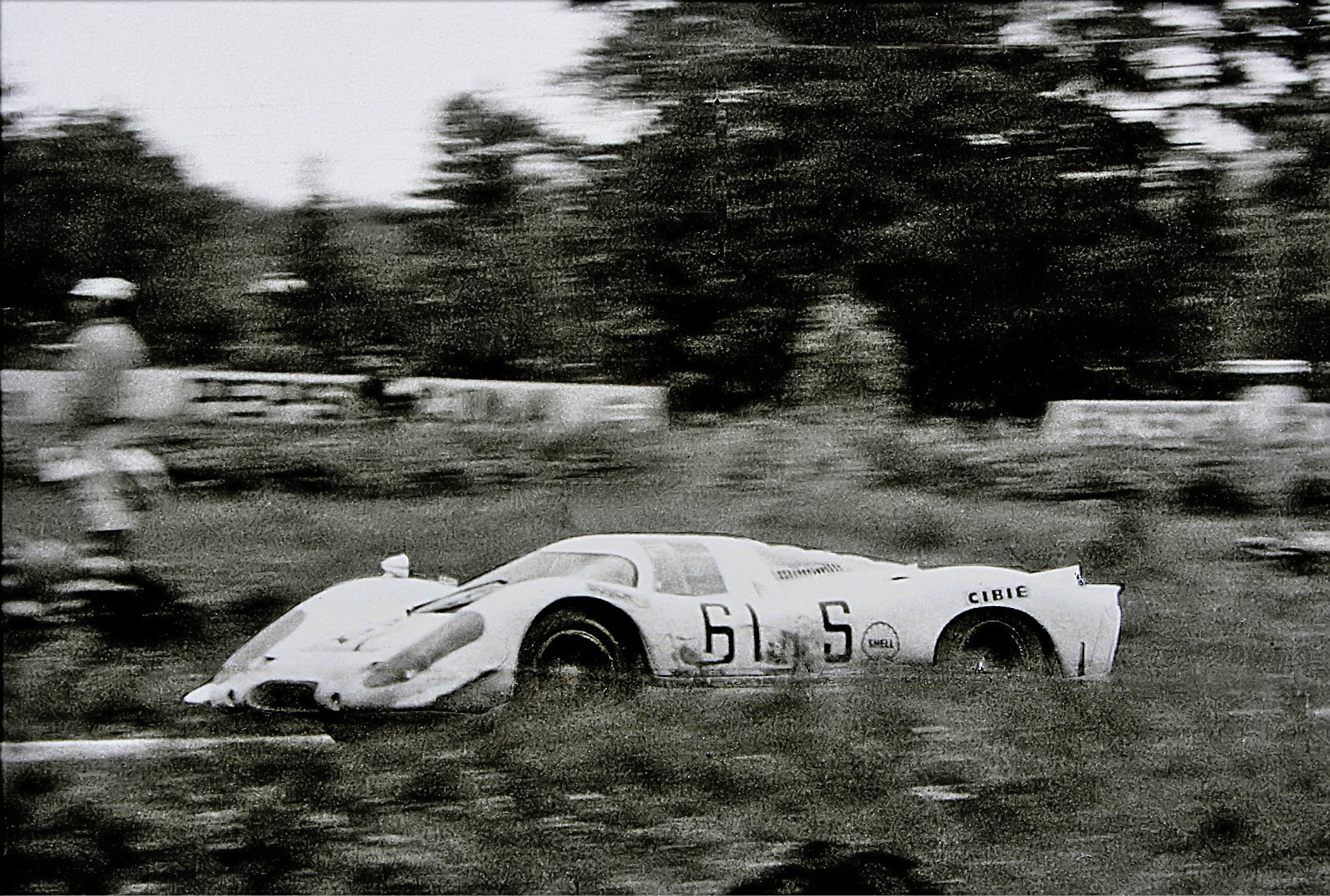
Porsche 917
"I mean, the 917 being outlawed in endurance racing is one that it's always been thought that the FIA being a French based organization... tended to favor the French teams."
The Porsche 917 is one of Porsche’s most famous race cars from the 1970s. The hosts are talking about how racing rules changed in a way that affected whether it could keep racing in certain endurance categories.
The Porsche 917 is a legendary Group 6/Group 4 era endurance prototype built for races like Le Mans. In this segment, it’s discussed as being outlawed in endurance racing, which is a major rule-driven turning point in how Porsche’s program could compete.
FIA
"...it's always been thought that the FIA being a French based organization... And so when the FIA made the decision to outlaw what became group four, the five leader cars..."
The FIA is the organization that writes and enforces many of the rules for international auto racing. In this discussion, they’re being blamed (or questioned) for decisions that changed what certain race cars were allowed to do.
FIA stands for Fédération Internationale de l’Automobile, the governing body that sets many of the rules for international motorsport. Here it’s mentioned in the context of rule decisions that affected Porsche’s eligibility in endurance racing.
group four, the five leader cars
"And so when the FIA made the decision to outlaw what became group four, the five leader cars, that really what the French were doing is they were trying to favor Matra..."
In that era, racing was split into different rule categories. The hosts are talking about the top prototype categories (Group 4/5) and how rule changes made certain cars—like the Porsche 917—no longer eligible.
“Group four” and “Group five” were historic FIA prototype racing categories, and “leader cars” refers to the top-level prototypes that competed for overall wins. The hosts are saying FIA rule changes outlawed the type of cars Porsche had been running in those categories.
World Sports Car Championship
"The interesting thought experiment would be, okay, what if they hadn't been outlawed, and they continued racing in the World Sports Car Championship?"
This was a big international endurance racing series. The hosts are imagining what would have happened if Porsche’s 917 could have kept racing there instead of being banned by rule changes.
The World Sports Car Championship was a major international endurance racing series that ran prototypes and sports cars under FIA rules. The hosts use it as a thought experiment for how later Porsche 917 development might have performed if it hadn’t been outlawed.

LMP 2000
"Right, it is. True or false, Porsche thought about putting the V10 in the GT1, but the rules changed, so they just ended up using that to develop the LMP 2000."
LMP 2000 refers to a Le Mans Prototype class with a 2000cc displacement limit that emerged as rules evolved for endurance racing. The hosts connect it to Porsche’s V10 development path—suggesting the engine work was redirected from a GT1 idea into the LMP 2000 program.
V10
"True or false, Porsche thought about putting the V10 in the GT1, but the rules changed, so they just ended up using that to develop the LMP 2000."
A V10 is an engine with ten cylinders arranged in two sides that form a V shape. The hosts are talking about Porsche considering a V10 for one racing category, then switching plans when the rules changed.
A V10 is an engine configuration with ten cylinders arranged in a “V” shape (typically two banks of five). Here, the hosts discuss whether Porsche considered using a V10 in the GT1 before rules changed and that V10 development was redirected toward the LMP 2000 program.

GT1
"Back up on that one. So the V10 in... They were going to use the V10 in the GT1. I don't know if this is true, but the rules changed..."
GT1 was a high-level racing class for race-prepped “grand touring” cars. The hosts are debating whether Porsche’s V10 idea was meant for GT1 before the rules pushed them in another direction.
GT1 is a top-level FIA GT racing category (grand touring cars) used for factory-style endurance competition. In this segment, Porsche’s potential use of a V10 in GT1 is discussed as a “what if” that may have been overtaken by rule changes.
mechanical problems
"But anyway, the point is that the car that Jurgen and Hurley are driving has had a bunch of mechanical problems. And at one point, there are 15 laps behind in 41st place."
“Mechanical problems” means the car isn’t working as it should. In a long race, that can be serious enough that the team has to change plans, like using a different car or driver.
In endurance racing, “mechanical problems” refers to faults that affect the car’s ability to run reliably—anything from engine or gearbox issues to cooling or other systems. These problems can force strategy changes like swapping drivers or switching to another car in the same team.
15 laps behind
"And at one point, there are 15 laps behind in 41st place. Now, you don't expect to pass 40 cars at Le Mans."
“15 laps behind” means the car is far back compared with the front of the race. In a long race, it can still recover if it keeps running without more breakdowns.
“15 laps behind” means the car has fallen significantly in the race order relative to the leaders, measured by completed laps. In endurance racing, being many laps down can still be survivable if the team can keep running and avoid further failures.
co-drivers
"And so this turns into X's greatest drive, in my opinion, because between roughly 830 at night and 9 o'clock or so the next morning, he does the equivalent of five Formula One Grand Prix races. Pretty much flat out as fast as he can go. And in that period of time, his co-drivers, I think Barth and Haywood only drive one shift each in that span of time."
In long races, more than one driver shares the car. They swap in and out so the car stays fast and the drivers don’t get too tired.
In endurance racing, co-drivers are additional drivers who share driving duties with the primary driver. Because races last many hours, teams rotate drivers to manage fatigue and maintain consistent lap times.
Formula One Grand Prix
"because between roughly 830 at night and 9 o'clock or so the next morning, he does the equivalent of five Formula One Grand Prix races. Pretty much flat out as fast as he can go."
A Formula One Grand Prix is a major race in Formula One. Here it’s used as a comparison to show the driver was pushing extremely hard for a very long stretch of time.
A Formula One Grand Prix is a top-level single-race event in Formula One, typically run over a fixed distance or time. The speaker uses it as a comparison to describe how intense the driver’s stint was—“five” F1 races worth of effort in a short window.
white smoke
"he feels the engine start to tighten up and cloud of white smoke he can see behind them. Luckily, he's able at that part of the track, he's able to get it into the pits."
White smoke usually means something is going wrong in the engine. In this case, it shows up right when the car starts having trouble, and the team later finds out a piston was damaged.
White smoke in a race car is often a sign of a serious engine issue, such as coolant or oil getting where it shouldn’t. Here, the smoke appears right as the engine starts acting up, and the team later identifies a piston failure.
engine start to tighten up
"He was supposed to finish the race, but with about 45 minutes left to go, he's coming through the Porsche curves and he feels the engine start to tighten up and cloud of white smoke he can see behind them."
When the driver says the engine “tighten[s] up,” they mean it suddenly feels like it’s not running freely. In a race, that can be a warning that something inside the engine is failing.
“Tighten up” is a driver description for an engine that suddenly feels like it’s restricting—often a sign of internal mechanical trouble. In endurance racing, that kind of change can quickly lead to visible symptoms like smoke and forced pit stops.
pits
"Luckily, he's able at that part of the track, he's able to get it into the pits. You know, if that had happened somewhere else on the track..."
“Pits” are where the race car pulls in to get help from the team. In long races, teams use the pits for repairs and to keep the car running.
The “pits” are the pit lane and service area where race teams stop the car for refueling, repairs, tire changes, and driver changes. In endurance racing, pit stops are also where teams can perform quick fixes to keep the car running.
burned a piston
"they realize, you know, that they burned a piston. And so they scramble and try to figure out, can we can we run it on five cylinders?"
A “burned piston” means the piston inside the engine got damaged from extreme heat. That’s serious enough that the team has to change how the engine runs to try to finish the race.
A “burned piston” means the piston face has overheated or been damaged severely, often from loss of cooling, detonation/overheating, or lubrication problems. In endurance racing, it’s a critical failure that can force the team into emergency strategies to keep the car running.
run it on five cylinders
"And so they scramble and try to figure out, can we can we run it on five cylinders? And so eventually they set it up to run on five cylinders."
If one cylinder is damaged, the team may shut it down and run the engine on fewer cylinders. It’s a way to keep the car going long enough to finish or get classified.
Running an engine on fewer cylinders than normal is an emergency “limp” strategy to keep the car moving when one cylinder (or piston) has failed. By disabling the bad cylinder, teams can reduce stress and sometimes still complete enough distance to be classified.
qualifying time
"And one more thing, those last two laps had to be within a certain amount of their qualifying time. They couldn't just putt around."
Qualifying time is the time the car sets in the qualifying session. The rules here use that number as a benchmark, so teams can’t just drive super slowly at the end and still be considered to have finished properly.
In endurance racing, “qualifying time” is the lap time a car sets during the qualifying session to determine starting position or eligibility. Some race rules require late stints to be completed within a percentage of that qualifying performance, preventing teams from coasting slowly just to stay in the race.
checkered flag
"So that's why he had to go around twice so that the very last lap to take the checkered flag would be within the timing rules of how slow your last lap could be."
The checkered flag is the signal that a race is over. The host is talking about rules that affect whether your last lap counts based on timing.
The checkered flag is the signal given at the end of a race to indicate the winner and the official finish. In the transcript, it’s tied to timing rules about how slow a last lap can be to still be classified as finishing within the rules.
Martini
"Well, I mean, Martini, the Martini logo, the Martini colors and the Martini logo live on. It's a popular logo and a popular color scheme."
Martini is a brand that sponsored race cars and is famous for a recognizable logo and color scheme. The host is pointing out that those colors aren’t unique to one specific Porsche.
Martini is a consumer brand best known in motorsport for its distinctive blue-and-red racing livery. In this episode, the host says the Martini logo and colors show up on multiple cars, not just the Porsche 936.
air box
"So aesthetically, yeah, the 936, although the 936 with the big air box is kind of unique looking."
An air box is part of the engine’s air intake system. The host is saying the Porsche 936 has a big one, which helps make it look unique.
An air box is an intake air chamber used to feed an engine, often to help manage airflow and improve consistency. The host notes the Porsche 936’s “big air box” as part of what makes its appearance distinctive.

Porsche 917K
"But yeah, it's hard to compete with a 917K when we're talking about the aesthetics."
The Porsche 917K is one of Porsche’s most famous old race cars, strongly tied to endurance racing. In this conversation, it’s basically the “looks the best” reference point.
The Porsche 917K is a legendary 1960s endurance-racing prototype, especially associated with Le Mans success. Here it’s used as the aesthetic benchmark—when the host says it’s “hard to compete” with the 917K, they’re comparing how iconic the car looks versus other Porsche racers.

Porsche 963
"For Porsche? ... you know, the 963 may, may end up not winning Le Mans. ... The 963 is sitting there in the unenviable position of having been a very successful car in many ways, but it might end up without a Le Mans victory"
The Porsche 963 is Porsche’s current-generation top endurance race car. The host is saying it’s already done well, but the big question is whether it can win Le Mans—because that single result affects how people judge its place in Porsche history.
The Porsche 963 is Porsche’s modern Le Mans–class prototype built for top-level endurance racing. The host argues it’s in a tough spot: it’s been very successful, but if it doesn’t win Le Mans, it could be seen as a “downgrade” in Porsche’s historical record compared with predecessors that won.

Porsche 919
"And so it's going to be, you know, when you think of its predecessors, 917, 936, 956, GT1, 919, you know, they all won the 24 hours of Le Mans."
The Porsche 919 is another Porsche race car that’s known for doing well at Le Mans. The host lists it to emphasize how often Porsche’s top prototypes have actually won the race.
The Porsche 919 is a modern-era Le Mans prototype associated with Porsche’s recent endurance dominance. Here it’s mentioned as part of a lineage of Porsche cars that “all won” the 24 Hours of Le Mans, setting expectations for the 963.

Porsche 804
"We could talk about the 804, you know, Porsche's only real Formula One car, only 11 race. ... The 804 makes the most ungodly screaming noise."
The Porsche 804 is an early Porsche race car that competed in Formula One. The host says it didn’t get great results back then, but it’s famous for sounding incredibly intense when it runs.
The Porsche 804 is an early Porsche Formula One car from the early 1960s. The host notes it was Porsche’s “only real Formula One car” and that it had limited results in period, but it’s still memorable—especially for the extreme, high-pitched sound it makes when running.
Request an Explanation
Heard something you'd like explained? We'll add it to this episode.
Sign in to request explanations for terms you heard.
Want to learn more?
Browse our glossary for plain-English explanations of automotive terms, jargon, and concepts.
Help improve this episode
See something that's not quite right? Our annotations are AI-generated and can sometimes miss the mark. Click the flag icon on any annotation to suggest a correction.