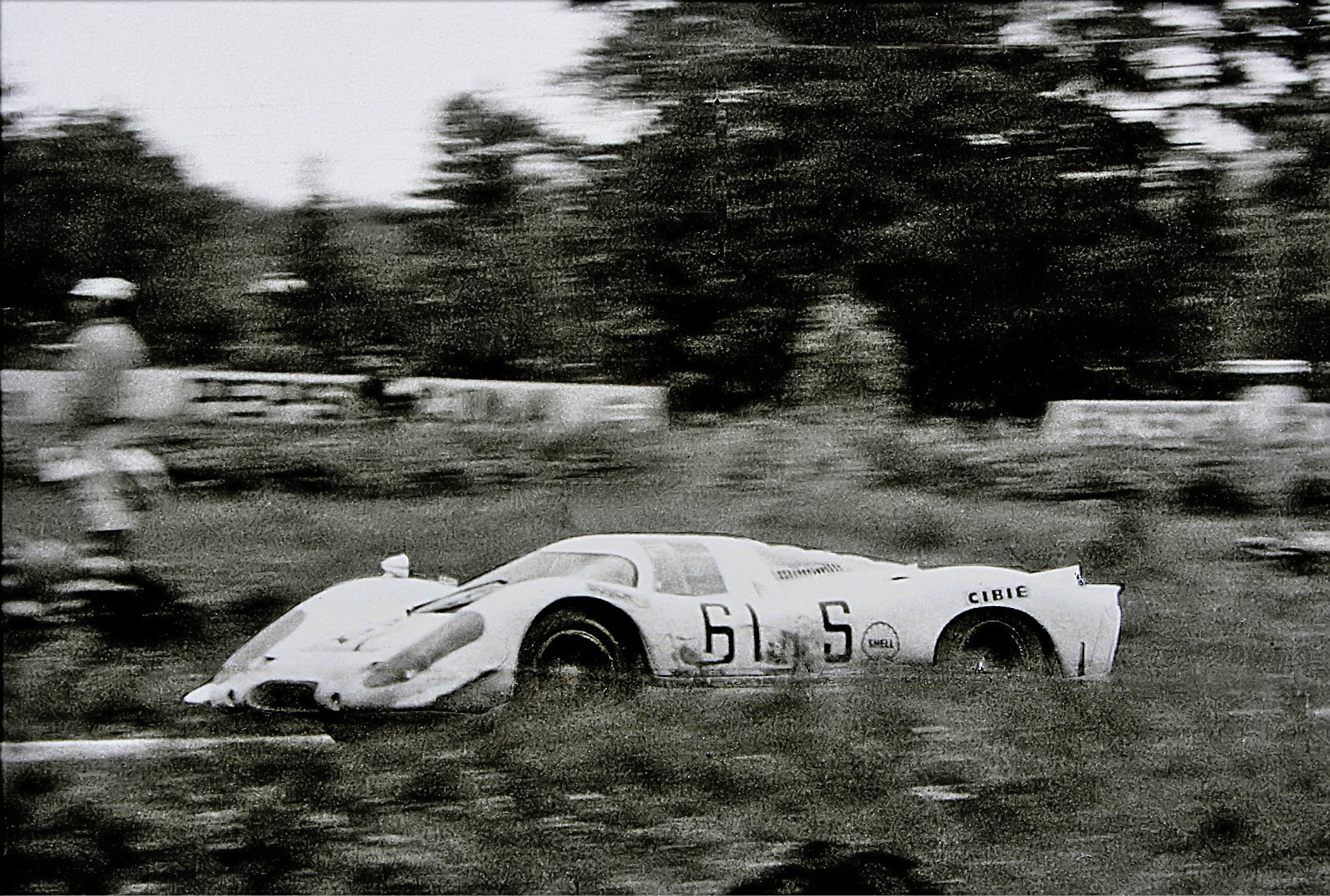
The Porsche 917 is a legendary Porsche race car from the late 1960s/early 1970s. People love it because it was built to win endurance races and it helped make Porsche famous in racing.
The host discusses a key concern in car culture: people driving irresponsibly on public streets (speeding, reckless behavior) rather than taking those risks to a controlled environment. The takeaway is that safer street behavior helps protect both people and the broader reputation of the community.
“Going viral” means a video or story gets shared a lot online very quickly. They’re worried that a single bad incident could spread and make people judge the whole community.
The Porsche 936 is a famous Porsche race car from the 1970s. It was made for long-distance racing, and it’s remembered as one of Porsche’s most important competition cars.
Term
Secret Spider
“Secret Spider” is a nickname tied to Porsche racing history. It refers to a specific behind-the-scenes project connected to the 936 story.
John Horseman was an engineer in racing. In this conversation, he’s described as a chief engineer working under John Weier, and he’s also associated with a book about racing in tough conditions.
John Weier is mentioned as the person John Horseman worked under on a racing team. The episode also connects him to a racing book that came out around the time the speaker was in college.
Topic
Rentsport Union
Rentsport Union is an event that’s mainly focused on Porsche racing history. It’s a place for fans to learn about and celebrate where Porsche’s racing story came from.
Ferdinand Porsche was the key engineer behind the Porsche company. People talk about him because his ideas helped shape how Porsche built cars and race cars.
Person
Jackie X
The speaker mentions “Jackie X” as someone they’d interview, but they don’t say who that is in the clip. There isn’t enough information here to confidently identify the real person.
“Porsche Decades” is a Porsche history book that’s meant to be easier to start with. The idea is that it helps new people learn the basics before getting into more detailed books.
A “rabbit hole” is when a conversation gets so detailed that you end up going off in a direction you didn’t plan. The point here is that Porsche discussions can get too niche for newcomers.
PCA is the Porsche Club of America. It’s a group for Porsche fans, and the discussion here is about how club talk can get so detailed that newer people sometimes feel left out.
A “deep dive” means going really far into details. Here, it’s contrasted with a simpler starter book that helps new people get into Porsche history before reading the super detailed stuff.
LIVE
Welcome to Porsche Patter with Bracken Helms, the show where we hear Bracken and his distinguished
guests from the Porsche community patter on about Porsches and all things automotive.
Porsche Patter is sponsored by Circuits Explore.
Circuits Explore creates authentic automotive apparel made for life-minded automotive enthusiasts.
The links for Circuits Explore are in the shown notes.
Okay, let's get to it.
Jay Gelotti, part 7.
Alright, this is the last one with Jay, but unfortunately I've got some pretty bad news.
A guy that kind of became my friend over the last couple years.
Dick Barber has died.
I do want to throw out a date.
November 11th, 2021.
That is the first day I contacted Dick.
I mean, we had mutual friends and I called like we should do an interview.
I've done interviews with these people and super nice over the phone.
Yeah, we should get it done like in the next couple weeks.
As soon as you're ready, like get your questions ready.
That interview never happened.
I mean, a lot of it has to do with stuff I can't talk about.
I mean, I guess I should be a little bit upset that we never were able to get it together.
We got close.
Like one time we were like 30 minutes, the zoom call was all set up.
You know, I'd already tuned in, I'd already got ready.
I was just waiting for him and all of a sudden my phone rings and he's like, oh, I got an emergency.
I can't do it.
I mean, we were talking like once a week at one point, just like, oh, yeah, you know, let me know.
Like, you know, and then I even set him out like a headset.
Like, I don't know how good the audio is on your side.
So like I bought him a headset and he's and I send it out to him and he's like, oh, I could have bought the headset.
And I'm like, no, it's fine.
He's like, well, you know, maybe I can send you some merch.
I'm like, great, because I know he has merch because, you know, our mutual friend says he like goes around and buys like all the stuff that like his dick barber oriented, you know, different parts where he was having different issues.
You know, we weren't talking, but like maybe every two months or something.
And so I am going to miss some of those talks because he was a talker and it was fun to like learn information.
And I really think it would have been like a really good interview because we have mutual friends.
Like I knew the background a little bit, but more than anything, like we talk so much that like it would have been probably a friendly interview.
I mean, a lot of these interviews is kind of a cold call.
I mean, I'm talking to him beforehand, but it's kind of a cold call.
We get to know each other through the interview.
This I already got to know him.
So I would pretty much be comfortable for the past six months.
Maybe it's been less.
I've been talking to his son because I was entered into his phone.
So when I was calling his phone to like, you know, like I always do to check in, my name was popping up.
So it didn't look like it was just spam.
And finally he called me back and he's like, um, my name's such and such stick barbers my dad and you've been calling his phone.
So then I've started talking to a son, you know, when he's been telling me like what's been going on and, you know, it looks like, oh, it looks like things are getting better.
Oh, no, they took a turn for the worse.
Now they're this, you know, now they're that.
And so like it's been kind of up and down.
So it's it wasn't really shocking to hear of his passing.
I mean, just a month ago, it was at Laguna Seca for the impsa race and they were doing the, what do they call it, flashback or whatever.
I don't know, whatever term they use where they, you know, they're bringing back old liveries to put on the cars.
You know, so Porsche did the apple and apple comes from Bob Garrett's and Slash Dick Barber.
And so they did have the original 935 there with the apple livery on it.
So I took some videos and some pictures and sent it to his son.
And his son texted me back and said, oh, I showed it to him and it made him smile.
So that's good.
But anyway, rest in peace, Dick Barber.
I may do like a pattering on, you know how I do the pattering on with my dad and pattering on with Bill Patton, like those filler episodes.
I may do one of those with Dick Barber because there was times where we were talking all the time on the phone and I asked, well, can I just record this conversation?
It might help with my notes when I do the interview questions, even though they were kind of already written for the most part.
And he said, yeah, yeah, yeah.
So I do have some phone call of us.
Okay, one of the things I want to talk about in this episode that I'm about to put up is he says, people should learn how to drive on a track before they go acting crazy out on the streets.
And at first I'm like, I agree, sounds good.
But then I start thinking, well, it depends on who you're asking.
Like I know when I go to easy, Jim does not stand for people acting like fools.
I mean, you can accelerate out of easy or whatever.
But if you start doing crazy things like he's not going to put up with it, he's going to put a stop to it.
And I agree, like these adults should not be like getting in their cars and doing stupid things that make it so we can't have our car vents.
But then the other part of me says, well, not everybody has money to go to a track.
I mean, I remember when I was younger, you know, that was back when like, you know, Fast and the Furious and, you know, all these kids with like, whether we had a fast car or a slow car, like you could have an economy car with like an exhaust tip on it.
Everybody was drag racing.
And so like I said, I'm from Utah.
And so they have a drag strip called Rocky Mountain Raceway Armour.
And so they opened it up.
What was it?
Every other Friday night.
And you could just go up there and drag race.
I don't even think you had to pay money.
And, you know, they put it, they made it cool.
Like they had music playing, like most of the people were in the stands, but then, you know, the people were racing their cars and it was just kids off the street.
They could just do it and it was all sanctioned and everything.
And so I think that was really smart.
And I'm old and out of touch.
So I see these side shows going on.
And I think these are just awful.
Like there's people getting shot at.
There's bad things that are happening.
If I can stop being an old man for five minutes, I think about like when I was young, like when I went to RMR, like it was crazy.
Like I went there like drinking sometimes and stuff like it was fun.
It was like a party.
And so like these side shows, yeah, whenever you get a big group of people together, it doesn't matter whether it's like the high school football games where you got rivalry teams and like people want to fight.
And, you know, there's testosterone, there's ego, there's hormones because there's also women around.
Of course, that's going on to the side show.
Of course, things are not going to go smoothly.
Anytime you get kids with their brain that's not developed, act in macho, that's going to happen.
If you don't like side shows, then the city should do something about it and do something like they did with us at the drag strip.
And another thing, it kind of has to relate to my question.
Are we really seeing the best drivers?
Because are we just seeing the richest people they can afford to race?
But you got to be rich.
You got to have talent.
And now there's even a new aspect to it.
Okay, you got to be marketable, meaning you got to be kind of obnoxious and stuff.
Of course.
Oh, why does this person act obnoxious?
That's exactly what these people want now because that's marketable.
They're going to make money.
So go out there and say stupid shit.
Oh, but if you're poor and obnoxious, run in your mouth about how good you are doing a side show that all of a sudden, oh, those are bad people.
Let's say someone's into cars like all of us that are listening to this podcast right now.
But you don't have any money.
You can't go to a race school.
You can't go buy some fancy car and hang out at a cars and coffee, really.
You can either go to like a little car show that you and your buddies hold like in a Walmart parking lot or you can do side shows.
Do I like that they go and flip donuts and cause traffic to stop and there's violence sometimes involved?
No, I don't like any of that.
But I'm old.
And when I take my old hat off and I think for a minute, I'm just like, okay, I'd have been doing the same thing when I was a kid.
And pretty much everybody listened into this would too.
I do have a problem with some of these influencers.
Oh, I'm famous on TikTok because I have a fancy car.
So I'm going to go ask the ligerant stupid like they know better.
They could go to driving school.
I think that's more ridiculous than someone just sitting in the intersection doing donuts, stopping traffic.
Anyway, here's the last Jajaladi part seven.
Okay.
Favorite time period that's well that's Porsche related.
Favorite time period at Porsche.
Well, again, I have to go back, I think to my 917 era just because that's the era that really speaks to me and kind of captures my imagination.
I think Porsche was doing some interesting things with their street cars at that same time.
And obviously the racing program was huge.
So I think I'd go without late 60s, early 70s time period just as certainly my favorite as far as to learn about and research, which I've done a lot of over the years.
What do you find troublesome in the car community today?
Not much.
I mean, the car community is pretty good.
I think it's pretty healthy.
The thing that immediately comes to mind is people not driving responsibly on the street.
So people driving too fast or doing things in an irresponsible manner on the street is probably the first thing that really concerns me.
If you want to drive fast, get on the track and learn how to drive.
That's what I think people should do if I'm allowed to preach for a minute.
Otherwise, I think things are pretty good.
I mean, I think people are friendly and nice and respectful and interested.
And like I said, I just would like to see people, to the extent that's possible, be safe on the street.
And the thing that always worries me a little bit, in the Porsche Club, we are put a very high emphasis on safety, as I'm sure you know.
Because all it takes is one really bad incident.
That colors the perception of the community and the brand outside of the car culture, and we don't want that to happen.
We talk about things going viral, and that's what we don't want to have happen.
That's really about it.
Yeah, our local event here in the Seattle area that I go to, which is exotics at Redmond Town Center, tries to police that as best they can.
You can get banned from the event, and I think that's totally reasonable.
In our case, Redmond Town Center is a large outdoor mall, and they are giving us the privilege of using their space to have a car show every week, basically.
We don't want to screw that up.
And if there was one bad incident, that'll be the end.
Because the property owners will say, well, that's it.
Your whole event is banned.
Um, favorite auto publication.
Well, again, I'm biased because I write for the Porsche Club magazine, the Panorama.
I have a very high opinion of that magazine.
I also like Forza, the Ferrari magazine, quite a lot.
I have written a few stories for Forza.
And Sports Car Market.
I think Keith Martin and his team do a tremendous job.
Even though I'm not really in the market to buy and sell, I still read my Sports Car Market.
Those are my three, for sure.
Oh, I was going to ask you.
You said look out for May Panorama.
Is that just a story that you like, or is that a story that you wrote?
Well, it's a story that I wrote on the 50th for the 936.
And it's slightly embarrassing because there's so much of me in there.
Because it's the cover story.
I also wrote the backstory page.
I'm on the starting grid page.
So it's like too much me in there.
But I hope people will really enjoy what we've done on the 936.
Hopefully it'll cause them to want to buy my book later on this year.
But if they don't buy my book and read it, this will give them a good idea of at least how the 936 program got started.
And a little bit about the success of our Secret Spider, as we call it.
What's your favorite car book, automotive book?
My favorite car book.
That's actually a really tough question.
I mentioned John Horseman.
He was the chief engineer for the golf racing team working under John Weier.
And his book called Racing in the Rain is quite good.
John Weier's book, which is called The Certain Sound, that came out when I was in college.
So when some of my college friends were spending a lot of money buying beer, you know, I spent my money buying car books.
So if you want to do deep dives on Porsche, you really need to look at Carl Ludwigson's catalog.
Excellence was expected, of course.
Most people know about that.
But he's written numerous other really good, really important books that relate in some way to Porsche.
So those are the ones that kind of come to mind.
Brian Redman's book is great.
Derek Bell's, you know, two great books.
Hurley's book is really good.
So yeah, there's a lot out there.
Yeah.
Thoughts on Rentsport Union?
Remember, that event started and continues to really mainly be focused on Porsche's racing heritage.
So if you're interested in Porsche's racing heritage, it's like heaven on earth.
I did go to Rentsport One at Lime Rock because I'm from Connecticut originally.
So I made a visit to see the family and my dad and I went up and we were there for Rentsport One.
It's amazing to see what it's grown into.
But yeah, I'm mostly positive on Rentsport.
I have almost nothing negative to say.
Thoughts on Lüftekult?
I haven't meant to Lüft yet.
And so it's something I need to do, but I'm sure I would enjoy it.
Yeah.
Most exciting person you've ever met?
In your opinion.
I have to say my friend Brian Redmond.
So I met him at Le Mans in 1985.
And it's one of those sort of life changing moments because I was there at Scrutineering.
You know, Le Mans, they do Scrutineering in the little park next to the cathedral.
At least they did at that time.
And it was getting late in the day and Brian was driving for Jaguar at the time.
And so the Jaguars were going through Scrutineering, Group 44 Jaguars.
And you know, Brian's standing there like 10 feet away from me.
And I'm just 21 year old kid, right?
You know, you have that moment of like, okay, am I going to pretend he's not standing right there?
Or am I going to go up and introduce myself?
Well, thank God I got up the courage to introduce myself to him.
And you know, we've stayed acquainted now for here.
Here we are 41 years later.
We're still acquaintances and I've done some events with them.
I think that would be the one.
And as far as the car world is concerned, that'd be the one I'd have to say.
Yeah.
What's the hardest part about writing?
What has been the hardest part of writing any of your books?
Um, hmm.
Borscht Decades was difficult because it's a sheer volume of research that I had to do.
I'm not that great of a reader.
But what I mean by that is when I'm doing a lot of reading, I get very relaxed and I tend to fall asleep.
And that's hard when you're doing research because you got to read a lot.
But I've been fortunate.
The book projects I've worked on have been very joyful.
I've learned a lot.
I had a lot to learn when I started, but really haven't had like huge problems or frustrations.
There's always little things, but I've really had good support from all the people I've worked with and a lot of good luck.
How do you feel with our hobby on the environment?
Well, I think the car hobby has a very small impact on the environment in the sense that we're not driving lots and lots of miles.
So the carbon footprint of the car hobby is fairly small.
I'd love to see us have a good way to offset that even for our collector cars and our car hobby cars that we ride around in.
I'm disappointed that California didn't pass Leno's law.
Maybe they will in the future because I think this second one's got a little bit more steam.
So maybe I hope so.
I mean, the logic of it is so obvious.
The economic benefit of the collector car hobby to me far outweighs any potential environmental concern.
Now, that's not to say that I'm not concerned about the environment.
I am very concerned about the environment in the large picture.
I'm not nearly as concerned if we bring it down to the car hobby level.
What part of your discovering finding stuff for your books are you most proud of or you find most intriguing?
Wow.
Again, that's a tough one.
I didn't think I was a very good networker when I started, but it turned out that I'm better than I thought.
I was able to get to a lot of the people with firsthand experience.
The networking part of it, I was a little bit afraid that I wasn't going to be any good at it.
Okay.
What else in your life do you find exciting or what excites you?
Well, my other sort of application or hobby is music.
I'm a singer, songwriter, guitar player, have been for basically since I was in about the 10th grade.
We're coming on 45 plus years.
I've been playing the guitar and writing songs and singing and doing all that stuff.
I think there's five of my CDs that are on Spotify and on YouTube.
So you can check me out there if you want to hear what I've done.
Is this under your name?
Yep. This is under my name.
And as I said, for the most part, most of the records I put out have been me playing all the instruments and then myself and my vocal coach do all the vocals and the vocal recording.
The last record we put out, I use a professional drummer, which was a really smart decision.
So that last record sounds way better with a real drummer instead of me trying to play the drums or using drum machines.
But I don't spend as much time on it now as I used to.
But over the years, I've spent a lot of time on and I'm a huge music fan in general.
Like what types of music?
All kinds.
You know, growing up in the 70s, we had all kinds of music on the radio at all times.
But over the years, I've been interested in everything from German electronic music to soundtrack music to rock music, pop music, folk music.
So I've kind of put a toe in the water of a lot of different kinds of music.
The music I make is sort of what we use to call album-oriented rock, which is what I grew up listening to.
That's kind of what it's rooted in and the Beatles.
Kind of like I'm a 917 superfan. I'm also a Beatles superfan.
Okay. Yeah, I was going to ask you about music, but I was hoping I could get it out through that question rather than kind of drink it.
I almost enjoy talking music more than I enjoy talking cars, if you can believe that.
If you could interview one person, who would it be?
Is it somebody who still has to be alive today?
No, let's just get crazy with it.
Yeah. You know, Ferdinand Porsche would be up there because there's so much we could find out historically and just...
Someone who's alive today would be maybe Jackie X, although I suspect he'd be tough interview.
He doesn't seem to like very much talking about the past.
He's very much a present and future guy. That's just the way he is.
But I certainly would have a lot of questions for him.
And another one on the list, not alive today, would be John Weier himself.
Because there's tons of gulf-related questions. I'd love to ask John Weier on things that he didn't put in his book.
And so that's another name I'd throw out.
What about on the music side?
Oh, the music side. Oh, my God. I mean, that's pretty much an endless list.
But probably number one, I think would have to be Paul McCartney for a whole variety of reasons.
There's so many technical questions I would like to ask him that he never gets to talk about in general interviews.
And his career has been so long and so varied.
There's so much I would like to ask him about a million things.
I think Paul would be number one on that list.
I think Bob Dylan would be on that list, except he probably wouldn't answer any of the questions.
And the Porsche Decades, it's still available. I know the 917 you can't buy.
You can buy it on eBay. It's sold out from the publisher, but Porsche Decades is still available.
I think it'd be so valuable for more of my Porsche Club people to have a look at that particular book.
Yeah, I agree. I mean, it's nice to just get the vast timeline without having to like...
Because like us, we can get crazy. We can start just blurting out crazy things and go down some rabbit hole.
And someone that's not super aware is going to be like, what the fuck are you guys talking? I'm lost.
I guess I'll walk away.
We in PCA sometimes get a reputation for not being welcoming to the new people.
And I don't agree with that. I think we are welcoming.
However, unintentionally, I think we sometimes do what you just talked about,
which is we start going down the rabbit hole and we're speaking a different language.
The new people or the newer people who just don't know all this history don't feel welcome
because they feel a little bit excluded from that conversation.
So very clearly, my goal with Porsche Decades was to give people an opportunity
to join the conversation with a relatively small, relatively easy book to read.
And then depending on what you're interested in, you branch out to all the other,
particularly the deep dive books.
Because virtually everything that comes out on Porsche now is a deep dive.
It's like my first book on the Golf 917.
Yeah, I mean, it's all different people's perspective.
Because with you, with PCA, I feel like it's way welcoming.
But I've had someone recently tell me they're a PCA member and I told them to come to Easy
and they're like, oh, I'm not doing that again.
I just felt like I was not part of the club.
And to me, Easy was fine and I'm super shy.
I know you've seen me at the Lit Show where I've got to turn it on.
But if I'm the new guy, I'm quiet until I feel like I've got somewhere a little bit.
You can't expect the whole PCA experience to be handed to you on a silver platter.
That's not going to happen.
That's pretty much it.
Any other crazy or exciting stories you haven't told me or want to tell me?
No, we got to a lot of great questions.
You asked really good questions.
So I think we're in good shape.
And I'll let you know for sure when the new book comes out.
So at least you have that information.
I'm hoping for June for Le Mans season, but we'll see if that actually happens.
We can get together again for our next episode.
Now get out there and enjoy the cars and the people.
About this episode
The hosts close out Jay Gillotti Part 7 with personal updates and a deep dive into Porsche culture. They discuss Dick Barber’s passing and why “That interview never happened.” The conversation ranges from Apple-liveried 935 history at Laguna Seca to advice on learning track driving before “acting crazy out on the streets.” They also debate influencer-era incentives, the car hobby’s environmental tradeoffs, and how approachable books can help newcomers feel welcome in PCA.
Jay Gillotti has written very well know books such as Gulf 917 and Porsche Decades. This year a new book he is writing is coming out about the Porsche 936. He has also written articles for 000, Panorama, Forza, Vintage Motorsports, International Motor Racing Research Center, Collier AutoMedia and Wayne Carini's The Chase. He was also contributed to other automotive books like A French Kiss with Death, 1982 and Daring Drivers, Deadly Tracks. He has helped out at events like Pebble Beach Concours D'Elegance and moderated many Porsche Events people like Brian Redman, John Horsman, Vic Elford, Derek Bell, Hurley Haywood among others.
In this episode we talk about: -Favorite time period of Porsches. -What he finds troublesome in the car community. -Hardest part of writing his books. -Automotive hobby on environment. -What else excites him outside of cars.