Link ECU makes the computer that controls the engine. In rallying, that computer can be tuned to help the car make power reliably on rough gravel stages.
Launch control helps the car get moving quickly and consistently from a stop. It manages the engine so you don’t spin the wheels or lose momentum at the start.
Your engine computer uses charts to decide how much fuel to add and when to ignite it. If those charts can be changed, the car can be tuned to run better for the specific rally conditions.
A power stage is a special rally stage where drivers can earn extra championship points based on their performance. It’s typically broadcast and treated as a high-stakes, high-pressure segment late in the event.
Concept
WC Finland
WC Finland means a big rally event in Finland that’s part of a world championship. The host wants to show people what it’s like if they’ve never been to one.
Behind the scenes means what happens off the track—like how the team prepares the car and plans between runs. It helps explain why rallies involve so many people working together.
Drifting is a driving style where the car intentionally oversteers and slides through corners while maintaining control and speed. In a series context, “drifting cars” implies the show will cover cars and setups tuned for sustained wheel slip and steering angle control.
A co-driver (often called a navigator) reads pace notes to the driver during rally stages. The co-driver’s timing and accuracy are critical because the driver relies on those notes to attack corners at speed safely.
They’re talking about assembling the engine for racing, not just buying a car and driving it. The point is that rally success depends on careful mechanical work before the event.
They’re describing driving on ice, where the tires can’t grip like they do on dry roads. That means you have to be gentler with steering and the gas/brakes so the car doesn’t lose control.
They’re saying that if you’re not already part of the rally scene, you might not know how it all works. They want to explain the people and process behind the sport.
“Grassroots” just means the rally scene starts locally, with regular people and smaller events—not only the big pro teams. They’re trying to show what it takes behind the scenes before you ever see the cars racing on TV.
“F cup” is described as a legendary Finnish rally series. The hosts frame it as a key part of Finland’s rally ecosystem, including notable figures and cars, and they connect it to the driver’s own start in rallying.
Toyota is discussed as the manufacturer the team is working with, and the hosts compare Toyota’s competitiveness to other brands in the World Championship. In rally, manufacturer support and car development strongly influence pace and reliability.
A puncture is when a tire gets damaged and loses air. In rally, that can slow you down a lot or even force you to stop, so avoiding punctures helps you finish strong.
Concept
WC
“WC” means the World Championship—the main rally competition. They’re saying the fight for podiums depends on how competitive the cars are across the season.
They’re talking about upcoming rule changes for the rally series. When the rules change, teams often have to redesign their cars, and that can change who’s fastest.
Hyundai is another rally manufacturer they’re comparing against Toyota and the top teams. They’re saying Hyundai seems slower right now, which makes the competition look less close.
M Sport is a rally team that builds and runs cars for big rally events. When they’re doing well, the team feels confident; when results slip, it can affect morale.
In rallying, results affect how a team feels day to day. When you’re not winning, people can get tense or less confident, which can make it harder to perform well.
Skoda is a car brand that has competed in rally racing. The speaker is saying that even when they were with Skoda and doing well, it was still hard to imagine what it’s like to not be winning.
Ford is a well-known rally brand with a long history in motorsport. The speaker is basically saying Ford’s situation isn’t as bleak as it used to be, even if things aren’t perfect.
Brand
Terry Neville
Terry Neville is a rally-related personality the hosts know well. They’re using his body language as a clue that the situation in the sport—or for a team—feels unusually tough.
Rally roads can have rocks in awkward spots. If you hit one, you can lose time immediately and it may also make the car feel “off” afterward, which makes driving harder.
Rally cars don’t race on the whole route at once. They race against the clock on closed sections called stages, and each stage time adds up to decide the winner.
A rally is made of timed sections called stages. The last stage is the final one, so if something goes wrong there, it can ruin your result because there’s no time left to make up the loss.
Concept
PR enemies
The host is talking about why brands care about results beyond just winning. Good performances help the team look good to fans and sponsors, which can influence how much support the manufacturer gives.
This is a common rally principle: minor errors—like misjudging a bump, braking point, or line—can lead to major outcomes because stages are fast and surfaces are unpredictable. In rally, the margin for error is tiny, so small mistakes can quickly snowball into loss of time or crashes.
Drivers don’t just race to win one event—they also earn “points” for their position. Sometimes it’s smarter to aim for a safe second place to keep collecting points toward the championship.
A “small bump jump” describes hitting a crest or bump that launches the car slightly. In rally, misjudging how much the car will jump can upset suspension geometry, traction on landing, and steering control—often leading to a loss of time or a crash.
“Speed factor” here refers to how fast a driver is across stages—essentially their pace relative to the field. The hosts are discussing whether the driver can maintain a “reasonable” pace for all events without pushing so hard that it leads to mistakes or crashes.
A “zero” is when you don’t earn any points from an event. If you have a couple of those in a season, you usually need other drivers to mess up or you’ll struggle to win the championship.
It means you don’t always drive as hard as possible. Sometimes you drive smart—aiming for a safe result—so you keep earning points and don’t risk ruining your season.
Sometimes the best strategy is to consistently finish near the front, like on the podium. That can earn enough points to win the championship even if you don’t win every event.
A “championship contender” is someone who has a real shot at winning the overall season. It’s not only about one good rally—your results have to be strong and consistent.
“Tricky” conditions in rally usually means changing grip (rain, loose gravel, cold tires, or uneven surfaces) that makes braking, throttle, and car balance harder to manage. Drivers who consistently adapt in these moments tend to protect their overall pace and championship chances.
Rally events are split into multiple timed stages, and losing time on even a couple of stages can swing the overall result. The speaker’s point is that if pace drops for a short stretch, it can be enough to cost the win or championship momentum.
The transcript suggests a strategy of maximizing performance on a subset of stages (e.g., three or four) to build enough time advantage. In rally, stage-by-stage timing is crucial—winning often comes from stacking strong runs where you can gain the most.
Topic
100 acre wood in Missouri
They mention an event in Missouri (“100 acre wood”) as the earlier experience. It’s used as the baseline to compare how the next rally felt and how the event was organized.
They’re talking about a specific rally called the Olympus Rally. They compare it to another rally in Missouri and talk about how well the event is run and what it’s like for the team.
Rally “stages” are the timed parts of the route. When the stages are well managed, it usually means the schedule and logistics are organized so drivers and teams can focus on driving and setup instead of dealing with chaos.
The “championship” is discussed as a broader competitive structure beyond a single rally, influencing how teams plan development and logistics across multiple events. The hosts highlight that the championship has lots to do, but the events themselves have been well run.
They’re saying they’re making small improvements after learning from experience. In rally, even minor tweaks to how the car is set up and how the team works can make a big difference over a whole event.
Running “two cars” means the team is operating more than one rally entry at the same event, which increases coordination demands. It affects how engineers and mechanics divide attention, how data and setup decisions are shared, and how service timing is managed.
Rally races are split into timed sections called stages. “Stage one” is the first timed section, and it’s where teams quickly figure out how the road feels and how the car is running.
A “target time” is the time a team hopes the car will achieve on a stage. It helps the driver go fast enough to score, but not so fast that they make mistakes.
A “new event” means the rally route is unfamiliar. If you don’t know the roads yet, it’s normal to feel nervous until you learn how much grip you have.
Concept
new continent
“New continent” is basically saying the rally is happening in a different part of the world. Different places can mean different road conditions and weather, which can affect how the car feels and how you drive.
Topic
ARA
ARA is the rally organization/series being discussed. The hosts are talking about how fans experience it—like events, professionalism, and whether it gets broadcast.
Rally tires wear out as you drive hard on rough roads. “Tire strategy” means planning which tires to use and when, plus making sure you have enough spare tires so you don’t get stuck later.
“Technical issues” are mechanical or systems problems that can affect reliability, pace, or stage completion. When the speaker says there were “zero technical issues,” they’re emphasizing how trouble-free the car was over the event.
When a rally team gets a new car, they usually adjust it a bit to make it work best for the roads and conditions. Even if nothing is broken, they may still change small settings to improve how it drives.
“Visibility” means how much people can actually see the event and hear about it. It’s about whether rally gets noticed through coverage and promotion.
Concept
parquet expose
This sounds like a public car display area where fans can get close to the rally cars. It helps people feel connected to the event, not just watch from far away.
“Broadcasting the message” refers to how effectively an event communicates its presence and story to a wider audience through media and coverage. The speaker’s point—there’s “no broadcast”—highlights a gap between on-site fan experience and wider visibility.
“Live feed” just means you can watch what’s happening in real time. Instead of only seeing results later, you get video or updates as the rally is going on.
NAP is mentioned as a production company involved with rally TV coverage. The host is saying they’ve made a simpler version of that streaming setup for lower-level championships.
They mean the TV broadcast can show live race information directly on the screen while the video is playing. In rally, that helps you follow who’s faster and how the standings change during each stage.
They’re talking about streaming rally live using cell networks. If people can watch from home (not just via radio), it’s much easier for more fans to get into the sport.
They’re suggesting using satellite internet if cell service doesn’t work in certain areas. That could let rally broadcasts stream live even from remote roads.
They’re talking about whether rally can catch on in the U.S. The main point is that people need to be able to watch it easily and understand what rally drivers and co-drivers do.
Rally stages are the timed sections of the route. Getting people to watch them is hard because organizers often restrict where fans can go, so the show needs smart spectator areas to make it easier to attend.
Spectator culture is basically how fans in a country or community like to watch races. In rally, it can mean people scout good spots ahead of time and go to watch in groups.
Topic
paid vs restricted access to spectate
Some rally events let you watch only from specific spots, and you can’t just go anywhere along the road. That makes it harder to find good viewing places and can change how many spectators show up.
They’re talking about setting up special fan areas with services like bathrooms, food, and places to watch, plus buses from town. Then you charge for entry so the event can make money while fans have a better experience.
The Toyota Supra is a sports car made by Toyota. It’s designed to be fast and fun to drive, and people often talk about it when discussing car upgrades. In the podcast, it’s likely mentioned because it’s a well-known performance model.
Himmosh is discussed as a spectator-friendly location because it’s a skiing center, making it easier to gather people and support additional activities. The hosts also mention overnight stays and local lodging options, which matters for event planning.
Pace notes are like a detailed “road map” for the next few seconds of the stage. The co-driver tells the driver what the road is about to do so the driver can react quickly and confidently.
“Flat out” means you’re pushing the car as hard as it can go. On rough rally roads, that’s not just about speed—it also affects how the car behaves over jumps.
Concept
WC-Castage
This sounds like a specific kind of rally stage format. The point being made is that stage design and length can change how big and exciting the jumps feel.
Concept
Rally 2
“Rally 2” is a rally competition rule/format that allows certain drivers to re-start after retiring (typically after an accident or mechanical issue), subject to conditions. The transcript uses it to argue that modern rally schedules can include longer segments than in the past, affecting how spectacular jumps are.
Concept
Kakaristo junction
A junction is a specific spot on the route where the road changes direction or merges. In rally, these are often dramatic places—especially with big crowds—so they can feel unforgettable.
They’re talking about a rally in the Canary Islands and how dominant the driver was there. The conversation is using that event as a reference point for how the driving style worked on those roads. It’s basically “here’s why this rally was a good match for his approach.”
Sometimes the perfect path through a corner doesn’t work in the moment. Instead of insisting on the same line, the driver adjusts and tries to keep speed up. It’s basically reacting to what the road and grip are doing right then.
Tires work best when they’re at the right temperature. If you push too hard, they can overheat and lose grip. Good drivers keep the tires in their “sweet spot” by being smooth and consistent.
Shakedown is like a pre-race practice day. Drivers and teams try out the car and learn the route so they’re ready for the real timed stages. If you’re fast in shakedown, it usually means you’ve got a good setup and you understand the roads.
The hosts describe a common motorsport reality: teams often spend the early part of a season learning what the car needs. As they gather data and adjust setup, performance can improve later—sometimes too late to fully capitalize on results.
Term
circuit background
A driver’s “circuit background” refers to experience racing on closed tracks, which can translate into smoother braking, throttle control, and line selection. In rally, that skill can help on faster, more predictable sections—especially tarmac—though rally still demands adaptation to changing surfaces.
Tarmac means paved roads. Rally on tarmac feels different from gravel, so the car and tyres are often set up to work best on asphalt.
Term
herniated disc
A herniated disc is a back problem where a spinal cushion slips and presses on a nerve. It can be painful and make it hard to sit comfortably or stay active.
Term
sciatic nerve
The sciatic nerve is a big nerve that goes from your lower back down your leg. If it gets irritated, it can cause pain that makes everyday movement—like sitting—really tough.
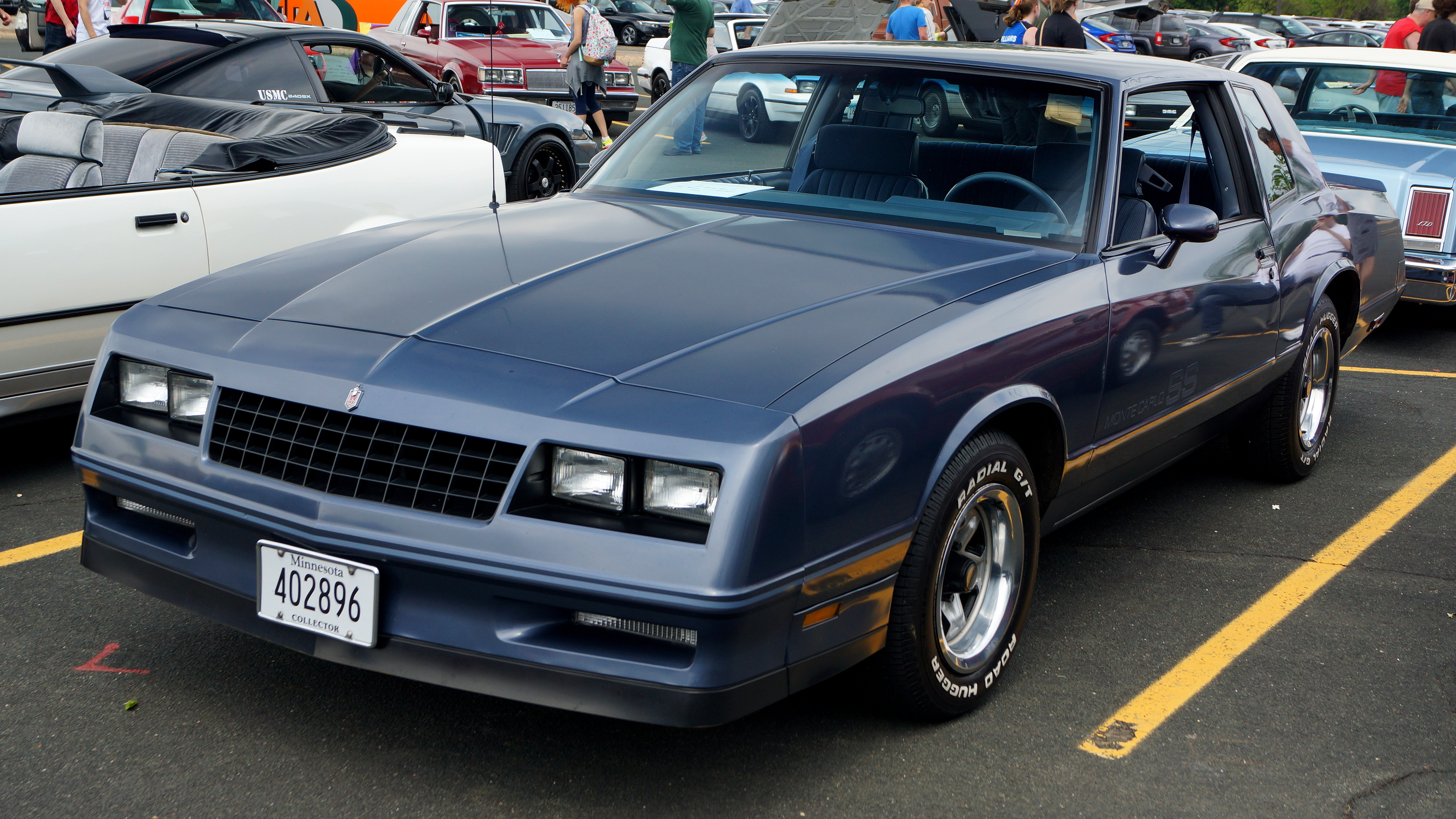
The Chevrolet Monte Carlo is a car model made by Chevrolet. It’s known for its classic look and was popular as a comfortable, stylish car with performance options. The podcast likely brings it up because it’s a familiar car name from the past.
“Sweden” likely refers to a rally event in Sweden (commonly the Arctic/Swedish rally calendar). The speaker groups it with Monte Carlo as another event potentially missed due to injury and recovery.
“Base notes” refers to the rally pace notes system drivers use to anticipate turns, hazards, and braking points. If the notes are “lost” or disrupted (for example, due to damage or interference), the driver’s ability to navigate accurately can drop sharply.
When someone says they’re “on the limiter,” it means the engine is revving as high as it’s allowed to. In rally terms, you’re basically using the car at its hardest while still trying to keep control over rough terrain.
Concept
car flows for the next jump
“The car flows” is rally shorthand for the suspension and chassis absorbing a landing and keeping the car stable over successive impacts. It implies the suspension is working in a controlled way so the driver can maintain speed and traction after each bump.
LIVE
This podcast is brought to you in association with Link ECU.
Link ECU supplies specialist performance ECUs designed for Subaru's enrallying.
They provide advanced tunability with fully adjustable fuel and ignition maps, launch control and anti-lag optimised for gravel stages.
The closed-loop boost control is designed for maximum power with consistency
and Link ECUs allow for flat-shifting, maintaining boost through gear changes.
The ECUs are built for reliability in the harshest conditions Motorsport presents,
with sending heat, dust and vibrations encountered in rallying.
The bottom line is Link ECUs give Subaru rally drivers the power, the control and the confidence needed
to push the limits while maintaining reliability and ease of use.
Link ECUs banged from his second American adventure at the Olympus rally where he guided Toyota to a 1-2
for Yeremeti and Seth Kintero and he's already working on his own TV show.
Jonny Heltonen, welcome back to Spin the Rally pod.
Thank you, it's always nice to be here.
I think we might, well, not everybody says that and that's a very nice thing to say, thank you very much for that.
We've peaked interest, I think, immediately and we must jump straight to the TV show.
Tell us a little bit, what's going on? Are you now a Finnish TV star?
Not that you weren't already, of course.
Yeah, well, it's totally new. Let's say something that I haven't done before.
I'm also the producer of the whole series, so that's a big thing.
So we are doing 10 episodes in the Finnish main channel, it's called MTV3.
So it will be aired always just prior to the power stage broadcast.
So in Finland we are showing power stage in our main channel on Sundays.
So my episode is coming always the first time, it's coming like 30 minutes or one hour before power stage.
So it's basically one big show for motorsports.
The first episode came out last Sunday, so two days ago and already the amount of viewers was like almost three times what we were expecting, which is good.
And quite rarely like 2pm on Sunday people are watching TV.
So it's also in the broadcasting channels at the moment and we are also searching the possibilities because now it's in Finnish language,
but already in the second episode we will have Scott Martin on it.
But there's an option that we will put subtitles on it or even just dub it in English language for the future, but that's still something under the process.
It's so exciting, Jonny. It really is to see a new product like this coming in.
It's your show, isn't it? It's what you're up to, it's your reflections.
And essentially it's a great way to warm people up for the power stage.
Yeah, well in a way it's my show, but we are doing a bit different kind of show, so it's also quite a lot about the mechanics and all the people working around the car.
So actually they are almost the main characters as I am.
And in the first episodes how the series basically starts is Kalle calls me and he's asking like what I'm doing.
And then he puts me on a challenge that you should drive the rally car yourself because all the time during WCES you were always saying that if I would be here driving I would do this and this and that.
So he basically knows your chance and he calls to Juha Kankunen that you have to go to his driving academy and I'm like oh my god and I don't know what's going to happen.
And then I'm going to Juha Kankunen's driving academy and Juha actually is teaching me to drive.
And that's how it starts.
So we will basically it shows how difficult driving rally car actually is.
What it takes to not also as rally in general as motorsport what it actually takes like how much you have to have people around you how to get the final sale back up.
It shows the spectators on stages stuff like this.
But also during the year we'll have special episodes one episode will be from WC Finland because I want to show the people who maybe never has been in the WC event that what it actually is.
So we want to show the whole spectrum of the event.
So maybe we start by going as a spectator.
They will be something nice what I cannot say yet but they'll be some very very nice stuff during the event.
But I will also go to as you guys go behind the scenes discuss with drivers when they are having a break and and so on.
But we will also drive for drifting cars in the series rally cross cars also circuit cars.
And we will have some quite known people in the episodes episodes also.
So it's it's a mix of let's say my path from co-driver as a driver.
But everything has been it's a bit like humoristic.
Everything is made by a small smile.
So it's it's quite nice to spectate.
But there's also quite some drama in the first episodes because we end up breaking them in two days before the event.
So we show like how it actually happens when you build the engine like what kind of mechanics you need to have.
And it's to be honest I wasn't expecting the series to be that good that it actually is.
I have got like quite a lot of feedback and zero negative ones which is quite nice.
And just for random people.
Yeah no good for you.
And I think the key takeaway there is is you are thinking and is he is he still a good teacher.
Well yes.
And it's so nice like we're driving in ice like like in their driving school and I start driving and then he shows what I should do.
And then he gives me a small feedback or not to me he will give it to camera.
The other guys like it's quite a lot of fun.
And the reason why I wanted to do this because I got my profession from rallying.
But a lot of people have issues to like what the rally actually if you're outside let's say from the inner inner like a rally circle or racing circle.
You maybe don't know what they like a hobby actually is or how it works and what kind of people you need around you and who to know and so on.
So we try to show like from the grassroots level what it actually takes.
And the series what I'm driving is F cup and that's the let's say one of the most legendary series of Finland.
Actually we also have Mikko Hirvonen in the first event.
Yeah.
And he's commentating also about the series.
So the reason I want to go there because that's the place where I started back in 2007 rallying.
So I wanted to give something back so we will also show these guys who are doing that kind of series with the nice cars and and so on.
But we are doing the series all the time.
So the last episode will come same time than Saudi Arabia and we actually stopped filming just three weeks before that before Saudi.
So it's great.
It's it's it's very exciting.
Absolutely it is.
And I'm sure potentially there is going to be some American content in there.
As I said in the in the intro there you are just back from Washington.
And right now it's fair to say one two in Croatia one two in Washington one two three four in Canaries.
It's not a bad time to be working with Toyota is it.
Yes.
But also to be honest I'm a bit concerned.
OK what we did in USA it's a bit different.
That's that we had a nice driver and it was a long event and now guys were basically also the only ones without any issues.
So we didn't have any punctures.
Our drivers did well said especially Seth.
I'm proud of him because it was all only he's let's say second properly.
And he managed to do double the kind of event because like the length wise it was like a double event without an issue.
So I'm not worried about that.
But like in WC I'm like generally worried like if you are top three Toyota you can be in podium.
It's not the healthy as a long term.
But luckily 27 is coming with the new regulation.
So I think that will change.
I'm more a bit more worried like what is Hyundai doing.
Like not as a Toyota guy as a rally guy that because if you look at speed last year and speed this year they were slower compared to the top guys.
So that's worrying that you cannot do any progress during the year or actually the opposite.
It is a worrying time isn't it Johnny because you know we need competition.
We need strong competition.
Yes we've seen M Sport we've seen Armstrong and Josh was quicker in Canaries.
But yeah and it's difficult to know I was going to ask you as a working in a team what's it like when you know you are not winning.
But actually it's a difficult question for you to answer because you've never really.
To be honest we have been old like even when we were in Skoda because Skoda was doing very well in rally two or five at that time.
And in Toyota we have basically been winning almost all the time.
Yeah.
So in that sense it's hard to say.
I see from the phases of the drivers like the mentality of the other guys but not who are not in Toyota.
OK M Sport is positive in a way because for me they have been doing fairly well like especially John has been for me the start of the season.
Like OK there has been a lot of small mistakes but he's still like learning and trying to show that he belongs to the top tier which he actually does.
If you ask from me because with that level of experience what he has he's doing like a mega job at the moment.
So that's good.
So for me Ford is actually not in that bad condition.
They have been in the worst situation before.
But if I go into the mindset of let's say for more and theory you can see already they are not so happy only coming to the event for sure.
So also if you see their like comments from their management they are not like very positive ones.
And I just can feel that it's not so nice inside the team.
And if we think the sport as a whole it would be a bit nicer situation if everybody would be happy at least once in a while.
Not everybody can win but that would be tight the fight.
And that's also for the fans.
Yes.
Yeah. No it is.
It is a difficult difficult time.
And you know we've we've both known Terry Neville a very long time and I can't remember a time when Terry has looked almost kind of defeated before he's started.
And that was tough.
You know canaries was tough wasn't it.
Yeah.
That fight to have what happened.
It takes a while to get over that.
Yeah well I've been in a situation in Finland 24 when we crashed to the stone.
Basically it wasn't last days but it was close to a last day is 100 meters to the finish of the last stage.
OK we couldn't do anything then because it was just a rock in the wrong place.
But I think also you could see from the like if you go back in Croatia you could see the interviews just before the last days.
Terry was already at the mindset that we will just finish the stages and win the rally and you could see how important it was for them and for the team in general.
And what happened.
And it's a bit of a heart breaking and I think it was just not like lack of concentration but maybe not concentrated to driving enough because maybe he was already in the finish of the like a rally
and he just missed the place bit and wasn't his best in the moment.
So it's not nice.
And if we want to have more teams for the future let's say for any brand I think they would also want to have nice let's say PR enemies to show for the manufacturer and for the fans.
And now when Toyota is winning everybody by a mile it's not easy to be against them.
And to go to the meetings and say why we should do this.
Yeah.
Yeah.
No exactly.
It is tough.
All is is looking as we say all is rosy within Toyota.
But if there was not by any means an area of concern but Oliver Oliver Solberg two rallies two crashes.
That's not great is it for him you know his championship.
Now he's a little bit behind but also for building confidence he came in one month he was strong in Sweden was strong in Safari two tricky rallies for him.
No.
Actually if you go a bit back it's five events and five crashes but he just got the way off three of them.
That's very true.
That's the hard reality.
You always have to think a bit bit behind so he has crashed in every event what he has done.
Ultimate speed what he has it's it's something what Calle did something what Calle had.
He's for me he's the fastest guy in the champion.
OK.
Osir is Osir but he's not doing full campaign but as we saw last year it doesn't matter for him maybe.
But if you look the rest after Osir and even I would say in gravel and in general I think Oliver will be super quick.
He just has to analyze I guess he has already like why are these things happening like small small mistakes big consequences.
I think he maybe just pushes a bit too harsh hard because nobody's expecting him to win every event and he's saying like like the right words.
If I remember right he said like stage two before the like the last interview he said that he doesn't have to win the rally.
It's OK to be second just to get good points.
Yeah.
OK.
He maybe misjudged the small bump jump jump a bit too far and crashed but these things tend to happen.
If you think about last year in rally two he won everybody all the time.
So is this only that he's trying to find his place a bit like speed wise.
Like what is his speed factor.
What is the let's say reasonable speed that he can do all the events.
But for me if he even goes a bit slower he's still beating others.
So yeah in that sense I'm not too concerned about for sure the mentality is maybe not the greatest at this point.
But if you think about his career in general the future I see it as a quite bright one.
Yes.
Yeah.
No it's it's absolutely.
I would agree with that.
I think he does have a very bright fruit.
It's almost as though he's trying to grab it too quickly isn't it.
Yeah it will.
He's got.
Yeah yeah.
Like I don't know maybe maybe I'm biased to say this but for me it feels a bit like he's trying to do what Calle did.
Like immediately beat everybody and be there.
And I don't know why Calle could do it like he was quite.
Well he was just ready when he came to WC in a way.
I see also Oliver as ready.
But doing the championship you have to gain points all the time.
If you get even one or two zeros between like during the season it's quite tough to take these all of these points back
because then it's also starting to mean that others have to make mistakes or they have to cross in the results quite a lot.
So doing the title you have to pick your fights in a way like where you want to win.
And as we can see from Taka this year he's already won two events and maybe hasn't been the fastest on these events.
But anyway he has to to win this year.
So it's a bit of a chess and like planning like how how you approach because I also remember calling 22.
His aim was to win all the rallies he attended.
And okay he managed to do it quite well.
But in 23 he changed his approach a bit that he didn't want to or he didn't try to win all the events where he could that he felt it's okay.
He did it.
And if not he just aim for top three and that's actually the way how to win titles.
Yes.
Yeah.
No absolutely.
Taka is do we think Taka as a championship contender this year?
I would like to say yes.
But he still has like like now we saw in Canada he was lowest of Toyota's.
Yeah.
So you cannot be slowest of third if you want to go for the title.
Yeah.
So I wouldn't bet my money on it.
I would like to bet but I wouldn't bet my money on it and Taka still have.
I wouldn't say as a them as issues but especially when the conditions go tricky his piece tends to go down.
Yeah.
And there's quite a lot of these during the season when the conditions do go tricky.
And then the guys like Elfin, Kalle, Seb, Oliver these inside the team they have been like super fast then and maybe then even win the races.
So somehow Taka has to find if he takes let's say lows out from his like season then yes.
But for some time he just drops a bit too much down in the speed and even like it can be two stages from the whole rally.
But if you want to go for the wins you have to be in certain level all the time and actually just push to like three or four stages in the rally.
Make the great time and that's how it goes.
Yes.
Yeah.
Absolutely.
Now that's true.
So just let's go back to America and talk.
Olympus was your second event as project leader but essentially team principal, team manager of Toyota in America.
You did 100 acre wood in Missouri last month and Olympus this time.
This one was different.
You had Jerry Matty-Lavola alongside Seth Kintero.
How was it for you?
Olympus was quite a different event.
Tell us, Jonny, how did it feel in comparison to Missouri?
Well, first of all, I have to say from the two events we have now done, I'm positively surprised about if you think events and the championship itself, how the stages are managed, how the events are managed, I'm positively surprised.
I wasn't expecting them to be so well organized.
Like all the basic stones are quite well in there.
So that's nice.
And I like the championships.
There's a lot of stuff to do for sure but the events are quite nice for sure what I've seen now.
One of the acre was first event for the car, first for the team.
So there was a lot of things to learn like inside, let's say team, how we work.
I'm trying to bring like at the way how we work in WC, how we work because in general in Europe, the rallying is so much bigger.
So we've been fine tuning all the small details everywhere.
So this is something I'm trying to bring into the team like how we work in Europe.
Also, they have a lot of good ways to work.
So trying to help the guys to find the right combination.
Now coming into the second event, like in team wise, it was actually working quite well.
There wasn't a lot of actually no issues at all.
For sure, the first time we are having two cars, so how the engineers work together, how the mechanics.
It went well.
For sure, there's also some small details to fine tune, but it went well.
But it was nice to have Jare Mati there and trying to manage him in a way.
And he was fairly nervous in the start of the rally.
Like he was actually nervous and he even said it and you could see that he was bouncing everywhere.
It was a bit like in WC.
And he was even thinking how fast will the guys go.
And actually, Semenuc was pretty fast in stage one when the car was working.
But after that, the guys did a good job.
No need to say them actually anything.
I'm also surprised how major Seth is.
It was only his second event and he didn't do any mistakes.
He manages himself quite well.
He knows when and how to, okay, he knows that there's a lot of improvement to be done,
but he doesn't try to like, let's say take everything by one event.
He wants to go step by step and that's working well.
Only small minus was I tried to work as a team manager a bit in the last stage.
I gave Jare Mati a target time so we could get a bit more points to Seth.
But Jare Mati, he only missed it by eight seconds.
So he was only eight seconds faster than I asked him to be.
I was surprised, Jonny, when I was talking to Jare Mati at the start on the Friday,
he was genuinely saying how nervous he was and I couldn't really understand why.
And he said it's a new event.
Yeah, and it's a new continent.
And for sure, there was quite a lot of hype Jare Mati going in there
and I could see that he could feel it, that people were expecting him to be there.
For the Champions itself, it was good that he was there because we got quite like a...
A lot of people were talking about it, that Jare Mati is there already.
Also in Europe, I think rally fans in generally somehow know this more, ARA.
But when you went there, there was a long line of people wanting to have an autograph from him for sure.
That's something he's used to.
But I think he enjoyed the event as a whole.
And even last days, he was pushing quite a lot.
We were in quite safe strategy with the whole event, I mean with the tires and how many spares and so on.
But the last days, we gave him an option that you can drive a bit faster
but you have to come in a certain time.
So we could help our other driver a bit because he's doing the full championship.
But he was just so on it that he basically forgot the time.
But I like how into it he was.
He generally enjoyed the event and did well, no issues.
And also we can see from the car, it's only second event, one, two, zero technical issues.
Also car wise, always when you have a new car, there's something to do with it.
But not much, there's just something, some small stuff.
But it was a good event.
Yeah, absolutely.
Feelings, thoughts on ARA, as we said, you've seen two rounds now.
One of the aspects that we talked about a little bit you and I on the event was the visibility.
Yes, you know, the parquet expose was great.
Lots of fans, lots of spectators in Dirtfish's corner of America.
But in terms of actually broadcasting the message, is there enough being done from ARA?
Well, there's no broadcast.
So I think that already answers the question.
Yes, like I said, I like the events, I like how professional they are made.
Everything is actually done quite nicely.
But you can see somehow in some aspects that because they have been driving like in their own bubble in a way,
that they haven't been looking maybe so much what we do in Europe, like I mean in terms of visibility.
There's like some people like on the stages taking pictures and stuff like this.
But after that, it basically solely relies on results.
There's no stream or live feed or anything, which is now we are living in 2026.
And if you want to promote any brand or sorry, not any brand, any kind of motorsport or sport in general,
if you just show them like not for the people who were in the event, I guess it's a nice one.
That's done like super well.
But like if you want to see it from Europe, Asia, even from America, you get only the results.
And that's not enough.
Like now there's not totally not enough.
No, it's not.
And you were talking about, you know, F Cup in Finland.
That level has a solution.
So actually NAP, so the same company who was doing the TV for WRC, they have made, let's say, I don't know,
it is like a light version of all life, I would say maybe.
And we even have it in F Cup and in our national championship series.
And it's quite close to all life level.
So let's say 20 top cars have life feed from the car itself.
You can have your own link so you can team like my team when I'm driving.
They can follow me all the time life.
They like everything they can be seen live.
But that's normal as a private link.
But so then there's a produce show and there's two guys in the studio and then they're just speaking like what they show.
And you have interviews in the end of each stage.
Maybe each stage you have a few cameras like in the states.
And you will have the results on top of the image like basically like what you can have in WC.
And it's all done just by mobile network and it's inside Finland.
It's even raised the popularity of sport quite a bit because now you can watch from home even the lower level championship, which is nice.
You can see all the action and I think this is something like I remember when all life came to WC, it changed the sport quite a bit.
Then suddenly people can watch it from everywhere.
Before that there was basically the radio and the results.
But you have to be quite hardcore fan to follow sports like that.
So in USA the issue is sadly that there's no mobile network in the states is zero.
So it actually the same system what we have now in Europe that wouldn't work.
But I guess there's a ways to fix it like Starlink or whatever satellite connection.
I would even go in that kind of system.
Yeah, definitely.
It's something that is being investigated right now.
And like you say it, we need it to drive the sport forward in terms of the media exposure out of ARA.
WRC coming next year.
What are your thoughts is from what you've seen?
Yes, it's only two rallies and neither of them have been in Tennessee and Kentucky.
But the appetite is there for rallying in America.
Do you think is America ready for WRC?
Well, what ARA could help to do would be like to have some kind of broadcasting.
So people would know if you go to New York or California and you say,
if I would go and say I'm a rally driver or rally co-driver, they wouldn't even know what it means.
And that's the issue at the moment.
So you have to raise the popularity of the sport and the only way of doing it.
I would say it's from the national championship level.
Such a show life feed and so on.
But I'm pretty sure when the event goes there, in the US, the motorsport is still quite a big thing.
And I'm sure they would love it.
But just how to get the spectators into the stages, that's a tricky thing.
Like in my country, we have quite strong spectator culture.
I remember myself, if you went to see a rally in Finland, I would go to drive already some stages before the event.
Okay, this could be a nice corner or some of your friends could go there.
And then you know already the place or you can call to somebody who's more active.
Like, where should I go to spectate?
In US, they basically have only few areas where you can go and the rest is denied.
You cannot go, like, it's not free to spectate.
Maybe money wise is free, but you cannot just go wherever you want.
But I would fix it somehow, like, I would just make big place where you can watch the rally.
It's a bit similar what would like nice VIP would be, but not like VIP.
They would be toilets, they would be good food to eat, some drinks, maybe some stand where to watch the rally itself.
And there would be some kind of transportation from the town with the buses or something.
And there would be something else also, like during the day.
And for the WC events itself, I would do something like that and get money from the people.
So this spectator in place, I don't know whatever the price would be, but that would include the transportation.
And then they could buy food and drinks and stuff like that.
Then this is how you could even actually make it as a business.
But somebody would already, and this place should be something else than just a 90 degree junction.
It should be something, you know, fast, nice place or something you can see quite a lot.
Like if you think about Kakaristo junction in Onimpoe, that's the perfect example of a good place to spectate.
And it's like a festival in a way.
So in USA because they don't have the spectator in culture, they don't know where to go.
Like in Europe we have this, I guess everywhere in Europe we have this, but they don't.
So we need to help them and this would be something for sure.
They can be let's say these normal spectator in places where you can go with your own car and so on.
But I would still make these small festival kind of places for each day.
And they would be something that's actually nice to spectate.
Yeah, 100%. You've said the word there, Jonny Onimpoe.
I hate to get ahead of ourselves, but what are your thoughts?
It's this year we looked down the barrel of a secto rally Finland with no Onimpoe.
We're going to Himmosh for the power stage. What do you think?
Well, also Himmosh is a good place.
I'm a bit going the same, because you can do the same thing what we have in Kakarisadjantse.
Because in Himmosh nowadays it's a big, it's a skiing center.
So it's easy to gather all the people there.
So I think for the organizer itself it's actually quite a good place to do it.
You can do quite a lot of other activity for the spectators.
People can stay there for the night. There's a lot of kodices.
Actually there's now two hotels.
Okay, we lose Onimpoe, but it's also nice sometimes that even it's the gem of Finland in a way.
But if you have it each year, it's maybe also losing its legendary status.
So it's nice if it goes off for a while and then comes back.
And also in rally in general, I think we should shuffle stages a bit more.
Like even in Portugal, a few times you go there, you have just the same notes.
So then it's going more like circuitry and drivers are just watching all the stages from last year.
And it's losing some kind of the difficultness of the event.
Like when you go for the new stages, you always see a lot of action, a lot of gaps in speed.
But when you are doing the same stages year by year, they tend to be quite tight.
Yeah, I totally can see that perspective that it is good to change things up a little bit.
And I hate, you know, I continually bang on about Onimpoe.
But just tell me, what is it like? What's that feeling like, Jonny?
When you read that note that you know is going to take you past that yellow house and into that huge jump.
Is it just another three or four lines of pace notes and you just got your head down and you ignore?
Or can you feel something different in the car?
For sure. There are like three places, like one of the yellow house jumps.
But sadly nowadays cars, they have such a good aero.
So even if you go flat out, you don't jump so much.
If you think back like super 3000 times and these WC-Castage jumps quite long
and even Rally 2 costs some longer than WC-Castage nowadays.
So it's not so spectacular-wise than maybe it used to be.
But you just know that there's a lot of people and you know what you'll bring to them.
But maybe the biggest feeling is coming to the Kakaristo junction.
Because you can actually hear all the crowded people and you can just see everybody like they are so hyped.
Like especially last year when we won the event and it was the last event and Finnish is just after the junction.
That's something, even it gives me a chills like now, but it's something you'll remember like the rest of your life.
Yeah, and as a co-driver coming into that hairpin right, you have time just to look up, don't you?
Yeah, so hi everybody.
Exactly. Now that obviously Finland last year was a huge success for you and Calle as was Canaries.
And I meant to touch on this earlier.
What do you think it was in Canaries last year that you led from the start and you and Calle dominated a lot of rallies.
But I can't remember one that you dominated quite as comprehensively as Canaries last year.
Estonia 23 or something when we won two days all the stages, bit similar.
But I would say that kind of stages actually suit Calle quite well.
Like his driving style in general.
Like his driving style is a bit racy.
Like if you look to set up what he has, he benefits from that kind of stages.
But also he did a lot of this pause stuff just the year before.
So you could see that he learned something from there.
Like I remember him saying something like sometimes when he felt that he cannot take the line that he was taking.
He was thinking to take normally he would force the car to go in.
But he actually improvised more and just tried to carry on more speed and maybe open the line a bit.
He was doing like stuff differently he was doing before.
More driving the car as like a circuit car than a rally car.
And he was committed quite a bit but he felt good with it.
And also he managed the tyre quite well because in circuit racing I think it's mostly about like how you can control the tyre and the heat of the tyre.
You have to be super gentle you cannot push it like a lot so you have to be gentle.
And I think that was something he was doing because I remember last year we won all the first run of shakedown by few seconds.
Second run by few seconds and we stopped that.
All the rest of the people still were driving and Carlos said I'm fine.
And we were the first car to leave. We just did two runs and out.
And then the whole event it was like a fairy tale.
It was so so so easy for him.
But I remember at power stage there was quite nasty downhill where you go almost on the limiter and small corners.
And that needs quite big corners to do it and he surely has.
And it was funny because we were fighting so much with the car for the whole first part of the season.
Because he just couldn't find the right combination with the car and the tyre.
We found it sadly in the later part of the season but that was maybe already a bit too late.
I think it generally suited and also this year I would say Kalle would have won the event.
Because I was now looking at the times and he was so much faster than everybody else last year.
I honestly think that this would have happened this year also.
But I would say the circuit background helps him a bit on that.
Absolutely.
We talked a little bit about Kalle there.
Obviously Kalle has paused his racing program for this year.
You're in touch with him regularly.
I would just like to say that please pass on all of our best wishes to Kalle for his recovery.
And dare I say a swift recovery for yourself as well.
It's fair to say if you and Kalle were competing now you would be in some pain or some difficulty right now?
If we would have continued this year I'm sure that I would have missed the both Tarmac events.
Because of this I just got an email same time.
So I couldn't have competed so I just have a herniated disc on my back.
I'm actually doing a recorded TikTok of it each day.
So I got a herniated disc and basically it was so big that it was pressing my sciatic nerve all the time.
So some mornings it can take up to 15 minutes just to put on the socks and shoes.
Some mornings it's almost impossible to do it.
And it just got worse and worse by time.
And I couldn't sleep.
I slept like three hours per night for two months already.
But I got the surgery last Wednesday and it went super well.
All the pain basically stayed on the table.
But for sure I have an issue on my back now.
So no I don't mean issue but like this injury in the wound in my back.
So it takes from now let's say three weeks.
I have to still go a bit slow but after that it should be all good.
Actually it's already now all good.
I can drive car do more normal stuff but just have to take it easy because the risk that it basically comes back is highest for the first few weeks.
If I would like bend too much or do something like that that could do it again.
So I just have to take it easy.
And I don't know was it a luck or what happened because I never even like I haven't skipped one event during my career by any kind of illness.
And actually I also broke my wrist in end of December.
And that has to I have I went through surgery on that.
And I'm pretty sure I would have missed also Monte Carlo because I couldn't even hold a pen at that time.
Sweden already.
But Monte would be or maybe with some huge pain killers that would have been an option.
But so I have gone through two surgeries in four and a half months.
So has been a tough year to turn 40.
Absolutely.
But the main thing you only know is that the pain has gone a little bit and you are sleeping for more than three hours.
Last night 12 and a half hours so I'm sleeping.
But many people have asked where the pain game and I want to be honest because I was already honest during the event.
It's a Paraguay rally last year stage one.
That's the same stage.
If you remember Eon Tracy lost the base notes because they were hitting.
So basically it was just and I told to the organizers before the event that this is a back breaker.
This event will be a back breaker.
But I didn't know that it's my back which will be the broken one because I started to get the pains immediately after it.
But they they like gradual like each month got worse and worse and worse.
And I felt like we won the first days by a few seconds with Khaled because we were flat out over.
It was basically like you go almost on the limiter from bump to another bump.
So you hit like this and then the car flows for the next jump.
And we won the stage first time by a few seconds and also seconds time time was quite good.
But it was just a silly because for me it wasn't like a rally stage.
They were unnatural stupid bumps.
And I told to the organizers before the event about that.
And I don't like that we have them because OK I was sure that this somebody will break it back and it was now me.
But yeah sometimes people would have a bit more common sense when making the stages that is it rallying or are we driving a Dakar kind of stuff with the rally car.
So yeah but I remember because already the next event I was complaining to our physio about it.
And then it just got gradually worse and worse and worse and worse.
And I went to MRI in February.
Yes well you are on the mend which is which is great news.
And when do we see you back in the driving seat.
When are you when's your next finish F cup championship.
Well this was the first thing I call I call to the doctor before having it.
I asked it like in six week of the surgery I have to be already on the rally itself to drive.
And I have to test the car before.
So the first event of the Finnish championship will be on first week of June.
Sorry not Finnish champions F cups F cup championship.
And so yeah that's the next rally.
But for sure we'll do one test day or two and I try to get Kalle to give me some tips as lead if he's in Finland at that time.
Have you have you ever driven in anger the rally one car or a world rally car.
Not on stage.
For sure I do quite a lot of this license but never on stage.
Rally two I've done a tarmac a bit but never also on a gravel stage.
But I have to say like I wouldn't have thought how cool and how nice is the driving.
And I don't even actually understand why it's I feel it's so nice because last event was like I don't know five six weeks ago in Finland the last winter event.
And I was I was on tears in the end of the last days.
I was so happy and it felt so nice and maybe it's because I've done rolling so long time that but it was very very very emotional.
And I was like I want to drive again for the next day.
And on these days you quite rarely get like that kind of feeling that you would like to do something again.
Like I want to do it now again.
And it's like a small child the feeling.
Yeah. But I think as well the car that you drive the Corolla that you drive it's that kind of car it rewards you doesn't it when you push on a bit it gives back to you.
Whereas rally one cars are so intense and so demanding.
Yeah. Yeah for sure.
And this is funny because that car is like how would I say it's an it looks like an old spec car but it's basically like a rally two.
Okay it's a really drive car.
But everything all the mechanical side it's like almost rally two spec all the bumpers are carbon fiber.
Everything is like best what you can buy for money.
So when you go into stages and like even I had a 10 was on my to drive the many many times Finnish championship.
Like with Skoda to drive the car and he like I have to buy this kind of car for myself.
He was like this is so cool.
And yeah but it is it's it's rewarding and.
For sure my goal is not to be like a champion or the fastest guy guy in there but it's us to have fun and be on my own level.
Which is I don't know what my own level be but I'm just happy to chase that.
Yeah. No absolutely.
Well final question as we as we come to an end here.
Obviously we are looking at Portugal next week.
What do you think?
Is there anything that you on a game we talked at the top of the show about high and high difficulties.
Can we expect anything more from them on gravel.
Do you think there seems to be a bit more a bit more optimism from from the high and high drivers.
But what do you think.
Yes I'm pretty sure they will do better because already coming into in the canaries they also said that this will be their worst event of event of the season.
And if you think later part of the season they were doing better like during the season.
So I'm not that concerned plus Toyota has not the best starting position so if it's not going to be rainy Portugal it can be rainy because it's close to the sea.
But if it's a dry event the guys will suffer a bit.
Not the worst event you can even still win it by first place but I for sure think they will be more competition.
But also we have Osir in the good starting position so he will be the benchmark for me.
It's very difficult to see that somebody will will be the Osir in Portugal from that starting position if he doesn't make any mistakes.
But for sure they are fighting for the second and third place.
Yeah absolutely but we know as much as we all look forward to Portugal and to the power stage next week the main action is on MTV 3 the hour before the power stage where it'll be episode 2 of your show.
We look forward to it.
Yes and I will try to get some kind of version for you at least to see with the subtitles so you see what we are doing.
Absolutely definitely looking forward to that.
Jonny as ever it's a huge pleasure to have you and hope that the back continues to improve and come back and talk to us again soon.
Will do thank you for the interview and have a nice day.
About this episode
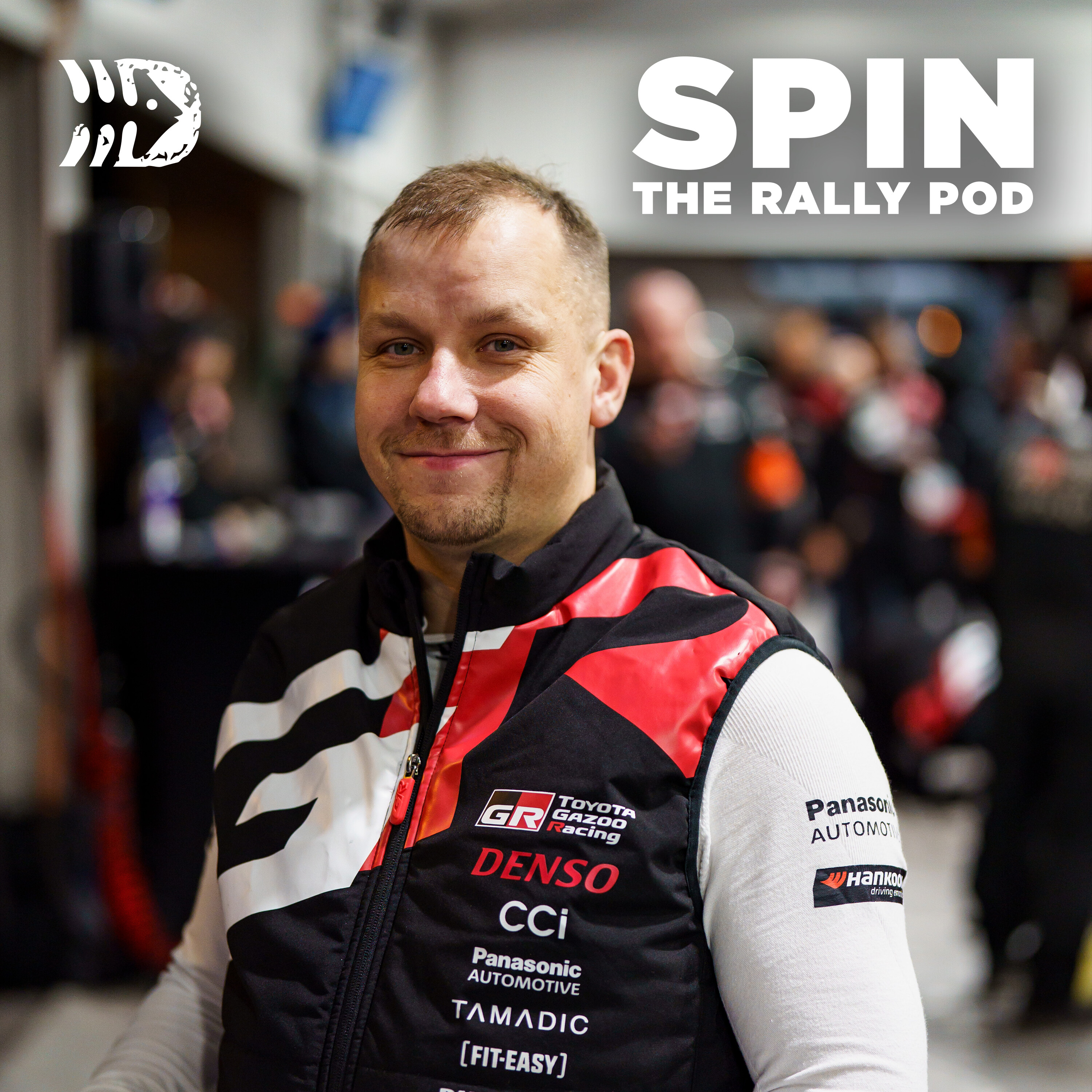
Jonne Halttunen talks about his new Finnish TV series, which he also produces, and how it aims to show rallying from the grassroots up, including mechanics, spectators, and different categories of cars. He also breaks down Toyota’s recent form in WRC and the pressure on rivals, especially Hyundai and M-Sport. The conversation shifts to his second U.S. rally event with Toyota, the organization of ARA, the lack of broadcast coverage, and what America would need to build rallying’s profile.
Two-time World Rally champion Jonne Halttunen checks in with David Evans on SPIN, The Rally Pod this week, discussing last week's Rally Islas Canarias, the recent Olympus Rally, the surgery he's had to have after Rally Paraguay and his TV project in Finland.