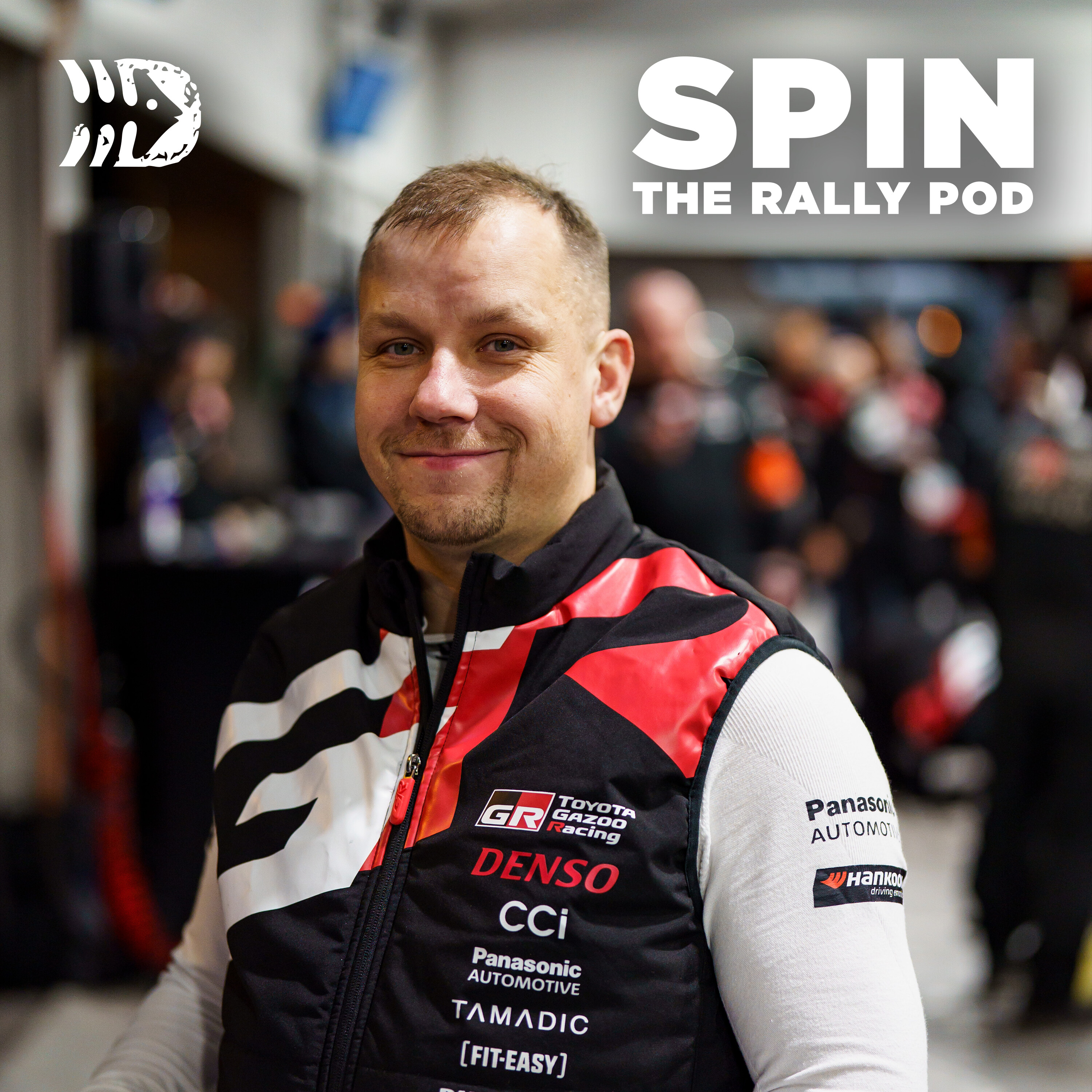
Jonne Halttunen: Rally Islas Canarias & Olympus Rally analysis
About this episode
Jonne Halttunen talks about his new Finnish TV series, which he also produces, and how it aims to show rallying from the grassroots up, including mechanics, spectators, and different categories of cars. He also breaks down Toyota’s recent form in WRC and the pressure on rivals, especially Hyundai and M-Sport. The conversation shifts to his second U.S. rally event with Toyota, the organization of ARA, the lack of broadcast coverage, and what America would need to build rallying’s profile.
Two-time World Rally champion Jonne Halttunen checks in with David Evans on SPIN, The Rally Pod this week, discussing last week's Rally Islas Canarias, the recent Olympus Rally, the surgery he's had to have after Rally Paraguay and his TV project in Finland.
See Privacy Policy at https://art19.com/privacy and California Privacy Notice at https://art19.com/privacy#do-not-sell-my-info.
Link ECU
"This podcast is brought to you in association with Link ECU. Link ECU supplies specialist performance ECUs designed for Subaru's enrallying."
Link ECU makes the computer that controls the engine. In rallying, that computer can be tuned to help the car make power reliably on rough gravel stages.
Link ECU is a company that makes aftermarket engine control units (ECUs) for motorsport and performance applications. In this segment, they’re positioned as providing rally-focused tuning hardware for Subaru rally cars.
anti-lag
"They provide advanced tunability with fully adjustable fuel and ignition maps, launch control and anti-lag optimised for gravel stages."
Anti-lag is a trick that helps a turbo stay “ready.” When you lift off or shift, it helps the turbo keep making boost so you don’t feel a delay.
Anti-lag is a turbocharged rally technique that keeps boost available when the driver lifts off the throttle or during gear changes. It does this by using ECU-controlled combustion events to maintain exhaust energy, reducing turbo lag.
launch control
"They provide advanced tunability with fully adjustable fuel and ignition maps, launch control and anti-lag optimised for gravel stages."
Launch control helps the car get moving quickly and consistently from a stop. It manages the engine so you don’t spin the wheels or lose momentum at the start.
Launch control is an ECU strategy that manages engine torque during the start to maximize traction and repeatability. In rallying, it helps the driver get off the line efficiently without excessive wheelspin or bogging.
fully adjustable fuel and ignition maps
"They provide advanced tunability with fully adjustable fuel and ignition maps, launch control and anti-lag optimised for gravel stages."
Your engine computer uses charts to decide how much fuel to add and when to ignite it. If those charts can be changed, the car can be tuned to run better for the specific rally conditions.
Fuel and ignition maps are the ECU’s lookup tables that determine how much fuel to inject and when to spark the mixture. “Fully adjustable” means the tuner can reshape these tables to match engine behavior and conditions, improving drivability and power consistency.
gravel stages
"They provide advanced tunability with fully adjustable fuel and ignition maps, launch control and anti-lag optimised for gravel stages."
Gravel stages are rally tracks made of loose surface. Because grip changes a lot, the car needs tuning that helps it stay controllable and consistent.
Gravel stages are timed rally sections on loose rock and dirt, where traction changes constantly. That makes engine response, boost control, and drivability strategies especially important for repeatable performance and control.
closed-loop boost control
"The closed-loop boost control is designed for maximum power with consistency and Link ECUs allow for flat-shifting, maintaining boost through gear changes."
Instead of guessing boost pressure, the ECU measures it and corrects it in real time. That helps the car deliver the same power feel run after run.
Closed-loop boost control means the ECU measures actual boost pressure and continuously adjusts wastegate/boost control to hit a target. This improves consistency because it compensates for changes in temperature, throttle demand, and track conditions.
flat-shifting
"and Link ECUs allow for flat-shifting, maintaining boost through gear changes."
Flat-shifting is how the car shifts gears without a big loss of power. The ECU coordinates the shift so the engine stays in the right power band.
Flat-shifting is a shift strategy where the ECU cuts ignition/fuel briefly to protect the drivetrain while keeping engine speed and boost behavior controlled. In turbo rally cars, it can help maintain momentum and reduce the power drop during gear changes.
harshest conditions Motorsport presents
"The ECUs are built for reliability in the harshest conditions Motorsport presents, with sending heat, dust and vibrations encountered in rallying."
Rallying is rough on equipment—heat, dust, and constant shaking. The point here is that the ECU is built to keep working when conditions are tough.
This refers to the extreme environment rally cars face: high heat, constant dust exposure, and sustained vibration. ECUs and related electronics must be designed and calibrated to keep working reliably despite those stresses.
power stage
"So we are doing 10 episodes in the Finnish main channel, it's called MTV3. So it will be aired always just prior to the power stage broadcast."
A power stage is a special rally stage where drivers can earn extra championship points based on their performance. It’s typically broadcast and treated as a high-stakes, high-pressure segment late in the event.
WC Finland
"But also during the year we'll have special episodes one episode will be from WC Finland because I want to show the people who maybe never has been in the WC event that what it actually is."
WC Finland means a big rally event in Finland that’s part of a world championship. The host wants to show people what it’s like if they’ve never been to one.
“WC Finland” refers to a World Championship rally event held in Finland. The episode intends to show viewers who may have never attended a World Rally Championship-style event what the full experience is like.
behind the scenes
"But I will also go to as you guys go behind the scenes discuss with drivers when they are having a break and and so on. But we will also drive for drifting cars in the series rally cross cars also circuit cars."
Behind the scenes means what happens off the track—like how the team prepares the car and plans between runs. It helps explain why rallies involve so many people working together.
“Behind the scenes” in motorsport usually refers to the operational side of an event: service crews, strategy discussions, and how cars are prepared between runs. For rally fans, it often explains why so many people are needed to keep the car competitive stage after stage.
rally cross cars
"But we will also drive for drifting cars in the series rally cross cars also circuit cars. And we will have some quite known people in the episodes episodes also."
Rallycross is racing on a short track that can include dirt and jumps. The cars are built to handle rough surfaces and quick changes in grip.
Rallycross is a motorsport discipline that mixes rally-style cars with short, mixed-surface circuits and frequent overtaking. Cars are set up for traction and durability over jumps, bumps, and mixed grip, which differs from traditional rally stage setups.
drifting cars
"But we will also drive for drifting cars in the series rally cross cars also circuit cars. And we will have some quite known people in the episodes episodes also."
Drifting is a driving style where the car intentionally oversteers and slides through corners while maintaining control and speed. In a series context, “drifting cars” implies the show will cover cars and setups tuned for sustained wheel slip and steering angle control.
co-driver
"So it's it's a mix of let's say my path from co-driver as a driver."
A co-driver (often called a navigator) reads pace notes to the driver during rally stages. The co-driver’s timing and accuracy are critical because the driver relies on those notes to attack corners at speed safely.
build the engine
"So we show like how it actually happens when you build the engine like what kind of mechanics you need to have."
They’re talking about assembling the engine for racing, not just buying a car and driving it. The point is that rally success depends on careful mechanical work before the event.
“Build the engine” refers to the hands-on process of assembling and preparing an engine for competition. In rally contexts, this often includes selecting parts, setting clearances, and ensuring reliability under high load and vibration.
driving in ice
"And it's so nice like we're driving in ice like like in their driving school and I start driving and then he shows what I should do."
They’re describing driving on ice, where the tires can’t grip like they do on dry roads. That means you have to be gentler with steering and the gas/brakes so the car doesn’t lose control.
“Driving in ice” describes rally/track driving on low-grip surfaces where traction is limited and technique matters more than raw power. It typically requires smooth inputs, careful throttle/brake modulation, and confidence in how the car behaves when it starts to slide.
rally circle / racing circle
"But a lot of people have issues to like what the rally actually if you're outside let's say from the inner inner like a rally circle or racing circle."
They’re saying that if you’re not already part of the rally scene, you might not know how it all works. They want to explain the people and process behind the sport.
The hosts contrast people “inside” the rally/racing community with those “outside” who may not understand how rally works. This highlights the sport’s culture and the network of people (drivers, mechanics, organizers, sponsors) required to make events happen.
grassroots level
"So we try to show like from the grassroots level what it actually takes."
“Grassroots” just means the rally scene starts locally, with regular people and smaller events—not only the big pro teams. They’re trying to show what it takes behind the scenes before you ever see the cars racing on TV.
“Grassroots level” means showing rallying as it’s built from the ground up—local people, smaller series, and the day-to-day work that makes events happen. In motorsport, it’s often about how teams, drivers, and volunteers develop skills and credibility before moving up the ladder.
F cup
"And the series what I'm driving is F cup and that's the let's say one of the most legendary series of Finland."
“F cup” is described as a legendary Finnish rally series. The hosts frame it as a key part of Finland’s rally ecosystem, including notable figures and cars, and they connect it to the driver’s own start in rallying.
Toyota
"It's not a bad time to be working with Toyota is it. Yes. But also to be honest I'm a bit concerned."
Toyota is discussed as the manufacturer the team is working with, and the hosts compare Toyota’s competitiveness to other brands in the World Championship. In rally, manufacturer support and car development strongly influence pace and reliability.
punctures
"So we didn't have any punctures. Our drivers did well said especially Seth."
A puncture is when a tire gets damaged and loses air. In rally, that can slow you down a lot or even force you to stop, so avoiding punctures helps you finish strong.
A puncture in rallying is a tire failure that can cost significant time and position, often forcing a roadside repair or wheel change. The hosts highlight that they avoided punctures, which is a major factor in staying competitive over long stages.
WC
"But like in WC I'm like generally worried like if you are top three Toyota you can be in podium."
“WC” means the World Championship—the main rally competition. They’re saying the fight for podiums depends on how competitive the cars are across the season.
“WC” here is shorthand for the World Championship, meaning the top-level rally series where manufacturers and drivers compete for overall standings. The hosts discuss how results and competitiveness in the World Championship can be affected by car performance and reliability.
new regulation
"But luckily 27 is coming with the new regulation. So I think that will change."
They’re talking about upcoming rule changes for the rally series. When the rules change, teams often have to redesign their cars, and that can change who’s fastest.
The hosts are referring to upcoming rule changes that will affect how rally cars are built and/or how they’re allowed to compete. In motorsport, “new regulations” can shift performance balance by changing technical limits, car setup freedoms, or sporting procedures.
Hyundai
"I'm more a bit more worried like what is Hyundai doing. Like not as a Toyota guy as a rally guy that because if you look at speed last year and speed this year they were slower compared to the top guys."
Hyundai is another rally manufacturer they’re comparing against Toyota and the top teams. They’re saying Hyundai seems slower right now, which makes the competition look less close.
Hyundai is singled out as a concern because the hosts believe its pace has been slower than the top teams. In rally, manufacturer performance gaps can reflect differences in car development, setup, and how well the team adapts to new stages and regulations.
M Sport
"Yes we've seen M Sport we've seen Armstrong and Josh was quicker in Canaries. But yeah and it's difficult to know I was going to ask you as a working in a team what's it like when you know you are not winning."
M Sport is a rally team that builds and runs cars for big rally events. When they’re doing well, the team feels confident; when results slip, it can affect morale.
M Sport is a major rally team and constructor partner best known for running Ford rally cars in the World Rally Championship (WRC). In this segment, the hosts discuss how M Sport’s results and internal mood affect performance and motivation.
team mindset when you're not winning
"But yeah and it's difficult to know I was going to ask you as a working in a team what's it like when you know you are not winning. But actually it's a difficult question for you to answer because you've never really."
In rallying, results affect how a team feels day to day. When you’re not winning, people can get tense or less confident, which can make it harder to perform well.
The hosts discuss how motivation and mental approach change when a rally team isn’t achieving results. This is a key performance factor in motorsport: even with the same car and strategy, morale can influence risk-taking, communication, and consistency.
Skoda
"To be honest we have been old like even when we were in Skoda because Skoda was doing very well in rally two or five at that time."
Skoda is a car brand that has competed in rally racing. The speaker is saying that even when they were with Skoda and doing well, it was still hard to imagine what it’s like to not be winning.
Škoda (Skoda) has been a competitive rally manufacturer, including periods where its rally program was strong in the WRC. Here, the speaker uses Škoda as a reference point for how it feels to be in a winning situation versus struggling.
Ford
"So for me Ford is actually not in that bad condition. They have been in the worst situation before. But if I go into the mindset of let's say for more and theory you can see already they are not so happy only coming to the event for sure."
Ford is a well-known rally brand with a long history in motorsport. The speaker is basically saying Ford’s situation isn’t as bleak as it used to be, even if things aren’t perfect.
Ford has a long rally history and has fielded factory-backed rally programs through partners like M Sport. In this segment, the speaker evaluates Ford’s current situation as not being as bad as it has been before, tying it to team morale and performance expectations.
Terry Neville
"And you know we've we've both known Terry Neville a very long time and I can't remember a time when Terry has looked almost kind of defeated before he's started."
Terry Neville is a rally-related personality the hosts know well. They’re using his body language as a clue that the situation in the sport—or for a team—feels unusually tough.
Terry Neville is a motorsport figure associated with rally coverage and/or team operations (commonly discussed in rally media circles). The speaker uses his reaction as an example of how unusual it feels when someone looks defeated before an event.
crashed to the stone
"Yeah well I've been in a situation in Finland 24 when we crashed to the stone. Basically it wasn't last days but it was close to a last day is 100 meters to the finish of the last stage."
Rally roads can have rocks in awkward spots. If you hit one, you can lose time immediately and it may also make the car feel “off” afterward, which makes driving harder.
Hitting a rock/stone in rallying is a common and dangerous way to lose time or damage the car. Even if the impact doesn’t fully end the rally, it can affect suspension alignment, cooling, and confidence for the rest of the event.
special stage
"Basically it wasn't last days but it was close to a last day is 100 meters to the finish of the last stage. OK we couldn't do anything then because it was just a rock in the wrong place."
Rally cars don’t race on the whole route at once. They race against the clock on closed sections called stages, and each stage time adds up to decide the winner.
A special stage (often just called a stage) is a closed-road, timed section where crews race for time. Rally strategy and risk management are heavily influenced by stage order—especially the final stages.
last stage
"Basically it wasn't last days but it was close to a last day is 100 meters to the finish of the last stage. OK we couldn't do anything then because it was just a rock in the wrong place."
A rally is made of timed sections called stages. The last stage is the final one, so if something goes wrong there, it can ruin your result because there’s no time left to make up the loss.
In rallying, the “last stage” is the final timed special stage of the event. Because it’s the last chance to gain or lose time, mistakes near the end can be especially costly and hard to recover from.
PR enemies
"And if we want to have more teams for the future let's say for any brand I think they would also want to have nice let's say PR enemies to show for the manufacturer and for the fans. And now when Toyota is winning everybody by a mile it's not easy to be against them."
The host is talking about why brands care about results beyond just winning. Good performances help the team look good to fans and sponsors, which can influence how much support the manufacturer gives.
This appears to refer to “PR incentives” or “PR outcomes”—the idea that teams/brands want good publicity and visible results. In motorsport, strong finishes help manufacturers justify effort and attract fans and sponsors.
small mistakes big consequences
"He just has to analyze I guess he has already like why are these things happening like small small mistakes big consequences. I think he maybe just pushes a bit too harsh hard because nobody's expecting him to win every event and he's saying like like the right words."
This is a common rally principle: minor errors—like misjudging a bump, braking point, or line—can lead to major outcomes because stages are fast and surfaces are unpredictable. In rally, the margin for error is tiny, so small mistakes can quickly snowball into loss of time or crashes.
stage two
"If I remember right he said like stage two before the like the last interview he said that he doesn't have to win the rally. It's OK to be second just to get good points."
“Stage two” is just the second timed part of the rally. Drivers may change how aggressively they drive depending on how the car and conditions feel.
“Stage two” means the second timed section of that rally. Rally strategy often changes by stage—drivers may push harder on stages where the car feels good or where they can take safer lines.
points
"It's OK to be second just to get good points. Yeah. OK. He maybe misjudged the small bump jump jump a bit too far and crashed but these things tend to happen."
Drivers don’t just race to win one event—they also earn “points” for their position. Sometimes it’s smarter to aim for a safe second place to keep collecting points toward the championship.
Rally championships award points based on finishing positions in each rally (and sometimes within stages/legs depending on the series). The hosts are emphasizing that finishing second can still be strategically valuable if it maximizes points while avoiding unnecessary risk.
small bump jump
"He maybe misjudged the small bump jump jump a bit too far and crashed but these things tend to happen. If you think about last year in rally two he won everybody all the time."
A “small bump jump” describes hitting a crest or bump that launches the car slightly. In rally, misjudging how much the car will jump can upset suspension geometry, traction on landing, and steering control—often leading to a loss of time or a crash.
speed factor
"So is this only that he's trying to find his place a bit like speed wise. Like what is his speed factor. What is the let's say reasonable speed that he can do all the events."
“Speed factor” here refers to how fast a driver is across stages—essentially their pace relative to the field. The hosts are discussing whether the driver can maintain a “reasonable” pace for all events without pushing so hard that it leads to mistakes or crashes.
zeros between during the season
"[992.9s] If you get even one or two zeros between like during the season it's quite tough to take these all of these points back [999.9s] because then it's also starting to mean that others have to make mistakes or they have to cross in the results quite a lot."
A “zero” is when you don’t earn any points from an event. If you have a couple of those in a season, you usually need other drivers to mess up or you’ll struggle to win the championship.
The “zeros” the hosts mention are events where a driver scores no championship points, often due to retirement, disqualification, or finishing outside the points-paying positions. Missing points forces rivals to make up ground through their own results and increases pressure on strategy.
pick your fights
"[999.9s] because then it's also starting to mean that others have to make mistakes or they have to cross in the results quite a lot. [1005.7s] So doing the title you have to pick your fights in a way like where you want to win. [1012.2s] And as we can see from Taka this year he's already won two events"
It means you don’t always drive as hard as possible. Sometimes you drive smart—aiming for a safe result—so you keep earning points and don’t risk ruining your season.
“Pick your fights” refers to choosing when to push for maximum speed and when to prioritize consistency and points. In rally, the fastest approach isn’t always the championship-winning one, especially if pushing too hard increases the risk of a DNF or a low finish.
chess and planning
"[1018.3s] But anyway he has to to win this year. [1020.9s] So it's a bit of a chess and like planning like how how you approach because I also remember calling 22. [1029.6s] His aim was to win all the rallies he attended."
They’re saying the season is like a game of chess. You can’t just think about one race—you have to plan how each weekend affects your chances later.
The hosts describe rally championship strategy as “chess,” meaning each event affects the next. Drivers plan risk and reward across the season—balancing outright wins against the need to stay in contention when conditions, reliability, and competition vary.
aim for top three
"[1045.5s] He did it. [1046.3s] And if not he just aim for top three and that's actually the way how to win titles."
Sometimes the best strategy is to consistently finish near the front, like on the podium. That can earn enough points to win the championship even if you don’t win every event.
“Aim for top three” highlights a common championship tactic: finishing consistently in podium positions can outperform occasional all-out attempts that carry a higher chance of scoring poorly. In points-based series, steady high finishes reduce variance and protect your title chances.
championship contender
"Taka is do we think Taka as a championship contender this year? I would like to say yes. But he still has like like now we saw in Canada he was lowest of Toyota's."
A “championship contender” is someone who has a real shot at winning the overall season. It’s not only about one good rally—your results have to be strong and consistent.
Being a “championship contender” means you’re consistently fast enough across the whole season to score enough points, not just win occasional rallies. The discussion highlights that repeatedly finishing behind the front group (e.g., being “lowest of Toyota’s”) can make it difficult to fight for the title.
conditions go tricky
"I wouldn't say as a them as issues but especially when the conditions go tricky his piece tends to go down. Yeah. And there's quite a lot of these during the season when the conditions do go tricky."
“Tricky” conditions in rally usually means changing grip (rain, loose gravel, cold tires, or uneven surfaces) that makes braking, throttle, and car balance harder to manage. Drivers who consistently adapt in these moments tend to protect their overall pace and championship chances.
two stages from the whole rally
"But for some time he just drops a bit too much down in the speed and even like it can be two stages from the whole rally. But if you want to go for the wins you have to be in certain level all the time..."
Rally events are split into multiple timed stages, and losing time on even a couple of stages can swing the overall result. The speaker’s point is that if pace drops for a short stretch, it can be enough to cost the win or championship momentum.
push to like three or four stages in the rally
"But if you want to go for the wins you have to be in certain level all the time and actually just push to like three or four stages in the rally. Make the great time and that's how it goes."
The transcript suggests a strategy of maximizing performance on a subset of stages (e.g., three or four) to build enough time advantage. In rally, stage-by-stage timing is crucial—winning often comes from stacking strong runs where you can gain the most.
100 acre wood in Missouri
"You did 100 acre wood in Missouri last month and Olympus this time. This one was different."
They mention an event in Missouri (“100 acre wood”) as the earlier experience. It’s used as the baseline to compare how the next rally felt and how the event was organized.
“100 acre wood” is referenced as a rally/event location in Missouri, serving as the comparison point for the Olympus Rally. In rallying, such event-specific references often imply different stage layouts, surface conditions, and logistics that can change how a team prepares.
Olympus Rally
"Olympus was quite a different event. Tell us, Jonny, how did it feel in comparison to Missouri?"
They’re talking about a specific rally called the Olympus Rally. They compare it to another rally in Missouri and talk about how well the event is run and what it’s like for the team.
The hosts discuss the Olympus Rally as a specific rally event and compare it to a previous event in Missouri. The conversation focuses on how the stages and overall event operations are organized, and how that affects the team’s experience.
stages are managed
"Well, first of all... how the stages are managed, how the events are managed, I'm positively surprised."
Rally “stages” are the timed parts of the route. When the stages are well managed, it usually means the schedule and logistics are organized so drivers and teams can focus on driving and setup instead of dealing with chaos.
In rallying, “stages” are the timed special sections, and “managed” refers to how organizers schedule, control, and run those sections. Good stage management can reduce confusion, improve safety, and help teams stick to their pace notes and service routines.
championship itself
"...if you think events and the championship itself... I'm positively surprised... I like the championships."
The “championship” is discussed as a broader competitive structure beyond a single rally, influencing how teams plan development and logistics across multiple events. The hosts highlight that the championship has lots to do, but the events themselves have been well run.
fine tuning all the small details
"So we've been fine tuning all the small details everywhere. So that's nice."
They’re saying they’re making small improvements after learning from experience. In rally, even minor tweaks to how the car is set up and how the team works can make a big difference over a whole event.
“Fine tuning” refers to iterative adjustments to car setup and team processes based on what’s learned from prior events. In rally, small changes can include setup preferences, service workflow, and how the team coordinates between engineers and mechanics.
two cars
"For sure, the first time we are having two cars, so how the engineers work together, how the mechanics."
Running “two cars” means the team is operating more than one rally entry at the same event, which increases coordination demands. It affects how engineers and mechanics divide attention, how data and setup decisions are shared, and how service timing is managed.
stage one
"And actually, Semenuc was pretty fast in stage one when the car was working. But after that, the guys did a good job."
Rally races are split into timed sections called stages. “Stage one” is the first timed section, and it’s where teams quickly figure out how the road feels and how the car is running.
In rallying, a “stage” is a timed section of the route, run on a specific stretch of road. “Stage one” is the first timed test, so it’s often where crews learn grip levels, pace, and whether the car is behaving as expected.
target time
"I gave Jare Mati a target time so we could get a bit more points to Seth. But Jare Mati, he only missed it by eight seconds."
A “target time” is the time a team hopes the car will achieve on a stage. It helps the driver go fast enough to score, but not so fast that they make mistakes.
A “target time” is a planned benchmark for a driver/co-driver to hit during a stage. Teams use it to manage risk—aiming for enough pace to score points without pushing so hard that mistakes happen.
new event
"I was surprised, Jonny, when I was talking to Jare Mati at the start on the Friday, he was genuinely saying how nervous he was... And he said it's a new event."
A “new event” means the rally route is unfamiliar. If you don’t know the roads yet, it’s normal to feel nervous until you learn how much grip you have.
In rallying, a “new event” typically means the crew is dealing with unfamiliar roads, surface characteristics, and pace-note accuracy. That uncertainty can make drivers feel nervous early on, especially before they fully understand grip and traction.
new continent
"And he said it's a new event. Yeah, and it's a new continent. And for sure, there was quite a lot of hype Jare Mati going in there"
“New continent” is basically saying the rally is happening in a different part of the world. Different places can mean different road conditions and weather, which can affect how the car feels and how you drive.
“New continent” highlights that the rally is taking place in a different region, which often implies different road conditions, climate, and possibly different tire and setup considerations. Even if the car is the same, crews may need to adapt their approach to the environment.
ARA
"Also in Europe, I think rally fans in generally somehow know this more, ARA."
ARA is the rally organization/series being discussed. The hosts are talking about how fans experience it—like events, professionalism, and whether it gets broadcast.
ARA is referenced as a rally context “in Europe,” implying a specific rally organization/series that fans follow. The discussion later focuses on event professionalism and broadcasting, so ARA is central to how the hosts evaluate the rally ecosystem.
spares
"We were in quite safe strategy with the whole event, I mean with the tires and how many spares and so on."
In rally, things can go wrong fast—like a puncture. “Spares” are backup items the team brings so they can fix the car quickly and keep racing.
“Spares” in rally usually refers to spare tires and sometimes other service items carried in the team’s service setup. Because punctures and damage can happen quickly, having spares ready is part of risk management.
tire strategy
"We were in quite safe strategy with the whole event, I mean with the tires and how many spares and so on."
Rally tires wear out as you drive hard on rough roads. “Tire strategy” means planning which tires to use and when, plus making sure you have enough spare tires so you don’t get stuck later.
In rally, tire strategy is about choosing the right tires and managing how they’re used across stages and days. Teams plan when to push, when to conserve, and how many spare tires to carry so performance stays consistent without running out.
technical issues
"And also we can see from the car, it's only second event, one, two, zero technical issues."
“Technical issues” are mechanical or systems problems that can affect reliability, pace, or stage completion. When the speaker says there were “zero technical issues,” they’re emphasizing how trouble-free the car was over the event.
new car setup / small stuff
"Also car wise, always when you have a new car, there's something to do with it. But not much, there's just something, some small stuff."
When a rally team gets a new car, they usually adjust it a bit to make it work best for the roads and conditions. Even if nothing is broken, they may still change small settings to improve how it drives.
Rally teams often start a season or campaign with a “new car” and then refine setup details—small adjustments to improve drivability, reliability, or stage performance. Even when major work isn’t needed, there are usually tweaks after early events.
visibility
"One of the aspects that we talked about a little bit you and I on the event was the visibility."
“Visibility” means how much people can actually see the event and hear about it. It’s about whether rally gets noticed through coverage and promotion.
“Visibility” here refers to how easy it is for fans and the public to see and understand the rally event and its message. In motorsport terms, it often connects to promotion, media coverage, and how well the event is communicated.
parquet expose
"Yes, you know, the parquet expose was great."
This sounds like a public car display area where fans can get close to the rally cars. It helps people feel connected to the event, not just watch from far away.
A “parquet expose” sounds like a fan-facing display or exhibition area where the cars are shown up close, often on a prepared surface. In rally, these kinds of public car displays can boost engagement by letting spectators experience the cars directly.
broadcasting the message
"But in terms of actually broadcasting the message, is there enough being done from ARA? Well, there's no broadcast."
“Broadcasting the message” refers to how effectively an event communicates its presence and story to a wider audience through media and coverage. The speaker’s point—there’s “no broadcast”—highlights a gap between on-site fan experience and wider visibility.
live feed
"There's no stream or live feed or anything, which is now we are living in 2026. And if you want to promote any brand or sorry, not any brand, any kind of motorsport or sport in general,"
“Live feed” just means you can watch what’s happening in real time. Instead of only seeing results later, you get video or updates as the rally is going on.
A live feed is real-time video or data streamed as the event happens. In motorsport, it can come from track cameras or from onboard systems in the car, which helps fans and teams follow action without waiting for post-event results.
NAP
"So actually NAP, so the same company who was doing the TV for WRC, they have made, let's say, I don't know, it is like a light version of all life, I would say maybe."
NAP is mentioned as a production company involved with rally TV coverage. The host is saying they’ve made a simpler version of that streaming setup for lower-level championships.
NAP is referenced as the company that previously handled TV production for the WRC, and is now providing a “light” version of that live coverage concept. The key point is that production/streaming tech from top-tier rallying is being adapted for smaller series.
WRC
"So actually NAP, so the same company who was doing the TV for WRC, they have made, let's say, I don't know, it is like a light version of all life, I would say maybe."
WRC is the biggest rally championship in the world. In this segment, it’s used as the benchmark for how good the TV/streaming can be.
WRC (World Rally Championship) is the top-level international rally series. Mentioning it here frames the comparison: the host says the same TV/streaming company used for WRC is now enabling similar coverage formats in other championships.
results on top of the image
"And you will have the results on top of the image like basically like what you can have in WC. [1646.2s] And it's all done just by mobile network and it's inside Finland."
They mean the TV broadcast can show live race information directly on the screen while the video is playing. In rally, that helps you follow who’s faster and how the standings change during each stage.
This refers to a broadcast graphics approach where live timing/results are displayed over the video feed. In rally, that matters because fans need to track stage times, gaps, and position changes as the action unfolds.
mobile network broadcasting
"And it's all done just by mobile network and it's inside Finland. [1653.9s] It's even raised the popularity of sport quite a bit because now you can watch from home even the lower level championship, which is nice."
They’re talking about streaming rally live using cell networks. If people can watch from home (not just via radio), it’s much easier for more fans to get into the sport.
The segment discusses using mobile networks to stream rally coverage in real time, including camera feeds and live results overlays. This is a major factor in how rally becomes accessible beyond hardcore fans.
satellite connection (Starlink)
"But I guess there's a ways to fix it like Starlink or whatever satellite connection. [1702.8s] I would even go in that kind of system."
They’re suggesting using satellite internet if cell service doesn’t work in certain areas. That could let rally broadcasts stream live even from remote roads.
The speaker suggests satellite internet (specifically Starlink) as a workaround where reliable mobile coverage is lacking. For rally broadcasting, satellite links can enable live camera feeds and timing data from remote stages.
broadcasting rally in America
"But the appetite is there for rallying in America. [1736.7s] Do you think is America ready for WRC?"
They’re talking about whether rally can catch on in the U.S. The main point is that people need to be able to watch it easily and understand what rally drivers and co-drivers do.
This is a discussion segment about whether the U.S. is ready for the World Rally Championship and what’s needed to build awareness. The speaker argues that better broadcasting and education about rally roles (driver/co-driver) are key barriers.
spectators into the stages
"But just how to get the spectators into the stages, that's a tricky thing. Like in my country, we have quite strong spectator culture."
Rally stages are the timed sections of the route. Getting people to watch them is hard because organizers often restrict where fans can go, so the show needs smart spectator areas to make it easier to attend.
The hosts discuss how to get spectators into rally stages, which is a major challenge because stages are often on closed-off roads with limited public access. They compare different spectator cultures and how access rules affect turnout and atmosphere.
spectator culture
"Like in my country, we have quite strong spectator culture. I remember myself, if you went to see a rally in Finland, I would go to drive already some stages before the event."
Spectator culture is basically how fans in a country or community like to watch races. In rally, it can mean people scout good spots ahead of time and go to watch in groups.
“Spectator culture” refers to how fans behave and where they choose to watch motorsport, including whether they plan ahead and explore locations before the event. In rallying, this can strongly influence attendance and the overall vibe at stages.
paid vs restricted access to spectate
"In US, they basically have only few areas where you can go and the rest is denied. You cannot go, like, it's not free to spectate."
Some rally events let you watch only from specific spots, and you can’t just go anywhere along the road. That makes it harder to find good viewing places and can change how many spectators show up.
The segment contrasts rally spectator access in the US—where fans are limited to certain areas and can’t freely roam—with other places where access feels more open. This affects how many people can attend and where organizers can place viewing infrastructure.
spectator business model (VIP-like viewing area)
"It's a bit similar what would like nice VIP would be, but not like VIP. They would be toilets, they would be good food to eat, some drinks, maybe some stand where to watch the rally itself."
They’re talking about setting up special fan areas with services like bathrooms, food, and places to watch, plus buses from town. Then you charge for entry so the event can make money while fans have a better experience.
They propose creating dedicated spectator zones with amenities (food, toilets, viewing stands, and transport) and charging for access—essentially turning spectator infrastructure into a revenue stream. The idea is to make rally viewing feel like an organized “experience,” not just roadside watching.
stage viewing location design (not just a 90-degree junction)
"But somebody would already, and this place should be something else than just a 90 degree junction. It should be something, you know, fast, nice place or something you can see quite a lot."
They’re saying the best places to watch aren’t just any corner. You want spots where cars move quickly and you can see a lot of the action.
The hosts emphasize that spectator spots should be chosen for how much action fans can see—favoring fast, flowing sections over dull corners. This is about maximizing visibility and excitement in rally stage design and spectator placement.

Toyota A90
"Then this is how you could even actually make it as a business. But somebody would already, and this place should be something else than just a 90 degree junction. It should be something, you know, fast, nice place or something you can see quite a lot."
The Toyota Supra is a sports car made by Toyota. It’s designed to be fast and fun to drive, and people often talk about it when discussing car upgrades. In the podcast, it’s likely mentioned because it’s a well-known performance model.
The Toyota Supra is a performance sports coupe known for its strong engine and driver-focused design. It often comes up in conversations about building or modifying cars because it has a reputation for being a capable platform for upgrades. In a podcast, it may be mentioned as an example of a car people choose when they want both performance and a recognizable name.
Himmosh
"Well, also Himmosh is a good place. I'm a bit going the same, because you can do the same thing what we have in Kakarisadjantse. Because in Himmosh nowadays it's a big, it's a skiing center."
Himmosh is discussed as a spectator-friendly location because it’s a skiing center, making it easier to gather people and support additional activities. The hosts also mention overnight stays and local lodging options, which matters for event planning.
Portugal
"And also in rally in general, I think we should shuffle stages a bit more. Like even in Portugal, a few times you go there, you have just the same notes."
They mention Portugal as an example where rally stages can feel repetitive. The point is that they want organizers to change things up more often.
Portugal is referenced in the context of stage planning, specifically that some rallies reuse similar notes or stage setups. The hosts are arguing for shuffling stages more to keep the experience fresh for spectators and competitors.
pace notes
"“Is it just another three or four lines of pace notes and you just got your head down and you ignore? Or can you feel something different in the car?”"
Pace notes are like a detailed “road map” for the next few seconds of the stage. The co-driver tells the driver what the road is about to do so the driver can react quickly and confidently.
In rallying, pace notes are the co-driver’s written/announced instructions that describe upcoming corners, hazards, and braking points. They’re used to let the driver go fast while still preparing for what’s over the next crest or turn.
aero
"“But sadly nowadays cars, they have such a good aero. So even if you go flat out, you don't jump so much.”"
Aero is how the car’s shape interacts with the air. Better aero can press the car down onto the road, which can reduce how much it pops up over jumps.
Aero (aerodynamics) in modern rally cars helps generate downforce, improving grip and stability at speed. The host is arguing that with better aero, cars don’t get as much lift over jumps even when going flat out.
flat out
"“So even if you go flat out, you don't jump so much.”"
“Flat out” means you’re pushing the car as hard as it can go. On rough rally roads, that’s not just about speed—it also affects how the car behaves over jumps.
“Flat out” means driving at maximum available speed/engine output for that section of the stage. In rally context, it’s often discussed relative to how much the car can accelerate, brake, and still remain stable over bumps and jumps.
WC-Castage
"“If you think back like super 3000 times and these WC-Castage jumps quite long… So it's not so spectacular-wise than maybe it used to be.”"
This sounds like a specific kind of rally stage format. The point being made is that stage design and length can change how big and exciting the jumps feel.
“WC-Castage” appears to refer to a specific rally stage category/format used in World Championship contexts. The speaker compares how long and jump-spectacle it used to be versus now, implying stage design changes affect how dramatic jumps look.
Rally 2
"“and even Rally 2 costs some longer than WC-Castage nowadays.”"
“Rally 2” is a rally competition rule/format that allows certain drivers to re-start after retiring (typically after an accident or mechanical issue), subject to conditions. The transcript uses it to argue that modern rally schedules can include longer segments than in the past, affecting how spectacular jumps are.
Kakaristo junction
"“But maybe the biggest feeling is coming to the Kakaristo junction. Because you can actually hear all the crowded people and you can just see everybody like they are so hyped.”"
A junction is a specific spot on the route where the road changes direction or merges. In rally, these are often dramatic places—especially with big crowds—so they can feel unforgettable.
A junction like “Kakaristo” is a specific rally location where spectators gather and where the road layout can create a memorable moment in the stage. The co-driver’s description highlights how crowd energy and visibility can affect the experience even for competitors.
hairpin
"“Yeah, and as a co-driver coming into that hairpin right, you have time just to look up, don't you?”"
A hairpin is a corner that turns back on itself very sharply. It usually means you have to slow down a lot and be very accurate with steering.
A hairpin is a very tight, slow corner that requires heavy braking and precise steering. The transcript connects it to co-driver timing—where the co-driver can glance up and manage the approach while still calling pace notes.
Canaries last year
"What do you think it was in Canaries last year that you led from the start and you and Calle dominated a lot of rallies. But I can't remember one that you dominated quite as comprehensively as Canaries last year."
They’re talking about a rally in the Canary Islands and how dominant the driver was there. The conversation is using that event as a reference point for how the driving style worked on those roads. It’s basically “here’s why this rally was a good match for his approach.”
This segment is discussing performance in the Canary Islands rally (often referred to as Rally Islas Canarias). The hosts compare dominance across events and mention winning multiple stages decisively. For listeners, it frames the context of why the driver’s approach and car control mattered on those specific roads.
improvisation on the line
"sometimes when he felt that he cannot take the line that he was taking. He was thinking to take normally he would force the car to go in. But he actually improvised more and just tried to carry on more speed and maybe open the line a bit."
Sometimes the perfect path through a corner doesn’t work in the moment. Instead of insisting on the same line, the driver adjusts and tries to keep speed up. It’s basically reacting to what the road and grip are doing right then.
This refers to changing your planned racing line when the ideal entry isn’t available. Instead of forcing the car to follow the original line, the driver adapts mid-corner to carry more speed and open up the path. In rally, that kind of on-the-fly adjustment can be crucial when grip, surface, or visibility differs from expectations.
tyre heat management
"And he managed the tyre quite well because in circuit racing I think it's mostly about like how you can control the tyre and the heat of the tyre. You have to be super gentle you cannot push it like a lot so you have to be gentle."
Tires work best when they’re at the right temperature. If you push too hard, they can overheat and lose grip. Good drivers keep the tires in their “sweet spot” by being smooth and consistent.
The speaker is describing how rally drivers manage tire temperature and grip. In circuit racing, tires often need careful control to stay in their optimal temperature window, which affects how much traction you can use. The idea is that gentle inputs and consistent driving help keep tires working instead of overheating or losing grip.
shakedown
"because I remember last year we won all the first run of shakedown by few seconds. Second run by few seconds and we stopped that."
Shakedown is like a pre-race practice day. Drivers and teams try out the car and learn the route so they’re ready for the real timed stages. If you’re fast in shakedown, it usually means you’ve got a good setup and you understand the roads.
In rallying, shakedown is a short practice session held before the competitive stages. Teams use it to test pace notes, setup, and tire behavior under conditions similar to the event. Winning shakedown runs can be a sign the car setup and driver confidence are working well.
setup evolution over a season
"And it was funny because we were fighting so much with the car for the whole first part of the season. Because he just couldn't find the right combination with the car and the tyre."
The hosts describe a common motorsport reality: teams often spend the early part of a season learning what the car needs. As they gather data and adjust setup, performance can improve later—sometimes too late to fully capitalize on results.
circuit background
"But I would say the circuit background helps him a bit on that. Absolutely."
A driver’s “circuit background” refers to experience racing on closed tracks, which can translate into smoother braking, throttle control, and line selection. In rally, that skill can help on faster, more predictable sections—especially tarmac—though rally still demands adaptation to changing surfaces.
Tarmac events
"If we would have continued this year I'm sure that I would have missed the both Tarmac events. Because of this I just got an email same time."
Tarmac means paved roads. Rally on tarmac feels different from gravel, so the car and tyres are often set up to work best on asphalt.
“Tarmac events” are rally stages run on paved asphalt, which changes grip levels and how the car responds compared with loose surfaces like gravel. Drivers and teams typically adjust tyre choice, suspension feel, and driving approach for tarmac to maximize traction and stability.
herniated disc
"So I couldn't have competed so I just have a herniated disc on my back. I'm actually doing a recorded TikTok of it each day."
A herniated disc is a back problem where a spinal cushion slips and presses on a nerve. It can be painful and make it hard to sit comfortably or stay active.
A herniated disc is a spinal injury where part of a disc bulges and can irritate nearby nerves. In motorsport, back and nerve issues can severely affect posture, vibration tolerance, and the ability to stay in the seat for long periods—often forcing drivers to miss events.
sciatic nerve
"So I got a herniated disc and basically it was so big that it was pressing my sciatic nerve all the time. So some mornings it can take up to 15 minutes just to put on the socks and shoes."
The sciatic nerve is a big nerve that goes from your lower back down your leg. If it gets irritated, it can cause pain that makes everyday movement—like sitting—really tough.
The sciatic nerve runs from the lower back down through the legs, and nerve compression can cause pain, numbness, or weakness. For a rally driver, sciatic symptoms can make clutch/brake/throttle inputs and sustained seating extremely uncomfortable, affecting both performance and safety.
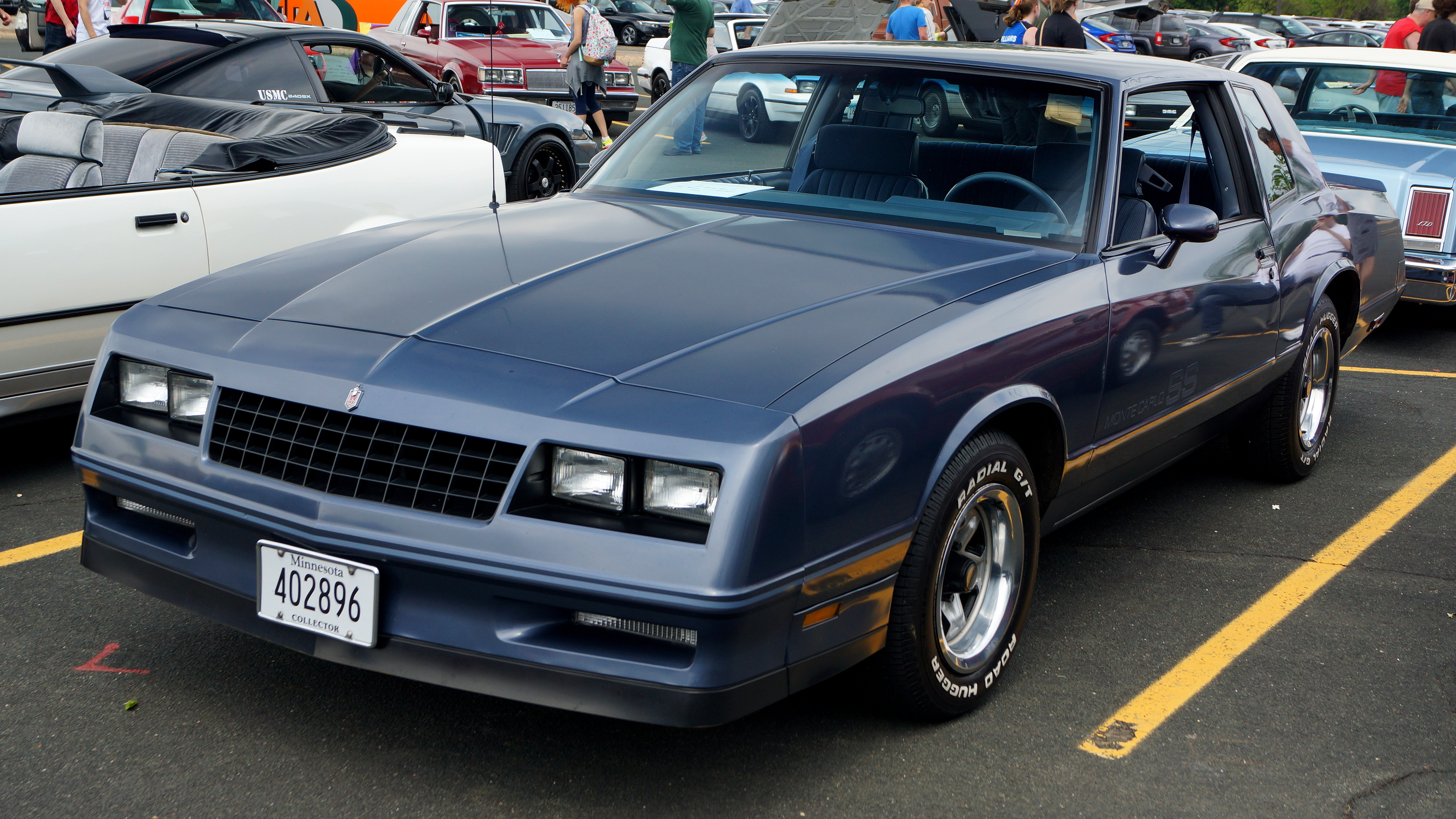
Chevrolet Monte Carlo
"...at. And I'm pretty sure I would have missed also Monte Carlo because I couldn't even hold a pen at that time. ..."
The Chevrolet Monte Carlo is a car model made by Chevrolet. It’s known for its classic look and was popular as a comfortable, stylish car with performance options. The podcast likely brings it up because it’s a familiar car name from the past.
The Chevrolet Monte Carlo is a classic American personal luxury/pony-style car that’s known for its distinctive styling and V8-era performance heritage. It may be referenced in the podcast as a recognizable name tied to a specific time period or memory, especially since the context suggests a personal recollection. That kind of mention is common when hosts discuss cars they associate with earlier experiences or events.
Sweden
"“I'm pretty sure I would have missed also Monte Carlo because I couldn't even hold a pen at that time. Sweden already. But Monte would be or maybe with some huge pain killers that would have been an option.”"
“Sweden” likely refers to a rally event in Sweden (commonly the Arctic/Swedish rally calendar). The speaker groups it with Monte Carlo as another event potentially missed due to injury and recovery.
base notes
"“That's the same stage. If you remember Eon Tracy lost the base notes because they were hitting.”"
“Base notes” refers to the rally pace notes system drivers use to anticipate turns, hazards, and braking points. If the notes are “lost” or disrupted (for example, due to damage or interference), the driver’s ability to navigate accurately can drop sharply.
on the limiter
"It was basically like you go almost on the limiter from bump to another bump. So you hit like this and then the car flows for the next jump."
When someone says they’re “on the limiter,” it means the engine is revving as high as it’s allowed to. In rally terms, you’re basically using the car at its hardest while still trying to keep control over rough terrain.
“On the limiter” means the engine is being pushed to its rev limit, where the ECU restricts further RPM. In rally driving, it’s often used to describe staying at the edge of maximum power while transitioning between bumps and traction changes.
car flows for the next jump
"So you hit like this and then the car flows for the next jump. And we won the stage first time by a few seconds and also seconds time time was quite good."
“The car flows” is rally shorthand for the suspension and chassis absorbing a landing and keeping the car stable over successive impacts. It implies the suspension is working in a controlled way so the driver can maintain speed and traction after each bump.
Request an Explanation
Heard something you'd like explained? We'll add it to this episode.
Sign in to request explanations for terms you heard.
Want to learn more?
Browse our glossary for plain-English explanations of automotive terms, jargon, and concepts.
Help improve this episode
See something that's not quite right? Our annotations are AI-generated and can sometimes miss the mark. Click the flag icon on any annotation to suggest a correction.