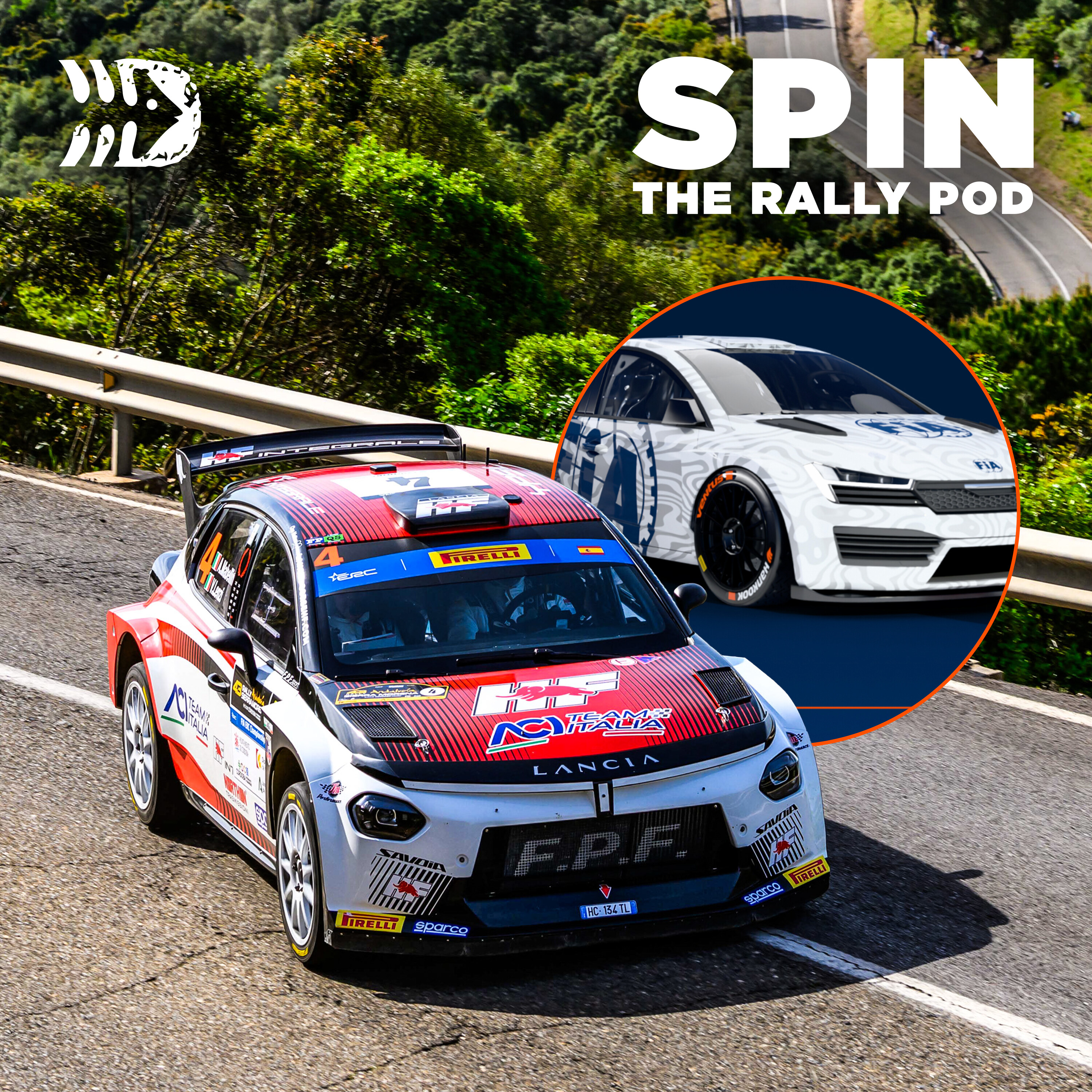
FIA reveals how Rally2 will compete with WRC27
About this episode
FIA rules are reshaping how Rally2 will sit alongside Rally1 in the next WRC, and the hosts break down the key 2027 changes. They explain the “amalgated kit of parts” confirmed in Macau, including a homologation window before December 1st, 2026, and a cost target around seven and a half thousand euros. The debate turns to eligibility for customer teams, manufacturer commitments, and whether the safety-and-chassis direction will keep speeds comparable while making the cars easier to watch and more accessible.
In this 'breaking news' edition of SPIN, The Rally Pod, DirtFish's David Evans and Alasdair Lindsay join host Luke Barry to discuss the new Rally2-WRC-Kit and what it means for drivers as well as competing constructors - both current and prospective.
See Privacy Policy at https://art19.com/privacy and California Privacy Notice at https://art19.com/privacy#do-not-sell-my-info.
WRC 27
"…this is a step into actually confirming how the rally two cars will be. I'm going to refer to our story here on dirt.com… confirmed there'll be an amalgated kit of parts… to make these cars more in line with what will be WRC 27 next year."
WRC 27 is the next set of rally rules for the top-level World Rally Championship cars, starting in 2027. The hosts say Rally2 cars are being updated to look and behave more like those new WRC cars.
WRC 27 refers to the next FIA World Rally Championship car regulations coming for the 2027 season. The segment explains that Rally2 is receiving an “amalgamated kit of parts” to align its aerodynamics with what the WRC 27 cars will use.
Rally2
"You speak to anybody about the 2027 championship season. And to a degree, we still don't know how to also work in practice, but this is a step into actually confirming how the rally two cars will be."
Rally2 is a class of rally race cars that’s meant to be cheaper and easier to run than the very top WRC cars. This episode is about new rules that will update Rally2 cars so they can race more evenly against the next WRC generation.
Rally2 is a FIA rally car category intended to be a more affordable, standardized step below the top WRC cars. In this segment, the hosts discuss how Rally2 will be updated so it can compete more directly with the next-generation WRC cars.
Macau
"…the FIA World Motorsport Council has met in Macau and there they confirmed there'll be an amalgamated kit of parts."
Macau is the place where the FIA meeting happened. The hosts mention it because that’s where the FIA confirmed the new Rally2 parts plan.
Macau is where the FIA World Motorsport Council met for this decision. The segment ties the meeting location to the confirmation of the Rally2 kit rules.
amalgated kit of parts
"…the FIA World Motorsport Council has met in Macau and there they confirmed there'll be an amalgated kit of parts."
This “amalgamated kit of parts” is basically a pre-approved package of upgrades that teams can add to their rally cars. It’s meant to help Rally2 cars meet the new 2027 direction without reinventing everything from scratch.
An “amalgamated kit of parts” here means a bundled set of approved components that teams can install to bring their Rally2 cars up to the new 2027-spec direction. The segment frames it as a standardized update confirmed by the FIA World Motorsport Council.
aerodynamic mods
"…it's essentially some aerodynamic mods, isn't it, to make these cars more in line with what will be WRC 27 next year."
Aerodynamic mods are changes to the car’s shape—like wings or body panels—to control how air flows over it. The goal is usually better grip and stability at speed.
Aerodynamic mods are changes to a car’s bodywork intended to alter airflow, typically to improve downforce and stability. Here, the hosts say the Rally2 kit includes aerodynamic updates so the cars better match the performance direction of WRC 27.
homogated
"These kits can be homogated on cars before December 1st, 2026. Basically, cars built this year can have these added to them for 2027 and 2028…"
“Homogated” is the FIA’s approval process (homologation). It means the parts are officially allowed for competition, so teams can install the kit and still race legally.
In FIA rally regulations, “homogated” (as spoken) refers to homologation—official approval that a car or parts package meets the rules. The segment says these kits can be homologated onto cars before December 1, 2026, meaning teams can legally fit them for the 2027 and 2028 seasons.
homologate
"homogated by a manufacturer registered as a constructor, and the car must compete in all events listed on the calendar with at least two cars."
Homologate means the rally organizers officially approve a specific car setup or parts kit. After it’s approved, teams are allowed to use it in that competition class.
In rally rules, to homologate means a governing body approves a specific car or parts kit as meeting the category’s technical regulations. Once homologated, teams can use that approved kit to compete in that class under the rules.
privateer
"It's not, yes, technically a privateer can do this, but you can't just turn up for one event and bow out and that'd be it."
A privateer is a smaller rally team that isn’t directly run by the car manufacturer. They may still be allowed to race, but the rules can limit what they’re required to commit to.
A privateer is a team or entrant that competes without being the manufacturer-backed constructor. In rally rules discussions, privateer eligibility often hinges on whether they can use homologated kits/cars and whether they must meet the same season-commitment requirements.
constructor
"There has to be some kind of commitment from a manufacturer slash constructor somewhere. I'm not sure I agree with that interpretation either,"
In FIA rally context, a constructor is the manufacturer entity (or registered organization) responsible for entering cars under the category’s rules. The constructor’s commitments—like season participation—are often used to define who is “officially” backing the program.
wing
"All you've got to do is have a driver, a customer, with one of those homologated parts, or one of those homologated cars, i.e. the car with the wing, at 14 rounds of the championship,"
Here, “wing” means the rear spoiler/aero surface on the car. In rally rules, certain aero parts can be regulated, so homologated cars may need the approved wing setup.
In rally car context, “wing” usually refers to an aerodynamic rear wing. Because homologation is about approved technical specifications, the wing is an example of a visible aero element that may be part of what’s regulated/approved for the category.
RC1
"and Toyota, quite clearly, Toyota already has an RC1 car, the new 27 car coming, whether it is whatever it's called, MR2 Celica, MR Relica, or whatever"
RC1 is a rally car category designation used in the FIA’s structure for rally competition, with higher-level cars generally having more freedom and/or performance potential than lower classes. In this discussion, Toyota’s “RC1 car” is contrasted against its “RC2 car,” implying a hierarchy of specs and eligibility.

GR Yaris Rally 2
"But, as somebody in our internal WhatsApp group pointed out, there will be a lot of very frustrated and annoyed GR Yaris Rally 2 customers who want to use these cars."
The Toyota GR Yaris is a rally car Toyota supports. “Rally 2” is a racing class with specific rules, so teams build cars to that spec.
The Toyota GR Yaris is Toyota’s rally platform, and “Rally 2” refers to the FIA’s Rally2 category rules that define what kind of spec the car must be. The hosts are discussing how customers who buy/prepare Rally2 cars may be affected by Toyota’s plans for its higher-priority class car.
Acropolis
"there'll be loads of bonus content for you as well from the Acropolis. But while I'm saying that, I've forgotten the actual nucleus of what I was going to say."
The Acropolis refers to a famous rally event in Greece. It’s the kind of competition where rally teams go to race on challenging stages. The host is saying there’s extra content tied to that rally week.
The Acropolis is a rally event associated with Greece, commonly referred to as the Acropolis Rally. In rally coverage, it’s a major stage-based competition that hosts teams and manufacturers and is often used as a benchmark for car development and driver performance. The host mentions it as the context for bonus rally-week content.
rally two
"But as a short term solution, surely that was easy to bring in... why I understand rally two cannot be the long term future... But as a short term solution... because the FIA has implemented new space frame chassis for WRC 27 cars, we know that rally two WRC kit cars are going to be going at the same speed"
Rally2 is a rally car category used in the FIA rally ecosystem (often as a step below the top WRC category). In this segment, the host argues that Rally2 can’t be the long-term future because of safety and production realities, but could be used short-term. They also claim Rally2 cars will run at similar speeds to WRC 27 cars while being less safe under the current chassis rules.
space frame
"But as a short term solution, surely that was easy to bring in... And space frame safety, the fact some of these cars aren't really produced any more manufacturers... because the FIA has implemented new space frame chassis for WRC 27 cars"
A space frame is the car’s main safety structure, built like a strong metal skeleton made of tubes. In rally cars, this matters because it helps protect the driver in crashes and keeps the car strong under hard driving. The episode is saying the FIA is changing the rules for these frames for the WRC 27 cars.
A space frame is a rigid vehicle body structure made from a network of tubes or members that triangulate loads. In rallying, the chassis design matters because it affects crash safety and how the car survives impacts and stresses at speed. The host is contrasting older space-frame approaches with newer FIA-mandated space-frame chassis rules for the WRC 27 era.
FIA
"You know, if it's a safety issue, which it is, because the FIA has implemented new space frame chassis for WRC 27 cars"
FIA is the international organization that makes and enforces the rules for major auto racing. They decide things like safety and technical requirements for the cars. In this segment, they’re the ones introducing new chassis rules for the WRC 27 rally cars.
FIA stands for Fédération Internationale de l’Automobile, the governing body that sets rules for international motorsport. In rallying, the FIA controls technical regulations—like chassis and safety requirements—that determine what cars can compete and how they’re built. Here, the host specifically credits the FIA with implementing new space-frame chassis rules for WRC 27.
M Sport
"…be it Hyundai, be it Ford with M Sport and get ready for the first three or four rounds…"
M-Sport is a rally racing team that helps manufacturers run their rally cars. They’re the kind of organization that builds and prepares the cars for competition.
M-Sport is a motorsport team/constructor that supports rally programs for manufacturers like Ford. In rallying, it’s known for building and running competitive cars and managing the technical effort behind the scenes.
Ford
"…be it Hyundai, be it Ford with M Sport and get ready for the first three or four rounds…"
Ford is a car brand that competes in rally racing. In this segment, it’s mentioned as an option for a driver looking at manufacturer-backed rally cars.
Ford is a major rally manufacturer and brand that fields rally cars through factory and partner teams. The host specifically links Ford to an M Sport program for a Rally2-style route for drivers.
Monty, Sweden
"…that you know, Monty, Sweden, Safari, these cars, new cars potentially will fail in the first half of the year…"
Sweden is one of the famous rally events/locations. It’s known for tricky winter grip, so small differences in setup and driving can matter a lot.
Sweden is a key rally location in the FIA rally calendar, known for fast, snowy or icy conditions that heavily test studded tires, traction, and driver confidence. The host is using it as an example of where differences between cars/drivers can be more noticeable.
Safari
"…Monty, Sweden, Safari, these cars, new cars potentially will fail in the first half of the year."
Safari is a tough rally event. It’s famous for rough conditions that can be hard on both the car and the team.
Safari refers to the Safari Rally, a historic and demanding event known for rough roads, heat, and high mechanical stress. The host is contrasting it with other rallies where new cars might be more prone to early failures.
seven and a half thousand euros
"…you shell out your seven and a half thousand euros, chuck a couple of bits on the front…"
They mention a rough budget—about 7,500 euros—for adding some extra parts. It’s used to illustrate that Rally2 is designed to keep costs down compared with top-tier rally cars.
The host cites “seven and a half thousand euros” as a budget figure for adding parts to a Rally2 base. In rally terms, this frames how the class is intended to be cost-controlled, with teams spending relatively modest amounts on upgrades.
front
"…you shell out your seven and a half thousand euros, chuck a couple of bits on the front, you know…"
In rally setup language, “front” typically refers to front-end components and their tuning (like front suspension/geometry and front-end grip). The host’s “chuck a couple of bits on the front” implies small, targeted changes can still make the car more competitive on certain events.
works Lancia driver
"now you can go to Monte Carlo as a works Lancia driver. Sign me up."
A works driver is an official factory-backed driver. It means the car is supported by the manufacturer, not just an independent team.
A works driver is a factory-supported driver—meaning the manufacturer backs the team and car directly (or through its official program). In rally, that usually implies access to manufacturer engineering support, parts, and a more direct link to the car’s development.
Monte Carlo
"now you can go to Monte Carlo as a works Lancia driver. Sign me up."
Monte Carlo is a major rally event that’s very famous in motorsport. It’s the kind of race where factory teams want to show they can win.
Monte Carlo refers to the Rallye Monte-Carlo, one of the most famous events on the FIA rally calendar. It’s a high-profile stage where manufacturer-backed (“works”) teams and drivers want strong results.
two wheel drive
"Why is this two wheel drive car beating or at least on a par with these high tech WRC cars?"
Two-wheel drive means the car only powers one set of wheels. On slippery rally roads, that can be a disadvantage—but the hosts are saying this 2WD car is still very competitive.
Two-wheel drive (2WD) means power is sent to only one axle, rather than both axles. In rally, that can make traction and acceleration harder on loose surfaces, so the surprise here is that a 2WD car is still matching or beating higher-tech WRC cars.

307 Maxi 306 Maxi
"in Catalonia or Corsica, watching Bugowski and people like that or Penizzi and in the 307 Maxi 306 Maxi or whatever, they didn't really care."
Peugeot made special rally versions of the 307 and 306 called “Maxi.” These are built to handle the bumps and grip changes of rally stages, not just normal road driving.
The Peugeot 307 Maxi and Peugeot 306 Maxi are rally-prepped “Maxi” cars built for top-level rally competition. They’re known for being purpose-built for the rough, high-stress demands of stages, with rally-specific suspension and drivetrain setups.
WRC event
"the only work per if you're watching a WRC event today, rally one first, if they're not there, you don't watch a rally two and say, Christ, that's boring."
WRC means World Rally Championship, the biggest rally series in the world. They’re basically saying that if you watch the top-level WRC rally, you’ll notice the difference versus the lower rally classes.
WRC stands for World Rally Championship, the top tier of international rally racing. When the hosts say “watching a WRC event,” they’re contrasting the highest-level rally format with lower classes like Rally2.
rally one
"the only work per if you're watching a WRC event today, rally one first, if they're not there, you don't watch a rally two and say, Christ, that's boring."
“Rally1” is the top level of rally cars in the WRC system. It’s the most advanced class, so if you’re used to watching Rally1, Rally2 can feel different—sometimes less dramatic.
“Rally1” (spoken here as “rally one”) is the top class of modern WRC-spec rally cars. It’s the category most associated with the biggest budgets and the most advanced performance, which is why the hosts argue that its absence changes how people perceive Rally2.
RX supercar
"But then equally, if you if you ever had the the the opportunity to watch a an RX supercar go off the line, that dwarfed anything."
“RX” is probably a reference to a rotary-powered sports car. The rotary engine tends to sound and accelerate in a very distinctive way, which can make the launch feel even more intense to watch.
“RX” here is likely referring to a rotary-engine sports car (commonly associated with Mazda RX models), where the engine’s sound and acceleration character can be especially dramatic at launch. The host is using it as a comparison to show how different top-tier cars can feel to spectators.
tubular chassis
"the safety perspective is definitely there. And it's the reason that we're moving in this general direction towards tubular chassis, we're getting there."
A tubular chassis is the car’s main safety frame made from metal tubes. It’s built to protect the driver in crashes by absorbing and managing impact energy.
A tubular chassis is a rally car frame made from welded metal tubes, designed to be strong while managing crash energy. The host argues it’s safer than older approaches, citing the sport’s shift toward this construction method.
FAA
"fundamentally, the FAA has done more under Mohammed Ben Salim. Is it? I can't remember exactly when tubular chassis came in."
The host credits an organization (called FAA) for safety work that helped push safer car design. The exact meaning of the acronym isn’t spelled out here, but it’s about safety rules and standards.
FAA is referenced as an organization credited with safety work that influenced rally car direction. In this context, the host appears to be discussing safety regulation/standards, but the acronym is ambiguous without the full name.
Mohammed Ben Salim
"fundamentally, the FAA has done more under Mohammed Ben Salim. Is it? I can't remember exactly when tubular chassis came in."
Mohammed Ben Salim is mentioned as someone who helped drive safety improvements. The host is thanking him for work that continues to make rally cars safer.
Mohammed Ben Salim is credited by the host with ongoing work related to rally car safety and the move toward tubular chassis. The mention is used to attribute the safety direction to a specific individual’s contributions.
Thierry
"from the beginning of 22, those things have been unbelievably safe. I mean, we all remember those pictures of Thierry's shunt before Monty, when it landed on its roof."
The host mentions Thierry in relation to a well-known rally crash. The point is that modern safety features help protect drivers even when cars flip over.
Thierry is referenced in connection with a famous rally crash where a car landed on its roof, used as an example of why modern safety design matters. The host is pointing to a specific incident involving a driver named Thierry (likely a rally driver) to support the safety argument.
Group B
"And any other specification of car, you know, 17 cars as much as we love them and as much as that the modern day Group B, they're not nearly as safe."
Group B was a past rally car class that became famous for being very powerful but also very dangerous. The host is using it as a comparison point for how today’s cars are safer.
Group B refers to a historic FIA rally category known for extremely powerful, lightly regulated cars and a high-risk reputation. The host contrasts modern safety improvements with the danger associated with that era’s cars.
rally three
" [1987.2s] the brand new WRC 27? Would it be rally two as it is? Would it be the rally two kit? Would it be a [1992.0s] rally three just for the giggles?"
Rally3 is a lower-level rally category under FIA rules than Rally2. They mention it as a joke option, not as the serious choice for competing in the top WRC context.
Rally3 is another FIA rally class below Rally2, typically aimed at lower-cost competition and a broader entry ladder. In this segment it’s brought up as a humorous “just for the giggles” alternative to choosing a more directly competitive class for WRC 2027.

Toyota WRC 27
" [2002.1s] No. Toyota WRC 27. It's going to be the most invested in car, have the most evolution within [2011.2s] the next two years. Wherever its baseline is, nothing will get better over time than it will."
They’re talking about a Toyota rally car called the WRC 27. The idea is that Toyota is putting a lot of work into it now, so it should keep improving as the rules season gets closer.
Toyota’s WRC 27 is being discussed as the most heavily invested-in rally platform for the 2027 WRC rules. The key point is that it’s early in its development cycle, so it’s expected to gain more improvements over the next couple of years than older, already-developed cars.

Toyota MR2
" [2030.9s] so that makes them a better option early doors, but longer term. And potentially, [2036.7s] you buy that WRC 27 MR2 Elica, whatever it's called, chassis, and that's good for 10 years,"
They mention an MR2-based “Elica” concept as the foundation for the new rally car. The point is that the same basic car structure could be used for different types of engines later.
“MR2 Elica” is mentioned as the chassis basis for the WRC 27 concept being discussed. The important idea is that the chassis is treated as a long-life platform that can accept different powertrain options over time.
hydrogen power
" [2045.2s] isn't it? This is the whole ethos of what's come. You can take out a nice engine, you can drop in [2052.5s] battery power, or you can hydrogen power, whatever, the chassis is there for a decade."
Hydrogen power means the car uses hydrogen for energy instead of normal fuel. They’re saying the same car “shell” could potentially be used with different kinds of power sources.
Hydrogen power here refers to using hydrogen as the energy source for the car’s propulsion system, rather than a conventional gasoline or diesel setup. In the segment, it’s part of the idea that the same rally chassis could be adapted to different powertrains over a long service life.
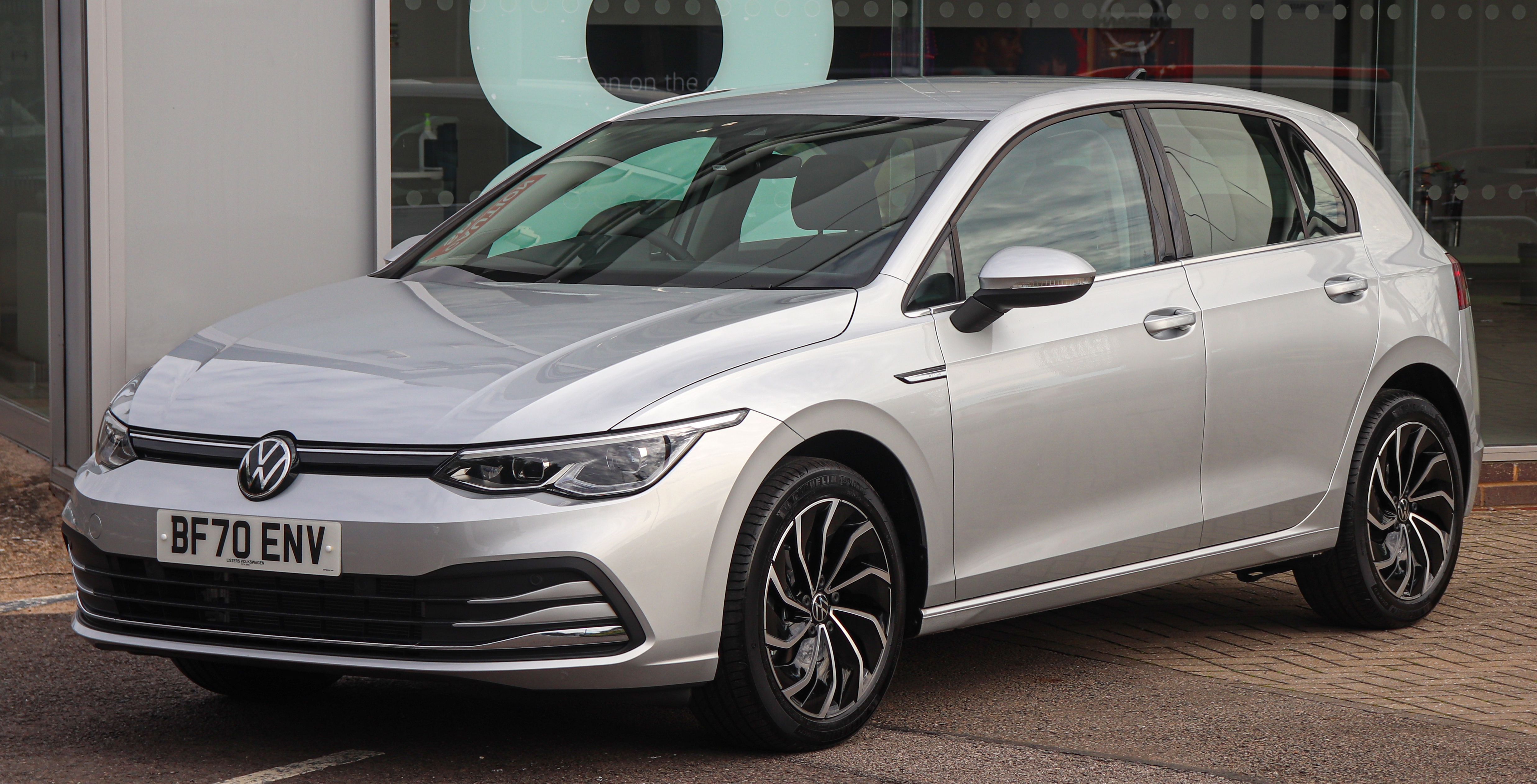
Golf
" [2088.6s] To do the Jim Clark rally in 2000, what would it have been? [2094.4s] The Golf, because it's the first car."
The “Golf” is referenced as the first rally car the speaker remembers seeing, specifically a Volkswagen Golf in a distinctive “Tapioca and Blue” livery. It’s used as a personal historical anchor for how they first became aware of rally cars.
Request an Explanation
Heard something you'd like explained? We'll add it to this episode.
Sign in to request explanations for terms you heard.
Want to learn more?
Browse our glossary for plain-English explanations of automotive terms, jargon, and concepts.
Help improve this episode
See something that's not quite right? Our annotations are AI-generated and can sometimes miss the mark. Click the flag icon on any annotation to suggest a correction.
1 community members have helped improve this episode.