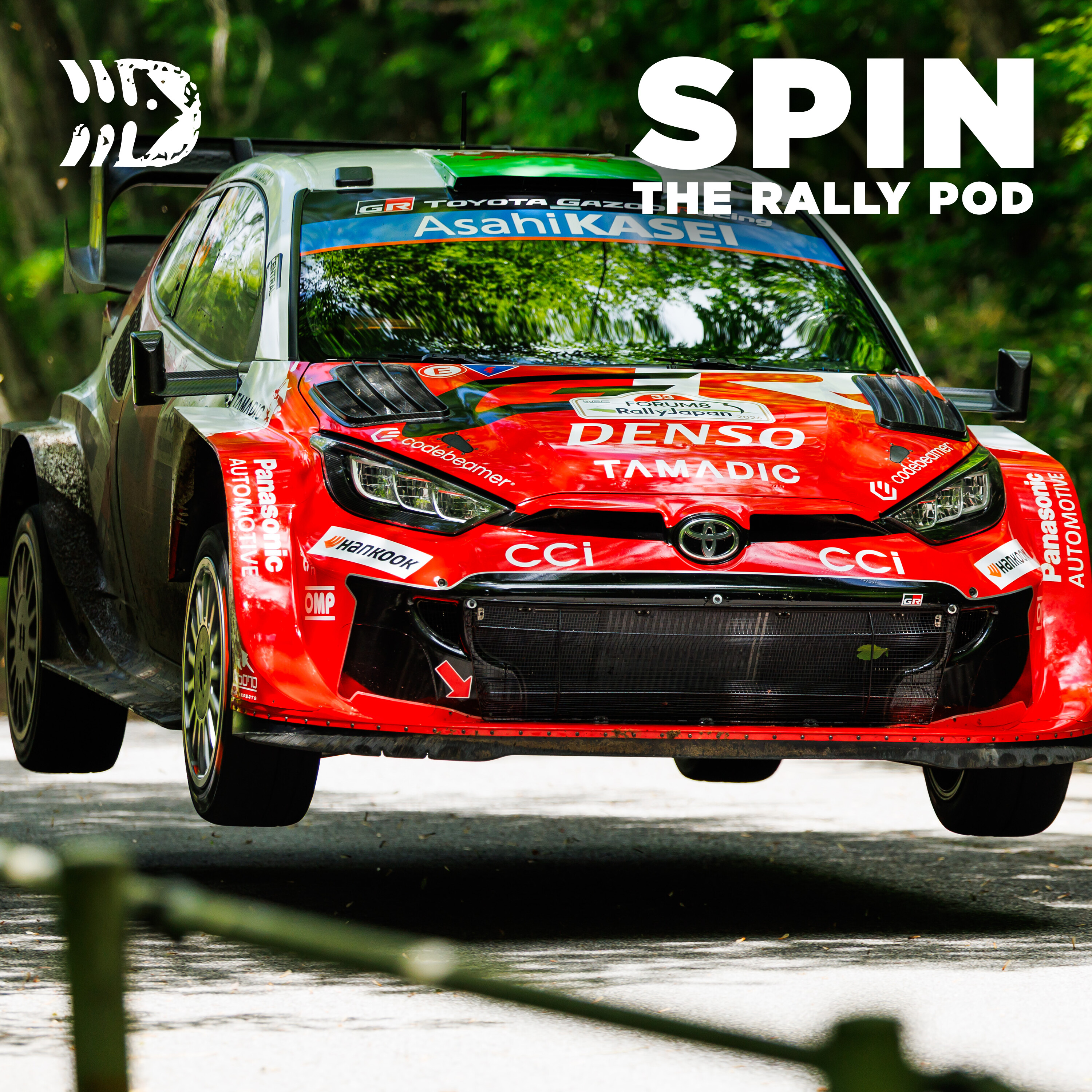
Rally Japan 2026 takes center stage as SPIN, The Rally Pod breaks down how Alvin Evans turned a key stage into an “immaculate win” and now leads the championship. With the season “50% through,” the hosts focus on road-position dynamics, damp Friday grip, and why Evans can “start cleaning the road.” They also dig into why Solberg’s Japan result swung on mistakes—especially a puncture and a speed-management issue tied to missing safety-note detail—while debating tire and hybrid effects late in the rally.
Colin Clark and Luke Barry convene to analyze an intriguing Rally Japan 2026. Just how good was Elfyn Evans? Is Oliver Solberg still a title threat? Is it even fair to expect him to be? Why was Sébastien Ogier slightly off color, and which of the Hyundai drivers continues to impress us?
"This podcast is brought to you in association with Link ECU, the specialist
performance ECUs for Subaru's in rallying.
Link ECUs offer plug-in convenience and advanced tunability with fully adjustable
fuel and ignition maps."
An ECU is the engine computer. It decides how the engine should run, including how much fuel to use and when to ignite it, based on sensor inputs.
An ECU (engine control unit) is the car’s computer that manages engine operation. In rally tuning, it’s used to control things like fuel delivery and ignition timing via programmable maps so the engine performs consistently across changing conditions.
"This podcast is brought to you in association with Link ECU, the specialist
performance ECUs for Subaru's in rallying.
Link ECUs offer plug-in convenience and advanced tunability with fully adjustable
fuel and ignition maps."
Link ECU is a company that makes the car’s engine computer for racing. It lets rally teams change how the engine runs—like fuel delivery and spark timing—so the car can be tuned for different conditions.
Link ECU is a specialist performance-ECU brand used in motorsport. In this segment, it’s positioned as offering programmable control for rally cars, including adjustable fuel and ignition mapping and diagnostic features.
"Link ECUs offer plug-in convenience and advanced tunability with fully adjustable
fuel and ignition maps.
They're designed to perform in harsh motorsport environments with fail-safe"
These are the engine computer’s settings. One set controls how much fuel the engine gets, and another controls when the spark happens—together they shape how the car accelerates and runs.
Fuel and ignition maps are the ECU’s calibration tables that determine how much fuel to inject and when to spark. By adjusting these maps, teams can tailor engine response and power delivery for different rally stages, temperatures, and fuel types.
"They're designed to perform in harsh motorsport environments with fail-safe
strategies to protect engine components and proven durability in extreme rally
scenarios worldwide."
Fail-safe strategies are backup protections built into the engine computer. If the car detects a problem, it changes to a safer operating mode to help prevent engine damage.
Fail-safe strategies are ECU behaviors designed to reduce damage if something goes wrong (like sensor faults or out-of-range operating conditions). In motorsport, they help protect engine components by switching to safer control modes rather than letting the engine run unchecked.
"Advanced idle control allows for smooth operation in tough terrain, and flex
fuel support means you can run pump gas all E85 without manual switching."
Idle control is how the engine computer keeps the engine speed steady when you’re not pressing the gas. Advanced idle control helps prevent stalling or rough running in difficult, low-speed driving.
Advanced idle control is ECU logic that stabilizes engine speed when the throttle is closed. In tough terrain, it helps keep the engine from stalling or surging during low-speed maneuvers and frequent changes in load.
"Advanced idle control allows for smooth operation in tough terrain, and flex
fuel support means you can run pump gas all E85 without manual switching.
With data and diagnostics, as well as customizable strategies, the bottom line"
Flex fuel support means the engine computer can handle different fuel blends, including high-ethanol fuel. It adjusts automatically so you don’t have to manually change settings when the fuel changes.
Flex fuel support means the ECU can adapt to different ethanol-gasoline blends. The segment specifically mentions running pump gas “all E85,” which implies the ECU can adjust fueling and timing for high-ethanol fuel without the driver manually switching setups.
"Advanced idle control allows for smooth operation in tough terrain, and flex
fuel support means you can run pump gas all E85 without manual switching.
With data and diagnostics, as well as customizable strategies, the bottom line"
E85 is a fuel mix that’s mostly ethanol. Because it burns differently than regular gas, the engine computer may need to adjust settings to run it correctly.
E85 is a fuel blend containing about 85% ethanol and 15% gasoline. Ethanol changes combustion characteristics, so a rally ECU with flex-fuel capability can recalibrate fueling and ignition to suit E85.
"With data and diagnostics, as well as customizable strategies, the bottom line
is Link ECUs give Subaru rally drivers the power, control and the confidence
needed to push limits while maintaining reliability and ease of use."
Diagnostics are the engine computer’s way of checking for problems and reporting what it finds. Data logging helps teams see how the car is behaving so they can spot issues faster.
Data and diagnostics refer to the ECU’s ability to log operating information and report fault conditions. In rally use, this helps teams monitor engine behavior and troubleshoot issues quickly between stages.
Person
Sebastian OJ
"[491.0s] You know, particularly what he said at that final stop line,
[495.0s] you know, he wins and wins.
[496.6s] That's not like OJ to win.
[498.2s] I am Sebastian OJ's biggest fan.
[500.4s] I absolutely love him.
[502.0s] I love the fact that he's done it in different cars."
Sebastian OJ is a rally driver the host really likes. The discussion suggests he can be very emotional during the rally, but he also performs well and has a strong track record.
Sebastian OJ is discussed as a rally driver with a reputation for strong results but also emotional, sometimes controversial, in-the-moment comments. The hosts connect his performance to specific rally contexts like Japan and earlier seasons, implying his driving style and mindset affect outcomes.
"[502.0s] I love the fact that he's done it in different cars.
[504.4s] I love the fact he's got a bit of edginess about him.
[507.2s] I love the fact that when the FIA tried to stop him from winning in the Volkswagen days
[511.4s] by changing the rules, he went, you, I'm going to win anyway."
The FIA is the organization that governs many kinds of racing worldwide. In this segment, they’re described as changing the rules to try to affect who wins.
The FIA (Fédération Internationale de l’Automobile) is the global governing body for major motorsport series, including rallying. In the segment, the host says the FIA tried to change the rules to stop OJ from winning in Volkswagen-era competition, highlighting how rule changes can reshape rally outcomes.
"[523.4s] And I will caveat it by saying that some of the things he said in the heat of the moment
[527.6s] in Japan disappointed me, really disappointed.
[531.3s] You're talking about Elvin only being in the lead because of road position."
In rallying, road position refers to where a car starts or runs relative to others on the same stages. The host implies that Elvin’s lead was influenced by road position—i.e., track conditions and timing can make it easier or harder to go fast.
"And then they were talking an awful lot about the tires and blaming the tires.
Look, Ted, you are the master of tires, but looking at the tires, understanding tires,
getting the best out of tires."
Tires are what actually touch the road, so they control how much grip the car has. In rally, if the tires aren’t working well for the conditions, the driver can’t go as fast or as confidently.
In rallying, tires are the main contact patch between the car and the road, so they largely determine grip, braking traction, and how confidently the driver can attack corners. When hosts talk about “blaming the tires,” they’re usually referring to how tire choice and condition affect performance across different stages and surfaces.
Term
hybrid units
"One of the stages this year where they broke a stage record on the hand-to-tires without the hybrid units."
A hybrid unit is the extra electric part of a hybrid car that can add power. If a stage was done without it, the car’s power delivery would be different, which can change how hard the tires have to work.
In modern rally cars, “hybrid units” refer to the hybrid power system that adds electrical energy to the drivetrain. The host’s point is that a stage record was set “without the hybrid units,” implying the car’s traction and acceleration behavior (and therefore tire workload) changed when hybrid assist wasn’t available.
"And he fully took it.
And over the rest of the rally, he managed the gap and it was just an immaculate win."
“Managing the gap” is rally strategy: once a driver has a time advantage over rivals, they adjust their pace to protect that advantage rather than pushing at maximum intensity. It often means balancing risk (mistakes) against time loss to ensure the lead survives to the end.
"But it is equally an indication of that stage being the key stage of the event.
And OJ was just, I think, quite angry about it afterwards"
A “stage” is one timed part of a rally, like a specific stretch of road the drivers race through. Your time on each stage adds up, so one stage can make a big difference to who wins overall.
In rallying, a “stage” is a timed section of the route (often on closed roads) where crews race against the clock. The winner of the rally is determined by total time across all stages, so a single stage can swing the overall result.
"... sense, we do have to consider him a championship challenger, even if we're expecting the names below him on t..."
The Dodge Challenger is a two-door car built for speed and strong acceleration. People talk about it a lot in racing because it has a reputation for being fast and there are many ways to modify it for competition. If it’s mentioned alongside “championship” talk, it’s likely being treated as a serious contender.
The Dodge Challenger is a performance-focused muscle car known for its powerful engines and classic two-door layout. It often comes up in motorsport and racing conversations because its strong straight-line performance and broad aftermarket support make it a common choice for competition builds. In a podcast discussing championship-level contenders, it’s likely mentioned as part of the lineup of cars being considered for top results.
"Let us talk about maybe not having again the right information in his gravel notes, his safety notes."
Rally drivers write “notes” about what the road will do next—like what corners are coming and how tight they are. On gravel, grip changes a lot, so those notes help the driver prepare for each turn.
“Gravel notes” refers to the pace notes rally drivers use to describe upcoming corners and hazards on a specific surface. Because gravel behaves differently than tarmac (traction and grip change constantly), the notes are crucial for timing braking, turn-in, and how aggressively to carry speed.
"Let us talk about maybe not having again the right information in his gravel notes, his safety notes."
“Safety notes” are extra reminders in the driver’s notes about where the stage is risky. The idea is to help the driver slow down or change approach so they don’t get caught out.
“Safety notes” are additional rally notes focused on risk management—things like where the road is particularly dangerous, where visibility is limited, or where conditions can surprise the driver. They’re meant to help the driver avoid or mitigate incidents by adjusting approach before a critical section.
"And then you're scrubbing speed, but you've got to lose a lot of speed. Unfortunately, Solberg was still trying to lose speed as he hit that cut."
“Scrub speed” just means slowing down on purpose before a corner. In rally stages, drivers do it to keep the car under control and set up for the next turn.
In rally driving, “scrub speed” means deliberately reducing speed before or while entering a corner, often by easing off the throttle, using braking, or managing traction. The goal is to slow the car enough to stay stable and set up the next turn, especially in tight, twisty sections.
"You know, that cut just before that left hander where you're looking at scrub speed. It was a very tight and twisty section of the stage... Unfortunately, Solberg was still trying to lose speed as he hit that cut."
A “cut” is a shortcut line through a corner that can save time. If you take it too fast (or don’t know what it’s like), the car can get unstable and you can make a mistake.
In rally stage driving, a “cut” is a marked or recognized shortcut line through a corner or chicane area, often used to reduce distance and time. Hitting a cut at the wrong speed or without the right information can force the car onto unstable surfaces, leading to loss of control or a big mistake.
Select text to request an explanation
Ever notice how life's best stories don't happen in your living room?
They happen on the open road, out on the water, or parked under the stars.
At Progressive, they get that you want to focus on the experience, not worry about the
what-ifs.
That's why they offer quality insurance designed for your ride, whether that's a
boat, RV, or motorcycle.
Adventure with confidence.
Visit Progressive.com and see how easy it is to protect your favorite way to get away.
Progressive Casualty Insurance Company and Affiliates.
Not available in DC.
Prices vary based on how you buy.
This podcast is brought to you in association with Link ECU, the specialist
performance ECUs for Subaru's in rallying.
Link ECUs offer plug-in convenience and advanced tunability with fully adjustable
fuel and ignition maps.
They're designed to perform in harsh motorsport environments with fail-safe
strategies to protect engine components and proven durability in extreme rally
scenarios worldwide.
Advanced idle control allows for smooth operation in tough terrain, and flex
fuel support means you can run pump gas all E85 without manual switching.
With data and diagnostics, as well as customizable strategies, the bottom line
is Link ECUs give Subaru rally drivers the power, control and the confidence
needed to push limits while maintaining reliability and ease of use.
Thank you for listening to Spin, the rally pod, brought to you by Dirtfish Rally School.
For your chance to experience life behind the wheel of a rally car, head to
drive.dirtfish.com to find the course that's right for you.
What are you waiting for?
We're right here waiting for you.
And with that, we are 50% through the 2026 World Rally Championship season.
Can you believe it?
I'm not sure I can.
Every single year seems to go by quicker than the last, but we are at seven
rounds into 2026.
Seven left.
Alvin Evans leads the championship after victory in rally Japan.
And here to discuss that particular event with me is a man who's never
anything less than 100% is Colin Clark.
Yes.
Hello, look, how are you?
I'm not bad, mate.
Not bad at all.
How are you?
Really good.
Thank you.
Really good.
Yeah, just making my way slowly home from Japan.
So yeah, you know, I'm in a pretty decent form, I'd have to say.
Good.
Well, I'm sure the listeners will be glad to hear that.
And I think my intro is appropriate.
I won't lie.
There was a point I used to script these and I literally did that off the top of
my dome.
That was good.
That was really good.
Considering it's quite early in the morning as well.
That was really quite impressive.
Thank you.
I'll take it.
And I realised that sounded like me fishing for a compliment.
That wasn't what I was trying to do.
Exactly what you were doing.
Dearing me.
But yeah, as I said, last weekend, obviously, rally Japan, the final,
actually, tarmac rally of the year as well, which is quite a bizarre thing
to think given it's only just ticked into June.
The rally ended in May, didn't it?
So that's quite a strange one.
But yeah, Alvin Evans, quite a clear victor, actually, Colin, in the end,
didn't lead after stage one, but he led after all the rest of them.
And you just it's not a surprise anymore, particularly in Japan, is it?
We've seen the form three wins at a four starts now.
But I think in terms of the championship and yes, the game changes
because he's going to have to start cleaning the road.
But this was a really emphatic performance when perhaps some of his
bigger rivals maybe didn't put the best foot forward again.
Well, I think that's very fair to say.
Yeah, Alvin was superb.
There's no other way of describing it.
But as you say, you know, his form in Japan, he was very much the form driver,
wasn't he? Two previous wins, second place.
He's now three wins and second place in the past four.
It's a rally he really enjoys.
It's a rally he's worked out.
He knows how to go well there.
He knows how to measure the risk.
And he did it beautifully.
He did it absolutely beautifully.
He built that lead.
You might argue he took a little bit of an advantage of road position
on the Friday morning.
When it was a little bit damp and a little bit slippery, it's fair to say,
particularly under the trees where we saw a lot of that green moss.
You know, he made the most of it.
He absolutely made the most of it.
And then he looked after his lead and he didn't do anything silly as we saw
from a number of other drivers.
It was a rally.
It was quite easy to get it wrong on.
But Alvin didn't, you know, Alvin didn't get it wrong.
And he put in a really, really impressive performance to take another win in Japan.
And set himself up nicely for the second half of the season.
As you say, you know, we had that massive run of gravel rallies in the middle
of last season, didn't we?
And they changed things around and it's almost the front loaded it to every day
this season. It's a bit bizarre, a bit bizarre.
There was no time back in the second half, but there we are.
You know, Alvin, I think, will now have the confidence to look to recognize
maybe where he's not done so well in previous years.
He's never lost it on the last rally of the season, Alvin Evans.
You might argue the statistics prove otherwise.
I would argue that he lost it in places like Sardinia last year,
where he just, it was awful in his battle with Sammy Payley on the Saturday.
I think Alvin has recognized that.
And I think we'll see a different Alvin Evans on gravel this year.
I don't think we'll see an Alvin Evans who is just flying
the ring in sixth and seventh and eighth place.
You know, the important thing is that he gets top four, top five
finish finishes and keeps the pressure on the opposition.
And he looks to me like a different driver this year.
Look, I don't know if you agree with that.
He looks to me as if he sucks a few things out this year.
I think last year was a big lesson, wasn't it?
And it was a brutal lesson in some respects because there was all this talk,
if you remember, and it feels ages ago now, but the end of 25,
there's some people saying, oh, it's not fair.
Oh, he's done this, but I think we see it this year.
And he's on a very similar programme, Sebastian,
but the difference in it, he's not performing badly this year at all.
He was just so good last year.
And he was quite unfortunate in some respects that he went up against that.
But that's the game.
And I think this year he's learned that he cannot.
There's this quote that kept going around at the start of the year
that basically there was maybe a point at the beginning of 25
where Alvin didn't fully look at OJ as a massive championship threat.
And how wrong did that prove?
So now he's like, no, every single rally doesn't matter who it is
in the championship fight or not, need to beat them, need the points,
everything else.
And he's got a lot of experience there of coming second, doesn't he?
Bless him. So I think, yeah, final six times.
Five, I think it's five. It's it's a lot.
And yeah, I'm thinking on the spot this decade.
I'm sure it's only 2022, the first year of rally one where he didn't finish second.
And so that would be the bill was the price made for many years, wasn't it?
He was the man that had the the the monitor of your price made for WRC.
He finished second, five or six times before.
Eventually he took the win and sussed it out.
So no, it's it's an interesting one with Alvin this year.
And you know, the OJ, the OJ situation
again is an interesting one.
I think had OJ taken a better result in Portugal, one Portugal,
we might have seen something different from OJ for the remainder of the season.
But, you know, that issue he had in Portugal,
and he was he was negaled in Japan OJ.
And I, OJ is an interesting character
because at the end of the stages, he quite often let the emotions get the better of them.
But by the time he's got back to service on the media zone,
he's calmed down, it's very monotonous about everything.
But he said some things in the heat of the moment, didn't he?
Last weekend in Japan, they kind of, you know, made you stop and think.
You know, particularly what he said at that final stop line,
you know, he wins and wins.
That's not like OJ to win.
I am Sebastian OJ's biggest fan.
I absolutely love him.
I love the fact that he's done it in different cars.
I love the fact he's got a bit of edginess about him.
I love the fact that when the FIA tried to stop him from winning in the Volkswagen days
by changing the rules, he went, you, I'm going to win anyway.
I love him, but I have to say some of the things he said in the heat of the moment.
And I will caveat it by saying that some of the things he said in the heat of the moment
in Japan disappointed me, really disappointed.
You're talking about Elvin only being in the lead because of road position.
And then they were talking an awful lot about the tires and blaming the tires.
Look, Ted, you are the master of tires, but looking at the tires, understanding tires,
getting the best out of tires.
But the cool fact is that you just can't get the best out of these tires.
You haven't sucked them out.
Yes, they're not the best tires in terms of performance, but everyone's got the same tire.
You know, and Elvin Evans and other drivers are making the most of it.
Who else did you hear whinging about the tires of the weekend?
I don't think anyone wants to vote.
I don't think they did.
You're right at the end of the rally.
And I need to check this out.
And I didn't tell you, Neville talked about.
One of the stages this year where they broke a stage record on the hand-to-tires without the hybrid units.
So the tires can't be that bad.
It can't be that bad, but usually let the tire situation get to him.
And I think that affected his performance.
I think he could have fought for the win there.
I think he could have got on top of those past.
But he got into his head.
He got into his head that he didn't like them.
He wasn't going to get the best out of them.
They weren't going to deliver for him.
So surprise, surprise, they didn't.
Yeah, I think what's interesting with OJ is this kind of goes from most drivers,
but I think particularly OJ, as you said, you can sometimes just let the frustrations boil over.
And it's easy to forget how badly he and Toyota will have taken what happened in Portugal.
There were a couple of the record conversations that I heard through audios,
which obviously can't repeat because they were off the record.
But it almost surprised me, actually, just how still almost frustrated that people are.
So I guess what, three weeks on from from the event.
And this is the thing, we all look at it as neutrals.
Like, oh, this is great because the WRC needed time to win.
But if you're a Toyota and you felt like you should have won and you feel like something
that shouldn't let you down, that's going to hurt.
And I think you're right.
I think there was a bit of that that was still playing on OJ's mind.
We all saw that in this reply in social media, didn't we?
In the game before the event, yeah, yeah.
So where are these things?
And I've just done a bit of math while you were talking there as well, Colin.
Not that I wasn't listening as well.
But as it stands, OJ is 61 points off Alvin.
Now, I don't like playing this game where you change one variable
and assume everything stays the same.
But for the sake of this point, I'm going to do it.
So he obviously finished sixth in Portugal in the end after what happened.
If he'd won, he'd be 44 points back.
So basically 17 points better off.
And as you say, that just seems a lot more competitive
in terms of that fight, doesn't it?
As I say, the points off the Alvin got as well.
The fantastic point, it doesn't.
So Alvin was third in Portugal.
He would have been so it would be down to 41.
41 points. Yeah, good point.
I forgot to say that.
So yeah, there you go.
But that is actually quite a big difference like that.
It's 20 points swing, actually.
20 points swing and even that you would say is 41 points.
Well, 41 points going into the gravel season.
But, you know, a lot of people say, well,
I said something before Portugal, you know, OJ still has ambitions to win a 10.
I thought, no, he doesn't.
No, he doesn't. He absolutely doesn't.
So he might have considered it.
You had things brought in his way in his limited program
up to the middle of year, as he did last year.
He might have considered going for it.
But he's got no ambitions to win 10 titles.
Because if he did, he'd have done that program.
He'd have done it.
If that was his ambition, he'd have done the program and he would have won.
He would have won without any question of the title this year.
So, you know, he doesn't have ambitions at 10 titles.
It's almost like a byproduct.
It's not like a happy accent of winning rallies.
He gets a bit pissed off by that.
Yeah, situationally, he could actually win it.
Yeah, but, you know, we'll talk about, you know, OJ is just,
I think for the rest of the year, going to be a distraction for Elvin Evans
and a distraction in terms of our title fight, a good distraction.
Because we always love seeing said back in the mix.
I certainly do anyway.
I think while we have the opportunity to see your brilliance,
we should appreciate it.
But he will be a distraction and he may yet still have a fairly big say
in the outcome of this year's drivers championship.
Because who knows, he may well take points
as the season goes on from potentially Evans, potentially Oliver Solver.
You know, do we have to now consider Takamoto, potentially a tackle contender?
Maybe, maybe we do.
And do we still consider Adrian for more title contenders?
Yeah, maybe we have to consider that as well.
But, you know, if Solver gets his nonsense together,
then he will be still a type of contender.
If he fails to, he won't be, but we'll come on to Solver, I'm sure, at some point.
But OJ will be just a little bit of a pain for certain people, I think,
because we know in the end.
Yeah, I would agree with that, actually.
And I think it's going to be fascinating to see just how it affects things
because, as we said, we know all he wants to do now.
And it's always what to do for the last few years is win, win rounds.
And again, I think you saw that in Japan, didn't you?
That he felt there was something he couldn't control.
It's always when there's things that he feels he can't control, he gets frustrated.
And there's robust in situation.
I like your point with Elvin in terms of taking advantage of it,
because I think there's potentially, even a few years ago,
would Elvin have made such a decisive gap on that stage?
I don't know. But I think he'd have known.
He'd have seen that and thought, right, this is my opportunity.
And he fully took it.
And over the rest of the rally, he managed the gap and it was just an immaculate win.
For OJ, I think he lost 16 and a half seconds in the stage and he lost by 12.
So he'd claim, oh, this is what cost me the rally.
But then Elvin wasn't going as hard for the rest of it, I'm sure.
And we saw that in Super Sony, didn't we?
So it's never as simple as just doing the math like that.
But it is equally an indication of that stage being the key stage of the event.
And OJ was just, I think, quite angry about it afterwards,
because he felt he couldn't do anything about it.
But yeah, it is going to be interesting in that team to see the dynamic.
Because, as you said, we assume you've got your hand up.
I'll just finish this point very quickly.
Oh, yeah, you can see me. Sorry.
Is that taking my nose as well?
I forgot.
If you weren't, I didn't see it.
So I'm taking three notes of my tea.
Oh, dear. Well, you're very brave to admit that because let's just come on.
But there we go.
Yeah, I think we assume that Toyota is still going to be the benchmark over the gravel.
But we also expect Hyundai is going to be more competitive.
So you mentioned Formo there.
He'll start at least Greece in fifth position on the road,
which is a lot better than Elvin Evans first.
So Evans has basically got to worry about those closest to him in the challenge,
which the minute is Taka Katsuta.
So he's 20 points back.
Then there's a bit of a gap, actually, between Taka and the rest.
Solberg is third, but he's 49 off Elvin.
So this is where it gets interesting.
It's like the tortoise versus the hare, isn't it?
How much can Elvin protect that advantage?
And how much can the rest erode that deficit?
What Elvin really needs in the next rally?
And it'll be very hard to do looking at the gap between them.
But for Solberg to immediately move ahead of Taka and the championship.
And then there's one fewer car in between them in the start order.
That's his dream, isn't it?
Be as close as possible to his rivals, but have as big a gap as possible.
Yeah, I think you're right.
I think one more point about Elvin, though.
I think Elvin is as well prepared as anyone this year.
We see him doing things, particularly on tarmac rallies.
And it's a little bit of an example that we know is actually happening.
But in terms of his preparation, in terms of him having access
to as much information as possible, he's doing things that other drivers aren't.
You know, remember, we saw back in where was it?
Where we saw Aaron Johnson reading off his telephone
because he hadn't got the grab a few notes in time.
We wanted to go over the heads.
Was it Monty? It probably was, wasn't it?
It certainly wasn't Canaries and it wasn't, I don't think it was.
It definitely wasn't Croatia.
But we saw that and it was in one of those situations
where there's so much information coming back from the gravel quiz
that you kind of have to be selective or you make a decision about how you either
take your face off and tease them or you go with the electronic that's on the telephone.
What I know for a fact is that Elvin has recognized the potential for trouble there
and has put measures in place to to make the most of that situation.
He's got huge amounts of information coming back to
between runs on the stages.
He's doing things that I say I understand that other drivers aren't doing.
And I feel it's just a step forward in terms of his preparation.
That first stage, as you say, he did, I suspect
you'll put a lot of work into that first stage, an awful lot of work into it.
You obviously need some classes on the wrecky, but but then your
how do you take time between the wrecky and the stage in terms of your
preparation for that stage?
I think he knew that was the one.
And I think he put a huge amount of effort into that.
We might not have seen that in previous years from Elvin Evans.
We are definitely seeing something different this year.
Look, and yeah, he is going to be looking for situations
to develop where he gets an advantage on gravel, as you say.
Oliver Solver, perhaps just being one carbide.
You know, if he gets a couple of rallies where it's wet, that might help him as well.
That could be the difference between Evans winning a title this year and not winning it.
But I just get his feeling that he is better prepared
and he's doing his homework and he's absolutely focused on the championship
and making the most of every opportunity this year.
Yeah, I can run with that theory and what's frustrating is I was hoping
you're going to talk for approximately another minute.
So I was trying to be seamless here and bring up a points table
with a point I wanted to make.
But I'm currently just searching, I'm speaking because I'm not sure.
But I'm fairly confident and I haven't done the research.
So somebody please correct me if I'm wrong.
And I think Elvin is the highest Super Sunday score this year as well.
Right. Even higher than Solberg, which might surprise some people.
But that does surprise me a little bit.
So it's why Solberg didn't take on the Paris stage in Canaries or score points
because obviously he crashed on the penultimate stage.
But the point there is you wouldn't necessarily pick Elvin Evans
as the fastest driver from A to B in one specific stage.
But when he's got the chat, he knows the value of this on a Sunday.
And he's lifted that every single thing you can take advantage of.
He's doing it. And I think that's what's really impressive.
So yeah, it'll be interesting to see, I guess, what happens now in the next
round, isn't it? Because as you said earlier, he's got this handicap now for.
I know what they were trying to do.
It was like, let's not make.
Yeah, well, I don't even know what they're trying to do.
Actually, I think about it because it's logic in that we've all we've got now
is an even longer period of somebody potentially suffering.
But then this is part of rallying unless you bring something back
like the qualifying stage, this is just going to happen.
You can't manipulate it necessarily because that's just how it is.
You can't change physics in terms of roads of all.
So someone has to do it.
No, I don't know.
I've got no issues with the way that the road order is run these days.
It's given us championships that have gone down to the wire
for the past goodness knows how many years.
So it can't be that bad.
It can't be that bad.
So no, no, I'm quite happy with it.
And Alvin, Alvin, I'm sure, has worked out what he needs to do.
He will target certain events between now and the end of the year
where perhaps road position might not make such a big issue
or might not be such a big issue, make such a big difference.
And let's wait and see what you can do.
What I don't want to see are situations like the one I mentioned
down there where, you know, he's battling with Sammy Pirey
on your one car between them.
They can't get past it.
He can't get past it.
That that that all apply is a different driver.
That's what I'm talking about.
Yeah, it's a very different driver.
But last year, you're the fully expected Alvin Evans, OK,
one car road difference that shouldn't make any difference
for a driver of Evans's quality and experience against Pirey
and you'd be affected.
But for me, those situations cost the master the cost
in the championship.
That won't happen this year.
Yeah, we'll see.
But I'm inclined to agree with that.
So I guess by Saturday we'll find out if we're both geniuses,
both silly.
And I know I'm silly.
I know I'm not genius.
So you're going to be neither.
OK, let's talk about Takakatsu if we can,
because obviously coming into this one, there was a lot of hope,
a lot of expectation, dare I say, a lot of pressure
as well on the man's shoulders.
Arriving back in Japan is not just a one but a two time winner
in the WRC.
Only six months since WRC was in Japan, of course,
but he'd won two rallies at that time.
Always, always, always, this has been the one that you wanted to win
for fairly obvious reasons, given his Japanese, Toyota's Japanese.
It's the whole rally in every sense.
But every single year, Colin, there always just seems to be something
that doesn't quite work out.
This time it was a stage one, wasn't it?
And I think it kind of what was disappointing
and I don't want to get too analytical myself, because that's your job.
But it was the afternoon look more than the morning look for me,
in that, yes, the things happened in the morning.
Loopy ran wide, got a puncture that then lost in the soft tyre
for the second stage, which he needed for the damp conditions.
That lost him, I think, 25 seconds or odd.
So he's walked half a minute down, then makes another mistake on stage three.
None of that is good, but it was the head just dropped, isn't it?
The afternoon, it was just like, I'm done.
And then I'm using the same caveat I used before with Oji and stuff.
You can't just change one variable and assume the same.
But over Saturday and Sunday's legs,
Taka was three tenths, there's only three tenths,
but he was quicker than Elvin Evans over those two days.
So he had the speed there, but just things didn't quite work out.
And yeah, it was just a shame, wasn't it?
You just, yeah.
It was a real shame.
He's had to speed every year in Japan for the past three or four years.
You know, remember, he was battling for the win last year, Saturday,
battling for the lead, sorry, on the Saturday when he hit those ballouts
a few years ago, when we had that biblical rain on the Friday morning
and he went off, he came back Saturday and Sunday
and he was ridiculously quick Saturday and Sunday.
He can go really quick in Japan.
We know that.
But he's failed to do a clean rally in Japan together.
And that's his issue.
And, you know, Takamori Katsuta was a star
before the start of this year in Japan, a big star.
He wins two rounds at WRC.
He's a superstar.
He's a superstar in terms of Japanese sporting culture.
Did that affect him?
You know, in some ways, you think, OK, he's won two rounds now.
Not just one, he's won two rounds at the WRC.
Surely that takes the pressure off.
That doesn't seem to have been the case, you know, because
he did seem to find that a little tricky to deal with.
As he does every year in Japan, with the extra attention,
with the extra pressure, with the lack of any sort of privacy,
you know, he gets no time to himself.
Any time he talks on the road section, he's instantly surrounded by by fans.
And, you know, the fans in Japan are amongst the very best in the world.
They're remarkably respectful.
But, you know, it all adds up, doesn't it?
And I thought, you know, this year could be tapestry
because that, you know, that that desperate effort to win around the championship
is no longer there.
But no, it was it was disappointing.
It was disappointing.
It was a silly mistake in the opening stage.
And I agree with you entirely.
The head just dropped way too much, way too much.
Now, I don't know again whether that's a cultural thing.
It may be, you know, it may be.
He feels he's let people down and therefore you can't be seen to be too
combative, too positive.
I don't know.
I don't know.
That's an interesting point, yeah.
But his head dropped and he was he was mumbling at stage rounds.
He was very he lacked positivity.
He lacked fighting spirit.
He lacked lots of things.
And it was disappointing because you knew he had it in him.
And we saw that, as you rightly see, on Saturday and Sunday across the stage.
But had we seen a bit of that fighting spirit on on Friday afternoon,
he wouldn't have won the question about that.
But he might have given himself a better chance of accordion.
It is disappointing.
Pakistan knows what he has to do to win rally Japan.
He has to have a clean rally.
He has to have perhaps a different strategic approach.
I don't know.
He needs to put the hard work in the Elvin Evans is putting.
I'm not saying he isn't putting hard work in, but is it hard or not?
He needs to change something because there's always a mistake in Japan or Pakistan.
And if he wants to win and we know he can win, something will have to change.
Because in that would be what he's done.
What he's done for our sport is remarkable.
And I never, ever underestimate the importance of Pakistan.
And I said this even before he won a rally.
You know, the importance of the world's biggest car manufacturer,
the biggest endorser of rallying.
You could argue the manufacturer who keeps rallying going.
The importance of having a competitive Japanese driver in that championship was enormous.
The importance of having a winning Japanese driver was stratospheric.
The importance of having a winning Japanese driver who can compete for a championship
is otherworldly.
And I'm not over exaggerating this.
It is so important to, well, I am a little bit.
In the context of how you can exaggerate, I would say you're not.
You know, it is so important that we have a Japanese driver performing at the highest level.
And don't forget, he's not just any Japanese driver.
He is Toyota's Sansan Sanam, I think we call that now.
Alistair discovered it's not Sansan Sanam.
It is actual Toyota's, it's his project.
It's his concept, you know, this young driver initiative that he set up many years ago.
So it's so important, so, so important that Pakistan succeeds.
Is it absolutely critical he succeeds in Japan?
Well, probably not, probably not.
But it would just bring an added level of impetus.
I think to the, you know, the drive to bring back other Japanese manufacturers
into our championship, which is critical.
We have to get Subaru's back.
We have to get Suzuki's back.
We have to get Mitsubishi's back.
You know, any of these manufacturers, any one of them would be magnificent.
And the most successful Takasan is the more of an advocate that Toyota becomes for our sport,
the more the likelihood is that we will get another Japanese manufacturer.
So there's so much, so much riding on Takasan.
Is it any wonder he feels a bit of pressure?
Yeah, would you put it like that?
But I think it's true to say, I mean, haven't maybe had enough of a sample set yet,
because since he won Croatia, he's only done three rallies, one of them being Japan.
But I do think there probably is, or he feels more relaxed now in general.
But I think Japan is just a different kettle of fish entirely.
And I think, yeah, it's just, and it'd be impossible to, it's easy to say,
oh, why can't drivers just block that?
Even the very best will feel that pressure.
Just the better you get, the more, the better you get at handling it and disguising it
and just getting on with it.
I think for Tak, it means so much.
I mean, no, he's an emotional character.
There's just times where that can kind of interfere.
But weirdly, and I say weirdly, that sounds harsh, but in the championship,
he's 20 points off Elvin, which makes him by far in terms of the math, as we said earlier,
the closest guy to the leader.
And so I guess in that sense, we do have to consider him a championship challenger,
even if we're expecting the names below him on the table, particularly Solberg,
and potentially Formo to have maybe changed that over the course of the year.
But he's in the right place, but then the problem with that is he's second on the road,
isn't he, which is not going to help him either.
So it's quite an interesting situation for him, championship wise as well.
Yeah, but if he continues just to find some consistent form on gravel,
and if he can really put any thoughts of championship out of his mind and just try
to the best of his abilities on gravel, who knows what might happen.
Who knows, you know, if we do see Elvin making the odd mistake, struggling a bit,
if we do see Solberg making more mistakes, if we do see more drivers winning rallies,
and that's the other thing.
You know, drivers have won rallies this year.
Is it five?
Four, because it's not, it's not, no, it is five.
Sorry, it's five.
Yeah, because it's been in your villa as well.
So it's four times.
You know, when you have a championship year that involves multiple drivers
winning rallies, that makes things more interesting, a lot more interesting.
One driver dominating.
So, you know, if Formo takes a win, highly possible.
That then skews things in terms of the championship.
And I think would work in Takasan speed.
It probably wins a ride.
Again, skews things even further and again works in Takasan speed but I suspect.
So anything is possible.
He just, he just has to keep, what Takasan has to do is keep his car on the road and score points.
I think if he has any big fat zeros between now and the end of the year,
it will be incredibly difficult for him to win the title.
If he scores consistently and he scores inside the top five on most events, he's in with a shout.
Yeah, I think you're right.
Not a great shout.
Not a loud shout.
But you could be there.
Yeah, it would basically, it would be silly for us all to not consider in them.
Although it is worth saying, I don't even know if Taka Philly sees himself
with a championship challenge yet.
I think he's kind of just ended up in a situation hasn't he, rather than targeting it,
which will help in terms of his psychology because he's not under pressure to achieve it.
Nobody's essentially expecting to become world champion this year.
So it's not the same pressure as say Evans.
And I dare say Colin, look at this first week segue over Solberg, who you could argue
shouldn't ever be looked at as a challenge or given us his first full year in one of these cars.
But we know how good Solberg is.
And he went and dominated Monte Carlo in the way he did.
That suddenly again, the bar just went up.
But since then in the sixth rally since he's had one podium finish, one.
And I think that every single rally he's had the speed and everything to do that,
but continually things just aren't coming together.
Now, I think he argued fairly strongly that the mistake in Japan that we saw at the weekend was,
I don't want to say it was hard luck because it wasn't because these things always happen
for a reason.
And he made some some kind of difference went on that caused him to go off and others didn't.
But I think potentially here he paid a fairly high mistake for an error,
but equally there's been times this year where he's got away with one quite substantially.
So the pot you can't ignore the pattern.
Can you?
Sadly, it's another event where he's made a mistake and it's bitten.
Yeah.
And it's a learning year for Solberg.
This is what we're all forgetting.
You're right after Monte Carlo.
We're talking about him as a championship contender.
It's a kid in his first full year in a rally one car.
And we're talking about him being a championship contender.
Goodness me.
And I think that hasn't helped him.
I really don't think it has.
David and I had quite a lively debate about that.
And he thinks it has nothing to do with the situation Solberg finds himself in.
I think it's everything to do with the situation Solberg finds himself in.
But I don't have any worries about all of Solberg.
You know, all of these mistakes might well mean that he doesn't become world champion this year.
But he will be world champion next year.
And he'll be world champion many times.
I'm absolutely certain about that.
You know, Japan, the mistake he made, look.
Let us talk about maybe not having again the right information in his
gravel notes, his safety notes.
You know, that cut just before that left hander where you're looking at scrub speed.
It was a very tight and twisty section of the stage.
Going on for quite a few kilometers, that section.
And just before the corner where he made his mistake,
there was actually quite a quick section.
You know, you flat line more or less two corners.
And then you're scrubbing speed, but you've got to lose a lot of speed.
Unfortunately, Solberg was still trying to lose speed as he hit that cut.
That cut, unfortunately, was the deepest cut that was seen in the whole stage.
It was very messy.
And he just, he didn't have a, the messy, deep cut in his
information from a safety crew and just wasn't able to scrub speed.
And we saw that consequence.
But that's a learning again.
And as I say, you know, you look at Elvin Evans,
and Elvin Evans has put extra measures in place to get the maximum information
from his safety crews on the stages.
So, you know, it's a learning for young Oliver, but I have no issues.
His speed is phenomenal.
His rally craft isn't quite there yet.
You know, he was four seconds up on the split,
three and a bit four seconds up on the split before he went off.
He was clearly putting a big push on on that stage.
And again, you could argue it would maybe be the right decision.
I think he'd taken three out of Elvin on the first run in that stage.
So he saw an opportunity and, you know, the confidence of youth.
He thought, well, I'm going to go for it.
He certainly was going for it, just a little bit.
And it was just a little bit fractionally too much.
And if he went, he will learn and he will get better.
And will he learn and will he get better to the degree
that he'll be world champion this year?
I think, I think we're now beginning to question that.
But it doesn't really matter.
As I say, Oliver Solberg should never have been considered
a world championship hopeful in his first school year.
His brilliance means that we all did have to consider him.
And maybe, maybe he will prove me wrong.
Maybe he's the sort of kid you can learn really, really quickly.
And the errors he's made have been really small, really small errors.
The kind of errors you will get away with on gravel.
Well, this is the thing is let's wait and see.
Let's wait and see.
If he shows the case that he's shown on time on gravel,
he's going to win that is between now and the end of the year.
And he's going to win quite soon.
Yeah, I think so.
I don't know if it's the right phrase to use,
but if we can call them his day-enders,
the accents that I've called the retire from my leg,
all three of those have been on tarmac, which is interesting, isn't it?
And that can't be pure Queensland's either.
But I guess it's that old adage where, essentially on tarmac,
if you go off, you're going to hit something.
That's kind of how it works, given where the stage is.
Even a small, yeah.
And the issue is on tarmac, that it just goes so quickly.
You're on gravel, it goes, and you have a chance to get it back.
On tarmac, it goes and it's gone.
But I remember Saul Bucket early on in his career,
did he do the Italian championship?
I think he did for tarmac experience.
This is a good question.
What I remember from the video was him getting tuition with low
in a 208.2, and that was just freeing him at the time.
But yeah, he certainly did come from tarmac rallying, yeah, as a youngster.
I don't think you can say he's weaker on tarmac than he is on gravel,
because his pace on tarmac has been exceptional,
as you mentioned earlier on, he was just otherworldly in Monte Carlo.
It was a phenomenal performance.
But the craft perhaps on tarmac, the thought process on tarmac,
what I've always said is great champions are the ones who make the right decisions at the right time.
And that's what rally practice is all about,
making the right decisions at the right time.
There are people who were never champions, and could have been champions,
if they'd made one or two right decisions that turned out to be wrong decisions for them.
See something that's not quite right? Our annotations are AI-generated and can sometimes miss the mark.
Click the flag icon on any annotation to suggest a correction.