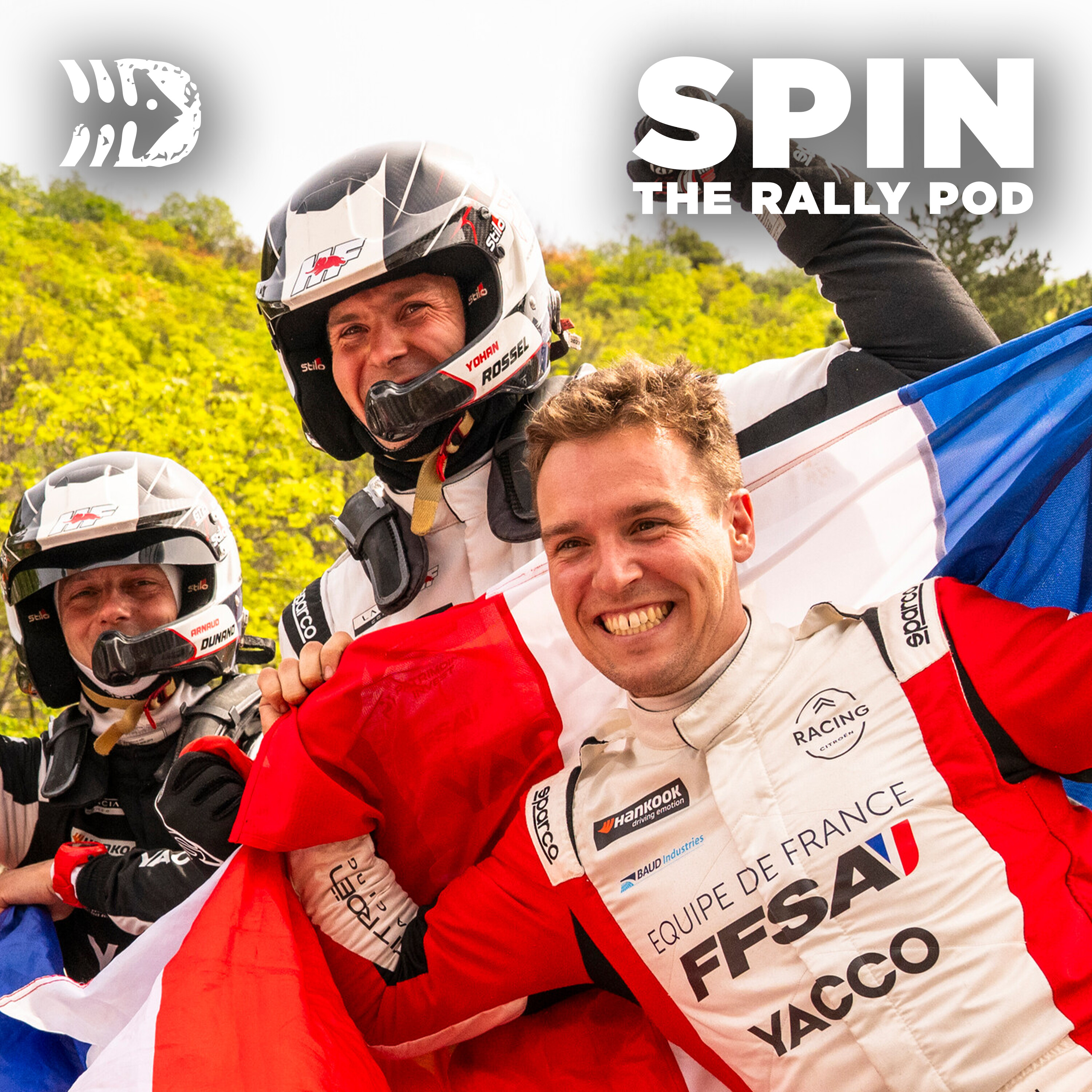
Lancia's Yohan & Léo Rossel on their relationship and rivalry
About this episode
Johan and Léo Rossel—WRC2 siblings and rivals—sit down for a playful “Johan or Léo” game that turns into a window on how they’ve built their careers. They compare school, mechanics, cooking, spending habits, and who gets into trouble, with Johan and Léo often disagreeing in small ways but agreeing on consistency and shared discipline. The conversation then shifts to their parallel rise in rallying, both supported by Stellantis and driving Lancia, aiming to challenge the top names and keep improving as they chase bigger results.
Both driving for Lancia, competing in WRC2 and even level on points in the championship as it stands, brothers Yohan and Léo Rossel join Luke Barry on SPIN, The Rally Pod to discuss their relationship on and off the stages, as well as their targets for the future.
See Privacy Policy at https://art19.com/privacy and California Privacy Notice at https://art19.com/privacy#do-not-sell-my-info.

Mitsubishi Lancer
"...ow both in wrc2 both with Stellantis both driving Lancers as well as of next week's acropolis rally grace i..."
The Mitsubishi Lancer is a regular compact car, but it’s also famous for rally racing. Rally teams use special versions of it to drive on rough roads and compete in events like the Acropolis Rally. The podcast is likely talking about who is running the Lancer in a rally series right now.
The Mitsubishi Lancer is a compact car best known in motorsport for its rally versions, where it has been used to compete in series like WRC2. In rallying, it’s discussed because its platform has supported competitive all-wheel-drive setups and has a long history of development for stages like the Acropolis Rally. The podcast mention ties it to current rally participation and the teams/drivers running Lancers in WRC2.
WRC
"my plan was to be in WRC one it's not a surprise if we don't say that but I am very very happy to to be here"
WRC means World Rally Championship. It’s the biggest rally racing series in the world, with races on different surfaces like gravel and paved roads.
WRC stands for World Rally Championship, the top level of rally racing run by the FIA. It features cars competing on mixed surfaces (like gravel and tarmac) across multiple countries and events throughout the season.
gravel
"we need to adapt a bit more the car on gravel I was not completely happy about the car in Portugal because it was not easy about the planning to anticipate the to drive more on gravel"
Gravel is loose dirt/stone used on many rally stages. Because it’s slippery and unpredictable, the car needs different setup and driving than on paved roads.
Gravel is a loose, low-grip rally surface that changes how the car accelerates, brakes, and turns compared with tarmac. Teams often adjust setup and driving strategy specifically for gravel to keep traction and stability.
tarmac
"we try to to understand very well the car on tarmac we win both our race and as Portugal come a bit too fast"
Tarmac means paved asphalt. It usually has more consistent grip than gravel, so the car and tires behave differently and you drive it differently.
Tarmac is paved asphalt, typically offering more consistent grip than loose surfaces like gravel. Rally teams still tune for it, because tire behavior, braking distances, and cornering feel can differ a lot from gravel.
testing last week
"after two days of testing last week it was very good"
They’re talking about a recent practice/testing session. In rally, teams use this time to adjust the car so it works better on the surfaces they’ll race on.
The hosts reference a recent testing session, which in rally terms is when teams evaluate car setup and performance on relevant surfaces before or between events. It’s often used to refine how the car behaves under braking, cornering, and traction changes.

Citroën C3
"you described the C3 as the grandmother compared to the Lancia didn't you you finally got your hands on this this new car you haven't driven it yet in a proper rally but how excited are you to finally get to drive the the Ipsod rally too yes I think on the Termac the Citroën it's not the problem he's really fast on this surface"
The Citroën C3 is the rally car Leo is talking about. He’s saying it feels great on one type of road surface, but gravel was harder for him last year.
The Citroën C3 is the rally car Leo is comparing to Lancia, and he’s describing how it behaves on different surfaces. He says it’s especially fast on the Termac surface, but he struggled on gravel last year.
world championship
"it's not easy to start with the new car because on the world championship you change every time the surface and the the ground"
They’re talking about the main global rally series. Since races happen on different kinds of roads, the driver has to adapt the car and how they drive each time.
The “world championship” here refers to the top-level rally series where events are held across different countries and surfaces. Because the championship schedule includes many different road types, drivers must continuously adapt the car and their driving style.
stage
"on every event like on the race next week the stage next to Lutwaki"
In rallying, a stage is a specific timed section of the route. Each stage can be different, so the driver and car may need to be adjusted for that section.
A rally stage is a timed section of road that the car runs through separately from other stages. Stages can have different surfaces and grip levels, so the car’s setup and the driver’s approach may change over the day.
Lutwaki
"on every event like on the race next week the stage next to Lutwaki"
They mention Lutwaki as the area where a timed rally section is located. Different places can have different road grip, so it changes how the car feels.
Lutwaki (spelled as in the transcript) is referenced as the location of a rally stage. Named stages/areas matter in rally because each one can have different surface texture and grip, which affects how the car should be driven and set up.
Lamia
"and on the path next to Lamia was a bit more rock with a bit more grip to use"
They bring up Lamia as another rally stage area. They’re saying the road there has different characteristics (more rock and grip), which changes how the car should be handled.
Lamia is referenced as another stage area, contrasted with the Lutwaki stage. The speaker describes it as having more rock and grip, illustrating how rally stages in different locations can demand different driving and setup choices.
grip
"was a bit more rock with a bit more grip to use"
Grip is how well the tires can hold the road. On rally stages, grip can vary a lot, so the car may feel more stable on some sections than others.
Grip is how much traction the tires have on the road surface. In rally, grip can change quickly due to loose stones, rocks, and evolving conditions, which is why drivers discuss having “more grip to use” on certain stages.
setting
"and the plan now is to to be able to fight and don't change the setting every time during the day"
In rally context, “setting” refers to the car’s adjustable setup (for example suspension and differential behavior) chosen for the day’s conditions. The driver’s goal here is to avoid changing the setup constantly, because frequent changes can make it harder to build confidence and consistency.
Sardinia
"um I would say a stage like trulla or um or montellerno in sardinia uh not start first to be [2996.3s] honest around the 10 10 position and uh yeah the car during this period was completely crazy"
Sardinia is where a lot of rally stages are run. It’s known for tricky gravel roads, so driving there is a good test of control and confidence.
Sardinia is an island in the Mediterranean that hosts famous rally events, including stages with very rough gravel and high-speed sections. In rally talk, “Sardinia” often implies a specific style of loose-surface driving where pace notes and tire choice matter a lot.
Trulla
"um I would say a stage like trulla or um or montellerno in sardinia uh not start first to be [2996.3s] honest around the 10 10 position"
Trulla is the name of a specific rally stage. A stage is a timed section of road, and different stages feel very different depending on the terrain.
Trulla is a named rally stage location referenced in the context of Sardinia. Named stages are specific timed sections with their own surface, elevation changes, and typical grip levels.
Montellerno
"um I would say a stage like trulla or um or montellerno in sardinia uh not start first to be [2996.3s] honest around the 10 10 position"
Montellerno is the name of a particular rally stage. It’s one of those timed sections where the road layout and surface make it a unique driving challenge.
Montellerno is another named rally stage location mentioned alongside Trulla in Sardinia. Because it’s a specific stage name, it implies a particular route and driving challenge rather than just “a rally in Sardinia.”
ice
"the I don't know I think sweet then yes that would be an incredible way to learn driving on ice [3059.6s] though if you do it in that car that would be really fun wouldn't it"
Driving on ice is very slippery, so the tires can’t grip well. In rallying that means you have to be extra gentle with steering and gas to keep the car from sliding.
Ice driving in rallying is a specialized discipline where traction is extremely limited and the car can slide even with small throttle or steering inputs. Drivers typically rely on very smooth inputs and careful pace-note execution to avoid sudden loss of control.
Request an Explanation
Heard something you'd like explained? We'll add it to this episode.
Sign in to request explanations for terms you heard.
Want to learn more?
Browse our glossary for plain-English explanations of automotive terms, jargon, and concepts.
Help improve this episode
See something that's not quite right? Our annotations are AI-generated and can sometimes miss the mark. Click the flag icon on any annotation to suggest a correction.