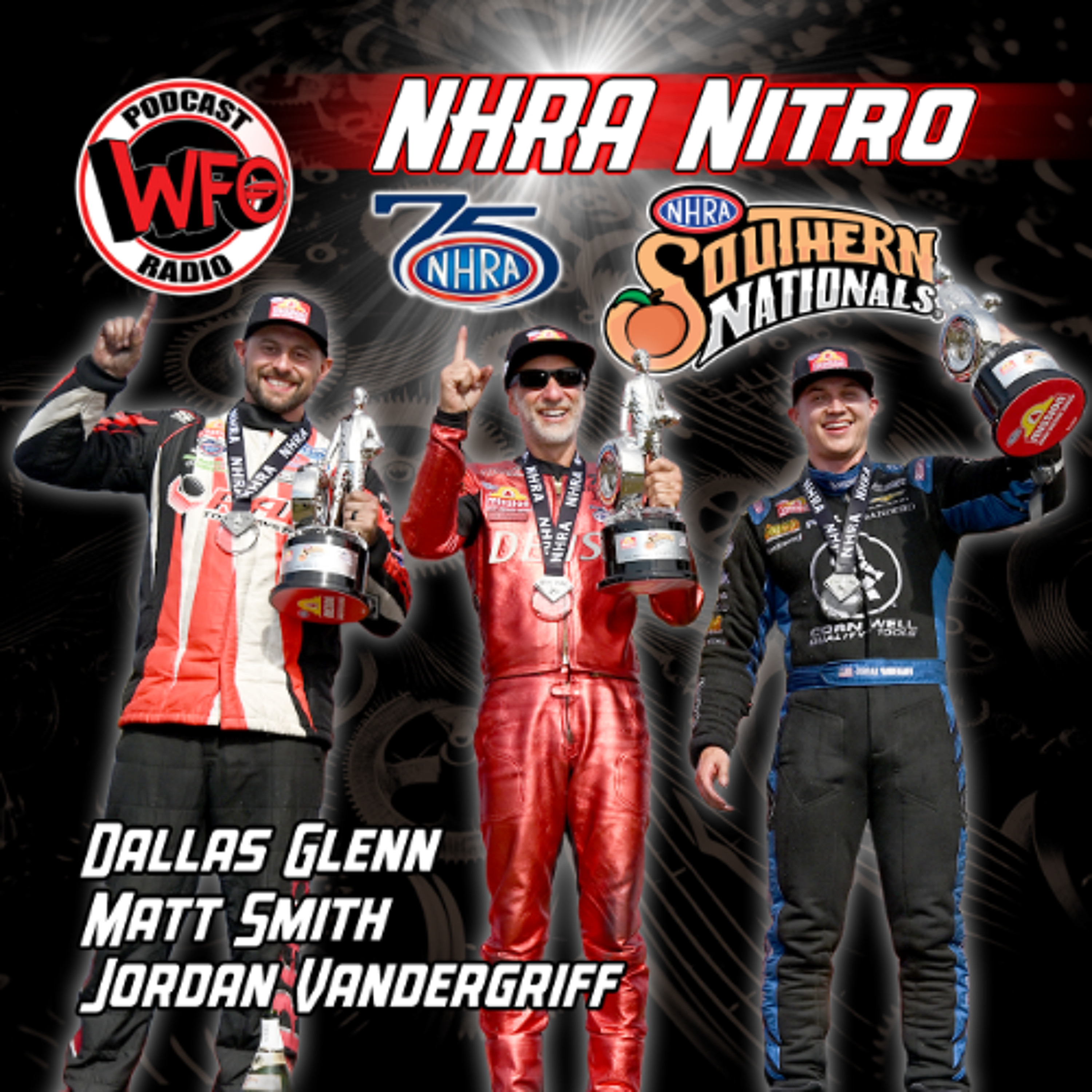
Jordan Vandergriff, Dallas Glenn and Matt Smith join WFO after NHRA Southern Nationals
About this episode
Jordan Vandergriff’s long road back to the cockpit pays off with his first Funny Car win, and he talks through the emotion, the team effort, and the broadcast experience that helped him get there. Dallas Glenn then breaks down a chaotic Pro Stock final, from tire shake and tricky shifting to the importance of lane choice and changing rules. Matt Smith closes with motorcycle development, backup-engine drama, and a look at how tight the class is getting heading toward Chicago.
diesel particulate filter
"Looking to replace your OEM diesel particulate filter or diesel oxidation catalyst? Look no further than DPFXfit..."
A diesel particulate filter is a device that catches the smoky soot from a diesel engine’s exhaust. If it gets clogged, the car can run worse and may need service or a replacement.
A diesel particulate filter (DPF) traps soot particles from a diesel engine’s exhaust. Over time it can clog and may need cleaning or replacement to restore proper exhaust flow and emissions control.
diesel oxidation catalyst
"Looking to replace your OEM diesel particulate filter or diesel oxidation catalyst? Look no further than DPFXfit..."
A diesel oxidation catalyst is an exhaust part that helps clean up diesel fumes. It works by changing some of the harmful stuff into less harmful emissions.
A diesel oxidation catalyst (DOC) is an exhaust emissions component that helps convert certain pollutants in diesel exhaust into less harmful gases. It’s often paired with a DPF as part of a diesel emissions system.
DPFXfit
"Look no further than DPFXfit, a complete line of aftermarket diesel particulate filters and diesel oxidation catalyst designed as an exact fit OEM replacement..."
DPFXfit is a company that sells aftermarket exhaust emissions parts for diesel trucks. They’re advertising filters and catalysts meant to replace the factory pieces.
DPFXfit is an aftermarket supplier marketing complete diesel particulate filter and diesel oxidation catalyst replacements. The segment frames it as a direct-fit alternative to OEM emissions components.
OEM replacement
"designed as an exact fit OEM replacement with all makes coverage for light, medium and heavy duty trucks."
An OEM replacement is an aftermarket part made to fit and work like the original factory part. The goal is to swap it in without special custom work.
An OEM replacement is a part intended to match the original equipment manufacturer’s fitment and function. In practice, it means the aftermarket part is designed to install like the factory component rather than requiring major modifications.
FTI
"For more than a decade, FTI has strived to become the leader in the aftermarket, performance, transmission and converter industry."
FTI is a company that makes aftermarket parts for performance and drivetrain systems. In this segment, they’re talking about expanding their reach and product support.
FTI is referenced as a company focused on aftermarket performance and drivetrain-related products, including transmissions and torque-converter components. The hosts describe it as expanding its distribution and resources through a partnership.
top fuel funny car
"We've joined forces with McLeod driveline components under the leadership of top fuel funny car pilot Paul Lee..."
Top Fuel Funny Car is a drag racing category. These cars are built for maximum acceleration over a short race distance, and they use specialized high-stress drivetrain parts.
Top Fuel Funny Car is a drag racing class where purpose-built cars run extremely high power levels and short, straight-line sprints. The mention signals the segment’s racing context and the kind of drivetrain components used at that level.
McLeod driveline components
"We've joined forces with McLeod driveline components under the leadership of top fuel funny car pilot Paul Lee..."
McLeod driveline components is a company that makes drivetrain parts used in performance and racing. The segment says FTI teamed up with them to expand capabilities.
McLeod driveline components is mentioned as a partner in a business “joined forces” scenario with FTI. In the performance world, McLeod is known for drivetrain hardware used in racing applications.
NHRA Nitro
"Hey, everybody. WFO Radio NHRA Nitro is back. I'm Joe Costello and boy, do we have a great show for you."
This part of the show is about NHRA drag racing. They’re about to talk about the winners from the recent event.
This is a segment framing the show around NHRA drag racing. It sets up the episode’s focus on winners from the recent NHRA event.
Funny Car Pro Stock and Pro Stock Motorcycle
"We've got the winners from the Southern Nationals, the South Georgia Motorsports Park in Funny Car Pro Stock and Pro Stock Motorcycle."
These are different NHRA racing classes. They include cars in Funny Car and Pro Stock, plus separate motorcycle racing in Pro Stock Motorcycle.
These are NHRA drag racing categories. Funny Car and Pro Stock are different classes of cars, while Pro Stock Motorcycle is the motorcycle counterpart with its own rules and performance targets.
South Georgia Motorsports Park
"We've got the winners from the Southern Nationals, the South Georgia Motorsports Park in Funny Car Pro Stock and Pro Stock Motorcycle."
South Georgia Motorsports Park is the race track where this event happened. They’re talking about the winners from that specific meet.
South Georgia Motorsports Park is the drag strip venue where the Southern Nationals took place. The hosts use it to anchor which event’s winners they’re discussing.
John Force Racing
"We're going to speak to Jordan from John Force Racing moments from now."
John Force Racing is a famous drag racing team in NHRA. The hosts are connecting Jordan to that team’s racing program.
John Force Racing is a well-known NHRA team associated with John Force and his family’s drag racing program. The segment says they’ll speak to Jordan from John Force Racing, tying the guest to that racing brand.
Top speed
"Matt Smith, no such issues for the pro stock motorcycles set the top speed. All kinds of great running this weekend with pro stock bike and Matt Smith is your winner."
Top speed is the fastest the bike or car gets during its run. It helps show how strong the vehicle is as it accelerates down the track.
In drag racing, top speed is the highest velocity the vehicle reaches during a run, typically measured near the end of the quarter-mile. It’s a key performance indicator alongside elapsed time (ET) and trap speed-related metrics.
NHRA drag racing
"The first of four new venues here in the 75th season of NHRA drag racing. I'm super excited."
NHRA drag racing is the organized drag-racing series run by the NHRA. It has set classes and rules, and the season includes different tracks.
NHRA drag racing refers to events run under the National Hot Rod Association, which organizes standardized drag racing classes and rules. The episode references the NHRA’s season and new venues, highlighting how the series schedule shapes what tracks racers compete on.
75th season
"The first of four new venues here in the 75th season of NHRA drag racing. I'm super excited."
“75th season” means this is a big anniversary year for NHRA drag racing. They’re talking about it in connection with new tracks on the schedule.
The “75th season” is a milestone season count for NHRA drag racing, indicating the series has been running for decades. In this segment, it’s used to frame the excitement around new venues joining the schedule.
torque converters
"You already heard from Jesse and the fine folks at FTI performance transmissions and torque converters. I'll tell you a little bit more about Larisse Motorsports insurance later on, but your stuff should be covered."
A torque converter is an automatic-transmission part that uses fluid to send power from the engine to the drivetrain. Racers use the right one to help the car launch harder and hook up better off the line.
A torque converter is a fluid coupling used in automatic transmissions that transfers engine power to the transmission. In drag racing, it’s often chosen/tuned to improve launch by multiplying torque at low speeds and matching stall speed to the engine.
Total seal piston rings
"Total seal piston rings. The leader in ring seal technology. Thank you."
Piston rings are the parts that seal the gap between the piston and the cylinder wall. Total Seal’s rings are designed to seal better so the engine holds compression and runs more consistently.
Total Seal piston rings are aftermarket rings designed to improve “ring seal,” which is how well the rings seal combustion gases in the cylinder. Better sealing can reduce blow-by, help compression stay up, and improve consistency—especially important in high-stress drag racing engines.
ring seal technology
"Total seal piston rings. The leader in ring seal technology. Thank you."
Ring seal technology is about making the piston rings seal tighter inside the engine. That helps keep combustion gases where they belong, which can improve power and consistency.
“Ring seal technology” refers to designs/features of piston rings that improve how tightly they seal the cylinder. In performance engines, improved ring seal can mean less blow-by (combustion gases leaking past the rings) and more stable cylinder pressure.
Redline synthetic oil
"Redline synthetic oil, Bernie's speed shop. That's Josh Hart."
Red Line is a synthetic engine oil brand. Synthetic oil is designed to handle heat and hard driving better than many conventional oils.
Red Line is a brand of synthetic engine oil being used as a performance lubricant reference. Synthetic oils are formulated to better resist breakdown under heat and stress, which matters for drag racing where engines see high loads.
Bernie's speed shop
"Redline synthetic oil, Bernie's speed shop. That's Josh Hart. That's Jordan's teammate, Josh Hart over there."
Bernie’s Speed Shop is being mentioned as a local shop/sponsor connected to the products they’re talking about.
Bernie’s Speed Shop is mentioned as the place associated with Redline synthetic oil. In this segment, it’s a sponsor/partner reference rather than a technical deep dive.
Frank Hawley's drag racing school
"Our great friends at Frank Hawley's drag racing school. This is all like related to Jordan. He went to Frank Hawley's drag racing school."
This is a drag racing training program. The hosts bring it up because Jordan attended and it’s part of the racing background they’re discussing.
Frank Hawley’s drag racing school is referenced as a training resource connected to the episode’s drag-racing community. The mention is about education/experience rather than a specific technical component.
summit racing equipment
"Course Fogget is now available at Motor State in addition to summit racing equipment. I prefer you order from summit just because they put me in the catalog."
Summit Racing Equipment is a company that sells performance parts for cars and trucks. The host says they prefer ordering from them.
Summit Racing Equipment is referenced as a parts retailer the host prefers for ordering. The context is sponsorship/distribution, not a technical discussion of any specific component.
Motor State
"Course Fogget is now available at Motor State in addition to summit racing equipment. I prefer you order from summit just because they put me in the catalog."
Motor State is a store that sells racing/auto parts. They’re mentioned because they now carry the same product line too.
Motor State is mentioned as a retailer carrying a product line (“Course Fogget”) in addition to Summit Racing. This is a distribution/sponsorship note rather than a technical explanation.
Cornwall quality tools
"But to get this opportunity with John Force racing and Cornwall quality tools and having John believe in me."
Cornwall Quality Tools is a company that’s supporting the racing effort. In this quote, it’s part of the team’s backing.
Cornwall Quality Tools is referenced as a sponsor/partner in the racing context. The mention is about support around the speaker’s opportunity rather than a technical automotive detail.
professional motor sports
"You've got a great situation, but this is different league. This is professional motor sports. You can you can come in with some swagger and then you may rapidly realize like, oh my gosh, there's so much that I don't know."
They mean racing at the top, where it’s not just a hobby—there’s a lot more pressure and competition. The speaker is saying it felt like a whole new level.
“Professional motor sports” refers to racing at the highest competitive level, where teams run full-time operations, specialized cars, and structured qualifying and elimination formats. The speaker contrasts it with their earlier experience, emphasizing the jump in competition and learning curve.
rookie year
"I did, you know, like, you know, my rookie year in 2019, you know, was driving for my family and, you know, on a part time schedule, but things went great."
A rookie year is someone’s first season in a new, tougher level of racing. The speaker is describing their first year and how it went well at first.
A “rookie year” is a driver’s first season competing at a higher level, often with fewer established results and more learning about car setup, race strategy, and track conditions. Here, it’s tied to the speaker’s first year in 2019 and their early success before later setbacks.
final round
"we were winning and we were doing well and going rounds, going on my first final round back then and everything was great."
The final round is the last race of the event. Reaching it means you were one of the last competitors left.
In drag racing, the “final round” is the last elimination race of an event, where the winner is decided. The speaker mentions reaching their first final round as a milestone during their early career.
starting line
"There were times where I was sitting on the starting line doing my reporting job and I was watching cars good on the track in my golf cart."
In drag racing, the starting line is the exact spot where the cars line up before they launch. It’s where the run begins and everything is set up for the start.
In drag racing, the starting line is the marked area where cars stage and begin their run. It’s where drivers line up, build pre-launch momentum, and prepare for the timed start.
pit
"But there was a few times throughout the day, I was in the back of my pit looking across, you know, just into Georgia into the state of Georgia away from the racetrack."
The pit is the team’s area near the track where they work on the car between runs. It’s where mechanics and crew prepare and make changes.
A pit is the area off the track where a racing team parks the car and handles day-to-day work during an event. Teams use it for repairs, adjustments, and strategy between runs.
on rails
"[632.2s] It was it was just on rails. [633.5s] It was literally on rails all weekend after first round. [636.0s] I think that it was that was the smoothest run I've had in this funny car."
“On rails” just means the car feels super stable and stays pointed straight. In drag racing, that’s a good sign that the tires and setup are working well.
“On rails” is racing slang meaning the car tracks straight and predictably with minimal wandering or instability. In drag racing, that usually points to good traction, correct tire prep/pressure, and a setup that keeps the car stable under acceleration.
lane choice
"[648.7s] That was when I was like, OK, I think we have the car that can do it here today. [653.0s] So keeping lane choice was super important for us. [655.9s] We were able to do that and keep the right lane and it paid off."
Lane choice means picking which lane on the drag strip you’ll run in. If one lane has better grip, your car can launch and stay straight more easily.
“Lane choice” refers to deciding which side of the drag strip (left vs right lane) to run in, based on track conditions and how the car responds. Track grip can vary between lanes, so choosing the better lane can improve straightness and consistency, which the speaker says “paid off.”
tested
"[698.4s] You tested in John's car. [700.1s] Some said and I want you to address this."
In drag racing, “testing” usually means running the car in controlled practice sessions to evaluate setup changes like tire pressure, gearing, and tune. The goal is to find a combination that produces consistent elapsed times and stable launches.
Wally four races
"[709.1s] We are with holding the Wally four races in. [711.8s] I you're ahead of the curve."
“Wally” is the name of the trophy NHRA gives to winners. “Wally four races” here sounds like a group of NHRA events where drivers are trying to win those trophies.
“Wally” refers to the NHRA Wally trophies awarded to event winners, and “Wally four races” likely means a specific set of NHRA events where those trophies are at stake. In this context, it’s about the schedule and the pressure of competing for those wins.
top fuel car
"I drove, you know, I finished in 2019 on my top fuel car. I drove Tony Schumacher's Dragster in a test in 2022 one run and we went like 72, 74 at like 320 something."
“Top Fuel” is a type of NHRA drag-racing car. It’s designed to launch extremely hard and go as fast as possible over a short straightaway.
A “Top Fuel” car is the NHRA drag-racing class built around a purpose-made dragster/drag car that uses a supercharged, alcohol-fueled engine. The goal is to accelerate as hard as possible over a short distance, with the car tuned for traction and stability at extreme speeds.
alcohol funny car
"we tested and hit, or we drove, I drove his alcohol funny car. We did eight runs, something like that."
An “alcohol funny car” is a drag-racing funny car that uses alcohol fuel instead of regular gas. The engine and tune have to be set up differently so it can make power reliably.
An “alcohol funny car” is a funny car that runs on an alcohol-based fuel (commonly methanol) instead of gasoline. Alcohol-fueled drag cars often have different tuning priorities—especially around fuel delivery and engine calibration—to produce strong power and consistent runs.
Chris Cunningham
"“I do want to talk about Chris Cunningham... I talked to Chris and Chris Cunningham.”"
Chris Cunningham is the person they’re talking about most in this segment. They’re describing his presence and how he’s been involved with racing.
Chris Cunningham is referenced as a key person in the conversation, including his willingness to talk and his role in the racing community. In this context, he’s treated like a notable driver/competitor whose perspective matters.
ETS
"“Let's do the round by round cause I'm looking at the ETS and, uh, you know, you're seven, you're 76 first round against Jeff Oren.”"
“ETS” is an abbreviation for the specific drag racing class or series they’re talking about. It tells you what rules and car category the race is using.
“ETS” is a racing class/series abbreviation used in drag racing contexts. It typically identifies the specific category of cars and rules the event is running.
round by round
"“Let's do the round by round cause I'm looking at the ETS and, uh, you know, you're seven, you're 76 first round against Jeff Oren.”"
In drag racing, the event is split into multiple elimination rounds. “Round by round” means they’re talking about each matchup in order, not the whole event at once.
“Round by round” describes how drag racing events are broken into successive elimination rounds. Each round is typically a head-to-head race, and advancing depends on winning that specific matchup.
first round
"“...you're seven, you're 76 first round against Jeff Oren. They gave you all you could handle 95 zero on the track.”"
“First round” is the first head-to-head race in the elimination bracket. If you win, you move on to the next round; if you lose, you’re done for the day.
“First round” is the opening elimination matchup in a drag race bracket. Your performance in that race determines whether you advance to the next round.
95 zero
"“...They gave you all you could handle 95 zero on the track.”"
In drag racing, they measure how fast the car runs using elapsed time (ET). “95 zero” sounds like a shorthand ET number they’re reading off the results.
“95 zero” is shorthand for a drag-racing elapsed time (ET) reading, where “zero” refers to the decimal portion of the time. It’s a way of quoting how quickly a car completes the timed distance.
super comp
"when I first went to Frank Holly's drag racing school for super comp in the very beginning back in 2018,"
“Super Comp” is a specific drag racing class with rules about what the car can be and how it’s set up. The training helps drivers learn how to launch and drive these cars effectively for that class.
“Super Comp” is a class in drag racing (NHRA-style) for cars that meet specific rules for engine and vehicle setup. Drivers train in the class because tuning, traction, and shifting strategy are tightly linked to the rules and typical performance targets.
second round
"when we did it again, you know, I think we ran 95 six [1013.8s] at 3 32 in the second round."
“Second round” is the next head-to-head race after the first one. Teams try to make small changes so the car runs the same way again.
“Second round” is the next elimination matchup after first round. By this point, teams often refine adjustments based on what the car did in round one, aiming for repeatable performance.
on rinse and repeat
"it was like, okay, this thing, you know, this thing's on rinse and repeat [1018.9s] right here."
“Rinse and repeat” here means the goal is to run the car the same way again and again. If the car keeps behaving the same, you’re more likely to advance.
“Rinse and repeat” is a racing shorthand for achieving consistent runs—doing the same procedure and getting similar results again. In drag racing, that usually means the car is stable on launch and the tune works across multiple passes.
bracket car
"You had yourself a bracket car... And you went through Spencer hide with 96 and pretty much a bracket car at that point."
In drag racing, a “bracket car” is tuned and driven to be consistent. The idea is to hit your target time as closely as possible and then beat the other car by being closer to your own prediction.
A “bracket car” is a drag-racing setup built around bracket racing rules, where the goal is to run a consistent elapsed time (ET) and beat the opponent by staying closer to a predicted target. Instead of chasing the absolute fastest pass, the car and driver focus on repeatability and reaction-time/ET accuracy.
car to beat
"But, um, yeah, we, we, you know, we just had the car to beat, I believe."
“Car to beat” just means the other racers think that car is the toughest one in the field right now. Everyone else is trying to beat it in the next runs.
“Car to beat” is drag-racing slang for the competitor (or setup) that’s currently performing best and is considered the one others must beat. It usually implies the car is running strong ETs and has momentum in the round.
97
"You know, we were coming into that second round and Spencer had ran a 97 in that left lane on the first round against Austin."
In drag racing, numbers like “97” usually refer to how many seconds the car took to run the track. Faster elapsed time (ET) means the car got down the finish line quicker.
A “97” in NHRA-style drag racing is almost certainly a 9.7-second elapsed time (ET) for the run. ET is the primary timing metric used to compare how quickly a car completes the quarter-mile (or the track’s race distance).
elimination bracket
"[1177.3s] That is an intense setup to the final round. [1179.4s] So walk me through that final. [1180.9s] Yeah, definitely."
An elimination bracket is the tournament format where you keep moving forward by winning. If you lose, you’re usually out of the event.
An elimination bracket is the tournament structure where racers advance by winning each head-to-head matchup. Losing a round typically knocks you out, which is why setups for later rounds can get very strategic.
qualified
"I saw a post on Instagram after the race was over, but you know, something came up [1189.4s] on my feed of where they all qualified and it was like, JR was one. [1193.3s] I think Doug was one and Sean was two."
Qualifying is the practice-and-timing part before the head-to-head races. Your qualifying results help set up who you race in the later rounds.
In drag racing, qualifying determines the starting order for eliminations. Drivers post times/scores in qualifying runs, and those results affect who they face in later rounds like semis and finals.
pedaled it
"So I watched him and what they did in the right, you know, they went up and smoke [1212.1s] and he pedaled it and you want it. [1213.3s] Now I was in the car thinking, you know, that's, that's a driver right there."
“Pedaled it” means the driver briefly backs off the gas and then reapplies it to get control again. It’s often used when the car starts to spin or lose traction.
“Pedaled it” is drag-racing slang for briefly easing off the throttle and reapplying it in pulses to regain traction or control. It’s commonly used when the car starts to slip or lose grip under acceleration.
left lane
"And, you know, we knew that, that they weren't going to be anything to mess [1227.5s] with in that left lane either. [1229.4s] So yeah, Titanic matchup and honestly super, super honored, super grateful"
Drag strips run two lanes side-by-side. Sometimes one lane has better grip than the other, so it can affect how well a car launches.
In drag racing, the track is split into lanes (typically a left and right lane) for side-by-side competition. Lane choice and conditions can matter because traction and surface grip may differ between lanes.
funny car drivers
"It really means a lot to me. [1245.4s] You know, you know, Joe, coming into this class at the beginning of this year, [1250.6s] I just wanted, you know, I wanted to feel like I belong or I wanted to prove"
“Funny car” is a type of drag racing class. The cars are built for very fast launches, and the drivers have to handle traction and control under hard acceleration.
“Funny car” is a specific class of NHRA drag racing with purpose-built, highly modified cars designed for very high acceleration and short runs. Drivers in this class are specialized for managing traction, power delivery, and stability at extreme speeds.
NHRA on Fox
"He wants to know if you think your NHRA on Fox experience made you a better driver, I think it made you a better interview."
This is NHRA drag racing shown on Fox. The host is saying that doing that job helped them learn how the sport works.
“NHRA on Fox” refers to the broadcast coverage of NHRA drag racing on the Fox TV network. The discussion focuses on how broadcast work trains someone to understand the sport’s teams, drivers, and race-day variables.
drivers drove
"...learning about the sport and how drivers drove and how teams worked and how crew chiefs thought..."
In drag racing, how the driver drives—especially at launch—can make a big difference in performance. Even small changes in throttle and timing can affect how well the car hooks up.
In drag racing, “how drivers drove” includes launch technique and throttle control that directly affect traction and elapsed time. Small differences in driving inputs can change how the car transfers power to the track.
crew chiefs
"...how teams worked and how crew chiefs thought and what the race track was doing..."
A crew chief is the team member who calls the shots on strategy and car setup. They work with the rest of the crew to decide what to change between runs.
A crew chief is the lead strategist for a racing team, responsible for car setup decisions and race strategy. They coordinate with the crew and interpret data to decide what changes to make between runs.
track temperatures
"...what the race track was doing, what kind of, you know, track temperatures or conditions are going to help and what they're going to do, when, where."
In drag racing, the temperature of the track matters because it changes how well the tires grip the surface. That can affect how well the car launches and accelerates.
Track temperature is a key drag-racing variable because it affects tire grip and how the car hooks up at launch. Teams often adjust strategy and setup based on conditions like how hot (or cool) the surface is.
track conditions
"...what the race track was doing, what kind of, you know, track temperatures or conditions are going to help and what they're going to do, when, where."
Track conditions are basically how the track surface is behaving that day—how slippery or grippy it is. That can change how the car performs and what the team needs to do for each run.
Track conditions describe the real-world state of the racing surface (for example, grip level, moisture, and rubber buildup). In drag racing, these conditions influence traction and can change how teams plan launches and tune the car for each run.
clutches
"I would listen to, I would listen to idols. [1327.6s] I would listen to the clutches coming out on funny cars on drafters and feeling the tempo of how people drove."
A clutch is what helps transfer power from the engine to the drive wheels. In drag racing, how you engage it at launch can make the car hook up or bog down.
In drag racing, “clutches” are the friction devices that connect and disconnect the engine’s power to the drivetrain during launches. The timing and feel of clutch engagement strongly affect how smoothly the car accelerates and how much traction you get off the line.
funny cars
"I would listen to, I would listen to idols. [1327.6s] I would listen to the clutches coming out on funny cars on drafters and feeling the tempo of how people drove."
“Funny cars” are a type of drag race car. They’re built specifically for straight-line racing and are designed to launch hard over a short distance.
“Funny cars” are a specific NHRA drag racing class with purpose-built, highly modified cars. They use a lightweight body over a purpose-built drag racing chassis and typically run very large engines for short, explosive acceleration.
drafters
"[1327.6s] I would listen to the clutches coming out on funny cars on drafters and feeling the tempo of how people drove. [1332.9s] And so I took everything I've learned and applied it now."
“Drafters” are drivers who take advantage of drafting. Drafting means staying close behind another car to reduce air resistance and potentially go faster.
“Drafters” here refers to drivers who use drafting—positioning close behind another car to reduce aerodynamic drag. In drag racing, drafting can help the trailing car maintain speed and improve elapsed time depending on track and conditions.
burnouts
"[1344.6s] I think this race in the middle of Charlotte, coming into this race, [1348.8s] I'm really starting to refine what I want to do on burnouts, packing up and staging and all that."
A burnout is when the driver spins the tires on purpose right before the run. It warms the tires so they grip better when you launch.
“Burnouts” are deliberate tire-spinning maneuvers used to heat and clean the tires before a drag run. Hotter, more pliable tires can improve traction and help the car launch harder and more consistently.
packing up
"[1348.8s] I'm really starting to refine what I want to do on burnouts, packing up and staging and all that. [1352.9s] So it's starting to come together."
“Packing up” sounds like the pre-race routine right after the burnout. It’s about getting the car ready and set so the launch goes as planned.
“Packing up” in drag racing typically refers to preparing the car and tires for the run after burnouts—often involving bringing the tires up to the right condition and setting up the car for the next step. The exact procedure can vary by team and class, but it’s part of the pre-launch routine.
staging
"[1348.8s] I'm really starting to refine what I want to do on burnouts, packing up and staging and all that. [1352.9s] So it's starting to come together."
Staging is how you line up at the start line before the race begins. You’re positioning the car so it can launch at the right time when the lights start.
“Staging” is the process of positioning the car at the start line so it can be released at the correct moment. In drag racing, drivers stage to synchronize with the tree’s lights and to ensure a consistent launch.
race control
"I got the race control perspective. ...no, first off, I want to apologize to the NHRA to race control, the NHR on Fox..."
Race control is the group of officials who run the event and make sure the rules are followed. They also handle timing and any calls that need to be made during the race.
In NHRA drag racing, “race control” is the officials team that monitors the event and enforces the rules. They manage things like timing, staging/starting procedures, and decisions when there’s a dispute or safety concern.
launch
"It launches, it launches clean and then all of a sudden I'm going right..."
The launch is how the car gets moving right after the start. That’s when tire grip and throttle control decide whether it goes straight or starts to slide.
The launch is the car’s initial acceleration off the starting line, where traction and drivetrain behavior matter most. Small changes in tire grip, throttle application, and vehicle setup can cause the car to hook up straight or start drifting.
shoving me over the wall
"...come to find out a drop the hole so that was shoving me over the wall and I was keeping my foot in..."
They’re saying the car started pushing sideways toward the track wall. That usually means the tires weren’t gripping evenly, so the car didn’t stay pointed straight.
What the speaker describes is a traction/handling issue during the run: the car is being forced sideways toward the wall. In drag racing, this often happens when the tires lose grip unevenly or when the car’s torque transfer and suspension geometry cause a pull or drift.
cross the finish line
"And I cross the finish line and, you know, shoots come out, breaks on and I get on the radio..."
Crossing the finish line means the race run is over. After that, the track’s systems and signals kick in and the car starts slowing down.
Crossing the finish line in drag racing is the point where the run is officially complete and timing/termination systems trigger. The speaker’s mention of finish-line cues (shoots, breaks on) suggests the car’s post-run sequence and safety/track signals.
breaks on
"...shoots come out, breaks on and I get on the radio and I go, did we win?"
This sounds like the brakes being applied right after the run. It’s how the driver slows the car down safely once they’re past the finish.
“Breaks on” appears to refer to the brakes being applied after the run. In drag racing, drivers often lift or apply braking immediately after the finish to slow safely, especially if the car is still unstable or drifting.

pro mod cars
"Sometimes, and I said it in the tower, I said, Hey guys, you know, sometimes you just got to go with it. And that was one, we had pro mod cars on the starting line and they're like, you know, I apologize too because I thought, you know, they put me last."
“Pro Mod” is a drag-racing category. It’s for heavily modified cars built to go extremely fast down the strip.
“Pro Mod” refers to a specific NHRA drag racing class for highly modified, purpose-built cars. These cars are designed for very fast acceleration and typically run on the drag strip under strict class rules.
tractors going
"I literally, I'm running on the track and I look up and I see the tractors going and I'm like, huh, I wonder where the tractors are going."
They’re talking about track vehicles/equipment moving around the strip. Seeing them is a clue that the event is still in progress, not over after their run.
“Tractors” in this context likely refers to track equipment used to prepare or manage the drag strip between runs. The speaker notices them while they’re on track, which signals the event isn’t finished and other cars are still staged.

Space Chariots
"...son Logan, who had his final race, perhaps played chariots of fire."
“Space Wagon” sounds like a nickname for a car, not a typical official model name. In a podcast, it’s probably used to describe a wagon-style vehicle that looks unusual or has a fun theme. More details from the episode would be needed to identify the exact make and model.
“Space Wagon” isn’t a standard, widely recognized car model name in mainstream production lineups, so in a podcast it’s likely being used as a nickname or playful reference to a vehicle with a distinctive, space-age style or theme. It may come up in a story or segment where the host is describing a particular car’s look, vibe, or role in an event. Without more context, the key significance is the themed or standout nature of the vehicle being discussed.
Larisse Motorsports Insurance
"I do want to tell you guys about the fine folks at Larisse Motorsports Insurance. This is for racers. If you've got a race car and equipment... they can provide a policy that covers it all."
Larisse Motorsports Insurance is an insurance company that specializes in covering racing-related stuff. They’re pitching it as coverage for race cars, tools, and other track equipment.
Larisse Motorsports Insurance is a motorsports-focused insurance provider. The hosts describe it as offering coverage tailored to racers, including policies that can cover race cars, equipment, and pit-vehicle needs.
limited exclusions
"the thing about their policies that attracted me was the limited exclusions like the lack of exclusions."
“Limited exclusions” means the policy has fewer “we won’t cover that” situations. So it’s more likely to pay when something happens.
“Limited exclusions” means the insurance policy has fewer situations it refuses to cover. In other words, the policy is designed to exclude less of what racers might need coverage for.
friction
"more friction than any other part of the engine. More friction and temperature means more wear and less horsepower."
Friction is the “drag” between moving engine parts. More friction usually means more heat and faster wear, which can hurt how well the engine performs.
In an engine, friction is the resistance to motion between moving parts (like piston components and cylinder walls). Higher friction typically increases heat and wear, which can reduce efficiency and power output.
piston ring design
"The Total Seal knows how to reduce friction and wear through innovative piston ring design. If it takes a piston, Total Seal could build a better ring."
Piston rings are small metal parts on the piston that help keep combustion gases from leaking and help manage engine oil. Better ring design can reduce friction, which helps the engine last longer.
Piston rings are the thin metal rings on a piston that seal the combustion gases and help control oil use. “Piston ring design” refers to how those rings are shaped and engineered to reduce friction and wear while maintaining sealing performance.
Drag Race Bracket Bonanza
"Drag racing fans, check out Drag Race Bracket Bonanza. It's the free, family-friendly fantasy bracket game."
This is a fantasy bracket game connected to drag racing. You pick winners after qualifying and play along with the events.
Drag Race Bracket Bonanza is a bracket-style fantasy game tied to drag racing events. Listeners are encouraged to make picks after qualifying and compete across pro classes.
WFL Radio League
"But that's why we run a league. The WFL Radio League is open and we encourage you to dive in, jump in, be a part of it."
The WFL Radio League is a way for listeners to join a group competition for the fantasy bracket game. They’re encouraging people to sign up and play.
The WFL Radio League is a community/competition layer for the fantasy bracket game mentioned earlier. The hosts invite listeners to join and participate.
factory hot rods
"All right, pro stock, factory hot rods, my favorite class,"
They mean race cars that start from regular, production models, not one-off custom builds. Then teams modify them to race.
“Factory hot rods” is a fan-style way of describing race cars that are based on production models and built to compete in classes like Pro Stock. The key idea is that the cars start from a recognizable factory platform, then get heavily developed for racing.
Lucas Oil Racers
"from bracket racers to sports and racers [1992.0s] to Lucas Oil Racers and a guy who's done all that."
This is a racing category or group tied to Lucas Oil sponsorship. It usually means a specific set of competitors and rules within the event.
“Lucas Oil Racers” refers to a racing group/class associated with Lucas Oil as a sponsor. In NHRA-style events, sponsorship-backed classes or series often have their own rules and competition structure.
transmission sliders
"...and not completely destroying your clutch or your engine or whatever your transmission sliders, it's tough."
“Transmission sliders” are internal parts inside the gearbox that physically move to select gears. If you shift at the wrong time—especially under hard launch conditions—you can damage them.
“Transmission sliders” are the internal shift components that move to engage different gears. In racing transmissions, these parts are stressed by aggressive shifting and can be damaged if the driver forces the gearbox out of sync with vehicle motion and engine speed.
60-foot
"So 105, 60 foot in the final, that's what I told you in the winter circles. It's like 105. How do you soften up a pro stock car to a 105, 60 foot and get it down there?"
In drag racing, “60-foot” is how fast the car gets down the track’s first 60 feet. Faster 60-foot times usually mean the launch was better and the car hooked up well right away.
In drag racing, the “60-foot” time measures how long it takes the car to cover the first 60 feet from the start line. It’s a key indicator of launch quality—traction, clutch/torque management, and how well the car stays in the right gear early on.
ET
"Troy was 103 and you guys ran the same ET, which is wild. You end up winning on a whole shot, but walk us through the process..."
“ET” means elapsed time—how long the car takes to finish the race distance. Lower ET usually means the car ran faster overall.
In drag racing, “ET” (elapsed time) is the total time it takes the car to run the measured distance, typically a quarter-mile. When the hosts compare ETs, they’re comparing overall run performance, not just the launch.
forward back gear shifter
"but walk us through the process because it's a forward back gear shifter. So like those of us who drive an H pattern shifter..."
A “forward back gear shifter” means the gear lever moves forward and backward to shift. Some racing cars use this style so shifting can be quicker and more consistent.
A “forward back gear shifter” refers to a shifter mechanism where gear selection is made by moving the lever forward and backward rather than through an H-shaped gate. In drag racing, this can be paired with sequential-style shifting to speed up gear changes and reduce missed shifts during hard launches.
H pattern shifter
"because it's a forward back gear shifter. So like those of us who drive an H pattern shifter, like, all right, you want to go to second, you go over here. You want to go to fourth, you go over here."
An “H pattern shifter” is the common manual-transmission gear layout where you move the stick into an H-shaped pattern to pick gears. It’s different from some racing shifters that move forward/back instead.
An “H pattern shifter” is a manual-transmission gear layout where gears are selected by moving the shifter in an H-shaped gate (typically with a separate reverse position). The hosts contrast it with a forward/back shifter used in some drag racing setups, which changes how drivers think about gear selection.
Liberty style shifter
"But with a forward back Liberty style shifter, [2083.6s] you're in first, you start to shake the tires, [2087.0s] you're trying to find a gear, where are you going?"
A “Liberty style” shifter is a drag-racing shifter setup. It’s designed so you can quickly and precisely select gears during hard acceleration runs.
A “Liberty style” shifter refers to a specific NHRA-style manual-shift linkage used on drag cars. It’s paired with a transmission that uses a gated shifter and dog-ring engagement, so the driver’s hand position directly controls which gear the transmission can lock into.
dog-ring engagement
"Well, the way these transmissions work is they, you know, [2095.2s] when they're in a gear, [2096.4s] they're kind of being held by the load of, you know, [2098.6s] the acceleration. So when you lift, it loses that load"
Dog-ring engagement is a racing-style way of locking gears together. It relies on the transmission’s internal clutch pieces and the driver’s shifter position—so when you lift off the gas, the gear can want to disengage.
Dog-ring engagement is how many drag racing transmissions lock gears: a sliding “dog” clutch engages with matching notches on the gear. Because engagement depends on load and shifter position, lifting off throttle can remove the force that keeps the gear locked, making the transmission want to return toward neutral.
ratchet
"if you're in a gear and you let off, [2112.6s] they'll want to ratchet your hand really bad [2114.3s] because they're running on the ramps backwards."
Here “ratchet” means the transmission wants to push the shifter back when you let off the gas. It’s like the mechanism is set up to stay put only while you’re pulling power.
In this context, “ratchet” describes the transmission’s tendency to move the shifter/selector back toward neutral when you lift off the throttle. The internal gear engagement is designed to resist movement under load, but when load is removed it can “walk” the lever due to the way the engagement ramps are cut.
ramps backwards
"they'll want to ratchet your hand really bad [2114.3s] because they're running on the ramps backwards. [2118.5s] So whenever you lift in one of these transmissions, you have to hold onto it"
“Ramps backwards” is about the shape inside the transmission that helps gears lock under power. When you lift off, that same design can make the transmission want to let go of the gear.
“Ramps backwards” refers to the ramp angles inside a dog-ring drag transmission that control how the gears engage and disengage. When the car is under acceleration load, the ramps help keep the gear locked; when you lift, the ramp geometry encourages disengagement and can pull the selector toward neutral.
gear mismatch (wrong gear selection)
"[2146.0s] and drops down too far [2147.4s] and then you go thinking you're shoving it into third [2149.3s] and you shove it into fifth, [2151.0s] it'll just completely destroy the clutch."
A gear mismatch means you end up in a gear that doesn’t “fit” the car’s current speed. In race cars, that can make the clutch take a huge hit instead of the shift being smooth. The result can be clutch damage that needs replacement.
The hosts are describing a gear mismatch: selecting a gear that doesn’t match the car’s current speed/engine speed. In a manual or sequential drag setup, that mismatch can force the clutch to absorb a large amount of driveline shock, leading to overheating or mechanical failure. That’s why they say it can destroy the clutch and require replacement.

Subaru Uncharted
"...on't think they did because they said we were in uncharted territory. We were just kind of doing everything"
“Subaru Uncharted” sounds like a name for an event or challenge, not a clearly defined car model. In the podcast, it’s being used to describe doing something new or unfamiliar. To know the exact vehicle, you’d need more details from the episode.
“Subaru Uncharted” doesn’t match a widely established Subaru model name, so it’s likely being used as a segment title, event name, or a themed description rather than a specific production vehicle. In the podcast context, it appears tied to the idea of “uncharted territory,” meaning they were doing something new or unfamiliar. The car reference is probably part of a broader activity or challenge rather than a technical discussion of a particular model.
clutch comes in
"[2189.4s] And then the clutch comes in [2190.7s] and then it rips the front end back up [2192.3s] and it's going right."
“Clutch comes in” means the clutch finally grabs and starts sending power through the drivetrain. In a race, when that happens matters a lot—if it grabs at the wrong time, the car can jerk or upset the suspension. That’s why they connect it to the front end moving around.
“Clutch comes in” describes the moment the clutch engages and starts transferring torque to the drivetrain. In drag racing, that engagement timing is critical: if it happens while the car is upset (wrong gear/load), the sudden torque transfer can pitch the car and stress the driveline. The transcript ties this to the front end lifting and then slamming down.
gear groove
"[2193.8s] And I pulled second gear and the front end slams down [2196.5s] and try to get it back to the groove."
“Groove” is the familiar, repeatable way the car is supposed to behave during a run. After a bad shift or upset, they’re trying to get back to the right RPM and traction so the car accelerates smoothly again. It’s basically getting back to the “right rhythm.”
“Groove” refers to the repeatable, correct operating window for the car during acceleration—especially around shift points and traction. When they say they “try to get it back to the groove,” they mean returning to the RPM/gear/load combination that lets the car launch and shift consistently without upsetting the drivetrain or chassis.

Ford Bronco
"...e groove. It's just, it was, it's like a bucking Bronco inside the car. It's pretty weird feeling compar..."
The Ford Bronco is a type of SUV made to drive on rough roads and off-road trails. People talk about it when they’re describing how it feels to drive, like if the ride or movement feels bumpy or “bucking.”
The Ford Bronco is a rugged SUV built for off-road driving, known for its body-on-frame design and ability to handle rough terrain. In a podcast, it may come up when discussing how it feels to drive—especially if someone describes unusual sensations like the vehicle “bucking” or moving in a way that stands out. That kind of comment usually points to suspension/traction behavior over uneven surfaces or during spirited driving.
dump the clutch
"Like every time you come to the starting line, you dump the clutch, it goes down the track, you shift the gears..."
“Dump the clutch” means letting the clutch out very fast at launch. It’s a way to get the car moving hard, but if traction isn’t right it can cause wheelspin.
“Dump the clutch” describes a drag-racing launch technique where the driver releases the clutch very quickly to transfer engine torque to the drivetrain. How abruptly it’s done affects traction, wheelspin, and whether the car hooks up cleanly at the start line.
pop the chutes
"...you shift the gears, you pop the chutes, a number comes up."
“Pop the chutes” means opening the parachutes at the end of a drag race to help slow the car down safely. The timing matters so the car stays stable.
“Pop the chutes” refers to deploying parachutes during a drag race to add aerodynamic braking and slow the car safely at the end of the run. Parachute timing is critical: deploy too early and you can destabilize the car; too late and you may not slow enough.
radial prep
"...I've heard that radial prep in the past, we had to get all of that off there and they got 90 percent of it off or 95 percent."
In drag racing, “radial prep” means preparing the track and/or tires so the tires grip the road the way the team wants. It’s done to make launches more consistent and prevent the car from spinning too much.
“Radial prep” refers to track and tire preparation practices used to condition radial tires for better traction and consistency. In drag racing, the goal is to manage how the tire grips at launch so the car can put power down without excessive wheelspin or instability.
braumeters
"[2272.5s] I mean, the weather conditions, I mean, you know, [2274.9s] the braumeters up two-tenths, [2276.3s] the vapor pressure and humidity are down."
They’re talking about a track readout that helps estimate the air conditions. In drag racing, the air can change a lot from run to run, and that can change how much power the car makes.
“Braumeters” is track-racing slang for a device or readout used to estimate air conditions at the track. In drag racing, small changes in air density can noticeably affect how much power the engine can make and how consistently the car runs.
humidity
"[2276.3s] the vapor pressure and humidity are down. [2278.1s] It's nice and cool out. [2280.5s] Just everything was going in our favor to be able to run fast"
Humidity is how much water vapor is in the air. For racing, drier air often helps the engine breathe better and can make more power.
Humidity is the amount of water vapor in the air. In drag racing, higher humidity usually means less dense intake air (and often less power), while lower humidity can help the engine make more horsepower and run faster.
air density
"[2276.3s] the vapor pressure and humidity are down. [2278.1s] It's nice and cool out. [2280.5s] Just everything was going in our favor to be able to run fast"
Air density is how “thick” the air is. Thicker (denser) air usually helps the engine get more oxygen, which can mean more power.
Air density describes how much mass of air is in a given volume. Cooler, drier conditions typically increase air density, which can let an engine ingest more oxygen and produce more power—one reason drag racers watch weather closely.
vapor pressure
"[2274.9s] the braumeters up two-tenths, [2276.3s] the vapor pressure and humidity are down. [2278.1s] It's nice and cool out."
Vapor pressure is basically how “ready” water is to turn into vapor. When it’s lower (and the air is drier), the engine often makes more consistent power.
Vapor pressure is a measure of how easily a liquid (here, water in the air) evaporates into vapor. Lower vapor pressure and humidity generally mean drier air, which can improve engine performance by reducing intake charge moisture.
horsepower
"[2280.5s] Just everything was going in our favor to be able to run fast [2283.4s] and make the engine make more horsepower. [2285.3s] Well, when the engine makes more horsepower,"
Horsepower is how much “pull” the engine can make. In racing, the air outside can change how much power the engine produces.
Horsepower is the engine’s power output, which determines how quickly a car can accelerate. In drag racing, better air conditions (cooler, drier, denser air) can increase horsepower, which is why the hosts connect weather to faster runs.
track prep changes over the day
"[2298.0s] and then, you know, not having really any experience [2300.9s] on how the track goes away throughout the day [2303.0s] and how it thins out and, you know, where it is."
The track surface doesn’t stay the same all day. As more cars run (and after rain), the grip can change, so the car may feel different in later rounds.
In drag racing, track conditions can change as the day goes on due to rubber buildup, moisture, and how the surface “thins out” after rain. That means the grip level and effective traction can shift between rounds, affecting consistency and performance.
Request an Explanation
Heard something you'd like explained? We'll add it to this episode.
Sign in to request explanations for terms you heard.
Want to learn more?
Browse our glossary for plain-English explanations of automotive terms, jargon, and concepts.
Help improve this episode
See something that's not quite right? Our annotations are AI-generated and can sometimes miss the mark. Click the flag icon on any annotation to suggest a correction.