Grand Prix racing is the highest level of motorcycle racing. Riders race in a series of events, usually on tracks, and the bikes are grouped by engine size.
A burnout is when you rev and spin the tires to heat them up and make smoke. It’s usually done on purpose, but it can be dangerous if someone isn’t expecting you.
In motorcycle crashes, injuries to the head can be life-changing. Even if someone survives and recovers, the damage can be severe enough to end their racing career.
They’re saying there was basically no time to practice or test beforehand. That makes racing harder because you can’t dial in the bike or learn the track as much.
A two-stroke engine makes power with fewer piston movements than a typical engine. It usually feels punchier and revs higher, which can help racing bikes.
“10 grand” is shorthand for the engine spinning at about 10,000 RPM. Riders use RPM like a “power dial”—higher RPM can mean more pull, but it’s also harder to manage.
A “brake marker” is a reference point on the track used to decide when to start braking. Using markers helps riders repeat consistent braking zones, especially when the bike’s braking performance is unusually strong.
Suzuki is a motorcycle company that races in competitions. Here, they’re connected to a specific racing series and a world championship, so it’s part of the bigger racing story.
“Falling off” means crashing. In racing, people get nervous about it because one mistake can ruin your whole race.
Car
Yamaha FZ750
A Yamaha FZ750 is a specific kind of Yamaha motorcycle. The speaker is saying they had a race-prepped version, and the way it was set up (especially the carburetors) mattered a lot for how it rode.
“Flat slides” here refers to the flat-slide carburetor setup that was installed on the Yamaha FZ750. The Japanese team later removed the flat slides and put CV carbs back on, implying the flat-slide configuration didn’t suit the bike/track conditions.
The pits are where the team helps the rider—repairs, adjustments, and getting ready for the next part. If you go back to the pits, it usually means something needs attention.
Honda is a big car and motorcycle company that also competes in racing. When someone says Honda in a race context, they’re talking about the race bike or team equipment.
MotoGP is the highest level of professional motorcycle racing. Riders race on tracks around the world, and it’s where the best teams and riders compete.
“Tyres” are the tires on the bike, and their grip changes as they heat up and wear. The rider is trying to keep them working well for longer instead of burning them out early.
Term
fuel tanks there
Fuel tanks add weight to the car, and where they are can affect how the car feels. As you use fuel, the car gets lighter, which can change grip and acceleration.
An “inside rut” is a worn groove in the racing line. If your tires drop into it, the car can feel like it’s being pushed or pulled, which makes it harder to drive smoothly.
A “wild card” entry is when a rider competes in a race without being a regular full-season participant. In this segment, the rider did a wildcard with Suzuki at a specific track, implying a one-off or limited appearance rather than a full-time ride.
A head neurosurgeon is a specialist surgeon who treats conditions involving the brain and nervous system. The speaker’s mention emphasizes the seriousness of the injury and the level of medical care involved.
The rev limiter is a safety system that stops the engine from revving too high. If you hit it, the car won’t keep accelerating the same way because the engine is being limited.
“260 plus Ks” means about 260+ kilometers per hour—very, very fast. At that speed, even a small slippery spot can be a big problem for the car.
LIVE
A Listener production.
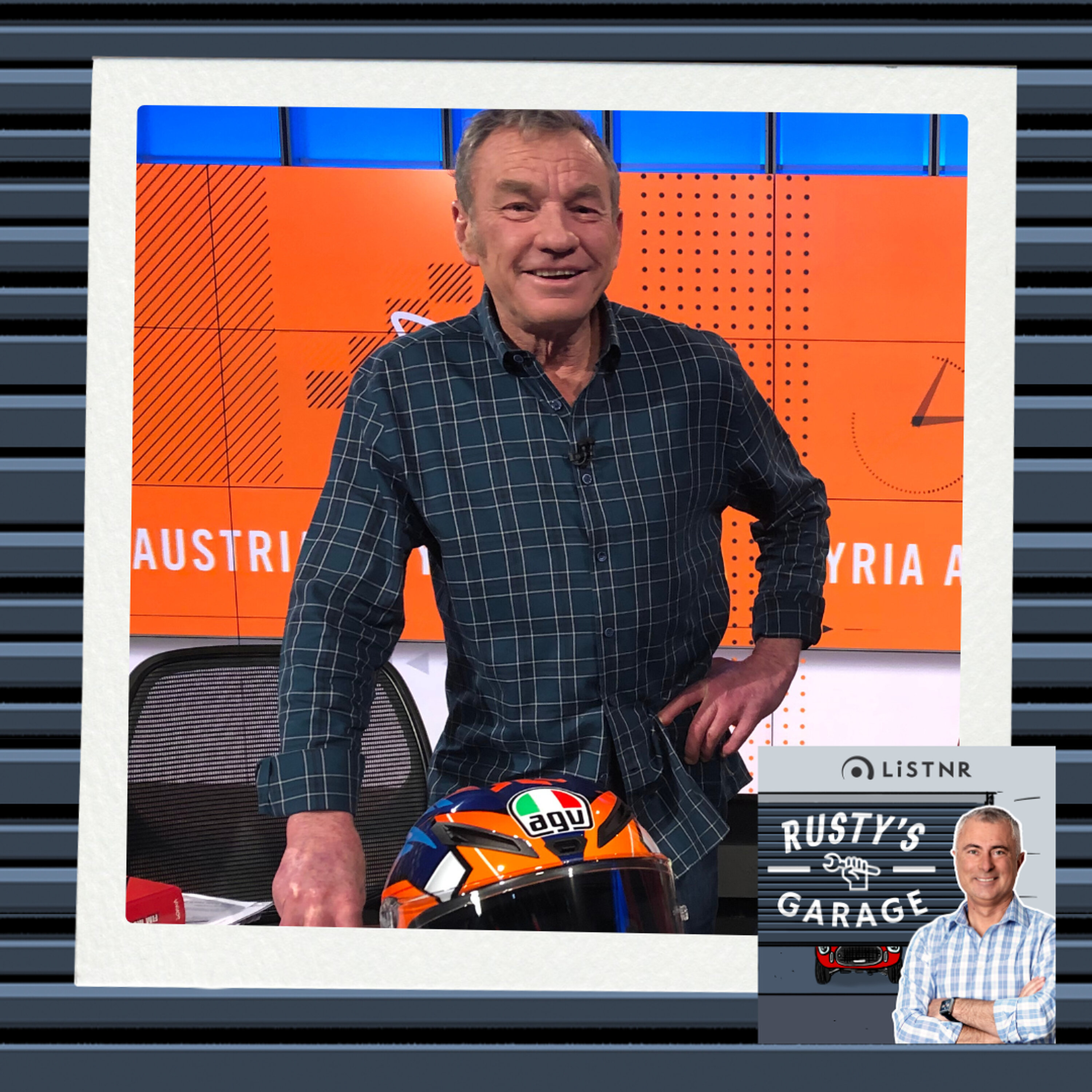
Hello everybody, Rusty here all set for part two of my podcast with former motorcycle racer Kevin McGee.
You know the deal, if you've arrived here before listening to part one, do not pass go, do not collect $200.
This is not monopoly, jump back to the garage library and kick that one into gear.
Growing up around Horsham and cutting his teeth on the dirt.
Losing his dad at a relatively young age and the impact that had.
Doing some seriously hard yards before discovering that he might be able to make a career out of racing bikes.
In this second part he opens up on a few things.
Finally breaking into Grand Prix racing and those fearsome, those awesome, those wild 500cc machines.
The part that Bathas played and the hurdle just before his debut.
He also talks about some frightening accidents including the 1989 US Grand Prix.
On the cooldown lap McGee had stopped to perform a burnout and was hit by former US Grand National and Superbike Champion Bubba Schobert.
Who hadn't seen the Aussie while he was on a congratulatory exchange with his countryman Eddie Lawson.
Schobert suffered serious head injuries and although he'd recover it ended his bike racing career.
You'll get a sense of how hard that hit McGee who had his own near-death experience in almost the same spot at Laguna Saker 12 months later.
Let's launch into this second instalment now.
And then they got in Trevor Flood Brannis at Bathas. That was when I won in 1986, the RR500.
And then Warren Willing had sort of finished off all his I think Grand Prix stuff and Dunlop stuff and all that.
And he became the manager before the end of the year at the D'Illatine.
And obviously he was overseas racing in Grand Prix and stuff and knew Kenny Roberts and that sort of thing.
And obviously Kelker Rothers, 1969-250 World Champion, working for Kenny Roberts with Eddie Lawson and Kenny himself before that.
So that was the link with Warren. He got on to Kel and Agostini, he knew all those people.
And they came out for the Swan Series and brought out those two Wys-It-Rs that they raced during the World Championship season.
And one for me and one for McElnay. No practice, no secret, private tests, no anything.
Turn up at surface. Don't even think we tested on the Thursday then, I think it was just the Friday morning.
Talking to Kelker Rothers and he said, Kevin, I'll tell you one thing.
It's easy to ride a slow bike fast, but it's hard to ride a fast bike fast.
And it was spot-blady on. Minimum weight for those back then were 118 kilos.
And you probably got a true 170, 175, two-stroke four-cylinder horsepower.
That must have felt unbelievable, mate, did it?
I can remember, he said, go out and run it in for two laps. Take it up to 10 grand.
And 10 grand, they're just starting to get happy. It was the fastest, lightest, quickest stopping.
I had to keep letting the brakes off because you'd just stop underneath you.
And you had to get on the gas to get to the corner. It was crazy.
Wow, so you had to adjust your stopping distances and go even deeper.
It was madness. Like it was crazy. You just didn't think, you know, it's like re-chipping your brain.
You just got to pull that one out and put another one in.
Like, I can go to that brake and marker because this thing will stop and won't.
Because they were so light, it didn't try to chip over as much as sometimes on our super bikes heavier.
But I don't know, it was just uncanny how easy it had stopped.
But I'll tell you what, if you're hitting the back of the shorts, when it hits 10-10-2,
you know you're alive then until about 11-8 or so.
And that was pretty much your operating range when you wanted full noise.
And that first session was just wild and macon-oved.
He's gone because he's used to fast tracks in Europe.
And, you know, your eyeball was bouncing around in the sockets.
It was a little bit bumpy in a few places at surface.
And you're just getting used to the actual average speed.
It was amazing. It was just, I was embarrassed to be smoked by Macon-oved so much.
But I'm given he'd been riding it for the year and ridden 500 years before that.
This gold band at Suzuki's Atlas One Series and in the World Championship I thought,
next weekend's Iron Pire, I'll have a good crack there.
And did you, and did that sort of open the door to the World Championship?
How did that kind of first proper contract at 500 world level come about?
Kelkar others saw that I raced fairly and squarely against Rob Magdalene.
I beat him in one of the races at Orem Park the next weekend.
I got my typical crap starts, but just chipped away.
And I think we're pretty much using second-hand Michelin tyres too from the Grand Prix season.
So there was a bit of coin slipping in the back of the truck for who got what tyre.
And I was good on knowing when the tyre pressure got too high from getting too hot from abusing it too much.
When I got all the shit started, I couldn't hammer through the field. I had to measure it.
Then we went to the old quarter with the hump over the back end. That was good fun.
Macon-o crashed in a wet one. I think he picked it up and beat me.
Wow.
It was paranoid about falling off at Rusty because there was sort of a saying going around then.
You know, the factories can easily get another bit of meat.
Yes.
And the mechanics like Mike Sinclair, he made out here in New Zealand, Paul Tracy, New Zealand and Jerry Burgess in that load.
You know what they used to call us riders?
What?
Spaces.
Yeah, we just filled the space between the handlebars and the seat.
Now your GP debut, if I'm not wrong, was slightly delayed, was it made?
Did you have a prank at Bathurst and that sort of delayed your 4A into GP racing?
So this is the end of 86 over in the shoulder there.
And that was pretty good because everyone was odds on bet that Macon-o was going to win all six races over three weekends and take away 50 grand prize money.
That was extra prize money just for winning all six and giving no one else a chance, which was odds on by the looks of things at surface.
So then we go into the start of 87.
And, oh sorry, back in the middle of 86, when I got back from 85, I said to Dowson, we've got to get, you know, Mobra 86 contracts.
We've got to get the Suzuki radar in her.
So we wouldn't sign our contracts.
We'd done a few races.
We wouldn't sign our contracts until the Japanese had us down for the eight hour.
So then we signed our contracts.
Awesome.
Little pricks we were.
So we got a Yamaha FZ750 Japanese superbike spec bike.
Takaki Suzuki was the engineer.
I remember him with the Yamaha too.
Anyway, that was on Dunlops.
And you got your A and your B riders and I was a B rider.
Dowson was a A rider, qualifying A and B.
Long story short, Warren had managed to get the magnesium flat slide carburetors instead of the CV carburetors
with the diaphragms and the butterflies and crap in them.
They're just horrible on a roast bike.
And well going, pretty good.
And Dowson crashed it in his qualifying, which mine came after that.
And the Japanese took the flat slides off and put the CVs back on it.
So I've gone out to qualify.
And when the throttle is not connected to the back wheel, which is what happens with the CVs,
when you turn the throttle, you want the throttle because if you haven't pushed the front,
you want the back wheel to turn so you can pick the front back up.
Gotcha.
And if it doesn't happen at that instant, no good.
So I do my out lap and come around and was going, all right, I was never a really good qualifier.
I was just getting the thing wound up and getting used to where this flat spot was.
And that hairpin around the back.
And then you've got that big, long, right hand, or I don't know what it's called,
before you flick it into the spoon at the back there, the long left.
You pin through there in a fifth and back to third, slicked it into the spoon, lost the front.
And back in those days, the curbs are about six inches high.
I've rolled on the left side and tried to bunny hop my body over the curb.
I walked back to the pits.
And from my ankle to my hip, at my hip, it was just that raging purple red color.
Went right down the left side of my leg because when I got launched off the curb.
Sugar.
Now, if it said go back to the hotel and just put hot and cold water on it for 20 minutes
and it was just like a big lump of bloody jelly.
Anyway, we'll race the next day.
And yeah, we got second.
And that was that was quite impressed because Kenny senior, Kenny Robert senior
had ridden that bike at Yamaha's test track.
And what I forgot to tell you was that I put that Japanese domestic super bike on Dunlops
fourth on the Lamon grid for the start of the eight hour amongst,
I think there was 13 factory formula one bikes.
Unbelievable.
Yamaha factory give me a test at sugo in Japan up there.
Send I on the TT formula one bike.
Yep.
And Christian Sal was riding one as well.
So that was the test Yamaha's track Yamaha's Grand Prix rider on a TT formula one bike
against the kid from country Victoria.
Anyway, got my crap start and done the same lap times and finished just a couple of seconds
behind him.
Amazing.
That was 86.
And that's when they tested me against Mac on A and the Swan series on the 500s.
And then they wanted me to run the Japanese TT formula one championship in 87 in Japan.
And so we go over there for testing it late February at Suzuka Yamaha only.
I think it was eight or nine.
It was all the Japanese races, the Japanese test riders, all the factory boys,
all the mulberry Yamaha lucky strike, go was Yamaha French guys.
And I was there on the TT formula one, the 754 stroke.
That was frustrating.
Hadn't ridden a 500 a couple of months ago, but anyway, Eddie Lawson called it the diesel.
So I'm ripping around on diesel.
What come out of that garden had the TT formula one lap record, I believe was to 17.8.
And I went around in 216 dead.
Neil McKenzie had the lap record, I think at 215.8 for a 500.
No, 215, I reckon from memory.
Eddie Lawson went around in 215.7.
I was 16 dead and all the rest of the 500s were slower.
Does this lead to, I think there's some wildcard opportunities with Kenny Roberts,
Yamaha team that sort of come in the wake of this, isn't there?
Yeah, what happened next was a very quick lead into, well,
we'll do your wildcard in the Japanese Grand Prix.
It was the first Grand Prix in Japan,
World Grand Prix in Japan since 1962 when I was born.
And when Suzuka was invented, as in the racetrack.
And so it's 87.
And on the wildcard, Japanese factory rider,
no lucky strike, no, no mobriyama or anything.
And qualified sixth.
So I was the first guy on the second row of the grid
because they used to have five back in the day.
So then it's poor and rain for the race.
And I was going good like Randy Mimola on the Dunlop wets
and Mike Bourbon on the Dunlop wets.
So both on Kenny's lucky strike gammas, they were gone.
They were just on another level, completely another level.
So they're gone and Garden was in third
and I was going for third.
Come out of the spoon and I'd sized him up
and there was enough room there at that last.
It's a bit of a kink before you straighten up for the back straight.
And then all of a sudden I was in the grass the next lap.
So that didn't work.
So I dropped right back because you're in fifth gear
going through there.
So then I was a bit angry and overcooked it up
the back of the pits and high side of the thing.
And I just walked away and discussed because I was so annoyed with myself.
And Mike Sinclair pulled it apart and showed me at the end of the race
in a wet race because the carburettors face forward as in
that's where they get the air from.
They just fill up with gunk.
So that goes through the engine and the piston ring was like
I don't know how I didn't jump out in the gap between the piston and the bore
because the cylinders and the piston and rings
are completely stuffed after a wet race
because they're completely worn out with all the grit that goes in them
and that gets them a little bit peekery said that power comes on a lot
sharper when they're worn out.
So I could use that as an excuse but I think I was more angry
because I was trying to get on the podium in my first one pre.
I think only in your third ever GP you get points.
Yeah. Okay. So it hasn't so the bath is where I broke me lead
and you know life was gone.
No, I won the 200k races.
Zuzuka five weeks later us.
Five weeks.
Amazing.
Then comes Aston and that turned to shit.
It was was raining.
There was two restarts.
So we started the race and I think we had two restarts after that.
And back in those days you got a point for 10.
I was racing Kenny Irons again the late great.
Mm hmm.
And I managed to nab him for 10th.
Oh, but before that in the dry qualifying I've never been to Aston
and when qualifying finishes I'm second to Eddie Lawson.
Amazing.
So that was a bit of a spin out.
Then that leads to Portugal late 87 now and I've just been
to Sugo for the World TT Formula One Championship
proper World Championship.
Yeah.
Crashed in Friday.
I'm practice.
Crashed in Saturday.
I'm practice.
Rolled the golf cart with Warren willing in the passenger side.
I landed in on him.
He is swearing his lungs out at me.
Pushed it back over.
Drove to the pits.
Got on the factory Formula One bike.
Crashed it at the last chicane in morning warm up.
I'm walking back.
Warren's walking towards me and he started yelling
from about 50 meters away.
And I just said doesn't matter Warren.
I'm going to win it anyway.
Because I was trying to get through this shitty chicane
to get up the all-weather Honda's just right away from it
and the Suzuki.
You know, got to make it up around the back.
And so having crashed three times,
packed up new leathers to go to Portugal the next weekend.
First bloke I saw at the back of the pits was Kenny.
Kenny goes, how did you get here?
I said I drove from Japan to Spain.
He looked at me a bit bewildered.
So we get on it there.
And qualified fifth on the front row.
A bit worse than Aston but better than Suzuki.
And then rolling around.
And just before the race,
Kenny Xenia says to me, you know,
if you can help Randy out with points,
you know, help him out.
I'm looking at Kenny Roberts' scene and going like,
you're a goose.
You're thinking I'm going to be able to help Randy Momolo,
Grand Prix.
And I've looked at all him in the magazines for years.
Help him out with points.
How do you reckon that's going to happen?
Anyway, Randy ran off at the end of the straight
while he was trying to beat Eddie Lawson apparently.
And I was sort of chipping away and got my usual first lap
loss of about eight and a half seconds or something.
And I pretty much stayed at that.
So I was pretty much doing competitive times.
And then I think Randy ran off somewhere else again
and ended up behind me.
Because I remember reading the ACU rule book.
You had to make a bona fide attempt.
Otherwise you get thrown out.
So I was waited till up around the back of the Picasso ramp
for Randy to catch me.
And I felt like I could get off the thing and push it faster.
He's gone past.
He's got second and I've got third.
And then it was all on from there.
Ago was on the phone.
What did that podium mean to you, mate?
If Ago's on the phone and things,
this is clearly a huge turning point.
That meant everything.
And that just cemented the whole deal from everything
late 86 through 87.
That was concrete.
I'll be there next year.
There's two wheel stories in Rusty's library
that will appeal to listeners on both sides of the Dutch.
Do you like what I did there?
In 2022 he spoke with former racer turn commentator
and official, Simon Crafar.
I believe that if we're talking about my sport,
what's the word?
You've got to have a little bit of mongrel in you
to want to risk your body,
risk everything to beat that other guy.
You know what I mean?
You've got to have a bit of that.
And I mean that mellows with age.
Search for the two-parter with Simon Crafar
in the Rusty's garage library later
and enjoy the story of a young Kiwi from a family
who sacrificed so much that made it to MotoGP
on incredible self-belief
and how he shares those learnings now.
Time to shift back into gear with Rusty and Migu.
I want to pinpoint some key moments of your career now
if we can just so that we don't run out of time.
Firstly, winning the last-ever Spanish Grand Prix
at Harama and there were two Aussies on the podium that day.
That must have been mega-made.
Is that the zenith moment?
Is that the pinnacle moment for you?
It's hard because there's a few Rusty,
but it is definitely the pinnacle
because it was such a hard battle with Eddie Lawson,
one of the best.
You know, that didn't come much harder
when beating Lawson on a good day
and he certainly didn't have a bad one.
When I rode five hours, I think it was 36 minutes
in the 87 Suzuka 8-hour.
Like, that was massive.
We just weren't supposed to win Yamaha's first Suzuka 8-hour.
Incredible, mate.
Like, that's the first win.
37 degrees, I think it was, and 98% humidity.
Unbelievable.
And that was a few months after I broke my femur.
And there's a few like that,
like after the head injury and back on the world super bikes
and stuff like that,
but because Harama's such a tight, difficult circuit,
500s are so volatile,
and Eddie Lawson was such a reliable motorcycle racer.
Yeah, Harama was definitely one of the massive moments.
Awesome.
Can I come to probably two of the more difficult moments?
Let's talk 1989 US Grand Prix there
and what happened kind of on the cooldown
and how that affected you and so on?
Rainy and Swanson were going out front in the race.
It was Eddie and Gardner.
And I knew that I couldn't ride as hard as I could
because I just...
Well, I think that we were doing 40 laps back in those days.
And I knew I couldn't punish the tyres
and Warren was always onto me about that
because I could just go and screw him to the wall in like five laps
if I wanted to, but he had the last 40.
So I tried to measure it out and I didn't punish the tyres.
Everything was going good.
And I'd caught Eddie and just stayed with him to let the tyres cool
and not put any more pressure on.
Gardner was in there somewhere.
I can't remember exactly how that worked.
Well, I remember Eddie was the main target
and I knew fuel was an issue
because I didn't do the siding lap on Warren's recommendation.
So I caught Eddie and then I pulled the pin
with like a lap and a half to go
and then a lap later going up
towards Corkshire up the hill.
Rapper, rapper, rapper.
I'd already calculated in your head
that I'd be equal second with Eddie
on points in the World Championship
and that's where I wanted to be.
So I went to Chug and Eddie comes past me.
I rolled down the line. I think we got fourth.
Eddie got third.
And then when you get around the infield,
I should have just thrown the thing against the wall.
Wish I had it.
When you get in the infield and then you start going uphill
with the fuel tanks there.
You know, they used to be nearly three foot long
with the big fuel tank we had.
I think it was like 28 litres.
And the fuel ran to the back
where the fuel tap was and fired up
and I said, ah, I'm not flying far enough.
I'll do a burnout.
Eddie and Baba be in the Americans.
They were like, you know,
shaking hands, patting each other on the back and all that.
And consequently, Baba hit the back of me
and I wasn't worried about me.
I was bawling my eyes out because he wasn't moving.
Far out.
And that's what killed me psychologically.
I stood up and thought I tripped over something.
I looked down and I'm looking at the bottom of my boot.
My boot was facing upwards and my leg was still in it.
But I was worried about Baba who was up the road.
And that affected me for a long time
because I was the arse of the paddock
because I'd injured Baba.
How did you cope with that, mate?
It fucked me mentally.
But we just had to get on with off.
So you continue to race
and there is a cruel kind of moment here
that's sort of same race meeting 12 months on.
You have a crash that...
Correct me if I'm wrong here, mate.
I think they basically,
in some of the papers in Australia
or perhaps globally somewhere, they pronounced you dead.
Is that right?
Apparently it is.
There's a newspaper somewhere that has a fatality.
Talk me through that day. What happened, mate?
Well, it's...
The irony is that I wouldn't start
Jeff Krust, a big burly army mechanic.
He pushed me up that Laguna Hill from the start
quite a while until the thing finally fired up.
And anyway, coming through that turn 6
to go up the hill,
ripply from all the car mileage they do around there.
So I just wanted to come through there.
And there was like this inside rut
you'd sort of drop into the rut
right near the white line on the apex.
And then that's where you'd hook it
and you'd do a high percentage of your turning there.
Couldn't particularly tell,
but that's where you fashioned the bike to head up the hill.
And I just wanted to tighten up my line
by about a foot 15 inches
because I was just getting into the ripple bumps
and it was just losing traction and going sideways.
I'd moved from Dunlop to Mitchell and as well.
Mitchell and I were a lot more snappy.
And the thing just snapped out
and I don't remember the crash.
I remember everything about a half a lap to it.
And obviously from watching videos
you had to work out what was wrong and what was your fault
and don't ever do it again.
Remember Mel Candon's saying if you crash
you just got to work out why I crashed and not do it again.
So yeah, and then it just flung me,
but I had an injury from a testing crash
where my right arm was really weak from nerve damage.
So my left held onto the bar
and the right one came off,
licked me onto my back and loom out
and told me the helmet looked like a dropped egg.
Oh.
He's a great photographer,
been around motorcycle racing for a long time.
What was the road to recovery like and so on?
I had to work out what happened
and I was stiff as a board.
I got back to Australia Road,
weighed 40, 48 kilos or something, 49 kilos.
Stiff as a board, you couldn't,
you know, if you're laying flat
you couldn't only get up to like 45 degrees.
At least you're weak as,
needed heaps of sleep.
I think because of the medications
when I was in the coma for,
that was the 13 days I think.
I'd wake up in the middle of the night
in Western Victoria in Horsing.
Soaked.
Top sheet, bottom sheet, no blankets.
Soaked.
I'll get out of bed at 2 in the morning and over shower.
Wow.
I think that was just all the medications coming out
and you had to have them four times a day.
I felt a fair bit better one morning
and then I thought,
I think I forgot to take one.
So I counted them out
because I was strictly numbered and measured.
Yes.
With one through many.
So I took four the next day,
I took three the next day
and I was good, bad, good, bad.
So then because your head actually felt like,
your head doesn't really feel anything
but it just felt like it was,
the only thing inside my skull was wooden.
It was a weird feeling.
I can't explain it.
To this day I can't explain it
and that's a lot of years ago.
What lasting effects did it have, mate?
Some memory loss, short-term memory sort of thing
but people have staggered
that that's things I can remember from decades.
You have just done in this podcast,
mate, some incredible detail around motorcycle types
and sprockets and all sorts of things.
You've got some stuff that's still locked in there.
Yeah.
There's shit like Sinclair,
Mike Sinclair and that
when I can tell him I was around in that track
and shit like that.
But anyway, I don't know,
like before when I was techno sort of ignorant,
scared really, didn't use the contact in my phone
and working at Fox and you've got to remember
a heap of stuff on the spot.
Like you haven't got time to look up,
you haven't got time to think.
Yeah.
It's just got to be there.
And I was thinking I've got to free up some disk space up here.
Yeah.
So I thought I'll use this contact thing on the phone.
So I sat in my office in Sydney,
filled three A4 pads with back in the day mobile numbers,
some home phones, some fax numbers,
33 lines on each page, three pages.
I just went, oh, that's enough.
If I put all those in your phone,
I'll have more space in the tank up here.
Well done.
You would get back on the bike.
You would do some GP events again.
You would win again in super bikes, which I'll come to.
But was it fundamentally the end of the GP chapter
and how difficult was it to confront
the proper end of the GP chapter?
Yeah.
Well, I had the two-year contract with Suzuki.
They said it was lucky strike.
Didn't want the litigation because I'd had the hit injury
and all that.
So that didn't happen.
So there was all kinds of stuff about the sponsors
and litigation.
Believe what you will.
But I didn't get a full-time gig again.
I did a wild card with Suzuki at Suzuki and Eastern Creek.
But you had to be riding like back in the day.
I said, well, I was riding like I had mum on the back.
Oh, wow.
Because if anything happened, it was going to be my fault.
You know what I'm saying?
Yeah.
I mean, when I flew over to England down to Donington,
met up with the head neurosurgeon who ironically
rode his VFR 750 out of London down to Donington.
He'd done all these tests.
He looked at me and he goes, was he four times faster
than the average human being?
And I felt dopey compared to how I used to feel
before the accident.
He must have had really good reaction times.
And the decision-making one's the same sort of thing.
And he goes, all right, let's go for a ride.
So he jumped on his 750.
They give me a RGV 250 to lap around Donington.
Start with, come back and neurosurgeon said,
he's all good and send him out on the 500.
And I was really worried because I thought the 500
would feel super fast after like a year off it.
Yeah.
It actually didn't.
And yeah, all that went good.
And I got my license back and did the wildcard in Japan.
I think it came 12th or 13th and about the same act
and creep, but one of them I think I beat my replacement.
Two quick ones to finish, if we can please.
Firstly, an unbelievable chapter with Fox Sports,
mate, as the expert there.
I think at one point you were the longest serving freelancer
in the company's history.
Weren't you on the sports side anyway?
Yeah, I think so.
Entitled Rusty 27 years.
Unreal, mate.
Great stint.
Great stint.
And one of the really cool projects that you worked on
in post-race life,
and I'm glad we're getting to talk about it in a podcast sense,
you were part of a record-breaking effort with a vision-impaired rider,
weren't you?
Just give us the summary of that.
Yeah, is it?
Yeah, and getting that motorcycle in New South Wales
sent me a cold calling email.
Hey, Kepp, bloody blah blah.
This guy Ben Felton, he's blind,
wants to break the Guinness World Landspeed Record
for a motorcycle-ridden blindfold.
Mum hadn't long passed away before that
and cleaning her stuff out, and she used to volunteer
and rattle the Labrador for the Victorian Guide Dogs Association
and all that stuff.
Yeah.
So it sort of hit home and I was scared as a kid
because when little rough farm kids go to school
and Mum and Dad always told us,
don't throw sticks or stones at other kids,
you know, hit them while they go blind.
And I remember walking around the school yard
with my eyes closed pretending.
Wow.
And so I thought about this.
I just started emailing and I got like
the second, third, fourth paragraph and I thought,
what am I sending him an email for if he's blind?
Well, maybe he's not fully blind.
And I'd put his number in my phone ready to push dial.
So I pushed send and then rang it.
Ben, Kevin McGee, blah blah blah.
Right.
So I had the gut wrenching thing was I had to ask him,
how blind is he?
That killed me.
That was, that was shit.
And he said, black, totally black, Kepp.
And that's when you just,
your heart drops through the bottom of your guts.
And I thought, well, I couldn't leave a blind guy
on the side of the road.
And he seemed pretty ambitious and bugger.
So that's incredible.
So you effectively acted as like a shadow for him.
And what speeds did you get to?
And, and you were basically on the, the, the same place
where they break, was it like Gardner or Lake Air?
And it's where they break the land speed records, isn't it?
Lake Gardner.
Yeah.
Yeah.
We practice out at Sydney Motorsport Park.
And that they give us the strip when they close down
and that the drag strip over the back
and the front straight stuff.
Yep.
When they finished up.
So it was real funny out there one night
because some of the staff said, um, you know,
well, it's getting dark.
I said, well, that doesn't matter.
And then the, the latest progression was, um, the salt.
And 272.9, something, I think, case.
Unbelievable.
That is seriously cool, mate.
Well, on that world record run, the salt's funny.
And, and my visor was just whiting out.
And the black markers that are like a quarter of a mile apart,
then was nearly at them when they came in the view for me.
It was a bit of a guessing game.
And I sort of imagined that if I was on the trajectory of a line
straight through the middle of my skull and back
and did not deviate from that at all,
then I'd end up somewhere near the middle of the next set.
So that's where I should send him.
And I got to the other end, I was balling.
Cause I got in through it, I said, well, I can't do that again.
Can't do that again.
And the wind come up and it was delayed.
And I'm going, thank God for that.
And right out of the wind stand under 11 o'clock,
I'm going to go out and come up again.
So we sat down and I was like, all right, stuff it.
And I knew I was on a mission because I heard him hit the rev limiter in fourth gear.
Wow.
And there was a sinkhole part way down the track.
I got it in pass on the way down because I stuck to sort of one third of the track.
And on the way back to myself, that much I thought stuff it.
And when he hit that, it hit me at like 260 plus Ks,
the wet soap that come off the thing.
It was like shotgun going off.
I shit myself, but then it was like lying back on the job.
And yeah, we got to the other end.
But at the end, because Ben's a bit chubbier than I am,
he was actually pulling away from me.
Wow.
Before we got to the end of the call.
So he was disappearing because my was wheel spinning on the soul.
You can roll it on in fifth gear at 260 Ks.
You can just play on it.
Oh, wow.
That is incredible, mate.
What a great achievement in post race life.
Thank you for the little walk down memory lane today,
mate, and to fix some key moments of your career
and tell a bit more of your story.
And we got to commentate together over the years,
which I'm chuffed about, mate.
And it's lovely to see you today and have a conversation with you.
Thank you for coming on.
Yeah, no worries.
I'll never forget how serious you were on that tarmac rally
when you were trying to drink.
Crackers that go and you are getting all shitty.
Great days, brother.
Great fun.
Rusty's Garage is written and presented by me, Greg Rust.
Series editor and producer is Joel Harrison.
Audio production by Link Kelly.
If you've got a guest suggestion,
get in touch with me on social media.
The Garage.
It's where a journey begins
with a tank full of passion-fueled stories.
About this episode
Kevin Magee (Part 2) dives into the brutal reality of 500cc GP racing—first breaking through via key factory links, then describing the razor-thin margins of fast bikes, tyre management, and wild wet races. He recounts his delayed GP debut, a string of crashes, and the emotional hit of the 1989 US GP cooldown-lap accident that ended Bubba Schobert’s career. Later, he reflects on recovery from his own near-fatal Laguna Seca crash, then shifts to post-racing life, including Fox Sports and shadowing a blindfolded rider on a Guinness land-speed attempt.
That first ride on a 500cc Grand Prix bike - Kevin Magee remembers it in visceral detail. Racing in Japan and the mark he made there on the way to what we now know as MotoGP. Racing for Kenny Robert’s Yamaha including a podium in Portugal. Finally adding his name to that prestigious list of Grand Prix winners on a memorable day in Spain. A frightening cool down lap crash in the late 80’s and the media mistakenly reporting his death at Laguna Seca! He would come back to win races in Superbikes but how tough it was to deal with the premature end of his GP career. And the remarkable story of helping a blind rider break a world record.This conversation leaves you in no doubt of Magee’s talent but like so many in this brutal sport the tradjectory can change suddenly. Hold on for an incredible ride.
Head to Rusty's Facebook, Twitter or Instagram and give us your feedback and let us know who you want to hear from on Rusty's Garage