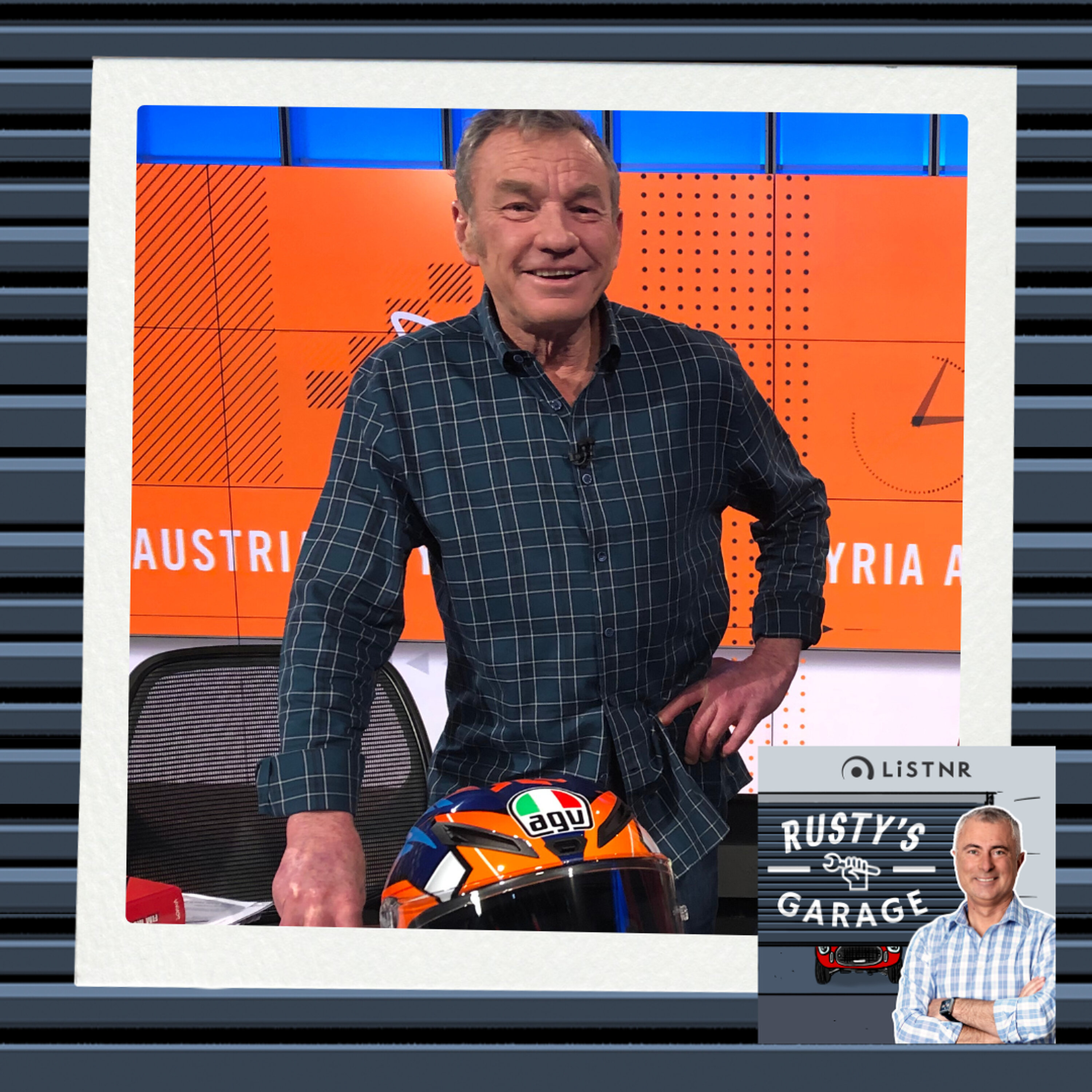
Kevin Magee | Part 2 - World class talent & world records
About this episode
Kevin Magee (Part 2) dives into the brutal reality of 500cc GP racing—first breaking through via key factory links, then describing the razor-thin margins of fast bikes, tyre management, and wild wet races. He recounts his delayed GP debut, a string of crashes, and the emotional hit of the 1989 US GP cooldown-lap accident that ended Bubba Schobert’s career. Later, he reflects on recovery from his own near-fatal Laguna Seca crash, then shifts to post-racing life, including Fox Sports and shadowing a blindfolded rider on a Guinness land-speed attempt.
That first ride on a 500cc Grand Prix bike - Kevin Magee remembers it in visceral detail.
Racing in Japan and the mark he made there on the way to what we now know as MotoGP.
Racing for Kenny Robert’s Yamaha including a podium in Portugal. Finally adding his name to that prestigious list of Grand Prix winners on a memorable day in Spain. A frightening cool down lap crash in the late 80’s and the media mistakenly reporting his death at Laguna Seca! He would come back to win races in Superbikes but how tough it was to deal with the premature end of his GP career.
And the remarkable story of helping a blind rider break a world record.This conversation leaves you in no doubt of Magee’s talent but like so many in this brutal sport the tradjectory can change suddenly. Hold on for an incredible ride.
Head to Rusty's Facebook, Twitter or Instagram and give us your feedback and let us know who you want to hear from on Rusty's Garage
See omnystudio.com/listener for privacy information.
Grand Prix racing
"Finally breaking into Grand Prix racing and those fearsome, those awesome, those wild 500cc machines."
Grand Prix racing is the highest level of motorcycle racing. Riders race in a series of events, usually on tracks, and the bikes are grouped by engine size.
Grand Prix racing is the top level of motorcycle road racing, run in classes by engine displacement. Riders compete across a season of races, often on purpose-built or closed-road circuits, with strict rules about bikes and setup.
burnout
"On the cooldown lap McGee had stopped to perform a burnout and was hit by former US Grand National and Superbike Champion Bubba Schobert."
A burnout is when you rev and spin the tires to heat them up and make smoke. It’s usually done on purpose, but it can be dangerous if someone isn’t expecting you.
A burnout is when a rider deliberately spins the rear tire(s) to generate heat and smoke, usually to warm tires or as a showy gesture. Doing it on a cooldown lap can create unexpected hazards if another rider approaches at speed.
serious head injuries
"Schobert suffered serious head injuries and although he'd recover it ended his bike racing career."
In motorcycle crashes, injuries to the head can be life-changing. Even if someone survives and recovers, the damage can be severe enough to end their racing career.
Head injuries are a major safety concern in motorcycle racing, often determining whether a rider can return to competition. The transcript notes that Schobert recovered but it ended his bike racing career, underscoring how severe these injuries can be.
no practice, no secret, private tests
"And one for me and one for McElnay. No practice, no secret, private tests, no anything."
They’re saying there was basically no time to practice or test beforehand. That makes racing harder because you can’t dial in the bike or learn the track as much.
This describes a race entry with minimal or zero testing time—no practice sessions and no private test runs. In motorsport, that significantly increases uncertainty because riders must adapt setup and lines without the usual track time.
two-stroke
"And you probably got a true 170, 175, two-stroke four-cylinder horsepower."
A two-stroke engine makes power with fewer piston movements than a typical engine. It usually feels punchier and revs higher, which can help racing bikes.
A two-stroke engine completes its power cycle in two strokes of the piston, unlike a four-stroke which takes four. Two-strokes are often lighter and can rev very high, which is why they’re common in racing motorcycles.
10 grand
"I can remember, he said, go out and run it in for two laps. Take it up to 10 grand."
“10 grand” is shorthand for the engine spinning at about 10,000 RPM. Riders use RPM like a “power dial”—higher RPM can mean more pull, but it’s also harder to manage.
“10 grand” refers to 10,000 RPM (engine speed). On performance motorcycles, hitting higher RPM often puts the engine into its strongest power band, but it also increases stress and demands precise control.
marker
"Like, I can go to that brake and marker because this thing will stop and won't."
A “brake marker” is a reference point on the track used to decide when to start braking. Using markers helps riders repeat consistent braking zones, especially when the bike’s braking performance is unusually strong.
Suzuki
"This gold band at Suzuki's Atlas One Series and in the World Championship I thought, next weekend's Iron Pire, I'll have a good crack there."
Suzuki is a motorcycle company that races in competitions. Here, they’re connected to a specific racing series and a world championship, so it’s part of the bigger racing story.
Suzuki is a major Japanese motorcycle manufacturer that competes in racing series worldwide. In this segment, it’s tied to Suzuki’s Atlas One Series and a world championship context, which helps listeners understand the competitive platform being discussed.
falling off
"Wow. It was paranoid about falling off at Rusty because there was sort of a saying going around then."
“Falling off” means crashing. In racing, people get nervous about it because one mistake can ruin your whole race.
“Falling off” is racing slang for crashing or losing control and going down. The speaker says there was paranoia about it, implying the rider felt pressure to avoid mistakes that could cost results or opportunities.

Yamaha FZ750
"So we got a Yamaha FZ750 Japanese superbike spec bike. Takaki Suzuki was the engineer."
A Yamaha FZ750 is a specific kind of Yamaha motorcycle. The speaker is saying they had a race-prepped version, and the way it was set up (especially the carburetors) mattered a lot for how it rode.
The Yamaha FZ750 is a specific 750cc sport motorcycle the speaker says they got in “Japanese superbike spec.” It’s mentioned alongside key race setup details like tires and carburetion, which affect throttle response and reliability in competition.
flat slides
"And the Japanese took the flat slides off and put the CVs back on it. So I've gone out to qualify."
“Flat slides” here refers to the flat-slide carburetor setup that was installed on the Yamaha FZ750. The Japanese team later removed the flat slides and put CV carbs back on, implying the flat-slide configuration didn’t suit the bike/track conditions.
pits
"I walked back to the pits. [541.4s] And from my ankle to my hip, at my hip, it was just that raging purple red color."
The pits are where the team helps the rider—repairs, adjustments, and getting ready for the next part. If you go back to the pits, it usually means something needs attention.
The pits are the service area where teams work on the bike between sessions and where riders return for adjustments, repairs, and strategy. Walking back to the pits implies the incident required immediate attention rather than continuing.
Eddie Lawson
"Hadn't ridden a 500 a couple of months ago, but anyway, Eddie Lawson called it the diesel. So I'm ripping around on diesel."
Eddie Lawson is a famous motorcycle racer from the sport’s top era. In this story, he’s the one who described the bike’s feel as “diesel.”
Eddie Lawson is a legendary American motorcycle racer known for multiple championships in the 500cc era. Here, he’s referenced as the person who gave the bike the “diesel” nickname, highlighting his influence and credibility.
Japanese factory rider
"And on the wildcard, Japanese factory rider, no lucky strike..."
A factory rider is backed by the motorcycle company itself. They usually get better support and newer race parts than independent riders.
A “factory rider” is supported directly by a motorcycle manufacturer’s racing team (the factory). That typically means access to the latest development parts, engineering support, and a higher level of team resources.
Dunlop
"...like Randy Mimola on the Dunlop wets and Mike Bourbon on the Dunlop wets."
Dunlop makes racing tires. Here, it means the riders were using Dunlop rain tires for the wet race.
Dunlop is a major motorsport tire brand with a long history in motorcycle racing. In this context, Dunlop “wets” indicates the specific rain tire supplier used during the race.
podium
"because I was trying to get on the podium in my first one pre."
“Podium” means you finished in the top three. It’s a big deal because it usually comes with recognition and points.
“Podium” refers to finishing in the top three positions in a race. It’s a key competitive milestone and often drives how aggressively drivers push, especially early in their career.
chicane
"Crashes it at the last chicane in morning warm up. ...trying to get through this shitty chicane to get up the all-weather Honda's just right away from it"
A chicane is a tricky section of the track with quick, tight turns. It’s meant to slow you down, and it can be easy to get wrong.
A chicane is a sequence of tight turns designed to slow cars/bikes and create a safer, more controlled cornering area. Because it’s technical and easy to misjudge, it’s a common place for crashes and overtaking attempts.
Honda
"trying to get through this shitty chicane to get up the all-weather Honda's just right away from it"
Honda is a big car and motorcycle company that also competes in racing. When someone says Honda in a race context, they’re talking about the race bike or team equipment.
Honda is a major Japanese motorsport manufacturer and engine/bike supplier. In racing talk, mentioning Honda usually refers to the brand of the machine or the team’s equipment being compared.
leathers
"having crashed three times, packed up new leathers to go to Portugal the next weekend."
Leathers are the protective racing outfits riders wear. They help protect your skin if you crash or slide on the track.
“Leathers” are the protective racing suits worn by riders/drivers, typically made from abrasion-resistant leather or advanced synthetic materials. They’re designed to reduce injury from sliding impacts and provide some thermal and abrasion protection.
MotoGP
"who sacrificed so much that made it to MotoGP on incredible self-belief"
MotoGP is the highest level of professional motorcycle racing. Riders race on tracks around the world, and it’s where the best teams and riders compete.
MotoGP is the premier motorcycle road racing series run by the FIM. It’s the top level of Grand Prix motorcycle racing, where riders compete on prototype-spec bikes and race on closed circuits worldwide.
tyres
"And I knew I couldn't punish the tyres and Warren was always onto me about that because I could just go and screw him to the wall in like five laps if I wanted to, but he had the last 40."
“Tyres” are the tires on the bike, and their grip changes as they heat up and wear. The rider is trying to keep them working well for longer instead of burning them out early.
“Tyres” here are the tires used on the motorcycle during the race, and their condition directly affects traction. The speaker’s strategy is about preserving tire performance across many laps rather than maximizing early pace.
fuel tanks there
"When you get in the infield and then you start going uphill with the fuel tanks there."
Fuel tanks add weight to the car, and where they are can affect how the car feels. As you use fuel, the car gets lighter, which can change grip and acceleration.
Mentioning “fuel tanks” in relation to the uphill section suggests the speaker is thinking about how fuel mass and placement affect balance and performance. As fuel burns off, the car’s weight distribution changes, which can influence traction and how hard the car feels under load.
inside rut
"And there was like this inside rut you'd sort of drop into the rut right near the white line on the apex."
An “inside rut” is a worn groove in the racing line. If your tires drop into it, the car can feel like it’s being pushed or pulled, which makes it harder to drive smoothly.
An “inside rut” is a groove in the track surface, often caused by repeated tire wear. Ruts can pull the car off line, change suspension loading, and make the steering feel unpredictable—especially near the apex where precision matters.
apex
"...right near the white line on the apex. And then that's where you'd hook it"
The apex is the closest point to the inside of the turn. Getting it right helps you exit the corner faster and more safely.
The “apex” is the point in a corner where the car comes closest to the inside edge of the track. Hitting the apex correctly is crucial for setting up the exit—especially in uphill or traction-sensitive sections.
wild card
"So there was all kinds of stuff about the sponsors and litigation... I did a wild card with Suzuki at Suzuki and Eastern Creek."
A “wild card” entry is when a rider competes in a race without being a regular full-season participant. In this segment, the rider did a wildcard with Suzuki at a specific track, implying a one-off or limited appearance rather than a full-time ride.
Donington
"I mean, when I flew over to England down to Donington, met up with the head neurosurgeon..."
Donington is a well-known race track in the UK. The speaker is describing traveling there for an important meeting connected to their racing career.
Donington refers to Donington Park, a famous UK racing circuit that hosts major motorsport events. The speaker says they flew to England down to Donington, connecting the story to a specific high-profile track and event context.
head neurosurgeon
"I mean, when I flew over to England down to Donington, met up with the head neurosurgeon who ironically..."
A head neurosurgeon is a specialist surgeon who treats conditions involving the brain and nervous system. The speaker’s mention emphasizes the seriousness of the injury and the level of medical care involved.
reaction times
"He must have had really good reaction times. And the decision-making one's the same sort of thing."
Reaction time is how quickly you respond when something happens. In racing, being quicker to react can help you choose the right move sooner.
Reaction time is how quickly a rider responds to what they see—like a changing line, braking marker, or opponent movement. In racing, faster reaction time often helps with staying smooth under pressure, but it works best alongside good decision-making.
decision-making
"And the decision-making one's the same sort of thing. And he goes, all right, let's go for a ride."
Decision-making is choosing what to do next while you’re going fast. Good racers don’t just react—they pick the right option at the right moment.
Decision-making in motorsport is the process of choosing the right action—when to brake, how late to turn in, and whether to pass or hold position. The episode frames it as closely related to reaction time, because the best riders don’t just react quickly; they choose correctly under uncertainty.
drag strip
"and the drag strip over the back and the front straight stuff. Yep."
A drag strip is a straight section of track made for fast runs in a straight line. It’s designed so runs are consistent and easy to measure.
A drag strip is a straight track designed for acceleration runs, usually with lanes and a focus on top speed and elapsed time. Even if the vehicle isn’t a typical drag car, the “strip” is useful for controlled, repeatable straight-line testing.
rev limiter
"And I knew I was on a mission because I heard him hit the rev limiter in fourth gear. Wow."
The rev limiter is a safety system that stops the engine from revving too high. If you hit it, the car won’t keep accelerating the same way because the engine is being limited.
A rev limiter is an engine control feature that prevents the engine from spinning faster than a safe maximum RPM. When the driver hits it, the engine may cut fuel/ignition or otherwise limit power, which can affect acceleration and speed during a record attempt.
260 plus Ks
"And when he hit that, it hit me at like 260 plus Ks, the wet soap that come off the thing."
“260 plus Ks” means about 260+ kilometers per hour—very, very fast. At that speed, even a small slippery spot can be a big problem for the car.
“260 plus Ks” refers to speed in kilometers per hour, indicating the run was at extremely high velocity. At these speeds, small changes in traction or surface condition (like wet patches or sinkholes) can have outsized effects on stability and control.
Request an Explanation
Heard something you'd like explained? We'll add it to this episode.
Sign in to request explanations for terms you heard.
Want to learn more?
Browse our glossary for plain-English explanations of automotive terms, jargon, and concepts.
Help improve this episode
See something that's not quite right? Our annotations are AI-generated and can sometimes miss the mark. Click the flag icon on any annotation to suggest a correction.