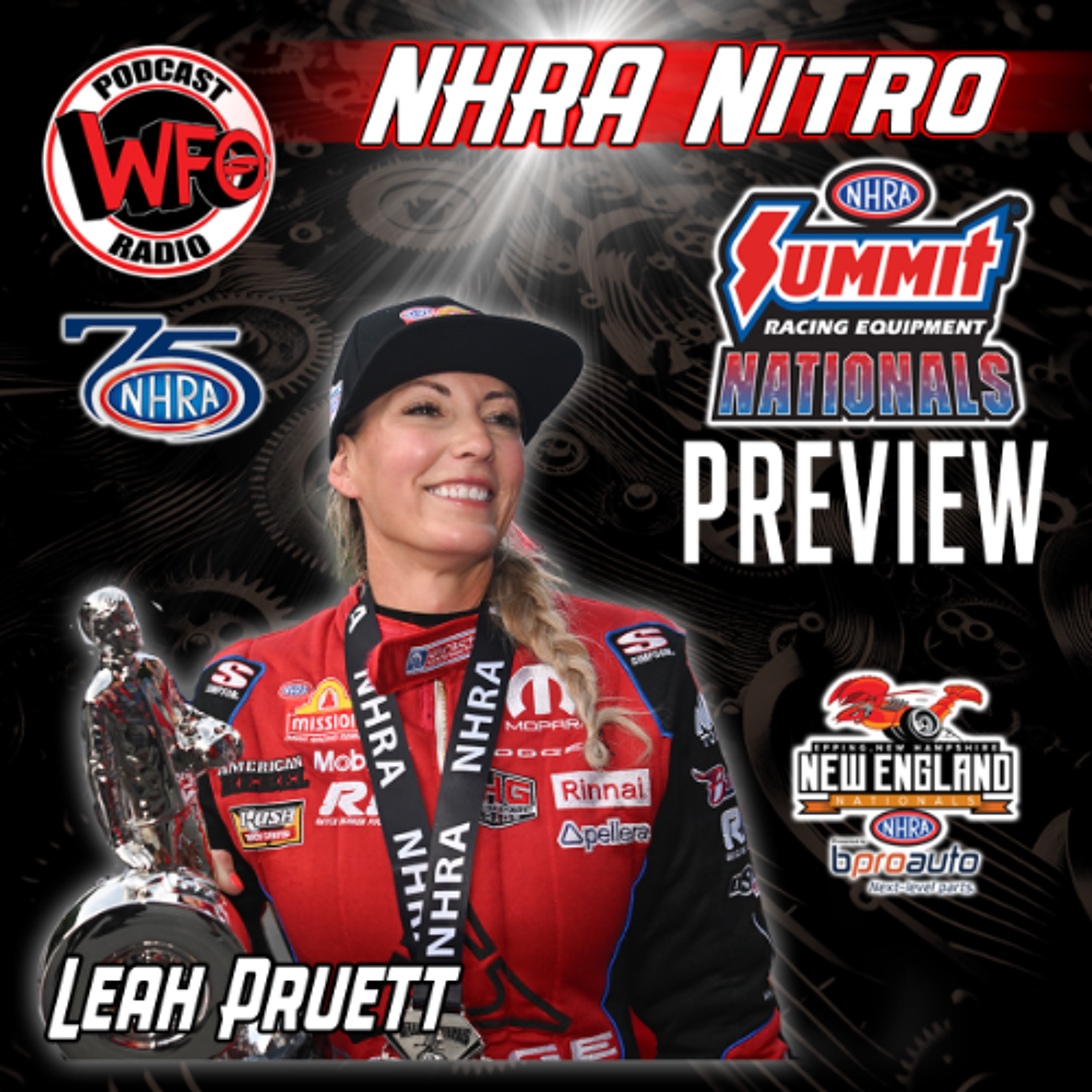
Leah Pruett joins WFO Radio before the Summit Racing Equipment NHRA Nationals
About this episode
Hosts kick off with engine-friction talk—“Piston rings rubbing against the cylinder walls generate more friction than any other part of the engine”—then set the stage for the Summit Racing Equipment NHRA Nationals in Norwalk, Ohio. Leah Pruett joins to discuss the NHRA countdown, her recent wins, and how qualifying, lane choice, and shifting conditions shaped outcomes at Epping and Bristol. She also gets into mental prep, data-backed crew communication, and why drag racing is far more than “stab the gas.”
friction
"The number one source of friction in your engine is not what you think... More friction and temperature means more wear and less horsepower."
Friction is the engine’s internal “drag” as parts move against each other. More friction usually means more heat and faster wear, which can hurt power.
In an engine, friction is the resistance to motion between moving parts, like rings sliding on cylinder walls. Higher friction increases heat and wear, which can reduce engine efficiency and power.
piston rings
"Piston rings rubbing against the cylinder walls generate more friction than any other part of the engine."
Piston rings are small metal bands on the piston inside the engine. They help seal the engine and manage oil, but if they rub too much, they create extra friction and heat.
Piston rings are thin metal rings mounted on a piston that seal the combustion gases and help control oil on the cylinder walls. When piston rings rub against the cylinder walls, they create friction that can increase heat and reduce efficiency.
cylinder walls
"Piston rings rubbing against the cylinder walls generate more friction than any other part of the engine."
Cylinder walls are the inside surfaces of the engine where the piston moves. How smooth and well-sealed they are affects how much friction and wear happen.
Cylinder walls are the inner surfaces of the engine block where the pistons move up and down. Their surface condition and how well the piston rings seal and slide across them strongly affect friction, wear, and power output.
Total Seal
"Fortunately, the team at Total Seal knows how to reduce friction and wear through innovative piston ring design."
Total Seal is a company that makes piston rings. The idea here is that their rings are designed to rub less and help the engine last longer.
Total Seal is known for manufacturing piston rings aimed at reducing friction and wear. In this segment, they’re presented as using “innovative piston ring design” to improve engine durability and efficiency.
after-market performance transmission and converter industry
"For more than a decade, FTI has strived to become the leader in the after-market performance transmission and converter industry."
This is about performance parts sold after the car is built—especially transmission upgrades and torque converters. These parts help the drivetrain handle more power and deliver it more effectively.
The after-market performance transmission and converter industry focuses on upgrading drivetrains beyond factory parts for higher power and racing use. A “converter” typically refers to a torque converter (common in automatic setups), which multiplies torque and helps manage how power is delivered to the drivetrain.
FTI
"For more than a decade, FTI has strived to become the leader in the after-market performance transmission and converter industry... We've joined forces with McLeod driveline components..."
FTI is a company that makes performance drivetrain parts. In this episode, they’re talking about teaming up with another company to reach more customers.
FTI is presented as a company in the after-market performance transmission and converter space. The segment says FTI joined forces with McLeod driveline components to expand distribution and resources.
McLeod driveline components
"We've joined forces with McLeod driveline components under the leadership of top fuel funny car pilot Paul Lee..."
McLeod is a brand that makes performance drivetrain parts. Here, they’re mentioned as a partner that helps broaden support and resources.
McLeod driveline components is referenced as a partner brand in the performance transmission/drivetrain world. The segment frames the collaboration as expanding distribution and resources for top-level racing applications.
funny car
"We've joined forces with McLeod driveline components under the leadership of top fuel funny car pilot Paul Lee..."
Funny Car is a type of NHRA drag race car. It’s designed to be very light and fast, and it competes in short, straight-line races.
Funny Car is an NHRA drag racing class where cars have a lightweight, aerodynamic body over a purpose-built chassis. They’re known for big power and dramatic acceleration, competing in matchups over a short sprint.
Paul Lee
"We've joined forces with McLeod driveline components under the leadership of top fuel funny car pilot Paul Lee..."
Paul Lee is a race driver in NHRA’s top fuel funny car class. The host mentions him because he’s connected to the leadership behind the companies’ partnership.
Paul Lee is described as a top fuel funny car pilot and is tied to the leadership behind the FTI/McLeod partnership mentioned in the segment. In NHRA drag racing, a “pilot” is the driver who competes in the car.
Summit Racing Equipment NHRA Nationals
"We are getting ready for the Summit Racing Equipment NHRA Nationals in Norwalk, Ohio."
This is a big NHRA drag racing event sponsored by Summit Racing Equipment. The teams race there as part of the NHRA season.
This is the event the hosts are preparing for: the Summit Racing Equipment NHRA Nationals. It’s a major NHRA drag racing stop where top fuel and funny car teams compete.
Norwalk, Ohio
"We are getting ready for the Summit Racing Equipment NHRA Nationals in Norwalk, Ohio."
Norwalk, Ohio is the city where this NHRA race weekend is happening. That’s where the teams and fans will be for the event.
Norwalk, Ohio is the location where the Summit Racing Equipment NHRA Nationals are being held for this episode. It’s a recurring stop for NHRA drag racing fans in the Midwest.
Leah Pruitt
"we got to catch up with at least one of our recent top fuel winners, Leah Pruitt is going to be joining us on the show seconds from now."
Leah Pruitt is a professional drag racer. The hosts are bringing her on because she recently won in top fuel and this is her first appearance on the show since that big success.
Leah Pruitt is a top-level NHRA drag racer referenced here as a recent top fuel winner and the guest joining WFO Radio. The segment highlights that this is her first WFO Radio appearance since her big win and return to driving.
top fuel
"if you're a fan of Leah, Tony Stewart, Tony Stewart Nitro, top fuel, NHRA, the 75th season."
Top Fuel is NHRA’s premier drag racing class for purpose-built, nitro-burning dragsters. These cars use a high-boost nitromethane fuel system and are known for extremely fast acceleration over a short quarter-mile.
western swing
"Like we kind of turn from the start of the season to in many ways the second half, the western swing then all of a sudden we're in Brainerd and Indy and just like that, it's the NHRA countdown."
It’s a stretch of NHRA races in the western part of the country. Teams treat it like a travel-and-racing block where they try to score points efficiently.
The “western swing” is a mid-season run of NHRA events held in the western United States. It’s a scheduling phase that teams plan around for travel, setup, and points strategy.
Brainerd
"the western swing then all of a sudden we're in Brainerd and Indy and just like that, it's the NHRA countdown."
Brainerd is where an NHRA drag race is held in Minnesota. It’s one of the stops on the schedule, and track conditions can change how cars are set up.
Brainerd refers to the NHRA event held at Brainerd International Raceway in Minnesota. It’s a well-known stop on the drag racing calendar where teams tune for track-specific traction and conditions.
NHRA countdown
"Like we kind of turn from the start of the season to in many ways the second half, the western swing then all of a sudden we're in Brainerd and Indy and just like that, it's the NHRA countdown."
It’s the part of the NHRA season where racers focus on points to qualify for the playoffs. As the season winds down, every race matters more because it affects who advances.
In NHRA drag racing, the “countdown” refers to the points-based stretch that leads into the playoffs. Drivers race to secure qualifying positions and momentum as the season transitions from regular events into elimination rounds.
Renault
"She's got her sponsors, Dodge, Renault, Rush Truck Centers and all the people and we've got ours."
Renault is an auto brand. In this episode it’s being named as a sponsor for the racing effort.
Renault is a global automotive brand. In this segment it’s referenced as part of the sponsor lineup for Leah Pruett’s NHRA campaign.
Dodge
"She's got her sponsors, Dodge, Renault, Rush Truck Centers and all the people and we've got ours."
Dodge is a car brand. Here it’s mentioned as a sponsor supporting the racing program.
Dodge is a major American automotive brand that sponsors motorsports teams and events. In drag racing contexts, Dodge sponsorship often ties to team branding and the manufacturer’s presence in NHRA.
Rush Truck Centers
"She's got her sponsors, Dodge, Renault, Rush Truck Centers and all the people and we've got ours."
Rush Truck Centers is a company that sells and supports commercial trucks. They’re listed as a sponsor in this segment.
Rush Truck Centers is a commercial truck dealer and service brand. Its mention here indicates sponsor support for the NHRA event coverage and/or the team’s program.
torque converters
"The people you just saw, Total Seal and FTI performance transmissions and torque converters."
A torque converter is a part that uses fluid to help the engine get the car moving from a stop. It’s especially important for launch because it affects how hard and how quickly the car accelerates.
A torque converter is a fluid coupling in an automatic-style drivetrain that multiplies engine torque during launch and then allows the car to transfer power smoothly as speed increases. In drag racing, the converter’s stall speed and efficiency are critical for getting the engine into its power band at the start.

Byd Seal
"got ours. The people you just saw, Total Seal and FTI performance transmissions and torque conv..."
The BYD Seal is an electric car, meaning it runs on a battery instead of gasoline. The podcast mentions parts related to how power is transferred inside the drivetrain. That matters because it affects how smoothly and effectively the car accelerates.
The BYD Seal is an electric sedan built around battery-electric power and modern drivetrain control. The podcast context mentions components and performance-related parts involving transmissions and torque conversion, which suggests they’re discussing how power is delivered and managed. That’s significant because electric drivetrains still rely on engineered power-transfer components for smooth acceleration and efficiency.
Larisse Motorsports Insurance
"Of course, thanks to them, Larisse Motorsports Insurance."
This is an insurance company that supports motorsports. Racing has special risks, so the coverage is tailored for that world.
Larisse Motorsports Insurance is an insurance provider aimed at racing customers. Motorsports insurance is a specialized coverage category because the risk profile differs from everyday vehicle use.
Redline Synthetic Motor Oil
"Thank you for supporting WFO radio, Redline Synthetic Motor Oil, Redline, huge with WFO."
Redline makes motor oil. Synthetic oil is designed to handle heat better, which helps protect the engine during hard driving or racing.
Redline is a performance lubricant brand, and “synthetic motor oil” indicates oil formulated for high heat stability and consistent lubrication. In racing, oil choice matters for protecting bearings and maintaining viscosity under repeated high-load runs.
Frank Hawley's Drag Racing School
"Bernie's Frank Hawley's Drag Racing School. Educating the next groove of champions, right?"
It’s a drag racing training school run by Frank Hawley. They teach people the basics of racing so new drivers can improve faster.
Frank Hawley’s Drag Racing School is a training program focused on teaching drag racing fundamentals. The mention signals an emphasis on driver development and technique, not just sponsorship.
Enginespray
"Our friends at Foggett, Gary Stinnitz, Enginespray, Protect That Engine and of course, RodaxCoffee"
Enginespray is a brand mentioned as a sponsor. It’s likely an engine-care product used to keep parts clean or protected.
Enginespray is referenced as a sponsor/brand associated with engine care products. In motorsports, products like this are typically used for cleaning or protecting engine components, especially around heat and grime.
final round
"one of the most difficult final rounds in recent history, the way that it played out. ... We all had to wait both teams to run that final round."
The final round is the last head-to-head race of the event. It’s where the event winner is decided, so everything—timing, track conditions, and preparation—matters a lot.
The final round is the last elimination race in an NHRA event, where the winner takes the event title. The speaker emphasizes how difficult it was and how the timing/conditions and waiting for both teams to run affected the outcome.
points
"Yeah, anytime you can, can take out the points later. And when you have, I think the hours aren't exactly correct, but 120 hours, right?"
In NHRA, points are how the series tracks who’s doing well over the season. The speaker is saying that winning later can be a big way to secure those points.
In NHRA, points are earned based on event results and standings, and they can determine playoff positioning. The speaker’s comment about taking out the points later suggests a strategy of securing points through later-round performance.
Epping
"We were advocates in Epping because the rain was coming and going, just enough time to try the track, we get a run in. ... So we navigated winning an event in a lane that we'd never been down in a new surface race track of Bristol."
Epping is the name of a specific NHRA drag-racing event location. The speaker is talking about what happened during that race weekend and how it affected lane choices and strategy later.
Epping refers to the NHRA event held at Epping, New Hampshire, where drag racers compete in multiple rounds. In this segment, it’s used as a specific race weekend context for lane choice, rain timing, and how the team’s results affected later decisions.
lane choice
"And for us to run it on Q2 of the Epping race, so we both had an opportunity to go down the track, but we were both slated for the right lane for our Q1. And Sean had lane choice given some of my finals from Epping."
In drag racing, lane choice means picking which lane you’ll race from. Since the track can grip differently from one lane to the other, choosing the better lane can help your car hook up and run faster.
Lane choice is the advantage in drag racing where a driver/team can select which side of the track to run in a given round. Because traction and conditions can differ between lanes, lane choice can meaningfully affect performance, especially when the track is changing (like after rain).
Q2
"And for us to run it on Q2 of the Epping race, so we both had an opportunity to go down the track, but we were both slated for the right lane for our Q1."
Q2 is qualifying round 2—another chance to make runs and improve your position. If conditions change (like rain), Q2 can be especially important.
Q2 means qualifying round 2, a second qualifying session used to improve or confirm a team’s qualifying position. The speaker notes they had an opportunity to go down the track during Q2, which mattered because rain was coming and going.
Q1
"but we were both slated for the right lane for our Q1. And Sean had lane choice given some of my finals from Epping."
Q1 is qualifying round 1—one of the early sessions where teams try to post their best runs. Your qualifying results can affect who you race and what advantages you get later.
Q1 means qualifying round 1, the first session where teams run to set their qualifying position. In drag racing, qualifying order affects matchups and can influence things like lane choice later in the event.
new surface
"So we navigated winning an event in a lane that we'd never been down in a new surface race track of Bristol."
A new surface means the track was recently resurfaced. That can change grip, so the car may feel different and teams may have to adjust to get good traction.
A new surface means the track has been freshly prepared or resurfaced, which can change traction and how the tires bite. That can make a lane that previously looked “good” behave differently, so teams may need to adapt their setup and driving approach.
smoked the tires
"[426.8s] it super hard. [428.2s] Smoked the tires. [429.3s] Okay, I pedaled it."
“Smoked the tires” means the tires were spinning instead of gripping. That creates smoke and usually slows acceleration because the car isn’t getting traction.
“Smoked the tires” describes tire spin under power, where the tires generate friction heat and leave visible smoke. In drag racing, it usually means the car didn’t hook up at launch or after a pedal adjustment.
gain traction
"[428.2s] Smoked the tires. [429.3s] Okay, I pedaled it. [430.4s] I wasn't able to gain traction again."
Traction is tire grip. If you can’t “gain traction again,” the tires are probably spinning or slipping, so the car can’t hook up and accelerate the way it should.
“Traction” is how well the tires can grip the track surface. When a driver can’t gain traction again, the car likely has wheelspin or reduced grip, so the tires can’t convert engine power into forward motion effectively.
pedaled it
"[428.2s] Smoked the tires. [429.3s] Okay, I pedaled it. [430.4s] I wasn't able to gain traction again."
“Pedaled it” means the driver quickly adjusts the gas pedal—usually easing off and then back on—to stop the tires from spinning too much.
In racing talk, “pedaled it” means the driver modulates the accelerator (often briefly lifting and reapplying) to manage traction and wheelspin. It’s a technique to keep the car from spinning the tires while still trying to maintain acceleration.
tire settle
"[433.7s] Take a breath. [435.0s] Let the tire settle. [436.8s] Pedal again."
“Let the tire settle” means wait a moment so the tires can regain grip after slipping. Then you apply the pedal again to get better traction.
“Let the tire settle” means giving the tire a moment to regain stable grip and contact after a traction event or pedal change. In drag racing, that pause can help reduce wheelspin and improve the next acceleration phase.
90 degree fitting line of a fuel line to the injector
"[444.6s] I know we're going to get it. [445.3s] Okay. [445.8s] But that run, because we smote the tires, we're like, when we look at the data, [450.4s] there wasn't any specific reason why, except that we physically could see. [457.1s] A 90 degree fitting line of a fuel line to the injector broke at the 90 degree right there."
This refers to a fuel line routed with a 90-degree fitting that connects to the injector. If that fitting or line breaks, fuel can leak under pressure, which can both create safety hazards and disrupt proper fueling to the engine.
Toyota A90
"And of course it's broken when we get back, when we got back. A 90 degree fitting line of a fuel line to the injector broke at the 90 degree right there. Just a clean break, you know, not at the attachment points, but just at the, at the,"
The Toyota Supra is a sports car made for fast driving and sporty handling. The podcast mentions a broken fuel line fitting near the injector, which can prevent the engine from getting the right fuel. When that happens, the car may not run until the part is fixed.
The Toyota Supra is a performance sports coupe known for its strong engine and track-capable driving feel. In a podcast context, it’s being discussed because something in the fuel line system broke during work or testing—specifically a 90-degree fitting near the injector line. That kind of issue is notable because fuel delivery problems can quickly stop a car from running correctly.
plume of fuel
"[467.0s] at the turn. [468.5s] And you just see on the left side, this plume of fuel. [472.0s] Well, we're like, did that induce the tire smoking, right?"
A “plume of fuel” is fuel spraying out where it shouldn’t. If it lands on the tire, it can make the tire grip differently and contribute to spinning/smoke.
A “plume of fuel” is a visible spray or stream of leaking gasoline. In this context, the host is connecting the leak to the earlier tire smoking—fuel on the tire can change traction and cause unexpected tire behavior.
smoking the tires
"In case you really were on the edge of smoking the tires."
“Smoking the tires” means the tires are spinning too much and losing grip, so they make smoke. In a drag race, that usually slows you down because the car can’t hook up to the track.
“Smoking the tires” is drag-racing slang for excessive tire spin that generates visible tire smoke. It usually means the car is losing traction at launch or during a shift, which can cost acceleration and cause inconsistent runs.
track surface
"The new track surface at Bristol was part of it."
Track surface is the condition of the racing surface (rubber buildup, moisture, and how recently it was resurfaced). In drag racing, surface condition directly changes traction, so teams may adjust launch strategy and tire management to match what the track is giving that day.
profilagraph
"You know, we have a profilagraph, Kurt Johnson, he is our track specialist for Tony Stewart racing [742.2s] and, you know, he also resurfaced that track along with many other ones,"
A profilagraph is a device that measures the track surface. It helps teams see where the track has bumps or dips so they can predict how the car will grip and launch.
A profilagraph is a track-surface measurement tool used to map how the asphalt varies along the racing line. In drag racing, small changes in bumps and dips can affect tire loading and traction, so teams use it to anticipate how the car will behave run-to-run.
Kurt Johnson
"You know, we have a profilagraph, Kurt Johnson, he is our track specialist for Tony Stewart racing [742.2s] and, you know, he also resurfaced that track along with many other ones,"
Kurt Johnson is the person the host says handles track preparation and measurement for the team. That means he helps make sure the racing surface is consistent and predictable for the drivers.
Kurt Johnson is described here as the track specialist for Tony Stewart Racing. In this role, he helps measure and prepare NHRA tracks so teams can better understand surface changes before they run.
Tony Stewart racing
"You know, we have a profilagraph, Kurt Johnson, he is our track specialist for Tony Stewart racing [742.2s] and, you know, he also resurfaced that track along with many other ones,"
Tony Stewart Racing is a drag racing team. The host is saying their track specialist helps prepare and measure the track so the team can set up for the runs.
Tony Stewart Racing is the racing team the host mentions in connection with track specialist Kurt Johnson. It’s part of the NHRA drag racing ecosystem where teams coordinate track prep and setup decisions.
smelt the tires
"our first round down the track in Q1, [774.2s] we smelt the tires real late, like as a driver, there's different chapters of when you smelt [781.0s] the tires and what they feel like, right?"
“Smelling the tires” refers to detecting tire smoke/odor that indicates the tires are overheating and slipping more than desired. The host uses it as a timing cue: when the tires start smoking earlier vs later, it changes how the car is accelerating and how much traction is being used.
Christmas tree
"If you smelt the tires early in the run, you know, [784.7s] at the hip before the Christmas tree, tires get, they get tall real fast, RPM jumps up,"
The Christmas tree is the set of lights at the drag strip that tells you when to launch. The timing matters because the tires heat up and grip changes during the run.
In drag racing, the “Christmas tree” is the starting light system that signals when the run begins. The host ties tire behavior to timing relative to the tree, since traction and tire temperature change as the car accelerates.
RPM
"at the hip before the Christmas tree, tires get, they get tall real fast, RPM jumps up, [790.5s] like you feel it, you hear it. It's not necessarily a sensation of losing acceleration,"
RPM is how fast the engine is spinning. When RPM jumps, it usually means the car is accelerating hard and the tires are loading up.
RPM (revolutions per minute) is the engine speed. The host uses RPM changes as an indicator of how aggressively the tires are working and how the car is accelerating during the run.
Gs
"You've already hit four or four and a half Gs and that's when you're really pulling [806.8s] to 55 and a half on a good run. If you're going to run in the high 60s, you're going to hit [811.3s] six and a half Gs as you're making that pull."
“Gs” tell you how hard the car is accelerating compared to gravity. Higher Gs mean the car is being pushed back into your seat more during that part of the run.
“Gs” are a measure of acceleration relative to gravity (1G is the acceleration you’d feel from gravity). The host describes how many Gs the car pulls at different points in the run, and how tire smoke timing correlates with being in the “prime” acceleration window.
mudflap gates
"And I think, [850.8s] you know, I think for the fans that follow along between mudflap gates and, you know, [855.9s] what teams are running them? Are they not? Do they ever switch back and forth or not?"
“Mudflap gates” is a drag-racing topic fans talk about—it's about rules and how teams handle rear tire/traction-related parts. The host is asking whether teams keep using them or change back and forth.
“Mudflap gates” refers to the NHRA rule/controversy around how teams manage traction devices and tire-related components near the rear of the car. The host mentions it as a reference point for fans tracking whether teams run certain setups and whether they switch between configurations.
mudflaps
"That reinvited our conversation to when we have the mudflaps on or off. You know, we're not dedicated to having them on or off and we're fine tuning what our threshold is for when we make that decision."
Mudflaps are the flaps behind the tires that help keep dirt and water from spraying. In racing, teams sometimes decide whether to run them depending on track conditions and how the car behaves.
Mudflaps are flexible panels mounted behind the wheels to reduce how much water, mud, and debris the tires throw backward. In racing, they can also affect airflow and track cleanliness, which is why teams may tune when they run them based on conditions.
track temps
"it's, it's, I think [895.7s] highs of 78 track temps will be 110, 115, 120. But when we get into Sunday, it's going to be warmer [901.8s] and maybe you'll see some people put some mudflaps on. Probably going to be us. We got 140 degree [908.7s] track temps."
Track temps are how hot the racing surface is. That affects how the tires work—how quickly they heat up and how much grip they get.
“Track temps” are the temperature of the racing surface, which strongly influences tire grip and how quickly tires reach operating temperature. Higher track temps generally increase traction but can also make tire management more challenging.
downforce
"And he goes, [923.5s] I like my setup to be a little draggy because I like that downforce down the, down the race track."
Downforce is the “squishing” force that presses the car down onto the road. More downforce usually means better traction, especially when you’re going fast.
Downforce is the aerodynamic force pushing the car toward the ground, improving tire grip. When the host says “downforce down the race track,” they’re describing how aero and setup choices help the car stay planted at speed.
draggy
"And he goes, [923.5s] I like my setup to be a little draggy because I like that downforce down the, down the race track."
“Draggy” means the car pushes against the air more, which can slow it down. But sometimes that extra air resistance helps the car stick to the track better.
“Draggy” describes a setup that creates more aerodynamic drag (air resistance). In racing, teams sometimes accept extra drag if it produces useful aerodynamic benefits like increased downforce, trading top speed for grip.
tire smoke
"I loved hearing that explanation of dealing with tire smoke, [943.6s] though. Back in the day, they smoked them all the way down the racetrack, right? And at some point, [947.9s] you had to deal with that."
Tire smoke happens when the tires get too hot and start slipping or breaking down. Drivers and teams try to manage it because it can mean the car isn’t gripping the way they want.
Tire smoke is what you see when tires overheat and the rubber begins to break down during heavy traction events. In drag racing, managing tire smoke is part of controlling how the car hooks up and how consistently it performs.
down the racetrack
"Back in the day, they smoked them all the way down the racetrack, right? And at some point, [947.9s] you had to deal with that."
“Down the racetrack” means the whole straight run from the start to the finish. Saying they smoked them the whole way means the tires were slipping and overheating for the entire pass.
In drag racing, “down the racetrack” refers to the full straight-line run from launch to the finish. When the host mentions “smoked them all the way down the racetrack,” they’re describing sustained tire slip/overheating over the entire run rather than just at launch.
peddling a car
"And I think that, you know, [952.9s] when we look back to how drivers peddle today versus in the nineties and in the eighties and in the seventies, they had, you know, 2,500, 3,000 horsepower in the nineties. You know, they're at [964.6s] 8,000 horsepower. So we're at 12,000 horsepower now. So peddling a car is, it's a different animal."
“Peddling a car” here means how the driver carefully controls the gas pedal. With more power, it’s harder to keep the tires gripping, so the driver has to be more precise.
“Peddling a car” describes the driver’s technique of modulating the throttle to keep traction and control acceleration. As power levels rise, the throttle inputs need to be more precise to prevent wheelspin and maintain consistent performance.
brake
"There's no, [981.8s] just grab the brake and then just like stop the tire and keep going. I know there's drivers out there that do that right now and kudos to them."
Here, “grab the brake” means using the brakes in a very intentional way while racing. The point is that different drivers use different techniques to keep control and traction.
In racing driving talk, “grab the brake” is shorthand for using braking to manage traction and control the car’s behavior. The host contrasts this with other driving styles, implying different ways to keep the tires from losing grip.
Bristol race
"but I do want [991.1s] to get into the Bristol race since that was all in one weekend right there. Yes. When we won the"
They’re about to talk about the Bristol race next. It’s basically the next story/topic they’re moving into.
The host is teeing up a discussion of the Bristol race, which is a specific event they plan to cover next. This is a segment marker for the episode’s narrative flow rather than a technical concept.
buy run first round
"And that allowed us to, you know, have that coveted buy run first round. You know, there's a lot of value."
A “buy run” is when you skip the first elimination race and automatically move on. You usually get it by qualifying really well, and it helps because you don’t risk the car right away.
In NHRA eliminations, a “buy run” means you advance to the next round without racing in that first elimination slot. Earning it usually comes from qualifying well (like being the top qualifier), and it’s valuable because it preserves the car and gives you a head start in the bracket.
pre-stage
"and I get motion to go in and stage. Put my pre-stage light on. It's on. Just waiting."
On the starting lights, “pre-stage” is the first step where the car is set up to launch. It’s like getting ready to go so you can react immediately when the real start happens.
In drag racing, pre-stage is the first position on the starting tree where the car is staged but not yet fully committed to launch. Drivers use it to ensure the car is properly positioned and ready so they can react instantly when the final stage signal comes.
12 seconds
"There's nothing on the radio. And it ended up being 12 seconds, which is all fair in game."
“12 seconds” is how long the car took to run the drag strip from start to finish. Faster ET usually means better performance, and it can change based on traction and setup.
In drag racing, “12 seconds” refers to the elapsed time (ET) of the run from launch to finish. ET is one of the primary performance metrics, and small changes in traction, tune, and reaction can swing it noticeably.
840, 60 foot
"We had 840, 60 foot in the first round, and that was a mile away pretty much from what anyone else had."
The “60-foot” number tells you how quickly the car gets moving in the first part of the run. It’s a big deal because good traction off the line helps the whole pass.
“60-foot” is the time it takes to cover the first 60 feet of the drag strip, and it’s a key indicator of launch quality and traction. A “840” 60-foot suggests the car is hooking up and accelerating hard off the line, which strongly influences the final ET.
tipping point
"Basically, we tipped over on tune up and that's that. But it is okay because you learn from your successes and you learn from the failures. And it's been a while since we've reached that tipping point. So coming into Norwalk,"
The “tipping point” is when the car’s setup stops working the way you need. Past that point, the car can lose traction or fall out of its best operating range.
The “tipping point” here refers to the threshold where the car’s setup and traction balance stops working and performance falls off. In drag racing, that can happen when tuning or conditions push the car past what the tires and drivetrain can manage.
fresh and blowers
"we have a better understanding of our horsepower level with the new fresh and blowers that we have"
A “blower” is a device that forces extra air into the engine so it can make more power. “Fresh” usually means the team has refreshed or replaced parts so the setup performs at its best.
In NHRA drag racing, “blowers” are superchargers that force more air into the engine to make more power. “Fresh” here likely refers to newly prepared/renewed supercharger components or a fresh setup, which can change boost and power output.
fine tuning
"and fine tuning it in. So man, to put that entire weekend together, I almost feel like"
Fine tuning is making small adjustments to the car’s settings so it runs better. In racing, tiny changes can make a big difference in how fast and consistent the car is.
“Fine tuning” in drag racing typically means adjusting engine and fuel/air settings to match track conditions and maximize performance. Small changes can affect boost, throttle response, and how consistently the car runs.
turnaround time
"The second child is the win. And then the third child is the Bristol race. And, you know, your turnaround time for that is, you know, is super, super tight."
Turnaround time is how long the team has to get the car ready for the next race run. At drag races, that window can be very short, so the team has to move fast.
“Turnaround time” is the time between runs when the team has to inspect, repair, and prepare the car for the next pass. In drag racing, it’s often extremely tight, so communication and quick decisions matter.
timer in your head
"you can only focus in one place at one moment. But I did, you know, the timer in your head always starts going off like, all right, how long is this taking?"
In drag racing, drivers mentally track elapsed time and how delays from an issue will affect the team’s next steps and the overall event schedule. Even when you can’t control the problem, time awareness drives how you prioritize focus and decisions.
in car communications
"which leads me to, do you have in car communications with your guys? I know everybody else is communicating on the radio and talking to each other."
In-car communications are how the driver talks with the crew during the race. The key idea is that timing matters—sometimes you need to focus on driving instead of getting extra information.
“In-car communications” refers to the driver’s ability to receive instructions and status updates from the crew during a run. In NHRA, radio discipline matters because once the car is staged/launching, the driver may need to focus rather than debate details.
running for wide
"So I think it's very similar to when you're running for wide, you go off of what the starter tells you that pops in and says, if there's an issue,"
“Running for wide” means you’re committed to the run and you have to react to what the officials tell you as it happens. The driver can’t pause to think—focus and timing are everything.
“Running for wide” is drag-racing slang for a situation where the driver is committed to the run and must follow the starter/official’s instructions as the pass unfolds. It emphasizes staying focused because you’re racing in real time, not planning around hypothetical outcomes.
lane number three
"So we think it's very similar to when you're running for wide, you go off of what the starter tells you that pops in and says, if there's an issue, lane number three is broke, whatever,"
Drag strips run cars in separate lanes next to each other. If someone says a specific lane is “broke,” it’s basically a fast warning that something on that side has failed or is having trouble.
Drag racing uses multiple lanes for side-by-side runs, and lane assignments can matter for how issues are reported and how the team interprets what the other car is doing. A message like “lane number three is broke” is a quick status call that affects whether the driver should expect a delay or a different outcome.
stage light
"I can always see that what the other car does in regards to stage light. And, you know, it's been a while since somebody has wanted to dunk it into Mexico..."
The stage light is one of the starting lights at the drag strip. It tells you when the race is about to start, and your timing depends on how you react to it.
The stage light is part of the starting “tree” sequence that indicates when cars are properly staged and when the race start is imminent. Drivers watch it closely because their reaction time is measured from the tree’s signal. The transcript implies that what the other car does relative to the stage light can inform strategy and performance evaluation.
staging
"it's been a while since somebody has wanted to dunk it into Mexico, as they say, right, and really grab an extra 234 inches in staging in the other lane. And so what that what that shares to me..."
Staging is where you line up your car at the start so the timing system knows you’re ready to race. If you’re staged differently, it can change when you’re allowed to launch.
Staging is the process of positioning the car so the front tires are set correctly in the staging beams before the race begins. In NHRA-style drag racing, staging affects when the driver can legally launch and how the timing system records the start. The transcript also references gaining an advantage by being staged correctly in the other lane.
reaction times
"Well, I want to mention your reaction times to like this is something that is a big deal. [1340.4s] Reaction time wise, you know, quickness is a part of it. But for me, consistency is more important."
Reaction time is how fast the driver starts moving after the lights tell them to. In drag racing it’s measured very precisely, and being consistent matters because one bad start can cost you the race.
In drag racing, reaction time is how quickly the driver leaves the starting line after the tree signals. It’s measured in thousandths of a second and directly affects whether you can win the race even if your car is fast. Drivers track reaction-time consistency because small swings can change who wins round-to-round.
consistency
"Reaction time wise, you know, quickness is a part of it. But for me, consistency is more important. You are 78 against Farley. You are 75 against Maddie. You are 72 against Billy."
In drag racing, consistency means keeping key performance metrics—especially reaction time—within a tight range across multiple runs. The transcript emphasizes that the “best to worst” reaction time spread is only a few thousandths of a second, which is treated as a systematic strategic goal. This reduces the chance that one run’s variation ruins the matchup.
Q one
"And when we go to Norwalk, Tony and I will be against each other in Q one, as we have been for a number of races."
In NHRA racing, “Q1” is the first qualifying run. It’s how drivers try to earn a good starting spot for the races that matter most—eliminations.
“Q one” means the first qualifying session/round in NHRA events. Drivers run to set their qualifying positions, which affects the elimination bracket later.
eliminations
"I mean, really, just so I don't want to go an entire season and not run them in eliminations."
Eliminations are the main head-to-head races in NHRA. If you win, you move on; if you lose, you’re done for that event.
In NHRA drag racing, “eliminations” are the bracket-style races where drivers advance by winning each head-to-head round. Leah is emphasizing that she wants to make sure her team is running in eliminations rather than only qualifying.
pairs back
"And oh man, the emotions I had on the starting line because I was pairs back was first round."
In drag racing, “pairs back” is about who you’re matched up against in the first round. It’s basically your opponent pairing for that run.
“Pairs back” refers to being paired in the first round of the elimination bracket (i.e., matched up against a specific opponent). Leah connects it to her first-round emotions, implying her lane/opponent pairing mattered.
team cars
"What Tony am I going to have all week? And just we are team cars, so to speak. Actual cars, power plant standpoint, tune up standpoint, really not even close, right?"
“Team cars” are race cars that belong to the same racing team. Even if teammates compete against each other during a race, they’re still part of the same organization.
“Team cars” means multiple cars/entries from the same racing organization that share resources and strategy. Leah contrasts that with how they still race each other on track, emphasizing the difference between team partnership off-track and competition on-track.
power plant
"And just we are team cars, so to speak. Actual cars, power plant standpoint, tune up standpoint, really not even close, right?"
“Power plant” is a racing way of saying the engine and the system that makes the car go fast. It’s more specific than just “engine” in everyday talk.
In drag racing, “power plant” refers to the engine and its overall setup that produces the car’s power. Leah uses it to say the cars are different not just in hardware, but in how they’re prepared.
tune up
"Actual cars, power plant standpoint, tune up standpoint, really not even close, right?"
A “tune up” is adjusting the engine settings so it runs the best. In racing, that can mean more than a normal shop tune—it's tailored for the event.
A “tune up” in racing is the calibration and setup work that optimizes how the engine runs—fueling, ignition timing, and other settings—so the car performs well for the track and conditions. Leah is contrasting her car’s setup with Tony’s.
DSM
"Because hearts operation was AJ based where everything DSM. They were in different clutches."
DSM is a nickname for a specific Mitsubishi car family that many racers modify. When someone says a build is “DSM,” they mean it’s based on that platform and its parts.
DSM is an enthusiast shorthand for Mitsubishi Eclipse/Talon/Laser platforms (the “DSM” family). Leah says Tony’s operation was “AJ based where everything DSM,” meaning the car builds were based on that Mitsubishi-derived parts ecosystem.
clutches
"Because hearts operation was AJ based where everything DSM. They were in different clutches."
A clutch is what connects and disconnects the engine’s power to the transmission. In racing, different clutch setups can change how smoothly and how hard the car launches.
In drag racing, “clutches” are the friction components that engage/disengage power to the drivetrain, especially in manual or multi-clutch setups. Leah notes the cars used different clutches, implying differences in how power is transmitted under launch and shifts.
TSR
"If you look at the people that are on the line when Tony is running, it's TSR. When you look at the people that I'm running,"
TSR is the name of a racing team/operation that supports one of the drivers in this matchup. It’s basically the “who’s behind the car” label.
TSR is referenced as the team/organization behind Tony’s on-track operation. Leah contrasts it with her own side’s backing, framing it as part of how their teams are supported and staffed.
elite
"When you look at the people that I'm running, we got elite backing. It's a great partnership."
“Elite” here is a sponsor or partner name supporting Leah’s racing effort. It’s part of the team’s backing, not just a description of skill.
“Elite” is mentioned as part of the backing/support Leah’s team has for her entry. In this context it’s a sponsor/partner identity rather than a general compliment.
practice tree
"So he did not beat himself, well actually he did beat himself up pretty bad... even things you learn at Frank Holly's school and there's right there's distraction modes on your practice tree for a reason."
A practice tree is a training version of the starting lights. Drivers use it to practice timing so they react correctly during real races.
A “practice tree” is a training starting-light setup used to drill staging and reaction timing. It helps drivers work on consistency and reduce mistakes when they’re under race-day pressure.
Frank Holly
"It all comes down to the fundamentals, even things you learn at Frank Holly's school and there's right there's distraction modes on your practice tree for a reason."
Frank Holly is mentioned as someone who teaches race-driving fundamentals. The host is saying his training helps drivers practice the right timing and stay focused.
Frank Holly is referenced as a racing instructor/teacher whose school covers fundamentals like staging and reaction timing. In this context, he’s being credited for training that helps drivers avoid mistakes caused by distraction.
braking zone
"if you go wide in a corner and ask a racer and any car race you miss the corner you blow miss the braking zone you make a blatant mistake"
On a road course, there’s a spot where drivers slow down before a turn. If you miss that spot, you’re usually too fast and the turn goes wrong.
In road racing, the braking zone is the specific area where drivers slow down to set up for a turn. Missing it—braking too late or not enough—usually means you arrive at the corner too fast and can’t hit the right line.
starting line
"I'm back drag racing a little different you're on the stage with another person you're on the starting line everybody's focused everybody sees it"
In drag racing, the starting line is the exact spot where the cars line up to launch. If something goes wrong right away, you can’t really recover.
In drag racing, the starting line is where both cars stage and begin the run. Because everyone is focused on the same moment, mistakes are obvious and the race is effectively “over” once you’re off the line or miss your launch.
Lucas oil
"I got it right yeah I'm back drag racing a little different you're on the stage with another person you're on the starting line everybody's focused everybody sees it it's that it's over you've made a mistake it's done now wait a week good luck have fun yeah so different and you you can just miss it our Lucas oil guys out there running every race"
Lucas Oil is a company that makes engine oils and related products. They sponsor racing teams, so “Lucas Oil guys” means those sponsored teams are competing.
Lucas Oil is a motorsports-focused brand known for lubricants and additives, and it commonly sponsors drag racing teams. In the transcript, “Lucas oil guys” refers to teams associated with that sponsor running the NHRA-style schedule.
super street
"got a big fan Carl sorry his brother's gonna be running in super street Joe and Leah"
Super Street is a category in drag racing. If someone is “running Super Street,” they compete under that class’s rules instead of just racing however they want.
Super Street is a drag racing class/category that groups cars by rules and performance expectations. The transcript mentions a brother “running in super street,” meaning he’ll compete under that specific class’s eligibility and setup guidelines.
Summit Motorsports Park
"Summit Motorsports Park I mean to answer that question it would be our red white and blue Dodge SRT Topfield Dragster in the winter circle at Norwalk"
Summit Motorsports Park is the drag strip in Norwalk, Ohio. It’s where the NHRA-style races happen and where teams compete on that weekend.
Summit Motorsports Park is the drag racing facility in Norwalk, Ohio. The hosts use it as the setting for the NHRA Nationals weekend, highlighting how the venue’s identity and traditions are part of the event experience.

Dodge Srt
"... that question it would be our red white and blue Dodge SRT Topfield Dragster in the winter circle at Norwalk..."
The podcast is talking about a Dodge SRT Top Fuel Dragster, which is a specialized drag racing car. It’s built to go very fast in a straight line for a short distance. The mention is about where it shows up during an event at Norwalk.
In the podcast, “Dodge” is referenced specifically as a red, white, and blue Dodge SRT Top Fuel Dragster. That’s a purpose-built drag racing machine designed for short, high-power runs down a strip, and it’s notable because it’s associated with a winter event at Norwalk. It’s being mentioned as part of the show’s lineup and the car’s presence in the racing environment.
winter circle
"it would be our red white and blue Dodge SRT Topfield Dragster in the winter circle at Norwalk"
The winter circle is the winner’s celebration area at a drag strip. After the race, that’s where the winners go to be recognized and photographed.
The winter circle is the ceremonial area at a drag strip where winners celebrate after their runs. It’s a tradition in drag racing—fans often recognize it as the spot where the trophy/celebration photos happen.
Lotus Elise
"...day so we had a couple days so Matt and Chloe and Elise and I friend Lisa and her brother so we had just ..."
The Lotus Elise is a small sports car that’s built to be light and fun to drive. It’s known for feeling quick and easy to maneuver. The podcast just references it as being present during the day’s events.
The Lotus Elise is a lightweight, driver-focused sports car designed to feel agile and responsive. It often comes up in conversations about hands-on driving and simple, compact packaging. In the podcast context, it’s mentioned as part of a group of people and cars during a day’s activities.

Dodge Polara
"...the tech with the team working with Neil and with Polara we have our our speeches that we have and our mee..."
The Dodge Polara is an older, larger-style car made by Dodge. The podcast mentions it in connection with a team and their plans or talks. It’s likely being discussed because it’s part of a project or event setup.
The Dodge Polara is a classic American full-size car that was produced in earlier decades and is often discussed in enthusiast circles. In the podcast context, it appears as a specific vehicle name tied to team work and presentations. That makes it notable because classic cars like this are frequently the subject of restoration, setup, or event preparation.
Indy
"before you know the final round at Indy that you never know oh man that'd be so cool would it though ...like a final round for a world championship on the line"
“Indy” means Indianapolis, a major racing city. The host is talking about a big drag-race event there where the final round could matter a lot for the championship.
“Indy” is shorthand for Indianapolis, where major motorsports events are held. Here, it’s referenced as a key NHRA destination for a potential “final round” moment tied to championship stakes.
q3
"if we've seated ourselves really well on Fridays you know q3 we put in an entire other package that we are systematically preparing ourselves for the countdown"
“Q3” is a qualifying run/round where racers try to post a fast time. Your qualifying result helps determine where you start in the elimination rounds.
“Q3” refers to a qualifying session/round in drag racing, where teams run to set their starting position for eliminations. Teams often use different setups across qualifying rounds to find traction and performance, especially when conditions change.
attrition
"because we've been able to have great attrition right down the track so like I said all of it is planning"
“Attrition” here means people getting knocked out as the races go on. If there’s “great attrition,” it means fewer cars are still running later in the weekend, which can help a team’s chances.
“Attrition” in drag racing means the loss of competitors as the event progresses—often due to eliminations, mechanical issues, or failures to advance. When the speaker says they’ve had “great attrition,” they mean fewer competitors remain, which can improve their odds of reaching the later rounds.
top dragster
"all right guys I'm going to talk about the ice cream eating contest I'm going to talk a little bit about um top dragster and we're going to do all that when we return"
Top Dragster is a category in NHRA drag racing. It’s for special drag cars designed to go as fast as possible down a straight track.
Top Dragster is an NHRA drag racing class for purpose-built dragsters. Cars in this category run on a straight drag strip and are typically optimized for maximum acceleration and top-end speed over a short distance.
composite gaskets
"they have composite gaskets as well and so reach out to David 412-716-4872 that's the number the shop number he's gonna give tell him to call the shop now if you need exhaust gaskets for a Pontiac like maybe I did"
A composite gasket is a heat-resistant seal made from layered materials. It’s used to stop exhaust leaks where engine parts meet.
Composite gaskets are sealing parts made from layered materials (often including fibers and elastomers) designed to handle heat and pressure. In exhaust applications, they help prevent leaks between engine components where gases pass.
Request an Explanation
Heard something you'd like explained? We'll add it to this episode.
Sign in to request explanations for terms you heard.
Want to learn more?
Browse our glossary for plain-English explanations of automotive terms, jargon, and concepts.
Help improve this episode
See something that's not quite right? Our annotations are AI-generated and can sometimes miss the mark. Click the flag icon on any annotation to suggest a correction.