Racing brakes work best when they’re hot. If they’re too cold, they may not bite the way the driver expects. That can make the car harder to control when you brake hard.
“Lock up” means the brakes grabbed so hard that the wheel stopped spinning and started sliding. When that happens, the car loses steering grip. It can be dangerous because the driver can’t control the car as well.
FP1 means the first practice session of the race weekend. Teams use it to test the car and learn what works. Drivers also try out things like braking and tire behavior before qualifying.
Brembo is a major F1 and high-performance braking supplier, known for designing brake systems and materials. In this segment, the key point is that Brembo changed brake “material” for Charles Leclerc, which affected how the brakes feel and warm up. That can influence driver confidence and braking consistency.
Warm-up is how long it takes the brakes to get hot enough to work properly. If they warm up slowly, the driver may not get the braking response they expect right away. That can be risky when you need to brake hard soon after a restart.
Term
carbon industry discs
In F1, many cars use carbon-ceramic brake discs. They’re designed to brake hard repeatedly without losing effectiveness. Different disc/material setups can change how the brakes feel and how fast they work when the car is restarting.
Term
Q3
Q3 is the last part of qualifying where the fastest cars go for their best lap. It’s high-pressure because you don’t get many chances to improve. If something feels off—like brakes or tires—it can ruin the lap.
A puncture is when a tire gets damaged and starts losing air. In racing, that can happen from hitting something on the track. When it happens, the car can suddenly become unstable and hard to steer.
Lewis Hamilton is a top Formula 1 driver and multiple-time world champion. In this segment, he’s used as the comparison point for how different brakes can behave in the same race situation.
A safety car restart is when the race goes back to full speed after a caution period. Right after that, the brakes may not be fully warmed up, so they can act differently than later in the race.
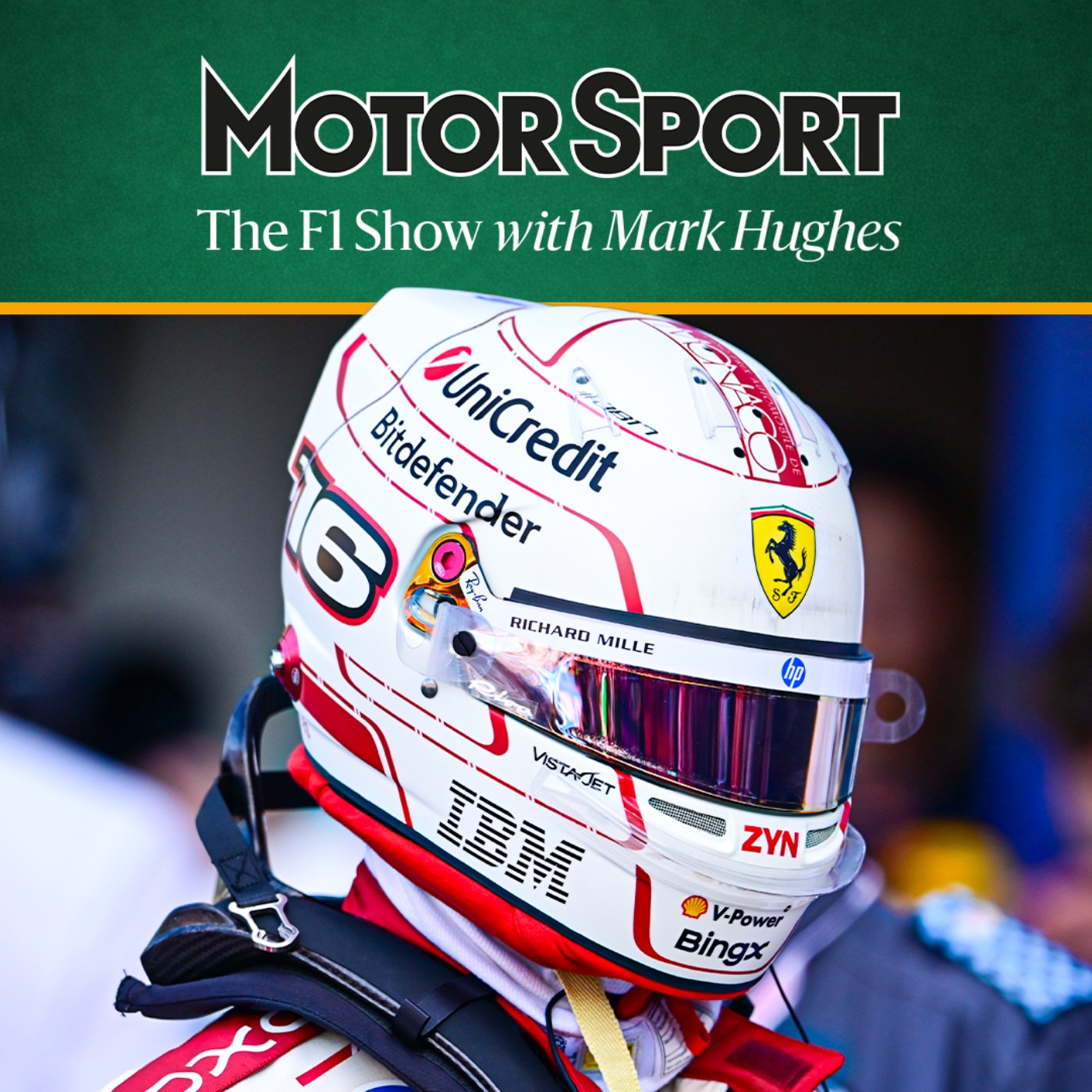
This is talking about Charles Leclerc, one of Ferrari’s top Formula 1 drivers. The episode is saying his race went badly because of problems with his brakes.
“Pedal feel” just means what the brake pedal feels like to the driver. If it feels firm and predictable, it’s easier to brake late and control the car the same way every lap.
“Braking late” means you wait longer before you hit the brakes as you approach a turn. The later you brake, the harder it is to stay in control, so it takes confidence in the brakes.
This is about how the car turns into the corner. “Front rotation” means the front tires help the car pivot so it can change direction quickly, but you only get a short window to do it well.
When you brake and turn at the same time, the tires have limited grip. If you use a lot of grip for braking, you may have less left for steering, so the car’s cornering changes.
In F1 context, “carbon” refers to carbon-fiber brake components (carbon brake discs and related materials). They’re known for strong braking performance, but their feel can differ from other disc materials—affecting how a driver modulates braking.
The transcript highlights brake “temperature” as the limiting factor: the rotors weren’t coming up to operating temperature. In F1, if brakes are too cool—especially early laps or after restarts—braking can feel weak or inconsistent because friction and heat transfer aren’t in their optimal range.
“Restarts” are moments after a race interruption (like a safety car period) when cars re-accelerate and braking demands change quickly. The transcript suggests Leclerc’s brake problem was worst during these phases because the discs hadn’t regained optimal temperature yet.
A “fuel flow arrangement” refers to how much fuel the car is allowed to use and how that allowance is managed under FIA rules. The transcript frames it as part of the regulatory/technical changes affecting the team since 2019, alongside other FIA arrangements in 2020–2021.
Ferrari is one of the top Formula 1 teams. In F1, the car the team builds and how it’s set up can make a huge difference to how well the driver can perform. Here, they’re saying Leclerc still sees Ferrari as his best long-term option even with a brake problem.
A brake issue means something isn’t right with how the car slows down. If braking feels inconsistent, the driver has to adjust how they enter corners, which can cost time and make the car harder to drive fast. The discussion here is whether Leclerc’s brake problem explains the performance gap.
Charles Leclerc is one of Ferrari’s top F1 drivers. This part of the show is about how his braking feel and stability have changed recently, and whether Ferrari’s attempts to help Lewis Hamilton could accidentally make things worse for Leclerc.
Michael Schumacher is a legendary F1 driver. Here he’s mentioned as an example of a driver who could strongly influence what a team focused on and how it evolved.
The friction material is the part of the brake that touches the disc and creates the stopping power. If the compound works best only within certain temperatures, it can feel great one moment and worse another—especially in racing where brake temperatures change constantly.
Alpine is the F1 team being talked about here. They’re dealing with penalties related to pit lane speed-limit measurements and are trying to appeal them.
“Cutting the corner” here refers to taking a shorter path through the pit-lane area by crossing or partially crossing marked lines. That can reduce the measured distance/time used for speed-limit enforcement, making it look like the car exceeded the pit lane limit even if the driver tried to stay within it.
The FIA is the organization that writes and enforces the rules in Formula 1. They’re the ones behind the measurement and penalty process being discussed here.
F1 has a maximum speed you’re allowed to drive in the pit lane. Officials measure it using timing between two points, so if you’re even a little too fast, you can get a penalty.
They don’t just measure your speed at one moment. They time how long it takes you to travel a set pit-lane distance, then convert that into an average speed to decide if you broke the limit.
Cadillac is referenced because the pit lane markings and boxes were rearranged with an extra team. The host thinks that the way cars route around those markings can affect how pit-lane speed is measured.
In F1, “Adio upgrade tokens” are like extra development allowances. If your engine is not keeping up with the best one, the FIA can give you extra resources to improve it.
ICE is short for the engine that burns fuel. Here, they’re talking about the combustion part of the F1 power system, which is what the FIA compares for Adio.
This describes how Adio tokens can be granted across multiple seasons based on measured performance gaps. Teams that fall behind by certain thresholds can receive upgrade allowances for the current year and again for the next year.
In Adio, the FIA doesn’t just grant permission to change the engine—it also provides additional resources like dyno hours and budget. “Dyno hours” are time on an engine test stand, used to develop and validate performance changes.
Drivability is how easy it is to drive the car smoothly and predictably. If drivability is “iffy,” the car may hesitate or behave oddly when you press the throttle. Even if the engine has strong power, poor drivability can stop the driver from using it well.
Here, “electronics” means the car’s computer-controlled systems that manage the engine and hybrid power. If those systems act up, the car can feel unpredictable or not respond the way it should. That can make the driver complain even if the engine has strong potential.
Battery deployment is how the car uses stored electrical energy while you’re driving. In an F1 hybrid car, that electric boost can be turned up or down depending on the situation. The FIA is trying to measure how much of the lap’s speed comes from the battery versus the fuel-burning engine.
Peak power is the highest power the engine can make at one moment. The FIA here isn’t just using that single best moment to judge teams. They care about how power is delivered across the entire lap, not just the top peak.
Term
audio adjustments
In F1, “audio adjustments” is about changing the car’s engine sound setup that’s allowed under the rules. If a team makes certain changes, it can affect whether they’re allowed to do it without losing eligibility or facing restrictions.
That phrase means the raw power coming from the gasoline/combustion part of the F1 hybrid power unit. In F1, there’s also energy stored and used from the hybrid system, but this specifically points to the engine’s contribution.
An “upgraded engine” is when an F1 team brings a newer version of the engine to make the car faster. Teams can’t just swap engines freely, so the timing of upgrades matters a lot.
“Barcelona” is the race weekend location in Spain where F1 teams bring their cars and try different strategies. It’s a track where engine and power management choices really show.
Term
engine ratio debate
The “engine ratio debate” is about how the rules should split responsibility between different parts of the F1 power system. That affects how teams build their cars and how they can use power during a race.
The “60-40 regulation” is a rules proposal that sets a percentage split for how the power system is balanced. If it passes, teams have to build their future cars around that balance.
A “super majority” means you need a very large vote to pass a big rule change. It’s harder to get than a normal majority, so it can make major decisions take longer.
This phrase is about future F1 rules that control how the cars use both gasoline-like engine power and electric power. Those rules affect how teams build their power units. They’re debating how the transition timing could play out and who benefits.
Compression ratio is how tightly the engine squeezes the fuel/air mixture before it’s ignited. That squeezing affects how efficiently the engine makes power. Here, the hosts are talking about how the rules measure it and how that could change who seems to have the advantage.
A turbo is a device that uses exhaust to spin and push extra air into the engine. More air can mean more power. They’re comparing how Ferrari’s turbo setup might help them get off the line faster.
Monaco Grand Prix is a specific F1 race. In this discussion, it’s used as a reference for when the rules for measuring engine compression changed. That’s important because the way you measure can change who looks like they have the advantage.
A “regulation cycle” is the time window where the rulebook stays mostly the same. Teams design their cars to those rules, and performance is compared across cycles.
Sometimes rules are written with one goal in mind, but they end up causing a different effect than expected. That’s what the host means by “unintended consequences.”
Modern F1 cars use a hybrid system, so there’s an electrical part that stores and releases energy. The host is saying the clever engineering is more in that electrical system than in the basic fuel-burning engine.
It’s a rule that limits how much fuel the engine is allowed to burn per second. That means teams can’t just use more fuel to make more power—they have to be efficient.
Monza is a legendary Formula 1 race track in Italy. It’s known for being very fast and very demanding on braking, so if someone looks quick there in practice, it’s a big clue they can be competitive.
Ascari-Chicade refers to a specific section of the Monza circuit (the Ascari complex and the following Chicane). It’s a technical part of the lap where drivers need precise car balance and traction, so being “quick through” there highlights real chassis/tyre control rather than just straight-line speed.
“New regulations” means the sport changes the rules. That can force teams to redesign the car, and if they’re still figuring it out, the car can feel harder to drive and less predictable.
“Track time” just means how much time the driver gets to practice on the actual race track. More track time usually means faster learning because you get more chances to feel what the car is doing.
“Data banks” here means the driver’s stored experience and information from previous driving. If you haven’t had much track time, you don’t know as well how the car will react, so it’s harder to know what to do quickly.
Concept
cortex forms
The cortex is part of the brain that helps with learning and decision-making. The point here is that at 18, a driver is still developing the mental skills needed to learn a new car fast.
The rear suspension is what connects the rear wheels to the car and controls how they move. If the team changes it the wrong way, the car can feel unstable or unpredictable, especially when you’re trying to go fast through corners.
The rules can force teams to run tires at certain pressures. That changes how the tires heat up and grip, so it can make the car harder to drive at the limit.
In today’s F1 cars, the power system manages stored energy. How much energy you have (and when you can use it) can change how the car feels when you brake and turn in.
A feedback loop is how the driver “reads” what the car is doing and then makes adjustments. If a driver relies on that information more than others, they may struggle when the car doesn’t feel consistent.
Low grip surfaces are parts of the track where the tires don’t stick as well. That means the car can slide more, so the driver has to be gentler and more precise with braking and turning.
Car
Ferrari 312 T5
This is a Ferrari Formula 1 race car from the late 1970s, driven by Gilles Villeneuve. The “T5” is tied to how the turbo was arranged in the car. The hosts bring it up because it’s an iconic qualifying-and-pit-story from that era.
Gilles Villeneuve was a famous Formula 1 driver who raced for Ferrari. In this story, he’s the driver trying to set a fast qualifying lap, after being delayed in the pits. The hosts also mention another driver affecting his lap.
Car
Ferrari 312 T4
This is another Ferrari Formula 1 car from the same late-1970s family as the 312 T5. The hosts say the photo might actually be the T4 instead of the T5. They also explain that the newer car’s engine shape was changed to help airflow around the sides.
Side pods are the bodywork “pods” on either side of an F1 car that house components and shape airflow. In this segment, the host says the narrower engine on the Ferrari 312 T5 was intended to create flow through the side pods, linking packaging to aerodynamic efficiency. Better airflow can improve cooling and reduce drag, which matters for qualifying pace.
“Pole” in Formula 1 means the driver who qualifies fastest and starts the race from the front of the grid. The segment describes a time “which stood as pole,” then explains how Villeneuve’s flying lap was nearly a second up on that benchmark. Pole is a key qualifying outcome because it affects track position at the race start.
Jody Schechter is referenced as “contractor number one” who set a time that stood as pole. In F1 terms, this describes a teammate/driver role where one driver’s lap becomes the benchmark for others to beat. The segment uses Schechter’s pole time as the comparison point for Villeneuve’s later flying lap.
Nelson Piquet is mentioned as being on an in-lap or similar slower lap when Villeneuve was on his flying lap. This is a common qualifying issue: traffic can disrupt a driver’s rhythm and prevent them from getting a clean, uninterrupted run. The segment calls it “lap ruin,” emphasizing how it affected Villeneuve’s attempt.
Car
Ferrari 126 C
The Ferrari 126 C is referenced as a drawing of Villeneuve in 1981, tying the discussion to Ferrari’s early-1980s turbo era. The “126” naming is part of Ferrari’s model designation for that generation of cars. In this segment it’s used as a visual/collectible context alongside the earlier 312 T-series story.
LIVE
Yeah, very, very unhappy Charlotte Clare. What was supposed to be his, you know, showcase grumpery.
He was outqualified by a teammate at Monaco for the first time. Very unhappy. I'm unhappy with
a brake situation. Unhappy with just how his weekend was unfolding. And then on the safety car
restart, the brakes were still too cold at the rear. It caused him to lock up over that bit of
track surface that was coming up. So that combination put him in the wall.
Well, Mark, off the back of the Monaco Grand Prix, I think really a Monogasque was racing at the
Monaco Grand Prix. Let's start with Charlotte Clare. What are your overriding thoughts from
his performance over the weekend? Well, Charlotte is habitually absolutely brilliant around Monaco,
but he had a really difficult weekend and absolute dynamite as usual on a Friday morning in FP1.
You know, he gets straight into the groove and is just, you know, so, so fast around there,
especially through that section from the chicane through to back in the swimming pool.
Other drivers in awe of him through there. But then as the weekend regressed, the Ferrari,
the others caught up basically with the Ferrari or Mercedes in particular did,
and Red Bull as well with the stab. But he was having difficulties with the brakes,
just as he was all through Canada. He does not like the feel of the brakes, this new material
that Brembo introduced for him in Canada. And it's a little bit marginal on warm-up. It's a
response from Brembo to Lewis Hamilton's feedback throughout last year of the feel that he wanted
with the pedal. And so they've tried to respond with that. And the outcome, even though Lewis Biden
then had switched to carbon industry discs, Brembo introduced this new material on Charles's car
and Montreal and they had it in Monaco. And all weekend temperatures were a little bit
difficult to get in the front tires and the brakes. So he was just not in a happy place.
He was, he'd done an absolute do or die effort in the final lap Q3 when he was
0.27 up on Hamilton going into the back. And it would have been fighting for Paul with that time.
But then, yeah, he's scripted, he's wheel rim along the wall on the exit and got a puncture. So
that was that. And so he was outqualified by a teammate at Monaco for the first time as a result.
Very unhappy, unhappy with the brake situation, unhappy with just how his weekend was unfolding.
And then so running in third place with Hamilton in second, both very distant from Kimmy Antonelli.
And then, of course, to have the safety carpet stops. And Ferrari wanted to bring Hamilton in
because they wanted them on new tires for the restart. So he could have a go at the win on
the restart against Antonelli. But that meant bringing Leclerc in as well for a tire change.
And even though, from his personal perspective, there was no logic to him coming in to have a
tire change. He was not really threatened from behind. And he would have been in second place,
but on all tires. So for our reason, we want one of our cars on new tires. We want the second
place car on new tires to challenge the leader. And so he was brought in as well. And so that
displeased him. And then on the safety car restart, the brakes were still too cold at the rear.
And it caused him to lock up over that bit of track surface that was coming up that
Landstroller just crashed on and caused the safety car. So that combination put him in the
wall. So yeah, very, very unhappy Charlotte Leclerc. It was what was supposed to be his,
you know, showcase grand prix. Yeah, he should have gone into the weekend, you know, on cloud nine
really, because he just announced a new contract extension, two year extension, I think to the
back end of 2028. But you mentioned that chicane, the Vell chicane, I took a photo when I was down
there, as you know, as in Monaco, of that barrier or one of the two barriers you're talking about.
And how close did he get to those? He brushed it to just the perfect amount, didn't he? Not
not clouting it, just grazing it. It was unbelievable how how close he can get, how
precise he is. But for Charlotte Leclerc going into the weekend, it was supposed to be a great one.
Can you explain to us in maybe a bit more detail what the problem is with
the brakes that he's having and how that differs to what Lewis Hamilton has because they they're
running different brakes as as you mentioned in your latest column as well.
Yeah, so Charles remains on Brembo front discs, and Lewis has switched
since Suzuka to carbon industry and different French manufacturer. And basically this is
when Hamilton talked in the press conference about thanking the support of Freddie Versailles
and getting to make all sorts of changes that were very difficult for Versailles to do.
That's what he's referring to, because the relationship between Ferrari and Brembo is
about 50 years old, and it extends beyond just Brembo. There's all the other companies within
such as AP Clutch and Olin's Dampers. It's all part of a big intricate relationship between the two
companies. So it was very, very difficult for Versailles to push through a change that Hamilton
was asking for, because these discs are what he had at Mercedes, and he feels he needs the
the pedal feel that they give to allow him to drive the way he wants to drive, the way he
brakes quite late, and he uses quite a lot of steering quite aggressively. So it means that
that little moment of opportunity to get really quick direction change, a good rotation on the
front of the car is very small using that style. Compared to Clare's a little bit earlier, floats
a lot of momentum in, trades off the braking with the cornering, gives them a few more options
in the entry point and still to get that rotation. So they're asking for different things from the
feel of the brake pedal, and the Brembo's have traditionally given fantastic feel, and they're
still the most common discs on up and down the grid. But the carbon industries are more powerful,
they do have greater stopping power, but the feel that they give Hamilton actually likes in the way
that he uses the brakes, he needs a very stiff pedal, and he's got used to understanding the
feedback he gets from that very stiff pedal when he's using the brakes very hard, and he doesn't
like the sort of ambiguity you get with the more gradient feel that you get from the Brembo's.
And so he eventually succeeded in getting what he wished for, they were introduced in Suzuka,
it's history repeating because he asked, he made the same change at Mercedes when he arrived there
from McLaren, it took him a year to get the brakes as it to his liking there as well.
So he's got that now, and Leclerc, because Brembo were trying to respond to Hamilton's
feedback all through last year, they were coming up with new materials, but it takes a long time
because they have to be baked, and you then have to go and try and test them, and it takes months
just to do a new spec of discs, absolutely, that's how long it takes, just the manufacturing process
because they have to be baked for so long. So what Brembo introduced on the Clare's car in Canada
was actually as a result of Hamilton's feedback from all through last year, so they've finally got
this new material, but they haven't got Hamilton's car to put it on anymore, so it got on the Clare's
car, it should have been better, it probably is better in normal circumstances, but both Canada
and Montreal, the energy was cool in Canada, Montreal, in Monaco, the energy being put into
the front tires and the disc is very low, so the problem was that it was on the margins of
not coming up to temperature enough, and particularly in the early laps or on restarts,
it was really given Le Clare some problems, so yeah, so he was very unhappy with the brakes in
both Montreal and Monaco, and this was happening at the same time that Hamilton was perfectly
happy with his carpet industry discs, so yeah, quite a tricky political situation for
Versailles to steer his way through, and it's not over yet, Le Clare is on about
one that used the carpet industries for Barcelona this weekend, so we'll see, we'll see where that
goes, but yeah, this has been the main issue for Le Clare the last two races, the brakes.
Next question to me, signed a new contract, as we've mentioned, he left Monaco really,
really unhappy with this brake situation, he'd said that he'd had other opportunities to move
to other teams, I'm sure he'd have quite a long list of other teams, maybe another 10 other teams
in fact that he would be able to walk into, why would he align himself further or you know,
continue his allegiance with a team that has let him down, it's not the first time that they've
let him down either, why would he continue to stay with them? That's a good question, but I think
even though he's had a particular issue the last couple of races, I think he believes that Versailles
gradually making progress and gradually ticking off the boxes where the team has underperformed
over the years and he does see that as going in the right direction and yeah, it's been a turbulent
time and as you know, if you think since he joined in 2019, you know, they had the fuel flow arrangement
in 2019, as a result of the thing in 2019, they had an arrangement of the FIA in 2020 and 2021,
which effectively took them out of the competitive picture altogether, so he's had since 22, 23,
since then, gradually trying to build a genuinely competitive team around Leclerc and I do think
that the relationship between those two is fundamentally good and I do think that Leclerc
probably believes this where his best chances are, if you look around, you'd question Red Bull,
what's the future there, is Max staying or going, there's people leaving, you know, you wouldn't
automatically think that's got to be a better bet than Ferrari long term, you know, Mercedes,
I don't know, it looks like they've got all the signs of coalescing around this new talent
that they've got and they may be taking on Max for stopping as well, so you know, Claren, yes,
maybe, I'm sure there was interest there on both sides, so possibly, but I think he's just decided
that no, his long term best bet of all the options that he has available is Ferrari and yeah, he's
got an irritating little thing which is making him angry at the moment, but I don't think that's
going to really damage the relationship, it's just something to work through.
A big announcement, I mean, I think it was Zach Brown that said on the lead up, we are,
we are very happy with our driver lineup, we're not looking to change, there was lots of that kind
of reassuring, wasn't there, reassuring noises from lots of the different teams,
for the second weekend though, and you've hinted about upon this in your article as well,
with the brake issue and how it's working for Hamilton and Leclerc or not for Leclerc,
for the second weekend running, Hamilton has finished ahead of Charles Leclerc,
is it purely down to the issue with the brakes that Charles Leclerc is having at the moment,
or is there something more fundamental going on, is this Lewis Hamilton doing
wondrous things and reshaping the team somewhat, or is it just what's going on with the brakes,
as simple as that? It's more the latter, but Hamilton is performing to a much better level
himself, now that he's got a car doing what he wants it to do, and then the brakes are a hugely
important part of that, and as we've made here before, a driver can only perform to his full
potential, if the car is allowing him to do what, to express himself in the way he needs to do,
if it's not, it brings him down to a standard level, and that's just where he was at for much
of last year, and the year before it must end, but if it's like this car is allowing him to
express himself and use that driving style that he naturally has, and so he is no question
performing to a much higher standard this year than he was last year, but at the same time,
Leclerc is the last two races had this stability with the brakes, so you're not really comparing
like with like there, but I think, you know, they'll work through that, I'm sure, I'm sure
that's not going to be a permanent issue for Leclerc, but no, I think genuinely you are seeing a
happier Hamilton, and I don't think it's so much that he's changing the whole way that the team
operates, as someone being said, that he's like this all powerful, all seeing, you know,
God that can look down and say that, that, that, and then change it all, I don't think that's
what's happening, I think he's just giving them feedback, no, I need the car to do this, and
well that's very difficult Lewis, because politically, well, you know, that's not my
problem, that's your problem, you've got to sort that out, that's what I need,
and that's what that conversation was last year, so the brakes were the main part of that conversation,
so it's, it's not as presented, I think it's, it's much, much simpler than that.
Leipzig to Appendon seems to lead what's going on at Red Bull, Michael Schumacher has led what's
happened at a few places he's been at, I was just wondering with, with the Lewis Hamilton,
the way he, the way he has come in and said he wants these changes, the fact that Ferrari have
made the changes to appease Lewis Hamilton, are the detriment of Charles Leclerc, who's the younger
driver, does that tell us anything, or is that a danger of reading too much into that?
Yeah, I don't think it, they will not have done that,
thinking this is going to be the detriment of Leclerc, there's no reason why this would have
been to the detriment of Leclerc, how it's turned out, because Brembo responded in a certain way,
and there's a certain friction material that doesn't work in a certain temperature,
is as a result, but it's just a sort of random result of that change to that Hamilton was asking
for, and it has ended up damaging Leclerc for the last couple of races, but it's not, it's not
systemically, could be damaging for Leclerc, and it certainly wouldn't have been done with that,
intention or that knowledge of that, I'd think that Ferrari still sees its future very much with
them both now, but there were questions about Hamilton last year, obviously, and how long
would that relationship sustain a level of underperformance from them, but there's no
real underperformance from them now, so that's looking fine, but at the same time they've shown
their commitment to Leclerc by extending the contract as well, so I don't think it's damaging
to Leclerc, I don't think this, you're seeing Hampton coming in and taking Leclerc's
team off them, I think they're operating an equal number one system. If you want to read
up more on this, you can do Mark's latest column, the MPH column at motorsportmagazine.com, it
goes into more detail about the brakes issue, so you get a real understanding of the differences
between Charles Leclerc's needs, requirements, and Lewis Hamilton's words, a really good read,
so check that out for you. Before we disappear from Monaco, though Mark, a couple of things to
mention, one is Alex Albon, he secured the 95th start for Williams, equalling the record
of Nigel Madsen, which is why I've just put the Williams over my shoulder just there,
lights give it topical, topicals, that was quite nice as well,
but as you know, I was out there and I really enjoyed it, I went on a yacht party, that can't
hurt, can it? But I really enjoyed it, I think Monaco is certainly a Grand Prix you need to be
at as opposed to watch, and I'm pretty sure you'll maybe share that opinion.
It's a spectacular place, close-up, yeah, yeah, close-up, it's just thrilling, yeah.
But one thing that struck me in, the reason I'm going to ask this question, it's also backed up
by one of our audience members, so before you ridicule my question Mark, just remember that
Grad Birdie also asked the question, and a few other people too.
Quite a lot, and it's unusual, quite a lot of speeding in the pit lane
incidents, penalties were thrown at different drivers, I know that McLaren had one, Alpine,
they had three, it got to a point of thinking maybe there was something wrong with Alpine's
calibration to start with, because they kept getting handed these penalties, I heard it
into Tom Stullard, who's Oscar Piastri's race engineer, he was saying that essentially there
was shortening the length of the pit lane by cutting the corner. What happens, how do they
read the measurements, how do they read the speeds, the FIA, and how do they go about the
process of issuing these penalties, and what's the outcome from Monaco?
The pit lane speed limit is measured from one line to the other line, and that's the distance,
and the time that it takes you to cover that distance is your average speed, sort of like
a speed camera on the road. There has been, because there's an 11th team this year, there was a bit
of a rearrangement of how the pit boxes were marked out, and Cadillac was the 11th team right at the
far end, and when there was no Cadillac in the pit lane, the quickest way to get through to the
pit exit was to partially go over their lines, and I think it may be that that has triggered
the measurement of the time taken, it's shortened by enough to take it over the average,
what they calculate as the average speed, but it's not really the average speed, it was perfectly
possible to not go over that 60km limit, but still trigger the timing to suggest that it's hard,
and I think that's probably what we're looking at, so Alpine have measured it out, and that's the
information that they're now taking to the appeal, to have Gasly's penalty removed,
which would put them in third place, so the outcome of that will be known, so yeah, they're
appealing that on that basis. As a somebody, I'm up and down pit lanes all the time, so speed limits
are really, really important, but if it's as fundamental as cutting a corner, making it shorter
and therefore appears that you've been speeding, that's got to change, and I did feel very sorry
for Alpine, I did feel very sorry for Pierre Gasly, who sort of dreamt of a podium at Monaco,
and it's been taken away from him, so we'll find out the outcome of that, and thanks very much
for clarifying it, and a great question by the way there from Rab Birdie, Mark, who also asked
that question, so thank you very much indeed, just log that on your brain. So let's just get to clear
the source of that question, you're trying to claim it was yours, but some other people have joined
in, or? That's right, yeah, that's right, yeah, 100%. Just for clarity, yeah, I'm piggybacking,
Mark. Yeah, yeah, I'm, you know, I'm unscrupulous in the fact that I, well, quite happily jump
in front of people accused. Now then, I'm going to move the topic on, as I say, all the stuff
about the brakes, all the issue with Charlotte Clair and Lewis Hamilton, go to Mark's latest
column, the MPH column at MotorportMagazine.com. Let's move the topic on, though, to Adio. Now,
I've got two audience questions, so I'm doing things slightly differently this time, Mark,
I've got a couple of audience questions that are about Adio and what's going on with it,
then I've got some of my own, I'm sure, inferior questions to bring here, but let's start off,
yeah, I know, let's start off with Fred, Fred Rodriguez says, dear Mark Hughes, starting
with Endearment, we like that. Are you shocked at the reports that Red Bull has the top ICE power
unit and Mercedes, he puts in brackets, a shock along with Ferrari, Honda and Audi will get
Adio upgrade tokens? Now, for those who don't know about Adio, can you briefly explain what Adio is
and then maybe come to the answer? Yeah, it's basically a mechanism whereby the internal combustion
engines can be, there's an opportunity for manufacturers to do further development if they're
found by the FIA's measuring system to be behind, if you're more than 2% of what they've measured
as the strongest internal combustion engine, then you're entitled to an upgrade this year and another
one next year, if you're 4% or more behind, you're entitled to this year and to next year,
plus there's extra engine, dyno hours and extra budget that you're allowed to spend,
but essentially, yes, that's what it is and they were assessed, the first assessment came
from the first five races, so after Montreal, so the first five races in Montreal and this was
published after Monaco, the teams were informed and the outcome was that the FIA determined that
the strongest performing internal combustion engine, not the whole power unit, just the internal
combustion engine, is the Red Bull and the second, just over 2% behind is the Mercedes
and then the Ferrari is 4% behind and then following the Ferrari, the Audi and the Honda,
also all over 4% behind, so this entitles Mercedes to one upgrade, Red Bull can't have any upgrades
until the next assessment and Ferrari can have up to two. Now, that doesn't mean that the FIA
isn't awarding upgrades to them, it's giving them the opportunity to upgrade, they still have to
actually make that improvement themselves, so it's no guarantee that it's going to close off any deficit,
but yeah, it's a very good opportunity. So yeah, in answer to Fred's question,
was a surprise, a little bit surprised, not shocked but a little bit surprised, but
it wasn't totally new to me because all through this discussion, Mercedes have been saying we
don't have the strongest internal combustion engine, we may have the best power unit and we've
got the best car, but we don't believe we have the best internal engine and what they're referring
to is the Red Bull and when you look at the specific parameters that they were looking at
to judge it, they qualified people, it is a very very strong engine, now it doesn't always perform
that well because its drivability is a bit iffy, the electronics can be a bit unreliable, you're
constantly hearing the stop and complaining of drivability and had your last weekend but that
was a specific fault, but when it's on song it is a very powerful, potent, internal combustion
engine and that is all that's being measured, that's all that Adios seeks to measure, so
it's ended up giving them the fastest car, i.e. Mercedes, an additional development opportunity
and the car which is probably only the fourth quickest is stymied, it can't bring any
internal combustion engine upgrades which is probably not what was intended when this mechanism
was dreamed up, but that's the way it's played out and we don't know for sure and the teams don't
know either because the FIA won't tell them what metrics are being measured, it's not just peak
power, it's quite easy for them to determine how much of an acceleration or performance of the lap
is internal combustion engine and how much is battery deployment, but obviously that part of it,
it's not just peak power and it's how the internal combustion engine's power is delivered
over the whole lap, but we don't know the exact metrics and the reason the FIA
haven't told the teams what metrics they're using is because they feel that the teams would
use that information to game the system, but it looks like it may have been gamed anyway,
I think as probably Mercedes would probably in those first few races have been keen that Ferrari
doesn't fall more than 4% behind or more than 2% behind, so it's been trying to ensure Ferrari
didn't get the audio adjustments and I think Ferrari may have been thinking no, the opposite,
you know, we want to make sure that we are more so that we get the adjustments, which might be
the whole reason, as we've said before, why the Red Bull is delivering the best
in terms of internal combustion engine power. So we'll see now, in fourth-class races, what the
pattern is, but certainly for Barcelona this weekend, no one's going to have an upgraded engine,
but we may see, be interested to see if Mercedes and Ferrari in particular use their engines more
aggressively than they have done so far. Turn it up to 11, that's what they'll do,
turn it up to 11, but it's interesting because of course with Mercedes, it's not just Mercedes
that are going to get the, if there's a change to the engine, if they're upgrading the engine,
it'll be McLaren, it'll be Alpine, it'll be Williams, they also get the benefit of it, so
maybe that, you know, woking just up the road for me, maybe they're going, oh, we get an improvement
there along the way. I've got a follow-up question for you, this is from Yemi Travels.
Would love to know your thoughts on the audio eligibility for Mercedes, as well as how you
think that will impact the season, also how that plays into the politics for the 2027
engine ratio debate, and if that super majority will be easier or tougher to achieve for the FIA?
Yeah, that's a great question, and I think it's going to take some beating that one.
It's impossible to answer that, especially the latter part and how it impacts upon whether we
get that 60-40 regulation through for 27 or not, because that's where the majority is needed,
the super majority is needed. I think it's going to depend how this performance pattern plays out
now under this, now that the addua ranking has been revealed. I think if we see a more
competitive Ferrari, a lot more competitive Ferrari when they bring their expected upgrade in
Austria and another one in Italy, there may be more of a push from Ferrari to delay these
regulations until 28. I think that will be, I think Ferrari is the key here. I think the
performance of Ferrari between now and the next, well the next two adio periods will probably
determine how lightly it is that we go to the 60-40 combustion electric regulations in 27 rather
than 28. That's a great question. I've got one more question for you about this,
well about compression actually, so it brings it nicely to. I won't go for the full question though,
because you've answered a fair bit of it through some of the other answers, but this is from Roger
Gamber-Jones, and like I said, I'm just paraphrasing a little bit. He's asking really,
why is that everyone's now ignoring Mercedes alleged engine compression advantage once
normal operating temperature is reached, whereas everyone is talking about Ferrari's smaller turbo,
giving them a faster getaway, but they're not talking about the Mercedes loophole.
What can you tell us there? Well the method of measuring it was changed from the Monaco Grand Prix
and Mercedes were saying all along, I won't make any difference, it's we will have the legal
compression as measured hot or cold, so I mean Monaco's not an engine circuit, so
even if they had a reduced engine advantage over Ferrari there, it wouldn't have really been a
partner. There we will have more of an idea, I guess, from Barcelona, but so the feeling from
the other teams is that they weren't expecting to see a significant difference with this
different way of measuring it, but there's a different way again coming in for 27,
and they think that that will then reduce the Mercedes performance through the compression ratio,
but yeah, as for why it's not being talked about, I think it's already been dealt with in terms of
the way it's been measured and that everybody signed off on that, so yeah, we'll see more
clearly next year I think. Yeah thanks very much for that, and thanks Roger for your question as
well. I'm just going to stick with Red Bull for a second, because is the electrical element letting
them down or really letting them down, because that was supposed to be, well Ford's injection was
supposed to be dealing with that as well, so has it gone wrong for Red Bull or is it just early
stages with that power unit? Yeah, I think it's remarkable that they've turned out what's been
measured as the best internal combustion engine for a start-up engine manufacturer. This is, you
know, it didn't exist in competition before this year, but the electrical side around that is not
refined enough yet, and it's not fully exploding that internal combustion engine,
and that's where the big development will come, but it indicates that there is big potential
if the internal combustion engine is the best, that defines the potential of the whole package,
the whole power unit package, because all the deployment and the electric power is derived
from the engine, so the more power the engine's delivering, the more that electrical system has
to work with, so that in theory the better it will be, so yeah, I think there will be very,
very encouraged Milton Keynes Red Bull powertrains by how well it's going, but it's not at its full
potential yet, and I've seen, as we talked about already, it's got a few drivability issues and
a few reliability, electrical reliability issues.
Yeah, it certainly seems to. With the duos measurement, is it a flaw in the system that
it's helping the championship leaders? When you think of the ratio between internal combustion
and the energy from the battery, is the focus too great on that small percentage? Well, it's still
a big percentage, it's a majority percentage, but there's a huge impact still on the battery.
Is it too narrow a view that the FIA are looking at, do you think?
I think the idea was to try and get as far as possible to a situation where all the internal
combustion engines were about the same, and that therefore the competition, the development
competition would all be around the electrical and the battery, because that was the direction
that automotive wanted to lead development. So I think that's what the idea of the audio system
was, to try as quickly as possible, get everybody's internal combustion engines up to about a
similar level, where there's only a couple of tenths maximum between the best and the worst,
which is where we were at the end of the previous regulation cycle. So I think that's what the
intention was, but certainly the short-term effects of it, just the way it's played out,
in that the team which has delivered the best car, is getting a performance,
opportunity of a performance upgrade from its internal combustion engine, just because of the
way that it's panned out. These regulations weren't made in the expectation that Red Bull would have
the best internal combustion engine, but only the fourth best car. Mercedes would have the best car,
but not the best combustion engine. There's no legislating for how it's going to come out,
but the basic intention was and remains that, to get everyone up to about the same level on
internal combustion engines, and that's what this mechanism is designed for.
Is there any form of appeal, a Red Bull likely to appeal, or can they respond to this? And what
about Ferrari? Would they be disappointed that they're seeing Mercedes also get this opportunity?
I think that Ferrari, yeah, depends if they're a glass half full or glass half empty. They've got
the opportunity of two performance upgrades, and we understand there are two big upgrades
planned around it already, even before they got it. So I think they'll be very pleased that those
upgrades, they can action them at the same time. Yeah, probably a little bit disappointing that
Mercedes gets an opportunity as well. Yeah, it's just the way it's, it's just where the
situation has panned out. It's not, you know, the role is be unintended consequences,
I think we've talked about before, and this is just one of them. But I think it's only just
going to be a fairly short term difficulty, because with the development, everybody's
internal combustion will get to a similar level pretty quickly, I'm sure, because that's not
where the trick technology is. The trick technology is in the, you know, in the electrical system.
So the internal combustion engine, especially at this reduced fuel flow limit is not, you know,
it's not new technology that they're working with. So I think, given the caliber of all the five
manufacturers involved, now that they have the data from the early races, they will be able to
all get themselves to roughly the same level quite quickly, I believe.
So there's two other elements to this one here. Would Mercedes have had any upgrades planned?
Would it be a surprise to them that they're getting this extra allowance? And what about
Aston Martin? There was talk about them getting extra help as well. Are they still getting that
additional help? Yeah, I'm not sure if Mercedes were expecting to be given this opportunity.
So I don't know, I have asked and they were a little bit secretive, as you'd expect.
But as for Aston Martin, well, Aston Martin, yes, Aston Martin not only gets the
the two upgrade opportunities, which it badly needs, but there's talk of it receiving further
help in terms of the amount of budget it's allowed to spend to catch, because it has to catch up
so much more than the others. So yeah, they will be probably getting extra
cost cap help as well as the upgrade opportunities.
Very briefly as well. What about Red Bull? They're the benchmark. When will the next
decision be made? And are they the benchmark until that point? Or does it go beyond that?
Yeah, well, the next assessment is after Hungary. If in the meantime Ferrari has introduced its
superduper upgrade engine, and during that time between Monaco and Hungary, the Mercedes has
performed better, and it's quite possible that Red Bull will only be the number three or the
number four, I'd say in theory, in which case it will then get upgrade opportunities in the next
period. So yeah, that's just kind of chin scratching and head scratching things like that.
If you want to stay up to date with everything that's going on in Formula One, and there's a lot
going on in the world of Formula One at the moment, go to the Motorport Magazine website
MotorportMagazine.com and subscribe to the F1 newsletter. The newsletter will go into your
inbox and you can stay up to date, up to speed with all of the changes, developments.
Now, Mark, we haven't mentioned Kimi Antonelli or George Russell yet, and we should. Kimi Antonelli,
five consecutive race wins now. His first five wins in his Formula One career, consecutive. That is
a record. He is beating his own records, and it's very, very impressive. He made quite a lot of
mistakes last year, but this year, he seems to be so, so composed. What's the difference? Where's
it come from? He's a stunning performance at the moment in Monaco in particular. That was just
fantastic. That was a level of mastery of that track that invites comparisons to
and other greats around there. You're saying there's a new Schumacher.
Yeah, I mean, the performance potential of Kimi Antonelli was always apparent. It was off the scale,
even in his junior categories. We saw it even in his first practice sessions at Monza in 24.
Yeah, he went off after a lap and a half, but he was incredibly fast before that happened,
and he remained. Even after the session had completed, nobody got close to how quick he
was through Ascari-Chicade. That just tells you what the potential is to get the fact that he
crashed. It was confirmation of the level that his junior career had suggested,
and you're then coming in with hardly an experience, not even a season of Formula
3, only one season of Formula 2 in a team that was having difficulty with adapting to the new
regulations and where you don't get any opportunity for track time, etc., etc.
So you had a difficult season in F2 followed by your rookie season of Formula 1 in a
difficult car with a top teammate, and yeah, your data banks are completely empty. You've got no idea
where different deficits are coming from and how to attack and how much to attack,
and which corners work with your natural style and which corners you're trying to adapt to.
You've got all these things coming at you, and you're 18 years old. Your brain is not even fully
developed yet. You're another two or three years away from the way the cortex forms and all that,
so yeah, it's incredibly challenging, and there was no way he was going to be coming in last year
and having a rookie season like, for example, Hamilton in 2007. It wasn't anything like as
prepared. It was a significant amount younger, and the car wasn't anywhere near as competitive.
So you're just still then looking, right, okay, just have a look at the peaks, because the peaks
are what's going to promise where his performance will be once he's filled all those data banks.
And he won't have filled them yet, but they're an awful lot more full than they were this time
last year. And in the middle of all that last year, you had a two-month write-off where the
team had gone down a development direction with the rear suspension, which
turned out to be absolutely the wrong direction. That was really confusing to him just as he'd been
making progress. So yeah, he had to sort of reset after that, and he did have a strong end of year.
So yeah, this is just what we're seeing. This is just the full flowering of the talent that he is,
and it happens to have come when the team have produced this sort of, you know,
absolutely amazing car. So yeah, absolutely perfect. Ticks all the boxes, isn't it? And he's just,
he doesn't know how to lose now. Now he's got used to winning it. He can just, it's as if he can't
do anything wrong. It's not always going to be like that, of course, and there's going to be more
challenges to come even this season. But he's just enjoying this period and just he's walking on water
really. His confidence is sky high. And he's bringing that level of ability to that confidence in a
perfect situation with the fastest car in F1 and a teammate that's getting psychologically
battered as a result. Let's quickly talk about George Russell then, because you said, and that's
all on you, you said it was make or break for Russell in going into Canada. Canada was where
George Russell said normal service will be resumed. And you know, make or break, he has to perform.
And he did perform, but he performed to the same level as Kimmy Antonelli. He didn't outclass Kimmy
Antonelli. So he kind of caused himself a problem by saying normal service will be resumed in Canada.
Going into Monaco, it was then going to be a vital round for him going into Monaco. A circuit he
doesn't particularly do very well at or doesn't enjoy anyway. What does that make Barcelona? If
he's had make or break going into Canada, vital going into Monaco, we come up with a term for
Barcelona, is it? Is it make or break 2.0? These are all just terms used to move a narrative along,
but that narrative does reflect a story of George's season. And it's, you know,
there was no particular reason why he should have struggled at Monaco, except he didn't have the
confidence to get the brakes and the tyres up to that threshold temperature because it was a
tricky thing to do because of the energy and the high tyre pressures that were mandated
for the weekend. So that made that quite tricky. And if you don't have that confidence at Monaco,
that is much more punishing of your lap time than at more conventional circuits because
you can't commit when the barriers are just there. If you try and commit in the feeling of the car
isn't there, you know you're just going to hit the barrier. That's pretty much guaranteed. Whereas
a more conventional circuit like Barcelona with wide open corners and lots of runoff, you can push
your luck. You can say, well, what happens? I'll just push a bit harder. And then you start getting
the temperature and the tyres, the brakes, and now that's starting to feel more like it. The car now
feels like out and it just sort of builds and you're off on the trajectory and you should be okay.
So that will be, I'm sure, what Russell will be hoping for coming in Barcelona, a much more
conventional track. It's not a track where you're going to be struggling for tyre temperatures because
it's the long fast corners, you're going to get the tyre temperature. So when George gets that
feeling of, yeah, as he's approaching the corner and beginning the corner,
that the front is really digging in and giving them all the sensations he wants,
then that season is happy place and then he's able to go. And tonight he doesn't drive in
quite the same way. He doesn't need the same feedback loop as George. So he won't be disadvantaged
but George will be, should be, performing to a better level there. So the championship
situation looks quite bleak for George. The points gap looks quite bleak, 68 points.
But the performance gap when he's having a normal weekend and he's had two not normal weekends,
Miami and Monaco and that's two of the last three races. So there's a bit of recency bias
making it look bad. But if you just look at his performance rather than his results, it's been
okay. There's only been two off-race. So he's 5-1 down on wins but it could easily be 3-3.
It's not that bad. But yeah, Antonini's at a good level the whole time. An extraordinary
level at Monaco. Whereas George has been up and down a little bit because he's difficulty on
low grip surfaces. But yeah, that's something he needs to attend to because you can't always
guarantee a high grip surface. You can't always guarantee that the tire temperatures are going
to be easy to generate and things like that. So he knows now the level that Antonini is at.
So he's going to have to attend to that weakness in his game.
Yeah. And we've got Barcelona coming as you say and that's, Chak's got a bit of everything. Maybe
we'll see a bit of new perspective on each car's performance. Before we finish this off, we'll pick
that up next time out, Mark. Before we finish this one off, I've got one more question for you.
And this is from the Whiskey Rebel. And they say, Mark, here's that photo just above your right
shoulder, the Ferrari 312 T5 driven by Gilles Villeneuve. It's actually a Whiskey Rebel. It's
actually the T4 from the year before, 312 T4. But the T5 looked virtually identical. It just had
a narrower engine to try and create a bit of flow through the side pods. But yeah, on that,
that's I think in qualifying in 79, where he'd been held in the pits by Ferrari for a long time
to enable the, Jody Schechter, who was the contractor number one to really get in the groove
and set a time which stood as pole and the only lead Villeneuve outright at the end. And
by the time he got to the chicane on his flying lap, he was almost a second up on the time that
Schechter would stand as pole. And he encountered Nelson Piquet dawdling along on an in lap or
something like that. And so that was lap ruin, but even so put him on the front row alongside
Schechter, but he was set to be on pole by about a second there. So yeah, that's that's that picture.
And that one over there is a drawing of him in the 1981 126 C.
Good stuff. Mark, as always, thank you very much indeed.
Thank you. And thank you for the great questions. And even the one that you tried to get
in on, that was a very good question. You probably contributed to that. So, you know,
I think you should just just keep working at it, Bryn, because yes, I think your questions are getting
better. Outrageous. Outrageous. Thank you very much there to Mark. And thank you as well for
tuning in. If you enjoyed the episode, hopefully you did give it a like and subscribe, tell your
friends as well about this all new F1 show from Motorsport and get your questions into Mark for
next time. Do so by going to the YouTube video, putting your questions in the comments below,
or going to motorsportmagazine.com. Now, on that topic, Ferrari is targeting a fourth consecutive
Le Mans win and first Grand Prix victory of the season this weekend. Our latest issue celebrates
75 years of Ferrari wins Mario Andretti, Jackie X, Nigel Mansell, Rubens Barrichello and more
offer 75 reasons why we love the prancing horse. We also have an exclusive interview
with Jean-Lucy, who on this day, the 11th of June 1995 won a Grand Prix for the first and only time.
On sale in the shops now or go to motorsportmagazine.com. Thanks for watching. We'll see you next time.
I wonder where Yemi travels to, but says would love to know your thoughts on the Aduo
eligibility, if I could say it. I'll do that again. Says would love to know your thoughts on the Aduo
eligibility for Mercedes as well as Oh God, take 48. Would love to know your I'm not looking at you
because I'm just this going to go wrong. He says would love to know your thoughts on the Aduo God,
would love to know your thoughts on the Aduo. This is your one from the other week. Right. Okay.
I'm glad we do outtakes at the end of this. Right. Here we go. Thanks for your support.
Right. This is this is all a vision so I can fix it in post. It's all fine. Right. Here we go.
Few edits required in that one. I think, Mark.
Gonna hit stop.
About this episode
Charles Leclerc’s Monaco weekend is traced to brakes that wouldn’t come up to temperature—especially on a safety car restart—leaving the rear “still too cold” and contributing to lock-ups and a crash. The hosts connect it to Brembo’s brake-material/spec changes and the way friction behavior depends on heat, contrasting Leclerc’s needs with Hamilton’s preferred brake feel and carbon-brake switch. They also discuss how Monaco’s constraints amplify confidence and temperature-window problems, before pivoting to pit-lane speeding penalties and FIA upgrade-token rules.
While Lewis Hamilton looked back to his best in Monte Carlo, nothing seemed to go right for Charles Leclerc who ended his Monaco Grand Prix in the wall after a terrible weekend — two years after winning at the circuit.
Mark Hughes and Bryn Lucas discuss the unusual, political situation behind the team-mate discrepancy, involving new brake discs for Hamilton and a different set for Leclerc — which were created to match Hamilton's demands.
They look at F1's decision to award engine upgrade tokens to every manufacturer on the grid bar Red Bull. Is the system really meant to reward the fastest performers?
Plus where has Kimi Antonelli's crushing pace come from after a hit-and-miss 2025 season? And how many more make-or-break races can George Russell fail to win?
More on the stories that really matter, in the latest episode of the Motor Sport F1 Show.
Subscribe now for every weekly episode and tell us what you want to know from Mark. Send us a message on social media or find this podcast at https://go.motorsportmagazine.com/49GnWSV and drop your questions in the comments. He'll answer a selection of the best every week.
Read Mark's column every Wednesday at https://go.motorsportmagazine.com/49GnWSV