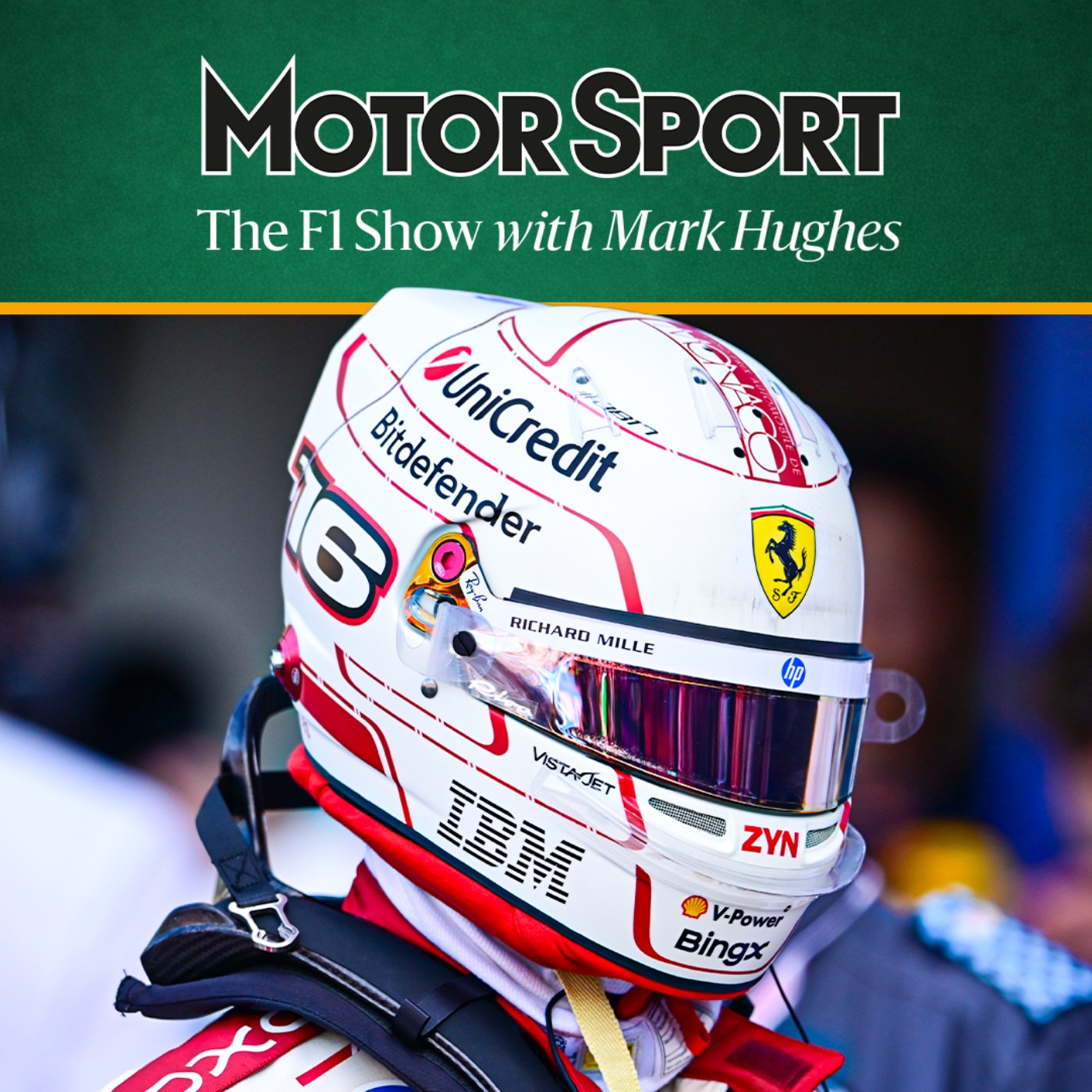
Leclerc disaster: why he can't get the brakes
About this episode
Charles Leclerc’s Monaco weekend is traced to brakes that wouldn’t come up to temperature—especially on a safety car restart—leaving the rear “still too cold” and contributing to lock-ups and a crash. The hosts connect it to Brembo’s brake-material/spec changes and the way friction behavior depends on heat, contrasting Leclerc’s needs with Hamilton’s preferred brake feel and carbon-brake switch. They also discuss how Monaco’s constraints amplify confidence and temperature-window problems, before pivoting to pit-lane speeding penalties and FIA upgrade-token rules.
While Lewis Hamilton looked back to his best in Monte Carlo, nothing seemed to go right for Charles Leclerc who ended his Monaco Grand Prix in the wall after a terrible weekend — two years after winning at the circuit.
Mark Hughes and Bryn Lucas discuss the unusual, political situation behind the team-mate discrepancy, involving new brake discs for Hamilton and a different set for Leclerc — which were created to match Hamilton's demands.
They look at F1's decision to award engine upgrade tokens to every manufacturer on the grid bar Red Bull. Is the system really meant to reward the fastest performers?
Plus where has Kimi Antonelli's crushing pace come from after a hit-and-miss 2025 season? And how many more make-or-break races can George Russell fail to win?
More on the stories that really matter, in the latest episode of the Motor Sport F1 Show.
Subscribe now for every weekly episode and tell us what you want to know from Mark. Send us a message on social media or find this podcast at https://go.motorsportmagazine.com/49GnWSV and drop your questions in the comments. He'll answer a selection of the best every week.
Read Mark's column every Wednesday at https://go.motorsportmagazine.com/49GnWSV
Hosted on Acast. See acast.com/privacy for more information.
brakes were still too cold
"And then on the safety car restart, the brakes were still too cold at the rear. It caused him to lock up..."
Racing brakes work best when they’re hot. If they’re too cold, they may not bite the way the driver expects. That can make the car harder to control when you brake hard.
Brake performance in racing depends heavily on temperature: pads and rotors need heat to work at their best. If the brakes are “too cold,” they may not generate the expected friction and can behave inconsistently. That can contribute to lock-ups or poor modulation, particularly at the rear where balance is critical.
lock up
"It caused him to lock up over that bit of track surface that was coming up. So that combination put him in the wall."
“Lock up” means the brakes grabbed so hard that the wheel stopped spinning and started sliding. When that happens, the car loses steering grip. It can be dangerous because the driver can’t control the car as well.
In braking, “lock up” means the wheels stop rotating and slide on the surface instead of rolling. That usually happens when brake pressure is too high for the available grip, especially if tires or brakes aren’t at the right temperature. In F1, a lock-up can quickly lead to loss of control and even a crash.
FP1
"but he had a really difficult weekend and absolute dynamite as usual on a Friday morning in FP1. You know, he gets straight into the groove..."
FP1 means the first practice session of the race weekend. Teams use it to test the car and learn what works. Drivers also try out things like braking and tire behavior before qualifying.
FP1 is “Free Practice 1,” the first on-track practice session of the Grand Prix weekend. Teams use it to gather data, test setups, and evaluate components like brakes and tires. Driver feedback during these sessions can strongly influence what gets changed before qualifying.
Brembo
"He does not like the feel of the brakes, this new material that Brembo introduced for him in Canada. ...And so they've tried to respond with that."
Brembo is a major F1 and high-performance braking supplier, known for designing brake systems and materials. In this segment, the key point is that Brembo changed brake “material” for Charles Leclerc, which affected how the brakes feel and warm up. That can influence driver confidence and braking consistency.
warm-up
"And it's a little bit marginal on warm-up. It's a response from Brembo to Lewis Hamilton's feedback..."
Warm-up is how long it takes the brakes to get hot enough to work properly. If they warm up slowly, the driver may not get the braking response they expect right away. That can be risky when you need to brake hard soon after a restart.
“Warm-up” in braking is how quickly the brake system reaches an operating temperature where friction is consistent. If warm-up is “marginal,” the brakes may feel weak or unpredictable until they heat up. In F1, this is especially important after restarts or during changing weather/track conditions.
carbon industry discs
"And it's a little bit marginal on warm-up. ...And the outcome, even though Lewis Biden then had switched to carbon industry discs, Brembo introduced this new material..."
In F1, many cars use carbon-ceramic brake discs. They’re designed to brake hard repeatedly without losing effectiveness. Different disc/material setups can change how the brakes feel and how fast they work when the car is restarting.
“Carbon … discs” refers to carbon-ceramic brake rotors, which are common in F1 because they can deliver strong braking performance and resist fade. The speaker contrasts this with Brembo’s new brake material on Leclerc’s car, implying differences in feel and warm-up behavior. Brake rotor type and material can significantly change how quickly the brakes become effective after a restart.
Q3
"He was, he'd done an absolute do or die effort in the final lap Q3 when he was 0.27 up on Hamilton..."
Q3 is the last part of qualifying where the fastest cars go for their best lap. It’s high-pressure because you don’t get many chances to improve. If something feels off—like brakes or tires—it can ruin the lap.
Q3 is the final qualifying segment in F1, where the fastest drivers set their last and best laps. It’s typically where small changes in grip, tire temperature, and braking feel matter most. A driver can be “do or die” in Q3 because there’s little room for mistakes.
puncture
"But then, yeah, he's scripted, he's wheel rim along the wall on the exit and got a puncture. So that was that."
A puncture is when a tire gets damaged and starts losing air. In racing, that can happen from hitting something on the track. When it happens, the car can suddenly become unstable and hard to steer.
A “puncture” is a tire failure where the tire gets damaged and loses pressure. In F1, a puncture can happen from debris, contact, or running over a damaged section of track. Once a tire is compromised, the car becomes difficult or impossible to control at speed.
Lewis Hamilton
"And then so running in third place with Hamilton in second... Can you explain to us... how that differs to what Lewis Hamilton has..."
Lewis Hamilton is a top Formula 1 driver and multiple-time world champion. In this segment, he’s used as the comparison point for how different brakes can behave in the same race situation.
Lewis Hamilton is a seven-time Formula 1 World Champion who drives for Mercedes. Here, the host contrasts Hamilton’s brake setup with Leclerc’s, explaining that Hamilton has a different brake supplier and material choice.
safety car restart
"And then on the safety car restart, the brakes were still too cold at the rear. It caused him to lock up..."
A safety car restart is when the race goes back to full speed after a caution period. Right after that, the brakes may not be fully warmed up, so they can act differently than later in the race.
A safety car restart is the moment racing resumes after the Safety Car period. Brakes can be especially sensitive then because components may not be at full operating temperature yet, affecting grip and braking consistency.
Charlotte Leclerc
"So yeah, very, very unhappy Charlotte Leclerc. It was what was supposed to be his, you know, showcase grand prix."
This is talking about Charles Leclerc, one of Ferrari’s top Formula 1 drivers. The episode is saying his race went badly because of problems with his brakes.
This refers to Charles Leclerc, Ferrari’s Formula 1 driver. In this segment, the host is describing how his race weekend unraveled due to brake issues and a crash during a safety-car restart.
Suzuka
"Yeah, so Charles remains on Brembo front discs, and Lewis has switched since Suzuka to carbon industry..."
Suzuka is a well-known Formula 1 race track in Japan. Here it’s just the reference for when Hamilton switched to a different brake setup.
Suzuka is a famous Formula 1 circuit in Japan. The host uses it as a reference point for when Hamilton changed brake components (“since Suzuka”).
pedal feel
"because these discs are what he had at Mercedes, and he feels he needs the the pedal feel that they give to allow him to drive the way he wants to drive"
“Pedal feel” just means what the brake pedal feels like to the driver. If it feels firm and predictable, it’s easier to brake late and control the car the same way every lap.
In racing, “pedal feel” is how the brake pedal responds—how firm it is, how much resistance you feel, and how consistently that response matches your braking input. Drivers tune their braking technique around this feedback so they can brake late and repeat the same feel lap after lap.
brakes quite late
"the pedal feel that they give to allow him to drive the way he wants to drive, the way he brakes quite late, and he uses quite a lot of steering quite aggressively."
“Braking late” means you wait longer before you hit the brakes as you approach a turn. The later you brake, the harder it is to stay in control, so it takes confidence in the brakes.
“Braking quite late” means delaying the brake application until closer to the corner entry than most drivers. Doing this well depends on confidence in braking consistency and traction management, because you’re asking the car to slow down harder with less margin.
rotation on the front of the car
"So it means that that little moment of opportunity to get really quick direction change, a good rotation on the front of the car is very small"
This is about how the car turns into the corner. “Front rotation” means the front tires help the car pivot so it can change direction quickly, but you only get a short window to do it well.
“Rotation on the front of the car” refers to how the car pivots into the corner, driven largely by front-end grip and steering response. A small “moment of opportunity” suggests the driver has only a brief window to get that front-end rotation before the car must be stabilized for the next phase.
trades off the braking with the cornering
"floats a lot of momentum in, trades off the braking with the cornering, gives them a few more options in the entry point"
When you brake and turn at the same time, the tires have limited grip. If you use a lot of grip for braking, you may have less left for steering, so the car’s cornering changes.
This describes tire “load sharing” during braking and cornering: the available grip is limited, so using more braking force can reduce how much grip is left for turning. Drivers and engineers balance that trade-off to shape the car’s behavior at corner entry.
carbon industries
"and they're still the most common discs on up and down the grid. But the carbon industries are more powerful, they do have greater stopping power, but the feel that they give Hamilton actually likes"
In F1 context, “carbon” refers to carbon-fiber brake components (carbon brake discs and related materials). They’re known for strong braking performance, but their feel can differ from other disc materials—affecting how a driver modulates braking.
baked
"they were coming up with new materials, but it takes a long time because they have to be baked, and you then have to go and try and test them"
“Baked” here means the brake material has to be processed and cured in a controlled way. It’s not ready to test until it’s been properly treated.
“Baked” refers to the curing/processing step used to manufacture high-performance brake materials. After new brake material formulations are made, they must be baked/processed to achieve the correct structure and properties before any on-track testing can happen.
temperature
"the energy being put into the front tires and the disc is very low, so the problem was that it was on the margins of not coming up to temperature enough, and particularly in the early laps or on restarts"
The transcript highlights brake “temperature” as the limiting factor: the rotors weren’t coming up to operating temperature. In F1, if brakes are too cool—especially early laps or after restarts—braking can feel weak or inconsistent because friction and heat transfer aren’t in their optimal range.
restar ts
"and particularly in the early laps or on restarts, it was really given Le Clare some problems"
“Restarts” are moments after a race interruption (like a safety car period) when cars re-accelerate and braking demands change quickly. The transcript suggests Leclerc’s brake problem was worst during these phases because the discs hadn’t regained optimal temperature yet.
fuel flow arrangement
"if you think since he joined in 2019, you know, they had the fuel flow arrangement in 2019, as a result of the thing in 2019, they had an arrangement of the FIA in 2020 and 2021,"
A “fuel flow arrangement” refers to how much fuel the car is allowed to use and how that allowance is managed under FIA rules. The transcript frames it as part of the regulatory/technical changes affecting the team since 2019, alongside other FIA arrangements in 2020–2021.

Ferrari
"so you know, Claren, yes, maybe, I'm sure there was interest there on both sides, so possibly, but I think he's just decided that no, his long term best bet of all the options that he has available is Ferrari and yeah, he's got an irritating little thing which is making him angry at the moment"
Ferrari is one of the top Formula 1 teams. In F1, the car the team builds and how it’s set up can make a huge difference to how well the driver can perform. Here, they’re saying Leclerc still sees Ferrari as his best long-term option even with a brake problem.
Ferrari is the Italian Formula 1 constructor Mark Hughes is discussing as Charles Leclerc’s long-term best option. In F1, the team’s car development and setup choices strongly affect driver confidence and performance. The segment ties Ferrari to the idea that Leclerc’s current brake problem is something to work through rather than a relationship-ending issue.
brake issue
"for the second weekend though, and you've hinted about upon this in your article as well, with the brake issue and how it's working for Hamilton and Leclerc or not for Leclerc, for the second weekend running, Hamilton has finished ahead of Charles Leclerc"
A brake issue means something isn’t right with how the car slows down. If braking feels inconsistent, the driver has to adjust how they enter corners, which can cost time and make the car harder to drive fast. The discussion here is whether Leclerc’s brake problem explains the performance gap.
A brake issue in Formula 1 refers to a problem with how the car slows down and how consistently it can brake lap after lap. Because braking is central to corner entry, any inconsistency can force the driver to change their lines and braking points, hurting lap time and confidence. In this segment, the host connects the brake problem to why Charles Leclerc isn’t matching Lewis Hamilton.
Charles Leclerc
"Leclerc is the last two races had this stability with the brakes... the Lewis Hamilton... the fact that Ferrari have made the changes to appease Lewis Hamilton, are the detriment of Charles Leclerc..."
Charles Leclerc is one of Ferrari’s top F1 drivers. This part of the show is about how his braking feel and stability have changed recently, and whether Ferrari’s attempts to help Lewis Hamilton could accidentally make things worse for Leclerc.
Charles Leclerc is Ferrari’s lead driver, and the segment focuses on how his braking stability has varied across recent races. The host argues that changes made to satisfy Lewis Hamilton’s feedback can have complex side effects, even if they weren’t intended to hurt Leclerc.
Michael Schumacher
"Leipzig to Appendon seems to lead what's going on at Red Bull, Michael Schumacher has led what's happened at a few places he's been at..."
Michael Schumacher is a legendary F1 driver. Here he’s mentioned as an example of a driver who could strongly influence what a team focused on and how it evolved.
Michael Schumacher is referenced as an example of a driver who has “led” what happened at multiple teams. In this context, it’s used to frame how driver influence and feedback can shape team direction and development priorities.
friction material
"and there's a certain friction material that doesn't work in a certain temperature, is as a result..."
The friction material is the part of the brake that touches the disc and creates the stopping power. If the compound works best only within certain temperatures, it can feel great one moment and worse another—especially in racing where brake temperatures change constantly.
Brake “friction material” is the compound on the pads (or similar contact surfaces) that actually creates stopping force. Different compounds behave differently across temperatures, so a change that helps one driver’s preferred braking feel can produce a less favorable result for another driver depending on how they brake and how the car heats the brakes.
Alpine
"they had three, it got to a point of thinking maybe there was something wrong with Alpine's calibration to start with, because they kept getting handed these penalties,"
Alpine is the F1 team being talked about here. They’re dealing with penalties related to pit lane speed-limit measurements and are trying to appeal them.
Alpine is the Formula 1 team involved in this discussion, and the hosts are focusing on its pit-lane compliance and penalty situation. The team is also preparing an appeal based on how the pit lane speed measurement was triggered.
cutting the corner
"he was saying that essentially there was shortening the length of the pit lane by cutting the corner. What happens, how do they read the measurements,"
“Cutting the corner” here refers to taking a shorter path through the pit-lane area by crossing or partially crossing marked lines. That can reduce the measured distance/time used for speed-limit enforcement, making it look like the car exceeded the pit lane limit even if the driver tried to stay within it.
FIA
"What happens, how do they read the measurements, how do they read the speeds, the FIA, and how do they go about the process of issuing these penalties,"
The FIA is the organization that writes and enforces the rules in Formula 1. They’re the ones behind the measurement and penalty process being discussed here.
The FIA (Fédération Internationale de l’Automobile) is the governing body that sets the rules and oversees race control decisions in Formula 1. In this context, it’s the organization that measures pit lane compliance and issues penalties based on those measurements.
pit lane speed limit
"The pit lane speed limit is measured from one line to the other line, and that's the distance,"
F1 has a maximum speed you’re allowed to drive in the pit lane. Officials measure it using timing between two points, so if you’re even a little too fast, you can get a penalty.
In Formula 1, the pit lane speed limit is a regulated maximum speed that teams must obey while entering and exiting the pits. It’s enforced using timing measurements between two specific lines in the pit lane, so drivers can’t just “feel” the speed—they have to stay within the measured window.
average speed
"and the time that it takes you to cover that distance is your average speed, sort of like a speed camera on the road."
They don’t just measure your speed at one moment. They time how long it takes you to travel a set pit-lane distance, then convert that into an average speed to decide if you broke the limit.
The pit lane speed limit is effectively checked by calculating an average speed over a measured distance between two lines. If the car covers that distance in less time than allowed, it can be treated as exceeding the limit even if the driver never “felt” like they were going too fast.
Cadillac
"and Cadillac was the 11th team right at the far end, and when there was no Cadillac in the pit lane, the quickest way to get through to the pit exit was to partially go over their lines,"
Cadillac is referenced because the pit lane markings and boxes were rearranged with an extra team. The host thinks that the way cars route around those markings can affect how pit-lane speed is measured.
Cadillac is mentioned as the 11th team in the pit-lane layout changes for the season being discussed. The host argues that when Cadillac isn’t present, the quickest route to the pit exit can involve crossing lines that affect how the speed measurement is triggered.
appeal
"Alpine have measured it out, and that's the information that they're now taking to the appeal, to have Gasly's penalty removed,"
An appeal is when a team officially contests a penalty they think was wrong. They present their case to try to get the decision changed.
In F1, an appeal is a formal process where a team challenges a steward decision or penalty after it’s been issued. Here, Alpine are using measured information to argue that the pit-lane timing/measurement was triggered in a way that shouldn’t count against Pierre Gasly.
Pierre Gasly
"so yeah, they're appealing that on that basis. As a somebody, I'm up and down pit lanes all the time, so speed limits are really, really important, but if it's as fundamental as cutting a corner, making it shorter and therefore appears that you've been speeding, that's got to change, and I did feel very sorry for Alpine, I did feel very sorry for Pierre Gasly, who sort of dreamt of a podium at Monaco,"
Pierre Gasly is the driver who lost a potential podium because of a penalty. Alpine are appealing to try to get that penalty taken away.
Pierre Gasly is the driver whose Monaco podium result is being affected by the pit-lane speed-limit penalty discussed in this segment. The team’s appeal is aimed at having his penalty removed, which would change the final classification.
Adio upgrade tokens
"Fred Rodriguez says, dear Mark Hughes... Are you shocked at the reports that Red Bull has the top ICE power unit and Mercedes... will get Adio upgrade tokens?"
In F1, “Adio upgrade tokens” are like extra development allowances. If your engine is not keeping up with the best one, the FIA can give you extra resources to improve it.
“Adio upgrade tokens” refers to a Formula 1 rules mechanism that lets teams spend additional development allowances on their engines. The FIA measures engine performance and awards tokens (and related resources) to teams that are behind the top-performing internal combustion engine.
ICE power unit
"Are you shocked at the reports that Red Bull has the top ICE power unit and Mercedes..."
ICE is short for the engine that burns fuel. Here, they’re talking about the combustion part of the F1 power system, which is what the FIA compares for Adio.
“ICE power unit” uses ICE as shorthand for “internal combustion engine,” meaning the combustion part of the F1 power unit. The key point here is that Adio is based on the ICE performance ranking, not the full hybrid power unit.
internal combustion engines
"Yeah, it's basically a mechanism whereby the internal combustion engines can be, there's an opportunity for manufacturers to do further development..."
This is the part of the F1 power system that burns fuel to make power. In this discussion, the FIA is comparing how well that engine part is doing.
“Internal combustion engines” are the combustion-based power units in F1 that burn fuel inside the engine to produce power. In this context, the FIA’s Adio system compares performance specifically for the ICE portion, not the entire hybrid power unit.
upgrade this year and another next year
"...then you're entitled to an upgrade this year and another next year, if you're 4% or more behind..."
This describes how Adio tokens can be granted across multiple seasons based on measured performance gaps. Teams that fall behind by certain thresholds can receive upgrade allowances for the current year and again for the next year.
engine, dyno hours and extra budget
"...plus there's extra engine, dyno hours and extra budget that you're allowed to spend..."
In Adio, the FIA doesn’t just grant permission to change the engine—it also provides additional resources like dyno hours and budget. “Dyno hours” are time on an engine test stand, used to develop and validate performance changes.
after Montreal
"they were assessed, the first assessment came from the first five races, so after Montreal, so the first five races in Montreal..."
They’re saying the first official check for Adio happens after the Montreal races. That’s when teams find out if they get extra upgrade help.
The FIA’s first Adio assessment is described as coming after the Montreal races, based on the first five races. This matters because it sets when teams learn whether they qualify for upgrade tokens.
drivability
"it doesn't always perform that well because its drivability is a bit iffy, the electronics can be a bit unreliable, you're constantly hearing the stop and complaining of drivability"
Drivability is how easy it is to drive the car smoothly and predictably. If drivability is “iffy,” the car may hesitate or behave oddly when you press the throttle. Even if the engine has strong power, poor drivability can stop the driver from using it well.
Drivability is how smoothly and predictably the car responds to the driver—especially during throttle changes and transitions. The host says the engine can be “on song” but that drivability is “a bit iffy,” with electronics issues causing stop-and-complaining behavior. In F1, drivability problems can limit how effectively a team can exploit the available power.
electronics
"the electronics can be a bit unreliable, you're constantly hearing the stop and complaining of drivability"
Here, “electronics” means the car’s computer-controlled systems that manage the engine and hybrid power. If those systems act up, the car can feel unpredictable or not respond the way it should. That can make the driver complain even if the engine has strong potential.
In this context, “electronics” refers to the car’s electronic control systems (engine management, sensors, and related systems) that govern how the power unit behaves. The host links electronics unreliability to drivability complaints, implying that software/control issues can affect how power is delivered. In modern F1, electronics are tightly integrated with hybrid power and throttle response.
battery deployment
"it's not just peak power, it's quite easy for them to determine how much of an acceleration or performance of the lap is internal combustion engine and how much is battery deployment"
Battery deployment is how the car uses stored electrical energy while you’re driving. In an F1 hybrid car, that electric boost can be turned up or down depending on the situation. The FIA is trying to measure how much of the lap’s speed comes from the battery versus the fuel-burning engine.
Battery deployment is how much electric power the hybrid system releases from the battery during the lap. In Formula 1, that electric contribution can be managed strategically, so it affects acceleration and overall lap performance. The host notes that the FIA’s metrics aren’t just peak power—they’re trying to separate ICE output from battery contribution.
peak power
"it's not just peak power, it's quite easy for them to determine how much of an acceleration or performance of the lap is internal combustion engine and how much is battery deployment"
Peak power is the highest power the engine can make at one moment. The FIA here isn’t just using that single best moment to judge teams. They care about how power is delivered across the entire lap, not just the top peak.
Peak power is the maximum power output a power unit can produce at a given moment. The host emphasizes that the FIA’s assessment isn’t only based on peak power, because teams can have different power delivery characteristics across a whole lap. That matters because drivability and how power is delivered over time can be as important as the maximum number.
audio adjustments
"I think Ferrari may have been thinking no, the opposite, you know, we want to make sure that we are more so that we get the adjustments, which might be the whole reason, as we've said before, why the Red Bull is delivering the best in terms of internal combustion engine power."
In F1, “audio adjustments” is about changing the car’s engine sound setup that’s allowed under the rules. If a team makes certain changes, it can affect whether they’re allowed to do it without losing eligibility or facing restrictions.
In Formula 1, “audio adjustments” refers to changes to how the car’s engine sound is presented to viewers and/or how the sound is managed under the sport’s rules. Teams can be affected by eligibility constraints, so whether a change is allowed (or triggers penalties) can influence strategy and development timing.
internal combustion engine power
"which might be the whole reason, as we've said before, why the Red Bull is delivering the best in terms of internal combustion engine power. So we'll see now, in fourth-class races, what the pattern is"
That phrase means the raw power coming from the gasoline/combustion part of the F1 hybrid power unit. In F1, there’s also energy stored and used from the hybrid system, but this specifically points to the engine’s contribution.
“Internal combustion engine power” is the output produced by the combustion part of the power unit (as opposed to any electric contribution). In modern F1, teams manage both the engine and energy systems, so comparing “engine power” helps explain why one car may feel stronger even when the overall power unit is regulated.
upgraded engine
"for Barcelona this weekend, no one's going to have an upgraded engine, but we may see, be interested to see if Mercedes and Ferrari in particular use their engines more aggressively than they have done so far."
An “upgraded engine” is when an F1 team brings a newer version of the engine to make the car faster. Teams can’t just swap engines freely, so the timing of upgrades matters a lot.
An “upgraded engine” in F1 means a new or revised engine specification brought to the track to improve performance—often through efficiency, combustion improvements, or reliability changes. Because F1 has strict rules on engine components and usage, when and how teams upgrade can be as strategic as the hardware itself.
Barcelona
"So we'll see now, in fourth-class races, what the pattern is, but certainly for Barcelona this weekend, no one's going to have an upgraded engine"
“Barcelona” is the race weekend location in Spain where F1 teams bring their cars and try different strategies. It’s a track where engine and power management choices really show.
“Barcelona” refers to the upcoming F1 race weekend at the Circuit de Barcelona-Catalunya. It’s a key test of efficiency and traction, so teams often plan upgrades and engine usage strategies around what they expect to work there.
engine ratio debate
"Would love to know your thoughts on the audio eligibility for Mercedes, as well as how you think that will impact the season, also how that plays into the politics for the 2027 engine ratio debate"
The “engine ratio debate” is about how the rules should split responsibility between different parts of the F1 power system. That affects how teams build their cars and how they can use power during a race.
The “engine ratio debate” is the discussion over how the power unit’s components should be proportioned—i.e., how much emphasis is placed on different energy sources or operating modes. In F1, these ratios directly influence car design, strategy, and the competitive balance teams can achieve.
60-40 regulation
"It's impossible to answer that, especially the latter part and how it impacts upon whether we get that 60-40 regulation through for 27 or not, because that's where the majority is needed"
The “60-40 regulation” is a rules proposal that sets a percentage split for how the power system is balanced. If it passes, teams have to build their future cars around that balance.
The “60-40 regulation” refers to a proposed or discussed split in how much of the performance/energy comes from one part of the power unit versus another (commonly framed as a percentage balance). In F1 politics, whether the rule passes affects how teams design engines and hybrids for the next era.
super majority
"because that's where the majority is needed, the super majority is needed. I think it's going to depend how this performance pattern plays out"
A “super majority” means you need a very large vote to pass a big rule change. It’s harder to get than a normal majority, so it can make major decisions take longer.
A “super majority” is an unusually high voting threshold required to approve major rule changes in F1 governance. Because it’s harder to reach than a simple majority, it can slow or block proposals—especially when teams disagree on the direction of future regulations.
combustion electric regulations
"determine how lightly it is that we go to the 60-40 combustion electric regulations in 27 rather than 28."
This phrase is about future F1 rules that control how the cars use both gasoline-like engine power and electric power. Those rules affect how teams build their power units. They’re debating how the transition timing could play out and who benefits.
“Combustion electric regulations” refers to the sport’s evolving rules that govern how much of the powertrain is based on the internal-combustion engine versus electric energy. In F1, these rule packages shape engine design, energy recovery, and how teams balance performance across race conditions. The hosts are discussing whether Ferrari’s performance now will influence how “lightly” the transition to those regulations happens in a given year.
compression ratio
"I've got one more question for you about this, well about compression actually... he's asking really, why is that everyone's now ignoring Mercedes alleged engine compression advantage... but they're not talking about the Mercedes loophole... they think that that will then reduce the Mercedes performance through the compression ratio"
Compression ratio is how tightly the engine squeezes the fuel/air mixture before it’s ignited. That squeezing affects how efficiently the engine makes power. Here, the hosts are talking about how the rules measure it and how that could change who seems to have the advantage.
In an internal-combustion engine, the compression ratio is how much the air-fuel mixture is squeezed in the cylinder before ignition. A higher or lower compression ratio changes how efficiently the engine can extract energy and can affect power delivery and drivability. In this segment, they’re discussing how rule changes and measurement methods may change the perceived advantage between teams.
turbo
"whereas everyone is talking about Ferrari's smaller turbo, giving them a faster getaway, but they're not talking about the Mercedes loophole."
A turbo is a device that uses exhaust to spin and push extra air into the engine. More air can mean more power. They’re comparing how Ferrari’s turbo setup might help them get off the line faster.
A turbocharger uses exhaust gas to spin a turbine that forces more air into the engine, allowing more power from a smaller displacement. In modern F1 engines, turbocharging is central to how teams manage power and efficiency. The segment contrasts Ferrari’s smaller turbo approach with Mercedes’ claimed compression advantage.
Monaco Grand Prix
"Well the method of measuring it was changed from the Monaco Grand Prix and Mercedes were saying all along..."
Monaco Grand Prix is a specific F1 race. In this discussion, it’s used as a reference for when the rules for measuring engine compression changed. That’s important because the way you measure can change who looks like they have the advantage.
The Monaco Grand Prix is referenced here as the event where the method of measuring engine compression was changed. That matters because measurement procedures can affect how teams’ claimed advantages are interpreted under the rules. The segment uses Monaco as a reference point for why Mercedes’ compression argument may not show up the same way.
power unit package
"the whole power unit package, because all the deployment and the electric power is derived from the engine"
In F1, the “power unit” isn’t just the engine. It’s the whole hybrid setup—engine plus electric parts—working together as one system.
In Formula 1, the “power unit” is the complete hybrid system: an internal-combustion engine plus energy recovery and an electric motor. Calling it a “package” emphasizes that performance depends on how well all those parts work together, not just the engine alone.
regulation cycle
"where there's only a couple of tenths maximum between the best and the worst, which is where we were at the end of the previous regulation cycle."
A “regulation cycle” is the time window where the rulebook stays mostly the same. Teams design their cars to those rules, and performance is compared across cycles.
A “regulation cycle” is the multi-year period of technical rules that teams build their cars around. The transcript compares the current situation to the end of the previous cycle, when performance gaps between the best and worst cars were already small.
unintended consequences
"It's not, you know, the role is be unintended consequences, [2118.7s] I think we've talked about before, and this is just one of them."
Sometimes rules are written with one goal in mind, but they end up causing a different effect than expected. That’s what the host means by “unintended consequences.”
“Unintended consequences” here means the regulations produced a side effect that wasn’t the original goal. The host argues that the rule design led to teams like Red Bull (and others) ending up with unexpected opportunities or difficulties as the season develops.
electrical system
"that's not where the trick technology is. The trick technology is in the, you know, in the electrical system."
Modern F1 cars use a hybrid system, so there’s an electrical part that stores and releases energy. The host is saying the clever engineering is more in that electrical system than in the basic fuel-burning engine.
The electrical system in modern F1 power units includes the hybrid components that generate and deploy electrical energy. The host’s point is that the “trick” development is more about the electrical side than the internal combustion engine, especially under fuel-flow limits.
reduced fuel flow limit
"The internal combustion engine, especially at this reduced fuel flow limit is not, you know, it's not new technology that they're working with."
It’s a rule that limits how much fuel the engine is allowed to burn per second. That means teams can’t just use more fuel to make more power—they have to be efficient.
A reduced fuel flow limit is a regulation that caps how quickly teams can use fuel during a race. By limiting fuel delivery, the FIA forces teams to manage efficiency and makes it harder for any one team to gain a big advantage purely through engine power.
Monza
"We saw it even in his first practice sessions at Monza in 24. Yeah, he went off after a lap and a half, but he was incredibly fast before that happened,"
Monza is a legendary Formula 1 race track in Italy. It’s known for being very fast and very demanding on braking, so if someone looks quick there in practice, it’s a big clue they can be competitive.
Monza is the famous Italian circuit near Milan, known for its high-speed straights and heavy braking zones. In Formula 1, it’s a track where aerodynamic efficiency and braking stability matter a lot, so early practice pace there is a strong signal of potential.
Ascari-Chicade
"Nobody got close to how quick he was through Ascari-Chicade. That just tells you what the potential is to get the fact that he crashed."
Ascari-Chicade refers to a specific section of the Monza circuit (the Ascari complex and the following Chicane). It’s a technical part of the lap where drivers need precise car balance and traction, so being “quick through” there highlights real chassis/tyre control rather than just straight-line speed.
new regulations
"…only one season of Formula 2 in a team that was having difficulty with adapting to the new regulations and where you don't get any opportunity for track time, etc., etc."
“New regulations” means the sport changes the rules. That can force teams to redesign the car, and if they’re still figuring it out, the car can feel harder to drive and less predictable.
“New regulations” refers to rule changes that alter how F1 cars are designed and operated, which can force teams to rethink aerodynamics, car balance, and development priorities. When a team is struggling to adapt, drivers can feel inconsistent behaviour because the car’s baseline setup direction is still evolving.
track time
"…only one season of Formula 2 in a team that was having difficulty with adapting to the new regulations and where you don't get any opportunity for track time, etc., etc."
“Track time” just means how much time the driver gets to practice on the actual race track. More track time usually means faster learning because you get more chances to feel what the car is doing.
“Track time” is the amount of time a driver spends actually driving the car on circuit during practice, testing, or race weekends. In junior-to-F1 transitions, limited track time slows learning because drivers gather less feedback on tyre behaviour, braking points, and car balance.
data banks
"You've got no idea where different deficits are coming from and how to attack and how much to attack, and which corners work with your natural style and which corners you're trying to adapt to. You've got all these things coming at you, and you're 18 years old."
“Data banks” here means the driver’s stored experience and information from previous driving. If you haven’t had much track time, you don’t know as well how the car will react, so it’s harder to know what to do quickly.
In F1 driver development, “data banks” means the accumulated performance information a driver has from prior testing and races—things like how the car behaves in different conditions and how to respond to setup changes. A rookie with limited track time has fewer reference points, so they can’t always predict where the car will be strong or weak.
cortex forms
"You're 18 years old. Your brain is not even fully developed yet. You're another two or three years away from the way the cortex forms and all that,"
The cortex is part of the brain that helps with learning and decision-making. The point here is that at 18, a driver is still developing the mental skills needed to learn a new car fast.
The “cortex” is the brain’s outer layer involved in higher-level processing, learning, and decision-making. The host is using it as a metaphor for how an 18-year-old driver may still be developing the mental processing speed and experience needed to interpret feedback and adapt driving style quickly.
rear suspension
"…you had a two-month write-off where the team had gone down a development direction with the rear suspension, which turned out to be absolutely the wrong direction."
The rear suspension is what connects the rear wheels to the car and controls how they move. If the team changes it the wrong way, the car can feel unstable or unpredictable, especially when you’re trying to go fast through corners.
The rear suspension is the set of components that controls how the rear wheels move and how the car’s grip is managed over bumps, cornering loads, and braking. In F1, changing rear suspension development direction can drastically affect traction and stability, so a wrong direction can confuse a driver and slow progress.
tyre pressures that were mandated
"...because of the energy and the high tyre pressures that were mandated for the weekend. So that made that quite tricky."
The rules can force teams to run tires at certain pressures. That changes how the tires heat up and grip, so it can make the car harder to drive at the limit.
“Mandated” tire pressures mean the series rules require a specific pressure range for the weekend. Because tire pressure strongly affects how the tire heats up and how much grip it provides, being forced to run certain pressures can make it harder to reach the right temperature and performance window.
energy
"...because of the energy and the high tyre pressures that were mandated for the weekend. So that made that quite tricky."
In today’s F1 cars, the power system manages stored energy. How much energy you have (and when you can use it) can change how the car feels when you brake and turn in.
In modern F1, “energy” usually refers to the hybrid power system’s energy management—how much electrical/hybrid energy is available and when it can be deployed. That affects acceleration and traction, which can change how confidently a driver can push into braking and corner entry.
feedback loop
"then that season is happy place and then he's able to go. And tonight he doesn't drive in [2731.8s] quite the same way. He doesn't need the same feedback loop as George."
A feedback loop is how the driver “reads” what the car is doing and then makes adjustments. If a driver relies on that information more than others, they may struggle when the car doesn’t feel consistent.
A “feedback loop” in F1 describes how the driver receives information from the car—through steering feel, braking/turn-in behavior, and tire response—and then adjusts inputs accordingly. If one driver needs more consistent feedback to drive at their best, they can be disadvantaged when conditions or car behavior change.
low grip surfaces
"Whereas George has been up and down a little bit because he's difficulty on [2794.0s] low grip surfaces. But yeah, that's something he needs to attend to because you can't always"
Low grip surfaces are parts of the track where the tires don’t stick as well. That means the car can slide more, so the driver has to be gentler and more precise with braking and turning.
“Low grip surfaces” are track conditions where the available traction is reduced, such as cooler asphalt, wet patches, kerbs that don’t provide grip, or abrasive/dirty sections. On low grip, drivers must manage tire temperature and throttle/brake inputs more carefully because the car can lose traction more easily.

Ferrari 312 T5
"the Ferrari 312 T5 driven by Gilles Villeneuve. It's actually a Whiskey Rebel. It's actually the T4 from the year before, 312 T4. But the T5 looked virtually identical."
This is a Ferrari Formula 1 race car from the late 1970s, driven by Gilles Villeneuve. The “T5” is tied to how the turbo was arranged in the car. The hosts bring it up because it’s an iconic qualifying-and-pit-story from that era.
The Ferrari 312 T5 is a Formula 1 car from Ferrari’s turbo-era, driven here by Gilles Villeneuve. Its “T5” refers to the car’s transverse-mounted turbo layout, which helped package the power unit and improve airflow around the side pods. In this segment, it’s used as a historical example of qualifying pace and race-weekend drama.
Gilles Villeneuve
"the Ferrari 312 T5 driven by Gilles Villeneuve. It's actually a Whiskey Rebel... on that, that's I think in qualifying in 79, where he'd been held in the pits by Ferrari for a long time"
Gilles Villeneuve was a famous Formula 1 driver who raced for Ferrari. In this story, he’s the driver trying to set a fast qualifying lap, after being delayed in the pits. The hosts also mention another driver affecting his lap.
Gilles Villeneuve was a legendary Ferrari driver known for aggressive, high-commitment driving and memorable qualifying/race moments. Here, he’s discussed in relation to the Ferrari 312 T5 and a qualifying session where he was held in the pits before setting a time that stood as pole. The segment also contrasts his pace with Nelson Piquet during a flying lap.

Ferrari 312 T4
"It's actually a Whiskey Rebel. It's actually the T4 from the year before, 312 T4. But the T5 looked virtually identical."
This is another Ferrari Formula 1 car from the same late-1970s family as the 312 T5. The hosts say the photo might actually be the T4 instead of the T5. They also explain that the newer car’s engine shape was changed to help airflow around the sides.
The Ferrari 312 T4 is the predecessor to the 312 T5, and the segment notes it was from the year before. The key point mentioned is that the T5 looked very similar but had a narrower engine intended to improve airflow through the side pods. This is a classic example of how small packaging changes can affect aerodynamic performance in F1.
side pods
"It just had a narrower engine to try and create a bit of flow through the side pods."
Side pods are the bodywork “pods” on either side of an F1 car that house components and shape airflow. In this segment, the host says the narrower engine on the Ferrari 312 T5 was intended to create flow through the side pods, linking packaging to aerodynamic efficiency. Better airflow can improve cooling and reduce drag, which matters for qualifying pace.
pole
"set a time which stood as pole and the only lead Villeneuve outright at the end. And by the time he got to the chicane on his flying lap, he was almost a second up on the time"
“Pole” in Formula 1 means the driver who qualifies fastest and starts the race from the front of the grid. The segment describes a time “which stood as pole,” then explains how Villeneuve’s flying lap was nearly a second up on that benchmark. Pole is a key qualifying outcome because it affects track position at the race start.
Jody Schechter
"to enable the, Jody Schechter, who was the contractor number one to really get in the groove and set a time which stood as pole"
Jody Schechter is referenced as “contractor number one” who set a time that stood as pole. In F1 terms, this describes a teammate/driver role where one driver’s lap becomes the benchmark for others to beat. The segment uses Schechter’s pole time as the comparison point for Villeneuve’s later flying lap.
Nelson Piquet
"And he encountered Nelson Piquet dawdling along on an in lap or something like that. And so that was lap ruin"
Nelson Piquet is mentioned as being on an in-lap or similar slower lap when Villeneuve was on his flying lap. This is a common qualifying issue: traffic can disrupt a driver’s rhythm and prevent them from getting a clean, uninterrupted run. The segment calls it “lap ruin,” emphasizing how it affected Villeneuve’s attempt.

Ferrari 126 C
"And that one over there is a drawing of him in the 1981 126 C."
The Ferrari 126 C is referenced as a drawing of Villeneuve in 1981, tying the discussion to Ferrari’s early-1980s turbo era. The “126” naming is part of Ferrari’s model designation for that generation of cars. In this segment it’s used as a visual/collectible context alongside the earlier 312 T-series story.
Request an Explanation
Heard something you'd like explained? We'll add it to this episode.
Sign in to request explanations for terms you heard.
Want to learn more?
Browse our glossary for plain-English explanations of automotive terms, jargon, and concepts.
Help improve this episode
See something that's not quite right? Our annotations are AI-generated and can sometimes miss the mark. Click the flag icon on any annotation to suggest a correction.
1 community members have helped improve this episode.