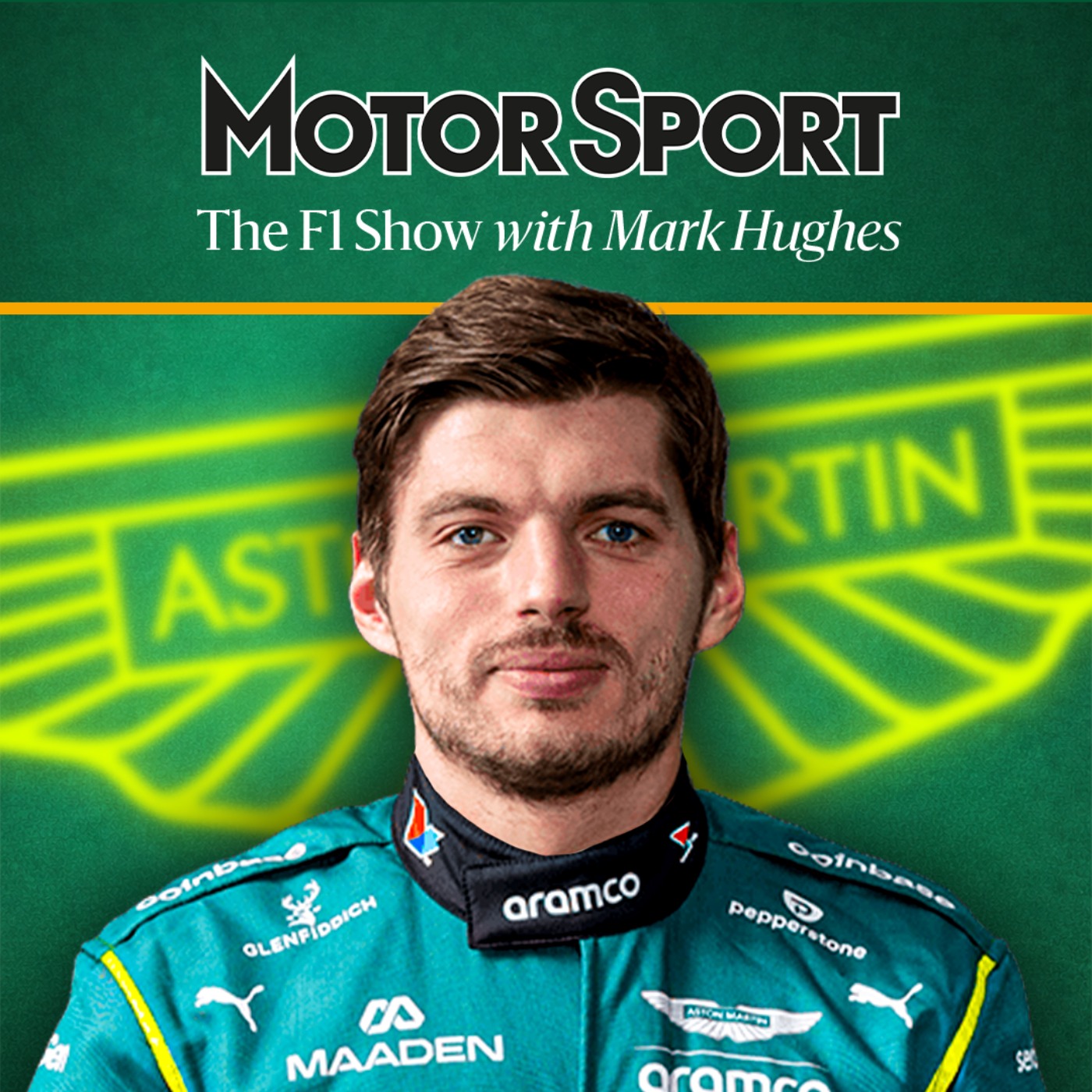
Max to Aston: why he'd be up for the challenge
About this episode
Max Verstappen’s potential move to Aston Martin is framed as a career challenge: the hosts compare it to Michael Schumacher’s Ferrari turnaround and weigh whether Aston could convince him of championship potential. They explore contract timing, performance clauses, and how a Verstappen domino effect could unsettle other teams’ plans. The conversation then pivots to the Belgian Grand Prix at Spa—where long, hilly laps make hybrid “electrical energy” deployment highly tactical, driving overtakes, yo-yoing, and safety considerations.
Max Verstappen may be the best driver in Formula 1 at the moment. So why would he even consider moving to current backmarker Aston Martin?
Hear Mark Hughes' compelling case in the latest episode of the Motor Sport F1 Show, as he sets out why the four-time champion is considering his future, and why he'd pick the Silverstone-based team over the likes of Mercedes, Ferrari and McLaren.
There's also Fernando Alonso to consider: what happens to him if he's displaced by Verstappen? Mark has an intriguing suggestion.
But it's not just silly season on the agenda ahead of the Belgian Grand Prix which will demand more electrical energy than the current generation of cars can provide. Can Spa provide a great race, even if cars spend much of the lap recharging their batteries?
Mark and presenter Bryn Lucas also discuss who will win the team-mate batle between Lewis Hamilton and Charles Leclerc, now that they both seem to be in tune with their Ferraris. How do they compare with the greatest team-mates in F1 history?
Plus your questions answered: What if Toto Wolff had signed Verstappen for Mercedes in 2014; and what's really happening when drivers tweak the torque map and differential on their cars?
Subscribe now for every weekly episode and tell us what you want to know from Mark. Send us a message on social media or find this podcast at https://go.motorsportmagazine.com/4gLZJPr and drop your questions in the comments. He'll answer a selection of the best every week.
Read Mark's column every Wednesday at https://go.motorsportmagazine.com/4gLZJPr
Hosted on Acast. See acast.com/privacy for more information.
driver market
"looking at that and looking at the potential impact upon the driver market and there's a bit of a thought exercise involved in it"
The “driver market” just means which Formula 1 teams are trying to sign which drivers. If one top driver becomes available, other teams start making moves too.
The “driver market” is the competitive marketplace of Formula 1 seats, where teams sign, retain, or replace drivers. The host frames Verstappen’s potential move as something that would ripple through contract decisions and team lineups.
Max Verstappen
"the topic or the thing you were alluding to there is that Verstappen could leave Red Bull and go and join up with his old mate Adrian Newy Aston Martin paving the way for Fernando Alonso to drift across to Red Bull yeah well the second part"
Max Verstappen is one of the top Formula 1 drivers. Here, they’re talking about what would happen if he left his current team and which other teams might try to sign him.
Max Verstappen is a Dutch Formula 1 driver who has been a leading contender for Red Bull Racing. In this segment, the hosts discuss how his potential availability could reshape the driver market and influence which teams would pursue him.
Adrian Newy
"Verstappen could leave Red Bull and go and join up with his old mate Adrian Newy Aston Martin paving the way for Fernando Alonso to drift across to Red Bull"
Adrian Newey is a famous Formula 1 technical mastermind who designs race-winning cars. The hosts are implying that his involvement could make Aston Martin a tempting destination for Verstappen.
Adrian Newey is a highly influential Formula 1 car designer known for shaping championship-winning race cars. The segment suggests Aston Martin could be attractive to Verstappen because Newey is associated with that team.
Red Bull
"Verstappen could leave Red Bull and go and join up with his old mate Adrian Newy Aston Martin paving the way for Fernando Alonso to drift across to Red Bull yeah well the second part I think"
Red Bull is the Formula 1 team Max Verstappen races for. The hosts are saying that if he left, Red Bull would have to rely on younger drivers to fill the performance gap.
Red Bull is the Formula 1 team and racing program that Max Verstappen drives for in this era. The discussion frames Red Bull’s junior setup and driver pipeline as a way to cover for any potential gap if Verstappen were to leave.
Fernando Alonso
"Aston Martin paving the way for Fernando Alonso to drift across to Red Bull yeah well the second part I think"
Fernando Alonso is a top-level Formula 1 driver with a long career and championships. They’re using him to illustrate how driver transfers could affect multiple teams at once.
Fernando Alonso is a veteran Formula 1 driver with multiple world championships. The segment uses him as an example of how one driver move could trigger a chain reaction across teams.
Racing Bulls
"he sends the Hajar plus whoever they promote from Racing Bulls probably wouldn't be quite the heavy hitting lineup that a top team needs"
Racing Bulls is a team connected to Red Bull that helps develop younger drivers. The hosts are saying it could supply talent if Red Bull’s main lineup changed.
Racing Bulls is a Formula 1 team in the Red Bull ecosystem that functions as a stepping stone for younger talent. The segment mentions it as part of Red Bull’s junior squad, implying it could help replace a top driver if needed.
Hajar
"he sends the Hajar plus whoever they promote from Racing Bulls probably wouldn't be quite the heavy hitting lineup that a top team needs as Hajar still you know putting all the pieces together"
“Hajar” is mentioned as a junior driver in the Red Bull setup. The episode doesn’t give enough detail here to be sure exactly who that refers to.
“Hajar” is referenced as part of Red Bull’s junior squad lineup, but the transcript doesn’t provide enough context to confidently identify the full name or correct spelling. It’s likely a young driver in the Red Bull development system.
Toto Wolf
"if suddenly he became available Toto Wolf would certainly be wanting to talk to him I'm pretty sure that Andrew Estella and Zach Brown would be wanting to talk to him over at McLaren"
Toto Wolf is a key decision-maker in Formula 1 team management. The point here is that if Verstappen were suddenly available, Mercedes’ leadership would immediately try to sign him.
Toto Wolf is a senior team principal figure in Formula 1, closely associated with Mercedes. The host says that if Verstappen became available, Wolf would want to talk to him—highlighting how seriously top teams would pursue a driver of that caliber.
McLaren
"I'm pretty sure that Andrew Estella and Zach Brown would be wanting to talk to him over at McLaren as well"
McLaren is a major Formula 1 team. The hosts are saying that if Verstappen became available, McLaren would want to talk to him too.
McLaren is a Formula 1 constructor/team with a long history of competing for wins and championships. The segment suggests McLaren leadership would also pursue Verstappen if he were available, emphasizing the breadth of interest from top teams.
Zach Brown
"I'm pretty sure that Andrew Estella and Zach Brown would be wanting to talk to him over at McLaren as well"
Zach Brown is a senior leader connected to McLaren in Formula 1. They’re mentioning him to show that McLaren would take a potential Verstappen opportunity seriously.
Zach Brown is a prominent executive associated with McLaren’s Formula 1 operations. In this segment, he’s referenced as someone who would want to engage Verstappen if the driver market opened up.
Andrew Estella
"I'm pretty sure that Andrew Estella and Zach Brown would be wanting to talk to him over at McLaren as well"
The host mentions Andrew Estella as someone at McLaren who would want to talk to Verstappen. It’s basically about who would be involved in signing a top driver.
Andrew Estella is mentioned as part of the McLaren leadership group that would want to talk to Verstappen. The name appears to be a transcription variant of a real McLaren executive, but the role in the conversation is clear: driver recruitment discussions.
driver structure
"but there's complications with each particular team because it could upset their dynamic within that driver structure"
“Driver structure” means how a Formula 1 team plans its drivers—who races now and who’s being developed for later. The idea is that changing one piece can throw off the whole plan.
“Driver structure” refers to how a team organizes its driver lineup and development pipeline, including relationships between the main team and feeder programs. The host says a big signing could upset that internal balance and strategy.
contractual mess
"while they would all absolutely understand the value that he brings it's got to be offset against the the contractual mess that it would create with the existing drivers"
When a team wants to change drivers, it can run into contract problems. That can mean money, timing, or legal terms that make the switch harder than it sounds.
In Formula 1, driver moves are constrained by signed contracts, release clauses, and timing. A “contractual mess” means changing lineups can trigger legal/financial complications with current drivers and teams.
Adrienne Ui era
"Alonso is still waiting to be convinced about the you know the Adrienne Ui era at Aston Martin because it's it's got off to a fairly catastrophic start"
The speaker is talking about a new period of leadership at Aston Martin. Alonso wants to see proof that the team’s direction will actually work before committing long-term.
This appears to refer to a specific leadership/management “era” at Aston Martin, tied to how the team is currently being run. The host is saying Alonso is waiting to be convinced that this new phase will deliver results.
Honda
"um you know Honda's taking it's gotta take some of the blame for that as well but it's um yeah within the time scale that Alonso's gonna be looking at 44 years old"
Honda is mentioned as the engine partner behind the scenes. If the car is struggling, the engine side (and how well it’s integrated) can be a big reason.
Honda is referenced as part of Aston Martin’s power-unit situation, where engine/technical partners can be blamed for early performance issues. In F1, the engine and related integration work strongly influence reliability and competitiveness.
Aston Martin
"this and also if he went to Aston Martin is it inconceivable that maybe they would allow him to disappear off and do the odd GT race from time to time and miss a Grand Prix in a development year like 2027"
Aston Martin is a car company that also has a Formula 1 team. The host is wondering whether they’d allow a top driver to do other racing (like GT events) and still miss some F1 races while the team develops the car.
Aston Martin is a British automaker that competes in Formula 1 via its F1 team. Here, the host weighs whether Aston Martin would let a star driver (like Verstappen) miss races for GT events while still participating in car development during a development year.
GT race
"if he went to Aston Martin is it inconceivable that maybe they would allow him to disappear off and do the odd GT race from time to time"
A GT race is a type of racing for cars that are closer to normal road cars than pure race prototypes. The host is talking about whether an F1 team would let a driver also race in those events.
A GT race is a competition for grand touring cars, typically based on production models and run in series like GT3/GT4. In the segment, it’s used to describe side racing commitments a Formula 1 driver might do while still being contracted to an F1 team.
development year
"and miss a Grand Prix in a development year like 2027 if it's still a development year for Aston Martin"
A development year means the team is mainly working on improving the car and learning what to change. The host is asking whether it would be okay for a driver to miss some races if the team is still in that improvement phase.
A development year in Formula 1 refers to a season where the team’s focus is heavily on improving the car—often tied to major regulation phases or planned upgrades—rather than chasing every result with the same urgency. The host uses it to question whether missing a Grand Prix would be acceptable if the team is still in a build-and-learn phase.
Philando Alonso
"what about Philando Alonso we spoke in fair bit about Max Verstappen let's just quickly turn to Philando Alonso how could a prospective team if Max says right I'm going to pull the pill on this"
This appears to refer to Fernando Alonso, the Spanish Formula 1 driver known for long career longevity and strong racecraft. The discussion focuses on how a team would assess Alonso’s pace at age 44 and manage the risk of disrupting existing driver/team performance dynamics.
gamble when you're taking on a new driver
"there's always a gamble when you when you're taking on a new driver um but I think that he's done enough"
In F1, bringing in a new driver can be risky because it’s not just about talent. The driver has to work well with the team and adapt to how the car is set up, and that can take time.
In F1, signing a new driver is a gamble because performance depends on more than raw speed—car feedback, adaptation to the team’s setup philosophy, and chemistry with engineers all matter. The host frames this as a risk teams take when changing the driver lineup and potentially upsetting established performance dynamics.
one year deal
"it um contract um and it would be a one-year deal though plus options probably something out of there why not"
A one-year deal means the driver’s contract is only for one season. The idea is to keep things flexible in case it doesn’t work out as expected.
A one-year deal is a short contract length where a driver is committed for a single season, often with performance-based extensions. The host suggests this could be a practical way for a team to take a chance on a driver while keeping flexibility.
performance clauses
"[971.2s] contract you'll yeah there's a lot of drivers in that performance clauses aren't there I think George [977.0s] Russell you mentioned Kimmy Antonelli a moment ago George Russell said I think earlier in the season [980.8s] that his contract essentially it's a multi-year deal but there are performance clauses in that"
A “performance clause” is a contract rule that depends on how well a driver does. If the driver meets certain targets, the contract can continue or change in some way.
In Formula 1 driver contracts, “performance clauses” are contract terms that trigger changes if a driver hits certain results. They can affect pay, contract length, or whether the deal continues as originally planned.
George Russell
"[977.0s] Russell you mentioned Kimmy Antonelli a moment ago George Russell said I think earlier in the season [980.8s] that his contract essentially it's a multi-year deal but there are performance clauses in that [986.9s] contract although he will meet those and they will meet all those performance um clauses"
George Russell is a Formula 1 driver. In this segment, they’re talking about his contract and how it might affect who Mercedes could sign in the future.
George Russell is a Mercedes Formula 1 driver whose contract is described as multi-year with performance clauses. The segment focuses on whether his deal could be the one that gets “ripped up” if a major driver move (like Max Verstappen) were to happen.
Kimmy Antonelli
"[977.0s] Russell you mentioned Kimmy Antonelli a moment ago George Russell said I think earlier in the season [980.8s] that his contract essentially it's a multi-year deal but there are performance clauses in that [1007.7s] you know is backing his young guy as well in Kimmy Antonelli that appears to be that Mercedes"
Kimi Antonelli is a young Formula 1 driver being talked about as a Mercedes prospect. The hosts are basically saying Mercedes believes in his long-term potential.
Kimi Antonelli is discussed as Mercedes’s young driver prospect, with the speaker saying his performance is strong enough that Mercedes has confidence in his future. The segment also frames him as part of how Mercedes would try to balance driver lineups if Max Verstappen became available.
rip up their contract
"[1064.4s] so yes the if a vacancy had to be created and you had to pay somebody an awful lot of money uh then yeah that that person would be Russell [1078.2s] and yes then then Toto would have the added headache of right try how do you [1084.9s] operate these two guys um together at the same time without sort of pulling the team apart"
They mean ending a contract early. In Formula 1, you usually can’t just do that without paying a big cost or penalty.
“Rip up their contract” here means terminating a signed agreement early, typically by paying a large penalty or buyout. In F1, that’s difficult because contracts often include structured terms and financial consequences.
Fred Vercer
"Ferrari in this scenario Max Verstappen potential to go to Ferrari Fred Vercer would he be welcoming there"
This likely refers to Fred Vasseur, who runs Ferrari’s Formula 1 team. They’re discussing whether he would want a major driver change, given how Ferrari is currently set up.
“Fred Vercer” is almost certainly a transcription error for Fred Vasseur, Ferrari’s team principal (and a key decision-maker). The host discusses whether he’d welcome a specific driver change, tying it to Ferrari’s internal leadership and priorities.
Charlotte Clairs
"he's got Lewis Hamilton who's re-found or rediscovered his form Charlotte Clairs on a multi-year deal as well"
This sounds like they mean Charles Leclerc, a Ferrari driver. They’re mentioning his multi-year contract as part of why Ferrari’s driver lineup is hard to change quickly.
“Charlotte Clairs” appears to be a transcription error for Charles Leclerc, Ferrari’s driver. The segment treats him as part of Ferrari’s lineup planning via a multi-year deal, which matters for whether other drivers could realistically join.
multi-year deal
"he's got Lewis Hamilton who's re-found or rediscovered his form Charlotte Clairs on a multi-year deal as well"
A multi-year deal is a contract that lasts for several years. In racing, it means the team can’t just swap drivers overnight without dealing with the contract terms.
A multi-year deal is a contract that spans multiple seasons, which locks in a driver (or other key personnel) for a longer period. In F1, that strongly limits how easily a team can sign someone else mid-cycle.
John Elkin
"however above Freddy John Elkin the guy that was very much in favor of bringing Hamilton on board was in alignment with Freddy"
This likely means John Elkann, who is in charge at Ferrari. The point here is that he has enough influence to shape big decisions, including who Ferrari tries to sign.
“John Elkin” appears to be a transcription error for John Elkann, Ferrari’s chairman. The segment explains that Elkann has influence over Ferrari’s direction, which affects how much power team leadership has in driver recruitment decisions.
Mercedes
"and he had that very poor season or they had a very poor season and then all of a sudden they became amazing Mercedes and he's left joined Ferrari ... Mercedes are absolutely flying at the moment"
Mercedes is a top Formula 1 team and manufacturer, especially dominant in the late 2010s and early 2020s. Here, the host contrasts Mercedes’ current strength with Alonso’s situation, implying team performance timing matters for title opportunities.
Ferrari
"and he's left joined Ferrari arguably okay he's joined Ferrari at the wrong time because Mercedes are absolutely flying at the moment ... Fernando Alonso seems to have"
Ferrari is a legendary Formula 1 team. The host brings it up while discussing how Hamilton’s team changes played out.
Ferrari is one of Formula 1’s most iconic teams, known for its historic success and constant development. In this segment, it’s mentioned as Hamilton’s next move after Mercedes, and as part of the broader “right time/wrong time” career argument.
team principal
"what would he do though if he left Formula One if he does retire from driving could he be a team principal would that sort of work for Alonso or just a mentor"
A team principal is basically the top boss of an F1 team. They make big decisions about how the team runs and competes.
A team principal is the senior executive leader of an F1 team, responsible for overall direction, major decisions, and managing the team’s sporting and operational strategy. The host is asking whether Alonso would want that kind of leadership role after retiring from driving.
mentor
"could that sort of work for Alonso or just a mentor ... I don't think he'd aspire to be a team principal"
A mentor is someone experienced who helps others improve. Here, the host is talking about Alonso advising people even if he isn’t the team boss.
In motorsport context, a mentor is an experienced person who helps guide drivers or engineers with advice, feedback, and career or performance perspective. The host suggests Alonso could remain involved in that capacity rather than aiming to run a team.
Austin Martin F1 project
"I don't think he'd aspire to be a team principal I think um but yeah ... the idea of a mentor or someone um he could still be involved in the Austin Martin F1 project"
Aston Martin is an F1 team. The host is saying Alonso might help them behind the scenes, using his experience, even if he stops racing in F1.
Aston Martin is a Formula 1 team and constructor, and the “Aston Martin F1 project” refers to the team’s ongoing effort to build a competitive car and program. The host suggests Alonso could stay involved using his experience to help that project.
Spa
"now what we'll do now is we'll go to the next Grand Prix as Spa is coming up this weekend [1446.2s] the Belgian Grand Prix at Spa a phenomenal place I love that track"
Spa is a well-known Formula 1 race track in Belgium. It has lots of hills and long climbs, so it’s physically demanding and makes it harder to keep speed and energy under control.
Spa-Francorchamps (often shortened to Spa) is a famous Formula 1 circuit in Belgium known for big elevation changes and long, demanding climbs. The track’s layout forces drivers to manage energy and traction carefully, especially in the uphill sections.
Belgian Grand Prix
"now what we'll do now is we'll go to the next Grand Prix as Spa is coming up this weekend [1446.2s] the Belgian Grand Prix at Spa a phenomenal place"
The Belgian Grand Prix is the Formula 1 race that takes place at Spa in Belgium. It’s famous for being tough because the track has big hills and long stretches.
The Belgian Grand Prix is the Formula 1 race held at Spa-Francorchamps. It’s a key event on the F1 calendar and is especially notable for Spa’s elevation changes and long, energy-intensive sections.
Kemble straight
"it's the first time I ran up the Kemble straight [1461.0s] and it is a long long haul up there so I imagine this round this race coming up is going to be"
Kemmel Straight is a long straight section at Spa, right after the big uphill part. It matters because it’s hard to stay fast there, and it affects when drivers can use extra power.
Kemmel Straight is the long straight at Spa that follows the uphill Eau Rouge/Rouge area. Because it’s so long and uphill, it’s a major factor in how teams plan traction, braking points, and—under modern F1 energy rules—when to deploy electrical power.
Eau Rouge Radeon
"you have the long uphill [1475.7s] Eau Rouge Radeon up to the top of Kemble straight to look calm there are five straight line mode"
Eau Rouge is one of Spa’s most famous uphill corners. It’s a steep, fast section that can really test the car’s grip and how you manage speed and energy.
“Eau Rouge” is the famous uphill corner complex at Spa, taken at high speed and followed by a fast transition toward the next sections. The transcript’s “Radeon” appears to be a mishearing of “Rouge,” but the key point is the Eau Rouge/Rouge sequence’s steep, energy-demanding nature.
electrical energy
"super clipping what's going to happen [1489.0s] you'll have to be very judicious with how you deploy the the electrical energy because obviously [1495.6s] it's right even without all the inclines it's over four miles long"
In modern F1, “electrical energy” refers to the limited energy available from the car’s hybrid system (stored and deployed to boost performance). Drivers must meter it carefully because it’s constrained by the battery’s state and the rules on how much can be used over a lap.
sector three
"you're going to have to conserve in [1534.1s] sector three after either the long run up to through Blanchermont and up to the bus stop"
Race tracks are split into sections called sectors for timing. Sector three is one of those sections, and the host is saying it’s where you may need to save or use extra power depending on the track layout.
F1 circuits are divided into timed “sectors” to measure performance and plan strategy. “Sector three” at Spa is described as a key place to conserve or deploy hybrid power depending on the corner-heavy layout.
Blanchermont
"you're going to have to conserve in [1534.1s] sector three after either the long run up to through Blanchermont and up to the bus stop"
Blanchermont is a fast part of the Spa track. Because it’s quick and flowing, it affects when drivers can best use extra hybrid power.
Blanchimont/Blanchermont is a high-speed section at Spa that comes after the long uphill run. It’s important for energy management because it’s fast and flowing, so teams often plan when to deploy hybrid power around it.
bus stop
"after either the long run up to through Blanchermont and up to the bus stop [1540.2s] because the bus stop and the calm at the end of sector three and one respectively"
The “bus stop” is a well-known braking area at Spa where cars slow down a lot before the final part of the lap. It’s important because it changes how you plan speed and power for the corners afterward.
The “bus stop” is the tight braking zone at Spa before the final sector, used as a major overtaking and setup point. Because it’s a heavy braking area, it influences how drivers time hybrid deployment and conserve energy for traction out of slower corners.
harvest
"internal combustion engine you might be doing a little bit of harvesting especially in the race through places like Puan because you're not going to be vulnerable to be an overtaken"
In F1, “harvesting” means recovering energy instead of wasting it. The car stores that energy so the driver can use it later to go faster.
In modern F1, “harvesting” refers to using energy-recovery systems to capture energy during braking or lift/coast phases and store it for later acceleration. The goal is to manage limited stored energy so you can defend or attack at the right moments.
battery
"you've used used a big chunk of energy to get past someone in sector one you're going to be depleted in sector three in the guy you've just passed is going to have more than more battery than you so yeah it's going to be like that"
The car has a battery that stores recovered energy. Whoever has more stored energy can use it to accelerate sooner or harder.
In F1’s hybrid power units, the battery stores recovered electrical energy that can be deployed to add power. Drivers can end up with different battery state-of-charge levels, which directly affects who can attack or defend in each sector.
lifting and coasting
"it's I don't think we're going to have it's not going to be necessary to do much lifting coasting in qualifying it's just it's more in the in the race you'll see that as "
“Lifting” and “coasting” are throttle-management techniques used to reduce fuel/energy demand. In qualifying, the speaker suggests it won’t be as necessary, but in the race it can help create opportunities to recover energy (“harvest”) and manage battery levels.
500 horsepower
"certainly the drivers will be nothing that they're going through with you know a bit more than 500 horsepower rather than a thousand horsepower though they'll definitely notice that but"
They’re comparing how much power the drivers will actually feel during the stint. Even if peak numbers sound huge, what matters is how much extra power is available to use when you need it.
The speaker contrasts typical power levels the drivers will notice with the much higher peak figures often discussed for F1. The key point is that the driver’s real-world feel comes from the usable power they can deploy, not just headline maximum output.
rear wing
"last time out and about twice this season in recent times we've seen red bull have an issue with [1728.3s] the rear wing we talked about it last time and you explained what was going on with the with the [1733.1s] rear wing itself have they had a fixed you know if they've worked on anything with the car"
The rear wing is the spoiler on the back of an F1 car. It’s there to push the car down onto the track so it sticks better at high speed. If there’s an issue with it, the car can become less stable and that can be dangerous.
The rear wing is an aerodynamic device mounted at the back of the car that generates downforce and helps stabilize the car at speed. In F1, it’s also adjustable/deployable in some systems, so a problem with the rear wing can affect both safety and lap performance.
airflow
"you spoke last time about how the the air flow [1763.5s] over the car needs to almost sort of re-engage once the the wings have changed the air has to [1767.4s] work itself out surely the simplest way around is just getting the drivers to break"
Air flow is how the air moves around the car as it drives. F1 cars rely on that airflow to create grip and stability. If something on the car changes, the airflow can take a moment to behave properly again.
Air flow refers to how air moves over and around the car’s body and wings. When aerodynamic elements change (like a wing adjustment), the airflow needs time to reattach and stabilize, which can temporarily reduce downforce and grip until the flow “settles.”
air efficient car
"but yeah the the deployment of the Ferrari is not as good but it's got a very air efficient car so [1828.0s] it'll it'll still fly down those straights so yeah it'll it'll stop it'll not accelerate for as long"
An air efficient car is designed to cut through the air with less resistance. That helps it stay fast on straight sections because it doesn’t slow down as much from drag.
An air efficient car is one that produces good aerodynamic performance with relatively low drag. In practice, that means it can maintain higher speeds down straights because it wastes less energy pushing through the air.
end of straight speeds
"it'll it'll stop it'll not accelerate for as long [1837.6s] but it can it can still achieve um good end of straight speeds or middle of straight speeds [1844.5s] because of that the speed starts to actually um starts to decrease slowly as the the electrical"
End of straight speeds are how fast the car is right before it has to slow down for the next corner. It’s a useful way to judge whether the car is strong on straights, not just in corners.
End of straight speeds are the car’s velocity as it approaches the braking zone at the end of a long straight. They’re a key performance indicator in F1 because they reflect how well the car manages drag, traction, and energy usage over the straight.
Lewis Hamilton
"Charlotte Claire and we've got Lewis Hamilton going toe to toe do you think we're going to see these inter-team battles these sensational battles between these two rivals within their own team"
Lewis Hamilton is one of the most famous and successful Formula 1 drivers. In this discussion, they’re wondering if he’ll race his own teammate as hard as he races rivals.
Lewis Hamilton is a multiple-time Formula 1 World Champion and one of the sport’s most successful modern drivers. The segment focuses on whether he’ll have direct on-track battles with his teammate, and how that could shape results across the season.
Charlotte Claire
"we've got Charlotte Claire and we've got Lewis Hamilton going toe to toe do you think we're going to see these inter-team battles"
“Charlotte Claire” sounds like it’s meant to be Charles Leclerc. The hosts are talking about how Leclerc and Hamilton could battle each other on track within the same team context.
“Charlotte Claire” appears to be a transcription error for Charles Leclerc, Ferrari’s driver. The segment treats him as Hamilton’s teammate counterpart for intra-team wheel-to-wheel battles and season-long performance comparisons.
safe great racing
"are we going to see Charlotte Claire and Lewis Hamilton going at it you know toe to toe in in safe great racing for the rest of the season"
They’re talking about racing aggressively but responsibly—staying close without causing crashes. The goal is to keep both cars running while still fighting for position.
“Safe great racing” is describing a style of competitive driving that stays within the rules and avoids contact. In F1, the key idea is racing hard while minimizing the risk of collisions that can end both drivers’ races.
wheel-to-wheel action
"we've seen it on at both teams I've seen we've seen plenty of wheel-to-wheel action um anything back to Canada with Anthony and Russell actually trading rubber"
Wheel-to-wheel action means two cars are racing side-by-side very closely. It’s the kind of racing fans like because it’s competitive, not just following in line.
Wheel-to-wheel action is close, side-by-side racing where two cars are competing for the same track space. In F1, it’s a key indicator of how intense and competitive the racing is, especially during teammate battles.
trading rubber
"um anything back to Canada with Anthony and Russell actually trading rubber um Hamilton and Claire have traded rubber earlier in the season in China in particular"
“Trading rubber” is racing slang for two cars going back and forth while their tires are still giving grip. It usually means the battle is close and neither driver is clearly pulling away.
“Trading rubber” is slang for two cars repeatedly challenging each other while using tire grip effectively, often implying they’re swapping advantages as tires wear. In this context, it’s used to describe how Russell and “Anthony” (likely a teammate) had competitive on-track exchanges.
team orders
"i think it's not going to just be strict team orders I think they're going to be allowed a certain degree of freedom to assert themselves"
Team orders are when a racing team tells its drivers what to do, like who should pass and who should hold back. Here, the hosts think they won’t be told to follow strict instructions all the time.
Team orders are instructions from the team to drivers about how to race—such as asking one driver to hold position or let a teammate pass. The segment suggests the drivers may be given more freedom than strict team orders would normally allow.
age old adage
"as long as they raced with the age old age old adage of just don't take your teammate out that's the one rule isn't it that's the race fairly but don't take each other out"
They’re referring to a long-standing racing rule: teammates should race hard, but don’t crash into each other. It’s about protecting both cars so you don’t lose points.
The “age old adage” referenced is the common racing guideline that teammates should race fairly but avoid taking each other out. It’s a practical rule of thumb in F1 because collisions between teammates can waste points for both drivers.
Zandvoort
"um Zandvoort isn't there there's yeah hungry I would say is more a Hamilton track than a Leclerc track um Zandvoort probably not much difference Singapore they've"
Zandvoort is a famous Formula 1 track in the Netherlands. The hosts are saying it might be a better match for Hamilton’s driving style than for Leclerc’s.
Zandvoort is a Dutch circuit known for its fast corners and high-speed feel, often producing lively racing. The hosts use it as an example of a track that may suit Hamilton more than Leclerc.
Singapore
"um Zandvoort probably not much difference Singapore they've"
Singapore is a track used for the Singapore Grand Prix, and it’s known for being a street-style circuit. The hosts are comparing it to other races to guess which drivers might have the edge.
Singapore refers to the Singapore Grand Prix circuit, famous for its street-circuit layout and night racing. The segment groups it with other tracks to discuss where certain drivers historically perform better or worse.
Baku
"both been brilliant around there um Baku's more Leclerc track Austin probably Lewis um"
Baku is a Formula 1 track in Azerbaijan. Because it’s a street circuit, cars often get stuck behind others, and that can make qualifying and races much more unpredictable.
Baku refers to the Formula 1 street circuit in Baku, Azerbaijan. It’s known for long straights, tight corners, and heavy traffic effects that can swing qualifying and race outcomes.
Leclerc
"both been brilliant around there um Baku's more Leclerc track Austin probably Lewis um"
Leclerc is a Formula 1 driver. The speaker is saying some tracks tend to suit his driving and results more than others.
Charles Leclerc is a Formula 1 driver known for strong qualifying pace and aggressive driving style. The host mentions him in the context of which tracks suit his strengths.
Silverstone
"just just on current form just where it looked like a ride at Silverstone and if we said right"
Silverstone is a major Formula 1 race track in the UK. It’s known for fast, flowing corners, so the car’s grip and stability at speed can make a big difference.
Silverstone is the famous Formula 1 circuit in the UK. It’s a high-speed, flowing track where aerodynamic efficiency and stability through fast corners strongly influence lap times and race pace.
traffic in qualifying
"you know 11 bit of traffic in qualifying for one and not the other or you know one tire"
In qualifying, traffic means other cars are on the track while you’re trying to set your fastest lap. If you get stuck behind someone, you can lose time and end up starting worse on race day.
Traffic in qualifying is when a driver’s flying lap is interrupted or compromised by other cars on track. Because qualifying laps are short and timing is everything, even small traffic delays can drastically affect who sets the best grid positions.
tire problems
"11 bit of traffic in qualifying for one and not the other or you know one tire problem for one another or"
A tire problem means the tires aren’t working the way they should—maybe they’re overheating, damaged, or losing grip. In F1 that can make the car feel slow or unstable almost immediately.
A tire problem is any issue with grip or tire condition that prevents a driver from using the car’s full potential. In F1, tire degradation, overheating, punctures, or damage can quickly swing performance between teammates.
turbo problems
"or one tire problem for one another or one turbo problem then you know it goes massively in the direction of the other one"
A turbo problem means the turbocharger isn’t boosting properly or has an issue. In an F1 car that can cut power and make acceleration feel weak or inconsistent.
A turbo problem refers to a malfunction or performance issue with the turbocharger system. Since F1 engines rely on turbocharging for boost, a turbo-related issue can reduce power and change how the car accelerates and manages heat.
inter-team rivalries
"quite a lot of the times they're fiery aren't they when you have these inter-team rivalries partnerships combined to bring vast success to the teams"
Inter-team rivalries are when drivers from different teams are competing closely. In Formula 1, that kind of rivalry can affect how teams plan races and how drivers push each other.
Inter-team rivalries are competitive matchups between drivers from different teams. In F1, these rivalries often shape strategy, media narratives, and how teams prioritize upgrades and race plans.
Senna
"talks about F1's greatest teammates so sometimes they're friendly teammates as teammates quite a lot of the times they're fiery aren't they when you have these inter-team rivalries partnerships combined to bring vast success to the teams like Senna and Prost"
Senna was a famous Formula 1 driver known for being extremely fast and competitive. The speaker mentions him because he had a well-known rivalry with a teammate.
Ayrton Senna is a legendary Formula 1 driver famous for his speed and intensity, especially in wet conditions. The host brings him up as part of a historic teammate rivalry.
Prost
"like Senna and Prost that was a fiery one Moss and Fangio Schumacher and Barrichello as well"
Prost was another top Formula 1 champion. The host is using him alongside Senna to talk about how intense teammate rivalries can still lead to great results.
Alain Prost is a Formula 1 World Champion known for tactical racing and consistency. The host pairs him with Senna to illustrate how teammate rivalries can still produce major team success.
team apart
"but it can rip the team apart and um you know McLaren was uh struggled to to be able to really um to to be a cohesive place"
This is about when two drivers push so hard against each other that the team stops working smoothly. Instead of everyone focusing on the same goal, it can turn into conflict that hurts results.
The speaker is describing how intense internal competition between drivers can fracture team unity. In F1, that can affect communication, strategy alignment, and overall performance as the team tries to manage two competing interests.
constructors' championship
"Williams just on that bothered really about the the the drivers fighting each other they did as long as they won the constructors championship"
This is the team points race in Formula 1. Teams earn points based on how their cars finish, and the best team over the season wins.
In Formula 1, the Constructors' Championship is awarded to the team based on the points its cars score across the season. It’s separate from the Drivers' Championship, which is awarded to individual drivers.
World Endurance Championship
"there's a big question Mark over the end of the world endurance championship season with Qatar and Bahrain maybe being dropped there in uh end of the October and November aren't they period"
This is the endurance racing season—long races where teams share driving duties. The episode is talking about whether the schedule could be affected.
This refers to the FIA World Endurance Championship (WEC), a season of long-distance races where teams compete with cars designed for endurance rather than single-race sprinting. The discussion is about how the season schedule might change.
Qatar
"there's a big question Mark over the end of the world endurance championship season with Qatar and Bahrain maybe being dropped"
Qatar is the country being mentioned as a possible host for races. The point is that the race calendar may be disrupted.
Qatar is referenced as a potential location for World Endurance Championship events later in the year. The speaker is tying it to broader uncertainty affecting Middle East race planning.
Bahrain
"with Qatar and Bahrain maybe being dropped there in uh end of the October and November aren't they period"
Bahrain is another country being mentioned as a possible host for races. The discussion is about whether events there might not happen as planned.
Bahrain is mentioned alongside Qatar as a venue for World Endurance Championship races that could be removed from the calendar. It’s also a key Middle East motorsport location, so schedule changes can ripple into other series.
Formula One
"there's no certainty that Formula One's going to be able to go out there as well with the big finale as well with Abu Dhabi"
Formula One is the main global race series with teams and drivers competing for championships. Here, it’s being discussed because the race calendar could be affected.
Formula One (F1) is the top-tier open-wheel racing series the host is discussing in relation to schedule risk and contingency planning. The segment focuses on whether F1 can still run its planned races in the Middle East.
Abu Dhabi
"with what's going on the Middle East there's no certainty that Formula One's going to be able to go out there as well with the big finale as well with Abu Dhabi"
Abu Dhabi is where the Formula 1 season finale is supposed to be. The host is being brought up because the schedule might need backup plans.
Abu Dhabi is referenced as the planned venue for the Formula 1 season finale. Because the host region is part of the uncertainty being discussed, it raises questions about contingency planning for F1’s last races.
differential settings
"“...you refer to the talk map and adjusting the differential in last week's MPH column please can you explain these comments... differential settings is to do with the amount of preload on the differential...”"
A differential is what lets the two rear wheels turn at slightly different speeds. The “settings” change how the car decides who gets more drive, which can make the car feel more stable or more eager to turn.
In Formula One, “differential settings” refer to how the differential is configured to control how drive torque is split between the two driven wheels. Changing the setting changes the car’s balance—especially as you transition on and off the throttle mid-corner.
preload on the differential
"“...the differential settings is to do with the amount of preload on the differential and preload applies to the split of torque between the two rear wheels within the through the clutches within the differential...”"
Preload is like a built-in “push” that makes the differential less willing to let the wheels act completely independently. More preload means the car forces the wheels to behave more similarly, which changes how the car turns.
“Preload on the differential” is the built-in bias that resists the differential’s normal tendency to let the wheels rotate at different speeds. In F1, preload strongly affects how torque is shared between the left and right rear wheels through the differential clutches.
split of torque
"“...preload applies to the split of torque between the two rear wheels within the through the clutches within the differential...”"
Torque is the turning force from the engine. The “split of torque” is how that force gets divided between the left and right wheels, which affects traction and steering feel.
“Split of torque” is how much engine twisting force is sent to each driven wheel. With a differential, the split can change depending on grip and the differential’s preload, which then influences cornering behavior.
oversteer
"“...a high preload will tend to increase understeer or reduce oversteer in that initial transient part of the corner...”"
Oversteer is when the rear of the car feels like it’s sliding outward more than you want. It often means the rear tires are losing grip before the front tires.
Oversteer is when the car turns more than expected or the rear loses grip first, causing the rear to step out. Hughes describes how differential preload can reduce oversteer (or increase it if preload is lowered) during the throttle transition at corner entry.
understeer
"“...so a high preload will tend to increase understeer or reduce oversteer in that initial transient part of the corner...”"
Understeer is when you turn the steering wheel but the car doesn’t rotate enough, so it tends to go wide. It usually happens when the front tires can’t grip as well as the rear.
Understeer is when the car turns less than the driver expects, so the front tires lose grip before the rear. Hughes links higher differential preload to increased understeer during the early “transient” phase of a corner as throttle changes.
on and off the throttle
"“...because the the big effect is between on and off throttle so in that initial part where you've come gone from full throttle to off throttle...”"
This is about what happens when you go from pressing the gas to lifting off it (or vice versa). That change can strongly affect traction and steering feel, especially in a corner.
“On and off throttle” describes the rapid change between accelerating and lifting off the gas. In F1, differential preload can change how the car responds during this transition, which is why it affects corner balance right at the start of the turn.
cork on the steering wheel
"“...you can choose how much preload you're running from controls on the steering wheel”"
F1 cars let the driver change certain settings using buttons and switches on the steering wheel. Hughes is saying preload (and thus handling balance) can be adjusted from there.
In F1, the steering wheel is the driver’s control hub for various adjustable settings. Hughes indicates preload can be selected via steering-wheel controls, meaning the driver can influence differential behavior without waiting for a pit stop.
diff setting
"[2827.7s] and you can also control how much that preload changes through the corner and there the maps so [2835.8s] that map does that thing that map does that thing so you'll quite often hear the suggestion from [2841.5s] the race engineer for example of diff setting too meaning just switch to that map other times uh [2848.4s] you'll hear use your toggle switch at turn four for example which just momentarily switches it to [2854.2s] a different map to that which you've selected and then reverts to the selected one um so yeah that's"
“Diff setting” is about how the car decides how to send power to the wheels. By changing it, the team can make the car feel more stable or more eager when you accelerate out of a turn.
In F1, “diff setting” refers to how the differential is electronically configured. Changing it alters how drive is distributed and how the car behaves when you’re accelerating out of corners, especially under traction changes.
torque map
"[2854.2s] a different map to that which you've selected and then reverts to the selected one um so yeah that's [2859.7s] all control from the cockpit the torque map is about how the throttle position is calibrated to [2866.3s] the amount of torque that the engine's delivering so it's it's relatively easy to vary because the [2871.5s] throttle is not mechanically linked but it's wireless um so you can have a more or a less"
A “torque map” is the engine’s programmed response to your right foot. Different maps make the car deliver more or less pull at the same throttle input.
A “torque map” is an engine control setting that calibrates throttle position to the amount of torque the engine delivers. Teams use different torque maps to change how aggressive the car feels at various throttle openings.
throttle is not mechanically linked
"[2859.7s] all control from the cockpit the torque map is about how the throttle position is calibrated to [2866.3s] the amount of torque that the engine's delivering so it's it's relatively easy to vary because the [2871.5s] throttle is not mechanically linked but it's wireless um so you can have a more or a less"
That means the gas pedal isn’t connected to the engine by a physical cable. Instead, electronics interpret your pedal input, which makes it easier to change how the engine responds.
This describes drive-by-wire throttle control, where the pedal signal is electronic rather than a direct mechanical connection to the throttle body. Because it’s electronic, the ECU can apply different torque maps quickly and precisely.
wet weather map
"[2883.8s] choose which map you're going to use for the rest of the weekend before qualifying and after that [2888.7s] it's locked in you can't change it unless unless it's um declared a wet race in which case there is a [2894.2s] wet weather map um but uh yeah that's not once you've chosen it you can't uh you can't alter it"
A “wet weather map” is an engine setting meant for rain or slick track. It helps the car put power down more smoothly so the wheels don’t spin as easily.
A “wet weather map” is a pre-defined engine control setting used when conditions are slippery. It typically reduces torque delivery aggressiveness to improve traction and drivability on low-grip surfaces.
declared a wet race
"[2883.8s] choose which map you're going to use for the rest of the weekend before qualifying and after that [2888.7s] it's locked in you can't change it unless unless it's um declared a wet race in which case there is a [2894.2s] wet weather map um but uh yeah that's not once you've chosen it you can't uh you can't alter it"
“Declared a wet race” means officials officially treat the event as rain/wet conditions. That can allow certain pre-approved changes to how the car’s engine behaves.
“Declared a wet race” refers to the race being officially classified as wet by the governing rules. That classification can unlock specific setup changes—like switching to a wet weather map—within the regulatory framework.
locked in
"[2883.8s] choose which map you're going to use for the rest of the weekend before qualifying and after that [2888.7s] it's locked in you can't change it unless unless it's um declared a wet race in which case there is a [2894.2s] wet weather map um but uh yeah that's not once you've chosen it you can't uh you can't alter it"
“Locked in” means once the team picks the engine setting for the race, it can’t be changed on the fly. Only special situations allow a different setting.
“Locked in” here means the selected engine map is fixed by regulation after qualifying. Teams and drivers can’t freely change it during the race except under specific conditions (like a wet-race declaration).
Request an Explanation
Heard something you'd like explained? We'll add it to this episode.
Sign in to request explanations for terms you heard.
Want to learn more?
Browse our glossary for plain-English explanations of automotive terms, jargon, and concepts.
Help improve this episode
See something that's not quite right? Our annotations are AI-generated and can sometimes miss the mark. Click the flag icon on any annotation to suggest a correction.