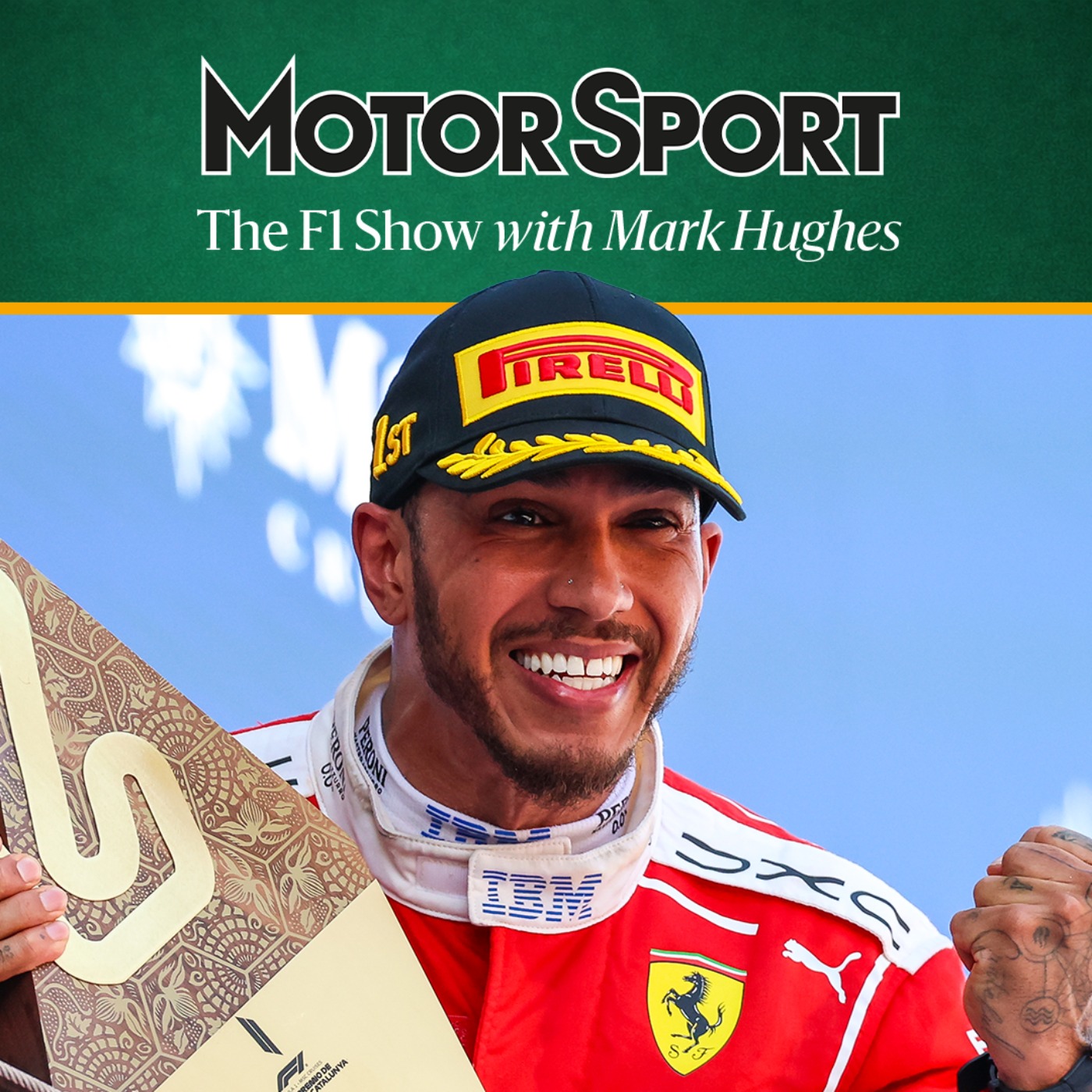
Lewis Hamilton: why he's back to his best
About this episode
Barcelona becomes the backdrop for a wider Hamilton turnaround story: race control timing, tire strategy, and power-unit freedom all shifted the competitive picture. Mark Hughes ties Lewis’s resurgence to regulation changes around ground effect, plus a car setup that finally matches his braking and engine-braking style. Confidence, driver-car “dovetailing,” and leadership changes are credited for getting the right feedback and brakes. The discussion also touches on how strategy, tire freshness, and reliability logistics can swing outcomes.
Lewis Hamilton's victory at the Barcelona-Catalunya Grand Prix marked a breakthrough for both the Briton and Ferrari, but how much of it is down to the man himself, and how much to a Formula 1 car finally built around his needs?
Mark Hughes and Bryn Lucas dig into the remarkable turnaround of both Hamilton and team principal Fred Vasseur, exploring how the new regulations, bespoke brakes and a complete rethink of Ferrari's set-up philosophy have unlocked a seven-time champion who openly admits he forgot who he was last season.
With Lando Norris warning that Ferrari could "embarrass" Mercedes if they reach engine parity, is the 2026 title fight now truly on?
They also examine the messy fallout from Monaco's pitlane penalty chaos: Alpine's successful appeal has handed Pierre Gasly back his podium, but leaves Oscar Piastri and McLaren with a grievance - and George Russell's bungled stop adds another layer of injustice to an already complicated picture.
Plus, are Mercedes hiding a serious power unit reliability problem? And with a race-free weekend ahead, what does the rest of 2026 hold for Charles Leclerc, who heads to the Red Bull Ring - historically one of his happiest hunting grounds - needing a reset?
Hosted on Acast. See acast.com/privacy for more information.
Grand Prix in Barcelona
"Well then Mark, off the back of another Grand Prix in Barcelona, what were your thoughts of what you witnessed from out there in Catalonia?"
They’re talking about a specific Formula 1 race in Barcelona. The whole discussion is based on what happened during that weekend.
This refers to the Formula 1 race held in Barcelona, discussed as the context for the on-track events and strategy calls. It’s the episode’s immediate setting for the Hamilton vs. rivals narrative.
Catalonia
"Well then Mark, off the back of another Grand Prix in Barcelona, what were your thoughts of what you witnessed from out there in Catalonia?"
Catalonia is a region in Spain. They’re referencing the race weekend held at the Barcelona area track.
Catalonia is the region in Spain where the Circuit de Barcelona-Catalunya is located. The host uses it to refer to the track weekend and the conditions/observations from that venue.
VSC
"Great race, wasn't it? I mean, even before the VSC came out and sort of ensured Lewis Hammond's victory, it was shaping up into a fantastic race..."
VSC means “Virtual Safety Car.” It’s a rule that makes everyone slow down for a short time so the race can stay controlled, usually because of an incident on track.
VSC stands for Virtual Safety Car. It’s a race control mode where drivers must slow down by following a target speed window, but without the full Safety Car deployment.
pit and come out
"...it was shaping up into a fantastic race with Hamilton due to pit and come out, probably behind Lando Norris..."
This is shorthand for stopping in the pits and then rejoining the race. In Formula 1, when you come back out can decide who you’re stuck behind—or who you can pass.
“Pit and come out” refers to the sequence where a driver enters the pit lane for a stop (often for tires and/or strategy) and then rejoins the race. In F1, track position after the stop can be as important as outright speed.
new tyres
"...he would have then presumably quickly picked off Norris and he had the pace on the new tyres."
“New tyres” are fresh tires after a pit stop. Fresh rubber usually grips better, so the car can feel much quicker right away.
“New tyres” refers to fresh tire sets after a pit stop. In F1, new tires typically provide better grip and can unlock a noticeable performance jump, especially in the first laps after the stop.
three-stop strategy
"It looked like that combination of the Ferrari upgrade in Hamilton's form was actually together with the Ferrari strategy, a very aggressive adventurous three-stop strategy that they committed to."
A three-stop strategy means the driver plans to change tires three times during the race. It can help you go faster on the fresh tires, but it also costs time in the pits.
A “three-stop strategy” means the race plan calls for three pit stops for tires and/or adjustments. More stops can be faster if tire wear is high, but it also increases time spent in the pits and the risk of getting stuck in traffic.
Ferrari
"So it looked as if that combination of the Ferrari upgrade in Hamilton's form was actually together with the Ferrari strategy, a very aggressive adventurous three-stop strategy that they committed to."
Ferrari is the F1 team being discussed. The host says Ferrari brought upgrades and a bold tire/stop plan that helped them run faster.
Ferrari is the Formula 1 constructor discussed as bringing an upgrade and committing to an aggressive three-stop plan. The host links Ferrari’s package to improved qualifying and race pace, suggesting a shift toward closer competition.

Fiat 600
"... qualifying when Hammond was vying for pole, only 600s I think it was, off pole. We haven't been nowhere..."
The Fiat 600 is a small car made by Fiat that was designed for everyday driving in tight city spaces. Because it’s compact and relatively light, it can also show up in racing events where smaller cars compete. The podcast mentions it in relation to qualifying, meaning it was one of the cars that ended up near the front or behind the pole position.
The Fiat 600 is a small, classic rear-engine city car made by Fiat, best known for bringing affordable personal motoring to a wide range of drivers. In a motorsport or racing context, it’s often mentioned because lightweight, compact cars like the 600 could be competitive in certain club and historic racing formats. It may come up in the podcast as part of a discussion about qualifying results and how specific models performed relative to the front of the grid.
power units
"It's also the first real race where we could see if the power units were being run more freely..."
In F1, the “power unit” is the car’s whole hybrid power system, not just the engine. How aggressively it’s used can change how fast the car feels on track.
In F1, “power units” are the hybrid engine systems that combine an internal-combustion engine with energy recovery and electric motor components. How freely they’re run affects acceleration, top speed, and overall race pace.
audio performance adjustment
"...and if there's any outcome from the audio performance adjustment being confirmed earlier."
They’re talking about a change in how the car is being tuned/managed that you can sometimes detect from how it sounds and behaves. The point is whether that change actually shows up in real race pace.
“Audio performance adjustment” here refers to a strategy or setting change that can be inferred from the car’s sound/behavior, tied to how the power unit is being managed. The host is saying this earlier adjustment can now be verified in race results.
Mercedes
"It looks like we may have genuine proper competition between Mercedes and Ferrari, even though Mercedes have dominated the results so far."
Mercedes is the other F1 team being compared. They’ve been winning more often, but the host thinks Ferrari may be closing the gap.
Mercedes is the Formula 1 constructor referenced as having dominated results so far, but now facing a more realistic challenge from Ferrari. The host frames it as a potential shift in the competitive order.
aerodynamics
"it seems to have been very, very effective. So yeah, I think that combination of aerodynamics and whatever gains they might have made through being more free to run the engine, do its full potential, I think is very interesting."
Aerodynamics is how air flows around the car. In F1 it’s crucial because it helps the car stick to the track in corners and go faster on straights.
Aerodynamics in F1 is how the car’s shape and wings manage airflow to generate downforce and reduce drag. Small aero changes can noticeably affect cornering grip and straight-line speed, which is why teams obsess over upgrades.
engine parity
"So you know, certainly Landon Norris was very vocal after the race, saying if they get anywhere near engine parity, they're going to be the best, they're going to be embarrassing us."
Engine parity means the engines are basically matched in strength. If one team’s engine is no better than the others, then the race is more about setup, tires, and driving.
“Engine parity” means the teams’ engines deliver comparable performance, so no one has a clear power advantage. In F1 discussions, it usually implies similar power output and efficiency so race pace differences come from other areas like aero and strategy.
brakes
"Now, last week, we were talking about him and saying that the brakes are a huge part of his success, but it"
In F1, brakes are more than just stopping power—they’re tightly managed for repeated heavy braking, tire wear, and maintaining stability under deceleration. A driver’s braking consistency can strongly influence lap times, especially in braking zones and for traction on corner exit.
ground effect regulations
"It's also about how the regulation change, the previous regulations, the ground effect regulations, they just did not suit the way he naturally drives."
Ground effect is a way race cars make downforce using the air under the floor. When the rules change for ground effect, the car’s grip and handling can change a lot.
“Ground effect” refers to aerodynamic designs that generate downforce by using the airflow under the car. In F1, the “ground effect regulations” are the rule changes that control how those underfloor tunnels/diffusers can work, which directly affects grip and how the car behaves in corners and braking.
flat platform
"You've got rid of that necessity to have such a flat platform of the car where the car has to run very, very low to the ground to really give the ultimate in grip."
A “flat platform” is about keeping the car’s floor at a steady height. If the car bounces or changes height, the aerodynamic grip can fall off.
A “flat platform” describes keeping the car’s floor close to level and at a consistent height relative to the track. Under ground-effect rules, maintaining that low, stable ride height helps the underfloor generate downforce; if the car moves too much, grip drops and handling becomes less predictable.
compliant car
"That's gone now. You can have a much more compliant car, and a car that's much more tolerant of the sort of dive and pitch you get if you want to brake as hard as Lewis likes to do."
A “compliant car” is one that can flex and move around more without losing control. That helps it stay stable when braking hard or hitting uneven track.
A “compliant car” is one that can move more in response to bumps, braking forces, and weight transfer without losing too much aerodynamic performance. In the context of F1 rule changes, it implies the car can tolerate pitch and dive better while still maintaining usable grip.
dive and pitch
"a car that's much more tolerant of the sort of dive and pitch you get if you want to brake as hard as Lewis likes to do."
“Dive and pitch” describe how the car moves when you brake hard. The nose can drop (dive) and the car can tilt forward or backward (pitch), which affects grip.
“Dive and pitch” are chassis movements under braking and acceleration: dive is the front end compressing downward, while pitch is the overall nose-up/nose-down rotation. F1 teams tune suspension and aerodynamics so these motions don’t ruin downforce and grip.
engine braking
"The way that they've configured the whole car around what he's been asking for through our last year in terms of especially engine braking."
Engine braking is when the engine helps slow the car down when you lift off the throttle. In racing, it can change how the car turns and how stable it feels during braking and corner entry.
“Engine braking” is the deceleration force created when the engine resists rotation as the driver lifts off the throttle or downshifts. In F1, how the team sets up the power unit and drivetrain mapping can strongly influence traction and the car’s rotation into the corner.
rotation into the corner
"Previously, Ferraris had developed a way of using a lot of engine braking to get the rotation into the corner to help him get that rotation."
“Rotation into the corner” means how the car turns in and pivots at the start of a turn. The setup and tire grip determine whether that turn-in feels sharp and controlled or unstable.
“Rotation into the corner” describes how the car pivots around its center to change direction at corner entry. In F1 setup terms, it’s influenced by traction under braking, weight transfer, and how the rear tires respond—so driver technique plus car configuration can make rotation easier or harder.
Freddy Versailles
"team boss Freddy Versailles into giving him the car that he wants, giving him the car that he needs to perform on his best, so that there's not this false sealant on his performance... What about Fred Versailles then, because as you rightly say, he came close to losing his job last"
Freddy Versailles is mentioned as the team boss. The host is saying he helped make sure Lewis Hamilton got the car changes he needed to drive better.
Freddy Versailles is referenced here as the team boss who had to be persuaded to provide Lewis Hamilton with the specific car setup he wanted. In Formula 1, the team boss plays a key role in approving major technical direction and resource decisions that affect how the car is developed and configured for a driver.
false sealant
"so that there's not this false sealant on his performance. He's able to exploit all the things that he can do"
“False sealant” sounds like a technical problem that was messing with how the car behaved. The host is saying it made Hamilton’s performance not reflect what the car could really do.
“False sealant” is described as something that was interfering with Hamilton’s performance—implying a setup or technical issue that created misleading behavior or masked the car’s true response. In F1, small technical changes can significantly affect how the car feels, so the host is framing this as a factor that prevented Hamilton from getting the performance he should have.
qualifying
"you then have this situation where we saw at times last year, when he'd failed to get through the next stage of qualifying, he was absolutely despondent"
Qualifying is when drivers race against the clock to decide where they start for the race. The host is saying Hamilton sometimes couldn’t advance to the next part of qualifying, which hurt his confidence.
“Qualifying” in Formula 1 is the session where drivers set lap times to determine the starting grid for the race. The host specifically mentions failing to get through the next stage of qualifying, which points to a driver not advancing past a cutoff in the multi-part qualifying format.
confidence
"he was absolutely despondent, and even saying things on his rubbish, maybe they should be looking at a different driver, that's how far it damaged his confidence, so when suddenly you get all the things you've been asking for"
The host is talking about confidence—how sure the driver feels in the car. If things aren’t working, confidence drops, and once the car feels right again, the driver can push harder.
The host is describing how a driver’s “confidence” can change performance in F1. When Hamilton couldn’t exploit what the car could do (and struggled in qualifying), it damaged his confidence; once the car matched his preferences again, he drove more freely and the speed returned.
inputs
"just how he likes it with his inputs, it's given him all the feedback he wants, and now that he's got the brakes that he's been asking for as well"
“Inputs” are what the driver does with the controls, like steering and how they press the pedals. The host is saying the car responds the way Hamilton wants when he makes those control actions.
In racing, “inputs” are the driver’s commands to the car—mainly steering, throttle, and braking actions. The host says the car behaves “just how he likes it with his inputs,” meaning the setup and dynamics respond in the way Hamilton is used to and can exploit.
telemetry
"there isn't [951.0s] not a perfect match up between, say, the GPS readings that the team are seeing and [960.0s] the telemetry, and what the driver is feeling, and that's a very, very much far from understood"
Telemetry is the car’s live data feed to the team. It helps engineers see what’s happening mechanically and dynamically, not just what the driver feels.
In Formula 1, telemetry is the stream of data the car sends back to the team during a session. It can include things like speeds, temperatures, and sensor readings, which are used to compare what the driver is doing versus what the car is actually doing.
GPS readings
"there isn't [951.0s] not a perfect match up between, say, the GPS readings that the team are seeing and [960.0s] the telemetry, and what the driver is feeling, and that's a very, very much far from understood"
GPS readings are location and timing measurements from satellites. In racing, teams use them to see exactly where the car is on track and how consistent each lap is.
GPS readings in F1 refer to position and timing data derived from satellite navigation. Teams use it to measure lap segments, braking/turn-in points, and consistency, then compare it against onboard sensor telemetry and the driver’s feedback.
physiological thing
"and that's a very, very much far from understood [971.8s] physiological thing with the driver, it's under-researched, it's not fully understood,"
The host means the driver’s body and senses play a role in how well they perform. It’s not fully understood, so it’s hard to perfectly connect feelings to the car’s data.
The host is describing driver performance as partly tied to physiology—how the body and senses respond under stress and changing conditions. The point is that this area is under-researched, so teams can’t perfectly map what drivers feel to what the data shows.
under-temperature tyres
"…Leclerc's difficulty is only really started in Canada when you had the under-temperature brakes and under-temperature tyres, and then it was cold there…"
If the tires are too cold, they don’t grip the road as well. That can make the car feel slippery or less responsive until the tires heat up.
“Under-temperature tyres” means the tires haven’t warmed up to their ideal grip range. Cold tires generate less traction and can make the car harder to control, especially when braking and turning forces are high.
Red Bull Ring
"We're coming up to the Red Bull Ring next, which has always been a very special place for him, it's one of the highlights of his year usually in his personal performances, there's Baku, there's Monaco..."
The Red Bull Ring is a famous Formula 1 race track in Austria. Some drivers feel like their car suits the track better than others, so a driver’s past results there can be a clue about how comfortable they’ll be.
The Red Bull Ring is a Formula 1 circuit in Austria that’s known for being relatively short and fast, with heavy braking zones and strong traction out of slow corners. It’s a venue where drivers often talk about how well their car’s balance matches the track’s demands, which is why Hamilton’s historical fit matters.
Baku
"it's one of the highlights of his year usually in his personal performances, there's Baku, there's Monaco, he's always very good at, it's not a great circuit for Lewis historically..."
“Baku” refers to the Formula 1 event held in Baku, Azerbaijan, on a street circuit. Street circuits tend to punish setup mistakes and driver errors more than purpose-built tracks because of narrow margins and frequent traction changes.
Monaco
"there's Baku, there's Monaco, he's always very good at, it's not a great circuit for Lewis historically..."
“Monaco” refers to the Monaco Grand Prix, raced on a tight street circuit where low-speed traction and precise car placement matter more than outright top speed. Because overtaking is difficult, qualifying and setup consistency often have an outsized impact on results.
gelled
"it's not a great circuit for Lewis historically, it's not something he's ever particularly gelled with, he's wouldn't there of course, he wouldn't pretty much everywhere..."
In racing talk, “gelled” means a driver and car setup have become well-matched—so the driver can consistently extract the performance the car is capable of. It’s less about raw speed and more about how the car behaves in the driver’s preferred way (balance, traction, steering feel).
develop this way
"so yeah, I mean it can swing again, I don't think we're looking at right this is it, this is now Lewis's team and it's going to just develop this way..."
“Develop this way” refers to the team’s ongoing car development direction—how they interpret feedback and choose upgrades to improve performance. In F1, development is iterative: if the car’s characteristics and the driver’s needs align, the team can keep pushing in a more effective direction.
extract a lot from it
"I don't think it's like that at all to think that it's a good car and I think they will both be able to extract a lot from it."
“Extract a lot from it” is F1 shorthand for getting the maximum usable performance out of the car—through setup, driving technique, and consistency. Even a strong car can be limited if the driver can’t exploit its strengths, so the phrase implies a good match between driver and machine.
unsuited to me
"I'm not going to be performing very well with a car like this because this is just everything about this car is unsuited to me so I need to see how I can perform when I get everything I need from the car..."
“Unsuited to me” describes a mismatch between the car’s characteristics and the driver’s driving style or preferences. In F1, small differences in balance, steering response, and traction can make a car feel fundamentally wrong, so the driver may struggle until the team delivers the right changes.
changes made
"which is why I was pushing ready for so hard to get those changes made because his point wasn't I'm looking at this and this is wrong..."
“Changes made” points to the typical F1 process of bringing updates—mechanical and/or aerodynamic—to correct weaknesses the driver identifies. The key idea is that performance comes from aligning the car with what the driver needs, not just from having a fast baseline.
team orders
"to the viewer questions mark was Lewis perhaps flattered a little bit by Mercedes decision [1363.0s] not to impose team orders or would he have won anyway"
Team orders are when a racing team tells its drivers to change how they race each other. It’s usually to help the team get the best overall result.
Team orders are instructions from an F1 team telling drivers how to race each other—typically to prioritize one car over the other. They’re controversial because they can override racing for position, but teams use them to maximize points or protect a result.
pit stops
"um a little bit when they were dicing [1371.8s] before the second stops with each other and Antonelli was asked to be let through and again [1380.3s] after the the VSC"
Pit stops are when an F1 car comes into the pits to change tires. How many times and when you do it can decide who has the fastest grip later in the race.
Pit stops are scheduled stops in F1 where the car changes tires (and sometimes makes other adjustments). The number and timing of pit stops (like two-stop vs three-stop strategies) can determine who has the best tires at the right moments.
tire
"it resulted in for most of that the way it worked out for most of that race Lewis was on a better [1431.9s] tire than them a newer tire and on a track which has got such high degradation as much as three [1444.5s] tenths per lap"
In F1, tires wear out and lose grip during the race. If you’re on newer tires, you usually go faster—especially on tracks where tires degrade quickly.
In F1, tire choice and tire freshness are major performance levers because tires degrade as the race goes on. This segment highlights that Lewis was on a newer tire and on a track with very high degradation, giving him a measurable lap-time advantage.
degradation
"a newer tire and on a track which has got such high degradation as much as three [1444.5s] tenths per lap that's a massive advantage"
Degradation means the tires get worse as you drive—usually losing grip and speed. On tracks where degradation is high, newer tires can make a big difference lap to lap.
Tire degradation is the rate at which tire grip and performance decline over laps. The host quantifies it as up to “three tenths per lap,” arguing that on such a high-degradation track, being on fresher tires can be a huge advantage.
two stop
"Ferrari trying to two stop here so if if we're both going to two stop we can't afford to stay out any longer"
A “two-stop” strategy means you plan to pit two times during the race. Teams choose it based on how quickly the tires wear and how fast they can be on each set.
A “two-stop” strategy in F1 means the car plans to pit twice during the race. Tire wear and the pace gap between cars determine whether two stops is optimal versus alternatives like three stops.
medium
"because Lewis had put on a hard tire not a medium there's every reason to think yeah Ferrari"
“Medium” is a tire type that’s in the middle—usually better grip than the hard tire, but not as long-lasting. Teams pick it when they want a compromise for race pace.
“Medium” refers to a tire compound in F1 that sits between harder and softer options. It’s commonly used when teams want a balance of grip and durability for a stint.
undercut
"because he will undercut us if we stay out one more lap he will undercut us he'll be in front"
An undercut is a pit-stop timing move. You stop earlier, get newer tires, and drive fast enough that when the other car finally pits, you end up ahead on the track.
In Formula 1, an undercut is when one car pits earlier than a rival and uses fresher tires to set faster lap times. The goal is to gain track position when the rival eventually stops, even if the rival’s tires are still relatively new.
track position
"he'll be in front and he'll have track position so they had to assume that that's what they were doing"
Track position just means where you are on the track relative to other cars. In F1, being ahead is valuable because passing can be hard.
Track position in F1 is the order of cars on the circuit at any given moment. Because overtaking can be difficult, teams often prioritize track position through pit timing and tire strategy.
three stopping
"they must be three stopping they they they weren't they weren't confident enough"
“Three stopping” means the team expects to pit three times. It’s usually chosen when the tires don’t last long enough to do the race with fewer stops.
“Three stopping” refers to an F1 race strategy where the team expects to pit three times. It’s often used when tire degradation is high or when a team believes shorter stints on fresher tires will produce enough lap-time advantage.
Nürburgring
"Banjo is still reckoned by many to be the greatest F1 driver that ever lived and he was 46 when he gave an almost superhuman display of driving at the Nürburgring in 1957"
The Nürburgring is a legendary race track in Germany. It’s known for being tough and challenging, so impressive driving there is a big deal.
The Nürburgring is a famous racing circuit in Germany, known for its demanding layouts and elevation changes. It’s often used as a benchmark for driver skill and car capability, especially in endurance-style conditions.
appeal
"Oscar Piastri served his penalty but McLaren are looking to appeal I mean what are they hoping to achieve there because they think it's so hard to say especially a circle like Monaco..."
An appeal is when a team asks officials to reconsider a penalty they think was wrong. In F1 there’s a deadline, so teams have to move fast if they want the decision changed.
In Formula 1, an appeal is the process where a team challenges a stewards’ decision (like a penalty) after a race. The key constraint is timing: teams must submit within the allowed window, or the decision stands.
penalty
"if you are sure that the penalty any penalty that you received was unjustified and you can prove that it was as Alpine did there then you have to go about proving it very quickly to get your appeal in on time..."
A penalty is what race officials give when someone breaks the rules. In F1 it can be served in different ways, and if it’s served at the wrong time it can hurt your position even more.
A penalty in F1 is an official punishment for breaking race regulations, such as causing an unsafe situation or failing to follow procedural rules. Penalties can be served in different ways (e.g., time penalties or drive-throughs), and how/when they’re served can drastically affect track position.
stand still for five seconds
"because the guy on the front left obviously hadn't been communicated to him to stand still for five seconds before he touched the car so he got straight on with it..."
Sometimes a penalty isn’t about driving through the pits—it’s about stopping for a set time. If you don’t stop for the full required time, officials can treat it as if you didn’t serve the penalty at all.
Some F1 penalties are served as a fixed time requirement where the driver must stop the car for a specified duration (here, five seconds) before resuming. If the team/driver doesn’t execute it correctly, the stewards can treat it as not having been served, triggering a harsher penalty.
drive through
"so in effect he didn't take his penalty um and so yeah there's no way around that if you don't take your penalty then you're gonna get a get a drive through and obviously the drive through came just as the field was really packed from the safety car..."
A drive-through penalty means you have to go through the pit lane without stopping, following the pit-lane speed rules. It costs you race position, which can be brutal when cars are bunched up.
A drive-through penalty requires a car to enter the pit lane and pass through it at the required speed without stopping. It’s typically used for certain rules breaches and can be especially damaging when the field is tightly packed, because you lose track position.
safety car
"and obviously the drive through came just as the field was really packed from the safety car so he ended up at the back..."
The safety car is used when the track isn’t safe, so cars slow down and follow it. Because everyone gets closer together, penalties can swing the race more than they would under normal racing.
The safety car is deployed in Formula 1 when there’s an on-track hazard, and it controls the pace of the race. When it’s out, the field bunches up, which can make penalties (like drive-throughs) have larger knock-on effects on finishing positions.
stewarding decisions
"[2071.5s] how do you think Alpine winning their monocoe appeal will affect stewarding decisions moving [2075.6s] forward"
In F1, officials called stewards decide things like penalties after incidents. Those decisions can sometimes be challenged if there’s new information.
Stewarding decisions are rulings made by the race stewards in F1, such as penalties for driving incidents or decisions about race results. These decisions can be reviewed or appealed if new evidence emerges.
Alpine
"[2066.4s] and here it is this is from Jerry Gallagher Jerry is on the topic of these appeals so Jerry says [2071.5s] how do you think Alpine winning their monocoe appeal will affect stewarding decisions moving [2075.6s] forward"
Alpine is an F1 team. In this discussion, they’re mentioned because they won an appeal by showing new information that affected the decision.
Alpine is the Formula 1 team/brand discussed in relation to winning an appeal and influencing how stewards handle future cases. The key point is how appeals succeed when teams can show new, relevant information.
race penalties
"[2075.6s] forward who do you see a scenario where everyone ignores in race penalties to argue them afterwards [2082.4s] or was Alpine's right to the review subtly different"
Race penalties are punishments for breaking F1 rules. They can change where a driver finishes, and teams may try to appeal if they think the penalty was wrong.
Race penalties are official punishments applied during or after an F1 race for rule breaches, typically affecting track position or race outcome. The discussion here is about whether teams might try to ignore penalties and appeal them later.
new evidence
"[2082.4s] or was Alpine's right to the review subtly different having shown new and relevant information [2087.7s] not available at the time this is a really interesting one isn't it"
For an appeal to work, the team needs proof that wasn’t considered before. The new proof has to matter to the decision, not just be extra detail.
In F1 appeals, “new evidence” means information that wasn’t available to the stewards at the time of the original decision. The hosts emphasize that appeals are most likely to succeed when the new evidence directly changes the key facts behind the penalty.
measured distance
"[2112.2s] is the new evidence and I think you would always be if if you'd worked out that the reason why [2116.9s] so many people again there's penalty was it's got to have been because the distance was wrong [2121.8s] that the the measured distance was wrong"
This is about the distance officials use when calculating a speed-related rule. If the distance measurement is off, the speed calculation can be wrong too.
“Measured distance” refers to the track distance used to calculate something like an average speed or to determine whether a rule threshold was exceeded. If the measured distance is wrong, the resulting speed calculation—and therefore a penalty—can be incorrect.
average speed
"[2121.8s] goblers an hour then there must be something wrong with the distance and that's giving you the wrong [2126.3s] average speed"
Average speed is the overall speed over a stretch of track. If the officials use the wrong distance, the average speed they calculate can come out wrong.
Average speed is the speed computed over a defined distance and time window, often used in F1 to assess compliance with speed-related regulations. In this segment, the host argues that an incorrect distance leads to an incorrect average speed and thus an incorrect penalty.
engine problem
"[2175.0s] you're having these failures do they have a serious engine problem do you think of Mercedes? [2180.9s] I don't know if they've established a common cause so the the Russell one in Montreal was battery"
They’re talking about whether Mercedes might have a serious problem with the engine that causes the car to fail. The question is whether the team knows what’s causing it.
An “engine problem” here means a suspected mechanical or technical fault in the power unit that could cause failures during the race. The host is asking whether Mercedes has identified a consistent root cause behind the reported issues.
battery
"[2180.9s] I don't know if they've established a common cause so the the Russell one in Montreal was battery"
The “battery” in an F1 car is part of the hybrid system that stores energy. If it fails, the car can lose power and may not be able to finish the race.
In modern F1 cars, “battery” refers to the energy storage system used alongside the hybrid power unit. A battery-related failure can cause the car to lose power or trigger retirement, so it’s treated as a serious root-cause candidate.
McLaren
"whether the Norris ones were installations on the McLaren or [2201.7s] to do with the the powian itself"
McLaren is an F1 racing team. Here, they’re being mentioned as one of the teams whose car might have had the problem due to how something was installed.
McLaren is a Formula 1 team and constructor, known for its long history and competitive cars. In this segment, it’s mentioned in the context of whether a failure was an installation issue on a McLaren car.
servicing diagnostics
"given how the engines post race go back to Brackley [2233.0s] for you know servicing diagnostics the rest of it why can't they get to the bottom of what's been [2237.7s] going on"
After a race, the team does troubleshooting to figure out what broke and why. They inspect the car and check the systems so they can fix it for the next race.
“Servicing diagnostics” describes the structured process teams use after a race to inspect components, pull data, and test systems to identify what failed. In F1, this is especially important because many subsystems are tightly integrated and failures can have multiple causes.
Brackley
"given how the engines post race go back to Brackley [2233.0s] for you know servicing diagnostics the rest of it why can't they get to the bottom of what's been [2237.7s] going on"
Brackley is where Mercedes’ F1 team is based in the UK. After races, cars are sent there so the engineers can inspect them and figure out what went wrong.
Brackley is the location of Mercedes’ major F1 operations base in the UK. The transcript notes that after races, cars go back there for servicing and diagnostics, which is part of how teams investigate failures.
Canada
"particularly we say George at Canada why can't they work it out? I mean they can [2243.4s] probably see what has gone wrong not necessarily why it's gone wrong"
They’re talking about the F1 race in Canada. If something goes wrong there, the team may need time to get the car back and inspect it properly.
“Canada” here refers to the Canadian Grand Prix, where F1 teams run a race weekend and then return cars for post-race inspection. Issues that happen there can be harder to diagnose quickly because the car has to be shipped back for servicing and diagnostics.
air freighted
"it would be a [2254.3s] fire risk if they air freighted it so it had to be sea freighted so it's going to take a while to [2263.6s] get back"
They’re talking about how the damaged part was shipped. Flying it can be risky if there’s a fire hazard, so they used a slower shipping method instead.
“Air freighted” refers to shipping the damaged F1 battery by plane, which can be restricted or unsafe if the component poses a fire risk. The transcript contrasts this with sea freight, which is slower but can be safer for hazardous damaged parts.
sea freighted
"it would be a [2254.3s] fire risk if they air freighted it so it had to be sea freighted so it's going to take a while to [2263.6s] get back"
They shipped it by boat instead of flying it. It takes longer, but it’s safer when the damaged part could be a fire risk.
“Sea freighted” means shipping by ship rather than by air. In the context of the transcript, it’s used because the damaged battery would be a fire risk if transported by air, so the team chooses the safer logistics route even though it takes longer.
Request an Explanation
Heard something you'd like explained? We'll add it to this episode.
Sign in to request explanations for terms you heard.
Want to learn more?
Browse our glossary for plain-English explanations of automotive terms, jargon, and concepts.
Help improve this episode
See something that's not quite right? Our annotations are AI-generated and can sometimes miss the mark. Click the flag icon on any annotation to suggest a correction.