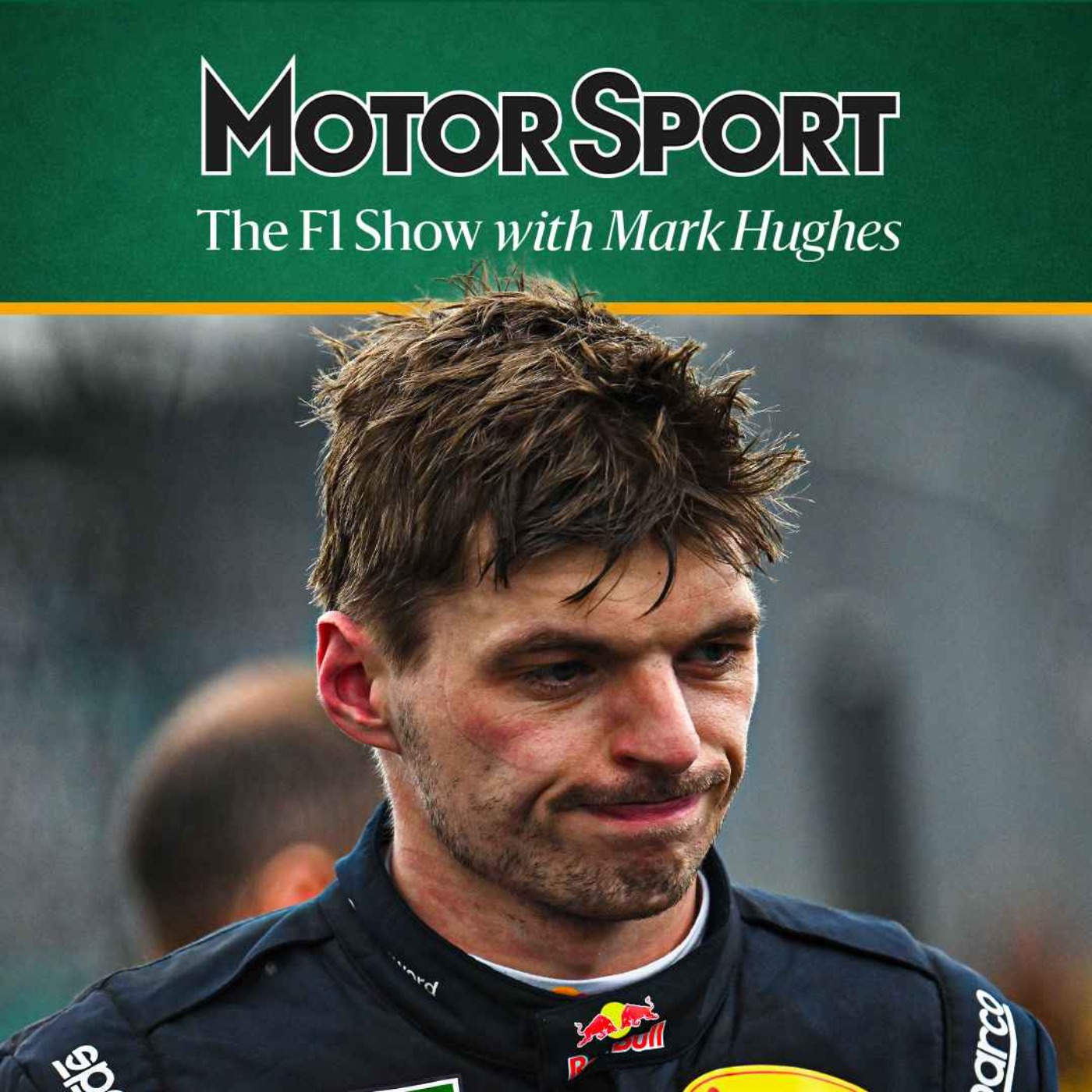
Will British GP crash seal Max Verstappen's Red Bull exit?
About this episode
Silverstone delivered a mixed bag: Ferrari’s resurgence looked real, with Charles Leclerc finding pace from qualifying onward thanks to setup tweaks around energy delivery and diff settings, while Mercedes struggled—George Russell couldn’t consistently convert speed into results despite a lucky sprint win for Antonelli. The biggest storyline was Red Bull’s late-race crash for Max Verstappen, raising fears about his mindset and the team’s technical reliability. The rear-wing issue and airflow/ground-effect timing were debated, alongside a safety-car confusion that sparked online outrage but was ultimately handled per the rules.
Max Verstappen arrived at Silverstone for the British Grand Prix on a high after an upswing in his Red Bull's performance. But after crashing out of the Formula 1 race, after a rear wing issue, the four-time champion sounded despondent
Red Bull must now face the possibility that he will leave the team, or even Formula 1, at the end of the season, says Mark Hughes in the latest episode of the Motor Sport F1 Show.
He and host Bryn Lucas examine what Verstappen's options are, and what went wrong last weekend.
At the opposite end of the scale, Charles Leclerc's fortunes changed for the better; after struggling in this year's Ferrari, which was designed with Lewis Hamilton's influence, it all clicked for Leclerc who raced to victory. What changed, and did Ferrari let Hamilton have too much influence? All is not as simple as it seems,
Mark and Bryn also talk about the discontent over the race ending under the safety car; why reliability is becoming a Mercedes bugbear; and whether F1 should reintroduce refuelling.
Plus, Mark answers your questions on matte paint, Honda's F1 record, and solutions to the safety car problem.
Subscribe now for every weekly episode and tell us what you want to know from Mark. Send us a message on social media or find this podcast at https://go.motorsportmagazine.com/4wvTMdI and drop your questions in the comments. He'll answer a selection of the best every week.
Read Mark's column every Wednesday at https://go.motorsportmagazine.com/4wvTMdI
Hosted on Acast. See acast.com/privacy for more information.
Max Verstappen
"We had the collapse of Max Verstappen's weekend in the race and just not a happy boy at all."
Max Verstappen is one of the best Formula 1 drivers. The hosts are saying his bad weekend could be a sign of bigger trouble for his relationship with his team.
Max Verstappen is a top Formula 1 driver for Red Bull Racing, and his season form strongly influences the team’s championship position. The segment frames his weekend collapse as a potential turning point for his future with Red Bull.
Red Bull
"Red Buller got real reason to be worried about whether he continues with them beyond the season."
Red Bull is the Formula 1 team in this story. The hosts are discussing whether Verstappen might leave if the team’s performance doesn’t keep up.
Red Bull is the Formula 1 team associated with Max Verstappen in this discussion. The speaker is tying Verstappen’s on-track results and confidence to whether he might stay with Red Bull beyond the season.
Austria
"He'd just come off the back of a very competitive Austria... during the Silverstone weekend, just while it struggled so much in Austria."
Austria is where another Formula 1 race was held. The hosts are comparing how the teams performed there versus at Silverstone.
“Austria” here refers to the Austrian Grand Prix weekend in Formula 1. The speaker contrasts Austria’s results with what happened at Silverstone, using Austria as a reference point for whether performance trends are improving or worsening.
McLaren
"If you went to McLaren, would it be better? Yeah, it might be."
McLaren is another Formula 1 team. The host is wondering if switching to McLaren would make things better for the driver and results.
McLaren is a Formula 1 constructor/team referenced as a possible alternative for Verstappen. The speaker is speculating whether a move to McLaren could improve competitiveness.
British Grand Prix
"Well, Mark, we had the British Grand Prix at the weekend. It was a lively one, wasn't it?"
The British Grand Prix is one of the big Formula 1 races. It’s usually held at Silverstone, and it’s a weekend where teams and drivers can make big progress—or have big problems.
The British Grand Prix is a Formula 1 race held in the UK, most commonly at Silverstone. In F1, it’s a major weekend where teams test upgrades and drivers’ form can swing the championship narrative.
Ferrari
"We had the resurgence of Ferrari. It looked a lot more like the Ferrari of two races ago..."
Ferrari is one of the top Formula 1 teams. The host says Ferrari looked much stronger at Silverstone than it did in Austria.
Ferrari is the Formula 1 team the host says showed a resurgence at Silverstone. The comparison to “two races ago” versus Austria suggests Ferrari’s car performance and competitiveness changed significantly over a short period.
Antonelli
"almost specifically Antonelli's Mercedes... all he came away with was the points for winning the sprint race because of the problem that he had in the late in the Grand Prix"
Antonelli is a Formula 1 driver mentioned here as part of Mercedes’ weekend. The host says he did well in the sprint but had trouble later in the main race.
Antonelli is referenced as the driver associated with Mercedes in this segment. The host credits him with winning the sprint race but says a late Grand Prix problem prevented a stronger result.
George Russell
"because George Russell was struggling this weekend, struggling to put it all together. And he got a lucky second place"
George Russell is a Mercedes driver in Formula 1. The host says he had a tough weekend but still ended up with a strong result.
George Russell is a Formula 1 driver associated with Mercedes in this segment. The host says Russell struggled to put it all together at the British Grand Prix but still managed a lucky second place.
sprint race
"all he came away with was the points for winning the sprint race because of the problem that he had in the late in the Grand Prix"
A sprint race is a shorter race on the same weekend as the main Grand Prix. It helps decide where cars start the big race and can also award points.
A sprint race is a shorter Formula 1 race held on a race weekend that determines grid positions for the main Grand Prix. Points can be awarded based on sprint results, so it can materially affect the championship.
newer tyres
"when he was about to relieve Leclerc of the lead on much newer tyres."
Newer tyres have more grip because they’re fresher. That often makes it easier to go faster and pass other cars, especially later in the race.
“Newer tyres” refers to tires with more remaining tread and better grip. In F1, tire freshness can strongly affect braking, cornering traction, and the ability to overtake late in the Grand Prix.
Charles Leclerc
"when he was about to relieve Leclerc of the lead on much newer tyres."
Charles Leclerc is a top Formula 1 driver who races for Ferrari. The host is describing a moment where someone was trying to take the lead from him.
Charles Leclerc is a Ferrari driver referenced as the leader Verstappen’s rival was trying to pass. The host’s wording suggests a late-race overtake attempt that was affected by a problem.
setup
"really was very quick from Grand Prix qualifying onwards, less so at the first part of the weekend, but they found something in the setup in terms of what he was doing in terms of the energy delivery"
“Setup” means how the team adjusts the race car so it drives the way they want. It can include suspension and balance changes that affect handling and speed at a particular track.
In Formula 1, a car’s “setup” is the collection of adjustable settings that tune how the car behaves—things like suspension settings, aerodynamic balance, and drivetrain behavior. It’s how teams tailor the car to a specific driver and track rather than changing the car’s core design.
energy delivery
"but they found something in the setup in terms of what he was doing in terms of the energy delivery and the diff settings"
“Energy delivery” is how the car feeds power to the wheels when you press the throttle. The team can change it so the car accelerates smoothly and predictably instead of feeling abrupt or inconsistent.
“Energy delivery” refers to how the car turns its available power into acceleration—especially how smoothly and aggressively the powertrain responds. In modern F1, it’s closely tied to engine/ERS mapping and throttle response so the driver can apply power consistently out of corners.
body language
"Should we read anything into, into his body language, into his tone? And we've been talking about, about Max this season, a fair bit."
“Body language” is the visible physical cues a driver shows—posture, gestures, and reactions—that can reflect stress, frustration, or confidence. In racing coverage, it’s often used as indirect evidence of how the driver feels about the car and strategy.
what went wrong with his rear wing
"I don't know. What went wrong with his rear wing? The wing was physically closed just as it had been in qualifying in Austria. As he turns in, the wing is closed."
They’re trying to figure out why the car suddenly lost grip. The idea is that the rear wing and airflow didn’t “catch up” fast enough when the car started turning, so the downforce and grip weren’t there.
The hosts focus on an aerodynamic timing issue: the rear wing being closed, and whether airflow reattaches and the boundary layer changes quickly enough during the transition into corners. The discussion ties that delay to a loss of grip and downforce.
airflow reattached
"The question is whether the airflow had reattached and you can't see that it's not visible."
Airflow reattachment means the air stops “peeling away” from a surface and starts flowing back along it. If that happens too slowly, the wing may not produce the downforce you expect, and the car can feel unstable or less grippy in the corner.
Airflow reattachment refers to the point where disturbed airflow that had separated from a surface starts following the surface again. In F1 aerodynamics, whether airflow reattaches quickly enough after a change in car attitude or wing configuration can determine how much downforce and grip the car has.
underfloor
"Once you ask it to do something else, it has to have time to come through the whole the underfloor that effuses up to the rear wing."
The underfloor is the bottom part of the car that’s shaped to help the air flow in a way that pushes the car down. In corners, it needs a moment to “settle” so it can keep producing downforce.
The underfloor is the aerodynamic floor beneath an F1 car, shaped to accelerate airflow and help generate downforce. When the car transitions from straight-line to cornering, the underfloor flow needs time to develop and feed the rear wing effectively.
damp force
"And it could be that delay was just a little bit too long and the grip just wasn't there. The damp force just wasn't there as he lends into the corners, same as in Austria."
The speaker is talking about downforce, which is what presses the car onto the track. If it doesn’t build quickly enough when you turn in, the tires can lose grip and the car won’t handle as well.
“Damp force” appears to refer to downforce—the vertical aerodynamic force that presses the car onto the track. The speaker is suggesting that delayed aerodynamic response meant the downforce wasn’t there when Verstappen turned in, reducing grip.
floor stall
"There's possibility also that of course the floor stall, as you can get these depending on how small ride height you've chosen to run and the lower the better at the front."
A floor stall is when the air under the car stops working the way it should. When that happens, the car suddenly loses downforce and grip, so it can feel like the tires “go dead” instantly.
Floor stall is an aerodynamic failure where the airflow under the car loses the low-pressure effect that generates downforce. In F1, it can happen when the car’s ride height changes too much or the front of the car pitches, causing a sudden loss of grip that’s hard to recover from.
ride height
"There's possibility also that of course the floor stall, as you can get these depending on how small ride height you've chosen to run and the lower the better at the front."
Ride height is how low the car sits to the ground. In F1, running it very low can help the car stick to the track because the aerodynamics work better.
Ride height is the distance between a car’s body and the ground. In F1, changing ride height strongly affects aerodynamic balance—especially front-end downforce—so teams often run very low ride heights to maximize grip.
safety cars
"Let's just talk safety cars. Get this one dealt with quite a lot of emails, quite a lot of the messages in about safety cars. The story is that there was a safety car at the end of the race..."
They talk about how safety cars work during a race and what happens when they’re about to restart. The discussion focuses on a confusing moment that sparked debate.
This segment shifts into how safety cars affect race control and driver behavior. The hosts discuss a specific restart-related situation that caused confusion and lots of fan questions.
safety car restart procedure
"So this is first one's from Martin. He says, read the safety car restart procedure. Would it not be better to simply bring the safety"
A safety car restart procedure is the official way F1 cars get going again after the safety car period. If drivers don’t follow the exact timing and positioning, it can be easy to get into trouble.
The safety car restart procedure is the regulated sequence for how cars line up and accelerate when the safety car returns to the pits. Timing and execution matter because cars can be caught out by changing grip levels and gaps, which can lead to incidents.
blue flags
"If they stopped in normal running, they'd have to repass the slower cars who did not stop, albeit with the help of blue flags. Why is a safety car stop different?"
Blue flags are warnings that you’re being approached by a faster car that needs to pass you. It’s basically a heads-up to let them through safely.
Blue flags are signals shown to a driver to warn them they are about to be overtaken by a faster car that’s lapping them. Under safety car and other race conditions, blue flags help manage traffic so the faster cars can pass without causing incidents.
unlapped
"But the regulations are pretty clear, aren't they, that once their cars have unlapped, you still have to go for one more lap."
In F1, “unlapped” refers to a slower car being brought back to the same lap count as the leader (typically because the leader is slowed by the safety car). The rules can require cars to complete an additional lap after unlapping before certain race procedures (like ending the safety car period) can occur.
race control
"And as soon as someone saw it, someone in race control saw it, they had to, you know, say, no, safety car deployed. And in other words, they were saying, no, safety car is still out."
Race control is the group of officials who run the race behind the scenes. They decide things like when the safety car comes out and they send the official instructions to teams and drivers.
Race control is the central operations team that manages F1 events, including decisions like deploying or cancelling the safety car and communicating official instructions. When the transcript mentions race control correcting an erroneous message, it’s describing how officials ensure the race follows the rules.
Abu Dhabi 21
"It was clear that it might not be cleared up. There might not be enough time to go through the whole procedure after that was cleared up. Very similar to Abu Dhabi 21. But in this case, the regulations were correctly followed, unlike on that occasion."
“Abu Dhabi 21” refers to the 2021 Abu Dhabi Grand Prix, a race remembered for controversy over how the safety car was handled near the end. The segment contrasts that earlier situation with the current one, emphasizing that the regulations were followed correctly this time.
red flag
"of a course that was open to risk control was that you could just red flag it and you could restart it for a lap or two laps or whatever it would have been."
A red flag is the signal that the race has to stop right away because something unsafe is happening on the track. After that, the race may restart, and that can completely change what teams do next.
In Formula 1, a red flag means the race is stopped immediately for safety reasons (typically due to a serious incident on track). When the race is stopped, officials decide whether and how it can be restarted, which can drastically change strategy and outcomes.
standing start restart
"If you'd done that, and especially if you had a standing start restart, it would have been more exciting for sure."
A standing start restart means the cars restart from a stop, not while already rolling. How the restart happens can change who gets a good launch and gains positions right away.
A standing start restart is a restart procedure where cars begin from a stationary position rather than rolling. Restart format matters because it changes how drivers can gain or lose positions immediately, affecting the competitive balance after a stoppage.
safety car regulations
"I was relieved to see that the safety car regulations were followed to the regulation this time, unlike in Abu Dhabi all those years ago."
Safety car regulations are the official rules for when the safety car comes out and how racing is controlled while it’s out. Those rules matter because they can change pit stops and the order of cars.
Safety car regulations are the rule set that governs when the safety car is deployed and how the race is managed during its presence. Because the field bunches up and pit timing changes, following (or not following) these rules can significantly affect who wins.
pit lane speed limit
"For example, by reducing the pit lane speed limit during VSE, so the time loss would be closer to a regular pit stop, that's from Chris Judd."
The pit lane speed limit is the maximum speed cars are allowed to drive in the pit area. If that limit changes, teams lose more or less time when they pit, which can affect who wins.
The pit lane speed limit is the maximum speed cars may travel while entering the pit lane for service. In F1, changing this limit during safety car periods would alter how much time teams lose in the pits, which can change race outcomes.
Chris Judd
"so the time loss would be closer to a regular pit stop, that's from Chris Judd."
Chris Judd is the person the host says came up with the suggestion about changing pit lane rules during VSE. Here, he’s mentioned mainly as the origin of that idea.
Chris Judd is referenced as the source of the idea about adjusting pit lane speed limits during VSE. In this context, he’s being credited for a specific rule-change proposal rather than discussed as a technical authority.
engine braking
"I know I hate this engine braking that you've built into the car over the years. So next year's car, I don't want either of those things. I want no engine brake in effect at all."
Engine braking is when the car slows down because the engine is still resisting as you lift off the gas. In racing, that can change how stable the car feels when you’re slowing down and turning in.
Engine braking is the deceleration you get when you lift off the throttle and the engine resists rotation. In F1, the way the power unit and drivetrain manage throttle lift can strongly affect how the car behaves as you approach and turn into corners.
ground effect era
"So next year's car... But they were helped because it was a regulation... And also these regulations helped because one of Hampton's problems in the ground effect era was that you couldn't really get a very good range of balance between your slow corner understeer and medium to fast speed instability of the rear."
The ground effect era is when F1 cars used the floor of the car to “suck” themselves toward the track for grip. The speaker is saying that those older rules made it harder to fine-tune how the car behaved in slow corners versus faster ones.
The ground effect era refers to the period in F1 when cars generated significant downforce by using underbody airflow (venturi tunnels/diffusers) close to the track. The host argues that those rules limited how teams could tune the car’s balance between different cornering regimes.
slow corner understeer
"one of Hampton's problems in the ground effect era was that you couldn't really get a very good range of balance between your slow corner understeer and medium to fast speed instability of the rear."
Understeer in slow corners means the front tires don’t grip enough, so the car tends to push wide instead of turning in. It’s one of the key handling problems drivers try to tune out.
Slow-corner understeer is when the front of the car loses grip first at low speeds, so the car won’t turn as sharply as the driver wants. The speaker contrasts it with rear instability at higher speeds, arguing that regulations affect how teams balance these behaviors.
medium to fast speed instability of the rear
"one of Hampton's problems in the ground effect era was that you couldn't really get a very good range of balance between your slow corner understeer and medium to fast speed instability of the rear."
This means the back of the car doesn’t feel stable when you’re going faster through corners. Instead of tracking smoothly, it can feel like it wants to step out.
Rear instability at medium-to-high speed describes a tendency for the back of the car to become unpredictable—often feeling loose or prone to sliding—when cornering faster. The host uses it to explain why earlier aerodynamic rules made it harder to achieve a consistent balance across different corner speeds.
Ferrari SF26
"But the point I was making is that the basic car, the SF26, very good car, much better car than last year's car. The parameters in which it works, it's got a very wide setup window..."
The Ferrari SF26 is Ferrari’s latest Formula 1 race car. In this discussion, the key point is that it’s easier to adjust so the driver can get the car to rotate and handle in a way that matches their style.
Ferrari SF26 is Ferrari’s Formula 1 car for the current regulations being discussed in the segment. The host focuses on how its setup characteristics (like the “setup window”) make it easier for drivers to find a balance that suits their driving style.
throttle to aid rotation
"What Charles has struggled a little bit with these new regulations are that he's no longer being able to use a very, very intricate way of using the throttle to aid rotation into a corner"
This is about using the gas pedal while you’re turning so the car pivots into the corner the way the driver wants. The speaker is saying the new rules make that trickier to do in the same detailed way.
Using throttle to aid rotation refers to how drivers manage power delivery while turning in to help the car rotate into the corner. The segment suggests that, under the new regulations, Charles Leclerc can’t use as “intricate” a throttle technique to achieve that rotation.
battery usage
"because that's very inefficient in terms of your battery usage because it, however much you use the throttle through the corners is it takes away from being able to use it on the straights."
In hybrid race cars, there’s stored electrical energy in a battery. How you spend it during the lap affects how much boost you have later for faster acceleration.
“Battery usage” refers to how an F1 hybrid power unit allocates stored electrical energy during a lap. Using more energy in one phase (like corners) can reduce how much is available later (like straights), which directly impacts lap time strategy.
throttle through the corners
"because that's very inefficient in terms of your battery usage because it, however much you use the throttle through the corners is it takes away from being able to use it on the straights."
It’s about how much you press the gas while you’re still turning. In a race, that choice changes how well the car grips and how fast it can accelerate out of the corner.
In racing, “throttle through the corners” means how much accelerator input you maintain while the car is turning. That matters because it affects traction and how much engine/electric power is available for corner exit versus being saved for straight-line speed.
FP1
"So that's the setup you arrive at at the circuit ready to hit the track and FP1, which was guided by the simulator at the factory"
FP1 is the first practice session on race weekend. It’s when teams try setups and collect information so they’re ready for faster sessions later.
FP1 is the first Free Practice session of an F1 weekend. Teams use it to test baseline setups, gather data, and decide what to change before qualifying and the sprint.
Silverstone
"for Silverstone, he went with a baseline setup... especially through long, fast corners like Silverstone has."
Silverstone is a well-known Formula 1 track in the UK. It has fast, demanding corners, so the car’s setup really shows up in lap times.
Silverstone is a famous F1 circuit in the UK known for high-speed corners and fast direction changes. It’s often used as a benchmark because car balance and aero efficiency strongly affect lap time there.
diff settings
"he migrated over towards Hamlin's setup in terms of wing levels and diff settings and things like that."
Diff settings control how the car sends power to the wheels when turning. Adjusting it can change how stable and grippy the car feels, especially when you’re braking and turning at the same time.
“Diff settings” refers to how the differential is configured to manage how torque is split between the driven wheels. In F1, changing diff behavior can strongly affect traction and stability during braking-to-cornering transitions and in different corner types.
wing levels
"he migrated over towards Hamlin's setup in terms of wing levels and diff settings and things like that."
Wing levels are how much aerodynamic “push” the wings create. More downforce helps the car stick in corners, but it can slow the car down on straights.
“Wing levels” means the aerodynamic settings on the front and rear wings that control downforce. Higher downforce generally improves grip in corners but can increase drag, reducing straight-line speed.
sprint qualifying
"But he, for Silverstone, he went with a baseline setup... But he, for Silverstone, he went with a baseline setup... as the went through the practice and towards sprint qualifying"
Sprint qualifying is a weekend format where a shorter race helps set the starting order for the main race. Teams often take different risks because the sprint is a big deal for grid position.
“Sprint qualifying” refers to the format where a shorter sprint race determines the grid for the main Grand Prix, with qualifying sessions feeding into it. It changes how teams manage setup and tire/power usage because the weekend’s fastest moments come in different sessions.
entry phase
"Friday evening, Leclerc and his engineers saw something in the data that explained why he might be having such difficulty with that entry phase where you're combining the braking and the cornering"
The entry phase is the moment you start turning into a corner. It’s important because it affects how well the car sets up for the rest of the turn.
The “entry phase” is the part of a corner where the car transitions from braking/turn-in into the cornering line. It’s a critical timing window because small setup or driving changes there can determine how much speed you carry through the corner.
braking and cornering
"that explained why he might be having such difficulty with that entry phase where you're combining the braking and the cornering, which is traditionally where he's made up so much time"
This is when you’re slowing down and turning at the same time. The car has to manage grip for both tasks, so it’s a tricky part of driving where setup matters a lot.
“Braking and cornering” describes the combined load condition when a driver is slowing down while also turning. This is where tire grip and car balance are most sensitive, so setup choices (like differential behavior and power delivery) can make a big difference.
talky delivery of the electrics
"because the very sudden and talky delivery of the the electrics on his cars combined with the way he drives, and the way he had the diff"
“Talky delivery of the electrics” refers to an abrupt or uneven feel in how the hybrid/electric power is applied. If the power comes in harshly, it can upset balance during turn-in and corner entry, especially when combined with aggressive driving and differential settings.
long, fast corners
"especially through long, fast corners like Silverstone has."
These are corners you take for a long time at high speed. The car stays under cornering load, so setup choices and power delivery can have a bigger effect than in short corners.
“Long, fast corners” are corners where the car stays loaded for a long time at relatively high speed. Setup and power/differential behavior can show up more clearly here because the car is continuously working the tires and maintaining balance through sustained cornering.
Grumbury Qualifying
"And he was half a second quicker on Grumbury Qualifying than he'd been the previous day."
This is the qualifying session where drivers set their best times to determine starting positions. The speaker is saying the car felt better after the tweak and the time improved.
This appears to refer to a specific qualifying session name at the event, where the speaker measures improvement in qualifying performance. The key point is that the setup tweak translated into a measurable improvement versus the previous day.
simulators
"I'm really interested about this way of setting a car up. Lewis Hamilton, as you say in your column and say just there doesn't trust simulators, Charlotte Clair seems to be all in for the simulators. What are the benefits?"
A simulator is a computer setup that tries to copy how the race car behaves. Teams use it to help drivers learn and try changes, but it can be imperfect compared to the real car on track.
In Formula 1, a simulator is a high-fidelity driving and vehicle model used to help drivers and engineers practice, test setups, and study lap-by-lap behavior without being on track. The key point in this segment is that simulators can lag behind real-world behavior, especially when the car’s systems are highly interconnected.
26 power units
"And the thing is, especially with these cars with the 26 power units, how everything is so much more interconnected and how you're using the throttle and the brakes and the corners and what impact that has on the power unit..."
In F1, the “power unit” is the engine-and-energy system. The rules limit how many of these you can use in a season, so teams have to manage both speed and how hard they’re stressing the system.
“26 power units” refers to the current F1-era power-unit allocation rules that limit how many complete power units a team can use over a season. Because the power unit is tightly integrated with the rest of the car, setup changes that affect throttle/braking/traction can also change how the power unit behaves and wears.
throttle and the brakes
"how you're using the throttle and the brakes and the corners and what impact that has on the power unit and how that varies from one track to another..."
On a race car, how you press the gas and the brakes affects more than just speed—it changes how the car grips and how the engine/energy system is working. That’s why setup can feel different from track to track.
This highlights that in modern F1 cars, driver inputs like throttle and braking are not isolated—they interact with traction, aero balance, and the power unit’s operating conditions. Small setup differences can therefore produce very different outcomes depending on track and grip.
grip level
"and how that varies from one track to another, one grip level to another, or the same track even, that it's suddenly become exponentially more complicated."
Grip level means how much the tires can stick to the road. If the track is slippery, the car behaves differently, and even the same setup can feel totally different.
A “grip level” is how much traction the tires have with the track surface at a given moment. In F1, changes in grip can alter braking distances, cornering balance, and how effectively the car can put power down—making simulator-to-reality matching harder.
rear grip
"I want lots of rear grip above all else. And that's what he went for on his baseline setting,"
“Rear grip” means how well the back tires stick to the road. If the back tires have good grip, the car is easier to control in corners and you can usually go faster.
“Rear grip” is how much traction the car’s rear tires can generate before they start to slide. More rear grip generally means better stability and faster cornering because the driver can apply more steering and throttle without the rear stepping out.
baseline setting
"And that's what he went for on his baseline setting, and that was that was the way to go."
A “baseline setting” is the starting setup the team uses for the car—before making further adjustments during practice or qualifying. It’s typically a compromise that aims to be predictable across different conditions, then refined based on driver feedback.
flow state
"You need to be getting to the level where all your inputs are automatic. You're just in like a, what's called a flow state."
A “flow state” is when driving feels effortless and automatic. Instead of thinking about every input, you react quickly because the car is behaving the way you expect.
A “flow state” in racing is when the driver’s inputs become so well-matched to the car that steering, braking, and throttle actions feel automatic. The goal is to reduce conscious effort and react instantly because the car behaves consistently with the driver’s expectations.
inputs
"You need to be getting to the level where all your inputs are automatic. You're just in like a, what's called a flow state."
“Inputs” are the things the driver does with the controls, like turning the wheel, braking, and pressing the gas. The point is that in a good driving state, those actions become automatic.
In single-seater racing, “inputs” are the driver’s control actions—like steering angle, brake pressure, and throttle application. The discussion here is about how quickly and automatically those inputs can be executed when the car’s behavior matches what the driver expects.
torque delivery
"There's been some talk, isn't there, that the torque delivery has been reduced on the car. So it's not so instant."
“Torque delivery” is how the engine’s pulling power shows up—how fast it comes on and how smooth it feels. If it’s less instant, the car might accelerate differently and the tires may grip differently too.
“Torque delivery” describes how engine torque is provided over time—especially how quickly it comes on and how smoothly it ramps. In F1, changing torque delivery can affect traction and acceleration, because the car may need to manage tire grip rather than just maximize peak thrust.
acceleration
"Now, wouldn't that just reduce acceleration? If that's the case, how come Charle-Claire's quicker with that parameter change?"
“Acceleration” means how quickly the car speeds up. In racing, it depends on both the engine and whether the tires can grip the track.
“Acceleration” here refers to how quickly the car’s speed increases, which depends on more than just peak power. In racing setup discussions, acceleration is closely tied to traction, tire behavior, and how torque is delivered to the wheels.
compromised corner
"you've got a compromised corner and you've used up some valuable energy that could have been put to better use from the straight."
A “compromised corner” means the car didn’t go through the turn in the best way. That usually makes it harder to accelerate cleanly and can slow the lap down.
A “compromised corner” is a corner where the car can’t be driven at its ideal line, braking point, or throttle application. That forces the driver to trade off speed through the corner versus traction and stability, often costing time overall.
valuable energy
"you've got a compromised corner and you've used up some valuable energy that could have been put to better use from the straight."
In F1, the car has limited energy it can deploy. If you waste it in the wrong place, you can’t use it to accelerate as well on the straight.
“Valuable energy” refers to the limited energy available to the car during a lap (especially in hybrid-era F1), and how efficiently it’s used. If the driver spends it poorly in a corner, there’s less available for acceleration on the straight.
lap time
"So it's just about getting the delivery better and getting the torque in the right places through the lap where that gives you the better lap time."
Lap time is simply how long it takes to do one full lap. Faster lap times usually mean the car is working better and the driver is getting more out of it.
“Lap time” is the total time it takes to complete one circuit around the track. Teams and drivers use it to compare performance across sessions and to judge whether setup and driving changes are working.
Charle-Claire
"Charle-Claire has said that the battle with his car might not be over... Yeah, I think Charle was quite... explaining what it is, that process..."
This is Charles Leclerc, one of Ferrari’s drivers. The host is talking about how he describes feeling like he’s fighting the car when it doesn’t behave the way he expects.
“Charle-Claire” is a transcription error for Charles Leclerc, Ferrari’s driver. The host is analyzing how Leclerc talks about his car—describing it as a “battle” when it isn’t delivering what he wants.
Lewis Hamilton
"but to have a firing Charle-Claire, a firing Lewis Hamilton, you know, both Mercedes Siemens V doing okay..."
Lewis Hamilton is a seven-time Formula 1 World Champion who drives for Mercedes. In this segment, he’s referenced as part of a competitive group that can fight for race wins.
twice the power
"and then down the Wellington Straight and into Cops and then just breeze by them with twice the power down the Hangar Straight, that was just on the cards"
That phrase means the car suddenly has a lot more shove because of the hybrid system. It’s the kind of extra acceleration that can make an overtake possible on the next stretch.
“Twice the power” is a shorthand for a big boost in available output when the hybrid system deploys electric energy. Hughes uses it to explain why a pass becomes likely after a straight and into a braking/turning zone.
Wellington Straight
"you'd have to say Antonelli was probably easily going to win it, especially given how easy it was to force somebody to use up their battery in defense and then down the Wellington Straight and into Cops and then just breeze by them"
A “straight” is the part of the track where cars accelerate. Hughes is pointing to a specific straight that sets up where overtakes become possible.
Wellington Straight is a named straight section of the circuit layout being discussed. Hughes references it as part of the overtake sequence: defense into the straight, then into the next corner/complex where the pass happens.
Cops
"and then down the Wellington Straight and into Cops and then just breeze by them with twice the power down the Hangar Straight"
“Cops” is the name of a specific corner on the track. It’s mentioned because it’s part of the route where cars line up for the next move.
“Cops” is a named corner/section on the circuit. Hughes uses it to describe the path from the straight into a braking/turning area where the driver can set up an overtake.
Hangar Straight
"and then just breeze by them with twice the power down the Hangar Straight, that was just on the cards, that's the way it was going to be"
Hangar Straight is a long acceleration section of the track. Hughes is saying the extra hybrid power shows up here, making it easier to get alongside and pass.
Hangar Straight is a named straight where cars can use maximum acceleration. Hughes ties it to the hybrid “power” advantage that makes passing likely after the preceding defense and corner sequence.
balance
"found a better setup for the race than Hamilton did and so had a better balance than that first stint which was where Lewis lost all the time really"
“Balance” in F1 refers to how the car behaves at the limit—how stable it is and how it distributes grip between front and rear. Hughes uses it to explain why one driver could be faster and maintain competitiveness compared with another during stints.
first stint
"found a better setup for the race than Hamilton did and so had a better balance than that first stint which was where Lewis lost all the time really"
A “stint” is how long a driver stays out on one set of tires. Hughes is saying the early part of the race is where Hamilton fell behind.
A “stint” is a period of running on a specific tire set. Hughes says Hamilton lost time in the first stint, implying tire performance and car balance early in the race influenced the overall gap.
Toto Wolf
"you said a few weeks ago now, a few episodes that Toto Wolf should be concerned about Lewis Hamilton, should he now be concerned about both Ferrari and what should Toto Wolf do about it?"
Toto Wolf is the top leader for Mercedes’ Formula 1 team. The host is asking what he should focus on if Mercedes is facing stronger competition from Ferrari.
Toto Wolf is the team principal of Mercedes in Formula 1. Hughes frames the question around what Wolf should worry about if both Ferrari drivers are now capable of winning.
component failure
"drivers. Yeah if it's not power unit issues it seems to be component failure which is very frustrating, now as I said before you can read all about that in the latest MPH column"
“Component failure” means a specific car part breaks or stops working properly. In racing, that can cost you time or even end the race.
“Component failure” refers to a specific part breaking or malfunctioning, forcing the car to retire or lose performance. In F1 discussions, it’s often used as a reliability diagnosis when the issue isn’t traced to the power unit.
power unit issues
"drivers. Yeah if it's not power unit issues it seems to be component failure which is very frustrating, now as I said before you can read all about that in the latest MPH column"
In F1, the “power unit” is the car’s main engine setup, including both the fuel engine and the electric parts. “Power unit issues” just means something in that engine system isn’t working right.
In Formula 1, the power unit is the hybrid engine system that includes the internal-combustion engine plus the electric motor and energy-recovery components. “Power unit issues” means reliability or performance problems inside that whole hybrid system rather than, say, brakes or suspension.
late braking
"Lewis Hamilton's style, being very hard on the brakes, very late braking, do you generate more energy if you brake harder"
“Late braking” means you wait longer before you start slowing down for a corner. That can change how the car rotates and how the rear feels as you turn in.
“Late braking” means braking as close as possible to the corner entry rather than earlier. It changes the timing of weight transfer and can influence rotation and stability, which is why it’s discussed alongside rear-end behavior and braking/energy recovery trade-offs.
initial rotation
"then use a lot of steering to get the initial rotation, quite an aggressive steering to get the initial rotation and that's why he's always chasing a very strong rear end"
“Initial rotation” is the car’s first big “turning in” moment at the start of a corner. How you brake and steer affects how quickly and how sharply the car starts to rotate.
“Initial rotation” is the car’s first, rapid change in yaw angle as you turn into a corner. The speaker links it to steering input and braking timing, explaining why Hamilton can chase a strong rear end when the turn-in is very sharp.
regeneration
"so in terms of regeneration it's probably not much, that different, it's just the effect it has on the the aerobalance of the car really, that's a more significance."
In F1 hybrid systems, “regeneration” is the process of recovering energy during braking. The car converts some of the car’s kinetic energy into electrical energy to recharge the battery, which can then be used for acceleration.
Mercedes
"[1911.6s] Mercedes, let's talk Mercedes, Kim Yantanelli left Monaco with a whopping 66 point lead in the championship mark"
“Mercedes” is the Formula 1 team the speaker is talking about. They’re discussing how well their car and driver are doing in the championship.
“Mercedes” here refers to the Mercedes-AMG Petronas Formula 1 team and its current F1 car/driver lineup. The segment uses the team’s championship situation to discuss performance and psychology.
Kim Yantanelli
"[1911.6s] Mercedes, let's talk Mercedes, Kim Yantanelli left Monaco with a whopping 66 point lead in the championship mark, three races on, he's now 25 points ahead of George Russell"
Kim Yantanelli is the driver being discussed in the championship standings. The host is talking about how it affects his mindset when a big points lead slips away.
Kim Yantanelli is referenced as the driver who left Monaco with a large championship lead and then saw it shrink. The segment uses that situation to discuss the psychological impact of losing a big lead “through no fault of his own.”
nose cone
"they pulled Kimmy Antonelli into the pits they changed the nose cone in the tyres and sent it back out again before they realised that actually that wasn't the problem"
The nose cone is the front aerodynamic bodywork on an F1 car, designed to shape airflow for downforce and stability. In this segment, Mercedes swapped the nose cone as part of troubleshooting, implying the team initially suspected an aerodynamic or front-end-related cause.
massive reduction in load
"yeah all they could see was a massive reduction in load and Kimmy saying I got the car won't turn I've got no front end at all"
“Load” here is about how much grip the car gets from the air pushing it down. If that drops suddenly, the tires don’t bite as well, especially at the front, so the car won’t turn properly.
In F1, “load” usually refers to aerodynamic downforce (how much the car is pressed into the track). A massive reduction in load can mean the car loses grip and steering response—consistent with the driver reporting “no front end at all.”
onboards
"yeah all they could see was a massive reduction in load and Kimmy saying I got the car won't turn I've got no front end at all so it was only when they were looking at the onboards and they saw that bit sticking up on the left hand side"
Onboards are recordings from cameras on the car (and sometimes related data). Teams use them to see exactly what the car was doing and spot problems they can’t tell just from the initial symptoms.
Onboards are the camera feeds and telemetry views from the car, used to understand what happened during a session. Here, Mercedes only identified the real cause after reviewing onboard footage and noticing a component sticking up on the left side.
brake duct
"it was only when they were looking at the onboards and they saw that bit sticking up on the left hand side that they realised what it was it was that since Montreal the way that they've designed the brake duct has now got a an upright carbon fibre piece"
A brake duct is a shaped opening that funnels air to cool the brakes. If the duct design changes, it can affect both cooling and airflow around the front of the car, which is why it matters when diagnosing a fault.
A brake duct is an aerodynamic channel that directs cooling air to the brakes. The segment says Mercedes redesigned the brake duct since Montreal to include an upright carbon-fibre piece, and that this change is what ultimately explained the handling problem.
carbon fibre piece
"it was that since Montreal the way that they've designed the brake duct has now got a an upright carbon fibre piece to separate the flow to the inside of the of the"
Carbon fibre is a strong, very light material used a lot in race cars. Here, a small carbon-fibre part was added to the brake duct area, and that change turned out to be important for what went wrong.
Carbon fibre is a lightweight composite material widely used in F1 for aerodynamic parts because it’s strong and can be shaped precisely. The segment notes an upright carbon-fibre element added to the brake duct design, which became the suspected cause of the handling issue.
curb
"wheel into the duct and it was that which just vibrated loose as he went over a curb on the exit"
A curb is the raised strip at the edge of the track. Hitting it hard can upset the car and, in this case, may have helped cause a part to come loose.
A curb is the raised edge along the track that drivers often ride over to stay on the racing line. The speaker says the wheel “vibrated loose” after going over a curb, implying curb impact contributed to a component coming undone.
pit stop
"they've done a pit stop and in case because the assumption is that something could do with the wing when you've got no front end"
A pit stop is a scheduled stop in the pit lane during the race. The crew can change tires and sometimes fix damage so the car can keep racing.
A pit stop is when a car enters the pit lane to receive service during the race, most commonly tire changes and sometimes repairs. In this context, the team is reacting to damage and checking whether aerodynamic parts like the wing need attention.
front end
"because the assumption is that something could do with the wing when you've got no front end and the the aerodynamic loads which you can see from the readings drastically reduced"
“Front end” means the car’s front section. If it’s damaged, it can hurt how the car handles and how well it sticks to the road.
“Front end” refers to the car’s front section—front suspension, nose, and aerodynamic surfaces—collectively affecting how the car grips and generates downforce. Here, the speaker notes the car has “no front end,” meaning the front is damaged enough to drastically reduce aerodynamic loads.
aerodynamic loads
"the the aerodynamic loads which you can see from the readings drastically reduced but yeah it turned out that attended to the wrong thing"
Aerodynamic loads are the forces from the air pushing down on the car (and other aerodynamic effects). If damage reduces them, the car can feel less planted and harder to control.
Aerodynamic loads are the forces created by airflow over the car—especially downforce from wings and bodywork. When damage reduces these loads, the car loses grip and stability, which is why the speaker ties it to readings and the wing/front-end issue.
ludicrous penalty
"and of course you've got a ludicrous penalty I mean I don't know what your thoughts are on that"
A penalty is a punishment for breaking race rules. The host is saying this one seems unfair because the driver didn’t really benefit from what happened.
A “penalty” in F1 is a rule-based consequence applied by the stewards for on-track behavior or race control decisions. Here, the speaker argues the penalty was “ludicrous” because it appears to be triggered by track limits even though the driver couldn’t gain advantage due to damage.
track limits
"you've got a penalty for track limits when there was no advantage gained and it was clearly an obvious knock on effect from from the damage to the car"
Track limits are the rules about staying within the marked edges of the track. If you go outside those boundaries, race officials can penalize you.
Track limits are the boundaries of the circuit that drivers must respect; going beyond them can trigger penalties. The speaker criticizes a track-limits penalty in a situation where the car was damaged and no advantage was gained.
high grip circuits
"George is better on high grip circuits than he is on low grip surface where he needs a bit of time to to get the feel of it"
High grip circuits are tracks where the tires stick well to the road. That makes the car easier to drive hard and feel predictable.
High grip circuits provide more tire traction due to surface characteristics and track layout, allowing drivers to brake, turn, and accelerate with greater confidence. The speaker contrasts this with low grip surfaces, where the driver needs more time to “get the feel.”
low grip surface
"George is better on high grip circuits than he is on low grip surface where he needs a bit of time to to get the feel of it"
A low grip surface is a track where the tires don’t stick as well. The car can feel less predictable, so drivers may need more time to adjust.
A low grip surface has less tire traction, often making the car more sensitive to setup and driver inputs. The speaker says the driver needs time to develop “the feel” on low grip, implying the car’s behavior changes enough to affect confidence and consistency.
pace of development
"…do you think there's something a bit more fundamental going on there I think with the pace of development there's a lot of new parts going on…"
This means how quickly an F1 team can keep improving the car with new parts. If they’re changing things too fast, they may not have time to fully check that everything works perfectly, which can lead to failures.
In Formula 1, the pace of development is how quickly a team can design, build, and bring new upgrades to the car across the season. A faster pace often means more experimental parts and less time to validate them thoroughly, which can hurt reliability.
new parts
"…there's a lot of new parts being made all the time and these as I said the the part that failed at Silverstone…"
“New parts” refers to the upgraded components teams introduce during the season—often aerodynamic pieces, cooling elements, or power-unit related hardware. In F1, reliability can suffer when parts are introduced before they’ve been fully stress-tested in race-like conditions.
Montreal
"…that would that had only been introduced to the car at Montreal so yeah probably not the same rigorous testing…"
Montreal is where the Canadian Grand Prix is held. The point here is that the part was new in Montreal, and then it failed later at Silverstone.
Montreal refers to the Circuit Gilles Villeneuve venue used for the Canadian Grand Prix. Comparing when a part was introduced at Montreal versus when it failed at Silverstone helps illustrate how quickly reliability issues can show up after an upgrade.
stress testing
"…probably not the same rigorous testing stress testing available in the time I think if you're looking for any reasons why that the reliability…"
Stress testing means pushing a part hard in controlled ways to see if it breaks or behaves badly. If a team can’t do enough of that before racing, the part is riskier.
Stress testing is the process of evaluating components under extreme loads and conditions to find weaknesses before race use. In F1, limited time between introducing a new part and racing can reduce how thoroughly it gets validated.
battery thing
"…if you're looking for any reasons why that the reliability is not so good this year it'd be somewhere in there and the battery thing also…"
The “battery thing” is the car’s energy storage system that helps the engine use extra electrical power. If it has problems, the car can lose power or become unreliable.
In modern F1, the “battery thing” refers to the energy-storage system used to harvest and deploy electrical energy as part of the hybrid power unit. Battery-related issues can directly affect reliability and performance because the system is tightly integrated with the car’s power delivery.
reliability
"…if you're looking for any reasons why that the reliability is not so good this year it'd be somewhere in there…"
Reliability here means whether the race car can keep working and finish races without breaking. The idea is that new upgrades can introduce problems if they weren’t tested enough.
In F1, reliability means how consistently the car can finish races without mechanical or systems failures. The host links reliability drops to insufficient time for rigorous testing when new parts are introduced quickly.
Honda
"…has Honda been a consistent negative in F1 since 1983… whilst Renault Ferrari and Mercedes have supplied the grid Honda have contributed nothing to F1…"
Honda is a company that has supplied engines to Formula 1 teams. In this segment, they’re talking about whether Honda has helped teams succeed consistently over the years.
Honda is an F1 engine manufacturer and works with multiple teams across different eras. The host discusses Honda’s track record—partnerships and race wins—while also addressing claims that Honda has been inconsistent since the early 1980s.
Renault
"…whilst Renault Ferrari and Mercedes have supplied the grid Honda have contributed nothing to F1…"
Renault is a company that has provided F1 engines. It’s mentioned in a comparison of engine suppliers and their impact on teams.
Renault is another engine manufacturer that has supplied power units to F1 teams. The question lists Renault alongside Ferrari and Mercedes as suppliers that “supplied the grid,” contrasting them with Honda’s perceived contribution.
matte paints
"says Mark since 2019 teams have increasingly used matte paints on their cars the reason I mostly see given is one of saving a few grams of weight however"
Matte paint is the non-shiny finish you see on some cars. Beyond looks, the surface can be slightly rougher, and that can affect how air flows over the car.
Matte paint is a non-gloss coating used on F1 cars that changes how light reflects and can also correlate with different surface finishes. In this discussion, the key point is that matte finishes may alter microscopic surface roughness, which can influence aerodynamics.
Request an Explanation
Heard something you'd like explained? We'll add it to this episode.
Sign in to request explanations for terms you heard.
Want to learn more?
Browse our glossary for plain-English explanations of automotive terms, jargon, and concepts.
Help improve this episode
See something that's not quite right? Our annotations are AI-generated and can sometimes miss the mark. Click the flag icon on any annotation to suggest a correction.