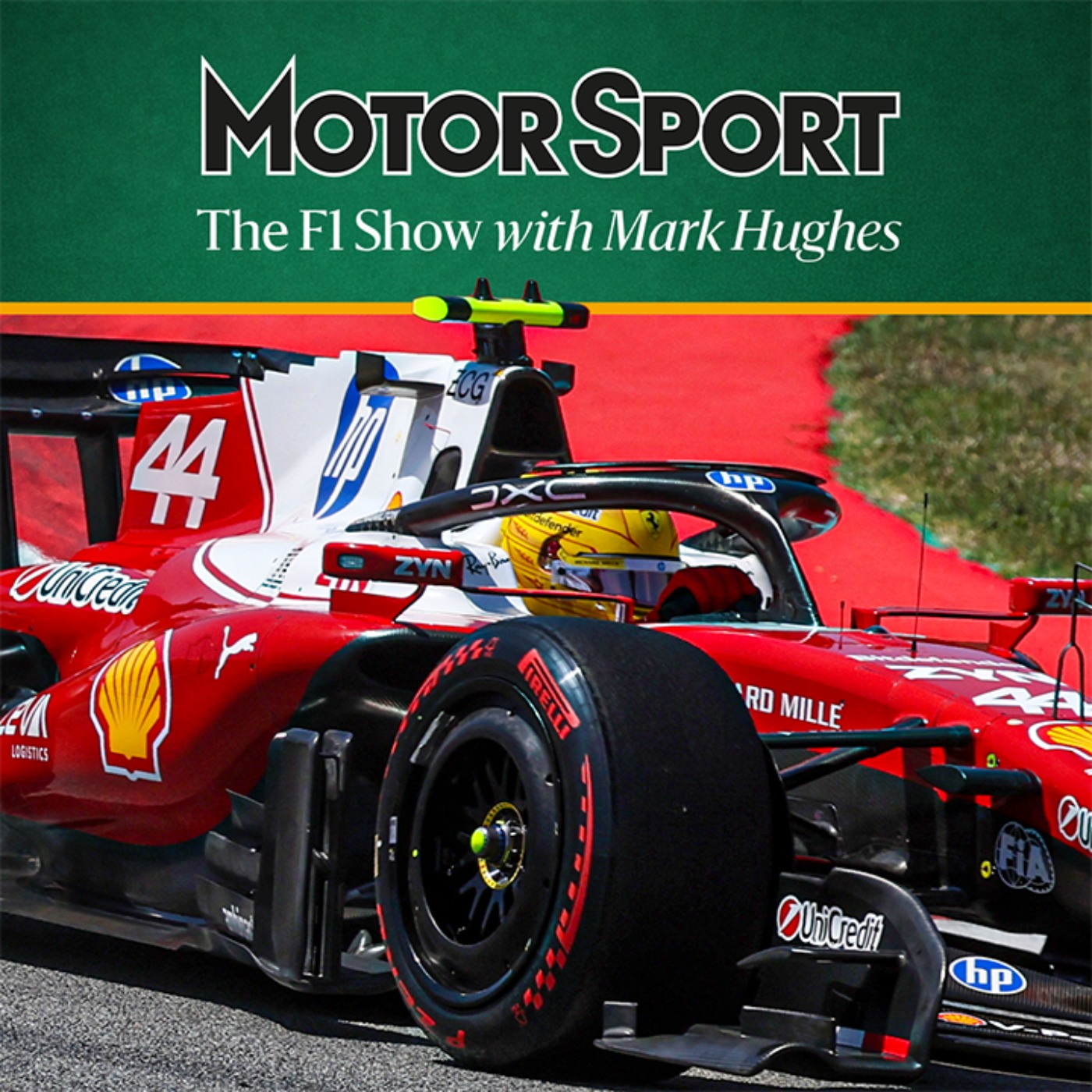
Are trick wheels behind Ferrari's F1 pace?
About this episode
Ferrari’s Barcelona turnaround sparks a debate: are “trick wheels” behind their improved F1 pace, or is it broader performance—strategy, safety car timing, and getting closer to the pace? The hosts explain how wheel-rim development can manage heat, with internal airflow aimed at extracting brake heat and helping the tire deck. They also note trade-offs between aero disruption and tyre temperature, plus post-2019 limits on wheel tricks. Regulation shifts could even trigger “wheel wars.”
F1 wheel wars: are new rims behind Ferrari success?
Mark Hughes and Bryn Lucas explain how the new design works and why it could be the opening shot in a new round of wheel wars, with Formula 1 regulations giving teams more freedom in their design.
They also consider whether this another example of Ferrari becoming F1's most innovative team, after its rotating 'Macarena' rear wing and clever spotting of a loophole around the crucial rear-end aerodynamics.
Ferrari will remain in the spotlight this weekend as it brings an engine upgrade: can it help Hamilton win for the second grand prix in succession; and does F1 need him to succeed?
Over at Mercedes, the questions of whether it should impose team orders to tackle the newfound threat have already begun. Mark gives his verdict.
He also answers your questions on the ideal driver line-up for next season; Ferrari's brake confusion; and why Isack Hadjar hasn't been blown away by Max Verstappen.
More on the stories that really matter, in the latest episode of the Motor Sport F1 Show.
Subscribe now for every weekly episode and tell us what you want to know from Mark. Send us a message on social media or find this podcast at https://go.motorsportmagazine.com/4w93qTp and drop your questions in the comments. He'll answer a selection of the best every week.
Read Mark's column every Wednesday at https://go.motorsportmagazine.com/4w93qTp
Hosted on Acast. See acast.com/privacy for more information.
heat dissipation
"Hamilton's win with Ferrari and Barcelona coincided with its new wheel rims of the rear, [5.8s] which have been designed to improve heat dissipation, get the heat away from the tires, [11.4s] and help with the tire deck."
Heat dissipation just means getting heat out of something. In racing, keeping tires from overheating helps them grip consistently.
Heat dissipation is how quickly a system sheds heat into the air or surrounding materials. In F1, wheel/rim and tire-related changes can be aimed at moving heat away from the tires so they stay in their best operating temperature range.
tire deck
"which have been designed to improve heat dissipation, get the heat away from the tires, [11.4s] and help with the tire deck. There's a narrative build up since then that Ferrari beat Mercedes [17.2s] because they had better tire deck because of the new rims."
The tire deck is the part of the car’s bodywork near the tires that helps control airflow. Better airflow can help the car stick to the track and stay stable.
In F1 aerodynamics, the tire deck refers to the bodywork area around and behind the tires that shapes airflow. Managing airflow there can affect how much downforce the car generates and how stable it is, especially as tire temperatures and grip change.
aerodynamics
"So one of the narratives that had formed since [76.4s] not really the full explanation. So one of the narratives that had formed since [83.2s] Hamilton's wound with Ferrari in Barcelona is that it coincided with not only an upgrade with [89.6s] the aerodynamics of the car, but also with its new wheel rims at the rear, which have been designed,"
Aerodynamics is how the car cuts through air. In F1, it matters because it affects how much the car is pushed onto the track and how much it slows down.
Aerodynamics is how air flows around the car, which strongly influences downforce and drag in F1. Small changes to bodywork and airflow management can shift the balance and lap time, even if the engine power is unchanged.
safety car
"And the reason why Ferrari [129.4s] beat Mercedes was to do with a car which was suddenly much closer to the pace. Even in qualifying [138.0s] was only 600s away. A better strategy and the help of the safety car, of course."
A safety car is used when the track isn’t safe, and everyone drives slower behind it. That can change when teams pit and which tires they use, which affects who wins.
The safety car is deployed when there’s danger on track, and it controls the pace of the race behind it. In F1, safety car periods can dramatically change strategy—especially tire timing and pit windows—so they can swing race outcomes.

Fiat 600
"...h closer to the pace. Even in qualifying was only 600s away. A better strategy and the help of the safet..."
The Fiat 600 is a small car made for everyday driving, especially in tight city spaces. In racing or event stories, it may come up because it’s a simple, lightweight car that can still compete depending on the situation. The mention of “600s away” sounds like a timing gap used to compare performance.
The Fiat 600 is a small, classic Italian city car that became well known for being practical and affordable. It’s often discussed in motorsport or racing-history contexts because older, lightweight cars like this can still be part of events where strategy and consistency matter. The podcast reference suggests it’s being used as a benchmark for pace or timing relative to other cars.
wheel rim development
"Now that it's open again, the teams are allowed to use wheel rim development as it's no longer a fixed part. So they are free to develop it within certain constraints."
The wheel rim is part of the wheel that holds the tire. If the rules let teams develop it, they can redesign it to help the tire work better and grip more, while still staying within the rules.
In Formula 1, the wheel rim is the outer part of the wheel that teams can develop to improve how the tire sits and works under load. When the rules allow it, teams can change the rim design to better manage tire behavior and performance within the regulation limits.
tire degradation
"Come back to your article then, talking about this tire degradation and this trick new wheel,"
Tire degradation is how quickly an F1 tire loses its grip and performance as the race goes on. Teams manage it through setup, driving style, and strategy, because once the tire degrades too much, lap times drop and the car becomes harder to control.
trick new wheel
"Come back to your article then, talking about this tire degradation and this trick new wheel,"
A “trick new wheel” means a special or newly designed wheel meant to help the tire work better. In F1, even small wheel changes can affect how the tire grips and wears during the race.
A “trick new wheel” in F1 usually refers to an unusual or newly developed wheel design intended to influence how the tire behaves. Even small changes to wheel geometry and tire mounting can affect contact patch shape, heat, and grip evolution over a stint.
wheel covers
"the wheel covers, like you said, they're different now, they're allowed to manipulate and do what [318.6s] they want essentially within regs to their wheels."
Wheel covers are special aerodynamic parts that sit over the wheel area. They help the car slice through air better and can also affect how heat moves around the brakes and tire.
In F1, wheel covers are aerodynamic panels over the wheel area. They’re used to manage airflow around the rotating wheel and brake zone, helping reduce drag and control how heat is handled near the tire and rim.
regs
"they're allowed to manipulate and do what [318.6s] they want essentially within regs to their wheels."
“Regs” means the official rules. In F1, teams can’t just build anything—they have to stay within the technical rulebook.
“Regs” is shorthand for the sport’s technical regulations. In F1, the rules define what teams are allowed to change on areas like wheel-related aero and cooling, which is why discussions often focus on whether a design stays within the letter of the regulations.
wheel supplier
"they've done it in combination with their wheel supplier, BBS, Japanese company, [350.4s] and it's all about just how you get the heat back out of the rim"
A wheel supplier is the company that manufactures the wheels used by the F1 team. In this segment, the supplier is part of the development story because the team and supplier jointly design the wheel/rim structure to improve cooling and heat extraction.
BBS
"they've done it in combination with their wheel supplier, BBS, Japanese company, [350.4s] and it's all about just how you get the heat back out of the rim"
BBS is a company that makes wheels. In this discussion, they’re involved in designing the wheel so it can handle heat better during racing.
BBS is a wheel manufacturer (a Japanese company in this context) that supplies wheels to F1 teams. The speaker says Ferrari worked with BBS to evolve the wheel rim design to improve heat extraction from the brake area.
heat back out
"and it's all about just how you get the heat back out of the rim that the brakes are put in. [359.6s] So you want that away from the tire, you want that nowhere near the tire"
“Heat back out” describes removing heat from the wheel/brake area so it doesn’t transfer to the tire. In racing terms, keeping tire temperatures in the right window helps maintain consistent grip and avoids a rapid drop-off in performance.
technical directorship
"some people have pointed out that it's come under the technical directorship of Loic Serra [391.5s] and free 2022 when you were last allowed to develop your wheel covers."
Technical directorship is basically the engineering leadership job. It’s the person who helps steer what the team focuses on and how it develops new technical ideas.
“Technical directorship” refers to the leadership role responsible for technical development and engineering direction within an F1 team. The speaker ties wheel-cover evolution to who was in that role, implying it may influence how aggressively the team pursues specific solutions.
Loic Serra
"some people have pointed out that it's come under the technical directorship of Loic Serra [391.5s] and free 2022 when you were last allowed to develop your wheel covers."
Loic Serra is mentioned as the engineering leader responsible for technical direction. The host is basically saying that the timing of wheel development may line up with who was leading the technical team.
Loic Serra is referenced as the technical director associated with the wheel-cover development timing. The speaker uses his role to suggest that leadership and engineering priorities can correlate with when teams make major changes to wheel-related aero and cooling.
aluminium, the magnesium construction
"if you look at the previous one and had fairly conventional sort of spokes within the [428.6s] aluminium, the magnesium construction, it's just conventional spokes"
They’re talking about what the wheel is made from, like aluminum and magnesium. Different materials can move heat differently and also affect weight, which matters in racing.
The speaker contrasts wheel materials and construction approaches—specifically aluminum and magnesium. Material choice affects weight and how heat moves through the wheel, which is why the design can be tuned to keep brake heat away from the tire.
carbon fibre circular rim
"This one has a sort of concave construction [448.4s] within a carbon fibre circular rim around the outside"
This is a wheel rim made with carbon fiber. The idea is that the shape and structure help move heat away more effectively than the older design.
This refers to a wheel rim built around carbon fiber, arranged in a circular structure. The segment’s point is that the new rim geometry and surrounding structure are designed to improve airflow and heat extraction, rather than relying only on conventional spoke layouts.
drum
"if you were to take the wheel off you would see that that is [462.4s] encased in a drum which has got inlets for cooling and outlets to extract the air"
In this context, the “drum” is an internal wheel structure that surrounds the rim area. It’s described as having cooling inlets and outlets, turning the wheel into a controlled airflow path to extract hot air away from the tire.
inlets for cooling and outlets to extract the air
"encased in a drum which has got inlets for cooling and outlets to extract the air and it's basically [473.2s] just doing that."
This describes a ducting-style airflow system inside the wheel: cooling “inlets” bring in air, and “outlets” let hot air escape. The goal is better thermal control—more cold air in, more hot air out—so tire performance doesn’t fall off as temperatures rise.
tyre management
"[501.6s] has always the aerodynamic disruption and the tyre management and it's the they work against [509.8s] each other to a certain extent"
Tyre management is about keeping the tires working in the best temperature range. If they get too hot or too cold, grip drops and the tires wear out faster.
Tyre management is the strategy and engineering goal of keeping tires in the right operating temperature and condition. In F1, it’s tightly linked to grip and degradation, so teams balance aerodynamic choices against how they affect tire heating and cooling.
aerodynamic disruption
"[501.6s] has always the aerodynamic disruption and the tyre management and it's the they work against [509.8s] each other to a certain extent"
It means a part of the car messes up the smooth flow of air. That “messing up” can hurt how well the car sticks to the track or how efficiently it moves through the air.
In Formula 1, aerodynamic disruption is how a component disturbs the airflow, creating turbulence and changing pressure around the car. Even small shapes—like wheels—can disrupt airflow enough to reduce downforce or efficiency.
downforce
"[519.3s] because otherwise your great aerodynamics will mean anything if you can't translate the downforce [523.3s] because the the tyres are too hot."
Downforce is the force that pushes the car down onto the road. More downforce usually means more grip—if the tires are hot enough to work properly.
Downforce is the downward aerodynamic force that increases tire grip by pressing the car toward the track. The host is emphasizing that downforce only helps if the tires can stay within a usable temperature range.
blown axles
"[573.6s] limited compared to how it was pre 2019 when they banned blown axles it's it's been limited still"
Blown axles were a trick airflow setup that helped the car’s aerodynamics around the wheels. The rules later banned it, which limited how much teams could use wheel airflow tricks.
Blown axles are an F1 airflow system that uses ducts to direct high-energy air around the wheel/axle area to energize airflow and improve aerodynamic performance. The host notes that gains from wheel-related aerodynamics were reduced after the FIA banned blown axles pre-2019.
power drag
"if you're looking at downforce power drag tires tires is always the most [680.6s] powerful so it's like a it if you if you took a 10% improvement in each of those things"
Drag is the air resistance that makes the car work harder to go fast. Less drag usually means you can carry more speed, but you can’t just remove it because you still need downforce to grip.
Drag (often discussed alongside power) is the aerodynamic resistance that slows the car down. In lap-time terms, reducing drag helps top speed and reduces the power needed to maintain speed, but it has to be balanced against the downforce you need for grip.
heat management
"it's now more about heat management so do you think this is the beginning of of wheel wars [742.4s] should we call it we have to label it wheel wars"
Heat management is controlling tire and brake temperatures so the car stays in the best operating window. In F1, regulations and aerodynamic changes can shift the performance challenge from pure aero efficiency toward keeping tires working effectively as they heat up and cool down over a stint.
wheel wars
"should we call it we have to label it wheel wars is there is there going to be this new [746.5s] frontier where all the teams are starting to do wacky weird and wonderful things"
“Wheel wars” is a way of saying teams will start competing with new, unusual wheel designs. The goal is to improve how the tires work—especially by helping manage temperatures.
“Wheel wars” is a nickname for an arms race where teams develop increasingly unusual wheel-related solutions to gain performance. The idea is that if wheels can influence tire temperatures and grip, teams may push designs beyond what was previously considered “standard.”
open source component
"it's now um whereas [764.5s] it's now more about heat management ... [770.2s] whereas [777.5s] same name it's now being opened again it is now open source"
Here, “open source component” means teams have to share detailed design plans rather than keeping everything secret. That can make development faster because others can learn from what’s published.
In this context, “open source component” means the regulations require teams to publish detailed design information for certain parts. That changes the competitive dynamic: instead of everyone having a fully private design, teams can build on each other’s published engineering work.
fuel weight
"the functions that go into the lap time the fuel weight and the tire deck um and you apply that to the the actual lap time that's been set"
“Fuel weight” just means how heavy the car is because of how much fuel is still in the tank. More fuel usually makes the car slower, so analysts account for it when comparing laps.
In F1 analysis, “fuel weight” is the mass of fuel onboard at a given moment. Because extra weight makes the car harder to accelerate and slows it through corners, fuel weight directly affects lap time.
second stint
"you'll say you take a the second stint in this case when all three drivers that we looked at Hamilton and the two Mercedes were on the same compound of tires so you could then have a proper comparison"
In F1, a “stint” is how long you run on the same set of tires. The “second stint” is the next run after the first pit stop, so it’s a key window for comparing how the tires and fuel are affecting lap times.
A “stint” in F1 is the period a car runs on one set of tires. The “second stint” is the next tire set after the first pit stop, and it’s often where tire wear and fuel load differences become important for lap-time comparisons.
compound of tires
"when all three drivers that we looked at Hamilton and the two Mercedes were on the same compound of tires so you could then have a proper comparison"
A “tire compound” is the type of rubber the tires are made from. Softer compounds usually grip more but wear faster, and analysts compare laps more fairly when everyone uses the same compound.
A “tire compound” is the rubber formulation chosen by the team, typically balancing grip versus durability. In lap-time comparisons, using the same compound helps isolate other factors like fuel load and tire wear rate.
theoretical time
"therefore how much lap time that is costing therefore if you subtract that from the lap time they actually did it should give you this theoretical time if you had nearly no no fuel in"
“Theoretical time” is a calculated estimate of what a lap would be like if you removed certain effects. Here, it’s basically adjusting lap times to account for fuel and tire wear so you can compare drivers more fairly.
“Theoretical time” is an estimated lap time calculated by applying modeled penalties from fuel load and tire degradation to the measured lap time. It’s used to infer what the car could do under a standardized condition (e.g., nearly no fuel).
MPH column
"and it's worth checking out go to motorsportmagazine.com and have a look at the MPH column it's about DEG it's about wheels it compares the Ferrari of Lewis Hamilton to the two Mercedes as"
They’re pointing you to a specific section of the magazine (“MPH column”) where the analysis is published. It’s basically where you can read the same breakdown they’re talking about.
The “MPH column” is referenced as the specific section of Motorsport Magazine where the analysis appears. It’s a structural pointer for listeners to find the article being discussed.
Red Bull
"hopefully it's not bleeding through by the way in the past it's been maybe Red Bull then you move on to or Mercedes"
Red Bull is an F1 team. The host is saying that, historically, Red Bull has been the kind of team that leads with new ideas and development.
Red Bull Racing is one of Formula 1’s most influential teams in the modern era, known for strong car development and frequent aerodynamic innovation. In the segment, the host uses Red Bull as a benchmark for how a team can lead the field.
regulation set
"I think so in this regulation set so far I mean the whole concept of the car was very interesting"
A regulation set is the rulebook for how F1 cars are allowed to be built during a certain era. Teams use those rules to design their cars in different ways.
A regulation set is the specific set of technical rules governing how F1 cars may be designed for a given period. Teams interpret those rules differently, and that interpretation can drive major design choices in aerodynamics and packaging.
differential
"the way that they read the regulations and moved the how they placed the differential in order to have a bigger area that they could put bodywork on"
A differential is a drivetrain part that helps the two driven wheels work together. In F1, where it sits in the car can also affect airflow and the shape of aerodynamic parts.
In Formula 1, the differential is part of the drivetrain that manages how torque is split between the left and right driven wheels. How teams package and position it affects available space and airflow, which can influence aerodynamic performance.
rear wing
"where they put this the flap on that directs the airflow up to the rear wing so that's just one"
The rear wing is an aerodynamic part that helps press the car down onto the track. That extra grip helps the car turn faster and stay stable.
The rear wing is a key aerodynamic device that generates downforce to keep the car planted in corners. In F1, teams also use it as part of a larger airflow system, often fed by other surfaces that direct air toward it.
flap
"where they put this the flap on that directs the airflow up to the rear wing"
A flap in F1 aerodynamics is a small movable or shaped surface used to manage airflow direction and pressure. Even minor changes to a flap’s shape or placement can alter how air reaches the rear wing and other aerodynamic elements.
Lewis Hamilton
"we've got Ferrari in particular Lewis Hamilton with a very interesting relationship building between him and his new Bono"
Lewis Hamilton is one of the most successful F1 drivers ever. The host is saying that, with the right kind of car, Hamilton has been working better with the team and getting more out of it.
Lewis Hamilton is a seven-time Formula 1 World Champion whose driving style and feedback can strongly influence how a team develops its car. The host connects his improved performance to the type of car Ferrari is building and to his working relationship with key team members.
Bono
"Lewis Hamilton with a very interesting relationship building between him and his new Bono as he's been sort of describing"
Bono is a key person on the F1 team who works closely with the driver. The host is suggesting that Hamilton and Bono working well together helps the car perform better.
Bono refers to the engineer/technical lead role within a Formula 1 team that coordinates closely with the driver on setup and development. The host highlights Hamilton’s “relationship building” with Bono as part of why things are working better.
Carlos Santi
"Bono as he's been sort of describing Carlos Santi that's that's an interesting thing"
Carlos Santi is a person mentioned in the discussion. The host is tying him into the background of how Hamilton and the team are working together.
Carlos Santi is referenced as part of the story around Hamilton and the team’s internal relationships. The segment doesn’t provide enough detail to confirm the exact role, but it’s clearly a named figure connected to Ferrari’s current setup/development narrative.

Ferrari
"and I think that's really why we have a much more competitive 26 Ferrari than we had 25"
Ferrari is a top F1 team. Here, they’re talking about how Ferrari’s newer car (the 2026 version) is much more competitive than the 2025 one.
Ferrari is one of Formula 1’s most historically significant teams, and the speaker is specifically contrasting "a much more competitive 26 Ferrari" versus "25." That implies Ferrari’s 2026 car has closed the gap to the front more than its 2025 package.
battery
"maybe there's less of us looking directly at this battery I see you know separation it seems to be more about what's happening on track"
In F1, the "battery" stores energy so the car can use extra power when needed. Teams have to manage it carefully during a race.
In modern F1, "battery" refers to the energy-storage system used to capture and deploy electrical energy. It’s central to how cars manage power and performance across a lap.

Mercedes
"yeah I mean initially when it was the in the Mercedes dominance phase of the the championship"
Mercedes is a major F1 team. The host is saying that at one point Mercedes was so strong that it basically defined the championship story.
Mercedes is another dominant F1 team, and the host references the "Mercedes dominance phase" of the championship. The point is that earlier storylines were driven by Mercedes’ strong performance, which then set up rival narratives when others closed in.
constructors world championship
"or the constructors world championship or or both together if it's if it's copy both it's gotta be both Mark come on it's gotta be both surely well yeah it's a different answer I think in each case if the aim is just to win the drivers world championship and you've"
F1 has two big season goals. The constructors championship is about the whole team earning points from both of its cars, not just one driver.
In Formula 1, the constructors world championship is a season-long points battle between teams (constructors), based on the combined results of their two cars. It rewards teams for having both cars score consistently, not just one standout driver.
drivers world championship
"if the aim is just to win the drivers world championship and you've [1433.6s] because that's guaranteed so but if your aim is to win the constructors world championship"
F1 also crowns a champion driver. The drivers championship is based on points each driver earns race by race across the season.
The drivers world championship is the F1 title awarded to the individual driver with the most points over the season. Because points come from race finishes, it often favors a driver who can reliably extract performance even when the team’s second car isn’t as strong.
Antonelli
"um Antonelli and Hamilton maybe for the constructors um or [1483.9s] yeah I think um you know Alonso and Antonelli will be an interesting one"
Antonelli is mentioned as a driver who could be paired with another top driver. The idea is that the team needs both cars to score regularly to win the team championship.
Antonelli is referenced as a potential teammate option for a team aiming at the constructors title. In F1 discussions, a pairing like this is about balancing a top scorer with a second driver who can consistently contribute points.
Alonso
"[1483.9s] yeah I think um you know Alonso and Antonelli will be an interesting one uh yeah something like [1492.0s] that uh I think would would be try and win if the car is dominant"
Alonso is mentioned as another driver option for a team lineup. The idea is to combine drivers so the team can keep scoring well across races.
Alonso is mentioned as a teammate pairing idea alongside Antonelli. The underlying strategy talk is about matching driver strengths to the team’s development direction so both cars can score effectively.
Verstappen
"[1514.1s] they would um I'd go constructors Antonelli and Hamilton and drivers Verstappen and another driver [1523.5s] could I could be say that hey either those Antonelli Hamilton could win the title as well"
Verstappen is mentioned as the kind of driver who can fight for the drivers’ title. The host is also talking about needing another driver who can score consistently too.
Verstappen is suggested as part of a drivers-championship lineup. The discussion frames him as a high-upside, points-maximizing driver, while the second driver’s role is to support the team’s overall points haul.
Gasly
"if you want somebody that's a consistent point scorer going to be a real team player yeah Gasly okay Gasly is very quick driver um he's struggled up against Max at Red Bull and his career never really fully got into stride after that but he's yeah he wouldn't you wouldn't be making a mistake putting Pierre Gasly in your car he's one of only three drivers who scored in every single race so far"
Gasly is praised as a driver who reliably earns points and works well with the team. The key point is that he doesn’t just have flashes—he tends to score race after race.
Gasly is highlighted as a consistent point scorer and a “team player” type driver. The host specifically notes his track record of scoring in every race so far that season, which is the kind of reliability that helps teams win the constructors championship.
Max
"but he's yeah he wouldn't you wouldn't be making a mistake putting Pierre Gasly in your car he's one of only three drivers who scored in every single race so far [1563.6s] this season or something as well I think I read that uh next question then Roger Gamber-Jones very cool name says have you also outlined Red Bull's issues here Max always had the perfect car whereas the number two driver always struggled"
“Max” refers to Verstappen. The discussion is about how the top driver can have a big advantage when the car is perfect, while the second driver may struggle more.
“Max” is used as shorthand for Max Verstappen in the context of comparing driver performance. The host’s point is that the team’s number-two driver often struggles when the lead driver has a consistently dominant car.
Sergio Perez
"if you look at my Sergio Perez was there for a long time and if you look at the gaps that he had from one season to the next they were all over the place"
Sergio Pérez is an F1 race driver. Mark is using him as an example of how a car can feel great for one driver one season, then feel worse later if the car’s behavior doesn’t match how that driver likes to drive.
Sergio Pérez is a Formula 1 driver whose lap-time gaps to teammates can reveal how well a car matches a driver’s preferred driving style. In this segment, Mark Hughes uses Pérez as an example of how performance can swing when the car’s behavior is “in phase” with what the driver needs.
carbon industry brakes
"says glad Lewis has his mojo back I was wondering how this was going to affect Charles given his negative feeling about the carbon industry brakes"
In F1, the brakes are often made with carbon fiber. Mark is saying Charles has had negative feelings about how those brakes feel or behave, even though they’re a common high-performance setup.
“Carbon industry brakes” is referring to carbon-fiber brake systems used in Formula 1. These brakes are known for strong performance and heat handling, but they can also feel different in modulation and consistency compared with other brake materials, which is why drivers may have preferences.
Brembo
"why not give Charles Brembo's and Lewis the CIs against the rules question mark no it's not against the rules"
Brembo is a company that makes racing brakes. Different brake systems can feel different to the driver, so changing suppliers can affect how confident a driver feels when braking.
Brembo is a major brake supplier in motorsport and production cars. In F1, the brake supplier can matter because brake feel, modulation, and thermal behavior affect how a driver can brake and turn in consistently lap after lap.
brake supply
"no it's not against the rules you can use whatever brake supply you wish um I don't think Charles being negative about the CIs"
“Brake supply” just means which company provides the brakes for the car. Mark is saying teams are allowed to pick their brake supplier, so drivers might get different brake feel depending on the choice.
“Brake supply” refers to which manufacturer provides the braking components used by an F1 team. The segment notes that teams can choose their brake supplier, which can influence brake characteristics like pedal feel and how the brakes perform as they heat up.
Barcelona
"he put the CIs on for the first time in Barcelona and he wasn't attuned to them and that probably contributed to his crash in Q3"
Barcelona is where the driver first tried something new, and the hosts think it wasn’t fully dialed in yet. They connect that lack of familiarity to problems later in the session.
Barcelona is referenced as the first time the driver used the “CIs,” after which they weren’t yet well matched to the driver’s feel. The key point is that unfamiliar brake/tyre hardware behavior can affect confidence and risk, contributing to incidents later in the weekend.
Q3
"and that probably contributed to his crash in Q3 but I don't think he's complained about"
Q3 is the last part of F1 qualifying. It’s where the top drivers go for their best lap, so mistakes there are especially costly.
Q3 is the final segment of Formula 1 qualifying, where the fastest drivers set their last and typically quickest laps. The hosts mention a crash in Q3 to emphasize how the issue showed up under peak qualifying pressure.
Monaco
"he was complaining about the Brembo's prior to that in Monaco and Canada specifically and it was to do with them not find a very difficult to get them up to temperature"
Monaco is a famous F1 race track. The hosts are saying that, in their view, it doesn’t always generate enough heat for brakes to work perfectly, so temperature becomes a factor.
Monaco is a street circuit known for tight corners and heavy braking zones, but the hosts specifically frame it here as a “low energy” event where brakes may not heat up as easily. That matters because braking performance depends on reaching the right operating temperature.
up to temperature
"it was to do with them not find a very difficult to get them up to temperature and Canada was very cold Monaco was very low energy circuit"
Brakes need heat to work at their best. If they’re still cold, they can feel less effective or less predictable, which can make driving harder—especially when you’re braking hard into corners.
“Up to temperature” refers to brakes reaching their ideal operating heat range so friction materials work consistently. If brakes are too cold—common in cold-weather races or certain track profiles—braking feel and stopping performance can be inconsistent, which can contribute to driver mistakes or crashes.
low energy circuit
"Canada was very cold Monaco was very low energy circuit so I think it was um a particular trait of the Brembo's"
A “low energy” track is one where the car doesn’t build up as much heat. If there isn’t much hard braking, the brakes may not get hot enough to work consistently.
A “low energy circuit” is a track where the car generates less overall thermal and mechanical load, often meaning fewer hard braking events and less heat buildup. In that situation, brakes may struggle to reach and maintain operating temperature, affecting braking consistency.
switching from one to the other and back again
"he may he may stay with the carbon industry but essentially he's going to need to pick something and stick with it because it it does impact upon how you how you drive the car and how you set up the car so yeah switching from one to the other and back again probably not the best idea"
If you change brake setups, the braking feel can change. The driver and team may need to adjust how they brake and how the car is set up, so swapping back and forth can be harder than sticking with one.
The hosts are discussing how changing brake hardware (between suppliers/systems) can force the driver to adapt braking timing and setup. Even if both options work, the temperature range and friction behavior can differ enough that frequent switching isn’t ideal.
carbon industry disc
"the Brembo tends to work from um in a different temperature range to the carbon industry disc and it obviously is an overlap"
In F1, some brake discs are made from carbon materials. They can work differently than other brake setups, so the team chooses what fits the track and weather best.
“Carbon industry disc” is shorthand for carbon-fiber brake discs (carbon brakes), which are common in Formula 1. Carbon brakes can have different temperature and friction characteristics than other brake systems, so teams may choose based on circuit energy, braking frequency, and expected track temperatures.
homologated
"because these are all homologated and everything has to be signed off and sealed and etc by the FIA"
“Homologated” means the FIA has officially approved a car part or rule so it’s allowed in races. If you want to change it, you usually need FIA permission first.
In Formula 1, “homologated” means a part or technical specification has been officially approved by the FIA to be legal for competition. Once homologated, teams can’t freely change it without going through the FIA’s approval process.
Monza
"is either going to be a Zandvo or more likely Monza and we believe it will have a bigger turbo"
Monza is the race the host thinks will get the biggest upgrade. They’re connecting the upgrade size to that specific event.
Monza is referenced as the likely venue for the biggest Ferrari upgrade, with the speaker expecting a larger turbo. In F1 talk, linking upgrades to specific races helps explain why teams might be cautious or aggressive with development timing.
turbo
"it will have a bigger turbo so that will be the big upgrade."
A turbo is a device that uses the engine’s exhaust to push more air into the engine. More air usually means more power, which is why it matters a lot in racing.
A turbocharger uses exhaust gas to spin a turbine that forces more air into the engine, allowing more power from the same displacement. In F1, changes to turbo-related hardware or boost strategy can materially affect engine output and drivability.
engine performance
"we may not see a significant um boost in its engine performance because i think the the big boost we saw already in Barcelona was from how much freer they were using it"
“Engine performance” means how strong and responsive the engine feels in real racing. When teams talk about upgrades, they’re usually talking about getting more power or better behavior from the engine.
“Engine performance” here refers to how much usable power and response the power unit delivers over a race-relevant operating range. In F1 discussions, it often ties to how upgrades change boost, efficiency, and how freely the team can run the engine within FIA limits.
aerodynamic upgrade
"i think a big part of their performance improvement came from that as well as the aerodynamic upgrade"
An aerodynamic upgrade is a change to the car’s shape or wings to improve how it cuts through air. Better aerodynamics can mean more grip and less drag, which helps the car go faster.
An aerodynamic upgrade is a change to bodywork and wings/underbody elements intended to improve airflow and generate more downforce or reduce drag. In F1, these upgrades can significantly affect lap time because they change tire grip and efficiency at speed.
Austria
"than we will see from that one to the austria one which is a relatively minor upgrade"
Austria is the next race the discussion is tied to. The host is saying the upgrade planned for that event might not be as big as the one coming later.
“Austria” is used as the next race context for an upgrade timeline. The speaker argues the Austria-spec update may be relatively minor compared with the larger Monza upgrade.
sandbagging
"there may have been a bit of i would say sandbagging but not quite sandbagging with what certain teams have done until they got the adio allocation"
“Sandbagging” means not showing your full speed on purpose. Teams might do it so rivals can’t tell exactly how fast they really are.
In racing strategy, “sandbagging” means deliberately holding back performance—running less aggressive settings or not fully deploying upgrades—so competitors can’t accurately gauge true pace. The speaker suggests teams may have done something similar until they had more freedom.
allocation
"until they got the adio allocation and then they're able to unleash full fury"
“Allocation” here means teams get a limited number of uses for some engine parts under the rules. When they have that allowance, they can push harder without getting penalized right away.
In F1, “allocation” refers to the limited quota of certain engine components or usage allowances teams are permitted to use within the season’s rules. Once a team has the relevant allocation, it can run the power unit more aggressively without immediately triggering penalties.
Grand Prix
"there's a Grand Prix coming on this weekend and i've got spa 24 prep going on over my shoulder"
A “Grand Prix” is an F1 race weekend. It includes qualifying and then the main race on Sunday.
A “Grand Prix” is the main race event format in Formula 1, typically a weekend with practice, qualifying, and a race. It’s the context for discussing how upgrades and incidents affect the championship.
pinch points
"there's sort of two pinch points turn three at the top of the hill and then the following 12 and four there they're sort of natural pinch points"
“Pinch points” are tight parts of the track where cars get funneled into less space. That makes it easier for drivers to bump into each other, particularly early on.
In racing, “pinch points” are sections of track where the road narrows or the geometry forces cars into a smaller space. That increases the chance of contact, especially when many cars arrive together under braking or in slow corners.
power units
"because it's a high altitude circuit um it's going to be interesting to see how the power units perform there"
In F1, the “power unit” is the whole high-tech engine system. It’s more than just the engine you hear—it also includes parts that store and reuse energy.
In Formula 1, “power units” are the complete hybrid engine package used by the teams, not just the internal combustion engine. They include the combustion engine plus energy-recovery and control systems that feed power back to the drivetrain.
high altitude circuit
"because it's a high altitude circuit um it's going to be interesting to see how the power units perform there"
A “high altitude circuit” is a track at higher elevation. Because the air is thinner, engines can feel different and cars may run differently than at sea-level tracks.
A “high altitude circuit” means the track is located at significant elevation above sea level, where air density is lower. Lower air density affects engine performance and cooling, which can change how the power unit behaves compared with lower-elevation races.

Ferrari 75
"...t chance to get hold of it in the issue it covers Ferrari 75 years of Ferrari wins Mario Andretti Jackie Ix Ni..."
The Ferrari 575 M Superamerica is a high-performance Ferrari designed for long-distance driving and it can be driven with the top down. It’s the kind of car people talk about because it’s a distinctive model from a particular period of Ferrari road cars. The podcast mention sounds like it’s included in a Ferrari-focused topic or feature.
The Ferrari 575 M Superamerica is a grand touring (GT) sports car built by Ferrari, notable for combining strong performance with open-top driving. It’s discussed because it represents a specific era of Ferrari’s road cars and is often highlighted in collectors’ conversations. The podcast context suggests it’s tied to a broader Ferrari history or a special publication/issue covering Ferrari’s achievements.
Request an Explanation
Heard something you'd like explained? We'll add it to this episode.
Sign in to request explanations for terms you heard.
Want to learn more?
Browse our glossary for plain-English explanations of automotive terms, jargon, and concepts.
Help improve this episode
See something that's not quite right? Our annotations are AI-generated and can sometimes miss the mark. Click the flag icon on any annotation to suggest a correction.