Formula 3000 was a racing series that helped drivers move up toward Formula 1. It was a common path for talented drivers to prove themselves before reaching F1.
A crash helmet is the helmet race drivers wear to protect their head during crashes. It’s also personal, because the design and look are part of who the driver is.
A simulator is like a high-end racing video game plus real engineering data. Drivers can test how the car might behave and help the team decide what to change.
It means a top driver can sometimes make a not-ideal car feel better and go faster anyway. The driver’s skill helps hide problems that the car itself has.
A “world championship” in F1 is the season competition where drivers earn points race by race. The driver with the most points at the end of the season is the champion.
A “qualifying lap” is the lap drivers do during qualifying to set where they’ll start the race. It’s focused on being as fast as possible for that one lap.
“Pole” is the starting position at the front of the grid, awarded to the fastest driver in qualifying. Starting from pole often provides a strategic advantage because you’re ahead of traffic and can control the pace into the first corners.
The “limit of adhesion” is basically the edge of tire traction—when the tires are about to start slipping. Great drivers can stay right near that edge without losing control.
LIVE
This episode is sponsored by Indeed.
There's a lot that goes on behind the scenes of this show,
booking guests across time zones,
tight turnaround edits, and constant time management.
When things get chaotic,
you realise pretty quickly how important it is to have the right person on your team.
If I had to hire someone tomorrow,
I wouldn't just want a good editor.
I'd want someone who understands pace in long-form interviews and can work fast under pressure.
And in moments like that, you think,
this is a job for sponsored jobs.
Because Indeed sponsored jobs boost your listing in search results,
helping you reach the candidates with the specific skills and experience you actually need.
And it works.
Sponsored jobs posted directly on Indeed
are 95% more likely to report a hire than non-sponsored jobs.
That's a serious edge when the pressure's on.
Spend less time searching and more time actually interviewing candidates
who check all your boxes.
Less stress, less time, more results.
When you need the right person to cut through the chaos,
this is a job for Indeed sponsored jobs.
And listeners of this show will get a $75 sponsored job credit
to help get your job the premium status it deserves at Indeed.com slash podcast.
Just go to Indeed.com slash podcast right now
and support our show by saying you heard about Indeed on this podcast.
Indeed.com slash podcast.
Terms and conditions apply.
Need to hire.
This is a job for Indeed sponsored jobs.
Allergy season does not slow down when you are on the move.
and silky soft for up to 100% irritation free skin.
And now with the new Kleenex snap and go,
you can get that same gentle care made for life on the go.
Get the Kleenex ultra soft tissues you love in a new compact durable package.
New Kleenex snap and go snaps shut for a clean tissue anytime, anywhere.
For whatever happens next, grab Kleenex snap and go.
Stretch out.
Little memories sneak up on you.
Sometimes it's just about what's in your hand.
That color.
That chill.
The new tropical butterfly refresher from Starbucks.
Quava and passion fruit flavors with mango pineapple flavored pearls.
Yeah, that feels like summer before you even taste it.
Funny how one small stop becomes the best part of the day.
Start your summer rhythm with Starbucks.
Try the new tropical butterfly refresher from Starbucks.
Timing is crucial in Formula One.
Being in the right place at the right time can decide the driver's destiny.
There's no question that the racing gods are a bit of racing luck is needed.
But should we be surprised that people who are training for that moment
are therefore able to deliver when the opportunity comes along.
And I think that's the key thing.
Someone who's really committed will do whatever it takes to get in the best car.
That's what I truly believe.
But some things are beyond a driver's control.
I was committed to staying with the fastest car, but Frank changed his mind and then changed his
mind again. I was racing for Williams, but I was sitting on the side of the McLaren lawyers.
The whole thing was totally unnecessary.
Hello and welcome to F1 Beyond the Grid with me, Tom Clarkson.
I'm intrigued by the driver market at the moment and which domino will fall first to trigger a
frenzy. It's led me to think more about how drivers get themselves into the best seats
to ensure they have everything they need to be successful.
And while David Coulthard never won a world title, his 13 wins 12 polls and 62 podiums
proved that he was often fighting at the front. So how did he make his way into those faster cars?
From driving for Williams after the death event in Senna to an astonishing legal battle that
saw him leave for McLaren and then joining Red Bull as a player manager nine years later,
David tells the stories that shaped his Formula One career.
It's really interesting to hear DC's attitude and approach to success,
including the way he dealt with the big name team bosses like Ron Dennis and how he tried
to use the media to his advantage. DC, how are you?
I'm good, I'm good thanks. I think I'm probably in slightly better shape than you because I've
not just run a marathon. So have you got blisters and cramps and all sorts of side effects?
All of the above. Difficult to walk, I have to say, but I've got the bug actually. Marathon
running is where it's at and I think I can say the same for Sebastian Vettel probably.
Very impressive what he did and should we be surprised though because he's still a young man,
he's got all of the sort of competitive genes that understands focus, discipline, preparation,
and then of course through to the execution. So maybe this has become his next bug. He's
got to be aiming for what would be an impressive amateur time because he did under three hours.
He did under three. There's a stack of people I think that get to about 230,
but he'll now be thinking I can do 230. We're not here to talk about marathons,
by the way, but his ability to absorb information, he treated it like a Grand Prix
actually, the marathon in terms of his preparation and I learned a lot about him and about preparation
really. But DC, funnily enough, we're talking about a racing driver in him because you are someone who
has lived and worked in Formula One for more than 30 years. Very few people know this paddock
better than you and I wanted to discuss how drivers get themselves into the right place
at the right time. When you look at a Max Verstappen, it looks easy, but there are a lot of
very talented drivers who never get there. How difficult is it? It's incredibly difficult.
There's no question that the racing gods or a bit of racing luck is needed. You're being in the
right place at the right time available with the right preparation. But should we be surprised
that people who are prepped, people that are training for that moment, are therefore able
to deliver when the opportunity comes along? And I think that's the key thing. If you look at
the current grid, we go back to when Carlos Sainz was at Ferrari, he has appendicitis,
gets pulled out of the car and suddenly with no prior understanding that he was about to make
his Grand Prix debut, you have Oliver Bearman jumping the car and go out and deliver. And then
suddenly that cements very strongly the foundations of what I'm sure will be a long career. All the
rumors are that he will be at Ferrari in the future. The thing that stands in the way of him is,
well, if Lewis has a great year, then he'll probably want to go again for another year.
And then unless Charles is out of contract and decides to go somewhere else, which is possible,
but seems unlikely, then he's maybe going to have to be a little bit patient, like we saw with
George Russell, who probably stayed a bit longer at Williams than he would have liked,
but there was no room at the end within Mercedes. So timing is definitely a key part,
but being prepped and making sure that either yourself, and I always believe that it's important
to put yourself forward, you can have a manager, but at the end of the day, they're not signing the
manager, they're signing you. So have the confidence to put yourself in front of the various decision
makers. How important is, was a manager? Because famously, Gerhard Berger says, I didn't want a
manager because I wanted to keep all of the money for myself. You did variously IMG, huge
agency behind you, then you worked with Martin Brundle. What did a manager do for you that you
couldn't have done yourself? So I got introduced to IMG, which were, as you say, a big management
agency of that era. They were working with Senna, Prost, Chumaker, and some of his business,
and it was through Paul Stewart Racing, Jackie Stewart's son's team that they had a relationship
with IMG for many years. Jackie had been managed by Mark McCormick, who's no longer with us.
So it, I guess, was part of them speculatively having some young drivers, which was, I guess,
at the beginning of that curve, there's lots of management companies out there now that are managing
kids and karting, offering them the dream. As long as you pay us some money, we will
offer you the dream of Future Stardom, and it's a trading business that they're hoping that one of
them comes through and proves to be successful. But I started into Formula One with IMG, which I
don't really feel that they put me in a place to become a Grand Prix driver, because I'd been
testing for Williams anyway. I tested in 1991, 1992, 93, and in the beginning I wasn't paid to test.
I was just called up to go and do aero running and things like that. So it was, let's say, a pretty
low-level relationship, and then it became more formal. And then what happened in Imola, which
no one could have predicted happened, and even then you couldn't lobby Williams to put you in the car.
And I actually remember saying to my manager, Tim Wright, at the time, after the weekend of
Imola, saying, we don't speak, we don't call Frank or Patrick, we don't, the team know me.
I've been testing for a few years. We're not going to be those people that are going, well,
one of your drivers is no longer with us. We have a driver for you. And I felt very strong that that
wasn't the thing to do. And I know that a number of drivers, of course, did reach out to the team
or managers had reached out to the team going, hey, you need a driver. And I think that I think the
approach was the right way. So eventually, the team, once the emotion was understood and they
got on with the business of going to Grand Prix racing, they decided to put me in the car for a
single race. That was it. I had to prove in that single race that I could be a servant to the team.
And then that led to me sharing the car with Nigel Mansell over the course of I did eight
Grand Prix in 94, which then led to the full-time drive. And what I believe took me to being a
full-time Grand Prix driver from 95 onwards was my commitment. I was there at the factory,
I was with the team, I was living close by. And I think Nigel, as an experienced former Grand Prix
champion, he was sort of flying in from America, he'd come into the race, he'd buzz out again,
you know, he was in that routine of, well, you know what I can do. So I'm not going to stay around
and sort of, you know, spend time with the team. But I think that's exactly what Williams needed at
that time through the emotion and the difficulty of 94, which was traumatic, you know, Roland
Raitzenberger, of course, and then with Ayrton, I think the team needed a reset of sort of family
commitment rather than just, you know, high-end, high performers coming in.
It seemed that you own that relationship with Williams. So what was IMG doing for you then at
the time? Well, you, sorry to sort of hesitate, difficult, of course, always to see what people
are doing. Andrew Hampel was one of the senior people, Ian Todd, who went on to work with Nike.
Tim Wright was my designated manager. He was keeping Formula One teams across my results
in Formula 3000. I remember Patrick Head saying to him, look, can you stop sending letters,
which is what people did back then. Nowadays, it would be an email. But so they were, I guess,
lobbying the name and doing that kind of managerial side, but very difficult to sell or to find
sponsorship for a young driver. So they weren't really doing that. They were, I guess, just,
I remember him saying to Ron Dennis, you know, you'd be really nice if you gave David a watch.
And I remember Ron going, well, why would I want to give David a watch? I was a Formula 3000 driver.
And he's going, well, because then he'll really feel connected to you. And he's going,
I run McLaren. He'll feel connected to me whether I do that or not. So there was probably some missteps
in that process. But what was a sort of low point in that relationship through the relations they
had with Ayrton and Alan, they had a Shoei contract, both the drivers at that time. And
they'd managed to leverage a helmet for me when I was in Formula 3 out of Shoei. And they brought
that helmet to Brandt Hatch when I was testing. And they took it out of the cover. And my helmet,
as you will well remember, is a white cross on a blue helmet, blue background. It's a Scottish
flag. It's called the Salter. They took the helmet out. It was a blue cross on a white background.
And I think that might be the finish flag or something. But they just, they see that's really
bad. They just didn't get the importance of the crash helmet. You know, helmets, as you know,
are the most personal thing that the race driver has. And it's, and it's something that we really
connect with. So when I ended up racing for Williams in 95, through into 96, I actually then
wrote to Mark McCormack, had a multi-year contract, asking to come out of the contract.
Because I just felt that I wanted something more racing centric. I wanted something more
personal to Formula 1. I don't doubt that IMG, like all of these other big companies, would be
commercially very good because that's the space they live in. But I was never, the money was never
the motivation for me. It was, what is the best car that I can be in? What is the best environment
I can be in? This episode is sponsored by Shopify. One thing I've always admired about people who
start their own businesses is that at some point they simply decide to give it a go. Of course,
that comes with a few doubts as well. Whether it's launching a business or beginning a new project,
there's always that moment where you think, what if this doesn't work?
But sometimes all you really need are the right tools to help you get started. And that's where
Shopify can help. Shopify gives you everything you need to get going in one place, from building
your online store with ready-made templates to Shopify's built-in AI tools that help you write
product descriptions, page headlines, and even enhance your images. And it can help with your
marketing too, thanks to email and social media tools designed to get the word out about your
brand and help you find your customers. It's basically like having your own commerce expert
at your fingertips, with world-class expertise in everything, from managing inventory to
international shipping to processing returns and beyond. It's time to turn those what-ifs into
a
compliance and risk management before they'll even consider working with you.
And that can really slow deals down if you're not already across things behind the scenes.
And that's exactly the kind of challenge Vanta is built to help with.
Vanta automates your compliance process and brings compliance, risk and customer trust
together on one AI-powered platform.
So whether you're preparing for a SOC2 or managing a larger enterprise GRC program,
Vanta helps keep everything organized and keeps your deals moving.
Companies like Ramp and Writer spend 82% less time on audits with Vanta.
So it's not just faster compliance, it's more time to focus on growing the business.
And it's no wonder that over 10,000 companies from startups to large enterprises
trust Vanta to help them prove security and build customer confidence.
So get started at vanta.com slash grid.
That's vanta.com slash grid.
End of 95, you're in a Williams.
You've just won your first Grand Prix at the Portuguese Grand Prix and McLaren
were having a torrid time, right?
They just switched to Mercedes engines and 95 was a real low point for them.
So if you're trying to get yourself in the best car, why walk away from the best car?
Yeah, absolutely. That's a good question.
But we have to take a step back to 94.
So numbers wise, 1994, I did eight races.
So I was a test driver, I had a test driver contract for Williams
and I was being paid £30,000, a reasonable amount of money in 1994.
Certainly probably better than people with a higher education were probably earning at that time.
And then I did the eight races where I was paid £5,000 a race, right?
And so at the end of that year, I had been paid £70,000 to be a Grand Prix driver.
What was Mansell getting per race?
Just out of a million per race.
And did you know that at the time?
Of course, I heard the rumors and I'm happy.
But anyway, again, I was never once was I complaining about money,
but I did have a conversation with Frank at the Canadian Grand Prix in 1994,
which is where I scored my first points.
Because the withholding tax agreement with Canada was a flat rate of $10,000 for every driver.
So whether you were Nigel or Ayrton or Schumacher or a young guy like me doing my second Grand Prix,
you were obliged to pay $10,000 Canadian dollars as a withholding tax.
Well, I was only earning £5,000, which was less than $10,000 Canadian dollars.
So I went to Frank and said, Mr. Williams, could you please help me with the tax?
Because otherwise, I'm basically, I'm paying to be here at the Grand Prix.
And he thought about it and went, no.
So I effectively paid to score my first points,
which is not unusual to have paying drivers in Formula One.
You just don't associate that with Williams.
So it's fair to say it was a little bit hand to mouth.
I was still living, sharing a house, a rented house in Milton Keynes with some mechanics.
Will he please tell me that Frank was paying your expenses?
Yes, the flight in the hotel was paid.
Yeah, absolutely.
So by the end of that first year, and bear in mind, I had an overdraft debt of £320,000,
which had been run up to race in Formula 3000.
So at the end of that year, that 70,000, 10% of that would be going to the management.
Some of it would be going to my, let's say, life expenses.
And a little bit would be going to drawing down that £320,000 that I owed,
which was secured against the family transport business.
So we get to the end of the year, 1994, we've agreed.
So my management have agreed a two-year contract, 95, 96, to drive for Williams.
We go at the end of 1994, December, to sign that contract.
And as the lawyers getting the paperwork out, so you see I was signing into the end of 96.
Frank goes, I've changed my mind. I want to do a one-year contract.
So the lawyers go off, okay, so we've got to scribble out 90, 96.
I take some time out with my manager to go into another office.
And we call Ron Dennis because Ron had approached us in 94 already
to look at whether we were available to join McLaren.
And we said, we're not, we're going to resign with Williams.
So we phoned Ron and Ron says, come to the factory.
I'll sign a contract with you for 96.
Now.
Now. So we sign for 95 to drive for Williams.
We go to walking.
We sign a contract for 96, 97 at McLaren.
And I then drive up to Scotland to spend Christmas with my mom and dad.
And I remember selling my parents, I'm going to be a Formula One driver for the next three years.
And they were, oh, that's lovely.
And I said, it'll be one year with Williams and two years with McLaren.
And of course they were like, how does that work?
Well, it works because people change their mind.
And then halfway through 95, Frank decides that he wants me for 96.
And we're like, we're not available.
And then he tries to use the contract recognition board to enforce the test driver contract,
which was a multi-year contract that ran through until I think 98.
And so this hopefully is not too confusing for the listener.
But we had to go to the lawyer's office in Geneva,
which is where all of the Formula One drivers' contracts are lodged at the contract recognition
board. And I was racing for Williams, but I was sitting on the side of the McLaren lawyers
and Martin Whitmarsh, who worked with Ron Dennis, whilst the lawyers of the contract
recognition board looked at the paperwork that Williams had, looked at the paperwork
that McLaren had, and decided that actually McLaren's contract was valid and that I would drive
for them in 96, 97.
I then went to the airport and flew with Frank, who was in the meeting,
to the next Grand Prix.
The whole thing was totally unnecessary if Frank had signed ultimately the contract
that we'd agreed at the end of 94.
So I finished that year with Williams, and then the 1995 Adelaide, I'd been leading the Grand Prix,
crashed out, as you recall, that cost half a million pounds win bonus at Williams,
and it cost me $2 million over my McLaren 96, 97.
So it was expensive crash. And I went to dinner that night with Ron Dennis and his ex-wife,
and I'm sitting there on my own going, okay, right? So I'm now a McLaren driver.
So that's how that came about.
Right. You didn't walk away from the fastest car you'd committed to McLaren before.
Yeah, absolutely. And I was committed to staying with the fastest car,
but Frank changed his mind and then changed his mind again.
Was it an emotional decision to ring McLaren that day that Frank sort of reneged on the
original deal? Yeah, I was understandably disappointed that I'm there ready to sign
a proper contract for two years with a team that I've been racing for.
And they changed their mind. And I think the reason they changed their mind was because
Damon Hill was, his lawyer was really pushing on trying to get Damon a big contract.
And Frank probably just got to the point where he was going, well, drivers are pissing me off.
So I'll put them both in a one year contract. But the risk to him was he would lose me.
And he did. The risk to me was I went to a less competitive McLaren for 96.
I think the Damon win 96 and Jack won 97. But then 98, McLaren came good.
So it was that hard for you. Did you look over your shoulder a bit and go?
I went from leading the last race of 95 in Adelaide. And then four months later,
I'm sitting, I think, 14th on the grid in Melbourne. And at that point, the penny dropped
just what the difference in performance was. And so I do recall not that I made the move for
money. I made the move for security of contract. But I do remember at that point thinking,
I will never make a move ever again based on, let's say security or financial,
it will always be only about performance. And you can never know one year to the next, of course.
But you get trends of performance. So when you have big regulation chains like we just had,
it shakes everything up. But when you have year to year of stability,
you do tend to see the same teams towards the front.
What is a driver prepared to put up with in order to get in the best car?
Well, Ayrton Senna famously told when he was at McLaren, and Alan Prost was there, 93,
he famously went in the media and said, I will drive for Williams for nothing.
I will drive for free. Because, of course, that suddenly makes people go, oh,
well, if we are not paying the driver X amount of million, that is money that we can invest in
the team. So the engineers will like that. The team owner will like that. So I think
someone who is really committed will do whatever it takes to get in the best car.
That is what I truly believe. And I spent nine years with McLaren, and at various times they
had the best car. And at various times it was not. The move to Red Bull was about unfinished
business. I knew it was not the best car, but I truly believed I could play a part
in helping develop and structure that team towards being a winning team in the future, which
turned out to be the case. The team did go on to be very successful.
And that comes from an absolute belief that Formula One is always about people.
It is always about people. If you have got the right group of people working together,
it is not always about who is the biggest talent or who has got the biggest brain or the best degree.
You have got to have people who have got a willingness to work together and to have each
other's back. So for me, the most successful teams are a little bit like SAS or any form of
special forces. No human gets left behind. They defend each other. And when you see
teams break down, it is because you get little factions of, well, it is their fault,
it is their fault, and that is when you no longer have a team.
Having been in the sort of straight jacket of McLaren for nine years, did you enjoy the
player manager role? Was it liberating to go to Red Bull?
It was, in many ways, the right environment at the right time in my life. I was into my
30s. I had Formula One experience and knowledge. I had life experience. And I think that is a
key thing that we do not always take into account when we are talking about drivers.
Kimmy Antonelli right now is leading the World Championship.
Brilliantly fast, young talent. He is still a boy. You cannot make a man out of someone that
has not had life man experiences. And you will know as a parent, and anyone else who has gone
into the 30s, it does not make you quicker. But you are just more worldly. You are more
capable of making decisions of going, no, that does not work for me. That is how I am
going to get the best out of myself and having the confidence and the environment that you are
working. So that is why I think you need to, you do not judge somebody on a couple of race wins.
You judge somebody on can they handle the pace of a Grand Prix season? Can they do it back to back?
We have seen brilliant drivers, you know, people like Heinz-Arl Frenzen, who could win in a Jordan.
He won one race in a Williams, which was a race winning championship winning car. But somehow,
when the pressure of expectation comes, some drivers do not deliver. And when they are in,
let us say, away from that spotlight, they extract performance from a car that you go,
wow, that is impressive. I always thought of Giancarlo Fizzichella as another driver.
Yeah, Fizzy Montoya, brilliantly fast, does not give a shit attitude, but came to McLaren,
replacing me, spent a year and then he was on his way again, because it just did not work out.
So, you know, drivers like that have got so much potential, but somehow do not manage, you know,
Daniel Ricciardo, brilliantly fast racing driver. But I think, as he's now recognized and he's
done an interview this year talking about, he started to feel he was losing his way towards
the end of his career, not because he was old, but he got distracted. He got distracted by what
the world was offering him, where the key focus always has to be stopwatch, checker flag.
They're your two North stars in Formula One. How difficult is it to maintain that focus
as you get richer, more famous? Absolutely. It is difficult because you get
used to people going, yes. And I remember I went from test driver Williams being told what to do
to being a Grand Prix driver and the same people saying, David, would you mind,
could you please? And you start to go, hold on, I can say no. And you go, no, I don't want to do
that. And they go, okay, no problem. Whereas when you're the test driver, you say, no, they'll go,
well, we'll get someone else to do it. Do you want to be the test driver? I never said no,
is the point. But if I take that attitude of discovering what works for me within the Grand
Prix Paddock, when I had the confidence to go, you know, that timing doesn't work, can we move it
because this will enable me to be better prepared. But yeah, for sure, you end up becoming a bit spoiled
and around 30 years old, you know, I was in Formula One for several years, I was earning millions.
I had the plane crash on an aircraft that I didn't need to be on. The aircraft that I was normally
using was booked, let's say, for two o'clock. I woke up early in London, I wanted to go back to
Monaco, I got on the phone to my office, said, let's bring the plane earlier. And they were like,
well, your aircraft isn't available. I said, find me another one. You know, it's ridiculous.
They found me another one. I turned up, say hi to the pilots. An hour later, we, you know,
the plane crashes, they're dead. And I'm going, ah, okay. So maybe, maybe being a little bit more
patient, a little bit more humble, a little bit less, I, you know, me, me, me could be a lifesaver.
And, you know, that marked my moment of growing up. And then the next few years were my strongest
years in Formula One. I always thought you were very good at using the media. We had some great
pre-season lunches at the Bluebird restaurant in London, didn't we? But perception is nine
tenths of the law in this paddock, isn't it? If enough people say something, whether it's true
or not, people will start to believe it. How did you use the media as a driver?
Well, I wanted to build personal relationships because my belief is that that gives you the
benefit of the doubt more often. So I didn't have the attitude of, I don't want to talk to anyone,
and the media are the enemy. For me, it was, we all work and live within this world,
this ecosystem of Formula One. I've got one of the best seats in the house as a driver.
How do I do everything in my power to make sure that I'm getting the best car, best opportunity
for filling my talent? And when things are not going so well, which will happen, how am I going
to have the benefit of the doubt rather than immediately being blamed or it's a driver's
fault? How do you build relationships with the people that are influential and the media are
influential? They are the voices of the sport that carry the news around the world. So yeah,
I always placed importance on that. And what have you learned about the media now that you're
working in it that you wish you'd known when you were racing?
I wish I just had the wider knowledge and experience of how words can craft opinion
and how some members of the media will use you to stimulate a story. So it could be going to
Michael going, David said that your driving is totally unacceptable because he's going to go,
Wilf, I don't give a shit about him. He's just another guy that it makes up the numbers.
So they can create attention, which is part of their remit to get a reaction. If everything's
all smashy and nicey, then you're not really going to get the human element of reaction.
And some drivers are very, Jack and Pablo Montoya were always very much what you see
is what you get. They had no problem to just blah, blah, blah, where I was maybe a little bit more
considered in my answers, a bit more diplomatic on occasions.
But would you drop a bomb with a friendly journalist? Just if you're trying to put pressure
on Ron Dennis to give you a few more quid or just change something in your contract for
the following year, might you go up to a journalist and say, you know, I had a really
interesting chat with Ferrari. Did you do a bit of that? Even if you hadn't?
I'm not a liar, Tom. I'm not a liar. But sharing information with key people is part of the game.
And you're telling something to a trusted journalist in confidence, but you absolutely know
that off the record has a boundary, which, you know, you don't want that to be broken.
But you know that you can then have something that's going to, you know, little rumors build.
So, yeah, it's part of the business of Formula One. Getting yourself in the seat is difficult
enough. Staying there, when everyone wants your seat, if you're not having good performance, it's
the other driver manager's job to get in there and speak to the journalist going, well, David's
not doing a good job. You'd be much better putting Damon in the car or whatever it happens to be.
So that's part of the game. That's, everyone looks so sort of friendly and all the drivers
get along. But behind the scenes, they want each other's seat. They want to do whatever's necessary
to get the best car. On that note, I think the Paddock is more friendly now than it was in your
day. Would you agree with that? I'm talking about between the drivers. Between the drivers.
There was animosity between some of you guys. 100%. It's a lot friendlier, Formula One.
And the Paddock is a lot friendlier. And I think Red Bull brought that more openness
when they started with the energy station and they started doing chilled Thursday nights where
other team members could come to Red Bull's hospitality to have a coffee or have a drink
at the end of work. And you could see it was, you know, people like Ron Dennis were like, well,
hold on. I don't want our guys going in there. It was very territorial. I've only ever been
in Ferrari's motorhome twice in 30 years. Even now? Yeah. I went in once to have a meeting with
Jean Todd and once because I was flying back to Switzerland with Michael and after the race,
he'd fallen asleep in his driver room and everyone's packing up. So I said to them,
well, you go in. So I was going in and said, Michael, we have to go. You need to wake up.
So I never, you just didn't go into rival teams' hospitalities. And even, you know, working as
I do on television, I'll go into, you know, McLaren for a briefing or I'll go into Red Bull
because I still do show runs for them. But I never really go into other team hospitalities
if I don't have a reason to go there to meet someone because they've got their partners,
their sponsors, whatever it is that they're doing that's important. They don't need me going
in and getting in the way. How did the meeting with Jean Todd go, by the way? I ended up having
a further meeting with them in Paris at his apartment near the Champs-Elysées to talk about
a contract for them. And it was interesting because it was the same time when I was coming
out of my IMG contract and I'd asked Bern Eccleston to help me speak to the owner of IMG,
whose name I've just forgotten right now, Mark McCormack, because on the level that I was talking
to to try and come out of my contract, they were saying, no, we have a contract, that's it.
And I understood that I would have to pay something to leave the contract, but they just
weren't entertaining the idea. So I went to meet with Bern Eccleston, asked him if he could speak
to Mark McCormack on my behalf. And that coincided with the time I'd just come back from a meeting
with Jean Todd in Paris. And Bern Eccleston said, so are you thinking about going to Ferrari? And I
went, well, you know, every driver would love to be with Ferrari at some point, but I think I'm happy
at McLaren. I then left that meeting, went to have a meeting with my lawyers, and I get a call
from Ron going, what's this? You want to leave and go to Ferrari? Bern Eccleston had spoken to him
and Jean Todd, they were manipulating the environment. And I was like, no, I don't want to
go to Ferrari. I want to stay with McLaren. So, but he showed you that at that level,
these guys all knew what was going on. And then they were just, you know, drivers are like the
ponds they move around. This episode is sponsored by Lisa. I've talked a lot on this show about
all the opportunities that come from traveling through the Formula One season. But I have to be
honest, nothing quite compares to getting home and sleeping in my own bed again, which is why I'm
delighted to be partnering with Lisa for this episode. Because at home, we've had our current
mattress for far too long, and we finally decided it's time to replace it. But to be honest, I
didn't really know where to start. I just know that if a mattress is too firm or too soft,
my back definitely lets me know about it. But Lisa's online sleep quiz was genuinely really
helpful. It asks about things like sleep position, firmness, whether you sleep hot,
and the sort of support that you need. And it pointed me towards the Superior Hybrid.
Medium firm, breathable, and designed with a combination of supportive springs and memory
foam. It sounds perfect, and I can't wait to try it. Lisa mattresses are designed and assembled in
the USA, and they've even been awarded Best Hybrid and Best Memory Foam mattresses by New
York Times Wirecutter. Plus, they make the whole process really straightforward with
free shipping, easy returns, and a 120-night sleep trial.
This episode is sponsored by Indeed. There's a lot that goes on behind the scenes of this show,
booking guests across time zones, tight turnaround edits, and constant time management.
And when things get chaotic, you realise pretty quickly how important it is to have the right
person on your team. If I had to hire someone tomorrow, I wouldn't just want a good editor.
I'd want someone who understands pace in long-form interviews and can work fast under pressure.
And in moments like that, you think, this is a job for sponsored jobs. Because Indeed sponsored
jobs boost your listing in search results, helping you reach the candidates with the specific skills
and experience you actually need. And it works. Sponsored jobs posted directly on Indeed are 95%
more likely to report a hire than non-sponsored jobs. That's a serious edge when the pressure's on.
Spend less time searching and more time actually interviewing candidates
who check all your boxes. Less stress, less time, more results.
When you need the right person to cut through the chaos, this is a job for Indeed sponsored jobs.
And listeners of this show will get a $75 sponsored job credit to help get your job the
premium status it deserves at Indeed.com slash podcast. Just go to Indeed.com slash podcast
right now and support our show by saying you heard about Indeed on this podcast.
Indeed.com slash podcast. Terms and conditions apply.
Need to hire? This is a job for Indeed sponsored jobs.
Can we talk about the lure of Ferrari then? I mean, is it true that every driver would like to race
for Ferrari? At least contemplate the idea. Yeah, I never had this big passion for Ferrari growing
up. The British teams as a young guy watching Formula One on television, I was drawn to
the British teams even when Nigel went to Ferrari and he was revered. He won his first
Grand Prix for Ferrari. It was an amazing story. But I think having raced a little bit in Europe
and karting and the lower formulas, there was a comfort for me in British teams. And in British
teams we know are international. You have every nationality working within them. But
I think I felt a security of knowing what I was dealing with that I would have been uncomfortable
doing that at Ferrari. And I think for Lewis, it must be challenging. He spent all his life
with British racing teams and he's there within Ferrari picking up the language but not fluent
in the language. You know, Charles is embedded. He's been there for some time and the teams are
so big now. No matter how much Lewis will tell us, he's been at the factory and he's been on the
simulator, to affect change and influence change in an organisation that large, I think just takes
a long, long time. And I'm not sure he'll have the time to really make it the way he was able to
be, I think Mercedes were shaped around his needs and it was tremendously successful.
It's like they're like big oil tankers, these teams. When I think of the lure of Ferrari,
I just always come back to Jean-Elyse, who turned down the 1991 Williams, of course they went on
to dominate. I think he'd even signed a contract with Frank, actually. I believe so. I think
Eddie Jordan was involved at that time. So part of that deal, Frank got a Ferrari Formula 1 car
out of releasing Jean to go to Ferrari. So I don't know which Formula 1 car that was in the
Williams collection, but that was Frank's payoff for having had a contract with Jean,
and Jean wanting to join Ferrari. The Williams organisation got a Ferrari, an old F1 car
for their collection. So yeah, look, I get it with Jean. And Jean is a great friend. His passion
for motor racing is still very much there. He's the president of Paul Ricard race track,
so I'll be with him next weekend for the Paul Ricard Classic. He was racing in the Monaco
Classic. So I had a little shunt in one of the Ferraris. Thankfully, he wasn't injured,
but a little bit of damage to these incredibly extensive classic cars. But yeah, passion took
him there. And as we know, the history books, he only had one victory in Montreal, but I'm
delighted he did get a victory. But I think in terms of raw talent, he was one of the fastest
guys out there. Engineering now, how much can a quick driver mask the deficiencies in a car?
I think the the exceptionals. So they're all good in Formula 1. And the most arrogant statement
you'll get out of me is to say I was a good Formula 1 driver, but sport is about exceptional.
And the exceptionals are the names that we can all mention, you know, the Schumacher's,
the Hamilton's, the Vestappens, the Senna's, and anyone who's won multiple world championships,
they're exceptional. You can you can win a world championship through being in the right place at
the right time and not to take anything away from Kiki Rosberg, but he famously won a world
championship winning one Grand Prix. You know, that's not historically what you associate with
the greats of the sport who get the scruff of the neck of the car and go on and win multiple
Grand Prix. So how would you put a number on that? I guess you would have to average their
performance relative to their teammates over the time they were in Formula 1. People like Senna
could be half a second or more, you know, famously a second quicker than Prost once in Monaco in a
qualifying lap, but such was the advantage they had. I think Alain was still second on the grid.
Actually, we spoke about this off air. I think last year when Formula 1 was so close, the grid
was covered by a second. There was one of the years, I think it was 99, Mika was on pole in
Barcelona. I was second and I was seven tenths slower and Michael was third and he was seven tenths
slower than me. So the top three were covered by 1.4 seconds. The whole grid was like four seconds.
We'd just come out of an era where the entire grid was covered by a second. So, you know, the sport
has evolved, but I think in terms of the greats, they've got to have a couple of tenths in their
pocket. And I think it's if you actually break a couple of tenths down to a five and a half
kilometre race track with 19 or 20 corners, the corners obviously is where they influence that.
It's tiny, tiny amounts of time. We're talking thousands of a second in every single corner
that makes them exceptional. So we're not talking that they're just stronger and they can bench press
an extra 20 kilos. They just, the mind controls the body. Their mind is able to process the feeling
of grip visually as they approach the corner and then physically when they're in the corner, when
the car's at the limit of adhesion, they just do it better and it's tiny margins that makes
exceptionals. You talk about processing, right? Would you agree that all the greats are bright,
have a strong intellect? I think it's a different kind of brightness because you could look at
a Nigel Mansell and his communication style with the team when things weren't going well was quite
blunt instrument. It was quite, you know, very often you'd see him ranting at his engineer on the
pit wall and storming off, throwing his gloves into the crowd. You know, it was, it was not,
it was an emotional. An emotional, unintelligent touch.
But you've got to have bravery. You've got to have commitment. You've got to have belief. You've
got to have the intelligence to understand how to work the political system in the garage because
you're constantly lobbying the new development you want on your car. The team may rationalise
putting it on the other car because they're ahead of you in the championship or the risk is it
doesn't work and you are being supported. But you've got to know which battles to fight. And
the battles you're fighting as a young driver is against people like Frank Williams or Ron Dennis.
People who've been around a long time and they've negotiated with some very successful drivers,
but you learn. You, you know, if, if you really want to be the best you can within your environment,
you figure out what are the things like I figured out the way to soften Ron was to have any
conversations starting talking about his family. If I could get his family and his mind, who he
famously kept away from the Formula One paddock, you could see him disarm. And then I would get
into the conversation of what I needed, what I wanted, what I, you know, I was there to try and
get something out of the conversation. Adria knew the way to get Adria into work at Red Bull was
through his ex-wife. He and, and I'm sure, you know, his wife today is very influential because
Adrian is very, very much a focus engineer on, on his creative skills and a lot of other things
probably not so important to him. So you learn how to get the best out of people. That's part of
the role. How do I soften someone to get what I want? How do I, you know, move someone to one
side because they're getting in the way of what I need in my performance. So it's a political game
as well as being a racing driver. You could do that brilliantly. Do you think the Verstappens,
the Hamilton's, the Leclercs are doing it as well? I have to believe they're doing it because they're
all at an incredibly high level. You know, I think that Lewis has his emotional intelligence.
He's clearly an incredibly talented race driver, but he's a softer personality
than a Nigel Mansell in his approach. You know, we all famously remember Ayrton
with absolute commitment doing interviews where he is, you know, the fact that there is a room of
people around when he's connecting with the person that he's making the point to, you know, he's,
he's on you and you would feel that because that was commitment. So they all have their different
way of positioning themselves within a team. But yeah, I'm not going to say that any of them
are going to suddenly re-engage with university and come out with a degree, but I think that there is,
there's a social intelligence, a human intelligence and obviously an ability to
feel the edge of adhesion. And that processing, just go back to the marathon. I was stunned with
how much information that Vettel could absorb and remember just talking about his training
program. We remember anything that will give us performance, things that will not give us
performance, we forget, no interest, but anything that is going to give a technical edge or a small
edge, that's there ready to be pulled. I know we're here to talk about drivers, but just in the last
half hour or so, it's really struck me why are you not running a Formula One team? And I'm actually
asking you a serious question there because you get the sport, politics, you get how to
get the best out of people. Well, maybe I will one day, but right now I'm doing what I'm doing.
Would that interest you? Yeah, of course, I love the sport. But right now my skills are deployed
in the areas that I've chosen over the last few years, beyond what I do within the paddock with
television, then I'm a shareholder and whisper, which is one of the fastest growing production
businesses over the last 15 years. I'm involved with velocity experience where we were doing the
McLaren event down in downtown Miami this weekend. We were doing some work with San Pellegrino at
another place. We work with VistaJets. We are across a number of the partners. You're too busy
to run a Formula One team. Well, I'm busy with all of those things as well. So you cannot be to use
a Jackie Stewart expression. You cannot be a little bit pregnant. You've either got to be fully
committed or as I am with my partners in my other businesses, I fulfill the role that I can to help
enhance those businesses and they get on with their skills, the leadership skills that they have to
run the businesses. I know you've got to go. I've got two more questions if I may. One is, okay,
looking at the 26th grid, the driver's silly season is going to kick off. It gets earlier and
earlier, doesn't it? Who is the most sought after driver in Formula One? Who is the first
domino to fall and then everything else slips into place afterwards? Who are we waiting for?
Well, I think Ferrari, we're waiting on Lewis. Obviously, decide if his year continues as it
started. Then I suspect that he'll naturally want to keep going because he's done a great job in the
first few grand prix. Time stands still for nobody, but as we're seeing with Fernando at 44, 45,
just become a dad, then he's not being at all outperformed by Lance within that team.
The longevity that drivers have nowadays, I think, is absolutely clear. It's about motivation and
energy rather than whether they've got the speed and the talent. I think Lewis is a key domino to
fall and that will, I believe, directly influence what happens for Olly Bearman. Then if that happens,
then that frees up an opportunity within Haas and then maybe there's a Formula Two driver that's
got the opportunity to come in. I think the other existing drivers, it's in Max's hands,
whether he stays or goes, whether he takes a year out or not. Any of those things are a possibility,
but we will find out when they make that decision. I think that the other key teams,
Williams hasn't started out the way they wanted. Therefore, I've got to imagine that
Carlos and Alex are looking at what are the other options. They've gone from there to there.
They've got to be considered to one as a Grand Prix winner. The other one has shown his speed
and performance over the last few years. All of them will be looking for where are the next steps.
What is the possibility? Is somebody going to be dropping out of Formula One or are you going to
be able to negotiate your way into that team? The last question then. You talked about performance
trends earlier. Put your racing driver head on. Which team would you commit the next three years of
your life to? It would seem obvious to say that what we're seeing perform right now, we're into
this new set of regulations. Mercedes are up and running. There's a safe, absolute safe... Safe
for the next three years? I believe so, but your big four are quite clearly where the safe places
are. Mercedes, McLaren, Ferrari, Red Bull have slipped obviously to be at the bottom of that
pecking order right now, but they could very quickly move forward again because their power
unit seems to be performing. It's about unlocking the chassis performance. Then it's a mix of teams
in that next grade, isn't it? Your Hasses, your Audi's, Williams have obviously got potential
because where they are right now, I don't think, is reflecting the DNA of that team.
Cadillac is a long-term play coming as a complete startup. I don't think I've probably
said anything that you wouldn't have put your finger on, but right now,
George and Kimi are in the World Championship pound seat. The World Championship is going to
one of those two drivers. If the continued trend of performance in the first three Grand Prix plays
out, a lot of upgrades will come. McLaren showed well, so they may get in the mix. I don't see Mercedes
winning everything. Of course, Ferrari, we know that Charles is one of the fastest drivers on the
grid and Lewis seems to be born again. He's got an energy and right there knocking on the door,
so there's a lot to be excited about. DC, such a pleasure to speak to you. Thanks for coming on
the show again. Thank you. What a gem of a conversation. DC rightly is now one of the most
authoritative voices in Formula One today. His observations on how to succeed in the
echo chamber that is the Formula One paddock should be the blueprint for any young driver.
For all the tech in this wonderful sport, one of the things that resonated with me the most
was DC saying Formula One is all about people. That's so true, and it will always be the case.
DC, thanks for your time, and I'll see you very soon.
Well, that's almost it for this week. Before I go, please do check out F1's other official
podcasts. F1 Nation's preview of the Canadian Grand Prix with myself, Jolyon Palmer and James
Hinchcliffe is out now, and this week's guest on F1 Explains is seven-time Grand Prix winner
Juan Pablo Montoya talking about the route to Formula One, something he's reliving through his
son, Seabass, right now. That'll be on F1 Nation Feed on Friday. Well, thank you very much for
listening. I will, of course, be back next week with another great guest from the world of Formula
One. F1 Beyond the Grid is produced by Formula One and AudioBoom Studios. Until next time, keep it flat
out.
About this episode
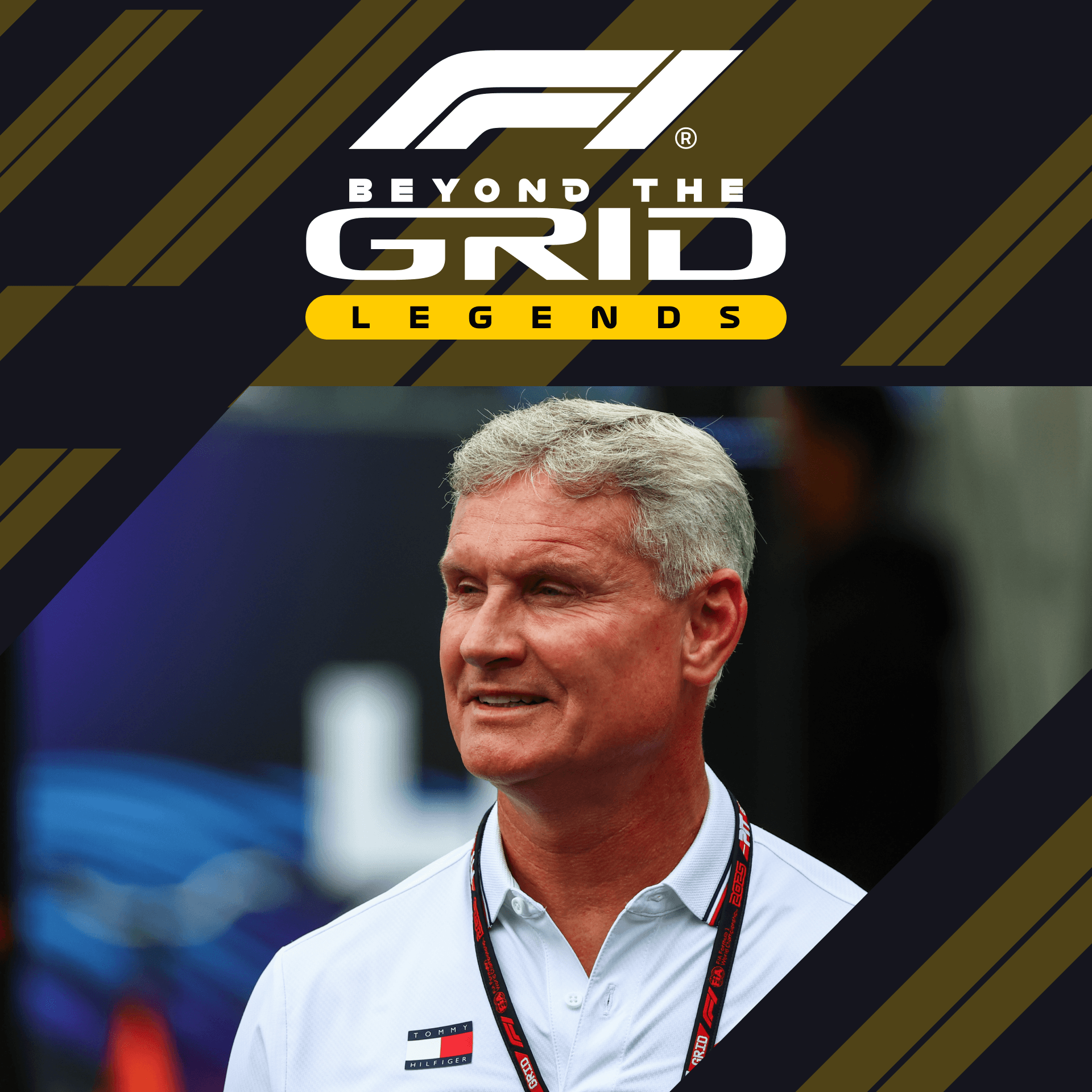
Seat selection in F1 isn’t just about speed—it’s timing, contracts, relationships, and even how you handle the paddock’s politics. David Coulthard walks through his path from testing and substitute roles into Williams, then the mid-1995 contract scramble that sent him to McLaren via the contract recognition board in Geneva. He also explains why unexpected moments (like Sainz’s appendicitis) create opportunities, and why “Formula One is always about people.”
The Formula 1 driver market is potentially just one domino away from exploding into a frenzy, so what exactly does an F1 driver need to do to get themselves into the best seat on the grid? With multiple wins, poles and podiums throughout his 15 seasons at the pinnacle of motorsport, David Coulthard was often fighting at the front. But how did he make his way into the fastest cars? Speaking to Tom Clarkson, David shares some of the remarkable tales from that journey – including his careful approach to getting a drive at Williams after the death of Ayrton Senna and why a ‘totally unnecessary’ contract dispute resulted in him leaving them for McLaren.
DC emphasises the importance of dealing with people, pressure and politics in navigating his way to the front of the grid. He reflects on how he negotiated with big team bosses like Ron Dennis, why he tried to use the media to his advantage and how surviving a plane crash changed his approach to life in F1.