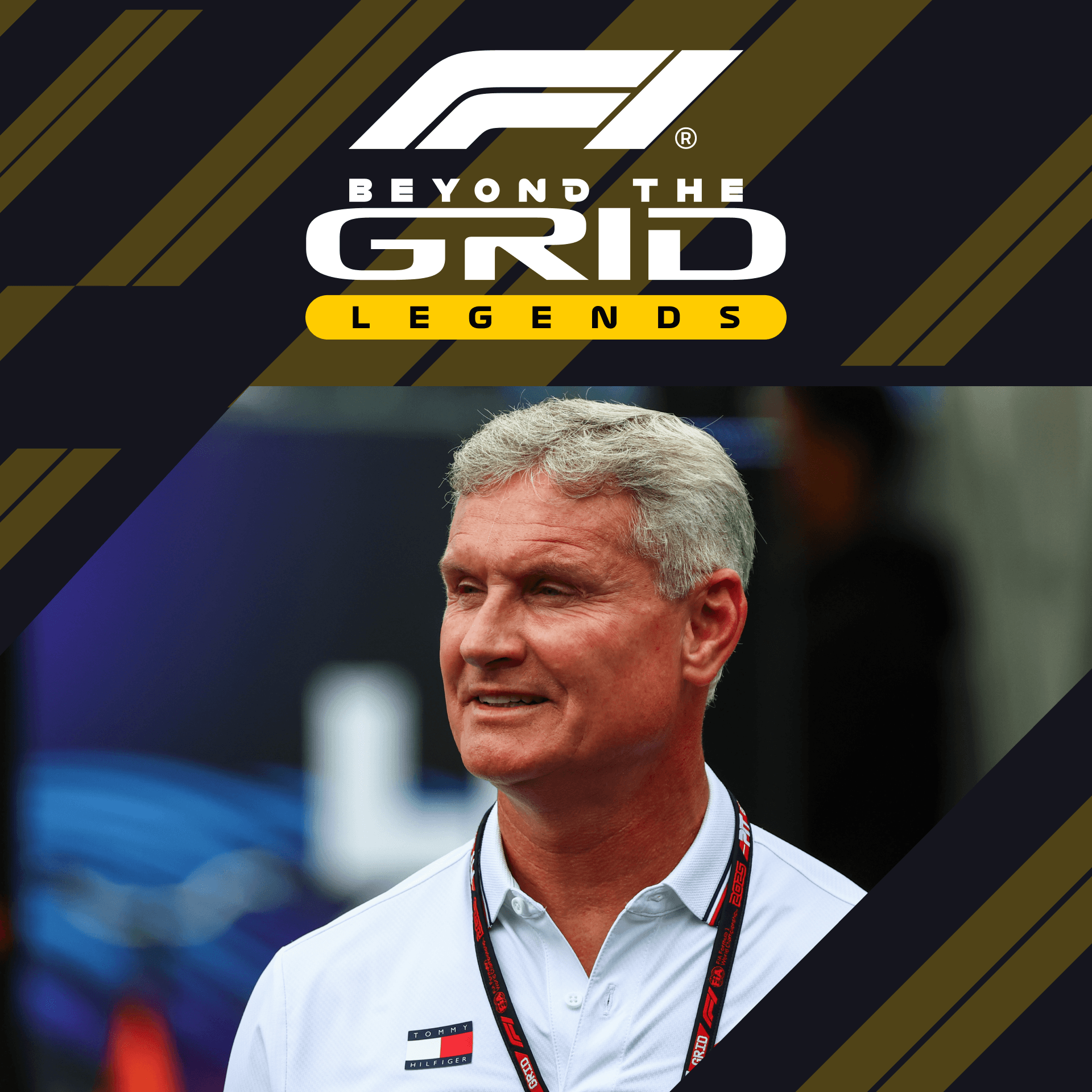
LEGENDS: David Coulthard on finding the best seat in F1
About this episode
Seat selection in F1 isn’t just about speed—it’s timing, contracts, relationships, and even how you handle the paddock’s politics. David Coulthard walks through his path from testing and substitute roles into Williams, then the mid-1995 contract scramble that sent him to McLaren via the contract recognition board in Geneva. He also explains why unexpected moments (like Sainz’s appendicitis) create opportunities, and why “Formula One is always about people.”
With multiple wins, poles and podiums throughout his 15 seasons at the pinnacle of motorsport, David Coulthard was often fighting at the front. But how did he make his way into the fastest cars?
Speaking to Tom Clarkson, David shares some of the remarkable tales from that journey – including his careful approach to getting a drive at Williams after the death of Ayrton Senna and why a ‘totally unnecessary’ contract dispute resulted in him leaving them for McLaren.
DC emphasises the importance of dealing with people, pressure and politics in navigating his way to the front of the grid. He reflects on how he negotiated with big team bosses like Ron Dennis, why he tried to use the media to his advantage and how surviving a plane crash changed his approach to life in F1.
This episode is sponsored by:
Shopify: sign up for your $1 per month trial today at shopify.com/beyondthegrid
Vanta: get started at Vanta dot com slash GRID
Leesa: go to leesa.com for 30% off select mattresses PLUS get an extra 50 dollars off with promo code GRID
Formula 3000
"Ron going, well, why would I want to give David a watch? I was a Formula 3000 driver."
Formula 3000 was a racing series that helped drivers move up toward Formula 1. It was a common path for talented drivers to prove themselves before reaching F1.
Formula 3000 was a major single-seater feeder series for drivers aiming for Formula 1. It was widely used as a stepping stone because it offered high-level competition in cars that were closer to F1 than lower junior categories.
Shoei
"they had a Shoei contract, both the drivers at that time. And they'd managed to leverage a helmet for me..."
Shoei makes helmets. Here, it’s mentioned because Coulthard had a helmet deal with them and his helmet design was part of the story.
Shoei is a helmet brand that supplies race-grade helmets used by motorsport drivers. In this segment, Coulthard describes a Shoei contract and how his helmet design was handled during testing.
Brandt Hatch
"And they brought that helmet to Brandt Hatch when I was testing."
Brands Hatch is a famous race track in the UK. Drivers and teams use it to test cars and practice before bigger races.
Brands Hatch is a well-known motorsport circuit in the UK used for testing and racing. It’s a venue where teams and drivers can evaluate setups and get track time before major events.
Salter
"And my helmet, as you will well remember, is a white cross on a blue helmet, blue background. It's a Scottish flag. It's called the Salter."
“Salter” is the name Coulthard uses for the helmet look/design he had. The point is that helmet designs are personal and recognizable.
“Salter” here refers to the specific helmet design/finish Coulthard describes (a white cross on a blue helmet, then later a blue cross on a white background). It’s an example of how helmet graphics can be distinctive and meaningful to the driver.
crash helmet
"They just didn't get the importance of the crash helmet. You know, helmets, as you know, are the most personal thing that the race driver has."
A crash helmet is the helmet race drivers wear to protect their head during crashes. It’s also personal, because the design and look are part of who the driver is.
A crash helmet is the race driver’s protective headgear designed to reduce injury in high-speed impacts. In F1, it’s also deeply personal—drivers often have distinctive designs and strong attachment to their identity on track.
Formula 1
"Because I just felt that I wanted something more racing centric. I wanted something more personal to Formula 1."
Formula 1 is the highest level of open-wheel racing. Coulthard is saying he wanted his career to feel more focused on racing and the F1 world.
Formula 1 (F1) is the top tier of open-wheel racing, where teams compete with highly engineered cars and strict technical regulations. Coulthard contrasts wanting a “racing centric” and personal environment specifically within F1.
simulator
"No matter how much Lewis will tell us, he's been at the factory and he's been on the simulator, to affect change and influence change in an organisation that large, I think just takes a long, long time."
A simulator is like a high-end racing video game plus real engineering data. Drivers can test how the car might behave and help the team decide what to change.
In Formula 1, a simulator is a computer-based driving and engineering tool used to study car behavior and practice scenarios without being on track. Teams use it to help drivers and engineers communicate about setup changes and performance.
shunt
"He was racing in the Monaco Classic. So I had a little shunt in one of the Ferraris. Thankfully, he wasn't injured, but a little bit of damage to these incredibly extensive classic cars."
A shunt just means a crash or bump—usually a sudden hit. In racing, it often refers to a quick impact that can still cause damage.
A shunt in motorsport is a collision or sudden impact, often caused by contact with another car or a barrier. It’s commonly used to describe a relatively brief, abrupt incident rather than a prolonged crash.
mask the deficiencies in a car
"But I think in terms of raw talent, he was one of the fastest guys out there. Engineering now, how much can a quick driver mask the deficiencies in a car?"
It means a top driver can sometimes make a not-ideal car feel better and go faster anyway. The driver’s skill helps hide problems that the car itself has.
This describes how a very fast driver can compensate for weaknesses in the car—like poor balance, traction, or responsiveness—by driving it in a way that minimizes the performance loss. It’s a way of separating driver skill from engineering shortcomings.
world championship
"And the exceptionals are the names that we can all mention, you know, the Schumacher's, the Hamilton's, the Vestappens, the Senna's, and anyone who's won multiple world championships, [2571.1s] they're exceptional."
A “world championship” in F1 is the season competition where drivers earn points race by race. The driver with the most points at the end of the season is the champion.
In Formula 1, the “world championship” is the season-long points competition that crowns the best driver and (separately) the best team. Drivers earn points based on race finishing positions, so being consistently fast across many races matters as much as winning individual Grands Prix.
qualifying lap
"People like Senna [2602.7s] could be half a second or more, you know, famously a second quicker than Prost once in Monaco in a qualifying lap, but such was the advantage they had."
A “qualifying lap” is the lap drivers do during qualifying to set where they’ll start the race. It’s focused on being as fast as possible for that one lap.
A “qualifying lap” is the single (or short set of) fastest lap(s) a driver completes during the qualifying session to set their grid position. Because qualifying is about peak performance over one lap, small differences in car setup and driver precision can translate into big changes in starting order.
grid
"Actually, we spoke about this off air. I think last year when Formula 1 was so close, the grid was covered by a second. There was one of the years, I think it was 99..."
The “grid” is the lineup of cars for the start of the race. If the grid is “covered by a second,” it means the cars were very close in speed.
The “grid” is the starting order for an F1 race, determined by qualifying results (and any penalties). When Coulthard says the grid was covered by a second, he means the lap-time gap between the fastest and slower cars was very small—so qualifying performance was tightly bunched.
pole
"There was one of the years, I think it was 99, Mika was on pole in Barcelona. I was second and I was seven tenths slower and Michael was third..."
“Pole” is the starting position at the front of the grid, awarded to the fastest driver in qualifying. Starting from pole often provides a strategic advantage because you’re ahead of traffic and can control the pace into the first corners.
grip
"Their mind is able to process the feeling of grip visually as they approach the corner and then physically when they're in the corner, when the car's at the limit of adhesion..."
“Grip” is how well the tires can hold the road. More grip means the car can turn and accelerate without sliding.
In F1, “grip” is the tire traction available between the tires and the track surface. Coulthard’s point is that elite drivers can sense and exploit grip earlier and more accurately, especially as the car approaches the limit of traction in cornering.
limit of adhesion
"Their mind is able to process the feeling of grip visually as they approach the corner and then physically when they're in the corner, when the car's at the limit of adhesion, they just do it better and it's tiny margins that makes"
The “limit of adhesion” is basically the edge of tire traction—when the tires are about to start slipping. Great drivers can stay right near that edge without losing control.
The “limit of adhesion” is the point where a tire is using nearly all the traction it can generate before it starts to lose control (slip). At that edge, tiny inputs—steering, throttle, and braking—make the difference between staying composed and sliding.
Request an Explanation
Heard something you'd like explained? We'll add it to this episode.
Sign in to request explanations for terms you heard.
Want to learn more?
Browse our glossary for plain-English explanations of automotive terms, jargon, and concepts.
Help improve this episode
See something that's not quite right? Our annotations are AI-generated and can sometimes miss the mark. Click the flag icon on any annotation to suggest a correction.