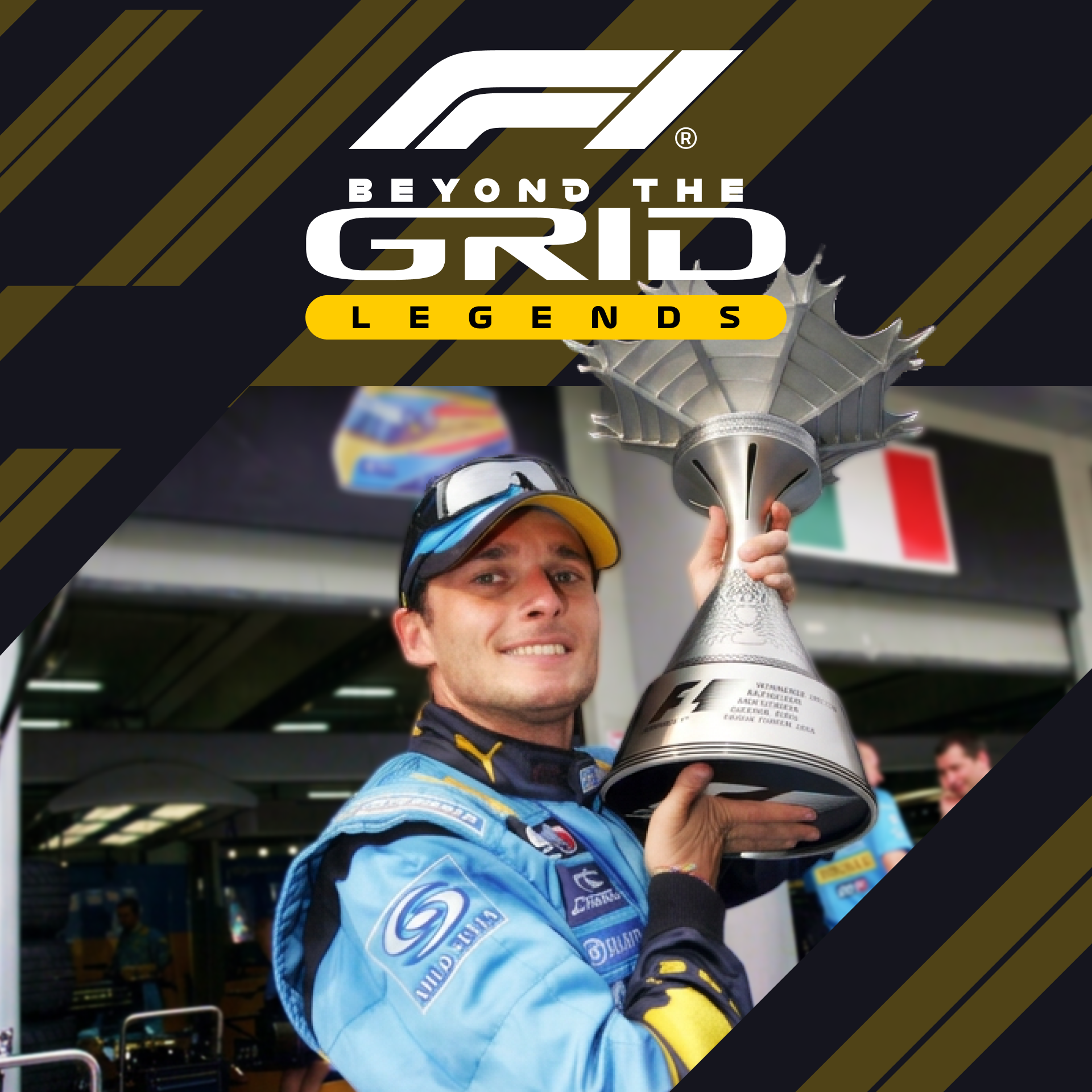
LEGENDS: Giancarlo Fisichella on winning for Italy + Antonelli’s potential
About this episode
Giancarlo Fisichella celebrates Kimi Antonelli becoming Italy’s next Grand Prix winner after a 20-year drought, praising his quickness, racecraft, and ability to manage pressure after a shaky rookie stretch. Fisichella compares Antonelli’s rapid rise to his own early career, explaining how adrenaline and mistakes shaped his jump from 1996 to 1997. He credits Toto Wolff’s development path and argues Antonelli’s confidence is built on experience and a strong car. The conversation also shifts to GT racing, including Max Verstappen’s Nurburgring 24H passion and what endurance demands differently than F1.
Fisi looks back on his own F1 career - the ‘hard’ moments he had supporting Fernando Alonso in his teammate’s title-winning seasons, how they relaxed before the race and how close he came to moving to another team in the mid 2000s.
Giancarlo remembers living his dream and joining Ferrari during the 2009 season. Does he think Kimi Antonelli could ever do the same?
This episode is sponsored by:
Vanta: Get started today at vanta.com/GRID
Homeserve: Join the millions of customers who trust HomeServe. For 50% less your first year, go to homeserve.com/grid
Shopify: You put in the work. Time to get paid like it. Free trial at shopify.com/beyondthegrid
Giancarlo Fisichella
"Giancarlo Fisichella knows all about carrying Italy's hopes in Formula One. 20 years since his last Grand Prix win, he's loving watching his countryman Kimi Antonelli flying the flag..."
Giancarlo Fisichella is a former Formula 1 race driver from Italy. Here, he’s talking about how another young Italian driver, Kimi Antonelli, is doing in F1 and how hard it is to handle pressure.
Giancarlo Fisichella is an Italian Formula 1 driver known for winning Grands Prix and for being a key part of Italy’s F1 story. In this segment, he’s discussing how Kimi Antonelli is carrying Italian hopes and how pressure affects young drivers.
Kimi Antonelli
"20 years since his last Grand Prix win, he's loving watching his countryman Kimi Antonelli flying the flag on the top step of the podium... I would say finally, I'm happy about that because 20 years is too long... Now this year, with Kimi, this is done..."
Kimi Antonelli is a young Italian driver in Formula 1. In this part of the episode, they’re impressed by how many races he’s already won and how confidently he’s handling the pressure.
Kimi Antonelli is an Italian Formula 1 driver being discussed here as a rising star. The hosts and Fisichella focus on his early 2026 results—winning races and building confidence—while also comparing his path to past Italian drivers like Fisichella.
Fernando Alonso
"and watching former teammate Fernando Alonso and former rival Luis Hamilton still racing... playing a supporting role in Alonso's championship seasons at Renault..."
Fernando Alonso is a well-known Formula 1 driver. They mention him because he’s had major success in F1, including championship seasons with Renault, and Fisichella describes how he supported Alonso.
Fernando Alonso is a Spanish Formula 1 driver referenced as both a former teammate and a former rival. The segment mentions his championship seasons at Renault, framing Antonelli’s development in the context of Alonso’s experience and success.
Luis Hamilton
"watching former teammate Fernando Alonso and former rival Luis Hamilton still racing. Here on F1 Beyond the Grid..."
Lewis Hamilton is a famous Formula 1 driver. They bring him up here to show that even after years at the top, he’s still competing.
Luis Hamilton refers to Lewis Hamilton, a British Formula 1 driver. In this segment he’s mentioned as still racing, used to highlight how long top-level careers can last in modern F1.
handling pressure as a young driver
"Giancarlo tells me, Tom Clarkson, about handling pressure as a young driver, playing a supporting role in Alonso's championship seasons at Renault..."
They’re talking about how new drivers learn to stay calm and confident under pressure. The idea is that handling stress helps them drive better and win races.
This segment is framed around how young drivers learn to manage pressure in Formula 1. The discussion ties confidence, comfort in the car, and race-winning performance to mental resilience.
Renault
"playing a supporting role in Alonso's championship seasons at Renault and where the Kimi could one day follow..."
Renault is the racing team/brand in Formula 1. They mention it because Alonso won championships while driving for Renault.
Renault is the Formula 1 constructor/team referenced for Alonso’s championship seasons. In F1, the team and its car development play a huge role in results, so Renault is a key part of the historical context here.
Minardi 96
"Even before then, we did. Minardi 96. I hope my pizza was good."
Minardi 96 points to a specific Minardi Formula 1 car period from the 1990s. In this conversation, it’s mainly used to remember when the two people first crossed paths.
Minardi 96 refers to Minardi’s 1996-era Formula 1 car/entry, used here as a timeline marker for when Fisichella and Tom Clarkson first met. Minardi was a smaller team, so referencing a specific year/car era signals the early-career context.
world championship
"Not just by single race, but also the world championship."
In Formula One, the “world championship” refers to the season-long points battle that crowns the Drivers’ Champion (and, separately, the Constructors’ Champion). Missing a race-winning driver can affect both race results and the overall points needed to win the title.
Formula Four
"For them, it's easier because they can start racing in a Formula Four already when you are 15."
Formula Four is a stepping-stone race series for young drivers. It’s where drivers learn how to race faster single-seater cars before moving up to higher levels like Formula Three and Formula One.
Formula Four (often written as F4) is a junior single-seater racing ladder below Formula Three. It’s designed to help drivers transition from karting into cars with more power, downforce, and racecraft.
Formula Three
"In my era, there was a possibility to race in Formula Three or something like that when you were 18 years old."
Formula Three is a more advanced junior racing series than Formula Four. It’s a key step for drivers trying to earn a path to Formula One.
Formula Three is a higher-level junior open-wheel series that sits between F4 and Formula One. Drivers use it to prove they can handle more powerful cars, stronger competition, and more complex race strategy.
age is just a number
"So age is just a number? Yes, exactly."
This is a discussion concept about driver development timing—how starting young in junior categories can make the jump to Formula One feel less abrupt. The speaker contrasts earlier eras (fewer junior ladders) with modern pathways that begin in mid-teens.
DTM touring cars
"You did that weird half-season in 1996, bit of DTM touring cars at the same time."
DTM is a German racing series for touring cars—cars that are based on production models. It’s a different kind of racing from Formula One, so switching between them can change how you drive.
DTM (Deutsche Tourenwagen Masters) is a German touring-car racing series. When the speaker mentions “DTM touring cars,” they’re referring to racing production-based cars in a different discipline than Formula One.
Hawkenheim
"I was quick in Hawkenheim. I was in the second position in the grid. I scored my first podium in Canada in 1997."
This is likely Hockenheim, a famous race track in Germany. It’s the kind of track where being quick in qualifying and managing tires/brakes during the race really helps.
This appears to refer to Hockenheim, a German circuit used in Formula 1. It’s known for high-speed sections and heavy braking zones, so qualifying position and race pace matter a lot.
grid
"I was quick in Hawkenheim. I was in the second position in the grid. I scored my first podium in Canada in 1997."
The grid is where cars line up before the race starts. If you’re second on the grid, you’re starting near the front, which is usually better for getting clean air and track position.
In Formula 1, the grid is the starting order and positions on the track for the race. Being “in the second position in the grid” means qualifying second, which usually gives a strong advantage at the start.
Canada
"I scored my first podium in Canada in 1997. So it was a good season for me."
He’s talking about the Canadian Grand Prix, an F1 race in Canada. Different tracks are different, so doing well there is a real achievement.
“Canada” here refers to the Canadian Grand Prix, an F1 race held in Canada. Podiums and points at specific Grands Prix are often remembered because each track has distinct characteristics.
Toto Wolf
"And how important do you think Toto Wolf has been in his development? I think it's the key. It's the key of Kimi's career."
Toto Wolff is a top Formula 1 leader connected to Mercedes. In this conversation, he’s presented as the person who backed and guided Kimi Antonelli’s career.
Toto Wolff is a key Formula 1 team principal and executive associated with Mercedes. Fisichella credits Wolff with identifying and developing Kimi Antonelli through the junior categories and into the Mercedes pathway.
Go Kart
"I think Toto took already Kimi when he was young in Go Kart. He gave him the possibility to grow up here by in Go Kart and then in Formula 4, Formula 3, Formula 2..."
Go-karting is how many F1 drivers start. It’s a small, simple racing car that helps you learn how to race and control the vehicle before stepping into bigger cars.
Go-karting is the common entry point for future Formula 1 drivers. It teaches fundamental car control—throttle/brake modulation, racing lines, and racecraft—before moving up the junior single-seater ladder.
Formula 4
"He gave him the possibility to grow up here by in Go Kart and then in Formula 4, Formula 3, Formula 2..."
Formula 4 is a stepping-stone racing series for young drivers. It helps them move up from go-karts into faster, more technical race cars.
Formula 4 is a junior single-seater racing category designed to bridge the gap between karting and higher-level feeder series. It’s where drivers learn racecraft in cars that are more powerful and more complex than karts.
Formula 3
"He gave him the possibility to grow up here by in Go Kart and then in Formula 4, Formula 3, Formula 2..."
Formula 3 is a step up from Formula 4. It’s where drivers face stronger competition and learn to handle more powerful race cars.
Formula 3 is a higher-level junior series than F4, typically featuring more advanced cars and tougher competition. It’s a key stage for developing consistency and adapting to faster, more aerodynamic downforce behavior.
Formula 2
"He gave him the possibility to grow up here by in Go Kart and then in Formula 4, Formula 3, Formula 2, by obviously the help of Toto Wolf and Mercedes."
Formula 2 is the last big junior series before Formula 1. Doing well there is a strong sign you’re ready for the top level.
Formula 2 (F2) is the final major step before Formula 1 for many drivers. It’s closely watched because performance in F2 often predicts whether a driver can handle F1-level speed, tire management, and race strategy.
Mercedes
"He gave him the possibility to grow up here by in Go Kart and then in Formula 4, Formula 3, Formula 2, by obviously the help of Toto Wolf and Mercedes."
Mercedes is a major car brand that also competes in Formula 1. Here, it’s mentioned as part of the support system helping a young driver progress toward F1.
Mercedes is the manufacturer brand behind Mercedes-AMG’s Formula 1 program and engine/systems support. In this context, it’s part of the driver development pipeline Fisichella describes for Kimi Antonelli.
F3
"you came from that sort of DT, obviously F3 in single-seaters, but those couple of years driving touring cars, Kimi's family are big into GT racing"
F3 is a stepping-stone racing series for younger drivers. It’s one of the places drivers learn how to race and improve before moving up toward F2 and F1.
F3 (Formula 3) is a junior open-wheel racing series that sits below F2 and F1 in the single-seater ladder. It’s a key development step where drivers learn racecraft, car control, and how to adapt to different teams and setups.
open wheel
"More than if you just focus on open wheel? It depends, because you know, driving a GT car and F1 car or F3, F2, whatever, it's a complete style of driving."
Open-wheel means the race car’s wheels are exposed (not hidden under the body). Those cars feel and handle differently than GT cars, so the driving technique changes.
Open-wheel refers to racing categories where the wheels are exposed rather than covered by bodywork, like Formula cars. The driving style differs from GT racing because open-wheel cars are lighter, generate different downforce/grip behavior, and use different cornering lines.
F1 car
"More than if you just focus on open wheel? It depends, because you know, driving a GT car and F1 car or F3, F2, whatever, it's a complete style of driving."
An F1 car is the top level of open-wheel race car. It handles and grips differently than GT cars, so you often avoid hitting curbs because it can upset the car.
An F1 car is a Formula 1 open-wheel race car built for maximum downforce and high-speed cornering. The speaker contrasts it with GT cars, noting that F1 drivers generally need to stay away from curbs because of how the car’s grip and aerodynamics behave.
GT car
"It depends, because you know, driving a GT car and F1 car or F3, F2, whatever, it's a complete style of driving. The GT is much heavier, there is less grip, less power and obviously you need to do a different trajectory."
A GT car is a race version of a normal sports car. It’s usually heavier than an F1-style car, so it grips the road less and you drive it differently through corners.
A GT car (Grand Touring) is a race car based on production-style sports cars, commonly used in GT championships. Compared with open-wheel F1, GT cars are typically heavier, have less grip, and require different driving lines and braking/turn-in habits.
F2
"The GT is much heavier, there is less grip, less power and obviously you need to do a different trajectory. You need to jump on the curbs and with a F1 car you need to be away from the curbs"
F2 is a higher-level junior series that comes before F1. Drivers use it to get better at racing at a top level and prepare for the demands of F1.
F2 (Formula 2) is the main feeder series to F1 in the modern single-seater pathway. It’s typically more competitive and technically demanding than F3, helping drivers refine race strategy and consistency.
curbs
"You need to jump on the curbs and with a F1 car you need to be away from the curbs, so it's not easy."
Curbs are the raised strips at the edge of the track. In racing, drivers sometimes use them to go faster through a corner, but in some cars hitting them can make the car unstable.
Curbs are the raised edge strips at the inside of many racing corners, used as part of the racing line. Drivers may “ride” or lightly use curbs in some cars, but in others—like F1—the car’s setup and grip can make curb contact destabilizing, so drivers keep a safer distance.
Nürburgring
"While we're talking GT cars, what do you make of Max Verstappen doing his Nurburgring 24 hours and his passion for GT3?"
Nürburgring is a well-known race track in Germany. It’s famous for being tough, so doing well there is a big deal.
The Nürburgring is a famous German motorsport venue known for its challenging layouts, including the Nordschleife. Endurance races there are a major test of pace, reliability, and driver consistency.
24 hours of Nurburgring
"It was very important to have Max in the 24 hours of Nurburgring."
The Nürburgring 24 Hours is a race that lasts an entire day. Drivers and teams have to manage the car carefully and work as a team, not just go fast.
The Nürburgring 24 Hours is an endurance race where teams run for a full day, rotating drivers and managing tire, fuel, and mechanical wear. It emphasizes strategy and reliability as much as outright speed.
GT3
"While we're talking GT cars, what do you make of Max Verstappen doing his Nurburgring 24 hours and his passion for GT3?"
GT3 is a category of race cars used in lots of racing events. Teams race cars that follow the same general rules, so different brands can compete fairly.
GT3 is a class of race car used in endurance and sprint series worldwide. It’s built to a common rule set so teams can compete with cars from different manufacturers while keeping performance relatively balanced.
Le Mans 24 hours
"I'm sure Max will do in the future Le Mans 24 hours and Spa 24 hours. I'm sure. Is it a different mindset at 24 hours?"
Le Mans is a famous 24-hour endurance race in France. It’s hard because the car has to keep running for a full day while drivers swap and teams manage strategy.
The 24 Hours of Le Mans is one of the world’s most prestigious endurance races, held in France. It’s known for its long stints, driver changes, and the need for a balanced car setup that can survive high loads for 24 hours.
setup
"You need to find a good setup, which is good for everybody. The Atomos Spa has to be relaxed."
A “setup” is how a race car is adjusted for a specific track and conditions. It’s about tuning things so the car feels right and stays consistent over long races.
In racing, a car “setup” is the specific configuration of adjustable settings—like suspension, aerodynamics, and tire pressures—tailored to the track and conditions. The goal is to make the car predictable and fast for the drivers across long stints.
teammates
"In a 24 hours all Le Mans, you need to find a very good friendship with your teammates."
In long races, teammates are the other drivers who take turns driving the same car. Everyone has to work together so the car stays fast and manageable for the whole event.
In endurance racing, teammates are the other drivers who share the same car over the event. Because the car is driven by multiple people, teams coordinate driving style, feedback, and stint strategy to keep performance consistent.
stint
"And then during the stint, you need to push absolutely. You need to push always because now"
A stint is just a chunk of time where the car stays out on the track before the next planned pit stop. Teams decide how long to run based on tire wear and fuel.
In endurance racing, a stint is a continuous period a driver (or car) stays on track before making a planned stop, usually for tires and/or fuel. Strategy revolves around how long each stint is and when you switch from pushing to managing wear.
24 hours of qualification
"the 24 hours of Le Mans are like 24 hours of qualification. But sometimes you need to understand"
He’s basically saying Le Mans feels like qualifying for a whole day—everyone is trying to go very fast, not just take it easy. But you still have to manage tires and fuel so you don’t fall off later.
This phrase is a comparison: it suggests that in Le Mans, drivers are expected to run very fast for long stretches, similar to qualifying pace, rather than cruising. The key idea is that maintaining high performance over time is as important as a single flying lap.
tires
"when is the time to push, when is the time to take care about the tires, maybe saving fuel."
In racing, tires aren’t just “rubber”—their grip changes as they heat up and wear out. In a long race, you can’t drive flat-out the whole time without hurting tire performance.
Here, “tires” means the race tires’ grip and wear rate, which directly affect lap times over a long stint. Endurance drivers often alternate between pushing for speed and managing tire temperature and degradation to avoid losing performance later.
saving fuel
"when is the time to push, when is the time to take care about the tires, maybe saving fuel."
Saving fuel means using less fuel than you normally would so you can finish the race without running out. Teams do it by driving a bit more gently and planning pit stops.
“Saving fuel” is endurance-racing strategy where the driver and team reduce fuel consumption to meet a target race distance or stint plan. It can involve lifting and coasting, adjusting engine modes, and managing throttle to keep pace while stretching fuel.
consistent
"It's important to be consistent. And that's the key here."
Being consistent means you keep turning in similar lap times instead of having big swings. That usually helps you avoid mistakes and prevents tires from getting destroyed too early.
In endurance and race strategy, “consistent” refers to producing steady lap times and predictable car behavior rather than alternating between extremes. Consistency helps protect tires, reduces mistakes, and keeps the team on plan for fuel and pit timing.
Flavio Briatori
"We had Flavio Briatori on this show. And he was saying that you and Alonso, that partnership in 2005, 2006 was the benchmark for teammates."
Flavio Briatore is a motorsport figure who’s being quoted about how teammate relationships can affect results. Here he’s talking about the kind of team atmosphere drivers had.
Flavio Briatore is referenced as a guest who previously discussed teammate dynamics and atmosphere. In this context, he’s used as an authority on how driver partnerships can influence development and performance.
telemetry
"We were sharing our telemetry, saying that the right direction to the engineers to improve the car."
Telemetry is the car’s live data from sensors. The team uses it to understand what the car is doing so they can adjust setup and strategy.
Telemetry is the stream of sensor data from the race car—things like speed, throttle position, brake pressure, tire behavior, and temperatures—sent back to the team. Teammates can compare telemetry to identify what changes improve performance and how to steer development.
George Russell
"So when you look at George Russell, Kimmy Antonelli now, do you think they have what I call now the physical Alonso ingredients?"
George Russell is an F1 driver. They’re talking about whether he (and others) has the right qualities to succeed like Alonso did.
George Russell is mentioned as part of the current generation of drivers being evaluated for the same kind of “ingredients” that made Alonso effective. The discussion is about whether a driver has the physical and mental traits to perform at the top level.
Kimmy Antonelli
"So when you look at George Russell, Kimmy Antonelli now, do you think they have what I call now the physical Alonso ingredients?"
Kimi Antonelli is a young F1 driver. They’re wondering if he has the right qualities to become a top-level racer like Alonso.
Kimmy Antonelli refers to Kimi Antonelli, a young driver being discussed as a potential future star. The host frames the question around whether Antonelli has the same “physical” traits that supported Alonso’s success.
qualifying session
"Unfortunately, Charles crashed the car in the qualifying session, but without this problem, without the crash in the qualifying session, probably Charles could have the same chance to Lewis to fight for the race, to win the race."
Qualifying is when drivers race against the clock to set the starting order for the main race. If something goes wrong in qualifying, you usually start farther back in the race.
The qualifying session is the part of an F1 weekend where drivers set lap times to determine the starting grid for the race. A crash or mistake in qualifying can severely hurt race chances because it affects where the car starts.
Charles
"Unfortunately, Charles crashed the car in the qualifying session, but without this problem, without the crash in the qualifying session, probably Charles could have the same chance to Lewis to fight for the race, to win the race."
“Charles” is Charles Leclerc, one of Ferrari’s drivers. The speaker is saying he had a crash in qualifying, which made his race chances worse.
“Charles” refers to Charles Leclerc, Ferrari’s driver. The speaker says Leclerc crashed during qualifying, which hurt his ability to compete for the win against Hamilton.
paddock
"I think at the moment, probably the car is the best car to drive in the paddock. They need to improve a little bit on the power."
The paddock is the team area at an F1 race. It’s where the cars are prepared and where the team staff and drivers talk strategy between sessions.
In Formula 1, the paddock is the secure area next to the track where teams park their motorhomes and garages, and where engineers, mechanics, and drivers coordinate between sessions. It’s where you see team operations and strategy discussions in the background of the race weekend.
favouring one driver over another
"What does it mean, favouring one driver over another? Ferrari famously prioritised Schumacher, and it's funny that we're talking here in Austria."
It means the team treats one driver as the priority. That can affect strategy—like who gets the better chances to win—especially when teammates are close on track.
This refers to team orders or driver prioritization, where a Formula 1 team directs strategy to benefit one driver more than a teammate. It can include decisions like who gets the best car setup, tyre usage, or track position in critical moments.
Schumacher
"What does it mean, favouring one driver over another? Ferrari famously prioritised Schumacher, and it's funny that we're talking here in Austria."
Schumacher was one of the greatest F1 drivers ever, and he raced for Ferrari. The speaker is saying Ferrari used to back him first when it came to race strategy.
Michael Schumacher is the legendary German F1 driver who raced for Ferrari and won multiple championships. The speaker uses him as an example of Ferrari historically prioritizing one driver over another through team strategy.
Rubens Barrakello
"Do you remember 2002 when Rubens Barrakello was asked to move over and let him win at what was only race six?"
Rubens Barrichello was an F1 driver for Ferrari. The story being referenced is about Ferrari telling him to let his teammate win—showing how teams sometimes prioritize one driver over another.
Rubens Barrichello is a Brazilian F1 driver who raced for Ferrari in the early 2000s. The speaker references a famous moment where Ferrari asked him to let teammate Michael Schumacher pass, illustrating team orders and driver prioritization.
tyres
"So I was working also Friday and Saturday morning to help the team, to understand, to use one set more of the tyres, to understand which one was good for the qualifying session or which one was"
In F1, tyres matter a lot because they provide the grip the car needs. Teams plan when to use certain tyres because they wear out and behave differently when hot.
In F1, tyres are a critical performance component because grip changes as tyres heat up and wear down. Teams manage tyre usage across sessions—like choosing which tyres to use for qualifying versus race pace—because tyre condition strongly affects lap time.
radio
"When you get the call, do you pretend radio is not working, radios or what?"
In Formula 1, “radio” is the communication system between the driver and the team. The team can tell the driver what to do while the race is happening.
In F1, “radio” refers to the driver’s two-way communication link with the pit wall. Teams use it to issue instructions like position changes, pace targets, and safety-related guidance during a race.
Ferrari
"But I don't think it's the case of Ferrari at the moment. Let's wait, a few races."
Ferrari is one of the most famous Formula 1 teams. Here they’re talking about how Ferrari’s results improved or changed when they brought in a new driver.
Ferrari is the Italian Formula 1 team and car manufacturer with a long history of racing success. In this segment, the host and guest discuss Ferrari’s recent performance and how a top driver can influence results.
drivers' champion
"It's been a long time since they've had a drivers' champion."
The “drivers’ champion” is the person who wins the Formula 1 championship for the year. They earn points across the season, and the top point-scorer becomes champion.
“Drivers’ champion” means the driver who wins the Formula 1 World Championship for that season. It’s based on points accumulated across races, and it’s a major signal of both driver performance and team competitiveness.
sprint race in China
"I remember he won the sprint race in China. But then somewhere he was really struggling compared to charts, compared to other drivers."
A sprint race is a shorter race on some Formula 1 weekends. It can help determine starting positions and points, and they’re referencing one of Lewis’s sprint results in China.
A “sprint race” is a shorter race format used in some F1 weekends that can award points and set the grid for the main Grand Prix. Mentioning “in China” ties the result to a specific event on the F1 calendar.
Team Endstone
"And how, I mean, you race for a lot of British teams, you know, Team Endstone for what, seven years"
“Team Endstone” is a British Formula 1 team based in Enstone. They’re using it as a reference point to compare team culture and day-to-day operations with Ferrari.
“Team Endstone” refers to the British racing team based at Enstone, historically associated with Aston Martin’s F1 operation (and previously Renault). The guest is comparing how Ferrari’s culture and operations feel versus the British team environment he came from.
Force India
"and then Team Jordan, Force India for five years."
Force India was a Formula 1 team. They’re mentioning it because the driver moved from that team to Ferrari and had to adapt quickly.
Force India was a Formula 1 team that competed under that name for several seasons before later rebranding. In this segment, it’s part of the guest’s comparison of team culture and how difficult it can be to switch cars without testing.
Team Jordan
"and then Team Jordan, Force India for five years."
Team Jordan was a Formula 1 team. The speaker mentions it to explain how his experience across different teams compares to Ferrari.
Team Jordan is a former Formula 1 team (Jordan Grand Prix) that competed in the sport for decades. Here it’s mentioned as part of the guest’s career path, used to contrast how different teams operate.
testing
"Unfortunately, the car was a bit difficult to drive. And jumping from Force India to Ferrari at the end of the season without testing wasn't easy."
In F1, “testing” means practice runs where the team learns how the car behaves. Without it, switching to a new car setup can feel harder because you have less time to get used to it.
“Testing” in F1 usually means running the car outside of race weekends to learn setup changes, tire behavior, and drivability. The guest says switching from Force India to Ferrari at season end without testing wasn’t easy, because there’s less time to adapt.
Monza Grand Prix
"And especially in the Monza Grand Prix, which was my first race. What a place to make your debut."
The Italian Grand Prix at Monza is one of Formula 1’s most historic races, held at the Autodromo Nazionale Monza near Milan. It’s especially famous for high-speed character and for being a major “debut” stage for drivers.
Fiorano
"And did you do any laps of Fiorano before Monza? No, I did just like an up and down for the for aerodynamics parts in Vairano..."
Fiorano is Ferrari’s private test track near Maranello, used for development and driver evaluation. It’s where Ferrari often runs aerodynamic and setup work before major race weekends.
aerodynamics parts
"I did just like an up and down for the for aerodynamics parts in Vairano..."
Aerodynamics parts are the body and wing components designed to manage airflow—creating downforce for grip and controlling drag for speed. In F1, testing these parts is crucial because small changes can noticeably affect lap time.
Vairano
"I did just like an up and down for the for aerodynamics parts in Vairano, which is two hours away from Modena."
Vairano is referenced here as a location used for aerodynamic-related running (“up and down”) before Monza. In F1 context, it suggests a nearby testing/track facility used for short sessions focused on aero work rather than full race preparation.
prancing horse
"you're imagining that first time the engine starting up, you're looking at the prancing horse on your steering wheel."
The prancing horse is Ferrari’s iconic logo, typically displayed on the steering wheel and throughout the car’s branding. In this context, it’s a symbolic moment—he’s describing the emotional impact of seeing the Ferrari identity right as the engine starts.
Stefano Domenicali
"And Stefano Domenicali was your boss. And now he's, he's kind of your boss again. What was Stefano like as a boss?"
Stefano Domenicali is a prominent Formula 1 executive and team leader who has been associated with Ferrari in senior roles. Here, the speaker compares his past experience with Domenicali as a boss to their renewed working relationship.
winning for Italy
"So I went to Maranello and we talked about the, the possibility to, to race for Ferrari in the next five races... I think it was the right choice."
This part of the episode is about Fisichella’s big career dream and how hard it is to succeed at the top. It’s also tied to the idea of representing Italy while doing it.
This segment centers on Fisichella’s career decisions and the challenge of performing in top machinery, framed by national pride (“for Italy”). It’s part of the broader episode theme of what it takes to win and succeed at the highest level.
Maranello
"So I went to Maranello and we talked about the, the possibility to, to race for Ferrari in the next five races."
Maranello is the main home of Ferrari in Italy. It’s where Ferrari runs its team and makes many of its cars, so visiting there usually means talking directly with Ferrari about racing plans.
Maranello is Ferrari’s home base in Italy, best known for the Ferrari factory and the team’s day-to-day operations. When Fisichella says he went there, it signals direct involvement with Ferrari’s leadership and planning.
Forza India
"But there was a problem, you know, to find the solution with, with VJ Malia, which was my boss in Forza India."
Forza India is the name Fisichella uses for the team/organization where his boss worked. In Formula 1, that kind of team support is what helps a driver get opportunities with other teams.
Forza India is referenced as the team/organization where VJ Malia was Fisichella’s boss. In F1 context, it points to the Indian-backed team structure that supported drivers before the Ferrari opportunity.
scoring points
"I think I knew it was difficult to score points, to do well. But after nearly 14 years in Formula 1, I was 37."
“Scoring points” in F1 means finishing high enough to earn points toward the championship. It’s how drivers and teams measure success even when they aren’t winning every race.
In Formula 1, “scoring points” means finishing in positions that earn championship points. It’s a key performance benchmark because even if you’re not winning, consistent point finishes keep you and the team competitive in the standings.
pole
"I'd like to ask you about Luis now. I remember you having a great scrap with him at Spa in 2009, actually, when you were starting on pole."
Pole means starting first at the front of the grid. It usually helps because you’re ahead of everyone else when the race begins.
Pole position is the starting spot at the very front of the grid, awarded to the fastest qualifier. Starting from pole typically gives a driver cleaner air and track position at the race start.
simulator
"Driving the car not every day. I mean, every two weeks, doing a lot of simulator, but especially driving the car in a proper circuit."
A simulator is like a high-end racing video setup that tries to mimic real driving. Drivers use it to practice and get better even when they’re not on the track.
A racing simulator is a driver training tool that recreates tracks and car behavior using motion/visual systems and real-time physics. In F1, it’s used to practice racecraft, learn setups, and improve consistency between on-track sessions.
overtaking
"The feeling gets always better. The experience to manage the race, the overtaking. It just becomes not easy, but it's better to do it."
Overtaking just means passing another car. In racing, it’s not easy—it depends on when you brake and how much grip you have.
Overtaking is passing another car on track, which in racing depends on speed, braking zones, tire grip, and timing. The segment frames it as a skill that improves with experience in Formula 1.
over-driving
"[1954.5s] mistakes. Sometimes you're not quick enough. You're over-driving. With experience, you learn to [1966.0s] manage these mistakes."
Over-driving is when you drive harder than the car can handle. You might brake or turn too aggressively, and that can cause mistakes like losing traction or going off line.
Over-driving means pushing the car beyond what you can control consistently—typically braking too late, turning too aggressively, or exceeding grip limits. In racing, it often leads to mistakes like sliding, locking wheels, or running wide.
Formula One car
"But how quickly do you think you'd get up to speed [1979.2s] today? In a Formula One car, it would be difficult."
A Formula One car is the top level of open-wheel racing. It’s built for maximum grip and speed, so it can feel very different from other race cars.
A Formula One car is a purpose-built open-wheel race car designed around extreme aerodynamics, high downforce, and a specialized racing setup. The driving technique and feedback can differ sharply from other categories like GT racing.
downforce
"The car is much bigger, much heavier. They have a lot of downforce, a completely [1997.1s] different engine."
Downforce is the “suction” effect from the car’s shape and wings that presses the tires onto the road. More downforce usually means better grip in corners.
Downforce is the aerodynamic force that pushes a race car’s tires harder onto the track. In Formula One, wings and body shape generate lots of downforce, improving grip and allowing higher cornering speeds.
engine
"They have a lot of downforce, a completely [1997.1s] different engine. Probably three or four days of testing."
Here, “engine” just means the car’s power source. In F1 it’s a very specialized setup compared with GT cars, so the driving feel can be totally different.
In this context, “engine” refers to the Formula One power unit as a major difference from GT cars. F1 engines are purpose-built for high performance and work with the car’s overall aerodynamic and energy systems.
Lewis
"Do you have any advice for Lewis as to [2042.7s] what it will be like going to Monza as a Ferrari driver with, I think, a very good chance to win [2049.4s] the race? ... I saw Lewis Sunday after the race in [2078.7s] Barcelona."
“Lewis” is Lewis Hamilton, one of the most successful Formula One drivers ever. They’re describing how emotional it was for him to win with Ferrari after a tough period.
“Lewis” refers to Lewis Hamilton, a multiple-time Formula One World Champion. The segment highlights his emotional reaction after winning with Ferrari and notes his long championship-winning career.
Barcelona
"I saw Lewis Sunday after the race in [2078.7s] Barcelona. I saw his face, very emotional."
Barcelona is where they say Lewis was seen after the race. It’s a well-known place for racing in Spain.
Barcelona is referenced as the location where Lewis was seen after a race. In F1 coverage, “Barcelona” usually points to the Circuit de Barcelona-Catalunya, a frequent testing and racing venue.
Benetton
"Probably in 1997 as well, but especially in Benetton era, [2147.7s] in 1998 until 2001."
Benetton is the name of a Formula One team. Giancarlo Fisichella is saying that period helped him learn a lot because the team had good people working with him.
Benetton is a Formula One team/constructor name associated with the late-1990s and early-2000s era. In this segment, Fisichella says the “Benetton era” was especially important for his development with strong engineers.
Frank Williams
"Frank Williams and Flavio Briatore in the middle of the season, they came to me to ask me to talk about the 2005 season. Fizzy, this is news."
Frank Williams was the key leader behind the Williams Formula 1 team. In this conversation, he’s described as personally contacting Fisichella to try to get him into the team.
Frank Williams was the founder and team principal of the Williams Formula 1 team. The segment portrays him as a persuasive negotiator who personally reached out to Fisichella, including speaking Italian, to discuss the 2005 season.
Flavio Briatore
"Frank Williams and Flavio Briatore in the middle of the season, they came to me to ask me to talk about the 2005 season... Flavio called me and I had a chat with him."
Flavio Briatore was an important Formula 1 team executive. Here, he’s mentioned as the person who talked with Fisichella and helped shape his decision to join Renault.
Flavio Briatore is a prominent Italian Formula 1 team executive associated with Renault-era leadership. In this segment, he’s part of the negotiation that led Fisichella to choose Renault for 2005.
Constructors' Championship
"Because Renault, of course, then go and win the Constructors' Championship. But how hard is it to navigate the politics of Formula 1 and make the right decision as a driver?"
The Constructors' Championship is the team title in Formula 1. Teams earn points based on how both of their cars finish, and the team with the most points wins.
The Constructors' Championship is the season-long points battle between Formula 1 teams, based on the combined results of their two cars. It’s separate from the Drivers' Championship, which tracks individual drivers’ points.
politics of Formula 1
"But how hard is it to navigate the politics of Formula 1 and make the right decision as a driver?"
“Politics” here means the behind-the-scenes stuff that affects who gets opportunities in Formula 1. It’s not just driving skill—team decisions and negotiations matter too.
“Politics of Formula 1” refers to the off-track power dynamics that affect careers and team decisions—contract negotiations, team leadership preferences, and internal strategy. The segment frames it as something drivers must navigate to pick the right team at the right time.
technical problem
"But then, just after the next race, I had some accident, technical problem and I couldn't fight for the championship."
A technical problem means something on the race car isn’t working right. It can slow the car down or force the driver to back off, which hurts their chances in the race and championship.
In F1, a technical problem is an issue with the car’s systems—like engine, gearbox, hydraulics, electronics, or cooling—that prevents the driver from performing at full potential. Even if it doesn’t fully retire the car, it can cost lap time and points.
momentum
"And then the momentum goes out of the challenge, doesn't it? Momentum is so important."
Momentum here means “things are going well, so it keeps going well.” If something goes wrong—like a crash or a car issue—it can throw off the whole run of good results.
Momentum in motorsport is the idea that once a driver or team is performing well, confidence, strategy rhythm, and car development tend to keep improving results. Conversely, an accident or technical issue can break that momentum and make it harder to recover points.
Formula Freca
"We have three drivers here in Formula 3 and a few drivers in Formula 4, Formula Freca. We got two girls in Formula 1 Academy, so I'm really happy about it."
Formula Freca is a junior racing level for developing drivers. It’s one of the series racers use to build experience before moving up.
Formula Freca (often written as Formula Regional/related naming in different eras) refers to a regional junior single-seater category aimed at developing drivers. It’s used as another rung in the path toward higher formulas.
Formula 1 Academy
"We got two girls in Formula 1 Academy, so I'm really happy about it."
Formula 1 Academy is a women-focused single-seater racing series connected to the Formula 1 ecosystem. It’s designed to create a clear route for female drivers into the sport.
Pro Racing
"What's the name of your management company? Pro Racing. Okay. If you could pick one of them, Or are they like your children?"
Pro Racing is a company that manages race drivers. Here, it’s described as handling drivers across several junior racing categories.
Pro Racing is the driver management company mentioned in the conversation. In this context, it’s responsible for managing careers across multiple junior and feeder series.
Mark Webber
"He nearly signed for Williams in 2005. My guess is that he and Mark Webber were going for the same two seats."
Mark Webber is a former Formula 1 driver. The hosts mention him because he and Fisichella were apparently in the mix for the same team seats around 2005.
Mark Webber is a former Formula 1 driver referenced as part of a 2005 seat decision. The conversation suggests Webber and Fisichella were competing for the same two opportunities.
British Grand Prix
"F1 Nation's review of the British Grand Prix is out now. Not such a great result for Kimmy this time after some reliability issues."
The British Grand Prix is a Formula 1 race in the UK. In this episode, they’re talking about how it didn’t go well for Kimmy because of reliability problems.
The British Grand Prix is a Formula 1 race held in the UK. The segment mentions it in the context of a review podcast and notes reliability issues affecting a driver’s result.
Request an Explanation
Heard something you'd like explained? We'll add it to this episode.
Sign in to request explanations for terms you heard.
Want to learn more?
Browse our glossary for plain-English explanations of automotive terms, jargon, and concepts.
Help improve this episode
See something that's not quite right? Our annotations are AI-generated and can sometimes miss the mark. Click the flag icon on any annotation to suggest a correction.