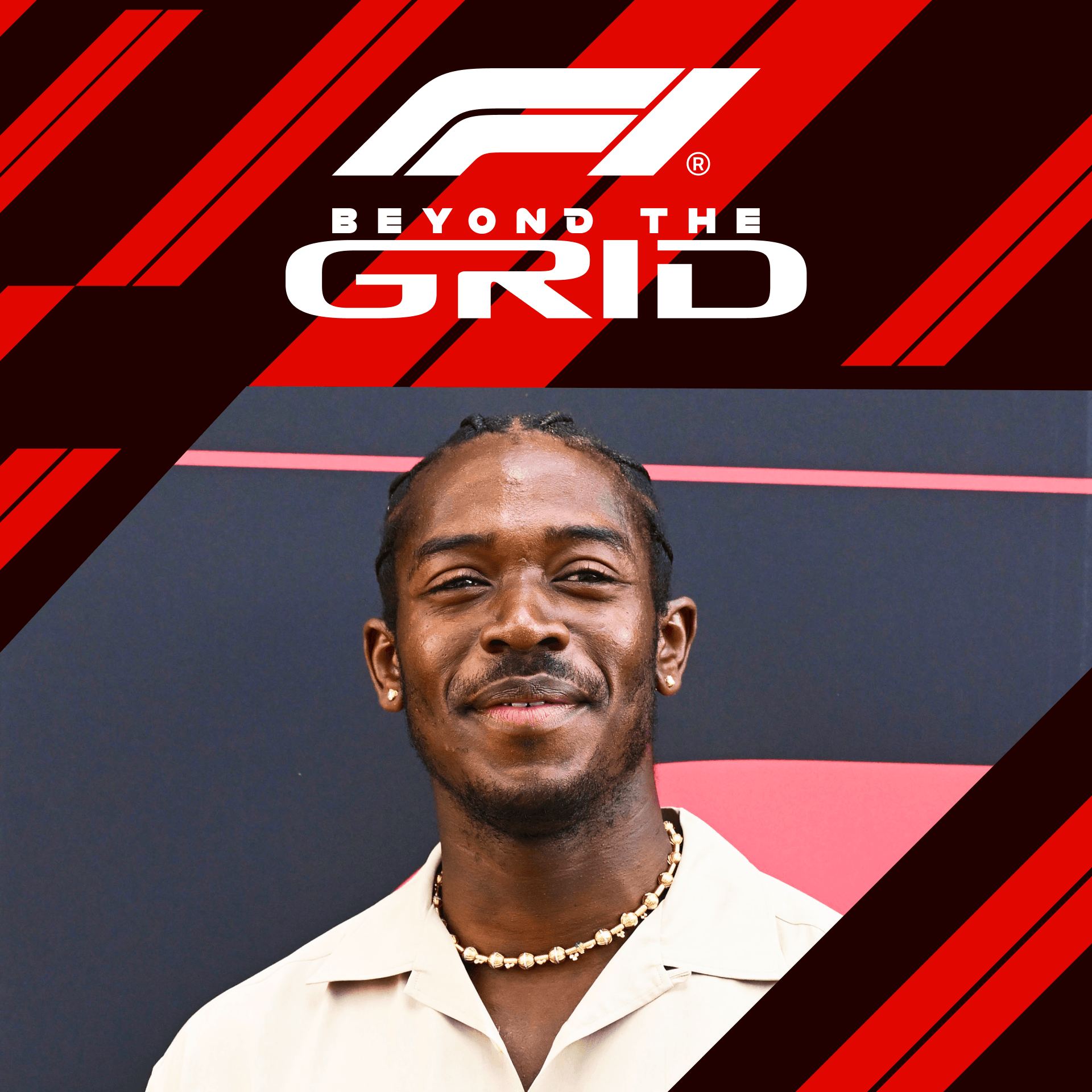
Damson Idris: F1: The Movie ‘changed my life’
About this episode
Damson Idris talks about how playing Joshua Pierce in F1 The Movie became “a watershed moment for Damzan Idris” and “really has changed my life.” He describes racing in the F2 cars used for filming, getting immersed at real Grand Prix events, and why the movie’s family-friendly appeal helped it land. The conversation also pivots to his path into F1 fandom, favorite tracks like Silverstone and Austin, and the advice he credits to Lewis Hamilton—“stop driving so slow.”
Speaking to Tom Clarkson a year since its release, Damson talks about racing in the F2 cars they used for the film, how he and co-star Brad Pitt compared against each other on track and what it was like to immerse himself in the world of Formula 1.
Damson also tells Tom about his relationship with Lewis Hamilton and why he believes the seven-time World Champion ‘has that Michael Jordan thing’. You’ll also hear about a dramatic moment during filming that showed Damson what it’s truly like to be a Formula 1 driver pushing to the limit.
This episode is sponsored by:
Claude: for problems worth solving — get started with Claude at — Claude.ai/grid.
Leesa: go to Leesa.com for 25% off select mattresses PLUS get an extra $50 off with promo code GRID, exclusive for our listeners.
F1 the movie
"Playing Joshua Pierce in F1 The Movie, the Oscar winning highest grossing sports film of all time, was a watershed moment for Damzan Idris."
“F1 The Movie” is a movie about Formula 1 racing. In this interview, Damzan Idris explains that making the film and getting to experience racing helped change his life.
“F1 The Movie” is the film adaptation centered on Formula One racing, which the guest says became a major turning point for his career. The segment also references how the production involved real on-track racing elements to sell the experience.
Formula One
"…being able to brag at family Christmas dinners that I'm a Formula One racer to my two-year-old niece."
Formula One is the highest level of professional race car driving. It’s a world championship where teams race specialized cars on tracks around the globe.
Formula One (F1) is the top tier of open-wheel motorsport, run as a global championship with teams racing purpose-built cars on circuits. In this segment, it’s used as the benchmark for the feeling the guest wants from his acting roles.
Grand Prix
"Lewis Hamilton wins a Grand Prix for Ferrari! Sent him a text when he won at Barcelona and I was like, get it!"
A Grand Prix is one big race weekend in Formula One. When a driver wins a Grand Prix, it’s a big deal and helps them in the season championship.
A Grand Prix is an individual race event within the Formula One season, typically held over a weekend at a specific circuit. Winning a Grand Prix is a major milestone because it awards championship points and is widely recognized as a top achievement.
Ferrari
"Lewis Hamilton wins a Grand Prix for Ferrari! Sent him a text when he won at Barcelona…"
Ferrari is a famous racing team in Formula One. The guest is referencing a big win connected to Ferrari.
Ferrari is the storied Italian Formula One team and constructor, famous for its racing heritage and iconic red cars. The segment mentions Hamilton winning a Grand Prix “for Ferrari,” tying the excitement to the team’s identity.
Barcelona
"Sent him a text when he won at Barcelona and I was like, get it!"
Barcelona is a city in Spain where a Formula One race (or race weekend) can happen. The guest is saying he texted Hamilton after a win there.
Barcelona is referenced as the location of a Formula One race weekend where Hamilton won. In F1 context, this usually points to the Circuit de Barcelona-Catalunya, a common testing and racing venue.
Michael Jordan
"He has that Michael Jordan thing. It's him against him."
Michael Jordan is a famous basketball superstar known for being intensely competitive. The guest uses him as a metaphor for the kind of rivalry and focus he’s describing.
Michael Jordan is a legendary basketball player used here as a comparison point for competitive intensity and rivalry. The guest says “He has that Michael Jordan thing,” then follows with “It’s him against him,” framing Hamilton’s mindset as driven by internal competition.
Silverstone
"Look, we're actually at Silverstone and I'm guessing this place was a second home for you guys during the filming of the movie, is that right? ... If you close your eyes, you did so many laps around here."
Silverstone is a major race track in the UK that hosts Formula 1. It’s the kind of track drivers learn so well that they can almost “see” the corners and remember which gear they use.
Silverstone is a famous Formula 1 circuit in the UK, known for its high-speed corners and long history as a home of British Grand Prix racing. In F1, it’s also a benchmark track where drivers build lap-time “muscle memory,” so hearing someone describe their usual lines and gears there is especially meaningful.
FIA race briefing
"the FIA race briefing, which was something that was new to me. ... they were talking about the different rules that could be in that particular race and the suggestions to make the race better"
Before a Formula 1 race, there’s a meeting where the officials explain what’s going on for that specific event. Drivers learn the rules and any safety or procedure changes before they go out.
An FIA race briefing is the pre-race meeting run under the FIA (the sport’s governing body) where teams and drivers get the latest instructions. It covers race-specific rules, safety notes, and how officials expect the race to be run that weekend.
race director
"Every Friday evening of every Grand Prix, they get together with the race director. So cool."
The race director is the person in charge of how the race runs. They coordinate the officials and make sure the race follows the rules and safety procedures.
The race director is the official who oversees how the race is conducted on the day, coordinating with marshals and applying sporting/safety procedures. In F1, they’re central to decisions like how incidents are handled and how race management is communicated.
flat
"I'm going to do a right, a fast right that I usually do flat. I think we're in cops here."
When a driver says they go “flat,” they mean they keep the gas pedal fully down through the corner. That usually takes a lot of confidence that the car will grip the road.
In racing driving, “flat” means holding full throttle through a corner without lifting or braking. It’s a shorthand for a driver’s confidence in grip and line, because staying flat usually requires the car to be stable and well-balanced at speed.
second gear
"All right. It's a slow. I'm going right down to second gear. Now I'm going round."
Second gear is one of the lower gears in the car’s gearbox. Drivers use it when they want more immediate pull when exiting a corner.
“Second gear” refers to the transmission ratio the driver selects for that part of the lap. In cornering, choosing a lower gear like second can help keep the engine in a responsive power band for acceleration out of the turn.

R8s
"My three older brothers were the ones who always had great cars, R8s and stuff. To this day, I don't know how they afforded it."
The Audi R8 is a supercar from Audi. It’s famous for being a fast, mid-engine car that looks and drives like a serious performance machine.
The Audi R8 is a mid-engine supercar built around the idea of strong performance you can drive on the street. It’s known for its distinctive look and for being one of the more accessible “supercar” experiences compared with more exotic exotics.
Formula Driving
"So I understood speed, but just the technicalities of Formula Driving, I mean, it's just out of this world. And it really was deep end stuff for me."
“Formula Driving” means the special way you drive race cars like the ones used in Formula 1. It’s about being very precise with braking, turning, and keeping the tires working well.
“Formula Driving” refers to the driving style and techniques used in open-wheel, single-seater race cars (the “formula” category). It typically emphasizes precision cornering, braking/turn-in timing, and managing grip at the limit.
Formula 2 car
"For someone who'd had no prior experience, just how difficult is it to go and suddenly get in a Formula 2 car?"
A Formula 2 car is a high-level race car used in a series that’s like a training ground for Formula 1. Drivers use it to learn how to race at very high speed in a single-seater.
A Formula 2 car is a single-seater race car used in the FIA Formula 2 Championship, which sits just below Formula 1 in the motorsport ladder. It’s designed to be fast and technical, and it’s a common stepping stone for drivers aiming for F1.
cap the speed
"I remember they would cap the speed. Or limit the revs."
“Cap the speed” means they limit how fast the car is allowed to go. It’s a safety/learning setting so you can practice without pushing full speed immediately.
“Cap the speed” means electronically or mechanically limiting the car’s maximum speed during early driving sessions. In driver training, this helps new drivers build confidence while reducing the risk of going too fast too soon.
limit the revs
"I remember they would cap the speed. Or limit the revs. Exactly."
“Limit the revs” means they keep the engine from spinning as fast as it normally could. That usually makes the car less powerful and easier to drive while you’re learning.
“Limit the revs” means restricting engine RPM (revolutions per minute) so the engine can’t spin up to its full range. Lower RPM reduces power and acceleration, making the car easier for a first-time driver to control.
braking
"The data proves it, right? The data proves it. Braking wasn't so good though. Through Val and everything."
In racing, braking is more than just hitting the brakes. It’s about slowing down at the right time and in the right way so the car stays stable for the next part of the track.
In racing, “braking” isn’t just slowing down—it’s the precise technique of decelerating at the right point to maintain grip and set up the next corner. The speaker saying braking “wasn’t so good” suggests their weakness was braking consistency or confidence under race conditions.
sector one
"So the, you know, sector one, as we call it, Austin is sort of the maggots, packets, complexes from Silverstone."
F1 tracks are split into a few sections for timing. “Sector one” just means the first part of the lap that gets timed separately.
In Formula 1 timing, a track is divided into sectors, and each sector is timed separately. “Sector one” is the first timed section of the lap, which helps teams pinpoint where a driver gains or loses time.

Mclaren F1
"And I think Brad did a Clarence car out there, right? He drove the McLaren F1 car, yeah."
The McLaren F1 is a supercar that’s famous for being built like a race car. It has a special three-seat setup and is known for being extremely fast and rare.
The McLaren F1 is a legendary supercar known for its mid-engine layout and driver-focused design. It’s famous for having a three-seat cockpit (driver in the center) and for its extreme performance and engineering, which is why it gets referenced in motorsport celebrity stories.
Ifsack Brown
"That was an Ifsack Brown. Yeah. If you're watching, Zach, Ifsack Brown offered you a ride in that car, would you take it?"
This sounds like “Zak Brown,” a prominent McLaren motorsport leader. Here, they’re joking about him offering someone a ride in a McLaren F1.
This appears to be a mis-transcription of “Zak Brown,” who is a well-known motorsport executive associated with McLaren. In this context, the speaker is talking about Zak Brown offering a ride in the McLaren F1.
Paul Ricard
"Down at Paul Ricard, right? Exactly."
Paul Ricard is a well-known race track in France. It’s the kind of circuit where big racing series test and compete, so it matters when someone says they first went there.
Paul Ricard is a famous racing circuit in France, known for hosting major motorsport events and for its variety of high-speed corners. In Formula One history, it’s been used for races and testing, so it’s a notable reference when someone talks about early track experience.
screamer
"Of course, that's an old screamer, isn't it? Yeah, yeah."
In racing talk, a “screamer” means an engine that sounds extremely loud and high-pitched. They’re describing the kind of engine note you’d hear from older, high-revving Formula One cars.
“Screamer” is a motorsport slang term for an engine that produces a very high-pitched, loud sound—often associated with older naturally aspirated F1 engines that rev very high. The speaker is using it to describe the distinctive noise character of that era’s V8-sounding car.
V8
"Sort of V8, I think. Spaceship."
A V8 is an engine with eight cylinders arranged in a V shape. In older Formula One cars, V8 engines were common, and they’re known for a distinctive sound.
A V8 is an engine with eight cylinders arranged in a “V” shape. In Formula One context, mentioning a V8 points to the older engine era (before the modern turbo-hybrid rules), where engine sound and high-rev character were a big part of the experience.
Lewis Hamilton
"Was it Lewis? Lewis Hamilton? Oh, 100%."
Lewis Hamilton is one of the most successful Formula One drivers in history. Here, the guest says he gave them the most advice.
Lewis Hamilton is a British Formula One driver and a multiple-time World Champion. In this excerpt, the speaker says Hamilton offered the most advice, highlighting Hamilton’s role as a mentor figure among current drivers.
Request an Explanation
Heard something you'd like explained? We'll add it to this episode.
Sign in to request explanations for terms you heard.
Want to learn more?
Browse our glossary for plain-English explanations of automotive terms, jargon, and concepts.
Help improve this episode
See something that's not quite right? Our annotations are AI-generated and can sometimes miss the mark. Click the flag icon on any annotation to suggest a correction.