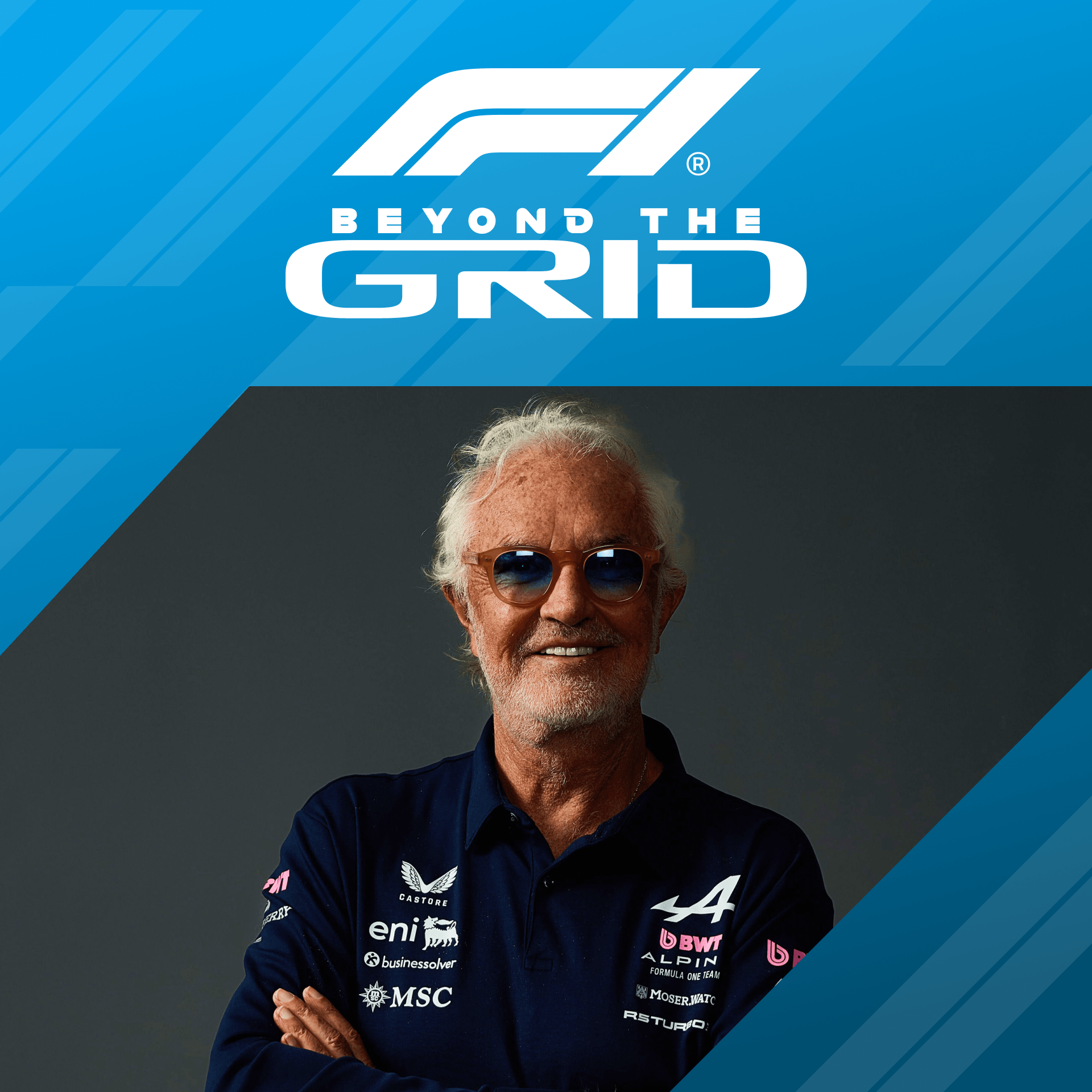
Flavio Briatore: growing Alpine with Colapinto, Gasly + Gucci
About this episode
Flavio Briatore and the hosts dig into Alpine’s turnaround, linking recent improvement to a Mercedes agreement and a relentless, “seven days a week, 24 hours a day” team culture. They discuss how building a championship challenge starts with “fixing the car,” then driver decisions and development. Briatore also frames Gucci’s arrival as a sign of F1’s global growth, citing “1.2 billion visualizations,” and compares the strategy to “Benetton 2.0.”
As Benetton in the 90’s, he led them to multiple World Championships with Michael Schumacher. And as Renault in the 2000s, he did the same with Fernando Alonso. So how can he achieve similar success with Alpine?
Speaking to Tom Clarkson, Flavio talks about the progress the team have made since he became Executive Advisor, what he makes of his drivers Pierre Gasly and Franco Colapinto, and whether he has a timescale for Alpine to be fighting for titles.
Flavio also shares some funny anecdotes about replacing Jenson Button with Alonso at Renault, firing Jackie Stewart and his criticism of Franco in the latest series of Drive to Survive.
Plus, Flav tells Tom about the arrival of Gucci as the team’s main sponsor in 2027.
This episode is sponsored by:
CarGurus: go to cargurus.co.uk for complete vehicle details without any surprises
Flavio Breatori
"Under the leadership of Flavio Breatori, Alpine are making progress... and Alpine's Executive Advisor, Flavio Breatori."
Flavio Briatore is a well-known Formula 1 team boss. He’s advising Alpine here and the hosts are comparing his past success to what he’s trying to do with the team now.
Flavio Breatori (Flavio Briatore) is a prominent Formula 1 team executive known for building competitive squads and for high-profile driver and team decisions. In this episode, he’s described as Alpine’s executive advisor and as the person trying to replicate past championship-winning success.
Alpine
"I arrived last year in Formula 1 with Alpine... With Mercedes engines powering them, Gucci arriving as the team's main sponsor in 2027..."
Alpine is the Formula 1 team in this conversation. They’re talking about how Alpine is improving and what changes are coming that could help it compete for wins.
Alpine is the Formula 1 team being discussed, and the episode focuses on its performance trajectory and leadership changes. The host also frames Alpine’s 2027 plans around engine supply and sponsorship, aiming for a stronger fight at the front.
P10
"Alpine was P10, but from P10 we've done a good job, but we just did the beginning."
P10 refers to finishing 10th in a race or session classification. In Formula 1, where points and momentum matter, moving from P10 toward higher positions is a sign of improvement in competitiveness.
Mercedes engines
"With Mercedes engines powering them, Gucci arriving as the team's main sponsor in 2027..."
“Mercedes engines” means Alpine will be using engines from Mercedes in F1. In F1, the engine is a huge part of how fast the car can go and how reliably it can finish races.
In Formula 1, “Mercedes engines” means Alpine will use power units supplied by Mercedes. Engine performance and reliability are major factors in lap time and race strategy, so engine partnerships strongly influence a team’s competitiveness.
Benetton 2.0
"I asked Flavio if he's trying to create Benetton 2.0, whether he has a time scale for the team to fight for titles..."
“Benetton 2.0” is basically the idea of making Alpine feel like the old Benetton—aiming to recreate that earlier success. The host is asking whether Flavio is trying to repeat a proven winning approach.
“Benetton 2.0” is a shorthand idea for recreating the kind of championship-winning team culture and results that Benetton achieved in the past. In this episode, it’s used as a question about whether Flavio is trying to build a similar winning formula at Alpine.
Pierre Gasly
"I asked Flavio if he's trying to create Benetton 2.0... what he makes of his drivers, Pierre Gasly and Franco Colopinto."
Pierre Gasly is a Formula 1 driver. The host is saying he’s among the best drivers, and that matters for Alpine’s chances to compete at the front.
Pierre Gasly is one of Alpine’s drivers discussed as part of the team’s lineup. The episode frames him as a top-tier driver (“one of the top six drivers”), tying driver quality to the team’s goal of fighting for titles.
Franco Colopinto
"what he makes of his drivers, Pierre Gasly and Franco Colopinto... his rather direct criticism of Franco in the latest series of Drive to Survive."
Franco Colapinto is a Formula 1 driver for Alpine. They talk about how he’s doing and how his performance and public image have been discussed.
Franco Colapinto is discussed as another key driver in Alpine’s lineup. The episode also mentions criticism of him in the context of the Netflix series Drive to Survive, and it contrasts that with how he’s improving inside the team.
Jensen Button
"In typical Flavio fashion, he tells some funny stories about replacing Jensen Button with Alonso at Renault..."
Jenson Button is a famous former Formula 1 champion. The host mentions him to illustrate a past story about how drivers were swapped at Renault.
Jenson Button is referenced as part of a story about driver replacement at Renault. Button is a well-known former Formula 1 World Champion, so his name signals the level of Flavio’s past team decisions.
Fernando Alonso
"he tells some funny stories about replacing Jensen Button with Alonso at Renault..."
Fernando Alonso is a top Formula 1 driver. They mention him in the context of past Renault decisions and championship-winning success.
Fernando Alonso is mentioned as the driver Flavio replaced Jenson Button with at Renault, and he’s also tied to championship success in the 2000s. Alonso’s presence is used to underscore Flavio’s track record of pairing top drivers with winning machinery.
Jackie Stewart
"replacing Jensen Button with Alonso at Renault, firing Jackie Stewart, and his rather direct criticism of Franco..."
Jackie Stewart is a legendary former Formula 1 driver and team figure. The host brings him up as part of a story about a dramatic decision in the past.
Jackie Stewart is referenced in a story about Flavio “firing” him. Stewart is a legendary Formula 1 figure, so the mention is used to highlight the boldness and controversy of past team leadership decisions.
Drive to Survive
"his rather direct criticism of Franco in the latest series of Drive to Survive."
Drive to Survive is a Netflix series about Formula 1. They mention it because it’s where some of the criticism and drama around drivers gets shown to a wider audience.
Drive to Survive is the Netflix docuseries that follows Formula 1 teams and drivers. The episode mentions it because Flavio’s criticism of Franco was discussed or amplified through the show.
points
"Because you've already doubled the tally of points from 2025. The team feels like it's really buzzing at the moment."
In F1, points are the numbers teams and drivers earn for finishing in certain positions. More points usually means better results across the season.
In Formula One, “points” are the championship scoring units awarded based on race finishing positions. The speaker says the driver/team has doubled their points tally versus 2025, using it as a concrete measure of progress.
simulator
"The building is the same. Maybe we are the simulator of this difference. There are a few new machinery and this and that."
In Formula One, a simulator is a high-fidelity driving and engineering tool used to model car behavior and driver inputs. Teams use it to develop setups and train drivers, so the speaker’s claim that the team is “the simulator of this difference” points to simulation being a key part of performance improvement.
balance sheet
"And the result is always Sunday, you know, we have a company, our balance sheet, normal companies presenting the balance sheet every six months. Our balance sheet is every week."
A balance sheet is a company’s financial snapshot. The speaker is using it as a metaphor to say their team tracks things more often than most businesses.
A balance sheet is a financial statement listing assets, liabilities, and equity. The speaker uses it metaphorically to describe how their team’s financial/operational tracking is done frequently (“every week”), contrasting it with normal companies that report every six months.
World Championship
"Are you putting a time scale on when you want to be challenging for the World Championship? Because other teams are doing that."
The World Championship is the big season title in Formula One. Drivers and teams earn points race-by-race, and the person/team with the most points at the end wins.
In Formula One, the “World Championship” refers to the season-long competition where drivers and teams accumulate points across races. The goal is to finish the season with the most points, not just win individual Grands Prix.
Minardi
"When I say Fernando, you remember Fernando, I send one year Fernando in Minardi to understand. And after I choose Fernando to replace in Jensenbato..."
Minardi was a Formula One team that often gave younger drivers a chance to learn. The speaker is using it as an example of training and development.
Minardi was a smaller Formula One team known for developing young drivers and competing with limited resources compared to the sport’s top teams. In the transcript, it’s used as an example of a place where a driver could learn and gain experience.
confidence game
"It's a confidence game, this isn't it? Is that the main difference we've seen in Franco?"
“Confidence game” here means mindset and belief can strongly affect how well someone performs. The speaker thinks confidence and communication can change results.
“Confidence game” is used as a metaphor for how driver performance and team expectations can become self-reinforcing. The speaker implies that belief, communication, and mindset can change results even when the technical setup is similar.
telemetry
"You don't need to drive in the car thinking about the telemetry, this and that. You have a talent."
Telemetry is the car’s live data that the team can monitor while it’s running. The point here is that the driver shouldn’t be distracted by watching that data—he should just drive well.
Telemetry is the stream of sensor data from an F1 car—things like speed, throttle position, brake pressure, and temperatures—sent back to the team. The speaker argues the driver shouldn’t be thinking about telemetry while driving; instead, they should focus on driving the car in their own style.
Buenos Aires
"Yeah, talking about enjoying the job. When he did the show car run in Buenos Aires, and what was it? 600,000 people came out to watch him."
Buenos Aires is the city they’re talking about. They mention a public show-car run there that drew a huge crowd.
Buenos Aires is referenced as the location where the driver did a “show car run.” In F1 culture, these kinds of public demonstrations are used to build fan excitement and visibility outside the race weekend.
Miami
"That was just before Miami, when we saw the turnaround. I mean, I was in the beginning already."
Miami is used as a timing reference for when things started improving. It’s one of the big F1 events, so it’s a natural “before/after” marker.
Miami is mentioned as a reference point for timing—“just before Miami” they saw a turnaround in performance. In F1, Miami is a major modern race on the calendar, so it often serves as a benchmark for momentum across the season.
defensive masterclass
"Actually, there was another, he did a defensive masterclass in China, didn't he?"
A “defensive masterclass” means the driver defended really well during the race. Instead of giving up the position, he used smart moves to keep the other car behind.
A “defensive masterclass” is a high-level description of elite defending during a race—holding position against pressure through smart positioning, braking timing, and managing tire grip. In F1, it’s often as impressive as overtaking because it requires anticipating the opponent’s moves.
China
"But sure. Actually, there was another, he did a defensive masterclass in China, didn't he?"
China is where they say the driver did a great job defending. It’s an example of strong racecraft, not just speed.
China is referenced as the place where the driver delivered a “defensive masterclass.” The mention highlights how racecraft—especially defending position—can be a turning point in how a driver is evaluated.
Formula One
"You've always seen the bigger picture in Formula One. Would you like to see a race in Argentina, back in Argentina?"
“Formula One” is the top level of open-wheel racing being talked about. They’re saying the driver needs to think about the bigger picture in that kind of racing.
“Formula One” is the motorsport series being discussed, where driver management, team strategy, and racecraft are tightly linked. The speaker references how the driver’s bigger-picture thinking matters in F1.
Michael Schumacher
"In the past, your main successes have come based around one big driver, was Michael Schumacher at Benetton, obviously, then Fernando at Renault."
Michael Schumacher was one of the greatest Formula 1 race drivers ever. Here, he’s mentioned as an example of a team having a standout star who helps them win big.
Michael Schumacher is a legendary Formula 1 driver who won multiple World Championships. In this segment, Flavio Briatore uses Schumacher as an example of how having one dominant driver can drive a team’s success.
Max Verstappen
"Do you think the icing on the cake for Alpine to be challenging for world championships, do you need a Max Verstappen in the team? Or can you do it a slightly different way this time? ... Max Verstappen is a super driver."
Max Verstappen is a superstar Formula 1 driver who has won World Championships. In this discussion, he’s used as the benchmark for what it takes to win at the very top.
Max Verstappen is a top Formula 1 driver and multiple-time World Champion. Briatore frames Verstappen as the kind of driver who can help a team like Alpine challenge for World Championships, especially when the car is already competitive.
Red Bull
"I believe as well, if you are a competitive car, you see Max, the moment that Red Bull was a super car, like we are Mercedes now, Mercedes are super cars, in delivery, incredible, incredible results."
Red Bull is one of the major Formula 1 teams. Here it’s mentioned because when Red Bull had a very strong car, the team started getting incredible results.
Red Bull is a Formula 1 team and constructor brand known for building very fast cars and developing them aggressively during seasons. Briatore links Verstappen’s impact to the moment Red Bull had a “super car,” implying the car and driver together create championship-level results.
Toto
"Now I think so. Toto have a drama, because he never spent Antonelli so quick. I love having a drama like Toto."
“Toto” here means Toto Wolff, a key leader in Formula 1. Briatore is talking about team decision-making and the tension that can come with signing or promoting drivers.
“Toto” is a shorthand reference to Toto Wolff, the prominent Mercedes team principal/executive. Briatore mentions a “drama” involving Toto, tying it to how quickly Mercedes moved on a driver compared with the earlier situation.
McLaren 2007
"I love having a drama like Toto. But it reminds me of McLaren 2007, a long time ago. Fernando, because Rondini's underestimated Hamilton completely."
McLaren 2007 is a reference to the McLaren team’s 2007 season. The point is that big driver/team decisions can create intense drama, and he’s saying it reminds him of that era.
McLaren 2007 refers to the McLaren Formula 1 team during the 2007 season. Briatore compares the current “drama” around driver decisions to what happened at McLaren in 2007, implying a similar high-stakes internal competition and timing of performance.
Hamilton
"Fernando, because Rondini's underestimated Hamilton completely. You remember, Rondini was the one on my driver, Kovalainen."
Hamilton is Lewis Hamilton, one of the most successful Formula 1 drivers. Here he’s mentioned as someone who was underestimated at first, then proved how fast he really was.
Hamilton refers to Lewis Hamilton, a multiple-time Formula 1 World Champion. Briatore discusses how Hamilton’s speed surprised people and how that changed the competitive dynamic within the team.
Kovalainen
"You remember, Rondini was the one on my driver, Kovalainen. And Rondini's, the time that she made Kovalainen was a superstar."
Kovalainen is Heikki Kovalainen, a former Formula 1 driver. Briatore is using him as an example of how people can underestimate a driver until they see how quickly they can go.
Heikki Kovalainen is a former Formula 1 driver who raced for teams including McLaren and Renault. Briatore mentions Kovalainen in the context of how a driver’s pace can be recognized only after real on-track performance.
where Formula 1 is at
"Look, final topic, Flavio, is just where Formula 1 is at. Because I think Gucci coming in says great things about Alpine, but it also says great things about the sport of Formula 1."
They’re discussing how Formula 1 is doing right now and whether it can keep growing. The rest of the talk connects that to sponsorship and leadership.
This is the segment’s main discussion prompt: the current state of Formula 1 and its growth trajectory. The conversation then focuses on sponsorship, leadership, and global expansion.
Gucci
"We have Gucci now in the car, and we have Louis Vuitton as well. The two luxury brands in the world."
Gucci is a luxury fashion brand. The speaker is saying Gucci being involved in Formula 1 is a sign the sport is getting bigger and more attractive to major global brands.
Gucci is a luxury fashion brand, and the speaker is highlighting its presence in Formula 1 sponsorship. The point is that luxury brands joining the sport signals Formula 1’s growing mainstream and global appeal.
liberty take over
"Formula 1, the moment liberty take over and the moment the safe one is in charge, is growing massively in very quick time."
He’s talking about Formula 1 being run by a new company (Liberty Media). The idea is that the sport’s business side changed, which helped it grow faster.
This refers to Formula 1’s commercial and governance transition to Liberty Media. In practice, it changed how the sport is marketed and managed, including sponsorship and broadcast strategy.
safe one is in charge
"Formula 1, the moment liberty take over and the moment the safe one is in charge, is growing massively in very quick time."
The host is talking about who’s running Formula 1 and how that affects growth. The exact name in the transcript is unclear, but the message is that leadership changes helped the sport expand quickly.
This appears to be a mis-transcription of “Stefano” or a reference to the sport’s leadership being in charge at the time. The speaker ties leadership to Formula 1’s rapid growth, but the exact identity is unclear from the wording.
Louis Vuitton
"We have Gucci now in the car, and we have Louis Vuitton as well. The two luxury brands in the world."
Louis Vuitton is a luxury fashion brand. Here it’s mentioned as another big-name sponsor in Formula 1, showing the sport’s growing reach.
Louis Vuitton is a luxury fashion brand mentioned as another major sponsor presence alongside Gucci in Formula 1. The speaker frames this as evidence that top-tier luxury brands see value in the sport.
Stefano
"Stefano realized as well to have Gucci in Formula 1 is a big brand. To have both brand like this in the basket of Formula 1, I believe is fantastic."
“Stefano” is a top Formula 1 leader. The speaker says he runs things in a more modern, collaborative way than the previous boss.
“Stefano” here refers to Stefano Domenicali, a key Formula 1 executive known for modernizing the sport’s approach to teams and commercial partners. The speaker credits him with being more open and working closely with teams and sponsors.
Ron Dennis
"We tried to race in America, and we had the agreement, including Ron Dennis, because that's always the difficult guy to pay for racing America."
Ron Dennis is a major Formula 1 boss, especially associated with McLaren. Here, he’s brought up as part of the behind-the-scenes effort to make racing in the U.S. happen.
Ron Dennis is a prominent Formula 1 team executive best known for leading McLaren during multiple eras of success. In this discussion, he’s mentioned in the context of negotiating or paying for racing in America.
Bernie Eccleston
"You've always been very close to the movers and shakers at the very top of Formula 1. You're very close to Bernie Eccleston. You're very close to Stefano now."
Bernie Ecclestone was the person who ran Formula 1’s business for many years. The guest is saying Stefano runs things differently than Bernie did.
Bernie Ecclestone (spelled “Eccleston” in the transcript) was the long-time commercial boss of Formula 1. The speaker contrasts his leadership style with Stefano’s, describing Bernie as more controlling and “one-way.”
Request an Explanation
Heard something you'd like explained? We'll add it to this episode.
Sign in to request explanations for terms you heard.
Want to learn more?
Browse our glossary for plain-English explanations of automotive terms, jargon, and concepts.
Help improve this episode
See something that's not quite right? Our annotations are AI-generated and can sometimes miss the mark. Click the flag icon on any annotation to suggest a correction.