A V12 engine is an engine with 12 cylinders arranged in two groups that make a V shape. In racing, it can spin very fast, and that’s part of why it feels so intense in Formula One.
“Revs” means how fast the engine is spinning, like RPM. 17,000 revs is extremely high, which is why racing engines can feel intense and put a lot of strain on the car.
An “electrical problem” means something in the car’s electronics isn’t working right. In a race, that can cause the engine or systems to act up and may even make the car stop.
“On the limit” with the fuel tank means they didn’t have much extra fuel to spare. If they used more fuel than expected, they could end up stalling or running out before the race ended.
Push rods are parts inside the engine that help open and close the valves. If they break or wear out, the engine can start running poorly or stop working.
Power steering is a helper that makes the steering wheel easier to turn. If a car doesn’t have it, you have to use more arm strength—especially when cornering fast.
Downforce is air pressure that pushes the car down onto the road. More downforce usually means better grip in corners, but it can also make the steering feel heavier because the tires are working harder.
Caster is an alignment angle in the suspension that changes how the steering behaves. If it’s “heavy,” it can make the wheel harder to turn and more demanding in slow, tight corners.
Person
Gerhard
Gerhard is the name of Jean Alesi’s teammate. Jean says they got along well and respected each other’s speed, which helped them work together while still fighting hard in races.
Alain Prost was Jean Alesi’s teammate at Ferrari. Jean explains that Prost had a very different attitude toward teammates—more focused on himself and the job than on how the teammate fits in.
In racing, a “setup” is the chosen configuration of the car—like suspension, aero balance, and steering feel—tailored to a driver’s preferences and the track. Alesi is describing trying two different setup philosophies to compare how the car behaves.
Nigel Mansell is a famous F1 champion. Alesi is saying he tried a car setup based on Mansell’s driving style and it felt very different from another driver’s setup.
Traction is how well the tires grip the track. You can have good grip overall, but still have a handling problem if the car’s balance makes it turn poorly.
Understeer is when the car doesn’t want to turn as sharply as you steer. Instead of rotating into the corner, it feels like it pushes outward.
Term
steering wheel was not coming back
If the steering wheel doesn’t return smoothly after hitting bumps, it can feel strange or unpredictable. That usually means the car’s steering and suspension are set up in a way that changes how it reacts over rough parts of the track.
Person
Jean Todd
Jean Todt (spelled “Todd” in the transcript) is a key Ferrari leadership figure from that era. Alesi is saying he asked him about whether Schumacher would join Ferrari.
A Grand Prix weekend is the whole event leading up to the race. It includes practice, qualifying (to decide your starting position), and then the race on Sunday.
Monaco is the tight, twisty street track in F1. Because it’s so narrow and slow, the car setup and track grip changes matter a lot.
Term
radite
“Radite” sounds like it means “ride height,” which is how close the car sits to the ground. Going lower can help the car feel faster, but if it’s too low you can hit the ground or get instability in fast corners.
“New tyres” means fresh tires with full grip. Teams often save them for the most important part of a session so they can see how fast the car really is.
Here “overdrive” means driving too aggressively for the grip available. It can cause you to enter corners badly—like going in too fast or braking too late—so the car doesn’t behave the way you want.
“Late on throttle” means you wait too long to start accelerating after a corner. That can make the car slower and harder to control because you’re not using grip at the right time.
A “warm-up” is a short session right before the race to get the car and tires ready. If conditions are wet, it helps you understand how the car will behave at the start.
Over-shooting a corner is when you don’t make the turn correctly and end up going too far past where you meant to. It usually happens when the car is going too fast for the available grip.
Over-driving is when you push the car harder than it can safely handle. In slippery conditions, that can quickly lead to mistakes because the tires don’t have as much grip.
Nürburgring is a legendary race track in Germany. It’s known for being tough and for changing conditions, which makes tire choice and driving technique really important.
Slick tyres are race tires with smooth rubber and no grooves. They work best when the track is dry or almost dry, because they can grip the road better than treaded tires.
A drive-through penalty means you have to go through the pit lane at the allowed speed, without doing a pit stop. It’s a time penalty that can affect your race strategy and tire plan.
Rain tyres have grooves that help push water out of the way. That helps the tire stay in contact with the road when it’s wet, reducing the risk of skidding on a water layer.
The pits are where the team stops the car to do things like change tyres. When you stop there, you can lose or gain positions depending on timing and how fast the stop is.
Michael Schumacher is one of the most famous F1 drivers ever. Here, the story is about Alesi trying to catch him during the race and how their positions changed.
Term
box boom
In F1, “box” means the pit stop area. The “boom” is basically how he describes the sudden pit-related communication that changes what happens next.
Damon Hill is a well-known British F1 driver who won the World Championship in the mid-1990s. In this story, he’s the driver Alesi overtakes to move up to second place.
Term
P2
P2 means second place. It’s the ranking position the driver is in during the race.
“Down the inside” means overtaking by going on the inside of a turn. It’s often done by braking later and trying to get the car positioned to pass at the corner.
The cockpit is where the driver sits and controls the car. “Out of the cockpit” means he climbed out of the driver seat after the moment they’re talking about.
Ferrari is the famous Italian racing team in Formula 1. In this part, the guest is describing how strongly he feels connected to Ferrari and how fans still feel that way.
A steward is an official in Formula 1 who watches the race and decides if something needs a penalty. They’re basically the rule-enforcers between the drivers and the race officials.
That’s how much fuel the car started the race with. More fuel means the car is heavier at the start, and as it burns off the car gets lighter during the race.
Pirelli makes the tires. In F1, the tire choice can make a huge difference—here they’re saying the Pirelli tires worked really well when the track had low traction.
Low grip means the tires have less traction because the track surface (or conditions) isn’t allowing rubber to bite well. That changes braking distances, cornering limits, and how aggressively a driver can accelerate without sliding.
LIVE
This episode is sponsored by Indeed.
There's a lot that goes on behind the scenes of this show,
booking guests across time zones,
tight turnaround edits, and constant time management.
And when things get chaotic, you realise pretty quickly
how important it is to have the right person on your team.
If I had to hire someone tomorrow, I wouldn't just want a good editor.
I'd want someone who understands pace in long formings of use
and can work fast under pressure.
And in moments like that, you think,
this is a job for sponsored jobs.
Because Indeed sponsored jobs boost your listing in search results,
helping you reach the candidates with the specific skills and experience
you actually need. And it works.
Sponsored jobs posted directly on Indeed are 95% more likely to report a hire
than non-sponsored jobs.
That's a serious edge when the pressure's on.
Spend less time searching and more time actually interviewing candidates
who check all your boxes. Less stress, less time, more results.
When you need the right person to cut through the chaos,
this is a job for Indeed sponsored jobs.
And listeners of this show will get a $75 sponsored job credit
to help get your job the premium status it deserves
at Indeed.com slash podcast.
Just go to Indeed.com slash podcast right now
and support our show by saying you heard about Indeed on this podcast.
Indeed.com slash podcast.
Terms and conditions apply.
Need to hire.
This is a job for Indeed sponsored jobs.
John Lacey, potentially victorious.
I was the best.
I was the best in a damp condition.
No question.
The Ferrari mechanics are already leaning over the Ancove,
ready to greet him home and what a hero he's going to be.
The mechanics in Ferrari, they are special.
They live what you live.
John Lacey wins the Canadian Crawl Free.
The emotion was so big.
And look at John Lacey out of the cockpit.
For me, a win is like a walkup.
John Lacey, a one-win wonder who wrote his name into F1
and Ferrari folklore on that very special day in Montreal back in 1995.
Hello, everyone, and welcome to F1 Beyond the Grid with me, Tom Clarkson.
From a lap of honour on the back of Michael Schumacher's Benetton
to visiting the Vatican a few days later,
Jean celebrated his one and only Grand Prix victory in unique style.
He knows he could and should have won more races,
but he feels as much joy and happiness when reliving those memories now as he did
when taking the checkered flag 31 years ago.
It's very infectious.
There are more great stories from other parts of Jean's career as well,
including the time he borrowed something from a rather unimpressed Ayrton Senna.
Great to have you on the show again, and it's lovely to see you at a race again.
You still love Formula One, don't you?
It's not about love, it's really passion.
For me, F1 is my life as a driver, and now I'm a supporter, I'm a super fan.
I watch everything.
Well, today, can I take you back to 1995, Montreal.
I'd be excited about that.
Your first win, your in-car number 27 in a Ferrari on your 31st birthday.
When you think back to that amazing day, what is the first memory that comes to mind?
The first memory is the last laps, because in our days we had cars very fragile,
just to remind a bit because we forgot about that.
Our engine we had at the time in Ferrari was a V12 engine, 17,000 revs.
So, you know, all these vibrations, and you have to cross the fingers to say,
please, please stay in one piece, you know, because people sometimes think I exaggerate
because they can say, OK, only one race, you know, and he's so excited about that.
But back to these days, if I look my career, I did 32 podiums.
My first race, I finished fourth, ran second.
Yeah, that was back in 1989 in the Terry.
And I had many, many possibilities to win the Grand Prix, but always something was happening
and I was not able to make it happen to have more wins.
So, for me, a win is like a World Cup.
And so you talk about the last 10 laps because, of course, Schumacher had his electrical problem here in Montreal, didn't he?
And do you start hearing strange noises from the engine?
Do you start questioning everything when you're in the lead with so little of the race still to go?
Yeah, absolutely.
That was my main issue was to bring back the car and get out during the race a fuel issue
because we were really on the limit with the fuel tank.
And just in lap, in a pit lane, his engine stopped, he ran out of fuel
and I ran out of fuel in my in lap after the finish line.
So, you know, we were always thinking, can the car stay in one piece?
Let's break down the weekend.
And can we start by talking about the track, the circuit Gilles Villeneuve?
You'd always gone well here. You'd already had a couple of podiums in 92 and 94.
What was it about the track that brought out the best in John Ellis?
I was a good breaker.
So my really special point was the braking.
And this is a circuit where you hit the brakes with a very high speed, like in Monza, where I go well as well.
So I think that was my best point in Montreal, the braking.
What about the car, the 412?
You've spoken about the V12, but was it a nice car to drive?
I mean, it was a quick car, but was it drivable?
For me, this car was the best car I drove for my all career.
Extremely fragile. I mean, I broke everything.
Push rods, gearbox, engines, fuel pump, everything was step by step going away, you know.
But except that, the car was always everywhere fast.
In Monza, in Monaco, in Montreal, on a wet condition, this car was just amazing.
And very drivable, very drivable.
Without power steering, so the steering wheel was a bit heavy.
But except that, we deal with it.
Tell us more about the lack of power steering, because of course today, the drivers have power steering.
Just how physical was it?
You know, many times we see with the new cars, with a button, they have a steering wheel and they change the regulations.
In nowadays, that was impossible, because with one hand, it was impossible to survive for the old Grand Prix.
So you have to really hold the steering wheel with two hands.
And in high speed corner with a downforce, it was very heavy.
In hairpins with the caster heavy as well.
So you had no chance really to go around with one hand and trying to change some parameters.
Look, final sort of preparation point about Montreal is you're with Gerhard, right?
You've mentioned his name.
He's your teammate. Why did you two rub along so well together?
What was it about Gerhard?
You know, many times people think we had a lot of fun together.
It was true, because out of the car, we had a very good relationship.
But we went well for five years because a lot of respect, speed from him and from myself at the time, very equal.
So we had to fight hard to beat or to beat me him.
And that kept in between him and myself a very good respect and relationship.
How different was he to Alan Prost? Because when you moved to Ferrari, Alan was your teammate.
Yeah, with Alan was absolutely different because Alan is the only driver I know.
Because at the time when you had a good position, you had the power to say to the team,
I don't like him, I want him as a teammate. And normally you choose a weak teammate.
Alan was the opposite. Alan didn't care about the teammate.
He cares only of how to get his car fast. He had a special way to drive.
So when I arrived in Fiorano, I remember very well this day, I had all the Ferrari available for me.
That was my first day presentation to the Italian press.
And I said to, after the picture and the first laps in Fiorano, they said,
OK, what do you want to do? And I said, I'd like to drive the car with two different setups,
Nigel Mansell and Alan Prost. So I said, OK, no problem.
They prepared the car. When I went out with the setup of Alan, I did 5 or 10 laps
because it's a short circuit in Fiorano. It's a 59-second lap.
And I came in and they said, no, this car is too easy. I mean, I have a good traction.
I have too much understeer in this place. And they start to change the setup and they were going slower, slower, slower.
Then I drove the Nigel Mansell setup.
First corner, I was not able to turn the corner because he had a massive power, Nigel, in his arms.
And he was setting the car mechanically in a way.
You had no surprise because the steering wheel was not coming back on the other direction, on the bumps and stuff like that.
But you had to be very physically prepared to drive a Nigel car.
So at the end, you know, what I found out is Alan was very quiet and very open book because you had not the capacity to drive the car as him was able.
So I learned a lot with him.
Who was the fastest teammate you ever had while we digress?
Yeah, I believe so far Alan, but Gerrard, he had this craziness at the moment when he was able to do something that surprised everybody in the team and myself as well.
So Gerrard had a very pure velocity.
But while we're talking drivers, bringing it back to 95, coming into the Montreal race, there was a bit of speculation that Michael Schumacher was going to move to Ferrari for 96.
That was just starting to raise its head.
Were you aware of that speculation and what did Ferrari boss Jean Todd told you, if anything?
Well, I came to him and I asked him and he said no.
But when I found out that make our relationship not so good.
Tough time. I mean, and had Todd made it clear that both you and Gerrard were going to be leaving at the end of the year?
Well, that was the wish of Michael Schumacher, because when he accept the proposition to join Ferrari, it was absolutely clear.
His position was choosing the teammate, choosing the way to work because we have a spare car at the time.
So everything was on him and we had no chance to stay.
It was not a question of if Michael is coming, do you stay or not?
If Michael comes, you're going.
Because Michael did a contract.
This episode is sponsored by CarGurus.
One thing I've learned from looking for cars over the years is that almost every listing can look brilliant in the photos.
The tricky part is figuring out what's actually a good buy once you start digging into the details.
You compare prices, mileage, features, ownership history, and before long, you've got dozens of tabs open trying to work out which cars are genuinely worth your time.
That's why I'd suggest anyone thinking about buying a car should take a look at CarGurus before anything else,
because instead of just showing you endless listings, CarGurus helps you make sense of them.
You can view deal ratings from great deal to overpriced, so it's easier to judge whether a car is fairly priced based on its condition, mileage, and features.
And all the important details are right there upfront as well, vehicle history, price changes, and dealer reviews,
which makes it much easier to really narrow down your options.
There are hundreds of thousands of cars available from top-rated dealers, and you can even set up alerts for price drops and new listings,
so you never miss something worth looking at.
Join the millions who've already found their best deal with CarGurus.
Go to CarGurus.co.uk for complete vehicle details without any surprises.
That's CarGurus, C-A-R-G-U-I-U-S.co.uk.
CarGurus, search buy sorted.
This episode is sponsored by Indeed.
There's a lot that goes on behind the scenes of this show, booking guests across time zones, tight turnaround edits, and constant time management.
And when things get chaotic, you realise pretty quickly how important it is to have the right person on your team.
If I had to hire someone tomorrow, I wouldn't just want a good editor.
I'd want someone who understands pace in long-form interviews and can work fast under pressure.
And in moments like that, you think, this is a job for sponsored jobs.
Because Indeed sponsored jobs boost your listing in search results,
helping you reach the candidates with the specific skills and experience you actually need.
And it works.
Sponsored jobs posted directly on Indeed are 95% more likely to report a hire than non-sponsored jobs.
That's a serious edge when the pressure's on.
Spend less time searching and more time actually interviewing candidates who check all your boxes.
Less stress, less time, more results.
When you need the right person to cut through the chaos, this is a job for Indeed sponsored jobs.
And listeners of this show will get a $75 sponsored job credit to help get your job the premium status it deserves at Indeed.com slash podcast.
Just go to Indeed.com slash podcast right now and support our show by saying you heard about Indeed on this podcast.
Indeed.com slash podcast.
Terms and conditions apply.
Need to hire? This is a job for Indeed sponsored jobs.
You were carrying the number 27 on the car in 95. Of course, everyone associates that with Gilles Villeneuve.
A lot of people, Jean, tell me that there are similarities between the way you drove and Gilles.
Do you think it's a fair comparison?
Well, it's really fantastic to hear that because he was my hero and he's so far right now the number one driver for the Italian fans up to now.
When there is an Indian press, they make a ranking of who was the best Ferrari driver, he's always number one.
So I'm very pleased about that, but I cannot say yes because Gilles is Gilles and I tried to drive by instinct at the time.
It was an easy time for the Formula One driver compared now.
I feel much more complicated the F1 drivers from now to drive these cars because they need to follow a kind of route to use the car on a limit.
In my days, you drive as you feel naturally.
An engineer said to me, you brake too late or you have to brake in this place.
You need to operate this return in this way, sacrifice this corner because you're going to be faster at the end of the lap.
Never. They just said to me, how we can improve the car to go faster.
Let's talk about that because you hit the ground running Montreal 95, your second fastest in both of the practice sessions.
And of course back then there were no simulators or nothing like what we have today.
How much did you change the car during the course of a Grand Prix weekend and specifically here?
So here you have to be very careful like in Monaco, the evolution of the circuit is massive.
So you don't have to overreact because straight after a few laps the car is not doing exactly what you want.
You need to be only concentrate of the radite because we had a lot of fuel at the beginning of the race and in qualifying, of course, we qualified with an empty tank.
But you had to make the car very low but not too low to have some issue in the fast corners.
So that was the main concern, the radite.
And then slowly you start to understand what was the point to work on.
And so how much qualifying preparation would you put in during practice?
Not so much because we waited the end of the session and we had three go with three set of new tyres.
And at this time you understand if the car was good or not.
You line up fifth on the grid. Fair representation of where you and the car were or?
No, something went wrong. I think if I remember very well I overdrive.
And that was my problems many times.
Overshooting the corners, be late on throttle.
And I had more, let's say it was easier for me during the Grand Prix to follow the others to understand because in my mind I was breaking it to on the right point.
But maybe I was already 20 meters too much, you know.
And I didn't make a very good qualifying but on Sunday we had a warm-up.
It was wet?
It was wet. I was P1 and then I said okay, start from this point and make it quiet for the first laps and then we see.
On the topic of overdiving, I think it's an interesting one.
Why do drivers, not just John and Lacey, why do drivers overdrive?
Because you hear a lot of people talk about it.
Is it just over-eager, too much passion, too late on the brakes?
But what causes it?
Every machine has a limit.
A good driver is a driver who understands the limit of the car.
Because maybe the driver can forget or go over this limit.
And then it's what we call over-shooting a corner, over-driving.
Because you don't know what is the limit of your car or you don't feel the limit of the car.
And that causes some problems.
So we've discussed the race morning warm-up. Your fastest, it's wet.
It then stops raining but there are still damp patches at the start of the Grand Prix.
How confident were you going into the race?
Well, in this condition, honestly, I don't want to make it...
I was the best.
I was the best. In a damp condition, no question.
And during this year in 1995, I started with slick tyres in Nürburgring.
In the middle of the race, I had one minute lead to the second.
Then in Suzuka, I had the penalty drive-through.
I came in, I did another lap.
When I came in, in this condition, it was wet.
Everybody and myself had to start with rain tyres.
But after a few laps, when I had this penalty, I said on the radio to the team,
I'm coming back now, slick tyres.
And nobody replied.
Then in this lap again, I said, slick, slick, slick, nobody replied.
And maybe my engineer said, OK, give him the slick tyres.
I came in, put the slick, it was really wet.
That was the race of my life.
I came out of the pits after two corners and maybe you exaggerate,
but I was so upset, I pushed, pushed, pushed.
OK, I was in between five and six seconds faster than Michael.
I pass everybody, I catch Michael.
And when Michael, because we talk about together after the race,
on the radio, he called the team and he said,
Alessi is in the same lap than me.
And the team said yes.
And then he started to worry a bit and then Michael box boom.
Well, as you say, you were electric at the start of the race
and you end up taking P2 from Damon Hill.
He's going for it now, he's going to try and go down the inside of course.
Damon Hill out, and he's done it.
John Alessi moves up into second place with a really powerful boom.
I think it was lap 17, a lovely move down the inside of the head.
Did you think you could catch Michael at that point?
Michael Schumacher leading the race.
No, no, because I try.
When I pass Damon, then I had a free, let's say air.
The car was working very well and I push, push, push.
And it was 65 seconds ahead.
I said, he was not really moving, you know.
And when I was driving like that, the rear started to move a bit
and they said, okay, maybe I will not be able to.
So I slowed down a bit to cool the car as much as possible.
And then I retry again, but when I retry, I see something in the tribunes.
And then I said, something happened.
I pass the finish line and my pit board was not there.
I said, okay, because Michael was already in the box
and there are no time to change the pit board position, you know.
And then when I arrived to the hairpin,
I see everybody standing up with the flag, the Ferrari flag.
They said, okay, I understand.
I pass the pit board, the CP1, and then I had a shock, you know.
I had a big shock.
I love the fact that you actually found out that you were in the lead of the race
from the fans before you did for the team.
Because Montréal is probably the circuit where you drive inside a stadium
because you have the grandstand so close to the circuit.
Not only at the hairpin, but in turn six, in turn seven and eight.
I mean, you see the people moving or showing something to you.
You've spoken already about how fragile the car was.
How nervous were you at that point when you'd taken the lead?
You've still got 10 or so laps to go.
Were you incredibly nervous?
Because you hadn't actually won a race since, I think, 89 in 3000 with Eddie Jordan, right?
Yeah.
As I said before, it was not a question of I didn't win and I had to win.
I didn't put a timer in my head saying, okay, you have to win.
It's how many times I was leading.
Maybe, I don't know, in my whole career, 10, 12 times.
We're leading not lap two, lap three.
Leading when the car is over, when you finish your pit stop,
where you just have to bring back the car to the finish line and then boom, boom, boom, boom.
So I was really thinking about the car, what to do to make it happen.
Not jumping on the curves.
We had a very high...
They were higher curves back then, weren't they?
We had a very high curve, not braking too late, not going to the 17,000 revs,
braking a little bit with the left foot on the straight to slow down the speed
because beginning of the Grand Prix with the fuel tank and the end of the Grand Prix,
the car was very light and the engine was going very well.
There were no dramas, right?
No, no problems. The car was perfect.
The car was perfect.
Can you remember how you felt crossing the line to win your first race?
Yes, because I make a calm down in my head.
I said, OK, brake for the chicane. It's the same chicane than now.
Go outside, four and whatever is happening, look just where is the finish line
because you don't see exactly the finish line.
It's like a corner.
I said, OK, even if now I have a big explosion with the speed that will cross the finish
like in the movie cars with the tunnel.
So I remember that.
And then a big moment up to the airpin where I feel no fuel in the car.
But in a stop, it looks like, you know, for a World Cup, a soccer one,
there is a penalty and yet there is all the fun sharing to you.
And look at John Alessi out of the cockpit.
Has he kept the engine running? No, he has not.
He may conceivably be out of fuel, but I suspect he's just so overcome with emotion
in front of this enthusiastic Canadian crowd with so many Ferrari flags.
And suddenly I hear the noise of a car.
It was Michael just behind me.
So Alessi getting a lift from Michael Schumacher.
Isn't it lovely to see real, real emotion and happiness?
Alessi absolutely overjoyed these every reason to be.
How was the ride back on the back of Michael's Benetton?
I burned my butt because I was on the engine cover and, you know,
I understand why now is not allowed anymore because it's quite dangerous.
The car is, you don't know where to put your feet.
But it was so good.
Michael was happy.
I mean, it's the first time he was not winning and he was happy as well.
Did you have a good relationship with Michael?
Yeah, very much.
We had a very good relationship again because of the respect in between him and myself.
Nobody was jealous about anything.
We were just enjoying a super time.
But probably because, you know, when I joined Formula One,
my competitor was Ayrton Senna, Nelson Piquet, Nigel Mansell, Gardeberger, Allen Prost.
I mean, big names and big champions.
So when Michael came in 93, 92 or 93, I don't remember.
Well, the first race was 91, but then he won his first race in 92.
No, no, when Michael came in F1.
Yeah, 91.
91.
So when you arrived in Spa, he was with Eddie Jordan.
Eddie brought him on the table at the restaurant.
He said, it's my new driver.
Tell him what to do, you know.
And I saw the face of him, like, I don't need to have your advice, you know.
And I said, no, just be careful with the fuel tank when it's full
because there's a big difference with the empty tank.
But the rest, do what you want, you know.
And then I found out during my relationship with him, with his character,
to have Eddie Jordan to tell him, to bring him to a driver and say,
tell him what to do, he was funny.
That's exactly why AI risk is becoming such a major conversation right now.
Most security programs simply weren't built for the speed at which
AI tools and integrations are evolving.
But that's where Vantor can help.
Vantor is the number one, a genetic trust platform,
used by over 16,000 fast-moving companies like Nando's and Granola
to help ensure they're always audit ready.
And now Vantor is helping companies monitor the risks that appear between audits too
across vendors, AI tools and their wider environments.
The Vantor agent works like a 24-7 GRC engineer in the background,
identifying issues, helping draw fixes and cutting vendor assessment time by up to 50%.
So instead of constantly trying to keep up manually,
teams can stay focused on growth while still maintaining trust and security.
Whether you're a fast-growing startup or a global enterprise,
Vantor is here to help you automate your security and compliance and earn and prove trust.
So get started today at vantor.com.
This episode is sponsored by Shopify.
You know that slightly annoying moment when you're rushing to buy something online
and get stuck at checkout.
You can't remember your password, your card details are out of date
and your bank decides now is the perfect time to send a verification code to another device.
It's amazing how quickly a very straightforward purchase can suddenly start feeling like an admin job,
which is why I always appreciate seeing that purple Shoppay button.
Because with Shoppay, your details are already saved.
So checkout becomes incredibly quick.
No searching for your wallet, no typing everything out again.
Just a couple of taps and you're done.
And that's all thanks to Shopify, the commerce platform powering millions of businesses around the world
from huge brands to people just getting started.
Shopify gives businesses everything they need in one place, ready to go website templates,
AI tools that help with product descriptions and images,
plus built-in email and social media tools to help brands reach customers more easily.
See less cards go abandoned and more sales go with Shopify and their Shoppay button.
Sign up for your $1 per month trial today at Shopify.com slash beyond the grid.
Go to Shopify.com slash beyond the grid.
That's Shopify.com slash beyond the grid.
You had a very close relationship with Eddie, didn't you, because you raced for him in 3000
and you actually shared the podium here in 95 with two Jordan drivers, Rubens and Eddie, Eddie Irvine.
Was that quite special, actually, to share it with Jordan drivers?
Yeah. Eddie was my man as a driver.
I would never be a Formula One driver without him.
Impossible, because when I joined Eddie Jordan in Formula 3000 in 1989,
that was my last chance to be a driver, not to think about F1.
And he brought me in his house.
I live with Marie and the kids for one year.
He did everything to me.
He was like a big brother.
And when I went to F1 in 1989 and I said to him, thank you, Eddie, you helped me a lot.
That was in July, but I will not drive the 3000 anymore with you because my goal was to go in F1.
He said, what did you say?
You will never, ever see a F1 car.
If you don't finish my year, you know how he was talking, championship and you won the championship.
And I said, no, Eddie, please, please, please.
But anyway, he convinced me or I have no possibility to do another way.
So I did every weekend, 3000 F1, 3000 F1.
And then I went to Eddie and said, Eddie, I'm sorry to tell you that, but why you don't do an F1 team?
You are more organized than the Tyrell team.
And Tyrell, honestly, they have a story.
They have two fantastic engineers.
So they designed a super car.
But the rest, the team, when you go inside of the workshop, it's embarrassing of them, you know.
And you start to think about that and then you make his team.
Jean-Alesi inspired George.
Absolutely.
No, but that is a true story.
And was EJ pleased for you?
Although you beat his drivers in Montreal, was he pleased that you'd won?
Yes.
We were always in contact, you know.
And he was a kind of place where you go to him, you know, like you go to see the priest in the church
because you don't know who can talk to have a right answer, I have to say.
And he was always the man.
So take us up onto the podium.
Just listen to the crowd.
You'd think it was Italy and not Canada.
Let's show you how popular EJ is.
Let's show you how popular a Ferrari win is.
Jean-Alesi, there's a man who's going to remember his 31st birthday for a very long time.
Hell of a good birthday present that, but there'd been a track invasion.
There were fans everywhere.
You had Jean-Torre, I think, came up to get the constructors trophy as well.
Just take us up there.
What was the emotion like for you?
Well, the emotion was so big.
I remember I had a massive headache when I came back to the hospitality.
And then I was with my brother and they said,
José, let's go back to Avignon and everything changed
because suddenly the national TV, they asked me to stay for the news on studio at eight o'clock.
So I had to change the flight, but I wanted to go home, you know.
And for a few days, I had to go to places because of this win.
Where did you go?
I go in Paris again.
When I landed, I went in Paris, a special show at eight o'clock on the prime time.
Then I called Montezemolo and they said,
No, no, come to Rome, I organize sightseeing in the Vatican.
Can I bring my parents?
Yes, you bring your parents.
So I went there in Rome and with my parents, we went everywhere,
like if I was a pope, you know, and that was a great, great moment.
And how did the team greet you when you were next in Maranello?
Well, the mechanics in Ferrari, they are special.
They have a spirit, like a driver.
They have very emotional, they support you, but they live what you live.
And that is fantastic.
Did the win change you as a racing driver?
No, because, unfortunately, we came in a chapter when Michael started to join Ferrari
and that destroyed my emotional moment.
What did it do for your confidence, though, the win?
No, the confidence.
You never lack confidence?
No, it didn't change anything on this respect.
Is it a huge frustration to you that you never won another one?
No, no, no.
My biggest, if I have to speak about frustration, it's the last Grand Prix I did with Ferrari in Monza.
I wanted to win for my fun and to say thank you for what I had all these years
and to have this retirement at six laps to go leading the Grand Prix.
That was my worst memories.
And although you went on and had many years afterwards in Formula One,
were you always a Ferrari fan even when you weren't racing for them?
Yeah, yeah, I had to be very careful sometimes to go to the racetrack with a pin,
with a Ferrari or something like that.
But Ferrari, still now, he looks like it's my house.
Let's bring it on to today. What do you make of Ferrari in 2026?
Do you think they can get back up to the very top?
I hope so, of course. My level of fun is like when you follow a football team
and whatever they do, you are fun.
So technically, these cars are amazing.
F1 is very different than what I used to have,
but Ferrari stays the leading team in terms of emotion for the fans.
Even now, with the new generation, it's the same.
So I really hope they can get the world championship for this new generation.
And when you look at the 22 drivers on the grid now, which one reminds you of you?
I don't know because we had freedom.
And these drivers are, for me, with the age they have,
the car, the size of the car, the technology on board.
You need to be an astronaut to drive that.
And my days was more a fight, more freedom in terms of everything.
Even if you had a fight with another driver on the circuit,
it was a question in between him and you.
Now it's in between you, the driver, and the steward.
And the steward with FAA is complicated.
I love F1, but I don't see myself being in a system like that.
Back to the drivers, though.
I look at Charles Leclerc, and I think he has the passion of Giorna Lacy.
He has the car control of Giorna Lacy. Would you agree?
Yeah, absolutely. Charles is the typical Ferrari driver.
He has a speed, he has respect for the team,
because sometimes you know Ferrari are the drivers where they don't care about Ferrari.
For them, it's a team. Ferrari is not a team.
It's a religion.
The final one, then. Who is the fastest racing driver you ever raced?
It's easy to say Ayrton. Ayrton Senna was incredible.
Back to Montréal one day, he had the Ford engine, and I had my Ferrari.
Beginning of the Grand Prix, we had 200 kg of fuel.
First lap, he passed me at the hairpin, and we made the whole hairpin together.
But then we had the long left and right corners.
And for the first few laps, it was not flat.
But we had the wheels, you know, like that.
So he was really, his head was here.
I was inside, he was outside. I said, if I lift, he's dead.
If he lifts, I'm dead. What do you think?
But you have, you know, such a short time to think about that.
I said, he will not lift. I stay flat, he stays flat.
And we passed the things like that, the car matched the ground like hell,
and then he passed, you know.
But that, if it was Nigel or Gerard, I was going away and letting go straight away.
So you had total trust in each other.
Yeah. And you knew he was going for it, but on a good way.
When I think of you and Ayrton, I mean, that's a lovely story that you've told us about Montréal,
but who can forget Phoenix?
Yeah.
Phoenix 1990.
But that was different.
The news on a Lacey overtook him. Hello.
Yeah.
In a Tyrell.
But that was different because we had the Pirelli tires.
And on the low grip condition, these tires was amazing.
And the Tyrell, beginning of the Grand Prix, I had 25, 30 kilos less fuel than the other teams.
So I had a super fast car.
At the start, I took the lead, and then I knew at one stage he was coming back, you know.
We had not the speed limit in a pit.
So he came, he changed the tires, middle of the race, and I did the whole Grand Prix with the same tires.
But he changed, he took him not long to catch me.
And then I said, okay, no problem.
Let's go for it.
So I was just, I was not blocking at all.
But I tried for the first time to brake later than what I think.
So then he was very late.
And he passed me.
He said, oh my God.
But he didn't make it.
He went a bit wild.
And then I have, you know, the door open.
So I crossed his line and I took the lead again.
That was funny because I had no stress.
The only thing that I was thinking was my friends in Avignon, they will see that and they will love, you know.
But I knew he had no chance to win the Grand Prix.
If you no longer go for a gap, you're no longer a racing driver, Jean.
That was the great quote from Etton.
Did you and him ever discuss that after the race?
No, after the race, he gets mad about me because I was on a grid with a normal t-shirt, you know, with a cotton.
And my team manager, he said, do you have any fugees, you know, for the Fire Pro for a t-shirt?
I said, no.
He said, what?
What do you think?
So he ran.
He went in the McLean hospitality and they give him a t-shirt.
And, you know, Etton was a bit mad about that.
He had all his t-shirts going to the church and benediction, you know, before the race.
And they give me this t-shirt and I put it and something was scratching.
He has his name inside Etton, you know.
So after the race, we arrived to the press conference and he said, wow, but the car, how it happened.
I was not able to catch him straight away.
Then he was okay.
But what was so special on your car?
And he said, no, today was to Etton and they show him the, when he sees that, he was very upset to me.
He said, why did you get that?
No, I would tell you later.
No, no, who gave you this t-shirt?
John, I never knew that.
You were wearing Senna's t-shirt in that race where you overtook him.
So we, then I said, okay, I explained the situation.
He said, okay, I understand, but you know the guys, it was very sensitive about that.
John, what a wonderful chat.
Thank you so much for just sharing some wonderful stories.
And of course, Montreal 95, we will remember for a very long time.
Thank you so much.
Thank you.
Jean's passion for F1 is so infectious.
That was a conversation I'll remember for a very long time.
Not only for his memories of Montreal 95, but for the tangents we went off on as well.
His memories of Eddie Jordan for one and that story of Senna being angry with him for using his Nomex top in Phoenix were both classic tales.
Jean, thank you for your time and I look forward to seeing you again soon.
Well, that's almost it for this week.
But before I go, we want to give you a chance to tell us what you think of F1 Beyond the Grid and F1's other podcasts.
So go to f1fanvoice.com, click where it says F1 Podcasts and answer a few questions.
And as a thank you, you'll be entered into a draw to win a Charles Leclerc poster.
So go to f1fanvoice.com to take part and for terms and conditions.
And speaking of other podcasts, F1 Nation's preview of the Monaco Grand Prix with me, Joly and Palmer and James Hinchcliffe is out now.
We discuss whether it could be the first Grand Prix of 2026 that Mercedes don't win.
And this week's F1 Explains is a quick-fire question special with F1 TV lead commentator Alex Jakes.
That will be on the F1 Nation feed this Friday.
Thanks very much for listening. I will of course be back next week with another big name from the world of Formula One.
F1 Beyond the Grid is produced by Formula One and AudioBoom Studios.
Until next time, keep it flat out.
.
About this episode
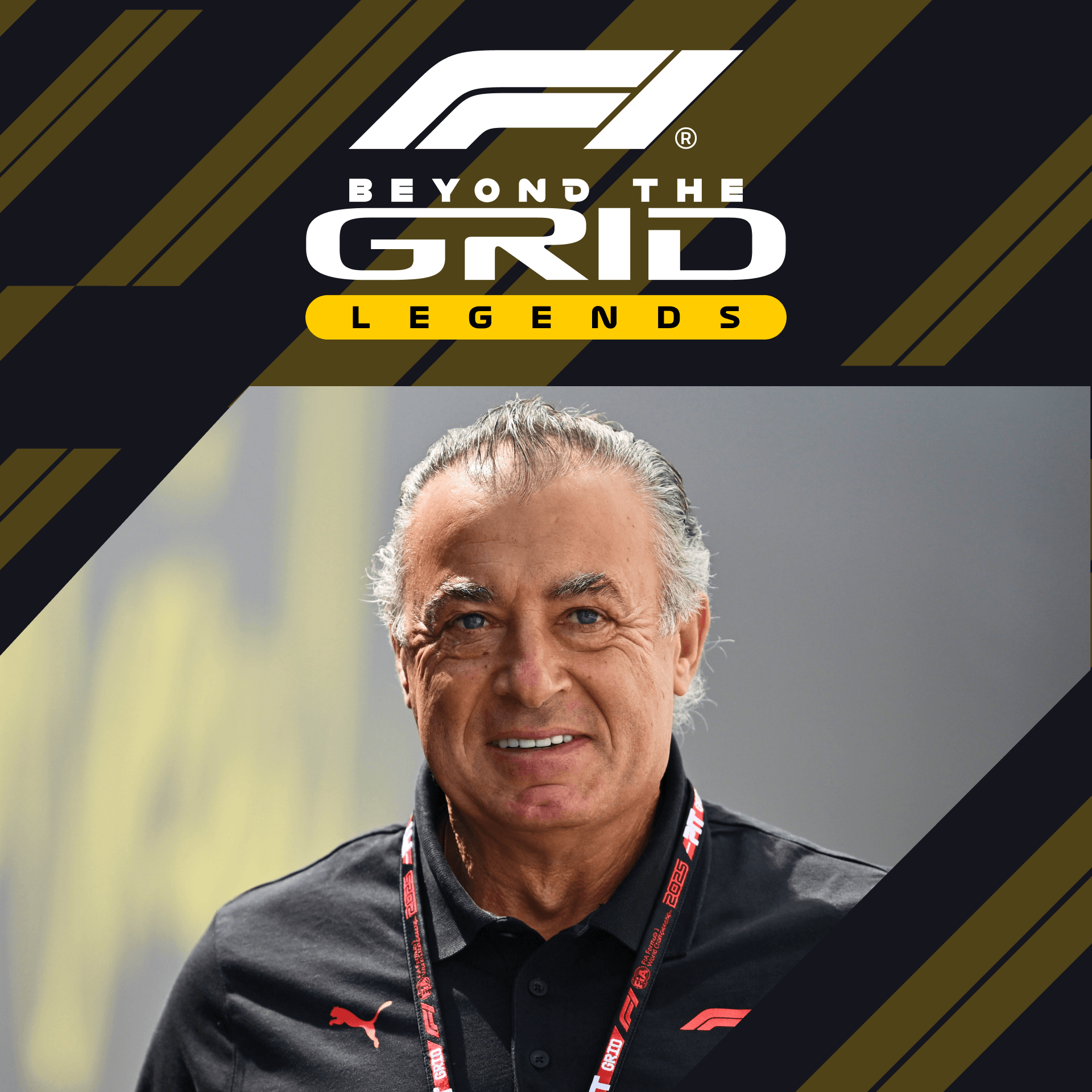
Jean Alesi’s one and only F1 win is traced back to Montreal in 1995, where a fragile Ferrari V12 and brutal braking demands shaped everything from qualifying to the final laps. He recalls heavy steering without power assistance, fuel-limit pressure, and late-race mechanical failures—yet highlights braking as his edge. The story also includes wet-to-slick tyre gambles, confusion over pit boards, and the emotional aftermath, including a lift from Michael Schumacher on his Benetton.
At the 1995 Canadian Grand Prix, Jean Alesi achieved the sole Grand Prix victory of his Formula 1 career. Speaking to Tom Clarkson, Jean relives the standout moments from that unforgettable moment in Montreal – like only finding out from the fans that he was leading the race, doing a lap of honour on the back of Michael Schumacher’s car, and then being whisked to the Vatican in Rome to celebrate. He talks about the emotions he felt when crossing the finish line and what he feels now when looking back – and whether only winning one race frustrates him.
Jean also shares some brilliant stories from other times in his career – telling Tom how he helped inspire Eddie Jordan to make his own F1 team and why Ayrton Senna was somewhat bemused when Jean borrowed something from him.
This episode is sponsored by:
CarGurus: Join the millions who have already found their best deal with CarGurus. Go to cargurus dot co dot uk for complete vehicle details without any surprises.