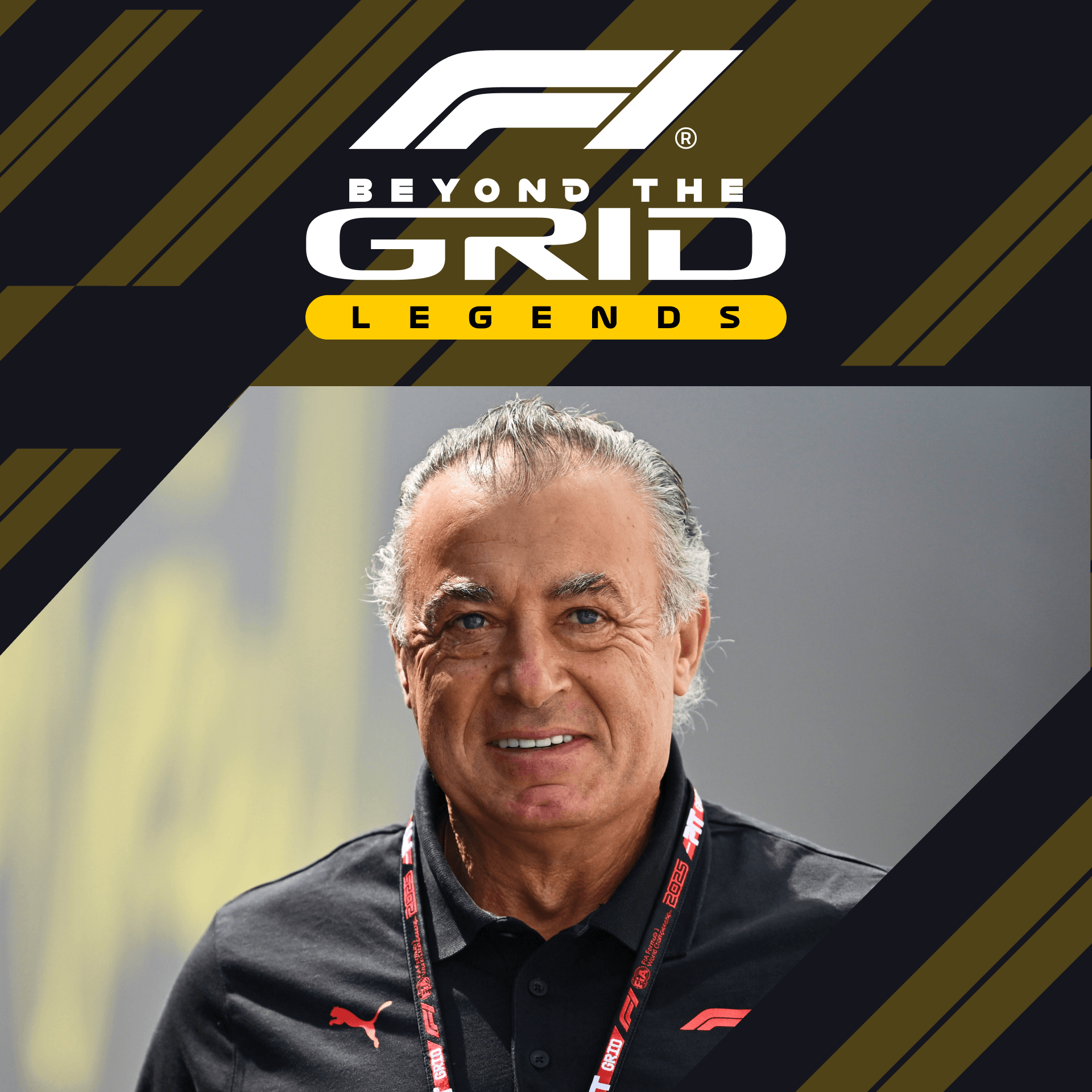
LEGENDS: Jean Alesi’s one and only win
About this episode
Jean Alesi’s one and only F1 win is traced back to Montreal in 1995, where a fragile Ferrari V12 and brutal braking demands shaped everything from qualifying to the final laps. He recalls heavy steering without power assistance, fuel-limit pressure, and late-race mechanical failures—yet highlights braking as his edge. The story also includes wet-to-slick tyre gambles, confusion over pit boards, and the emotional aftermath, including a lift from Michael Schumacher on his Benetton.
Speaking to Tom Clarkson, Jean relives the standout moments from that unforgettable moment in Montreal – like only finding out from the fans that he was leading the race, doing a lap of honour on the back of Michael Schumacher’s car, and then being whisked to the Vatican in Rome to celebrate.
He talks about the emotions he felt when crossing the finish line and what he feels now when looking back – and whether only winning one race frustrates him.
Jean also shares some brilliant stories from other times in his career – telling Tom how he helped inspire Eddie Jordan to make his own F1 team and why Ayrton Senna was somewhat bemused when Jean borrowed something from him.
This episode is sponsored by:
CarGurus: Join the millions who have already found their best deal with CarGurus.
Go to cargurus dot co dot uk for complete vehicle details without any surprises.
Vanta: Get started today at vanta.com/GRID
Shopify: sign up for your $1 per-month trial today at shopify.com/beyondthegrid
Montreal
"Well, today, can I take you back to 1995, Montreal. I'd be excited about that."
Montreal is a city in Canada that has hosted Formula One races. Here, it’s used to set the scene for the year and place of Jean Alesi’s first win.
Montreal is the Canadian city where Formula One has held races, including the Grand Prix at Circuit Gilles Villeneuve. In this segment, it anchors the timeline for Jean Alesi’s first win in 1995.
V12 engine
"Our engine we had at the time in Ferrari was a V12 engine, 17,000 revs. So, you know, all these vibrations, and you have to cross the fingers to say, please, please stay in one piece..."
A V12 engine is an engine with 12 cylinders arranged in two groups that make a V shape. In racing, it can spin very fast, and that’s part of why it feels so intense in Formula One.
A V12 engine is an engine with 12 cylinders arranged in two banks that form a “V” shape. In Formula One, the V12 was known for high-revving character—here, Jean Alesi mentions 17,000 revs, emphasizing how hard these engines were worked.
17,000 revs
"Our engine we had at the time in Ferrari was a V12 engine, 17,000 revs. So, you know, all these vibrations, and you have to cross the fingers to say, please, please stay in one piece..."
“Revs” means how fast the engine is spinning, like RPM. 17,000 revs is extremely high, which is why racing engines can feel intense and put a lot of strain on the car.
“Revs” refers to engine speed, measured as revolutions per minute (RPM). Mentioning 17,000 revs highlights how F1 engines were tuned to run extremely fast, which increases stress on components and contributes to the “fragile” feeling Alesi describes.
electrical problem
"And so you talk about the last 10 laps because, of course, Schumacher had his electrical problem here in Montreal, didn't he?"
An “electrical problem” means something in the car’s electronics isn’t working right. In a race, that can cause the engine or systems to act up and may even make the car stop.
In an F1 context, an “electrical problem” can mean faults in engine electronics, sensors, or power delivery systems that can force a driver to slow down or even stop. The segment ties it to Schumacher’s issue and the resulting race strategy stress.
on the limit with the fuel tank
"because we were really on the limit with the fuel tank. And just in lap, in a pit lane, his engine stopped, he ran out of fuel"
“On the limit” with the fuel tank means they didn’t have much extra fuel to spare. If they used more fuel than expected, they could end up stalling or running out before the race ended.
Being “on the limit” with the fuel tank means the team is operating with very little fuel margin, so small changes in pace or consumption can force a risky strategy. It highlights how fuel planning and consumption directly affect whether a car can finish.
ran out of fuel
"And just in lap, in a pit lane, his engine stopped, he ran out of fuel and I ran out of fuel in my in lap after the finish line."
“Ran out of fuel” means the car ran out of gas. When that happens in a race, the engine can’t keep running and the car may stall or stop.
“Ran out of fuel” means the engine’s fuel supply was depleted, causing the car to stop or lose power. In racing, it’s often the end result of fuel management being pushed to the limit by pace, safety cars, or unexpected mechanical issues.
circuit Gilles Villeneuve
"And can we start by talking about the track, the circuit Gilles Villeneuve? You'd always gone well here."
Circuit Gilles Villeneuve is the F1 track in Montreal. It has demanding braking and cornering, so being good at braking can make a big difference.
Circuit Gilles Villeneuve is the Formula 1 track in Montreal, known for heavy braking zones and a layout that punishes mistakes. The guest connects its characteristics to his driving strengths, especially braking performance.
push rods
"Push rods, gearbox, engines, fuel pump, everything was step by step going away, you know."
Push rods are parts inside the engine that help open and close the valves. If they break or wear out, the engine can start running poorly or stop working.
Push rods are mechanical linkages used in some engine designs to transfer motion from the camshaft to the valve train. When they fail or wear, valve timing and engine operation can degrade quickly—especially under racing loads.
fuel pump
"Push rods, gearbox, engines, fuel pump, everything was step by step going away, you know."
The fuel pump is what moves gas from the tank to the engine. If it fails, the engine can’t get enough fuel and the car may stall or run out of power.
A fuel pump is the component that pressurizes and delivers fuel from the tank to the engine. In a race car, it has to keep supplying fuel reliably under hard acceleration and high fuel demand.
power steering
"Without power steering, so the steering wheel was a bit heavy. [444.3s] But except that, we deal with it."
Power steering is a helper that makes the steering wheel easier to turn. If a car doesn’t have it, you have to use more arm strength—especially when cornering fast.
Power steering is a system that helps the driver turn the steering wheel by adding assist (usually hydraulic or electric). Without it, the steering effort becomes much higher, especially at speed and in corners, so the car feels “heavier” to steer.
downforce
"And in high speed corner with a downforce, it was very heavy. [482.3s] In hairpins with the caster heavy as well."
Downforce is air pressure that pushes the car down onto the road. More downforce usually means better grip in corners, but it can also make the steering feel heavier because the tires are working harder.
Downforce is the aerodynamic force that pushes the car’s tires toward the track, increasing grip. In high-speed corners, more downforce generally means the car can hold a tighter line, but it can also make the steering loads heavier because the tires are generating more lateral grip.
caster
"In hairpins with the caster heavy as well. [485.8s] So you had no chance really to go around with one hand and trying to change some parameters."
Caster is an alignment angle in the suspension that changes how the steering behaves. If it’s “heavy,” it can make the wheel harder to turn and more demanding in slow, tight corners.
Caster is the suspension geometry angle that affects steering feel and self-centering. In racing cars, caster can increase steering effort and stability, so if “caster” is heavy, the wheel may require more force—especially in tight turns like hairpins.
Gerhard
"Look, final sort of preparation point about Montreal is you're with Gerhard, right? [499.1s] You've mentioned his name. [500.1s] He's your teammate."
Gerhard is the name of Jean Alesi’s teammate. Jean says they got along well and respected each other’s speed, which helped them work together while still fighting hard in races.
Gerhard refers to Gerhard Berger, Jean Alesi’s teammate during their Ferrari years. Alesi describes their on-track competitiveness and off-track relationship as built on mutual respect and similar pace.
Alan Prost
"How different was he to Alan Prost? Because when you moved to Ferrari, Alan was your teammate. [550.5s] Yeah, with Alan was absolutely different because Alan is the only driver I know."
Alain Prost was Jean Alesi’s teammate at Ferrari. Jean explains that Prost had a very different attitude toward teammates—more focused on himself and the job than on how the teammate fits in.
Alan Prost refers to Alain Prost, Jean Alesi’s teammate at Ferrari. Alesi contrasts Prost’s approach—where Prost didn’t “care about the teammate”—with Alesi’s own experience, highlighting different team-mate dynamics at the top level.
Fiorano
"So when I arrived in Fiorano, I remember very well this day, I had all the Ferrari available for me... because it's a short circuit in Fiorano. It's a 59-second lap."
Fiorano is a track Ferrari uses to test cars and help drivers learn them. Because it’s short and twisty, changes to the car’s setup show up quickly.
Fiorano is Ferrari’s private test track in Italy, used for development and driver evaluation. It’s known for short lap times and tight corners, so small setup changes can feel dramatic.
setups
"OK, what do you want to do? And I said, I'd like to drive the car with two different setups... They prepared the car."
In racing, a “setup” is the chosen configuration of the car—like suspension, aero balance, and steering feel—tailored to a driver’s preferences and the track. Alesi is describing trying two different setup philosophies to compare how the car behaves.
Nigel Mansell
"I'd like to drive the car with two different setups, Nigel Mansell and Alan Prost... Then I drove the Nigel Mansell setup."
Nigel Mansell is a famous F1 champion. Alesi is saying he tried a car setup based on Mansell’s driving style and it felt very different from another driver’s setup.
Nigel Mansell is a legendary Formula 1 driver known for aggressive driving and strong car control. Here, Alesi is comparing a “Nigel Mansell setup” to an “Alan Prost” setup to highlight how different drivers’ styles demand different car behavior.
traction
"they said, no, this car is too easy. I mean, I have a good traction. I have too much understeer in this place."
Traction is how well the tires grip the track. You can have good grip overall, but still have a handling problem if the car’s balance makes it turn poorly.
Traction is how effectively the tires can grip the road surface to transmit acceleration and cornering forces. Alesi notes he had “good traction,” even though the car still had too much understeer, pointing to a balance issue rather than outright grip.
understeer
"I have a good traction. I have too much understeer in this place. And they start to change the setup..."
Understeer is when the car doesn’t want to turn as sharply as you steer. Instead of rotating into the corner, it feels like it pushes outward.
Understeer is when a car turns less than the driver expects—so it tends to push wide toward the outside of the corner. Alesi says the Alan setup gave him “too much understeer,” meaning the car’s balance wasn’t right for that corner.
steering wheel was not coming back
"You had no surprise because the steering wheel was not coming back on the other direction, on the bumps and stuff like that."
If the steering wheel doesn’t return smoothly after hitting bumps, it can feel strange or unpredictable. That usually means the car’s steering and suspension are set up in a way that changes how it reacts over rough parts of the track.
When the steering wheel “doesn’t come back” after bumps, it suggests reduced self-centering or altered steering response—often tied to suspension geometry, steering rack behavior, and tire grip. Alesi uses this as a clue that the car’s setup and mechanical behavior were different between drivers’ preferences.
Jean Todd
"Were you aware of that speculation and what did Ferrari boss Jean Todd told you, if anything? ... I came to him and I asked him and he said no."
Jean Todt (spelled “Todd” in the transcript) is a key Ferrari leadership figure from that era. Alesi is saying he asked him about whether Schumacher would join Ferrari.
“Jean Todd” appears to refer to Jean Todt, the Ferrari team principal/manager figure associated with the Scuderia during the 1990s. Alesi says he asked this person directly about Schumacher’s rumored move.
Grand Prix weekend
"How much did you change the car during the course of a Grand Prix weekend and specifically here?"
A Grand Prix weekend is the whole event leading up to the race. It includes practice, qualifying (to decide your starting position), and then the race on Sunday.
A Grand Prix weekend is the multi-day event structure around an F1 race, including practice sessions, qualifying, and the race itself. Teams use practice to dial in the car, then qualifying to set the starting grid, and the race to execute the final strategy.
Monaco
"So here you have to be very careful like in Monaco, the evolution of the circuit is massive."
Monaco is the tight, twisty street track in F1. Because it’s so narrow and slow, the car setup and track grip changes matter a lot.
Monaco is the famous F1 street circuit known for tight corners, limited overtaking, and a setup that’s extremely sensitive to grip changes. Alesi notes the circuit’s “evolution” over time, meaning the track surface can change lap-to-lap.
radite
"You need to be only concentrate of the radite because we had a lot of fuel at the beginning of the race and in qualifying, of course, we qualified with an empty tank. But you had to make the car very low but not too low to have some issue in the fast corners."
“Radite” sounds like it means “ride height,” which is how close the car sits to the ground. Going lower can help the car feel faster, but if it’s too low you can hit the ground or get instability in fast corners.
“Radite” appears to be a transcription error for “ride height,” which is the car’s ground clearance. Alesi says they had to run it very low for speed but not too low to avoid problems in fast corners.
empty tank
"You need to be only concentrate of the radite because we had a lot of fuel at the beginning of the race and in qualifying, of course, we qualified with an empty tank."
“Empty tank” means the car has very little fuel during qualifying. Less fuel makes the car lighter, which usually helps it go faster for one lap.
An “empty tank” qualifying run means the car starts qualifying with minimal fuel to reduce weight and improve lap time. Because fuel mass affects acceleration, braking, and tire wear, teams manage fuel levels carefully between qualifying and the race.
new tyres
"Not so much because we waited the end of the session and we had three go with three set of new tyres."
“New tyres” means fresh tires with full grip. Teams often save them for the most important part of a session so they can see how fast the car really is.
“New tyres” refers to using fresh tire sets to maximize grip for a specific session or run. Alesi says they waited until the end of practice and then did three runs on three sets of new tyres to judge the car’s potential.
overdrive
"No, something went wrong. I think if I remember very well I overdrive."
Here “overdrive” means driving too aggressively for the grip available. It can cause you to enter corners badly—like going in too fast or braking too late—so the car doesn’t behave the way you want.
In this context, “overdrive” means pushing the car beyond what the tires and traction can consistently handle—often leading to overshooting corner entry and losing the optimal line. Alesi links it to being late on throttle and braking at the wrong point.
late on throttle
"Overshooting the corners, be late on throttle."
“Late on throttle” means you wait too long to start accelerating after a corner. That can make the car slower and harder to control because you’re not using grip at the right time.
“Late on throttle” describes delaying the moment you start accelerating out of a corner. In F1, that timing affects traction and balance, and it can compound other issues like overshooting the corner entry.
warm-up
"And I didn't make a very good qualifying but on Sunday we had a warm-up. It was wet?"
A “warm-up” is a short session right before the race to get the car and tires ready. If conditions are wet, it helps you understand how the car will behave at the start.
A “warm-up” session is a short pre-race period used to bring tires and brakes up to operating temperature and confirm the car’s setup. Alesi says it was wet and that he was P1, then used that as a cue for how to approach the opening laps.
over-shooting a corner
"And then it's what we call over-shooting a corner, over-driving. [1243.5s] Because you don't know what is the limit of your car or you don't feel the limit of the car."
Over-shooting a corner is when you don’t make the turn correctly and end up going too far past where you meant to. It usually happens when the car is going too fast for the available grip.
Over-shooting a corner is when a driver enters too fast or turns too late, causing the car to go past the intended apex and run wide. It’s often linked to exceeding the grip limit and misjudging braking/turn-in timing.
over-driving
"And then it's what we call over-shooting a corner, over-driving. [1243.5s] Because you don't know what is the limit of your car or you don't feel the limit of the car."
Over-driving is when you push the car harder than it can safely handle. In slippery conditions, that can quickly lead to mistakes because the tires don’t have as much grip.
Over-driving means pushing the car beyond what the tires and brakes can consistently handle, even if the driver feels they’re “in control.” In wet or changing conditions, over-driving is more likely because the grip limit is harder to sense and predict.
wet
"So we've discussed the race morning warm-up. Your fastest, it's wet. [1258.6s] It then stops raining but there are still damp patches at the start of the Grand Prix."
“Wet” means the track has water on it. When it’s wet, tires grip less and it’s easier to lose control, so drivers often switch to rain tires.
In racing context, “wet” refers to track conditions where water reduces tire grip and increases the risk of hydroplaning. That changes braking distances, cornering limits, and tire choice (rain tires vs slicks).
Nürburgring
"And during this year in 1995, I started with slick tyres in Nürburgring. [1286.1s] In the middle of the race, I had one minute lead to the second."
Nürburgring is a legendary race track in Germany. It’s known for being tough and for changing conditions, which makes tire choice and driving technique really important.
Nürburgring is a famous motorsport venue in Germany, best known for the Nordschleife (the long “North Loop”) and the modern Grand Prix circuit. It’s often used as a benchmark because weather and grip can change dramatically lap to lap.
slick tyres
"And during this year in 1995, I started with slick tyres in Nürburgring. [1286.1s] In the middle of the race, I had one minute lead to the second."
Slick tyres are race tires with smooth rubber and no grooves. They work best when the track is dry or almost dry, because they can grip the road better than treaded tires.
Slick tyres are race tires with no tread pattern, designed to maximize contact and grip on dry or drying track surfaces. They shed water poorly, so they’re unsafe in standing water or heavy rain compared with rain tires.
penalty drive-through
"Then in Suzuka, I had the penalty drive-through. [1295.6s] I came in, I did another lap."
A drive-through penalty means you have to go through the pit lane at the allowed speed, without doing a pit stop. It’s a time penalty that can affect your race strategy and tire plan.
A drive-through penalty is a race sanction where a driver must enter the pit lane and pass through at the regulated speed without stopping for service. It costs time immediately and can force changes in tire and strategy decisions.
Suzuka
"Then in Suzuka, I had the penalty drive-through. [1295.6s] I came in, I did another lap."
Suzuka is a major Formula 1 race track in Japan. Like many tracks, it can get tricky when the weather changes, so tire choice matters a lot.
Suzuka is a well-known Formula 1 circuit in Japan, famous for its distinctive layout and high-speed corners. Tire strategy is especially important there because grip can vary with weather and track evolution.
rain tyres
"When I came in, in this condition, it was wet. [1302.8s] Everybody and myself had to start with rain tyres."
Rain tyres have grooves that help push water out of the way. That helps the tire stay in contact with the road when it’s wet, reducing the risk of skidding on a water layer.
Rain tyres are treaded racing tires designed to channel water away and maintain grip in wet conditions. Their tread pattern helps prevent hydroplaning, but they generally offer less outright grip than slicks on a fully dry surface.
pits
"I came out of the pits after two corners and maybe you exaggerate, but I was so upset, I pushed, pushed, pushed."
The pits are where the team stops the car to do things like change tyres. When you stop there, you can lose or gain positions depending on timing and how fast the stop is.
The pits are the area where an F1 car stops for service, most importantly tyre changes and adjustments. A pit stop can dramatically change track position, especially during changing weather.
Michael Schumacher
"I pass everybody, I catch Michael. And when Michael, because we talk about together after the race, on the radio, he called the team..."
Michael Schumacher is one of the most famous F1 drivers ever. Here, the story is about Alesi trying to catch him during the race and how their positions changed.
Michael Schumacher is a legendary German Formula 1 driver known for multiple World Championships and a dominant racing style. In this segment, Alesi describes chasing Schumacher and the radio/strategy moments around their positions.
box boom
"And then he started to worry a bit and then Michael box boom."
In F1, “box” means the pit stop area. The “boom” is basically how he describes the sudden pit-related communication that changes what happens next.
“Box” is F1 slang for the pit lane/box where cars stop for service. The “boom” here is an on-air, radio-style way of describing the pit call/communication moment that triggers a change in strategy or timing.
Damon Hill
"you end up taking P2 from Damon Hill. He's going for it now, he's going to try and go down the inside of course."
Damon Hill is a well-known British F1 driver who won the World Championship in the mid-1990s. In this story, he’s the driver Alesi overtakes to move up to second place.
Damon Hill is a British Formula 1 driver and World Champion (1996). In this segment, he’s referenced as the driver Alesi ends up taking P2 from, highlighting how late-race position changes can happen.
P2
"you end up taking P2 from Damon Hill."
P2 means second place. It’s the ranking position the driver is in during the race.
P2 means “position 2,” i.e., finishing or running in second place. In F1, position changes like this are often the result of pit timing, tyre choice, and on-track overtakes.
down the inside
"He's going for it now, he's going to try and go down the inside of course. Damon Hill out, and he's done it."
“Down the inside” means overtaking by going on the inside of a turn. It’s often done by braking later and trying to get the car positioned to pass at the corner.
“Down the inside” describes an overtaking move where a driver attacks the inside line at a corner, aiming to get alongside and pass before or through the apex. It’s a common racing phrase because corner geometry and braking zones make it a high-risk, high-reward move.
Jean Alesi
"And look at John Alessi out of the cockpit. [1658.1s] Has he kept the engine running? No, he has not. [1665.5s] ...overcome with emotion in front of this enthusiastic Canadian crowd with so many Ferrari flags."
Jean Alesi is a Formula 1 driver. The host is describing him getting out of the car and celebrating, then getting a ride back after the race.
Jean Alesi is a well-known Formula 1 driver, famous for his passion and distinctive driving style. In this segment, the host recounts Alesi getting out of the cockpit and celebrating in front of a crowd with Ferrari flags, then riding back with Schumacher.
out of the cockpit
"And look at John Alessi out of the cockpit. [1658.1s] Has he kept the engine running? No, he has not."
The cockpit is where the driver sits and controls the car. “Out of the cockpit” means he climbed out of the driver seat after the moment they’re talking about.
The cockpit is the enclosed driver compartment in a race car. “Out of the cockpit” here describes Jean Alesi getting out of the car after the race, which is part of the emotional aftermath the host is recounting.
engine cover
"How was the ride back on the back of Michael's Benetton? [1698.8s] I burned my butt because I was on the engine cover and, you know,"
The engine cover is the panel that sits on top of the engine area. In a race car it can get extremely hot, so it’s not a safe place to sit.
The engine cover is the body panel over the engine bay. In an F1 car, it’s a shaped, exposed surface that can get very hot, and the host mentions burning himself while sitting on it.
Ferrari
"we came in a chapter when Michael started to join Ferrari... Let's bring it on to today. What do you make of Ferrari in 2026?"
Ferrari is the famous Italian racing team in Formula 1. In this part, the guest is describing how strongly he feels connected to Ferrari and how fans still feel that way.
Ferrari is the Italian Formula 1 team and car manufacturer that Alesi raced for during his career. In this segment, he talks about Ferrari’s emotional pull for fans and his personal connection to the team.
Monza
"My biggest, if I have to speak about frustration, it's the last Grand Prix I did with Ferrari in Monza."
Monza is a famous race track in Italy that hosts Formula 1. It’s known for being very fast and loud, and it’s been used for F1 for decades.
Monza refers to the Autodromo Nazionale Monza in Italy, one of Formula 1’s most historic circuits. It’s known for high-speed racing and is a frequent host of the Italian Grand Prix.
Formula One
"And although you went on and had many years afterwards in Formula One, were you always a Ferrari fan even when you weren't racing for them?"
Formula One is the highest level of open-wheel racing. It’s a championship where teams race around the world on different tracks.
Formula One (F1) is the top tier of open-wheel motorsport, run as a global championship with teams and drivers racing on circuits worldwide. It’s the series Alesi continued in after his Ferrari period.
steward
"Even if you had a fight with another driver on the circuit, [2471.7s] it was a question in between him and you. [2476.4s] Now it's in between you, the driver, and the steward."
A steward is an official in Formula 1 who watches the race and decides if something needs a penalty. They’re basically the rule-enforcers between the drivers and the race officials.
In Formula 1, a steward is an official who reviews incidents and applies race control decisions, such as penalties for on-track behavior. When Alesi says it’s now “in between you, the driver, and the steward,” he’s pointing to how much more the sport is governed by formal officiating compared with earlier eras.
200 kg of fuel
"Back to Montréal one day, he had the Ford engine, and I had my Ferrari. [2553.9s] Beginning of the Grand Prix, we had 200 kg of fuel."
That’s how much fuel the car started the race with. More fuel means the car is heavier at the start, and as it burns off the car gets lighter during the race.
“200 kg of fuel” refers to the amount of fuel loaded at the start of a Grand Prix, which directly affects car weight and therefore handling and tire wear. In older F1 regulations, cars carried much more fuel at the beginning, so the car became lighter as the race progressed.
hairpin
"First lap, he passed me at the hairpin, and we made the whole hairpin together."
A hairpin is a super tight turn, like a near-U-turn. In a race, it’s a place where drivers often brake hard and try to set up an overtake.
A hairpin is a very tight, slow-speed corner that forces the car to turn sharply—often nearly 180 degrees. In racing, it’s a common overtaking and braking zone because drivers can gain or lose a lot of time exiting the corner.
Montréal
"When I think of you and Ayrton, I mean, that's a lovely story that you've told us about Montréal,"
Montréal is the city in Canada where F1 races are held. The host is reminding listeners of a past story connected to that race weekend.
Montréal refers to the Canadian city that hosts Formula 1 races (notably at Circuit Gilles Villeneuve). The speaker is referencing an earlier story tied to Montréal, using it as context for how drivers trust each other and manage racecraft.
Phoenix 1990
"but who can forget Phoenix? Yeah. Phoenix 1990."
Phoenix 1990 is a reference to a particular race in 1990. They’re using it to explain why one situation turned out differently than another.
Phoenix 1990 is a specific race reference (Phoenix area) used to frame a comparison between two different overtaking/handling situations. The speaker says it was different because of the tire situation and track grip.
Pirelli
"In a Tyrell. But that was different because we had the Pirelli tires. And on the low grip condition, these tires was amazing."
Pirelli makes the tires. In F1, the tire choice can make a huge difference—here they’re saying the Pirelli tires worked really well when the track had low traction.
Pirelli is a tire manufacturer and one of the key suppliers in Formula 1. In this story, the speaker credits Pirelli tires for working especially well in low-grip conditions, which can strongly affect race pace and confidence.
low grip
"But that was different because we had the Pirelli tires. And on the low grip condition, these tires was amazing."
Low grip means the tires have less traction because the track surface (or conditions) isn’t allowing rubber to bite well. That changes braking distances, cornering limits, and how aggressively a driver can accelerate without sliding.
Request an Explanation
Heard something you'd like explained? We'll add it to this episode.
Sign in to request explanations for terms you heard.
Want to learn more?
Browse our glossary for plain-English explanations of automotive terms, jargon, and concepts.
Help improve this episode
See something that's not quite right? Our annotations are AI-generated and can sometimes miss the mark. Click the flag icon on any annotation to suggest a correction.