Formula One is the highest level of professional auto racing. The segment is saying Cadillac is connecting its performance car lineup to racing success in F1.
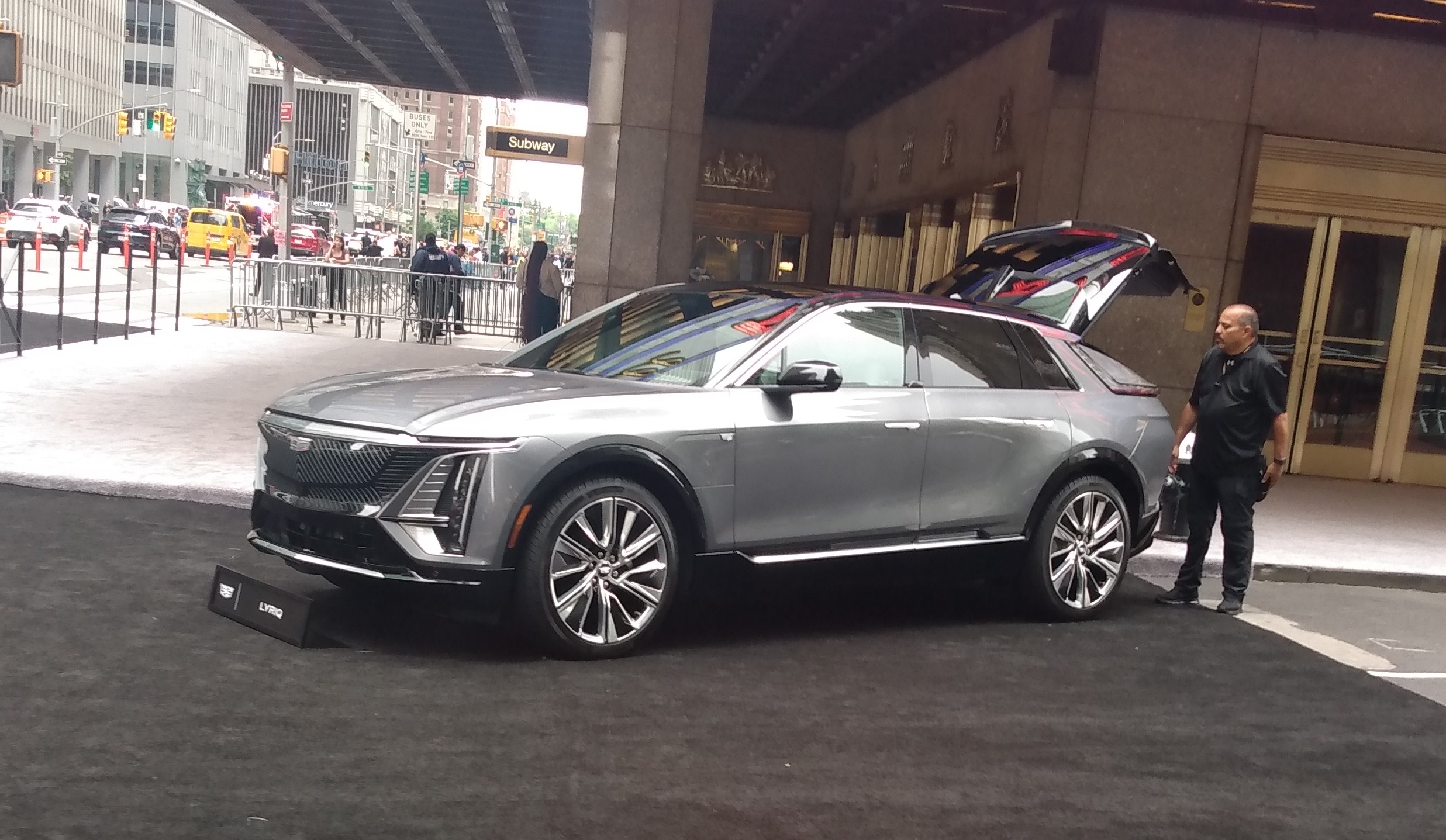
The Cadillac Lyriq is an electric SUV from Cadillac. It uses electricity instead of gasoline and is built to feel quick and smooth. When people talk about the “quickest” Lyriq, they mean a higher-performance version within the electric SUV lineup.
Car
CT5V Blackwing
This is a high-performance version of the Cadillac CT5. “Blackwing” is Cadillac’s way of saying it’s the more serious, enthusiast-style model.
This is a Cadillac model with the “V” performance branding. The point here is that it’s meant to feel quick and nimble compared with a regular version.
This is a high-performance Escalade. It’s still a big luxury SUV, but the “V” badge means it’s been tuned to feel more exciting and powerful.
Place
Salber
Salber sounds like the team’s base or factory area. When someone says it hasn’t changed much in decades, they’re basically talking about how the team’s setup and day-to-day operations stayed similar.
A wind tunnel is a place where they blow air over a car model. It helps engineers figure out how slippery the car is and how much “push down” it gets for grip.
Kimi Räikkönen (spoken here as “Kimi Raikkon”) is a former Formula 1 driver whose transfer/sale is being linked to funding for a wind tunnel. In F1, driver moves can directly change team budgets, which then affects development resources like aerodynamics testing.
A power unit is the car’s main engine-and-energy system. It includes the engine plus extra parts that store and reuse energy to help the car accelerate more effectively.
Neuburg is a place the team uses for building key engine technology. When they say the power units are designed and built there, they mean that’s where the most important engine-related parts are developed.
Hinwil (spoken as “Hinville”) is a place in Switzerland tied to an F1 team’s base. Here it’s mentioned to talk about how close or far key facilities are.
The chassis is the car’s main frame—the part that holds the driver and all the key components together. In F1 it’s separate from the engine package, which is the power unit.
Sauber is an F1 team. The speaker is saying their team is already set up at the Swiss site, with lots of staff and skills, so moving everything isn’t realistic.
Ferrari is a famous Formula 1 team. In this part of the conversation, it’s mentioned to explain how organizing the car’s main systems in one place can help engineers work together.
“Synergies” here means advantages from having the car’s main systems work closely together. If the chassis and engine team are coordinated, it can be easier to make changes and get better overall results.
Red Bull is a top Formula 1 team. They’re mentioned here as an example of a team that can still win even when the engine and car development aren’t all in the same place.
Place
Bister
“Bister” is where the speaker says they have a facility in the UK. The idea is that having a base there helps the team operate more effectively.
“Motorsport Valley” is a UK area known for lots of racing-related companies and engineering talent. The speaker is saying being near that cluster matters.
The Audi Quattro is a famous rally car from Audi. Its big deal was four-wheel drive, which helps it grip the road better on dirt and gravel so it can accelerate and turn more confidently.
A V8 is an engine with eight cylinders arranged in a V shape. In this context, it’s being mentioned as a possible future engine type if the rules change.
Term
V6, V8
V6 and V8 are two different engine types. Switching between them can change how the engine is built and how it performs, especially for fuel efficiency.
They’re describing how F1 teams can cooperate when it comes to the rules. Even though they compete on Sunday, they may still talk together to help make the regulations work for everyone.
The Ferrari 195 S is an old Ferrari race car built for sports car competition. It’s remembered because it represents an important time in Ferrari’s racing history and engineering development. When it comes up in an “engine guy” discussion, it’s usually about how the car’s power and design were built for racing.
Person
Jean Todd Ross
Jean Todd Ross is a person the speaker credits as a strong leader/manager they worked with. In this segment, she’s mentioned to support the speaker’s point about learning from good leadership.
Michael Schumacher is one of the most famous F1 drivers ever. Here, the speaker isn’t talking about lap times—he’s talking about Schumacher’s leadership and influence on the team.
McLaren is one of the famous Formula 1 teams. The speaker says the team culture being built at McLaren comes from the same kind of mindset they learned earlier.
“Winning culture” is the team’s attitude and habits that make people focus on getting results. In this context, it means working hard together and aiming for improvement rather than pointing fingers.
“No blame culture” means the team doesn’t try to find someone to blame when things go wrong. The goal is to learn from problems and improve as a group.
“Team spirit” is how well the group works together and supports the same goals. Here, the speaker says it matters because it keeps everyone pushing in the same direction.
“Complexity” here means Formula 1 has become harder to manage because there are more moving parts and decisions. The speaker is saying the sport has changed, so it’s worth asking what still applies from earlier eras.
Hybridization means the car uses a hybrid power system that can store energy and use it later. In F1, that adds extra engineering work, so teams need more people and more budget.
Jonathan Wheatley is a senior leader in Formula 1. In this part, they talk about him leaving the team principal role and what that meant for the team’s changes.
Alan McNich is a senior racing official. Here, they explain he’s taken over operational responsibilities as racing director, and that his first weekend was extremely challenging.
A racing director is a key official who helps run the team’s race-day operations. They coordinate what happens on track and how the team responds during a race weekend.
Formula 1 is the highest level of car racing with open-wheel race cars. In this part of the show, it’s the reason Cadillac is talking about performance and credibility.
The Cadillac Optiq is a smaller electric SUV made by Cadillac. It’s meant to be easier to drive and more agile than bigger vehicles, while still using electricity. In a lineup comparison, it’s often described as the “nimble” electric option.
Gabriel Bortoleto is a younger Formula 1 driver mentioned as someone the team is trying to develop. The guest is basically saying one driver brings experience while the other is still learning and being coached.
Nico Hülkenberg is a Formula 1 driver. Here, the guest is praising him for being consistent, easy to work with, and good at getting the most out of the car during race weekends.
In F1, a podium means finishing in the top three of a race. It’s a big deal because it usually comes with trophies and lots of championship points.
Person
Mattia Binotto
Mattia Binotto is a key person in Formula 1 leadership. Here, he talks about how he thinks about drivers and what it takes for a team to be competitive.
Fernando Alonso is one of the most successful and experienced F1 drivers ever. Here, Binotto explains that Alonso wasn’t a major factor in the negotiations he’s talking about, except in a limited way.
A “destination team” is a team that top drivers want to sign with. It usually means the team is strong enough to help them win races and championships.
Max Verstappen is one of the best drivers in Formula 1. The speaker is saying Audi would need to be truly competitive before it could attract someone of his caliber.
Here, “platform” doesn’t mean a physical part of the car. It means the team’s setup and competitiveness—whether it can give a driver a real shot at winning.
Carlos Sainz is an F1 driver. They’re talking about his earlier team discussions and why the speaker wasn’t disappointed by his decision to go to Williams.
The Dodge Challenger is a car built for strong acceleration and performance. It’s often discussed in racing and car communities because teams can modify it to compete better over time. In that sense, it can represent a car that starts out improving and then becomes a real contender.
“Drivability” is how easy and consistent the car feels to drive—how smoothly power delivery responds to the driver’s inputs. In F1, it’s often tied to engine mapping, control software, and how the hybrid system behaves under acceleration and traction changes.
The simulator is a virtual test environment for the race car. Engineers and drivers can study how changes might affect handling and speed without needing to run on track every time.
Telemetry analysis means using data from the car during driving to figure out what’s going on. GPS-based data helps teams compare laps and pinpoint where performance is lost.
Term
in season 26
“In-season” means upgrades you bring during the year, not just at the beginning. It’s a measure of how fast the team can develop and deliver improvements to the race car.
Mattia Binotto is a person who helps run and lead Formula 1 teams. In this interview, he talks about why he came back and what he thinks Audi needs to do to get better.
They mention 2028 as a target year. It’s basically the next point in time when Audi expects to make a big step forward in Formula 1.
LIVE
This episode is sponsored by Indeed.
There's a lot that goes on behind the scenes of this show,
booking guests across time zones,
tight turnaround edits, and constant time management.
When things get chaotic,
you realise pretty quickly how important it is to have the right person on your team.
If I had to hire someone tomorrow,
I wouldn't just want a good editor.
I'd want someone who understands pace in long-form interviews and can work fast under pressure.
In moments like that, you think,
this is a job for sponsored jobs.
Because Indeed sponsored jobs boost your listing in search results,
helping you reach the candidates with the specific skills and experience you actually need.
And it works.
Sponsored jobs posted directly on Indeed
are 95% more likely to report a hire than non-sponsored jobs.
That's a serious edge when the pressure's on.
Spend less time searching,
and more time actually interviewing candidates who check all your boxes.
Less stress, less time, more results.
When you need the right person to cut through the chaos,
this is a job for Indeed sponsored jobs.
And listeners of this show will get a $75 sponsored job credit
to help get your job the premium status it deserves at Indeed.com slash podcast.
Just go to Indeed.com slash podcast right now
and support our show by saying you heard about Indeed on this podcast.
Indeed.com slash podcast.
Terms and conditions apply.
Need to hire?
This is a job for Indeed sponsored jobs.
Cadillac has entered Formula One,
deepening the racing pedigree behind every V-Series on the road.
Discover a lineup that delivers pure adrenaline in the form of modern luxury.
Experience the quickest Cadillac ever,
the all-electric Lyric V,
the peak performance of the CT5V Blackwing,
the nimble agility of the OPTIQ V,
and the legendary Roar of the Escalade V,
all engineered to thrill.
Find out more about Cadillac's performance story in Formula One
and our race-tested V-Series lineup at Cadillac.com.
It's those in-between moments.
That's where the ideas hit.
Conversations stretch out.
Little memories sneak up on you.
Sometimes it's just about what's in your hand.
That color.
That chill.
The new tropical butterfly refresher from Starbucks.
Quava and passion fruit flavors with mango pineapple flavored pearls.
Yeah, that feels like summer before you even taste it.
Funny how one small stop becomes the best part of the day.
Start your summer rhythm with Starbucks.
Try the new tropical butterfly refresher from Starbucks.
Audi has joined and they are becoming serious.
No stones unturned.
Moving forward, we're raising the bar and the challenge
to become better each single race.
I've been lucky because I have a lot of great leaders and managers.
Starting from Jean Todd Ross, even Michael Schumacher was a great leader.
I feel that he was even stronger as a leader than as a driver.
Hi everyone.
I'm Tom Clarkson and this time on F1 Beyond the Grid,
I'm talking to a team boss trying to turn a group of great people into winners.
Mattia Bonotto has seen how it's done.
He was at Ferrari in the 2000s when Jean Todd, Ross Braun and Michael Schumacher
led the way to title after title.
So can Mattia do it with Audi?
He and the brand bring ambition and resources,
which weren't there when the team raced as Sauber.
That brings pressure.
Audi set themselves the target of fighting for the championship by 2030.
Mattia admits that's ambitious.
But as you'll hear, he's happy to take on that challenge
and he's confident that the ingredients needed are being put in place.
Mattia, it's great to have you on the show again.
It's been six years since you were last on.
My pleasure to be here again, as you said.
You don't look a day older.
No, but I don't know, time is flying.
Six years I couldn't imagine.
How different is your life at Audi?
Because when you were last on your team principle,
you were running all things Ferrari in Formula One.
How different is your life now?
It's very different because I think different companies
and different stages of the process of developing.
So Ferrari is a very settled organization.
Audi and F1, not as Audi, but Audi F1 team is really a team
that has to become a competitor for the title.
But it's a long way for us.
It's different countries, so really different language, different culture.
I've been in Ferrari for 30 years, so I knew Ferrari very well.
I knew each single person, maybe by name.
I knew each single corner of the company.
And now for me, it's a learning process.
It's brand new.
As we said, different countries, different language,
different culture, different governance.
And certainly when you look at the governance in Ferrari,
compared to the big corporate of Audi, it's a different one,
which is not simply different.
It doesn't mean what is right or wrong.
I think at the end, it's based on my experience,
having seen differences, get the most out of it.
But it's a change on which I'm happy with.
Because at the end, it's like restarting with a new challenge.
It's enjoyable, keep me young.
Does it feel like coming home?
Because you were born in Switzerland in Lausanne.
Yeah, it feels like because it's back to Switzerland,
but I'm born and grow up in the French part of Switzerland.
Here, Zurich, is the German side.
And in Switzerland, two different cultures at the end of French and German.
So it's Switzerland, so it's back to the mountains, the Alps, the lakes.
But certainly it's not Lausanne.
It's certainly a different area, a different culture.
Can we talk about Hynville and what Audi have bought in their purchase of Sao Paulo?
I mean, you said not so long ago that it is actually easier
to start from scratch than to buy an existing team.
What did you mean by that?
It's not a comparison to different realities.
But when you look at our challenge, it's about transforming a team.
Because Sao Paulo at the time has been a great team,
a fantastic team, a private team in F1 competing for the best they could do.
But it was more a matter of participating,
being sustainable from a financial perspective.
Obviously not having the ambition to win and to be,
let me say, the winning team in F1.
So it was a completely different ambition.
And here when you need to transform, because then it's about transforming.
It's not building only.
It's transforming a team.
It's not only about the infrastructure, the buildings to expand.
The process is really changing habits, mindset, behaviors to the people,
people that were used not to spend, not to invest,
to do the best out of maybe not little money, but the money you had.
While here now it's a different ambition
with all the means and resources which are required.
So sometimes if you for many years, maybe 30, 20 years,
you were used simply not to spend and now you need to change your mentality.
That's the most difficult challenge.
I think that's really our challenge at the moment.
It's about culture transformation.
So as I said, yes, it's about as well infrastructure expansion.
Manufacturing capacity, expansion, team size, skills.
But the most difficult and that's what I was meaning by it is harder.
On top of that, you need to change people mindset, approach, behaviors,
towards the required.
Interestingly, I can relate to a lot of what you've just said.
I first went to Salber in 1998 and then I came a few months back
and you showed me around what you've got now.
And it didn't feel that different to 1998.
There's the wind tunnel, of course,
which was the result of the sale of Kimi Raikkon and back in the early 2000s.
But beyond that, there was a lot that was the same as 30 years ago.
So as you said, the team infrastructure, the buildings
have remained the same for many, many years.
The last, let me say, expansion was BMW, but that's it.
While today, if you look what would be required,
if the benchmark are the top teams of today,
we need more space, buildings, expansion and that's our challenge.
And if you look where we are, not much space,
even no parking slot for our employees.
So we need really to expand knowing that there is not much space there around.
So that's one of the challenges we have.
And do you have some ideas about how you can do that?
We have ideas. We've got a plan.
I think we've got as well a very ambitious, a great plan.
I have to say, luckily as well, we found some solutions
that now we are going through in terms of projects.
But yes, I can say we've got a proper plan for that.
But we can't talk about it now, right?
But this begs the question, I think, that, what is it?
Neuburg, where the power units are designed and built,
is what, 280 miles from Hinville?
Did you think about putting the chassis on the same site?
We considered it, as much as we even considered maybe to build the team in UK or in Italy.
But first, an existing team, the Sauber team was in Inville, 600 people.
So first, the team exists, so you can't move it, honestly.
And still, so 600 people had F1 skills, had proper skills and are based in Inville.
So on top of that, I believe that Switzerland
may become a competitive advantage.
It's a great place to live.
I think once you have attracted the right people,
the people will retain, will stay.
And they can't get poached by another F1 team, because you haven't got any.
Or if they would be approached, they would stay again,
because I think they will be in the best place and in the right place to stay and to work.
So we simply need to transform Hinville and Neuburg in our competitive advantage.
Just out of interest, what advantages did you see when you were at Ferrari,
when you had the chassis and the engine under the same roof?
Certainly the synergies are better, but it's not such a big obstacle being distant.
Now, if you look all the other teams, do not have the chassis and the power unit together.
Red Bull has won many years with an engine from Japan.
So the distance is not a true obstacle.
And for us, it's a three-hour drive, so again, I would call it very close.
You did mention the UK. You have a facility in Bister.
How important is it for you to have a foothold in the UK, in Motorsport Valley in the UK?
It is very important.
That's why somehow we open it for many reasons.
As you said, in the motor valley, you've got the knowledge and the competence and the skills.
It's a way of being close to high potential.
It's an entry point to our team, because often when you approach, maybe people for the teams,
difficult for them to move because of housing, kids, schooling, whatever,
the wife having a job, and maybe it's not the right time in the year to move.
So while somehow having their Bister, it can be a first and entry point to the team.
We've said we need to ramp up in terms of team size, but the most we are hiring are
young graduates, which is our investment for the future.
We've got an ambition in fighting for a championship in 2030.
So we can afford that. We can afford that investment.
And pretty sure that the young graduates in 23 years' times
will be the foundations of our winning team.
So you're going to grow the team organically.
When you look at the gap between where you are now and Mercedes and Ferrari and the rest,
is there a silver bullet in the shape of an Adrian Nui-type figure that you need,
or are you going to grow internally?
No, we will grow internally.
Today, the complexity, I think, of our product of our F1 vehicle from the power unit to the chassis
such as not a single person would believe will make the difference.
It will be more a team effort as well in terms of competence and skills.
And I believe in that. yours. diversity.
And I think that are the strategic advantage that you may have in the future.
It will take time. As I said, all the investments, you do not have an immediate return on it.
So we know that by investing on young people, first you will need to onboard them.
You need to coach them. You need to develop them.
But the energies I have, we mentioned the change of culture and mentality.
That's a good way of doing it, because the energy, the vibes that are bringing to the team,
it's outstanding. And if you come today in our team in Inville or in Neuburg,
the average age you will see is very, very young. It's a very young team.
I'm somehow proud of it. I'm the oldest. I'm really an all-clown.
It's 25, 27, 20. That's really the people you meet.
This episode is sponsored by car gurus. I think one of the most stressful things about
buying a car is that deep down, most of us are slightly worried that we're about to overpay
for something or get a nasty surprise further down the line. You start comparing prices,
mileage, specs, opening tab after tab. And after a while, every listing starts blending into one.
And unless you really know what you're looking at, it's hard to know whether something is genuinely
a good deal or not. I remember feeling like I was going round in circles the last time I was looking
for a car. And after hours of comparing everything, I still wanted a second opinion before handing my
money over. And that's why I recommend car gurus to anyone looking to buy a new car.
Because instead of leaving you second-guessing yourself, car gurus gives you the information
you need to feel more confident in your decision. You can view deal ratings from great to overpriced,
so you can quickly understand whether a car you like is actually fairly priced based on its condition,
mileage and features. And all the important details are right there up front too. Vehicle history,
price changes and dealer reviews, which makes it much easier to narrow things down. There are
hundreds of thousands of cars available from top-rated dealers. And you can even set up alerts
for price drops and new listings, so you never miss something worth looking at. Join the millions
who have already found their best deal with car gurus. Go to cargurus.co.uk for complete vehicle
details without any surprises. That's car gurus, C-A-R-G-U-R-U-S dot co dot u-k. Car gurus, search
buy sorted. This episode is sponsored by Indeed. There's a lot that goes on behind the scenes
of this show, booking guests across time zones, tight turnaround edits and constant time management.
And when things get chaotic, you realize pretty quickly how important it is to have the right
person on your team. If I had to hire someone tomorrow, I wouldn't just want a good editor.
I'd want someone who understands pace in long-form interviews and can work fast under pressure.
And in moments like that, you think, this is a job for sponsored jobs. Because indeed,
sponsored jobs boost your listing in search results, helping you reach the candidates with
the specific skills and experience you actually need. And it works. Sponsored jobs posted directly
on Indeed are 95% more likely to report a hire than non-sponsored jobs. That's a serious edge
when the pressure's on. Spend less time searching and more time actually interviewing candidates
who check all your boxes. Less stress, less time, more results. When you need the right person to
cut through the chaos, this is a job for indeed sponsored jobs. And listeners of this show will
get a $75 sponsored job credit to help get your job the premium status it deserves at indeed.com
slash podcast. Just go to indeed.com slash podcast right now and support our show by
saying you heard about Indeed on this podcast. Indeed.com slash podcast. Terms and conditions
apply. Need to hire. This is a job for indeed sponsored jobs.
I'm trying to join the dots here, but you're trying to change a culture. You're trying to
build the infrastructure. Yet you've given yourself a deadline of 2030 to win
championships in Formula One. Do those dots join? It feels more longer term than that.
2030, when we agreed, we discussed and agreed as an objective, it seemed far away,
because it was, I remember it was Monza 24 when we somehow declared it. It was in a press conference
with our CEO, Gernad Delner, and we said 2030 as the objective. 56 seasons by then.
Is it longer? I think in F1 everything has to happen immediately. Fans expectations,
partners expectations, shareholders expectations, already five to six years a long time. So
I know it's a very challenging one, but I think it's the right one as well. Each single
objective has to be a challenging one. To set an objective first or more would not be right,
but on top of that, I believe it's possible. So I believe in it. It's not that we simply
put an objective ahead just to have some more time. I believe that by 2030 we can do it, yes.
And has Audi always set itself very ambitious targets like that in its motorsport history,
when you think of the 13 Le Mans victories, for example? Certainly they did it, because they won,
and they won by even innovating. The ways they approach, always the exercise has been
very ambitious, not only by the winning, but the ways they won. Diesel in Le Mans, fully electrical,
let me say electrical car with the Dakar, Audi Quattro with the four-wheel drives in the rally.
So it has always been that type of approach, which I think is great now, because exactly
what you feel being part of that company. How would you describe the Audi way? We're talking
about culture. If the Ferrari way is all about passion, or certainly from the outside looking
in, you just see passion oozing through Marinello. What would you say is the Audi way?
First, Audi vision is the four-sprung-douche technique, also innovating through the technology.
So whatever is technique, technical is the approach. And also the way I feel it, it's
proper technical plan, proper innovation. The process I write, the technical solution are
the right one. So it's very robust. And it's exactly the mentality I see, especially I can
see it in Neuber, because that was the Audi way, and the technical approach to the project. It's
very robust. While we're talking tech, looking longer term for Audi, how wedded are they to
the current power unit that was introduced in 2026? If, for example, FIA President Mohammed
Bensouleh's suggestion of a V8 was to be introduced at the next regulation cycle, would Audi welcome
that? Certainly Audi will be collaborative to the discussion. Audi is part of the F1 and is
willing to remain in F1 for a long. So certainly we will be part, I would say, proactive,
positive part of the discussion, making sure that we identify and we define the proper regulation
for the future. F1 will remain the pinnacle of the technology, because that's part of the DNA.
Was the format V6, V8, I don't think that's somehow a detail, no, at the end. Certainly for
Audi, how efficiency engines are important. But on the other side, and I think that's one of the
elements of the FIA President's proposal, we need to reduce the cost of the power unit. Yes,
even as a bit corporate as Audi, we are sensitive to the cost and reducing the cost. We see that as
a positive approach to the next regulation. So as I said, again, we'll be very open to the
discussion. We'll be supportive to a constructive discussion. And I don't think that today there
is anything which will stop us by being part in the future. While we're talking about collaborative
discussions, there's something that's fascinating me in the Formula One Patrick at the minute,
which is the discussions between teams about the regulations and the way that you guys sit
down with your rivals to discuss how to solve a problem. Now, I've been around Formula One for
30 years. I have never seen this collaboration. What is it like for someone like you to be wanting
to beat everybody on a Sunday and then two days later be having a chat about how we can all work
together for the sake of the regulations? Are we really collaborating? I think we are simply
all willing the best of the F1. We know that's our sport. We need to support it the best we can.
There are common interests, which is to make the best for the fans, for the spectacle, for the
show. And I think more than collaborating, I think there is a common intent, which is already a good
step forward. Now, you joined Ferrari 1995 in the engine department. You're an engine guy. Do you
not become an engine guy where a chassis you may become? I believe because an engine got a cell,
so I still believe, yes, that I'm more an engine guy rather than anything else.
When you think of yourself as a leader now, you've led Ferrari, you learned a lot there.
How would you describe your management style? Do you think in those terms?
Personally, I've never been a great engineer, so that's why I change.
A lot of people would want to disagree with you on that.
No, but I like managing what's my style. I don't think it's me to judge. I think I've been lucky
because I have a lot of great leaders and managers, which I've been working closely to,
starting from Jean Todd Ross. Even Michael Schumacher was a great leader, not a manager,
but certainly a great leader. I feel that he was even stronger as a leader than as a driver,
Stefano. Can I pick you up on that? That's a big statement. Say, Michael was a better
leader than driver? I think he was capable of pushing always ahead the team to do better.
He was so ambitious, raising the bar, pretending the best from everyone, but from him as first.
He was a role model in that respect, and people were simply following him,
but with great gratitude and conviction. He was a leader, yes, and the way he was capable of,
as I said, pushing the entire organization one by one. He knew one by one. He knew us all by one,
one by one. Yes, he was a great leader. I think that was his talent, his speed on track.
Certainly we cannot discuss it, but what made the difference was his mental approach to the team.
While we're talking about your influences, can we talk about Jean Todd now? Because
when I look at the grid now, there are some Jean Todd pupils who are running Formula One teams.
There's you at Audi. There's Andrea Steller at McLaren. Both of you work with him at Ferrari.
Then there's Laurent Mechiers, who work with Jean Todd at the FIA. Stefano Dominicani.
Stefano Dominicani, who's running F1. What did you learn from Jean?
First, I think the school we had at the time was an incredible school, because as you said,
as a matter of fact, many of us had the opportunity somehow to develop within his sport and business.
I think what we learned is exactly the usual way we were mentioning before, the mentality,
the winning culture. He was a hard worker, but he was capable of, he was so hungry to win.
No stones unturned, but then the importance of the team spirit, no blame culture. It was about
all together pushing in the right direction. I think if I look at what Andrea Steller has built
in McLaren in terms of culture, it's coming from that old school. It's whatever I'm trying
as well to duplicate. So we are a great school at the time, and I think we have been somehow
lucky in part of that team, yes. And the success that you had at Ferrari, particularly in those
early 2000s with Schumacher, with Todd, the reasons that that was so successful,
is that still relevant today in Formula One, or has the sport changed too much?
The team size has changed, the complexity has changed. I think when I started myself,
Ferrari was 600 people today, more than 1500 people. The budget, three times more at least,
the complexity of the product hybridization. So certainly it has changed in that respect,
but as I said, the culture has remained the same. Not to be a winning team, you need that
culture. You need those behaviors from your team and members, and that's something which remains.
And that is what you're trying to recreate at Audi. Well, you can't do that on your own,
although you are team principal and CEO. Can we talk about some of the senior management changes
that have happened recently? Jonathan Wheatley was team principal. He left pretty much on the
12 months since he joined the team. Did that come as a surprise to you, him leaving?
I think it came to a surprise to a lot of us, yes, out of blue skies, as you would say.
As a surprise, I think it was inevitable in a way that he couldn't commit. So once the team
have been informed, there was no different solution to somehow the solution we discussed,
and somehow the decision we made. It has been great working with him. I think he has been part
of that initial transformation we're discussing. From a cultural point of view?
As well, because certainly coming from a different team to the one I've been experiencing, Red Bull,
but again, a winning team. So again, with the winning mindset and mentality, what does it mean
to get there? What does it mean to become champion? So I think certainly he brought a lot of his
experience, of his background. But at the end, it's the way it has happened now, as I said,
unexpected. As a team, we need to look forward. I think there's no discussion. I'm very happy
with Alan, I have to say. Alan has now joined the team as a racing director, covering at least
operationally the responsibility of Jonathan that there is track. And since my aim, it has been a
very difficult weekend for us. It has been his first weekend in the role. Real baptism of fire.
It has a really tough one. But the way you can see, he's an expert, he knows the job,
and I'm sure he will bring again added value. So how different is the job that Alan McNich is doing
compared to what Jonathan was doing? I think it's not 100% the same perimeter. So
Jonathan had as well some sponsor commercial responsibilities, which now are not part of
Alan's responsibilities. So Alan is really focusing on the operational at the race weekend. He's the
main person, the main responsible during the race weekends for what happened on track.
And that's covering the most, I would say. And that as well, for me, it's the most relevant one
because it gives me the opportunity to remain at the factory whenever that's required.
We are mentioning the transformation of the team, the transformation of the factory,
what's needed to build and transform the new team. And for the next seasons,
that's our biggest challenge, where we need the most of the focus and maybe of my energy. So that's
why having Alan at the racetracks give me the confidence that I can remain back at home and
being covered. Do you like the fact that Alan is an ex-driver? Do you like the driver's mentality
and the leadership that comes with that? And it takes us back to Schumacher, I suppose?
Yeah, he's a racer. So being a racer, he understands what's that sport, what's required. He's
speaking the same language of the drivers, being himself a former driver. So when it's come to
managing drivers, I think you understand better than anyone else what is in the head,
in the mind of the driver. So I think it's very helpful, certainly. And as we said, he's a winner
because he won the Le Mans, so he knows what's required again. And as I said, I'm very happy.
This episode is sponsored by Indeed. There's a lot that goes on behind the scenes of this show,
booking guests across time zones, tight turnaround edits, and constant time management.
And when things get chaotic, you realise pretty quickly how important it is to have the right
person on your team. If I had to hire someone tomorrow, I wouldn't just want a good editor.
I'd want someone who understands pace in long-form interviews and can work fast under pressure.
And in moments like that, you think, this is a job for sponsored jobs. Because Indeed sponsored
jobs boost your listing in search results, helping you reach the candidates with the specific skills
and experience you actually need. And it works. Sponsored jobs posted directly on Indeed are
95% more likely to report a hire than non-sponsored jobs. That's a serious edge when the pressure's
on. Spend less time searching and more time actually interviewing candidates who check
all your boxes. Less stress, less time, more results. When you need the right person to cut
through the chaos, this is a job for Indeed sponsored jobs. And listeners of this show
will get a $75 sponsored job credit to help get your job the premium status it deserves
at Indeed.com slash podcast. Just go to Indeed.com slash podcast right now and support our show by
saying you heard about Indeed on this podcast. Indeed.com slash podcast. Terms and conditions
apply. Need to hire. This is a job for Indeed sponsored jobs. Cadillac has entered Formula 1,
deepening the racing pedigree behind every V-Series on the road. Discover a lineup that delivers pure
adrenaline in the form of modern luxury. Experience the quickest Cadillac ever, the all-electric Lyric
V, the peak performance of the CT5V Blackwing, the nimble agility of the OPTIQ V,
and the legendary roar of the Escalade V, all engineered to thrill. Find out more about Cadillac's
performance story in Formula 1 and our race-tested V-Series lineup at Cadillac.com.
While we're talking drivers, can we talk about Nico Holkenberg, Gabriel Bortoletto now? I mean,
you have worked with some of the greatest drivers of the modern era, right? Schumacher, Alonso,
Reichen and Vettel, Charles Leclerc. How do your current guys stack up to some of those names I've
just mentioned? Speaking about my drivers, that's the easiest task I have in the interview tonight
and the postcard, because at the end I think I'm very pleased and happy with the drivers. We've
got the mix, the setup, a more experienced, a younger. Nico is really an easy one to deal with
in a way that is always very honest, transparent, funny, no politics at the end. He loves driving
and he's good in driving, he's consistent, he's got the experience, he's scoring points,
getting out the most out of the car in the race weekend and we saw his podium in Silverson,
someone who asked about experience, how to drive in those, let me say, situations. On the other
side there is Gabriel, young talent to be developed, to be coached and I think the mix of the two
is getting on well together. So at the moment you can see that normally your teammate is your first
enemy, I would say it's your first, let me say competitor, but they both understand that our
challenges are different, challenge today is to develop that team, to become a winning team and
the things that the tasks they understand, so they are not yet fighting each other, that will
happen once we fight for wins. Probably helped by the fact that Nico is 38 and Gabby is 21,
completely different stages of their careers. Different completely stages but I believe that
Nico is 38 but he's got a lot of fuel in his tank still and I don't think that he's looking for a
retirement at the moment. How do you think age affects racing drivers? Certainly it affects
because in a way it's a physical sport but experience is important as well, you can somehow
compensate in a way. So I think that Fernando is an example, there is still as I said he's got
some seasons ahead, there is some season still ahead for Nico so it's not close to retirement.
Now you signed Gabby whereas actually Nico was signed by the previous management, wasn't he?
Tell us about Gabby because you've said he impresses you so much as a person,
as much as as a racing driver and during the course of this discussion I'm now learning
how important that is to you. What impresses you the most about Gabby?
So I didn't follow him much when it was when he was younger on karting or F3 so I've been more
focusing on him once he had been in F2 in the last season before F1 and before we signed and
see what he has achieved somehow outstanding, winning on the first year in F3 and in F2 which
is very little drivers have been capable of it so his speed was no discussion for me and his speed
you can understand it by looking at telemetry data or somehow by the results he has achieved.
As you said what counted the most for me was more the attitudes. Yeah when I met him the first
time I've been somehow impressed, humble, very high ambition no doubt so he's got the
full ambition to become a champion one day and that is in his mind the way that he is
any decision he's taking is towards becoming a champion one day. He won a learn from previous
drivers so whenever we meet tell me about Michael, tell me what he was doing, he's a passionate
in Brazilian of Senna so trying to know everything about him but not simply because he has been a
hero in Brazil because he want to know how those guys have become champions because again as I
said he's got that ambition and any of his decisions but still staying humble, hard worker
and he's listening, he's willing to learn and whatever you may tell him he will try to put
in practice and certainly he thinks he's the right attitude and so I'm enjoying somehow
staying close to him and to see the progress. There's an intensity to him that I like he's
very personable but it's almost like you can flick a switch and he suddenly drills down into the
detail. He certainly did diving with the engineers on the details from one race to the others having
meetings willing to understand never being self-satisfied pushing the engineers to the
right attitude in that respect and as you said I think he can be very kind but whenever he's
put down the visor he's on track he can be very aggressive as well and I think that's great to
see and I think this is the potentials you need to become a champion one day. Can you clarify one
thing for all of us really when you were negotiating to get Gabby in the team where you
having to negotiate with Fernando Alonso your former driver? No I have to say that didn't happen
or very little so Fernando pop out only maybe in one meeting when it was to come to the last
decisions but now that's lucky didn't happen I have to say. Because it was just to clarify
Fernando is his manager. The ambition at Audi is clear which means you will become a destination
team for every driver on the grid. Are you looking are you part of the discussion now
when it comes to Max Verstappen and people like that? No we are not I'm not and the reason why
I think we are not yet ready for it as a team so if Max would join you need to offer him a
platform which is a proper platform where you can fight for victories so and maybe it will be even
not required in the future because as I said I'm so happy at the moment with the drivers we've got
and let's see what will be our future but at the moment we've got long-term contract with our
drivers and I'm happy with the current situation. Okay and Carlos Sainz was part of the discussion
a couple of years ago wasn't he and he ended up deciding to go to Williams were you disappointed
in that? No. Did you feel you got close to signing him again because of course you had him at Ferrari?
No obviously we had a good relationship in Ferrari I employed him in Ferrari so he knew that somehow
I trusted him as much as I trust him today it was good to meet and have a discussion or a chat
with him he evaluated but as for everyone I'm always very respectful to the decisions of the
people and if he decided for a different way somehow I'm happy for him because honestly
I think he made his own choice and that was important I would even say that he made his own
choice and not his dad choice but which is great for him so and on the other side then we had
the opportunity of Gabri ourself which as I said before I'm very pleased of. So let's look at the
short term the median term we've talked about the championships in 2030 but to get to that point
obviously there's the the internal transformation that needs to happen
but also you need to start putting some results together don't you you need to start
scoring points regularly you need to start getting on the podium you need to win races
have you mapped out in your mind when you need to start achieving all of those different things?
Not only in my mind we have agreed and discussed that with the team and as much as we have set
2030 objective we have a roadmap to it and we've got objective for 26 but the roadmap is first
to become competitive as a team and maybe a challenger and then a true let me say potential
competitor for the win and final win. Now 26 is our very first season as Audi and somehow
to become competitive is really what we have set ourselves as an ambition and a target objective
for the for the season so which is not the number of points is not the number of
maybe Q3 or whatever positions in the championship is the mentality transformation
to become competitive means that every single people in the team understand what does it mean
to compete and being Audi not anymore as we said before to be self-satisfied by participating but
no stones unturned moving forward raising the bar and the challenge
and to become better each single race and I would be very happy by the end of the season that
mentality that mindset is not only obvious to us but it's obvious from the fans perspective
or the media perspective seeing the transformation of a team that by the end of the season
anyone may recognize how they are joined and they are becoming serious and that's really the
ambition we have for our objective for 2026 in our way to 2030 I think the next true step will
be in 28 because some of it to make as you said victories podiums good results you need as well
a great car it's not only about the infrastructure the process of the team size you need a great car
and if we are measuring our gaps to the top competitors today maybe the biggest gap is more
from the power unit performance power unit controls and drivability where we believe there is a
significant step which is required to close the gap and when it's about the power unit the timer
was always longer the lead time of developing an engine is longer than the aerodynamics so that's
why I'm saying maybe the next significant step cannot be a short step is that because you're
changing the hardware in the engine because we will need to change the hardware of the engine so
to improve our current one to be a better engine or as good as the competitors engines we believe
that that cannot be possible by 27 but to reach the right level by 28 okay and what about the car
can we isolate the car in this conversation where do you think you are this year with the chassis
I think we can and I'm very pleased by the chassis I have to say even discussing that with drivers
not only GPS telemetry analysis first we've got a good correlation with the wind tunnel and the
simulator that's in terms of platform from the engineers was that was the most important
saying that again in our process and methodologies we've done a step forward but I think our car is
pretty fast in the corners we believe that maybe we're even the fourth team in terms of chassis
which has an ex-sauber it's an outstanding result and that's showing that the current dynamic in
indiville in terms of organization people developing and I see as well the development
we are producing in the wind tunnel for the in season already 26 it's a great dynamic it's a
great development rate and I'm again it's we are not yet the benchmark we are not the best
but I think we are in a good way yes but when you think where salvo were two years ago
and look at if you say you know you've got the fourth best chassis how have you made that jump
have you made I don't know have you made changes to the wind tunnel have you got employed people
to work arrow people to work with James Key that weren't there before or I think the biggest change
of it's as we said it's working on every single aspect but the biggest I think has been giving
a clear direction a clear objective and motivating people I think that was the most important
well Alan Mcnish said in Canada that if you guys get a good result he's up for a tattoo
oh really? Zach Brownesk I want to ask you the same question when you win your first race as
Audi is Mattia Bonotto gonna get a tattoo no no tattoo no sorry for that no tattoo but I didn't
know that Alan was going for a tattoo I'm so curious now no not a tattoo but I will enjoy the
moments that's no doubt I'm looking forward to it Mattia it's been wonderful to chat you know one
thing that's become apparent is that you have a lot to do when you look back at your time at Ferrari
you then stepped away from the sport for what was it 18 months why did you come back and sort of
put all this pressure on yourself again what was the lure for you I couldn't resist I think it's
what aspect of it couldn't you resist well obviously I stopped even tried to do different
things in my life wine which I'm enjoying so but that's not that's not the main task but at the end
I I've been part of that sport since many years I enjoyed the adrenaline of the competition
I enjoy being part of a team on the team dynamics and socializing as well with team members I
enjoyed so much and of the Audi project was so fascinating because of the brand
ambition because of the project itself so that simply I couldn't resist and then I'm happy for
the choice it's a bit challenge yes you said it I can admit it is it too big I think as Audi
we can make it and I've got full trust in the team to achieve our objective and that's it's great
somehow to be here but for the racing itself no for the competition and for the project
Formula one just gets in in your veins doesn't it's very difficult to to shake it off isn't it
difficult yeah even difficult maybe even not right no because if you are enjoying it yeah why
not continuing enjoying it well Mattia best of luck with what you've got ahead thank you
exciting time for you I can see that thanks for your time thank you
there is a lot to do but Mattia has a plan he knows what's needed to get Audi to the front
and it'll be fascinating to watch their progress the next step will come in 2028 he says but there
will be no tattoos Mattia I love this chat thank you very much for your time and I'll see you very
soon well that's almost it for this week a couple of parish notices before I go F1 nations review
of the Canadian Grand Prix is out now I'm joined by Jolian Palmer and Alex Jakes to discuss that
dramatic race in Montreal and on the same podcast feed you can hear Juan Pablo Montoya talking about
the route drivers take to get to the top on F1 explains I will of course be back with BTG
next week with another great guest from the world of Formula 1 thanks for listening F1 Beyond the
Grid is produced by Formula 1 and Audio Boom Studios until next time keep it flat out
Cadillac has entered Formula 1 deepening the racing pedigree behind every V series on the road
discover a lineup that delivers pure adrenaline in the form of modern luxury experience the
quickest Cadillac ever the all-electric Lyric V the peak performance of the CT5V Blackwing
the nimble agility of the OPTIQ V and the legendary roar of the Escalade V all engineered
to thrill find out more about Cadillac's performance story in Formula 1 and our race
tested V series lineup at Cadillac.com what if you could get more from what you already do
as a Shell Fuel Rewards member that's just a regular Friday morning you get more rewards
more savings and more special offers earn rewards when shopping dining out and fueling up and all
of that becomes fuel savings when you're at the pump use the Shell app and enjoy life with more
your nearest Shell station is closer than you think hear that that's the sound of your skin
silently crying out for hydration luckily Dr. Teals has just the thing to get you glowing in no time
meet Dr. Teals skin renewal deep hydration made with a proprietary triple magnesium complex
plus skincare actives for 50 improved skin hydration after just one bath the words dry and
dehydrated are about to be wiped from your vocabulary find Dr. Teals all dressed in blue
and your local bath aisle Dr. Teals yep you needed that
About this episode
Audi’s F1 push is framed through Mattia Binotto’s leadership lens: Audi are “becoming serious” and have set a championship target “by 2030.” Binotto contrasts his Ferrari experience with Audi’s need to build a competitor culture from scratch—arguing “it is actually easier to start from scratch than to buy an existing team.” He highlights culture transformation, long-term internal growth, and where the performance gap sits now, especially in “power unit controls and drivability.” Driver plans mix experience and youth as Audi builds toward 2026 and beyond.
He learned how to win at Ferrari. He believes Audi can become Formula 1 World Championship contenders by 2030. For Mattia Binotto, the first step is raising the ambition of every person in his team. Audi aren’t on the grid to take part. They’re there to win. The Audi Team Principal tells Tom Clarkson how he plans to turn the former Sauber team into winners. Mattia talks about the pressure and opportunity created by Audi, a brand with an impressive record in other forms of motorsport. He explains the ingredients that made Ferrari the dominant team of the early 2000s and how he aims to apply the same approach to Audi.
Why are drivers Gabriel Bortoleto and Nico Hulkenberg perfect for Audi? Could the team be a destination for a megastar like Max Verstappen? Will Mattia get a tattoo for the team’s first race win? Tom asks Mattia all these questions and more.
This episode is sponsored by:
CarGurus: go to cargurus.co.uk for complete vehicle details without any surprises.