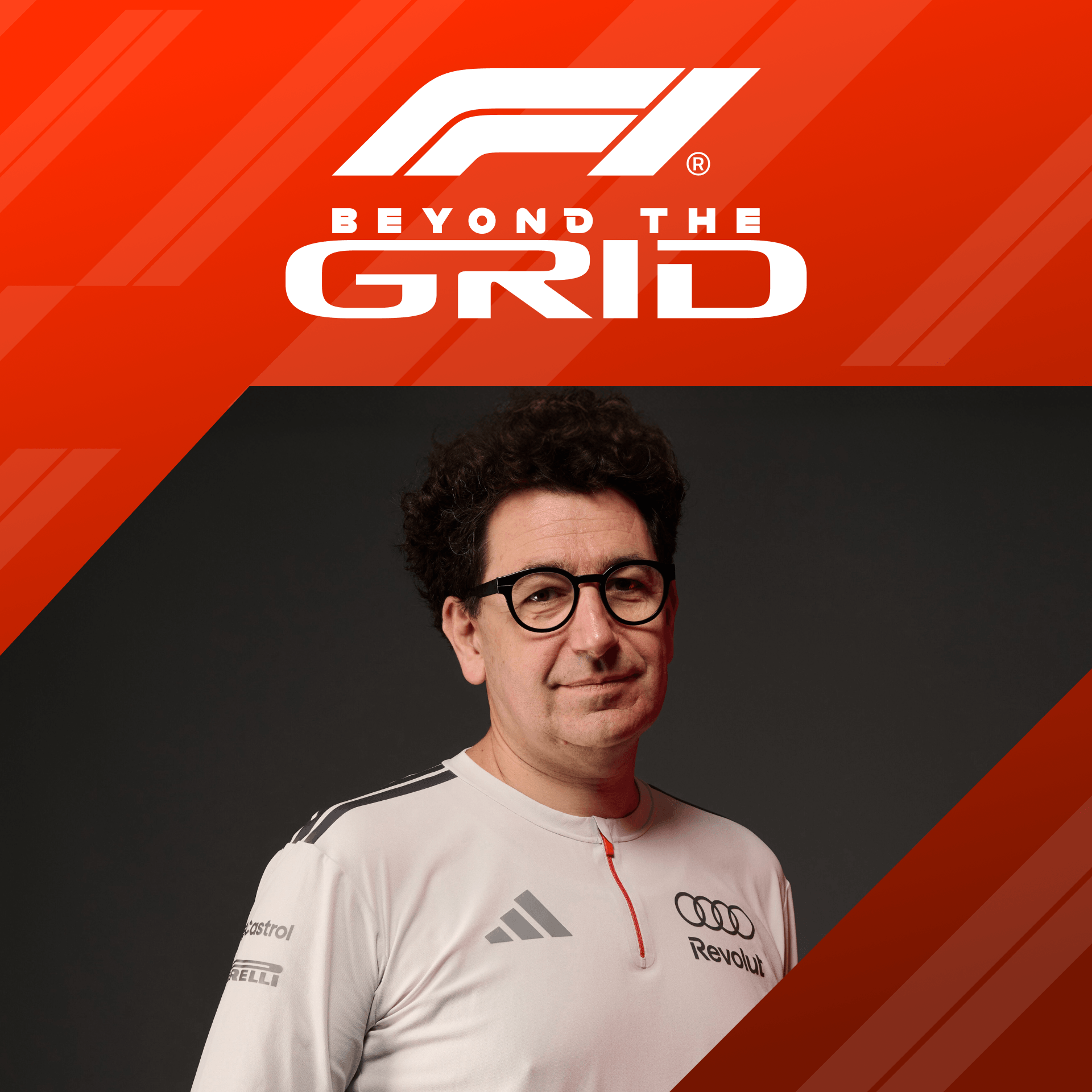
Mattia Binotto: ‘Audi are serious’ about F1 success
About this episode
Audi’s F1 push is framed through Mattia Binotto’s leadership lens: Audi are “becoming serious” and have set a championship target “by 2030.” Binotto contrasts his Ferrari experience with Audi’s need to build a competitor culture from scratch—arguing “it is actually easier to start from scratch than to buy an existing team.” He highlights culture transformation, long-term internal growth, and where the performance gap sits now, especially in “power unit controls and drivability.” Driver plans mix experience and youth as Audi builds toward 2026 and beyond.
The Audi Team Principal tells Tom Clarkson how he plans to turn the former Sauber team into winners. Mattia talks about the pressure and opportunity created by Audi, a brand with an impressive record in other forms of motorsport. He explains the ingredients that made Ferrari the dominant team of the early 2000s and how he aims to apply the same approach to Audi.
Why are drivers Gabriel Bortoleto and Nico Hulkenberg perfect for Audi? Could the team be a destination for a megastar like Max Verstappen? Will Mattia get a tattoo for the team’s first race win? Tom asks Mattia all these questions and more.
This episode is sponsored by:
CarGurus: go to cargurus.co.uk for complete vehicle details without any surprises.
Formula One
"Cadillac has entered Formula One, [92.8s] deepening the racing pedigree behind every V-Series on the road. [98.2s] Discover a lineup that delivers pure adrenaline in the form of modern luxury."
Formula One is the highest level of professional auto racing. The segment is saying Cadillac is connecting its performance car lineup to racing success in F1.
Formula One (F1) is the top tier of open-wheel motorsport, where teams race highly engineered cars on purpose-built circuits. In this segment, it’s used as the backdrop for Cadillac’s claim that it’s entering F1 and that this will deepen its racing credibility tied to Cadillac’s V-Series road cars.
V-Series
"Cadillac has entered Formula One, [92.8s] deepening the racing pedigree behind every V-Series on the road. [121.1s] Find out more about Cadillac's performance story in Formula One"
“V-Series” is Cadillac’s name for the more performance-focused versions of its cars. The ad is saying those cars are backed by racing experience.
Cadillac’s V-Series is its performance sub-brand, used to label models that are tuned and equipped to feel more athletic than standard trims. Here, the host links V-Series credibility to Cadillac’s involvement in Formula One, framing it as “race-tested” performance.
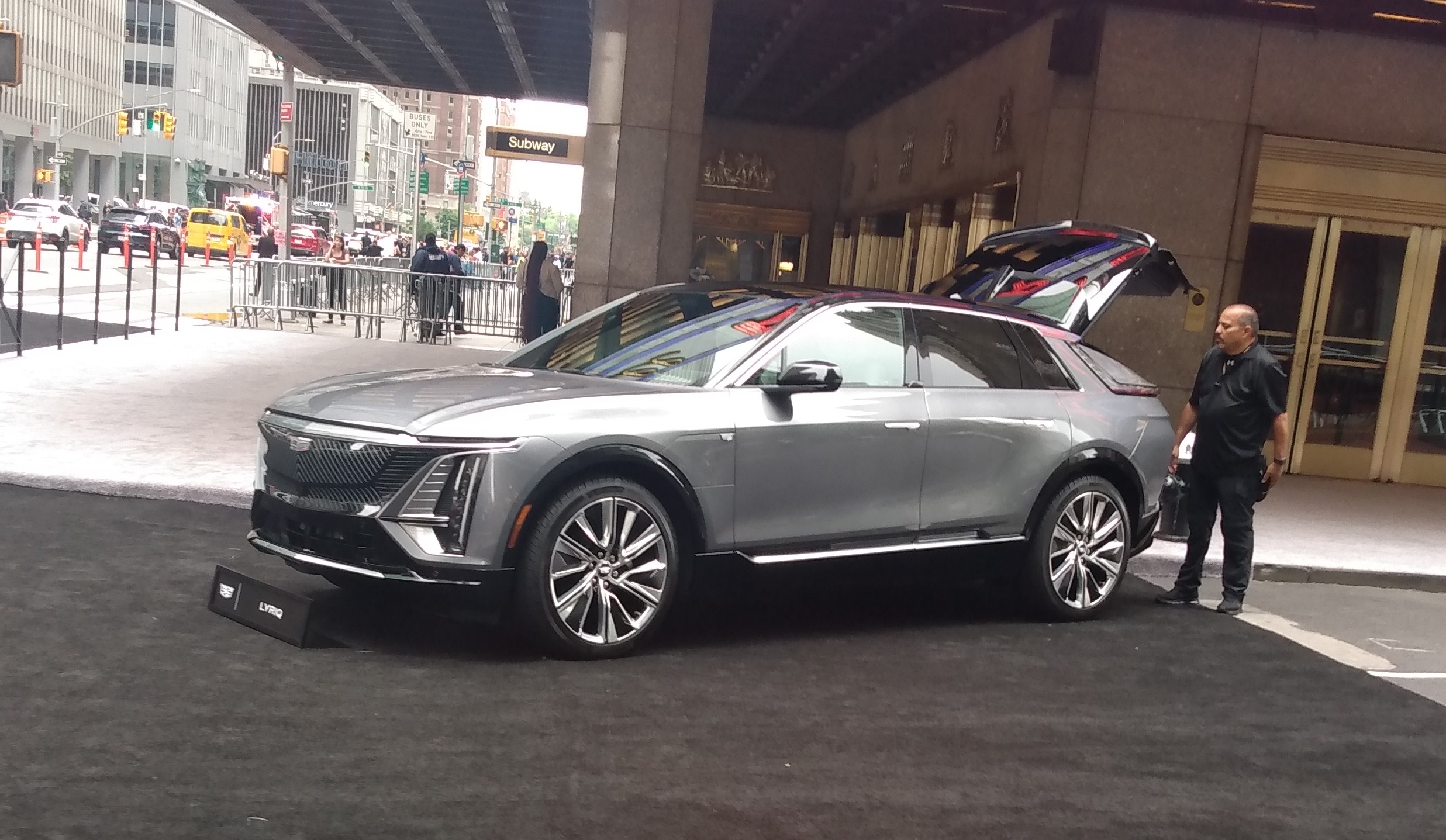
Cadillac Lyric
"...ence the quickest Cadillac ever, the all-electric Lyric V, the peak performance of the CT5V Blackwing,"
The Cadillac Lyriq is an electric SUV from Cadillac. It uses electricity instead of gasoline and is built to feel quick and smooth. When people talk about the “quickest” Lyriq, they mean a higher-performance version within the electric SUV lineup.
The Cadillac Lyriq is Cadillac’s all-electric luxury SUV, designed to deliver quick acceleration with an emphasis on comfort and modern tech. It’s significant in a performance conversation because the Lyriq line includes higher-output variants, and it’s often highlighted as one of Cadillac’s fastest electric models. That’s why it may be mentioned alongside other top Cadillac performance models in a “peak performance” context.
CT5V Blackwing
"the all-electric Lyric V, [108.5s] the peak performance of the CT5V Blackwing, [111.5s] the nimble agility of the OPTIQ V,"
This is a high-performance version of the Cadillac CT5. “Blackwing” is Cadillac’s way of saying it’s the more serious, enthusiast-style model.
The Cadillac CT5V Blackwing is a high-performance CT5 variant from Cadillac’s V-Series lineup. The “Blackwing” name is used by Cadillac to signal a more track-oriented, enthusiast-focused tuning and hardware package compared with standard trims.

OPTIQ V
"[108.5s] the peak performance of the CT5V Blackwing, [111.5s] the nimble agility of the OPTIQ V, [114.4s] and the legendary Roar of the Escalade V,"
This is a Cadillac model with the “V” performance branding. The point here is that it’s meant to feel quick and nimble compared with a regular version.
The Cadillac OPTIQ V is another V-Series model positioned around agility and responsiveness. In this segment, it’s presented as part of Cadillac’s broader “performance story,” linking the V-Series branding to the same kind of excitement Cadillac is associating with Formula One.

Cadillac Escalade
"[111.5s] the nimble agility of the OPTIQ V, [114.4s] and the legendary Roar of the Escalade V, [118.5s] all engineered to thrill."
This is a high-performance Escalade. It’s still a big luxury SUV, but the “V” badge means it’s been tuned to feel more exciting and powerful.
The Cadillac Escalade V is a performance-oriented version of the Escalade, using Cadillac’s V-Series branding. The segment calls it “legendary,” emphasizing that even a large luxury SUV can be tuned and marketed as a performance machine.
Salber
"[523.5s] I first went to Salber in 1998 and then I came a few months back [527.3s] and you showed me around what you've got now."
Salber sounds like the team’s base or factory area. When someone says it hasn’t changed much in decades, they’re basically talking about how the team’s setup and day-to-day operations stayed similar.
Salber is the facility location Binotto is referencing when he describes visiting in 1998 and again recently. In Formula 1 terms, this kind of site is where teams develop and coordinate their car programs, so the “feel” of the place reflects how the team’s infrastructure has evolved.
wind tunnel
"[534.2s] There's the wind tunnel, of course, [535.5s] which was the result of the sale of Kimi Raikkon and back in the early 2000s."
A wind tunnel is a place where they blow air over a car model. It helps engineers figure out how slippery the car is and how much “push down” it gets for grip.
A wind tunnel is a test facility that uses controlled airflow to measure how a car’s shape affects drag and downforce. F1 teams use it to refine aerodynamic parts like wings, floors, and bodywork so the car generates grip without slowing down too much.
Kimi Raikkon
"[534.2s] There's the wind tunnel, of course, [535.5s] which was the result of the sale of Kimi Raikkon and back in the early 2000s."
Kimi Räikkönen (spoken here as “Kimi Raikkon”) is a former Formula 1 driver whose transfer/sale is being linked to funding for a wind tunnel. In F1, driver moves can directly change team budgets, which then affects development resources like aerodynamics testing.
power units
"[603.3s] But this begs the question, I think, that, what is it? [607.0s] Neuburg, where the power units are designed and built,"
A power unit is the car’s main engine-and-energy system. It includes the engine plus extra parts that store and reuse energy to help the car accelerate more effectively.
In modern Formula 1, the power unit is the complete hybrid propulsion system, not just the engine. It combines internal-combustion power with energy recovery (harvesting energy under braking) and an electronic control system to manage deployment.
Neuburg
"[603.3s] But this begs the question, I think, that, what is it? [607.0s] Neuburg, where the power units are designed and built,"
Neuburg is a place the team uses for building key engine technology. When they say the power units are designed and built there, they mean that’s where the most important engine-related parts are developed.
Neuburg is referenced as the location where the power units are designed and built. In F1, the “power unit” is the hybrid engine system (engine plus energy recovery and control electronics), so naming the design/build site points to where the team’s core technical work happens.
Hinville
"[609.8s] is what, 280 miles from Hinville? [612.8s] Did you think about putting the chassis on the same site?"
Hinwil (spoken as “Hinville”) is a place in Switzerland tied to an F1 team’s base. Here it’s mentioned to talk about how close or far key facilities are.
Hinwil is a Swiss location strongly associated with Sauber’s F1 operations, including engineering and team facilities. In this discussion, it’s used as a reference point for how far the team’s sites are from each other and whether that distance matters.
chassis
"[609.8s] is what, 280 miles from Hinville? [612.8s] Did you think about putting the chassis on the same site?"
The chassis is the car’s main frame—the part that holds the driver and all the key components together. In F1 it’s separate from the engine package, which is the power unit.
In F1, the chassis is the car’s main structural frame that everything else mounts to, including suspension, steering, and the driver’s survival cell. It’s distinct from the power unit, which is the engine package that provides propulsion.
Sauber team
"[624.5s] But first, an existing team, the Sauber team was in Inville, 600 people. [629.3s] So first, the team exists, so you can't move it, honestly."
Sauber is an F1 team. The speaker is saying their team is already set up at the Swiss site, with lots of staff and skills, so moving everything isn’t realistic.
Sauber is an F1 team whose operations are discussed in terms of where the team is based and how many people work there. The speaker argues that because the Sauber team already exists at the Hinwil site, it’s harder to relocate the whole operation.
Ferrari
"[669.2s] Just out of interest, what advantages did you see when you were at Ferrari, [674.0s] when you had the chassis and the engine under the same roof?"
Ferrari is a famous Formula 1 team. In this part of the conversation, it’s mentioned to explain how organizing the car’s main systems in one place can help engineers work together.
Ferrari is an F1 constructor with a long history of developing both chassis and power unit integration strategies. Here it’s used as context for how having the chassis and engine under one roof can create engineering “synergies.”
synergies
"[669.2s] Just out of interest, what advantages did you see when you were at Ferrari, [674.0s] when you had the chassis and the engine under the same roof? [677.6s] Certainly the synergies are better, but it's not such a big obstacle being distant."
“Synergies” here means advantages from having the car’s main systems work closely together. If the chassis and engine team are coordinated, it can be easier to make changes and get better overall results.
In motorsport engineering, “synergies” means the benefits you get when related systems are developed and managed together—like the chassis and power unit being under the same roof. Closer integration can speed up iteration, reduce communication friction, and improve how well the systems work as one package.
Red Bull
"[684.0s] Now, if you look all the other teams, do not have the chassis and the power unit together. [690.4s] Red Bull has won many years with an engine from Japan."
Red Bull is a top Formula 1 team. They’re mentioned here as an example of a team that can still win even when the engine and car development aren’t all in the same place.
Red Bull is an F1 team known for winning championships with a power unit supplied by an external manufacturer. The speaker uses Red Bull as an example to argue that distance between chassis and power unit development isn’t necessarily a deal-breaker.
Bister
"[699.8s] You did mention the UK. You have a facility in Bister. [706.0s] How important is it for you to have a foothold in the UK, in Motorsport Valley in the UK?"
“Bister” is where the speaker says they have a facility in the UK. The idea is that having a base there helps the team operate more effectively.
“Bister” is mentioned as a UK facility location, implying the team has operations there rather than being fully concentrated in Switzerland. In F1, having a foothold in multiple countries can support staffing, logistics, and access to specialized motorsport suppliers.
Motorsport Valley
"[706.0s] How important is it for you to have a foothold in the UK, in Motorsport Valley in the UK? [712.0s] It is very important."
“Motorsport Valley” is a UK area known for lots of racing-related companies and engineering talent. The speaker is saying being near that cluster matters.
Motorsport Valley is a nickname for the UK region around Oxfordshire and surrounding areas that’s home to many motorsport and engineering companies. Teams value it because it concentrates expertise, suppliers, and talent in one geographic cluster.

Audi Quattro
"Diesel in Le Mans, fully electrical, let me say electrical car with the Dakar, Audi Quattro with the four-wheel drives in the rally."
The Audi Quattro is a famous rally car from Audi. Its big deal was four-wheel drive, which helps it grip the road better on dirt and gravel so it can accelerate and turn more confidently.
The Audi Quattro is a rally icon built around Audi’s early use of four-wheel drive, which dramatically improved traction on loose surfaces. In rallying, that traction helps the car put power down while still rotating through corners.
four-wheel drives
"Diesel in Le Mans, fully electrical, let me say electrical car with the Dakar, Audi Quattro with the four-wheel drives in the rally."
Four-wheel drive means the car can push with all four wheels. That helps it grip better on slippery roads, which is especially useful in rally stages.
Four-wheel drive (4WD) means power is sent to both the front and rear axles. In rallying, that usually improves traction and stability on low-grip surfaces like gravel, snow, or mud.
V8
"If, for example, FIA President Mohammed Bensouleh's suggestion of a V8 was to be introduced at the next regulation cycle, would Audi welcome that?"
A V8 is an engine with eight cylinders arranged in a V shape. In this context, it’s being mentioned as a possible future engine type if the rules change.
A V8 is an engine configuration with eight cylinders arranged in a “V” shape. In F1 regulation discussions, proposing a V8 is about changing the engine architecture to meet future performance and efficiency targets under new rules.
V6, V8
"Was the format V6, V8, I don't think that's somehow a detail, no. Certainly for Audi, how efficiency engines are important."
V6 and V8 are two different engine types. Switching between them can change how the engine is built and how it performs, especially for fuel efficiency.
The “V6, V8” phrasing refers to possible future cylinder-count and layout choices for F1 engines. Changing between these formats can affect how the engine is packaged, how it makes power, and how it meets efficiency requirements.
V6
"Was the format V6, V8, I don't think that's somehow a detail, no. Certainly for Audi, how efficiency engines are important."
A V6 is an engine with six cylinders arranged in a V shape. Here it’s part of the discussion about what engine layout F1 might use in the future.
A V6 is an engine configuration with six cylinders arranged in a “V” shape. In F1, the mention of V6 vs V8 is part of how teams and the FIA debate future engine formats for the next set of regulations.
collaboration
"And I don't think that today there is anything which will stop us by being part in the future. While we're talking about collaborative discussions, there's something that's fascinating me in the Formula One Patrick at the minute, which is the discussions between teams about the regulations..."
They’re describing how F1 teams can cooperate when it comes to the rules. Even though they compete on Sunday, they may still talk together to help make the regulations work for everyone.
In F1, “collaboration” here refers to teams working together off-track to influence or solve regulatory problems. Even though they race each other, teams can coordinate discussions to shape the rules in ways that keep the sport viable and competitive.

Ferrari 1995
"...h is already a good step forward. Now, you joined Ferrari 1995 in the engine department. You're an engine guy. D..."
The Ferrari 195 S is an old Ferrari race car built for sports car competition. It’s remembered because it represents an important time in Ferrari’s racing history and engineering development. When it comes up in an “engine guy” discussion, it’s usually about how the car’s power and design were built for racing.
The Ferrari 195 S is a classic Ferrari sports racing car from the mid-20th century, associated with the brand’s early competition era. It’s often discussed in historical “engine department” or development conversations because these cars represent a period when Ferrari’s engineering approach and powertrain work were central to racing success. Mentioning it alongside other Ferrari-era engine topics highlights how specific models fit into the evolution of performance technology.
Jean Todd Ross
"because I have a lot of great leaders and managers, which I've been working closely to, starting from Jean Todd Ross. Even Michael Schumacher was a great leader..."
Jean Todd Ross is a person the speaker credits as a strong leader/manager they worked with. In this segment, she’s mentioned to support the speaker’s point about learning from good leadership.
Jean Todd Ross is referenced as one of the leaders/managers the speaker worked closely with. The context is about leadership and management style rather than technical engineering, but it’s a notable named figure in the speaker’s career.
Michael Schumacher
"starting from Jean Todd Ross. Even Michael Schumacher was a great leader, not a manager, but certainly a great leader."
Michael Schumacher is one of the most famous F1 drivers ever. Here, the speaker isn’t talking about lap times—he’s talking about Schumacher’s leadership and influence on the team.
Michael Schumacher is a legendary Formula 1 driver, mentioned here for his leadership qualities. The speaker distinguishes “leader” versus “manager,” arguing Schumacher was especially strong as a leader even beyond his driving.
McLaren
"There's Andrea Steller at McLaren. Both of you work with him at Ferrari... I think that if I look at what Andrea Steller has built in McLaren in terms of culture, it's coming from that old school."
McLaren is one of the famous Formula 1 teams. The speaker says the team culture being built at McLaren comes from the same kind of mindset they learned earlier.
McLaren is a Formula 1 constructor with a long history of race engineering and team organization. Here, the speaker points to Andrea Steller’s work at McLaren, saying the culture he built traces back to the “old school” lessons from Jean Tod.
winning culture
"I think what we learned is exactly the usual way we were mentioning before, the mentality, the winning culture. He was a hard worker, but he was capable of, he was so hungry to win."
“Winning culture” is the team’s attitude and habits that make people focus on getting results. In this context, it means working hard together and aiming for improvement rather than pointing fingers.
“Winning culture” in motorsport means the day-to-day mindset and standards that push everyone toward performance—expectations, discipline, and shared focus on results. The speaker contrasts it with a blame-driven environment, emphasizing unity and consistent effort.
no blame culture
"No stones unturned, but then the importance of the team spirit, no blame culture. It was about all together pushing in the right direction."
“No blame culture” means the team doesn’t try to find someone to blame when things go wrong. The goal is to learn from problems and improve as a group.
“No blame culture” is an organizational approach where the team avoids scapegoating individuals after mistakes. Instead, it focuses on problem-solving and learning so the group can keep moving forward together.
team spirit
"No stones unturned, but then the importance of the team spirit, no blame culture. It was about all together pushing in the right direction."
“Team spirit” is how well the group works together and supports the same goals. Here, the speaker says it matters because it keeps everyone pushing in the same direction.
“Team spirit” refers to how strongly people collaborate and align around shared goals in a high-pressure racing environment. In this segment, it’s presented as a core ingredient of the leadership style that helped Ferrari succeed.
complexity
"The team size has changed, the complexity has changed. I think when I started myself,"
“Complexity” here means Formula 1 has become harder to manage because there are more moving parts and decisions. The speaker is saying the sport has changed, so it’s worth asking what still applies from earlier eras.
In Formula 1, “complexity” refers to how many interacting systems and variables affect performance—car design, setup, data analysis, and operations. The speaker argues that while the team-size and complexity have changed, the underlying relevance of culture and leadership is still worth discussing.
hybridization
"The budget, three times more at least, the complexity of the product hybridization."
Hybridization means the car uses a hybrid power system that can store energy and use it later. In F1, that adds extra engineering work, so teams need more people and more budget.
Hybridization in modern F1 refers to adding an energy-recovery hybrid system that stores and reuses energy to help power the car. The host links increased budget and staffing to the added complexity of developing and operating these hybrid components.
Jonathan Wheatley
"Jonathan Wheatley was team principal. He left pretty much on the 12 months since he joined the team."
Jonathan Wheatley is a senior leader in Formula 1. In this part, they talk about him leaving the team principal role and what that meant for the team’s changes.
Jonathan Wheatley is an F1 team leader who served as team principal in this context. The segment discusses his departure timing and how it relates to the team’s transformation and leadership continuity.
team principal
"Jonathan Wheatley was team principal. He left pretty much on the 12 months since he joined the team."
A team principal is basically the top boss of an F1 team. They help steer the team’s decisions and manage how the organization runs.
Team principal is the top leadership role in an F1 team, responsible for overall direction, decision-making, and managing the organization. In this segment, the discussion contrasts team principal responsibilities with other senior roles as leadership changes.
transformation
"I think he has been part of that initial transformation we're discussing. From a cultural point of view?"
Here, “transformation” means the team is changing how it works—like updating leadership and ways of operating—to get better results.
In an F1 context, “transformation” usually means a structured change in how the team is organized—culture, processes, and leadership—to improve competitiveness. The segment ties it to recreating a winning culture and adjusting responsibilities after management changes.
Alan McNich
"I'm very happy with Alan, I have to say. Alan has now joined the team as a racing director, covering at least operationally the responsibility of Jonathan that there is track."
Alan McNich is a senior racing official. Here, they explain he’s taken over operational responsibilities as racing director, and that his first weekend was extremely challenging.
Alan McNich is described as joining the team as a racing director, taking on operational responsibility that previously sat with Jonathan Wheatley (at least in part). The segment emphasizes that his first weekend in the role was a “baptism of fire,” highlighting the pressure and importance of the role.
racing director
"Alan has now joined the team as a racing director, covering at least operationally the responsibility of Jonathan that there is track."
A racing director is a key official who helps run the team’s race-day operations. They coordinate what happens on track and how the team responds during a race weekend.
Racing director is a senior role focused on race operations and on-track decision-making, coordinating how the team executes during events. Here, the host says Alan McNich’s racing-director job covers operational responsibility related to what Jonathan Wheatley handled, at least in part.
Formula 1
"Need to hire. This is a job for Indeed sponsored jobs. Cadillac has entered Formula 1, [1934.2s] deepening the racing pedigree behind every V-Series on the road. Discover a lineup that delivers pure [1941.7s] adrenaline in the form of modern luxury."
Formula 1 is the highest level of car racing with open-wheel race cars. In this part of the show, it’s the reason Cadillac is talking about performance and credibility.
Formula 1 is the top tier of open-wheel racing, and it’s the context for Cadillac’s stated entry. The segment frames F1 as a way to build “racing pedigree” that can be marketed back to Cadillac’s road-car V-Series lineup.
Cadillac Optiq
"... of the CT5V Blackwing, the nimble agility of the OPTIQ V, and the legendary roar of the Escalade V, all ..."
The Cadillac Optiq is a smaller electric SUV made by Cadillac. It’s meant to be easier to drive and more agile than bigger vehicles, while still using electricity. In a lineup comparison, it’s often described as the “nimble” electric option.
The Cadillac Optiq is a compact electric SUV positioned for agility and everyday usability, with a focus on nimble handling and modern interior features. In a performance-themed discussion, it may be referenced as the “nimble” option within Cadillac’s electric lineup. That makes it relevant when comparing different Cadillac models by character—quick, agile, or high-powered—rather than just top speed.
Gabriel Bortoletto
"While we're talking drivers, can we talk about Nico Holkenberg, Gabriel Bortoletto now? I mean, [1985.9s] you have worked with some of the greatest drivers of the modern era, right? Schumacher, Alonso, [1991.1s] Reichen and Vettel, Charles Leclerc. How do your current guys stack up..."
Gabriel Bortoleto is a younger Formula 1 driver mentioned as someone the team is trying to develop. The guest is basically saying one driver brings experience while the other is still learning and being coached.
Gabriel Bortoleto is discussed as a younger driver being developed and coached within an F1 team context. Binotto contrasts him with Hülkenberg, emphasizing that Bortoleto’s role is growth-oriented while the team works toward becoming a winning outfit.
Nico Holkenberg
"While we're talking drivers, can we talk about Nico Holkenberg, Gabriel Bortoletto now? I mean, [1985.9s] you have worked with some of the greatest drivers of the modern era, right? Schumacher, Alonso, [1991.1s] Reichen and Vettel, Charles Leclerc. How do your current guys stack up..."
Nico Hülkenberg is a Formula 1 driver. Here, the guest is praising him for being consistent, easy to work with, and good at getting the most out of the car during race weekends.
Nico Hülkenberg is a Formula 1 driver known for being a consistent points scorer and for his reputation as a straightforward, communicative teammate. In this interview, Binotto describes him as honest and transparent, and highlights his ability to extract performance from the car over a race weekend.
podium
"Nico is really an easy one to deal with [2017.9s] in a way that is always very honest, transparent, funny, no politics at the end. He loves driving [2026.4s] and he's good in driving, he's consistent, he's got the experience, he's scoring points, [2030.6s] getting out the most out of the car in the race weekend and we saw his podium in Silverson,"
In F1, a podium means finishing in the top three of a race. It’s a big deal because it usually comes with trophies and lots of championship points.
A podium in Formula 1 means finishing a race in the top three positions (1st, 2nd, or 3rd). The guest uses it as evidence that Hülkenberg is scoring points and getting strong results from the car.
Mattia Binotto
"and he's listening, he's willing to learn and whatever you may tell him he will try to put in practice... Can you clarify one thing for all of us really when you were negotiating to get Gabby in the team... No... The ambition at Audi is clear..."
Mattia Binotto is a key person in Formula 1 leadership. Here, he talks about how he thinks about drivers and what it takes for a team to be competitive.
Mattia Binotto is an Italian Formula 1 team leader best known for his role at Ferrari, where he led the engineering and team operations. In this segment, he discusses driver management and how Audi’s F1 ambitions affect recruiting and team readiness.
Fernando Alonso
"when you were negotiating to get Gabby in the team where you were having to negotiate with Fernando Alonso your former driver? No I have to say that didn't happen or very little so Fernando pop out only maybe in one meeting"
Fernando Alonso is one of the most successful and experienced F1 drivers ever. Here, Binotto explains that Alonso wasn’t a major factor in the negotiations he’s talking about, except in a limited way.
Fernando Alonso is a two-time Formula 1 World Champion known for repeatedly returning to the front of the grid with different teams. Binotto mentions negotiating around Alonso’s involvement as a driver-manager relationship during the period being discussed.
destination team
"The ambition at Audi is clear which means you will become a destination team for every driver on the grid."
A “destination team” is a team that top drivers want to sign with. It usually means the team is strong enough to help them win races and championships.
“Destination team” is a recruiting concept meaning a team that top drivers actively want to join because it offers the best chance to win. Binotto ties it to Audi’s ambition and the need to provide a competitive platform.
Max Verstappen
"Are you looking are you part of the discussion now when it comes to Max Verstappen and people like that? No we are not I'm not and the reason why we are not yet ready for it as a team"
Max Verstappen is one of the best drivers in Formula 1. The speaker is saying Audi would need to be truly competitive before it could attract someone of his caliber.
Max Verstappen is a current-era Formula 1 superstar and multiple-time World Champion. Binotto says Audi isn’t ready to recruit a driver like Verstappen yet, because a top driver needs a team platform capable of fighting for victories.
platform
"if Max would join you need to offer him a platform which is a proper platform where you can fight for victories"
Here, “platform” doesn’t mean a physical part of the car. It means the team’s setup and competitiveness—whether it can give a driver a real shot at winning.
In this F1 context, “platform” means the overall package a team provides—car competitiveness, resources, and development direction—so a driver can realistically fight for victories. Binotto argues Audi must be ready to offer that before targeting elite drivers.
Carlos Sainz
"Okay and Carlos Sainz was part of the discussion a couple of years ago wasn't he and he ended up deciding to go to Williams were you disappointed in that?"
Carlos Sainz is an F1 driver. They’re talking about his earlier team discussions and why the speaker wasn’t disappointed by his decision to go to Williams.
Carlos Sainz is a top Formula 1 driver who has raced for multiple teams, including Ferrari. This segment discusses his past contract discussions and his move to Williams, plus how Binotto viewed the situation.
Williams
"and he ended up deciding to go to Williams were you disappointed in that?"
Williams is an F1 racing team. The speaker mentions it as the team Carlos Sainz ended up joining.
Williams is a historic Formula 1 team. In this segment, it’s referenced as the destination Carlos Sainz chose after earlier discussions.

Dodge Challenger
"...first to become competitive as a team and maybe a challenger and then a true let me say potential competitor f..."
The Dodge Challenger is a car built for strong acceleration and performance. It’s often discussed in racing and car communities because teams can modify it to compete better over time. In that sense, it can represent a car that starts out improving and then becomes a real contender.
The Dodge Challenger is a performance-focused American muscle car known for its powerful engines and long-running presence in motorsport and enthusiast culture. In a podcast discussion, it may come up as an example of a “challenger” model that can become competitive depending on how it’s prepared and developed as a team. That makes it relevant when talking about progress from early competitiveness toward true race-winning potential.
drivability
"maybe the biggest gap is more from the power unit performance power unit controls and drivability where we believe there is a significant step which is required to close the gap"
“Drivability” is how easy and consistent the car feels to drive—how smoothly power delivery responds to the driver’s inputs. In F1, it’s often tied to engine mapping, control software, and how the hybrid system behaves under acceleration and traction changes.
simulator
"not only GPS telemetry analysis first we've got a good correlation with the wind tunnel and the simulator that's in terms of platform"
The simulator is a virtual test environment for the race car. Engineers and drivers can study how changes might affect handling and speed without needing to run on track every time.
In F1, the simulator is a high-fidelity driving and engineering environment used to evaluate car behavior without waiting for track time. Teams use it to study setup changes, predict performance, and validate how the car should respond to different conditions.
GPS telemetry analysis
"not only GPS telemetry analysis first we've got a good correlation with the wind tunnel and the simulator"
Telemetry analysis means using data from the car during driving to figure out what’s going on. GPS-based data helps teams compare laps and pinpoint where performance is lost.
Telemetry analysis uses recorded car data—often including GPS position and speed—to understand what happened on track and why. Teams use it to compare lap-to-lap behavior, diagnose performance gaps, and correlate driver feedback with measurable results.
in season 26
"we are producing in the wind tunnel for the in season already 26 it's a great dynamic it's a great development rate"
“In-season” means upgrades you bring during the year, not just at the beginning. It’s a measure of how fast the team can develop and deliver improvements to the race car.
“In-season” development refers to updates the team brings during the current racing year, rather than only preparing for the start of the season. When he says “for the in season already 26,” he’s describing how quickly the team can turn development work into usable parts for that year’s races.
James Key
"have you employed people to work arrow people to work with James Key that weren't there before"
James Key is a well-known Formula 1 engineer. The host is saying the team improved partly by bringing in people like him to help with car development.
James Key is an F1 engineer and technical leader known for roles in chassis and technical development. Binotto’s mention suggests the team’s performance jump involved staffing and technical leadership changes around Key.
Mattia Bonotto
"Audi is Mattia Bonotto gonna get a tattoo no no tattoo no sorry for that no tattoo but I didn't [2704.9s] know that Alan was going for a tattoo I'm so curious now no not a tattoo but I will enjoy the [2712.8s] moments that's no doubt I'm looking forward to it Mattia it's been wonderful to chat you know one"
Mattia Binotto is a person who helps run and lead Formula 1 teams. In this interview, he talks about why he came back and what he thinks Audi needs to do to get better.
Mattia Binotto (spoken here as “Mattia Bonotto”) is a key Formula 1 team leader and engineer who previously worked at Ferrari and later became central to Audi’s F1 effort. This segment is an interview where he explains why he returned to the sport and how he views Audi’s path to success.
2028
"there is a lot to do but Mattia has a plan he knows what's needed to get Audi to the front [2836.9s] and it'll be fascinating to watch their progress the next step will come in 2028 he says but there [2843.2s] will be no tattoos Mattia I love this chat thank you very much for your time and I'll see you very"
They mention 2028 as a target year. It’s basically the next point in time when Audi expects to make a big step forward in Formula 1.
2028 is referenced as the next major step in Audi’s Formula 1 progress. The segment suggests a timeline for when improvements should start translating into front-running results.
Request an Explanation
Heard something you'd like explained? We'll add it to this episode.
Sign in to request explanations for terms you heard.
Want to learn more?
Browse our glossary for plain-English explanations of automotive terms, jargon, and concepts.
Help improve this episode
See something that's not quite right? Our annotations are AI-generated and can sometimes miss the mark. Click the flag icon on any annotation to suggest a correction.