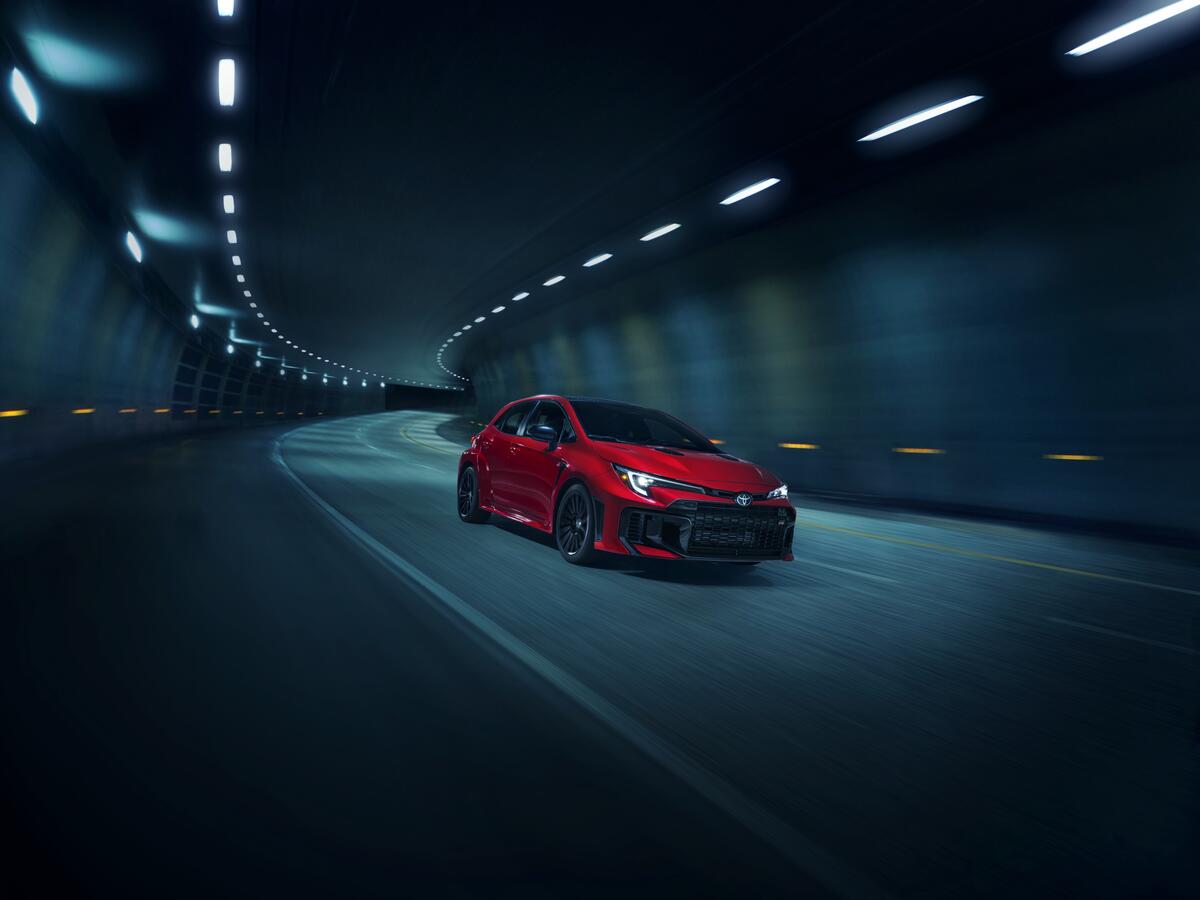
The Toyota GR Corolla is a sporty compact hatchback made by Toyota. It’s built for drivers who want more performance than a typical small car. The podcast mentions it because Toyota is changing where it’s made, which can affect how many cars are available.
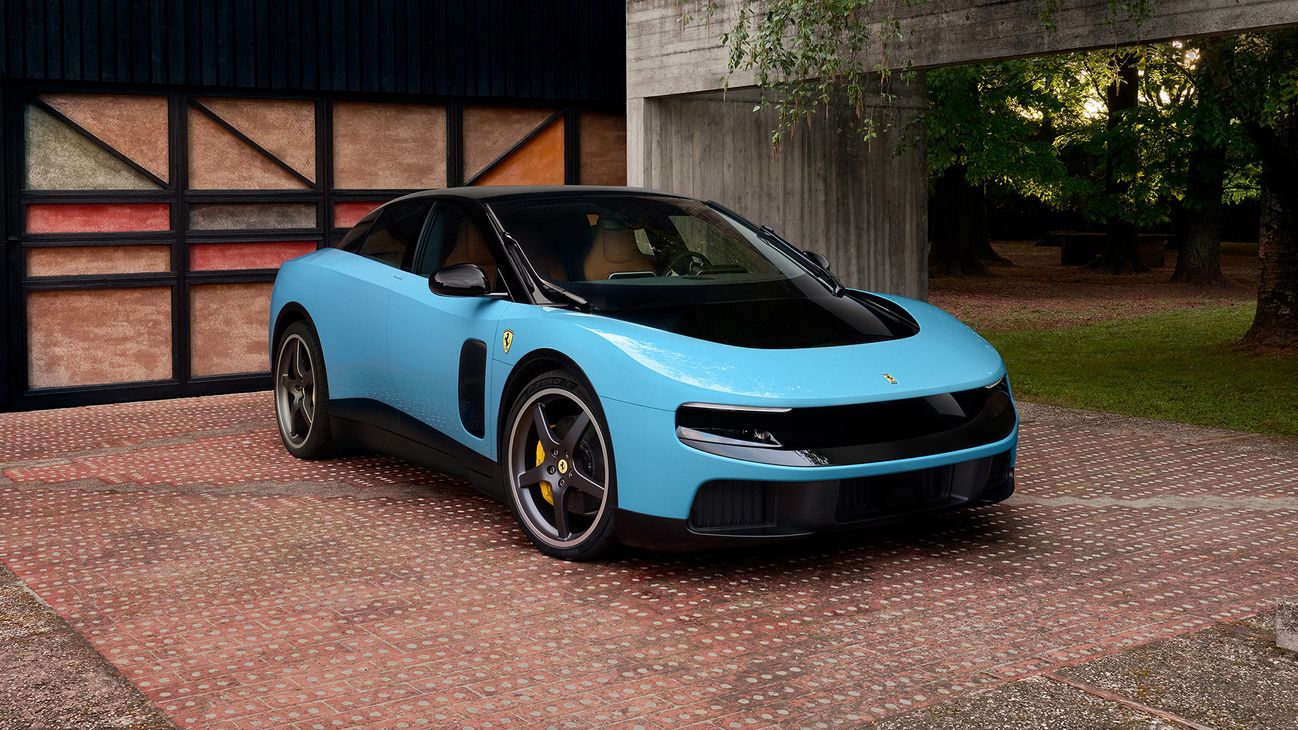
The Ferrari Luce is a Ferrari model. It’s being talked about because its design looks very different from what many people expect. The podcast also notes that it was styled by a specific designer, Johnny Ivey.
Johnny Ivey is the person the hosts say designed the Ferrari Luce. They mention he also designed the iPhone, to show he’s a well-known designer outside of cars.
A gearbox is the part that changes gears so the engine can work efficiently at different speeds. The hosts say an electric layout doesn’t need the same rear gearbox space, which helps the car fit more seats.
Lamborghini is another famous supercar brand. The hosts mention it because they say Lamborghini has pulled back from electric supercars, while Ferrari is going all-in.
The Honda Ridgeline is Honda’s pickup truck. In this story, Honda is stopping production for a while and planning to bring it back later with changes, mostly because of emissions rules and planning for future electric vehicles.
“Tightened emission standards” means the government is requiring cars to pollute less than before. If a truck can’t meet the new limits, the company may have to stop selling it or fix it so it complies.
A V6 engine is a gasoline engine with six cylinders arranged in a V shape. Saying it gets an “updated V6” means Honda plans to change the engine as part of the truck’s refresh.
Here, “compliance” means the vehicle has to meet government rules to be sold. The hosts are saying the updated engine should help the Ridgeline meet those rules again.
The Honda Passport is Honda’s midsize SUV. In this segment, they say Honda can’t make enough Passports at the plant, so it will temporarily build some Passports on the same production line used for the Ridgeline and Odyssey.
The Honda Odyssey is a minivan built on the same assembly line as the Ridgeline at the Alabama plant discussed here. The segment describes a production rebalancing: Honda plans to increase Odyssey output by about 20% to use capacity while Ridgeline production is paused.
Concept
pivot from EVs to hybrids and ICE vehicles
The hosts are saying Honda changed direction. Instead of focusing mainly on fully electric cars, they’re putting more effort into hybrid cars and regular gas-engine cars while they work on the next hybrid versions.
A V6 hybrid powertrain is a setup where a V6 gas engine works together with an electric motor and battery. The idea is to improve efficiency while still using a traditional engine, and the hosts say Honda is planning this for the next Ridgeline.
A refresh is when a car gets updated during its model run—like new styling, features, or powertrain changes—before the next all-new generation. Here, they’re saying Honda will refresh the Ridgeline heavily so it can keep selling while the hybrid version is developed.
A RoboTaxi is a self-driving taxi service. Instead of a human driver, the car handles the driving, and you request a ride through a service like a rideshare app.
Term
L4
L4 means the car can do the driving by itself in certain situations. In those conditions, you’re not expected to constantly monitor or take over like you would with lower automation levels.
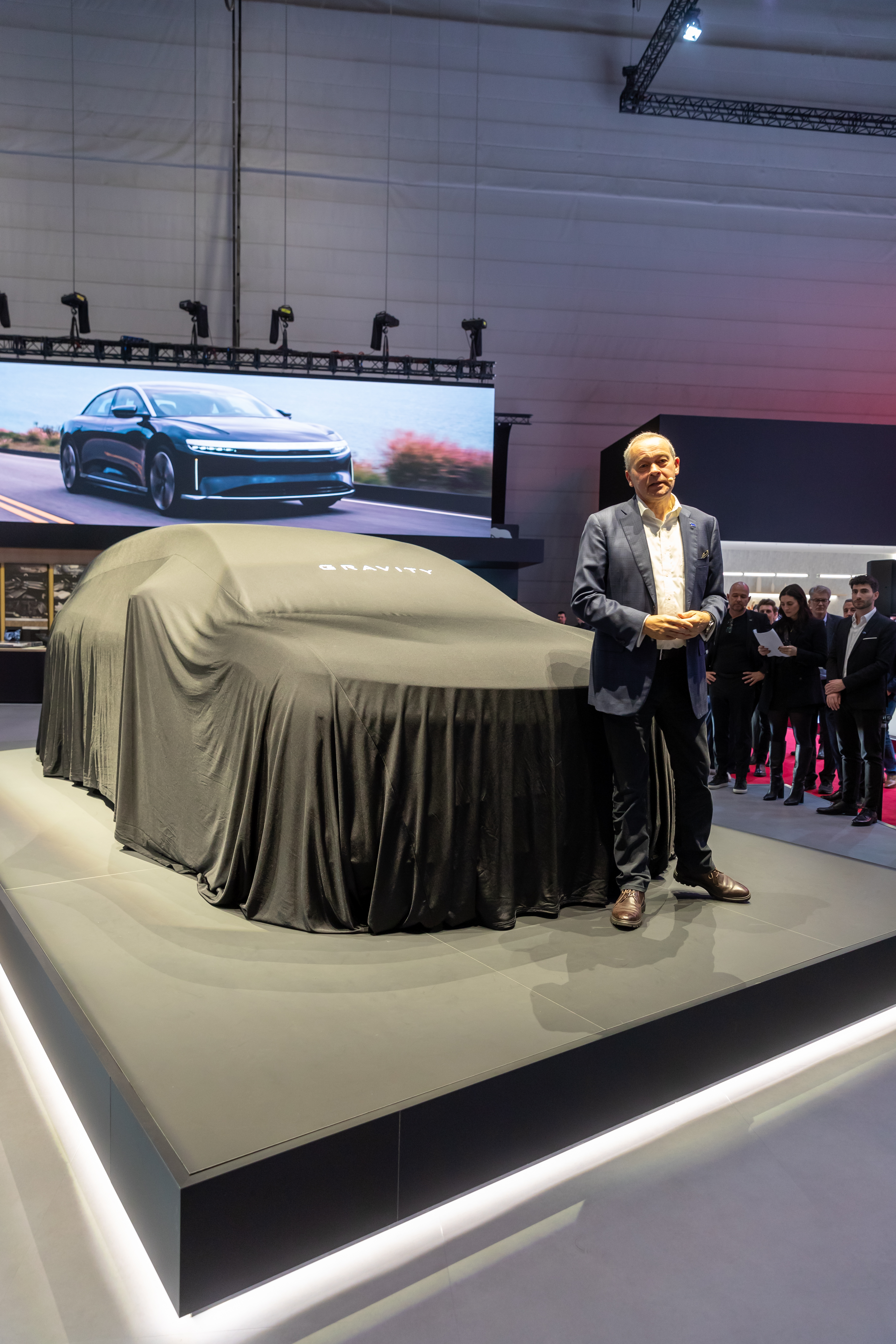
Lucid Gravity is an electric SUV made by Lucid. In this story, it’s the car that Nero’s self-driving system is meant to work with, so the vehicle and the tech are designed to fit together.
Fleet operations and logistics are the behind-the-scenes tasks of running a lot of cars for a ride service. It includes things like getting the right car to the right place and coordinating how the vehicles are managed over time.
“Superhuman safety bar” means aiming for safety that’s better than what most human drivers can consistently achieve. The speaker is saying the public will expect extremely high safety from self-driving cars over time.
An AV provider is a company that supplies the self-driving technology. The question is which company can make it work reliably for real customers at scale.
An autonomy system is the car’s self-driving “brain” and sensing setup. It’s what lets the vehicle make driving decisions without a human doing the driving.
Redundancy means the car has backup systems. If something goes wrong with steering or braking, the design aims to keep the vehicle safe and controllable.
Capital intensive means the business needs a lot of money up front. For EV and self-driving projects, that’s because building vehicles and systems for a fleet costs a lot.
LIVE
Welcome to Daily Drive.
For Tuesday, May 26, 2026, I'm Kellyn Walker in Las Vegas.
Today on the show, Honda is taking a break from its Ridgeline pickup.
British automakers face a U.S. import cap that could trigger higher tariffs.
And Ferrari just unveiled its first EV, designed by the guy who created the iPhone.
Plus, why Neuro's COO thinks robotaxes won't become a commodity, and how the company is
diversifying its business with partners Uber and Lucid.
Behind the scenes, three different parties doing three very different things, but it
all comes together to have this very safe, very awesome experience for the end user.
Let's run through all the news you need to know to keep up in the auto industry.
Honda is hitting pause on its Ridgeline pickup.
That's because the truck can't meet tougher emission standards.
The automaker will stop building the mid-sized Ridgeline by year's end.
Production won't restart until 2028, when a freshened version with an updated V6 rolls
off the line at its Alabama plant.
The 2028 redesign buys Honda time to finish developing an advanced hybrid system,
which the Ridgeline is expected to get in the early 2030s.
We'll have more on this in a minute with our own Urvash Kakaria.
British automakers are staring down a US import cap that could trigger higher tariffs.
The US-UK deal allows 25,000 vehicles per quarter at 10%.
Go over that, the tariff jumps to 27.5%.
According to the Automotive News Research and Data Center,
eight British brands sold nearly 98,000 vehicles here last year.
Now, Toyota is moving GR Corolla production to the UK,
which could push everyone over the limit.
Here's the kicker.
There's no system to coordinate who ships when.
And Ferrari just unveiled its first EV, and it looks like nothing you'd expect from Ferrari.
The Luce was styled by Johnny Ivey, the guy who designed the iPhone.
And it turns out ditching the gas engine solved a problem Ferraris had for decades.
Without a gearbox taking up space in the back,
they finally have room for five seats instead of four.
The Luce starts at around $640,000 and has over a thousand horsepower.
This is a big bet, especially since competitors like Lamborghini
have backed away from electric supercars.
But Ferrari says it's taking, quote,
the deliberate decision to lead what comes next.
And those are today's headlines.
You can find more details on all those stories at AutoNews.com.
Joining me now to talk more about the Honda Ridgeline production pause
is our own Ervash Karkaria, who got the scoop for us at Automotive News.
Ervash, welcome back to Daily Drive.
Ervash, great to be back, Kel.
How are you doing?
How was your long weekend?
It was good.
It was good.
How about yours?
Fantastic.
Busy as usual.
All right.
Well, I heard you got the scoop.
So you write that the 18-month gap in production
is fallout from Honda's abandoned EV plans.
Can you explain that?
Yeah, so Honda is basically hitting pause on the current generation Ridgeline production.
According to sources, production will end in December of this year.
It will restart in the third quarter of 2028.
There are several reasons this is happening.
Sort of the most urgent reason is that the Ridgeline is not meeting the
tightened emission standards.
Honda does not want to keep selling this vehicle if it's in default,
because even though the Trump administration has sort of turned a blind eye
towards enforcing these tightened emission standards,
the next administration might essentially not take too kindly to this
and retroactively penalize automakers that have been flouting the Biden-era emission regulations.
So Honda didn't want to take that risk.
The other reason also is that the reason there's a pause is because,
as you mentioned, Honda had essentially focused on building EVs going forward,
and they had all these new EV models coming.
They had devoted a lot of resource and time to developing next-generation EVs,
and so they didn't have a fallback for Ridgeline, which they now need to keep a little longer.
So they're going to come up with what has been described to me as a significant update.
It's not technically a next generation, but it will have essentially a new design.
It will have revised new components, and it will also have an updated V6 engine,
which is the current engine, and then that updated engine will likely bring the Ridgeline back in
compliance. Today I was speaking to some folks, and essentially the next generation Ridgeline,
which is expected in 2031, is expected to have a lot of similarity with the Passport crossover
that Honda also builds, and it'll also be a more ruggedized version of the Ridgeline.
So it will be very interesting to see what the next Ridgeline looks like.
What's Honda planning to do at that Alabama plant during the year and a half when the Ridgeline isn't
being built? So Honda's kind of being opportunistic about it. The Ridgeline is built alongside the
Odyssey minivan on the same assembly line. So what Honda's going to do is crank up production
of Odyssey by about 20% over the next couple of years, and then they're also going to increase or
expand production of the Passport, which is on another assembly line in the plant, but which
is at capacity. So they're going to basically start building some Passports on that Odyssey Ridgeline
line in the interim. They're going to increase Passport production by about 10%. So that's how
they are essentially utilizing the plant. And finally, Irvash, why is this Ridgeline update so
significant? Yeah, so the Ridgeline update suggests a longer term strategy that Honda has adopted.
You know, we reported a few weeks ago that Honda is extending a number of the lifecycle of a number
of key models by several years. And again, this comes back to the pivot, the last minute pivot
from EVs to hybrids and ICE vehicles. You know, Honda has sort of been has been caught between
a rock and a hard place. They've been investing in this EV plan. And suddenly that plan is not
going to materialize. So they are basically extending these life cycles while they develop
next generation hybrids for the Ridgeline as well as other models. So for example, the next generation
Ridgeline is going to get a new V6 hybrid powertrain that's currently in development.
But instead of leaving the line fallow and just continue to sell the existing models for several
years, they're going to now start investing in up refreshes. In some cases, very heavy refreshes
like the Ridgeline. So this news that we have on Ridgeline is suggestive of a broader strategy
that Honda is taking now that it has had to pivot from EVs.
Always insightful. Irvash, thank you so much for joining me.
Thanks so much, Gil.
Nero announced a partnership earlier this year with Uber and Lucid to bring more than 20,000
RoboTaxes to US and international markets starting with the Bay Area. But with Lucid
posting significant losses and the challenge of scaling autonomous vehicles, questions remain
about how the business model will work. Andrew Chapin, COO at Nero, spoke with our own Molly
Boygon about why he thinks RoboTaxes won't become a commodity and how Nero is diversifying its
business beyond just RoboTaxes. They talked on the latest episode of the Automotive News Shift
podcast. Here's a piece of that conversation. It's been a big year for Nero. You all had the
announcement of a RoboTaxi partnership with Uber and Lucid, which is slated to bring more than 20,000
Lucid Nero RoboTaxes to US and international markets beginning with the Bay Area. Talk to me
a little bit about the operational and safety complexity of scaling to that volume.
Absolutely. RoboTaxi is a service that is starting to proliferate. I think the public
is starting to get more acquainted with it. But there is so much that goes on behind the
scenes to make that happen. And let me start by saying that the beauty of this partnership between
Nero, Uber, and Lucid is that each party gets to focus on what it does best. And so Nero is
providing the safe, performant level for autonomy system. Lucid is providing this vehicle, the Lucid
Gravity, that is not only great to ride in, but really it just has a phenomenal experience for
the user. It's very easily compatible with our L4 system. And then Uber, of course, is bringing
the marketplace together. They are bringing ryer demand. They are also owning all of the fleet
operations and logistics. And so behind the scenes, three different parties doing three very different
things. But it all comes together to have this very safe, very awesome experience for the end user.
And as we think about safety, we are really trying to achieve a superhuman safety bar over the
long term. That is the expectation of the public. And so Nero is hard at work really developing
the Nero driver to bring that to reality. And we are closely collaborating with both Uber and Lucid
to make sure that we validate that in an incredibly rigorous way and come together with the safety
case that we feel really good about. And can you just talk a little bit more about how the actual
scale challenge changes anything operationally for Nero? In other words, is it like if you're
running 10 RoboTaxes, it's the same process as if you're running 20,000? Or what changes
at that point of scale? Sure. I mean, first, the autonomy system itself needs to perform at a
level that can handle that sort of scale. And so again, that is the main part that falls to Nero
and the main part that we are focused on. The operational element is something that we are
partnering with Uber on that they are ultimately responsible for. And so we are trying to make
sure that the Uber fleet managers or a third party in partnership with Uber has the ability to
service the vehicles, troubleshoot the vehicles, make sure that they can interface with the autonomy
system to manage a fleet. When you look at a company or a service that has this incredible
level of operational complexity like a RoboTaxi service, again, there's just so much that has
to happen operationally. And our role in that is really to make sure that the interface between our
technology, our autonomy system, and the folks managing the vehicles is very smooth, very scalable,
so on. When the partnership was first announced, the chatter that I heard in the industry was
that this was a smart play, especially for Uber, because it's sort of positioning itself as
a future marketplace provider for consumers to basically be able to log onto their Uber app and
choose their RoboTaxi provider of choice. However, for Nero, that possibility is a little bit
challenging because then you're competing with other providers within the same marketplace.
Do you think that ultimately RoboTaxi are headed in that direction? And in that case,
how can you differentiate in such a way that it would be the equivalent of people
logging onto their Uber app and saying, I'd prefer a Toyota with XYZ
software defined vehicle platform over Ford? Sure. The first thing I would push back on a little bit
is the notion that there is going to be this broad pool of commoditized AV players. This is
just such a hard problem that so many folks have tried and failed at over the years that there is
going to be a very small number of providers in the end that cross that threshold into scaled,
safe, commercialized RoboTaxi services. And so at some point, yes, there will be competition
within the Uber app, within other marketplaces in terms of AV provider A versus B. But I think
we're a long ways from that just given how hard the problem is and how far most folks still have
to go to cross that threshold. Uber made the bet on Nero that it did partly because of where we
are in our journey and the confidence that they were able to build in terms of our timeline to
market. And so that really in the next few years is going to be a big differentiator. Just can you
offer this service or not? And again, we feel very confident in our ability to get there faster
than some other players out there. In terms of the actual user experience, part of the reason why
we ended up partnering on the Lucid Gravity vehicles opposed to something else is because it
is this platform that allows us to offer a really differentiated experience. Not only is the vehicle
super comfortable, quiet, safe, great range. But again, it's something that can integrate into our
autonomy system and reach scale at a rate that is faster than perhaps some other vehicle platforms
might just because of the redundancy built in from the factory with respect to steering, braking,
and some of the other controls. So all of that comes together to say over the next three to five
years, it's really about time to market and scale as the big differentiators. Can you actually offer
a service? I agree. I think Lucid has a lot of really interesting technological advantages over
some competitors and also top of mind because it was just earning season is that they posted a
significant loss. And so I'm wondering, given the capital intensive nature of auto manufacturing,
some of Lucid's ongoing challenges, what contingency plans does Nero have if Lucid faces production
interruptions or delays or a change in direction? Well, as you rightly note, these sort of businesses,
EV startups, roguotaxis, so on, are incredibly capital intensive. And so as we think about the
overall timeline to market, the overall vehicle program plan, making sure that we mitigate those
risks is huge. And so we have a lot of effort behind the scenes to make sure that supply chain
risks come up or as other risks come up that we have the ability to adjust and keep timelines on
track. That's a big part of my job. It's a big part of the job of a lot of folks working on this.
But when it comes to Nero specifically, we are really targeting three different commercial
verticals at the end of the day. And so we have roguotaxi. Obviously, this is a big bet for us.
We have logistics, so last mile delivery and the like. And then we ultimately have
personally owned vehicles as well, level four personal vehicles into the future. And so
our business is going to be diversified across those different verticals. And we have active
partnerships being negotiated in those other verticals that we'll share more on soon. So
all of that is to say, we're very focused on delivering for this initial partnership. And
over time, you'll start to see a more diversified commercial customer base for us.
We'd love to hear from you. Let us know what you think of the show and the topics we cover today.
Send us an email at dailydrive at autonews.com or leave us a voicemail at 313-444-2774. And if
you enjoy the podcast, remember to like, leave a review and subscribe so you never miss an episode.
About this episode
Honda is pausing Ridgeline production because “the truck can't meet tougher emission standards,” with production ending and not restarting until 2028. The refresh is tied to revised components and an updated V6, and Honda plans to reallocate capacity to other models in the interim. The show also pivots to Nuro COO Andrew Chapin, who explains how RoboTaxi partnerships split autonomy, vehicle platform, and fleet operations—plus what it takes to scale safely.