Mazda is the car company in the news here. The hosts say Mazda is selling fewer cars, changing its plans for electric vehicles, and cutting back production.
“EV launches” means when a company starts selling new electric cars. If those launches get delayed, it means the company is postponing when those electric models will arrive.
“Year over year” means comparing this month to the same month from last year. So “off 17.3% year over year” means sales were down by that amount versus last year’s April.
The Mazda CX-70 is a bigger, pricier Mazda SUV. The hosts mention it as a model that might not be selling as well because it costs more than many shoppers want to pay for Mazda.
The Mazda CX-5 is one of Mazda’s more affordable, everyday SUV models. The hosts mention it as part of the lineup that fits the price range where sales are expected to be better.
The Mazda CX-50 is a smaller SUV that’s usually priced in the mid-range. They also mention the CX-50 hybrid and say it uses a Toyota hybrid system, which helps explain why the hybrid is a big part of its sales.
The Mazda 3 is Mazda’s compact car. The hosts group it with other Mazdas that are priced lower, implying that those models should sell better than the pricier SUVs.
Toyota is mentioned because Mazda’s CX-50 hybrid uses Toyota’s hybrid technology. So the hybrid system isn’t unique to Mazda—it’s based on Toyota’s approach.
“Go up market” means a brand tries to move from selling mostly affordable vehicles into higher-priced, more premium segments. The segment frames Mazda’s “premium push” as a strategy that may have backfired by making the brand less affordable during an affordability crisis.
Dealer markups are extra fees a car dealer adds to the price of a car. The point here is that during COVID, dealers were charging huge markups and people still bought cars, so Mazda and others tried to move to higher prices afterward.
“Move upscale” means trying to sell more expensive, higher-end cars instead of the cheaper ones. The host’s argument is that Mazda went that direction too fast and left behind some buyers who used to be the core customers.
Stellantis is a big car company that owns several brands. The host mentions it as a comparison for how a company can change its lineup and pricing and accidentally lose some buyers.
An “EV mistake” means the company’s choices about electric cars didn’t go the way they needed to. The host is saying Mazda may have waited too long or invested differently than it should have, and that could have hurt sales.
It’s a way to estimate how long the dealer’s cars would sit before they’re all sold. If cars are likely to sit for a long time, dealers often have to offer bigger discounts.
Concept
buyer's market vs seller's market
This is about who has the advantage. When there are lots of cars available, buyers can negotiate more; when cars are scarce, dealers don’t need to discount as much.
Tariff impact is about extra taxes on imported cars. If those taxes are high, the car’s cost goes up, which can make it harder for dealers to sell at prices customers will pay.
Dealer inventory just means how many cars a dealership has available but hasn’t sold yet. If they have too many cars sitting around, they usually lower prices to move them quickly.
This is when there are more cars available in an area than people are actively buying. When that happens, dealerships may need to offer deals to get cars sold.
The Mazda CX-90 is a bigger Mazda SUV meant for families. Here they’re saying Mazda has a lot of them sitting around because people aren’t buying them as fast as expected.
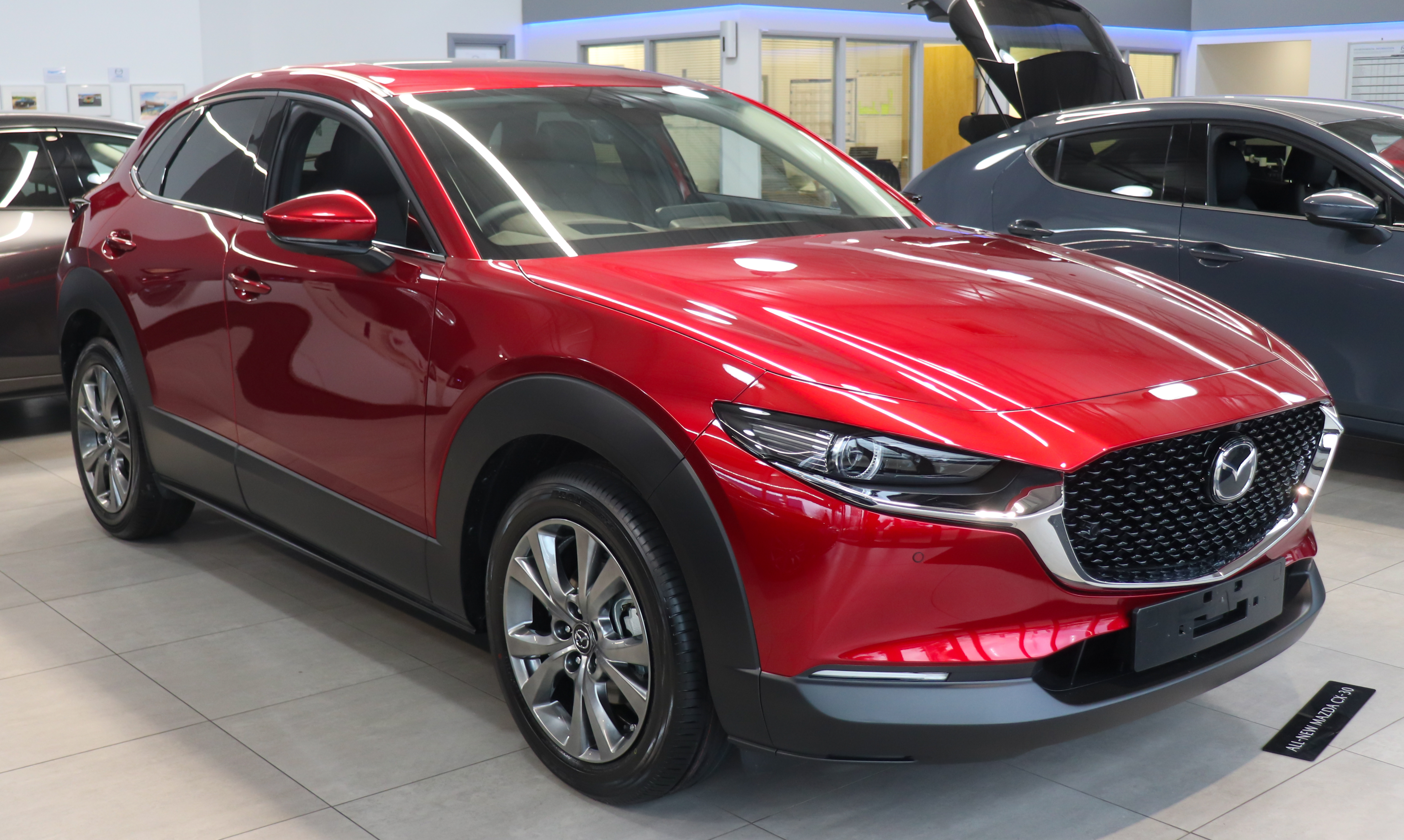
The Mazda CX-30 is a smaller Mazda SUV/crossover that usually costs less than the CX-90. In this segment, they’re saying it’s moving better and that extra import costs (tariffs) can affect pricing.
Inventory levels mean how many cars are sitting at dealerships or available to buy. If there are a lot and not many people want them, sellers often have to adjust pricing or incentives.
Average days on market tells you how many days cars usually stay unsold before someone buys them. If it’s high, cars are taking longer to sell; if it’s low, they’re moving faster.
Tariffs are extra taxes on imported products. If a car has to be imported, tariffs can make it cost more, which can influence the price you see at the dealership.
The infotainment system is the car’s main screen and electronics for things like music, navigation, and phone connection. If it’s old, it can feel clunky compared to newer cars.
This is the typical advertised price for new cars. It may not match the final price after discounts, but it’s still a useful indicator of how expensive cars look to shoppers.
Car segments are groups like small SUVs, larger SUVs, and full-size trucks. Prices can move differently in each group, so the market can feel better or worse depending on what you’re shopping for.
Mix shift means buyers are choosing different types of cars than before. If more expensive models sell, the overall average price can rise even if each model’s price stayed similar.
The Alfa Romeo Giulia is a sporty sedan. “Intensa” is a particular version/trim level, and they’re talking about the price—especially how much cheaper it might be than the sticker price (MSRP).
Destination charges are fees added to a car’s price to cover shipping the vehicle from the factory to the dealer. In this segment, they call out how large the destination charge can be, which affects the total MSRP baseline.
The Dodge Charger SCAT Pack is a higher-performance version of the Charger. They’re talking about big discounts on leftover inventory and how fast one got sold after the price drop.
A lease contract is like renting a car for a fixed time. You make payments, and at the end there’s usually a set “value” for the car that determines what you owe.
Residual value is the estimated value of the car at the end of the lease. If you end the lease early, that number often gets used to figure out what you still have to pay.
Equity in a lease means the vehicle is worth more than the amount you effectively owe to buy out the lease. If the car’s market value is higher than the payoff figure, you may be able to trade it in or settle the lease with money left over (depending on the lease terms).
It’s basically a scorecard for car dealerships. The goal is to show which dealers are honest and clear about pricing and reviews, so shoppers can avoid sketchy ones.
In this context, “F-rated” means the dealership scored very poorly on the host’s transparency scorecard. It’s a warning sign that the dealer may not be straightforward with customers.
They’re walking through a website map that helps you compare car dealers. You can filter by brand and see how dealers’ advertised prices and quotes line up.
An out-the-door price is the final total you’d pay at checkout. It includes the extra fees, so it’s a better comparison than just the advertised price.
An “out the door” quote is the final total you’d pay to get the car, not just the sticker price. It includes the extra costs like taxes and dealer fees.
An OTD worksheet is a dealer’s breakdown of the final “out the door” price. It shows how the total is calculated from the car price plus taxes and fees.
They’re using software to do parts of the car negotiation process for you. Instead of you doing every back-and-forth, the system handles negotiation steps and records the outcomes.
LIVE
It's noon here in Venter City, New Jersey in Maryland's Live Casino, and this is CarEdge Live
for Tuesday, May 12th with your hosts, me, Ray, in my living room in Venter and Zach,
hanging out in the dressing room at Maryland Live Casino. How are you today, handsome?
Dad, I'm doing fantastic. Had a really humbling experience earlier today,
keynoting the auto industry AI summit, which is really cool. I also met Dad Russ
whips for the first time in my life in person, so that was super cool to be in the
froze of a celebrity. He's a pretty high-energy young man.
He really is, and he's a Pittsburgh guy, which was pretty cool. I forgot about that.
So anyway, having fun here in Maryland at Maryland Live at SokuCons AI Industry Summit,
but Dad. Yes. But Dad, but Dad, but Dad. Today's show, we're going to be talking about all the
things going on over at Mazda before we do. We must remind everyone that it is brought to you by
today's show is brought to you by caredge.com. If we can help you out with anything, it would be my
dad and my personal privilege to do so. Please check out the website caredge.com. Let's start here,
Pops. May I say one thing before we get started? Yeah, sure. Okay. I've noticed in comments,
people keep mentioning my persistent cough. So just to fill everybody here, because we are
nothing if we are not transparent on this channel. Yes, I have been going to a doctor. Yes, I have
been diagnosed with interstitial lung disease, which is an irreversible, incurable lung disease
that, according to my doctor, is not going to be the cause of my death. Something else will,
perhaps the beer truck that runs me over when I'm crossing the street one day.
Who knows? But the downside of what I have is that I cough and I can't necessarily always
control the cough. I am doing a pulmonary function test on Wednesday, tomorrow. I'm doing a sleep
apnea sleep study. And in six weeks, I will be meeting with the doctor and we will be coming
up with a plan to help me get through all this. But I just really, I know my cough has been annoying.
It's been annoying to my son. It's been annoying to the audience. And trust me when I tell you,
it's been more annoying to me than anyone. But I figure we should address the elephant in the
room and let everybody know what's going on. So that is what's going on for those of you who might
have any questions. Thank you, dad, for sharing that. Yeah, I was so anxious leading up to you
getting your test results because for those of you that don't know my mom, my dad's wife,
died from lung cancer. So yeah, I was so nervous. So scared. So grateful when your x-rays and your
CT scan came back with no tumors, no modules, nothing like that, no nodes. So really excited
about that. And disappointed you have this now, but you're going to live through it. And I think
it might even get you walking a little bit more. So that's exciting, dad. But thank you for sharing
that. Yes. Yes. Until I, you know, one of the side effects is also a shortness of breath. So
I will have to build up my stamina. And trust me, I spent many, many years seeing to it,
I had no stamina. And so this is going to be quite the adjustment to develop some stamina.
But, but I will do my best to do that. You're a funny guy. All right, guys, let's jump in
to the stories today. First things first. Yeah, please send my wishes to my dad in the comments
and in the chat. Dad, Mazda sales plummeted in April. We're going to look at that data in just
a second. And they're canceling some of their vehicle production. Mazda's delaying EV launches
by over two years and slashing some of their investments. They're pivoting back towards
hybrids. Now, for those of you that are unfamiliar, the auto industry had a bit of a wake up call
in April as sales dropped for the fourth month in a row. New car sales that I'm going to jump
all the way down here to our handy dandy table. Mazda sales that for the month of April were off
17.3% year over year. The industry overall data that we have from automotive news down
six and a half percent. So some significant changes going on at Mazda. And if I may pops.
Yes. We had Joe Lewis who runs JC Lewis Mazda down Savannah, Georgia on the show recently. Joe also
went on his lot, filled the lot for us, has tons of inventory. What is going on over at Mazda?
What's your read on the room here? Aren't they the other brand that people who can't get their hands
on Toyotas right now should be turning to? They should be thriving, but they're struggling
significantly. How about the Red One? Yeah, they are that other brand in my opinion. I think
not because I drive one. I've always had an affinity for Mazda. I've always thought that it was a very
under the radar high quality brand, Asian brand, Japanese brand. And that goes back
30, 40 years. They've always made a quality product that provides a lot of bang for your buck.
Why their sales are off? I don't know. I mean, they still, even though their prices have gone up
somewhat, they are still one of the major players in the mid 20s to under $40,000 price point. They
have plenty of vehicles over $40,000 as well. I would think the vehicles that aren't selling as
well are like the CX70 and the CX90, which are their really overly expensive brands for
models for that brand. But the CX50, the CX30, the CX5, the Mazda 3, those vehicles
can be had for in the mid 20s to under $40,000. And I would think they should be doing well. I know
the CX50 hybrid accounts for what was it, 35 or 40% of their CX50 sales. And that hybrid
is a Toyota. I mean, that's the Toyota hybrid that they use in that vehicle. That won't be the
future of their hybrids, but that is what they're using now for that. But let's talk about this
a little bit more. Their sales down almost 20% is a huge deal. I mean, none of their peers,
obviously, we can look at the chart here. We saw some other big drops in terms of industry-wide
sales, Lexus sales off 20% year over year, Lincoln sales off 21%. But those are very
different brands than Mazda. I mean, Ford, to be clear here, with a 14% decline year over year,
maybe you can make a case, okay, that was tariff activity going on, people buying cars before
tariffs last year. But then Mazda is the leader in the pack of non-luxury brands losing that much
sales growth year over year. And then what's fascinating is you say they have a lot of options
at the sub or in the $20,000 to $30,000 price point, which they do. We're going to look at
this in a second here. But Mazda has been very clear that their ambition is to go up market.
You can see here from Rob report why Mazda wants to take on Mercedes and BMW from Torque Cafe was
Mazda's premium push a mistake. There was a bit of a fascination and excitement from all
automakers to push up the prices of their vehicles or to restrict and rebalance what types of vehicles
they produce, exacerbating the current affordability crisis. And we're going to look at it in a
second here. You know we have the data to look at CX-90 market availability versus CX-30, for
example. We'll look at it in a second here. But Mazda's decisions, I think that have painted a
pretty clear picture for why they're struggling as much as they are right now. I think during the
height of COVID, when dealers were charging additional dealer markups anywhere from like $1,500
to $20,000, every one of the manufacturers took notice of that and they said to themselves,
oh my god, we've got our cars priced too inexpensively. Okay, the dealers are able to add 10,
15, 20,000 dollars and people are still buying them. Oh, this is the opportunity we've been waiting
for to go more up market. Well, the problem is there is not enough customers to handle all the
let's go more up market brands that they want to do. Yes, there's 13 to 15% of the population that
can comfortably buy whatever it is that they want and do. The rest of us are struggling. So if you
say to yourselves, we're just going to cater to that 13 to 15%, well, that becomes a much smaller
market that you're trying to grab market share out of. It's much harder. So yeah,
Mazda to a certain degree decided to move upscale and to abandon their customers
similarly to what Stellantis did with many of their products. It is a mistake that they made.
I would imagine that if the CEO is looking closely at the EV mistake and they have always said,
when it comes to EVs, we're going to be the followers, we're not going to be the leaders
and by moving slowly, they're able to scale back their EV investment. Perhaps, just perhaps.
I don't know this, but my guess would be that that same CEO is going to look at
where they're trying to go and say, we're moving too upscale too quickly and we're leaving too many
of our customers behind. Let's take a look at the data, Deb. Let's do, you know me,
live experiment. So we've gone here over on the car edge, car search. We have filtered to new
Mazda CX90s and I have the location set to anywhere, anywhere in the United States.
There are 17,500 new Mazda CX90s for sale right now and I'm going to click on our handy dandy
map view. And the thing that I'm looking at, okay, here we go. So the thing that I'm looking at here,
dad, on the map view is what color am I seeing? Now, it's a little hard. I know our heads are
covering it a little bit. I'll try and zoom in so you can get it higher up on the screen.
There you go. You can see it. This map shows you where the day's supply is higher or lower.
Day's supply, for those of you that don't remember, it's the number one thing me and my dad care about
because it dictates to you how much leverage you have when buying a car. If there's over a 120
days supply of inventory, that means it would take over 120 days to sell all available inventory
based on current sales rates. That's a buyer's market. If there's 45 days or less, that's a
seller's market. Look at this. Oh, let me zoom back out. Look at this map, dad. It's all green
and a few grays. Yes. Okay, where we just have very limited inventory. North Dakota, there's
very limited inventory with a 405 days supply. Make your way down our state, Maryland. Yes.
You know, we can zoom in here. Your state. I live in Jersey. And when I zoom in here, dad,
now, instead of looking at day's supply of inventory, this map showing us the days on the
market. So what's the other indicator for how likely a dealer is to negotiate on a car?
The longer it's been sitting on their lot, the more likely they want to get rid of it because
it's costing them money. We're doing this with Mazda CX90s right now. We're going to do this
exact same experiment in a second with the CX5 or the CX30. I mean, there's some dealers here,
dad. I mean, this dealership in particular, they've got an Annapolis. Holy cow. An Annapolis.
That would be Fitzgerald, yes. Fitzgerald has 33. 2026 Mazda CX90s on their lot right now,
120 days on the market, 171 days, 177 days. Let's click on this one.
177 days supply. In Annapolis, Maryland, there's a 477 days on the market, 413 days supply.
And they are advertising, look at that. They're advertising this $8,471 off of MSRP. So what's
Mazda's problem? They pushed up market with a nearly $60,000 SUV. And now their dealers are
having to advertise it at an $8,471 discount well above $10,000. I'm not really a car guy.
I didn't spend nearly 50 years in the industry. But when you see a 33-day supply of CX90s in one
deal, we're in an Annapolis market. 33 sitting at one dealership, not 33 days.
33 sitting on the ground. I'm thinking to myself, oh, that's probably about 32 many.
Okay. And so seriously, the rage are selling them. Yeah. And we talked with Joe Lewis about this.
So you can see that they have, and I don't know if those are produced in the United States. I'm
not sure where they're produced. You can tell by the then. If it's a one, it would be the United
States, I believe. But if they're trying to load up their dealers with vehicles that have
less tariff impact, those prices are too high for their customers. And that would be like
when I was an Acura dealer, and I had 33 RLs. You need three. You need a half a dozen max.
You don't need 33. And so, yeah, if you happen to be interested in a CX90, and you don't want to
look at a comparable Lexus or an Acura or something else, you should be able to get a
hell of a deal on one of those. I mean, they need to relieve themselves of that inventory as quickly
as they possibly can because it gets very expensive to carry those vehicles. Now, let's do another
example this time, not the CX90. I'm going to want to look at the CX70 in a second here, but let's
take a stab at, I don't know, something that we do think is selling relatively well for Mazda.
What do you think the CX30, the CX5, the CX50? I think the CX50 is at this point one of their
better sellers. The CX50 typically is. So dealers nationwide have 10,000 more Mazda CX50s for sale
right now than they do CX90s. We're going to, again, right over here, click on Map View.
Okay, I still see a lot of green, Dad, but less green. And I see some red. I actually see some
markets, for example, what's that, Connecticut? Yeah. There's not a lot of Mazda CX50 availability
relative to demand. New Mexico, not a lot of availability relative to demand. Maryland again,
we've got an oversupply of inventory. This is so fascinating to look at the Map View for Mazda
because you know, let's zoom into one of these things. Let's go back to Maryland.
How many do they have in Annapolis? Yeah, this is fascinating. They only have 28.
So of a faster seller, they have five less of those in inventory than those CX90s that
when you think of Annapolis and you think of the Navy and you think of water,
you know, they have basically 33 anchors when it comes to those CX90s and perhaps they'll
sell them as such. But what's so fascinating here, Dad, is again, Mazda sales plummeted 17%
year over year. And again, where we started today shows the fact that the headline in
automotive news is pretty scary. They're delaying two more, or delaying vehicles and they're
slashing investments. Yeah. That's scary. But then you can look at the data, the actual like
vehicles on the ground data. And then you can talk to some dealers as well, like Joe Lewis from
J.C. Lewis in the picture is super clear. They made some vehicles, 17,500 CX90s, for example,
that are not selling nearly as well as vehicles that they have still more supply, not enough
more supply. One of the ones I wanted to look at here, Dad, if you'll bear with me for a moment,
sure, go back, the CX30 has comparable inventory levels in terms of total models out there to the
CX90. Mazda had 17,500 CX90s. They have 15,633 CX30s. Couldn't be more different.
And these are going to come in at half the price. That's the point I want and look at the map. Again,
still not a lot of red. So it's not necessarily a seller's market for Mazda anywhere right now,
I guess with the exception of in Nebraska, but a lot less green. A The Mazda CX90,
this whole map was super, super, super green versus here, like even in a state like New Mexico,
let's zoom in here. Okay, you've got one dealer who's been sitting on a bunch of these, but Albuquerque,
the inventory is like kind of the right age, average days on markets, 84 days. I'm not saying
that's great or bad, but it's kind of neutral. And that's a totally different price point vehicle,
one that they make less money on to be certain, but also one that isn't pushing for premium.
And one that costs them more to bring into the country because it's produced in Mexico.
And so there's additional tariffs impacting the CX30s at the moment.
It all adds up and it's, you know, I drive a CX30. It is a little more than adequate for me.
You've ridden in the car. I mean, it's a lovely little vehicle. It was a tiny bit bigger than
the Mini that I had. It slots nicely into the category. The reality is it's half the price of
what they're not able to sell right now and it's selling better. And that's, I think,
should be take away here. Again, if you're interested on the car search, we've been using the
map view on today's show. I think it's one of the best tools you can use. Maybe you can get a
better deal on a car out of state. Maybe if you get a significantly better deal by just going
over the state line to another state, use it as a research tool to help you think things through.
For instance, if you're in Connecticut, which was a red, you know, had very limited supply
of what was CX50, you know, Maryland is not that far away. That might be the state to go to
if you're looking to save significant amount of money trying to buy one of these things.
Let's come to the chat, Dad. We had earlier in the show running through life. My local Mazda
dealership is flooded. Time to bring Geig 0% from Mazda. I wouldn't be surprised if we see big
offers like that from Shannon. And it's so good to see you here.
Have the day off. So I'm able to watch the live instead of the replay. Just wanted to say how
did you guys always grateful to see you. Thank you so much. You're incredibly kind,
incredibly generous. Dad, we have here from Scott. Thank you, Scott.
Wondering if you guys did an episode on Q1 winners as far as sales by manufacturer.
Any guesses who's the Q1 winner? Would it be Toyota?
Toyota. There's your winner. It's one winner and it's Toyota. The Toyota market is crazy.
Actually, just to demonstrate that for a second here, I will pull up on the screen like,
okay, we're looking at Mazda CX 30s. So let's change this. Whoops. Let's change this not to
Ray to Toyota. And then literally any model. Give it a second here. We'll do the Camry.
And now we'll go to map view. Yeah. And I question some of the data here even for the
green states. All right. That means dealers are probably advertising cars that they don't
necessarily already have on the ground. Some of the stuff the FTC is trying to work like.
Yeah. Who's winning right now in the auto industry? Toyota. Okay. It's seller's market for Toyota,
pretty much all other automakers. The buyer's market we've got here, Dan, from Big Fan.
Straight from Big Fan. I consider the Mazda CX 50. The view out the back view, the rear view,
was terrible and the infotainment system was maddening in my opinion. There you go.
You know, and that's why we have as many options in this country as we do.
And why you should go test drive all new cars? I'll never forget when your
sister and brother-in-law were, when it was time for them to get a new car and Dara came up with
a list of vehicles that she wanted to look at that she was considering. I said, well, did you
drive any of them yet? She goes, well, no, why do I need to drive? Because you need to find out
if they're comfortable. You need your five foot one. You need to figure out if you can see over
the hood. And that was a perfect example for that person. Being able to see out of the back
wasn't as easy as they would have liked. And let's face it, the infotainment system on the Mazda
is almost as old as I am. It is a pretty ancient infotainment system that they use,
which I think was one of the big upgrades that they included in the 2026 CX-5 because they knew
it was time to replace that infotainment system. For sure. For sure. Now, Deb, the other story I
wanted to turn our attention to this morning, this afternoon, excuse me, is KBB came out with
their new vehicle price point for the month of April. They crunched the numbers over there.
And shocker, we have a slightly higher average transaction price for new cars. We're right
hovering in at almost $50,000, $49,461 is the average transaction price for new cars. The average
MSRP year over year was higher by 2.1% to $51,607. And then incentives here, Deb, in the month of
April actually decreased to 6.9% of the average transaction price from 7.2%. So we're starting
to see some automakers surprisingly pull back some of their two consumer incentives. Now,
we do know that some of these automakers have increased their incentives to dealers. We had
Jared from Jim Glover on the show recently, and they did that. But was it final pay on some of
his vehicles? And I mean, the incentives to the dealer were huge to make up for the fact that
they were going to have to discount that car so much. So what do you make the numbers essentially
kind of flat in terms of $50,000 price new cars and incentives still down a little but not that
much? If you go to the front page of Automotive News today, which is one of my favorite things to
check on a daily basis, we'll see that things are trending in the wrong direction. Now, would I
suspect that we will see incentives go up this month? Well, since most of the manufacturers
have decided to book expected tariff refunds into their profits so far for the year,
and I believe Ford was booking $1.3 billion in tariff refunds. And what was GM, $500 million
or something? So I would think that provides them with the extra funds to be able to increase some
of the incentives to help move these slower moving vehicles. And here's my point. The average
marketed price, if you go back to that script, is $51,385 on new cars right now. That's $681
more than it was 30 days ago. It's $1,494 more than it was a year ago. So it just seems to me,
for anyone who suggests that new car pricing is going to go down, I can share the stats with
you on a daily basis that shows that does not appear to be the case. And I know that there's
any number of pundits on YouTube, and we're one of them, that says, but prices aren't going
backwards. And even if incentives tick back up to 7.2% of the average transaction price,
that's still 3%, 4%, 5% less than what it used to be. And so we are, in my opinion, a long way
from getting back to more affordable vehicles for more people. I really believe that the
manufacturers are very, very content just marketing that 13% to 15% of the population.
I'm going to put you and our community on the spot. What do you think the average
transaction price last month was for a full-size pickup truck in the United States of America?
I will tell you, it was up about 3% year over year, the full-size average transaction price.
That's going to put it just under 70 grand. How far below 70 grand? Because you're pretty close.
About 68.5%. That is a tremendous guess from my dad. We've got 72, 72, 75. We are fortunately
in the 60s. We're not up in the 70s quite yet. We're at $66,705 for full-size pickup trucks,
up 2.9% year over year. What's surprising here, Dad, is you actually have subcompact SUVs up the
most 3% year over year at $30,790, mid-size SUVs up over $50,000. It's interesting to look at the
mix shift of what different types or different segments of vehicles are selling at. Obviously,
full-size pickup trucks are the highest there at almost 70 grand.
And I think the compact SUVs that went up 3%, probably most of them were impacted
primarily from terrorists. And even with a 3% increase, the average was just slightly over
$30,000, which still means that they are so much more affordable than the comparable larger vehicles
at the higher price points. Yeah, they really are. And again, like we demonstrated before with
the CX90 versus CX30 example, obviously the CX90 is not a full-size pickup truck, but it's a more
expensive full-size versus the less expensive compact. The compact one is selling faster,
still buyers market from us because of all the challenges they're facing, but it's selling
faster. No wonder people are looking for more affordable options. Let's come here, Dad,
from Jnagamy. Thank you. Thanks for your kind contribution. Hi, Zach. How much is the 2025
Alfa Romeo Giulia Intensa selling for, it looks like the MSRP is $59,000. I'll see if we have any
data on this. I don't think we have a ton of data on Alfa, but Dad, my gut's telling me that any
Stalantis product, especially something like a 2025 Giulia, is selling with a significant discount
off of MSRP. Well, and we know that the Stalantis is only attached to like an above $3,000 destination
charge on Alfa Romeo's, which didn't help the base, total MSRP of the vehicle when,
I know for 2026, it's $3,250 just in destination charges, which is absolutely crazy.
Your thoughts on a 25 leftover, I mean, you're probably talking at least 15% off of MSRP.
I don't know. My guess is you could probably get closer to 20.
It's not like they're selling. Yeah, they're not selling.
It's not like there's a ton of people running in going, I got to have it.
Yeah, I think you're right about that. Yeah. Dan's got a question. Did the huge decrease in
Stalantis' MSRP on leftover SCAT packs, chargers, things like that go through as indicated by Jared
Glover last week? Yeah, they did. And actually, Jared called me the next day. He thanked us and
thanked you to the community. That same day that he was on the show, they sold the SCAT pack
to a Carriage Community member. They leased it. Yeah. Very cool. It's awesome. It's awesome. It
only took Stalantis what they have to do. It was ultimately the dealer. What do you have to do?
45% off of MSRP? That's already hard. Yeah, crazy. And I guarantee you Jared was thrilled
to get rid of it. Of course. Of course. Yeah. Dad here from Catherine, Zach and Dad. I like that.
He is Dad the holder. When turning in a lease before lease end date, will other manufacturers
add on what you still owe to a new loan? So, Dad, let's help Catherine out here. With a lease
contract, you don't owe anything at the end, unless... Well, if she's trying to trade it in
before the lease is up, there'll be a payoff just like there is on a car loan. Now, typically,
the payoff is the residual value plus any remaining payments less a little bit of interest.
Okay. Now, depending on what type of vehicle it is, you very well could have equity in that lease.
But you also have to understand that many of the leasing companies won't allow
the vehicles to be paid off by a different brand. So, you have to see if it's complicated.
It is complicated. I would say this. We have the communityforumcarriage.com slash community.
We also have our concierge service where we do leases as well. So, two options. One free,
obviously, a full white glove service is not free. Check out our website, see if we can help you
out, Carriage Community Forum, where you can get into more of the nuances with community members
and our team. Dad, let's call it a show for today. Again, today's show is brought to you by caredge.com.
I am just going to share one thing from my presentation earlier, Dad. Live on stage,
I launched 100 of our car-buying AI agents to different dealerships. We've already done 34
out-the-door price quotes back since I did my presentation. 87% of dealers responded,
to be clear, we targeted just dealers on the East Coast because I went out at 10 a.m.
But I was in front of a room full of car dealers, people who work in the auto industry,
and I will share with you one of the slides I had, Dad. Yeah, bear with me for one second.
Let me pull it up. I was nervous to do this, if I'm being totally honest.
I had, wait for it, this slide on the screen, this slide that you're about to see,
reminded everyone in that room that at Carriage, we grade car dealers based on how
transparent they are. Dealers who advertise one price online and then add additional dealer
markups or products and things like that get graded in F. Then obviously,
dealers who are transparent and straightforward, they get graded in A. It was a tremendous moment.
We should have the recording sometime this week. I can't wait to share it and promote it.
This is me speaking to the auto industry saying, be transparent, please, because if you're not,
we're going to catch you. We want to be able to push people towards dealers who aren't playing
these BS games. Such a fun moment for me, Dad. I think hopefully when you watch the recording,
if you watch the recording, you'll feel really proud.
Well, not if. I will watch the recording and you'll be happy to know that prior to this show,
I was filming a spot with the CBS station, KDKA in Pittsburgh. One of the things that we talked
about was how we have created the dealer transparency index. There would be no
excuse for people today to find themselves in an F-rated dealership. She said to me,
well, how do you get these reviews? There are costs for that. I said, there is not.
There are certain things we charge for and certain things we think should be free.
One of the things we think should be free are the things that will help customers determine who's a
to get dealerships to agree and do it the right way and put ourselves out of business.
The good news is that's probably going to take 20 years or more, but that's a great goal to have.
A friendly reminder for what we're talking about. Carage.com dealer reviews. Then you can search
for dealers. You can go on the map. The map is one of my favorite things that we built
from the map you can sort by brand. If I want to look at just four dealers that are rated
for whatever reason, B. There you go. Here's all the nationwide B rated. Four dealers out there
will zoom in here on Topeka. They can come in here and I can see, okay, this dealer has only
given us one outdoor price quote. What do they do well? Their online advertised price as compared
to the quote that they gave us was only 2.5% above. Their dock fee of $999 is $413 above the
average of all other Kansas car dealers that we've contacted at 586. You want to see the
actual data? You can come down here and view the quote. This, to me, Dad, changes the game for
car shoppers. Carage.com slash dealers. Look it up in your area. Use the map as caredge.com slash
map. So, so proud of what we're doing. And to be in a room of hundreds of people today to talk about
it, cool moment, man. If that doesn't scare the poopies out of so many of the dealers out there,
then I don't know what will because they can say, well, you can't do that. Well,
we got the receipts. It's your damn out the door quotes that you sent to us. Okay,
we're not making them up. To be clear here, literally every piece of data we get is from a
redacted OTD worksheet that we've received from that dealer. So, this type of data,
this type of information that should literally scare dealers straight because you don't want to be,
if you're an F-rated dealer and you're not far from a B or an A-rated dealer,
why do you think the customer would go to you when they have a choice?
And the last time I checked, they do. Yes. And they have a choice today based on legitimate
information that they haven't had in the past. So, if this doesn't scare them, nothing will.
So, and just to address this, dealerships share their OTD sheets with caredge directly.
Some kind of. The reason I'm kind of being coy about that is because for those of you that may
not be familiar, when me and my dad started caredge, this business, we offered a car buying service.
Literally, me and my dad would get on the phone and call car dealers and negotiate car deals.
We started doing that six years ago. We have built out an incredible team, if you click on car buying
service, an incredible team of what we call our concierges. These are people who have spent,
in next case, 20 years in the industry, 25 years in the industry, 26 years in the industry, 30 years
in the industry. These people provide that service that me and my dad provided for many years at the
beginning of caredge. And you can even come in here and see the deals that they've worked on
and the customers that they've helped save money. We have also built AI, AI agents that you're able
to deploy to car dealers that will negotiate on your behalf. All of the data we collect from
our concierges, all the data that we collect from our AI agents that we use on behalf of customers,
that data gets fed into the dealer transparency index. It's fascinating. Even some automakers now
that are calling us asking, yeah, I'm sorry to sell us so much. I just did a whole presentation
talking about this. So it's the end of the show. You can leave. We were not offended. So apologies
that we're being so promotional. But, Eddie, we've even had automakers call us and ask us,
hey, can you mystery shop our dealerships? And it's like, didn't you watch our Ford video?
Like, are you sure you want us to mystery shop 100 of your dealerships? It's pretty cool the
data that we're able to collect. And obviously, hopefully it's clear to everyone, we're making
it publicly accessible. We're not gatekeeping it. We're not making it so that you have to pay to
access the dealer reviews. It's accessible, which I'm really, really proud of. So anyway,
can't wait to share. Yeah, this was 10 minutes of self-promotion, but it's because I was,
I did a keynote that it was a really cool moment. My girlfriend dressed me. I felt very, very,
very swab. You look very tech CEO-ish today. Thanks. Oh, actually, you know what? All right,
the little clip that I reshared, I haven't posted on my personal Instagram, but this little clip,
dad. Yeah. I mean, it's like a big stage and a bunch of people and I'm in there, I promise you.
So really a cool moment for me and for us. Very proud of you, young man. Very proud of you.
Okay. I love you, dad. Thanks for taking the time to do today's show. I'm going to go eat some lunch
and go shmooze with some folks. And you do that. And I got a couple more media engagements today.
Oklahoma, I'll be coming your way at around 5.15 and Phoenix. I'll see you at 2.30.
Love you, dad. Enjoy the afternoon, everyone. Have fun, everybody. Have a great day. We'll see
you back here tomorrow.
About this episode
Mazda’s April performance takes center stage as the hosts note “Mazda sales plummeted in April” and “off 17.3% year over year,” alongside “canceling some of their vehicle production” and “delaying EV launches by over two years.” They connect the slump to pricing and strategy shifts—“pivoting back towards hybrids” and “move upscale and to abandon their customers”—then dig into how inventory days influence discounts. The episode also covers new-car pricing/incentives, plus CarEdge’s dealer transparency index using out-the-door quote data.
Today on CarEdge Live, Ray and Zach discuss the latest info on Mazda and their decision to slash production of certain vehicles after sales plummet. Tune in to learn more! Hosted by Simplecast, an AdsWizz company. See https://pcm.adswizz.com
for information about our collection and use of personal data for
advertising.