from skyrocketing storage costs and fees from the big guys.
Wasabi is the go-to provider for professional
and collegiate sports teams around the world.
Check out Wasabi's AI-enabled intelligent media storage,
WasabiAir, in the industry's only cloud storage service
with triple protection against cyber criminals.
Wasabi, driving innovation and data storage
for up to 80% less than market competition.
Try for free at wasabi.com.
Wasabi Hot Cloud Storage, proud partner
of My Heart Podcast Network.
Bloomberg Audio Studios, podcasts, radio, news.
I'm Hannah Elliott.
And I'm Matt Miller, and this is Hot Pursuit.
Coming up on the show, we speak with Mercedes CEO,
Ola Kalenius.
This is a really big deal that Ola came to talk with us, Matt,
and I am very excited about what he chose
to share with us, a world exclusive on Hot Pursuit.
The last time we had it, I think the last series
was in 2013, you could buy it.
We had a final edition.
If you had bought one of those,
and I know that Bloomberg viewers are savvy business
people, you would have gotten it
a little bit north of $100,000.
If you wanna buy one now, a used one, albeit,
you probably have to pay between four and 500,000.
So you see the icon status.
That is coming up on the show.
But first, I wanna talk about a competitor
to that G-Wagon.
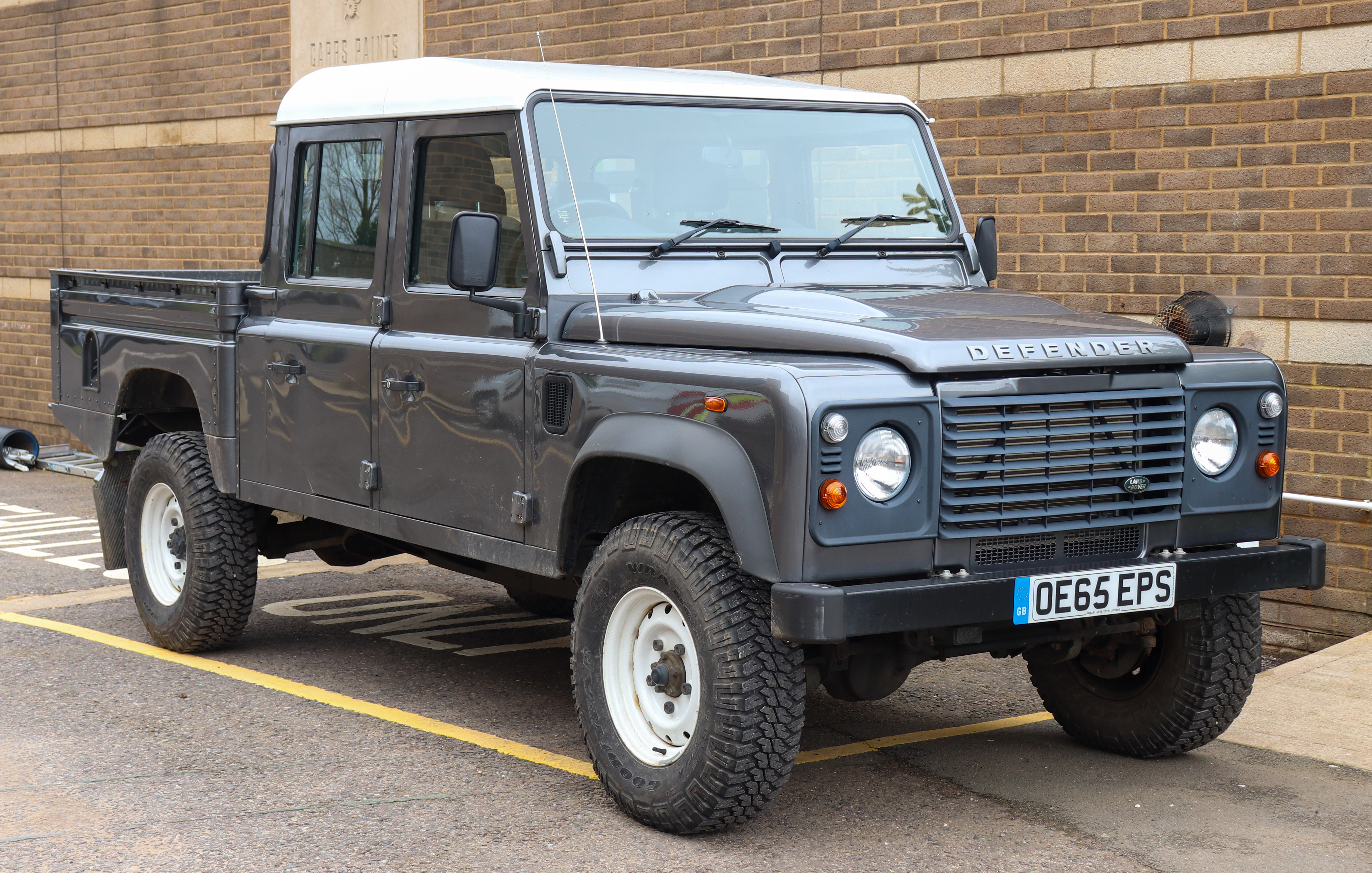
I've been driving the Land Rover Defender Akta
for the last week.
And Hannah, I'm sure you know, this is the V8 version,
and it is essentially a BMW V8,
a twin-turbo 4.4 liter powertrain that they use
in the Range Rover and have been for a few years.
Otherwise, you can't get a V8 in the Defender anymore.
They did have the beloved supercharged
five liter powertrain in that previously.
Now this is your only choice for a V8.
And it's a stunning vehicle, I think,
from the exterior.
They've executed it really well.
Mine came in this really cool dark green,
almost black color.
But the price is so high for such a Spartan vehicle.
You know, the Defender on the interior is pretty Spartan.
They've made it nice with leather and stuff.
But 153,000 in change, I think,
is the starting price before you add any options.
Which makes it, you know,
60% more expensive than a Bronco Raptor.
50% more expensive than a Jeep Wrangler 392.
And even more expensive than the base Mercedes G-Wagon,
which I think is a huge ask, right?
Because it's just, I mean, it's special,
but is it as special as a G-Class?
Well, here's my question to you.
For that price, if I saw the Octa on the street,
would I know it's the special one or not?
No, no.
I don't think, unless you are a Land Rover Defender fanatic,
or, you know, I mean, you might know it's the Octa,
and I might know it's the Octa,
but no one else would know.
And honestly, you can get really cool colorways
in the other models.
So, yeah, I don't think it sounds particularly good.
You know, it's not a big displacement,
it almost sounds like an inline six motor.
Maybe that's just the fact that I know it's got a BMW heritage,
but you wouldn't know, no.
Yeah, I mean, it's interesting
because you think my thought process is,
okay, like defenders wore ranch vehicles forever.
So does it seem weird that one is that expensive?
Yes, but then you got to say,
well, the G-Class was a military vehicle.
Was it fair to hold the Land Rover to a different standard?
I don't know.
Somehow the Land Rover feels like it should be
a little bit more attainable to me somehow.
Yeah, and the weird thing is this price is higher
than the price you would pay for a Range Rover
with the same powertrain.
So, okay, it's got bigger turbochargers.
It has over 600 horsepower.
They've beefed it up a little bit,
but you can get the Range Rover,
which is a step up from the Defender.
It's certainly in terms of luxury for like 135
with a 4.4 liter twin turbo V8.
So I don't know how many sales
they're gonna make of this.
Yeah, it'll be interesting.
There's also a part of me that's like,
well, what about just a Ford Bronco?
If you're going in that direction
and you want something kind of retro,
but the new version of it,
you could just get a Ford Bronco, right?
Call it even.
Yeah, no, absolutely.
I mean, that's probably what I would do.
I love the way the Bronco looks.
I frankly, I prefer it to the Defender.
It's not quite as big the Bronco.
And then the one issue that will be important
to a lot of well-heeled buyers is the NVH issue
that I will speak about
and just build it with Ola Colenius,
the CEO of Mercedes.
The Bronco, no matter what you do to it, it's loud.
It vibrates a lot.
It's pretty harsh in terms of getting in and out
and living with it on a daily basis.
It's great.
That's what you want with that kind of vehicle
for a lot of people.
But this Defender, much like the G-Class,
is very vault-like on the inside.
When you get in there,
you're completely protected from everything outside
and you don't hear everything outside.
It doesn't rattle or shake too much.
So at least it's got the noise, vibration,
and harshness under control
in terms of what you would expect from a luxury vehicle.
Well, that's good to hear.
Yeah, I can't wait to drive it.
I think I might have that coming up in my roster.
I hope I can drive it and compare it
and see if I agree with you, Matt.
All right, that's coming up.
Well, your drive will come up on a future program.
And the Mercedes interview, CEO of Mercedes,
is coming up on this program.
You're listening to Hot Pursuit from Bloomberg Radio.
I'm Matt Miller along with Hannah Elliott.
We've got more on the way after this.
Did you know Tide has been upgraded
to provide an even better clean and cold water?
Tide is specifically designed to fight
any stain you throw at it.
Even in cold.
Butter, yep.
Chocolate ice cream, sure thing.
Barbecue sauce, Tide's got you covered.
You don't need to use warm water.
Additionally, Tide pods let you confidently fight
tough stains with new cold-zyme technology.
Just remember, if it's got to be clean,
it's got to be Tide.
Now let's talk about concept cars.
Audi just rolled out a new one
and Hannah, you were there.
Yes, I was there and I'm still here actually.
In Milan, the early part of this week,
Audi had a big media event last night
at a hotel owned by the Ferragamo family, incidentally,
or created by them.
Actually, I think it's owned by the Vatican.
Anyway, Audi debuted the Concept C,
which they are saying is basically
their complete moonshot revolution
that they are basing all of their brand imaging
and all of their products on from here going forward.
The Concept C is a two-seat electric sports car
that basically, if you can imagine a TT
and an R8 pushed together,
you kind of get the Concept C.
Although the Concept C is longer and wider
than both of those, especially the R8,
that's kind of what you're looking at.
It's very brutalist.
It's like a monolithic block
and it's also got a drop top.
It's a Targa-style sports car.
So yeah, it was very interesting to spend a few days
with Audi and hear about this car
and hear them talk about striving for clarity,
which is their new tagline.
And they basically were very upfront about saying,
we got way too complicated.
We were trying to be all things to all people.
We were too complex for our consumers.
We tried to do everything all at once
and now we are going to pair it all back
and we're doing simple, minimal in a real way.
And the Concept C is their attempt at that.
They can learn from Land Rover Defender
because that interior is minimalist.
But actually it makes sense to me.
Audi is the luxury brand of Volkswagen
and I can see that they do their sort of fru fru stuff
with Bentley or Porsche or Lamborghini, right?
They might as well keep it simple,
minimalist luxury with Audi.
I feel like that tracks.
Yeah, I mean, I would say Bentley
is the luxury brand of Volkswagen really.
And throw in Lamborghini.
Honestly, I think Audi has really been struggling
and they admit it.
I mean, this isn't anything new.
They've struggled to even be a choice behind Porsche,
obviously within their own family,
but even behind BMW and Mercedes,
if you had asked me what does Audi mean,
I would have been a little unclear.
It's been vague.
So yeah, it's interesting that you bring up luxury brand
because yesterday in a round table,
their chief, Dolner, said we want to be
the most aspirational premium brand out there.
And he kind of admitted, he knows they're not right now
and they really need to ramp up and go for it.
I guess they're like premium economy for Volkswagen
and then Bentley is like a full-on business class
or first class.
I feel like, by the way,
Audi, my dad had an Audi 5000 when I was a little kid.
Audi, the RS2 was the first performance car
that I ever drove.
I drove an RS2 with a stick in Cologne
when I was like 18 years old.
And then an Audi A4 station wagon
was the first new car I ever bought with my own money.
So I have a real personal connection.
Also, Audi made my favorite concept vehicle of all time,
the Audi Nanook, N-A-N-U-K.
Wow, that is a clear reference.
Yeah, so I mean, I'm happy for them to
make somewhat of a comeback.
I thought, you know, the e-tron era,
at the very beginning, I thought this is gonna take off
and it kind of didn't.
So I'm glad that they're stepping it up.
This is a whole new era for sure at Audi.
They have their designer, Massimo Frisella.
Of course, it's perfect for our use.
He was formerly at Jaguar Land Rover
until last year, last year he moved to Audi
and obviously he didn't completely design
this new concept C.
He didn't have that much time,
but Audi was quick to say
that he did have his hands on this vehicle
and Massimo is obsessed with the TT.
Like that is his icon.
I didn't hear you mention the TT in your list, Matt.
So that makes me think, maybe it's too small for us.
But you know, yeah, I never, honestly,
I never liked the TT.
It felt too small.
But Massimo loved it and it's interesting
that we've been talking about Land Rovers
because he was at Land Rover for many years.
Now he's at Audi.
And he thinks Audi has icons too,
just like you're saying, Matt.
So and of course the auto union cars from the 30s,
like those old race cars really were exceptional.
And I think Audi's trying to retain
some of that glamour as well.
Yeah, in the class B, Quattro as well.
All right, coming up on the show,
we speak with Mercedes CEO, Ola Kalenius.
I'm Matt Miller, along with Hannah Elliott.
More hot pursuit after the break.
Innovation is what gets your business to market.
And Wasabi is designed to give every business
a shot at competition.
How?
Break free from skyrocketing storage costs
and unpredictable egress fees
from old and top heavy legacy providers.
You know, the big guys.
Wasabi is the world's hottest cloud storage company
and the go-to provider for professional
and collegiate sports teams and leagues around the world.
And here's why, innovation.
From Wasabi's AI-enabled intelligent media storage,
Wasabi Air, to the industry's only cloud storage service
with triple protection against cyber criminals,
dated deletion and ransomware,
the world's top companies trust Wasabi.
Remember, Wasabi is up to 80% less than market competition
and doesn't charge a cent for businesses
to access their own data.
Wasabi, another championship story.
Check them out for free at wasabi.com.
Wasabi Hot Cloud Storage,
proud partner of iHeart Podcast Network.
We are now joined by Ola Kalenius.
He's chairman of the management board
and CEO at Mercedes-Benz.
Ola, thank you for joining Hot Pursuit.
Pleasure to be with you guys.
And yes, we are in the final preparations for this weekend.
And we have, of course,
brought some great world premieres to Munich this year.
So what are you gonna show?
What's the standout debut for you at Munich this year?
The standout debut is the all-new electric GLC,
which is based upon a whole new architecture
that we call Mercedes-Benz Electric Architecture, MBEA.
Considering that the GLC today in our portfolio
is our most sold model,
we have taken that extremely popular car
and literally in every dimension
taking it to the next level.
So this is a very, very big world premiere for us.
So Ola, tell us how important this GLC is
in hitting some of your targets
that you've talked about, obviously,
the world EVs is slightly chaotic these days.
How crucial is this car for Mercedes?
It's a very important car
because that segment, the compact SUVs,
that's a model that is popular everywhere in the world.
And that segment has grown for us over the years.
And indeed, it is individually the most sold car
from Mercedes-Benz.
So when you do that,
you really want to delight Mercedes fans
and customers around the world
and also surprise them a little bit.
So in this particular case, I think the engineers,
they looked at this as a special challenge.
And of course, it's a second generation electric vehicle.
So in all powertrain dimensions,
incredible on efficiency,
should be around benchmarking its class
with that coming good range, incredibly fast charging.
Charging almost turns into the same thing as fueling,
not quite, but you can charge several hundred kilometers
in 10 minutes.
So all of those dimensions,
and for those people who maybe have not made the leap
into the electric era yet,
we had tried to engineer out every reason why you wouldn't.
And of course, it's going to be a Mercedes
through and through.
It's ushered in our new design language.
So next generation design language from Mercedes
will start with this car.
And if you step into it, you feel at home.
It's like a welcome home feeling of a Mercedes-Benz.
And considering it's a compact SUV, it's pretty big.
If I put myself in my most comfortable driving position
and I'm six, four and a half,
I could actually sit behind myself very comfortably,
have space between the seat and my knees
and certainly between the head and my,
and the very beautiful sky roof.
So we have thought this package through
into the last detail.
So I think this car is something
that is going to convince Mercedes fans around the world.
Sounds impressive, certainly for tall drivers.
Hannah and I both have the same issues.
I'm sure that you have in a normal vehicle.
What about the boldness that we've seen from BMW?
Some analysts are worried that Mercedes
may be a little bit more conservative.
I'm not sure that they can make that judgment
until they see the vehicle this weekend,
but you know, 400 horsepower from a dual motor setup
in the Neue Clasta, 400 miles of EPA range,
200 miles of charging in 10 minutes.
Can you meet or beat those standards?
If you would just take out the technical spec book
of the new GLC, we're not going to be shy
in literally every single dimension.
We will be world-class in many the outright leader
and in some amongst the best.
So we have pulled out all the stops with the new GLC.
So I'm not at all worried that the technical specs
of this vehicle has anything to hide.
And I also would like to highlight
the new Mercedes-Benz operating system
and the ADAS capability of this vehicle.
It literally has 27 sensors looking in all directions
and it has the supercomputer on board
and all the genes for jumping into level two plus plus
automated driving from the word go
where it's regulatory allowed.
So literally it feels like you have an autonomous car,
still in this case supervised by the driver.
And if you then add the absolutely insane
ultra screen pillar to pillar,
and I'm talking about one seamless screen in this case
and how we have added any digital experience
that you can possibly dream of to this car
but also given it an aesthetic look
like maybe you have on your smartphone
you have a very, very nice and beautiful wallpaper.
All of those things that also makes the feeling
inside the car a digital delightful experience.
But beyond the high tech
where we're definitely going to be on the leading edge
it's more than this, it's a car made for you.
So every single dimension of the car,
the safety, the way it rides and drives
how the seat wraps around you
and you can drive hundreds of miles
and you feel refreshed when you step out of the car.
The things that make a Mercedes-Benz a Mercedes-Benz
all of those things have been taken
to the next level in this car as well.
So creating an important vehicle like this
it's not just about the flashy technical numbers
that we have, it's really thinking through
what does the human want?
This is human-centered innovation at its very best.
Stay tuned for Sunday when we reveal it.
Ola, I'm curious on the other side of things
I know obviously you're the head
of the European automaker body, the ACEA
and you've been pretty vocal about regulations
that are realistic for meeting decarbonation goals, et cetera.
Can you tell us a little bit more
about what you mean by realistic?
What would that look like
to have a market-driven regulatory infrastructure
versus something else?
So in the role as president of ACEA this year
and it's something that rotates
between the CEOs of the car makers in Europe
you have to kind of take off your own hat
running your own company.
So I take off the Mercedes-Benz hat
and I put on an industry hat and talk to all the OEMs
but not just the 20 plus OEMs.
In this case we stand side by side
with the sister organization for the suppliers
that is called CLEPA and Mattias Tink of CLEPA and I
are working with the suppliers and the OEMs
to do an inventory or where we stand right now
in the regulatory environment
and how we successfully transform this industry
and successfully find the right path towards decarbonization.
So I wanna stress that this is all the OEMs
with of course some various opinions
but a strong common denominator
and literally thousands and thousands of suppliers.
And the conclusion that we come to is quite clear.
We're all on the way towards zero emission.
There are no ifs or buts that is the journey
that is the destination.
The EU as an economic region has committed
to being net zero by 2050.
We wholeheartedly support this.
We also wholeheartedly support that electrification
is the main road to this.
So the electric vehicle will play the main role
in achieving those targets on the way to net zero.
To demonstrate that not only have we
in the last five or six years put hundreds of billions
of investment into this manufacturers and suppliers
and launched hundreds of vehicles.
So there is a very broad offering already.
And on top of that, we are about to invest
the next chunk of hundreds of billions into this.
So the industry is committed.
I wanna say that as a preface
before we go into the challenges
and we need to make some course corrections.
In spite of the ambition, in spite of those good efforts,
one must recognize and for the world as a whole
the world markets at the whole
it's a very heterogeneous picture.
You use the word chaotic, I would say heterogeneous
that the state or the take rate of BVs
what we thought five or six years ago
is not yet at the level in 2025 that we should have been at.
And we're now looking at kind of nine years time
to go to literally 100%.
And that's where we're saying, okay
if we haven't achieved as a market, as a region
already the milestones, then we analyze why is that
and where do we make a course correction?
And we suggest in general, two main things.
One is absolutely doubling down on the enabling factors
and putting money behind and effort behind everything
that you need to make electric mobility successful.
I'm gonna use one example, charging infrastructure.
The EU has 27 individual countries.
I would say in about six or seven of those
in the last five, six years
a significant effort has been made
and charging infrastructure has been built up
maybe not as much as it should have been at this stage
but it's on the way
but literally in 20 of the 27 countries
it's still in its infancy.
Do we believe, do we really believe
to cover 100% of the purchase intent by 2035
in nine years time that in those nine years
we're gonna go from an infancy stage
to fully fledged built out charging infrastructure
in every single country
because we're talking about the whole market here.
That's going to be a herculean task.
Whatever we do, we have to double down on this
to make sure that electric mobility becomes
even more attractive to consumers
and ultimately is the thing.
You can couple that with all sorts of other measures
where we're suggesting to the commission
not a ready recipe and say do exactly this
but think about incentivization and nudging
when shaping policies to make the total cost of ownership
of the electric vehicle even more attractive
so that we can get ultimately one day
to full penetration
but it seems in just stock taking
it's a very, very big ask
now that we're around 15% take rate in 2025
achieved in the last five or six years
to do the 85 in nine years time
but that ask double down on the enabling conditions
that's number one.
Number two, we think that the method in general
that is being applied select only one stakeholder
of many in this once in a hundred years systemic shift
and put the complete burden on that stakeholder
in this case the producer of the vehicle
and if the producer of the vehicle doesn't make it
sanction it with draconian penalties.
We don't think that method
that planning method is the best method.
We want to turn it on its head and say
why don't we use market forces instead
and switch to a market economy driven approach
with incentivization and nudging
free up the market for technology neutrality
and let the consumer choose
and I underline again with the electric car
as the main actor in this play
but also allow different forms of hybrid formats
and maybe a sliver at the bottom of combustion
high tech combustion, electrified combustion vehicles
where some of the segments of the markets by 2035
were still hard to evade from a consumer point of view.
If we switch to that, we should then open up the horizon
and look at the complete CO2 footprint
of what's going on, not just the tailpipe emission
of the newly registered vehicles that are bought
in that year.
In fact, the car park in Europe is 250 million vehicles
and new registration sits at around 13 million vehicles.
So you have in that sense maybe 5% turnover of the fleet
every year if consumers don't choose to hang on
to their cars longer.
So why don't we look at the CO2 footprint
in a more holistic way and see if we can find ways
if we flexibilize 2035 to also reduce CO2
of the whole value chain here.
So we want to open up the discussion
and if we do do that, we can avoid,
and I'll end with this for now,
we can avoid an effect that maybe if the system is not ready,
what could consumers do?
And I think this is a scenario that is not unlikely.
If not every purchase intent is covered by then
through charging infrastructure or other reasons
why the consumer wants to go for something else,
the consumer might buy the last combustion vehicles
in 33 or 34, hold on to it longer
the car park gets older, very bad for decarbonization.
The market reduces drastically
or maybe even collapses in 2035
and it takes three or four or five years for it to recover
back up to the 13 million.
You would destroy so much economic value,
harm so many companies, so many suppliers,
mid-size, smaller family owned businesses.
Why would we want to jeopardize
that economic strength of Europe's biggest industry
when there perhaps is a better path to green?
That is what these two associations,
Asiya and Klepa are suggesting.
Well, you know, it makes total sense, Ola,
and I just wonder, you don't have a lot of time left, right?
And you're gonna, I think the EU's gonna revisit
this 2035 goal next year.
So have you had a chance to speak with the,
for example, the incoming German government
because they're willing to put their money
where their mouth is when it comes to defensive Ukraine,
shouldn't they be willing to put their money
where their mouth is when it comes to, you know,
planet Earth and also, you know,
how many hundreds of thousands of auto workers
are there in Germany?
Is Friedrich Mayer gonna step up?
In this role as president of the Association,
I and also my counterpart for Klepa,
of course, we're speaking with policy makers
in Brussels on all levels,
but also in the different countries.
And yes, of course, we have also spoken
to the German government.
And I think the, and many other governments for that matter,
but also to trade unions and other stakeholders.
As I said, this is a multi-stakeholder systemic shift
once in a hundred years.
We're talking about the transformation
of the world's biggest industry.
So it's not the small tasks here.
What I think is happening now
is that we have a debate both in the industry
and with many of these stakeholders
and certainly in the political space
where a lot of people are thinking like us saying,
oh, hang on a minute.
If it's not working the way we intended to,
yes, we need to have a political conversation about it.
But of course, there's also strong commitment
to say decarbonization is one of the major tasks
of this generation.
Let's not lose any speed or any momentum
in decarbonization.
So I think there are some stakeholders that go like,
if we do go for flexibilization,
what's gonna happen?
Are we gonna slow down?
It's not what we're suggesting.
We're suggesting to switch method to a method
that we think is actually going to be more successful
than the current method.
So I am fully aware that this political debate is alive.
And right now we're in this period
where a common opinion for the EU,
if they're willing to change,
which we urge them to do, needs to be formed.
So expect the next weeks, months, an intense debate on this.
And indeed, the European Commission is listening
to the auto industry assist the German government.
That is for instance, the reason why they invite us
to a summit meeting on the 12th of September
to discuss these matters.
So we're not at the end of the discussion.
I would say we're in the middle of the beginning.
I'm Matt Miller, along with Hannah Elliott.
You're listening to Hot Pursuit.
We have more coming up after this.
Innovation is what gets your business to market.
And Wasabi is designed to give every business
a shot at competition.
How?
Break free from skyrocketing storage costs
and unpredictable egress fees
from old and top heavy legacy providers.
You know, the big guys.
Wasabi is the world's hottest cloud storage company
and the go-to provider for professional
and collegiate sports teams and leagues around the world.
And here's why.
Innovation.
From Wasabi's AI enabled intelligent media storage
Wasabi Air to the industry's only cloud storage service
with triple protection against cyber criminals,
data deletion and ransomware.
The world's top companies trust Wasabi.
Remember, Wasabi is up to 80% less than market competition
and doesn't charge a cent for businesses
to access their own data.
Wasabi, another championship story.
Check them out for free at wasabi.com.
Wasabi Hot Cloud Storage,
proud partner of iHeart Podcast Network.
Let's pivot a little bit to what has been really a bright spot
for Mercedes-Benz, the G-Class.
You and I have driven multiple variants
of the G-Class together.
And, you know, there's so much excitement around that vehicle
and so much fandom and fervor for decades.
You guys have already confirmed
there will be a baby G coming.
What can you tell us about how that is coming along
with the planning for that?
And also, can we expect any other variants
of the G-Class coming our way?
So we're now in full series development
of this little brother to the big G.
And we're very excited about that car.
We have shown it to, you know,
some of our trusted dealers and other people
that we know are fans of the brand.
I get the same reaction every time, and they go like, wow.
I mean, is this the G that I've been waiting for,
for my daughter, for my son, or for myself?
So, yes, I can confirm that series development
has started of this vehicle, and it is in the pipeline.
So stay tuned.
But now that you mention it, and yes, Hannah,
I vividly remember going up the famous Schuckel Mountain
outside Gratz in Austria with you over rocks and trees
and what have you, the most hardcore of off-roading
in that electric G.
And I think we mastered that quite well together.
So the G is a legend.
It's an icon in our portfolio.
There is another surprise coming on Sunday in Munich
at the IAA.
We will announce the rebirth of the G-Class Cabriolet.
So the last time we had it, I think the last series
was in 2013.
You could buy it.
We had a final edition.
If you had bought one of those, and I
know that Bloomberg viewers are savvy business people,
you would have gotten it a little bit north of $100,000.
If you want to buy one now, a used one, albeit,
you probably have to pay between $400,000 and $500,000.
So you see the icon status of a G Cabriolet.
And we have had so many fans say, when are you going to bring it back?
When are you going to bring it back?
When are you going to bring it back?
Now is the time to do it.
So we have decided to kick off the development of an open top G.
Can I ask?
I mean, I have so many questions about this.
I'm a big fan, former owner.
I had a 2020 G500 in Berlin that I loved.
I've now turned it into a house in Scarstale, by the way.
What kind of powertrain are we expecting?
Could this be electric and gas?
Because I think the electric powertrain really
works well for the G-Class.
I know you and Hannah drove it in Schuckel.
I got the chance to drive it around Westchester,
which was also fantastic.
And how do you deal with NVH?
One of the best things about the G-Class
is that you're in an absolute vault.
Compared to other off-road vehicles,
it's just worlds of difference in terms
of the noise, vibration, and harshness.
How do you deal with the convertible?
So on the powertrain, we'll let you guess for a little while longer.
So I'm not going to reveal that here today.
But trust me, the hardcore G fans
are going to love what we're going to do there.
And in terms of NVH, I think this is pretty amazing
what has happened on our convertibles over the year.
I, myself, even though, of course,
I get to drive a company car and I'm thankful for it,
I feel like a kid on my birthday and Christmas
on the same day, every day I step into, in my case,
my EQS SUV Maibach.
I bought last year a personal car.
I bought an SL, which is obviously a convertible.
And I've been driving SLs and test driving
and stuff like that over the many years.
So I know, obviously, what a convertible feels like.
And when it comes to NVH, what struck me the most
next to the incredible beauty of this car
and the performance was that when I took it
for the first time on the Autobahn
and I pushed it a little bit,
is how incredibly quiet it is.
And this is what I love about our engineers.
You know, they never stop, right?
It always gets better and better and better.
So you can rest assured when we electrify,
no, not electrify, when we open up the G
and make it open top, don't worry about it.
You're gonna be able to have a conversation
with whoever sits next to you.
Okay, I gotta ask, what kind of timeline
are we talking about here?
If the baby G might be out in 2027,
what are we thinking for the Cabriolet?
Not too far away.
That's it.
Let's just say that.
Start working on selling that house, Matt.
You don't have to rush it so that you get a good price,
but it's not like it's too far away.
So wait and see.
And a follow-up, is that Cabriolet coming for the world?
Can we expect it'll be in all markets for Mercedes?
In the relevant markets.
Not every market in the world is a Cabriolet market,
but in all the relevant markets.
I wanna ask about the SL.
You mentioned that you bought one for yourself
and I had the pleasure of test driving the AMG SL63 SE
performance last week.
And the power in that thing absolutely blew me away.
And it wasn't until I was talking about it with Hanna
that I actually looked up the specs
and saw it's more than 800 horsepower
and more than a thousand pound feet of torque.
Then I started looking at other vehicles
with those kind of power figures.
And it's not till I get to a Lamborghini Revuelto
at double the price that I start to see
those kinds of figures.
After that, you have to go to Bugatti and then Koenigsegg.
How has that been received?
And 225,000 seemed like a hefty price tag
until I noticed that power.
Yeah, it's pretty crazy, isn't it?
If you're an AMG fan, you're a performance fan.
So you can never have enough performance.
But I think the best news is that is a car
that you can drive every day to work.
So it's not just that you bought a super car
with unbelievable acceleration and performance and all that.
It's a car that you can actually use every single day.
And I think that's the unique position of AMG.
You get motorsports on the road,
but on the road Monday through Friday as well,
not just for a Sunday afternoon outing.
It's really a car that you would like to drive
every single day.
Our thanks, Tola Colenius, for joining us.
He's the Chairman of the Management Board
and CEO of Mercedes-Benz.
I'm pretty excited about driving the convertible G-Wagon,
the Cabrio G.
Yeah, my question is gonna be like,
how much of a cage does it have on it?
Is it truly like open open air
or does it have a cage kind of like a Jeep Wrangler?
You know what I mean?
Or are they truly gonna go full Cabrio?
No, I imagine it'll have some kind of roll cage.
That looks pretty boss when they do it right.
Yeah.
Although I guess, did the previous,
did the older models just have a full convertible top?
It was open.
It was open.
It's been done.
Well, it'll be like 200 grand.
So I'm not gonna be buying one anytime soon.
Freaking dream.
That does it for this week's show.
Remember to follow and subscribe to Hot Pursuit
on Apple Spotify and anywhere else you listen.
You can also send us your comments.
Please send us your comments.
Email us at hoppersuitatbloomburg.net.
And check out Hannah's columns and stories on bloomburg.com
and the Bloomburg business app.
Go there for car reviews, events and stories
that you won't find anywhere else.
Find it all at bloomburg.com slash pursuits slash autos.
I'm Matt Miller.
And I'm Hannah Elliott.
We'll be back in your podcast feed again next week.
Wasabi is purpose built to free your business
from skyrocketing storage costs
and fees from the big guys.
Wasabi is the go-to provider
for professional and collegiate sports teams
around the world.
Check out Wasabi's AI-enabled
intelligent media storage, Wasabi Air,
in the industry's only cloud storage service
with triple protection against cyber criminals.
Wasabi, driving innovation and data storage
for up to 80% less than market competition.
Try for free at wasabi.com.
Wasabi Hot Cloud Storage,
proud partner of iHeart Podcast Network.
About this episode
Mercedes-Benz CEO Ola Kallenius shares exciting news about the revival of the G-Wagon Cabriolet, a beloved model last seen in 2013. The conversation dives into the G-Class's iconic status and its high resale values, alongside a discussion on the competitive landscape with vehicles like the Land Rover Defender. Kallenius also highlights the importance of the new electric GLC, emphasizing its role in Mercedes' electrification strategy and addressing industry challenges in achieving decarbonization goals. The episode is packed with insights on luxury vehicles and the future of the automotive market.
Mercedes-Benz CEO Ola Kallenius confirms the G-Wagon Cabriolet is coming back—and this time, it’ll be sold in the US. Plus, Hannah covers the world debut of the Audi Concept C and Matt drives the Land Rover Octa.