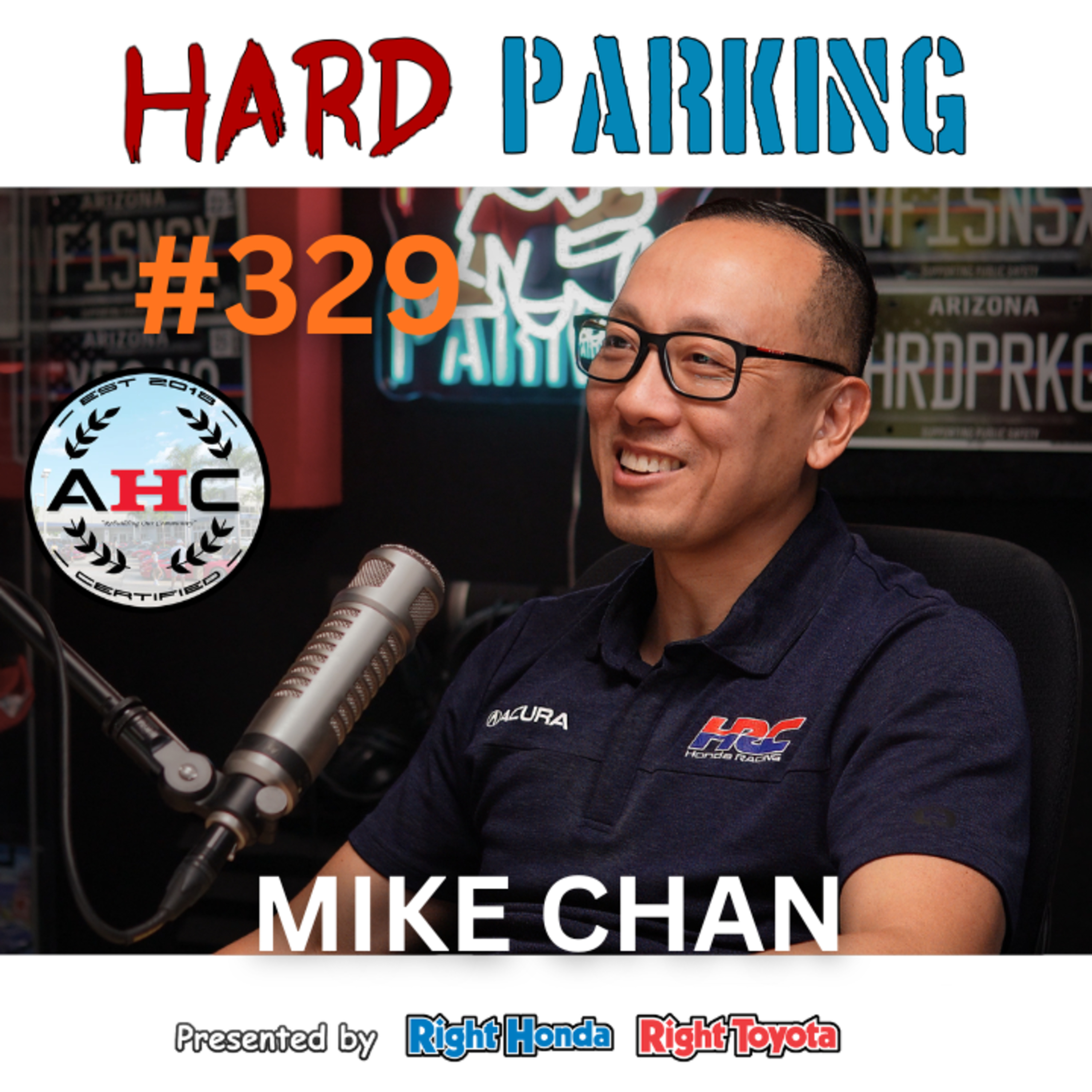
Mike Chan of AHC Garage joins Hard Parking to connect Florida-to-AZ roots with NSX community stories, Honda/Acura dealership history, and the way car culture overlaps. They talk NSXPO in Orlando, Mike’s NSX codes (NA1/NC1), and how AHC Garage started as a simple car meet with early turnout. The conversation also covers rebuilt-title Honda projects, YouTube growth and monetization, and shop-level diagnostics/parts sourcing—plus a few first-car and VTEC memories.
Episode Summary: Jhae Pfenning sits down in-studio with special guest Mike Chan of AHC Garage (Acura Honda Classic Garage) out of Pembroke Pines, Florida. Mike made the trip to Arizona for the podcast, a cruise, and good food — their first real extended conversation after crossing paths at events like Long Beach. They explore the welcoming Honda/Acura family vibe, AHC's origins as a low-drama community hangout, dealership car meets, NSX stories, generous parts swaps in the scene, and more. Laid-back, fun, and full of community love.
Timestamps:
00:00 Intro & Arcus Foundry Spark Forge Sponsor
01:55 Welcoming Mike Chan from Florida
05:00 RJ / Adam Motive Connection & First Meetups
12:00 AHC Garage Start: 2018 Meet at the Dealership
25:00 Honda/Acura Community Culture & Tight Bonds
40:00 NSX Ownership, Parts Stories & Refresh Program
55:00 SEMA, HRC, Dealer Insights & John Shoutout
1:05:00 Wrapping Up & Plans for the Day
1:14:00 Outro, Thanks & PoNy's Miches Mention
Guest: Mike Chan (@chan_mike on Instagram) — AHC Garage / Acura Honda Classic (@acurahondaclassic on Instagram).
"I think we had like 25 NS6s, if not more, like 30 S2000s, just friends."
The S2000 is a Honda roadster that enthusiasts love. It’s known for being fun to drive and for the engine revving high.
The Honda S2000 is a lightweight, rear-wheel-drive roadster known for its high-revving 2.0-liter four-cylinder and strong enthusiast following. Mentioning “S2000s” highlights the kind of cars that show up in this Honda/Acura community car meet.
"At that time, I bought a rebuilt title DC2 Type R from a good friend of mine."
This is a Honda Integra Type R, and “DC2” is the car’s model code. Type R means it’s the more performance-focused version, usually with better tuning and parts than the regular model.
A Honda DC2 Type R is a specific Integra generation/variant known for being a lightweight, track-focused front-wheel-drive hot hatch. “DC2” refers to the chassis code, and “Type R” is Honda’s performance trim with more aggressive tuning and hardware than a standard Integra.
"At that time, I bought a rebuilt title DC2 Type R from a good friend of mine."
A rebuilt title means the car was once written off as a total loss, then fixed up and approved to be driven again. It can be a red flag for buyers because the history is more complicated than a clean-title car.
A rebuilt title is a legal status for a vehicle that was previously declared a total loss (often due to major damage) and then repaired. It matters because it can affect buyer confidence, insurance, and resale value compared with a clean title car.
"Yeah. Growing up in Hong Kong. So original from Hong Kong. Yeah. 87 Honda Civic Si in my little village thing that I was there."
This is a Honda Civic Si, which is the sportier version of the Civic. The “Si” usually means it’s meant to be more fun to drive than the regular model, and “87” means it’s from the 1987 model year.
The Honda Civic Si is a performance-oriented trim of the Civic, and the “Si” badge typically points to a more enthusiast-focused setup than a base Civic. The “87” indicates this is the 1987 model year, which is part of the classic era of small, rev-happy Hondas that became popular with tuners.
"I hop in a Honda Richline. Could it be a F-150? But when did, you may not even know the answer to this."
The Ford F-150 is a large pickup truck. It’s designed to carry cargo in the back and tow things when needed. People talk about it a lot because it’s very common and comes in different versions.
The Ford F-150 is a full-size pickup truck built for hauling, towing, and everyday work use. It’s frequently discussed because it’s one of the most common trucks on the road and comes in many configurations. In this podcast context, it sounds like the conversation is about identifying or comparing vehicles people might recognize.
"[1670.2s] I was going to ask about your NSX, but no, I'm not going to.
[1672.8s] I'm not going to forget to ask that question.
[1674.6s] 91 Honda Civic, Alex automatic.
[1679.7s] Well, white with a blue interior."
A Honda Civic is a small, everyday car that’s also popular with car fans because it’s reliable. Here, “91 Honda Civic” means a 1991 Civic, and they’re talking about it as an automatic, which affects how it drives.
The Honda Civic is a compact car known for being practical and durable, and the early-90s “Civic” era is especially popular with enthusiasts. In this segment, “91 Honda Civic” refers to a 1991 model, and the host also mentions it being an automatic, which helps explain the driving feel and ownership experience people associate with that generation.
"[1679.7s] Well, white with a blue interior.
[1682.0s] Are those four speed?
[1683.7s] I don't know a lot of four speed automatic.
[1685.6s] Yeah.
[1686.1s] Yeah.
[1686.7s] Yeah."
A “four-speed automatic” means the car’s automatic transmission has four forward gears. That can make the shifts feel different than newer cars with more gears.
A “four-speed automatic” is an automatic transmission with four forward gears. Older four-speed automatics typically shift less often than modern multi-speed units, which can change how the car feels during acceleration and cruising.
"[1698.7s] Yeah, I guess that makes sense.
[1699.7s] That was a rebuild title too, by the way, because I couldn't really afford it.
[1702.3s] So, you know, but that was a nice car."
A rebuild title means the car was previously written off as a total loss, then got fixed up and passed inspection. It can be a warning sign because the car may have had serious damage before it was repaired.
A rebuild title is a vehicle title issued after a car has been declared a total loss (often due to damage) and then repaired. It’s a big deal for buyers because it can signal prior structural or safety damage, and it may affect insurance and resale value.
"I was so proud. I had a 91 Civic DX that I bought off a friend of mine. Was it a hatc..."
This is a 1991 Honda Civic DX, which is a small car from the early 1990s. It was made for everyday driving and is known for being straightforward to own. The host is mentioning it because it was their first car.
The Civic mentioned here is a 1991 Honda Civic DX, which is a compact car from the early 1990s. Older Civics are often discussed because they’re simple, durable, and have a strong track record with owners who keep them running for years. In the podcast, it’s brought up as a personal ownership milestone.
"[1713.9s] Was it a hatch?
[1715.1s] It was a hatch.
[1716.1s] Nice."
A “hatch” means the back door opens upward and the cargo area is part of that same opening. It usually makes the car easier to load than a normal trunk.
A hatchback (often shortened to “hatch”) is a body style where the rear door lifts up and the trunk area opens as one. It’s common on Civics because it gives practical cargo space compared with a traditional sedan trunk.
"[1720.1s] You know, you kind of buy it aftermarket or whatever.
[1722.6s] And you just don't get around to painting it.
[1724.7s] And then I had a Wings West body kit on it, but my friend had had it in"
Wings West makes aftermarket car styling parts. The speaker is saying their Civic had a Wings West body kit, which changed how the car looked.
Wings West is an aftermarket parts brand known for styling components like body kits for popular cars. In this segment, the speaker says their Civic had a Wings West body kit, which is why it had a more aggressive look than stock.
"It's got this straight, straight pipe on it. You get welded on there, very loud, kind of embarrassing car."
A straight pipe means the exhaust is set up to be very loud, with little or no muffling. It’s the kind of mod people do for sound, even though it can be annoying.
A straight pipe is an exhaust setup with minimal muffling, so it produces a loud, raw sound. When someone says it’s “straight pipe” on a car, they’re usually talking about an aftermarket exhaust that’s louder than stock.
"But I was too impatient to wait for the body kit to like sit out and unravel. So I kind of like just drilled it onto the car."
A body kit is a set of add-on parts that change how the car looks, like bumpers or side pieces. Here, they’re saying they didn’t wait for it to fit properly and just mounted it quickly.
A body kit is an aftermarket set of exterior parts—like bumpers, side skirts, and sometimes spoilers—installed to change the car’s look. The host mentions waiting for it to “sit out” and then drilling it on, which suggests a DIY fitment approach.
"So I kind of like just drilled it onto the car. I get it."
Drilling parts onto a car is a DIY fitment method that permanently mounts an aftermarket component. It can be necessary for some body kits, but it also risks misalignment and can create holes that are hard to reverse.
Term
GSR wheels
"But I have my GSR wheels on there. Yeah, I get it."
“GSR wheels” means wheels from a Honda GSR-style setup. They’re talking about using different wheels to make the car look cooler.
“GSR wheels” refers to wheels associated with Honda’s GSR trim (commonly used as a shorthand in the community). The key point is that the speaker is talking about swapping wheel styles to change the car’s stance and appearance.
"Did you at least get the clear corners for it? That car, like the little ABC ones, whatever you can order, you may."
Clear corners are replacement front light lenses where the turn-signal area looks clear instead of amber. People change them mainly for the look.
“Clear corners” are aftermarket headlight/turn-signal lens assemblies where the amber sections are replaced with clear lenses. Enthusiasts often swap them for a different look, and sometimes to match a specific lighting style.
"I had a 99 Civic EX that used for travel, for school and for delivery.
[1863.6s] Try and make some income."
The Civic EX is a nicer trim level of the Honda Civic than the basic ones. This “99 Civic EX” was used as an everyday car for commuting, school, and deliveries.
The Honda Civic EX is a mid-to-upper trim that typically adds more comfort and convenience features than the base models. Here, the speaker says they had a 1999 Civic EX for travel, school, and delivery—highlighting how the EX was used as an everyday, practical car.
"I was like, dude, oh, there's the underbody spoiler kit.
[1871.8s] Yes."
An underbody spoiler is a piece that sits under the car to help the air flow better underneath. It’s usually added to improve how the car feels and looks, and sometimes to help with stability at speed.
An underbody spoiler (often part of an undertray/aero kit) is a panel mounted underneath the front or rear of a car to manage airflow under the vehicle. The goal is usually to improve aerodynamic balance and reduce lift, and it’s commonly included in model-specific body kits.
"Did you do, uh, were you on the forums or anything?
[1905.8s] No, no, I'm on the Acura dot net or another stuff."
A “forum” is a website where people post questions and answers. Car forums are where owners talk about their cars and help each other out.
In car culture, “forums” are online message boards where owners trade advice, share troubleshooting tips, and discuss modifications. They’re especially common for brand communities like Acura.
"I, that's how I got kind of famous in the little Acura world way before I even had
[1915.0s] an SX is I was a T and J motorsports is the name of my handle.
[1919.1s] Oh, and that came from playing a Gran Turismo."
Gran Turismo is a popular racing video game. The host is saying their online racing name came from playing that game.
Gran Turismo is a racing video game series that the speaker says inspired their “T and J motorsports” handle. For many car people, games like this are an entry point into learning car brands, tuning, and racing culture.
"As you know, you get the top record and you put your name on there and you play
[1929.5s] the endurance and you couldn't save back then once you started."
Endurance means a race that lasts a long time. It’s more about staying consistent and managing the car than just going as fast as possible for a short period.
“Endurance” refers to longer-duration racing formats where the goal is to keep the car running and consistent over time, not just win a short sprint. In sim racing, endurance events are often about strategy and reliability.
Term
bumper plug guy
"But everybody knew me as the bumper, the bumper plug guy, because I had a plug in
[1939.0s] "
A “bumper plug” sounds like a small piece that goes in the front bumper area. The host is saying people recognized them because they were known for that kind of modification.
“Bumper plug” is enthusiast slang for an aftermarket front bumper insert/cover piece—often used for styling or to block airflow openings. The speaker is identifying themselves by that specific mod/part they were known for in the Acura community.
"...s. And so I'd mail them to everybody that had the Integra is all around the place. That's cool."
The Acura Integra is a compact car made by Acura. It’s designed to be more fun to drive than a typical everyday commuter. People mention it because it has a strong fan base and many versions over the years.
The Acura Integra is a compact performance-oriented car from Acura, known for being an enthusiast favorite in many model years. It’s often discussed because it has a loyal following and a reputation for being fun to drive while still being practical. In the podcast, it sounds like the conversation is about sharing information and recognizing the Integra as a notable model.
"Did you have a cold air intake on it and everything? Well, when I first got out of just stock, yeah, I just take the top portion of the intake box off."
A cold air intake is a modification that helps the engine breathe cooler air. It can make the car feel a bit quicker and usually makes more noticeable intake noise.
A cold air intake is an aftermarket intake system designed to pull cooler, denser air into the engine. Cooler air can improve combustion and make the car feel more responsive, and it often changes the sound too.
"Um, and in pay for school, um, we should pull up to, uh, uh, car meet and, uh, V tech, yo, uh, yeah, let's do it."
VTEC is Honda’s system that changes how the engine’s valves work. It helps the car feel better at low speeds and also make more power when you rev it.
VTEC (spoken here as “V tech”) is Honda’s Variable Valve Timing and Lift Electronic Control system. It changes valve timing and lift to improve low-end drivability and high-end power, which is why many Honda performance models are known for it.
"It, it, it, people that know me, I, I like stuff that's all just like OEM stuff. [2250.1s] OEM or OEM plus, OEM plus, exactly."
“OEM plus” means you upgrade the car, but in a way that still feels like it came from the factory. Think subtle improvements—better parts or small upgrades—rather than a totally different build.
“OEM plus” means modifying a car in a way that stays close to the factory look and engineering intent—typically using higher-quality or slightly upgraded parts rather than turning it into a radically different build. The goal is usually to improve drivability, reliability, or appearance while still feeling “stock-like.”
"So the car was running at that time. [2309.3s] We had a major oil leak, um, find out from a valve cover. [2313.4s] Uh, it was leaking directly onto the turbo manifold."
An oil leak means the car is losing engine oil from somewhere. If it’s leaking onto hot parts, it can smoke and can be a problem that needs to be repaired before driving.
An oil leak is when engine oil escapes from a seal or gasket and drips or sprays onto surrounding components. In this case, the leak is serious enough that it’s described as “major” and it’s contacting hot exhaust hardware, which can create smoke and additional risk if it isn’t fixed.
"We had a major oil leak, um, find out from a valve cover. [2313.4s] Uh, it was leaking directly onto the turbo manifold."
The valve cover is a top engine cover that helps keep oil inside the engine. If its gasket gets old or damaged, oil can leak out and make a mess (and sometimes smoke if it hits hot parts).
A valve cover is the housing over the top of the engine’s valvetrain (camshafts and valve mechanisms). Leaks from the valve cover are commonly caused by worn gaskets or seals, and they can drip onto exhaust components below.
"Uh, it was leaking directly onto the turbo manifold. [2316.7s] Uh, so we didn't really drive the car."
The turbo manifold is part of the exhaust system that feeds the turbo. If oil leaks onto it, the oil can burn on contact with hot metal, causing smoke and making the problem more urgent.
The turbo manifold is the exhaust manifold section that routes exhaust gases to the turbocharger. Because it sits in the engine bay near very high heat, oil dripping onto it can burn and create heavy smoke and odor.
"Let's just do the refresh, change all the seal, all the gasket, make sure this car is perfect.
I'm like, John, you know, I think, why don't we have, because we won't do content, right?"
A seal is a part that keeps fluids from leaking. If seals are worn, oil or coolant can leak, and fixing them is part of restoring the engine to a healthy, leak-free state.
In an engine “refresh,” changing seals and gaskets means replacing rubber or sealing surfaces that prevent oil and coolant from leaking. Worn seals can cause oil leaks and can also contribute to internal contamination that damages cylinder walls.
"We want to show people how to do all this stuff.
That's your compression test.
Three of the cylinder have low compression."
A compression test checks how well each cylinder is sealing and building pressure. If one cylinder has low pressure, it can mean something inside the engine is worn or damaged.
A compression test measures how much pressure each cylinder can build when the engine is cranked. Low readings on one or more cylinders often point to internal wear or sealing problems like worn piston rings or cylinder wall damage.
"That's your compression test.
Three of the cylinder have low compression.
The car ran fine."
Low compression means that cylinder isn’t making the right pressure. The engine might still run, but it usually indicates wear or damage inside that can get worse.
Low compression means a cylinder isn’t sealing or sealing well enough to build proper pressure during cranking. Even if the engine seems to run “fine,” low compression can indicate cylinder wall pitting, ring wear, or other internal damage that may worsen over time.
"So we stick a camera down into the cylinder and the cylinder was pitted.
Oh, I call it sitting Steve's sleeve and you know, like, oh, that's not good."
“Pitted” means the inside surface of the cylinder has little holes or rough damage. That can stop the engine from sealing properly, which can lead to low compression.
“Pitted” refers to the cylinder wall having small pits or rough spots. Cylinder pitting can come from corrosion or coolant-related issues and can prevent the piston rings from sealing, which contributes to low compression.
"Now, the only thing that I wish the car had was the carbon fiber spoiler.
Oh, I see.
Yeah."
A carbon fiber spoiler is a wing-like piece on the back of a car. It’s made from a lightweight material, and it can help the car look sportier (and sometimes improve airflow).
A carbon fiber spoiler is an aerodynamic add-on made from carbon-fiber composite. It’s usually chosen for its light weight and stiffness, and it can also change the car’s look by adding a more aggressive rear profile.
"It didn't have the exterior carbon fiber kit, which I didn't care.
It still has a silver beak or did someone replace it with the white?"
An exterior carbon fiber kit is a set of outside parts made from carbon fiber. People get it mainly for the sporty look, and sometimes because the parts can be lighter.
An exterior carbon fiber kit is a set of body components (like splitters, trims, or covers) made from carbon fiber. Enthusiasts often buy these for weight savings and for the visual “carbon” look, even when they don’t change performance much by themselves.
"So, yeah, we got the car back at the dealership and we start doing, you know,
SOS stuff, downpipe, right?
Necessity, lower it down, you know, with the cups, got the charge pipes."
A downpipe is part of the exhaust system right after the turbo. Changing it can help the engine breathe better and can make the turbo respond more quickly.
A downpipe is the exhaust pipe section that connects the turbo (or exhaust manifold) to the rest of the exhaust system. On turbo cars, upgrading the downpipe can reduce exhaust backpressure and improve how quickly the turbo spools, which often helps power and responsiveness.
"Necessity, lower it down, you know, with the cups, got the charge pipes.
Oh, yeah, do the full service on it.
You have it on the first purge or the second purge as far as lower?"
Charge pipes are tubes that move boosted (pressurized) air from the turbo system to the engine. Upgrading them can help airflow and can be part of a performance setup.
Charge pipes are the plumbing that carries pressurized air from the turbo/intercooler to the engine’s intake. Upgraded charge pipes are often used to improve airflow, reduce restrictions, and sometimes to replace factory parts that may be less robust under higher boost.
"Necessity, lower it down, you know, with the cups, got the charge pipes.
Oh, yeah, do the full service on it."
Here, “cups” sounds like parts used to lower the car. The goal is usually to change ride height and stance, not to change the engine.
In this context, “cups” likely refers to wheel-related hardware or suspension components used to lower the car (for example, adjustable suspension parts). The key idea is that it’s part of the setup to change ride height rather than an engine or exhaust change.
"...ink people who bought like a 21, they have to me. Acura NSX luggage. Wow. I didn't know I got a pin."
The Acura NSX is a sports car made by Acura. It’s meant to be fast and exciting to drive, and it’s usually more expensive and less common than regular cars. People mention it when they’re talking about special features or ownership.
The Acura NSX is a high-performance sports car from Acura, known for its advanced engineering and premium positioning. It’s often brought up because it’s a relatively rare, enthusiast-focused model compared with more common cars. In the podcast, it’s mentioned in a way that suggests people are discussing ownership details and what comes with the car.
"[3177.3s] but that whole thing was interesting.
[3180.0s] The pre-order program that it came up with was a bit of a disaster."
A pre-order program means you reserve/buy the car before you actually get it. The host is saying the NSX Type S pre-order process didn’t go smoothly.
A pre-order program is a sales process where customers place an order before the car is fully finalized or delivered. In this episode, the host calls the NSX Type S pre-order program “a bit of a disaster,” implying problems with how it was handled for buyers and dealerships.
"Uh, he was an NSX freak and he's still NSX freak now."
The Honda NSX is a special sports car from Honda. It’s known for being a real driver’s car, not just a flashy one, and it has a big enthusiast community.
The Honda NSX is a mid-engine sports car known for its all-aluminum construction and its reputation as a “driver’s supercar” that’s usable every day. In enthusiast circles, being an “NSX freak” usually means deep knowledge of the model’s quirks and community history.
Term
NC one certified tech
"And, uh, about 12 months ago, he became the NC one certified tech too."
“NC one certified tech” means that a technician has been officially trained and tested by a program. It’s a way of saying they’re qualified to work on certain cars and systems to a standard.
“NC one” refers to a certification program for technicians, indicating they’ve been trained and tested to work on specific Honda/Acura systems to a defined standard. When someone says they became an “NC one certified tech,” it usually means they’re recognized for technical competence beyond basic shop experience.
"Yeah. So he's my master tech and a six certified tech. And he is going to be o..."
“Master” here doesn’t sound like a car model. It refers to a top-level mechanic or technician who has extra training. The point is that the person working on cars is highly qualified.
“Master” in this context appears to refer to a person’s role or certification level—specifically a master technician—rather than a vehicle model. It’s being mentioned alongside a “six certified tech,” which suggests experience and training in automotive repair. In the podcast, this would matter because it relates to who is doing the work or diagnosing issues.
"We had a problem with camshaft.
Like we look for camshaft."
A camshaft is a rotating part inside the engine that controls when the engine’s valves open and close. If there’s a camshaft problem, the engine timing can be off and the car may run poorly.
A camshaft controls the timing of engine valve opening and closing by using lobes that actuate the valves. When someone says they had a problem with the camshaft, it usually points to valve timing issues, wear, or damage that can affect how the engine runs.
"Well, I got an A1 and I have the O ABS system.
He has the entire SOS kit."
ABS is the system that helps keep your wheels from locking up when you brake hard. It helps the car stay steerable, and here they’re talking about having (or needing) the ABS parts for their NSX.
ABS (anti-lock braking system) helps prevent wheel lockup during hard braking by modulating brake pressure. In an NSX parts context, mentioning an “ABS system” suggests they’re tracking down specific braking-control components rather than general brake parts.
Term
SOS kit
"Well, I got an A1 and I have the O ABS system.
He has the entire SOS kit."
“SOS kit” sounds like a bundle of parts for a specific job. The speaker doesn’t explain what’s inside it here, so it likely refers to a known kit in their NSX community.
“SOS kit” isn’t a standard, universally defined automotive abbreviation, so in this context it likely refers to a specific NSX-related parts bundle the shop/community uses. Because the transcript doesn’t spell it out, listeners would benefit from clarification on what components are included and what problem it addresses.
See something that's not quite right? Our annotations are AI-generated and can sometimes miss the mark.
Click the flag icon on any annotation to suggest a correction.