Concorso Villa d'Este is a famous car show in Italy. It’s the kind of event where brands bring special concept vehicles and big design statements.
Car
BMW R18
BMW R18 is a BMW motorcycle. It’s known for having a very distinctive engine and a bold, showy look—so it stands out even when you’re just seeing it from certain angles.
An inline six means the engine has six cylinders lined up in a row. It’s a specific engine layout that affects how the bike’s internals and packaging look.
Angle of attack is how tilted a wing is relative to the air hitting it. The host is saying the Concorde could create lift even when the wing was tilted a lot.
A delta wing is a triangular wing shape you often see on fast aircraft. The host is using it as a comparison for the bike’s shape and how aircraft wings can stay stable while generating lift.
Tail fins are those pointy or wing-like shapes you sometimes see on the back of older cars. In the late 1940s, they were a fashion statement inspired by airplanes and the idea of going fast.
Lincoln is a luxury car brand. The host is saying Lincoln’s design looked so sharp around 1961 that it made Cadillac’s styling seem outdated.
Term
bumper bombs
“Bumper bombs” is a nickname for those exaggerated, chunky bumper-end shapes you see on some older cars. The host is saying they were basically the last remnants of the earlier “jet” styling idea.
A “straight eight” means the engine has eight cylinders in a single row. The host is saying this particular Buick’s straight-eight runs so smoothly that you can hear it in the sound.
Harley Earl was an influential GM designer/manager who helped shape how cars looked. The host is using him to explain that car styling can strongly influence what people want to buy.
The Pontiac Firebird is a sporty American car built for performance. It was designed to feel fast and exciting to drive, and it came in different versions over the years. People bring it up when talking about classic muscle cars from that era.
Alfred P. Sloan was a top GM leader. The point in the episode is that he helped GM structure its brands so shoppers could “move up” to more expensive models.
This means manufacturers sort pistons by weight so they’re closer to the same mass. That helps the engine run more smoothly because the moving parts are better balanced.
The host’s main point is that people don’t always buy cars because of specs. A lot of the time, they buy because the car looks and feels right to them.
Topic
fabulous idea cars
Idea cars are show vehicles that automakers build to preview what future cars could look like. They’re used to generate excitement and ideas.
OPEC is a group of countries that control a lot of the world’s oil supply. When their decisions change oil prices, it can affect how people buy and use cars and bikes.
General Motors is a major American car company. The host is saying their strategy worked best when the economy was strong and people were spending more.
The Great Depression was a huge economic crash starting in 1929. When money got tight, fewer people could afford to buy new cars or bikes, so the auto industry had to change.
The Volkswagen Caddy is a small work-focused vehicle made by Volkswagen. It’s commonly used to carry cargo or people, depending on the version. Enthusiasts sometimes modify them because the shape and size make them good candidates for custom builds.
That phrase describes a very large V8 engine—472 cubic inches is a lot of engine size. The point is that it made so much power that the tires couldn’t grip well.
Slicks are drag-racing tires with little to no tread designed for maximum grip on a straight line. They help prevent wheelspin when a powerful engine overwhelms traction.
Downforce is the aerodynamic force pushing the car or bike downward to increase tire grip. The host ties it to traction: if there isn’t enough downforce, a car may spin its tires instead of accelerating effectively.
Carbide refers to very hard materials used for cutting tools, often in industrial blades. In the segment, it’s used to describe a no-holds-barred approach to removing weight from the car quickly.
This is a performance principle: extra mass makes it harder to accelerate, slows changes in speed, and can increase braking demands. The host uses the stripped-down car example to argue that reducing weight can improve times more directly than many engine-only tweaks.
“Inline four” means four cylinders arranged in a single row, and “air-cooled” means the engine sheds heat without a liquid coolant system. “1,000 cc” is the engine’s displacement (about 1.0 liter), a common way to describe sportbike engine size.
A dual-clutch transmission is a gearbox that can switch gears very quickly. It uses two clutches so the next gear is ready ahead of time, which makes shifting faster.
John Britten was a motorcycle designer famous for building creative, unconventional bikes. The host mentions his V-twin as an example that people talk about when discussing motorcycle styling.
“Eye guards” are little plastic parts on the front of a motorcycle that help direct air around the bike. They can look cool, but sometimes they don’t actually do much in real-world riding.
RPM tells you how fast the engine is spinning. Higher-RPM sport bikes are built to make power when the engine is revving very high, so the riding style is more about keeping it in that range.
They’re saying looks matter a lot when people buy motorcycles. Even if some design details don’t help much mechanically, they can still make the bike feel more exciting and worth buying.
The speaker is basically saying most people won’t become expert riders. So instead of buying a bike purely for track-level skill, people often buy for how it makes them feel.
“ADV bike” means an adventure motorcycle made for mixed riding—street and rough roads. The host is saying there was a time when you had to dress and look a certain way to fit in with that crowd.
Term
aero-stitch business
The host is talking about riding gear that’s designed for speed, like performance leathers. Here it’s less about the physics and more about the image and rules of the riding crowd.
One-piece leathers are a full riding suit worn for sport riding. The host is using them as an example of how people dress to match the sport-bike identity.
The host is using “totemic” to mean the bike becomes a symbol. It can represent your identity or the group you feel you belong to.
Car
1995 VFR 750
The Honda VFR 750 is a motorcycle with a V4 engine that’s meant to be fast but also comfortable enough to ride regularly. Here, the host is saying they bought a 1995 model because they wanted that “track hero” feeling.
Willow Springs is a famous race track in California. The host mentions it to describe real track riding—like how riders set up corners and push the bike hard.
Dragging the gas cap means the rider leaned so far in a turn that the fuel cap area could hit the road. It’s a sign of very aggressive cornering and how little clearance is left.
Car
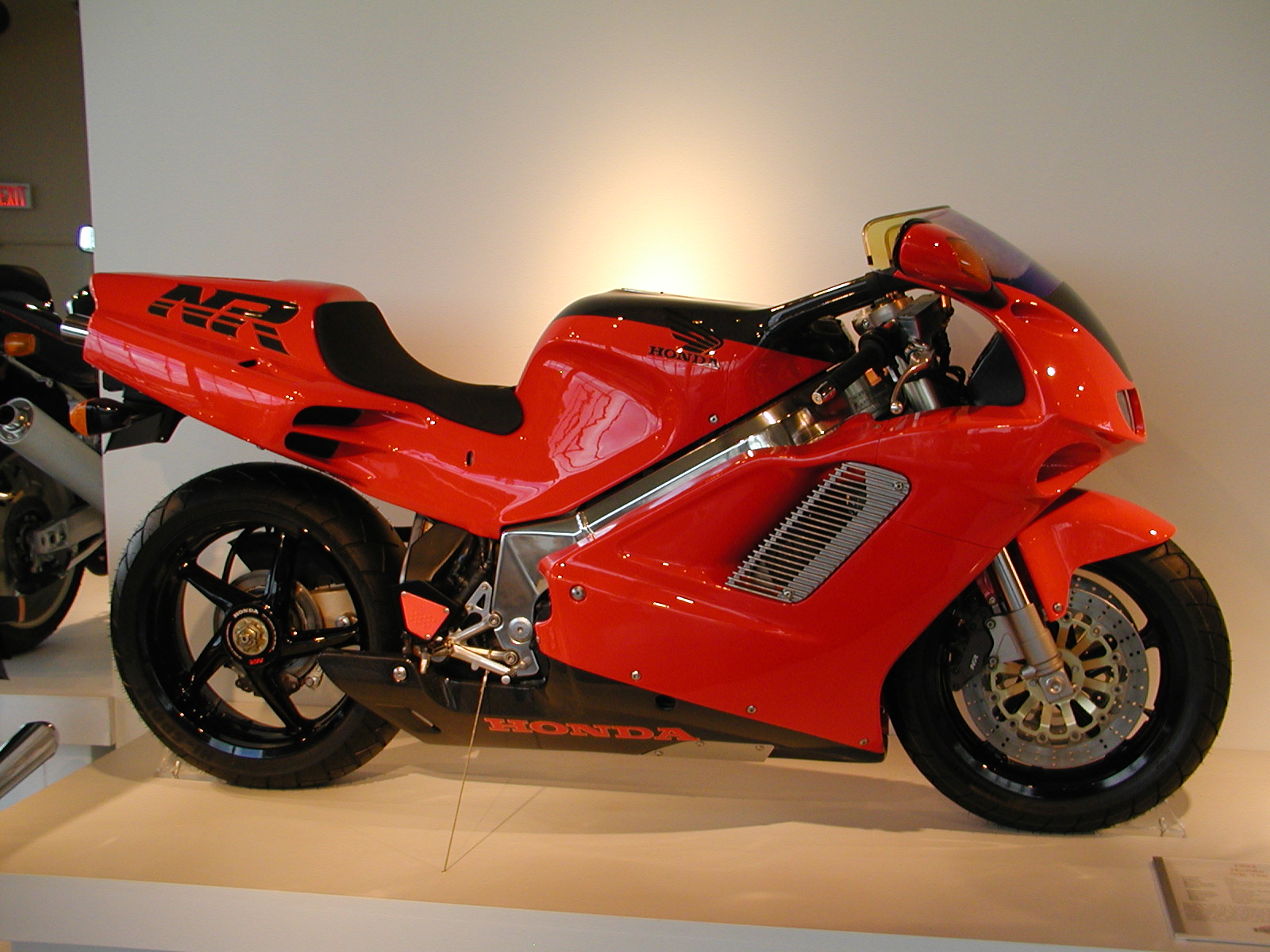
NR750
The Honda NR750 is a famous, rare Honda that people talk about because it was built with unusual, race-focused engineering. Here, the host is saying their VFR 750 looked and felt inspired by that NR750 vibe.
Instead of using a chain or belt to run the engine’s camshafts, gear-driven cams use gears. The host also points out that the gears make a noticeable sound, and that sound matters to them.
Horsepower is how much “pull” the engine can make. RPM is how fast the engine is spinning, and the number tells you at what engine speed that horsepower happens.
Edward Turner was a famous motorcycle designer linked with Triumph. The host is saying his design work helped define what those bikes looked and felt like.
Norton is a motorcycle brand from the UK. The host is using it as a comparison point for how similar some bikes can be mechanically.
Term
oil and frame
This phrase is talking about the bike’s core parts: the engine’s oil system and the frame that holds everything together. The host is saying the design identity went beyond just those basics.
Term
ray gun mufflers
This is a nickname for a particular look of the exhaust pipes on motorcycles. The host is saying people cared a lot about how they looked, not just how they worked.
Bonneville is a famous speed-testing location in the U.S., known for records. The host is using it as a reference point for an era when motorcycles were chasing speed.
The AMC Javelin is a muscle car made by AMC. It was built to be sporty and powerful, and it’s known for its bold look. People mention it when talking about classic performance cars from that time.
Harley-Davidson is a famous motorcycle company known for cruisers with a very recognizable look. The point here is that their bikes tend to keep a familiar style even when they update them.
LiveWire is Harley-Davidson’s electric motorcycle line. The host’s point is that it looked so different from classic Harley bikes that some riders didn’t like it, even though it was a strong performer.
An electric motorcycle runs on electricity from a battery and uses an electric motor. The host is saying electric bikes tend to feel especially quick when you twist the throttle.
This phrase means a regular, commercially sold motorcycle that accelerates quicker than other bikes. Electric bikes often feel like they launch fast because the power comes on right away.
Here “Sportster” means a Harley-Davidson motorcycle that people love for its attitude and style. The point is that it may not be the best on paper, but it still sells because it feels right to buyers.
“Soft tail” refers to Harley-Davidson’s suspension design concept that uses hidden rear suspension components to preserve a classic rigid-looking frame appearance. The host notes Harley marketed it with claims like increased chassis rigidity.
Chassis rigidity means how stiff the bike’s frame is when you ride and apply forces. A stiffer frame can help the bike handle more predictably, but the host says that isn’t always the main reason people buy.
A touring chassis is the bike’s main structure designed for long rides. The host is saying Harley updated it in 2009 to make the touring bikes better, and that design is still the basis today.
A “60 degree v-twin” is an engine with two cylinders arranged like a V. The 60° angle is part of how the engine is built, and it influences the feel and sound of the bike.
An adventure bike is made for a mix of roads and rougher terrain. In this discussion, it’s the category Harley wanted to compete in, which affected what engines they could build.
“Cams up” means changing where the camshafts sit inside the engine. The host is basically saying they’d rather update the engine layout than redesign everything else.
A modular frame is a bike frame made in sections that can be swapped or reconfigured. The idea is to make updates easier without changing the whole bike.
On motorcycles, “stance” is basically how the bike looks when it’s sitting—its attitude and proportions. People talk about stance because it strongly affects the bike’s style.
A “chopper” is a custom motorcycle style. It usually looks stretched and dramatic, and it’s built to be a certain kind of statement as much as (or more than) a practical machine.
“Drag bikes” are motorcycles set up to race in a straight line for quick acceleration. The host is saying choppers borrowed some ideas from that racing world.
Term
digger
“Digger” is slang for a rougher, dirt-oriented motorcycle style. The host is using it to explain where chopper styling ideas came from.
The host is saying motorcycle choices are often guided by feelings—style, identity, and how the bike makes you feel—more than by logic alone. Some people buy for practicality, but others buy because they love the look and vibe.
Royal Enfield is a motorcycle brand known for building classic-style bikes and for scaling manufacturing to meet global demand. Here, the host credits Royal Enfield with improving manufacturing efficiency so the bikes can be “made to be bought,” tying production to affordability and availability.
A “platform” is the main underlying design a company reuses. If you share the same base, you can build many different bikes without starting from scratch each time.
A “base engine” is the core engine design that serves as the starting point for multiple models. Even when bikes look different, using the same base engine can keep parts common and make the lineup cheaper to produce.
“Supply lines” are the logistics and manufacturing routes that move parts from suppliers to the factory. The speaker is arguing that controlling more of the process reduces disruption risk from distant suppliers.
Term
tie designed chassis manufacturing operation
This refers to an in-house chassis manufacturing setup where the manufacturer designs and produces the motorcycle’s frame/chassis rather than outsourcing it. Building the chassis internally can improve cost control and quality consistency.
CVCC (Compound Vortex Controlled Combustion) is Honda’s early emissions-focused engine technology. It helped Honda meet emissions requirements while maintaining drivability, and the speaker uses it as an example of how Honda’s innovations eventually became mainstream.
The Honda Civic is a small, everyday car made by Honda. It’s known for being efficient and easy to live with, which is why people often talk about it when discussing popular Honda models. It’s the kind of car you’d choose for regular driving, not just special occasions.
Concept
catch up
“Catch up” here is about how industries and consumers eventually adopt newer standards, quality levels, or technologies after early skepticism. The speaker frames it as a lag between innovation and widespread acceptance.
“Outer race only” needle roller bearings are a bearing type where the needle rollers run with an outer race, typically requiring a compatible inner surface (often a shaft or housing feature) instead of a full inner race. This can reduce parts and cost, but it also makes correct fitment and material quality especially important.
4130 is a specific steel alloy commonly used for structural tubing in motorsport and performance builds. The host’s point is that manufacturers must meet the correct material specification so the tubing has the expected strength and consistency.
UCE is a way of building a motorcycle where the engine and the transmission are made as one combined unit. “Single” means it has one cylinder, which changes the feel and layout of the bike.
This is about parts coming from outside companies not always being consistent. If suppliers vary in quality, the finished motorcycle can end up with uneven results.
They’re talking about a management idea: when you make things to a higher standard, you waste less time fixing mistakes. That can actually let you build more bikes/cars instead of getting stuck redoing work.
LIVE
Welcome to the Cycle World podcast. I'm Mark Hoyer, the editor-in-chief. I'm with Kevin
Karen, our technical editor. Thanks for joining us here on YouTube. You can catch us on Patreon
where it's all commercial free for a low price. And we can have a more direct relationship that
way. But if you want to stick on YouTube, by all means, stick with us here. We love you.
Enjoy the comments as well. Kevin and I are going to talk about styling. We talked about beauty.
What is beauty? In our previous podcast, not too long ago. And now we're talking about styling
because we were talking about cars. Kevin brought up this thing called Caddy hack, which we'll talk
about later, which is a humorous, a humorous quarter mile test with a car. You know, motorcycles
are honest. That's what I want to start off with is generally speaking, they're honest because they
have to be. There are certainly a lot of bikes with fairings and full coverage things going on.
But generally, they more echo what's underneath than do automobiles. And automobiles, in a lot of
ways, are just big fakers. You know, they just have a giant, I don't know, outbuilding stuck on
top of some mechanicals. And you might like the looks of that outbuilding that looks like it was,
you know, born in the outback, or you might like that outbuilding that was born on the front straight
at Lemmel. But all up, it's, well, don't we fall for design anyway, Kevin? Isn't that why
lots of designers make a living designing things that make us feel something? This is what has to
be admitted is that all purchase decisions are emotional. And very few people will say, well,
now I need to know more about fuel economy at 60 miles per hour. Do you have that data?
What a tiresome motorcycle, prospective motorcycle owner. Go away. Get some enthusiasm.
And, but a motorcycle is basically simple. So it can't carry a lot of self advertisement.
And the styling exercise that we were going to tuck in here at some point is a, what is it?
A K18, it's one of those super tours with six cylinders must be. Yeah, BMW K18, the Vision K18.
No relation to the Vision victory vision. There have been so many visions.
Lots of visions, visions, just a vision for the future. Vision for BMW is typically
a flight of fancy that might indicate something. It certainly isn't a prototype. It's not a,
of what we would actually get. Although there could be some powerful inspiration there for
a future direction for six cylinders. Now they have a, you know, this thing was debuted at the
Concorso Villa d'Estee in Italy, like Como, it's a lovely spot. And BMWs, it is BMW owns a piece of
that. They may own the whole thing. I don't know actually, but they're certainly big players in
it. And they bring their products there and it's a beautiful, beautiful event. And they've rolled
out the R18. They had the R18 prototype in 2020 that was, you know, actually pretty close to
production. I don't think they called that one a vision. But this is a real flight of fancy. It's
an inline six. It has six individual intake pipes that are very broadly featured. And then it has
six pipes going out the back. Which look like they echo a grenade launcher from an army tank.
Well, the pipes do, but yeah, they come out in a box at the rear of the vehicle that
echo the shape of bags. Now, when I saw this,
two rural free delivery mailboxes with these strange pipes in there. And to emphasize that
they have something to do with the heat engine, there are red LEDs in there to give it that glow.
Well, I think those are the taillights, Kevin, and they do, but they do impart a glow
on these white ceramic covered pipes. It's really something. So I got to give credit to BMW for
executing a feeling because when I looked at it, especially from certain angles, I immediately
thought of the XB70 prototype supersonic bomber. And it has that kind of delta shape and the
nose is high. They actually use the Concorde to inspire this. So it was a very similar visual
family. So I said, I say to them, good job. Concorde, being a delta wing, develops lift by
outrageous angles of attack and it remains stable like that. So that's how they've got it propped
up on the ground so that you don't have to raise the nose wheel 30 feet in the air to develop some
lift. But here is this wonderful little book about Harley Earl, who was General Motors chief
stylist. Actually, he was the styling department. There were a lot of people working there,
but he was the one who would say, if you disagreed with him in a meeting,
I want you to stand up so all these people can see what kind of a son of a bitch disagrees with me.
Oh, that's what that is. Time to whip out the 45. Well, there's a lot of those are
those meetings can be heated. He saw the P 38 in a privileged exhibition. Please don't step
any closer than 30 feet because it was before the war. And he studied it for he just stared at it.
Tail fins. Remember, the P 38 has twin booms coming back from the engine that sells to us
to a single horizontal tail and two vertical stabilizers. And
in 1949, they did a clay mockup of a car with fins. And two years later, they had motorized it
by lowering it on to an existing chassis. And it had two
turbine inlets in the front with bulbous noses sticking out of them and blades.
I don't think they whirled about. And a big jet tube in the back. This was an idea car.
Hey, maybe you'd like to buy some more surplus JTO bottles and attach them to your buggy.
One fellow did that.
He's no longer with us, sad to say. Those bottles have some thrust for just a few seconds.
At least that's honest styling.
Put your JTO on it. It was a hell of a ride while it lasted. And all that we got out of that was
fins. Chrysler Corporation went nuts with them. They had the tallest. Cadillac was
quite reserved by comparison. But still pretty, I want to say pretty flamboyant though. Cadillac,
when they grew into 59, by 59, they were incredibly flamboyant. And I think they
got handed their lunch by Lincoln in 61 when the Lincoln came up. And it had these really
crisp old money lines. And I think it just made the Cadillac look like new money. A carbon new.
Yes. And the fins were over. It didn't last much longer than that. We had this very
wonderful brief moment of... We also had bumper bombs. There have been a variety of names for
these. But that's all that was left of the twin turbines. Turban inlets was bumper bombs. And
the dollar grin, as the Europeans liked to make fun of American cars of the late 40s,
was on my uncle's 1948 Buick convertible. It was just a marvelous excess of chrome teeth.
I love that car because it made that straight eight sound, which is so smooth.
But the point is here, Harley Earl said, the stylist must lead the public, but not by too much.
And so everything got tremendously toned down between his flights of fancy, the various
firebirds, 12 and three. That destroyer of conversation, Firebird two, I think, had each
passenger, it was a two-seater, had his or her own bubble. You couldn't turn and talk to the other
person. So just like the late war, sliding canopies on fighters, made it into 60 degree vision,
what could be better? And Harley Earl encountered Alfred P. Sloan, we think of him as having given
money for a vast cancer research operation, for which we thank him. But what he discovered in the
process of trying to organize five companies into a single organization, somehow it came to him,
I could entice people to spend beyond their budget by presenting a stairway of expense
and decoration in automobiles. We'll have Chevrolet at the bottom, and then we'll have Oldsmobile,
well, Podiac eventually, Oldsmobile, Buick, and finally Cadillac. And it just worked fantastically.
Well, and side note, there was a difference between Chevrolets and Cadillacs. In the 60s,
Chevrolet had three piston weight groupings in building their engines, Cadillac had five.
Yes, I remember that. We were getting smoother, you see, in Cadillacs. Yes, certainly. No, I think that
it was very much their credit that they retained separate engine
each division had its own engines, and which meant that there were different ideas of what
should be done, which is always a rich source of argument and fresh ideas. So then came the idea
that dial could sell cars. And what Harley-Eau discovered was that people buy cars for emotional
reasons, and therefore it is cheaper and much more effective to spend promotional money on the
appearance of the car rather than technological features, safety, etc. The question of comfort
is quite a separate thing. I've had such discussions with my Mrs. Anyway,
this worked out into a methodology that carried on until 1970. At one point,
I think General Motors had more than half the US market. At the present moment,
in the face of worldwide competition, 17.3% is what they had. So it was a wonderful party
that seemed like it would never end. And along the way, fabulous idea cars,
grandiose notions of what the future might bring, rocket cars, what have you.
And then came OPEC, Volkswagen, Datsun, and the others. And everything was changed.
But what worked well for General Motors worked best during a time of an upmarket.
So from 1919, the year after World War I ended, until 1929, just before the Great Depression,
they didn't call them recessions then, or timeouts. US industrial production doubled.
So, and then the post-war boom after World War II was another, that fed Harley-Earl's
division like crazy. It was a wonderful time for stylists. This is much more difficult to do
with the motorcycle because it can't carry as much extra stuff. And that's why I was interested to
look in the, what was it, February 87 issue of Hot Rod Magazine, Caddy hack.
They wanted a four door, but they got a coupe and it only weighed 4,500 pounds. So they put eight
people, two surfboards, and in the vast, vastly spacious trunk, two extra doors.
And they, they went 17-point something seconds at 80-point something miles per hour.
In a quarter mile.
That was basic. Yes, in a quarter mile. None of those 1,000 foot nonsense. And
then they took all that stuff out. They took 1,880 pounds of stuff out and the car went a second
quicker. Try making your car a second quicker with engine modifications. One of the things they
found was that the mighty 472 cubic inch V8 turned the tires into smoke. So they had to
put slicks on. There wasn't enough weight. They needed more downforce.
Road hugging weight. Yes. Then they started up the destruction saw in one of those carbide
chainsaws. And it just started hacking stuff off the car. And the bottom line for all this was
they got the car down to 2,900 pounds. The driver is sitting on a peach crate
and goes 13 seconds, 100 miles per hour.
And the lesson, of course, is that weight is the enemy of performance.
And this is why motorcycle design is constantly seeking ways to make structures and other parts
lighter. I remember that the big inline four air-cooled 1,000 cc bike engines of the sit-up
superbike era 200 to 225 pounds and could be modified up to Rob Muzzy's 150 odd horsepower.
And the present day, Ducati's V4 weighs 143 pounds with the intake system on it and gives
how much do you want to pay? 200, 214, 228 horsepower. So there's been a lot of changes
since those days. My point here is that much of the actual change in motorcycles is not styling
because the motorcycle can't carry hundreds of pounds of style package. It is things that you
see like the tires, the drivetrains, these dual clutch transmissions and automated shift
offend the daylights out of traditionalists who want
motorcycles to be served raw on a plate. They don't want anything between them and the steel.
Everything went downhill after the 68 Triumph. Yes, if you please.
And they machined a place on the cheek of those twins and put another cylinder on them and called
it Trident. Try curling a Trident crankshaft. It is substantial. I tried. The late Robert
Iannucci had one sitting on the bench and I couldn't resist. It's a mighty thing.
Harley cranks have a bit of mass. Yes, yes, they do.
Motorcycle innovations are continuous, but they aren't a part of styling.
There are sort of big trends like around 2002, the idea that the motorcycle should resemble
a dart or lance that has been hurled and has stuck in the ground at an angle. It just looks like
we're going forward. That's a big theme. Super Sonics buddy too. Yes, fake intakes.
Lots of fake intakes. Nacoducks. Nacoducks, man.
No, they were real on my VFR. I'm sure they were real on my VFR 750. Had to have them.
Yes, clutch doors. They had to be real. Because of all the smoke coming from your clutch at every
red light. It was a wet clutch, of course. But the scope for all of this is quite limited.
I believe one of the bikes that's often pictured in styling commentary is John Britten's V-Twin
with its sort of pink and bluish-purple paint job. It is really to be
put with some of the English designers who, unable to get management to go for a complete cover,
put little graceful curlicues of fiberglass that are held on brackets. What are they? I call them
eye guards. You look at them and you can imagine the smoothly streaming airflow
traveling around the vehicle. They're not unattractive, but they're nonsense.
And it doesn't matter because people are going, well, here's the story that tells it all.
Our friend, Mark, who's still employed at that agency, came home one day to find
his son and three friends talking about whatever concerned them. And he said to himself,
here's an opportunity to make contact with the younger generation. And he asked them how they
would choose a new 600. This is back in the days of sport bikes and 17,000 RPM 600.
And they sort of had a little conversation among themselves. And one of them said,
finally said, well, it's like this. They're all on the market. What that means is they're
satisfactory. They're vehicles. They work. So that's a given. Consequently, we would buy the one
that looks the coolest. And that's how it is. I don't think that you can distill these aspects
into little jars of differently colored brown powders and say a pinch of this, a three-soul of
that, a whiff of the other. And Shazam, you have touched the nerve, the sales nerve,
and all of those models rush out of the showroom.
But styling commentary continues to be written on that basis as though, well, we'll put in a
this and that and the other thing. And it's all very much like those chef shows on TV. We're
taking a pinch of this and a pinch of that. And they put this thing in front of you that is,
has every color under the rainbow of the rainbow. So I'm deeply suspicious of this.
But I do accept that the motorcycle industry would be very different
if styling was not an effective sales tool.
Because the basic fact is this, most of us will never become very good motorcycles. We may become
experienced. We may cultivate the right responses to situations as they come up.
But we're not going to be able to come in off the course and say,
back ends not hooked up. I want to have a little conference here.
No, we're not going to get close to those radical edges. There are a few, but most of us aren't going
to. So much of modern motorcycle technology is not for those people. It's not for the majority
of motorcyclists. They want to ride on a motorcycle that pleases them. And they'll ride at the speed
they choose, not a speed that is chosen by the motorcycle itself. We had an era like that for
a while in which you cannot wear shorts and go-aheads and ride an ADV bike.
You have to have all that aero-stitch business. Or you'll just be laughed out of the club.
And of course, one-piece leathers on the sport bike and so on.
Well, you are fulfilling your self-image with a motorcycle. My opinion is that you're
fulfilling your self-image. So it's how do you like to dress? You like to dress like a pirate?
Well, you're probably going to go on the cruiser side, et cetera. So you're definitely
fulfilling that primal level of self-image. One might almost call it totemic.
Yeah. And what do you want? You want to fulfill that feeling that you have,
even if you aren't necessarily executing it. So I was not a particularly competent
motorcyclist when I bought my first new motorcycle. Let me say I was competent,
but I was an expert at relatively low street miles. And I bought a 1995 VFR 750. But I'd been
reading Cycle World magazine and watching Don Cannae out there dragging the gas cap in Turn 8
Willow Springs. Or Sport Rider. That was one of your great lines in the back of your book,
where you talked about the sport bike performance handbook. In the back end of it,
you talked about all the different publications that were around. And that was your line for
Sport Rider was the view from Turn 8, Willow Springs. That was your characterization for
someone to check out Sport Rider. And it rings true. I wanted a piece of what Don Cannae was
showing me and Kevin Schwantz and Wayne Rainey, looking at those heroes getting the most out of
the motorcycle. So that's why I wanted a piece of it with a VFR. And the VFR was really inspired
by an NR750. The one I bought was inspired by the NR750. And I knew it had gear driven cams
so that was, is that internal styling? Pretty cool. It is very cool. It is. Could you hear it?
Yeah, you could. Oh, yeah. Well, that's very important. That sound. Yes. The sound of gears
will sell me. Yeah. So highly emotional. I mean, we are definitely, for our market, we are an
emotional purchaser. You can use all the other justifications. You can say, well, it will get
good gas mileage and look how comfortable the passenger seat is and we can ride on it together.
It will be easy to park in California. I can ride between traffic lanes. There are many, there's,
you know, secondary justifications, tertiary, septinary. I told my parents that the motorcycle I
had bought was little and had only 4.95 horsepower at 4,500 RPM. How fast does it go? 45 miles an hour.
Oh, I was in. Yeah. But you got to have it. You weren't buying it because it was
anything except something you got to have. I mean, you just, that's it.
But that was also in a day when the $140 that I paid for it would have bought me a running car.
I didn't want a car. So, yes. I go back to Edward Turner of Triumph,
transforming the line into twins and his, I don't know, his sensitivity for proportion,
color, shape was real knockout. Triumph lived off of that. I mean, they were
hardly different than a Norton twin, hardly different. And he did not discuss it with anyone.
It was up to him. Just like when Cook Nelson needed a cover photograph, he loaded up a motorcycle
and drove to Willow to arrive at what, five o'clock in the morning to get those light conditions as the
sun just illuminates the world. And they would come back with the cover photo.
AutoKratz, I believe they're calls. Certainly Edward Turner was an AutoKrat.
But he did well with it. He did have his finger on the pulse of the motorcycles.
Well, and they lived on that essential design until even in the oil and frame before slumbers
clade and all that, uh, hoo-ha with the ray gun mufflers and, and, you know, the styling of the
vehicles. We had a bunch of those in the back room at our dealership hanging out. Yeah. Yeah.
Try to find them now. Everybody, you know, everybody who's doing those would like to get
it, get those on their bike because they did, you know, they certified time. But that period,
that block, you know, from say 39 to, you know, 70 with the final oil tank, you know, Bonneville,
they were just living off of that. Just like Harley, it continues to live off of, you know,
the EL that, that continuous line and, and all of those designers like it's great.
It's great in this business to go to a press launch and have the design team there and have a,
a piece of the presentation dedicated to we made it look like this for these reasons.
And then you see all the artwork behind it. And as you were talking about the, you know,
the javelin sticking into the ground, the sport bikes that are up on their nose and their asses
in the air and they're aggro. Like all of that is, is kind of gestured. That's all
gestured. And they have overlays of swooping lines and, you know, like that, the, the artistic
pursuit of gesture drawings where you just kind of like do all this stuff and this,
the shape appears as you're watching it, you know, laying down the line. It's, it's great.
At Harley Davidson, the shape doesn't look a lot different from last year's
and they're, they make damn certain of it.
Well, they so significantly do look different. That's what's fantastic about it as a view.
You know, when the, when the last, the last version of the road glide was the last version
of the road glide, you looked at it and go, yeah, that's the road glide. That's great.
It looks cool, man. You know, great. And then they came out with the most recent design of the road
glide, the one they're selling now. And you're like, huh, I don't know. Yes. I mean, I don't know.
Looks like a road glide. Yeah, I guess. And then when you look at the old road glide,
you're like, man, that, that looks out of date. You know, this new road glide, that's,
the road glide. So it really carries the image forward in a million really subtle ways,
but it keeps that, it keeps the cozy blanket there that I feel comfortable with this design
and it moves it forward, but not too far. Well, they had CEOs who decided
to scare away a substantial portion of their clientele with live wire and electric motorcycle
that looked like a suitcase with fins, with a wheel in front and a wheel behind. And it was an
excellent electric motorcycle and the fastest accelerating production motorcycle ever from
that company, as you would expect, because that's what electrics do best is accelerate.
And someone had to decide, yes, let's pour millions into this. And some other great leadership,
schooled at Walmart or wherever, decided our hands are tied. We have to drop Sportster.
Drop Sportster? Why not stop making motorcycles all together and go into pots and pans?
So now they're bringing Sportster back. And I think there is a God or a functional equivalent
because Sportster, Sportster is the realization of cocky,
young man, young woman arrogance and willingness to try anything. It's not a high performance
motorcycle. No, on no technical merit, they sold a million plus from 03 to the last year.
And it's not that it's not a good motorcycle, it is a good motorcycle, but it isn't technically
superior to other things on the market. It's heavy by comparison. You want to go, you want to light
agile motorcycle, MTO7, MTO9, and give you plenty of pep and 100 pounds less easy.
So no technical merit. But that's the thing is like, if you look at Harley's marketing evolution
over the last, oh, since, well, when they brought out the soft tail,
they made a huge deal about, oh, 15% more chassis rigidity. And they started trotting out all these
technical reasons that they made the new soft tail, which is, it's pretty cool, but not why we're
here. You know, like if that was always, that was always buried into the product, like we're
going to make it better. Like touring, they, they made a big deal in 09 when they redid the touring
chassis, which was a huge improvement, which is what they're still using. But it wasn't,
they weren't leading with all of this technical stuff. So, you know, the sports are, oh, we're
going to use the 60 degree v-twin. I mean, they didn't have manufacturing capacity to do, we need
the 60 degree v-twin to put in an adventure bike because we want to play in the space and we want
to show people that we are technically proficient and we can design and compete.
Modern engines and they did. And they did. It's a great engine. It's just like,
you know, again, I would have fought to the death to keep Sportster as it was. Change it,
update it, move the cams up, but leave the exhaust ports where they are, leave the intakes where
they are, mount the exhaust in a very similar way, but modular frame that you can change into
sporty standard to laid back, you know, high A-panger type thing.
I wanted to look, look like the Sportsters looked when I would come out of the
Ebtide, a music place north of Boston, which had, among others on their playlist, Chuck Berry.
He was, he was like two hours late arriving one time, and we're all getting restive,
and the girls are walking around and picking up our half full bottles and making faces at us.
They're like, are you, you're not really a man, are you? Drink up.
And outside sitting at the curb were these bikes that were leaned over on their side
stance to the left with the front wheels turned to the right.
And it was, it was just like just a third finger in iron and steel.
Stance, swagger. Yes, sweat. You know, it's, it is 100%. I mean, you know,
choppers, terrible motorcycles, but they have a feeling. They have, they culturally speak
feeling to the builder and the owner in particular, but also watching them go down the road.
And we can talk about, oh, they were based on drag bikes and diggers and,
and all of that, but the chopper evolved into its own thing, tall, skinny bike, no front brake,
just what you need. And it's a feeling. And if you don't, you know, I think.
Emotion rules. Yeah, for, for our market, emotion rules, you know, for a functional
market where we're, we're using our motorcycle to transport five family members or using it for
work or, I mean, how many, I love the ingenuity and balance and proficiency of people carrying
rebar on 150s and shopping and bags of flour and crates of chickens,
goats, you name it. It's fantastic. And that's not necessarily an emotional purchase, but
for the artistic folk in the United States, man, first thing got to have it. Everything else,
justification is affordable. You got to work on all those conflicting problems of just loving it.
And because you also got to be able to buy it and it has to be made to be bought,
which is another podcast in and of itself. Like, thank goodness we have efficient production.
Thank goodness Royal Enfield innovates its manufacturing in such a way as to basically,
I don't know, crib the Harley Davidson model, like, well, here's a couple of platforms,
and now we're going to riff on them in 28 different ways. And you've got cruisers,
you got 650 cruisers, 40 bikes, you got the bear scramblery guy, like you're just getting
different feelings, different colors, slightly different shapes, but we're making a million of
the base engine, by the way, and it's very affordable. That's been it's affordable because
they have made a pilgrimage made a made a essential feature of their effort to eliminate
supply lines, to have it all under their own control, rather than so well, the railroad from
here to Thailand, where they're making our frames, there's something going on there, maybe
labor trouble or something. No, they have they have the tie designed chassis manufacturing
operation at their plant. So they are able to to make use of labor saving and cost cutting
methods that are not yet general in motorcycling as a whole, they are the leaders in this area.
And this is what happens when I remember when people said, cheap Jap junk.
And I was riding a Honda, and I just thought, you ignoramus, because I knew better,
not because I was a cocky young man who should have been riding a sports car,
but because I'd been I'd been inside, good stuff in there.
But like Harley Earl said, the public are always a little bit behind the leading edge.
And before long, people were lining up to buy Honda automobiles, CVCC,
the Civic, and then later, all those other attractive models. So
they were soon talking out on the other side of their mouths. Same thing is happening in the
cases of China now. I went to lunch with some friends. I said something about having bought
four Chinese made outer race only needle roller bearings. I said, what, you're not going to put
those in something important, are you? They're marketed through a US company who will definitely
hear about failures. So very interesting to see how long it takes to catch up in certain areas.
The Chinese have to come up with standards so that when a manufacturer orders 4130 tubing,
that's what will come. And not some melted down scrap automobiles rolled into sheet metal and
curved around and seam welded. Yeah, I think going to India in 2008,
when the UCE, the unit construction single with 550 singles, were just coming out.
That was the beginning of the transformation of Royal Enfield and Dr. K. P. Nayir was their
director of quality control and director of quality. He looked me in the eye and said, well,
we don't have Japanese quality. We're at least 80% there, probably more.
And the Japanese had been in the market. There was Hero Honda and other Suzuki,
TBS and whatever the partners were. He had worked at Honda and he was trying to bring that
thinking and methodology to Royal Enfield and they had a modern factory and they were making
those steps. You don't change it overnight or maybe you do. But it took this long and
unrelenting pressure from Royal Enfield and volume to transform that company into what
they build now, which is a really high quality motorcycle that has no real distinct difference.
You don't walk up to it. When you walked up to a UCE, you could still see like, oh, this is,
this bolt head is obviously heavily polished in the wrong direction and it's rounded the edge
off and the hex is not quite hexagonal. And that's just over. That stuff's just over. But
they had a supplier problem too. And if you order parts, it's really hit or miss. A friend of mine
is in the British parts business. There's an aftermarket company. So if you need parts for
your triumph, call JRC engineering and they source from around the world because they have to.
They source in England as much as they can in America. You name it, but there's, you know,
if you're carrying the part that costs less, there's a lot of people who just want that one that
costs less and that's it. They want the Chinese part or the Indian part. But sometimes when you
call the Indian supplier, if you're trying somebody new, they will send you fenders that are made out
of salvaged car parts. On the underside, it's the pain of an automobile stitched welded to
something else and hammered into a fender. And the outside of it looks pretty darn good. But,
you know, I think there's less of that happening. Yeah. In the late 40s, I had pressed tin toys,
wind up little cars. And when I unbent the tabs to take the body off,
it was beer can logo. People were salvaging beer cans from American PX and making toys out of them.
You can either say how primitive or what enterprise, in both cases, you would be right.
But this is all a process and that's why Dr. Deming said an increase in quality
is an increase in production. Because it means fuel will be rejected for not meeting the quality
standard. That is added to production. So many cars were being sold hand over fist during the
post war boom in the US, 40s, early 50s. That they were tolerating as much as 30% rework,
that's all they say. This one doesn't work, send it to rework. They would pull the engine out or
pull the rear axle out and correct whatever the problem was because sales were just
whoo. And then when competition arrives and your competitor is using these new methods,
I wouldn't call Dr. Deming's methods new, but certainly the competitors were using them.
You have to start using them too or you're going to get a dropping.
Well, in the case of the British industry, they needed to start using them a decade before
the Japanese just pounded them into the earth. Money was good though. We kept making the
same bike and the Americans kept buying it. Why don't we just keep on doing it? Yeah,
we should probably update the twin, but maybe it could use a center crank web. I don't know.
Look what happened to HAS when they tried that.
Yeah. See, they were wrong.
Yeah. Now, why does the motorcycle industry, why do they waste money on stuff like new
casting processes and so forth? Because it's 32 pounds of aluminum they don't have to buy
to go into the new motorcycle. That's why. And the process also happens to produce
sounder parts. It used to be that if I took die-cast parts from the Japanese motorcycle to
the welder, the welder would strike the arc and they would say, goddamn, jam metal. No, it was goddamn
die-cast metal because die-cast metal in those days was full of gas. The moment you got it hot,
it lifted up like a pile of wet leaves that had been put on a hot stove top.
It delaminated. It was marvelous. Yeah, all that stuff. But quality is a process. And what drives
it is not a fanatical desire to do things perfectly. It's to increase production without
significantly increasing cost. And the tires that are now available, the rubber that is now
available, is completely different from 20 years ago. And it's just wonderful. So
there's so much in a modern motorcycle that is new and highly desirable, that increases control,
that improves safety, longevity, that we have to be, it's a prideful thing. It's wonderful that
all these improvements are there, but they have been undertaken for profit.
But when it comes to sales, you've got to make it look right or they won't buy it.
Well, I'd like the honesty of the motorcycle in general. I mean, we've seen fake covers,
or just calm covers, because if fake is implied.
Royal Star, Yamaha Royal Star, the V4 was based on the VMAX. Really nicely produced motorcycle,
steel fenders, they really, they worked Yamaha. It was the sub-brand of Yamaha,
Star became its own thing like Alexis is sort of what they were going for.
And the Royal Star was a pretty nice bike, I think. In the cosmic sense, they should never
utter the word VMAX when they talked about the V4, because the Royal Star was tuned to be very
Harley like it had 62 horsepower. I believe on our dyno, it was 62 horsepower, which is what
Harleys were making at the time. But on a Harley, it was a very rapid and easy, I'm changing the
pipes, I'm changing the intake, and I'm doing a little bit to the carb, and I got 77 horsepower,
or 82 horsepower. And then you had something and it sounded throaty, and it was a little bit
harder to do that on the Royal Star. But on the covers front, you know, aside from the beautiful
paint and the steel fenders, they put covers that were bolted to the sides of the engine that you
could take off and replace with accessory covers. And this was the era billet, you know, this was
like 95, 94, 95. And this was the, all the customizers had discovered billet. And so everything
was being because the Cold War ended in 91. Then we needed, we had access to all those machine tool
spindles, we're looking for something to bite. Yes, billet. Okay, boomer, let's go. So, you know,
those engine covers on the one hand, yeah, it makes it really easy to say this is my bike,
and I've made it look a certain way. And I like the way it looks, but it's disingenuous. And I've
always had a problem with that. And I like, like, I like the engine to be designed with an indication
as an engine, it's showing something underneath it. So if you look at the timing side on a Norton
Commando, you're like, Oh, I know what that's. Yeah, okay, I get it. I know what's in there.
And there's gears for you to take it off. And like, there's gears, even, even when they left
the lobe where the distributor used to be. That's fake. But yet we still, we still love it.
I don't know, it's just, you know, we, some things we can't get around, around
the covers on exhaust systems. You have to go in the aftermarket, like on your Harley,
virtually every exhaust system now covered with a cover. It sweeps the contour, it doesn't discolor,
it's held on with hose clamps. But how hard would I try to fight against that if I were there? I
probably would. I'd be like, no, no, like, why don't we have stainless pipes here?
Legal department, legal department guy comes in and says, riffling through a pile of documents,
bikes fell over on people, exhaust pipe burns. We paid. We're not going to pay anymore.
They're going to design it out. Well, that's good sense. But we got used to the way it looks.
Yeah. Now, back to this, this K18 thing, K12 thing, whatever it is.
K18. Yeah. You'll see that the exhaust pipes, six of them, curl. And I'm sure that that is inspired
by looking at the beautiful Akrapovic exhaust systems on whoever they produce exhaust systems for.
They are so beautiful. I want to eat them. I want to have them.
Yeah, Akra's been a real league, man. I mean, they have a titanium foundry. And I know I keep
talking about the baggers, but I got up close to them. And the header pipes.
Well, they're making castings, yeah. Yeah, the header, because they're real,
real accurate. So your match to the port is perfect. And a lot less labor involved in fabrication.
Sure. But I'm sure that that's where some of the inspiration came for that look on that
idea bike, except that it just looks like some tubing that was twisted around.
It doesn't have all the fine detail and the fasteners and the clean.
Well, I mean, if you look back at, you know, particularly the pipes on Dan Gurney's All American
racer, his Formula One car, all those Indy cars, those were sand bent titanium tubes
in the wonderful contours. And why do we have the contours? We have the contours because they
were going for certain lengths. And so they were trying, you know, I think we overly emphasize
equal length headers because not every, depending on the engine timing, not every header should be
exactly the same length, but you probably do have a bigger benefit than just having the long
pipe from the first one, meet the short pipe from the last one. But you know, it has a look
and a feeling. We associate those beautiful contours and pipes with speed. It's historically there
to anyone who was round for that era of Formula One and Formula One afterward. I mean,
you know, you still see all these gorgeous artistic bends and stainless and Incanel and
titanium and right. I mean, that's, and that's why BMW did it. They, they wanted to do something
outlandish with the K 1600 platform, the inline six touring platform. They make a bagger than
actual bagger, you know, and that's very American inspired. And I think, you know, they're just
trying to get a piece of that Harley market, which is always hard to get a piece of because
Harley's Harley, even if you're Indian, you know, your volumes are not the same yet.
They're much smaller. Yes. Well, there is a manufacturer whose name I will not give
who inspired me to conceive
finned shelf paper.
If you have a water cooled engine, which works extremely well, it is thermostatic. It doesn't
overheat. It warms up quickly so that it begins carburetting promptly.
It is one of the modern flat black epoxy finish engines. Where are the fins, you may ask? Pull
them off of my roll of finned shelf paper, which is self-adhesive cut to shape and stick it on there.
And suddenly you've transformed your liquid cooled industrial unit into an exciting air
cooled with lots of fin. Well, it goes back to the carbon fiber shelf paper too, where you get
that textured stuff that you can tack on to whatever you want. Like, you know, you go out to
lunch and they'll be like an 87 Honda Accord with a carbon fiber trunk, but it's kind of,
you know, carbon fiber shelf paper on the trunk lid, but it's like peeling off.
You know, we're all searching for a feeling. And if we can't afford the carbon fiber body
panel in the aftermarket by gum, we'll stick it on with glue. There. I wanted the fins.
Of course, they would be rolled, on the roll, the fins would all be lying down.
And then when you unroll it, they would stick up properly and they would have buffed tips.
But alas, but there is spray cheese still in the supermarket.
What could be more convenient? I think they call it cheese, don't they call it cheese food?
Cheese type food product. Yes. That's right. And I found that that beef has that unnatural
pinkness, not because of the colorants that have been placed in it, but because of
strange packaging methods. They include carbon monoxide
as a to enhance the natural redness of the meat. There are various packaging methods
that will enhance the color because the colorants being inject, you know,
how old is this animal? Oh, four months. Well, that's feel, isn't it? Well, not under the current law.
And we make it look red. Well, they can't do that. Not it. But if the styling of a motor vehicle
suggests aerospace, we can't argue with it because that kind of sales motivation, that kind of
emotional appeal demonstrably works. We may think of ourselves as rational beings and we'd better
be if we're trying to get our car out of a sand trap, or if we're trying to get an engine started
that won't, we'd better be thoughtful. But when it comes to buying things, we're going to pick the
one that looks the coolest. There we are. That's what that's the kind of critters that we are.
It is. Well, you look at them, the biggest sellers in the emotional markets, and
it is an emotional purchase. You got your Harleys, got your Royal Enfields.
Ducati has its own way. Oh, absolutely.
It says, you think you're rich, do you? Here's the accessory book.
Check all the items desire. Well, yeah, they have that, they do have that segment,
but they also have scrambler, you know, or you can just, well, yeah, sure, they're trying to cover,
cover the waterfront. But in times of financial restraint, shall we call it?
One of the ways to continue doing business is to sell things, to promote things to the people who
still have money to spend. And that's why, well, my dad was talking to a guy who was
part of sales promotion for some consulting firm. And the fellow said, well, for instance,
here are the, here are these two hand creams. They both contain the same ingredient. The
substance, the liquid in these two containers is identical. This plastic bottle contains four ounces
of it. This glass container contains one ounce and sells for 20 times more than the plastic one.
And people pay it because it exudes quality, cut glass, gold highlights, tasteful shape.
Hmm. I got this plastic bottle here.
All set. Look great.
All right. Well, that's it, folks. That's styling. We're just, we're just simple primates looking
to sparkle. I hope you, I hope you enjoy the program. Thanks for joining us. We'll catch you next time.
About this episode
Motorcycle buying gets framed as an emotional process where styling, identity, and sensory cues often outweigh specs. The hosts connect the psychology of “looking right” to real examples—from BMW’s inline-six R18 and Triumph’s proportion-first design to Harley’s brand consistency and LiveWire’s radical look. They also contrast cosmetic tricks with engineering changes, arguing that performance gains can come from weight, traction, and grip rather than just visual hype. Overall: riders buy feelings, then rationalize.
Find us on Patreon! https://www.patreon.com/cw/CycleWorldPodcast
The US motorcycle market is a market of love. Performance stats, spec sheets, MPG, or other more practical concerns have a role, but it's usually to support and justify buying THE MOTORCYCLE WE LOVE. Technical Editor Kevin Cameron and Editor-in-Chief Mark Hoyer talk about motorcycle styling, car styling, "covers" on appliances, and more. They also consider that motorcycles at the very least have to be more honest than cars in what they represent underneath their skin. Find out if you agree and we'll see you in the comments!