
Motorcycle Purchase Decisions Are Emotional--Or Why we Fall for Styling
About this episode
Motorcycle buying gets framed as an emotional process where styling, identity, and sensory cues often outweigh specs. The hosts connect the psychology of “looking right” to real examples—from BMW’s inline-six R18 and Triumph’s proportion-first design to Harley’s brand consistency and LiveWire’s radical look. They also contrast cosmetic tricks with engineering changes, arguing that performance gains can come from weight, traction, and grip rather than just visual hype. Overall: riders buy feelings, then rationalize.
Find us on Patreon! https://www.patreon.com/cw/CycleWorldPodcast
The US motorcycle market is a market of love. Performance stats, spec sheets, MPG, or other more practical concerns have a role, but it's usually to support and justify buying THE MOTORCYCLE WE LOVE. Technical Editor Kevin Cameron and Editor-in-Chief Mark Hoyer talk about motorcycle styling, car styling, "covers" on appliances, and more. They also consider that motorcycles at the very least have to be more honest than cars in what they represent underneath their skin. Find out if you agree and we'll see you in the comments!
quarter mile test
"Kevin brought up this thing called Caddy hack, which we'll talk about later, which is a humorous, a humorous quarter mile test with a car. You know, motorcycles are honest."
It’s a straight-line acceleration test over a quarter mile. People use it to see how fast a motorcycle or car can get up to speed.
A quarter mile test is a drag-racing style run where a vehicle accelerates over a distance of one quarter mile (about 402 meters). It’s commonly used to compare acceleration and power delivery because the time and trap speed reflect how quickly the bike/car builds speed.
fuel economy
"And very few people will say, well, now I need to know more about fuel economy at 60 miles per hour. Do you have that data?"
Fuel economy is how far you can go on a given amount of fuel. Higher fuel economy usually means lower running costs.
Fuel economy is how efficiently an engine turns fuel into distance, usually expressed as miles per gallon (MPG) or liters per 100 km. It’s a key metric for everyday costs and environmental impact, and it’s often what buyers compare when they’re thinking practically rather than emotionally.
all purchase decisions are emotional
"This is what has to be admitted is that all purchase decisions are emotional. And very few people will say, well, now I need to know more about fuel economy at 60 miles per hour."
The hosts are saying people buy motorcycles (and cars) for how they make them feel. Looks and style can matter as much as facts like efficiency.
This is the episode’s core concept: buyers often choose vehicles based on feelings and visual appeal, not just measurable specs. In enthusiast terms, styling can act like a “hook” that makes people overlook or downplay practical tradeoffs.
Concorso Villa d'Este
"Now they have a, you know, this thing was debuted at the Concorso Villa d'Este in Italy, like Como, it’s a lovely spot. And BMWs, it is BMW owns a piece of that."
Concorso Villa d'Este is a famous car show in Italy. It’s the kind of event where brands bring special concept vehicles and big design statements.
Concorso Villa d'Este is a high-profile classic-car and design event in Italy, known for showcasing concept and special vehicles. The host mentions BMW’s presence there to frame the R18 as a design-forward, inspiration-driven reveal.

BMW R18
"And they’ve rolled out the R18. They had the R18 prototype in 2020 that was, you know, actually pretty close to production."
BMW R18 is a BMW motorcycle. It’s known for having a very distinctive engine and a bold, showy look—so it stands out even when you’re just seeing it from certain angles.
The BMW R18 is BMW’s cruiser-style motorcycle built around a distinctive big boxer engine layout. In this segment, the host focuses on its inline-six concept direction and the dramatic intake/exhaust styling that makes it feel like a “flight of fancy.”
inline six
"But this is a real flight of fancy. It’s an inline six. It has six individual intake pipes that are very broadly featured."
An inline six means the engine has six cylinders lined up in a row. It’s a specific engine layout that affects how the bike’s internals and packaging look.
An inline six is an engine configuration where six cylinders are arranged in a single straight line. The host uses it to describe the R18’s powerplant direction and the way the intake and exhaust plumbing is visually presented.
angles of attack
"Concorde, being a delta wing, develops lift by outrageous angles of attack and it remains stable like that."
Angle of attack is how tilted a wing is relative to the air hitting it. The host is saying the Concorde could create lift even when the wing was tilted a lot.
Angle of attack is the angle between the oncoming airflow and the wing’s chord line. The host uses it to explain how the Concorde’s delta wing could generate lift at extreme angles while staying stable.
delta wing
"Concorde, being a delta wing, develops lift by outrageous angles of attack and it remains stable like that."
A delta wing is a triangular wing shape you often see on fast aircraft. The host is using it as a comparison for the bike’s shape and how aircraft wings can stay stable while generating lift.
A delta wing is a triangular wing shape used on some aircraft, especially supersonic designs. The host compares that geometry to the motorcycle’s “delta” visual stance and explains how it relates to lift and stability at high angles.
tail fins
"Tail fins. Remember, the P 38 has twin booms coming back from the engine that sells to us to a single horizontal tail and two vertical stabilizers."
Tail fins are those pointy or wing-like shapes you sometimes see on the back of older cars. In the late 1940s, they were a fashion statement inspired by airplanes and the idea of going fast.
Tail fins are vertical fin-like body shapes added to the rear of cars, popular in the late 1940s and early 1950s. They were heavily influenced by aircraft and jet-age styling cues, meant to visually suggest speed and modernity.
Cadillac
"Cadillac was quite reserved by comparison. But still pretty, I want to say pretty flamboyant though. Cadillac, when they grew into 59, by 59, they were incredibly flamboyant."
Cadillac is a luxury car brand. The host is describing how its styling went from more restrained to very flashy as the fin era evolved.
Cadillac is a luxury brand known for leading (or at least strongly participating in) American styling trends. Here, the host describes Cadillac as more reserved than Chrysler at first, then becoming very flamboyant by the late 1950s.
Lincoln
"And I think they got handed their lunch by Lincoln in 61 when the Lincoln came up. And it had these really crisp old money lines."
Lincoln is a luxury car brand. The host is saying Lincoln’s design looked so sharp around 1961 that it made Cadillac’s styling seem outdated.
Lincoln is Ford’s luxury brand, and in this segment it’s used as a styling benchmark. The host claims Lincoln’s 1961-era design “handed Cadillac their lunch,” implying Lincoln’s lines looked more refined and modern.
bumper bombs
"We also had bumper bombs. There have been a variety of names for these. But that's all that was left of the twin turbines."
“Bumper bombs” is a nickname for those exaggerated, chunky bumper-end shapes you see on some older cars. The host is saying they were basically the last remnants of the earlier “jet” styling idea.
“Bumper bombs” is a nickname for the protruding, bomb-like styling elements that appeared around bumpers on some late-1940s/early-1950s American cars. In this segment, it’s tied to the idea that the twin-turbine jet styling cues were reduced into smaller rear-end features as the trend faded.
straight eight
"I love that car because it made that straight eight sound, which is so smooth."
A “straight eight” means the engine has eight cylinders in a single row. The host is saying this particular Buick’s straight-eight runs so smoothly that you can hear it in the sound.
A “straight eight” is an inline eight-cylinder engine layout, where all eight cylinders are arranged in a single line. Inline eights are often described as smooth because the firing order and engine balance can produce a refined, even feel compared with many shorter or more compact layouts.
Harley Earl
"But the point is here, Harley Earl said, the stylist must lead the public, but not by too much."
Harley Earl was an influential GM designer/manager who helped shape how cars looked. The host is using him to explain that car styling can strongly influence what people want to buy.
Harley Earl was a major early figure in American automotive styling and design leadership at General Motors. In this segment, he’s used to frame the idea that styling should guide what the public wants, but not so aggressively that it alienates buyers.

Pontiac Firebird
"...ed down between his flights of fancy, the various firebirds, 12 and three. That destroyer of conversation, Fi..."
The Pontiac Firebird is a sporty American car built for performance. It was designed to feel fast and exciting to drive, and it came in different versions over the years. People bring it up when talking about classic muscle cars from that era.
The Pontiac Firebird is a performance-oriented muscle car from Pontiac, known for its sporty styling and strong engine options. It comes up in conversations about classic American performance cars, especially when discussing different “generations” or notable variants. The Firebird is often discussed alongside other muscle-era models because it represents that period’s focus on power and driving excitement.
Alfred P. Sloan
"Harley Earl encountered Alfred P. Sloan, we think of him as having given money for a vast cancer research operation... But what he discovered... trying to organize five companies into a single organization..."
Alfred P. Sloan was a top GM leader. The point in the episode is that he helped GM structure its brands so shoppers could “move up” to more expensive models.
Alfred P. Sloan was a key General Motors executive known for organizing GM into semi-independent divisions. Here, he’s credited with a marketing insight: using a “stairway” of brands and price/aspiration steps to encourage customers to spend more than they planned.
stairway of expense and decoration
"I could entice people to spend beyond their budget by presenting a stairway of expense and decoration in automobiles. We'll have Chevrolet at the bottom, and then we'll have Oldsmobile, well, Podiac eventually, Oldsmobile, Buick, and finally Cadillac. And it just worked fantastically."
It’s a sales strategy where car brands are set up like levels. Each higher level looks nicer and more “special,” so people feel tempted to spend more.
This describes a marketing strategy where brands are arranged like steps, from lower-cost to higher-cost, with increasing styling and “decorations.” The idea is that customers can be nudged upward in spending by making the higher tiers look more attractive, even if the technology isn’t the main draw.
Chevrolet
"We'll have Chevrolet at the bottom, and then we'll have Oldsmobile, well, Podiac eventually, Oldsmobile, Buick, and finally Cadillac."
Chevrolet is a GM brand. In this story, it’s mentioned as the entry-level option in a lineup of brands that go up in price and image.
Chevrolet is one of General Motors’ core divisions, used here as the “bottom step” in a brand ladder. The host uses it to illustrate how GM positioned different divisions to encourage buyers to move up toward more expensive brands.
Oldsmobile
"We'll have Chevrolet at the bottom, and then we'll have Oldsmobile, well, Podiac eventually, Oldsmobile, Buick, and finally Cadillac."
Oldsmobile was a GM brand. The episode mentions it as one of the steps between cheaper and more expensive GM brands.
Oldsmobile is a GM brand that the host places in the middle of a “stairway” of brands. The point is that GM used distinct brand tiers to shape buyer aspirations and spending behavior.
Buick
"We'll have Chevrolet at the bottom, and then we'll have Oldsmobile... Buick, and finally Cadillac."
Buick is a GM brand. Here it’s mentioned as one of the steps in GM’s lineup that helped steer shoppers toward higher-priced cars.
Buick is another GM division used in the episode’s brand ladder from lower-cost brands up to Cadillac. It’s part of the example of how GM structured its lineup to influence what people chose to buy.
piston weight groupings
"In the 60s, Chevrolet had three piston weight groupings in building their engines, Cadillac had five. We were getting smoother, you see, in Cadillacs."
This means manufacturers sort pistons by weight so they’re closer to the same mass. That helps the engine run more smoothly because the moving parts are better balanced.
“Piston weight groupings” refers to sorting pistons into weight-matched sets so the reciprocating assembly is more balanced. In the segment, the host claims Cadillac used more groupings than Chevrolet, which they connect to smoother running.
people buy cars for emotional reasons
"And what Harley-Eau discovered was that people buy cars for emotional reasons, and therefore it is cheaper and much more effective to spend promotional money on the appearance of the car rather than technological features, safety, etc."
The host’s main point is that people don’t always buy cars because of specs. A lot of the time, they buy because the car looks and feels right to them.
This is the episode’s core marketing thesis: buyers often choose cars based on emotion and appearance, not just engineering specs. The host argues that, as a result, spending on promotional styling can be more effective than spending on technology or safety features for influencing purchase decisions.
fabulous idea cars
"So it was a wonderful party that seemed like it would never end. And along the way, fabulous idea cars,"
Idea cars are show vehicles that automakers build to preview what future cars could look like. They’re used to generate excitement and ideas.
“Idea cars” are concept vehicles used to show off futuristic styling and technology directions. In this segment, they’re mentioned as part of the ongoing GM-era strategy of using visuals and imagination to keep interest high.
OPEC
"And then came OPEC, Volkswagen, Datsun, and the others. And everything was changed."
OPEC is a group of countries that control a lot of the world’s oil supply. When their decisions change oil prices, it can affect how people buy and use cars and bikes.
OPEC stands for the Organization of the Petroleum Exporting Countries. It influences global oil supply and pricing, which can quickly change fuel costs and consumer demand for vehicles.
Volkswagen
"And then came OPEC, Volkswagen, Datsun, and the others. And everything was changed."
Volkswagen is a big car company. The host mentions it as part of the group of forces that changed what people wanted from vehicles.
Volkswagen is a major automaker known for mass-market vehicles and, historically, for pushing fuel-efficient cars into markets when oil and consumer priorities shifted. In this segment, it’s used as an example of how outside forces reshaped the industry.
Datsun
"And then came OPEC, Volkswagen, Datsun, and the others. And everything was changed."
Datsun was an older name Nissan used. The host is using it to point to how different companies changed the direction of the auto market.
Datsun was Nissan’s earlier brand name, especially known in the U.S. for bringing smaller, more fuel-efficient cars to market. The host groups it with other forces that “changed everything” for vehicle buyers.
General Motors
"But what worked well for General Motors worked best during a time of an upmarket. So from 1919, the year after World War I ended, until 1929, just before the Great Depression,"
General Motors is a major American car company. The host is saying their strategy worked best when the economy was strong and people were spending more.
General Motors (GM) is one of the largest U.S. automakers. Here, the host contrasts how GM’s approach worked during a prosperous “upmarket” period, implying that styling and product strategy track consumer spending cycles.
Great Depression
"So from 1919, the year after World War I ended, until 1929, just before the Great Depression,"
The Great Depression was a huge economic crash starting in 1929. When money got tight, fewer people could afford to buy new cars or bikes, so the auto industry had to change.
The Great Depression was a severe worldwide economic downturn that began in 1929. In automotive history discussions, it matters because it sharply reduced demand for discretionary purchases like new vehicles and shifted what manufacturers could profitably build.

Volkswagen Caddy
"...at was it, February 87 issue of Hot Rod Magazine, Caddy hack. They wanted a four door, but they got a cou..."
The Volkswagen Caddy is a small work-focused vehicle made by Volkswagen. It’s commonly used to carry cargo or people, depending on the version. Enthusiasts sometimes modify them because the shape and size make them good candidates for custom builds.
The Volkswagen Caddy is a small commercial vehicle (often used as a light-duty van or people/cargo hauler) built by Volkswagen. It’s mentioned in a hot-rod or enthusiast context because people have modified Caddys for unique builds and swaps, including discussions around body styles like four-door versus other configurations. The Caddy’s significance here is its versatility as a platform for custom projects.
mighty 472 cubic inch V8
"One of the things they found was that the mighty 472 cubic inch V8 turned the tires into smoke. So they had to put slicks on."
That phrase describes a very large V8 engine—472 cubic inches is a lot of engine size. The point is that it made so much power that the tires couldn’t grip well.
“472 cubic inch V8” refers to an engine displacement of 472 cubic inches (about 7.7 liters) arranged as a V8. The host uses it to illustrate how big-displacement power can overwhelm traction, forcing changes to tires and traction strategy.
slicks
"One of the things they found was that the mighty 472 cubic inch V8 turned the tires into smoke. So they had to put slicks on."
Slicks are drag-racing tires with little to no tread designed for maximum grip on a straight line. They help prevent wheelspin when a powerful engine overwhelms traction.
downforce
"There wasn't enough weight. They needed more downforce. Road hugging weight. Yes."
Downforce is the aerodynamic force pushing the car or bike downward to increase tire grip. The host ties it to traction: if there isn’t enough downforce, a car may spin its tires instead of accelerating effectively.
carbide
"Then they started up the destruction saw in one of those carbide chainsaws. And it just started hacking stuff off the car."
Carbide refers to very hard materials used for cutting tools, often in industrial blades. In the segment, it’s used to describe a no-holds-barred approach to removing weight from the car quickly.
weight is the enemy of performance
"And the bottom line for all this was that weight is the enemy of performance. And this is why motorcycle design is constantly seeking ways to make structures and other parts lighter."
This is a performance principle: extra mass makes it harder to accelerate, slows changes in speed, and can increase braking demands. The host uses the stripped-down car example to argue that reducing weight can improve times more directly than many engine-only tweaks.
inline four air-cooled 1,000 cc
"And this is why motorcycle design is constantly seeking ways to make structures and other parts lighter. I remember that the big inline four air-cooled 1,000 cc bike engines of the sit-up"
“Inline four” means four cylinders arranged in a single row, and “air-cooled” means the engine sheds heat without a liquid coolant system. “1,000 cc” is the engine’s displacement (about 1.0 liter), a common way to describe sportbike engine size.
Ducati's V4
"And the present day, Ducati's V4 weighs 143 pounds with the intake system on it and gives [1012.4s] how much do you want to pay? 200, 214, 228 horsepower."
A V4 is an engine with four cylinders arranged in a V shape. It’s a common way to build a bike engine that can rev high and make strong power.
A Ducati V4 is an engine layout where four cylinders are arranged in a “V” shape. That layout helps package a compact, high-revving powerplant for sportbikes, and it’s a big part of why modern Ducati superbikes feel and sound the way they do.
dual clutch transmissions
"because the motorcycle can't carry hundreds of pounds of style package. It is things that you [1038.9s] see like the tires, the drivetrains, these dual clutch transmissions and automated shift [1050.1s] offend the daylights out of traditionalists"
A dual-clutch transmission is a gearbox that can switch gears very quickly. It uses two clutches so the next gear is ready ahead of time, which makes shifting faster.
A dual clutch transmission uses two separate clutches to pre-select the next gear, so shifts can be very fast and smooth. On motorcycles, it’s often paired with electronics to automate shifting, which can feel “too modern” to riders who prefer mechanical simplicity.
automated shift
"these dual clutch transmissions and automated shift [1050.1s] offend the daylights out of traditionalists who want [1055.4s] motorcycles to be served raw on a plate."
Automated shifting means the bike changes gears for you. You don’t have to do every gear change by hand.
Automated shifting means the bike changes gears without the rider manually operating a clutch and shift lever. It’s typically controlled by electronics and can be paired with a dual clutch system for quick, consistent gear changes.
wet clutch
"Because of all the smoke coming from your clutch at every [1165.0s] red light. It was a wet clutch, of course."
A wet clutch is a clutch that works while immersed in oil. The oil helps keep it cool, and it can behave differently than a dry clutch.
A wet clutch runs in oil, which helps cool it and can make it more durable under frequent use. Because it’s bathed in oil, some riders associate it with visible smoke or oil-related residue when it’s slipping or being worked hard.
John Britten
"I believe one of the bikes that's often pictured in styling commentary is John Britten's V-Twin [1187.2s] with its sort of pink and bluish-purple paint job."
John Britten was a motorcycle designer famous for building creative, unconventional bikes. The host mentions his V-twin as an example that people talk about when discussing motorcycle styling.
John Britten was a motorcycle designer known for unusual, engineering-forward custom machines. In this segment, his V-twin is brought up as an example of a bike that gets discussed in styling commentary, but with a focus on the craftsmanship and design choices rather than just “looks.”
eye guards
"eye guards. You look at them and you can imagine the smoothly streaming airflow traveling around the vehicle. They're not unattractive, but they're nonsense."
“Eye guards” are little plastic parts on the front of a motorcycle that help direct air around the bike. They can look cool, but sometimes they don’t actually do much in real-world riding.
“Eye guards” are small front-end fairing pieces on a motorcycle that shape airflow around the rider and bike. They’re often styled to look purposeful, but they may not provide meaningful aerodynamic benefit compared with the cost and complexity.
17,000 RPM
"This is back in the days of sport bikes and 17,000 RPM 600. And they sort of had a little conversation among themselves."
RPM tells you how fast the engine is spinning. Higher-RPM sport bikes are built to make power when the engine is revving very high, so the riding style is more about keeping it in that range.
RPM (revolutions per minute) is how fast an engine’s crankshaft spins. Sport motorcycles in the “17,000 RPM” era were often designed and marketed to make power at very high engine speeds, which changes how they feel and how you ride them.
styling was not an effective sales tool
"But I do accept that the motorcycle industry would be very different if styling was not an effective sales tool. Because the basic fact is this, most of us will never become very good motorcycles."
They’re saying looks matter a lot when people buy motorcycles. Even if some design details don’t help much mechanically, they can still make the bike feel more exciting and worth buying.
The host is arguing that motorcycle styling functions as a “sales tool,” meaning appearance strongly influences purchasing decisions. Even if certain design elements don’t have much engineering value, riders still respond emotionally to how the bike looks.
most of us will never become very good motorcycles
"Because the basic fact is this, most of us will never become very good motorcycles. We may become experienced. We may cultivate the right responses to situations as they come up."
The speaker is basically saying most people won’t become expert riders. So instead of buying a bike purely for track-level skill, people often buy for how it makes them feel.
This is a rhetorical way of saying most riders won’t reach “expert” skill levels on a motorcycle. The point is that many buyers are chasing an emotional connection (like styling) rather than the ability to fully exploit the bike’s performance potential.
ADV bike
"We had an era like that for a while in which you cannot wear shorts and go-aheads and ride an ADV bike. You have to have all that aero-stitch business."
“ADV bike” means an adventure motorcycle made for mixed riding—street and rough roads. The host is saying there was a time when you had to dress and look a certain way to fit in with that crowd.
“ADV bike” refers to an adventure motorcycle—typically built for mixed on-road and off-road riding with upright ergonomics, long-travel suspension, and luggage-friendly designs. The host is describing a past era where adventure styling and clothing expectations were part of the culture.
aero-stitch business
"You have to have all that aero-stitch business. Or you'll just be laughed out of the club. And of course, one-piece leathers on the sport bike and so on."
The host is talking about riding gear that’s designed for speed, like performance leathers. Here it’s less about the physics and more about the image and rules of the riding crowd.
“Aero-stitch business” is a stylistic reference to motorcycle riding gear—especially performance-oriented leathers or suits—where the design and construction are meant to reduce drag and improve stability at speed. In context, it’s about the social expectation of wearing the “right” gear for a bike category.
one-piece leathers
"Or you'll just be laughed out of the club. And of course, one-piece leathers on the sport bike and so on. Well, you are fulfilling your self-image with a motorcycle."
One-piece leathers are a full riding suit worn for sport riding. The host is using them as an example of how people dress to match the sport-bike identity.
One-piece leathers are track-focused motorcycle riding suits made as a single garment, designed to improve aerodynamics and keep the rider positioned consistently during aggressive cornering. The host mentions them as part of the sport-bike “look” culture.
self-image
"Well, you are fulfilling your self-image with a motorcycle. My opinion is that you're fulfilling your self-image. So it's how do you like to dress?"
The host is saying people often choose motorcycles to match who they want to feel like. It’s about image and identity, not only speed or specs.
The host is describing motorcycle choice as identity-driven: riders pick bikes that match how they want to see themselves. This frames styling and “look” as part of the riding experience, not just engineering performance.
totemic
"So you're definitely fulfilling that primal level of self-image. One might almost call it totemic. Yeah. And what do you want?"
The host is using “totemic” to mean the bike becomes a symbol. It can represent your identity or the group you feel you belong to.
“Totemic” here means the motorcycle functions like a symbolic object—something that represents belonging, status, or identity for the rider. The host uses it to argue that styling and category cues (cruiser vs sport, etc.) can carry emotional meaning.
1995 VFR 750
"And I bought a 1995 VFR 750. But I'd been reading Cycle World magazine and watching Don Cannae out there dragging the gas cap in Turn 8 Willow Springs."
The Honda VFR 750 is a motorcycle with a V4 engine that’s meant to be fast but also comfortable enough to ride regularly. Here, the host is saying they bought a 1995 model because they wanted that “track hero” feeling.
Honda VFR 750 is a sport-touring motorcycle known for its V4 engine and its ability to feel both quick and stable for real-world riding. In this segment, the host specifically ties the 1995 VFR 750 to a desire for track-style performance and hero-inspired riding.
Willow Springs
"But I'd been reading Cycle World magazine and watching Don Cannae out there dragging the gas cap in Turn 8 Willow Springs. Or Sport Rider."
Willow Springs is a famous race track in California. The host mentions it to describe real track riding—like how riders set up corners and push the bike hard.
Willow Springs is a well-known motorsports venue in California used for motorcycle and car testing and racing. The host references riding lines and corner behavior there (Turn 8), using it as a benchmark for what “getting the most out of the motorcycle” looks like.
dragging the gas cap
"But I'd been reading Cycle World magazine and watching Don Cannae out there dragging the gas cap in Turn 8 Willow Springs. Or Sport Rider."
Dragging the gas cap means the rider leaned so far in a turn that the fuel cap area could hit the road. It’s a sign of very aggressive cornering and how little clearance is left.
“Dragging the gas cap” is a slang way to describe how far a rider leans the bike in a corner—so far that parts near the tank (like the fuel cap) can contact the pavement. It’s a visual indicator of aggressive cornering and ground clearance being used up.
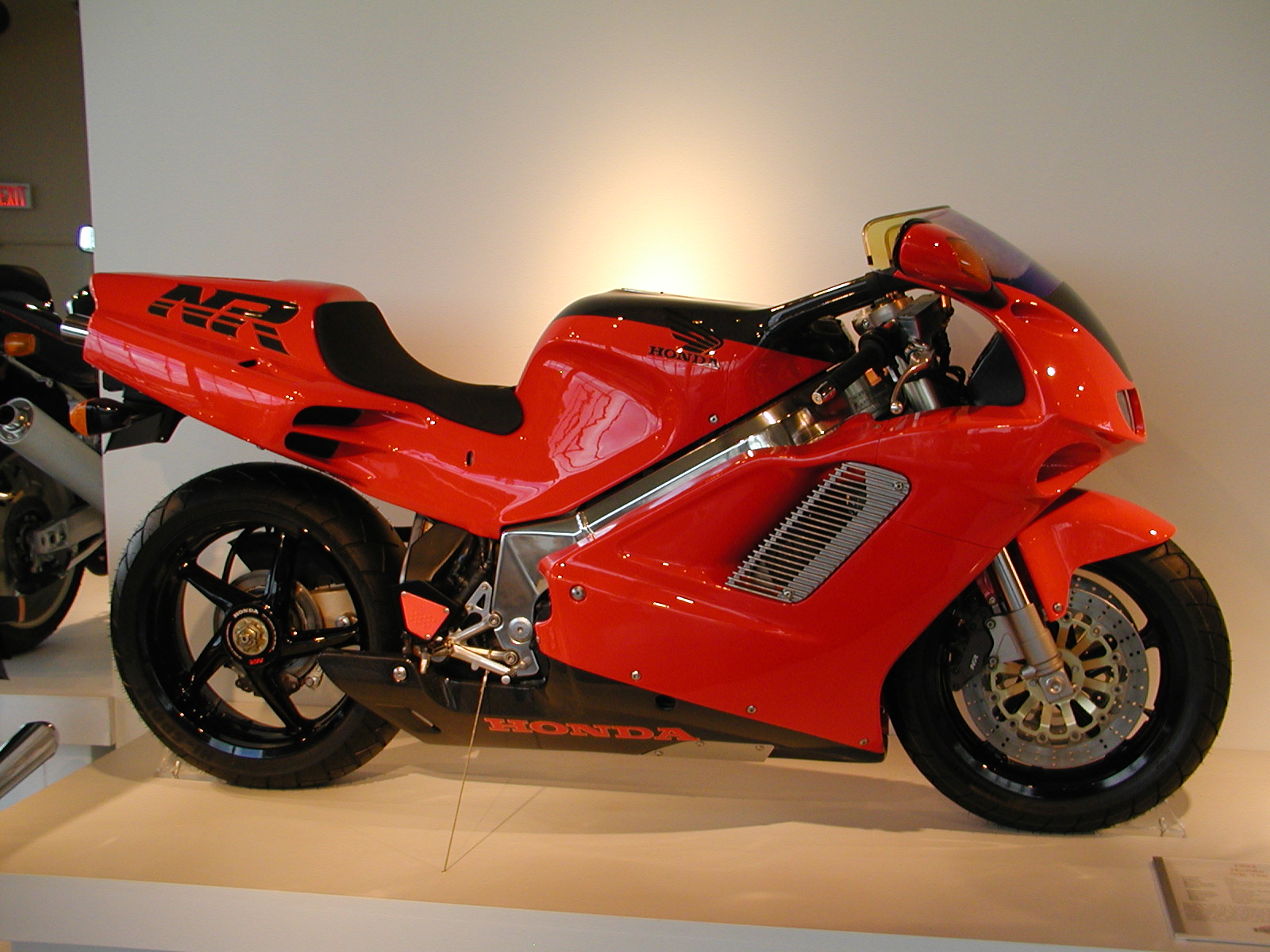
NR750
"And the VFR was really inspired by an NR750. The one I bought was inspired by the NR750. And I knew it had gear driven cams so that was, is that internal styling?"
The Honda NR750 is a famous, rare Honda that people talk about because it was built with unusual, race-focused engineering. Here, the host is saying their VFR 750 looked and felt inspired by that NR750 vibe.
Honda NR750 is a legendary, limited-production Honda built around a unique oval-piston “out-of-the-box” engine concept and a race-bred reputation. The host says the VFR 750 they bought was inspired by the NR750, and highlights the VFR’s gear-driven cam setup as part of that appeal.
gear driven cams
"And I knew it had gear driven cams so that was, is that internal styling? Pretty cool. It is very cool. It is. Could you hear it?"
Instead of using a chain or belt to run the engine’s camshafts, gear-driven cams use gears. The host also points out that the gears make a noticeable sound, and that sound matters to them.
Gear-driven cams use gears to synchronize the camshafts instead of a chain or belt. This can improve timing precision and durability, and it can also create a distinctive mechanical sound—something the host emphasizes as “very important.”
4.95 horsepower at 4,500 RPM
"I told my parents that the motorcycle I had bought was little and had only 4.95 horsepower at 4,500 RPM. How fast does it go? 45 miles an hour."
Horsepower is how much “pull” the engine can make. RPM is how fast the engine is spinning, and the number tells you at what engine speed that horsepower happens.
Horsepower is the engine’s power output, and RPM (revolutions per minute) is how fast the engine spins when that power is measured. Saying “4.95 horsepower at 4,500 RPM” tells you the bike makes that power only at a specific engine speed, not across the whole rev range.
Edward Turner
"I go back to Edward Turner of Triumph, transforming the line into twins and his, I don't know, his sensitivity for proportion, color, shape was real knockout."
Edward Turner was a famous motorcycle designer linked with Triumph. The host is saying his design work helped define what those bikes looked and felt like.
Edward Turner was a major motorcycle designer at Triumph, known for shaping the brand’s look and engineering direction. In this segment, he’s credited with “transforming the line into twins,” tying his design choices to the bikes’ appeal.
Triumph
"I go back to Edward Turner of Triumph, transforming the line into twins and his, I don't know, his sensitivity for proportion, color, shape was real knockout. Triumph lived off of that."
Triumph is a well-known British motorcycle maker. Here, the host is saying Triumph bikes were popular partly because of how they looked.
Triumph is a British motorcycle brand, and the host frames it as succeeding by leaning into distinctive styling and proportions. The segment suggests Triumph’s identity was strongly tied to design choices rather than purely technical specs.
twins
"I go back to Edward Turner of Triumph, transforming the line into twins and his, I don't know, his sensitivity for proportion, color, shape was real knockout."
“Twins” here means the motorcycle has two cylinders in its engine. That’s a basic engine layout that affects how it sounds and how it delivers power.
In motorcycle context, “twins” refers to engines with two cylinders (often a parallel-twin or V-twin layout). The host uses it to describe how Triumph’s lineup was “transformed” into a two-cylinder configuration.
Norton
"Triumph lived off of that. I mean, they were hardly different than a Norton twin, hardly different."
Norton is a motorcycle brand from the UK. The host is using it as a comparison point for how similar some bikes can be mechanically.
Norton is another classic British motorcycle brand. The host compares Triumph’s twins to Norton twins to emphasize how similar the underlying motorcycle “formula” could be, even when the styling and branding differed.
oil and frame
"Well, and they lived on that essential design until even in the oil and frame before slumbers clade and all that, uh, hoo-ha with the ray gun mufflers and, and, you know, the styling of the vehicles."
This phrase is talking about the bike’s core parts: the engine’s oil system and the frame that holds everything together. The host is saying the design identity went beyond just those basics.
“Oil and frame” is shorthand for the mechanical foundation of a motorcycle: the engine’s lubrication system (oil) and the structural chassis (frame). The host is contrasting that engineering baseline with the era’s focus on styling and exhaust changes.
ray gun mufflers
"Well, and they lived on that essential design until even in the oil and frame before slumbers clade and all that, uh, hoo-ha with the ray gun mufflers and, and, you know, the styling of the vehicles."
This is a nickname for a particular look of the exhaust pipes on motorcycles. The host is saying people cared a lot about how they looked, not just how they worked.
“Ray gun mufflers” appears to be a nickname for a distinctive exhaust/muffler style associated with that motorcycle era. The host links it to the “hoo-ha” around styling, implying the exhaust shape was a major visual and cultural cue.
Bonneville
"that block, you know, from say 39 to, you know, 70 with the final oil tank, you know, Bonneville, they were just living off of that."
Bonneville is a famous speed-testing location in the U.S., known for records. The host is using it as a reference point for an era when motorcycles were chasing speed.
Bonneville refers to the Bonneville Salt Flats, famous for land-speed records and speed-focused motorcycle and car development. The host uses it to anchor a time period when certain motorcycle design themes were “living off” that performance culture.

AMC Javelin
"... And as you were talking about the, you know, the javelin sticking into the ground, the sport bikes that ar..."
The AMC Javelin is a muscle car made by AMC. It was built to be sporty and powerful, and it’s known for its bold look. People mention it when talking about classic performance cars from that time.
The AMC Javelin is a muscle car from American Motors Corporation (AMC), known for its sporty performance and distinctive styling. It’s brought up in the context of “sticking into the ground,” which fits how these cars were often discussed for their aggressive stance and road presence. The Javelin is a notable part of the muscle-car era and is frequently referenced when talking about that period’s performance lineup.
Harley Davidson
"At Harley Davidson, the shape doesn't look a lot different from last year's and they're, they make damn certain of it."
Harley-Davidson is a famous motorcycle company known for cruisers with a very recognizable look. The point here is that their bikes tend to keep a familiar style even when they update them.
Harley-Davidson is the American motorcycle brand most associated with big V-twin cruisers and a very recognizable design language. In this segment, the host uses Harley-Davidson as an example of how a brand can keep its “shape” consistent from year to year while still evolving details.
Live wire
"Well, they had CEOs who decided to scare away a substantial portion of their clientele with live wire and electric motorcycle that looked like a suitcase with fins, with a wheel in front and a wheel behind."
LiveWire is Harley-Davidson’s electric motorcycle line. The host’s point is that it looked so different from classic Harley bikes that some riders didn’t like it, even though it was a strong performer.
LiveWire is Harley-Davidson’s electric motorcycle brand/line, positioned as a more futuristic alternative to traditional Harley styling. The host argues that LiveWire’s radical look—compared to a “suitcase with fins” shape—helped scare off some longtime customers, even though the bike was described as excellent and very fast.
electric motorcycle
"with live wire and electric motorcycle that looked like a suitcase with fins, with a wheel in front and a wheel behind. And it was an excellent electric motorcycle and the fastest accelerating production motorcycle ever from that company"
An electric motorcycle runs on electricity from a battery and uses an electric motor. The host is saying electric bikes tend to feel especially quick when you twist the throttle.
An electric motorcycle uses one or more electric motors powered by a battery pack instead of a gasoline engine. In this segment, the host links electrics to strong acceleration, noting that the LiveWire was described as the fastest-accelerating production motorcycle from that company.
fastest accelerating production motorcycle
"And it was an excellent electric motorcycle and the fastest accelerating production motorcycle ever from that company, as you would expect, because that's what electrics do best is accelerate."
This phrase means a regular, commercially sold motorcycle that accelerates quicker than other bikes. Electric bikes often feel like they launch fast because the power comes on right away.
“Fastest accelerating production motorcycle” refers to a factory-built (not prototype) bike that can reach a given acceleration benchmark quicker than other production models. The host attributes this to how electric drivetrains deliver torque instantly, which makes acceleration feel immediate.
Sportster
"So now they're bringing Sportster back. And I think there is a God or a functional equivalent [1981.8s] because Sportster, Sportster is the realization of cocky, [1993.9s] young man, young woman arrogance and willingness to try anything. It's not a high performance [2001.6s] motorcycle."
Here “Sportster” means a Harley-Davidson motorcycle that people love for its attitude and style. The point is that it may not be the best on paper, but it still sells because it feels right to buyers.
The host uses “Sportster” as a shorthand for Harley-Davidson’s small-displacement, classic V-twin motorcycle identity. They argue it’s not “technically superior,” but it sells because it matches an aspirational, rebellious image.
soft tail
"since, well, when they brought out the soft tail, [2045.4s] they made a huge deal about, oh, 15% more chassis rigidity."
“Soft tail” refers to Harley-Davidson’s suspension design concept that uses hidden rear suspension components to preserve a classic rigid-looking frame appearance. The host notes Harley marketed it with claims like increased chassis rigidity.
chassis rigidity
"they made a huge deal about, oh, 15% more chassis rigidity. And they started trotting out all these [2052.3s] technical reasons that they made the new soft tail"
Chassis rigidity means how stiff the bike’s frame is when you ride and apply forces. A stiffer frame can help the bike handle more predictably, but the host says that isn’t always the main reason people buy.
“Chassis rigidity” is how resistant the motorcycle’s frame is to twisting and flexing under load. Higher rigidity can improve handling consistency, but the host argues Harley’s marketing used it as a technical selling point rather than the core emotional appeal.
touring chassis
"Like touring, they, they made a big deal in 09 when they redid the touring [2070.2s] chassis, which was a huge improvement, which is what they're still using."
A touring chassis is the bike’s main structure designed for long rides. The host is saying Harley updated it in 2009 to make the touring bikes better, and that design is still the basis today.
A “touring chassis” is the frame and structural platform tuned for long-distance riding—typically prioritizing stability, comfort, and luggage-carrying practicality. The host says Harley improved the touring chassis in 2009 and still uses that approach.
60 degree v-twin
"So, you know, the sports are, oh, we're [2083.5s] going to use the 60 degree v-twin. I mean, they didn't have manufacturing capacity to do, we need [2089.1s] the 60 degree v-twin to put in an adventure bike because we want to play in the space"
A “60 degree v-twin” is an engine with two cylinders arranged like a V. The 60° angle is part of how the engine is built, and it influences the feel and sound of the bike.
A “60 degree v-twin” describes the engine’s cylinder layout and crankshaft angle: two cylinders in a V shape with a 60° angle between them. That geometry affects how the engine vibrates, how it sounds, and how smoothly power is delivered.
adventure bike
"they didn't have manufacturing capacity to do, we need [2089.1s] the 60 degree v-twin to put in an adventure bike because we want to play in the space"
An adventure bike is made for a mix of roads and rougher terrain. In this discussion, it’s the category Harley wanted to compete in, which affected what engines they could build.
An “adventure bike” is a motorcycle category built for mixed on-road and off-road use, often with longer travel suspension, upright ergonomics, and luggage capability. The host’s point is that Harley wanted to enter that segment, which drove engine and manufacturing decisions.
cams up
"again, I would have fought to the death to keep Sportster as it was. Change it, [2111.8s] update it, move the cams up, but leave the exhaust ports where they are"
“Cams up” means changing where the camshafts sit inside the engine. The host is basically saying they’d rather update the engine layout than redesign everything else.
“Cams up” refers to changing camshaft placement/packaging in the engine—often to improve breathing, serviceability, or performance characteristics. The host is saying they would have updated the Sportster by moving the cams while keeping other hardware locations similar.
exhaust ports
"Change it, [2111.8s] update it, move the cams up, but leave the exhaust ports where they are, leave the intakes where [2116.4s] they are"
Exhaust ports are the passages where burned gases leave the engine. Keeping their location can help preserve how the engine sounds and performs.
“Exhaust ports” are the openings in the cylinder head where spent combustion gases exit the engine. The host’s point is that they’d keep the exhaust port location to preserve the engine’s character while still updating other parts.
intakes
"but leave the exhaust ports where they are, leave the intakes where [2116.4s] they are, mount the exhaust in a very similar way"
Intakes are how air (and sometimes fuel) gets into the engine. The host is saying they’d keep the intake setup the same to preserve the bike’s feel.
“Intakes” refers to the air/fuel intake path into the engine—typically including the intake ports and manifold runners. The host argues for keeping the intake location while changing other components, to maintain the engine’s established behavior.
modular frame
"leave the intakes where [2116.4s] they are, mount the exhaust in a very similar way, but modular frame that you can change into"
A modular frame is a bike frame made in sections that can be swapped or reconfigured. The idea is to make updates easier without changing the whole bike.
A “modular frame” is a design where the motorcycle’s structure is built from interchangeable sections or subframes. The host is describing a way to update or reconfigure the bike without redesigning everything from scratch.
stance
"And outside sitting at the curb were these bikes that were leaned over on their side stance to the left with the front wheels turned to the right. And it was, it was just like just a third finger in iron and steel. Stance, swagger. Yes, sweat."
On motorcycles, “stance” is basically how the bike looks when it’s sitting—its attitude and proportions. People talk about stance because it strongly affects the bike’s style.
In motorcycle culture, “stance” means the bike’s overall visual and physical attitude—how it sits relative to the ground and how its angles (like rake and wheel position) create a particular look. The host uses it alongside “swagger” to describe the emotional appeal of a certain chopper-like presentation.
choppers
"I mean, you know, choppers, terrible motorcycles, but they have a feeling. They have a culturally speak feeling to the builder and the owner in particular, but also watching them go down the road. And we can talk about, oh, they were based on drag bikes and diggers and, and all of that, but the chopper evolved into its own thing, tall, skinny bike, no front brake,"
A “chopper” is a custom motorcycle style. It usually looks stretched and dramatic, and it’s built to be a certain kind of statement as much as (or more than) a practical machine.
A “chopper” is a highly customized motorcycle style built around a long, stretched frame and distinctive geometry. In this segment, the host also calls out signature traits like a tall, skinny look and the “no front brake” stereotype that’s associated with some chopper builds.
drag bikes
"And we can talk about, oh, they were based on drag bikes and diggers and, and all of that, but the chopper evolved into its own thing, tall, skinny bike, no front brake,"
“Drag bikes” are motorcycles set up to race in a straight line for quick acceleration. The host is saying choppers borrowed some ideas from that racing world.
“Drag bikes” are motorcycles configured for drag racing—short, straight-line acceleration runs. The host mentions them as one of the influences on chopper evolution, linking the custom culture’s roots to straight-line speed and performance parts.
digger
"And we can talk about, oh, they were based on drag bikes and diggers and, and all of that, but the chopper evolved into its own thing, tall, skinny bike, no front brake,"
“Digger” is slang for a rougher, dirt-oriented motorcycle style. The host is using it to explain where chopper styling ideas came from.
“Digger” is slang for a motorcycle style associated with off-road or dirt-focused customization—often with rugged, utilitarian intent. In this context, it’s listed alongside drag bikes as part of the mix of influences that helped shape the chopper’s identity.
Emotion rules
"Emotion rules. Yeah, for, for our market, emotion rules, you know, for a functional market where we're, we're using our motorcycle to transport five family members or using it for work or, I mean, how many, I love the ingenuity and balance and proficiency of people carrying"
The host is saying motorcycle choices are often guided by feelings—style, identity, and how the bike makes you feel—more than by logic alone. Some people buy for practicality, but others buy because they love the look and vibe.
“Emotion rules” is the host’s framing that motorcycle buying and ownership decisions are driven more by feelings and identity than by pure practicality. The segment contrasts this with a more utilitarian use case (commuting, work, carrying family), arguing that different rider motivations change what “makes sense.”
Royal Enfield
"And because you also got to be able to buy it and it has to be made to be bought, which is another podcast in and of itself. Like, thank goodness we have efficient production. Thank goodness Royal Enfield innovates its manufacturing in such a way as to basically,"
Royal Enfield is a motorcycle brand known for building classic-style bikes and for scaling manufacturing to meet global demand. Here, the host credits Royal Enfield with improving manufacturing efficiency so the bikes can be “made to be bought,” tying production to affordability and availability.
platforms
"I don't know, crib the Harley Davidson model, like, well, here's a couple of platforms, and now we're going to riff on them in 28 different ways."
A “platform” is the main underlying design a company reuses. If you share the same base, you can build many different bikes without starting from scratch each time.
In vehicle manufacturing, “platforms” are shared engineering foundations—like frame architecture and major component layouts—that multiple models use. Using common platforms helps reduce cost and speed up development while still allowing different styling and trim.
base engine
"different feelings, different colors, slightly different shapes, but we're making a million of the base engine, by the way, and it's very affordable."
A “base engine” is the core engine design that serves as the starting point for multiple models. Even when bikes look different, using the same base engine can keep parts common and make the lineup cheaper to produce.
supply lines
"That's been it's affordable because they have made a pilgrimage made a made a essential feature of their effort to eliminate supply lines, to have it all under their own control..."
“Supply lines” are the logistics and manufacturing routes that move parts from suppliers to the factory. The speaker is arguing that controlling more of the process reduces disruption risk from distant suppliers.
tie designed chassis manufacturing operation
"No, they have they have the tie designed chassis manufacturing operation at their plant. So they are able to to make use of labor saving and cost cutting methods..."
This refers to an in-house chassis manufacturing setup where the manufacturer designs and produces the motorcycle’s frame/chassis rather than outsourcing it. Building the chassis internally can improve cost control and quality consistency.
CVCC
"And before long, people were lining up to buy Honda automobiles, CVCC, the Civic, and then later, all those other attractive models."
CVCC (Compound Vortex Controlled Combustion) is Honda’s early emissions-focused engine technology. It helped Honda meet emissions requirements while maintaining drivability, and the speaker uses it as an example of how Honda’s innovations eventually became mainstream.

Honda Civic
"...ere lining up to buy Honda automobiles, CVCC, the Civic, and then later, all those other attractive model..."
The Honda Civic is a small, everyday car made by Honda. It’s known for being efficient and easy to live with, which is why people often talk about it when discussing popular Honda models. It’s the kind of car you’d choose for regular driving, not just special occasions.
The Honda Civic is a compact car from Honda that became well known for being practical, efficient, and widely appealing. In a discussion like this, it’s often mentioned as part of Honda’s lineup that drew attention for its smart design and everyday usability. The Civic’s significance is that it helped establish Honda’s reputation in the mainstream passenger-car market.
catch up
"So very interesting to see how long it takes to catch up in certain areas."
“Catch up” here is about how industries and consumers eventually adopt newer standards, quality levels, or technologies after early skepticism. The speaker frames it as a lag between innovation and widespread acceptance.
outer race only needle roller bearings
"I said something about having bought four Chinese made outer race only needle roller bearings. I said, what, you're not going to put those in something important, are you?"
“Outer race only” needle roller bearings are a bearing type where the needle rollers run with an outer race, typically requiring a compatible inner surface (often a shaft or housing feature) instead of a full inner race. This can reduce parts and cost, but it also makes correct fitment and material quality especially important.
4130 tubing
"The Chinese have to come up with standards so that when a manufacturer orders 4130 tubing, that's what will come. And not some melted down scrap automobiles rolled into sheet metal..."
4130 is a specific steel alloy commonly used for structural tubing in motorsport and performance builds. The host’s point is that manufacturers must meet the correct material specification so the tubing has the expected strength and consistency.
seam welded
"curved around and seam welded."
Seam welding means welding along the whole seam, not just a few spots. It’s generally a more deliberate, sturdier way to join metal.
“Seam welding” is a continuous welding method along a joint line, often used to create a strong, sealed connection. The speaker contrasts earlier manufacturing/assembly quality with later improvements.
UCE, the unit construction single
"when the UCE, the unit construction single with 550 singles, were just coming out."
UCE is a way of building a motorcycle where the engine and the transmission are made as one combined unit. “Single” means it has one cylinder, which changes the feel and layout of the bike.
“Unit construction” (UCE) is a motorcycle engine design where the engine and gearbox are built as one integrated unit. That “single” refers to a single-cylinder engine layout, which affects how power is delivered and how the bike is packaged.
hex is not quite hexagonal
"you could still see like, oh, this is, this bolt head is obviously heavily polished in the wrong direction and it's rounded the edge off and the hex is not quite hexagonal."
The “hex” is the multi-sided shape on a bolt head. If it’s not shaped correctly, the wrench may not fit well and the bolt can be harder to work on.
This is a fit-and-finish quality issue: the “hex” refers to the shape of a bolt head intended to match a wrench or socket. If the hex is rounded or not properly formed, it can make tools slip and signals poor machining/finishing.
supplier problem
"they had a supplier problem too. And if you order parts, it's really hit or miss."
This is about parts coming from outside companies not always being consistent. If suppliers vary in quality, the finished motorcycle can end up with uneven results.
A “supplier problem” here means inconsistent part quality or availability from outside vendors. The speaker ties it to how ordering parts can be “hit or miss,” which directly impacts motorcycle fit, finish, and reliability.
JRC engineering
"So if you need parts for your triumph, call JRC engineering and they source from around the world because they have to."
JRC Engineering is a parts supplier. The host is saying they help track down motorcycle parts by sourcing them from different countries.
JRC Engineering is referenced as an aftermarket parts sourcing company that supplies parts for motorcycles like Triumph. The host describes it as sourcing globally to find the specific components needed.
salvaged car parts
"they will send you fenders that are made out of salvaged car parts."
This means using parts taken from old wrecked cars. The host is warning that reused parts can lead to lower-quality motorcycle components.
“Salvaged car parts” refers to components reused from wrecked vehicles rather than purpose-made motorcycle parts. The speaker describes how this can show up as poor material matching and questionable fabrication quality.
stitch welded
"On the underside, it's the pain of an automobile stitched welded to something else and hammered into a fender."
Stitch welding means welding in short spots with gaps between them. The host is using it to illustrate a questionable way of joining metal.
“Stitch welding” is a welding technique where short welds are placed at intervals rather than a continuous seam. In the transcript, it’s used to describe a low-quality-looking repair/fabrication method on reused metal parts.
increase in quality
"But this is all a process and that's why Dr. Deming said an increase in quality is an increase in production."
They’re talking about a management idea: when you make things to a higher standard, you waste less time fixing mistakes. That can actually let you build more bikes/cars instead of getting stuck redoing work.
The host is referencing W. Edwards Deming’s idea that improving quality is not just “less defects,” it can also increase output. In this framing, better quality reduces rework and scrap, so production becomes more efficient.
Request an Explanation
Heard something you'd like explained? We'll add it to this episode.
Sign in to request explanations for terms you heard.
Want to learn more?
Browse our glossary for plain-English explanations of automotive terms, jargon, and concepts.
Help improve this episode
See something that's not quite right? Our annotations are AI-generated and can sometimes miss the mark. Click the flag icon on any annotation to suggest a correction.