
The Day That Saved Ducati! Its First Successful V-Twin Superbike wins at the Daytona of Italy, 1972
About this episode
Travel back to the 1972 Imola 200 with Cycle World's Mark Hoyer and technical editor Kevin Cameron as they dissect the legendary race that saved Ducati from financial ruin. Discover how legendary designer Dr. Fabio Taglioni engineered the revolutionary 90-degree V-twin engine, utilizing desmodromic valves to conquer vibration and unlock unprecedented RPMs. The hosts share fascinating behind-the-scenes stories of riders Paul Smart and Bruno Spadgiari nursing their sputtering, fuel-starved bikes to a historic one-two finish, forever cementing Ducati's reputation as a world-class superbike manufacturer just before the Japanese multi-cylinder boom.
Find us on Patreon! https://www.patreon.com/cw/CycleWorldPodcast
Every superbike and MotoGP bike Ducati has made in the last 50-plus years owes it all to the company's first successful V-twin racer: The 1972 Imola 750. The Imola 200-mile race was the coming out party for Ducati's 750 Imola racebike, designed and led by the great engineer Fabio Taglioni. It was the motorcycle Ducati needed to stay in business, and the win showed it was exactly the right bike at precisely the right time, all the way down to its bevel-driven overhead-cam desmodromic valve system. It's a story of financial woes, drama, and an unlikely success that set Ducati on a path it maintains today. Join Technical Editor Kevin Cameron and Editor-in-Chief Mark Hoyer as they talk about the Imola 750 and Hoyer's chance to see one of the original eight bikes in person with Mecum Auctions as that example gets prepared for the Monterey Car Week Auction August 13-15.

Ducati 750 Imola
"Kevin was at the 1972 Imola 200 where Ducati brought its first racing... successful racing between... and then suddenly Ducati was a builder of world-class Superbike between 750s."
A famous racing motorcycle built by Ducati in 1972. It used a unique engine design that didn't vibrate like other bikes of the era, allowing it to win a massive race and save the company from going out of business.
The 1972 Ducati 750 Imola Desmo is a legendary racing motorcycle built specifically for the Imola 200. Designed by Fabio Taglioni, it featured a 90-degree V-twin engine utilizing desmodromic valve actuation, securing a historic 1-2 finish that cemented Ducati's reputation as a high-performance superbike manufacturer.

Honda CB750
"They were in a in an era of then explosion of big bike sales, you know Honda's CB 750 had changed the market"
A revolutionary motorcycle released by Honda in 1969 that changed the industry forever. It was fast, reliable, didn't leak oil, and popularized the four-cylinder engine layout.
The Honda CB750, introduced in 1969, is widely considered the world's first 'Universal Japanese Motorcycle' (UJM) and the first modern superbike. It featured a revolutionary transverse inline-four engine, overhead camshaft, and front disc brake, completely disrupting the global motorcycle market.

Triumph Trident
"Of course, Smart was accustomed to things like the Triumph Trident. Triumph told dick man. This is an 8200 RPM engine and dick man privately said to himself feels more like a 7800 RPM engine to me"
An early British three-cylinder motorcycle built to compete with fast Japanese bikes. It made good power but shook a lot and had an older engine design that limited how fast it could spin.
The Triumph Trident was an air-cooled 740cc inline-triple motorcycle produced from 1968 to 1975. It was one of the first multi-cylinder superbikes, developed to compete with the rising threat of Japanese imports, but suffered from pushrod engine limitations and high vibration at high RPMs.
Fabio Taglioni
"What was wonderful was that Talioni used wisdom to make his choices. First of all, he got rid of the vibration by going with the 90 degree angle the V angle. This is the famous dr. T."
The genius engineer who designed Ducati's most famous engines, introducing the high-revving valve designs and V-twin layouts that make Ducatis sound and perform the way they do.
Fabio Taglioni (often called 'Dr. T') was Ducati's legendary chief designer and technical director from 1954 to 1989. He pioneered the use of desmodromic valve systems and the 90-degree V-twin engine configuration, defining Ducati's engineering philosophy for decades.
desmodromic
"Yes, he was a he he introduced desmo went on the 125 in the 50s and he was a fan of desmo and he was solving a problem because valve springs were horrible"
A special way of opening and closing engine valves using mechanical arms instead of metal springs. This stops the valves from getting confused or failing at really high speeds.
A desmodromic valve system uses dedicated cam lobes and rocker arms to both positively open and positively close the engine's valves, completely eliminating traditional valve springs. This design prevents 'valve float' at high RPMs, allowing engines to rev higher and more reliably.
90 degree V-twin
"But the fact is that everyone had known for decades that a 90 degree v-twin if counter weighted to 100 percent of one cylinder's reciprocating weight resulted in basically zero primary shaking force"
An engine with two cylinders arranged in an 'L' shape at a perfect 90-degree angle. This layout naturally cancels out engine shaking, making the ride incredibly smooth without needing extra heavy parts to stop vibrations.
A 90-degree V-twin engine layout places the cylinders at a right angle to each other. This specific configuration offers perfect primary balance, meaning the reciprocating forces of the pistons naturally cancel each other out, eliminating the harsh vibrations common in parallel-twin engines.
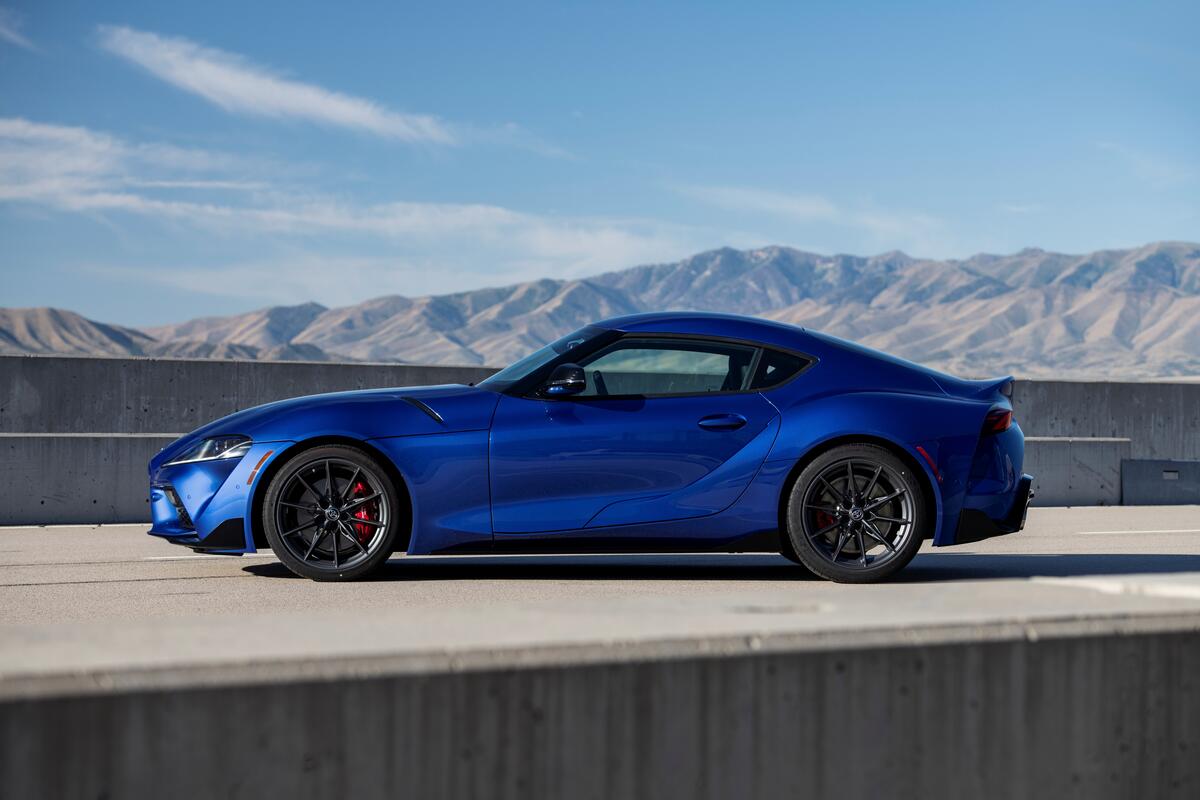
Toyota A90
"cylinder angle from the apollo police bike But the fact is that everyone had known for decades that a 90 degree v-twin If counter weighted to 100 percent of one cylinder's reciprocating weight"
The Toyota Supra is a fast, two-door sports car made by the Japanese company Toyota. It is built for people who want a quick, stylish vehicle that is fun to drive on winding roads.
The Toyota Supra is a high-performance sports coupe celebrated for its sharp handling, rear-wheel-drive dynamics, and strong tuning heritage. Developed in partnership with BMW, the modern GR Supra features a powerful turbocharged inline-six engine and a driver-focused cockpit, making it a staple in the sports car community.
primary shaking force
"resulting in basically zero primary shaking force. Primary means once per crankshaft revolution. There were secondary vibrations"
The main shaking feeling you get from an engine as the pistons move up and down once per turn. Getting rid of this force makes the engine run much smoother.
Primary balance refers to the cancellation of first-order reciprocating engine vibrations that occur once per crankshaft revolution. Achieving perfect primary balance minimizes engine vibration, reducing mechanical stress and rider fatigue without needing heavy balance shafts.
sandcast cases
"And you'll also see in descriptions of this motor that had sandcast cases. There's a good reason to use sandcast. Honda for years has used sandcast cases in moto gp because one they can be heat treated"
Engine cases made by pouring hot liquid metal into molds made of sand. It's an old-school, expensive way of making parts, but it makes them stronger and easier to customize for racing.
Sand casting is a metal casting process using sand as the mold material. In racing, sandcast crankcases are favored over mass-production die-cast cases because they allow for thicker walls, custom alloy compositions, and heat treatment to prevent cracking under extreme stress.

Ducati 750 Super Sport
"I was at blackhawk farms with me come and they had a a green frame 70 supersport 1974 and then they had this imola 200 bike"
An incredibly rare and beautiful street version of Ducati's winning race bike. It is famous for its bright green painted frame and is worth a fortune to collectors today.
The 1974 Ducati 750 Super Sport, famous for its 'green frame' and silver bodywork, is one of the most collectible production motorcycles in history. Built to celebrate Paul Smart's 1972 Imola victory, it was a true street-legal race replica featuring the desmodromic round-case V-twin engine.

Jaguar Xk
"...e aluminum cylinder had introduced in 1948 on the jaguar xk engine Introduced in 48 that was used in a produc..."
The Jaguar XK is a luxury sports car made by the British brand Jaguar, starting in the late 1940s. It was designed to look elegant while driving much faster than standard cars of its era.
The Jaguar XK refers to a legendary line of sports cars and grand tourers, beginning with the XK120 in 1948, which debuted Jaguar's famous dual-overhead-cam inline-six engine. These vehicles defined post-war British sports car design, offering high-speed performance and beautiful styling.
squish band
"And there was supposedly a 516 squish band around the outside. But the vertical clearance that they gave it was and this is not dynamic"
A tiny, tight space at the top of the engine cylinder. When the piston goes up, it squeezes the fuel and air out of this tight spot, mixing it up like a mini-tornado so it burns faster and cleaner.
A squish band is a tight clearance area between the piston crown and the cylinder head at Top Dead Center (TDC). As the piston reaches the top of its stroke, it 'squishes' the fuel-air mixture out of this zone into the main combustion chamber, creating turbulence that promotes a faster, more complete burn.

Dodge Aries
"Um But all the details, um, it was interesting, you know, I looked at all the period photos of spudgy arie's bike and some of those guys and I was telling cabin in our conversations about this the ignition switch is kind of under the"
The Dodge Aries is a basic, budget-friendly family car sold by the American brand Dodge during the 1980s. It was designed to be affordable, practical, and fuel-efficient.
The Dodge Aries is a compact family car produced from 1981 to 1989 as one of Chrysler's seminal 'K-cars.' It was highly significant for saving Chrysler from financial ruin in the 1980s by providing a fuel-efficient, front-wheel-drive platform during a challenging economic period.

BMW R90S
"you know those first races at Daytona was it was there with bmw and and we had the r90s and Udo Guido was there and Udo san"
A classic, fast BMW motorcycle from the 1970s with cylinders that stick straight out to the sides. It was famous for its beautiful paint job and for winning major races in America.
The BMW R90S is an iconic sport motorcycle produced from 1973 to 1976, featuring an 898cc boxer flat-twin engine. Designed by Hans Muth, it was famous for its distinctive two-tone paintwork, bikini fairing, and winning the inaugural AMA Superbike Championship in 1976.
Request an Explanation
Heard something you'd like explained? We'll add it to this episode.
Sign in to request explanations for terms you heard.
Want to learn more?
Browse our glossary for plain-English explanations of automotive terms, jargon, and concepts.
Help improve this episode
See something that's not quite right? Our annotations are AI-generated and can sometimes miss the mark. Click the flag icon on any annotation to suggest a correction.