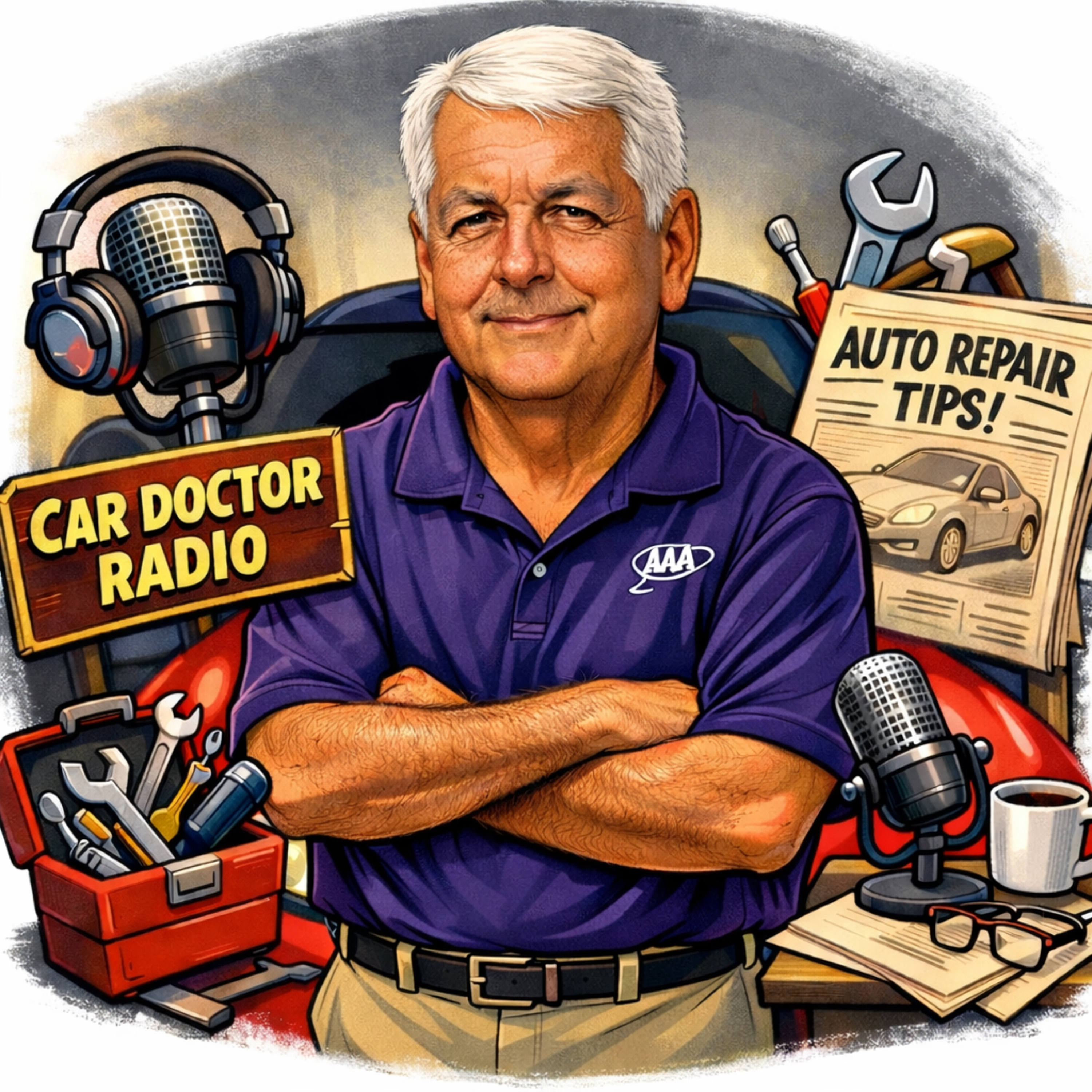
Packards, Fords and a review of the Honda Pilot
About this episode
Craig Hanley, president of the Packard Club, joins John Paul on The Car Doctor Podcast to talk Packard history and a July 15 Warwick, Rhode Island car show featuring 50–60 Packards from 1912–1956. The conversation covers Packard’s origins in 1899, its “American Rolls Royce” reputation, and a string of engineering firsts (steering wheel, rumble seat, 12-cylinder, air conditioning). They also debate why Packard faded after WWII amid Big Three dominance, plus the Studebaker merger, late V8/Ultramatic issues, and today’s hobby support.
A bit of Packard history with Craig Handley the President of the Packard club of America, a quick chat with Ted Ryan Ford historian and a full review of the Honda Pilot
Packard
"Tell us a little bit about Packard. Where did, when Packard first started, it was a true luxury car right up there with the best of the best, right?"
Packard was a famous American company that made luxury cars. The point here is that it was considered a top-tier luxury brand—like a “Rolls Royce” for the U.S.
Packard was an American luxury car brand that became known for high-end vehicles in the early 20th century. In this segment, the host frames it as the “American Rolls Royce,” emphasizing its reputation for luxury and quality.
independent company
"But Packard was an independent company. It formed in 1899."
An “independent company” here means Packard wasn’t part of the larger, already-established automaker groups—it operated as its own business. The segment uses this to explain why listeners might not recognize Packard’s origins if they only know the major Detroit brands.
Winton
"And so he came up with a whole list of things that he thought would improve the car... and went back to Winton and met with Alexander Winton to share these things."
Winton is the name tied to an early car maker in this story. Packard’s founder visited their factory, bought one of their cars, and then talked with them about making it better.
Winton refers to Alexander Winton’s automobile operation in the story. The segment describes James Packard visiting the Winton factory, buying a Winton car, and later meeting Alexander Winton to discuss how to improve it.
automatic spark advance
"In that very first car in 1899, it had automatic spark advance. It had the H pattern for shifting."
This is about controlling when the engine’s spark happens. The timing changes depending on driving conditions so the engine runs smoother and more efficiently.
Automatic spark advance is an engine control strategy that adjusts when the spark plug fires relative to piston position. Advancing or retarding timing helps the engine burn fuel efficiently across different speeds and loads.
H pattern
"It had the H pattern for shifting. And then in 1901, Packard invented the steering wheel."
On many older manual cars, the gear shifter moves in a pattern that looks like the letter “H.” That layout helps you find gears without guessing.
The H pattern is a common manual-transmission gear layout where the shifter moves in an “H” shape to select gears. It’s designed to make gear selection intuitive, especially for drivers learning the layout.
steering wheel
"And then in 1901, Packard invented the steering wheel. Before that, cars were used to teller."
A steering wheel is the main wheel you turn to control where the car goes. The host is saying Packard helped popularize the steering wheel layout we recognize today.
A steering wheel is the circular control used to direct a vehicle’s front wheels through a steering mechanism. The host is framing Packard’s early adoption as a major usability shift from earlier steering methods.
Rumble seat
"Packard came out with the first Rumble seat in 1908. They had the first U.S. 12-cylinder engine in 1915."
A rumble seat is a little extra seat in the back of some older cars. It was meant for a passenger and was often more exposed than the main cabin.
A rumble seat is a small, fold-out passenger seat built into the rear of certain early luxury cars. It was often exposed or semi-exposed and became a signature feature of some classic American coachbuilt designs.
U.S. 12-cylinder engine
"Packard came out with the first Rumble seat in 1908. They had the first U.S. 12-cylinder engine in 1915."
A 12-cylinder engine has twelve cylinders working together. More cylinders often means smoother power delivery, and in the early days it was a big luxury/technology flex.
A 12-cylinder engine is a V12 or similar configuration with twelve combustion cylinders. The host’s point is historical: Packard is credited here with introducing a high-cylinder-count engine in the U.S., which was associated with smoothness and prestige.
hydraulic shock absorbers
"Hydraulic shock absorbers, 1926, air conditioning. Packard invented air conditioning."
Shock absorbers are the parts that calm the car’s bouncing. “Hydraulic” means they use fluid inside to slow the motion when the wheels hit bumps.
Hydraulic shock absorbers use a piston moving through fluid to control how quickly a car’s suspension compresses and rebounds. That damping helps keep tires in contact with the road and reduces bouncing over bumps.
air conditioning
"Hydraulic shock absorbers, 1926, air conditioning. Packard invented air conditioning."
Car air conditioning is what cools the cabin and helps keep the windows from fogging. It uses a special system to move heat out of the car.
Automotive air conditioning is a climate system that cools and dehumidifies cabin air using a refrigerant cycle. Early implementations were notable because they added complexity and power draw compared with non-A/C cars.
steel beam headlights
"They also came out with steel beam headlights, padded dash and power windows were Packard brought out in 1940."
This is an older style of headlight setup that used a sturdy steel frame. The goal was to make the headlights hold their position better and last longer.
“Steel beam headlights” refers to an early headlamp design where the headlight assembly uses a rigid steel beam structure for mounting and aiming. That kind of construction helped improve durability and consistency compared with more fragile lamp mounts.
padded dash
"They also came out with steel beam headlights, padded dash and power windows were Packard brought out in 1940."
A padded dash is an interior dashboard covered with energy-absorbing material to reduce injury risk in a crash. It also improves perceived comfort by softening hard surfaces.
power windows
"They also came out with steel beam headlights, padded dash and power windows were Packard brought out in 1940."
Power windows let you open and close the windows with a button or switch. Instead of turning a handle, the car uses a motor.
Power windows use electric motors and switches to raise and lower window glass instead of manual cranks. They became a key convenience feature as electrical systems improved.
independent companies
"because when you consider that Packard and Nash and Kaiser and Willis and all these little independent companies together only had 2% of the market, there was just no way that they were going to survive."
This means smaller car companies that weren’t part of the biggest, most powerful automakers. The hosts say they struggled because they didn’t sell enough cars to fund new models like the big companies could.
“Independent companies” refers to smaller automakers outside the dominant large manufacturers (the “Big Three”). The hosts use this to explain why these firms struggled—limited market share meant fewer resources to fund frequent new model development.
amortize
"They didn't have the money to amortize. They couldn't sell enough cars to bring out new models every year and so forth like the big three could."
Amortize means “spread out the cost over time.” The point here is that big automakers could sell enough cars to cover the cost of new designs over several years, while smaller companies couldn’t.
To amortize means to spread the cost of something—like developing new car models—over multiple years or production runs. The hosts argue that smaller independents lacked the sales volume to amortize those development costs the way larger automakers could.
American Motors
"The plan was that all these independents would merge and most of them did and formed American Motors. And Packard was supposed to be the luxury car division of American Motors."
American Motors was a company created by merging several smaller car makers. The hosts say Packard was supposed to become the luxury brand within that merged company.
American Motors Corporation (AMC) was formed when several smaller U.S. automakers merged to survive in a market dominated by the “Big Three.” In the segment, Packard is described as being intended to serve as AMC’s luxury division.
George Romney
"But there were personality conflicts. George Romney and James Nance, who was then president, they didn't go long."
George Romney was a business leader involved in the car industry during the time when smaller automakers were trying to merge. In this segment, he’s mentioned as part of a leadership conflict.
George Romney was an executive who became a key figure in the early American Motors era. The hosts mention him alongside James Nance to explain that leadership conflicts helped derail the intended merger/luxury-division plan.
James Nance
"But there were personality conflicts. George Romney and James Nance, who was then president, they didn't go long."
James Nance was a top executive in the car industry. Here, he’s mentioned as the president involved in a leadership clash with George Romney.
James Nance was an automotive executive who served as president during the American Motors period discussed here. The segment frames his relationship with George Romney as a “personality conflict” that contributed to the plan not lasting.

Packard Caribbean
"Now is it possible, and I could be confusing brands, is it possible that I saw a Packard Caribbean with an Oldsmobile engine in it? [762.5s] Well, you might have seen one."
The Packard Caribbean is a specific Packard car model. Here, it’s mentioned because someone might have swapped in an engine from another brand, which people sometimes doubt or question.
The Packard Caribbean was a premium Packard model known for its distinctive styling and V8-era performance. In this segment, it’s used as an example of a car that might have been modified with a different brand’s engine.
VA
"And one of the things that they were late bringing out a VA, everybody had a VA around in the early 50s, 50, 51. [793.3s] And Packard didn't bring out a VA until 55."
“VA” is the name the host is using for Packard’s V8 engine. A V8 is an engine with eight cylinders arranged in a V shape, and the point here is that other brands had them earlier than Packard did.
“VA” here refers to Packard’s V8 engine family designation used in the early-to-mid 1950s. The host is contrasting when Packard introduced it versus other automakers that had similar V8s earlier.
torque
"But when they did bring it out, it had the highest torque of any engine produced that year. [803.8s] It was so powerful that the transmission, they had their own transmission too."
Torque is the engine’s “pulling power.” More torque usually means the car feels stronger when you start moving or when you’re not already at high speed.
Torque is the twisting force an engine produces, and it strongly affects how quickly a car accelerates from low speeds. The host says Packard’s newly introduced engine had the highest torque of any engine produced that year, which is why it felt so strong.
hydromatics
"I remember the original hydromatics were sort of really just a one-speed transmission. [833.6s] Yeah, well, the Packard transmission is a two-speed."
“Hydromatics” is a brand name for an automatic transmission used by GM. It’s basically the gearbox that shifts for you without a clutch pedal.
“Hydromatics” refers to General Motors’ automatic transmission line (Hydra-Matic). The host compares earlier Hydramatic behavior to Packard’s own automatic transmission design.
constant variable transmission
"Basically, it's kind of like a constant variable transmission up until you get around 40, 45 miles an hour and then it downshifts and you feel that, but that's it. [853.6s] And it was not, the Packards were not built for speed, I guess."
A constant variable transmission (CVT) is an automatic gearbox that can change ratios smoothly instead of using fixed gears. The idea is to keep the engine in the right “sweet spot,” and the host says you can feel it change around 40–45 mph.
A constant variable transmission (CVT) uses a belt or chain and variable pulleys to keep the engine near its most efficient operating point. The host describes it as feeling smooth until around 40–45 mph, when it downshifts and you can feel the change.
downshifts
"Basically, it's kind of like a constant variable transmission up until you get around 40, 45 miles an hour and then it downshifts and you feel that, but that's it. [853.6s] And it was not, the Packards were not built for speed, I guess."
A downshift is when the transmission switches to a lower gear so the engine can spin faster. That usually makes the car respond more strongly, and you can feel the change.
A downshift is when an automatic transmission changes to a lower gear ratio, typically to increase engine speed for stronger acceleration or to maintain power. The host notes that Packard’s transmission downshifts around 40–45 mph, creating a noticeable “feel.”
ultramatter transmission
"Which is funny because at the time, you know, what was fuel costing? [896.1s] Yeah, pennies. [898.2s] But Packard had their ultramatter transmission and it worked good for the straight Aids that they were building."
The Ultramatic transmission is Packard’s automatic gearbox. The host is saying it worked well for how those cars were meant to be driven, even if people criticized their fuel economy.
The “Ultramatic transmission” was Packard’s automatic transmission system introduced in the mid-1950s. The host argues it helped the cars work well for the straight-ahead driving they were building, even though critics complained about fuel economy.
V8
"And then in 55, they came out with this V8 and the transmission wasn't quite strong enough to keep up with the power of the engine."
A V8 is an engine with eight cylinders arranged in a V shape. The host is saying that when Packard added a V8, the automatic transmission couldn’t keep up with how much power the engine made.
A V8 is an engine with eight cylinders arranged in a V shape, commonly used in American cars for strong power and smoothness. The host says that when Packard introduced its V8 in 1955, the transmission wasn’t strong enough to handle the engine’s power.
adapter kit
"Now, there have been people, I've known people in the club who have, for years there was somebody sold an adapter kit that would put a torque flight across their torque flight. [934.8s] Transmit three speed in a Packard."
An adapter kit is like a custom set of connectors and brackets that helps two parts fit together. With older cars, it’s often used when someone wants to install a newer transmission or drivetrain component.
An adapter kit is a set of parts used to make one component work with another that wasn’t originally designed to fit together. In classic-car circles, adapter kits are commonly used for engine/transmission swaps or to mate a different transmission to an older drivetrain.
three speed
"[934.8s] Transmit three speed in a Packard. [938.9s] And I know some people are still fitting in a more modern transmission. [947.2s] For one thing, there's very few people in the country that know how to work on them."
A “three-speed” transmission means the car has three forward gears. Older cars often used simpler gearboxes, and changing to a different transmission can be tricky because the parts have to match up.
A “three-speed” transmission is a gearbox with three forward gear ratios. Many older American cars (including some Packards) used three-speed automatics or three-speed manuals, and swapping to a different transmission often requires compatibility work.
car show
"Tell us about what's going to go on in Rhode Island in a, well, [1034.9s] about 10 days. [1036.9s] Yeah, it's actually, it'll be about, it'll start a week from today, but the car show is on Wednesday."
A car show is an organized event where owners display vehicles and enthusiasts gather to compare cars, talk history, and sometimes judge or feature specific makes. In this segment, it’s used to describe how the Packard community meets and keeps the brand’s legacy alive.
Newport
"[1148.7s] We're going to take a bus trip into Newport. [1151.3s] We've been told that it would be foolish to try to drive Packard's into Newport with all the congestion and, and."
Newport refers to the city in Rhode Island that’s famous for historic mansions and classic-car tourism. In this segment, the group plans a bus trip there to tour local attractions and museums.
Audrain Museum
"[1160.5s] Well, you absolutely need to go to both the Audrain Museum and the Newport Car Museum. [1215.4s] And, and the Audrain just can't handle that big of a crowd."
The Audrain Museum is a car museum in Newport, Rhode Island, focused on automotive history and notable collections. The hosts mention it as a must-see, but also note crowd-size limits for their group.
Ford Motor Company
"He is the historian for Ford Motor Company and he is always an interesting guy to talk to."
Ford Motor Company is the company that makes Ford cars. The guest works there as a historian, so he knows a lot about Ford’s past vehicles.
Ford Motor Company is the automaker behind the Ford brand. In this segment, the guest is described as the historian for Ford Motor Company, tying the discussion to Ford’s product history and archives.

Honda pilot
"Right now I want to talk about the Honda pilot. The Honda pilot is a vehicle that has gotten me around this week."
The Honda Pilot is a midsize three-row SUV built around family practicality rather than flashy styling. In this segment, the host highlights its sensible packaging and everyday usability, then gets specific about its 3.5-liter V6 and 10-speed automatic.
three row SUV
"The Honda pilot is a vehicle that has gotten me around this week. And it is, I think, probably one of the most sensible choices in a three row SUV."
A three-row SUV is an SUV with three rows of seats. It’s built to carry a bigger group—usually around 7 to 8 people.
A three-row SUV is a sport-utility vehicle designed with three rows of seats, typically for up to seven or eight passengers. The extra row is meant to make family hauling and carpooling practical without moving to a minivan.
3.5 liter V6 engine
"Power comes from Honda's pretty well proven 3.5 liter V6 engine. It makes almost 300 horsepower."
This is a V6 engine with 3.5 liters of displacement. It’s a common setup for family SUVs because it can provide smooth, steady power for everyday driving.
A 3.5-liter V6 engine is an internal-combustion engine with six cylinders arranged in a “V” shape and a total displacement of 3.5 liters. Displacement is a rough measure of how much air/fuel the engine can move, and V6s are often chosen for smooth power delivery in family SUVs.
CVT
"I think it's 385 and it's connected to a 10 speed automatic transmission, so no CVT in a market where many people, people, many manufacturers have gone to smaller turbocharged four cylinder engines."
CVT means continuously variable transmission. Instead of shifting through set gears, it can smoothly change the ratio all the way across its range.
CVT stands for continuously variable transmission, a type of automatic that uses pulleys/belts to provide an infinite range of effective gear ratios rather than fixed steps. The host contrasts the Pilot’s 10-speed automatic with CVTs, which are common in some fuel-focused models.
10 speed automatic transmission
"I think it's 385 and it's connected to a 10 speed automatic transmission, so no CVT in a market where many people, people, many manufacturers have gone to smaller turbocharged four cylinder engines."
A 10-speed automatic transmission is the car’s automatic gear system with ten different gear ratios. It helps the engine stay in the right range so the car drives smoothly and efficiently.
A 10-speed automatic transmission is a gearbox that automatically selects among ten gear ratios to keep the engine in its efficient power band. More gears can help improve both acceleration feel and fuel economy compared with older fewer-gear automatics.
turbocharged four cylinder engines
"I think it's 385 and it's connected to a 10 speed automatic transmission, so no CVT in a market where many people, people, many manufacturers have gone to smaller turbocharged four cylinder engines."
A turbocharged four-cylinder engine is a smaller engine that uses a turbo to make more power. Automakers use this approach to get better fuel economy while still feeling quick.
Turbocharged four-cylinder engines use a turbocharger to force more air into a small displacement engine, allowing it to make more power than a naturally aspirated four-cylinder. This is a common downsizing trend in modern vehicles aimed at improving efficiency.
V6
"This V6 is reminiscent of V8 because you drive a four cylinder so long and then you get in a V6. [1869.0s] It just feels different."
A V6 is an engine with six cylinders. It usually feels smoother and pulls more strongly than a four-cylinder, even if the four-cylinder has higher peak horsepower.
A V6 is an engine with six cylinders arranged in a V shape. Compared with a four-cylinder, it often delivers stronger low- and mid-range pull and a different “feel” even if peak horsepower is similar.
cubic inches
"Even though the horsepower of that four cylinder may be higher than the V6, there's something about cubic inches and displacement. [1881.6s] And I think someone once said there's no replacement for displacement."
Cubic inches is a way to measure how big an engine is. Bigger displacement often helps the engine make stronger pull, which can make it feel different to drive.
Cubic inches is a unit of engine displacement, which describes the total volume swept by the pistons. Larger displacement generally means more air/fuel potential per cycle, which can translate to stronger torque and a different driving character.
towing capacity
"Towing capacity, you can tow up to 5,000 pounds with the right trailer hitch. [1891.8s] And again, no turbocharger worry about, which is kind of nice."
Towing capacity is the maximum weight a vehicle is rated to tow safely. It depends on the engine, transmission, cooling system, and braking capability, and it’s also affected by the trailer hitch and trailer setup.
turbocharger
"And again, no turbocharger worry about, which is kind of nice. [1894.8s] On the road, the Honda Pilot feels refined."
A turbocharger is a device that boosts engine power by forcing more air into the engine. The host is saying they like not having to think about turbo-related issues.
A turbocharger is a forced-induction device that uses exhaust gases to spin a turbine, compressing intake air to increase power. The host’s point is that a non-turbo setup avoids “turbo worries,” which can include heat management and turbo-specific maintenance concerns.
all wheel drive system
"The available all wheel drive system should provide really good traction in the snow. [1930.0s] Hopefully, in my life, I don't see any more snow. [1933.6s] But also, all wheel drive is great in the rain too."
All-wheel drive sends power to all four tires. That usually helps the car grip better on slippery roads like snow or wet pavement.
An all wheel drive (AWD) system sends power to all four wheels to improve traction. In this segment, the host connects AWD to better grip in snow and rain, where distributing torque helps reduce wheel slip.
ergonomics
"Inside Honda has done an excellent job with comfort ergonomics. [1942.4s] The seats are comfortable, supportive."
Ergonomics means designing the inside of the car so it fits people well. Here, the host is saying the Pilot’s layout and seating make it easier to stay comfortable while driving.
Ergonomics is the design of controls, seating, and interior layout to fit how people naturally sit and move. The host uses it to describe how the Pilot’s cabin supports comfort and easy driving posture.

Chevy Suburban
"You know, if you need more room than this, if you're carrying more kids, more people, more luggage, you probably need to step up to a Chevy Suburban."
The Chevy Suburban is a bigger SUV than the Pilot, with more space for passengers and cargo. The host is saying that if the Pilot still feels too small, the Suburban is the next size up.
The Chevrolet Suburban is a full-size three-row SUV that’s often used as a benchmark for maximum passenger and cargo space. The host mentions it as the step up from the Honda Pilot if you need substantially more room for kids, people, or luggage.
wireless Apple CarPlay
"Technology, you know, it's typical Honda. It's got a good infotainment screen, wireless Apple CarPlay, wireless charging."
Wireless Apple CarPlay connects your iPhone to the car’s screen without a cable. You can use things like maps, calls, and music through the infotainment system.
Wireless Apple CarPlay lets you mirror and control compatible iPhone apps through the car’s infotainment screen without plugging in a cable. It typically supports navigation, calls, messages, and music while keeping your phone’s interface familiar.
wireless charging
"It's got a good infotainment screen, wireless Apple CarPlay, wireless charging."
Wireless charging charges your phone without plugging in a cable. You just set the phone on the charging pad in the car.
Wireless charging uses an inductive charging pad in the vehicle to power a compatible phone without plugging in. It’s usually slower than wired charging but is convenient for everyday use.
blind spot monitoring
"Honda's suite of safety features includes adaptive cruise control and lane keeping and blind spot monitoring and automatic emergency braking."
Blind spot monitoring is a safety feature that watches for cars you can’t see. If another vehicle is in your blind spot, it warns you so you don’t change lanes into it.
Blind spot monitoring uses sensors to detect vehicles in areas you can’t easily see in your mirrors. It typically alerts you when you’re about to change lanes, helping reduce lane-change accidents.
automatic emergency braking
"Honda's suite of safety features includes adaptive cruise control and lane keeping and blind spot monitoring and automatic emergency braking."
Automatic emergency braking is a safety system that can slow or stop the car if it thinks a crash is about to happen. It’s meant to help you avoid hitting something, especially when you might not react fast enough.
Automatic emergency braking (AEB) detects an imminent collision and can apply the brakes for you if you don’t react in time. It’s designed to reduce the severity of crashes or prevent them altogether at lower speeds.
adaptive cruise control
"Honda's suite of safety features includes adaptive cruise control and lane keeping and blind spot monitoring and automatic emergency braking."
Adaptive cruise control is cruise control that can react to traffic. It keeps a safe distance from the car in front by slowing down and speeding up as needed.
Adaptive cruise control automatically adjusts your speed to maintain a set following distance from the car ahead. Unlike traditional cruise control, it can slow down and speed back up as traffic changes.
lane keeping
"Honda's suite of safety features includes adaptive cruise control and lane keeping and blind spot monitoring and automatic emergency braking."
Lane keeping is a driver-assist feature that helps you stay in your lane. If the car senses you drifting, it can nudge or steer you back.
Lane keeping helps prevent unintentional lane departures by monitoring lane markings and providing steering assistance. Depending on the system, it may gently correct the car back toward the lane center.

Mazda Cx90
"...like the Telluride maybe is a little bit cheaper, CX90, stuff like that. Fuel economy, pretty good."
The Mazda CX-90 is a larger SUV that can seat more people because it has three rows. People often compare it to other family SUVs based on how efficiently it uses fuel. In the podcast, it’s mentioned as having pretty good fuel economy.
The Mazda CX-90 is a three-row midsize SUV designed to fit more passengers than a typical two-row SUV. It’s often discussed alongside other family-oriented SUVs because buyers look at factors like fuel economy and overall value. In the podcast context, it’s grouped with similarly sized options and called out for having pretty good fuel economy.
road noise
"Road noise, a little bit more noticeable on course pavement, but nothing. [2074.5s] Those aren't deal breakers at all. [2075.9s] And I think overall, the Honda Pilot remains an excellent family SUV."
Road noise is the noise you hear inside the car from the tires and the road surface. If it’s louder, the cabin feels less quiet and more tiring on longer drives.
Road noise is the sound that enters the cabin from the tires and the surface of the road. It’s often more noticeable on rougher pavement, and it can affect how “quiet” a vehicle feels even if the car’s powertrain is smooth.

Honda Civic
"My girlfriend has a 2013 Civic with about 160,000 miles on it. [2131.9s] I noticed mostly when we're going at a pretty good clip, maybe like 40 miles an hour on an off run for an on-range. [2140.6s] I'm hearing kind of like a clicking sound, kind of a rapid sound coming from like the driver's side rear."
This is a 2013 Honda Civic, and the host is using it as the customer’s car for a problem. They mention the car has high mileage and then describe a clicking sound from the rear.
A 2013 Honda Civic is a compact car example used to set up a diagnostic issue. The host mentions its mileage and then describes a noise coming from the rear, which is the kind of detail you’d use to narrow down potential causes.
suspension wear
"Also, I would be a little suspicious about, just make sure there's no suspension wear back there too, because those tend to be kind of prone to wear, bushings, ball joints, stuff like that. So be a little bit cautious about that, but what you describe sounds pretty classic rear wheel bearing kind of thing."
Suspension wear means parts in the suspension system are getting worn out. When that happens, the car can feel noisy or loose in a way that can be mistaken for a wheel bearing problem.
Suspension wear refers to deterioration in the components that control ride height and wheel alignment, especially parts that allow movement (like bushings and ball joints). Worn suspension parts can mimic wheel-bearing symptoms by causing noise, looseness, or changes in handling.
bushings
"Also, I would be a little suspicious about, just make sure there's no suspension wear back there too, because those tend to be kind of prone to wear, bushings, ball joints, stuff like that."
Bushings are soft mounts that help suspension parts move smoothly. When they wear out, the suspension can get loose and start making noise.
Bushings are rubber or polymer mounts that allow suspension components to move while isolating vibration and noise. As bushings wear, they can introduce play (looseness) and clunks or hums that may show up during cornering or over bumps.
ball joints
"Also, I would be a little suspicious about, just make sure there's no suspension wear back there too, because those tend to be kind of prone to wear, bushings, ball joints, stuff like that."
Ball joints are hinge-like parts that let the suspension move. If they wear out, you can get looseness and knocking noises, and it can affect how the tires track.
Ball joints are pivot joints that connect suspension arms to other components, letting the wheels move up/down and steer. Worn ball joints can cause looseness, knocking, and uneven tire wear, and their symptoms can overlap with wheel-bearing issues.
rear wheel bearing
"So be a little bit cautious about that, but what you describe sounds pretty classic rear wheel bearing kind of thing. Otherwise you're saying rear suspension?"
A wheel bearing is a part that helps your wheel spin smoothly. When it wears out, it can make noise and feel shaky, especially when you’re turning or driving under load.
A rear wheel bearing is the sealed set of rollers/balls that lets the rear wheel spin smoothly while supporting the vehicle’s weight. When it wears out, it can create a humming or growling noise and sometimes vibration that changes with speed or cornering load.
end play
"It should have zero end play, it should have zero movement in it. If there's a little bit of looseness in there, that's going to give you the clue of what's going on."
End play is how much a part can move when it shouldn’t. If a wheel bearing has end play, it usually means the bearing is worn and needs attention.
End play is the amount of movement a component has along its axis when it should be fully seated. For a wheel bearing, excessive end play indicates wear or improper seating and is a key diagnostic sign when you jack up the car and check for looseness.
drum brakes
"And depending on what kind it is, it's not, does it have disc brakes in the back or drum brakes? Drum, I believe. Drum, yeah."
Drum brakes use pads/shoes inside a drum to stop the wheel. The brake design can change how easy it is to get to the bearing and related parts.
Drum brakes use brake shoes that press outward against a rotating drum to slow the wheel. Compared with disc brakes, drum setups can be a bit more straightforward to service in some designs, and the brake type can affect how the wheel hub/bearing area is accessed.

Buick Century
"...ou split those up over the, you know, more than a century? Well, the real reason is they had to be more nar..."
The Buick Century is a car model made by Buick. The name “Century” is tied to the model’s long-running history, which is why it comes up when someone talks about “more than a century.” In this podcast moment, it sounds like the speaker is clarifying the reason behind that reference.
The Buick Century is a mid-size sedan that was produced for many years, and it’s mentioned in the podcast in the context of “more than a century,” likely as a play on the model name. It’s a car that can come up when discussing older vehicles, naming history, or how long a particular model line has existed. The podcast reference suggests the speaker is explaining why the name or concept is tied to that long-running history.
technical service bulletin
"And I like to see if there's a technical service bulletin. And there is. And this is a weird one on the four liter engine, some common causes of vibration..."
A technical service bulletin is like an official “heads up” from the car maker to mechanics. It explains a known issue and what the shop should check or fix for that problem.
A technical service bulletin (TSB) is an official notice from a vehicle manufacturer to dealers and technicians. It describes known problems and the recommended diagnostic or repair steps for specific symptoms, often including parts and procedures.
exhaust center tube
"it says if the idol is verified to be below specification, Nissan has in some cases recommended replacing the exhaust center tube. When the center tube, the resonator partially collapses..."
The exhaust center tube is a section of the exhaust system in the middle of the car. If it’s damaged, it can mess up how exhaust flows and lead to symptoms like vibration or rough idle.
The exhaust center tube is a mid-section of the exhaust system between other exhaust components. If it’s replaced due to a defect, it’s usually because internal damage (like collapse) can change exhaust flow and cause drivability issues such as vibration or unstable idle.
resonator partially collapses
"When the center tube, the resonator partially collapses, or the baffles break loose, exhaust flow becomes turbulent, turbulent."
The resonator is part of the exhaust that helps control noise. If it collapses, it can block exhaust flow, leading to rough running and vibration.
A resonator is an exhaust component used to reduce certain noise frequencies and smooth exhaust flow. If the resonator partially collapses, it can restrict flow and create turbulence, which can destabilize combustion and cause vibration.
exhaust flow becomes turbulent
"When the center tube, the resonator partially collapses, or the baffles break loose, exhaust flow becomes turbulent, turbulent."
Turbulent exhaust flow means the exhaust gases aren’t moving smoothly. That can change pressure in the exhaust and make the engine’s idle less stable.
Turbulent exhaust flow means the exhaust gases are moving in a chaotic, non-smooth way rather than flowing evenly. That turbulence can change pressure and flow characteristics, which can affect combustion stability—especially at idle where exhaust flow is low.
baffles break loose
"When the center tube, the resonator partially collapses, or the baffles break loose, exhaust flow becomes turbulent, turbulent."
Baffles are internal parts inside the exhaust that help guide exhaust gases. If they come loose, they can interfere with flow and cause the car to run poorly or vibrate.
Baffles are internal plates or structures inside an exhaust component that help direct and manage exhaust flow. If baffles break loose, they can obstruct flow and increase turbulence, which can contribute to vibration and unstable idle behavior.
idle speed
"At idle, the engine is very little rotational initial and low exhaust flow. So even a small restriction or pressure wave disturbances can affect combustion stability. So that it says the computer may struggle to maintain the correct idle speed."
Idle speed is how fast the engine runs when you’re stopped at a light and not touching the gas. The car’s computer tries to keep it steady, and certain problems can make it hard to do that.
Idle speed is the engine’s target RPM when the car is stopped and not pressing the accelerator. Modern engines use sensors and engine control software to maintain a stable idle; if airflow or exhaust flow is restricted, the computer may have trouble holding the correct idle speed.
combustion stability
"So even a small restriction or pressure wave disturbances can affect combustion stability. So that it says the computer may struggle to maintain the correct idle speed."
Combustion stability is how consistently the engine burns fuel. If exhaust flow is restricted, the engine may not burn as smoothly at idle, causing rough running.
Combustion stability refers to how consistently the engine’s air-fuel mixture burns in a controlled way. At idle, small restrictions or pressure disturbances in the exhaust can upset that stability, leading to roughness and the computer struggling to maintain target idle speed.
pressure wave disturbances
"So even a small restriction or pressure wave disturbances can affect combustion stability."
Pressure wave disturbances are changes in exhaust pressure as gases move through the exhaust. If the exhaust system is partially blocked or damaged, those pressure changes can make the engine run less smoothly.
Pressure wave disturbances are fluctuations in exhaust pressure caused by how exhaust gases move through the system. When the exhaust system is restricted or damaged, these pressure waves can interfere with how the engine breathes and burns fuel, which can show up as vibration or unstable idle.
combustion chambers
"...use something like Tecron to clean the fuel ejectors and combustion chambers,"
Combustion chambers are where the engine burns the fuel. If they’re dirty, the engine can waste fuel or run less smoothly.
Combustion chambers are the spaces inside the engine where the air-fuel mixture is ignited. Keeping them clean helps maintain proper combustion, which can support fuel economy and reduce deposits.
fuel ejectors
"...use something like Tecron to clean the fuel ejectors and combustion chambers,"
Fuel ejectors are parts that help deliver fuel into the engine. If they get clogged or dirty, the engine may not burn fuel as efficiently.
Fuel ejectors are the components that spray or deliver fuel into the engine’s intake/combustion area. If they get dirty, the spray pattern can degrade, which can hurt efficiency and drivability.
fuel economy
"Usually what happens is whenever you add any kind of gas saving device, you drive better, you drive easy, you take it easy, you watch your fuel economy."
Fuel economy is how far you can go on a tank of gas. The show is saying your driving habits and maintenance matter more than tricks.
Fuel economy is how efficiently a vehicle converts fuel into distance (often discussed as miles per gallon or liters per 100 km). The episode ties it to driving style and maintenance rather than gimmicks.
gas on the manifold
"...I smelled some gas... it was gas on the manifold, not terrible, but any gas on the manifold is not good."
If you see or smell gasoline around the intake manifold, it usually means fuel is leaking where it shouldn’t. On older engines, that can be a carburetor or gasket problem and it’s not safe.
Gas on the intake manifold means raw fuel is leaking or overflowing into the area where the air-fuel mixture normally travels. On older carbureted engines, this often points to a carburetor gasket, float/needle issue, or a leaking fuel line/connection.

Volkswagen Caddy
"Thank you, sir. I was driving my old 67 Caddy convertible when I got home, I smelled some gas, ..."
The Volkswagen Caddy is a small van used for carrying people or cargo. In the podcast, the speaker mentions smelling gas, which usually means something in the fuel system may not be sealed or working correctly. If you ever notice that smell, it’s something to check promptly.
The Volkswagen Caddy is a compact van (or van-based wagon) commonly used for practical hauling and everyday driving. In the podcast context, it’s connected to a story about smelling gas, which points to a potential fuel-related issue that can come up with older vehicles. That kind of symptom is often discussed because it can indicate a leak or another problem that needs attention.
carburetor
"...it goes into a cotter carburetor and where it went into the carburetor, it was leaking at the connection."
A carburetor is the part that mixes gas with air for the engine. If its seals or connections leak, fuel can spill out and cause issues.
A carburetor mixes air and fuel before it enters the engine. In older vehicles like the one discussed, leaks at carburetor connections or worn gaskets can cause raw fuel to escape and create drivability and safety problems.
four barrel
"...said I have a carburetor, a cotter car, four barrel quadruped jet is what it says."
A four-barrel carb is a carburetor with four passages for feeding the engine. It’s important to match the exact carb type when buying replacement gaskets.
A four-barrel carburetor has two primary and two secondary throttle bores, allowing more fuel/air flow when you need it. The speaker is trying to identify the exact carb type so the right gasket can be sourced.
fuel filter
"And there's probably, there could be another fuel filter inside that."
A fuel filter is like a small screen/filter in the fuel line that catches dirt before it gets to the engine. If it gets clogged, the engine can run poorly.
A fuel filter is a component that traps debris and rust particles before fuel reaches the carburetor. On older carbureted systems, a clogged or contaminated fuel filter can contribute to poor running and can also increase wear on internal carburetor parts.
mechanical fuel pump
"So it's a little mechanical fuel pump, but it doesn't provide a whole lot of pressure."
A mechanical fuel pump is a fuel pump that runs off the engine’s movement instead of electricity. Because it usually doesn’t push fuel at very high pressure, small leaks may be less dangerous than with high-pressure systems.
A mechanical fuel pump is a fuel pump driven by engine motion (often via a camshaft or crankshaft mechanism) rather than an electric motor. In many carbureted setups, it delivers fuel at relatively low pressure compared with modern electric pumps, which affects how serious a small leak might be.
fuel line nut
"I would avoid like sometimes some people take some Teflon tape and wrap it around the fuel line nut. That would be kind of my last ditch effort."
The fuel line nut is the threaded connection that holds the fuel line tight and helps keep fuel from leaking. If it doesn’t seal properly, people sometimes try quick fixes, but those can create new problems.
A fuel line nut is the threaded fitting that clamps and seals a fuel line to the next component. If the seal isn’t right, fuel can leak, and improvised sealing methods (like tape) can introduce debris into the fuel path.
Teflon tape
"I would avoid like sometimes some people take some Teflon tape and wrap it around the fuel line nut. That would be kind of my last ditch effort."
Teflon tape is a slippery tape used to help threaded connections seal better. The concern here is that if any tape bits get into the fuel system, they can cause problems with how the carburetor meters fuel.
Teflon tape (PTFE tape) is a thin sealing tape often used on threaded pipe fittings to help prevent leaks. In this context, it’s being discussed as a workaround for a fuel-line connection, but it’s risky because tape fragments can migrate into the fuel system.
float
"I always worry about little pieces of Teflon tape getting past the fuel line and into the carburetor and causing the float to stick."
In a carburetor, the float is a small valve mechanism that maintains the correct fuel level in the carburetor bowl. If the float sticks, the carburetor can flood or run incorrectly because fuel level won’t be regulated properly.
gasket
"I just noticed when I tightened it, at first it stopped, but then that feel, I'll call it the gasket, it got wet and just didn't hold it."
A gasket is a seal that sits between two parts to stop leaks. If it gets wet and still doesn’t seal after tightening, it may be worn, installed incorrectly, or not the right part.
A gasket is a sealing sheet or ring placed between two mating surfaces to prevent leaks. Here, the speaker is describing a gasket that gets wet and doesn’t hold after tightening, implying the seal isn’t staying tight and may need replacement or correct torque.
timing belt
"Mechanics says it's not necessary to replace the timing belt unless you're towing a trailer or going off-roading. The manual makes no reference of change in timing belt."
The timing belt is a belt inside the engine that keeps the engine’s moving parts working in sync. If it’s worn out and you don’t replace it when it’s time, the engine can be seriously damaged.
A timing belt synchronizes the engine’s crankshaft and camshaft so the valves open at the correct time. If it’s due and you ignore it, the engine can lose timing and potentially suffer major damage.
maintenance minder
"And they also say this pilot continues to be the best vehicle I've ever owned. Your Honda uses a maintenance minder. It tells you when to do things like that."
A maintenance minder is the car’s built-in reminder system. It monitors your driving and tells you when certain services are needed, like timing-belt replacement and other maintenance.
A maintenance minder is the vehicle’s onboard system that tracks driving conditions and mileage to recommend service items. Instead of a single fixed schedule, it can trigger specific tasks—like timing belt service—when the system calculates they’re due.
adjust the valves
"Also to adjust the valves and replace the spark plugs. Typically that occurs around 105,000 miles."
Valve adjustment means checking and setting the small gaps in the engine’s valve system. If those gaps get off, the engine can run poorly, so it’s part of scheduled maintenance.
Valve adjustment sets the correct clearance (or “lash”) between valve components so the valves open and close properly. Over time, wear can change that clearance, affecting engine performance and potentially causing rough running.
spark plugs
"Also to adjust the valves and replace the spark plugs. Typically that occurs around 105,000 miles."
Spark plugs are what create the spark that starts combustion in the engine. When they wear out, the engine can misfire and feel less smooth.
Spark plugs ignite the air-fuel mixture in the combustion chamber. As they wear, misfires can increase, which can reduce fuel economy and cause rough idle or hesitation.
105,000 miles
"Typically that occurs around 105,000 miles. If you use the guideline of, you know, 10 years or 105,000 miles, your pilot's 12 years old."
105,000 miles is the mileage point the host says these services are typically due. It’s basically the “when to do it” number for that maintenance set.
105,000 miles is presented as the typical interval for the combined maintenance tasks (timing belt replacement, valve adjustment, and spark plug replacement). It’s an example of how the maintenance schedule is tied to mileage rather than just time.
5,000 RPM
"No. Use marine oil because marine engines run at steady high RPM, 5,000 RPM continually kind of thing."
RPM means how fast the engine spins. The host is saying boat motors often stay at high RPM for long periods, which affects what kind of oil you should use.
RPM (revolutions per minute) is how fast the engine’s crankshaft spins. The host is pointing out that marine engines often run at steady, high RPM, which is a different duty cycle than typical car driving.
marine oil
"No. Use marine oil because marine engines run at steady high RPM, 5,000 RPM continually kind of thing."
Marine oil is special engine oil made for boat motors. Boat engines can run hard for long stretches, so the oil is built to better handle that environment and protect the engine.
Marine oil is engine oil formulated for boat engines, especially outboards, that run differently than most cars. It’s designed to handle sustained high RPM and often includes additives tailored for marine use (like corrosion protection).
extra additives
"And you need those extra additives in there."
Additives are ingredients mixed into oil to help it protect the engine. The host is saying marine oil usually has extra protection built in for boat-motor use.
Engine oil additives are chemicals blended into the oil to improve performance and protection. The host is saying marine oil typically includes extra additives to better cope with marine engine conditions.
National Marine Manufacturer's association
"So use something that says it was certified or meets the National Marine Manufacturer's something, something association."
The host is talking about a marine industry standard/certification group. The idea is to buy oil that’s approved for boat motors, not just whatever oil you use in your car.
This refers to a marine-industry organization that sets standards/certification for products used in marine applications. The host is advising listeners to use oil that is certified or meets those marine standards for outboard engines.
four stroke outboard
"That's the oil you want to use in a four stroke outboard."
A four-stroke outboard is a type of boat motor that runs in four steps to make power. The host is saying you should use the right marine oil for that kind of motor.
A four-stroke outboard is a boat motor that uses a four-cycle combustion process and is mounted on the stern. Oil requirements can differ from other engine types (like two-strokes), so using the correct marine oil matters.
Request an Explanation
Heard something you'd like explained? We'll add it to this episode.
Sign in to request explanations for terms you heard.
Want to learn more?
Browse our glossary for plain-English explanations of automotive terms, jargon, and concepts.
Help improve this episode
See something that's not quite right? Our annotations are AI-generated and can sometimes miss the mark. Click the flag icon on any annotation to suggest a correction.