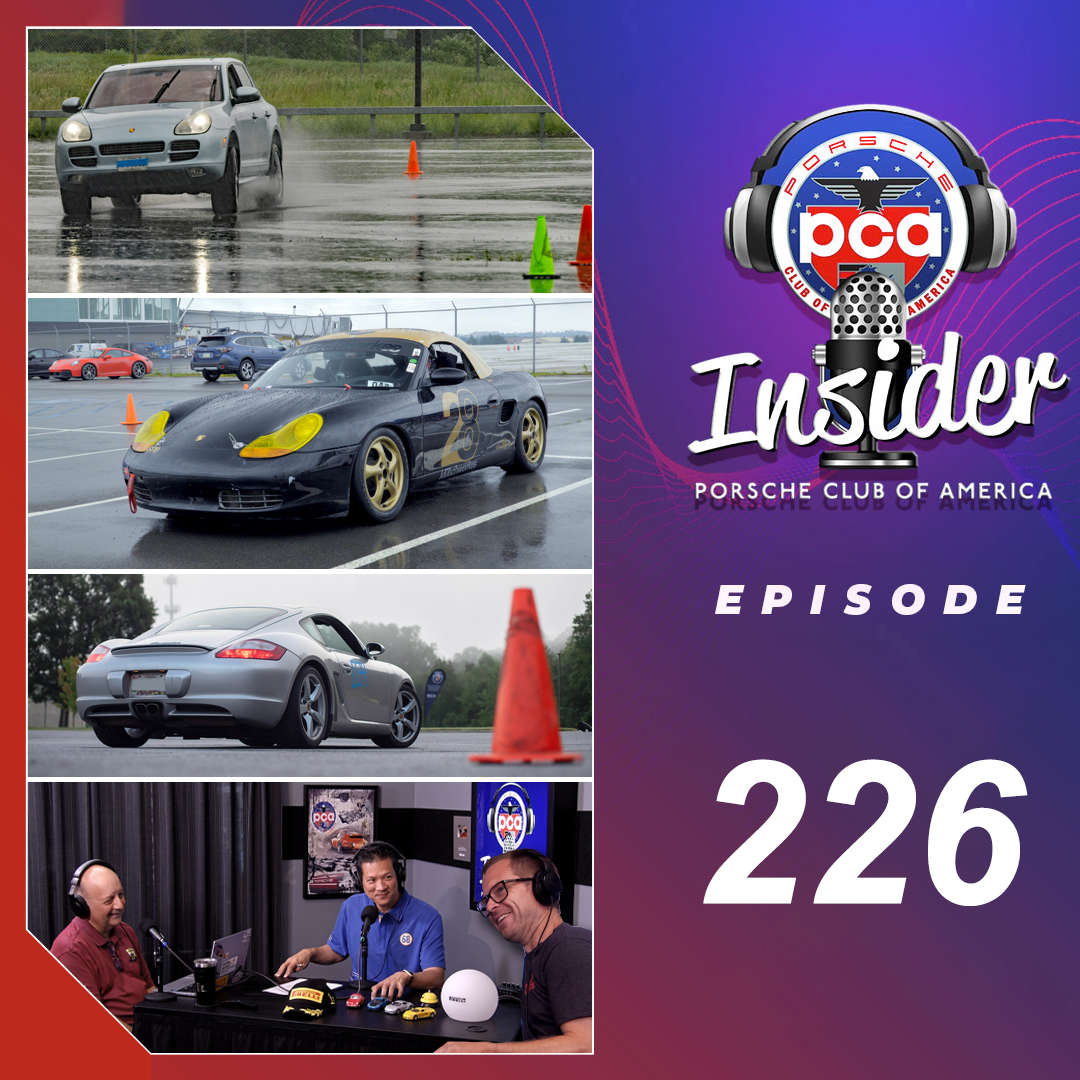
Autocross is a timed driving event on a closed course with cones. You drive through a layout that tests how well the car handles and how smoothly you can steer.
A battery tender is a smart battery charger/maintainer that keeps a car’s battery at the right voltage while the vehicle sits. It’s commonly used to prevent battery drain and sulfation when a car isn’t driven regularly.
The Porsche 356 is a classic early Porsche sports car. Here, the speaker is working on a 356 project so it’s ready for autocross events.
Term
pits and seals
“Pits and seals” is shorthand for the sealing surfaces and components inside an engine that need time to seat properly after rebuild—often discussed in the context of piston rings and cylinder sealing. The host contrasts that traditional approach with the idea of using autocross to help the engine settle.
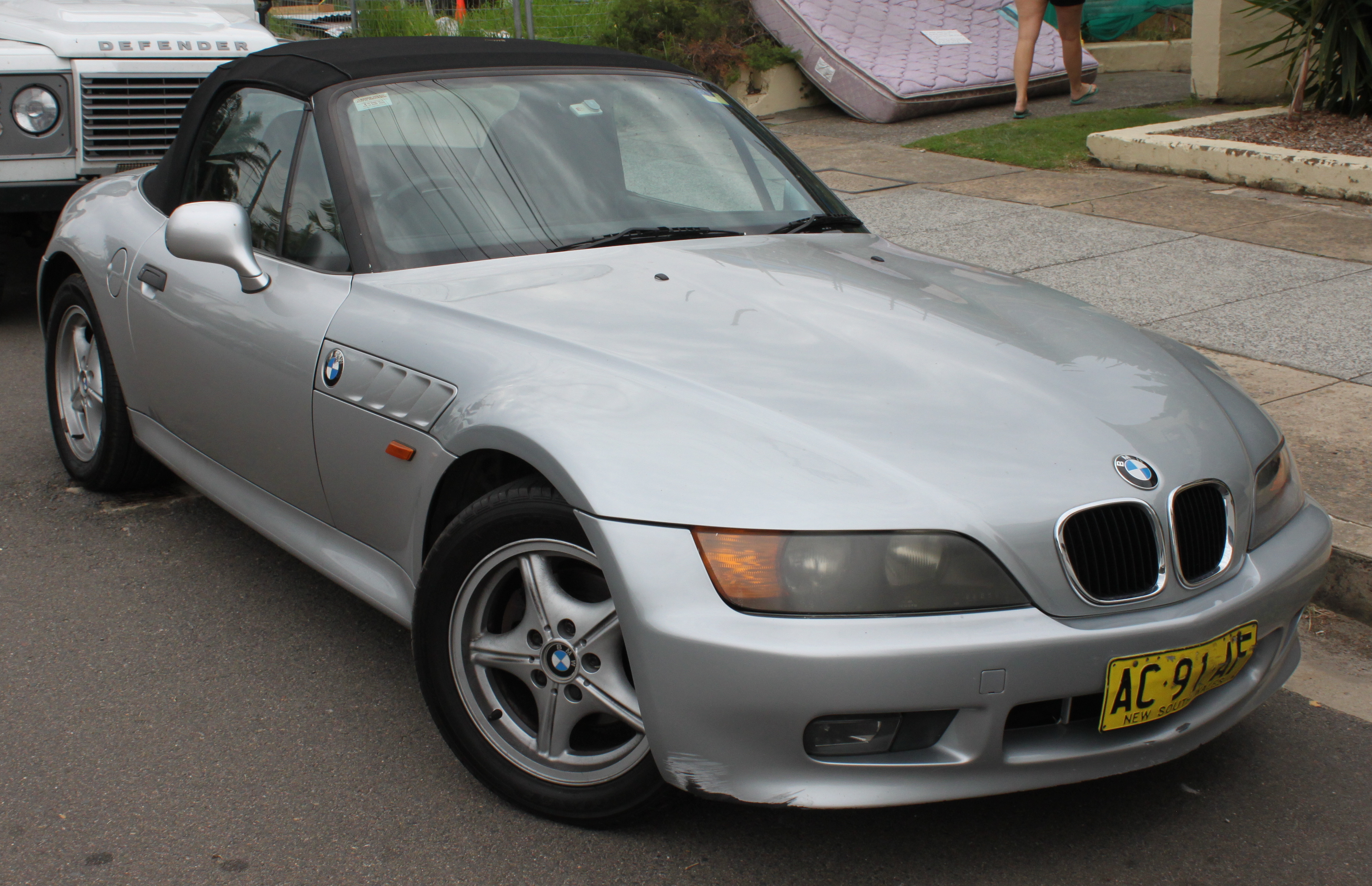
The BMW Z3 is a small two-seat roadster. The speaker mentions it because when they pushed it hard at autocross, they learned where the car’s cooling system maxed out.
The cooling system keeps the engine from overheating by circulating coolant and dumping heat. The speaker is saying autocross can stress it more than everyday driving.
The Porsche 928 is a Porsche grand tourer that uses a V8 engine. In this segment it’s just the other Porsche being referenced while they’re trying to locate the 356.
A starter relay is like a heavy-duty electrical switch that helps the car’s starter engage. If the relay trigger wire connection is loose or damaged, the starter may not get the signal to crank the engine.
A spade connector is a plug-style electrical connection that can feel seated but still be slightly loose. If it isn’t tight, the car may start sometimes and fail to start other times.
A relay kit is an aftermarket wiring solution that uses relays to route power more safely and efficiently, often reducing load on the ignition switch or improving starting reliability. Here, the speaker says they used a relay kit to bypass the ignition for running power to the starter, which changes how the starter circuit is triggered.
Crimping is how you permanently attach an electrical connector to a wire. If the crimp isn’t tight enough, the connection can fail when the car vibrates or heats up.
In autocross, “production” is a class meant for cars that are basically stock. The idea is to keep the competition fair by limiting how much you can modify the car.
“Stock” means the car is basically as it came from the factory. In racing classes, being “stock” usually means you can’t do big performance modifications.
Term
S, P, and I
Those letters are shorthand for different autocross categories. They determine what kind of car setup is allowed, so it matters which one you’re entered in.
All-season tires are meant to be a compromise for different weather. They can be okay year-round, but in deep winter or snow/ice they may not grip as well as winter tires.
Pirelli “P Zero” tires are made for strong grip, mostly in warm or normal weather. They’re not the same as winter tires, which are designed to bite in snow and cold.
The Ford F-150 is a large pickup truck. People use it for hauling, towing, and general driving, and some versions are set up for off-road use. It comes up a lot because it’s a common choice for both work and weekend driving.
“Torrential rain” describes extremely heavy rainfall, which dramatically changes tire grip and braking/acceleration behavior. In autocross, it can turn a normal traction problem into a near-hydroplaning or sideways-control challenge.
Hydroplaning happens when water builds up between the tire and the road surface, reducing traction and making the car harder to steer. The host’s description of “raining sideways” and “rivers going across” is consistent with conditions that can trigger hydroplaning during high-speed sections.
The Ford F-150 Lightning is a pickup truck that runs on electricity instead of gasoline. It’s built to do the same kind of truck tasks, but with an electric motor. The podcast mention sounds like it was connected to an event where rainy weather was part of the story.
The Porsche 911 GT3 RS is a track-focused 911 variant built for maximum grip and lap-time performance, with a strong emphasis on aerodynamics and chassis balance. Here it’s referenced as a benchmark car in the autocross flow, with the host noting relative pace in multiple runs.
The Porsche Cayenne is Porsche’s SUV. Even though it’s not a sports car, it can still do really well on autocross tracks where you have to turn quickly and stay on the right path.
In driving, the “line” is the specific path you choose through a corner or sequence of corners. Learning the line helps you place the car where it can maintain traction and speed, especially in autocross where the course is tight and repeatable.
Slicks are race tires with no tread pattern, designed to maximize contact patch and grip on dry pavement. They generally perform poorly in wet conditions because there’s no tread to evacuate water.
“Stickies” is enthusiast slang for very grippy tires, typically with a sticky compound and/or tread designed for high traction. In autocross, tire grip can be the difference between maintaining speed through corners and losing time to wheelspin or sliding.
“Water crossings” are sections of an autocross course where the surface is wet or flooded, creating a sudden traction and visibility challenge. The host notes that standing water can quickly overwhelm grip and lead to loss of control.
A fiberglass hardtop is a rigid roof panel made from fiberglass composite. In spec Boxster setups described here, it’s used as a lightweight, rules-compliant alternative to full factory-style windows/roofing.
A “cage” is short for a roll cage—an internal metal framework installed to protect occupants during crashes. In autocross-spec cars, the cage is often the primary safety structure, with body panels or hardtops covering it.
Fiberglass is a lightweight material. A fiberglass top means the roof/upper panel is made to be lighter than normal, which helps the race car stay light and handle better.
Coilovers are suspension parts that control how the car rides and grips the road. They can often be adjusted so the car sits right and handles better for racing.
A race seat is a special seat for motorsport that keeps you held in place during aggressive driving. It usually has stronger side support and works with a racing harness.
“DOT legal” means the tire is approved under U.S. rules to be used on public roads. But that doesn’t necessarily mean it’s good in rain or for every driving situation.
Tires get hot during a run, and then they cool off afterward. If they cool too much before the next run, they can grip worse—so event timing rules try to keep things fair.
Term
weight period
A “weight period” here sounds like a minimum waiting window required by the event rules. The idea is to give the tires time to come up to the right temperature and grip level before the run matters.
In autocross events, volunteers “shag” cones—meaning they pick them up and set them back in place between runs. It helps keep the event moving so drivers can get their next timed attempt.
“Stabbing the brakes” means hitting the brake pedal suddenly and hard. On a slippery autocross course, that can make the car slide or lose control because the tires can’t grip evenly.
Autocross scoring often rewards your fastest attempt. So the goal is to avoid blowing the first run and instead make sure your best run is clean and fast.
“Rocket out” means you accelerate or launch too aggressively right away. The warning is that it can cause you to make mistakes before you’ve figured out the course.
“Rolling into it” means you add gas smoothly instead of flooring it instantly. That helps the tires stay hooked up, which is especially important when the track is wet.
Track driving is driving on a real race circuit for multiple laps or a longer session. If you mess up one corner, you often have more chances to improve on the next lap.
Shifting is choosing when to change gears. In autocross, the timing matters because it changes how the car pulls out of turns and how smoothly it behaves.
PSM is Porsche’s electronic stability system. When the car starts to lose traction, it can automatically brake individual wheels to help you stay in control.
A Spec Boxster is a Boxster that’s set up for a more controlled, rules-based racing format. Here they’re saying its engine makes less low-end pull, so you often need to shift differently, especially when the track is wet.
They’re comparing a 2.7-liter Cayman to the Spec Boxster. The point is that the Cayman’s engine delivers torque differently, so on a wet course you may need to shift sooner to keep the tires from slipping.
Wheel slip is when the tires spin but the car doesn’t move forward as intended. On wet courses, it’s a sign you’re asking for more grip than the tires can provide.
Wheel hop is when the tires start bouncing because they keep losing and regaining traction. It usually means the car is getting too much torque for the surface.
PDK is Porsche’s automatic-style gearbox with two clutches. It can change gears quickly, which helps you stay in the right power band during fast cornering.
Heel-toe is a technique for downshifting smoothly. You brake and give a quick throttle blip at the same time so the engine speed matches the lower gear.
Carrying momentum means you don’t lose speed in the corner. The host is saying the right gear choice helps the car stay fast and smooth instead of bogging down.
Lap times are the measured durations for completing a circuit or a defined course segment. Here, the host uses lap-time changes as feedback that downshifting strategy affected smoothness and speed through the corner.
When you shift gears, it can slow you down a little because the car’s power delivery changes. In autocross, those small slowdowns add up, so drivers try to shift as efficiently as possible.
Understeer is when the car doesn’t turn in enough. Instead of following the corner, it tends to push wide, and the driver may need to adjust speed or inputs.
Oversteer is when the back of the car wants to swing outward more than you planned. Drivers often try to control it so the car stays pointed where they want.
Term
slip from the rear
This is about the back tires losing some grip. When that happens, the car may rotate a bit, and the driver can feel it and adjust to keep control.
The differential is what lets the left and right drive wheels spin at different speeds when you turn. Changing it can change how the car grips and handles in corners.
A lightweight flywheel helps the engine spin up and down faster. That can make the car feel more responsive, especially when you’re changing throttle often.
This is a specific kind of tire (from Toyo) that’s popular for autocross. It’s designed to respond quickly to steering inputs, so the car feels more precise and predictable.
Countersteer is when you quickly steer the opposite way to correct a slide. If you don’t need it, it usually means the car is behaving predictably.
Term
spec Boxer
“Spec Boxer” is an autocross class where cars are kept closer to stock (or limited by rules). That helps make the competition more about driving rather than who spent the most money.
This is an autocross category for the Porsche Cayman where the rules limit how much you can modify the car. The goal is to keep cars more comparable so driving matters more.
“Gut your car” means removing interior parts to save weight. It can make the car less comfortable, so it’s a bigger decision if you still want to use it day-to-day.
Term
spec SPC
“Spec SPC” sounds like a rules-based autocross class. It’s meant to limit modifications so cars compete on a more even footing.
The Porsche 944 S2 is a classic Porsche from the 944 family. Here it’s used as a cautionary example: removing interior parts to save weight can make the car less enjoyable and harder to finish.
Term
sock class
They’re talking about the race “class” rules—what kind of car you’re allowed to run. If you know the class rules first, you can build your car to fit them instead of wasting money on changes that won’t be allowed.
Term
Spec 996
“Spec 996” means a Porsche 911 (the 996 generation) prepared for a specific rules-based racing class. The rules limit what you can change so different cars stay more evenly matched.
Term
Spec Kame
“Spec Kame” sounds like another rules-based racing class, similar in spirit to Spec Boxster. The goal is that cars are prepared to the same rules, so the competition is more about driving than random build differences.
Tires are the part of the car that actually touches the ground, so they control grip. If the weather changes (like getting drier), tires can work better and help you go faster.
Term
time of day contender
“Time of day” is basically the best lap time people set during that part of the event. A “contender” is someone who has a real chance to be near the top.
The Porsche 911 GT3 is a performance-focused 911 meant for track driving. In this segment, they’re talking about how a GT3 did well in autocross, especially because of the tires it was running.
“Cup Two” is a type of performance tire. The host is saying the car was running that tire model, which matters a lot for grip and lap times, particularly when the course is wet.
The Porsche 356 Coupe is a classic early Porsche from the 1950s/60s era. The host is pointing out that even this older model was out autocrossing in the rain.
Autocross cars are sorted into groups (classes) so the competition is fair. If you get moved to a higher class, you’re usually racing against stronger cars.
The Porsche Panamera is Porsche’s four-door car. In this story, it’s brought up because it was in the same autocross group/class, even though it didn’t show up.
The Toyota Corolla is a small, everyday car. It’s made to be practical and easy to live with, especially for commuting. In the podcast, it’s mentioned as an example of a normal car you could use for everyday driving.
The Porsche 911 is Porsche’s famous sports car. Autocross is a great way to learn how it turns and handles, because you’re driving on a controlled course.
A tornado watch means the weather could turn into tornadoes. For driving events, that kind of weather can be dangerous because the roads get slick and visibility drops.
In autocross, the “course” is the cone-marked driving layout that determines where you turn, brake, and accelerate. Course design strongly affects strategy—fast sections reward momentum, while tight sections punish poor line choice.
Second gear is one of the transmission settings that controls engine speed. In autocross, choosing the right gear helps you stay in the power band while you change direction quickly.
Pointer cones are extra cones that help you understand which way the course wants you to go. They’re like visual arrows on the track so you don’t accidentally take the wrong line.
LIVE
Welcome to the Porsche Club Insider.
Your one stop for all things Porsche and PCA.
Before we get into it, we want to thank our presenting sponsor, Pirelli.
Pirelli tires have to achieve the highest levels of performance, safety, noiselessness,
and grip on the road surface. Innovative tires that can satisfy even the most specific mobility
needs of the in-consumer. Thank you all for listening. If you aren't currently a PCA member
and own a Porsche, what are you waiting for? Grab that VIN, head over to pca.org and make yourself
a member. For those of you that don't currently own a Porsche, check out our Test Drive program
where we unlock resources to find that special Porsche for your driveway and our garage.
We are back at PCA's national office, although we have been back from parade for a while.
It feels like it was just yesterday. To my right, I have our technical director,
Manny Aubin, and at the controls, of course, is Damon Launey. Gentlemen, how are you doing?
Did you ever watch Big Bang Theory when it was on? I did.
So, we are six episodes away from matching Shelton Cooper's Fun with Flags show in a number of
episodes. Really? I was just watching a rerun and he said it was his last episode,
and it was episode 232, I think. Yeah. And I thought, wow, we're about to match that, which
tells me if we can find 232 episodes to talk about Porsche topics, or he can find about flags,
then we can certainly find double that amount for Porsche. There's still so much for us to talk
about. And I know, I think we said it in the last episode, it was really cool. While we were at
parade, how many people came up to us and thanked us for occupying their time on Mondays, especially?
Well, speaking of parades, I made a mistake of going on some forums, which I usually don't do,
and I think I thread about parade. And of course, the comments are from people that hadn't been
paraded, but had read articles about parade and looked at photos. Interesting. And we're commenting
that what a poor showing it looked like it was. What? Yes, that's what. We had a record turnout.
They were looking over 200 cars in crappy weather at the Concorde, and because they were complaining
that Porsche brought their Macan EV, and I don't know if they mentioned the Cayenne EV,
but only four doors. No one cares about four doors, they only care about two doors,
so why did he bring four doors? And I started to write your response, but then I thought, you
know, it's not worth the effort. It's futile. Because it's like just talking, pissing in the
wind, I guess, is what they say. Yeah. Yeah, for those who were wondering, like I said, I think
last week, the Cayenne EV seminar at Tech Tactics at Parade was the most popular one we had,
and we didn't plan it that way. We didn't think it was going to be that way.
Actually, they were kind of worried that no one would be engaged in that particular seminar.
I mean, we didn't even follow anybody. We followed Frank Yong, but we didn't follow
like Nathan, so we could have captured all his, Nathan actually followed the EV discussion.
But anyways, that was the record turnout, and there were so many other cars at the Concorde.
I mean, Porsche did bring their three Toy Story cars, which obviously were all sports cars.
Yeah, and we brought historic cars. We brought super cars. We got the 19. We had
the Carrera GT. We had all three Club Coops. There were plenty of cars.
I think if we spoke to people who actually dare, they would argue very much differently that...
And not to defend the people that are online that weren't there, but sometimes we are so,
and I mentioned this to Damon and Bogdan sometimes, that when we're at events,
we're so excited that we start snapping pictures early in the morning, especially during setup.
And those are the pictures that get shared. And that early morning setup,
before the rest of the crowd has had their cup of coffee, sometimes it does look like.
So I, again, not to defend them. Some of the photos they may have seen,
may have looked at it was like, but as you said, it was a record breaking
parade with 2,600 people. I mean, it was, we've said this before, like the town was 2,100 people.
We doubled the population and it was so cool to see Porsches every which way. When you came to
a stop sign, a light, Porsches parked on the curb, PCA and Porsche clothing clad people
walking on the sidewalks. It was, it was cool. Yeah. No, it was a, and why did Porsche not
bring any sports cars other than the Toy Story cars? Because they haven't really come out with
anything. Yeah, nothing new. They're not going to bring boxers and Caimans that they don't make
anymore. Right. They're not going to bring McCons that other than the electric ones because...
Hopefully next year, we'll see some debuts of some of the sports cars. But for now, it's just...
Here's the honest thing too. I mean, we all know the situation in which Porsche is in.
They're going to bring the things that make sense, especially financially. Like you said,
why would they bring older cars or cars that are no longer going to be available? Right.
They're going to spend their money wisely. And if photos aren't aware, Porsche doesn't have a
museum here or archive here in the US. That's all those photos you see of the warehouse of old
Porsches are in Germany. So whenever you go to the heritage exhibit at PEC, that's all cars owned
by the public and other people, not just not Porsche. So when they say, when I hear people say,
they should just bring some cars up from Atlanta. I really have a whole lot of cars. Yeah. Maybe
the 50th Club Coupe is the only car I can think of that they could just keep it inventory. Yeah.
Everything else rotates because people offer to display their cars or they ask people to display
their cars. Even though they had the number 150th anniversary, we actually asked them to bring
something else because we had access to a 50th. So we brought Prescott Kelly's car over from
Connecticut and that way they can save that budget to bring the Toy Story cars or what other
else they might bring that we don't have access to. Autocrossing. So I got to say this year,
I've been lagging, lagging behind. I think some of you might know the car that I typically
Autocross is my 996 and that unfortunately has been on the top of the rack and I haven't moved
it, started it, looked at it since November since I put it away. I have an excuse too. I've been
lagging with Autocross a little bit. Maybe I have a little bit of rust, if I'm a little bit
slow, no rust if I'm not slow. You know, what other excuses do we have here? It's just been busy.
Like this year, I can't believe we're... At least I have a battery tender on the car. I have a
battery tender on the car. It's been sitting... That's because you found a new love. No. The cars
are getting good. Heck, you got your 356. Yes, but the 356... You post your whole life on Facebook.
We can pull that up right now. I do. But the 356 project was so that I could Autocross it at
Parade, which was a plan that did not get fully executed. The good news is it got done. The motor
is in. But yeah, it's just been so busy, especially with this Parade being as large as it was and all
the different logistical... I'll say at nightmares that we had to deal with because it's a small town
and people were spread out and a crowd of marathon runners were going to be there at the beginning.
It really took all of our attention. And when I did get time to wrench on something, it was
trying to get the 356 ready. So the idea was to get the motor in, break it in here in Maryland,
and then Autocross it at Parade. Did Steve tell you how long... How many miles was considered
breaking? He said I would be comfortable if you had four or 500 miles on the car.
That's interesting. Yeah. And then a funny thing is I think there was a discussion at Parade since
I asked him that. He was talking to Ed Meo. Ed Meo goes, what better way to break in a motor? Just
send it at Autocross and they all kind of debated it at dinner. Because usually that's
just for the pits and seals to set, right? Yeah. And because when I had my motor rebuilt with my
club race car, it was still stock motor. It was a race car, both stock motor. But I remember Gennady
saying, just take it easy for the first three laps and just treat it like it's your regular race car
after that. Yeah. I don't know. I'm a bit conservative. So I took the approach of it's,
one, not only is the motor not broken in, but literally what we finished putting the motor in
the car and got it started, what, Tuesday or Wednesday? And then it was on the trailer.
You will find. Remember the time I had Autocross my Z3 at BWI parking lot? Yeah. And even though I
daily drive that car, when you are ragging a car out, that's when you're pushing it to the limit
and that's I found that the limit of the BMW cooling system.
So the car did make it to parade. And I think a lot of people were kind of enamored to see that,
you know, they fall. As you said, I, I post all this stuff on, on Facebook and people
followed the progress. There were several black 356 coupes that I thought was you. Yes. Yes.
And then I looked at the plate and I'm like, wait a minute, I saw the Maryland plate.
Nathan and I were going to meet for that, that video that'll be coming out. And with Frank
Young driving the 928 and he said, meet me by booze 356. Yeah. And I run out there. I see a
black 356. And I'm like, that's not, that's not booze. It has a luggage rack on the back.
Yeah. Mr. Tate's and his son brought two. They brought the, the, the coupe as well as the speed
stir, I think the coupe is what I thought was your car. Yeah. Yeah. Because he parked there
right in front of the Olympic center. Yeah. And I forgot about it. I must be you. And
you know, my car was like five hours later, I still see a park there. I'm like, well, that's
strange. And it turned out to be yours. Yeah. So in, in, in hindsight, not auto crossing it was
fine. And I did get to drive it or break it in somewhat, you know, driving this, the, the
back roads of Lake Placid, which was fun, but it was still very nerve wracking because I don't
know if you remember, but there was this one wire on my starter that is like tucked at the very top.
And it's kind of a blind connection and it's super tight and it kind of rubs on this like
insulation thing that twice when I was driving the car around here in Columbia, by the time I
got back, I would start the car and there'd be nothing. And it's really, it's the trigger wire
for the relay for the starter. For whatever reason, the connector either wasn't, you know how
sometimes when you use a spade connector, you kind of have to press the ends of the connector a
little bit to make it tighter. I think because I used a relay kit so I can bypass the ignition
for running all the power to the starter. So anyways, I think that was not crimped very well.
And so before I put it on the trailer, I even got a little scope. I crimped it, I put it on there,
I took the scope to look at it to make sure it was on there nice and tight. I also zip tied it
so that even if it wanted to come loose, the zip tie would kind of hold it into position.
That was all theoretical. Like I did all this before I put it on the trailer. I did not know
driving around Lake Placid like it wouldn't still pop off and knock on wood. Now I'm going to make
some noise, knock on wood. Thankfully, it held and it started. No problem. But after you were told
by the engine builder not to autocross it. Yeah, but I'm not going to miss out on an autocross.
I'm registered and did you think as a backup out across the Cayenne? Absolutely. And I've
autocrossed the Cayenne at least two or three times at previous parades. And I love autocrossing
my Cayenne because I feel like it's a win-win. Like if you're slow, you can just say, oh, come on,
man, I'm in a Cayenne. But what happens if there's other Cayennes in your class? Well, so
I will say. Wait, did you get beat by another Cayenne? No, let me just say in the past,
in the past, I've always won my class with my Cayenne. Now, because we were doing the seminars
on Wednesday, I couldn't run my proper class. We didn't need you for the seminars. Yeah,
you did. You absolutely needed me. More importantly, if I wasn't there,
I know you were going to give me a wrath of crap for not being there. So I was dedicated to the
seminars. I stayed there all day. So actually, I ran in a higher class. I ran in production
with the Cayenne so I could run. So stock then production? Does that work? So stock is Wednesday
and then production. You should get prepared, but now it's production. Well, I mean, I think of it as
S, P, and I. Exactly. So whatever the P means, production or prepared. Yeah. So I don't know.
Technically, my car is stock. Yeah, I think technically it is stock, the Cayenne. I don't
think I've heard that one before. I mean, I may have modified my stock. I mean, you may have extra
weight with all the audio stuff you put in. True, it all evens out. I stripped it. Like,
I took everything that I could. You got all seasons on there, right? Or you got summers.
I've got summers. So did I tell you this story of how a dumb, dumb thing I did in the winter
and turned out to be a positive thing on the cross? You ordered the wrong pearly tires?
I thought I ordered all seasons and I took it out in the snow and it was sliding all over the place.
That's because their names or their tires are hard to understand what exactly what they are.
So I get to the office. I'm like, man, I'm going to call Megan about these tires that I ordered
that, you know, they're all seasons. But as I'm driving here thinking, you know, Megan, I got to
be honest with you. Megan's our contact at Pirelli. And I was going to tell her, you know,
these all seasons are not really good in the snow. So I pull up to the office and I hop out.
Yeah, they're P zeroes. Oh, wow. So I got to say. It's Soto zero for the winter. I don't know what
the all seasons are. So where does Scorpion play into this? I think that's like the off-road,
like you bought a Raptor, F-150 Raptor, and you want to take it off-road. Yeah. So that mistake
actually worked in my favor or as I thought would work in my favor in the autocross. And so
the, um, I would have loved to run in stock on Wednesday because guess who was also running
on Wednesday in his, in his Cayenne? El Presidente, Aaron Aaron. So that would have
been really cool. Do you have a time though? Did you beat his time? Well, let me, let me explain
what had happened was, was on Wednesday, they actually, I think his session,
they were able to run in the dry. So he ran like a 49 five. And I'm like, okay, Thursday was terrible
rains. But if I can get like to 50, 51, that would kind of show that, you know, if it was
the same, same conditions, I probably could have gone toe to toe with him. But Thursday was torrential
rain. I don't know if, um, Damon has some of the video here, but we, it was raining sideways. There
was rivers going across. There's a video that there, uh, I don't know if we have it or not.
However it was, it was just out of a trailer and we have it, we have it going sideways. Yeah,
that was, that was Megan. Megan and her crew, uh, Pirelli, shout out to them for being at
parade, not only, um, at the tour departure area, but this is them kind of shielding themselves,
trying to stay away from the rain that was going sideways. And that's what we were driving in.
And kudos to the events. Um, Paul Kudrow and team, it wasn't lightning. It was just
lots of rain. And so we, we soldiered on, we still ran and, um,
So all your runs are in a rain. My run, my runs were not only in rain, but it was in torrential
rain. And, uh, here's where 5,000 pounds all wheel drive and summer Pirelli's. I'm like,
I'm going to send it. Like I think I can catch some of these cars. In fact, there was a GT3 RS
in front of me that I think I only look so it's slower than him in three runs, three out of four
runs. And if you've never ought to cross your Cayenne, do it just for the fun of it, because
you'll be surprised at how capable, how very capable a Cayenne is. Here's the run. If you're
watching YouTube, if you're watching on YouTube, this is up there. I think this is my fastest run.
I ran a 52 flat and I was probably easily top 10 on Thursday in a Cayenne stock.
Oh, six. I don't learn anything from an in-car video. Well, you can, what you can learn is the
line. You can't learn the line. Yes, you can. You can definitely learn the line of what, I mean,
it's in hindsight, but like if I had this, if we were allowed to use drones, that beard, I study my
line after almost every autocross that I have on my gopros. And here's the thing, there were a lot
of cars out there, including the car that Damon got to drive that were on slicks or on very aggressive
stickies. Once you got up to speed on some of these crossings, these water crossings,
like you could see like the car standing water. You're done. You see people pushing water with
other tires and you know, I'm like, I got a chance. And so yeah, I believe I came in
faster. Some of these spec Boxster runs too, I believe. Yeah. So if you want to see, let's,
I'll show you Conor's best run in the spec Boxster. And it was his first run and it came after my runs.
So how did, why don't you tell us how you got into a spec Boxster?
Yep, of course. So the, I was going to this autocross not thinking that I would actually
be autocrossing that day, because we had our seminar with Nathan, what's my Porsche worth,
which will be uploading at some point fairly soon to our YouTube channel. And it's an hour,
over an hour away to the autocross site. I just wasn't feeling really comfortable to really commit.
And so I didn't, I get there and the same day that Boo does the Cayenne, right? Yep. Yep. So
this was Thursday. So it's raining. I get there. I have all my camera equipment. I'm realizing
I can't even film in this, you know, I break my camera. So unless I use the action cams,
which are like little GoPro, DJI GoPro, sort of. For those not familiar with spec Boxster,
most of them use a fiberglass hardtop that it's almost just a covering of the cage
and no windows. Yeah. And that's it. It's just the cage is what protects you, not the little
fiberglass top, but they all have to run this fiberglass top. Yep. Yep. And the cars are
2,650 pounds with the driver. And it even says it on the on the outside of the car.
They have really nice suspension. It's all spec stuff, but it's nice spec stuff. I forget
what's on the car. I think it might be motion control. Coilovers. It's stripped. It's got the
race seat. It's got no exhaust. It was. Yeah. That's killing my ears. Not from the inside. On
the inside, it sounded great. On the outside, it was like ripped a hole in your eardrum. Yeah.
And it had, and I will say, and this will be both a plug towards Toyo and Pirelli here.
Unfortunately, it was running Toyo Proxy R slicks. Oh, yeah. The worst tires you can have on that
day. So they're technically DOT legal in the sense that, you know, technically they are legal.
They have like a few little slits, you know, around the tire, a couple, you know, like grooves,
but that's it. They're basically slicks. I kind of wish I had a Pirelli P zero that day.
Oh, absolutely. Like what Boo had. Or at least what the, I'm sure the club racers use a.
Rain tire. A rain tire, a Toyo rain tire. Yeah, there's probably a rain tire, but I don't think
that car, you know, Van wasn't bringing, he brought two cars. He brought a cup car. He brought a
display car, wasn't it? Yeah, it was a display car, but he figured, you know, more marketing,
he's the club racing marketing manager, more marketing for club racing and running at the
the autocross. And I'm walking up and just got out of my car. Hey, Damon, you want to autocross
the spec boxer today? I'm thinking, why yes, if I can. And so this, how this worked out was
Van had a call conference called 11 a.m. I had to leave at 12. So I hopped in, took his fourth run,
last run. And then I thought that might be the only one I could do, but then it was a really
quick turnaround to the second group. And I figured if I do two in a row, which goes against the rules,
once again, Connor should have, we should have alternated basically. But I did two in a row,
and then Connor took over and did his four runs. So I did three runs. I got the best conditions.
You aren't doing this for award standard. The reason they do that for the autocross is
there's no five minutes for the tires to cool down to make things even. Otherwise,
people would set up to where they have their friends drive. So the tires are super warm.
So it's a five minute minimum weight period. But in the rain, I think the tires weren't even
done. It didn't even matter. But here's the thing. So I was shagging cones at the far side,
a pretty quick section of the autocross. When this first session was off, and I could see
Van and Connor and Damon, and I could visibly tell without seeing the actual driver, I could tell
when it was Damon driving or when Damon drove, because club racers drive differently on an
autocross course than an autocross course person. And what I mean is when they were told go,
like they just dropped the hammer, came up to the first corner, stabbed the brakes,
and then hammered it, and then lost control, and then hit the brakes. I would say club racers
who don't autocross. Yes, yes, yes, yes, yes. That's what I mean.
You're leaning to Mike Levitas. Oh yeah, Mike. Yeah. I'm about to show, if you're watching on
YouTube, Connor's first run, which ended up being as fastest because of the conditions.
Was it a pretty easy course to memorize? Yeah, it was pretty easy to memorize. It's a bunch of
slowns in a turnaround. And you'll see that this first run, it was quite rainy, quite wet out there,
and he got a 52-7, I believe. My first run. Did you hear that, Manny? 52-7. Yeah, which
voodoo beat him apparently in the Cayenne. My first run was a 56-2 in similar conditions,
so I don't know what was that me, that I just take it a little bit more slowly to figure the
course out, and Connor just sent it on his first go. I always tell my students, it's your best run
that counts, so don't go rocket out on the first run. The difference was you were smoother,
more composed when you were applying the throttle, when you were coming up that back
section. You were pushing it, but you rolled into it as opposed to Connor and Van. They were
just nailing it. Right there at the end, Connor really messed up. That would have been a 51 or
a 50 point something maybe in that rain, but it wasn't. And then also, you're my run.
And I think also what happens is, if everything connected for them while they were driving that
way, they probably could have had a really decent score, but you know, Manny, when you mess up one
corner and you overcook it, it just mentally messes you up for the rest of the run, and you
can't make up that time. Yeah, the difference between track driving is you have a 20-30 minute
session, so if you mess up a corner, yeah, it may affect the next two or three corners, but you can
get back on track. Autocross is like Olympic downhill skiing. You mess up one turn and you're
done. Yeah. And this course, shout out to Paul Kudger and team for it. If you're watching now,
I'm showing my run, which was, so if Connor was a 50-7, this was a 49-4. And so this run,
you don't even have rain in this run. There's a little bit at the end, but you know, you'll see
it on the windshield, but it's basically, this is the driest you've got all day, was this run
in the run right before. This is my third run. My first run in the first group was very wet,
but you know, this was quite a bit quicker. We can actually see it looks like
sunlight trying to peak out. Yeah, exactly. And so you had, where he's driving right now,
you had a choice of staying left or staying right. And I think when I walked it, I originally
thought I was going to go to the right. Same. But then after seeing people drive in the rain
and how their cars were shifting, I thought going left was better. And it turned out it was. I think
if it was dry, I would have definitely stayed right. But yeah, you're just super smooth.
Yeah, a little bit overshot it there, but it was okay. Did you find yourself, Damon,
short shifting or were you taking it all the way to the red line?
So when it comes to shifting in autocross, I tend to try and get into second gear, just
not as soon as possible, but where it makes sense. And if I remember correctly on this run,
first gear, I was, I believe I shifted right before the first sort of turn really. And then
I'm in second gear the whole time. So I am short shifting a little bit at our autocross this weekend
many, which I'm sure we'll get into in a little bit. I had real problems with the start. And I
think I probably could have made up time. Everyone else was out there, I think staying in first or
shifting a second, not breaking, you know, for the first little kink. And I was barely brushing
the brakes and trying to figure, should I shift in the first after these first two little squiggle
turns? Do I need to use the break? You know, do I use my left foot to break or not break at all,
or do you use my right foot for the first break and then shift over to the left foot? So there's
all sorts of stuff that can come up even at the start. But I try and stay in first gear if I can,
over it makes sense if I need to turn in really hard after a start. But second gear, usually,
if you can get into that sooner, it's better. It's interesting to see the higher horsepower guys
were shifting, because for those who aren't aware, short shifting obviously means you're
getting up to a higher gear quicker than you would if you were to rev it out all the way to
red line, then shift. And when it's wet, you want to avoid all that torque because you're
going to lose the rear end or your PSM will come on and automatically start breaking the car.
So you short shift, you get to the higher gear, so you're giving less torque to the rear wheels
and it gives you more control. That's a hard decision to make. That's the good thing about
autocross, you get multiple runs because you can play around with that and look at your time and see.
So you can see here, so one of the things I'll talk about with the Spec Boxer, it's a two and a
half liter engine, it has less torque and the torque happens higher up in the rev range and in
my 2.7 liter Cayman. I'm going to put this up again and if you're on YouTube, you'll see that
I shift pretty soon because I'm starting to get a little bit of wheel slip because it is so wet,
like it's not raining as hard as there is still a ton of water on the course.
So you'll see that I shift pretty soon after the car starts to shake and that's because I'm
getting a little bit of wheel hop right there. Oh, you shift it super early. Yes, super early
because I didn't need to stay in it for that and I'd rather just be in the correct gear and
start worrying about my braking points and my turn in rather than thinking about where do I shift.
Can I tell you what was nice about driving the Cayenne? One, it's all about drive. But two,
if you never noticed this, but a Cayenne always starts out second when you're in regular drive
mode, so I actually put it in manual. Do you have a support drive mode? When you turn PSM off,
it starts in first. Yes, correct. So I can turn PSM off or I can just put it in manual and put it
down in first. So I actually started out in first, nailed the throttle and I probably got
halfway up the slalom before I actually put in second once you're starting to build speed.
And so now I'm in second. I'm coming down into that loop around and at the very end of the loop
before you start coming back up the hill, it was really nice because I probably wouldn't do this in
my 996 or my Boxer just because I always fear full of not putting it back in first correctly.
But I grabbed it and went from second to first again and it gave me all the torque to kind of
launch up the hill. That's cool. And that's why I would love to have a PDK car to autocross at
some point because you can do things like that to maybe get an advantage. I used to experiment
with shifting down into first where you would think it makes sense like a really,
really slow corner, tight, maybe you need the rotation or it's so slow that maybe
first gear is going to help you jump out of the corner more. My success with that, I can heel
toe into first perfectly 95% of the time and my upshifts are quick, just as quick. It's never
worth it. It's never worth it. Almost never if ever. I never go into first. You gotta slow down.
You don't realize it, but you're slowing down. And it's not the downshift. And yes, you can make a
mistake by paying too much attention to the downshift, but it's not even the downshift for me.
It's just shifting back into second. But how many times you didn't go into first and you stay in
second and you come out of that corner and it just seems like forever for the torque to build up
because your RPMs drop and you're just like, come on, on. I'm all
never in that situation. Like even if it's like a tiny bit, like I wish I had a little,
it's still faster to stay in second. But it also teaches you to carry more momentum.
It does. So you don't let it drop. I mean, on the track, I did that at turn one at some
point, I would downshift the second gear. Now when I came out, it felt like I had the power of
Thor coming up and then I would shift into third. But I started looking at my lap times and they
were getting worse. Because you weren't carrying as much speed?
You're not being as smooth because you're shifting. They said, leave it in third and
start teaching yourself to bring more speed into that turn so your revs are higher.
And that's what I did. And then it became standard. But yeah, it's an autocross,
they say the least amount of shifting, I forgot how many seconds or half second,
whatever a shift costs you. So yeah, it's kind of smart sometimes to shift into second
earlier than you want. So you can focus on driving.
When you're turning, basically, if you're coming up to a turn where you just need to lift,
shift to second there. But that's the first turn.
So how different was driving the Spec Boxster platform? And it's kind of hard because it was
rainy, crazy rain, but how did it feel that platform versus your 987?
So this was pretty interesting. I went into this expecting not to have any grip.
And there was grip, even in my slow first run. And Conor, I think, proved in his runs as well
that there's grip. There's maybe not as much as if you had tires with grooves, but there's enough
to play around with, have some fun, feel out the slip from the rear, the oversteer and the understeer.
And because there was grip and it wasn't like I was on an ice rink, I felt like I could give a
pretty good sort of review of the car or just basic understanding. So my came in and we'll get
into this a little bit later. It's fairly well modified when it comes to suspension and brakes
and cooling. Fairly. He just said fairly. It's got basically coilovers and a roll bars
and the mounts for all that stuff. And that's it for suspension and square setup.
Yeah, but lightweight flywheel and differential. Different differential.
And the lightweight flywheel doesn't really do probably anything. Probably Rob's your horsepower.
We've heard Rob. We know. I'm just kidding. Just kidding. But the spec Boxster, it's very similar
setup to my car just with a lot less weight. And you know, as much as I love the Olin's
road and track coilovers, if the spec Boxer pretty sure is running motion control coilovers,
those are probably even higher quality than what I have on my car. And so the combination of
very high quality parts, not not insane, like JRZ, like it's a spec series, but very high quality
parts and low weight of about 2650 pounds with the driver. My car with me in it is between
3,150 and 3,200 pounds. It just felt sharper, you know, in those Toyo proxy Rs. Those are racing
tires, stiff sidewall. It was just a very connected experience. You could feel what the car was doing
through the steering wheel, through the seat of your pants. It was just very easy to drive. And
for me, at least figure out where that limit was. You'll, you know, I noticed on my best run,
my third run in the Boxer, I didn't have a single point of countersteer at all. Period. I went
through that. I very deliberate turning in and that's because the car wasn't jumping out on me.
It wasn't nervous. It wasn't scaring me. It too runs 255 squared. 255 squared. Yeah, like I was
last year. So that's a little spec Boxer trip. So are you tempted to gut your car to get that,
get that sort of direct feel? They have a 987, right? There is spec Cayman, spec SPC.
And that is 987.1 Caymans, I believe. I forget if that was a base model or
I'm not too familiar. That class never took off like spec Boxer did. Because the cars were too
expensive. Yeah. Caymans always kind of maintained it. Like, are you ready to shed your door panels,
your carpet, your? No, I'm not. It's, I love, I love that car too much. And I've done this to
a car before and really, really regretting it. It was my old 944 S2. I regret gutting that thing.
And I never finished it, you know, because I was young, dumb, didn't have the time or the space.
And well, I mean, as much as you autocross and you do autocross more than Manny and I,
but you still enjoy that car in the street. I do. And I want something to be said to be able
to drive your car in the street. Cause there's some people that have these dedicated track cars,
which I'm sure is absolutely fun at the track and at the autocross, but they get to use it.
Oh, shoot. I'm like, I'm putting myself into a corner here. I'll put myself into a corner here.
Let's bring wine for the first one minute of this podcast. I realized that as I'm saying it,
I'm like, man, he's going to take this one out and he's going to hit it out the yard.
Yeah. Most people have the opportunity to drive their car on the street
more so they can still enjoy it as opposed to a stripped out car that is uncomfortable on the
street. Yeah. Yeah. I think the way to go, don't make the mistake I did and take your nice Porsche
and strip it out and try and make it just buy something that's already been done to buy a
spec boxer. Those things are like a steal, a lot of money people put into it. The best way is to
buy pennies on a dollar or someone else's project. But a lot of people are like, well,
you know, I got my car, I've done a lot of stuff to it, but then at least know what class you're
going to run in. So you can set your car up for that class. Your class has changed. You could strip
your car out, build it to a class. Well, I mean, whatever. But then it'll change radically. So
when I built my race car, I knew exactly what sock class I was going to go for, what I could,
what I couldn't do on it. And that stayed fairly consistent in my 13 years of club racing.
I never, right when I was getting done is when they were letting you strip out more stuff out
of your car. But for a stock class that you had to keep fairly, at least when people peeked in,
you had to have carpeting. My carpeting weighed probably less than a pound because I got really
cheap Walmart carpeting and replaced it. But at least when you looked into it, it looked like
it had carpeting. So it's, but yeah, if you can buy someone else's race car, and especially
Spec Boxster, you can get a heck of a deal on someone else's, they had fun, but the car's
all set up for you. I would talk to folks like Connor or Van, people in club racing, like if
you want to go that route, they always know cars that are probably coming up for sale that are
sweet deals. And people that have ran in Spec Boxster or Spec Kame or Spec 996 that they're
kind of ready to move on to the next level. And sometimes they're just looking to get that car
out of their garage. Spec Boxers, you know, what I learned from all this is that they make excellent
autocross cars. I'm sure if it were drier on those tires, that would have been, you know,
potentially a top time of day contender, you know, with at least the car's capabilities.
Yeah. And you can Spec Boxers once again, you know, you can, in many states, not all states,
you can probably drive them on the street because they're stock engines.
Who got the top time of the day, do you remember?
It was a Kamin GTS two and a half liter four. Yeah. Which no surprise, by the way,
if you want the cheat code when it comes to autocross, buy a Turbo 4718.
And was it improved or? I don't remember. But he beat, he got a 44 or 45 and beat David
Critcher in his GT3 on cup two. He's not cup two ours anymore. Who had a 45.
So there was no 1600 pound 914 with 3.8? No, not on Thursday. I mean, it was torrential.
But shout out to, I mean, there were a lot of cars. There are a lot of cars driving in the rain,
especially Tom Tate drove his 356 Coupe, Ed Mayo and his 911 S. There was a 914 out there.
How many runs you guys get? Unfortunately, well, it, I mean, because of four runs,
four runs. So it was kind of tough to, I mean, it went pretty quickly, but as a person shagging
cones, those four runs were more than enough because it was cold. It was wet. It was terrible.
We're like, please let this be their last one. I was inside the Olympic center doing,
working my laptop and I was looking at the window and all I could think of was void is poor people
working corners right now. It was painful. You know, you know, my yellow boots, my famous yellow
boots, right? They are very good to protecting my, you know, toes and keeping my socks dry when I'm
stepping in, you know, wet puddles, like Concord Day and stuff like that. But it was raining so
hard. The water was coming in from the top of my boots. And because my boots were so sealed,
it actually made like a little swimming pool because it held in all the water. It was,
it was crazy. I hope he did. He didn't design it for rain. Not for rain that was going sideways
and entering from the very top. I don't think anyone was dry. You needed a new pair of shoes.
If you, if you're to buy a new pair, if you didn't bring a second set, it was that bad.
Did they make you, uh, did they make you run the window down?
Yeah. It's unusual. Yeah, nearly. Same. Okay. Yep. I mean, it was, you know, a little wet.
Once you're that wet, it doesn't even matter. That was the last thing I was worried about.
I think that's changed with DE, I think. I don't want to.
I think they say full up or full down. But I remember these poor people show up in brand new
Alcantara interior cars. And I would tell them, I'm like, it's up to you. We don't have to go
out to session, but your car will get wet on the track with the window open. Yeah. So again,
shout out to Paul Kudra, the autocross crew for setting that up. And thank you to all the volunteers
that you run, you work and man, you really worked that day and, and got your, earned your credit
to be able to. So you ended up, uh, you ran for trophy. So the funny part is, uh, I was running
as though I was competing against others, but, uh, there was a, you bumped up to a higher class.
Yeah. There's a Panamera. There was a Panamera in my class and they didn't even show up.
So I trophyed, I could have just put my car in park, but I wanted to run.
And they moved just doing a demonstration. Yeah. Demo runs.
But like I said, it's so much fun to do. I don't care if you thought about autocrossing or have
maybe said autocrossing is not for me. I don't care if you do it in a Toyota Corolla, if you do
it in your Cayenne, your 911, your boxer, it's so much fun. Like don't be intimidated.
Ask your significant other to join you to drive at the autocross because they'll
more than likely haven't driven the car to this level. And if you drive,
I mean, I see Luanne at the autocross all the time.
She does. She, she, she drives her boxer at times. That is the only time I'm allowed to,
I would, uh, how would I say this? Not yell, but speak aggressively because I, uh,
I instruct her and she says, you know, this is the time that you can make sure that I go in
the right direction and you have to yell it out to me. And so, uh, we do that. And she does that
fun. She hasn't done it in a while, but give it a try. Again, if you haven't tried autocrossing,
it's a lot of fun. You'll learn the capabilities of your car in a very controlled environment.
And you'll be surprised at how capable. And you didn't, oh, so Aaron got to run into the drive.
You got to run the drive. He ran, he ran a 49 and a half and I ran a 52.
Let's see the fastest Cayenne at Paris then. I think so. Yep. Yep. Was anybody
running McCons? Uh, I don't know. I didn't see any, no. I think we were supposed to run
some, uh, McCons in the, the runoff, but it was raining so hard. It was raining so hard.
It was tornado watch. We canceled the runoff. So I kept on thinking,
anyone who has clogged drains is going to find out today. Yeah. Hard way. Oh yeah.
Yeah. And again, shout out to Megan and the team for the runoffs so that we don't burn up
Porsche's tires on the cars that they brought. They brought brand new sets of Pirelli's for
the runoff and we didn't even get to use them. Is it a weather? Yeah. It's okay. Safety,
safety always comes first. Speaking of safety, is it safe for someone that hasn't
autocross in three years to pilot such a specialized tool as Damon's prepared autocross Cayenne?
Well, luckily it has an accelerator so you can go as fast or as slow as you want.
You're not strapped onto a rocket. I was excited that you're getting back out there.
Yeah. Damon said, uh, you want to, you want to autocross my car? And I thought, yeah, well,
well, Nathan sort of inflated my ego by saying, Oh, it drives pretty good. It drives pretty well.
And I'm like, man, you should drive it. And he's like, well, there's no use driving it on the
street, you know, maybe on a motocross. Oh, that's true. That's true. I forgot I said,
but yeah, I can't remember. I cannot really gauge a car by just driving on the street.
Isn't it funny how like journalists like say they can spit out five pages about the performance
of a car driving on the street, but I'm like, you like, how do you even know? Like other than
I was watching the video, um, the draft video of the, uh, 997 versus 991, uh, when you and Nathan
were in the car, talk, and I thought you guys did a very, um, everyday driver type of drive.
Yes. Uh, but it's really hard to tell the limits of the car. You have to,
if Porsche puts us on a track, then it's a, you can do some fun stuff. I remember with the
McCann, uh, GTSCV, we happened to have a section of road that was closed. So we were to go back
to back to back for three miles and that was a great, but that's rare that that happens.
So anyways, when, when Damon offered his car, the autocross site is like 12 minutes from my house.
And if you're on YouTube, I'm going to put up an article you can find on pca.org that kind of
details everything that's on my car. So I said, uh, yeah, sure. I said, uh, and then I realized I
haven't done this in three years. I was a little hesitant, you know, because, uh, um, even though
I did this for 30 years, you still get rusty, you know? And, uh, and so, um, it was kind of funny
because I was going to the autocross site, they put it, rural forums, gas station right next door.
And I thought, wow, that was not there. That might came here. So I actually stopped and got some
coffee on the way in. Um, but, uh, fortunately it all came back pretty quick. I walked the course
twice, um, just, uh, I didn't, um, because my fear was getting lost. And I just, uh, I don't think,
I think that was back, but Greg, uh, uh, Greg Hartke, the autocross chair, uh, he had done a great, uh,
job with the event and I'm not sure who exactly they, the course out, but it was a pretty straightforward
course. Even though some people got lost, um, I thought it was, uh, very straightforward.
Yeah, it was very straightforward. I think, um, PCA regions have been taking some feedback.
I think PCA in years past, uh, has been accused of maybe having too much tightness and all that. So
what we've, I've noticed that Chesapeake actually is that the autocross team has opened up the
course a bit. So you have a little bit more faster flowing corners plus some tighter stuff.
Yeah. But it's a better mix.
Yeah. When I was walking and I remember thinking, this is a pretty fast course, meaning
if you look, you can see a straight line and what, and then you got to turn around and say,
okay, so that means this turn here is going to be critical, how I come out and how fast, because
I'm going to be shooting straight up this hill. I even do it as pylons and everything. I think it's,
it's pretty much a straight line. And there was a, uh, quite a few sections that were like that,
that still stayed in second gear, uh, but it was very, um, uh, was not a slow autocross that,
uh, uh, in the sense that like Damien was articulating, uh, uh, being super tight. I've been
to autocrosses where the parking lot's so small, they actually had color code your course because
you loop around and come back so many times. Right. Right. Uh, and that would drive you,
that would get everyone lost. Um,
would, would you agree with me that say like 10 years ago when we were
autocrossing quite a bit, especially in our region, I feel like the courses
had minimal cones. And so you really had to kind of study and know your way.
But because we were, we went through that, like when I autocross at parade,
there's like a bazillion cones. And I feel like it's so easy because it's telling me
exactly where to go. Like I feel like locally we had to learn
how to read the course more. If you're, if you have experienced autocrossing,
and I say that because I had a student who was the first autocross and, uh, so I told him, uh,
you know, let's learn, let's learn the course first before we worry about going fast.
And I think it was a third pylon. He almost went the wrong direction. Oh, really?
And I had my hand going this way, way. And I told him, I said,
look at the pointer cones because they had pointer cones for every cone. I'll tell you
which way to go. I said, that's what you want to look at and, you know, look ahead type thing.
Us in the room here, we're all used to that. So, uh, we do that naturally, but for the
first time where it can look like a sea of cones really quick when you're, especially when you're
at speed, walking, you're like, it's very obvious. But then when you're at speed, you're like, oh,
it comes up so quick. I was telling our friends of mine, because they were going to do the group
walk. And I said, the only problem, the group walk is you don't get to see the course in front of
you because there's people in front of you. I said, I like to walk when there's no one in front
of me. So I can take a good look at what I'll be seeing or close to what I'll be seeing when I'm
in the car. Um, and yeah, when you actually, if you actually scoot down and, and, and be a drier
eye level in the car, that changes things too. Yep. So I'm going to put up Manny, your best run,
which is your fifth run. My best run was my fifth fifth run as a best run. That's rare. I've never
been in this car. Oh, there was a couple of things that I look at that face of concern. Look at it.
Do you know, I just realized, uh, I left PSM one every single run. Yeah. And I asked David,
how do you turn it off? But you never, which is the same as my 987. But I was like, uh, he told me
like, uh, turn off the, um, warning lights, you know, the stuff that he's modified and looking
good, my man. I was so focused on that that I ever talked to myself, you know what, I forgot to
turn PSM. But when you were driving, did you feel it kick in a couple of times? You feel, uh, I think
when I, uh, plowed a cone down one of my runs, it was because the PSM, um, made me understand
steering to it. Yeah. It was doing his job. Uh, but, uh, other than that, uh, David's car is a
square setup, which I wasn't used to. Uh, my 914 is square setup, but not the horsepower that, uh,
David's car has, which by the way, for a base Cayman, uh, I did not miss the horsepower. Yeah.
For an S, I, it was perfectly matched, uh, uh, horsepower wise. Nice. Very predictable car to
drive. Very forgiving. Um, tons of grip. Are you, were you running RE71s? Yeah, they're RE71
RSs. So those are the last model. Their RZs are the new ones, but they're as fast, if not the fastest
autocross tire. I felt very pampered because I'd get out of the car and he would check the
temperatures and put his little water sprayer to keep the temps, uh, because we were going,
we were straight sharing the car on the same run. So, you know, was it raining that day? So here's
the funny thing. Uh, the first heat, we're running, we're going to run the third. Yeah.
And if you looked at the weather forecast, the first heat was supposed to be wet. Um,
and we're running the third heat. First heat, completely dry like Damon said. Um, second heat,
literally that, that the weather app nailed it to almost to the second because I was looking at it
and I said, according to this, it's going to start raining in 30 seconds and 30 seconds,
it started raining. It rained pretty hard. Oh my God. And then it got dry enough for at least
one or two people to set a top 10 time on their last run rerun, I should say rerun. So it started
to dry out where the class, where you, it was, were you running at the same time as your class?
Or were they, uh, so that's, that's what's tough is that you could be in a class and you get the
rain and the parade does it by class. Uh, which nice. But I think SCCA pro solo probably does
SCCA does it. You're always running with your class. I don't know explain for those that don't
know, explain what that means when you say run by class. Um, so the, the PCA PCA has several
different classes. You have stock P, which is either prepared for production. Um, but that
is like a few mods. Um, then you have improved a few more mods and then modified is pretty much
open. And so what you don't want is to have cars in, let's say improved, like my car running in
all three heats because that's different conditions, different temperatures, rain, no rain. Um, and so
most autocross sanctioning bodies, including PCA, uh, and I'm pretty sure at Chesapeake,
they're running it by class because all the improved people were running. Do you think so? Oh
didn't used to do that. It's become like a first come, first serve. So yeah, it wasn't as, um,
who does it and we're doing that. Yeah. So, so we, even the, even the field a bit. Oh, sure. Oh,
by a lot. Yeah. So, so basically you want to run in your, in the same class as the other car so that
they don't have an advantage. So that's, that's what we mean by that and improved ran in the third
heat. Um, and as we were talking about, uh, the third heat was, so it was dry, really wet, and
then like completely dry except for like a little bit of dampness. I got humid, but it was dry. Yeah.
Nice. Yeah. So, like Damon said, the last three runs of the second group, it started to dry out
and I kept on thinking, take your time boys. Yeah. Just dry, dry this quarter sound. Yep. And
then, um, I'm just going to run, if you're watching YouTube, my best run, which was a 50.011, almost
exactly two seconds quicker than many, which you would expect, you know, for, I know the car.
Which is a lifetime in autocross, but I was very happy with, uh, my time. Al Pacheco beat you by
just like a thousandth of a second or two. Yeah. Damon told me, he goes, you know,
you're only this, like the tenth of a second away from that, but that can be really hard to find
tenth of a second and you're pushing it, what you think is as hard as you can go. Well, and you
push it and you mess up somewhere else, right? Oh, sure. You think, oh, I'm going to make up time
by staying in it. And you feel it as soon as you come out of the corner that you messed that up.
Yeah. This was a pretty good run. And I, but I knew I had a few areas to improve.
This was a fast course. I can tell. Look at that. Yeah, definitely was. Um, and then I did improve,
until the very last corner, I was trying to go a little bit faster and I reached the limit of
my driving skills and the car's grip. Surprisingly, what was throwing everyone off was the
soft garage. Oh yeah. Because it was kind of short. It didn't look short when you walked it,
but then in the first heat where you're watching cars, um, shooting right past the,
oh yeah, it comes up. You have to come to a dead stop. Yep. Yeah. I think that's so hard on it.
Like I like the ones where it's long and they just slow you down and you kind of roll through as
opposed to come the chest peak thing. Yeah. Yeah. Well, congratulations on being back
on the autocross course. Hopefully even for, let me, uh, thanks for driving. Drive. It was a
hopefully my ego is just like through the roof right now. Because now he did a great job setting
this car up. What am I going to do to catch up? In fact, I thought of a demon. I wanted to tell
you, um, hopefully you have all the alignment specs and everything written down somewhere.
Oh yeah. Negative, negative. Just so you guys know actually negative two front, negative 1.7 rear
on the Tarot monoball camber plates up front and, and, you know, the rear, just monoball plates in
the rear and then a zero tow front and rear. Yeah. Well, as you keep that in just in case
something happens and you have to go back to now, now I'm getting that kind of do something
with the 996 and get it down and hopefully run in a couple of you've never driven his car in an
autocross. Nope. No, I've only driven it first off a suspension. Yeah. Yeah. It's very, very,
it reminded me of 964 in a sense that it was very predictable. Yeah. And you could do
stuff like come up to throttle really fast. Yeah. And, uh, it didn't, uh, it didn't feel nervous or
loose or anything, which gave you confidence to go in the corners faster to come out of corners
faster. Yeah. Yeah. It was a very well, uh, very well set up car. Awesome. Thanks. All right. Well,
I'm going to remind everyone to head over to PCA.org to sign up for PCA's newsletters,
performance news, e-brake news and mart fresh all free. And we've got a couple of news items here.
We'll try to hit it through it pretty quickly because we're getting to the top of the hour.
Cayenne production back to Germany. Yeah. So I believe it's in slow bucket right now. Yeah.
And they have, Porsche hasn't confirmed anything, uh, but that's the, uh,
the rumor mill now saying that they may be moving production. Go back to Leipzig. To Leipzig to fill
in, uh, because obviously they're not building nearly the amount of electric macaques that they
were gas macaques. And, uh, as we know, because of the labor force and, and unions in Germany,
it's hard to lay people off. So, uh, it would only make sense that they move production back to, uh,
to, uh, Leipzig. But it's, uh, been since O3, they moved it out into Slovakia. So.
Oh, okay. Uh, next up is, uh, some interesting good news. I think we, we are kind of, um,
used to this as, as far as Porsche being listed, uh, high up in the JD powers and once again,
they're, they're up on top, aren't they? Yeah. So that was obviously a good news for Porsche that
tells them that, uh, even though they're not selling as many cars as they like to, the quality
has not diminished at all. And, uh, they were back at the top, which for them is super important.
They, uh, put a heavy emphasis on making sure that they, uh, rank in customer satisfaction.
All the JD powers, uh, uh, surveys, uh, uh, near the top. So this was a, uh,
this was the premium sports car or premium sporty car category.
So that may be considered good news. The next news item is a little bit tougher to, uh, to take.
Well, this just seems like a, uh, this year, uh, uh, it's almost common news where it says, uh,
Porsche holding. So Porsche holding is the family owns that, that Piek family and Porsche family,
um, had, uh, six, uh, their shares at 16 year lows. And that's for all the, uh, problems at
Volkswagen, their, uh, subsidiaries are having. Um, I'm sure Porsche will be happy for 2026
to be over with and they can move forward, uh, with, uh, the plans for the future, uh, which, um,
I think that those plans are supposed to come out here in July. I think July or October.
Uh, I think they're supposed to hear about in July and become effective in October.
I may be wrong, but it's, it's going to come out for 2026.
Either way, it involves a, obviously they're, um, they're slimming down lots of restructure.
Yep. Yeah. And, uh, and not just Porsche, but like I said, all the, uh, all the other, uh,
companies they own. So, um, I'm not a stock person, but maybe the time to ask you Bibles
where I can stock up it's down that low. I have no idea. I'm, I'm so illiterate when it
comes to stocks and stuff. I don't know. And I'm too risk averse, as you know, to,
to even gamble about that. Um, sort of on the island at Porsche, because they, you know,
motorsports, you know, kind of has a different beat and, uh, they just dropped a GT four,
but this is a nine 11. And it's, it's not a street car. Yeah. It's a race car. Um, so GT
four, uh, is basically named after the class that it runs in, uh, GT one, GT two, GT three,
all were cars that were supposedly built to run in that race class. Now GT three being the most
popular, uh, but, uh, Porsche, I think realize, um, and I have a feeling a lot had to do with the
fact that they've built so many that they can qualify for GT four. Before you used to be called
group one, group two, group three, and Porsche realized that, Hey, we built so many, our career
R S's that we can run in a lower class group because we built over 1500, which made them even
more competitive with that particular car. Uh, so in this case, um, uh, from a business standpoint,
I can see where they would make their customers happy because they're using, uh, a car that's
very similar to the cup car, uh, small differences, but, uh, for setup, uh, for parts that interchange,
you know, if you're a team and you were running GT three cup, it's gotta be a lot of
easier than running a Cayman GT four and having all different parts, uh, to be able to have a GT
four for your, um, junior drivers or up and coming drivers. So you know what I noticed that is
probably silly to notice, but on the 911 GT four, what is it that we always talk about that kind
of doesn't make sense in a race application and for the street, we, uh, we would choose to go this
way, but in this case, a race car is going to be five lugs. Yes. And not, and not center locks.
Interesting, huh? Yeah. It's a lower running cost. I think the next question is,
will they make a street version of this? Now you could say they have a GT three, a GT three RS, so
the GTS, um, but this is a perfect opportunity for Porsche to generate more revenue if they come
out with yet another model that's closer connected to the motor sports. So we've been also hearing
about how the, you know, is the GT three RS going to be turbocharged next or this all, all these
rumors about where does the GT two go from here? GT three and GT four with no seven 18. And, uh,
yeah, I would be thinking about all of that and where those models are moving when we think about,
you know, is there going to be a nine 11 GT four street car, which I have no,
I'm not privy to any information about it. Um, but it would make sense, you know,
especially if the seven 18 is all electric or if they're in the middle of trying to
rejigger the platform for, um, internal combustion that, you know, a GT four street car isn't going
to be ready for, for quite some time. If it's going to be a mid engine, well, or seven 18 based,
I guess their product planners have opened up capacity because they're not building the
Cayman and boxers. And as a business person, you would say with that open capacity, we should
probably build something that's going to maximize our profitability. And I would think it would be
something along these lines, as opposed to just base models or just, you know, trim variants.
Um, so I, I agree with you. I think this probably should happen, but who knows? Yeah,
we'll see. We'll All right. Speaking of, we'll see. We hope to see you at
a works reunion Monterey August 14th. Uh, if you're looking to have your car judged, unfortunately,
the judge cars are sold out. We still have plenty of Corral spots. I can tell you,
we're going to have a fantastic display of the restoration challenge. Michelin will be there
as well with a big setup. Um, we have well over 30 exhibitors that are going to be there,
and it's going to be a fun time. And we're looking forward to being there and looking
forward to hosting you. Uh, Unstock, we've talked about Unstock being on the Huntington Beach Pier
November 8th registration open September 2nd, a very unique opportunity for PCA members and
modified Porsches to be featured on the pier. No cars other than the, and these weren't cars.
These were VW vans and campers that were the only ones that were allowed to be on the pier.
We're going to be the first cars that are going to be on the pier. So that's,
that's going to be exciting. We've got Treffen at sea 2026, the Pacific wine country cruise
September 19th through 25th out of Vancouver down to San Francisco down to Santa Barbara.
And then finally ending up in LA. We have a great host of speakers. And again,
if you haven't checked out the price in which you can be on this cruise for it's a tremendous value
because it's a, what they call a ship relocation. So we'll have lots of fun. Look forward to seeing
you there. And then September 12th, um, right before we head off for the Pacific wine country
cruise, we will have the PCA open house registration will open the end of July, July 29th, I believe.
We typically have about 300 or so people this year. I believe Melanie is, uh, promising a,
what do you call it? A, uh, October fest. We won't be drinking beer because we'll be driving.
Well, maybe we'll have zero beer or something. Parade. They were saying, how can you have
October fest dot beer? I'm like, I'm not planning this. Uh, we'll have zero beer. So it'll taste
like you're drinking, but not like a whole beer. That's what I'm saying. Zero beer. Yeah. Zero
dot zero, whatever that Heineken calls it, but it'll be fun looking forward to see you there.
And if you haven't been to the national office, we'll give you the tour. If you go on my tour,
you get the, you know, the PC tour. If you somehow follow Manny,
you'll get the behind the scenes. I don't even know what he talks about.
Where we keep the dead body. Exactly. Uh, videos that we've dropped,
Nathan Merz video on how not to get ripped off when buying a Porsche. Um,
any other updates on videos that you want to share? Damon,
uh, that autocross video with Connor and me, uh, we'll be coming out at some point. Uh,
we also have a 997.2 versus 991.1 video that will be coming out likely in August,
if not late July. Um, it's slated for August, but we'll see how that works out.
Um, and I know there are a couple more. So stay tuned. Yeah,
we've been pulled away. Oh, nine 14 guide. That should be coming out very soon. Um,
it'll be gargantuan effort to get that published next week. If I did that,
it would be published the day after you hear this episode, but you know, cross your fingers on that
one. Okay. In July 22nd, uh, we haven't advertised yet, but, uh, inside information we'll have a
tech tactics live. It's Wednesday, eight o'clock. Um, and it'll be Vue and David Ducart who helped
Vue, uh, uh, take out the engine and put the new engine in things that we've learned,
things we learned, made along the way. Uh, it should be, uh, we got a lot of video clips that
David filmed with both the, uh, taking it out and putting it in. So it should be a good, uh,
yeah, it's a realistic, uh, view of taking it engine out. Cause you always hear people say,
oh, I can take it out in and out in half an hour. Yes, but no. And heavy emphasis on the no.
Um, if you're looking to race others, uh, PCACemRacing.com, give that a try. A lot of folks
tried it at parade and had a fun time. So if you want to race, we'll teach you how PCACemRacing.com.
Insider swag. If you're looking for bottles, mugs, or t-shirts, head over to PCAwebstore.org.
If you would like some decals to show your support of PCA Insider, send us your physical
address information to podcast at PCA.org. And with that, we come to a close. Anything else,
gentlemen, before we wrap it up? Nope. All good. Well, thank you for listening. Be sure to like,
comment, and subscribe and consider sharing our show with fellow Porsche enthusiasts. I've been,
it's been a good time speaking with you all until next time. Stay safe and we'll catch you down the road.
About this episode
Porsche Club Insider dives into PCA Parade chatter, including online debates about Porsche’s lineup and why the Cayenne EV seminar drew record interest. The hosts defend the event’s car choices, noting Porsche’s US heritage resources are limited and that budgets and availability shape what shows up. The conversation then shifts to autocross prep and lessons learned, especially around a 356 project and the risks of breaking in a fresh engine. They also discuss autocrossing a Cayenne as a practical, fun fallback when other cars aren’t ready.
On this episode, we recap our recent autocross adventures at the Porsche Parade and with the Chesapeake Region. We share our driving impressions from a rainy-day racing Vu's Cayenne, Damon's first time behind the wheel of a Spec Boxster, and Manny's experience driving Damon's Cayman. Plus, we cover the latest Porsche news, preview upcoming PCA events, and share an exclusive update on our next video releases.